Tank Setup Guides
Tank Setup Guides
Setting up your first aquarium is exciting — and a bit daunting. There’s equipment to choose, a cycle to run, and a hundred opinions on the internet about the “right” way to do it. We’ll keep it practical. This guide covers what actually matters, based on years of helping customers at Amazonia get their tanks up and running.
1. Choosing Your Tank
The single best piece of advice for beginners: go bigger than you think you need. Larger volumes of water are more stable — temperature swings are slower, waste dilutes more, and you have a bigger margin for error.
| Tank Size | Good For | Considerations |
|---|---|---|
| 20L (nano) | Shrimp, single betta, snails | Parameters shift quickly; careful stocking required |
| 60L | Small community (tetras, corydoras), planted tank | Great starter size; fits most furniture |
| 120L+ | Full community, cichlids, larger fish | More stable; needs sturdy stand (water weighs ~1 kg/L) |
Placement tips: Keep the tank away from direct sunlight and heating/cooling vents. Make sure the surface is level. Place it near a power point and not too far from a water source.
2. Essential Equipment
- Filter: Sized for your tank or slightly over. Hang-on-back (HOB) filters are great for beginners. The filter houses the beneficial bacteria that process fish waste.
- Heater: Most tropical fish need 24–26°C. Get an adjustable heater rated for your tank volume (roughly 1 watt per litre).
- Thermometer: A separate glass or digital thermometer for an honest reading.
- Lighting: Essential for live plants. LED lights designed for planted tanks give the right spectrum. For fish-only setups, basic lighting on a timer (8–10 hours daily) is fine.
- Substrate: Gravel or sand for fish-only tanks. Nutrient-rich aquasoil for serious planted setups.
Browse equipment and accessories →
3. The Nitrogen Cycle
This is the part most beginners skip — and it’s the most important. Fish produce ammonia (toxic) → bacteria convert it to nitrite (also toxic) → another group converts nitrite to nitrate (much less toxic, removed by water changes). This bacteria colony takes 4–6 weeks to establish.
- Set up the tank with filter, heater, and substrate. Fill with dechlorinated water.
- Add an ammonia source — pure ammonia drops, fish food, or a bacterial starter.
- Test water every few days. You’ll see ammonia spike, then nitrite spike, then both drop to zero while nitrate rises.
- When ammonia and nitrite read 0 ppm and nitrate is present, your cycle is complete.
For the full science, read our water chemistry guide.
4. Aquascaping Basics
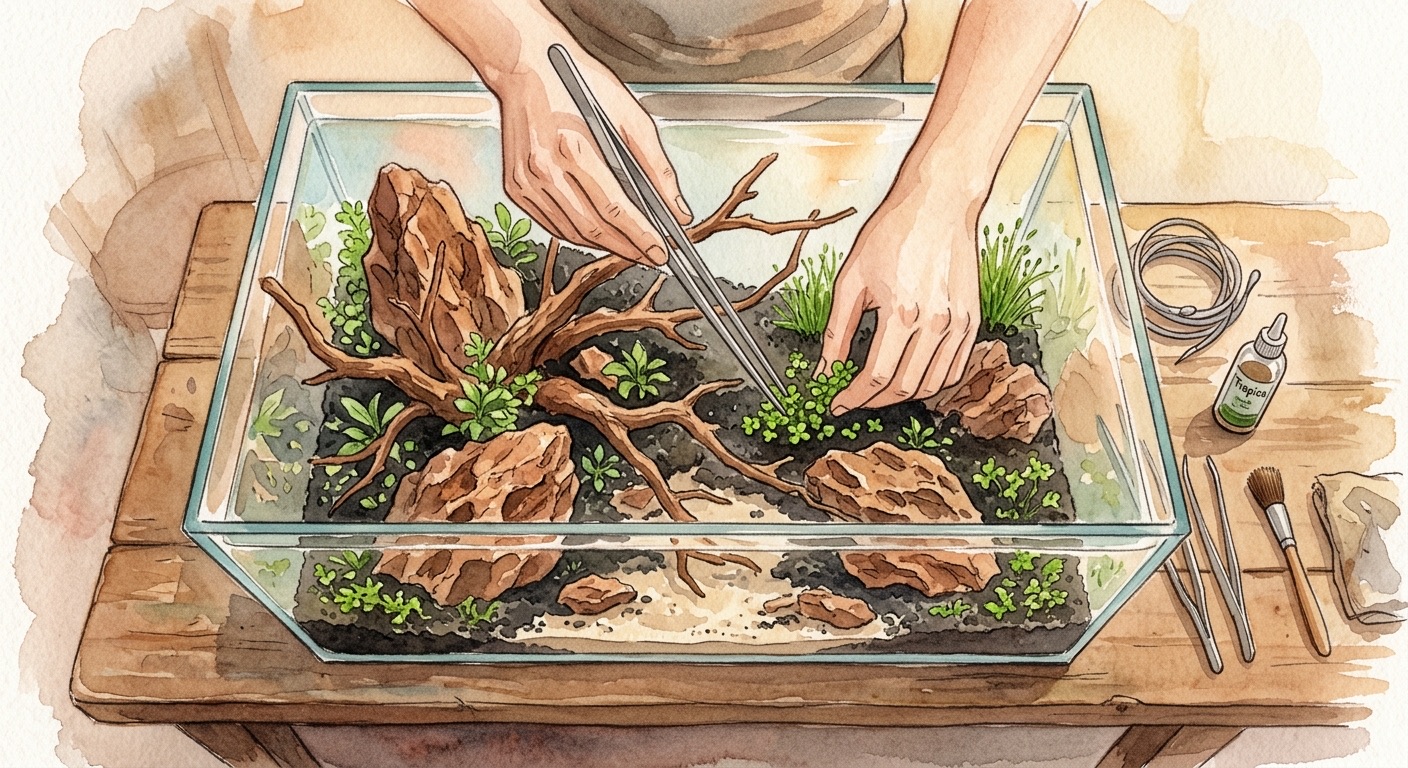
- Substrate first: Slope it higher at the back for depth. 3–5 cm at the front, 5–8 cm at the rear.
- Hardscape next: Rocks and driftwood form the backbone of your layout. Place before filling with water.
- Plants last: Use tweezers for stem plants. Epiphyte plants (Anubias, Java fern) attach to hardscape — don’t bury their rhizomes.
Pick one focal point and build around it. Browse our plant range →
5. Stocking Your Tank
- Add fish slowly. Start with 4–6 hardy fish and wait two weeks before adding more.
- Research compatibility. Not all peaceful fish get along.
- Quarantine new arrivals in a separate tank for 1–2 weeks if possible.
6. Community Tank Ideas
Peaceful Community (60L+):
- 10× neon or cardinal tetras
- 6× corydoras
- A few nerite snails
Planted Tank Focus (60L+):
- 8× ember tetras
- 6× otocinclus
- Dense planting with CO2 if budget allows
Dwarf Cichlid Setup (90L+):
- A pair of Apistogramma or German blue rams
- 10× rummy-nose tetras
- 6× corydoras
- Driftwood, leaf litter, and low-light plants
Need help planning? Drop by Amazonia at 8 Lakeside Rd, Eastwood — we love helping beginners get it right from the start.