Water Chemistry
Freshwater Water Chemistry: The Complete Guide
Water chemistry is the foundation of successful fishkeeping. Your fish live in their water the way you live in air — when it’s wrong, everything suffers. The good news is that understanding the basics isn’t complicated, and once you get the hang of testing and maintaining your water, most problems become preventable.
The Nitrogen Cycle
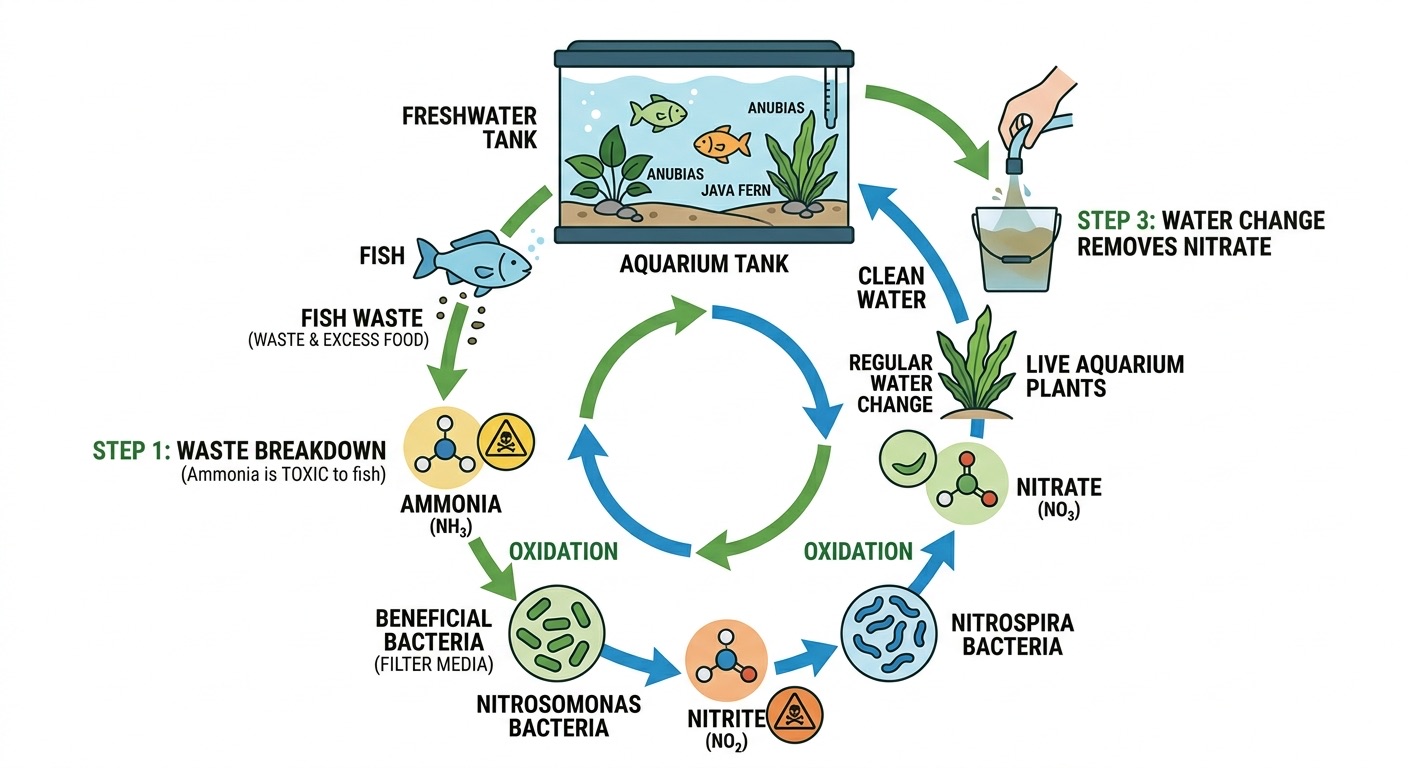
The nitrogen cycle is the single most important biological process in your aquarium:
- Ammonia (NH₃) — Fish waste and uneaten food produce ammonia. Highly toxic, even at low concentrations.
- Nitrite (NO₂⁻) — Beneficial bacteria (Nitrosomonas) convert ammonia into nitrite. Still very toxic.
- Nitrate (NO₃⁻) — A second group of bacteria (Nitrospira) convert nitrite into nitrate, which is far less harmful. Removed through water changes and plant uptake.
Cycling a New Tank
Building a mature bacterial colony takes roughly 4 to 6 weeks. Two approaches:
- Fishless cycling: Add a pure ammonia source to the empty tank. Safest method — no fish exposed to toxic spikes. Monitor daily until ammonia and nitrite consistently read zero.
- Fish-in cycling: Stock lightly with hardy species and perform frequent water changes (every 1–2 days). More labour-intensive and riskier.
Adding mature filter media from an established tank can significantly speed up the process.
Key Water Parameters
pH
Most tropical fish thrive at pH 6.5 to 7.5. The key principle: consistency matters more than hitting a specific number. A stable pH of 7.8 is far better than one that swings between 6.5 and 7.5.
Ammonia & Nitrite
Both should always read 0 ppm in a cycled aquarium. Any detectable level means something is wrong — your biological filtration is overwhelmed or not yet established.
Nitrate
Aim to keep nitrate below 40 ppm. Sensitive species (discus, crystal shrimp) do best below 20 ppm. Live plants help absorb nitrate.
GH (General Hardness)
GH measures dissolved minerals (calcium, magnesium). Soft-water fish (tetras, rasboras) prefer 2–8 dGH, while hard-water species (African cichlids, livebearers) thrive at 10–20 dGH. Shrimp need adequate minerals for healthy shells.
KH (Carbonate Hardness)
KH acts as a pH buffer. When KH is too low (below 3 dKH), your pH can crash overnight. If you experience unexplained pH drops, check your KH first.
Temperature
Most tropical fish: 24–26°C. Sudden changes (more than 2°C) stress fish significantly. Match replacement water temperature during water changes.
Testing Your Water
Liquid Test Kits vs. Test Strips
- Liquid test kits (like the API Master Test Kit) — more accurate and cost-effective per test. Recommended for serious fishkeepers.
- Test strips — faster but less precise. Acceptable for quick spot-checks only.
How Often to Test
- New tanks (cycling): Daily
- Established tanks: Weekly
- After any issue: Immediately
When Parameters Are Off
Don’t panic — the first response should be a partial water change (20–30%). Avoid reaching for chemical additives as a first resort; they often cause more instability than they fix.
Common Water Problems & Solutions
| Problem | Likely Cause | Solution |
|---|---|---|
| High ammonia | Overstocking, overfeeding, uncycled filter | Immediate 30–50% water change, reduce feeding, check filter |
| pH crash | Low KH buffer | Check KH. Add crushed coral to filter to gradually raise and stabilise. |
| Cloudy white water | Bacterial bloom (common in new tanks) | Usually resolves in 1–2 weeks. Don’t over-clean the filter. |
| Green water | Excess light and/or nutrients | Reduce light to 6–8 hours, add fast-growing plants, avoid direct sunlight |
| High nitrate | Infrequent water changes, overstocking | Increase water change frequency, add live plants, reduce feeding |
Sydney Tap Water
Sydney’s tap water is generally soft and slightly acidic — typically around pH 7.0–7.5 with low to moderate GH. This makes it naturally well-suited for most tropical species including tetras, rasboras, corydoras, and dwarf cichlids.
The non-negotiable: always use a dechlorinator. Sydney Water uses chloramine (not just chlorine), and chloramine doesn’t gas off by sitting overnight. A quality conditioner like Seachem Prime neutralises both instantly.
For species needing harder, more alkaline water (African cichlids), buffer up using crushed coral, limestone, or a commercial cichlid buffer.
Water Chemistry by Species
| Species Group | pH | GH | Temp | Notes |
|---|---|---|---|---|
| Tetras & Rasboras | 6.0–7.0 | 2–8 dGH | 24–27°C | Great match for Sydney tap water |
| Livebearers | 7.0–8.0 | 10–20 dGH | 24–28°C | May need mineral supplementation in Sydney |
| African Cichlids | 7.5–8.5 | 10–25 dGH | 24–28°C | Need hard, alkaline water. Use coral substrate. |
| Dwarf Cichlids | 5.5–7.0 | 2–8 dGH | 26–30°C | Warm, soft, acidic. Excellent for Sydney tap. |
| Shrimp (Neocaridina) | 6.5–7.5 | 6–12 dGH | 22–26°C | Stability is critical. Avoid sudden swings. |
| Shrimp (Caridina) | 5.5–6.5 | 3–6 dGH | 20–24°C | Require active buffering soil and RO water. |
| Goldfish | 7.0–8.0 | 4–20 dGH | 18–24°C | Need strong filtration and spacious tank. |
Not Sure About Your Water?
Bring a water sample to Amazonia and we’ll test it for free — pH, ammonia, nitrite, nitrate, GH, and KH. No appointment needed, just bring a small clean container during opening hours.
Whether you’re setting up a new tank or troubleshooting, understanding your water is always the right first step.