🪨 Species at a Glance
| Scientific Name | Puntius titteya |
| Former Genera | Barbus titteya / Systomus titteya (historical synonyms) |
| Family | Cyprinidae |
| Order | Cypriniformes |
| Origin | Sri Lanka — Kelani and Nilwala river basins, shaded forest streams |
| Variety | Albino — line-bred recessive colour form |
| Adult Size | 3-5 cm (1.2-2 in) — sold here at ~3 cm juvenile |
| Lifespan | 4-6 years |
| pH Range | 6.0-7.5 (ideal 6.8) |
| Temperature | 22-27 °C (72-81 °F) |
| Hardness (dGH) | 4-15 |
| Diet | Omnivore — flake, micro pellet, frozen daphnia/bloodworm |
| Minimum Tank Size | 60 L (15 gal) for a school of 8+ |
| Care Level | Easy — beginner-friendly and community-safe |
| Temperament | Peaceful schooling fish — NOT a fin-nipper |
| Breeding | Egg scatterer on fine-leaved plants/moss; parents non-parental |
| Tank Position | Middle to lower — hovers between stem plants |
Species Background
The Cherry Barb earned its common name from the spectacular, almost glowing cherry-red colour that mature males develop during breeding condition. In a wild-type male at full courtship saturation, the flanks deepen from their everyday dusty rose to a rich, luminous red-wine tone that would not look out of place on a ripe morello cherry; the fins take on a matching warm crimson wash, and the single dark horizontal band running from snout to tail peduncle sharpens to the colour of wet ink against the fiery body. It is one of the quietest yet most transformative displays among small cyprinids — the same fish that spent the previous week looking like a pleasant little russet minnow will, overnight, turn into a glowing jewel. Sri Lankan villagers who lived along the forest streams where these fish hide had already given the species a local name (“titteya” simply means “bright” or “blood-red” in Sinhala), but when the species was first exported to the European aquarium trade in the 1930s and 1940s, it was the English-speaking hobbyists who locked in the common name “Cherry Barb” for the startling red of a male in full courtship display. The Latin species name titteya, preserved by ichthyologist Paules Edward Pieris Deraniyagala when he formally described the fish in 1929, directly echoes that Sinhala word — a rare case where the scientific name and the local vernacular point to exactly the same visual impression.
The scientific name has had an unusually stable history compared to most aquarium fish. The fish was formally described in 1929 by Deraniyagala as Puntius titteya, and despite the occasional flicker into the older genera Barbus and Systomus in mid-twentieth-century literature, Puntius titteya has been the dominant, widely accepted binomial throughout the species’ aquarium history. You may occasionally see Barbus titteya on older shipping labels or vintage aquarium books, and more recent molecular work has raised the possibility that the species may eventually be moved to a revised genus as ichthyologists continue untangling the large, sprawling Puntius group, but for all practical hobbyist purposes the name Puntius titteya is what you will see in modern shops, wholesale lists, peer-reviewed literature, and reputable online retailers.
In the wild, Cherry Barbs inhabit slow-moving, heavily shaded forest streams across the wet zone of southwest Sri Lanka — primarily in the Kelani, Kalu, and Nilwala river drainages, with scattered introduced populations in Mexico, Colombia, and parts of Southeast Asia where hobby releases have taken hold. Their native habitat is small, cool, and dark: shallow stretches of stream water perhaps 30-50 cm deep, running gently over leaf-littered substrates beneath a dense canopy of overhanging rainforest vegetation. The water is soft, slightly acidic, often tinted brown with tannins from decaying leaves, and dappled with shifting sunlight. Cherry Barbs are rarely found in bright open water; they shelter tightly under overhanging branches, within clumps of aquatic stem plants, and around tangles of submerged root. Their whole biology is tuned to this shaded, densely vegetated environment, and it is the single most important piece of context to keep in mind when setting up an aquarium for them — they are not an open-water schooler like the Tiger Barb or Danio; they are a shy, stream-margin, plant-hugging fish that looks its most natural and displays its finest colour when it feels it has cover to retreat into.
Sadly, wild populations of Puntius titteya have declined significantly over the last fifty years due to deforestation of Sri Lanka’s wet-zone rainforests, and the species is currently listed as Lower Risk / Conservation Dependent on the IUCN Red List. Virtually every Cherry Barb in the global aquarium trade — wild, long-fin, or albino — is now farm-bred rather than wild-caught, primarily in Southeast Asian and Eastern European commercial farms, with some Australian domestic production as well. The Albino Cherry Barb offered here is entirely farm-origin and places no pressure on wild stocks. If anything, a thriving commercial aquarium trade in farm-bred Cherry Barbs helps preserve genetic lines that might otherwise be lost should wild populations continue to decline.
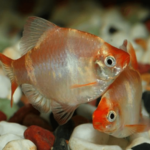
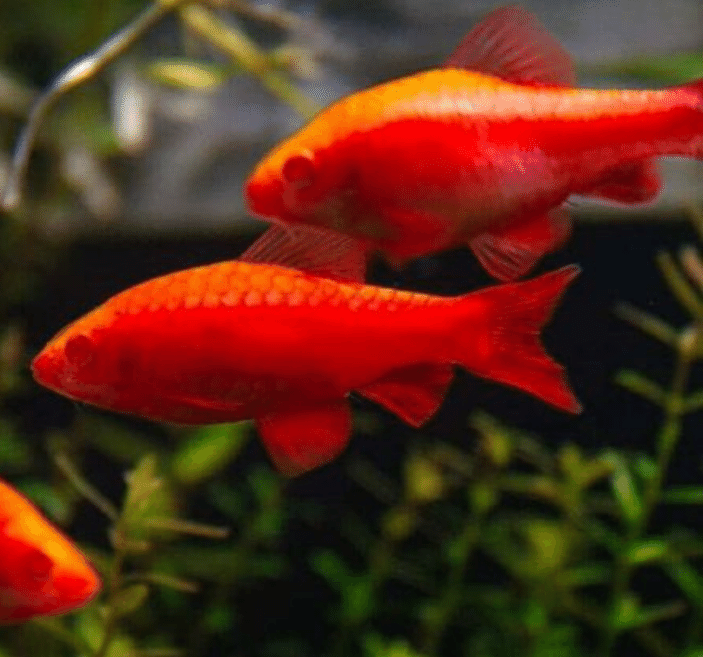
The Albino strain you see here carries none of the warm red-brown melanin-based pigment of the wild form. Albinism in Cherry Barbs is a recessive genetic trait that suppresses the production of dark melanin, erasing the horizontal lateral stripe, pale-ing out the body, and leaving behind a delicate pearlescent base tone of cream and rose-pink. The eyes glow translucent red because, without melanin, the retina’s blood vessels are visible through the pupil — the classic hallmark of true albinism, shared by the Albino Tiger Barb, the Albino Corydoras, and countless other domesticated aquarium morphs. The soft pink-peach flush remains on the albino’s flanks and fins because the carotenoid pigments responsible for those warm tones are not affected by the albino mutation; only the eumelanin-based dark pigments are lost. A breeding-condition male albino is still recognisably “a Cherry Barb” — his flanks will deepen from pale pink to a much richer saturated rose-cherry red as he courts, though he will never reach the wine-dark intensity of his fully pigmented wild-type counterpart. The albino line has been stably maintained in the hobby since at least the 1990s and is thought to have first been isolated by Southeast Asian commercial breeders, almost certainly as a spontaneous natural mutation that was then carefully line-bred into a reliable, heritable strain.
The Colour Spectrum
🍒 Wild Type Cherry Barb
The original form: warm russet-bronze body with a dark horizontal lateral stripe from snout to caudal peduncle. Breeding males saturate to a glowing wine-red. Still the most widely farmed and sold strain globally.
🤍 Albino Cherry Barb
The variant offered here — a recessive line-bred colour morph without melanin. Pale pearl-pink to cream body, no dark stripe, red eyes, and a soft peach-rose flush that intensifies in males in breeding condition.
🏳 Long-Fin Cherry Barb
A line-bred form with extended, flowing dorsal, anal, and caudal fins. Most often seen in wild-type base colour, though albino long-fins do appear in some breeding lines. A calm, elegant variant for aquascaped tanks.
⚫ Black Ruby Barb (P. nigrofasciatus)
Not a Cherry Barb variety, but a close Sri Lankan cousin in the same Puntius group — sometimes sold alongside Cherry Barbs for biotope displays. Dark-bodied with three jet-black vertical bars and a brilliant red head in breeding males. Shares water parameters and compatible temperament.
The Albino Cherry Barb’s gentle pearl-pink colour is entirely a pigment story, not a behavioural one. Beneath the pale skin, the fish is identical in every other respect to its wild-type sibling — same calm schooling drive, same stream-margin preferences, same soft-water tolerances, same peaceful temperament with community tank mates. The single practical difference keepers should account for is that the red eyes of an albino are more photosensitive than the melanin-shielded eyes of a wild-type fish. Under harsh overhead lighting, especially the bright, cold-white LEDs that have become popular in modern planted tanks, albino Cherry Barbs retreat more readily into shadowed corners, spend more time hiding beneath floating plants, and display less openly in the front of the tank. The answer is simple: soften the lighting, add floating plants such as frogbit, salvinia, or red root floaters to diffuse the column, and choose a warm-spectrum LED in the 5500-6500 K range rather than a cold blue-white. Under those more naturalistic lighting conditions — which also happen to bring out the warm carotenoid tones in the fish’s flanks — the albinos emerge from cover and hold station openly in the mid-water among the stem plants, which is exactly where their quiet glowing-pearl colouration looks its best.
Colour saturation in the albino strain is noticeably diet-dependent and behaviour-dependent in a way that surprises many first-time keepers. Young juveniles sold at 3 cm often look almost ghostly: a very pale translucent pink-cream, with the faintest peach flush along the dorsal ridge and the signature red eyes. This pale juvenile phase can last for several weeks after arrival, and it is easy to assume that the fish will stay chalk-white forever. They will not. As they mature past about 4 cm, fed a carotenoid-rich diet (paprika-enriched pellets, frozen cyclops, frozen daphnia, spirulina flake, and occasional live or freshly-thawed bloodworms), raised in a planted tank with a dark substrate and warm lighting, and housed in a properly sized shoal of eight or more, Cherry Barb albinos fill out remarkably. Within six to ten weeks of good husbandry, the pale juveniles transition into glowing pearl-pink young adults with distinct peach saturation across the flanks and dorsal, and the dominant males begin to flush to a visible rose-cherry red as they start courtship displays for the maturing females. The transformation is one of the quiet delights of keeping this fish — you are effectively watching the colour “come in” over the first three months in your care.
One final note on colour: the Albino Cherry Barb shows almost no stress-striping under threat, precisely because the dark lateral band that produces stress stripes in wild-type Cherries has been pigmentally erased in the albino line. This means that unlike wild Cherries — which telegraph poor water quality, aggression, or illness through visibly darkened stripes — albinos communicate stress through subtler cues: reduced feeding, paler-than-usual flank tone, reduced social interaction within the shoal, and increased hiding time. Attentive keepers learn to watch for these behavioural signals rather than waiting for visible colour warnings. A confident, well-kept Albino Cherry Barb school spends its day drifting calmly through the mid-water of a planted tank, occasionally sparring gently over food or display territory, with males maintaining a visible warm-rose flush as the baseline colour rather than the pale cream of a stressed or newly arrived fish. Once you know what a settled, coloured-up Albino Cherry Barb looks like, the difference between a stressed and a happy one is obvious at a glance.
Sexual Dimorphism
Sexual dimorphism in Cherry Barbs is among the strongest and most visually spectacular in the small-barb world — in wild-type fish. A mature wild-type male in breeding condition next to a mature wild-type female looks almost like two different species: he is a slim, glowing, wine-red torpedo with a black horizontal stripe; she is a plumper, softer, tawny-bronze fish with a muted pattern. In the albino strain, the underlying dimorphism is exactly the same, but the visual contrast is softened because both sexes have lost their dark melanin base. Males still deepen their colour during courtship, but the deepening runs from pale pink to saturated rose-cherry rather than from russet-bronze to wine-dark red. Females still stay paler, rounder, and visually calmer in appearance, but the baseline difference between a pale female and a pink-peach male is subtler than in wild-types and takes a slightly more practiced eye to read reliably.
The most reliable cue in the albino strain is body profile. Mature males stay slim and elongated even after a big meal, while mature females develop a noticeably rounder, deeper belly as they mature and begin producing eggs. View the shoal from above during feeding — this gives the clearest dimorphism read in the albino line — and the females stand out as distinctly broader silhouettes, often a third or more wider than the males. A second cue is the warm-rose flush that breeding-condition males show on their flanks and anal fin. It is subtle compared to a wild-type male’s wine-red saturation but still clearly warmer and more saturated than anything a female will ever show. A third cue is behaviour: males display, chase gently, and patrol small display zones within the planted areas, especially in the early morning and late afternoon. Females remain in the main body of the shoal, largely indifferent to male theatrics until they themselves are ready to spawn. Spend twenty minutes watching a well-settled albino shoal at dusk and you can usually pick out the two or three most dominant males by their courtship runs alone.
Juveniles under 3 cm — including the young fish offered here at this size — are essentially impossible to sex reliably, and are always sold as unsexed small groups. This is not a limitation; it is the correct way to buy Cherry Barbs. A shoal of eight to twelve juveniles raised together will sort itself into a natural mix of roughly 1 male to 2 females (the ideal breeding ratio) or perhaps 1:1, and within three to four months the sexes become clearly readable as the fish hit 4-5 cm. At that stage, keepers interested in breeding can select their most vivid male and plumpest females from the established shoal with confidence. Buying pre-sexed adult pairs is generally not recommended for Cherry Barbs — young, grown-out fish settle into an aquarium much more easily than single adult pairs, and the gentle courtship politics within an established shoal produce much better breeding condition than a forced pair in an isolated tank.
| Feature | Male | Female |
|---|---|---|
| Body Shape | Slim, elongated, torpedo-profile — stays slender even when well-fed | Noticeably plumper and fuller-bellied, especially when carrying eggs — broader from above |
| Adult Size | Slightly smaller at 3-4 cm, more streamlined | Slightly larger at 4-5 cm, heavier-bodied and rounder in profile |
| Body Colour (Albino Strain) | Warm peach-pink baseline; deepens to glowing rose-cherry in breeding condition | Consistently paler — pale pink to warm cream-tan, with very little saturation change in breeding condition |
| Fin Colour | Dorsal, anal, and caudal fins edged in warmer peach-red wash; intensifies during courtship | Fins pale pink to nearly transparent, with minimal red wash regardless of condition |
| Behaviour | Displays actively — flares fins at rivals, performs courtship runs past females, patrols small territories within the planted areas | Calmer, less confrontational — tends to shoal together in small groups of two or three and avoid male display zones |
| Sexing Young Juveniles | Difficult before 3 cm — early sex-linked colour cues are minimal | Difficult before 3 cm — body-shape differences become reliable only after 4 cm / 3-4 months grown out |
Water Chemistry Guide
6.0–7.5
ideal 6.8
22–27 °C
ideal 25 °C
4–15 dGH
Soft to moderately hard — soft preferred
Albino Cherry Barbs thrive in water that reflects their wild Sri Lankan stream origin: soft, slightly acidic, warm, and gently flowing. In their native wet-zone rainforest streams, water runs clear or mildly tannin-stained, typically pH 6.0 to 6.8 with low hardness (often below 6 dGH), over substrates of leaf litter and fine gravel beneath a dense rainforest canopy. Generations of commercial farm breeding, however, have produced a domesticated strain that adapts very well to the harder, more neutral tap water that most Australian hobbyists have available. A pH anywhere from 6.0 to 7.5 is acceptable, with the ideal landing at a softly acidic pH 6.8. Temperature is similarly flexible: 22 to 27 °C covers the full range, and 25 °C suits them perfectly. Hardness from 4 to 15 dGH presents no meaningful problem, though fish kept towards the lower end (4-8 dGH) tend to colour up slightly richer and breed more reliably. Most Australian tap water, once aged and dechlorinated, falls within Cherry Barb tolerance with no adjustment required.
Where Cherry Barbs differ from their Tiger Barb cousins is in flow preference. Tigers are muscular active swimmers that appreciate strong current to race against; Cherries are shaded stream-margin fish that prefer gentle, unobtrusive flow. A canister filter’s spray bar pointed straight into the open water column can push an albino shoal into a permanent stress posture, with fish spending the day wedged behind driftwood or inside stem-plant thickets to escape the current. Instead, aim filter returns along the back glass, use a baffled HOB, or choose an air-driven sponge filter for a small tank — any of these creates gentle circulation without a firehose effect. Target 3-5 times tank turnover per hour for a planted Cherry Barb tank; anything above 6x is usually excessive and will keep the shoal permanently in cover. Adequate oxygenation matters of course, but Cherry Barbs are not oxygen-demanding sprinters in the way that Tiger Barbs or Giant Danios are, and their modest metabolism is well-served by moderate gentle filtration rather than industrial-grade flow.
Temperature stability matters far more than hitting any particular target number. A rock-steady 25 °C is far better than a tank that swings between 22 and 27 °C across the day. Place the heater near the filter return so warmed water distributes evenly, and avoid positioning the tank against an exterior wall or a window that catches direct afternoon sun. Sudden cold-water changes — a bucket of winter tap water dumped into a warm tank — can shock a Cherry Barb shoal and often trigger an ich outbreak within 24-48 hours. Always temperature-match your change water to within one degree, and aim for a pH delta no greater than 0.3 between old and new water. Cherry Barbs are forgiving of most parameter ranges, but like all fish they dislike sudden changes, and the albino strain shows slightly less visible stress warning than wild-types due to the lost dark stripe — so the best practice is always to err on the side of gentle, gradual, temperature-matched water changes.
Tannins and blackwater conditions are optional but strongly appreciated by this species. Adding a handful of Indian almond leaves (Terminalia catappa) to the tank, or a small piece of catappa bark in the filter, will gently stain the water a light tea colour, release mild antifungal and antibacterial compounds, and gradually drop the pH towards 6.5-6.8 if starting from mildly alkaline tap water. Many Cherry Barb keepers in Sri Lankan biotope setups run their tanks blackwater-style year-round, and the effect on fish colour is remarkable: wild-type and albino Cherry Barbs alike deepen their warm tones under gently tannin-stained water, and breeding activity increases noticeably. For Australian keepers in hard-water regions such as Perth or Adelaide, a small addition of driftwood plus a monthly catappa leaf refresh can reliably soften the water to Cherry Barb preference without the expense or complexity of RO/DI systems. For Melbourne and Sydney keepers with softer municipal water, tannins are still a nice aesthetic and husbandry touch but less strictly necessary.
Regional Australian notes are worth flagging for completeness. Summer heatwaves in Brisbane, Sydney, and Adelaide can push unheated planted tanks above 28 °C, which is above the Cherry Barb comfort zone. Float a sealed bag of ice, angle a small fan across the water surface to boost evaporative cooling, and reduce feeding during the hottest days to lower metabolic heat load. Winter conditions in Melbourne, Canberra, and the southern states are the opposite problem — an unheated tank in a cold lounge room can drop below 20 °C overnight, which while not immediately fatal to Cherry Barbs will suppress feeding, breeding, and colour. A reliable adjustable heater sized to roughly 1W per litre of tank volume is essential outside the tropics. Australian tap water hardness varies regionally, but Cherry Barbs are tolerant enough that dechlorinated tap water works everywhere from Perth to Hobart with minimal adjustment.
Creating the Perfect Habitat
Think of a Cherry Barb tank as a Sri Lankan forest-stream vignette: heavily planted along the back and sides, carpeted with low-growing midground plants, softly shaded by floating plants above, with an open mid-water lane down the front where the shoal can drift and display. This is very different from the tank layout a Tiger Barb needs. Tigers want a long open raceway down the middle for sprinting; Cherries want refuge, shade, and overhanging vegetation, with only a modest open patrol zone. A 60-litre tank is the practical minimum for a school of eight Albino Cherry Barbs, though 80-100 litres gives far better aquascaping options and comfortably supports a larger shoal of ten to twelve plus community tank mates. A standard 60 x 30 x 36 cm or 80 x 30 x 40 cm tank footprint works perfectly; Cherries are not sprinters and do not demand an ultra-long tank the way Tigers do.
Substrate should lean dark to best display the albino’s warm pearl-pink tones. Fine-grain black basalt sand, dark river gravel, or a planted-tank aquasoil such as Fluval Stratum or ADA Amazonia all work beautifully. Avoid bright white or pastel substrates — they bounce light back up into the albino’s sensitive red eyes, wash out the fish’s subtle carotenoid tones, and tend to make the tank feel aesthetically flat rather than forest-stream-like. If you use aquasoil, expect (and enjoy) the gentle pH-lowering and slight tannin release that comes with the first few months of the setup.
Planting is where a Cherry Barb tank really comes alive. Think dense stem-plant thickets along the back third — Hygrophila polysperma and H. corymbosa, Cabomba caroliniana, Ludwigia repens and L. palustris, Rotala rotundifolia, Limnophila sessiliflora, and Bacopa caroliniana all perform beautifully and provide the fine-leaved cover Cherries love to drift through. Midground anchors include Cryptocoryne wendtii (a forgiving classic), C. undulata, Anubias barteri var. nana tied to driftwood, and small clumps of Java fern (Microsorum pteropus). Foreground can be kept simple with a sparse carpet of dwarf Sagittaria or short Cryptocoryne parva, or left open as a sand pathway for shoaling. Most importantly: include a thick layer of floating plants across at least a third of the surface. Frogbit (Limnobium laevigatum), Amazon frogbit, red root floaters, water lettuce (Pistia stratiotes), salvinia, or even a tangle of hornwort left floating — any of these will soften the overhead light, provide the shaded forest-canopy effect Cherry Barbs evolved beneath, and dramatically increase how confidently the albino shoal displays in the open. Do not skip the floaters in an albino Cherry Barb tank; the difference between a floaters-covered tank and a bare-surface tank is the difference between visible, coloured-up, shoaling fish and shy, hiding ones.
Hardscape should reinforce the forest-stream mood. One or two small-to-medium pieces of driftwood (Malaysian driftwood, spider wood, or mopani), positioned to create overhangs and shaded pockets, look beautiful and function as both territorial landmarks for males and retreat spots for females. A scattering of dry Indian almond leaves across the substrate is aesthetically authentic, biologically beneficial (tannin release, antifungal compounds, gentle pH lowering), and gives a foraging surface where fry can find infusoria if you ever breed. Rocks are optional — Cherries are not strongly rock-associated in the wild — but a small pile of smooth river stones near the back can frame a nice sight line and house a bristlenose pleco or two.
Lighting deserves particular attention for the albino strain. Red-eyed albino fish are more photosensitive than their melanin-pigmented relatives — the iris cannot shade the retina as effectively, and prolonged exposure to bright cold-white light stresses them visibly. Choose a moderate, warm-spectrum LED in the 5500-6500 K range, avoid running it at full output, and limit the photoperiod to 8-10 hours per day via a timer. A dense mat of floating plants across a third of the surface further diffuses the light column beneath; this combination — warm spectrum, moderate intensity, floater-diffused — is the single best lighting setup for both the plants and the fish. Do not use a “marine-white” 12000K+ reef-style LED; these make the albinos look chalky, wash out the plants, and stress the fish. A plant-friendly warm-white LED at 30-40% output with floaters is ideal.
Tank lid matters less for Cherry Barbs than for Tigers — Cherries are not habitual jumpers — but a glass or mesh lid is still recommended to limit evaporation, maintain humidity for floating plants, and prevent the occasional startled fish from making an ill-advised leap. Mesh-cover the filter cutouts so curious fish can’t squeeze through.
On health, Albino Cherry Barbs are robust, hardy fish under good husbandry. The three most frequent issues are white spot disease (ich), fin rot, and mild bacterial infections following minor injuries. Ich presents as small white grains on body and fins, almost always following a temperature drop or a new fish introduction without quarantine — treat by raising temperature gradually to 28 °C for two weeks alongside an over-the-counter ich medication. Fin rot appears as frayed, darkening fin edges and is secondary to poor water quality; improving filtration and water-change schedule is the primary treatment. Quarantine any new tank additions for two weeks in a separate tank before introducing them to your display. Albinos require slightly more vigilance than wild-types because the loss of the dark stripe removes one of the easy visual health cues — watch for behavioural changes (reduced feeding, unusual hiding, abnormal swimming) as your early-warning signal rather than waiting for visible colour change.
Tank
60 L minimum for a school of 8; 80-100 L strongly preferred. Standard footprint works — Cherries do not need a long raceway
Filter
Sponge filter, baffled HOB, or small canister at 3-5x tank turnover per hour. Gentle flow — Cherries dislike strong current
Heater
75-150 W adjustable heater set to 25 °C, sized to roughly 1 W per litre
Lighting
Moderate warm-spectrum LED (5500-6500 K). Avoid bright cold-white — photosensitive red eyes in the albino strain
Substrate
Fine dark gravel, black sand, or planted aquasoil. Dark tones showcase albino pearl-pink colour
Plants
Dense stem plants (Hygrophila, Ludwigia, Cabomba, Rotala) at back; Cryptocoryne and Anubias mid; floating plants (frogbit, salvinia) on top — mandatory
Hardscape
1-2 pieces of driftwood (Malaysian, spider wood); optional scattered Indian almond leaves for authentic biotope and tannin release
Thermometer & Test Kit
Glass or digital thermometer plus liquid tests for ammonia, nitrite, nitrate, pH, GH/KH
What to Feed
Albino Cherry Barbs are classic small-cyprinid omnivores. In the wild they feed on insect larvae, small crustaceans, zooplankton, algae scraped from leaf surfaces, and the occasional fallen-fruit fragment that drifts into their forest-stream habitat. In the aquarium they take readily to prepared foods, and a high-quality tropical flake or a small 0.5-1 mm sinking pellet makes an excellent staple. Look for a product with whole fish or insect meal as the first ingredient, at least 40% crude protein, some plant matter, and ideally added astaxanthin or paprika for carotenoid colour enhancement. Cherry Barb mouths are small — roughly half the size of a Tiger Barb’s — so crumble flake to small pieces or choose a fine-sized pellet designed for small community fish. Over-large food is simply ignored, sinks, and fouls the substrate.
Supplement the staple two to three times a week with small frozen or freeze-dried meaty foods: frozen daphnia, brine shrimp, cyclops, and mysis are all eagerly accepted; frozen bloodworms in moderation are a reliable favourite and an excellent conditioning food for breeders. Live foods — black worms, brine shrimp nauplii, grindal worms, daphnia from a home culture — trigger spectacular feeding responses and are essential for breeding condition. Once a week, offer a small vegetable component: a pinch of spirulina flake, a sliver of blanched spinach, or a crushed skinned pea. This aids digestion, keeps gut flora healthy, and boosts carotenoid intake to enrich the warm rose tones in the albino strain. A weekly veg meal is a meaningfully underrated husbandry detail — fish kept on an all-protein diet tend to suffer mild chronic constipation, duller colour, and slightly suppressed immune function.
The most common feeding mistake new Cherry Barb keepers make is overfeeding. Cherry Barbs are enthusiastic eaters but they are small fish with small stomachs, and excess food plunges to the substrate where it fouls the water. A healthy adult needs only what it can clean up within 60 seconds, twice daily. Aim for two small meals a day rather than one large portion. A weekly skip-day is a good idea — it gives their gut a chance to clear and mimics the natural feast-and-famine rhythm of a wild stream fish. Cherries are NOT the aggressive fast-feeders that Tiger Barbs are; they approach food more politely and share space at the surface with tank mates calmly. This is actually one of the great virtues of the species for community tanks: they do not bulldoze slower fish away from food, and shrimp, corydoras, and small tetras can all feed comfortably alongside them without being muscled out.
Finally, a feeding-technique note. Cherry Barbs feed predominantly in the middle and upper water columns but will follow sinking food towards the substrate if nothing remains on the surface. Distribute food across the full width of the surface rather than dropping it in one corner — this spreads the shoal out and gives shyer individuals a fair shot. If you keep bottom-dwellers like corydoras or bristlenose plecos alongside your Cherries, the usual rule applies: drop a small distraction pinch of flake on the surface first, then add a sinking tablet at the opposite end for the bottom-dwellers. This gives the slower fish their meal while the Cherries are busy at the top.
Reproduction & Breeding
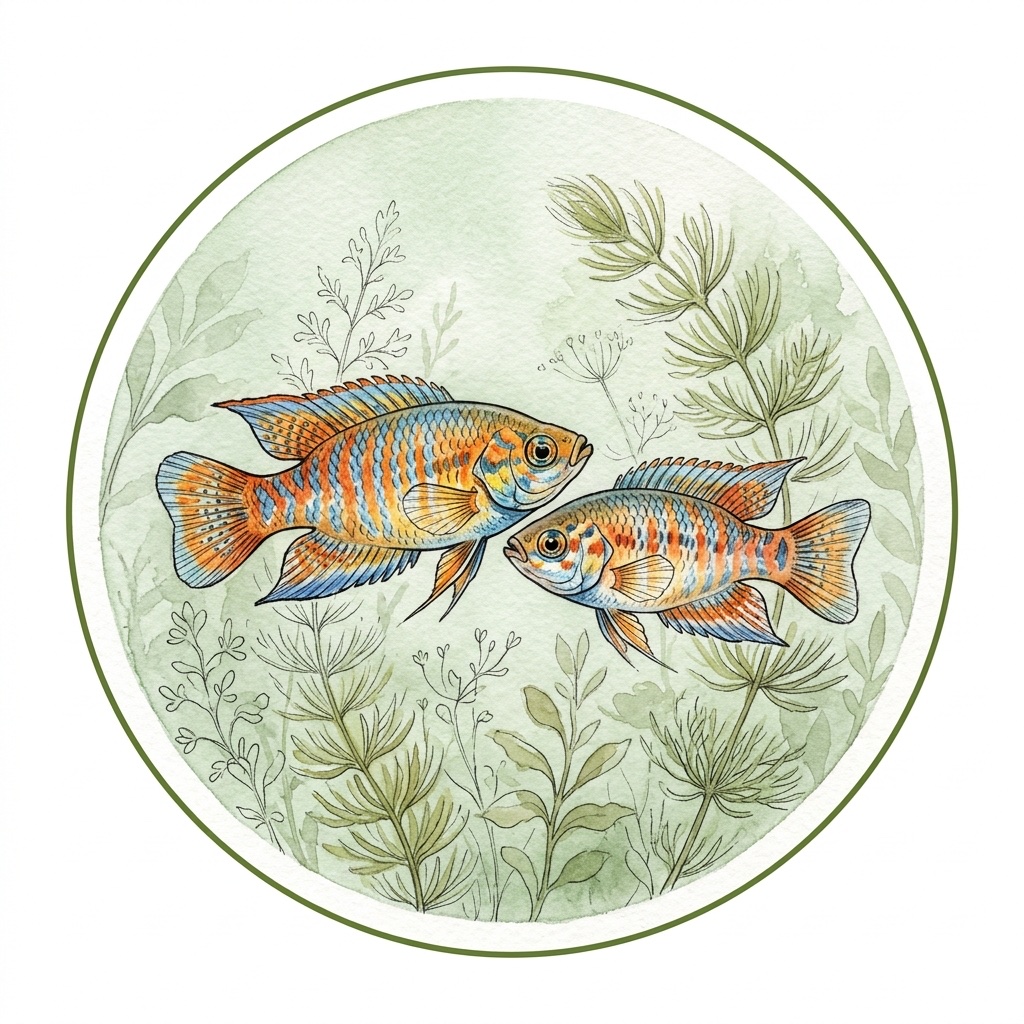
Week -2 to -1
Conditioning
Separate a plump female and a vivid male, feed heavily on live foods
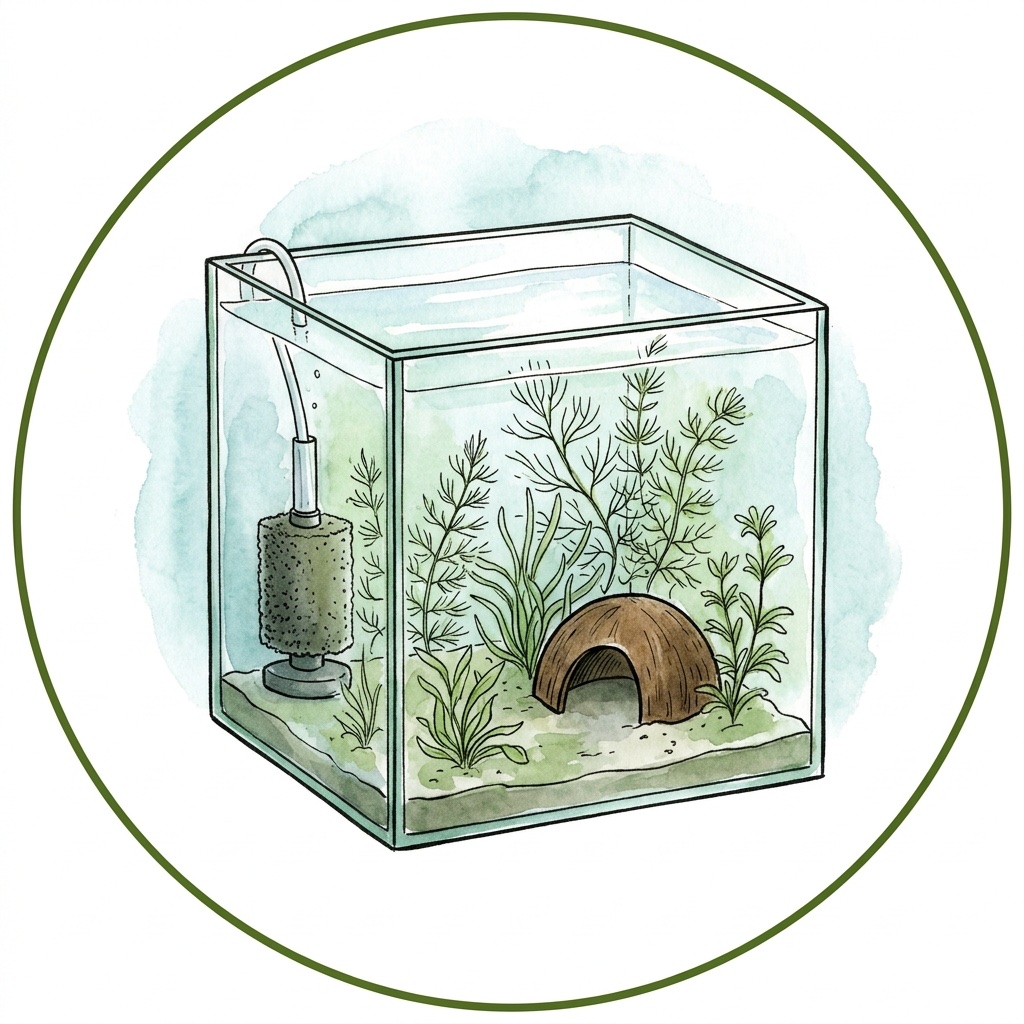
Day 0
Spawning Tank Setup
Prepare a soft-water breeding tank with fine-leaved plants or spawning mops
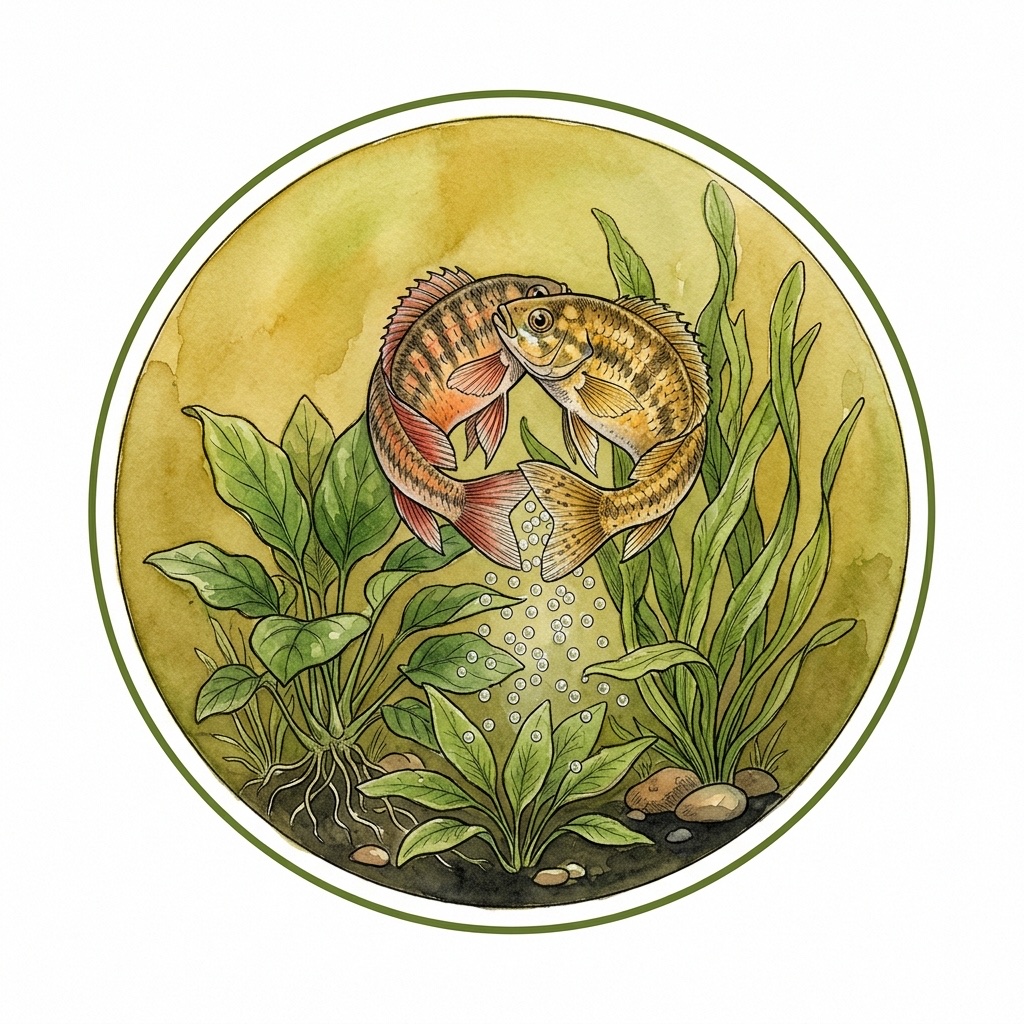
Day 1 (morning)
Spawning
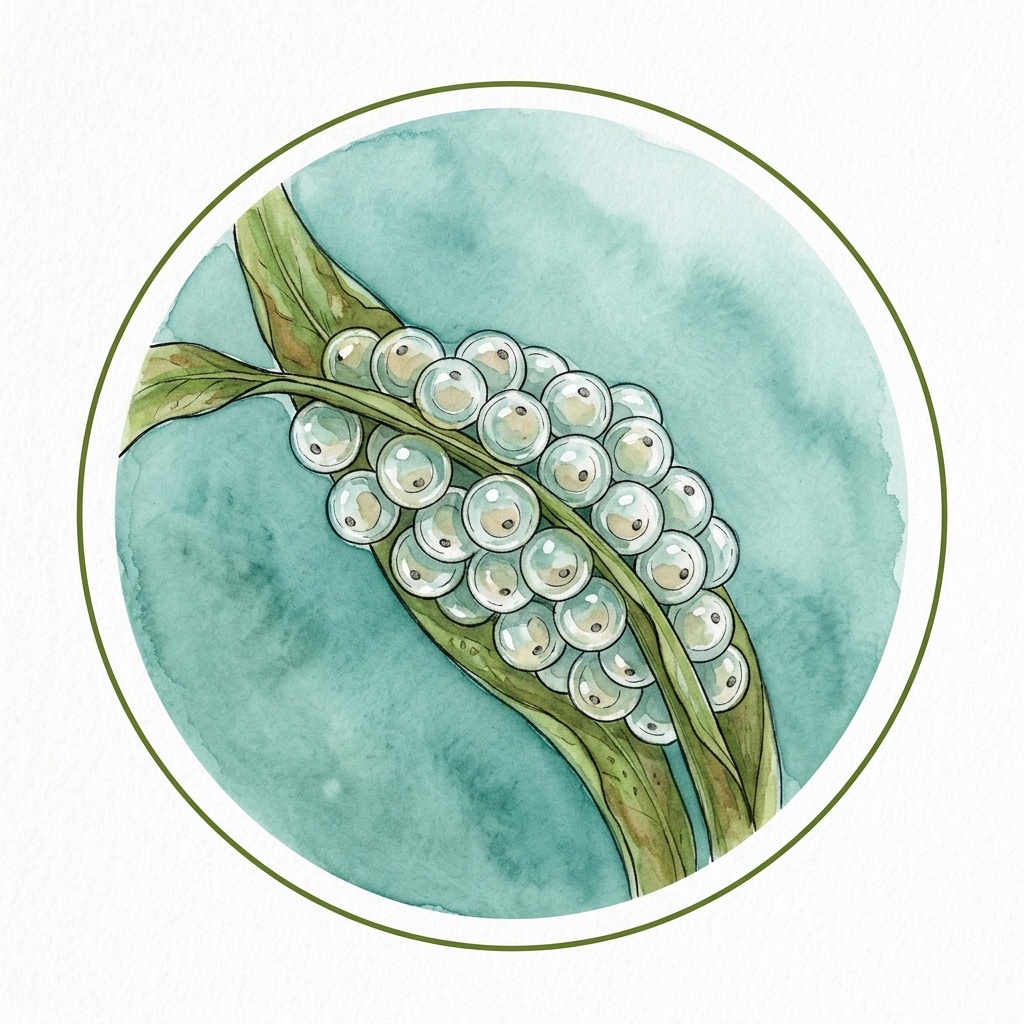
Male drives female through plants; 100-300 adhesive eggs scattered
Day 1 (immediately after)
Remove Parents
CRITICAL — Cherry Barbs will eat their own eggs if left with the spawn
Day 2
Hatching
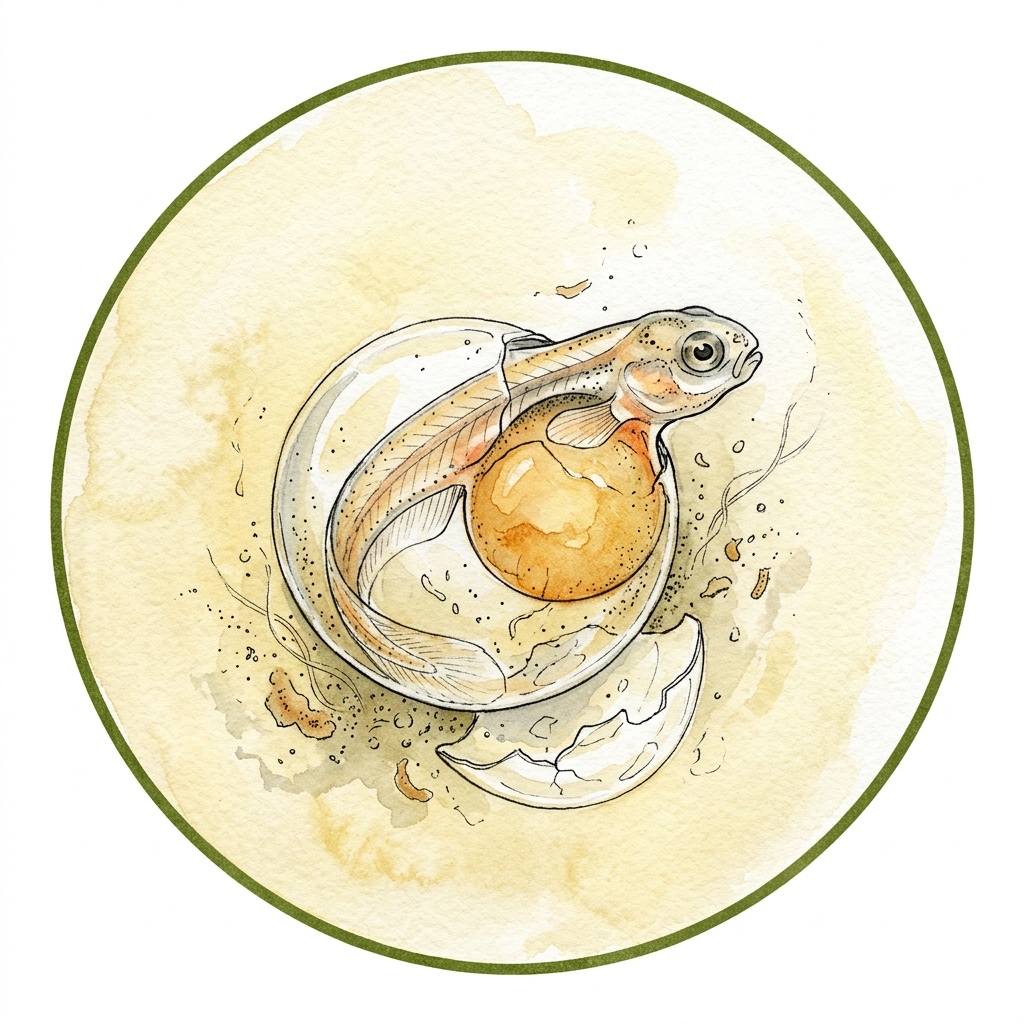
Eggs hatch within 24-48 hours; fry cling to surfaces on yolk sac
Day 4-6
Free Swimming & First Foods
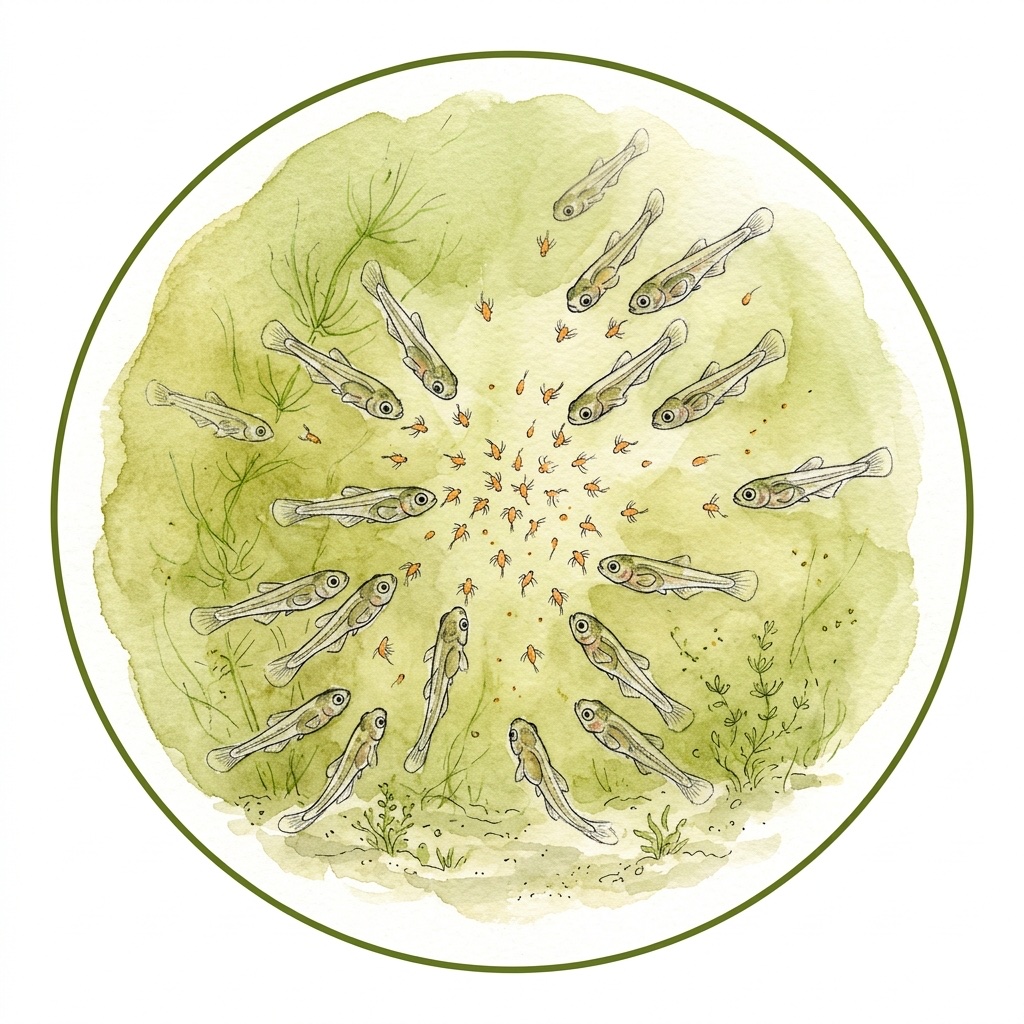
Feed infusoria then baby brine shrimp; grow out over 6-8 weeks
Conditioning
Select the deepest-bodied female and the male showing the most warm-rose flush on flanks and fins. House them separately — or in two mesh-divided compartments of the same tank — for seven to fourteen days. Feed live baby brine shrimp, live blackworms, and frozen bloodworms generously, two to three times daily. The female’s belly should round out noticeably as she develops eggs; the male’s warm-rose tones will intensify towards a saturated cherry-pink as his hormones rise. Water during conditioning should be clean and stable — perform small daily 10-15% changes with slightly cooler, slightly softer water to simulate the pre-monsoon freshening that triggers breeding in the wild. The goal is two conditioning levers: plenty of high-quality protein to build eggs and condition the male, and clean soft water with gentle gradual changes to signal spawning readiness. Cherry Barbs are far less demanding than many commonly bred egg scatterers; many spawns happen accidentally in well-kept community tanks without any deliberate conditioning at all.
Spawning Tank Setup
Set up a separate 20-40 litre breeding tank with soft, slightly acidic water — pH 6.5 and 4-6 dGH is ideal. Temperature 25-26 °C. No substrate is needed, or a very thin layer of small pebbles so eggs can fall into gaps. Fill the bottom third with spawning medium: a thick layer of java moss, Cabomba, Myriophyllum, or a bundle of spawning mops. The purpose is to let eggs drop onto fine-leaved surfaces where the adhesive eggs stick and the parents cannot easily reach them to eat them. Use a gentle air-driven sponge filter only — never a powered filter that could suck up eggs or fry. Keep lighting dim, or cover the tank on three sides. Introduce the conditioned pair in the evening, feed one small live-food meal, and leave them undisturbed overnight.
Spawning
Spawning typically begins at first light. The male drives the female through the moss or mops, flashing his fins beside her and nudging her flanks with gentle flicks. She releases small batches of clear, slightly adhesive eggs — usually 100 to 300 in a single session — which the male fertilises as they drift and settle onto fine plant leaves or spawning mops. The whole event takes around one to two hours. Watch closely: the moment active spawning behaviour stops, the parents switch from courtship mode into egg-snacking mode.
Remove Parents
Although Cherry Barbs are less aggressively egg-eating than Tiger Barbs, they are still non-parental — the adults will casually eat eggs and fry if left in the spawning tank, reducing your yield dramatically. Net both parents out gently within the hour after spawning ends and return them to the main tank. Lower the breeding tank’s lighting to near-darkness for the next 48 hours (the eggs are light-sensitive) and maintain a stable 25-26 °C. Add a few drops of methylene blue to the water to help prevent fungal bloom on the eggs; it is harmless to embryos at correct dosage and will fade over the next several days.
Hatching
Viable eggs hatch roughly 24 to 48 hours after spawning. The tiny, nearly transparent fry initially lie on the bottom or cling to moss and tank walls, absorbing their yolk sacs over the next two to three days. Infertile eggs will turn opaque white within 24 hours — siphon these out gently with a pipette or airline tube to prevent fungal bloom from spreading to viable eggs. Keep the lighting dim and do not disturb the tank more than necessary.
Free Swimming & First Foods
Fry become free-swimming around day four to six and begin actively hunting for food in the mid-water. Begin feeding with infusoria or commercial liquid fry food for the first four to five days, then transition to freshly hatched baby brine shrimp as soon as the fry are large enough to ingest them — usually within a week. Feed small amounts four to six times daily and perform gentle 10% water changes every other day to keep nitrates low. A cycled sponge filter and daily gentle siphoning of uneaten food and detritus from the bottom are essential, as Cherry Barb fry are sensitive to poor water quality in the first three weeks. Growth is steady: fry reach 1 cm by four to five weeks and can rejoin the main community around 2 cm at six to eight weeks. Albino genetics are recessive, so breeding two albinos together produces 100% albino fry, while crossing albino with wild-type produces all wild-coloured heterozygous carriers, which can then be paired back to an albino or another carrier to throw 25-50% albino offspring in the next generation. Many hobby breeders maintain mixed wild+albino colonies precisely to keep the gene pool diverse while still producing reliable albino offspring.
Tank Mate Guide
The Albino Cherry Barb is one of the most versatile and peaceful community fish in the entire small-cyprinid world, and this is the single most important point to internalise when stocking a Cherry Barb tank: it is NOT a Tiger Barb. The two species share the word ‘barb’ in their common names and they both belong to the broad Cyprinidae family, but in every other respect — behaviour, temperament, social needs, and tank-mate compatibility — they are chalk and cheese. Tiger Barbs are boisterous, semi-aggressive, notorious fin-nippers that must be kept only with fast, short-finned tank mates. Cherry Barbs are gentle, shy, peaceful, non-nipping schoolers that happily share a tank with almost any other small peaceful community fish, including species with long flowing fins like male bettas (though bettas bring their own incompatibilities), dwarf gouramis, and even male guppies (with caveats around water hardness). The two species are, mercifully, placed in entirely separate genera — Cherry Barbs are Puntius titteya, Tigers are Puntigrus tetrazona — a taxonomic distinction that reflects their very different behavioural biology. If you have previously kept Tiger Barbs, throw out everything you learned about barb social dynamics and start over; Cherries play by different rules.
The core Cherry Barb community rule is simple and generous: keep them in a proper school of at least six, ideally eight or more, in a well-planted tank with good cover, and they will coexist calmly with virtually any other peaceful small community species that shares their water parameters. A school of fewer than six tends to produce shy, hidden fish that never colour up or display; eight is the safe minimum, ten to twelve is ideal, and in a larger tank (80 litres plus) a shoal of fifteen or more is genuinely spectacular. Mix the albino strain with wild-type Cherries for a stunning colour contrast — the pale pearl-pink albinos drifting alongside the warm russet-bronze wild-types, all weaving through the same stem plants, is one of the most quietly beautiful shoaling displays in the aquarium hobby. Unlike in Tiger Barb tanks where you build the community around the tigers’ volatility, with Cherries you simply add whatever peaceful small species suits your taste and biotope interest.
The long-fin compatibility story is one of the happiest aspects of keeping this species. Dwarf Gouramis, Honey Gouramis, Sparkling Gouramis, and Pearl Gouramis all pair beautifully with Cherry Barbs — the gouramis’ trailing pectoral feelers and delicate fins are completely safe because Cherries have no interest in nipping. The same goes for male fancy guppies (if water hardness permits — guppies prefer harder water), Siamese fighting fish (if water temperature and stocking density permit), and long-fin variants of other species. For a Southeast Asian biotope feel, pair Cherry Barbs with Harlequin Rasboras, Pearl Gouramis, and Kuhli Loaches. For a South American community, pair them with Cardinal Tetras, Corydoras sterbai, and a centrepiece pair of Dwarf Cichlids such as Apistogramma cacatuoides. For a nano-tank peaceful community in 40-60 litres, pair a small group of 6-8 Cherries with a colony of cherry shrimp, a few Otocinclus, and a single Sparkling Gourami — one of the most harmonious small-tank setups in the hobby.
Shrimp compatibility is genuinely possible with Cherry Barbs — adult shrimp coexist comfortably and established colonies continue breeding alongside a Cherry Barb shoal. Expect the occasional shrimplet to disappear (Cherries are, after all, still opportunistic omnivores), so colony growth will be slower than in a shrimp-only tank, but the colony will persist and adult shrimp are completely safe. This alone distinguishes Cherry Barbs from Tiger Barbs, which treat shrimp of any size as live food.
Good communities to avoid, despite the generally peaceful Cherry Barb temperament, are any fast or boisterous species that will out-compete Cherries for food or stress them with constant high-energy activity. Tiger Barbs top this list, as discussed above. Large-sized schoolers like Giant Danios or Tinfoil Barbs are inappropriate — not because they are aggressive but simply because their size class and activity level makes shy Cherries retreat. Large cichlids (Oscars, Jack Dempseys) will simply eat Cherries. Cold-water species like goldfish require temperatures outside the Cherry Barb comfort zone. And fin-nipping species like Serpae Tetras or Black Widow Tetras will — unusually in the community story — target the slightly extended fins of mature Cherry Barb males, reversing the usual dynamic.
A final note on introduction order. When setting up a new Cherry Barb community, add the tank mates (bottom-dwellers, small top-dwellers, shrimp) first, let the tank settle for a week or two, and add the full Cherry Barb shoal last, in a single group of eight or more. Cherries are shy when first introduced, and they settle much better into a tank that already has other peaceful residents quietly going about their business than into a bare new tank where they feel exposed. They will spend their first week or two largely in cover, emerging a little more each day as they gain confidence, and by week three or four the shoal will be drifting openly in the mid-water with the characteristic calm, unhurried group movement that makes this species such a pleasure to keep.
On the long-running myth that Cherry Barbs are boring compared to their stripy Tiger cousins — it is not true, it is a failure of observation. Cherries are not theatrical; they are quiet, steady, gently beautiful, and reward attentive keeping with subtle displays of courtship, slow-motion sparring between males, and the gradual warming of albino flank colour from pale cream to glowing rose-pink over the first months in a well-kept tank. The whole aesthetic is closer to watching mist drift through a forest than watching sparks fly off a grinder. For keepers who have decided they want a peaceful, community-safe, planted-tank-compatible, beginner-friendly small fish that looks its best in a gently lit Sri Lankan biotope or any warm community setup, the Albino Cherry Barb is arguably the single best choice in the hobby — and the albino strain, with its soft pearl-pink glow and luminous red eyes, brings a quietly unusual visual note that even seasoned keepers rarely tire of.
| Species | Why | |
|---|---|---|
| ✅ | Wild-Type Cherry Barb | The same species — albinos school naturally with wild-type Cherry Barbs, and a mixed-colour shoal of 10+ is the single best way to keep Cherry Barb genetics diverse while producing stunning colour contrast between pale pink albinos and warm russet wild-types |
| ✅ | Harlequin Rasbora | Classic peaceful schooler with identical water preferences — soft, slightly acidic, warm. Same tank zone (mid-water), same temperament, same feeding style. Arguably the single best Cherry Barb tank mate for a Southeast Asian community |
| ✅ | Chili / Phoenix Rasbora | Tiny nano-schoolers with brilliant red colouration. Same soft-water preference, same peaceful temperament, different enough size class that the two species stay out of each other’s way |
| ✅ | Zebra Danio | Quick, hardy, short-finned schooler that occupies the upper water column while Cherries hold mid-water. Slightly more active than Cherries but not aggressive, and the activity contrast gives the tank nice visual layering |
| ✅ | Peaceful Tetras (Neon, Cardinal, Rummy-Nose, Ember) | Small peaceful schooling tetras share Cherry Barb water preferences (soft, slightly acidic, warm) and non-aggressive temperament perfectly. A mixed shoal of Albino Cherries and Cardinal Tetras is a classic community display |
| ✅ | Corydoras Catfish (Panda, Sterbai, Bronze) | Bottom-dwelling peaceful scavengers that share the same water parameters. Cory and Cherry Barb combinations are one of the most reliable peaceful-community pairings in the hobby — different tank zones, non-competing diets, mutually calm temperaments |
| ✅ | Dwarf Gourami | Peaceful centrepiece fish for a Cherry Barb community. A single male or a bonded pair of Honey Gouramis or Dwarf Gouramis provides a calm top-water presence. Because Cherries are non-nippers, the gourami’s long trailing feelers are safe — a combination that would be catastrophic with Tiger Barbs works beautifully with Cherries |
| ✅ | Cherry Shrimp (Adult) | Adult cherry shrimp are safe with Cherry Barbs in a planted tank — the fish are too peaceful and too small-mouthed to bother adults. Shrimplets may occasionally be snacked on, so expect a slow colony growth rate rather than explosive breeding, but an adult shrimp colony can thrive alongside a Cherry Barb shoal, unlike with Tiger Barbs |
| ✅ | Amano Shrimp | Larger than cherry shrimp and entirely safe from predation. Excellent algae crew for a Cherry Barb planted tank, and Cherries will completely ignore them |
| ✅ | Otocinclus / Bristlenose Pleco | Quiet algae-eaters in the bottom zone, entirely ignored by Cherries. Share identical water parameters and make excellent cleanup crew for the heavily planted Cherry Barb tank |
| ❌ | Tiger Barb and Green Tiger Barb | Despite sharing the word ‘barb’ in the common name, Tiger Barbs are notorious fin-nippers from a different genus (Puntigrus) and will harass Cherry Barbs, nip their fins, and bully them out of feeding space. Never mix these two species — the confusion between them is one of the hobby’s most common beginner mistakes |
| ❌ | Large Cichlids (Oscars, Jack Dempseys, larger Central Americans) | Cherry Barbs are small, peaceful fish and will simply be eaten by any cichlid large enough to fit them in its mouth. Also the wrong water parameters in most cases |
| ❌ | Large Aggressive Barbs (Rosy Barb in small tanks, Tinfoil Barb, Clown Barb) | Too big, too boisterous, and too likely to outcompete Cherries for food. Also unsuitable tank sizes — these species need much larger setups than Cherries |
| ❌ | Fin-Nipping Species (Serpae Tetra, Black Widow Tetra, Skirt Tetra) | Known fin-nippers that will target the slightly longer fins of mature Cherry Barb males. A stressed Cherry shoal will hide permanently |
| ❌ | Goldfish | Cold-water species requiring very different temperature range (10-22 °C vs Cherry Barb’s 22-27 °C). Also heavy waste producers that foul water chemistry unsuitable for Cherries. Never mix tropical and coldwater species |
Quick Reference
| Scientific Name | Puntius titteya (albino strain) |
| Adult Size | 3-5 cm (sold at ~3 cm) |
| Lifespan | 4-6 years |
| pH | 6.0-7.5 (ideal 6.8) |
| Temperature | 22-27 °C (ideal 25 °C) |
| Hardness | 4-15 dGH (soft preferred) |
| Min Tank Size | 60 L for a school of 8+ |
| School Size | 8+ recommended (6 absolute floor) |
| Sex Ratio | 1 male : 2 females ideal |
| Diet | Omnivore — flake/micro pellet staple plus frozen/live |
| Care Level | Easy — beginner-friendly, peaceful community fish |
| Temperament | Peaceful schooler — NOT a fin-nipper (unlike Tiger Barb) |
| Tank Position | Middle — hovers among stem plants, lightly shaded |
| Breeding | Egg scatterer on moss/fine plants; parents non-parental |
| Avoid With | Tiger Barbs, large cichlids, fin-nippers, goldfish |
| Price | $7.95 AUD |
Related Products
Reviews
Clear filtersThere are no reviews yet.