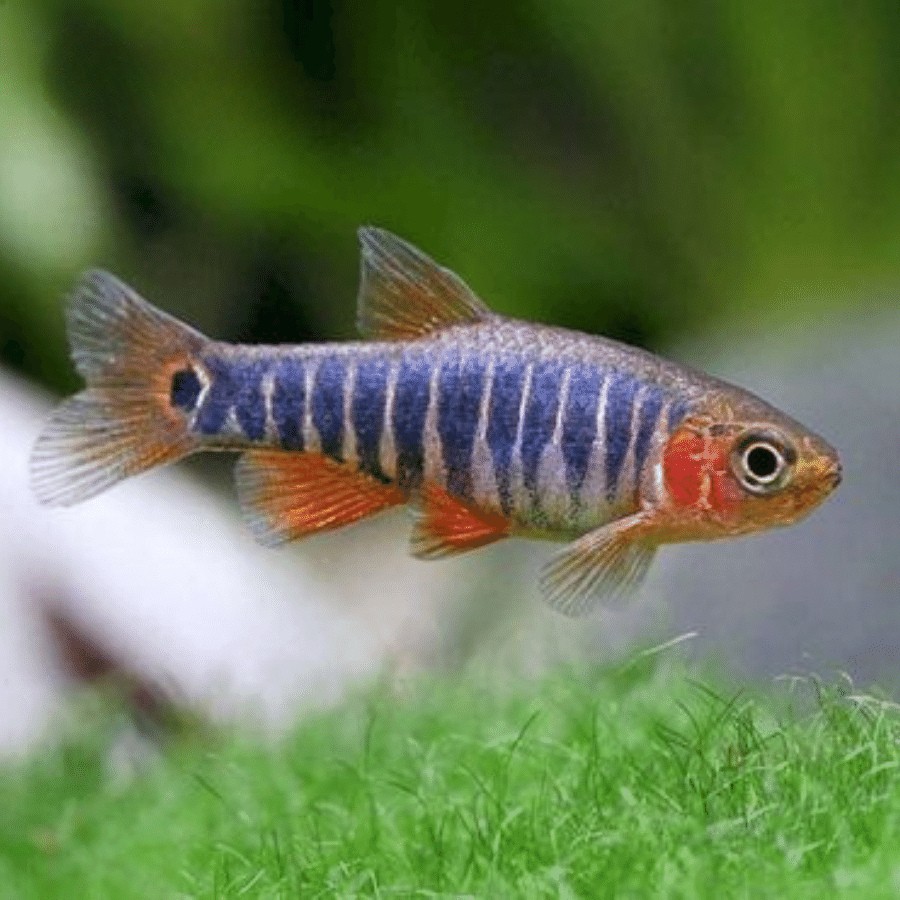
🪨 Species at a Glance
| Scientific Name | Microdevario kubotai |
| Authority | Liao, Kullander & Fang, 2010 |
| Family | Danionidae (formerly Cyprinidae) |
| Order | Cypriniformes |
| Origin | Thailand (Khao Sok, Mae Khlong basin) and Myanmar — slow blackwater forest streams |
| Adult Size | 2.0-2.5 cm (0.8-1.0 in) |
| Lifespan | 3-5 years with proper care |
| pH Range | 5.5-7.5 (ideal 6.5) |
| Temperature | 22-27 C (72-80 F) |
| Hardness (dGH) | 1-8 (soft water strongly preferred) |
| Diet | Micro-carnivore — crushed flake, micro-pellet, frozen daphnia and baby brine shrimp |
| Minimum Tank Size | 40 L (10 gal) for a school of 10+ |
| Care Level | Intermediate — sensitive to water quality |
| Temperament | Peaceful, loose-schooling, gregarious |
| Breeding | Egg-scatterer — moderately difficult but possible at home |
| Tank Position | Mid to upper water column |
Meet the Species
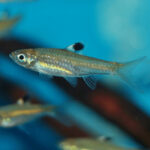
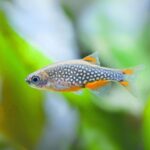
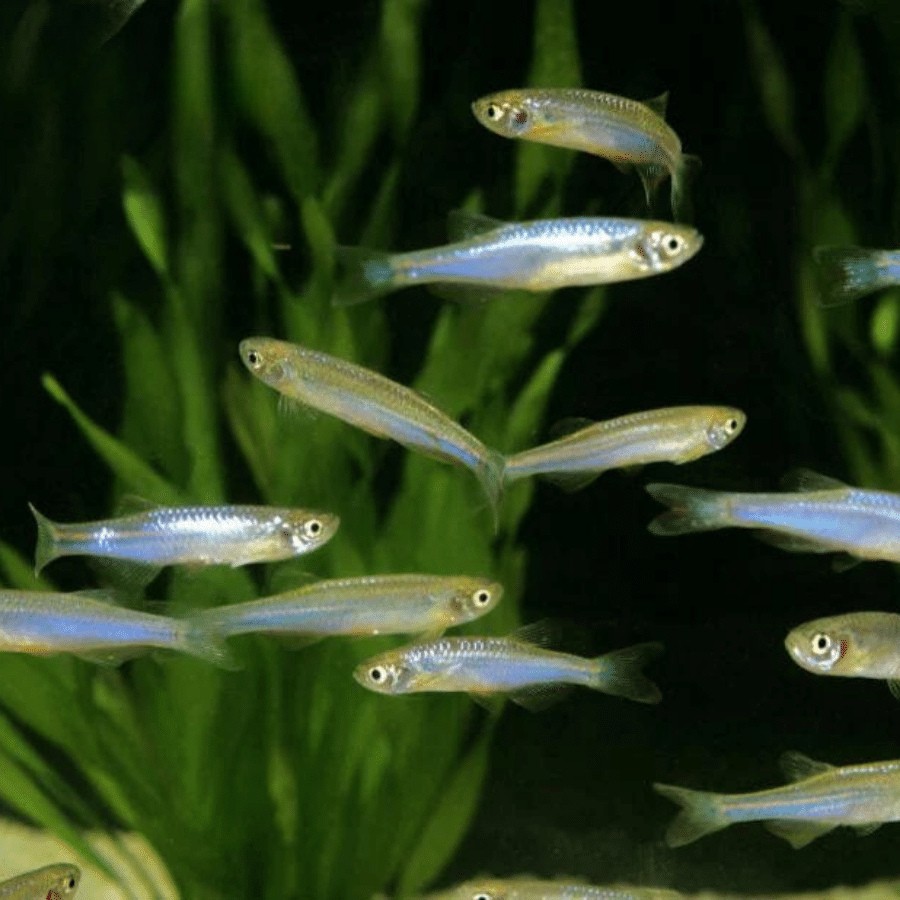
The name on your invoice reads Emerald Tiger Rasbora, and at first glance that description fits the fish perfectly — the body is a luminous emerald green, and in some lights a faint dark lateral streak does hint at a tiger stripe. But the trade has been notoriously loose with this group, and the name “Emerald Tiger” has historically been stuck onto at least three different species sold under nearly identical labels. What arrives in most Australian and European shipments today is Microdevario kubotai, a species only formally described in 2010 by Liao, Kullander and Fang in a revisionary paper that split several small Southeast Asian cyprinids out of the sprawling genus Microrasbora and into a new, tighter grouping. The genus name Microdevario literally means “small Devario,” acknowledging its close relationship to the larger danio-like fishes, while the species name kubotai honours Katsuma Kubota, the Japanese aquarist who first brought the fish to scientific attention after encountering it in Thai export shipments during the late 1990s and early 2000s.
There is one honest naming caveat every buyer should know. The trade name “Green Neon Rasbora” is sometimes also applied to Sundadanio axelrodi, a genuinely different fish from Borneo with a blue-green cast and a much more demanding blackwater requirement. And “Emerald Dwarf Rasbora” is the usual English label for Microrasbora (Celestichthys) erythromicron, a related but distinctly patterned species with vertical bars rather than a solid green body. Adding to the confusion, older stock lists and imported labels sometimes still list Microdevario kubotai as Microrasbora kubotai (its pre-2010 name) or even as the more generic “Kubotai Rasbora” — all refer to the same fish. When your fish arrives, the quickest way to confirm you have Microdevario kubotai is simple: look for a uniformly neon-green flank with a thin, broken dark lateral line, a slightly translucent belly, and a total length no greater than 2.5 cm. If the pattern shows vertical bars, if the body carries a red or orange flush, or if the fish noticeably exceeds 2.5 cm, you are looking at a cousin, not the true kubotai. We sell this fish under its trade name for searchability, but we want you to know precisely what you are buying — and what you are not.
The Kubota provenance matters for another reason: it tells you where this species stands in hobby history. Microdevario kubotai is a genuinely recent arrival — well under two decades old in the aquarium trade — and much of what is known about its behaviour, tolerances, and breeding still comes from hobbyists rather than laboratories. The species was briefly mistaken in the aquarium press for a juvenile form of another green danionine before Liao and colleagues established its full taxonomic identity, and it has spent most of its commercial life under multiple parallel labels. That makes it a rewarding fish for keepers who enjoy observation; you are still, in a real sense, part of the species’ ongoing documentation. Notes on breeding success, colour triggers, preferred tank mates, and regional water tolerances continue to emerge primarily from home aquarists sharing records online, rather than from formal scientific literature — which means the photographs and care journals you keep of your own group genuinely contribute to what the hobby as a whole knows about the fish.
Naturally occurring populations of Microdevario kubotai are currently known from blackwater forest streams in southwestern Thailand — especially in the Khao Sok region, in the Mae Khlong river basin, and in smaller drainages flowing into the Andaman Sea — and from similar habitat in southeastern Myanmar. Collection reports describe the species living in loose aggregations of dozens to hundreds in slow, heavily vegetated water three to thirty centimetres deep, often amongst dense root mats and over beds of decomposing leaf litter. Crucially, the water is almost always soft, slightly acidic, and stained to the colour of weak tea by tannins leaching from the surrounding forest. Understanding that origin tells you everything you need to know about how to keep the species at home — it is not a fish that evolved for bright showroom water; it is a fish that evolved for shade, tannin, and stability.
Water Quality Requirements
5.5–7.5
ideal 6.5
22–27 °C
ideal 25 °C
1–8 dGH
Soft water strongly preferred; very soft to moderately soft
In the wild, Microdevario kubotai inhabits slow, tannin-stained forest streams where the pH typically measures 5.5 to 6.5, dissolved minerals are very low, and the water moves only enough to keep leaf litter from settling into anaerobic mats. The species tolerates a surprisingly wide parameter range in captivity — pH anywhere between 5.5 and 7.5 is workable, and temperatures from 22 to 27 degrees Celsius are all accepted — but tolerance is not the same as thriving. The fish colours up properly, schools properly, and breeds properly only when the water leans soft and slightly acidic. If your Melbourne or Sydney tap runs hard and alkaline, you have two practical options: cut with RO water (fifty-fifty is a reasonable starting point and gets you into the fish’s comfort zone), or keep the tank itself biologically acidifying through leaf litter, alder cones, and cholla wood, which steadily push the pH downward and add tannins.
Stability matters far more than hitting an exact target. A pH that sits steady at 7.2 is better than a pH that swings from 6.2 to 7.0 every water change. Perform small, frequent water changes — 15 to 20 percent weekly is ideal — and match new water to tank temperature within one degree. Avoid the trap of chasing parameters with buffers and acid drops; every swing stresses the fish and the biofilm they depend on. These are low-bioload fish in a low-volume tank, so stability is easier to achieve than people expect; the mistake is usually over-intervention, not under-intervention. Keep ammonia and nitrite at zero, keep nitrate below 20 ppm, keep the flow gentle, and let the leaves do the chemistry work for you.
A word on acclimating new fish, because this is where most losses happen. Microdevario kubotai arrives in shipping water that is typically much softer and more acidic than Australian tap water, and dropping them straight into a new tank is a recipe for pH shock. Use a slow drip-acclimation method: float the bag for fifteen minutes to equalise temperature, transfer the fish and shipping water into a clean bucket or container, then start a siphon drip from the tank at roughly two drops per second. Over the course of sixty to ninety minutes, the shipping water should double or triple in volume and should now be chemically close to the destination tank. Net the fish across (do not pour the shipping water into the tank — it may contain ammonia from transit), and dim the tank light for the first evening to reduce stress. Done this way, losses in the first week are almost always zero. Done the “pour-and-hope” way, losses of two to four fish out of a group of ten are distressingly common.
Temperature sits in a comfortable middle band — 22 to 27 C, with 25 C as the ideal sweet spot. Avoid the high end of the range in summer, because warmer water holds less dissolved oxygen and Microdevario kubotai are not strong swimmers; they will gather near the surface gasping if oxygen drops. If your room reaches over 28 C during an Australian summer, consider a small USB desk fan blowing gently across the water surface — evaporative cooling of two to three degrees is usually plenty and costs almost nothing to run. Do not use ice or chilled water changes to spot-correct temperature; the thermal shock is worse than the warmth.
Visual Varieties
💚 Wild-Type Microdevario kubotai
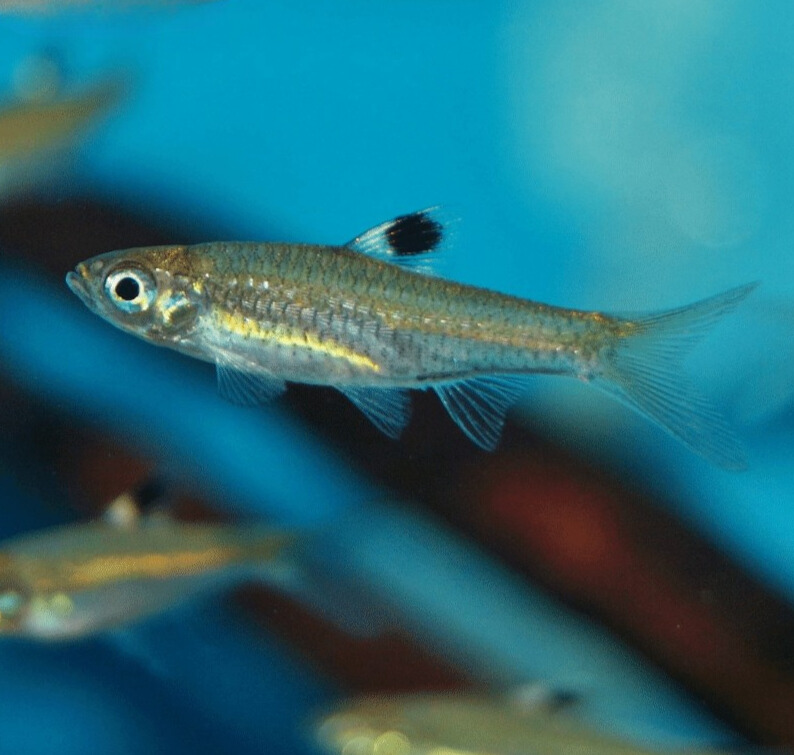
The classic and only true Emerald Tiger Rasbora: neon-emerald flank, thin broken dark lateral line, translucent belly, fine yellow edging on the dorsal.
🟠 Microdevario (formerly Microrasbora) rubescens
A close cousin from Inle Lake, Myanmar: slimmer body with a warm orange-pink flush along the flanks rather than green — sometimes shipped as ‘Red Neon Rasbora’.
🏁 Celestichthys erythromicron (Emerald Dwarf Rasbora)
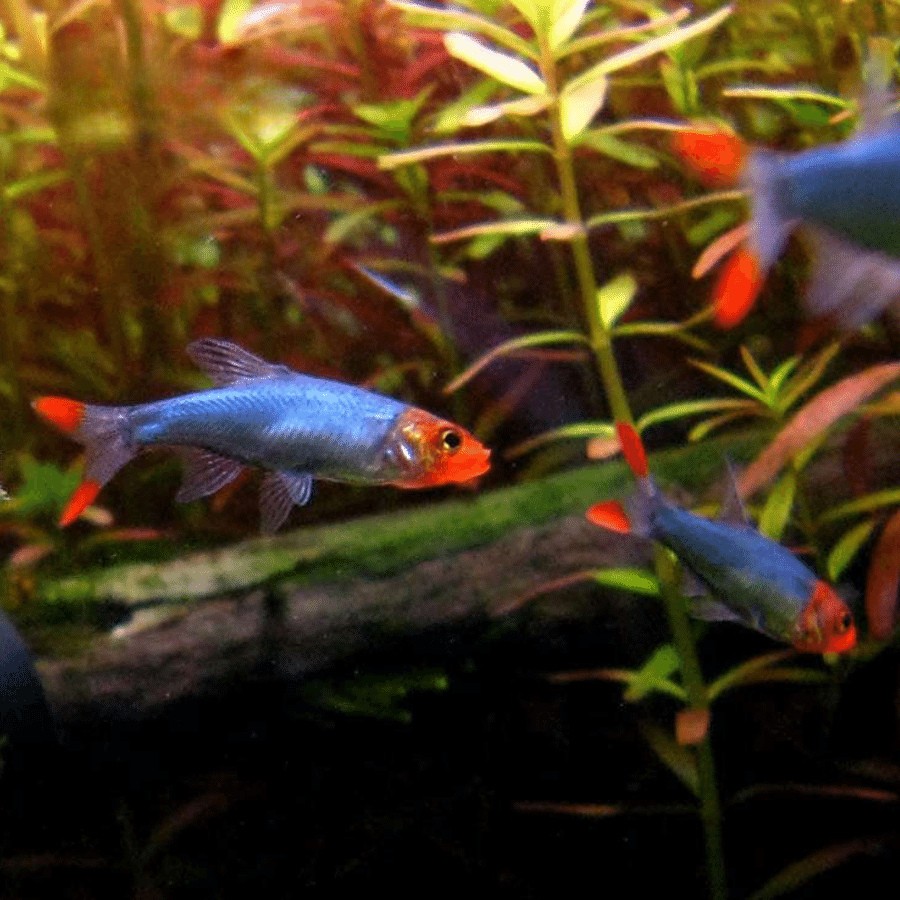
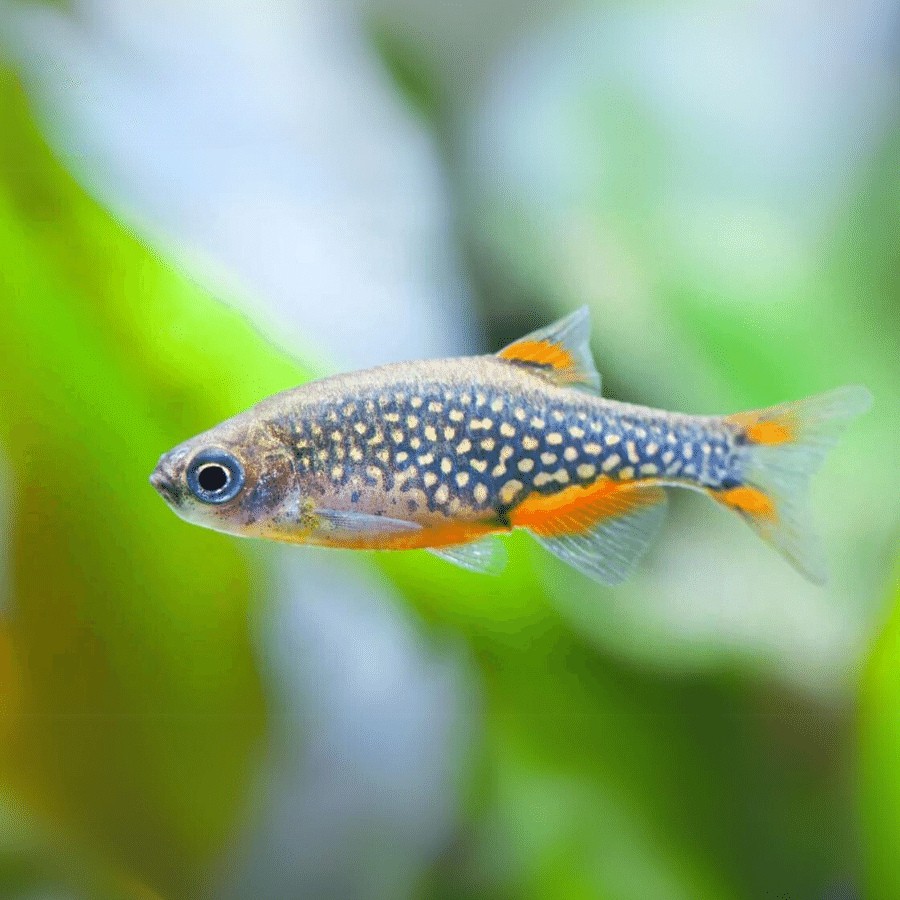
Often confused in the trade: a related nano cyprinid with clear vertical blue-green bars and a pale orange base — visually quite different on close inspection.
Unlike the neon tetra or the guppy, Microdevario kubotai has not yet been line-bred into a catalogue of colour morphs. What you see in the shop tank is effectively what Thai and Myanmar streams produce in the wild. That said, the apparent brilliance of any given group varies dramatically with husbandry. In a stark, bright tank with pale substrate and carbonate-hard water, the fish often looks washed out — a faded yellowish-green that does not justify the name. Move the same fish to a tannin-tinted, dim, densely planted tank with dark substrate, and within days the flanks deepen to a vivid, almost fluorescent emerald that seems to reflect light back at the viewer. This is a structural-colour fish: the green comes from iridophores in the skin, not from a dietary pigment, so colour will not wash out with age or fade in a mature tank — but the intensity depends entirely on contrast, lighting angle, and the fish’s stress level. If your group looks pale, the fix is almost never food; it is the tank. Drop the light, add shade, darken the substrate, and let tannins tint the water. The colour follows.
A few practical observations from hobbyists who have kept the species for years are worth repeating here. First, new arrivals almost always look dull for the first seven to ten days after introduction; this is normal and not a cause for intervention. Shipping stress, unfamiliar water chemistry, and the absence of a settled shoal all dampen colour expression, and the improvement once the fish relax is dramatic. Second, the most vivid specimens are almost always the males during brief moments of courtship display — the flanks briefly flare to a metallic green that looks artificially saturated. Third, the presence of a dark background (black cardboard taped behind the tank, or simply placing the tank against a dark wall) shifts perceived colour noticeably, because the viewer’s eye measures the fish against its context rather than absolutely. These are not tricks; they are the conditions under which structural iridophore colour evolved to function. Recreating them in the aquarium is the single highest-leverage thing you can do for the appearance of the fish.
When comparing Microdevario kubotai with its close relatives in the trade — particularly Microdevario rubescens (the orange-pink Inle Lake endemic) and Celestichthys erythromicron (the bar-patterned Emerald Dwarf Rasbora) — keepers sometimes wonder whether they can be housed together. The short answer is yes, provided all three species receive the same soft, shaded, gently moving water, and provided each shoal is kept large enough (ten plus) to feel secure. The visual effect of a mixed display — green, orange, and bar-patterned nano fish drifting through the same mid-water zone — is genuinely striking, and because none of the three are aggressive, competition is minimal. The caveat is behavioural: Microdevario kubotai is the boldest of the three and tends to dominate open swimming space, while Celestichthys erythromicron is shyer and needs denser planting to feel at home. Set up the tank around the shyest species, and the bolder ones will adjust without issue.
Tank Requirements & Layout
The Emerald Tiger Rasbora is a species whose appearance transforms with the tank it lives in, so the setup is not a cosmetic choice — it is a husbandry decision. The goal is a shaded, densely planted nano tank with dark substrate, cover overhead, and strong horizontal swimming space in the mid-water. A 40-litre cube or rectangular tank is the practical minimum for a group of ten to twelve fish; step up to 60 litres if you want a fuller shoal of twenty or are planning to add compatible species like pygmy corydoras or amano shrimp. Anything under 40 litres starts to constrain the school’s swimming room, and a cramped school is a stressed school — stressed Microdevario kubotai lose their colour within days and rarely get it back without a move.
Start with a fine dark substrate. Black aquasoil is ideal both for colour contrast and because it gently acidifies the water column, but fine black sand works well too. Cover around 60 to 70 percent of the tank footprint with plants — stem plants like Rotala rotundifolia, Ludwigia arcuata, and Cabomba furcata along the back and sides, and mid-ground epiphytes like Anubias nana, Bucephalandra, and narrow-leaf java fern on driftwood. Crucially, add floating plants: Amazon frogbit, red root floaters, or salvinia are all excellent. Floating cover is non-negotiable for this species — it diffuses overhead lighting, simulates the forest canopy of their native streams, and gives the school the sense of shelter that triggers open swimming rather than perpetual hiding. A completely uncovered surface will keep your fish pressed against the substrate, darting for cover every time you walk past.
Driftwood provides the final layer. A piece of spiderwood or two pieces of jati root draped with moss and leaf litter around the base creates the shaded mid-water zone where the fish actually spend most of their time. Add a generous layer — not a token few — of Indian almond leaves, magnolia leaves, or alder cones to the substrate. These are not decorations; they are part of the water chemistry and part of the microfauna food web. Lighting should be low to moderate and dimmable; a nano LED with a reasonable colour spectrum running at 30 to 50 percent intensity for six hours a day is more than enough. Overlighting this tank is one of the most common mistakes new keepers make — intense light destroys the shaded, contemplative feel of a blackwater setup and makes the fish look dull even when they are in great condition.
Think about water flow the way you would think about breeze in a shaded forest: present, but gentle. A sponge filter rated for roughly twice the tank volume per hour is ideal — enough turnover to keep biological filtration active without creating current strong enough to push the fish around. If you use a hang-on-back or canister filter, reduce the output with a spray bar aimed at the glass, a pre-filter sponge on the intake, or a lily pipe set low so that surface movement is subtle. You want to see a slight, rippling glitter on the water surface and gentle sway in the stem plants, not directional streaming. Check flow by watching where the floating plants drift: if they pile against one end of the tank, the flow is too strong; if they sit motionless for hours at a time, the flow is slightly too weak.
The aquascape aesthetic that suits Microdevario kubotai best is often called “botanical” or “aged blackwater” — a look built around dark substrate, dense stem-plant jungles, visible leaf litter on the tank floor, moss-covered driftwood, and tannin-stained water. It is deliberately the opposite of the bright, pristine, Dutch-style aquascape that dominates social media, and it requires a mental adjustment for keepers used to competing on cleanliness. The “mess” in a botanical tank — the softening leaves, the brown tint, the biofilm on the wood — is not a failure state; it is the water chemistry and microfauna food web the fish actually evolved with. Resist the urge to gravel-vac the leaf litter, to scrub off biofilm, or to run carbon to clear the tint. The tank will look moody and layered and surprisingly calming once you stop fighting what it is trying to become. Your fish, and your own eyes, will thank you for it.
One additional layout tip specifically for shoaling visibility. Microdevario kubotai tends to drift in the middle third of the water column, so the mid-water space is where you want the most open, uncluttered swimming room. Push the tallest plants up against the back glass, place wood and epiphytes along the sides, keep the mid-ground open (or planted only with very short foreground carpets like Hydrocotyle tripartita mini or Eleocharis parvula), and angle the substrate deeper at the back. The resulting visual funnel draws the eye naturally into the school, and the fish will happily arrange themselves across the open stage you have given them.
Tank
Minimum 40 L (10 gal) for a school of 10+; 60 L recommended for 20 fish or mixed nano community
Filter
Sponge filter driven by air pump (ideal) or baffled nano HOB / small internal — gentle flow is essential
Heater
25-50 W adjustable heater; set to 25 C. Use an external thermometer to verify accuracy
Lighting
Low to moderate dimmable LED. Six-hour photoperiod. Always pair strong light with floating plants
Substrate
Fine black aquasoil or dark sand — both improve colour contrast and (for aquasoil) mildly acidify water
Plants
Stem plants (Rotala, Ludwigia, Cabomba) dense at back/sides; epiphytes on wood; floating plants mandatory
Botanicals
Indian almond leaves, alder cones, magnolia leaves, cholla wood — restock as they decompose
Driftwood
Spiderwood or jati root for vertical and horizontal structure, moss attachment, and shaded mid-water zones
Thermometer
Digital or stick-on glass — verify heater calibration weekly, especially in winter
Test Kit
Liquid kit covering ammonia, nitrite, nitrate, and pH — strips are not accurate enough for a blackwater nano tank
Spot the Difference: Male & Female
Sexing Microdevario kubotai is one of the more honestly difficult tasks in the nano hobby. The species is only weakly dimorphic, and in a shop tank — where fish are stressed, young, and swimming fast — it is effectively impossible to pick a confirmed pair. The table above lists the cues that become usable once fish settle into a home aquarium for two or three weeks and begin to mature, but none of them is reliable in isolation. The single best sexing technique is patience: buy a school of ten to fifteen fish, let them grow out for a month in conditions they like, then observe from above at feeding time. The females that will contribute eggs in a breeding attempt are the ones whose bellies noticeably round out behind the pelvic fins when seen from the top — the side view almost never gives it away. Males, by contrast, retain a pencil-straight body line even when well fed, and in a mature group you will sometimes catch them flaring at each other in slow-motion displays near plant edges.
If you are buying specifically to breed, order the largest group your tank will support. A batch of fifteen gives you statistically near-certain odds of having a workable sex ratio without you ever needing to identify individuals, and the larger school also triggers better conditioning and more natural spawning behaviour. Trying to sex three or four fish by eye in a store is a guess, not a plan.
One further point worth making honestly: many published keys and older care guides describe male Microdevario kubotai as showing distinctly brighter green colouration than females, and while this is broadly true, the difference is not large enough to sort individuals reliably. Colour variation between individual fish caused by mood, angle, lighting, and recent feeding genuinely exceeds the average difference between the sexes. Do not spend twenty minutes at the shop staring into a bag trying to count “greener” versus “paler” fish; the exercise is essentially random. What you can do reliably in the shop is avoid fish that look obviously emaciated, show clamped fins, or have visible wounds or fungus — those are quality-of-stock signals, not sex signals, and they matter far more to your eventual success with the species than getting a perfect male-to-female ratio on day one.
| Feature | Male | Female |
|---|---|---|
| Body Shape | Slender, narrow, straight-lined from head to caudal peduncle | Fuller, slightly deeper-bodied; belly visibly rounder when mature |
| Size at Maturity | ~2.0 cm, noticeably finer build | ~2.2-2.5 cm, marginally larger overall |
| Colour Intensity | Slightly more vivid emerald flank, especially during display | Green is present but tends to be paler; belly may look almost translucent |
| Vent View (from above) | No abdominal bulge when viewed from above | Visible rounding behind the pelvic fins when conditioned |
| Fin Extension | Dorsal and anal fins may appear fractionally longer | Fins slightly shorter and less pointed in profile |
| Behaviour | More active darting, brief chasing, sparring with other males in strong light | Calmer positional swimming, often in the centre of the shoal |
Feeding Schedule & Diet
Microdevario kubotai is a true micro-carnivore. In the wild, its entire diet consists of microscopic crustaceans, insect larvae that fall into the stream from the canopy, small worms, and zooplankton — everything it eats has to fit in a mouth smaller than a grain of rice. In captivity, that biology translates into two clear rules: the food must be tiny, and the food must be animal-based. A generic community flake marketed for tetras is usually already too large unless crushed between the fingers before feeding, and a standard community pellet is almost certainly too large to be accepted at all.
Build the staple diet around a high-quality crushed flake or a purpose-made micro-pellet (roughly 0.4 mm granule size). Look for a product whose first ingredient is whole fish meal, shrimp meal, or insect meal — avoid anything starting with wheat or soy flour. Supplement at least three times per week with frozen foods: daphnia, cyclops, and baby brine shrimp are all eagerly taken and far more nutritionally complete than any dry food. Live baby brine shrimp once or twice a week transforms both colour and breeding readiness; if you keep your own brine hatchery, this species is one of the biggest beneficiaries. Feed two small meals per day rather than one large one — Microdevario kubotai stomachs are tiny and quickly overloaded, and uneaten food in a nano tank turns into ammonia faster than a larger system can buffer it.
One habit that helps: feed while the tank light is on so you can watch. These fish are polite eaters, but they lose interest in food after thirty seconds. If the flake or frozen portion is still visibly floating or settling after a minute, you have overfed. Remove the excess with a pipette, reduce the next portion, and adjust. A well-kept group should eat every grain you drop in, then go back to drifting within a minute.
A few specific food products consistently get strong acceptance from Microdevario kubotai in Australian keeping reports. Hikari Micro Pellets and Fluval Bug Bites Micro Granules are two widely available staples — both are approximately the right size and have protein-forward ingredient lists. For freeze-dried variety, tiny freeze-dried daphnia or tubifex rehydrated in tank water is accepted readily; do not feed freeze-dried foods dry because it reduces digestion efficiency and occasionally causes swim-bladder issues in nano fish. Among frozen foods, cyclops is the unsung hero for this species — bite-size for the smallest fish in the shoal, nutrient-rich, and clean-burning in the water column. Frozen daphnia and baby brine shrimp both rank equally well. For keepers who want to occasionally prepare their own live food, vinegar eels and microworms are both easy home cultures that suit Microdevario kubotai perfectly, especially during breeding conditioning or when raising fry.
If the tank also houses shrimp or snails, a brief note on cross-feeding is worth making. Amano shrimp and cherry shrimp eat leftover fish food that reaches the substrate, which helps waste management — but it can mask overfeeding. Do not size your Microdevario kubotai portions expecting the shrimp to “take care of the extra”; feed the rasboras only as much as they can eat in thirty seconds, and let the shrimp graze on biofilm and plant detritus instead. This keeps water quality predictable and the whole system sustainable long-term.
Choosing Tank Mates
Microdevario kubotai is one of the gentlest mid-water fish in the hobby — but gentleness is exactly what makes community selection critical. The fish will not defend itself against anything larger or pushier, and it will not out-compete anything faster at feeding time. The two criteria that matter are mouth size (nothing in the tank should have a mouth wide enough to swallow a 2cm fish) and tempo (nothing should swim noticeably faster or more aggressively at food). Within those limits, Microdevario kubotai is an ideal centrepiece for a nano biotope, and it pairs gorgeously with other small, soft-water species that occupy different zones. A textbook community would be ten to fifteen Microdevario kubotai in the mid-water, six to eight Boraras brigittae drifting alongside them, six Corydoras pygmaeus on the substrate, and a small cleanup crew of amano shrimp — all in a 60-litre blackwater tank. That setup is genuinely peaceful, visually layered, and colour-rich without being chaotic. Keep the primary shoal no smaller than ten fish; at eight or fewer, schools begin to break up, colour fades, and the fish spend most of their time hiding. If you can only commit to five or six fish, buy a different species. This one needs numbers to be itself.
A few community-tank pitfalls are worth calling out specifically because they tempt beginners. First, do not be seduced by size-compatibility alone. A peaceful fish can still be a poor tank mate if it out-competes Microdevario kubotai at feeding time — white cloud mountain minnows, for instance, are similar in size and are famously peaceful, but they feed faster and more aggressively, which will leave your rasboras perpetually underfed. Second, avoid species that occupy the same mid-water zone unless they are equally gentle; otters this rule out zebra danios, harlequin rasboras, and most tetras larger than 3 cm, all of which will monopolise the water column. Third, be cautious with small fry-predators even if they are nano-sized — dwarf chain loaches and kuhli loaches, for example, will sometimes take eggs or newly hatched fry in a tank where Microdevario kubotai are attempting to breed, though they are fine in a non-breeding display setup.
Finally, a realistic note on stocking density. A 60-litre tank sounds roomy for a group of 2 cm fish, and technically it is, but Microdevario kubotai behaviour deteriorates in sparse tanks just as much as it does in overcrowded ones. The fish want to be part of a clearly defined shoal, and they want to navigate around visual obstacles — plant stems, wood, leaf litter — as part of that shoaling behaviour. An under-stocked, under-planted 60-litre tank with only ten fish will often leave them looking uncertain and isolated, whereas a well-planted 40-litre tank with the same ten fish will have them looking relaxed and confident. Given a choice between scaling up tank volume and scaling up plant density, plant density is the more valuable investment for this species every single time.
| Species | Why | |
|---|---|---|
| ✅ | Chili Rasbora (Boraras brigittae) | Near-perfect nano companion — same water, same temperament, similar size; the red and green colours contrast beautifully without any competition for space |
| ✅ | Phoenix Rasbora (Boraras merah) | Another small Boraras species with identical care needs; creates a gorgeous layered effect when the two schools shoal loosely together |
| ✅ | Pygmy Corydoras (Corydoras pygmaeus / hastatus) | Tiny peaceful bottom shoaler that occupies the substrate zone without crowding the mid-water; loves the same soft, dim setup |
| ✅ | Celestial Pearl Danio (Celestichthys margaritatus) | Similar tiny cyprinid with comparable temperament; both species leave each other alone and both prefer densely planted nano tanks |
| ✅ | Amano Shrimp (Caridina multidentata) | Large enough that adult Microdevario kubotai ignore them entirely; excellent algae cleanup crew that thrives in the same gentle water |
| ✅ | Neocaridina Shrimp (Cherry / Blue Dream — adults only) | Adult shrimp are left alone by Microdevario kubotai; baby shrimplets may be picked off, so accept a working population rather than a breeding colony |
| ✅ | Otocinclus cocama / vittatus | Tiny non-aggressive algae eaters that occupy plant leaves and glass; zero competition with a mid-water shoaler |
| ✅ | Dwarf Sparkling Gourami (Trichopsis pumila) | A rare surface-dweller small and peaceful enough for this community; adds a slow centrepiece without stressing the shoal |
| ❌ | Angelfish, Discus, or any adult cichlid | Mouth size alone makes them a threat — adult angelfish and cichlids will swallow a 2cm Microdevario kubotai whole within days of being introduced |
| ❌ | Tiger Barb and other barb species | Fast swimmers that out-compete Microdevario kubotai for food and harass them relentlessly; the barb will be eating while your rasboras cower in the plants |
| ❌ | Male Betta splendens | Individual temperament varies, but the risk is real — some bettas will pick off small nano shoalers one by one and the outcome is never recoverable |
| ❌ | Zebra or Giant Danio | Too fast, too pushy, and too large — they will steal every feeding and bully the shoal off the mid-water by sheer presence |
| ❌ | Large gouramis (Trichopodus / Trichogaster) | Adult pearl, gold, and blue gouramis grow large enough to view 2cm fish as prey; avoid even if the individual seems currently peaceful |
Breeding in Captivity
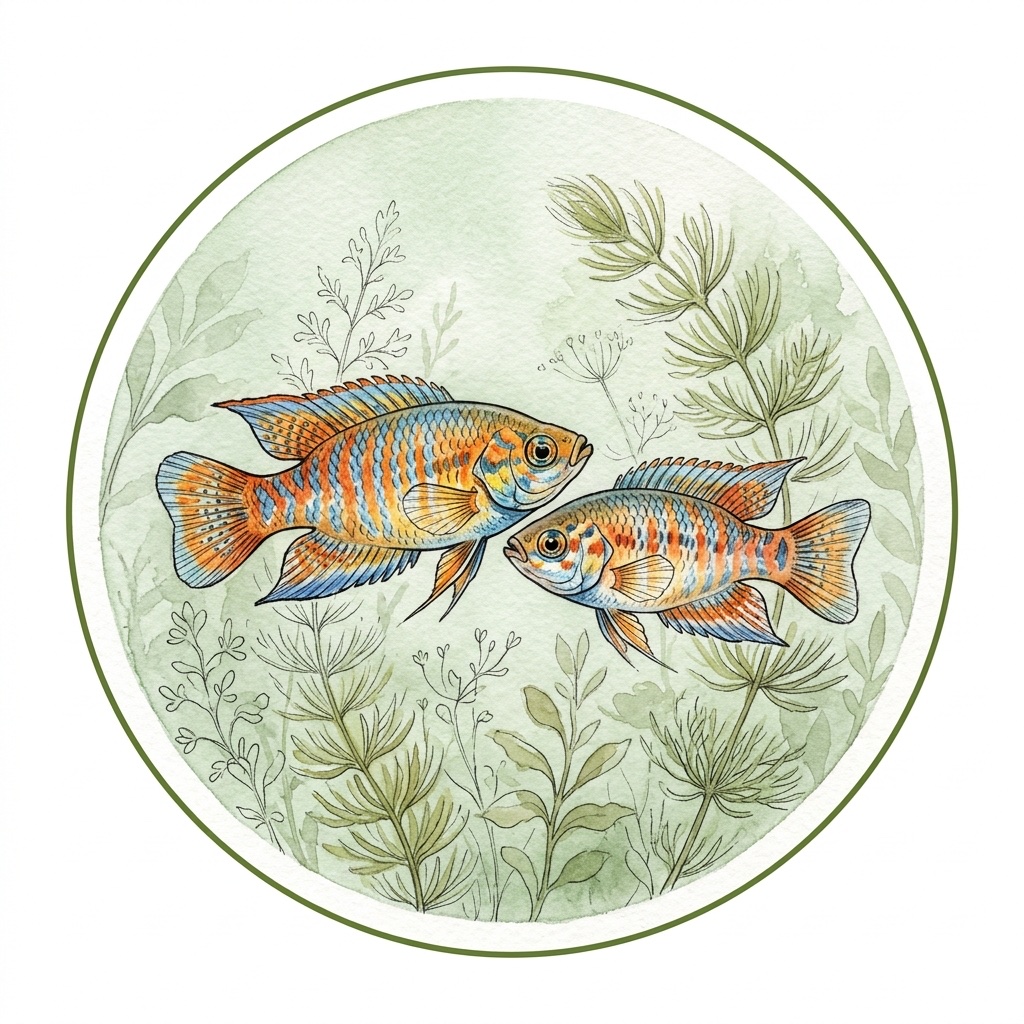
Week -2 to -1
Conditioning
Heavy feeding of live and frozen foods on the main shoal
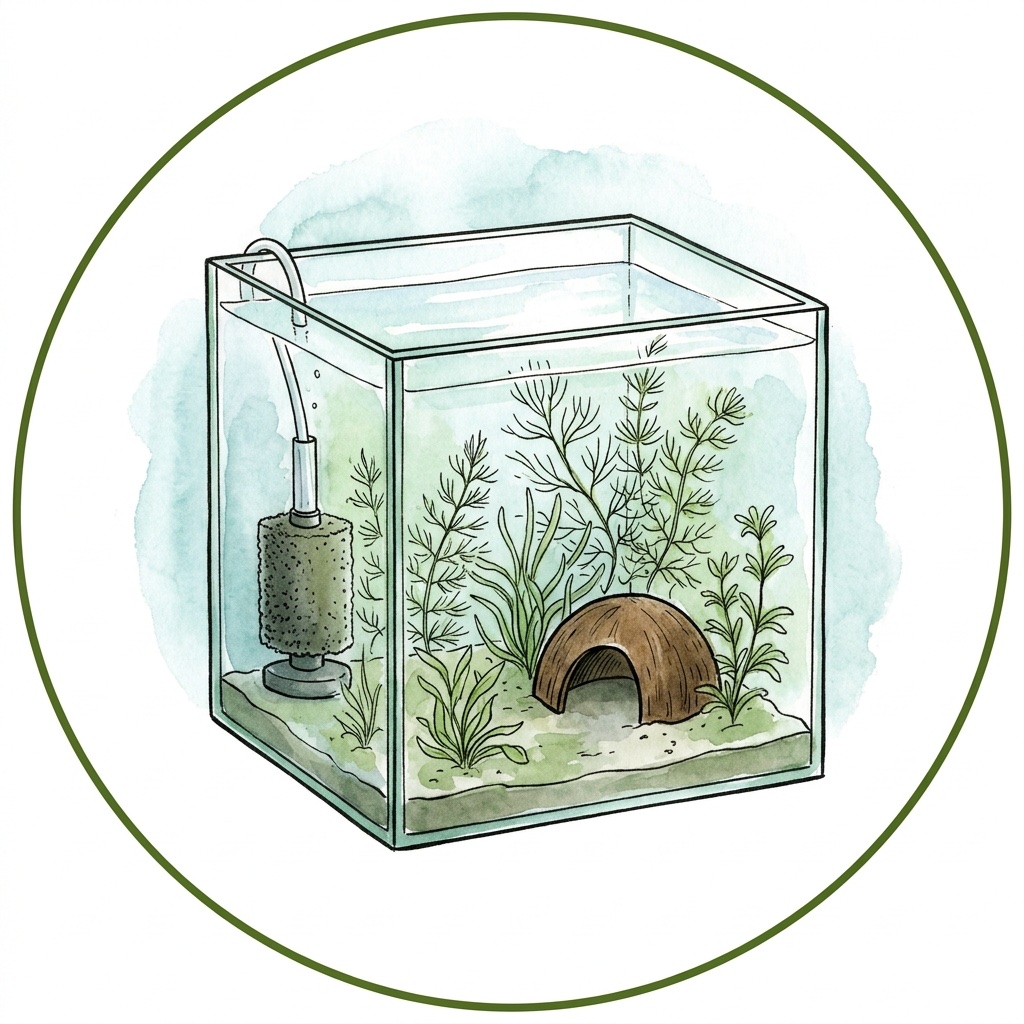
Day 0
Breeding Tank Setup
Prepare a dedicated 10-20 L tank with soft water, java moss, and dim light
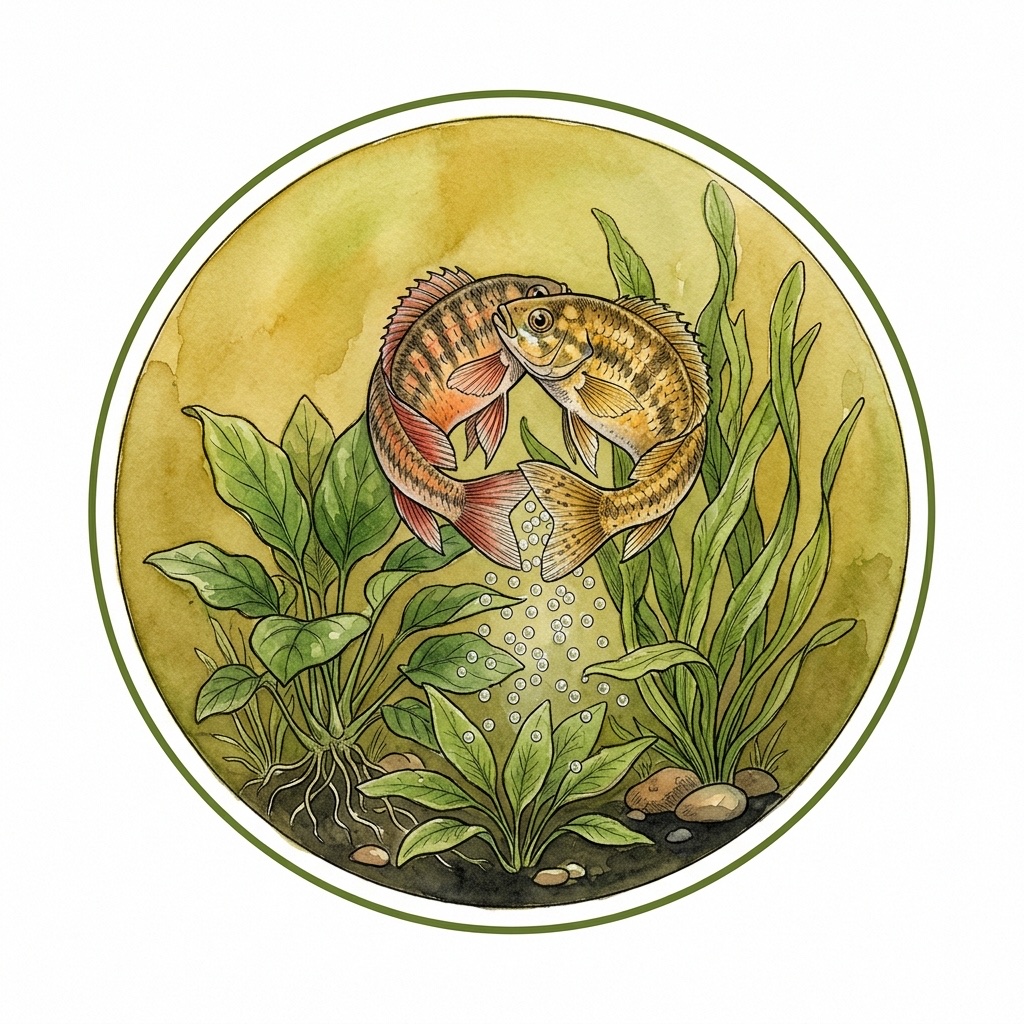
Day 1-2
Introducing the Spawners
Move 2 males and 3-4 females into the breeding tank at dusk
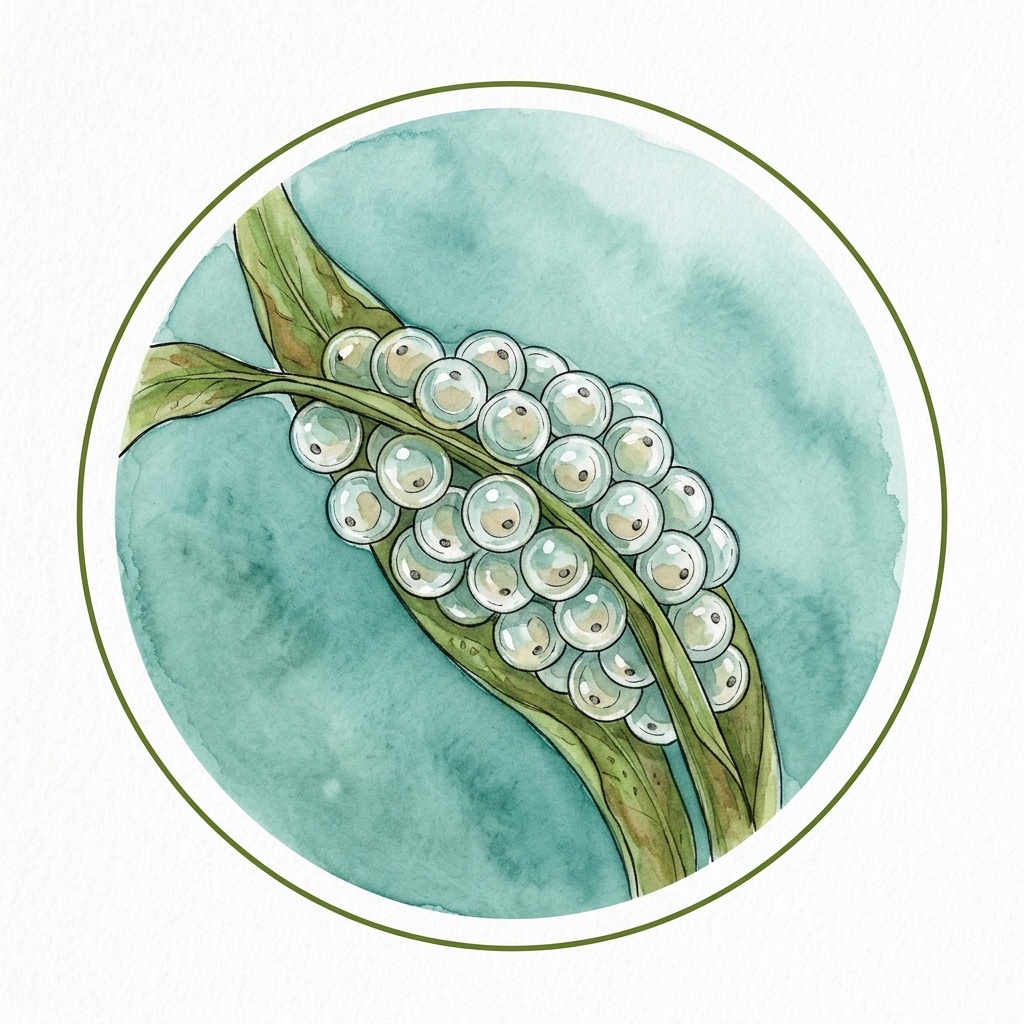
Day 2
Removing the Parents
As soon as visible scattering stops, move adults back to the main tank
Day 2-4
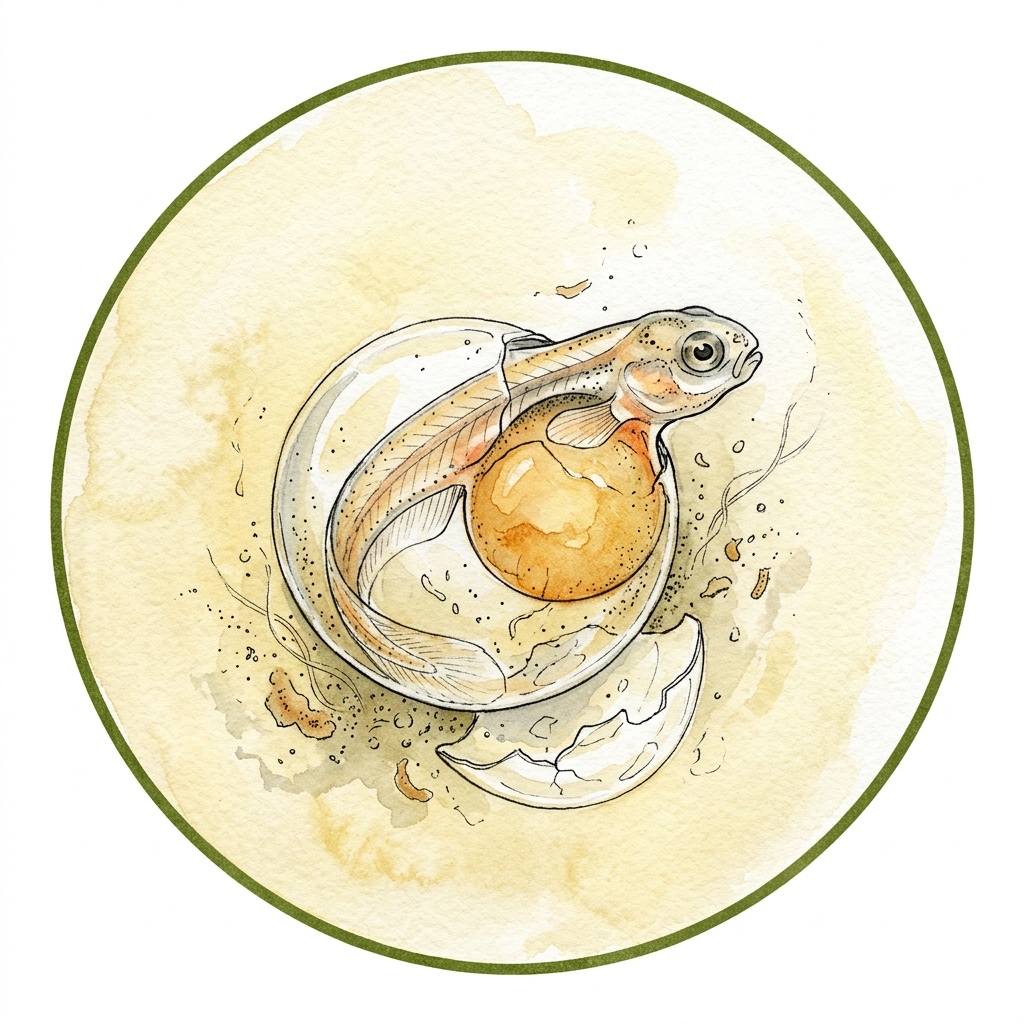
Incubation and Hatching
Keep dark and stable; fry hatch 36-60 hours after spawning
Day 5-10
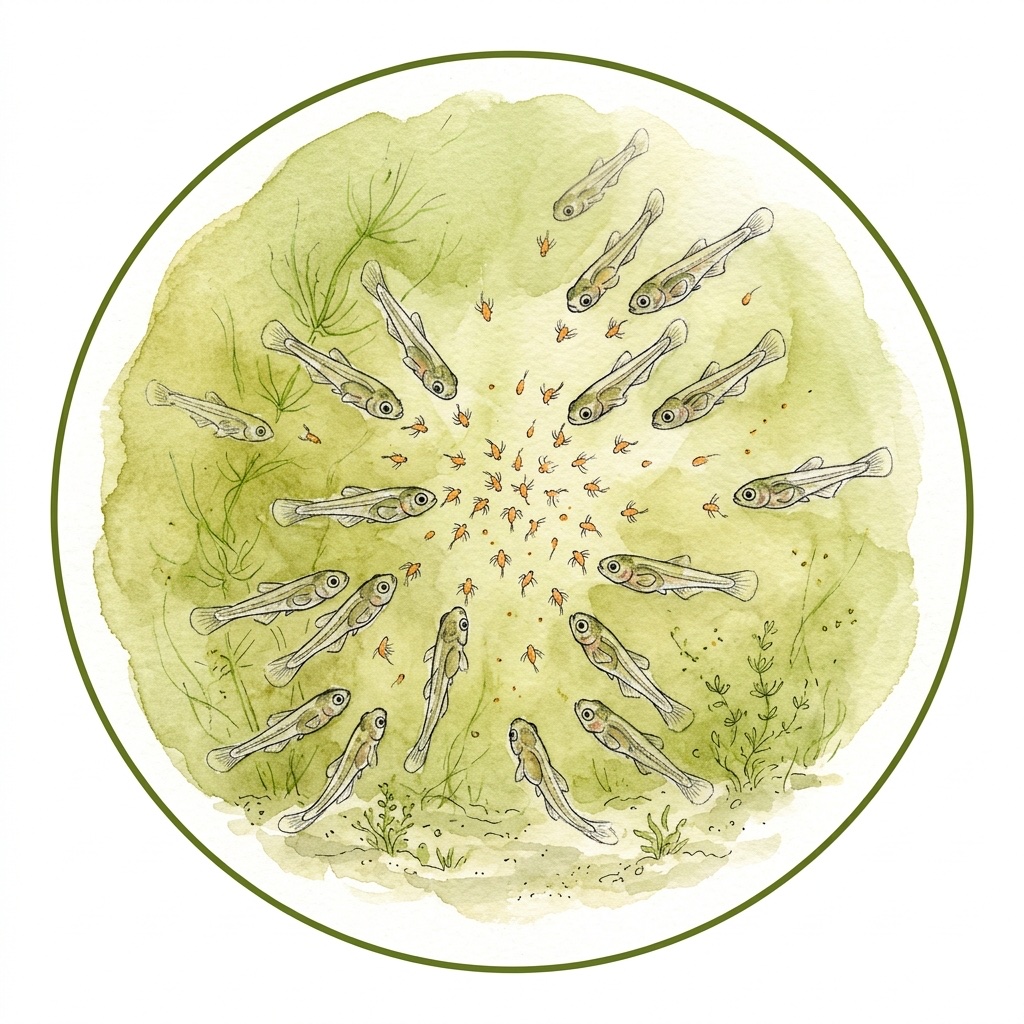
Free-Swimming Fry
Begin feeding infusoria, then vinegar eels and baby brine shrimp
Conditioning
Breeding attempts begin long before any breeding tank is set up. For two weeks, feed the main shoal more generously than usual, focusing on live baby brine shrimp, live daphnia, and frozen cyclops. Keep the staple flake or micro-pellet feedings going, but push the protein and fat intake up. Within ten days, the best-conditioned females will show visibly fuller bellies when viewed from above — this is the single most reliable sexing cue in the species and the signal that conditioning has worked.
Breeding Tank Setup
Set up a small, bare-bottom breeding tank of 10 to 20 litres. Fill it with very soft water — either 100 percent RO water with a trace mineral supplement, or tank water blended heavily with RO to drop hardness below 3 dGH. Aim for pH 6.0 and a temperature of 25 C. Drop a generous handful of java moss across the bottom — this will be the egg catchment and fry hideout — along with a small clump of spawning mop or peat fibre. Light the tank very dimly; a single shaded LED or natural ambient light from a nearby window is plenty. Add a tiny sponge filter, cycled in advance on the main tank.
Introducing the Spawners
Catch a small group of clearly conditioned fish — two slender males and three or four round-bellied females — and move them into the breeding tank in the evening. Spawning typically begins at dawn the following morning, triggered by the first light. Males will dart at females through the moss and mops; females scatter small clutches of eggs a few at a time, ultimately depositing between thirty and a hundred eggs across multiple passes. The eggs are minute, translucent, and non-adhesive — they fall into the moss where the adults cannot easily find them.
Removing the Parents
Microdevario kubotai are notorious egg-eaters. As soon as spawning behaviour has clearly ended — typically by mid-morning of the spawn day — net the adults out and return them to the main tank. Do not leave them in overnight; even well-fed fish will clean up 90 percent of their own eggs given the chance. The eggs themselves should now be invisible to you among the moss, which is fine.
Incubation and Hatching
Keep the breeding tank dim and undisturbed. Eggs hatch between 36 and 60 hours depending on temperature, and the newly emerged fry are transparent slivers that cling to plant surfaces while they absorb their yolk sacs. At this stage they look like small splinters of glass; you will only see them when they move. Do not feed yet. Gently pipette out any eggs that have turned opaque white — these are infertile and will quickly fungus if left.
Free-Swimming Fry
Around day five to seven, the fry become free-swimming and begin searching for food in the mid-water column. Start with infusoria or commercial liquid fry food for the first three or four days — Microdevario kubotai fry are too small to take newly hatched brine shrimp immediately. By day ten, most will be large enough to accept freshly hatched baby brine shrimp, at which point growth accelerates. Perform tiny water changes (10 percent, drip-fed) every three days to manage waste without stressing the fry. Juveniles show their first hint of green flank colour at around six weeks and are ready to join the main tank at roughly three months old.
Quick Reference
| Scientific Name | Microdevario kubotai |
| Common Name | Emerald Tiger Rasbora / Kubota’s Rasbora |
| Adult Size | 2.0-2.5 cm |
| Lifespan | 3-5 years |
| pH | 5.5-7.5 (ideal 6.5) |
| Temperature | 22-27 C (ideal 25 C) |
| Hardness | 1-8 dGH (soft preferred) |
| Min Tank Size | 40 L for 10+ fish |
| School Size | 10+ minimum, 15-20 ideal |
| Diet | Micro-carnivore — crushed flake, micro-pellet, frozen/live small foods |
| Care Level | Intermediate |
| Temperament | Peaceful, loose-schooling |
| Tank Position | Mid to upper |
| Breeding | Egg-scatterer — moderately difficult, home-breedable |
| Price | $26.50 AUD |
Related Products
Reviews
Clear filtersThere are no reviews yet.