🪨 Species at a Glance
| Scientific Name | Brevibora dorsiocellata |
| Former Name | Rasbora dorsiocellata (reclassified to Brevibora in 2010) |
| Authority | Duncker, 1904; Liao, Kullander & Fang, 2010 (genus revision) |
| Family | Danionidae (formerly Cyprinidae) |
| Order | Cypriniformes |
| Origin | Peninsular Malaysia, Sumatra, Borneo — peat swamps and slow forest streams |
| Adult Size | 4.0-5.0 cm (1.6-2.0 in) |
| Lifespan | 4-6 years with good husbandry |
| pH Range | 5.5-7.5 (ideal 6.5) |
| Temperature | 22-27 C (72-80 F) |
| Hardness (dGH) | 1-8 (soft water strongly preferred) |
| Diet | Micro-omnivore — flake, small pellet, frozen daphnia and bloodworm |
| Minimum Tank Size | 60 L (15 gal) for a school of 8+ |
| Care Level | Easy to Intermediate — hardy once acclimated |
| Temperament | Peaceful, tight-schooling, gregarious |
| Breeding | Egg-scatterer — relatively easy at home |
| Tank Position | Mid-water column |
Meet the Species
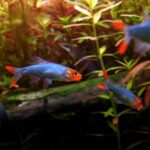
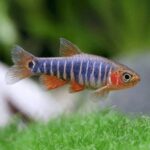
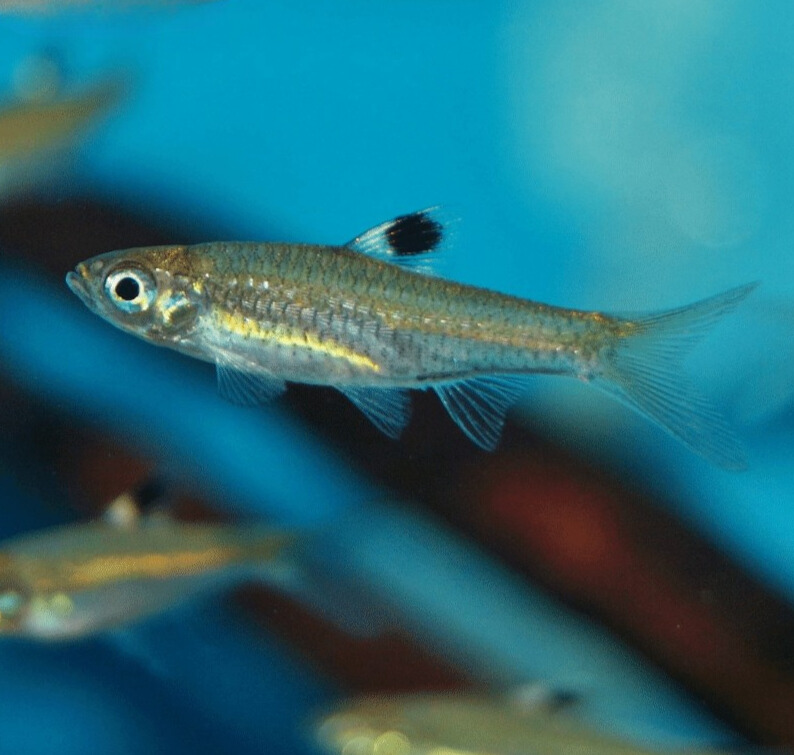
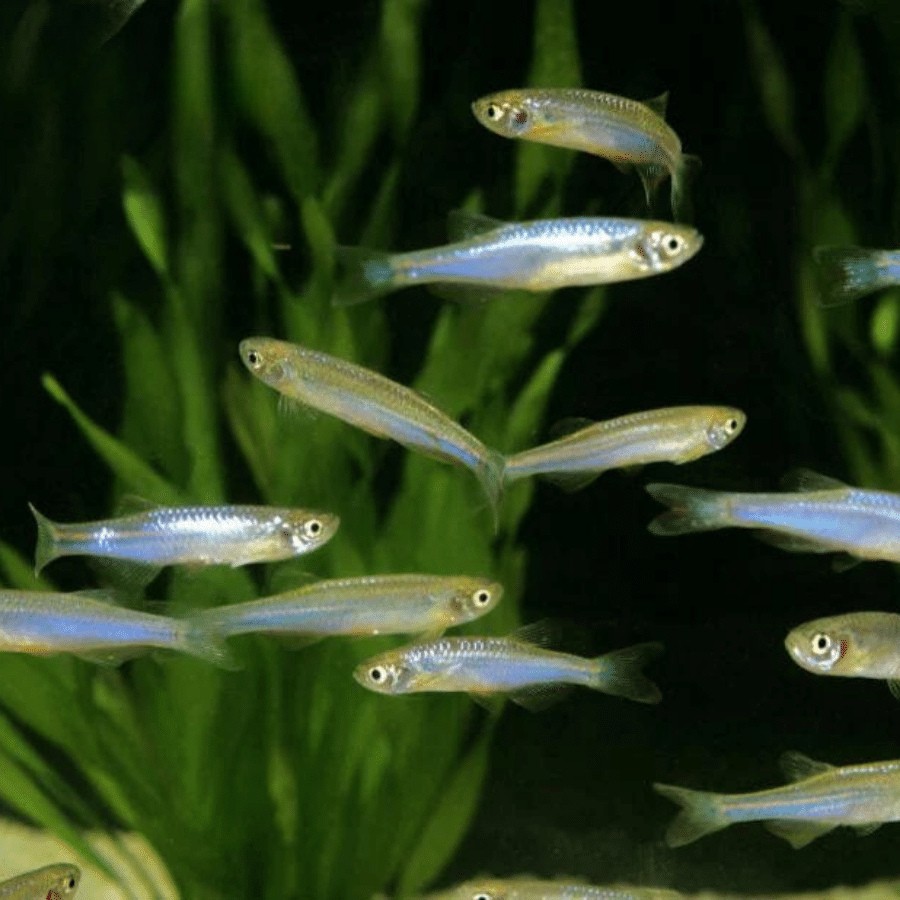
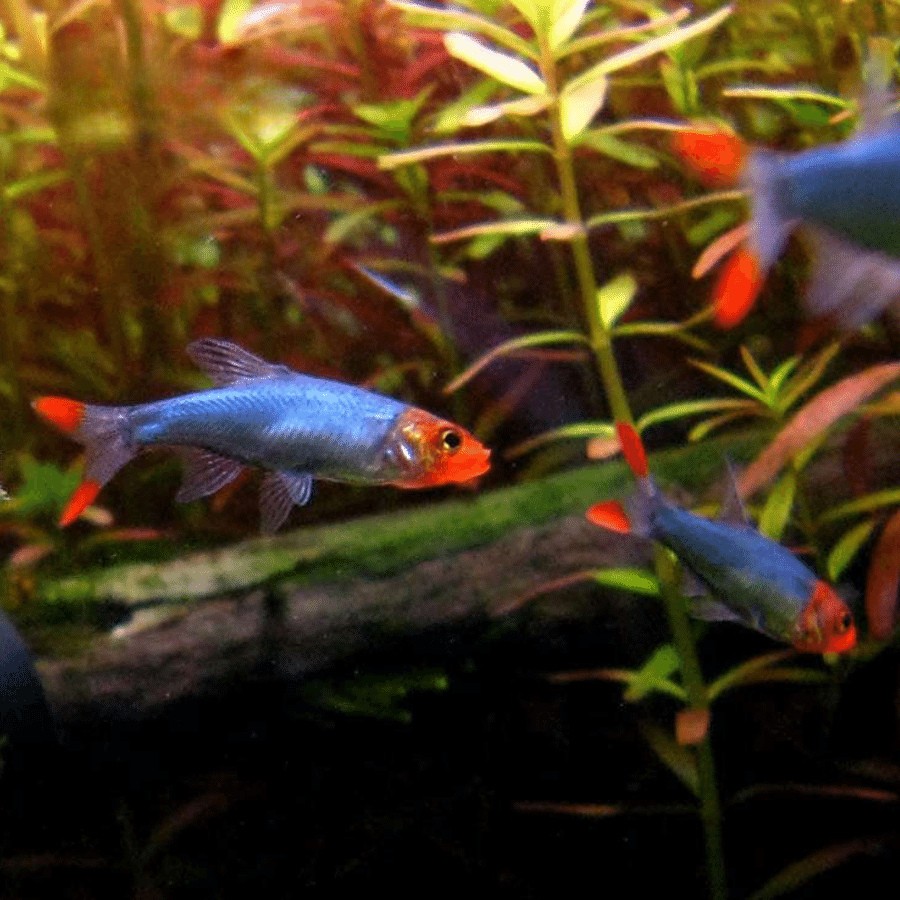
The name Emerald Eye Rasbora is unusually literal, and it describes the single feature that distinguishes this otherwise understated fish from every other silvery cyprinid on the market. The iris of a healthy adult Brevibora dorsiocellata is not merely coloured — it is structurally iridescent, and in the right light it glows a vivid, almost fluorescent emerald green. From the side the fish looks like a modest silver torpedo with a dark spot on the dorsal fin; from the front, or when the fish turns and the light catches the eye at the right angle, a pair of tiny green lamps seem to switch on. Multiply that moment across an entire school drifting through a shaded planted tank and the effect is genuinely striking, far more than any photograph conveys. It is the sort of fish whose appeal you only understand properly once you have kept it — and once you have, it becomes very difficult to go back to fish whose colour lives entirely on the body.
The other common name you will encounter in the older literature is Ocellated Rasbora or Spot-Fin Rasbora, and that name refers to the second diagnostic feature of the species: a crisp black ocellated spot — a dark centre ringed by a paler halo — set on the leading edge of the dorsal fin. The Latin species epithet dorsiocellata comes directly from this feature, with dorsi referring to the back and ocellata meaning ‘with a little eye’, a reference to the eye-like marking on the fin. Read the specific name alongside the trade name and you have two complementary descriptors: emerald-iris eye in the head, and dark ocellated eyespot on the dorsal fin. One fish, two ‘eyes’. Names in this family of cyprinids tend to wander — you will sometimes see this species listed under its older name Rasbora dorsiocellata, or even under the colloquial ‘Hi-Spot Rasbora’ in vintage hobby books — but the fish itself has been stable and the identifying features are unmistakable once you know what to look for.
The genus Brevibora itself is a relatively recent creation. For most of the twentieth century this species and a handful of relatives sat uncomfortably inside the sprawling catch-all genus Rasbora, where roughly eighty described species jostled together despite clear anatomical and genetic differences. In 2010, Liao, Kullander and Fang published a major revisionary paper on the Southeast Asian rasborine cyprinids, in which they erected several new genera — among them Brevibora, a small genus defined by specific anatomical traits of the jaw, fin rays and skeletal morphology. Under that revision, Rasbora dorsiocellata became Brevibora dorsiocellata, and a closely related species described the same year, Brevibora cheeya, was added as the only other described member of the genus. As of this writing the two species make up the entirety of the genus, though ichthyologists familiar with Southeast Asian blackwater habitats suspect additional undescribed Brevibora populations exist in remote peat-swamp systems that have not yet been formally surveyed. If you buy a fish today sold as ‘Emerald Eye Rasbora’ from a reputable Australian importer, it is almost certainly Brevibora dorsiocellata — but stock lists that still carry the old Rasbora dorsiocellata label are referring to exactly the same animal.
Understanding the Brevibora story matters beyond academic curiosity, because it tells you what kind of fish you are actually buying. Brevibora are not generic rasboras. They are a small, tightly-defined genus of slow-water, soft-water, forest-stream fish from the peat-swamp ecosystems of the Malay Peninsula and the Greater Sunda Islands. Those habitats are genuinely special — shaded, tannin-stained, oxygen-variable, mineral-poor systems that have shaped the biology of the species that live in them. Recognising that your Emerald Eye Rasbora comes from a peat-swamp lineage rather than from a hard-water Indian river (like some of the old ‘scissortail’ rasboras) immediately tells you which direction to push your aquarium chemistry, your aquascape and your tank mates. We will return to this throughout the guide, but keep it in mind as a navigation point: Brevibora dorsiocellata is a blackwater fish at heart, and every decision you make about its husbandry should be weighed against whether it recreates or violates that origin.
Visual Varieties
💚 Wild-Type Brevibora dorsiocellata
The standard and only commonly traded form: silver body with faint yellow undertone, emerald-green iris, crisp black ocellated spot on the leading dorsal fin, subtly darker caudal base.
🟡 Brevibora cheeya
The only other described species in the genus (Kottelat, 2011) from Malaysian peat swamps: similar silver body but carries a stronger lateral dark stripe and lacks the prominent emerald iris — easy to distinguish if you know to look.
Unlike the neon tetra, the guppy, or the endler, Brevibora dorsiocellata has not been subjected to generations of line-breeding for alternative colour morphs. The fish you see in a shop tank is effectively what Peninsular Malaysian and Sumatran peat swamps have always produced — a wild-type form that varies only subtly from one geographic population to another. In practical terms, you will not encounter ‘Gold’, ‘Albino’, or ‘Super Red’ Emerald Eye Rasboras in the legitimate trade; claims to the contrary almost always indicate mis-identification with another species, or rare colour aberrations that have not been stabilised into true varieties. This is the honest reality of the group: only one form is farmed at scale, and it is the wild-type form.
That said, the perceived brilliance of any given group varies dramatically with husbandry, and the difference between a dull shop specimen and a spectacular settled adult in a mature blackwater tank is genuinely startling. Three factors explain almost all of that variation. First, the tank background: on pale substrates under bright light, the fish washes out to a flat silver and the iris barely registers. On dark substrate under subdued, tannin-tinted light, the body takes on a soft pearlescent sheen and the iris flashes visibly green with every turn of the head. Second, the shoal size: a group of five or six fish behaves as stressed individuals, colour-muted and constantly wary, while a group of fifteen to twenty settles into relaxed mid-water schooling and each fish brightens accordingly. Third, the water chemistry: slightly acidic, soft, tannin-stained water brings out what biologists call ‘pigment assertion’ — fish in their preferred chemistry simply display more vividly than fish tolerating harder or more alkaline conditions. None of these factors is expensive; all of them are free once you understand them.
The genus Brevibora is small enough that there is really only one other species you may encounter: Brevibora cheeya, described formally in 2011 by Kottelat, also from Peninsular Malaysian peat swamps. B. cheeya is subtly but visibly different from B. dorsiocellata — slimmer body, stronger lateral dark band running along the flank from gill to caudal base, and crucially a less prominent emerald iris. In the rare case that a shipment contains mixed individuals, a quick comparison of the lateral stripe (prominent in cheeya, faint or absent in dorsiocellata) and the iris (dull in cheeya, vivid emerald in dorsiocellata) will sort them reliably. For ninety-nine percent of Australian buyers, however, this is academic — almost all imported ‘Emerald Eye Rasbora’ in this market are true B. dorsiocellata, and the question only becomes relevant if you are sourcing from specialist wild-caught importers.
One final note on colour perception. The emerald iris is a structural iridescent effect, not a pigment, which means its apparent brightness depends strongly on viewing angle. From directly in front, or when the fish banks into a turn, the iris lights up dramatically; from a direct side-on view, it can look like a simple dark eye. This is normal and not a sign of ill health. A tank positioned so that the main viewing angle is roughly perpendicular to the back glass, with the fish naturally turning as they school, gives you a near-constant flicker of green iris flashes across the group — which is, frankly, the entire point of buying this fish. Plan the tank layout around that viewing geometry and the species will reward you every time you sit down in front of it.
Spot the Difference: Male & Female
Sexing Brevibora dorsiocellata is subtle work but not difficult once the fish are settled into a home aquarium and well conditioned. Both sexes share the same base colouration, the same iris brilliance and the same dorsal spot, and in a shop tank — where fish are usually under a year old, stressed from shipping and swimming fast — sexing by eye is effectively a coin flip. The cues listed in the table above become usable only once the fish have been in your tank for a few weeks, have reached mature size, and are being viewed during calm feeding periods rather than during chase-and-dart behaviour.
The single most reliable cue by a clear margin is body shape viewed from directly above. Mature females, especially after a week of heavy feeding on frozen bloodworm or live daphnia, develop a clearly rounded abdomen that is visible from above in a way no lateral view captures. Males remain pencil-straight in dorsal outline even when well fed. If you can position yourself to look down into the tank during a feeding session — a bright morning hour, with the fish well-conditioned — the difference between the sexes becomes obvious within a minute or two of observation. From a side-on view, both sexes can appear surprisingly similar, because the flanks and dorsal profile overlap considerably between slender females and heavier males. Always sex Brevibora from above if you can.
A secondary cue, useful in confirmation rather than primary identification, is the sharpness of the dorsal ocellated spot. In dominant, well-conditioned males, the spot is crisp, well-defined, with a clearly visible paler halo around the black centre — a tiny bullseye. In females, the spot is unmistakeably present but its outline can look a shade softer and the halo less precisely resolved. This is a subtle difference and should never be used as the sole criterion, but it supports the body-shape cue nicely in a mature, settled group.
If you are buying specifically to breed, the practical recommendation is the same as for every weakly-dimorphic schooler: buy a large group and let the tank reveal pairs over time. A purchase of ten to fifteen fish statistically guarantees a workable sex ratio without requiring you to sex individuals at the store, and the larger group also triggers better conditioning, tighter schooling, and more natural spawning behaviour. Trying to hand-pick four guaranteed pairs from a tank of forty juveniles is not a strategy; it is a gamble. Invest in the school and let biology sort it out.
| Feature | Male | Female |
|---|---|---|
| Body Shape | Slender, narrow, straight-sided from behind the gills to the caudal peduncle | Fuller, noticeably deeper-bodied, with a visibly rounder belly when conditioned |
| Size at Maturity | 4.0-4.5 cm — slightly smaller and finer | 4.5-5.0 cm — marginally larger and heavier |
| Colour Intensity | Flank silver with a slightly brighter lustre; iris green tends to be a shade more saturated | Slightly paler overall; belly often looks a little more translucent when empty |
| Dorsal Spot | Sharp, well-defined black ocellated spot | Spot present but may appear fractionally softer at the edges |
| Abdominal Profile | Straight-bellied profile even when well fed | Distinctly rounded belly when conditioned on live and frozen foods |
Water Quality Requirements
5.5–7.5
ideal 6.5
22–27 °C
ideal 25 °C
1–8 dGH
Soft water strongly preferred; very soft to moderately soft is ideal
In the wild, Brevibora dorsiocellata lives in slow peat-swamp water where pH routinely measures below 6.0, dissolved minerals are very low, and the water is tinted deeply with tannins from decomposing leaves and roots. The species tolerates a genuinely broad parameter range in captivity — pH 5.5 to 7.5 is all workable, and temperatures between 22 and 27 degrees Celsius are all accepted — but tolerance is not the same as thriving. The fish colours up, schools tightly, and breeds reliably only when conditions sit toward the soft and slightly acidic end of its range. If your local tap water runs hard and alkaline, as much Australian water does outside of a few specific catchments, you will need to plan for this rather than ignore it. The two sensible strategies are dilution and biological acidification.
Dilution means mixing a percentage of RO water (reverse-osmosis, available from aquarium shops or produced at home with a unit) into your tap water to bring hardness down. A fifty-fifty blend of RO and Melbourne or Sydney tap water typically lands you in an acceptable hardness range (3-5 dGH) and reduces alkaline buffering enough that additional acidification can move pH into range. Biological acidification means allowing leaf litter, alder cones, Indian almond leaves, peat fibre and driftwood to steadily release tannins and humic acids into the water column, gently and sustainably lowering pH over days and weeks. Used together, the two approaches can take hard, alkaline tap water and convert it into an ideal Brevibora tank almost without chemical additives. What you should not do is chase parameters with pH-down bottles or phosphate buffers — the rebound swings are worse for the fish than the starting conditions, and every swing stresses them.
Stability matters more than hitting a perfect target. A pH that sits steady at 7.2 is better than a pH that swings from 6.2 to 7.0 every water change. Perform small, frequent water changes — 20 percent weekly is ideal for a well-stocked tank — and match new water to tank temperature within one degree. Mineralise your RO blend with a trace mineral salt if you are running soft water, because zero-TDS water stresses fish just as surely as excessively hard water does. Aim for conductivity in the 80 to 200 microsiemens range; that is the rough window that replicates the softness of natural peat-swamp water while still supporting healthy fish biology.
Acclimation is where most new-arrival losses occur with this species. Brevibora dorsiocellata typically arrives in shipping water that is much softer, much more acidic and much more tannic than Australian tap water. Dropping the fish straight into a new tank even within their tolerated pH and hardness range is a recipe for pH shock, because the chemistry change is abrupt. Use a slow drip-acclimation method: float the sealed bag for fifteen minutes to equalise temperature, transfer the fish and shipping water into a clean bucket or tub, then set up a siphon drip from the destination tank at roughly two drops per second. Over the course of sixty to ninety minutes, the shipping water should double or triple in volume and should now be chemically close to the destination tank. Net the fish across (never pour the shipping water into the tank — it may contain ammonia from transit), and dim the tank light for the first evening. Done this way, losses in the first week are almost always zero. Done the ‘float and dump’ way, losses of two or three fish out of a group of ten are distressingly common.
Temperature sits in a comfortable middle band — 22 to 27 C — with 25 C as the ideal sweet spot for daily life and 26 C a reasonable setpoint if you intend to trigger breeding behaviour. Avoid sustained spells above 28 C, because warmer water holds less dissolved oxygen and Brevibora dorsiocellata are moderate rather than strong swimmers. If your room reaches the high twenties during an Australian summer, run a small fan gently across the water surface; two to three degrees of evaporative cooling is plenty and costs almost nothing. Never spot-cool with ice cubes or chilled water changes; thermal shock is far worse than moderate warmth.
Tank Requirements & Layout
The Emerald Eye Rasbora is a fish whose appearance and behaviour transform completely with the tank you put it in, so the setup is not a cosmetic choice — it is a husbandry decision. The goal is a densely planted, dimly lit tank with dark substrate, tannin-tinted water, floating cover overhead, and clear mid-water swimming space. A 60-litre tank is the realistic minimum for a well-shoaling group of eight or ten adult fish; step up to 90 or 120 litres if you want the luxury of a twenty-strong school or intend to combine the species with compatible tank mates like pygmy corydoras, amanos, or peaceful gouramis. Anything under 60 litres begins to constrain the school’s lateral swimming room, and a constrained school is a muted school — the fish drop colour, pull tight against cover, and lose the very behaviour you bought them for.
Start with a fine dark substrate. Black aquasoil is my recommendation both for colour contrast and because it mildly acidifies the water column through the first three or four months of its life; fine black sand is an acceptable alternative if you prefer an inert substrate. Cover sixty to seventy percent of the tank footprint with plants — stem plants like Rotala rotundifolia, Ludwigia arcuata, Cabomba furcata and Limnophila sessiliflora along the back and sides, and mid-ground epiphytes like Anubias nana, Bucephalandra and narrow-leaf Java fern attached to driftwood. Crucially, add floating plants: Amazon frogbit, red root floaters, Salvinia natans or a mat of duckweed mix are all excellent choices. Floating cover is effectively mandatory for this species — it diffuses overhead lighting, simulates the forest canopy of peat-swamp habitat, and gives the school the sense of overhead shelter that triggers open mid-water swimming rather than permanent hiding behind structure.
Driftwood provides the next layer. A good piece of spiderwood or two pieces of jati root, arranged to create caves, overhangs and shaded mid-water zones, dramatically improves the visual space the school actually uses. Drape moss over the wood — Christmas moss, Java moss, or weeping moss all work — and let it grow in naturally. Add a generous rather than token layer of Indian almond leaves, magnolia leaves, oak leaves, or alder cones scattered across the substrate. These botanicals are not decoration; they are integral to water chemistry and the microfauna food web that supports fry and keeps biological filtration robust. A tank that looks ‘messy’ with softening leaves is a tank doing its job correctly.
Lighting should be moderate and dimmable. A nano or planted-tank LED with a warm-leaning colour spectrum running at 30 to 50 percent intensity for six to eight hours a day is more than sufficient. Overlighting a Brevibora dorsiocellata tank is one of the most common new-keeper mistakes — strong light destroys the shaded, contemplative feel of a blackwater aquarium, makes the fish appear dull even when they are in perfect health, and drives algae blooms that are hard to reverse. If in doubt, err toward dimmer; the plants listed above tolerate low light perfectly well, and the fish will colour up correspondingly.
Think about water flow the way you would think about breeze through a shaded forest: present, but gentle. A sponge filter rated for roughly twice tank volume per hour is ideal for a 60-litre tank — enough turnover to keep biology stable without pushing the fish around. If you use a hang-on-back or canister, reduce the output with a spray bar, a pre-filter sponge on the intake, or a lily pipe set low so that surface movement is a subtle rippling glitter rather than directional current. Observe the floating plants: if they pile consistently at one end of the tank, the flow is too strong; if they sit immobile for hours, the flow is slightly too weak. Gentle, living movement of the floaters is a good proxy for appropriate flow.
The aquascape aesthetic that suits this species best is the ‘aged blackwater’ or ‘botanical’ look — dark substrate, dense stem-plant thickets, visible leaf litter carpet, moss-covered driftwood, and amber-tinted water. It is deliberately the opposite of the clean, pristine, Dutch or Iwagumi style that dominates social media aquascaping, and it requires a mental adjustment for keepers used to celebrating sparkle and clarity. The softening leaves, the tannin haze, the biofilm on driftwood — these are not failure states. They are the chemistry and microfauna ecosystem that the fish actually evolved with, and once the tank matures, the visual effect is deep, layered and genuinely calming. Resist the urge to gravel-vac leaf litter, scrub off biofilm, or run activated carbon to clear the tint. Your fish will tell you whether the tank is working, and the answer will be unambiguous: bright iris, tight schooling, steady appetite.
One more specific layout tip for shoaling visibility. Brevibora dorsiocellata tends to drift in the middle third of the water column, so the mid-water space is where you want the most open, unobstructed swimming room. Push the tallest plants against the back glass, place wood and epiphytes along the sides, keep the mid-ground open or planted only with short foreground carpets like Hydrocotyle tripartita mini or Eleocharis parvula, and angle the substrate deeper at the back to create visual depth. The resulting tank forms a natural viewing funnel, drawing the eye into the school, and the fish will happily use that open stage.
Tank
Minimum 60 L (15 gal) for a school of 8+; 90-120 L recommended for 15-20 fish or a blackwater community
Filter
Sponge filter driven by air pump (ideal) or baffled HOB / small canister with spray bar — gentle flow is essential
Heater
50-100 W adjustable heater; set to 25 C. Use an external digital thermometer to verify calibration
Lighting
Moderate, dimmable LED at 30-50 percent intensity. Six-to-eight-hour photoperiod. Always pair with floating plants
Substrate
Fine black aquasoil or dark sand — both improve colour contrast and (for aquasoil) help mildly acidify the water column
Plants
Stem plants (Rotala, Ludwigia, Cabomba) dense at back/sides; epiphytes on driftwood; floating plants mandatory
Botanicals
Indian almond leaves, alder cones, magnolia leaves, cholla wood — replenish as they decompose over weeks
Driftwood
Spiderwood or jati root for vertical/horizontal structure, moss attachment, and shaded mid-water zones
Test Kit
Liquid kit covering ammonia, nitrite, nitrate, pH and KH — strips are not accurate enough for a blackwater nano tank
Feeding Schedule & Diet
Brevibora dorsiocellata is a genuinely easy fish to feed. Unlike the strictest micro-carnivores of the nano world, this species is a straightforward micro-omnivore — in the wild it eats small insect larvae, zooplankton, crustaceans, algae, and organic detritus from the leaf litter zone, and in captivity it will enthusiastically accept almost any appropriately sized prepared food. The mouth is small but not tiny; a 4cm adult can comfortably take standard aquarium flake crushed lightly between the fingers, micro-pellets of 0.5 to 1.0 mm, and most frozen foods without difficulty. You do not need specialist nano-carnivore products for this species the way you do for some of its smaller cousins.
Build the staple diet around a high-quality flake or a small pellet (roughly 1 mm granule size). Look for products whose first ingredient is whole fish meal, shrimp meal, insect meal, or krill — avoid products that lead with wheat flour or soy flour. Supplement at least three times a week with frozen foods: daphnia, cyclops, bloodworm (yes — the larger 4cm adults take bloodworm readily, unlike the smaller Microdevario species), and baby brine shrimp are all eagerly accepted and nutritionally far more complete than any dry food. Live baby brine shrimp once or twice a week transforms both body condition and breeding readiness; if you keep a small hatching cone, Brevibora dorsiocellata is one of the species that benefits most. Feed two small meals per day rather than one large one — the fish have modestly sized stomachs and quickly overload, and uneaten food in a 60-litre tank becomes an ammonia source faster than many new keepers expect.
Watch the fish during feeding. These are polite eaters, not gluttons, but they lose interest in food after thirty to forty seconds of active consumption. If flake or frozen portions are still floating or settling after a minute, you have overfed. Remove the excess with a pipette, reduce the next portion, and recalibrate. A well-fed group should clear the surface and most of the water column of food within thirty seconds, then drift back into school formation for the next half hour.
A few specific food products have strong user acceptance in Australian keeping experience. Hikari Micro Wafers and Sera Vipan flake (crushed) are two reliable staples that Brevibora dorsiocellata eagerly accepts. For pellets, New Life Spectrum Small Fish Formula 0.5mm pellets are excellent — colour-enhancing, well-digested, and sized perfectly for an adult Emerald Eye. Among frozen foods, bloodworm (one of the few ‘treats’ this species is large enough to enjoy), daphnia, and cyclops all rank highly; feed bloodworm sparingly, once or twice a week, because it is high-fat and can contribute to digestive sluggishness in larger doses. Freeze-dried tubifex and daphnia are acceptable alternatives if you lack a freezer — always rehydrate them in tank water before dropping in, because dry freeze-dried food expands in the digestive tract and has been associated with swim-bladder issues in sensitive species.
If the tank also houses shrimp, snails, or corydoras, a brief note on cross-feeding applies. Amano and cherry shrimp will happily clean up leftover flake or frozen food that reaches the substrate, which helps waste management — but do not size Brevibora feedings expecting the shrimp to ‘take care of the extra’. Feed the rasboras only as much as they can eat in thirty seconds and let the shrimp graze on biofilm and detritus for the rest. Pygmy corydoras will also appreciate a small sinking micro-wafer dropped at a different end of the tank in the evening, which prevents competition with the upper-water school at mealtime. Well-designed community feeding is a layered event: surface feeds for the rasboras, mid-water frozen for everyone, and sinking wafers for the bottom dwellers. Mix those three timings across the week and everyone eats without conflict.
Breeding in Captivity
Week -2 to -1
Conditioning the Shoal
Heavy feeding of live and frozen foods on the main tank
Day 0
Breeding Tank Setup
Prepare a dedicated 20-40 L tank with very soft water, java moss, and dim light
Day 1-2
Introducing the Spawners
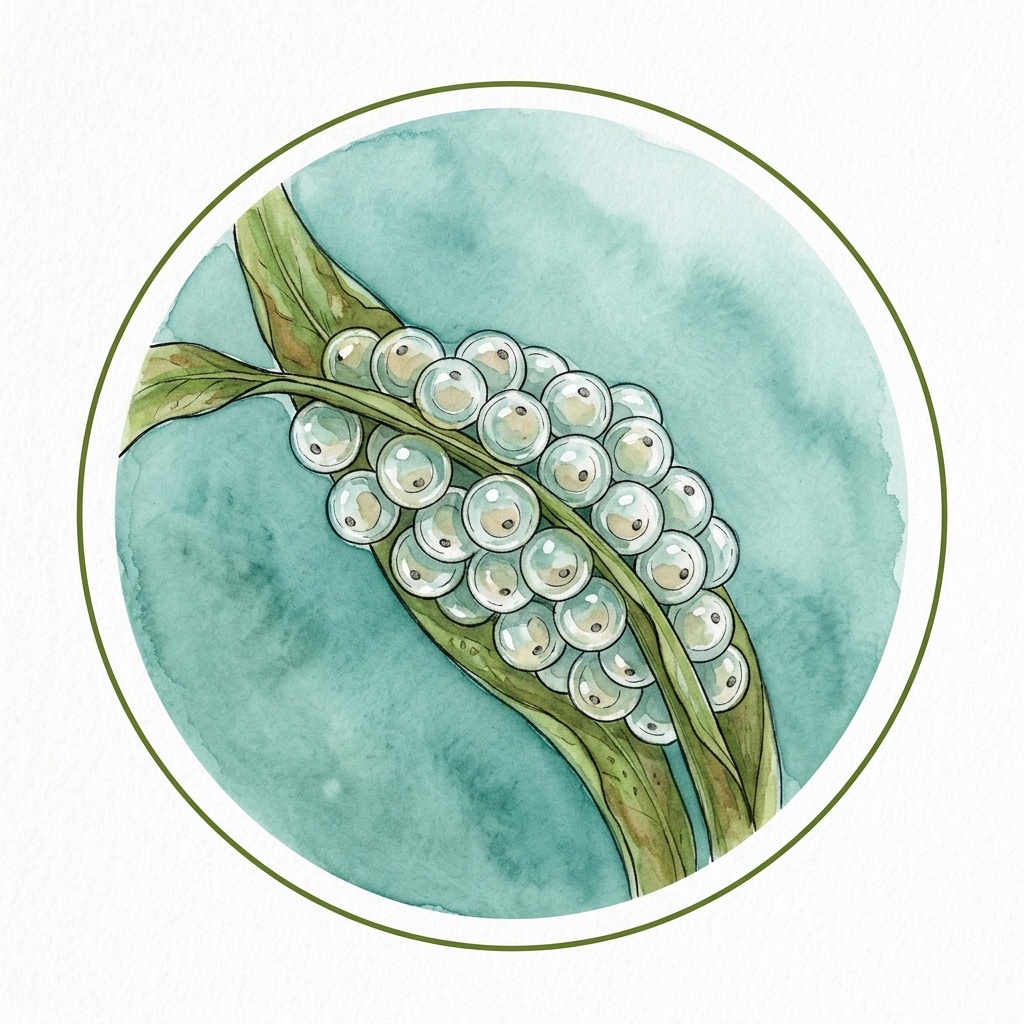
Move 2-3 males and 3-4 females into the breeding tank at dusk
Day 2
Removing the Parents
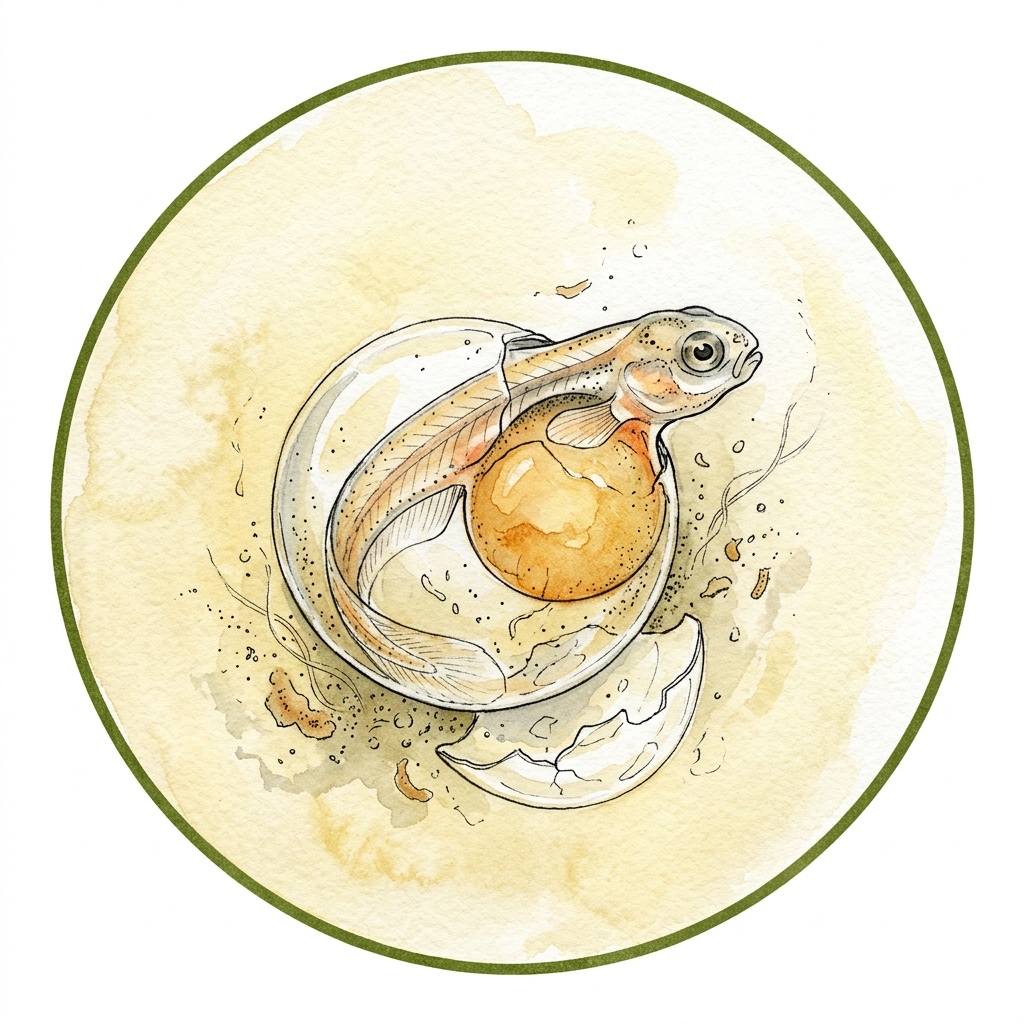
As soon as visible scattering behaviour stops, move adults back to the main tank
Day 2-4
Incubation and Hatching
Keep dim and stable; fry hatch 36-60 hours after spawning
Day 5-14
Free-Swimming Fry
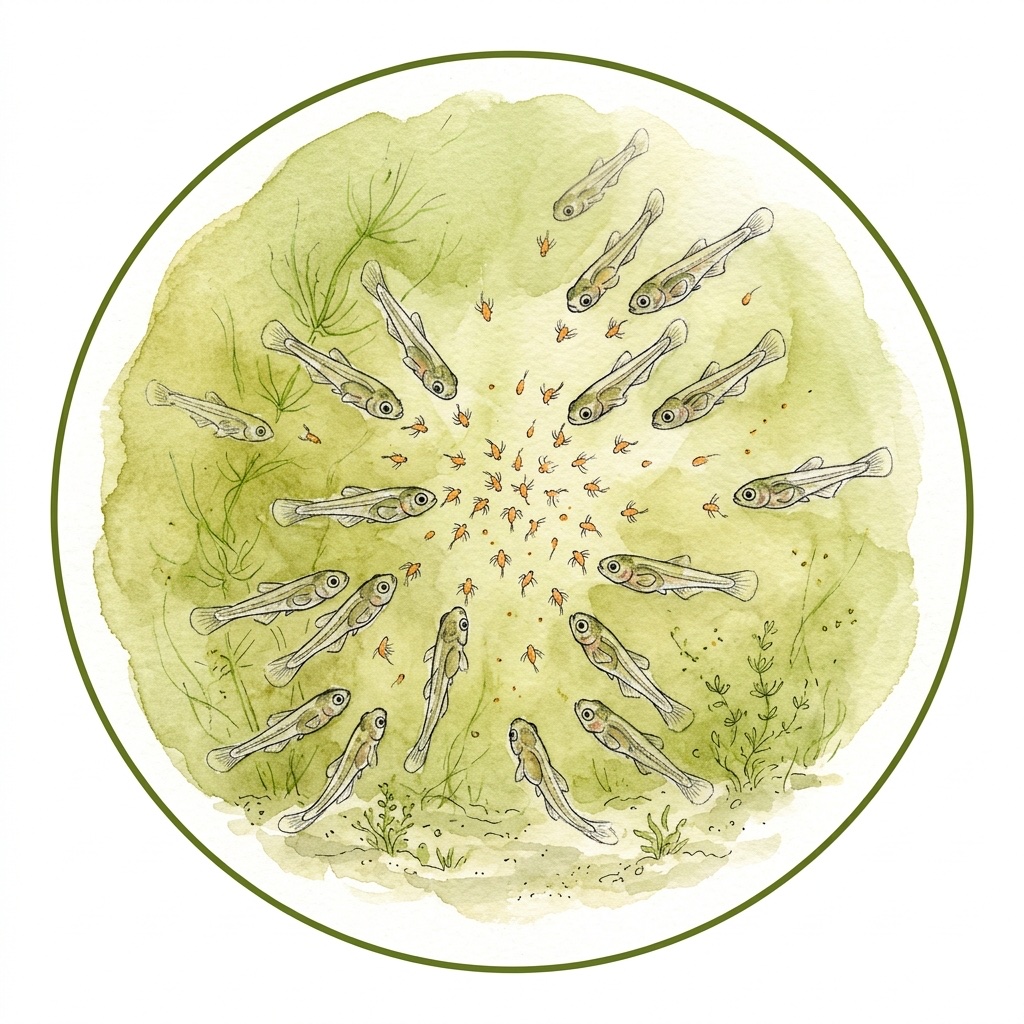
Begin feeding infusoria, then microworms and baby brine shrimp
Conditioning the Shoal
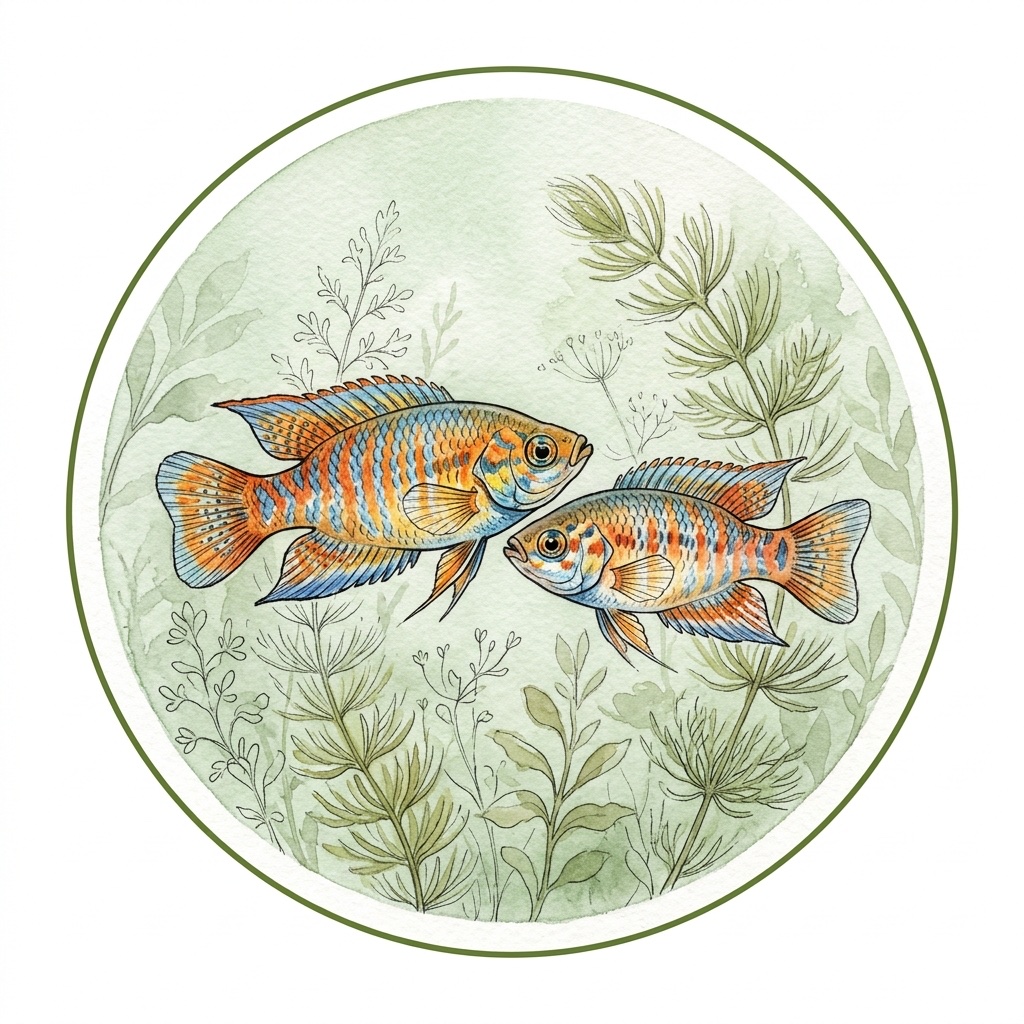
Breeding attempts with Brevibora dorsiocellata begin well before any dedicated breeding tank is set up. For two weeks, feed the main shoal more generously than normal, focusing on live baby brine shrimp, live daphnia, frozen bloodworm and frozen cyclops. Keep the staple flake or pellet schedule going, but push protein and fat intake up. Within seven to ten days the best-conditioned females will show visibly fuller bellies when viewed from above — this is the single most reliable sexing cue in the species and also the clearest indicator that conditioning has been successful. Do not skip this phase; spawning attempts on under-conditioned fish are the main reason home breeding attempts fail with Brevibora.
Breeding Tank Setup
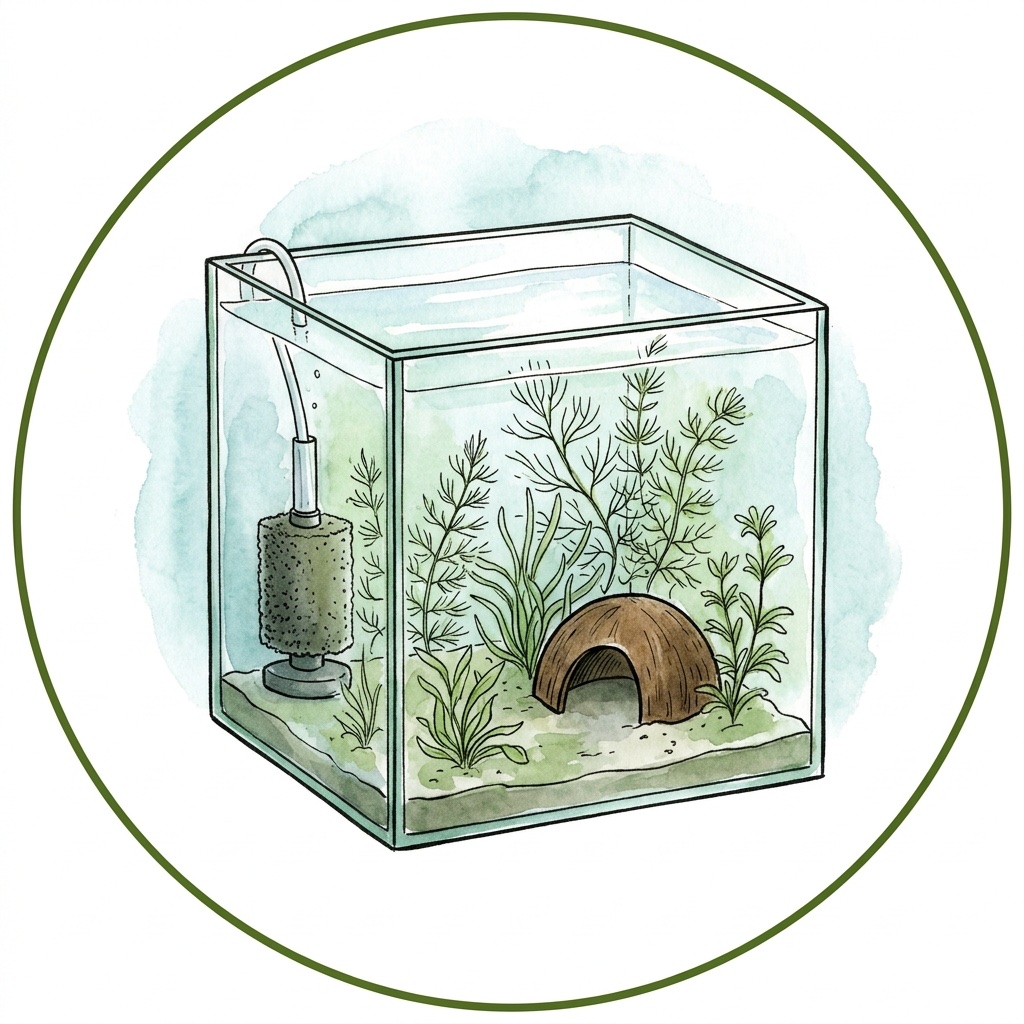
Set up a small bare-bottom breeding tank of 20 to 40 litres. Fill it with very soft water — either 100 percent RO water lightly mineralised with a trace mineral supplement, or tank water blended heavily with RO to drop hardness below 3 dGH. Aim for pH 6.0 and temperature 26 C (slightly warmer than the display tank to encourage spawning). Drop a generous handful of java moss across the bottom — this is the egg catchment and fry hideout — along with a small clump of spawning mop or peat fibre for redundancy. Light the tank dimly, either with a single shaded LED at low output or from ambient room light alone. Fit a tiny sponge filter that has been cycled in advance on the main tank so that biological filtration is in place from day one.
Introducing the Spawners
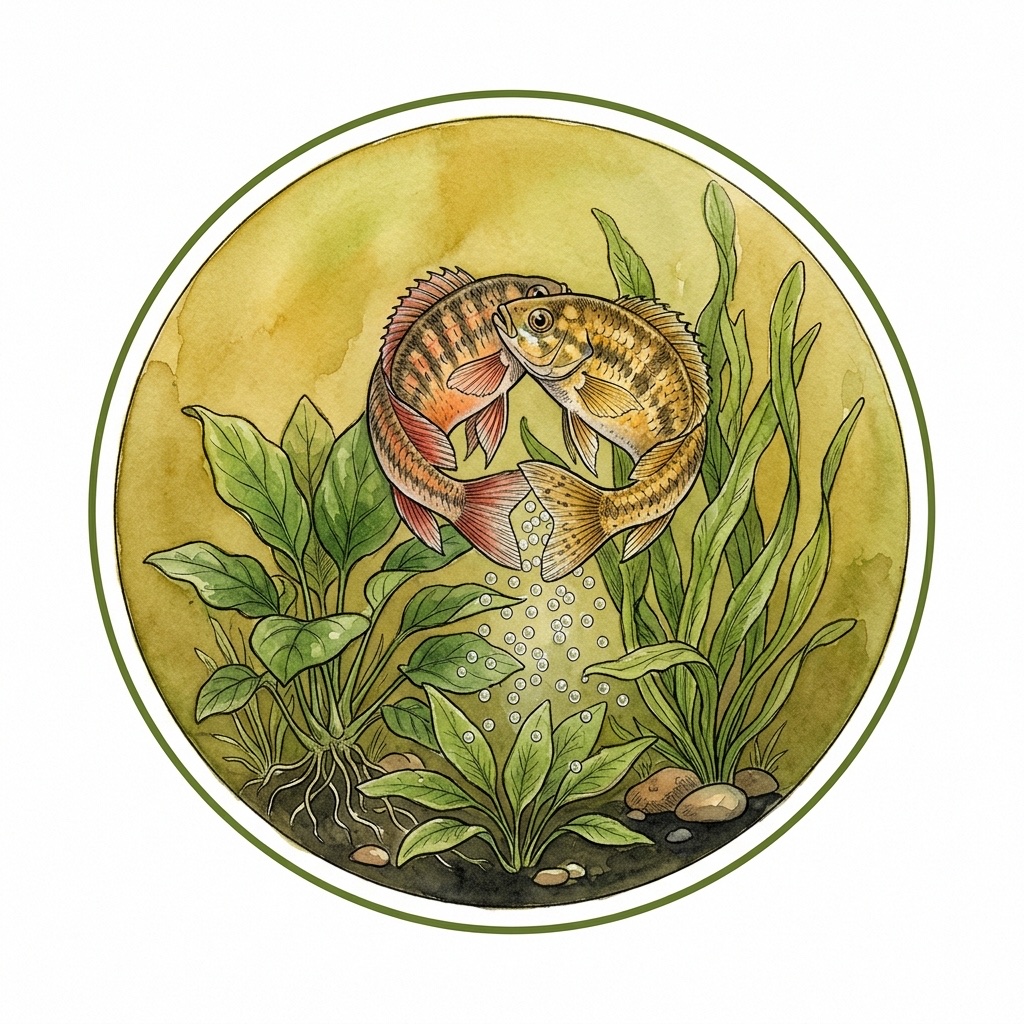
Catch a small group of clearly conditioned fish — two or three slender, active males and three or four round-bellied females — and move them into the breeding tank in the evening. Spawning typically begins at dawn the following morning, triggered by first light. Males dart at females through the moss and mops, and females scatter small clutches of eggs a few at a time, ultimately depositing between a hundred and three hundred eggs across multiple passes over a single morning. The eggs are tiny, translucent and non-adhesive; they fall through the moss to the bare glass below, where the adults cannot easily reach them.
Removing the Parents
Brevibora dorsiocellata, like most egg-scatterers, are enthusiastic egg-eaters. As soon as spawning behaviour has clearly ended — typically by mid-morning of the spawn day — net the adults out and return them to the main tank. Do not leave them overnight; even well-fed adults will clean up a substantial fraction of their own eggs given the chance, and a half-day delay costs you the majority of the spawn. The eggs should now be invisible to you among the moss and on the bare bottom, which is fine. Resist the urge to disturb the tank searching for them.
Incubation and Hatching
Keep the breeding tank dim and undisturbed. Eggs hatch between 36 and 60 hours depending on temperature, and the newly emerged fry are transparent slivers that cling to plant surfaces and glass while they absorb their yolk sacs. At this stage they look like tiny splinters of glass and are only visible when they move. Do not feed them yet — the yolk sac supports them for two to three more days. Gently pipette out any eggs that have turned opaque white; these are infertile and will quickly fungus if left in place, potentially contaminating viable eggs nearby.
Free-Swimming Fry
Around day five to seven, the fry become free-swimming and begin searching actively for food in the mid-water. Start with infusoria or commercial liquid fry food for the first three or four days, because Brevibora dorsiocellata fry are too small to immediately take newly hatched brine shrimp. By day ten, most will be large enough to accept freshly hatched baby brine shrimp, at which point growth accelerates visibly. Perform tiny water changes (10 percent, drip-fed slowly) every three to four days to manage waste without stressing the fry. Juveniles show their first hint of body silver at around three weeks and the emerald iris begins to develop at around six to eight weeks. They are ready to move to the main tank at roughly three months old, when they approach 2 cm in length and can hold their own in a community context.
Choosing Tank Mates
Brevibora dorsiocellata is one of the more versatile peaceful mid-water fish in the hobby, and that versatility is a real selling point — it fits cleanly into a very broad range of peaceful community setups as long as two constraints are respected. First, nothing in the tank should have a mouth wide enough to easily swallow a 4 to 5 cm fish. Second, nothing should be aggressively faster at feeding time or physically intimidating in the mid-water zone. Within those boundaries, the Emerald Eye Rasbora thrives alongside a genuinely wide selection of community partners, and unlike more demanding nano species it does not require an exclusively miniature tank to work.
A textbook peaceful community built around this species might look like: ten to fifteen Brevibora dorsiocellata in the mid-water, six to eight Corydoras pygmaeus working the substrate, a pair of honey gouramis as gentle centrepiece fish, a small cleanup crew of amano shrimp, and a trio of otocinclus handling algae duty on plant leaves. That arrangement is genuinely peaceful, visually layered across every water column zone, and sustainable in a 90 to 120-litre blackwater tank for years with minimal intervention. The Emerald Eyes in the mid-water provide the primary visual event — the schooling motion, the emerald iris flashes, the tight turning formations — while the other species add the textured background of a living biotope.
Keep the primary Brevibora shoal no smaller than eight fish. Ideally, aim for twelve to twenty. At six fish or fewer, schools tend to fragment, colour fades, and the fish spend most of their time hovering near cover rather than displaying the open-swimming behaviour that makes the species worth buying. If you cannot commit to at least eight individuals, the honest recommendation is to buy a different species; Brevibora dorsiocellata is a school fish in the truest sense, and a small group is not the same species experience as a large group.
A few community-tank pitfalls deserve specific callouts because they recur in keeper questions. First, do not be seduced by size compatibility alone. A peaceful fish can still be a poor tank mate if it out-competes Brevibora at feeding — white cloud mountain minnows, for instance, are similar in size and famously peaceful, but they feed so fast and aggressively that they leave slower rasboras underfed in a shared tank. Second, avoid mid-water species that occupy the same swimming zone unless they are equally gentle; this rules out zebra danios, most larger tetras, and many of the faster cyprinids. Third, be cautious even with small fry-predators during breeding — dwarf chain loaches and kuhli loaches will sometimes take Brevibora eggs in a planted display tank, though they are fine companions in non-breeding setups. Fourth, do not add male bettas to a shoal tank ‘because they worked with a friend’s guppies’. Individual betta temperament varies wildly, and you are rolling dice with the lives of an expensive school.
Finally, a practical note on stocking density for this species specifically. A 60-litre tank sounds roomy for a group of 4cm fish and it is — just barely — but Brevibora dorsiocellata behaviour improves visibly as you move up to 90 or 120 litres because the lateral swimming room matters to the school. These fish want to drift across a meaningful horizontal distance, turn together, and re-form into tight formation multiple times per minute. A tank that is narrow in the long dimension forces the school to repeatedly reverse direction, which is visibly less elegant than watching them traverse a 90 cm or longer aquarium. If your budget and space permit an upgrade to a 90 to 120-litre rectangular tank, this species is one of the strongest arguments for making that move — you will notice the difference within the first week.
| Species | Why | |
|---|---|---|
| ✅ | Cardinal Tetra (Paracheirodon axelrodi) | Near-perfect mid-water companion — identical water preferences, similar peaceful temperament, matching adult size; the red-and-blue cardinal contrasts beautifully with the silver-and-green Emerald Eye |
| ✅ | Harlequin Rasbora (Trigonostigma heteromorpha) | Classic Southeast Asian mid-water shoaler from the same broad biotope; peaceful, same water preferences, and the two schools often drift loosely together |
| ✅ | Pygmy Corydoras (Corydoras pygmaeus / hastatus) | Tiny peaceful bottom shoaler that occupies the substrate zone without crowding the mid-water; loves the same soft, dim setup and adds gentle movement below the main school |
| ✅ | Sparkling Gourami (Trichopsis pumila) | A small surface/mid-water dweller that is peaceful enough for this community; the slower centrepiece complements the faster-schooling rasboras without disturbing them |
| ✅ | Honey Gourami (Trichogaster chuna) | Gentle single-pair centrepiece gourami well-suited to soft, tannin-tinted water; non-aggressive and ignores the Brevibora school |
| ✅ | Amano Shrimp (Caridina multidentata) | Large enough that adult Brevibora dorsiocellata ignore them entirely; excellent algae cleanup crew that thrives in the same gentle soft water |
| ✅ | Cherry Shrimp / Neocaridina (adults only) | Adult shrimp are ignored by the rasboras; accept that shrimplets may be picked off and treat it as a working colony rather than a pure breeding project |
| ✅ | Otocinclus vittatus / cocama | Tiny non-aggressive algae grazers that occupy plant leaves and glass; zero competition with a mid-water shoaler and identical water chemistry needs |
| ❌ | Angelfish, Discus, or any adult cichlid | Mouth size alone makes them a threat — adult angelfish and discus will regard a 4cm rasbora as prey and the shoal will never settle in that company |
| ❌ | Tiger Barb and other aggressive barbs | Notorious fin-nippers and fast feeders that out-compete Brevibora dorsiocellata for food and harass them relentlessly at mid-water; avoid absolutely |
| ❌ | Male Betta splendens | Individual temperament varies, but the risk is real — some bettas pick off small shoalers one by one, and the outcome is never recoverable once it starts |
| ❌ | Zebra or Giant Danio | Too fast, too pushy and in the case of giant danios too large — they will steal every feeding and bully the Emerald Eyes off the mid-water by sheer presence |
| ❌ | Large gouramis (pearl, blue, gold) | Adult pearl, gold and blue gouramis grow large enough to view 4cm fish as prey or harassment targets; avoid even if the individual currently seems peaceful |
Quick Reference
| Scientific Name | Brevibora dorsiocellata |
| Former Name | Rasbora dorsiocellata (reclassified 2010) |
| Common Name | Emerald Eye Rasbora / Ocellated Rasbora / Hi-Spot Rasbora |
| Adult Size | 4.0-5.0 cm |
| Lifespan | 4-6 years |
| pH | 5.5-7.5 (ideal 6.5) |
| Temperature | 22-27 C (ideal 25 C) |
| Hardness | 1-8 dGH (soft preferred) |
| Min Tank Size | 60 L for 8+ fish |
| School Size | 8+ minimum, 12-20 ideal |
| Diet | Micro-omnivore — flake, small pellet, frozen daphnia/bloodworm |
| Care Level | Easy to Intermediate |
| Temperament | Peaceful, tight-schooling |
| Tank Position | Mid-water |
| Breeding | Egg-scatterer — relatively easy at home |
| Price | $9.95 AUD |
Reviews
Clear filtersThere are no reviews yet.