The Name Behind the Legend
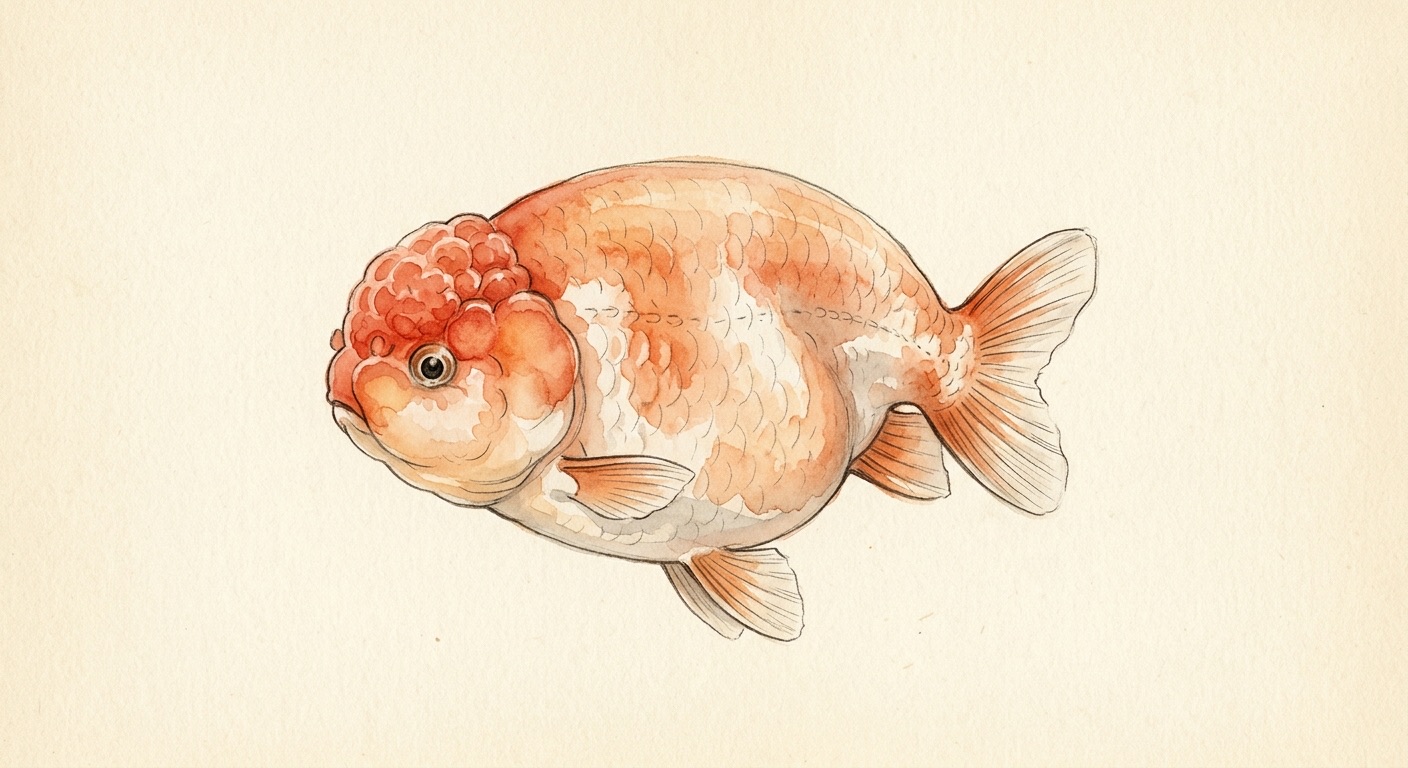
The name Ranchu (蘭鋳/蘭畴) comes from Japanese, where ran (蘭) means ‘orchid’ and chu (鋳) means ‘cast’ or ‘mould’ — literally ‘orchid cast’, reflecting the fish’s refined beauty crafted through centuries of selective breeding. The Ranchu lineage traces back to the Chinese Egg Fish (蛋種, danzhong), which arrived in Japan around the 1600s. Japanese breeders then spent over 300 years perfecting the breed, developing the distinctive head growth (wen, 肉瘤) and the rounded, humpback profile that earned the Ranchu its title as the ‘King of Goldfish’ (金魚の王様, kingyo no ōsama). Today, Ranchu competitions in Japan follow strict judging criteria established during the Meiji era, evaluating body shape, wen development, tail tuck angle, and swimming posture.
🏅 At a Glance
| Common Name | Ranchu |
| Scientific Name | Carassius auratus (Ranchu variety) |
| Origin | Japan (originally from China) |
| Adult Size | 15–20 cm |
| Lifespan | 10–15 years |
| Temperament | Peaceful, slow-swimming |
| Care Level | Intermediate |
| Viewing Style | Top-view (traditional) or Side-view |
| Diet | Omnivore — sinking pellets, frozen, live foods |
Appearance & Varieties
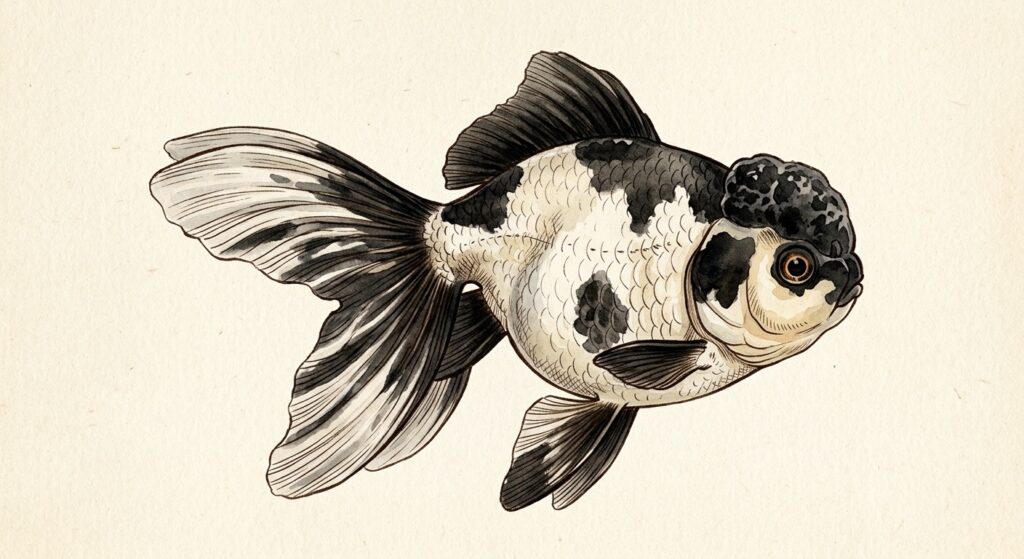
The Ranchu’s silhouette is unmistakable. Viewed from the side, the body forms a deep, egg-shaped oval with a smoothly arched back that curves from the head down to the tail peduncle without any bump, ridge, or vestige of a dorsal fin. The back profile is one of the most critical judging criteria — it should resemble a gently drawn bow, free of irregularities. The belly is full and rounded, giving the fish a solid, compact presence in the water.
The head growth, called the wen, is the Ranchu’s crowning glory. This fleshy, textured growth develops gradually over the first two to four years of the fish’s life, eventually covering the top of the head and cheeks in a symmetrical, berry-like pattern. A well-developed wen should be proportionate to the body — impressive but not so overgrown that it obstructs the fish’s vision or breathing. The texture ranges from smooth in young fish to deeply ridged and almost brain-like in mature specimens.
The tail is short, stiffly held, and tucked downward at roughly a 45-degree angle from the body. When viewed from above, the paired caudal fins should spread symmetrically, resembling an open fan or a butterfly’s wings. This compact tail, combined with the absence of a dorsal fin, gives the Ranchu its characteristic slow, waddling swim — more dignified procession than darting pursuit.
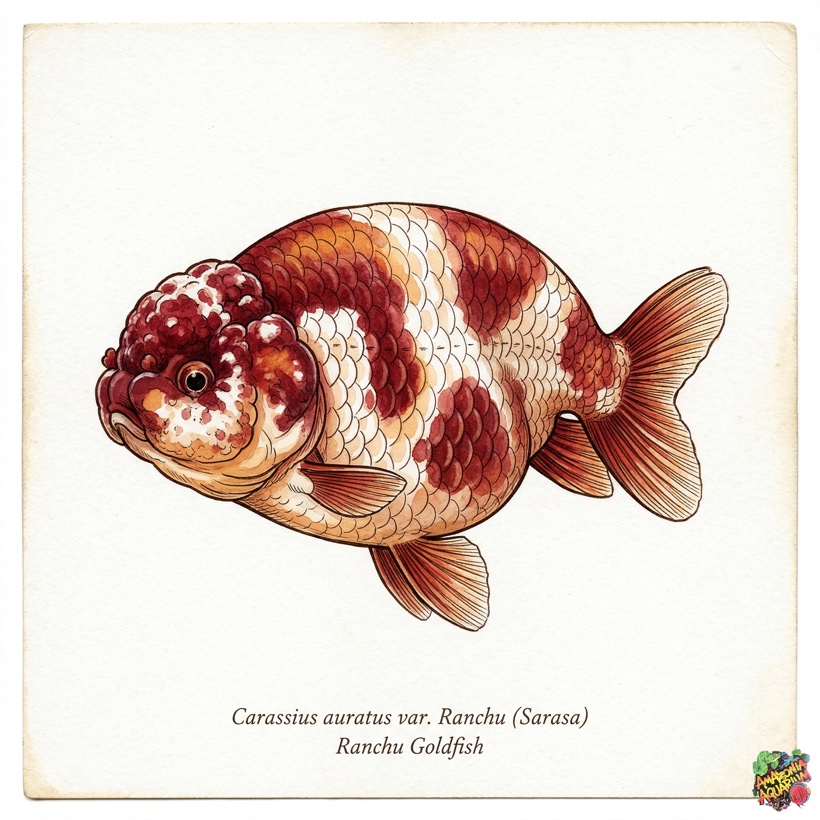
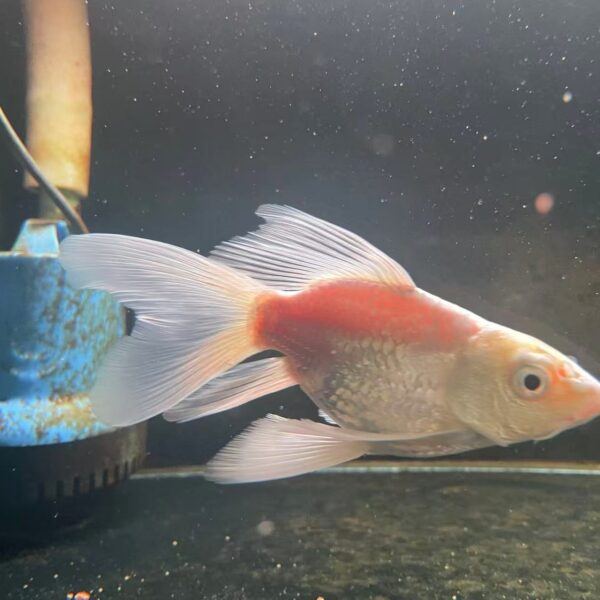
An XL Ranchu displaying the breed’s hallmark features: smoothly arched back, prominent wen, and tucked butterfly tail.
Colour Varieties
🔴 Aka (Red/Orange)
A deep, uniform red-orange covering the entire body. The most traditional colour, prized when the red is rich and consistent from head to tail without pale patches.
⚪ Shiro (White)
Pure, clean white with no yellow tinge. High-quality Shiro Ranchu have a porcelain-like lustre that makes the wen texture especially visible and dramatic.
🔴⚪ Sarasa (Red & White)
The classic and most popular pattern — bold red patches on a clean white base. The best Sarasa have sharply defined colour boundaries, particularly a red cap on the head (tancho-style) paired with balanced body markings.
🌸 Sakura (Cherry Blossom)
A softer variation of Sarasa where red pigment sits beneath translucent scales, creating a delicate pink-on-white effect reminiscent of cherry blossom petals in spring.
🐯 Calico / Five-Colour
A mosaic of red, white, black, blue, and sometimes yellow spread across nacreous (semi-transparent) scales. Each calico Ranchu is essentially unique, with patterns that continue to shift subtly over the fish’s lifetime.
⚫ Kuro (Black)
Solid black Ranchu are striking and uncommon. Maintaining deep, stable black colouration is notoriously difficult, as many black Ranchu gradually fade to bronze or chocolate with age and warm water.
It is completely normal for a Ranchu’s colour to change as it matures. Juvenile fish often look quite different from their adult form — young blacks may bronze out, whites can develop unexpected orange patches, and red markings may intensify or recede over the first two years. Water temperature, diet, lighting exposure, and underlying genetics all play a role in colour development. Experienced keepers learn to read these shifts and adjust conditions accordingly. This gradual transformation is part of the joy of raising Ranchu: you are watching your fish reveal its true self over time.
Heritage & Origins
The Ranchu traces its ancestry to the egg-shaped goldfish of southern China, where round-bodied, dorsal-finless varieties were cultivated as early as the Ming Dynasty. These early dorsal-finless fish, known in China as egg fish (蛋種), were prized in scholar gardens for their plump silhouettes and gentle demeanour. When they arrived in Japan during the late 1600s, they encountered a culture obsessed with perfection through patient refinement — and the modern Ranchu was born.
The pivotal figure in Ranchu history is Ishikawa Kamekichi (石川亀吉), a Tokyo-based breeder active from the late Edo period into the early Meiji era who is widely honoured as the father of the modern Ranchu. Ishikawa spent decades stabilising the breed’s defining traits: a smoothly curved back free of any dorsal fin remnant, a prominent and balanced head growth, and a short, tucked tail that fans downward like a spread hand. His line became the foundation for virtually every quality Ranchu bred in Japan since.
Japanese breeders adopted a philosophy borrowed from sumo wrestling: raise your fish like you would raise a yokozuna. A champion Ranchu should project power, dignity, and presence — broad-shouldered, thick-bodied, moving through the water with unhurried authority. This is not a fish bred for speed or flash; it is bred for gravitas.
The title “King of Goldfish” is no casual nickname. In Japan, the Ranchu occupies the highest rung of goldfish culture, supported by a network of regional breeding societies, annual competitions, and a formal judging system that has remained largely unchanged for over a century. No other goldfish variety commands the same reverence, the same prices at auction, or the same devotion from its keepers.
🇯🇵 Japanese Heritage
👑 King of Goldfish
Water & Tank Setup
Ranchu are cold-water fish that thrive without a heater in most Australian climates. In Sydney, where water temperatures naturally range from around 12°C in winter to 26°C in summer, Ranchu feel right at home year-round. The ideal temperature range sits between 18–22°C for optimal growth and wen development, though they tolerate cooler winter temps without issue. What Ranchu cannot tolerate is poor water quality — their heavy bodies and generous wen produce significant waste, so strong biological filtration and regular water changes are non-negotiable.
Aim for a pH of 7.0–7.5 and moderate hardness (6–12 dGH). Sydney’s municipal tap water, once dechlorinated, generally falls within these parameters without adjustment. Ammonia and nitrite must always read zero; nitrates should stay below 20 ppm. A consistent weekly water change of 30–40% is the single most effective thing you can do to keep your Ranchu healthy and encourage wen growth.
A single XL Ranchu requires a minimum of 75 litres, with an additional 40–50 litres for each companion. However, more water is always better — Ranchu produce a surprising amount of waste for their size, and a larger water volume provides a more stable environment. Traditional Japanese Ranchu keeping favours wide, shallow containers (30–38 cm deep) rather than tall tanks, as this maximises surface area for gas exchange and allows top-view appreciation. Fibreglass tubs, stock tanks, or purpose-built shallow aquariums all work well.
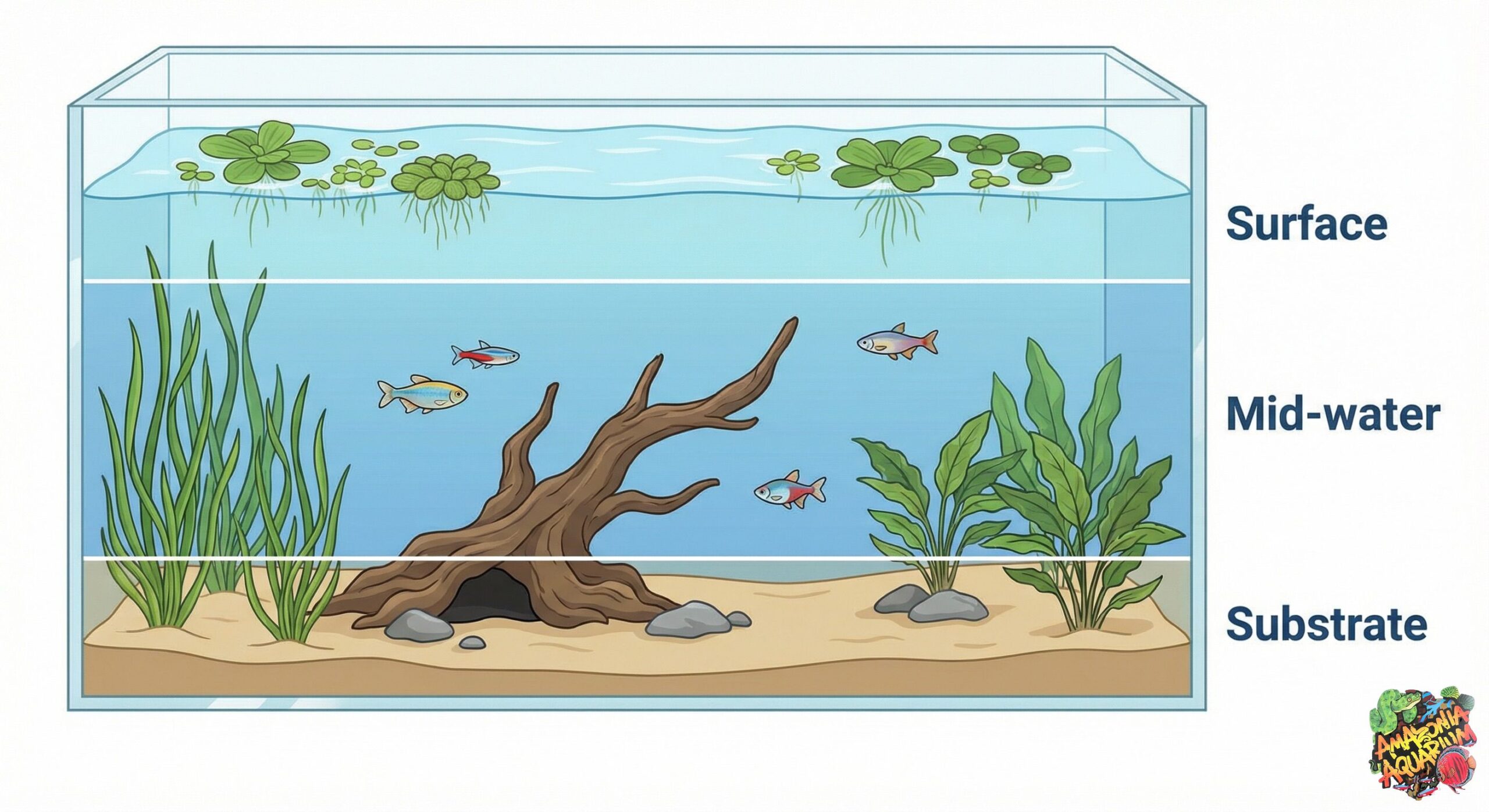
Keep the tank floor bare or use only fine, rounded sand — gravel can trap waste and sharp substrates risk damaging the wen if the fish noses along the bottom while foraging. Avoid pointed rocks, rough driftwood, or plastic plants with hard edges for the same reason. Smooth river stones and live plants like anubias or java fern (attached to smooth surfaces) are safe choices. Filtration should be robust but gentle: sponge filters or low-flow canister outlets are ideal, as Ranchu are clumsy swimmers that struggle in strong currents.
Essential Equipment
Feeding for Excellence
Diet is one of the most powerful tools you have for developing your Ranchu’s wen and enhancing its colour. The foundation of a good Ranchu diet is a high-quality sinking pellet — sinking is essential because Ranchu naturally feed from the bottom, and floating foods force them to gulp air at the surface, which can trigger swim bladder problems. Saki-Hikari Fancy Goldfish (the purple bag) is widely regarded as the gold standard among serious Ranchu keepers; its proprietary blend includes ingredients specifically formulated to promote wen development and overall body condition.
Supplement the staple pellet with variety: frozen bloodworms and brine shrimp two to three times per week provide protein and enrichment, while live daphnia is an excellent natural laxative that helps prevent the digestive issues fancy goldfish are prone to. Feed small amounts two to three times daily rather than one large meal — Ranchu have short digestive tracts and process small, frequent meals far more efficiently. A good rule of thumb is to offer only what the fish can consume in two to three minutes per feeding.
Sinking Pellets (staple)
Frozen Food (bloodworm/brine shrimp)
Live Food (daphnia)
Fasting Day
To bring out the deepest reds and brightest whites, look for foods containing natural colour-enhancing ingredients: spirulina, astaxanthin, and carotenoids derived from krill or shrimp meal. These pigments are absorbed and deposited in the skin over time, gradually intensifying colour with consistent feeding over several months. Spirulina-based gel foods or occasional blanched, skinned peas also support healthy digestion and provide beneficial plant matter that Ranchu would encounter in a natural diet. Avoid foods heavy in artificial dyes — they do nothing for long-term colour development and may place unnecessary stress on the liver.
Health & Seasonal Care
Ranchu are generally hardy fish, but their specialised body shape makes them vulnerable to a few specific issues. Swim bladder disorder is the most common concern — their compressed organs and short bodies mean even mild constipation or overfeeding can affect buoyancy. Ich (white spot disease) can strike when water temperatures fluctuate rapidly, particularly during seasonal transitions. Fin rot, usually bacterial, tends to appear when water quality slips. Dropsy, while less common, is serious and often indicates an internal bacterial infection that requires prompt treatment.
The wen itself needs monitoring. In some fish, the head growth can become so extensive that it partially covers the eyes or encroaches on the gill openings. Minor wen trimming is practised by experienced keepers to maintain the fish’s quality of life, though this is a task best left to those with training. Prevention, as always, centres on water quality: a Ranchu living in clean, well-filtered water with stable parameters and a balanced diet will resist disease far more effectively than one in a neglected tank.
Seasonal Care Calendar (Australia)
Salt baths (3–5 grams of pure aquarium salt per litre for 5–15 minutes) are a time-tested natural remedy for external parasites, mild fungal infections, and general stress recovery. Keep a bag of pure, non-iodised aquarium salt on hand at all times for emergencies. Equally important, always quarantine new fish for a minimum of two to three weeks in a separate container with its own filtration before introducing them to an established tank — this simple precaution prevents the vast majority of disease introductions and protects the fish you already have.
Quick Reference
| Tank Size | 75L minimum per fish |
| Temperature | 18–22°C (no heater needed in Sydney) |
| pH | 7.0–7.5 |
| Diet | Sinking pellets + frozen/live food supplements |
| Tankmates | Other fancy goldfish only (no fast swimmers) |
| Special Need | Avoid sharp décor — protect the wen (head growth) |
Acclimation & First-Week Care
Proper acclimation prevents shock and greatly improves survival. Never rush this process.
Step-by-Step Acclimation
- Float the sealed bag in your aquarium for 15–20 minutes to equalise temperature.
- Open the bag and roll down the edges to create a floating collar.
- Drip acclimation: Add approximately ¼ cup of tank water to the bag every 5 minutes for 20–30 minutes.
- Net and release — gently net the fish/shrimp and place them into the aquarium. Discard the bag water; never pour it into your tank.
First-Week Checklist
- Keep lights dimmed for the first 24–48 hours to reduce stress.
- Feed sparingly for the first 3 days — overfeeding is the #1 cause of goldfish health issues.
- Ensure the filter flow is gentle — Ranchu struggle in strong currents.
- Monitor ammonia and nitrite daily — any spike above 0.25 ppm warrants an immediate 25% water change.
- Observe for signs of disease (white spots, clamped fins, lethargy) and quarantine if needed.
Frequently Asked Questions
Can Ranchu live in a pond?
How fast does the wen (head growth) develop?
Do Ranchu need a heater?
Can I keep Ranchu with tropical fish?
How do I judge a quality Ranchu?
How to Appreciate a Ranchu
In Japan, the traditional way to view a Ranchu is from above (uwami), looking down into a shallow white ceramic basin or a purpose-built fibreglass tub. From this angle, the symmetry of the wen, the breadth of the back, the spread of the tail fins, and the overall balance of the fish are fully revealed. Serious breeders and judges evaluate Ranchu almost exclusively from this perspective, and the fish’s proportions have been refined over centuries to look their absolute best when viewed from the top. White containers are preferred because they show off the fish’s colour without distortion and provide a clean backdrop for judging.
Side-view appreciation has gained popularity outside Japan, particularly in aquarium settings. While a quality Ranchu looks impressive from any angle, side viewing highlights the smooth dorsal curve, the depth of the body, and the dignified swimming motion. Whichever perspective you choose, the hallmarks of an excellent Ranchu are consistent: the head growth should be symmetrical and proportionate, the body deep and broad without being bloated, and the tail compact, neatly tucked, and evenly spread. Above all, the fish should move with calm, unhurried grace — projecting quiet power rather than nervous energy.
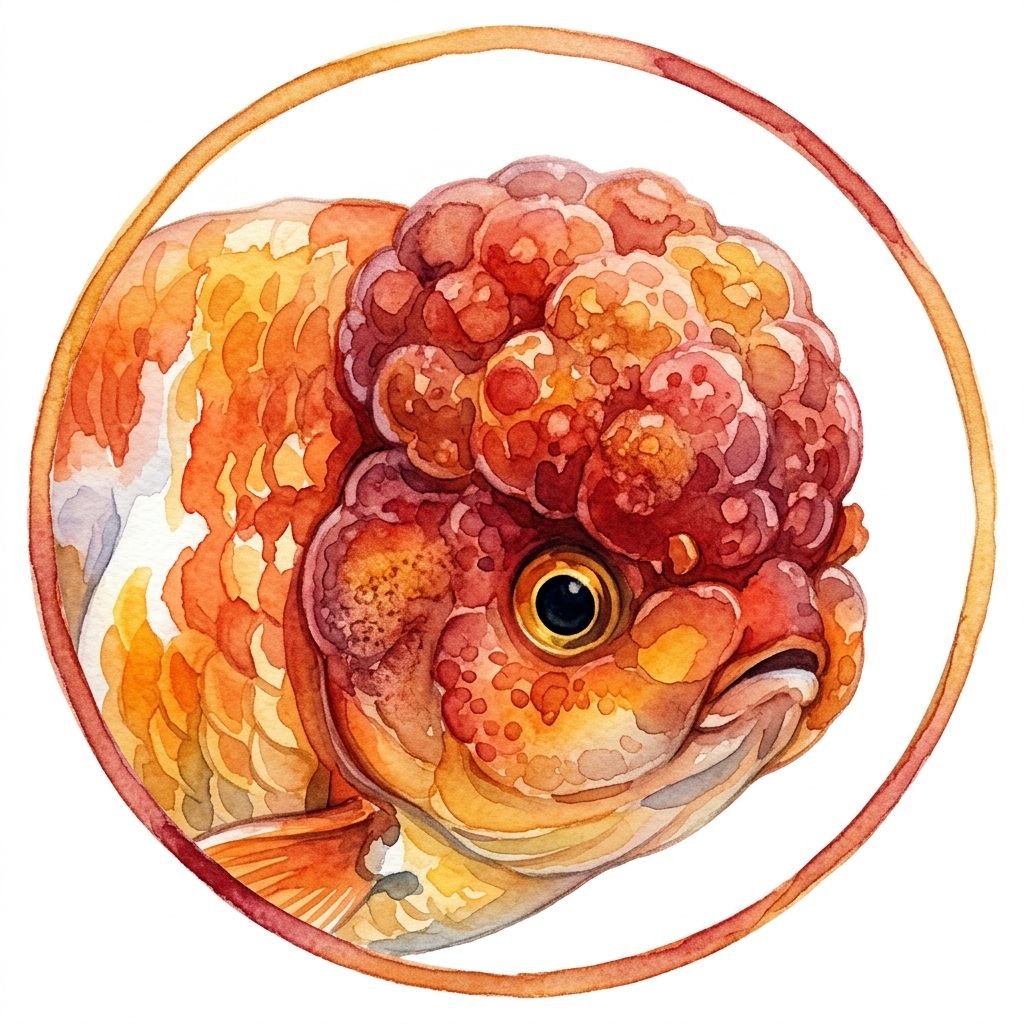
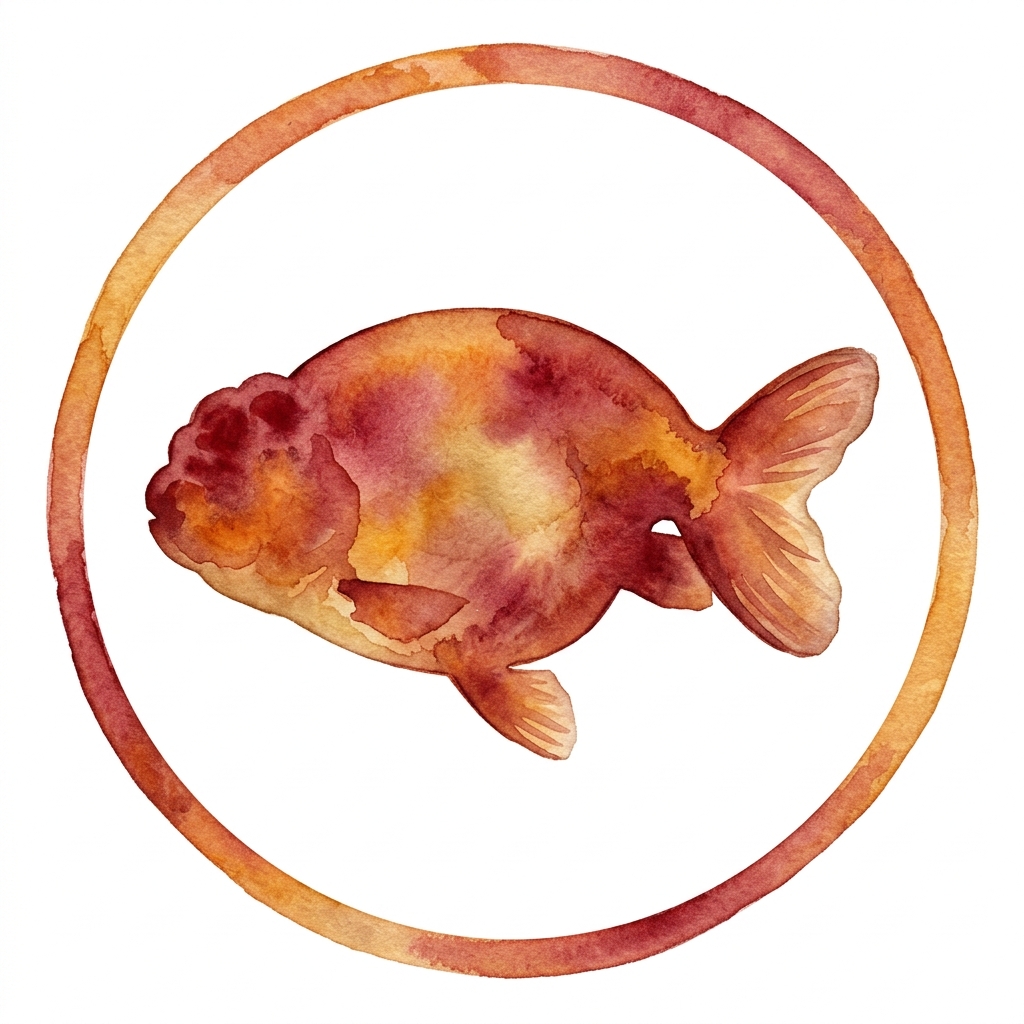
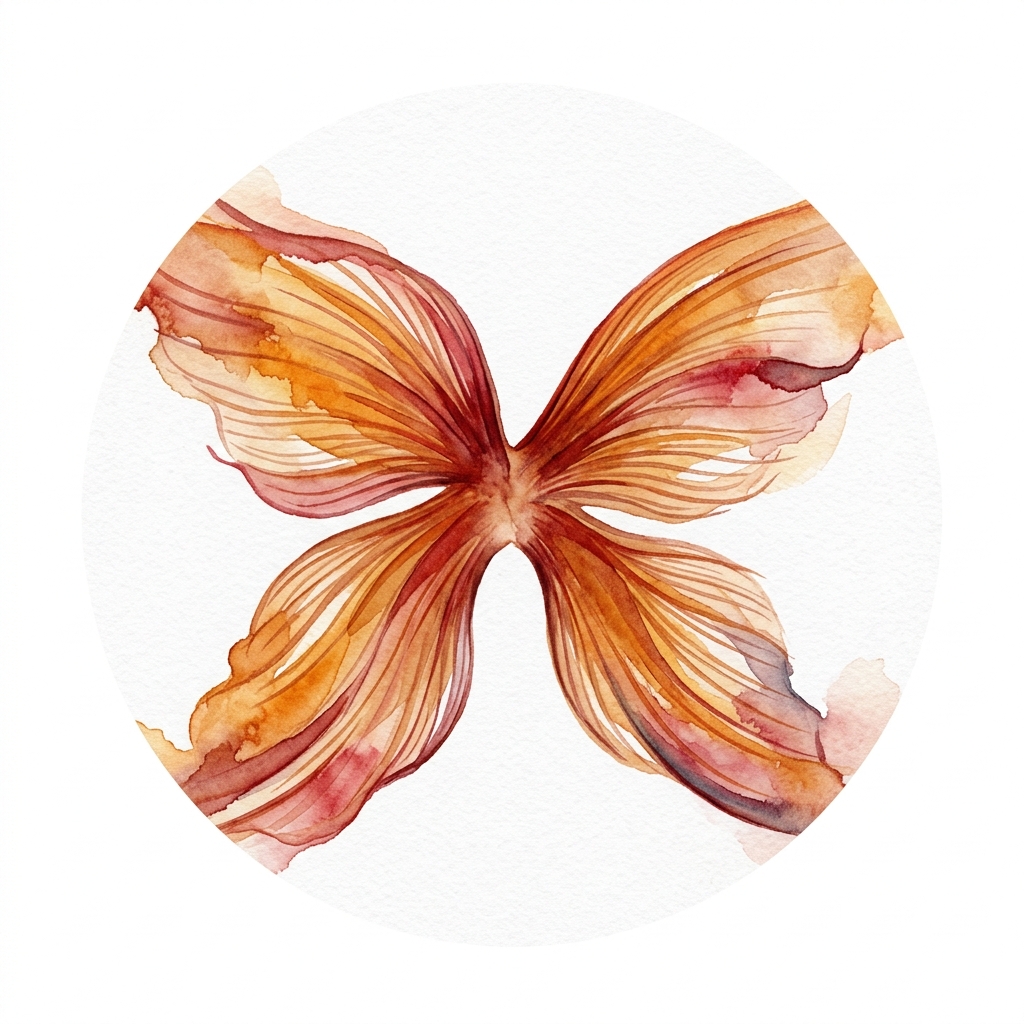
There is a well-known saying among Japanese Ranchu keepers: “Raising Ranchu is like raising sumo wrestlers.” Just as a sumo stable master carefully manages diet, exercise, and rest to produce a champion, a Ranchu breeder must balance feeding, water quality, and tank conditions to bring out the fish’s full genetic potential. A Ranchu with champion bloodlines raised in poor conditions will never reach its potential, while a modest fish given expert care can surprise everyone. The craft lies in the keeping as much as in the breeding.
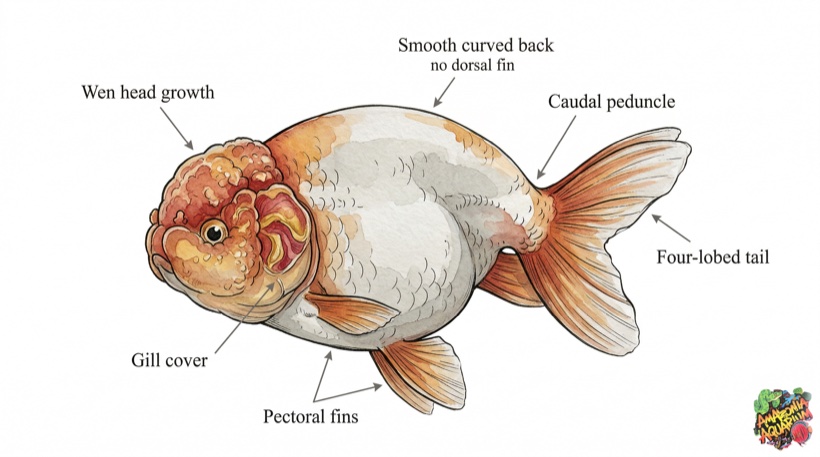
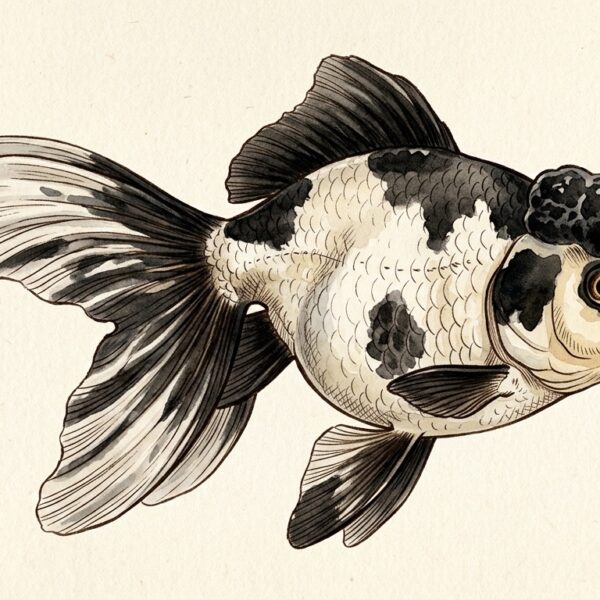
Key anatomical features of the Ranchu: smooth dorsal curve, wen coverage zones, tucked tail angle, and ideal body proportions.
Related Products
Reviews
Clear filtersThere are no reviews yet.