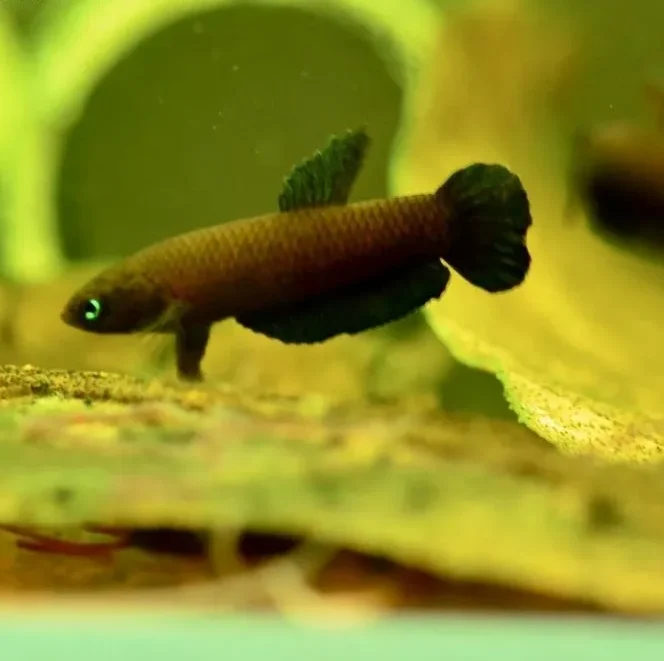
🪨 Species at a Glance
| Scientific Name | Betta miniopinna (Tan & Tan, 1994) |
| Family | Osphronemidae (gouramis & bettas) |
| Order | Anabantiformes |
| Origin | Bangka Island, Sumatra, Indonesia — peat swamp forest & blackwater streams |
| Complex | Betta coccina species group — small wild mouthbrooders/bubble-nesters |
| Adult Size | 2.5–2.8 cm (rarely 3 cm) — true nano |
| Lifespan | 3–5 years in species tank conditions |
| pH Range | 4.0–6.0 (ideal 4.5–5.5 — extreme blackwater) |
| Temperature | 22–26 °C (72–79 °F) |
| Hardness (dGH) | 1–4 — ultra-soft, near RO water |
| Diet | Strict micro-carnivore — live and frozen micro-fauna only |
| Minimum Tank Size | 60 L (16 gal) species tank for a pair or trio |
| Care Level | Advanced — blackwater chemistry & live food required |
| Temperament | Extremely shy, peaceful; NOT a display fighter |
| Breeding Mode | Paternal mouthbrooder — male broods 10–14 days |
| Tank Position | Lower mid-water; hides among leaf litter & roots |
| IUCN Status | Near Threatened — peat swamp habitat loss |
Species Background
The genus name Betta has its own tangled history — borrowed by Dutch naturalist Pieter Bleeker in 1850 from a Javanese vernacular word, likely ikan bettah, used across the Malay archipelago for small, combative swamp fish. For more than a century the name rode on the back of a single species, Betta splendens, the Siamese fighting fish, and almost every non-specialist who hears Betta pictures that long-finned show animal. The genus Betta, however, now contains more than seventy described species ranging from 2 cm giants of the leaf litter to 14 cm predators of flooded forest floors. They fall into several well-defined complexes — the splendens complex, the coccina complex, the unimaculata complex, the picta complex, the akarensis complex and others — each with its own characteristic body form, reproductive mode, and habitat preference. Betta miniopinna belongs firmly to the small, cryptic coccina complex, the group of tiny red-brown bettas from the peat swamp forests of Sumatra, Peninsular Malaysia, Borneo, and Bangka.
The species epithet miniopinna was coined by the Singapore ichthyologist brothers Heok Hui Tan and Heok Hee Tan in their 1994 description, published in the Raffles Bulletin of Zoology (volume 42, pages 351–361). It is compounded from the Latin minius, meaning cinnabar or vermilion red, and pinna, meaning fin — literally ‘the red-finned one’. The authors were pointing at the single most arresting feature of the live fish: in mature males the anal fin burns a bright, almost glowing scarlet that stands in sharp contrast to the otherwise understated red-brown body. Hold a male up against a lit tank from behind and the anal fin looks nearly translucent red, like stained glass. In life this fin is constantly in motion — folded, flared, folded again — as males signal to females and to rival males using fin posture rather than the full broadside displays of Betta splendens. In the original description the Tans contrasted miniopinna against its close relative Betta persephone from Peninsular Malaysia, which has a similarly small body but entirely dark fins without the vermilion flash; the anal fin colour is therefore not just cosmetic to aquarists but a genuine diagnostic character used in the scientific literature.
It is worth lingering on how different miniopinna is from the fish most people mean by Betta. Betta splendens is a bubble-nest builder: the male froths a raft of mucus-coated bubbles at the surface, the female is wrapped in a spawning embrace, and the male catches falling eggs in his mouth only to spit them into the bubble nest he guards at the water’s ceiling. Betta miniopinna, by contrast, is a paternal mouthbrooder — there is no bubble nest at all. The male keeps the eggs inside his mouth for ten to fourteen days, not feeding, until he releases fully formed fry. Splendens has been artificially selected for vivid colour and huge flowing fins for more than a century; miniopinna exists only in its wild form, a small brown fish with one red flag, shaped by natural selection inside acidic peat water. They share a genus. They do not share a lifestyle, a breeding strategy, a habitat, a water chemistry, a feeding ecology, or a temperament. Coming to miniopinna expecting splendens behaviour is the single most common mistake new keepers make, and it almost always ends in a disappointed aquarist and a wasted fish.
There is one final naming note worth knowing: in the aquarium trade Betta miniopinna has historically been muddled with Betta burdigala (another coccina-complex species from Bangka) and occasionally with Betta uberis. The three are genuinely similar — all small, all red-brown, all blackwater — and reliable identification sometimes requires counting anal-fin rays and examining the pelvic-fin filament length. If you buy miniopinna from a specialist with a known collection locality (ideally marked ‘Bangka’ on the bag), you are almost certainly getting the real species. Mass-market shipments labelled simply ‘wild nano Betta’ are riskier and may contain a mix of coccina-complex species.
Creating the Perfect Habitat
A Betta miniopinna tank should look like a slice of the forest floor someone has poured water over. The goal is a small, shaded, tannin-rich environment with plenty of visual cover at every level — because a miniopinna that never feels hidden will never colour up, feed properly, or spawn.
Start with footprint over volume. A long, shallow 60-litre tank (roughly 60 × 30 × 35 cm) is far better than a tall 60 L cube. Miniopinna work the middle and lower water column and need surface area to breathe labyrinth-style and floor area to defend territories. For a single pair, 60 L is the practical minimum; for a trio (one male, two females) or a small group of three to five, step up to 80–100 L. Larger is not automatically better here — cavernous tanks swallow small fish visually and make them feel exposed, and a 200 L tank containing one pair of miniopinna is a tank you will never see the fish in.
Substrate should be a fine dark inert sand or aquasoil intended for blackwater setups; avoid crushed coral, aragonite, or any calcareous substrate that will buffer your pH upward. Black diamond blasting grit (inert silica-based substrate), ADA Amazonia V2, or Tropica Aquarium Soil all work well; so does plain fine black sand. On top of the substrate, build a thick carpet of dried leaves: Indian almond (catappa), oak, magnolia, guava, and beech leaves are all suitable, and a mix is better than a single type. Let the leaf litter cover at least half the floor and allow it to slowly decompose — this is not a mess to clean up, it is the tank’s biological engine. Decaying leaves host a continuous quiet bloom of microfauna (rotifers, nematodes, copepods, infusoria) that provide supplementary snacks between scheduled feedings and are particularly valuable for fry survival if your pair breeds. Supplement with a few alder cones and a piece or two of spiderwood or Malaysian driftwood, angled so their roots create dark cave pockets.
Planting should emphasise shade and cover without fighting the low pH. Java fern, Anubias nana petite, Bucephalandra, and Cryptocoryne parva tolerate pH below 6 and attach to wood and stone. Plant stem species only if you are confident in your lighting and fertilisation; many melt in blackwater, and those that do survive (e.g. certain Rotala, Ludwigia palustris) will grow slowly under the low light miniopinna prefer. Crucially, cover 60–80 percent of the water surface with floating plants: Amazon frogbit, red root floaters, Salvinia, or Ceratopteris. Miniopinna are a forest-floor species and flatly refuse to display in a brightly lit open tank. The floating plant ceiling also gives males an anchor point to defend and cuts evaporation on a tightly covered lid — which you absolutely need, because all bettas are accomplished jumpers and a 2.5 cm miniopinna can squeeze through a gap you would not believe.
Provide at least two potential spawning caves. A coconut shell with a 1.5 cm entrance, a half-buried terracotta pot laid on its side, an upturned catappa leaf weighted with a twig, or a natural hollow in driftwood all work. Place the caves toward the back of the tank in the darkest zone, with a clear swim-path leading to them through the leaf litter. If the male chooses a cave, do not move it — ever. Learn to live around his choice.
Tank
60 L minimum (pair) / 80–100 L (trio or small group); long & shallow footprint preferred
Tight-Fitting Lid
Glass or acrylic cover with NO gaps — even 1 cm of clearance is enough for a miniopinna to jump out
Filter
Small air-driven sponge filter, or canister with spray bar aimed at the rear glass; flow must barely ripple the surface
Heater
25–50 W adjustable; set to 24 °C. Avoid heaters that can’t run reliably below 25 °C
Lighting
Low, dimmable LED; floating plants should shade at least 60 % of the surface. Bright light = stressed, faded fish
Substrate
Fine dark inert sand or blackwater-safe aquasoil. Never calcareous
Botanicals
Heavy bed of catappa / oak / magnolia / guava leaves; alder cones; spiderwood or Malaysian driftwood
RO / DI Water Source
Either a home RO unit or a trusted retailer — tap water alone will not reach pH 4–6 safely
Mineral Salt
Salty Shrimp GH+ or equivalent to reconstitute RO to GH 2–3 / TDS 40–70 ppm
Low-Range pH Kit
Liquid test kit covering pH 4.5–7.4, or a calibrated digital pen with pH 4 buffer solution on hand
Water Chemistry Guide
4.0–6.0
ideal 5.0
22–26 °C
ideal 24 °C
1–4 dGH
Ultra-soft, near-RO, tannin-stained blackwater
If you take nothing else from this guide, take this: Betta miniopinna requires water parameters that would kill a goldfish or a guppy in a day, and it requires them consistently. The type locality is the peat swamp forests of Bangka Island, where tannins and humic acids leached from decaying leaf litter drop the pH into the four-point range and where dissolved minerals are almost absent. Published field measurements from Tan & Tan and subsequent collectors cluster around pH 4.5–5.2, conductivity below 20 µS/cm, and hardness essentially unreadable on standard GH test kits. Ordinary tap water — even soft tap water — is not close enough. A city tap reading of pH 7.6, GH 8, KH 6 is a completely different chemical environment from a Bangka peat pool, and you cannot talk a miniopinna into liking it.
The practical recipe that works in the home aquarium: start with 100 percent reverse osmosis or distilled water. Reconstitute it lightly with a blackwater-oriented mineral salt such as Salty Shrimp GH+ (a pinch, not a scoop — aim for GH 2–3 and TDS 40–70 ppm). Do not use a general-hardness booster that also raises KH, because you need the buffering capacity to stay low so the tannins can do their work. Introduce tannins aggressively: a cured piece of spiderwood or Malaysian driftwood, a thick bed of catappa (Indian almond) leaves on the substrate, a handful of alder cones, and optionally a mesh bag of aquarium peat in the filter. Target water colour: strong black tea — if you can read a newspaper through the tank easily, you have not added enough botanicals. Within a week the pH will drop into the 5s on its own; if it hasn’t, add more botanicals rather than chasing it with acid buffers, which tend to produce exactly the pH crashes we are trying to avoid.
Stability is more important than a perfect number. A rock-steady pH 5.3 is dramatically healthier for miniopinna than a pH that swings between 6.2 and 4.8 because you are doing heavy water changes with unprepared water. Mix and age your change-water in a bucket with a pinch of the same mineral salt and a leaf or two for twenty-four hours before it goes in. Change 15–20 percent weekly, never more than 25 percent at once, and temperature-match within one degree. Skip water changes entirely during the first ten days of a male’s mouthbrooding cycle — a sudden pH or temperature shift at day five of brooding is the single commonest cause of a male spitting and abandoning his clutch.
One last chemistry note that trips up many otherwise-experienced aquarists: conventional biological filtration does not work well below pH 6. Nitrifying bacteria lose efficiency sharply as pH drops into the 5s and become nearly inactive at pH 4.5. This is not a disaster for miniopinna tanks, because the same organic chemistry that produces the low pH — a thick leaf litter layer, driftwood, and botanicals — also supports a rich community of heterotrophic bacteria and fungi that process ammonia differently. But it does mean you cannot rely on a standard nitrate-cycle test kit to read a healthy blackwater tank, and you must keep the bioload very low (a pair of miniopinna, nothing else) and your feeding portions very small. Overstocking is lethal in a way that shortcuts the normal warning signs.
What to Feed
Betta miniopinna is uncompromising about food. In the wild these fish hunt minute invertebrates drifting through root tangles and leaf litter — springtails washed in from the forest floor, copepods, ostracods, mosquito-larva instars, tiny midge larvae, and aquatic mites. Every one of those prey items is alive, moving, and shorter than four millimetres. That is the size and behaviour profile you must reproduce in the aquarium.
In practice this means your staple foods will be live and frozen micro-fauna. Live baby brine shrimp (Artemia nauplii), freshly hatched, are eaten enthusiastically by adults and are the single most useful food for both conditioning and weaning wild-caught fish. A simple two-jar hatchery rotation — one jar hatching, one jar harvesting, switched every 24 hours — will deliver fresh nauplii every day of the year for a cost of about ten dollars per month in brine-shrimp eggs and aquarium salt. Live Cyclops and Moina (common under the trade name ‘Daphnia moina’) are excellent year-round, often cultured in outdoor tubs in warmer months. Microworms (Panagrellus redivivus) and banana worms are perfect for juveniles and acceptable for small adults; both are trivial to culture on a mix of oatmeal and active yeast in a Chinese-takeaway container. Grindal worms (Enchytraeus buchholzi) can be offered in small amounts as an occasional treat but are fattier than ideal as a staple and can cause bloat if overfed. Frozen equivalents — baby brine, cyclops, daphnia, bloodworm (only the smallest grade, chopped), and mysis (also chopped small) — round out the rotation when live cultures are unavailable.
Dry foods are the elephant in the room. Most Betta miniopinna flatly refuse flake and pellet, particularly wild-caught specimens, and many will simply starve rather than eat a dry pellet. A small minority of tank-bred individuals will take high-quality micro-pellets (Hikari Vibra Bites chopped small, Fluval Bug Bites Nano, or similar) but you should never rely on this. Plan your husbandry around a working live or frozen rotation, and treat any pellet acceptance as a bonus. Feed small amounts twice daily rather than one large meal — a miniopinna’s stomach is roughly the size of a match head, and excess food rotting in an acidic tank will crash the nitrogen cycle faster than you can test for it.
A final practical tip: feed miniopinna in the same spot every time, ideally with a long-pipette baster aimed just above the leaf litter. Within a week of arrival the pair will associate your approach with food and will begin to emerge from cover at feeding time — often the only moment in the day when you will see them clearly. This routine also gives you a daily opportunity to count fish, assess body condition, and catch the early signs of illness (clamped fins, pale colour, gasping at the surface) while there is still time to react.
The Colour Spectrum
🔴 Wild Type (Bangka)
The only form in the trade: velvet red-brown body, dark lateral flanks, iridescent green-blue scale flecks across the operculum, and a signature vermilion anal fin edged in black. Unchanged from the fish Tan & Tan described in 1994.
🟥 High-Colour Male (Breeding Dress)
Not a separate variety — the same wild fish when conditioned and displaying. The body darkens to near black-crimson, cheek iridescence intensifies, and the anal fin turns from red to glowing orange-red at the peak of courtship.
🟫 Sub-Adult / Non-Display
Juveniles and stressed adults fade to a plain milk-coffee brown with only a hint of red in the fins. This pale form is what customers most often see in holding tanks and is often mistaken for a different, uninteresting fish.
Unlike Betta splendens, where more than twenty stabilised tail shapes and dozens of colour strains exist — Halfmoon, Crowntail, Koi, Galaxy, Nemo, Alien, and on and on — Betta miniopinna has no line-bred strains. None. Every miniopinna offered in the aquarium trade is either a wild-caught Bangka Island fish or, increasingly, the first-generation offspring of wild parents in a specialist breeder’s tank. The species is commercially too small, too shy, and too slow-breeding to have ever attracted the selective-breeding industry that reshaped splendens into a global commodity, and frankly that is part of what makes it special. You are looking at the exact animal that natural selection built inside a Bangka peat pool, not a decade-long cosmetic project.
Colour intensity in miniopinna is therefore determined almost entirely by water chemistry, diet, and perceived safety rather than genetics. A stressed fish in bright, mineralised tap water will look like a brown sliver with a faint orange fin — and many shop tanks hold fish in exactly this state, which is why miniopinna often does not sell at first glance to customers walking past. The same fish moved into a dim, heavily tannin-stained tank with Indian almond leaves covering the bottom and fed live Cyclops and microworm will colour up within ten to fourteen days: the body darkens to a deep mahogany, the cheek scales start throwing metallic green and peacock-blue highlights under angled light, and the anal fin shifts from a muted terracotta to an almost fluorescent red with a crisp black submargin and a fine pale outer edge. What you are seeing is not a different morph — it is the same fish finally relaxed enough to show you what it looks like at home.
This context matters when you buy. Do not judge a prospective miniopinna by its colour in a bare, brightly lit retail tank — judge it by body condition, finnage integrity, and behaviour. A pale, clamped-fin fish that is eating live food, has intact fins, and is holding its position without drifting is a perfectly viable specimen that will colour up in your blackwater aquarium within two weeks. A fish that looks brilliant red in the bag but has clamped pelvic fins and refuses food is a poor buy regardless of how striking it seems at purchase.
Sexual Dimorphism
Sexing Betta miniopinna at the 2–3 cm size offered in the trade is realistic because fish of this length are already at or near sexual maturity — this is not a Betta splendens where a 3 cm fish is a juvenile. In miniopinna, 2.8 cm is a fully grown male. The most reliable combined cue is the anal fin: males carry a long, tapered, brightly red-edged anal fin whose leading rays extend well past the base of the caudal peduncle, while females have a shorter, rounder anal with only a rusty flush along the edge. Back that up with head shape — mature males develop a broader, squarer lower jaw that will eventually form the brooding pouch — and with colour saturation, where males in any decent water hold a noticeably deeper mahogany body while females stay on the paler, warmer, latte-brown side.
One practical trick: observe the fish at feeding time in a dimly lit tank. Females that have conditioned on live food will show a noticeably rounder abdomen when viewed from above, and the ovaries are often faintly visible as a paler patch behind the pectoral fins when the fish is backlit. Males at the same moment will be the ones holding position at the mouth of a driftwood cavity or upturned leaf, slowly flaring the anal fin. You do not need the theatrical broadside display of a splendens to sex miniopinna — the quiet fin postures at the edge of a cave are enough.
If you are buying from a trusted retailer, the simplest approach is to ask for a sexed pair rather than picking from a community tank yourself. Specialist importers of coccina-complex bettas routinely separate males and females at receipt, because two males housed together long-term in a shop tank will slowly erode each other’s fins through low-grade chronic sparring. If only unsexed fish are available, buy three or four from the same shipment and let them sort themselves out in a larger planted grow-out tank; this is in fact how most experienced breeders establish pairs. Be aware that behaviour-based sexing (who flares, who gets chased) is far more reliable than photograph-based sexing — still photographs of miniopinna flatten the anal-fin length difference that is obvious in side-by-side live comparison.
| Feature | Male | Female |
|---|---|---|
| Adult Size | 2.6–2.8 cm, slightly larger and broader head | 2.3–2.6 cm, more slender overall |
| Body Colour | Deep mahogany to blackish-red; iridescent cheek flecks | Paler warm brown to café-au-lait; cheek iridescence minimal |
| Anal Fin | Long, pointed, bright vermilion with black submargin | Shorter, rounded, dull orange-brown without sharp margin |
| Ventral Fins | Longer, with a distinct reddish filament tip | Shorter, plain, no filament |
| Head Shape | Broader jaw line; enlarged gular pouch visible when brooding | Narrower head, flat under-jaw, no pouch |
| Behaviour | Patrols cave entrances, slow fin-flares toward rivals | More mobile, probes leaf litter, submits with pale barring |
Reproduction & Breeding
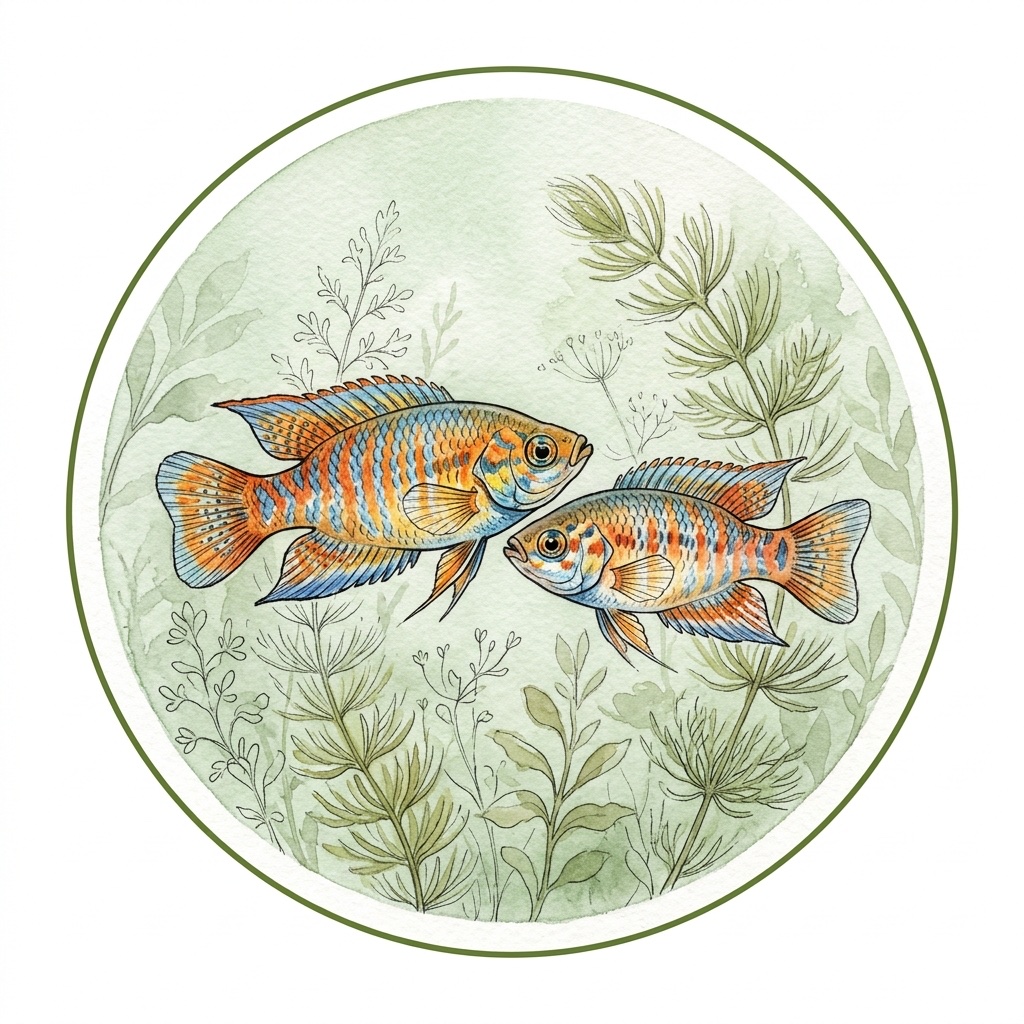
Week -2 to -1
Conditioning & Pairing
Heavy live-food feeding; male and female share a well-planted 60 L
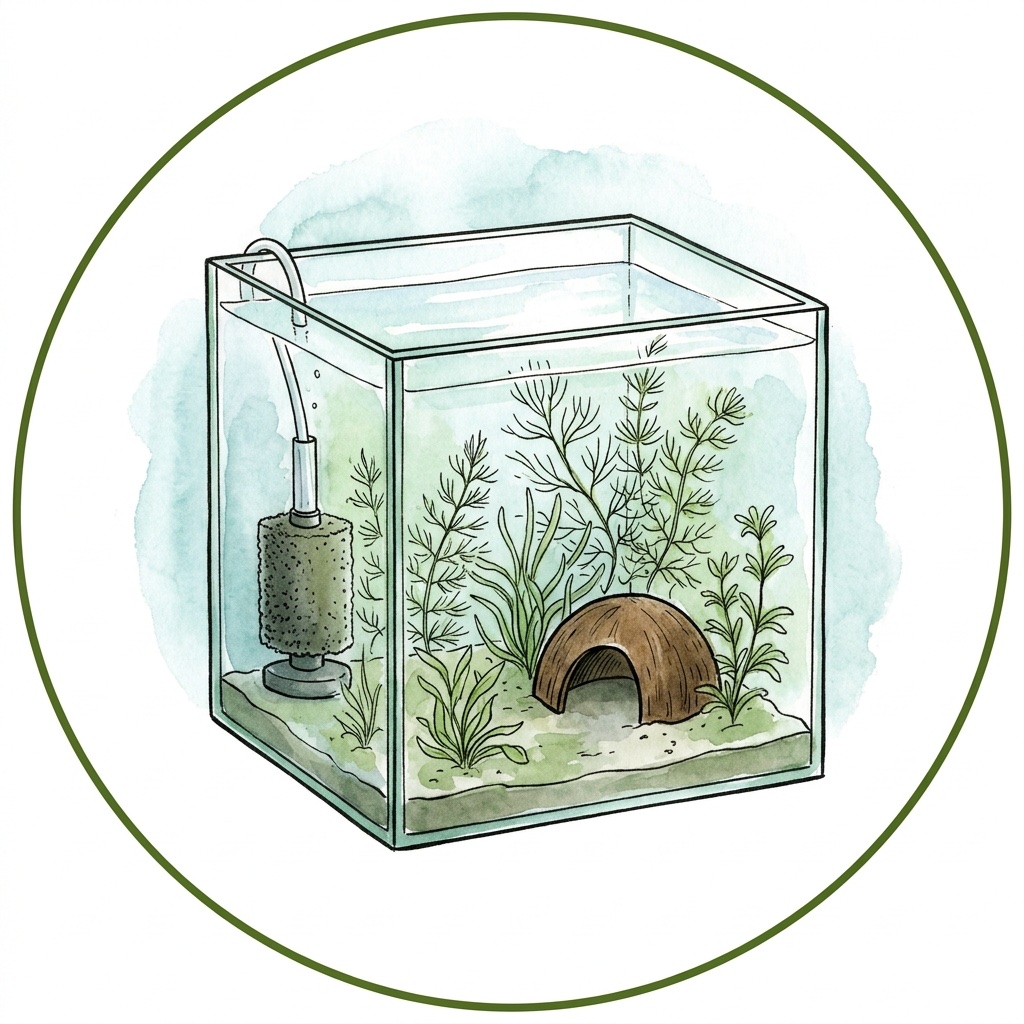
Day 0 — Morning
Cave Courtship
Male leads female to a chosen cavity; slow fin-flaring and body shivering
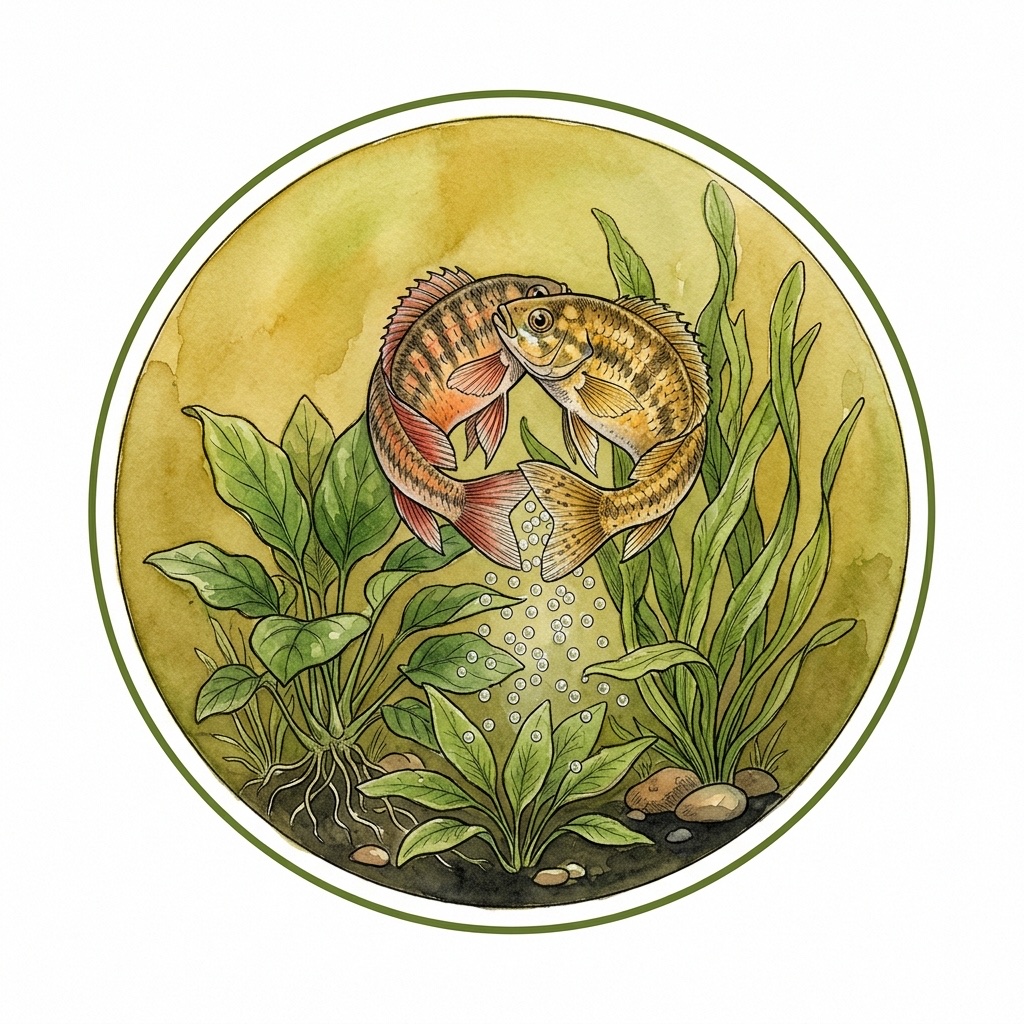
Day 0 — Spawning Embrace
Egg Wrap & Transfer
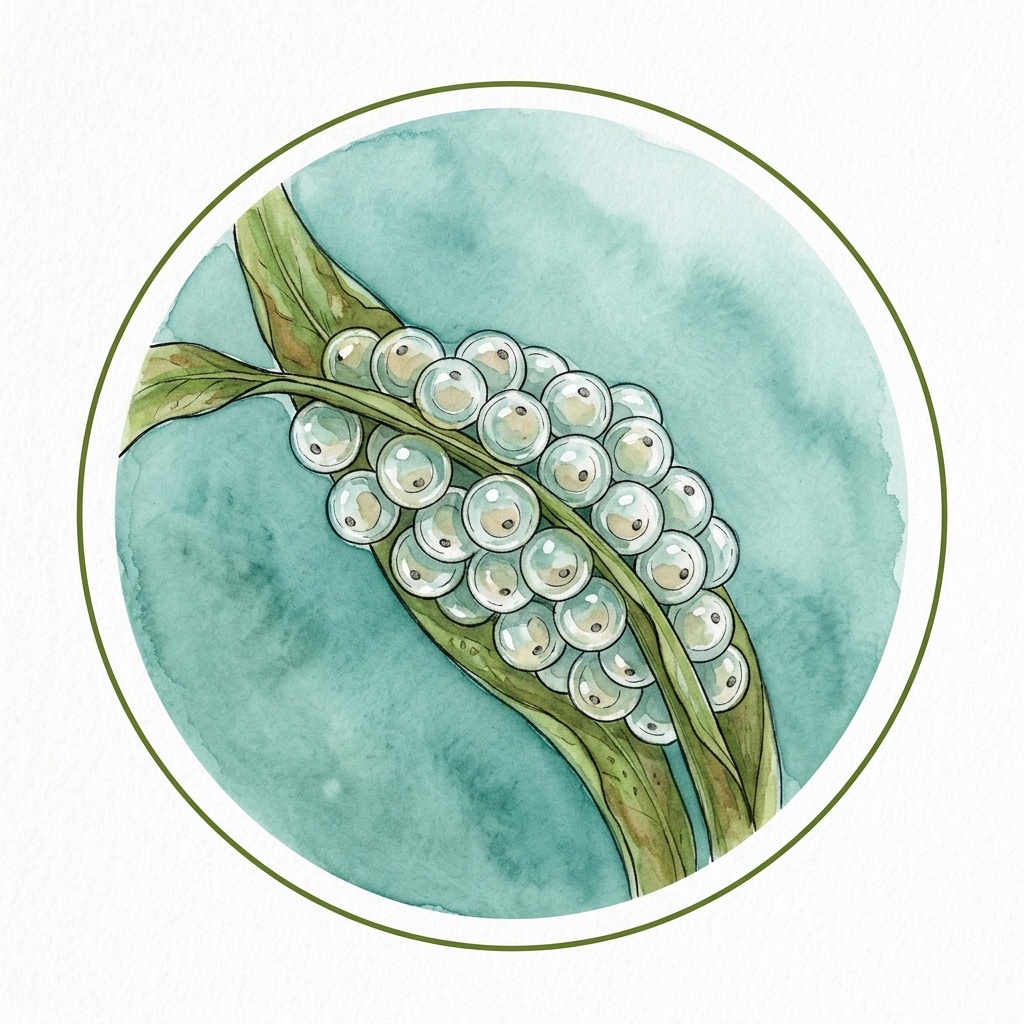
Pair embraces inside the cave; 6–15 eggs per wrap, up to 30–80 total
Day 0 — Evening
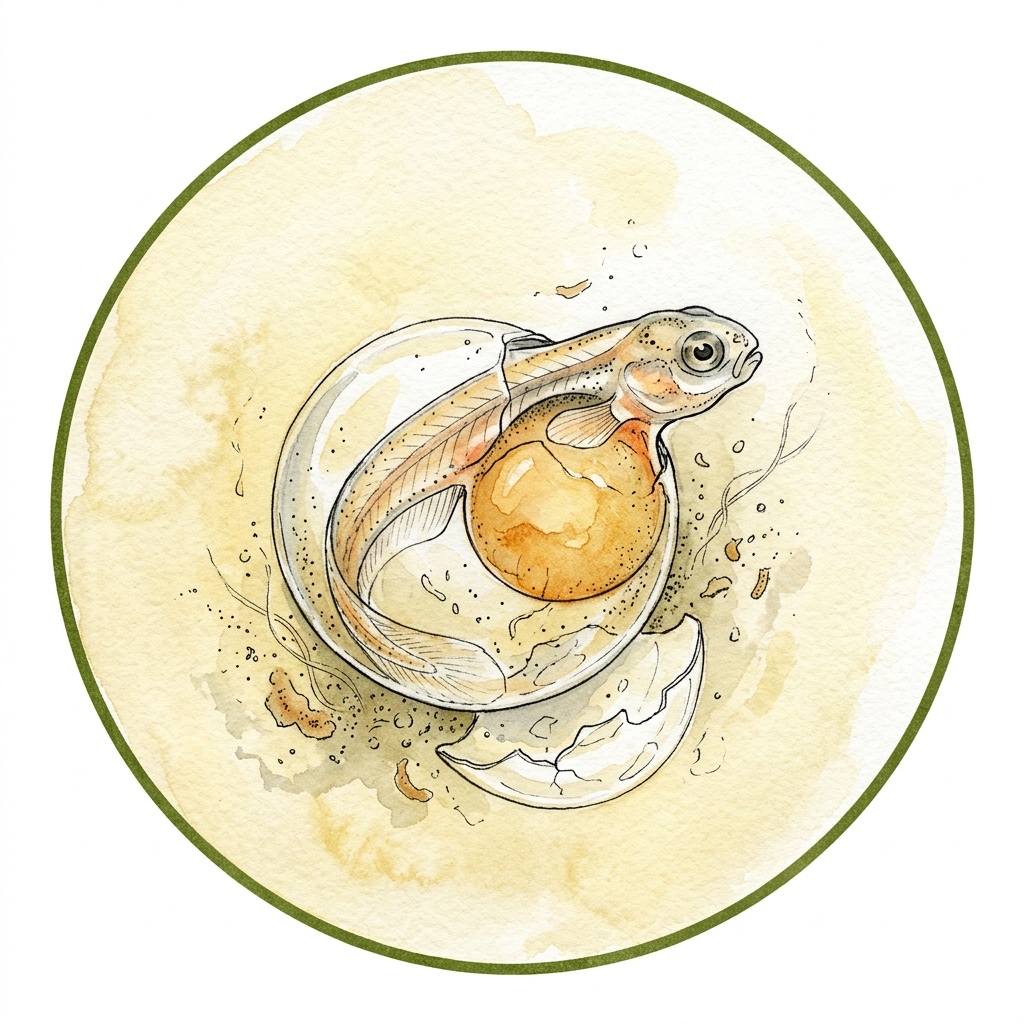
Brood Settles In Male’s Mouth
Male’s lower jaw visibly distended; he stops feeding
Day 10–14
Release of Free-Swimming Fry
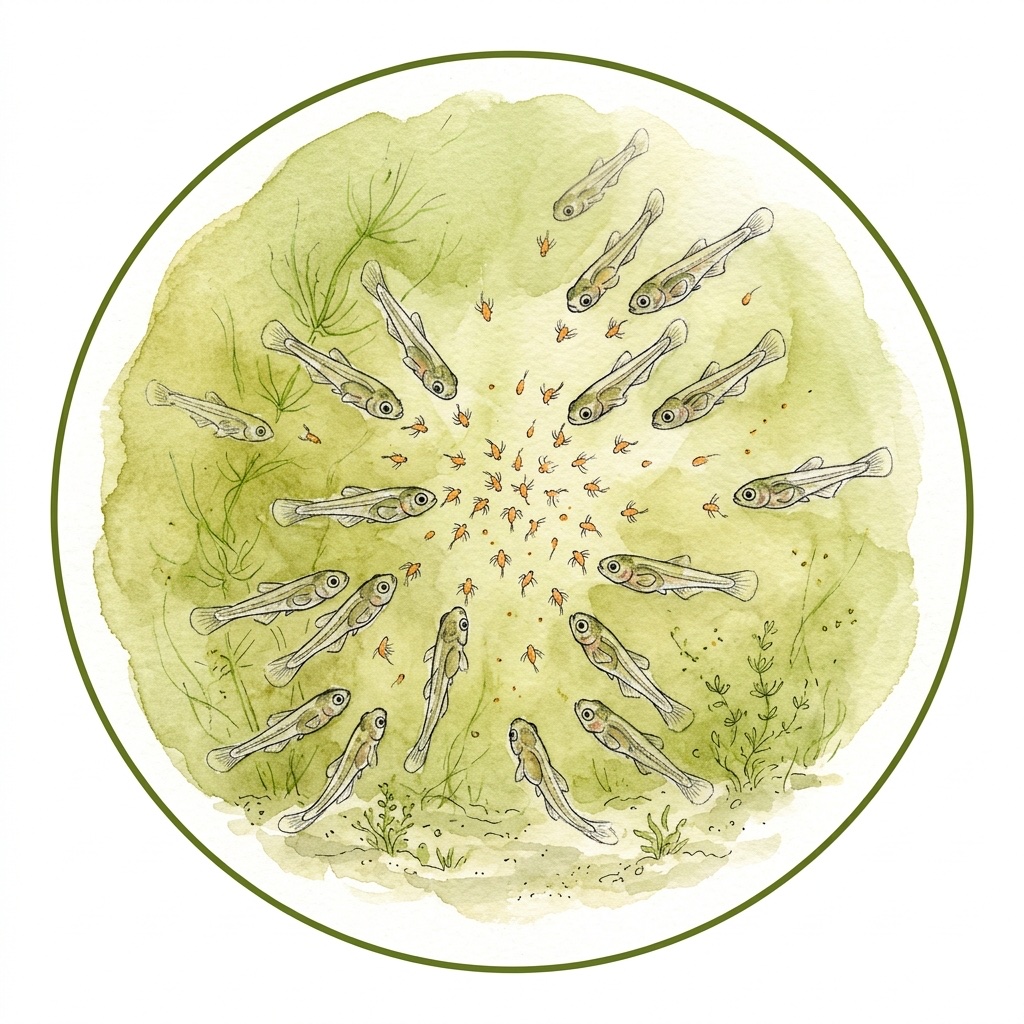
Male spits out 20–60 fully formed fry, each 2–3 mm long
Week 3 onward
Fry Rearing
First food: live microworms, baby brine shrimp; slow growth
Conditioning & Pairing
Begin by confirming the pair. A proven male will hold a tighter territory near a chosen cave — a half-buried leaf, an upturned catappa cup, or a hollow in driftwood — and slowly flare his anal fin at any female passing close. Feed the pair two to three times a day on live baby brine shrimp, live cyclops, and microworms for ten to fourteen days. The female’s belly should visibly round and pale out behind the pectoral fins; the male’s body darkens to near black-crimson. Keep lighting dim and tannins strong. Do not move fish into a separate breeding tank — miniopinna spawn on their own schedule in their established territory, and rehousing often resets weeks of courtship.
Cave Courtship
Spawning in Betta miniopinna is a quiet, patient affair compared with the violent flag-waving of splendens. The male stations himself inside or just outside his chosen cave — almost always a horizontal space such as a leaf cup, a coconut shell, or a natural hollow in driftwood. He signals the female with slow, repeated anal-fin extensions and small body shivers. A receptive female approaches with dark vertical barring on her flanks and pale submissive colouration; an unreceptive female is chased off firmly but without injury. Courtship may last one to three hours before the first embrace.
Egg Wrap & Transfer
Inside or beneath the cave the male wraps around the female, often inverted, in the characteristic Betta spawning embrace. The female releases a small clutch of six to fifteen translucent, creamy-white eggs; these sink slowly toward the substrate. The male breaks the embrace, darts after the falling eggs, and catches them in his mouth one by one. He then spits them gently back toward the female — who, in a behaviour that startles first-time observers, catches and holds them briefly before the male retrieves them again and finally tucks them into his gular pouch. The embrace-catch-spit cycle repeats five to ten times over an hour or two. Total clutch size in a well-conditioned miniopinna pair is modest: 30 to 80 eggs. Published reports of ‘up to 500’ refer to other larger Betta species and do not apply here.
Brood Settles In Male’s Mouth
By the end of the spawning day the male’s gular region is clearly swollen, giving him a pronounced ‘chinstrap’ silhouette when viewed from below or in side profile. He retreats to a quiet, shaded corner — often deep inside the leaf litter or inside his original cave — and becomes virtually invisible to the keeper. He will not eat for the next 10–14 days, and he must not be disturbed. This is the single most fragile window of the whole breeding cycle: if the male is startled, harassed by the female or tankmates, or stressed by a large water change, he will almost always spit and abandon the brood.
Release of Free-Swimming Fry
After ten to fourteen days of mouthbrooding, the male releases a cohort of miniature but fully formed fry. Each fry is approximately 2–3 mm long, already pigmented in a muted brown, and capable of horizontal swimming within an hour. There is no yolk-sac stage to wait through — these fry are past that point. The male takes no further interest in them and may even gently predate on stragglers if feeding is delayed; the wise breeder moves the fry to a dedicated rearing box or a fry-safe nursery within the same tank on release day.
Fry Rearing
Miniopinna fry are too large for infusoria and too small for adult-size foods. Offer live microworms and freshly hatched baby brine shrimp from day one, two or three tiny meals per day. Keep the rearing water identical to the parents’ tank — same pH, same tannin load, same temperature — and perform only very small daily water changes (5 percent) with matched water. Growth is glacial by tropical-fish standards: fry reach 1 cm at around six to eight weeks, sexual maturity at six to nine months. Expect survivorship of 20–60 percent of released fry even with excellent care; this is a species where successful home breeding is rare enough to be a minor badge of honour in specialist keeper forums. Many experienced keepers find that survivorship actually climbs when fry are left in the parents’ tank rather than moved, provided the tank has a deep leaf litter layer to hide in and enough microfauna to forage between scheduled feedings — miniopinna parents are not fry predators, unlike many other fish, though they will not actively care for the young after release.
Tank Mate Guide
The honest advice for Betta miniopinna is to keep them as a species tank, full stop. Everything about this fish — its extreme blackwater chemistry, its tiny size, its shy behaviour, its slow and competitive feeding at food items smaller than four millimetres, and its mouthbrooding that requires silence — argues against mixing. A 60 L blackwater aquarium holding one pair of miniopinna and nothing else is not an understocked tank, it is a correctly stocked one, and it will show you behaviour you will simply never see in a mixed community.
That said, experienced keepers with 80 litres or more sometimes add a very small dither group from the compatible list above — most often a group of eight to twelve chili rasbora or celestial pearl danio — to occupy the upper water column and give the miniopinna the confidence to come out into open water. If you go this route, introduce the dithers first and let them establish for two to three weeks before adding the miniopinna pair, so the bettas arrive into an already-calm environment. Skip every other suggestion you may have read online about ‘peaceful community’ tankmates — the compatibility math that works for Betta splendens simply does not transfer to this species.
A word on conservation. Betta miniopinna is listed as Near Threatened on the IUCN Red List because its entire natural range — the peat swamp forests of Bangka Island — is under sustained pressure from palm-oil conversion, tin mining, and the drainage and burning of peat for agriculture. Specimens in the trade are almost entirely wild-caught, and responsible keepers can contribute to the species by establishing stable captive breeding populations at home. If your pair spawns successfully, offering surplus fry to other dedicated hobbyists through a specialist club or forum (rather than selling back to the general pet trade) helps keep captive lineages in the hands of people equipped to maintain them. This is a small, quiet form of conservation aquaculture, and it is one of the more meaningful reasons to keep this species rather than another.
| Species | Why | |
|---|---|---|
| ✅ | Pygmy Corydoras (C. pygmaeus) | Genuinely tiny, mid-water schooling cory that occupies a different zone and tolerates low pH better than most cories — still only advisable in tanks of 80 L+ |
| ✅ | Celestial Pearl Danio (Galaxy Rasbora) | Nano-sized, peaceful, and visually non-competitive; occupies upper-middle water while miniopinna hold the lower leaf-litter zone. Can be used as light dither to bring shy miniopinna out of hiding |
| ✅ | Chili Rasbora (Boraras brigittae) | Classic soft-acid blackwater companion; micro-size schooling behaviour complements miniopinna without competing for food items above 1 mm |
| ✅ | Ember Tetra | Peaceful mid-level schooler that tolerates pH down to around 5.5; acts as gentle dither and ignores the bottom where miniopinna spawn |
| ✅ | Amano Shrimp (adults only) | Adult Amanos are the one invertebrate large enough that miniopinna will leave them alone — useful for leaf-litter maintenance. Juvenile shrimp of any species will be hunted |
| ❌ | Siamese Fighter (Betta splendens) | The single worst tankmate imaginable — splendens are larger, display-aggressive, and will bully miniopinna to death even without drawing blood. Never house them together |
| ❌ | Gouramis (Honey, Dwarf, Pearl, etc.) | Same family, overlapping surface-air breathing behaviour, and all are far larger; they will outcompete miniopinna for food and monopolise any surface cover |
| ❌ | Tiger Barb & Other Fin-Nippers | The long trailing anal fin of a male miniopinna is a magnet for fin-nippers; repeated attacks cause chronic stress and fin rot even when the nipper is ‘small’ |
| ❌ | Neocaridina / Cherry Shrimp | Adult cherries might survive, but every juvenile and shrimplet will be eaten. Incompatible with any shrimp-breeding plan |
| ❌ | Guppies, Platies, Mollies | Hard-water livebearers whose pH and hardness requirements are physiologically incompatible with miniopinna’s blackwater needs. Not a behavioural problem — a chemistry one |
Quick Reference
| Scientific Name | Betta miniopinna |
| Authority | Tan & Tan, 1994 |
| Origin | Bangka Island, Sumatra, Indonesia |
| Adult Size | 2.5–2.8 cm |
| Lifespan | 3–5 years |
| pH | 4.0–6.0 (ideal ~5.0) |
| Temperature | 22–26 °C (ideal 24 °C) |
| Hardness | 1–4 dGH (ultra-soft) |
| Min Tank Size | 60 L for a pair |
| Diet | Live / frozen micro-fauna only |
| Breeding | Paternal mouthbrooder — 10–14 days |
| Clutch Size | 30–80 eggs; ~20–60 released fry |
| Temperament | Shy, peaceful (NOT a display fighter) |
| Community | Species tank strongly recommended |
| IUCN Status | Near Threatened |
| Care Level | Advanced |
Related Products
Reviews
Clear filtersThere are no reviews yet.