🪨 Species at a Glance
| Scientific Name | Paratya australiensis (Australian native Glass Shrimp) |
| Common Names | Glass Shrimp, Australian Glass Shrimp, Freshwater Shrimp, Paratya |
| Family | Atyidae |
| Order | Decapoda |
| Origin | Eastern Australia — NSW, VIC, QLD and parts of SA; cool creeks, rivers, dams and estuaries |
| Adult Size | 2.0–4.0 cm (0.8–1.6 in) |
| Lifespan | 1.5–3 years (longer in cooler waters) |
| Temperature | 12–25 °C (54–77 °F), ideal 18–22 °C — temperate, NOT tropical |
| pH Range | 6.5–8.0, tolerant of a wide range |
| Hardness (dGH) | 5–20 dGH |
| Diet | Omnivorous scavenger — biofilm, detritus, algae, flake, protein scraps (more carnivorous than Neocaridina) |
| Minimum Tank Size | 40 L (10 gal) for a colony of 10+ |
| Care Level | Beginner for keeping, Advanced for home breeding |
| Temperament | Peaceful, active, social |
| Breeding | Amphidromous — larvae require brackish water to complete development; very difficult in home aquaria |
Body Structure & ID
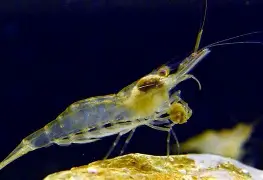
The Glass Shrimp earns its common name honestly. Paratya australiensis is almost entirely transparent in its wild form, with the carapace and abdomen so clear that the beating heart, branching hepatopancreas, pulsing digestive tract and — in gravid females — the mass of developing eggs are all plainly visible to the naked eye. A faint network of chromatophores produces subtle mottling in shades of grey, pale brown, pale green or cream, and individuals from tannin-stained waters may show a slight amber cast, but overall the animal remains glassy rather than coloured. This transparency is not decorative: in a stream full of rainbowfish, pygmy perch, native gudgeons and foraging kingfishers, being invisible against the substrate is the best possible defence an animal without claws or venom can manage. Watch a wild Paratya standing over a sandy creek bed and it literally disappears against the grain — only the dark pinpoints of the eyes and the faint shadow of the gut line give it away. Under aquarium lighting the effect is even more striking when a shrimp moves across a piece of dark driftwood: for a second or two it seems like a floating, disembodied digestive tract with legs, an illusion that never fails to catch a first-time visitor off guard.
Body plan follows the classic atyid pattern. The fused cephalothorax carries a pointed rostrum (shorter than in Macrobrachium but longer than in Neocaridina), two pairs of long antennae for chemical and mechanical sensing, and stalked compound eyes that sit high on the head for near-360-degree vigilance. The rostrum itself is a useful diagnostic feature for telling apart Paratya from lookalike species: it is armed with dorsal teeth along its upper edge and bears a characteristic set of ventral teeth as well, a combination not shared by most introduced dwarf shrimp. Six pairs of thoracic appendages include the first two pairs tipped with delicate, fringed brushes rather than true pincers — the characteristic atyid “feeding fans” that sweep biofilm and fine particles directly from substrate and current into the mouth. These are the single most diagnostic feature that separates genuine Paratya from the superficially similar but predatory Macrobrachium “long-arm” shrimp sometimes sold in the trade: if the animal has conspicuous pincers longer than its own body, it is absolutely not a Glass Shrimp, and it will hunt Paratya relentlessly if mixed into the same tank. Five pairs of pleopods run beneath the abdomen, and in females these carry the eggs; the telson and uropods form the familiar tail fan that powers an explosive escape flick when a predator looms. The escape response is fast — a Paratya startled by a shadow can clear 10 body lengths in a single flick — and explains why large colonies in planted tanks often seem to vanish all at once when the room lights come on.
Sexual dimorphism is subtle but readable once animals mature at around four to six months of age. Females are noticeably larger and more robust, reaching the full 3.5 to 4 centimetre adult size, with a deeper, broader abdomen that accommodates the egg mass and a wider second abdominal pleuron that gives the underside a visibly curved silhouette when viewed from the side. Males remain smaller (2 to 2.8 centimetres), with a narrower, straighter abdominal profile and a more translucent overall appearance. The most reliable single field mark is a berried female: the cluster of 10 to 60 translucent green, amber or olive eggs packed beneath her abdomen is unmistakable through the clear carapace, and observers who have handled large colonies soon learn to read the egg colour as a development timer — bright pale green eggs have just been laid, amber or brown eggs are weeks old and close to hatching. Juveniles in the wild emerge from the brackish nursery already looking like miniature adults, and are functionally indistinguishable from scaled-down parents except for slightly rounder eyes and a faint yellowish tinge that fades over the first few weeks post-settlement. One further anatomical point is worth noting for keepers: Paratya australiensis is actually a species complex. Genetic studies published over the last two decades have identified several cryptic lineages within what is superficially one species, each adapted to different drainage basins across eastern Australia. To the naked eye they all look alike, but if you source animals from different suppliers in different states you may be mixing lineages — something to keep in mind if you value the biotope integrity of your tank.
💎 Wild Transparent (Only Form)
Fully transparent body with faint grey, brown or green mottling; internal organs clearly visible through the carapace and abdomen. This is the sole recognised form of the species — Paratya australiensis has NOT been selectively colour-bred in the way Neocaridina has, and responsible Australian keepers deliberately avoid inbreeding colour morphs in order to protect the native genetic pool and keep the species aquacultured-but-wild-type rather than turning it into a boutique line. The natural colouration is not a limitation; it is a deliberate statement about respecting the ecological identity of a native species.
🍂 Tannin-Tinted (Environmental)
Animals kept in heavily tannin-stained water (Indian almond leaves, blackwater, eucalyptus leaf litter) may develop a subtle amber or tea-coloured tint over weeks. This is an environmental effect, not a genetic morph, and fades once the shrimp is moved to clearer water — it is analogous to the seasonal darkening seen in wild Paratya from tannin-heavy coastal swamps.
🥚 Gravid Female (Seasonal)
Berried females display a conspicuous green, olive or amber egg mass packed beneath the abdomen, visible through the transparent body — the most photogenic presentation of the species, and the classic subject of Paratya macro photography. Egg colour shifts from pale green through olive to amber as the embryos develop over two to four weeks.
Shell Health & Molting
As with every decapod crustacean, Paratya australiensis must shed its rigid exoskeleton in order to grow, and the molt is by far the most vulnerable event in a shrimp’s life. Juveniles molt every one to two weeks during rapid growth, slowing to roughly every four to six weeks in mature adults, and further slowing through the winter months in unheated outdoor tubs when metabolism drops. Because Glass Shrimp are a temperate species, the molt cycle also tracks seasonal temperature: animals held at a cool 14 to 18 degrees Celsius molt more slowly and live longer than conspecifics pushed to tropical temperatures, where the accelerated molt cycle increases the risk of failure and shortens lifespan noticeably. This is one of the reasons Paratya kept in a cool, stable indoor tank or shaded outdoor tub often reach the upper end of their lifespan range (2.5 to 3 years), while animals kept in a warm tropical setup frequently burn out in 12 to 15 months. A few days before a molt, the shrimp may appear slightly cloudy, eat less, become reclusive, and spend extra time hiding in moss or leaf litter while the new, still-soft exoskeleton forms underneath the old. The actual molt itself is quick — seconds to a couple of minutes — during which the carapace splits along the dorsal midline and the shrimp reverses out of its old shell in a single fluid motion, leaving behind a ghostly transparent husk that looks so much like a dead shrimp that new keepers regularly mistake the shed for a casualty and panic-siphon it out. The shrimp will then hide for the next several hours to a full day while the new exoskeleton hardens; during this window it is acutely vulnerable to any predatory tankmate, which is another reason dense plant cover and deep leaf litter matter so much.
Adequate dissolved calcium and magnesium are essential for a successful molt. Glass Shrimp are tolerant of hard water — unlike crystal or caridina species that demand soft, acidic water — and do well in most Australian tap water at 5 to 20 dGH. Soft, mineral-poor rainwater supplies or heavily peated tanks can produce failed molts where the animal becomes stuck in the shed skin at a constriction around the thorax, a fatal condition sometimes called the white ring of death; you see a pale stripe of exposed new flesh where the old carapace has parted but the animal has been unable to pull free. Affected shrimp generally cannot recover on their own and will perish within hours. Supplementing with a piece of cuttlebone, crushed coral in the filter, or a dedicated invertebrate mineral block provides a reliable calcium buffer and dramatically reduces molt losses. Large water changes in soft water can also trigger stress molts, which are more likely to fail than natural ones, so keep water changes modest (15–25 percent weekly) and match temperature and conductivity where possible. After every successful molt the shrimp will itself eat the discarded exoskeleton over the following day — recycling calcium, phosphorus and trace minerals that would otherwise be lost. This is normal, efficient, and should not be interrupted by siphoning the shell out of the tank. If you reliably find intact shells left behind uneaten, that usually indicates the colony is being overfed on other food sources, not that anything is wrong. In a properly balanced tank the shells vanish within 12 to 24 hours, converted neatly back into the next generation of exoskeletons.
Critical Water Parameters
6.5–8.0
ideal 7.4
12–25 °C
ideal 20 °C
5–20 dGH
Tolerant — soft to moderately hard; Australian tap water is usually ideal
Relative to tropical dwarf shrimp, Paratya australiensis is a notably forgiving animal. The species has evolved in a landscape of creeks that swing between cool winter flows and warm shallow summer lagoons, and between clear upland headwaters and tannin-brown coastal blackwaters, so it tolerates a genuinely broad range of pH (6.5 to 8.0), hardness (5 to 20 dGH) and conductivity. Australian municipal tap water, once dechlorinated, is almost always suitable without mineral supplementation, and the species adapts readily to bore water, treated rainwater, and mixed-source pond water provided transitions are made gradually. Many successful outdoor tub colonies run happily on nothing more sophisticated than weekly topups of dechlorinated tap water, with no deliberate remineralisation, pH adjustment or kH buffering beyond the natural mineral content of local tap. This hardiness is arguably the species’ single greatest practical advantage over Neocaridina and Caridina, which both demand careful water preparation and are easily lost to parameter drift. What Glass Shrimp will not tolerate, however, is the single universal shrimp-killer: copper. Copper sulfate and related compounds — common in fish medications, algae treatments, garden fertilisers, plant fertilisers marketed for aquarium use, snail-killer products, and even the first flush of water from some older galvanised plumbing — are acutely lethal to every freshwater shrimp including Paratya, at concentrations far below anything harmful to fish or plants. A single accidental overdose of an “all-in-one” plant fertiliser containing trace copper can wipe a mature colony in an afternoon. Read every label before adding anything to a shrimp tank, and when in doubt, assume it is not shrimp-safe until you have confirmed the ingredient list.
The other genuine sensitivity is to temperature, and it runs the opposite direction from tropical species: Glass Shrimp struggle in sustained heat, not cold. They remain active, fed and reproducing happily at 12 to 14 degrees Celsius, will overwinter outdoors in most of southern Australia without a heater, and will spawn repeatedly through a temperate summer at 20 to 22 degrees. Above 26 degrees the animals start to pant at the surface, breathing becomes visibly laboured through the gill chamber, and feeding slows; above 28 degrees they begin to die, often in mass die-off events over a single hot afternoon. Oxygen solubility drops sharply as water warms, which amplifies the thermal stress — a heatwave in an unaerated tank can wipe a colony in hours, and summer heatwaves in Sydney, Brisbane and Adelaide are the single most common cause of sudden, unexplained colony losses reported by Australian Paratya keepers. Plan for this in advance: a simple USB desk fan blown across the water surface can drop tank temperature 2 to 3 degrees through evaporative cooling, and a floating frozen water bottle in an emergency can buy several more. Beyond copper and temperature, watch for the usual nitrogen cycle hazards: ammonia and nitrite must be zero, nitrate below 20 ppm, chlorine and chloramine neutralised before any water change. New animals should always be drip-acclimated slowly because even this tolerant species can be shocked by rapid shifts in conductivity or pH across a 0.5 unit range delivered in a few minutes. Finally, avoid any recent insecticide exposure on hands or equipment — residual pyrethroids from mosquito sprays or household insect bombs are invisibly lethal to invertebrates in the way copper is, and are a common overlooked cause of silent colony collapse.
Creating the Perfect Habitat
A thriving Glass Shrimp colony starts from 40 litres for a group of ten or more, with 60 to 80 litres providing far greater parameter stability, room for a naturalistic native scape, and enough volume to buffer summer heat. For large display colonies, 100 to 200 litres lets the colony self-organise into distinct foraging patches and makes the constant activity of dozens of transparent shrimp one of the most hypnotic displays in the hobby. Because Paratya is a temperate species, one of its great strengths is that in most of Australia it requires no heater at all: an indoor tank will sit happily at room temperature year round, and an outdoor tub pond — shaded, plant-filled, overwintered in situ — is arguably the most natural and rewarding way to keep the species. The tank should be cycled properly before any shrimp are introduced: an immature nitrogen cycle is the single most common cause of early losses in new Paratya colonies, because even tolerant shrimp cannot survive detectable ammonia. Allow at least four weeks of cycling with an ammonia source before adding animals, and confirm zero ammonia and zero nitrite readings on two consecutive tests before stocking. The substrate should be fine inert sand or small rounded gravel that mimics the beds of the creeks they inhabit; avoid sharp, calcium-loaded aqua soils designed for tropical Caridina biotopes, which will drive pH down below the range Paratya prefers and offer no advantage. A 3 to 5 centimetre substrate depth is sufficient — Paratya do not dig or burrow like some freshwater invertebrates, so you do not need the deep substrate beds some shrimp keepers favour for bacterial filtration.
Aquascape the tank around the species’ native habitat. Dense clumps of Vallisneria, Myriophyllum, native Blyxa, Hydrilla and native sedges provide the tangled foraging territory Paratya prefers — they are animals that like to walk along leaves and stems rather than hover in open water. Floating plants such as Azolla, Amazon frogbit (where legal) or native Lemna provide surface shade and reduce light intensity to levels that suit the species’ crepuscular nature. Dense java moss, flame moss or native Fissidens mosses carpeting driftwood and stones provide the single most useful hiding habitat a Paratya tank can have, because newly-molted animals instinctively wedge themselves into moss for safety. A generous leaf litter layer of Australian native eucalyptus, bottlebrush, paperbark or Indian almond (Catappa) leaves breaks down slowly, seeds the tank with the biofilm the shrimp scrape all day, releases mild tannins that replicate the tea-stained waters of many eastern Australian streams, and provides endless cover for molting individuals. Driftwood, smooth river stones and a few overhanging grass-like plants complete the biotope. Keep lighting moderate rather than bright — Paratya are crepuscular foragers that appreciate shaded refuges, and moderate light suits the pondweed-style plants best while discouraging nuisance algae. For an outdoor tub the same logic applies with native water plants such as Nardoo and native water lilies adding surface cover that keeps the water cool and limits summer algal blooms. An outdoor tub also benefits from a partial roof or shade cloth over at least half the surface, which prevents direct summer sun from pushing temperatures above safe limits and reduces evaporation losses during dry weather.
Sponge Filter
Essential in a breeding or nursery tank — protects any surviving larvae and juveniles from impeller damage, provides a rich biofilm grazing surface, and is silent in an outdoor tub. Two sponges give redundancy and extra biofilm for a hungry colony.
No Heater (Optional)
In most of Australia, Glass Shrimp need no heater. If winter indoor temperatures drop below 10 °C, a low-wattage heater set to 14–16 °C prevents extreme cold; never set above 22 °C for routine keeping or the animals lose the cool-water advantage they were chosen for.
Thermometer
Digital thermometer is critical for monitoring summer highs. Plan active cooling — desk fans across the water surface, room air conditioning, a floating ice bottle, or partial shading of an outdoor tub — if the tank exceeds 26 °C for any sustained period.
Aquascape: Native Plants + Leaf Litter
Vallisneria, Myriophyllum, Blyxa, plus eucalyptus or Catappa leaves. Provides biofilm foraging and refuge, and creates an authentic Australian biotope look that honours the species’ native ecology rather than dressing it up in tropical aesthetics.
Substrate: Inert Sand or Fine Gravel
Fine inert sand or rounded gravel at 3–5 cm depth. Avoid active tropical aqua soils — Paratya prefers neutral to slightly alkaline water and does not need pH-buffering substrate. A mix of sand and small river pebbles mimics creek beds perfectly.
Tight-Fitting Lid
Glass Shrimp are active climbers that will walk up filter cords, heater cables and airline tubing overnight. A secure lid or fine mesh cover prevents escapes that otherwise always end in a dried husk on the floor the next morning.
Calcium Source
Small piece of cuttlebone, crushed coral in a filter bag, or a shrimp mineral block provides a steady calcium supply for successful molts, especially if your local water is soft or if you are using rainwater or RO water. Replace every 2 to 3 months as the material dissolves away, and do not combine multiple sources in hard tap water where calcium is already plentiful — over-hardening can cause its own molt problems.
Outdoor Tub Option
For the authentic experience, a shaded outdoor tub pond (80 L or larger) of Paratya, native plants and fallen leaves is the most natural setup — self-sustaining through most of the Australian year, cool in summer if well-shaded, and requires essentially zero feeding once the tub has matured. Half-buried half wine barrels or large terracotta planters lined with pond liner both work well; position under dappled shade from a tree or pergola, never in full summer sun.
What to Feed
Glass Shrimp are opportunistic omnivores with a noticeably stronger appetite for protein than their tropical Neocaridina cousins — a fact that becomes obvious the first time you drop a single bloodworm into an established tank and watch the entire colony converge on it within seconds, feeding fans flailing as half a dozen shrimp tug on opposite ends of the same worm. In the wild, Paratya australiensis scavenges a constant buffet of biofilm, detritus, leaf litter, filamentous algae, decaying plant matter, mosquito larvae, small aquatic insects, carrion from dead tadpoles and fish, and any tiny invertebrate it can catch. It is both gardener and clean-up crew in eastern Australian creeks, and research has shown that the species contributes meaningfully to detritus breakdown and nutrient cycling in the streams where it is abundant — in some upland creek systems Paratya and its congeners process a genuinely surprising fraction of the total annual leaf fall. A mature, planted tank with leaf litter will seed enough biofilm to support a small colony indefinitely, but for a healthy, visibly active breeding group supplemental feeding three to four times a week is ideal. Good staples include sinking micro-pellets, high-quality flake crumbled fine, blanched zucchini, cucumber, spinach and pumpkin, and — the part Paratya particularly loves — small amounts of animal protein such as frozen bloodworms, daphnia, cyclops, or broken-up fish flake. Many keepers rotate a protein day once or twice per week alongside five days of plant-based or biofilm-supplementing foods, which roughly mirrors the mixed diet the species eats in the wild and keeps females in the condition needed to produce and carry eggs. Pregnant or berried females in particular show a noticeable preference for protein and will often be the first to abandon shelter and race to a newly dropped bloodworm, a useful behaviour to watch for when judging colony breeding condition.
Offer only what the colony can clean up in roughly two hours. Paratya are efficient scavengers and will find everything, but uneaten protein rots fast and will spike ammonia in a small tank, especially a cool-water tank where biological filtration runs more slowly than in a warm tropical system. Indian almond leaves, alder cones and a handful of dried oak or eucalyptus leaves serve double duty as slow-release food substrate and water conditioner — drop a fresh leaf in every couple of weeks, let it soften for a few days until the biofilm establishes, and the colony will graze on it for days afterward. Eucalyptus leaves are particularly appropriate for an Australian native biotope: dried gum leaves release mild tannins and antifungal oils, condition the water slightly, and are eaten down to bare leaf ribs over two to three weeks. As with every shrimp species: no copper in any fertiliser, medication or algaecide, ever. Also avoid “iron-boosted” plant foods unless you have verified every ingredient, and never drop food sourced from an unknown commercial pet-food packet into a shrimp tank without reading the label, as many bulk foods contain copper-based preservatives or colourants. Finally, do not rely on the shrimp to “clean up” excess fish food in a community tank as a feeding strategy: uneaten flake designed for fish often contains mineral premixes that are fine for fish but harmful for shrimp at accumulated concentrations, and the shrimp generally eat far less of it than keepers imagine.
Reproduction & Breeding
Egg Carrying
This is where Paratya australiensis differs most dramatically from Neocaridina or Caridina, and where an honest care guide must be blunt: Glass Shrimp are AMPHIDROMOUS. That single word encapsulates why home breeding so often fails, and why most online forum threads about “my Paratya babies all disappeared” end in puzzled disappointment. In the wild, adult females produce 10 to 60 small eggs which they carry beneath the abdomen for two to four weeks, fanning them continuously with the pleopods until they hatch into free-swimming larvae called zoeae. These larvae then drift downstream into brackish estuarine water, where they feed on plankton and pass through several larval stages over a period of several weeks before metamorphosing into juvenile shrimp and migrating back upstream into pure freshwater to complete their lives as adults. This life-history strategy — juveniles and adults in freshwater, larvae in the sea or in brackish estuaries — is called amphidromy, and it is shared by many freshwater shrimp and fish species in the Indo-Pacific region. Without this brackish larval phase, the great majority of larvae in a standard home freshwater aquarium simply die within days of hatching, typically within 72 hours of release, because they cannot osmoregulate properly in pure freshwater and cannot find suitable planktonic food at the size they need it. You will see berried females carrying eggs for weeks. You will see tiny swimming larvae emerge one morning, darting erratically through the water column. You will almost certainly not see them reach juvenile stage in a pure freshwater setup, no matter how mature, green, infusoria-rich or plankton-bloomed the tank is — and this is not a failure of husbandry, it is simply biology.
Research over the past two decades has complicated the picture slightly: some inland, landlocked populations of Paratya australiensis in drainages such as the Murray-Darling appear to have evolved fully freshwater-tolerant larvae, and there are occasional, usually modest, breeding successes reported by keepers sourcing shrimp from those specific lineages rather than from coastal stocks. These landlocked populations have been separated from the sea for long enough that natural selection has favoured larvae capable of completing development in hard, slightly saline inland freshwater — a genuinely fascinating piece of evolutionary plasticity, and an active area of research within Australian freshwater ecology. But these are the exception, not the rule, and they are not what you typically receive when you buy Paratya from an east-coast breeder or collector; the overwhelming majority of the Paratya stock available in the Australian aquarium trade originates from coastal populations whose larvae still require brackish water to survive. The responsible expectation for a new keeper is that your Paratya colony is essentially a long-lived display population — interesting, social and visually striking, but not self-sustaining in a standard freshwater tank. Serious breeders set up dedicated two-tank systems with a brackish larval nursery at approximately 10 to 15 parts per thousand salinity, rotating berried females into the nursery when eggs are close to hatching, collecting hatched zoeae with fine mesh, feeding them on phytoplankton (Nannochloropsis, Tetraselmis) and enriched rotifers or brine shrimp nauplii, monitoring salinity daily as evaporation concentrates the water, and returning post-metamorphosis juveniles to pure freshwater over a gradual reverse-acclimation of several days. This is advanced work requiring real aquaculture discipline — algae cultures, rotifer cultures, hydrometers, precise salt measurement, zero-tolerance cleanliness — and it is the only reliable path to a breeding colony of coastal-lineage Paratya. The alternative — simply topping up the population every 12 to 18 months from a licensed supplier — is both easier and, for most keepers, genuinely sufficient. It also supports licensed Australian aquaculture, which is preferable to illegal wild collection under most state jurisdictions.
Tank Mate Guide
The ideal Glass Shrimp tank is a dedicated Australian temperate biotope — a species-only colony, or a small group of native Pacific Blue-Eyes, Murray River Rainbowfish or Western Pygmy Perch in a planted cool-water scape with leaf litter, river stone and native hardscape. This pairing is not just aesthetic: it honours the ecological context in which Paratya australiensis actually evolved, and every element — the temperature, the water chemistry, the plant choices, the shared predator/prey history — fits together into something more coherent than any generic tropical community tank. A well-executed Paratya biotope is, without exaggeration, one of the most distinctively Australian displays you can set up, and it doubles as a small piece of ecological education: visitors who have never thought about native freshwater invertebrates come away with a sharper sense of what lives in the creek at the bottom of the local park. If you want to broaden the mix, smaller non-native temperate peacekeepers like White Cloud Mountain Minnows work well, and non-aggressive nano tropicals (ember tetras, chili rasboras, microrasboras) remain safe at the warm end of Paratya’s tolerance, though they cease to be a truly native display and push the tank toward the upper edge of the comfortable temperature range. The golden rule is the same as for any shrimp species: if a tankmate can swallow a 3 cm shrimp, it eventually will — even “shrimp safe” individuals have bad days and all it takes is one successful hunt for a fish to learn the habit. Dense planting, thick leaf litter and Catappa leaves provide essential refuge that significantly improves survival rates even when some opportunistic fish are present, and in a large, heavily planted tank a steady-state balance between Glass Shrimp colony and small native fish population can be sustained for years. One final note worth mentioning: Paratya australiensis is often itself fed as a live food to larger native predatory fish such as Bass and Silver Perch, both in the trade and in conservation contexts. If you keep both groups, keep them in different tanks, and do not be tempted to breed Paratya as a feeder species — the amphidromous life cycle makes home breeding impractical regardless of intent, and buying wild-caught feeders raises the same legal and ecological questions as wild-collecting for your display tank.
| Species | Why | |
|---|---|---|
| ✅ | Pacific Blue-Eye (Pseudomugil signifer) | Small, peaceful, native east-coast rainbow-relative; exactly the right temperate range and size to share a tank with Paratya, and one of the most beautiful native Australian fish with its iridescent blue eye ring and subtly yellow-tipped fins. An authentic NSW/QLD biotope pairing that looks as good as it is ecologically honest — these two species genuinely share habitat in the wild. |
| ✅ | Murray River Rainbowfish (Melanotaenia fluviatilis) | Native Australian rainbowfish that shares Paratya’s temperature preference (18–24 °C); small enough not to threaten adult shrimp in a well-planted tank, though it will eat any shrimp larvae that hatch. Great centrepiece fish for a native temperate display. |
| ✅ | Western Pygmy Perch (Nannoperca vittata) | Small native temperate perch with a peaceful demeanour and perfect cool-water overlap. Will eat very young shrimp but coexists well with adults in a leaf-littered tank with dense cover, and is itself an interesting and often-overlooked native species with a calm, deliberate hunting style that rarely disturbs established adult Paratya. A subtle fish for a subtle shrimp. |
| ✅ | White Cloud Mountain Minnow (Tanichthys albonubes) | Non-native but an excellent temperate community fish; thrives at the same 16–22 °C Paratya prefers, mouth too small to threaten adult shrimp, peaceful schooler that adds movement in the upper water column where Paratya rarely ventures. A group of 8 to 12 White Clouds above a dense-planted Paratya colony is one of the most reliable peaceful temperate community setups in the hobby. |
| ✅ | Horned / Zebra Nerite Snail | Non-predatory algae grazer; ignores shrimp entirely and shares the cleanup duties on glass and hardscape. Tolerates temperate temperatures well and will not breed in freshwater, so no population explosion to worry about. The hard calcium-rich shells shed by nerites over time also contribute trace mineral content back to the water, which is a small bonus for Paratya molting. |
| ✅ | Other Paratya australiensis | A species-only colony of 20+ Glass Shrimp is arguably the best setup of all — they are social, always visible, and endlessly active without any fish stress. In a well-planted outdoor tub a pure Paratya colony is effectively self-maintaining through the year, requiring only seasonal leaf top-ups and occasional supplemental feeding during peak foraging activity in spring and summer. |
| ❌ | Goldfish and Koi | Share a cool-water preference, but will opportunistically eat every shrimp that fits in their mouth — and goldfish mouths are large. Absolutely incompatible despite the matching temperature range. A Paratya colony dropped into a goldfish pond is effectively an expensive fish-food delivery. |
| ❌ | Large Native Predators — Australian Bass, Silver Perch, Yellowbelly | All will devour Paratya on sight. These are the species that eat Glass Shrimp in the wild; a tank is not a fair contest, and even juveniles of these large predators will pick off adult shrimp within days. Many native-fish hobbyists actually keep separate “shrimp production” tanks to supply feeders to their predator displays — exactly the opposite of community compatibility. |
| ❌ | Freshwater Crayfish (Cherax spp. — Yabby, Marron, Redclaw) | Aggressive nocturnal predators that will hunt and eat shrimp methodically once the lights go off. Share the Australian-native theme but are wholly incompatible as tankmates; keep cray and Paratya in separate tanks. |
| ❌ | Cichlids (any) | Universally shrimp-eaters; also generally prefer warmer water than Paratya can tolerate. Wrong fish on both counts — incompatible temperature range and guaranteed predation. Even the smaller, supposedly peaceful dwarf cichlid species will systematically hunt shrimp once they learn the prey is available. |
| ❌ | Tropical Fish Requiring 26 °C+ | Discus, rams, many gouramis and similar warm-water species force the tank above Paratya’s thermal comfort zone. Biologically incompatible regardless of predatory behaviour — the heat alone ends the shrimp, and forcing the tank cool enough for Paratya will stress the tropical fish. Choose one temperature regime or the other and commit to it. |
Quick Reference
| Scientific Name | Paratya australiensis |
| Origin | Eastern Australia — native freshwater species |
| Adult Size | 2.0–4.0 cm |
| Lifespan | 1.5–3 years |
| pH | 6.5–8.0 (tolerant) |
| Temperature | 12–25 °C (ideal 18–22 °C) — TEMPERATE, not tropical |
| Hardness | 5–20 dGH |
| Min Tank Volume | 40 L (10 gal) |
| Care Level | Beginner keeping / Advanced breeding |
| Breeding Difficulty | Very hard — amphidromous, larvae need brackish water |
| Copper Tolerance | NONE — lethal at trace levels |
| Legal Sourcing | Always buy from licensed Australian breeder or aquaculture supplier — unpermitted wild collection is illegal in most states and harms local creek populations |
Related Products
Reviews
Clear filtersThere are no reviews yet.