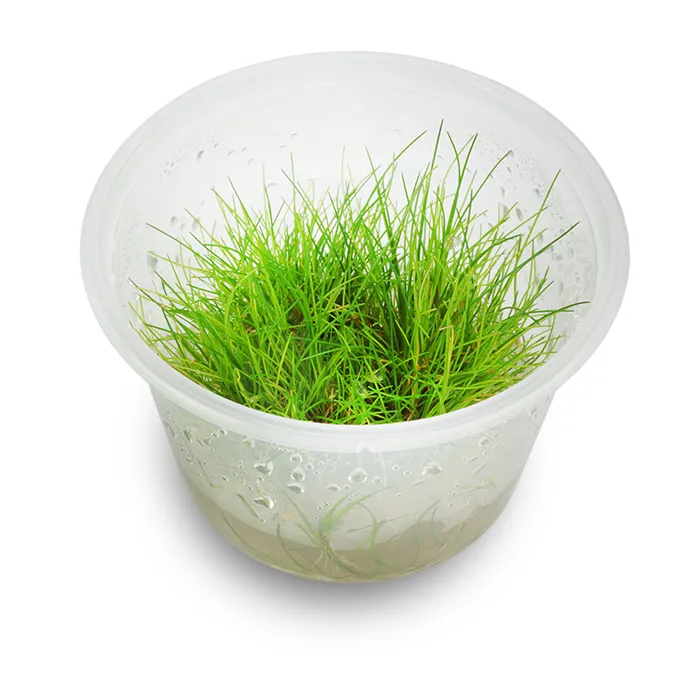
🪨 Species at a Glance
| Scientific Name | Eleocharis parvula (sold in the trade as ‘mini hairgrass’) |
| Common Names | Mini Hairgrass, Dwarf Hairgrass, Pygmy Spike-Rush, Micro Hairgrass |
| Family | Cyperaceae (the sedge family) |
| Origin | Cosmopolitan — North & South America, Europe, Asia, Australia |
| Supply Format | Tissue Culture (TC) cup, 1-1-2 grade, pesticide-free and snail-free |
| Mature Height | 3-5 cm (significantly shorter than standard E. acicularis which reaches 8-15 cm) |
| Blade Width | ~0.3 mm — finest of any commercial carpet species |
| Planting Method | Carpet — divided into small portions of 8-12 blades |
| Light Level | High (80-150 PAR measured at substrate level) |
| CO2 | Required for tight, dense carpet formation |
| Growth Rate | Slow to medium (accelerates sharply once runners initiate) |
| Propagation | Horizontal runners (stolons) — self-replicating lateral network |
| Placement | Foreground — nano tank and iwagumi showcase plant |
Planting Guide
Carpet
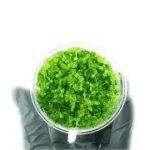
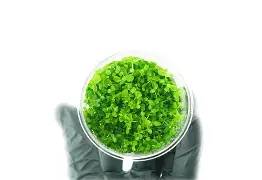
Unpacking a tissue-culture cup of Mini Hairgrass feels like unwrapping a miniature turf roll delivered from a microscopic lawn farm. Inside the sterile plastic cup you will find a pale, almost lime-green mat of juvenile shoots embedded in a translucent nutrient gel. The first and most important step — non-negotiable, genuinely non-negotiable — is to rinse every last trace of that gel off the root mass before planting. The agar is a sugar-and-nutrient medium designed for sterile laboratory conditions, and if it enters your aquarium it will feed biofilm, bacteria and fungi indiscriminately, triggering a microbial bloom that can smother fresh plantings within forty-eight hours. Hold the TC portion under a gentle stream of dechlorinated water, teasing the roots apart with your fingers until the water runs completely clear and the shoots feel clean to the touch rather than slippery. Do not be alarmed if the mass separates into many small tufts during rinsing — that is exactly what we want for carpet planting.
Once rinsed, divide the cup into small portions of roughly eight to twelve blades each. Think of each portion as a single plug of lawn turf. Using a pair of fine, straight aquascaping tweezers (curved tweezers work too, but straight give you better depth control in nano tanks with vertical glass walls), pinch a portion just above the white root crown and insert it into the damp substrate at a shallow angle of roughly thirty to forty-five degrees. The crown itself should sit level with the top of the substrate, not buried. Burying the crown is the single most common cause of melt in newly planted hairgrass — the growth point rots, the blades yellow, and the runner never initiates. When you withdraw the tweezers, do so slowly and straight up, so the plug stays in place rather than pulling back out. Space each plug one to two centimetres apart in a staggered grid pattern, like planting rice paddies. Closer spacing gives a faster initial fill at higher cost per square centimetre of carpet; wider spacing is cheaper but takes an extra four to six weeks for the runners to meet in the middle. A standard 60×30 centimetre foreground zone typically needs three to four TC cups for a two-week fill, or one to two cups for a six-week fill. The right choice depends on your patience and your budget.
For the first week after planting, keep the water level low — ideally only one to two centimetres above the substrate surface — to maximise light intensity and CO2 concentration at the leaf blades. Many professional aquascapers go further with the dry-start method (DSM), keeping the substrate saturated but not submerged under a sealed lid for three to six weeks until the carpet is fully established, then slowly flooding the tank. DSM eliminates melt almost entirely, accelerates runner production by fifty to seventy per cent, and produces the densest possible carpet, but it requires patience and a tight lid to maintain close to one hundred per cent humidity. Whichever method you choose, resist the temptation to cram portions too densely on day one; give each plug room to send out its own network of runners and the final carpet will be stronger, not weaker. A carpet that fills in through runner expansion has an interlocking root mat that resists lifting for years. A carpet that fills in through sheer planting density never develops that interlock and tends to lift off the substrate in sheets around the two-year mark.
A final planting tip that saves hours of frustration: pre-soak your aquasoil for twenty-four hours before planting. Freshly hydrated aquasoil is light and fluffy, and TC portions will float back out of the substrate as the tweezers withdraw — you will find yourself re-planting the same plug five times in a row while it keeps wriggling loose. Pre-soaked soil has compacted slightly, holds the plugs firmly, and leaches less ammonium into the first fill of water, reducing early algae pressure during the critical first fortnight of the new tank’s life.
One planting pattern that professional scapers use to achieve the fastest possible fill is what is known in the trade as the ‘checkerboard offset’ or ‘quincunx’ arrangement. Rather than planting plugs on a simple square grid, plant them in a staggered pattern where each row is offset by half a plug-spacing from the rows in front and behind it. This places every new plug at an equal distance from its five nearest neighbours, which maximises the efficiency of runner expansion and ensures that the carpet closes uniformly from all directions at once rather than forming visible rows. The pattern is invisible once the carpet has knitted, but during the fill-in weeks it dramatically reduces the appearance of bare substrate gaps between plugs, giving the tank a more finished look two to three weeks earlier than a square-grid layout.
How Much Light?
HIGH LIGHT
PAR: 80-150 PAR at substrate level
High
Mini Hairgrass is a high-light carpet and there is no polite way around that fact. Anything less than roughly 80 micromols of PAR measured at the substrate surface will produce a stretched, pale, loose carpet that lies flat rather than standing upright — the blades elongate desperately searching for light instead of thickening and branching sideways. The ideal intensity range sits between 80 and 150 PAR, which on a standard 60-centimetre tank translates to a modern planted-tank LED such as the Chihiros WRGB II Pro, Twinstar S-line, ONF Flat Nano, Week Aqua L-series, or a Kessil A80 Tuna Sun at roughly sixty to eighty per cent output with the fixture suspended fifteen to twenty-five centimetres above the water surface. If you are using older T5HO fluorescent fixtures, two to four tubes over a standard 60P footprint will achieve similar intensity, though modern LEDs are strongly preferred for their tunable full-spectrum output, lower heat load, and precise dimming and schedule control through companion smartphone apps.
Spectrum matters more than most new hobbyists realise. Hairgrass responds best to a full-spectrum white-dominated output in the 6500-8000 Kelvin range, supplemented with modest red and blue peaks around 660 nm and 450 nm respectively. Cheap ‘full white’ LEDs lacking the red peak often produce a thin, pale carpet even at high PAR because the plant cannot efficiently perform the final stage of photosynthesis without sufficient red light. If your fixture has RGB channels, set red to around seventy per cent, green to forty per cent, and blue to sixty per cent as a starting point and tune from there based on how the carpet colours up over the first month.
Photoperiod matters almost as much as intensity, and the two must be balanced. A short, intense blast is more effective than a long, weak soak — this is a universal truth of planted-tank lighting, and hairgrass exemplifies it. Run the lights at full intensity for seven to eight hours per day during the first six weeks while the carpet establishes, then you may extend to nine or ten hours once the canopy is fully knitted. Do not exceed ten hours total — longer photoperiods simply accelerate algae before they accelerate plant growth, because the plant’s dark-reaction enzymes saturate long before ten hours have elapsed but algae have no such limit. The classic symptoms to watch for are dark-green blades (ideal), pale-yellow stretched blades (more light or more iron needed), and short brown tips with green-dust algae on the glass (too much light relative to CO2, trim photoperiod by one hour and raise CO2 half a bubble per second). A ramped sunrise and sunset of thirty minutes on each end of the photoperiod is a gentle touch that mimics natural lighting, reduces the sudden algae-triggering spike of a snapped-on full-intensity cycle, and is less stressful for any fish or shrimp in the tank.
A practical tip on fixture height: every five centimetres you raise the light above the water surface roughly halves the PAR at the substrate, because light intensity follows an inverse-square law with distance. This means a fixture that delivers 150 PAR at ten centimetres above water drops to around 75 PAR at fifteen centimetres, and roughly 40 PAR at twenty centimetres. Use this relationship as your dimming dial — if your fixture has no physical dimmer and you are seeing algae, raise the fixture on taller legs or a suspension kit rather than trying to compensate through photoperiod reduction. Conversely, if the carpet is stretching and pale, lower the fixture closer to the water. It is a simpler and more effective tuning knob than spectrum adjustment for most hobbyists.
Recommended Photoperiod: 7-8 hours during establishment (first 6 weeks), extending to 9-10 hours once the carpet is fully knitted
CO2 & Nutrient Guide
CO2 INJECTION REQUIRED
Let us be direct — if you want the postcard-perfect, billiard-table carpet you see in aquascaping competitions, pressurised CO2 is not optional. Mini Hairgrass can technically survive without injected CO2, but the carpet will be sparse, slow, prone to algae colonisation, and it will never achieve the dense upright habit that makes this species famous in the first place. Target a steady twenty-five to thirty-five parts per million of dissolved CO2 during the full photoperiod (measured using a drop checker charged with 4 dKH reference solution, which should read lime-green to light-yellow at equilibrium). Turn the solenoid on sixty to ninety minutes before lights-on and off sixty to ninety minutes before lights-off, so that the concentration is already built up in the water column when photosynthesis begins and falls gracefully before darkness rather than wasting gas overnight.
The quality of CO2 dissolution matters more than the raw flow rate. A good diffuser — ceramic disc, inline atomiser, or reactor — matters more than the CO2 bubble count, because fine bubbles dissolved across the whole tank beat a high flow rate of large bubbles that shoot straight to the surface without entering solution. An inline atomiser plumbed into the canister-filter output is the most efficient solution for tanks over forty litres, delivering a fine mist of micro-bubbles into the return flow with dissolution efficiencies approaching ninety-five per cent. For smaller nano tanks, a high-quality ceramic disc diffuser directly below the filter outlet works well and has the aesthetic advantage of being largely invisible once tucked behind hardscape.
If pressurised CO2 is genuinely impossible — rental restrictions, strict budget, nano tank without space for a cylinder, or an absolute aversion to the hissing and tinkering that comes with pressurised gas — you have two fallback routes, neither as effective as proper injection but both viable. First, liquid carbon supplements such as Seachem Excel or APT Fix dosed daily provide roughly ten to twenty per cent of the carbon uptake of pressurised gas — enough to keep the carpet alive and growing slowly, but not dense. Be aware that liquid carbon is toxic to certain delicate mosses (Riccia, some Vesicularia) and to Vallisneria at the labelled dose, so take care with tankmates. Second, the dry-start method described in the planting section uses atmospheric CO2 (around 420 ppm in air, versus 3-5 ppm dissolved in typical tap water) to grow the carpet emersed before flooding. DSM produces excellent carpet results without a CO2 cylinder, though once flooded the long-term maintenance still benefits from some form of carbon supplementation.
Fertilisation
Mini Hairgrass is both a root feeder and a water-column feeder, and it responds best to a balanced programme that feeds both zones. In the water column, follow an EI (Estimative Index) or ADA-style liquid dosing schedule providing roughly twenty to thirty parts per million of nitrate, two to four ppm of phosphate, twenty to thirty ppm of potassium, and 0.3 to 0.5 ppm of iron per week, split across three to four doses. Iron is the single most visible nutrient for this species — an iron-deficient carpet goes pale from the new growth inward, while a well-fed carpet shows an intense deep-green at the blade tips that verges on blue-green under strong light. If you notice the carpet paling after its first flush of growth, a dedicated iron supplement (Tropica Premium, Seachem Flourish Iron, APT Sky, ADA Green Brighty Iron) dosed two to three times per week will restore colour within ten to fourteen days. The iron effect is one of the most satisfying visible responses in planted aquaristics — you dose on Monday and see the blades deepen by Thursday.
In the substrate, root tabs placed every ten to fifteen centimetres at a depth of three to four centimetres give the runners a rich nutrient target to colonise. Rich aquasoil alone is usually enough for the first six to twelve months of a new setup, but from the second year onward root tabs become the primary source of nitrogen and phosphorus for the root mass. Avoid dosing excess phosphate in the water column if you can deliver it through the substrate instead — hairgrass carpets tolerate high nitrate much better than they tolerate elevated water-column phosphate, which tends to fuel green-dust and green-spot algae on the older blades near the substrate line. A useful rule of thumb: if your tank has livestock producing waste (shrimp, small schoolers, otocinclus), you will rarely need to dose phosphate at all; if the tank is unusually lightly stocked or plant-only, a micro-dose of one to two ppm phosphate weekly is sensible.
Micronutrients beyond iron matter too, though less visibly. Magnesium (Mg) drives chlorophyll production and is especially important in soft-water tanks where reconstituted RO water is used — dose epsom salt to maintain around five ppm magnesium if your GH mix does not already include it. Potassium (K) drives carbohydrate transport and is rarely deficient if you follow any mainstream fertiliser brand’s label rate. Manganese, boron, molybdenum, zinc and copper are all present in trace-element supplements and generally do not require independent dosing. The fertiliser brands that bundle everything into a single bottle — APT Complete, Tropica Specialised, ADA Green Brighty Neutral, Easy-Life Profito — all work well for a Mini Hairgrass-dominant tank provided the dose rate is tuned to the plant mass.
A subtle but important point about nitrogen source: ammonium (NH4+) drives rapid vegetative growth but also strongly fuels algae in the first weeks of a new setup, whereas nitrate (NO3-) is slower-acting but far safer for a brand-new tank. Aquasoil releases plenty of ammonium in the first three to four weeks of use, so during that window dose nitrogen through nitrate-based supplements only (potassium nitrate, KNO3, is the cleanest source) and skip any urea- or ammonium-heavy ‘plant starter’ liquids. Once the aquasoil has settled and the ammonium release has tapered (check by testing for zero ammonia in the water column with a standard test kit), you may introduce ammonium-based dosing if the carpet seems nitrogen-starved, but most hobbyists never need to — nitrate alone is sufficient for long-term maintenance.
Maintenance Guide
SLOW GROWTH
Mini Hairgrass has a deceptive growth pattern that catches out a surprising number of new aquascapers. For the first two to three weeks after planting, very little visible progress happens above the substrate — the plant is investing almost all of its energy into root development and runner initiation below the surface. This silent phase is where most hobbyists panic, convince themselves the carpet is failing, and respond by dosing more fertilisers, cranking up the light intensity, or extending the photoperiod. Resist the urge absolutely. Those adjustments almost always trigger an algae crash rather than rescuing a carpet that was never in trouble in the first place. From week three or four onward you will see the first runners emerge — pale, white, pencil-thin horizontal shoots pushing sideways across the substrate and sending up new vertical blade tufts every one to two centimetres. Once runner production begins, the carpet typically achieves full knit-up within six to ten weeks of the original planting date, accelerating sharply in the final two weeks as the runners converge from multiple directions and the whole foreground suddenly ‘clicks’ into a unified carpet.
Maintenance revolves around one central practice: the trim. The first trim, performed around week six to eight once the carpet is roughly two to three centimetres deep and has essentially closed its canopy, is the single most important maintenance event in the life of the carpet. A sharp pair of curved scissors (Do!aqua Pro Scissors Curve, ADA Pro-Scissors M Curve, or Chihiros curve scissors) held almost parallel to the substrate, cutting the blades at one to one-and-a-half centimetres, stimulates dense lateral branching and turns a loose tuft-carpet into a true lawn. Without this first trim, the blades elongate upward rather than thickening sideways, and the carpet becomes a tall, floppy, mop-like mess that traps detritus, shades itself into yellowing at the base, and eventually lifts off the substrate in sheets. After the first trim, repeat every four to six weeks on average, always cutting high enough to leave plenty of green tissue behind for rapid regrowth. Never scalp the carpet down to the root crown — that causes weeks of brown, bare substrate before recovery.
The clippings themselves must be removed immediately and completely. Every single cut blade — and there will be thousands, floating on the surface and settling across the tank — must be vacuumed out with a fine-mesh net or brine-shrimp sieve immediately after trimming. Floating clippings will settle into the carpet, rot over two to four days, and cause brown-algae blooms and bacterial blooms within a week. A useful technique: after trimming, turn off the filter briefly so the clippings float still on the surface, skim them off with a net, then vacuum the carpet surface with a thin siphon to catch any that have already settled. Turn the filter back on only when the surface is completely clean.
Beyond trimming, routine carpet maintenance involves monthly iron checks (look for paling at the growth tips), quarterly thin-outs where the carpet has lifted or grown above the original substrate line in year two and beyond, and annual substrate refreshes where fresh root tabs are inserted along the carpet edges to sustain nutrient delivery as the aquasoil gradually exhausts. A well-maintained Mini Hairgrass carpet easily lasts five to seven years in the same tank without replanting, though many scapers choose to strip and replant at the three-to-four year mark simply to refresh the design and clear out any accumulated detritus under the root mat.
One stealthy failure mode worth naming explicitly: the ‘hollow carpet’ phenomenon. After a year or more, the visible green surface can remain lush and healthy while the root mat silently lifts off the substrate underneath, creating a hidden air-filled gap between the living blades and the aquasoil. You typically only notice it when you prod the carpet with a finger and feel it bounce unnaturally, or when a section suddenly floats up during a water change. Prevention is simple — a quarterly thin-out where you push tweezers down into the root mat at several points and gently press the carpet back into contact with the substrate — but once it has happened on a large scale the usual remedy is to lift out the affected section entirely, divide it into fresh plugs, discard the detritus underneath, and replant. Catching it early saves that labour.
Initial trim (week 6-8)
Cut at 1-1.5 cm with curved scissors held parallel to the substrate — triggers the dense lateral branching that defines a competition carpet
Routine trim (every 4-6 weeks)
Maintain a height of 1.5-2 cm; always remove every clipping with a fine net immediately after cutting
Weekly clipping removal
Vacuum any stray clippings and accumulated detritus from the carpet surface during each water change
Monthly iron check
Look for pale new blades at the growth tips; if observed, dose chelated iron two to three times per week
Quarterly thin-out
From year two onwards, use tweezers or a spatula to pull out clumps where the carpet has lifted off the substrate
Annual substrate refresh
Insert fresh root tabs along the carpet edges once per year to sustain long-term nutrient delivery as aquasoil exhausts
Water Chemistry Guide
6.0–7.5
ideal 6.5
18–26 °C
ideal 23 °C
4–15 dGH
soft to moderately hard; thrives on the soft side when paired with CO2 injection
Mini Hairgrass is delightfully forgiving of a wide range of water chemistries, which is a large part of why it has become the planted-tank default carpet species. It grows equally well in the soft, acidic, blackwater-style tanks beloved by South American biotope keepers (pH 6.0 to 6.8, GH 2 to 6) and in the harder, near-neutral water that most suburban tap supplies deliver in temperate regions (pH 7.0 to 7.5, GH 8 to 15). The sweet spot, if you have the luxury of adjusting, sits around pH 6.5 and GH 6 to 10. This range maximises CO2 efficiency (lower pH means better CO2 saturation), provides enough calcium and magnesium for strong blade structure and bright colour, and happens to suit the vast majority of fish and shrimp species that pair naturally with a carpeted aquascape — cardinal tetras, green neons, ember tetras, chili rasboras, Caridina shrimp, Neocaridina shrimp, otocinclus catfish, honey gouramis, and the full range of dwarf cichlid species.
Temperature is where this species quietly shows its cold-tolerant roots. Eleocharis parvula grows across a huge climatic range in the wild, from cold temperate Europe and Canada to subtropical Asia and Australia, and in the aquarium it is comfortable anywhere from eighteen to twenty-six degrees Celsius. Cooler water, in the twenty to twenty-three degree range, actually slows algae more than it slows the plant, so many professional aquascapers deliberately run their high-tech carpet tanks at the cooler end specifically to buy themselves a wider maintenance window between trims and to keep algae pressure low during the establishment phase. If you want to keep warm-water fish such as discus (requiring twenty-eight to thirty degrees) or altum angels, be aware that hairgrass will survive but will thin out and grow looser at sustained high temperatures above twenty-seven degrees; it is simply not the carpet of choice for a warmwater discus biotope. Consider Monte Carlo or Hemianthus callitrichoides ‘Cuba’ for those warm setups instead.
Filtration and water flow deserve specific attention. A carpet plant lives in the bottom centimetre of the tank, and if the flow pattern is wrong that zone can become a dead-flow area where detritus settles, CO2 stratifies upward away from the blades, and algae take hold. Aim for gentle but comprehensive flow that circulates the water column without blasting the carpet flat. A canister filter sized at four to six times the tank volume per hour, combined with a Poppy or lily-pipe outflow angled slightly downward across the surface, usually achieves this balance. If you have visible dead spots on the carpet (darker patches, detritus accumulation, thinning blades), add a small inline powerhead or circulation pump rated around one to two times tank volume per hour aimed obliquely across the foreground to eliminate the stagnation. Water changes of twenty-five to fifty per cent weekly are standard; larger changes are preferable during the establishment phase.
Layout & Placement
Foreground
Mini Hairgrass is the carpet species that defines modern aquascaping. Walk through any high-end international competition aquarium — IAPLC finalists from Japan, AGA rankings from North America, ADA Gallery installations from the heart of the Takashi Amano school, or AquaDesign cup entries from Europe — and you will see this species used in virtually every foreground that is not deliberately using a stem-plant alternative or a moss-based texture. It is the default for good reason: the ultra-fine blade width (roughly 0.3 millimetres), the short mature height (three to five centimetres), and the dense self-replicating carpet habit combine to produce a foreground that reads as pure green negative space from a normal viewing distance, which is precisely what contemporary iwagumi and nature-style compositions demand. The blades are fine enough to blur into a single unified plane; the height is low enough never to distract from the rock or wood composition; the carpet is dense enough to serve as visual ground without any gaps or tufts that draw the eye.
In an iwagumi featuring Seiryu, Ryuoh, or Ohko Dragon stones, the Mini Hairgrass carpet acts as a visual ground plane that lets the rock composition breathe against unbroken green. The classic Takashi Amano technique uses three rocks (Oyaishi, Fukuseki, Soeishi) arranged on a golden-ratio grid above a hairgrass carpet, with the carpet’s fine texture providing the quiet stillness that makes the dramatic rock shapes read clearly. In a Dutch-style or jungle-style layout, the same carpet creates the low, flat transition between hardscape and the taller stem-plant beds behind it, acting as an emerald floor that draws the eye inward and upward through the composition. In a nano tank of ten to forty-five litres, a single carpeted foreground is often the entire planting scheme, with hardscape and a few strategically placed moss-on-wood accents providing all the additional structural interest.
When pairing Mini Hairgrass with other plants, think in terms of height layers and textural contrast. Midground companions that work exceptionally well include various Bucephalandra species, Anubias nana ‘Petite’, Cryptocoryne parva, Staurogyne repens, and Pogostemon helferi ‘Downoi’ — all of which sit at five to fifteen centimetres tall and provide broader-leaf contrast against the hair-like blades of the carpet. For background drama, Rotala rotundifolia, Ludwigia super-red, Pogostemon erectus, Limnophila hippuridoides, and Myriophyllum tuberculatum all work without overwhelming the fine carpet below. Avoid aggressive foreground competitors such as Marsilea hirsuta, Glossostigma elatinoides, Hemianthus callitrichoides ‘Cuba’, or Monte Carlo in the same zone as hairgrass — they will invade the carpet from the edges, fight for substrate space, and create a scruffy mixed-texture foreground that looks unintentional rather than designed. If you want a mixed carpet, do it deliberately with clear borders (for instance, Mini Hairgrass in the left two-thirds, Monte Carlo in the right third, separated by a sandy path or stone line) rather than allowing two species to scramble across each other.
One last piece of composition advice that new aquascapers often ignore: do not carpet the entire foreground. Leave at least one area of open substrate, even if only a small sandy path between stones or a curving inlet along the front glass. The eye needs rest. An unbroken green sheet from left glass to right glass can feel claustrophobic despite its technical beauty, whereas a carpet that flows around and between open sand regions creates a sense of depth, movement, and intentional design. The small open patches also provide algae-eating shrimp and bottom-dwelling fish (otocinclus, corydoras, kuhli loaches) somewhere comfortable to forage, which adds life to the scape.
For photography and competition entries, Mini Hairgrass carpets reward specific viewing angles. The ultra-fine blades catch side light beautifully when photographed from a slightly lowered camera angle, roughly level with the top of the substrate or just slightly above, so plan your final trim and water-change routine to coincide with photography sessions. A freshly trimmed carpet photographed two weeks later, when the regrowth is uniform and two to three centimetres tall, is the classic ‘magazine shot’ moment in the lifecycle of any planted tank. Schedule a major water change and glass clean the day before shooting, let the water clear for twenty-four hours, dose a small pre-shoot water change to polish the clarity, and shoot with the CO2 on and the fish active during feeding time. These small planning habits transform an ordinary carpet into an award-worthy one.
| Plant | Why | |
|---|---|---|
| 🌿 | Bucephalandra sp. | Low midground companion — broad-leaf texture contrasts beautifully against the fine hair-blade carpet, attaches to hardscape |
| 🌿 | Anubias nana ‘Petite’ | Tiny rhizome plant for attachment to hardscape edges without shading the carpet below, ultra-hardy |
| 🌿 | Cryptocoryne parva | Smallest true Cryptocoryne, grows to only 5 cm — perfect midground step up from the 3-5 cm hairgrass carpet |
| 🌿 | Rotala rotundifolia | Background stem plant — pink-to-red tops contrast the pure-green foreground when given strong light and iron |
| 🌿 | Staurogyne repens | Creeping midground with larger rounded leaves that transition smoothly between the carpet and taller background stems |
| 🌿 | Pogostemon helferi ‘Downoi’ | Compact curly-leaf accent at the carpet’s edge, especially effective in iwagumi-style rock compositions |
Propagation Guide
Runners
Mini Hairgrass propagates itself almost automatically once established. The mother plant sends out horizontal runners — technically classified as stolons in botanical terminology — that travel one to three centimetres through the top layer of the substrate before popping up as a new vertical tuft, which in turn sends out its own next generation of runners. This self-replicating network is what makes Eleocharis parvula the defining carpet species of the aquarium hobby. In a well-lit, well-fertilised, CO2-injected tank, a single TC cup divided into twenty small portions and planted on a 60×30 centimetre foreground can fully carpet the area within six to ten weeks purely through this runner expansion, with zero intervention from the aquascaper beyond regular trims and fertilisation. It is one of the most satisfying displays of passive plant propagation in the entire hobby — you plant twenty small plugs and several weeks later you have a continuous carpet containing thousands of individual blade tufts, all genetically identical to the original twenty parents.
Harvesting excess carpet for another tank, for trading with fellow hobbyists, or for gifting to a friend starting their first planted tank is satisfyingly simple. Once the carpet is mature (three or more months post-planting), grip a section with your fingers or a flat aquascaping spatula, work the tool under the root mat, and lift a square of turf measuring one to five centimetres on a side. The interconnected root network will hold together as a cohesive mat, pulled up essentially as a single living rug. Rinse it briefly in tank water to remove the substrate grains clinging to the roots, then replant it into a new tank exactly as you would a fresh TC portion. Because the harvested tissue is already fully adapted to submerged life and already aggressive with runners (there is no dormancy period, no emersed-to-submerged adaptation), this kind of transplant often establishes in under two weeks — significantly faster than starting fresh from a TC cup. Many experienced aquascapers deliberately keep a large ‘farm tank’ of mature hairgrass solely to supply transplant material to new scapes.
One nuance to be aware of: while Mini Hairgrass can in theory be propagated from flower spikelets and seeds (since it is a true flowering plant in the sedge family, not a fern or moss), this is essentially never practical in the aquarium hobby. Emersed flowering is rare in submerged conditions, viable seed production even rarer, and germination rates are poor without specific lab conditions. Stick to runner propagation and division — it is the method nature uses, it is the method that works, and it is the method that all commercial TC labs rely on to produce the cups you buy.
Tissue culture itself is worth a brief note, because understanding where your plant came from helps you treat it correctly. Commercial TC labs take a small fragment of a healthy mother plant, sterilise it, and grow it on sterile agar medium enriched with specific hormones (auxins for roots, cytokinins for shoots) that push the tissue to produce many new plantlets from a single starting fragment. The resulting cup you buy contains dozens of genetically identical juvenile plants that have never experienced substrate, predators, algae, fish, shrimp, or even liquid water in the usual sense — they have lived their entire lives in sterile gel under controlled lab light. This lab origin is why they must be rinsed so thoroughly (the gel is a contamination vector once it hits a non-sterile tank) and why they sometimes pause growth for one to two weeks after planting (they are adapting from lab sugar-nutrient uptake to true photosynthesis-driven growth in an aquarium environment). Once that adaptation completes, the juvenile vigour of TC material actually outpaces traditionally-potted plants within a month or two, which is why competition scapers prefer TC despite the higher unit price.
Quick Reference
| Scientific Name | Eleocharis parvula |
| Trade Name | Mini Hairgrass (often labelled ‘acicularis mini’) |
| Supply Format | Tissue Culture (TC) cup |
| Mature Height | 3-5 cm |
| Placement | Foreground carpet |
| Light | High (80-150 PAR) |
| Photoperiod | 7-10 hours |
| CO2 | Required (25-35 ppm) |
| pH | 6.0-7.5 (ideal 6.5) |
| Temperature | 18-26 C (ideal 23 C) |
| Hardness | 4-15 dGH |
| Growth Rate | Slow-medium (accelerates sharply once runners initiate) |
| Propagation | Horizontal runners (stolons) |
| Aquascape Style | Iwagumi, nano, nature-style, Dutch foreground |
Reviews
Clear filtersThere are no reviews yet.