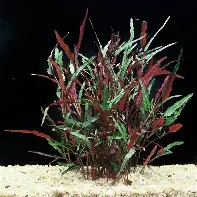
🪨 Species at a Glance
| Common Name | Dragon’s Tongue / Dragonflame / Purple Waffle / Red Ivy |
| Scientific Name | Hemigraphis repanda |
| Family | Acanthaceae |
| Origin | Southeast Asia — Malay Peninsula, Indonesia, Philippines; humid bog margins and stream banks |
| True Classification | Bog or marginal terrestrial plant — NOT a true aquatic; melts when fully submerged long-term |
| Form Supplied | Traditional bunched stems (6-10 cuttings per bunch, weighted base, grown emersed in nursery) |
| Planting Method | Stem — plant cuttings into saturated substrate; creeping stolons also root from nodes |
| Light Level | Medium (purple underside brightens considerably under stronger light in emersed conditions) |
| CO2 | Helpful for short-term submerged displays, but does not prevent long-term melt |
| Growth Rate | Slow underwater; fast and vigorous when grown emersed or marginal |
| Expected Submerged Lifespan | 2-3 months typical; replacement-plant mindset required for submerged use |
| Ideal Use | Paludarium, ripariums, emersed-scape walls, terrarium groundcover; submerged only as short-term accent |
How to Plant
Stem
Hemigraphis repanda is morphologically a stem plant, with elongated flexible stems that produce alternating or loosely whorled narrow serrated leaves, nodes that root readily wherever they touch moist substrate, and a natural tendency to spread horizontally via creeping stolons once established. This stem-and-stolon growth habit is why the plant is so successful as a groundcover in vivaria and paludariums — cuttings root fast, spread laterally, and quickly cover soil and hardscape with a dense carpet of colourful narrow foliage. In the aquarium hobby, the plant is sold as traditional bunched stems, much like Ambulia or Rotala: six to ten individual cuttings gathered at their base by a rubber band or lead strip, grown emersed in the nursery, trimmed to uniform length, and shipped wet. That familiar presentation reinforces the mistaken impression that the plant is a true aquatic, but the nursery conditions it came from were almost certainly humid greenhouse beds where the stems spent their lives with their roots in saturated soil and their leaves in open air.
When you receive a bunch at home, preparation is straightforward. Remove the band or weight at the base and separate the cuttings by hand, gently teasing apart any tangled roots without tearing them. Rinse the stems under dechlorinated water to clear nursery debris, then examine each one: healthy cuttings have firm green stems, plump well-coloured leaves, and at least two or three visible nodes along their length. Discard any cutting with a blackened soft base, wilted translucent foliage, or a rotten smell at the root zone. With clean sharp scissors, make a fresh diagonal cut one centimetre above the original cut at the base, strip the lowest two to three centimetres of leaves, and the cutting is ready to plant.
For a paludarium or emersed setup — which is the use case this plant was genuinely designed for — plant cuttings directly into saturated peat-based or aquasoil substrate, burying the bottom three to four centimetres of stem and leaving the leafy upper portion in the humid air above the waterline. Space cuttings two to four centimetres apart for quick coverage, or further for a more measured spread. The plant will root from the buried stem within a week, produce new leaves at the growing tip within two weeks, and begin sending out lateral stolons that crawl across the substrate or over hardscape within three to four weeks. In an enclosed paludarium where humidity remains above seventy percent, growth is rapid and the plant can cover a square decimetre of substrate in two to three months from a single bunch. Paludarium glass walls, epiphyte-laden branches, and mossy mounds all serve as climbing surfaces where Hemigraphis repanda will happily creep and root.
For a fully submerged aquarium display — which is how the plant is unfortunately most often sold — plant the cuttings the same way as any stem plant, pushing their bases into soft fine substrate using long planting tweezers, burying three to four centimetres, and spacing two to three centimetres apart. Understand, however, that what you are doing is installing a short-term accent plant, not a permanent aquascape element. The first two to three weeks will look encouraging: the emersed-form leaves remain turgid, the purple undersides show beautifully when illuminated from above at an angle, and the stems may even produce one or two sets of new leaves in a more modest underwater form. This is the plant’s initial reserve, drawing on the energy it built up as an emersed stock plant in the nursery. After that initial honeymoon, the story changes. From roughly week three onwards, you will notice older leaves beginning to thin, become translucent, develop pinholes, and eventually fall from the stem. The new growth that appears — if any — is progressively smaller, paler, and less vigorous. By month two the plant typically has lost most of its original foliage mass, and by month three the remaining skeleton is unattractive enough that most hobbyists remove and replace it.
This is not a failure of your tank parameters. This is the plant’s biology. Hemigraphis repanda, like many Acanthaceae that are marketed as aquatics (and like Alternanthera sessilis, various Hemianthus cultivars grown poorly, and countless house-plant cuttings pushed as aquarium species by less scrupulous suppliers), simply cannot maintain indefinite photosynthesis underwater. Its stomata, cuticles, and leaf architecture all evolved for gas exchange with air. Submerged, it slowly starves. CO2 injection helps, high light helps, aggressive fertilisation helps — but none of these interventions change the fundamental mismatch between the plant’s biology and permanent submersion. Honest planning means accepting this from the outset and making decisions around it.
Lighting Guide
MEDIUM LIGHT
PAR: 30-60 PAR at the canopy (in a paludarium, measure at the leaf surface above the waterline)
High
Hemigraphis repanda is a medium-light plant in either emersed or submerged contexts, and it rewards well-considered lighting with a dramatic transformation of colour and form. In an emersed paludarium setup, the plant thrives under a balanced full-spectrum LED running at roughly 30 to 60 PAR measured at the leaf surface, for eight to twelve hours per day. Under these conditions, the upper leaf surfaces develop a rich olive-green often tinted with bronze or burgundy where the strongest light strikes, and the undersides express their signature vibrant purple most fully. Because the purple colour is a pigment adaptation to high-light exposure and is quite responsive to light quality, a fixture with strong red and blue output — the classic horticultural spectrum — will produce more saturated purple undersides than a fixture with predominantly white or warm-white spectrum. Many paludarium builders specifically choose higher red-blue ratio fixtures such as Finnex Planted+ 24/7 CC or Chihiros WRGB II for this reason.
In a submerged aquarium, the same medium-light target holds. Position stems near the water surface where they will receive the strongest light before it attenuates through the water column, or plant them in shallow-water setups (20 to 30 centimetres deep) where light is strong throughout. The purple underside of the foliage is a key aesthetic selling point and is only visible from certain viewing angles: if the stems grow completely upright with leaves pointing up, you see only the olive-green topside, and the colour story is lost. Work with the plant’s natural tendency to sprawl, and plant stems at the edges of hardscape mounds or along the substrate line where they will lean outward and tilt, revealing the purple undersides from the front viewing pane. Lateral lighting from the sides, rather than purely top-down, also helps show the colour contrast by catching the undersides as they curl.
Photoperiod for Hemigraphis repanda is not especially sensitive. Six to nine hours per day suits submerged displays; emersed paludarium setups tolerate ten to twelve hours comfortably because there is no algal competition in an aerial environment. Too short a photoperiod (below five hours) produces pale leggy growth with washed-out underside colour. Too long a photoperiod combined with high intensity and inadequate nutrition produces scorched leaf edges on the exposed upper surfaces and, in submerged displays, quickly drives algae onto the leaves — an especially frustrating scenario because this plant’s delicate foliage does not tolerate manual algae cleaning and does not respond to chemical algaecides without damage.
Observe your plant’s signals. Vivid bronze-tinged olive upper surface with saturated purple underside is the target colour expression. Uniform pale green with little purple expression indicates insufficient light; raise the fixture output or reduce water-column shading from floating or background plants. Scorched brown edges on upper leaves indicate too much light and likely nutrient imbalance; reduce light or extend the fertilisation regime. In a submerged aquarium, one important signal is that stressed Hemigraphis repanda often responds to high light by producing pale under-developed new growth rather than by colouring up — this is the plant giving up on the losing battle with submersion rather than responding to better conditions. If the only symptom improvement you can achieve with more light is more algae, treat that as a signal that the plant is not in its preferred habitat and plan accordingly.
Recommended Photoperiod: 6-9 hours per day submerged; 10-12 hours per day emersed in a paludarium without algae pressure
Carbon & Nutrients
CO2 OPTIONAL
CO2 injection is genuinely helpful for a submerged Hemigraphis repanda display, but it must be understood correctly: CO2 extends the useful life of the plant underwater and improves the quality of the brief submerged period, but it does not and cannot transform this bog-margin species into a permanent aquatic. Under pressurised CO2 dosed to 20 to 30 parts per million during the photoperiod, a newly planted Hemigraphis repanda bunch may hold its emersed-form foliage for an extra two to four weeks beyond what it would manage without CO2, produce slightly more new submerged-form growth during the transition, and display richer colour while the leaves are still turgid. In practical terms, adding CO2 to your submerged Hemigraphis repanda aquascape might push the useful lifespan from perhaps six to eight weeks up to ten to fourteen weeks. That is genuinely meaningful — a quarter of a year of attractive plant presence is not nothing — but it is still a replacement-plant cycle, not a permanent element. Honest hobbyists planning submerged Hemigraphis repanda should budget for replacing the plant every two to three months, and CO2 is one of the tools that lengthens that interval but does not eliminate it.
For emersed paludarium displays, CO2 injection is not standard practice and not needed. Above the waterline the plant accesses atmospheric CO2 at 400 parts per million naturally, which is well above saturation for its photosynthesis. What emersed displays do benefit from is good air circulation: a small computer fan, a paludarium mister-and-circulator system, or simple passive ventilation through mesh panels all prevent stagnant humid pockets from encouraging fungal issues on the foliage. In a well-ventilated humid paludarium without any CO2 injection, Hemigraphis repanda grows vigorously for years, producing bright colourful foliage and spreading actively via stolons.
Liquid carbon products such as Seachem Flourish Excel or Easy Life EasyCarbo can partially substitute for pressurised CO2 in a submerged display, though with the same caveats. Dose daily at roughly one millilitre per forty litres of water. Under liquid carbon dosing, a Hemigraphis repanda bunch may see its useful lifespan extended by perhaps two to three weeks beyond an untreated baseline, again a meaningful but bounded improvement. Note that liquid carbon products can damage sensitive plants (some Vallisneria, some mosses, Riccia); Hemigraphis repanda itself tolerates liquid carbon without issue while alive, but its decline trajectory is only slowed, not reversed.
The honest recommendation with CO2 and Hemigraphis repanda is this: if you already run CO2 for other plants in a high-tech planted tank, your Hemigraphis repanda will look its best for a little longer and is worth including as a short-term accent. If you would only be adding CO2 specifically for Hemigraphis repanda, do not bother — invest the same money in a small paludarium setup where the plant truly thrives instead.
Fertilisation
Hemigraphis repanda is a moderately heavy feeder that benefits from a full-spectrum fertilisation approach covering both root zone and water column. The emersed plant in a paludarium is the more rewarding context: feed through the substrate using a nutrient-rich terrarium base layer or occasional supplementation with controlled-release fertiliser pellets designed for tropical houseplants (Osmocote Plus in modest quantities beneath the root zone works well), and mist the foliage weekly with a dilute balanced liquid fertiliser such as Seachem Flourish or Tropica Specialised Nutrition at half the label dose. Emersed Hemigraphis repanda responds to feeding with rapid growth, stronger leaf colour saturation, and more aggressive stolon production. Avoid over-feeding, which in a closed paludarium can cause algae on glass walls and moss on adjacent surfaces.
For submerged aquarium use, water-column dosing is the dominant fertilisation method because the plant’s roots are proportionally less active underwater than its leaf surfaces. A comprehensive liquid fertiliser providing macronutrients (nitrogen, phosphorus, potassium) and micronutrients (iron, magnesium, and trace elements) dosed per Estimative Index or leaner alternatives both work, with the Estimative Index approach tending to give slightly richer leaf colour during the plant’s window of health. Supplement with root tabs beneath the stems for insurance, though these are less impactful than water-column dosing given the plant’s physiology. Iron supplementation is particularly relevant for maintaining underside purple colour; dose Seachem Flourish Iron or similar two to three times weekly.
The frustrating reality of fertilising a submerged Hemigraphis repanda is that no matter how carefully you manage nutrients, you are fundamentally in a palliative-care scenario rather than a growth-promotion one. The plant is declining because of its fundamental biology, not because of nutrient deficiency, and overzealous fertilisation can actually worsen algae problems on the declining foliage and in the surrounding water without meaningfully extending the plant’s life. A moderate, balanced fertilisation regime matched to the rest of your tank is the pragmatic approach — there is no fertilisation trick that rescues Hemigraphis repanda from its fate as a short-term submerged accent.
Ideal Water Conditions
6.0–7.5
ideal 6.8
22–28 °C
ideal 25 °C
4–12 dGH
soft to moderately hard; the plant is not particularly fussy about hardness but the rest of its biology is the real constraint
Hemigraphis repanda is reasonably tolerant across a broad range of water parameters, which paradoxically contributes to the confusion about its suitability as an aquatic plant — because the plant does not die quickly or dramatically in aquarium water chemistry, the slow decline from fundamental biology mismatch is easy to misattribute to parameter issues rather than to the underlying problem. Across pH 6.0 to 7.5, general hardness from 4 to 12 dGH, and tropical temperatures of 22 to 28 degrees Celsius, the plant’s short-term appearance and transition-phase behaviour will be broadly similar. Moving closer to the centre of these ranges (pH around 6.8, hardness around 6 to 8 dGH, temperature around 25 degrees) gives a slight edge in leaf quality during the plant’s window of submerged health, but changing parameters within this acceptable range will not change the ultimate submerged-decline trajectory.
Temperature is worth a specific note. Hemigraphis repanda is a warmth-loving tropical species that genuinely suffers below 20 degrees Celsius, with growth slowing dramatically and the plant becoming vulnerable to rot at cooler temperatures. In a paludarium, aim for 22 to 26 degrees at the emersed foliage level; this may require a gentle heating cable under the substrate or a heating mat beneath the enclosure to compensate for evaporative cooling that terrariums experience. In a submerged aquarium, a standard tropical tank heater set to 24 to 26 degrees is fine. Do not attempt Hemigraphis repanda in coldwater or subtropical tanks; it simply will not cope.
Water-change discipline in a submerged Hemigraphis repanda aquarium should follow your normal planted-tank routine: 30 to 50 percent weekly is a good default, with careful dechlorination of all replacement water. Because the plant is declining over weeks regardless, water changes are more about maintaining overall tank health for the fish and other plants than about specifically supporting Hemigraphis repanda. In a paludarium, water changes for the submerged lower section can be monthly or as needed, because emersed sections do not rely on the water column for nutrients in the same way submerged plants do.
Perhaps the most useful parameter insight for Hemigraphis repanda is humidity, which is relevant for paludarium and emersed setups rather than submerged ones. The plant thrives at 70 to 90 percent relative humidity around its foliage; below 60 percent the plant wilts and browns at the leaf edges. Enclosed paludariums with glass lids and moderate ventilation naturally maintain appropriate humidity. Open-top aquariums do not, which is another reason why Hemigraphis repanda struggles in conventional aquarium setups — even if you could somehow keep the leaves in air above the waterline, the ambient humidity in a typical living room (30 to 50 percent) is too dry for long-term success.
Growing & Trimming
SLOW GROWTH
Growth rate for Hemigraphis repanda varies dramatically depending on whether the plant is submerged or emersed, and understanding this difference is central to planning realistic maintenance. Underwater, the plant grows slowly if at all — in the most favourable submerged conditions (medium-high light, strong CO2, full-spectrum fertilisation, warm water) you might see a small amount of adapted submerged-form growth during weeks two and three, with one or two small new leaves emerging per stem per week. More typically, there is essentially no meaningful underwater growth, and the plant is simply depleting its stored reserves from its emersed-nursery life while slowly losing its original foliage to progressive melt. The practical takeaway is that submerged Hemigraphis repanda is not a plant you trim, shape, and manage over time as a growing aquascape element; it is a plant you install fresh, enjoy for two to three months, and replace. Treat it like a cut flower in a vase rather than a potted plant on a windowsill.
Above the waterline in a humid paludarium, everything changes. Emersed Hemigraphis repanda is a vigorous, almost rampant groundcover that spreads at a rate of two to five centimetres per week horizontally via creeping stolons, produces new leaves continuously at every growing tip, and will cover a square decimetre of substrate surface in two to three months from a single bunch of cuttings. Under good conditions, emersed Hemigraphis repanda flowers — producing small pale violet or white tubular flowers from leaf axils — which is an attractive bonus for paludarium displays and occasionally encouraged in botanical collections. Maintenance for emersed growth is the opposite of submerged: frequent trimming is required to keep the plant from overrunning its allocated space and smothering smaller companion plants in the vivarium. A sharp pair of terrarium scissors can trim a Hemigraphis repanda mat back to size in minutes, and the trimmings can be discarded, composted, or replanted elsewhere.
Maintenance tasks for submerged aquarium use focus on managing the plant’s decline gracefully and preparing for replacement. In the first two to three weeks post-planting, perform standard water changes and fertilisation and enjoy the plant at its peak. Through weeks four to eight, monitor for melted leaves at the base of stems and remove them promptly during weekly maintenance to prevent organic load buildup; this is best done with long tweezers, grasping individual leaves as they become translucent and decomposed, before they break free and scatter through the tank. Through weeks eight to twelve, assess whether the remaining plant mass is still contributing to the aesthetic — often it is reduced to perhaps half its original foliage — and either commit to planned replacement or allow the decline to continue if the remaining plant material is still providing value. Have replacement stems on order or from a stock plant by week ten so that the transition to fresh plants is smooth.
Maintenance for emersed paludarium use is both more enjoyable and more demanding. Expect to trim the plant every three to six weeks depending on the overall planting density in your vivarium, removing approximately a third of the stem length each time to keep the plant in bounds. The trimmings can be replanted into gaps elsewhere in the vivarium to extend coverage, or shared with fellow paludarium enthusiasts. Fertilisation in an emersed setup should be modest; the plant is already vigorous under good conditions and over-fertilisation causes softer, paler foliage with weaker colour expression. Weekly misting maintains humidity and also provides foliar access to any liquid fertiliser applied; some paludarium keepers dust foliage with very dilute balanced ferts monthly for an extra growth boost.
One specific maintenance challenge in humid paludariums is fungal and bacterial issues on crowded, poorly ventilated foliage. Hemigraphis repanda has broad flat leaves that retain moisture on their upper surfaces, and in a stagnant humid enclosure this moisture can encourage powdery mildew or bacterial leaf spot. Prevention is better than treatment: ensure the vivarium has at least modest air circulation (a small clip-on fan running a few hours per day is usually sufficient), avoid overcrowding the plant mass, and promptly remove any leaves showing signs of fungal speckle. For treatment, reduce misting frequency briefly, improve ventilation, and consider a single light application of a neem-based plant foliar treatment if infection is established. Healthy well-circulated paludariums rarely have these issues.
Daily (Paludarium)
Brief visual check for wilted or fungal-spotted leaves; ensure misting system or manual misting schedule is maintaining humidity at 70-90 percent at the foliage
Weekly (Submerged)
Remove translucent or melted leaves with long tweezers before they disintegrate; perform 30-50 percent water change; dose liquid fertiliser per schedule; assess plant health and melt rate
Weekly (Paludarium)
Dose diluted foliar fertiliser via misting; inspect growing tips for vigorous new growth; check that stolons are not overrunning companion plants; wipe condensation from glass walls if obstructing view
Every 3-6 Weeks (Paludarium)
Trim emergent stems back by roughly one-third to prevent overgrowth; replant trimmings in gaps or share with fellow hobbyists; divide oversized mats if needed
Every 2-3 Months (Submerged)
Plan and execute plant replacement: remove declining original bunch, install freshly purchased bunch of Hemigraphis repanda cuttings; treat as an ongoing replacement cycle rather than a permanent aquascape element
As Needed
Improve ventilation or reduce misting in paludariums if foliar fungal issues appear; strengthen CO2 or liquid carbon dosing in submerged displays to extend useful life; remove and replace stems that have collapsed to bare skeletons
How to Propagate
Cuttings
Hemigraphis repanda propagates with spectacular ease in its preferred emersed conditions, which is part of why it is so beloved by paludarium and terrarium keepers. The plant reproduces via two closely related mechanisms: traditional stem cuttings, and spontaneous rooting from stolons (creeping horizontal stems) that run along the substrate or over hardscape. Both methods are trivially simple and neither requires any special hormone, substrate, or technique.
For stem cutting propagation, take any healthy stem section five to ten centimetres long with at least two or three nodes. Strip the lower one to two centimetres of leaves, make a fresh diagonal cut at the base if the original cut is ragged, and plant the cutting directly into moist substrate. In emersed conditions the cutting roots within four to seven days and begins active growth at the tip within ten to fourteen days. In submerged conditions the cutting behaves the same way the original bunched stems did — it looks healthy for a few weeks and then begins its melt trajectory — so submerged cuttings of Hemigraphis repanda are not a productive long-term propagation strategy. Keep submerged cuttings only if you need short-term replacement stock and have the humidity-maintained emersed mother plant providing unlimited cuttings.
Stolon-based propagation is where Hemigraphis repanda particularly shines. As established plants grow in a paludarium, their stems naturally extend outward from the mother plant and begin to creep horizontally across substrate and hardscape. Nodes along these stolons produce adventitious roots wherever they touch moist surfaces, effectively self-planting without any intervention from the keeper. After a few weeks the stolon becomes a rooted independent plant; at that point you can simply cut the connection to the mother plant and transplant the newly rooted section elsewhere in the vivarium or to a separate propagation container. Over a growing season, a single original Hemigraphis repanda bunch can produce dozens of daughter plants this way, making long-term self-sufficient paludarium displays entirely achievable and propagation costs essentially zero after the initial purchase.
For hobbyists who want to maintain a reliable stock of Hemigraphis repanda for submerged aquarium use as a replacement-plant cycle, setting up a dedicated propagation container is the practical approach. A modest plastic tote with a few centimetres of aquasoil topped with sphagnum moss, a clear lid for humidity, a small LED light for ten hours daily, and one initial bunch of cuttings will produce essentially unlimited replacement stems within two to three months and continue indefinitely after that. This removes the repeated purchase cost of submerged-use replacement plants and gives you full control over the cleanliness and vigour of the stock. The propagation container itself is an attractive small paludarium in its own right and can be kept in a utility room or on a shelf as long as it has light and heat.
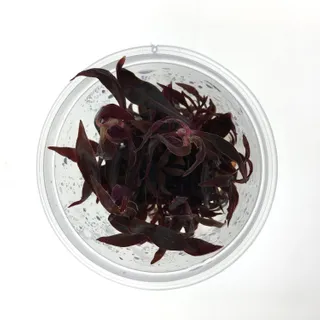
Seeds are produced by mature flowering plants in paludarium conditions, but seed propagation is not commonly practised because vegetative propagation is so effective and produces true-to-type plants. Tissue culture versions of Hemigraphis repanda occasionally appear in the aquatic plant market sold in small cups, but these are essentially the same plant in cleaner presentation and have the same fundamental aquatic-versus-bog biology limitation — the cup format does not change the plant’s ecology.
Aquascaping & Design
Foreground
Aquascaping with Hemigraphis repanda means very different things depending on whether you are planning a paludarium, a riparium, or a submerged aquarium. In each case the plant has genuine design value, but the honest framing of that value shifts dramatically between contexts. This section addresses all three setups because each one represents a legitimate use case for the plant, and aquarists deserve to know which route matches their actual hardware and commitment level.
In a paludarium — the plant’s true home — Hemigraphis repanda is a star performer and belongs front and centre as a textured, colourful foreground groundcover. Plant stems at the wet margin of the land-water transition, where substrate stays constantly moist but is not permanently submerged. The creeping stoloniferous habit means the plant will spread across mossy mounds, drift sideways over driftwood, climb gently up vertical surfaces if humidity is high enough, and eventually reach downward into splash zones at the water’s edge. Partner plants for paludarium compositions include other Acanthaceae groundcovers (Hemigraphis alternata, Fittonia varieties, Pilea species), epiphytic rhizome plants (Anubias varieties, Bucephalandra cultivars grown emersed on driftwood), vivarium ferns (Asplenium, Microgramma, Nephrolepis dwarf cultivars), and carpet mosses (Leucobryum, Java moss, Christmas moss). Hardscape with dense moss growth provides ideal substrate for Hemigraphis repanda stolons to creep across, creating a multi-textured forest-floor aesthetic that is extraordinarily beautiful under careful lighting.
In a riparium — effectively a tall aquarium with plant baskets hanging above the waterline — Hemigraphis repanda works brilliantly in the emergent basket as a trailing element, with foliage tumbling down toward the water surface and roots absorbing nutrients from the submerged basket rear. This setup combines the aquatic benefits of a fish tank with the terrestrial beauty of the plant, and avoids the submerged-use problem entirely. A classic riparium composition includes several emergent baskets along the back of a 90 centimetre tank, each planted with a different emergent species including Hemigraphis repanda as a trailing colour accent, while the submerged lower half contains conventional aquatic plants and a school of peaceful community fish.
In a submerged aquarium — the use case most hobbyists are attempting when they buy this plant — Hemigraphis repanda is best understood and deployed as a short-term foreground or low-midground accent. Place bunches in areas where the purple underside will be visible to viewers, typically the front edge of a low mound or the forward slope of a substrate ridge. Because the plant will need replacement in two to three months, avoid using it in structural roles that would be disrupted by replanting — do not plant it underneath or behind other established plants that cannot be disturbed. Instead, design around it as a featured accent that rotates through your aquascape. Some planted-tank hobbyists treat Hemigraphis repanda like a cut-flower display element in a room: beautiful, seasonal, deliberately ephemeral, refreshed on a planned cycle.
Design partners in a submerged context include other short-lived or adaptable specimen plants (Alternanthera sessilis has similar honesty issues but beautiful colour; tissue-cultured bog plants used as accents), robust midground plants that frame the accent (Cryptocoryne wendtii, Cryptocoryne parva, Echinodorus tenellus), and background stem plants (Rotala rotundifolia, Ludwigia repens) that provide stable visual structure behind the rotating accent position. Livestock compatibility in a submerged Hemigraphis repanda aquascape is broad and similar to any community planted tank: peaceful tetras, rasboras, Corydoras, dwarf shrimp, peaceful dwarf cichlids, and small livebearers all coexist without concern. The plant is not eaten by most fish, so herbivorous species like goldfish or silver dollars are the rare exceptions; these would damage the foliage mechanically.
For hobbyists who love the aesthetic of Hemigraphis repanda but want long-term stable aquascapes rather than rotating accents, the clearest recommendation is to pivot toward paludarium or riparium design. A small desktop paludarium with Hemigraphis repanda as the featured groundcover can be set up for modest cost and provides years of beautiful stable growth, with none of the replacement-cycle frustration of submerged use. Many planted-tank hobbyists who discover paludariums through their first attempt at growing Hemigraphis repanda underwater become enthusiastic paludarium keepers as a result — the disappointment of submerged failure often leads to the discovery of a more rewarding hobby branch.
| Plant | Why | |
|---|---|---|
| 🌿 | Bucephalandra varieties (emersed on hardscape) | Paludarium rhizome companion; grows emersed on driftwood and rocks at the splash zone, providing dark-leaved structural contrast against Hemigraphis repanda’s creeping colourful mat |
| 🌿 | Cryptocoryne wendtii ‘Green’ or ‘Brown’ | Submerged midground partner that provides stable long-term structure around a rotating Hemigraphis repanda accent; thrives in similar warm soft-water conditions |
| 🌿 | Java Moss (Taxiphyllum barbieri) | Ideal paludarium substrate for Hemigraphis repanda stolons to creep across; grows emersed or submerged and creates the damp mossy base layer the plant loves |
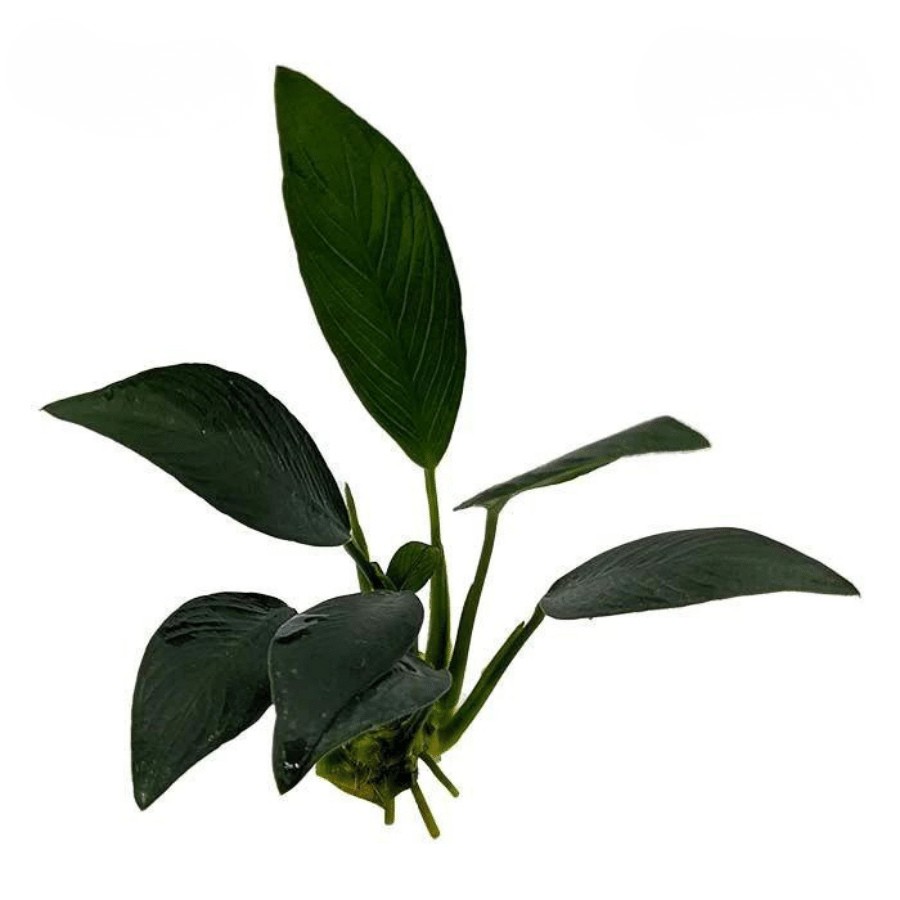
| 🌿 | Anubias nana ‘Petite’ (emersed or submerged) | Dark broad-leaved rhizome plant for textural contrast against narrow serrated Hemigraphis repanda foliage; works in either paludarium or submerged aquascape roles |
| 🌿 | Rotala rotundifolia | Reliable background stem plant for a submerged display; provides stable colourful backdrop that remains when the Hemigraphis repanda accent is rotated out for replacement |
| 🌿 | Fittonia albivenis (Nerve Plant) | Fellow Acanthaceae paludarium groundcover; shares ideal humid emersed conditions and provides contrasting silver-white venation against Hemigraphis repanda’s purple-bronze colour palette |
Quick Reference
| Scientific Name | Hemigraphis repanda |
| Common Name | Dragon’s Tongue / Dragonflame / Purple Waffle |
| True Classification | Bog / marginal terrestrial plant — NOT a true aquatic |
| Best Use | Paludarium, riparium, emersed vivarium groundcover |
| Submerged Lifespan | 2-3 months typical; plan for replacement cycle |
| Light | Medium (30-60 PAR) |
| CO2 | Helpful underwater but does not prevent long-term melt |
| Growth Rate | Slow submerged; fast and spreading emersed |
| pH | 6.0-7.5 |
| Temperature | 22-28 degrees C |
| Hardness | 4-12 dGH |
| Placement | Foreground / splash zone in paludariums; short-term accent in submerged tanks |
| Propagation | Stem cuttings and creeping stolons — effortless in emersed conditions |
| Supplied As | Traditional bunched stems (grown emersed in nursery) |
| Honesty Note | Sold as aquatic but biologically terrestrial — choose paludarium setup for lasting success |
Reviews
Clear filtersThere are no reviews yet.