🪨 Species at a Glance
| Scientific Name | Neocaridina davidi ‘Bloody Mary’ |
| Common Names | Bloody Mary Shrimp, BM Shrimp, Wine-Red Neocaridina |
| Family | Atyidae |
| Order | Decapoda |
| Origin | Line-bred strain (selectively developed from Neocaridina davidi native to Taiwan and southern China) |
| Adult Size | 2.5–3.5 cm (1.0–1.4 in) |
| Lifespan | 1–2 years (up to 2.5 years in ideal conditions) |
| Temperature | 18–28 °C (64–82 °F), ideal 22–24 °C |
| pH Range | 6.5–7.8 (tolerant), ideal 7.0–7.5 |
| Hardness (dGH) | 6–15 dGH |
| Carbonate Hardness (dKH) | 2–8 dKH |
| Diet | Omnivore — biofilm, soft algae, blanched vegetables, shrimp pellets, leaf litter |
| Minimum Tank Size | 20 L (5 gal) for a starter colony; 40 L preferred |
| Care Level | Beginner |
| Temperament | Completely peaceful |
| Breeding | Egg-carrying (berried female); ~30-day carry; no larval stage |
Visual Identification Guide
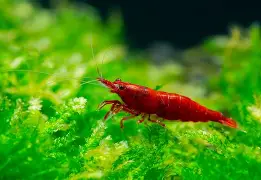
Bloody Mary Shrimp share the classic body plan of all Atyidae dwarf shrimp: a fused cephalothorax protected by a single domed carapace, followed by a segmented flexible abdomen that terminates in a fan-shaped telson and a pair of uropods. Adults reach 2.5–3.5 cm, with females at the top of the range and males typically smaller. From the thorax extend two pairs of small chelate claws (chelipeds) tipped with fine brushes for gathering biofilm, and four pairs of walking legs (pereiopods) used for clinging to moss, gravel, wood, and glass. The underside of the abdomen bears five pairs of pleopods — feathery swimmerets that propel the shrimp in its darting backward escape flick and, in gravid females, continuously fan the egg mass to oxygenate it and remove waste.
What sets the Bloody Mary apart from other Neocaridina morphs is not its anatomy but its pigmentation pattern. In most red Neocaridina strains — including standard Cherry, Sakura, and Fire Red grades — the red pigment sits on top of a still-translucent cuticle, so under bright light you can still see the internal organs, the yellow ovaries behind the head, and a faint outline of the gut along the back. In the Bloody Mary strain, roughly two decades of selective breeding (the line is widely attributed to European hobbyist breeders in the early 2010s, selecting sports from top-grade Painted Fire Red stock that displayed unusually opaque tissue pigmentation) have moved the red pigment into the hypodermis — the living tissue immediately underneath the cuticle — producing a body that appears solidly blood-red from every angle. The shell itself is near-clear; the deep wine colour you see is the flesh beneath. This gives Bloody Marys a distinctive ‘painted’ or ‘enamel’ appearance that does not fade under strong light and does not reveal internal anatomy the way translucent Cherries do. One frequent practical consequence is that it can be noticeably harder to spot a saddle or early egg development on a Bloody Mary female — the red body pigment masks the yellow ovarian tissue of the saddle — so keepers often rely on overall body shape, the broader pleural skirt of the abdomen, and the size difference between sexes to identify mature females, rather than the saddle alone.
Sexual dimorphism becomes reliable at around 60–75 days of age. Females grow noticeably larger (2.8–3.5 cm versus 2.0–2.5 cm for males), carry a broader, rounder abdomen with the curved pleural plates on segments two through five expanded outward to form a natural egg-carrying ‘pouch,’ and display a more uniformly saturated body colour because a higher total tissue mass of red pigment. Males are consistently smaller, slimmer through the abdomen, and in many lines the male colouration is visibly weaker or patchier — a useful identification cue once you train your eye. A common sexing technique is to observe the shrimp from directly above while they graze on a flat surface: the female’s abdomen curves out noticeably wider than the carapace above it, while the male’s abdomen tapers in a straight line.
The rostrum (the forward-projecting pointed spine on the front of the carapace) is short and gently serrated in Neocaridina, noticeably shorter than in some other shrimp families such as Caridina multidentata (Amano) or Macrobrachium. The compound eyes sit on short movable stalks providing nearly 360° vision — an essential adaptation for a defenceless animal with no venom, no spines, no significant size, and no speed beyond the reflex backward flick. The two pairs of antennae are long and constantly in motion, sweeping the substrate and nearby water column for chemical signals: food, pheromones from moulted females, and predator cues. Inside the carapace a pair of gills sits behind the walking legs, bathed in fresh water pulled in by the scaphognathite — a specialised appendage that beats continuously to ventilate the respiratory chamber.
Bloody Marys are graded commercially by the coverage, depth, and evenness of their red pigment. Top-grade individuals — sometimes labelled ‘SSS’ or ‘Taiwan-line’ by specialist breeders — are uniformly deep blood-red across the entire body, legs, antennae, and tail fan, with zero translucency visible under direct overhead lighting. Lower-grade specimens may show slight clearing on the legs, a lighter band on the rostrum, or a faded stripe down the back. When buying foundation stock for a new colony, always pay a premium for the highest-grade females you can find — females pass colour strength to their offspring more reliably than males do, and the whole future colour trajectory of your colony depends on the genes carried by a handful of founding females. A good rule is to start with 10–15 animals heavily biased toward females, at the highest grade you can afford, from a single experienced breeder rather than a chain pet store — mixed-source stock is a leading cause of early colony disease.
🍷 Bloody Mary (this strain)
Deep opaque wine-red pigment embedded in the tissue beneath the shell; even colouration across the whole body and legs; does not fade under bright light.
❤️ Painted Fire Red
A closely related top-grade red Neocaridina — solid bright crimson across the full body including legs and underside; the historical benchmark against which Bloody Mary is often compared.
🔥 Fire Red (High Grade)
Deep opaque red covering most of the body and legs; slightly less saturated than Painted Fire Red and usually priced lower.
🌸 Sakura (Mid Grade)
Red covers most of the body but with visible translucency on legs and underside; a common commercial grade, still the same species.
🔴 Cherry (Low Grade)
Translucent body with scattered red patches; the base grade from which all higher red Neocaridina strains were selectively bred.
🐞 Kanoko
Red base colour with distinctive black dorsal spots or ‘fawn’ dots; a rarer patterned red Neocaridina variety.
🟡 Yellow Neocaridina
The same species expressed as solid yellow; mentioned because interbreeding any yellow with Bloody Mary degrades both lines (see hybridisation warning).
💙 Blue Dream / Blue Velvet
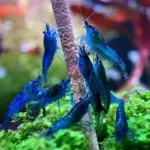
Another Neocaridina davidi strain in deep blue; must be kept in a separate tank to avoid grade collapse from hybridisation.
Keeping the Water Safe
6.5–7.8
ideal 7.2
18–28 °C
ideal 23 °C
6–15 dGH
Moderately hard — minerals essential for molting; standard tap water usually fits
This is the single most important chapter of the guide — and the place where Neocaridina strains like Bloody Mary genuinely shine compared to their more demanding Caridina cousins. Bloody Marys thrive in a broad, forgiving ‘beginner-friendly’ parameter window: pH 6.5–7.8, general hardness 6–15 dGH, carbonate hardness 2–8 dKH, temperature 18–28 °C, and TDS 150–350 ppm. In practice this means most dechlorinated municipal tap water in the United States, United Kingdom, Europe, East Asia, and Australia is immediately suitable for a Bloody Mary tank — no reverse osmosis filter, no remineralisation salts, no active (pH-buffering) substrate required. This broad tolerance is exactly why Bloody Mary is recommended as the first shrimp for new keepers. Crystal Red Shrimp, Shadow Panda Shrimp, Tiger Shrimp, and other Caridina species, by contrast, require soft acidic water (pH 5.5–6.5, GH 4–6, KH 0–2, TDS 100–180 ppm) that is almost never found in municipal tap water and must be created from pure RO water mixed with specialised GH-only mineral salts, then stabilised on top of an active buffering soil such as ADA Amazonia, Fluval Stratum, or Brightwell Shrimp Substrate. That setup is several times more expensive, requires ongoing TDS monitoring, and is far less forgiving of small mistakes — which is exactly why so many intermediate keepers eventually return from Caridina to Neocaridina for the sheer ease of maintenance.
No matter how hardy the strain, certain substances are immediately lethal to all shrimp at concentrations so low they are almost invisible. Copper is the most critical — even trace amounts in fish medications (ich treatments, anti-parasite medications, many broad-spectrum antibacterials), algaecides, plant fertilisers (especially cheaper ‘all-in-one’ fertilisers that include copper as a micronutrient), some tap water supplies with old copper plumbing, and even residues from non-aquarium products can wipe out an entire colony of Bloody Marys within hours. The lethal concentration for Neocaridina sits below 0.5 ppm — below the detection limit of many aquarium test kits. Always read the full ingredient list of any product before adding it to a shrimp tank; if it contains copper sulfate, cupric compounds, malachite green (also shrimp-toxic), formalin, or any product marketed as an anti-snail or anti-parasite treatment for fish, do not use it. When buying aquarium plant fertiliser, look explicitly for ‘shrimp-safe’ or ‘copper-free’ on the label — Seachem Flourish Comprehensive, Tropica Premium, and Easy-Life Profito are three common shrimp-safe options.
Beyond copper, Bloody Marys require a fully cycled tank. Ammonia and nitrite should read undetectable at all times (0.0 ppm on any home test kit); even short excursions above 0.25 ppm ammonia cause visible stress and can trigger mass mortality. Nitrate, the end-product of the nitrogen cycle, should be kept below 20 ppm through regular small water changes — 10–15% weekly is the typical schedule. Chlorine and chloramine in untreated tap water must always be neutralised with a dechlorinator such as Seachem Prime or API Tap Water Conditioner before the water touches the tank. Avoid sudden pH swings of 0.5 units or more in a single day, and avoid TDS swings greater than 50 ppm in a single water change — these two parameters define the envelope of ‘stability,’ and stable mediocre water is always better for shrimp than perfect water that fluctuates.
A key point that confuses many new keepers: Neocaridina and Caridina look superficially similar but demand opposite water chemistry. If you already have a planted tank running at pH 7.0–7.4 with hard-to-moderately-hard tap water and an inert substrate, it is almost certainly already a Neocaridina (Bloody Mary) tank — you can add Bloody Marys directly after dechlorination and cycling. Adding Caridina shrimp to the same setup, however, will kill them slowly over weeks through failed molts and reproductive failure. Conversely, an active-soil shrimp tank deliberately buffered to pH 6.2 and GH 5 will not support Bloody Marys long-term, because the low mineral content will eventually cause the famous white-ring molting failures. The rule is simple: pick one water chemistry and one shrimp type per tank, and commit fully to that choice. If you want to keep both Neocaridina and Caridina shrimp, run two separate tanks — you cannot split the difference in one.
Tank Requirements & Layout
A 20-litre (5-gallon) nano tank is the practical minimum volume for a small starter colony of 10–15 Bloody Marys, but a 40–60 litre setup is strongly preferred — the larger volume buffers parameter swings, supports a larger self-sustaining breeding population, and produces a far more visually striking display once the colony reaches 50–100 animals. The foundation of any successful shrimp tank is a fully cycled nitrogen cycle; never introduce shrimp to a tank that has not been deliberately cycled with an ammonia source, demonstrated the full ammonia-to-nitrite-to-nitrate conversion, and then registered zero ammonia and zero nitrite for at least a week continuously. If you are new to cycling, plan on four to six weeks from empty tank to shrimp-ready, and seed the filter with mature media from an established tank if you possibly can — a handful of old sponge from a friend’s filter halves cycling time.
Because Bloody Marys do not require soft acidic water, you do not need an active (buffering) aqua soil and you specifically should not use one in most cases — active soils like ADA Amazonia drop pH into the Caridina window (5.8–6.4) and lock the tank into Caridina territory for the first year of its life. Inert substrates serve Bloody Marys better: fine black sand (Flourite Black Sand, Tropica Soil Powder-inert, or even aquarium-safe pool filter sand) is the classic choice and produces the most visually striking contrast against the deep red shrimp. Natural-coloured fine gravel is also acceptable, though the red of the shrimp reads less intensely against a pale background. Substrate depth should be 3–5 cm — deep enough to anchor plants and support biofilm, shallow enough to prevent anaerobic pockets.
Aquascaping should prioritise surface area and refuge. Java moss, Christmas moss, Weeping moss, Flame moss, or any fine-leafed moss is practically mandatory for a Bloody Mary tank — moss traps biofilm (the shrimp’s primary food), provides near-infinite grazing territory, and offers dense protective cover for newly hatched shrimplets to survive their most vulnerable first two weeks when they are only 1–2 mm long. Attach moss to driftwood, lava rock, or purpose-made moss walls using thin cotton thread (dissolves in weeks) or super glue gel (aquarium-safe, bonds instantly). Add driftwood for additional biofilm surface area, shelter, and slow tannin release — tannins are beneficial, providing mild antimicrobial action, slight pH softening, and a natural tea-colour that softens the overall look of the tank. Cholla wood (the hollow internal skeleton of a dead cholla cactus), mopani wood, spider wood, and Malaysian driftwood all work well. Cholla in particular is a Bloody Mary favourite — its porous interior is a shrimplet refuge of last resort.
Floating plants such as Amazon frogbit, red root floaters, salvinia, or duckweed reduce light intensity, export nitrates and phosphates through their rapid-growing roots, and provide an additional biofilm surface for shrimp to cling to and graze on at the water surface — it is not unusual to see a dozen Bloody Marys hanging upside-down from frogbit roots grazing like tiny red fruit. Indian almond (Catappa) leaves and alder cones break down slowly on the substrate over weeks to months and release humic acids, tannins, and biofilm — add one or two small leaves per 20 L every two to four weeks, replacing them as they decompose. Alder cones last longer (several months) and slowly leach the same compounds at a gentler pace.
Low-demand foreground plants such as Marsilea hirsuta (four-leaf clover), dwarf sagittaria, Monte Carlo, and Cryptocoryne parva suit shrimp tanks well because they tolerate low-nutrient conditions and accumulate biofilm readily. Avoid any hardscape with sharp or jagged edges — shrimp bodies are fragile and can be cut by broken glass, sharp slate, or certain manufactured rocks. Finally, fit a tight-fitting glass lid or fine mesh cover over the entire water surface. Bloody Marys are competent climbers, and they will occasionally escape a tank during a parameter drift, a mild ammonia spike, or the first few nights after being added to a new home. A lid also slows evaporation and therefore TDS drift.
Sponge Filter (Essential)
A simple air-driven sponge filter is mandatory — it cannot suck shrimplets into an impeller, it provides a massive surface for beneficial bacteria, and it creates gentle circulation. Two small sponges are better than one large one for redundancy and biofilm surface.
Adjustable Heater (25–50 W)
Keep the tank at a stable 22–24 °C. An inline or external heater eliminates the rare risk of a shrimp being stuck against an in-tank heater element.
Digital Thermometer
Daily monitoring matters — sustained temperatures above 28 °C suppress breeding and stress the colony, while temperatures below 18 °C halt breeding entirely.
Java Moss or Christmas Moss
Non-negotiable habitat element. Dense moss mats provide biofilm grazing and the single most important refuge for shrimplets against predation and filter intake.
Inert Fine Sand or Gravel Substrate
Because Bloody Marys do not require a low pH, active aqua soil is unnecessary (and can even drop pH too far over time). Inert dark substrate, 3–5 cm deep, is ideal.
Driftwood + Indian Almond Leaves
Driftwood adds surface area, shelter, and slow tannin release; Indian almond leaves provide additional biofilm, mild antimicrobial action, and natural buffering of parameters.
Calcium / Mineral Supplement
Cuttlebone fragment, crushed coral in the filter media bag, or a proprietary shrimp mineral product maintains the dGH and calcium availability that Bloody Marys need for successful molting.
Tight-Fitting Lid or Mesh Cover
Shrimp are escape artists. A sealed lid prevents dried-out, dead shrimp on the floor in the morning — especially common after parameter changes or a new shipment’s first night.
Molting: What to Expect
Because the shrimp’s exoskeleton is rigid, all growth happens in sudden discrete steps separated by a biological process called ecdysis — molting. A healthy adult Bloody Mary molts roughly every three to six weeks; juveniles molt more frequently during their fastest growth phase, sometimes as often as once a week in the first month of life. In the day or two before a molt the shrimp often eats less, becomes slightly pale or milky in appearance as fluid accumulates between the old and new exoskeletons, and spends more time hiding in moss or under leaf litter. The molt itself takes only seconds to a few minutes: the carapace splits cleanly along the dorsal midline between the head and first abdominal segment, the shrimp flexes sharply and backs out of its old shell head-first, and the discarded exoskeleton is left behind as a perfect transparent husk — sometimes so lifelike that it still appears to show legs, antennae, and a tail fan.
New keepers regularly panic at the sight of a molt, believing it to be a dead shrimp — but there is a reliable visual test to tell the difference. A molt is empty, crisp, fully translucent, and usually floats or sits on a surface rather than sinking. A dead Bloody Mary, by contrast, sinks to the substrate, loses its red colour within hours (the pigment breaks down quickly post-mortem), and often shows a pinkish or whitish cast. If you find a crisp red-translucent shell shape in the tank, it is a molt; leave it. The shrimp and its tankmates will consume the old exoskeleton within a day or two to reclaim its calcium and chitin content — a valuable and free nutritional supplement.
Calcium, magnesium, and general mineral content are critical during molting. Soft, mineral-poor water is the single most common cause of the ‘white ring of death’ (also called ‘white band’ or ‘white line disease’) — a condition in which a molt fails partway through, trapping the shrimp at a visible white constriction ring around the junction of the carapace and the first abdominal segment. Affected shrimp cannot free themselves and die within hours as they suffocate inside the stuck old shell. Maintaining a general hardness of 6–15 dGH, a carbonate hardness of 2–8 dKH, supplementing with cuttlebone fragments, crushed coral in a media bag, or a dedicated proprietary shrimp mineral product (Salty Shrimp GH/KH+, Shrimp King Mineral, etc.), and above all avoiding sudden large water changes will almost entirely prevent molt fatalities in a healthy colony. A secondary cause of white-ring is a sudden drop in TDS (total dissolved solids) caused by topping up with pure RO water without remineralisation — always top up evaporated water with conditioned tap water of the same hardness as the tank, or with properly remineralised water, never with pure distilled or RO.
Bloody Marys are no more or less prone to molt problems than any other Neocaridina strain — the selective breeding that produced the deep wine-red pigment affects pigment metabolism only, not molting physiology — so the standard Neocaridina molting practice applies without modification. In practice, a stable, moderately hard, copper-free tank with a cuttlebone present and steady water changes at 10–15% weekly will produce essentially zero molt fatalities over the life of a colony.
Feeding Schedule & Diet
Bloody Mary Shrimp are opportunistic omnivores whose natural and preferred food is biofilm — the thin microbial film of bacteria, microalgae, protozoa, fungi, diatoms, and organic debris that coats every surface in a mature aquarium. In a well-planted, well-matured tank, biofilm alone can sustain a small colony of ten to fifteen shrimp indefinitely without any deliberate supplemental feeding. You will see your Bloody Marys constantly ‘picking’ at glass, wood, moss, and substrate with their tiny fan-like claws held in rapid alternating motion — this is biofilm grazing, and it is the single most important activity of their daily life. The visual benefit of a high-biofilm diet is that it tends to deepen the red pigment in Bloody Marys by supplying a steady stream of carotenoids (the pigment precursors responsible for red colouration) and a full amino acid profile, whereas a diet dominated purely by commercial pellets can produce slightly duller or uneven colouration over time. Biofilm also happens to be the most ammonia-safe food source imaginable — the bacteria are already part of the tank’s nitrogen-processing ecosystem.
As the colony grows past about 20–25 animals, supplemental feeding becomes beneficial to prevent nutritional competition and to support the substantial energetic demands of continuously-breeding females. Offer food three to four times per week, in quantities small enough that the shrimp finish everything within two to three hours. Rotating across several food categories over the week produces the best nutritional variety and the richest colouration. Staples include dedicated shrimp pellets, sticks, or wafers — look for formulas containing spirulina, kelp or seaweed, calcium, and astaxanthin or similar natural carotenoids. Products marketed specifically for colour-enhancing Neocaridina (Shrimp King Colour, GlasGarten Shrimp Dinner, BorneoWild, Dennerle Shrimp King, and Hikari Crab Cuisine) are all ideal for Bloody Marys.
Blanched vegetables are an excellent live-food-style treat once or twice a week: zucchini (courgette), spinach, kale, cucumber, peeled blanched broccoli stems, and thin slices of carrot are all readily accepted. Always blanch vegetables in plain boiling water for 30–60 seconds to break down the cell walls and sink the piece (raw vegetables float and are ignored). Weigh slices down with a small stainless steel fork or a vegetable clip, and remove any uneaten portion after three to four hours. Indian almond leaves, mulberry leaves, oak leaves (untreated, dried, and soaked to sink), stinging nettle powder, and alder cones serve double duty as slow-release food substrates and gentle water conditioners — they can be left in the tank for weeks and continue to host biofilm and provide grazing nutrition as they decompose.
Very occasionally — no more than once every two weeks — a tiny piece of protein can be offered to support egg production in berried females: a single frozen bloodworm, the tip of a boiled egg yolk on a skewer, a pinch of high-quality fish food flake, or a small piece of sinking protein wafer. Keep protein feeding rare and in tiny quantities. Excess protein is by far the leading cause of bacterial infections in shrimp tanks (cloudy water, white bacterial film on the shrimp’s gills or tail fan, and sudden die-off) and reliably spikes ammonia in the small, lightly filtered tanks typical of shrimp keepers.
Remove any uneaten food after two to three hours — decomposing shrimp pellets in a lightly filtered nano tank generate ammonia remarkably quickly, and the resulting spike can be fatal to an entire colony overnight. A useful habit is to include a ‘fast day’ once per week when no food is offered at all. Bloody Marys do not need to eat every day, and a fast day allows the colony to clean up any residual debris, keeps the digestive tract clear, and reinforces the biofilm-first feeding philosophy.
Breeding in the Aquarium
Egg Carrying
Bloody Mary Shrimp, like all Neocaridina davidi strains, are among the easiest freshwater invertebrates to breed in captivity. If you maintain stable water parameters, a fully cycled tank, adequate food, a steady temperature in the 22–26 °C range, and a mixed-sex colony of at least six to eight founding animals, a healthy group will reproduce reliably without any deliberate intervention from you. In fact, for most keepers the challenge is not starting reproduction but managing the eventual overpopulation that follows — a well-run Bloody Mary tank can double its population every three months indefinitely, until biofilm production becomes the limiting factor.
Females reach sexual maturity at approximately 60–75 days after hatching and are identifiable by their larger body size (2.8–3.5 cm), the rounder curve of their abdomen with the expanded pleural plates that form a natural egg-carrying pouch, and — when lighting allows — a visible yellow or orange saddle of developing ovarian tissue immediately behind the head. It must be noted that the saddle is harder to see in Bloody Marys than in translucent Cherry Shrimp, because the strain’s deep opaque red pigment in the hypodermis masks the yellow ovarian colour underneath. Experienced Bloody Mary keepers learn to identify near-mature females by body shape and size alone, checking for the saddle only as a secondary confirmation in the few seconds when the shrimp turns sideways under bright light.
When a mature female moults, she releases species-specific pheromones into the water that trigger a characteristic ‘mating swarm’ response: the males in the tank become visibly agitated within minutes and dart frantically around the tank searching for her recently moulted location. This swarm behaviour, sometimes alarming to new keepers who mistake it for panic, is actually the most reliable visual indicator that a breeding event is underway. Fertilisation occurs within minutes of the moult, while the female’s new exoskeleton is still soft enough to allow the transfer of sperm. Within a few hours of the mating, the female transfers her eggs from the saddle (in the ovaries behind the head) to the underside of her abdomen, clustering them between her pleopods (swimmerets). From this point she is known as a ‘berried’ female, after the resemblance of the dark dense egg mass to a cluster of tiny berries tucked beneath her tail.
A berried Bloody Mary carries between 20 and 30 dark reddish-brown eggs for approximately 25 to 35 days. Incubation time depends primarily on temperature: roughly 22 days at 26 °C, 30 days at 22 °C, and up to 35 days at 20 °C. A useful rule of thumb for most shrimp keepers is approximately 30 days at typical room temperature of 22–24 °C. Throughout this gestation period the female continuously fans the egg mass with her pleopods to oxygenate the developing eggs and remove waste. You can watch the eggs slowly change colour and internal pattern as development progresses — from solid dark reddish-brown in the first week, through visible dark eye spots around day 14, to nearly-transparent well-developed shrimplets in the final days before hatching.
A critical feature that makes Neocaridina beginner-friendly — and one of the single most important reasons Bloody Mary is recommended as a first shrimp — is that they have no free-swimming larval stage. The eggs hatch directly into fully formed 1–2 mm miniature adults that are immediately capable of walking, grazing on biofilm, and living entirely in the same freshwater environment as their parents. This contrasts sharply with Amano Shrimp (Caridina multidentata) and many other Caridina species, which release planktonic larvae requiring brackish or saltwater conditions to complete larval development — impossible to replicate in a standard home aquarium. Bloody Mary shrimplets survive and thrive in the same tank as their parents from the moment they hatch, provided the tank offers dense moss cover, plenty of biofilm, and sponge-filter-only filtration (any power filter, hang-on-back filter, or canister filter with an uncovered intake will inevitably vacuum up shrimplets and kill them).
Population growth in a well-established tank can be striking. A starter colony of 10 can expand to 50–100 within three months under good conditions, and reach 200 or more within six months. After the first generation matures (around three months in), a well-run Bloody Mary tank holds multiple overlapping generations at once, with berried females, free-swimming shrimplets, and mature adults visible simultaneously — a spectacle that is one of the main reasons people keep this species. Most keepers eventually reach a carrying capacity limited by biofilm production and either give excess shrimp away to friends and local aquarium clubs, sell them, or simply let the colony self-regulate against the tank’s natural food supply. Be prepared: you will almost certainly end up with more Bloody Mary Shrimp than you planned for, and this is a pleasant problem to have.
Choosing Safe Companions
Bloody Mary Shrimp are completely defenceless animals — no venom, no spines, no significant size, no meaningful speed beyond a single reflex backward flick — and their survival in a community tank depends entirely on choosing tankmates that cannot or will not eat them. The universal rule is simple and almost never wrong: if a fish’s mouth can fit a shrimp, it will eventually eat one, regardless of how ‘peaceful’ the species is described as being by the local pet shop. This applies even to species that have coexisted with shrimp for months without incident — a single hungry morning, a single newly moulted soft shrimp, and the predation behaviour switches on. For a genuinely shrimp-safe community tank, restrict tankmates to fish under 3 cm total length with genuinely tiny mouths: Ember Tetras, Chili Rasboras, Pygmy Corydoras, Otocinclus, Dario Dario (Scarlet Badis) are acceptable candidates. Or — most reliably of all — keep a species-only Bloody Mary tank where every single variable tilts in favour of the colony. Species-only tanks consistently produce the best survival rates, the fastest population growth, and the deepest colouration, because the shrimp can graze the substrate in the open without fleeing the shadow of passing fish. Dense moss, heavy planting, and a thick bed of Indian almond leaves dramatically improve shrimplet survival rates even in a mixed community, but nothing beats no predators at all.
More important than any predator discussion, however, is the single community rule that defines every successful Neocaridina keeper: never mix two colour strains of Neocaridina davidi in the same tank. Bloody Mary, Blue Dream, Blue Velvet, Blue Jelly, Yellow Fire, Yellow Neon, Green Jade, Sakura, Painted Fire Red, Kanoko, Carbon Rili, Orange Pumpkin, Orange Sakura, Snowball, Rili Red, Rili Blue, Black Rose — all of these dozens of commercially named varieties are the same species, Neocaridina davidi, separated only by decades of selective breeding for specific pigment patterns. Put any two colour strains in the same tank and they will freely, eagerly, and indiscriminately interbreed. Within one to two generations the offspring revert toward the wild-type translucent brown-grey that the original Taiwanese ancestor shrimp wore — destroying the carefully bred colour of both parent lines and producing ‘muddy’ F1 and F2 shrimplets with no commercial or aesthetic value. This is not something that ‘might happen’ under certain conditions; it is a certainty, observed by every serious breeder worldwide. The dominant gene in Neocaridina is the wild-type translucent brown, and every colour strain represents a fragile recessive pigmentation state. Mix colours and the dominant wild-type wins within one generation.
The practical consequence is that every serious Neocaridina keeper operates under a strict one-colour-per-tank rule. If you want to keep Bloody Marys and Blue Dreams, you need two separate tanks. If you want to raise both colours and a Yellow Fire, you need three separate tanks. There is no workaround, no trick, and no ‘mostly separate’ arrangement — any shared tank volume will produce hybrids. Accept this rule from the start and plan your Neocaridina keeping around it.
The good news is that Neocaridina and Caridina do NOT interbreed — they are different genera, require different water chemistry, and the reproductive biology is incompatible. This means it is safe to keep Bloody Marys in one tank and Crystal Red Shrimp or Shadow Panda Shrimp in a completely separate tank with separate equipment, or to keep Bloody Marys alongside Amano Shrimp (Caridina multidentata) in the same tank, since Amanos require brackish water to complete their larval stage and cannot produce viable offspring in freshwater at all. Mixing genera is safe; mixing colour strains within Neocaridina is not.
| Species | Why | |
|---|---|---|
| ✅ | Otocinclus Catfish (Otocinclus spp.) | Exclusively algae-feeding, physically incapable of eating even the smallest shrimplet. Ignore shrimp entirely and share the biofilm-grazing duty. |
| ✅ | Pygmy Corydoras (Corydoras pygmaeus) | Tiny peaceful bottom-dwelling catfish under 3 cm; mouth is too small to take adult shrimp. Some risk to the smallest shrimplets but generally safe. |
| ✅ | Ember Tetra (Hyphessobrycon amandae) | A nano fish under 2 cm with a genuinely tiny mouth; cannot harm adult Bloody Marys and rarely catches even shrimplets in a densely planted tank. |
| ✅ | Celestial Pearl Danio (Danio margaritatus) | Small, peaceful, gorgeous schooling nano fish that coexists well with adult shrimp. Occasional shrimplet predation, but the colony easily out-breeds it. |
| ✅ | Horned Nerite Snail (Clithon corona) | Algae-eating snail that is completely non-aggressive and shares grazing work on glass and hardscape. Cannot reproduce in freshwater, so no snail overpopulation. |
| ✅ | Mystery Snail (Pomacea bridgesii) | Peaceful, large snail that coexists with shrimp without conflict; scavenges fallen food and algae. Size alone rules out predation risk either way. |
| ✅ | Amano Shrimp (Caridina multidentata) | Larger peaceful shrimp species with no reproductive overlap (Amanos need brackish water to complete their larval stage, so there is no possibility of hybridisation). They coexist well. |
| ❌ | Other Neocaridina davidi colour strains (Blue Dream, Yellow, Green Jade, Sakura, etc.) | CRITICAL: All colour strains of Neocaridina davidi are the same species and will freely interbreed. Offspring revert toward the wild-type brown/translucent base colour within 1–2 generations, destroying both parent lines. Only keep ONE Neocaridina colour per tank. |
| ❌ | Betta Fish (Betta splendens) | Most bettas actively hunt shrimp; even individuals that ‘seem fine’ for months often switch behaviour suddenly. Not a reliable tankmate. |
| ❌ | Gouramis (Trichopodus / Trichogaster spp.) | Will readily eat shrimp, especially during the vulnerable post-moult period. Even dwarf gouramis target shrimplets. |
| ❌ | Angelfish, Cichlids, and most medium fish | Will consume Bloody Marys of all sizes quickly. German Blue Rams and Apistogramma are especially active shrimp hunters despite their small size. |
| ❌ | Goldfish | Omnivorous generalists that will eat shrimp of any size; also prefer cooler temperatures incompatible with optimal Neocaridina conditions. |
| ❌ | Assassin Snail (Clea helena) | Primarily snail-predators but will attack and kill weakened or freshly moulted shrimp when other prey is scarce. |
Quick Reference
| Scientific Name | Neocaridina davidi ‘Bloody Mary’ |
| Adult Size | 2.5–3.5 cm (1.0–1.4 in) |
| Lifespan | 1–2 years (up to 2.5 years) |
| pH | 6.5–7.8 (ideal 7.0–7.5) |
| Temperature | 18–28 °C (ideal 22–24 °C) |
| Hardness (GH / KH) | 6–15 dGH / 2–8 dKH |
| Min Tank Volume | 20 L (5 gal), 40 L preferred |
| Care Level | Beginner |
| Breeding Difficulty | Very easy |
| Berried Period | ~30 days (range 25–35) |
| Clutch Size | 20–30 eggs per brood |
| Copper Tolerance | NONE — lethal at trace levels |
| Filter Type | Sponge filter only (protects shrimplets) |
| Hybridisation Rule | ONE Neocaridina colour strain per tank — all strains interbreed and revert to wild-type within 1–2 generations |
Related Products

Reviews
Clear filtersThere are no reviews yet.