🪨 Species at a Glance
| Scientific Name | Neocaridina davidi ‘Blue Dream’ (line-bred strain) |
| Common Names | Blue Dream Shrimp, Blue Dream Neocaridina, Dream Blue Velvet, BDS |
| Family | Atyidae |
| Order | Decapoda |
| Origin | Taiwan and southern China (wild species); strain line-bred from rare recessive blue allele |
| Adult Size | 2.5–3.5 cm (1.0–1.4 in) |
| Lifespan | 1–2 years under stable conditions |
| Temperature | 18–28 °C (64–82 °F), ideal 22–24 °C |
| pH Range | 6.5–7.8, ideal 6.8–7.4 |
| Hardness (dGH) | 6–15 dGH — moderately hard |
| Diet | Omnivore — biofilm, soft algae, blanched vegetables, shrimp pellets, leaf litter |
| Minimum Tank Size | 20 L (5 gal) for a starter colony; 40 L+ recommended |
| Care Level | Beginner–Intermediate (colour stability needs discipline) |
| Temperament | Completely peaceful, shoaling grazer |
| Breeding | Egg-carrying (berried female); no larval stage; ~25–35 day gestation |
| Price (AMAZONIA) | $10 per shrimp |
Identifying Your Species
The Blue Dream Shrimp shares the compact, streamlined body plan typical of the family Atyidae and is structurally identical to every other colour form of Neocaridina davidi. The body divides into two major regions: the cephalothorax, where head and thorax are fused beneath a single hardened carapace, and the segmented abdomen, which folds beneath the body and terminates in the broad, fan-shaped telson and uropods that power the shrimp’s explosive backward escape swim. Five pairs of thoracic walking legs (pereiopods) — the first two tipped with small chelate claws (chelipeds) used for picking food — carry the shrimp across substrate and plant surfaces, while five pairs of abdominal pleopods continuously fan water, provide respiratory flow across the gills tucked inside the carapace, and — in berried females — cradle and oxygenate the developing eggs. Long sensory antennae sweep the water for chemical cues, and two stalked compound eyes provide near-360° peripheral vision that compensates for the shrimp’s otherwise complete lack of defences. Two shorter, forked first antennae (antennules) carry the primary olfactory receptors and are what the shrimp uses to ‘taste’ a new food source within seconds of its introduction to the tank. The mouthparts themselves — a complex arrangement of mandibles, maxillae, and three pairs of maxillipeds — are optimised not for biting chunks of flesh but for scraping, combing, and filtering the fine biofilm layer that represents the shrimp’s primary natural food.
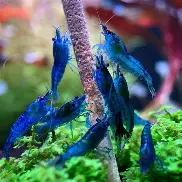
The defining feature of the Blue Dream strain is of course its colour. Unlike the translucent blue-tinted ‘Blue Velvet’ or the patchy ‘Sky Blue’ morphs that preceded it, a show-grade Blue Dream displays an opaque, saturated, cobalt-to-navy blue that covers the entire carapace, abdomen, tail fan, legs, and antennae. The pigment is uniformly distributed and does not fade under bright aquarium lighting the way many other shrimp colours do. The colour itself arises from a combination of ommochrome and pterin pigments deposited into the newly forming exoskeleton at each moult, supplemented by underlying crystalline guanine reflective platelets that scatter short-wavelength light; the visual effect is a dense, slightly velvety blue that can shift between midnight navy and bright cobalt depending on angle and lighting temperature. In the best specimens the blue appears almost matte, photographing beautifully against a background of green moss, black substrate, or warm amber driftwood. Stressed or poorly fed animals may briefly exhibit lighter, ashy-blue bands or translucent patches on the abdomen; this is generally reversible with improved water quality and nutrition, though persistent pale colouration in otherwise healthy animals usually indicates genetic dilution from careless breeding rather than husbandry error. Show-grade Blue Dreams are sometimes further categorised informally by hobbyists into ‘Dream Blue Velvet’ (deeper, almost indigo navy) and ‘Blue Dream’ (brighter, classic cobalt) sub-types, although the distinction is cosmetic and the two interbreed identically.
Sexual dimorphism is evident once the shrimp reach maturity at 60–75 days. Females grow noticeably larger than males, typically 3.0–3.5 cm against 2.2–2.7 cm. A mature female’s carapace and abdomen are more rounded and fuller in profile, creating the characteristic ‘chubby’ silhouette sought after by colony keepers. The single most reliable sex indicator is the ‘saddle’, a patch of yellowish-green ovarian tissue visible through the translucent dorsal carapace just behind the head — if you can see a saddle, the animal is an adult female readying eggs for her next moult cycle. Males are slimmer, slightly paler on average (particularly along the underside of the abdomen where blue coverage is often thinner), and show a straight, narrow abdominal profile without the pronounced lateral curve of a gravid female. The rostrum — the small forward-projecting spine between the eyes — is modest in Neocaridina compared to other genera, and carries only a few short teeth on its dorsal edge. Careful observers will also notice that a berried female’s first pair of pleopods is modified to form a brood pouch that cups the fertilised egg cluster against her underside. A useful field-identification tip for new keepers: viewed from directly above, a mature female’s abdomen flares outward past the edges of her carapace in a visibly ‘pear-shaped’ silhouette, while a mature male’s abdomen is straight-sided and roughly parallel with the carapace — this dorsal-view test is usually faster and more reliable than trying to inspect the saddle through a green moss tangle. Finally, the internal anatomy worth noting for any keeper interested in husbandry fine points: the heart sits dorsally near the back of the carapace and can often be seen beating through the cuticle in translucent juveniles, the hepatopancreas (the combined liver-pancreas analogue responsible for most digestion and nutrient storage) occupies much of the cephalothoracic cavity and is one of the first organs to appear compromised in shrimp suffering from copper poisoning or chronic malnutrition, and the gonads — either ovaries in females or paired testes in males — sit immediately beneath the dorsal carapace where the saddle becomes visible in adult females.
🔴 Red Cherry / Painted Fire Red
The original and most familiar Neocaridina davidi colour form — translucent Cherry at the low grade, deep opaque scarlet at the top Painted Fire Red grade. The benchmark against which all other strains are measured.
🔥 Bloody Mary
A separate line from Cherry, recognised by its distinctive see-through ‘red-on-red’ colour where pigment is layered in the body tissue itself rather than in the shell — producing an almost glass-red glow under front lighting.
💙 Blue Dream
The strain on this guide — deep, opaque cobalt-to-navy blue full-body coverage. Selectively bred from a recessive wild-type blue allele and stabilised over many generations. The darkest and most saturated blue Neocaridina currently available.
💚 Green Jade
A relatively recent line-bred strain exhibiting a soft jade-to-olive green body with varying opacity. Still being stabilised; quality varies dramatically between breeders and colour tends to dilute rapidly when crossed.
💛 Yellow Neon / Golden Back
Bright canary-yellow body colouration, often with a distinct opaque golden dorsal stripe in the ‘Golden Back’ variant. A cheerful, highly visible strain that contrasts beautifully against dark green plantings.
🧡 Orange Sakura / Pumpkin
Warm orange-to-pumpkin body colouration, less saturated than Fire Red but more vivid than the dilute ‘Sakura’ term traditionally implies in the Red line. Coexists aesthetically with yellow and red strains in dedicated mixed-colour shots.
🖤 Black Rose / Chocolate
A deep, almost-black body with faint mahogany or purplish undertones in the right light. One of the more recently stabilised colour forms and still relatively uncommon in the general hobby market.
❄️ Snowball / Carbon Rili
Specialist patterns: Snowball is an opaque white-bodied variant derived from a separate Neocaridina palmata line crossed into the davidi gene pool; Carbon Rili and similar ‘Rili’ patterns show a banded head-and-tail pigment distribution with a translucent midbody.
Setting Up Your Tank
A 20-litre nano aquarium is the technical minimum for a productive starter Blue Dream colony, but a 40–60 litre planted tank provides the parameter stability that really allows colour and breeding to shine. Larger volumes buffer against the temperature, pH, and TDS swings that would otherwise stress the shrimp in a small vessel, and they also give the keeper more margin for error during feeding and water-change mistakes. For a display colony aiming at visual impact, a low-slung rectangular ‘shallow’ nano such as a 45×30×20 cm tank makes an excellent footprint: the reduced water column improves top-down viewing of the shrimp’s dorsal colouration, simplifies LED lighting coverage, and makes aquascape photography dramatically easier. The single most important element of the setup, however, is not the tank footprint but a fully cycled biological filter running on mature beneficial bacteria: never, under any circumstances, add shrimp to an uncycled tank. Let the nitrogen cycle complete over 4–8 weeks with hardy plants, a handful of established moss or filter media seeded from a healthy tank, and a small dosing source of ammonia (household ammonia, fish food decaying in the substrate, or commercial bacterial starter) before introducing the first animals. A completed cycle is verified by dosing ammonia to ~2 ppm in the evening and reading zero ammonia and zero nitrite the following morning, with rising nitrate confirming nitrification is functioning end-to-end. Substrate choice matters visually and chemically: dark inert substrates such as black Flourite, black quartz sand, or dark volcanic gravel produce the most dramatic contrast with the shrimp’s cobalt-blue body, while active aqua soils such as ADA Amazonia, Fluval Stratum, or Dennerle Scaper’s Soil gently buffer pH toward the ideal 6.8–7.2 band and actively support biofilm development. Active soils do leach ammonia for the first 2–4 weeks after setup, which is one more reason to complete the cycle before introducing animals. Bright or white substrates should be avoided — not only do they make the shrimp look washed-out in the viewing glass, but they also encourage the animals to fade their own pigmentation as a natural camouflage response, a phenomenon widely reported in Neocaridina strains and one that can visibly degrade colour saturation over weeks to months.
Dense, fine-leafed plantings are effectively mandatory. Java moss, Christmas moss, Flame moss, Weeping moss, and Fissidens fontanus all provide enormous surface area for biofilm (the shrimp’s primary natural food) and a three-dimensional refuge that is especially important for freshly moulted soft-shelled adults and tiny newborn shrimplets. In a new tank it is worth deliberately over-planting moss — a dense moss volume is directly correlated with shrimplet survival and colony expansion rate. A single large clump of moss, two or three small pieces of spider-wood or Malaysian driftwood, and a handful of Indian almond (Catappa) leaves added to the tank floor essentially replicate the ideal microhabitat. Epiphyte plants such as Anubias nana ‘Petite’, Bucephalandra sp., and small Microsorum ferns can be tied directly to hardscape and provide additional shaded hiding surfaces without demanding a CO2 injection system. Floating plants such as Amazon frogbit, red root floaters, Salvinia natans, or dwarf water lettuce diffuse overhead lighting, export excess nutrients through their fast-growing roots, and create additional grazing surfaces beneath their leaves where shrimp often spend hours foraging. Hardscape should be smooth and non-abrasive — avoid any sharp edges that could tear the delicate pleopods of a berried female or damage a soft post-moult body. A tight-fitting lid or mesh cover is non-negotiable because Blue Dreams, like all Neocaridina, are excellent climbers and will walk up airline tubing, heater cords, filter intakes, and any condensation trail on the inside of the tank wall to escape into the room, where they desiccate within hours. A final often-overlooked detail: lighting intensity should be modest. Bright high-PAR plant lighting, while great for demanding stems, tends to suppress shrimp activity and encourage them to hide; a gentle low-to-moderate LED run on an 8–10 hour photoperiod produces much more visible, surface-grazing shrimp and healthier biofilm growth on every surface.
Sponge Filter (primary)
Air-driven sponge filter is the gold-standard shrimp filter. Open-cell foam protects shrimplets from impeller suction while developing a deep bacterial colony and a rich biofilm layer that the shrimp graze directly. Two filters in a single tank provide valuable redundancy.
Adjustable Heater (25–50 W)
An adjustable heater with an accurate thermostat keeps temperature stable at 22–24 °C, the sweet spot for Blue Dream metabolism and breeding. Inline or external heaters remove the risk of shrimp perching on the heater element. Avoid internal heaters with hot contact surfaces.
Digital Thermometer
A stick-on or probe thermometer for daily monitoring. Temperatures above 28 °C suppress breeding, accelerate ageing, and reduce dissolved oxygen — an inexpensive digital unit will pay for itself many times over.
TDS Meter
An inexpensive pen-style Total Dissolved Solids meter is the easiest way to track mineral content and water stability. Target 150–250 ppm TDS for Neocaridina. A sudden TDS jump during a water change is a reliable warning that your top-up water is mis-mixed.
Inert or Buffering Substrate
Black Flourite, black quartz sand, or active aqua soil at 3–5 cm depth. Active soils buffer pH toward ~6.8 and stimulate biofilm; inert substrates demand mineral supplementation via cuttlebone or GH booster.
Java Moss / Christmas Moss
Dense moss mats provide the foraging biofilm and the essential shrimplet refuge that determine whether a colony expands or stagnates. Budget generously — shrimp tanks almost cannot have too much moss.
Indian Almond (Catappa) Leaves
Whole dried leaves added to the substrate slowly release tannins and humic acids that buffer pH, lightly antiseptic the water column, feed biofilm, and provide an immediately grazeable soft food source.
Calcium / Mineral Supplement
Cuttlebone, crushed coral, Wonder Shell, or a dedicated Salty Shrimp GH+ booster keeps dissolved calcium and magnesium within the band required for successful moulting and stable colour deposition.
Tight-Fitting Lid or Mesh Cover
Blue Dreams, like all Neocaridina, are adept climbers. A lid prevents overnight escapes up airline tubing, heater cords, or the corner joints of rimless tanks.
Water Quality & Sensitivity
6.5–7.8
ideal 7.1
18–28 °C
ideal 23 °C
6–15 dGH
Moderately hard — dissolved minerals essential for moulting and colour
One of the great strengths of the Neocaridina davidi line — and therefore of the Blue Dream strain — is its genuine tolerance of a wide range of water chemistries compared to its much fussier cousin, Caridina (the genus containing Crystal Red, Taiwan Bee, and related strains). Where Caridina species demand a narrow acidic pH band of 5.5–6.5 and extremely soft water, Neocaridina will happily breed and colour up across the broader pH 6.5–7.8 range and the moderately hard water that comes straight out of most municipal taps. This broad tolerance is not an accident of domestication; the wild Neocaridina davidi type locality in Taiwan and southern China is a mineral-rich moderately alkaline stream environment very different from the soft blackwater streams that produced Caridina cantonensis. For this reason Blue Dreams are widely (and correctly) recommended as the beginner-friendly entry point into serious shrimp keeping, and are often specifically contrasted with Caridina strains as the ‘tap-water shrimp’ of the dwarf shrimp world. That said, three specific sensitivities remain non-negotiable and will kill a Blue Dream colony just as quickly as they would any other invertebrate.
The first and most absolute rule is zero tolerance for copper in any form, at any concentration. Copper sulfate, copper chelates, and copper-based algaecides are acutely lethal to all crustaceans at parts-per-billion concentrations — levels so low that standard hobby test kits cannot detect them. Copper disrupts the haemocyanin-based oxygen transport system used by crustaceans (in place of the haemoglobin system used by vertebrates) and simultaneously poisons the hepatopancreas, producing a mass die-off within hours of exposure that almost always wipes out an entire colony at once. Many fish medications (especially those labelled for external parasites, ich, or velvet), many commercial plant fertilisers (particularly those with micronutrient trace-mix formulations), many algaecides, a surprising number of wood preservatives used on driftwood pieces, and some tap water supplies — especially those flowing through older copper household plumbing — contain copper. Always read the full ingredient list on any product before it enters a shrimp tank; when in doubt, do not add it. A practical habit worth adopting: if tap water in your region runs through copper pipes, let the cold tap run for 60 seconds before collecting water for a change, and consider using an RO/DI system with a remineraliser for shrimp tanks regardless of local water chemistry.
The second rule is stability: Neocaridina tolerates a wide range of parameters, but it does not tolerate rapid swings within that range. A pH shift of more than ~0.5 units in a short time, a temperature swing above a few degrees, or a GH change of more than 2–3 dGH in a single water change can trigger stress moults, dropped egg clutches, and spikes of mortality that unfold over 24–72 hours after the triggering event. Large weekly water changes of 50% or more that are standard practice for many fish tanks are emphatically not appropriate for Neocaridina; aim instead for smaller, more frequent changes of 10–20% weekly, or even twice-weekly, using water that has been pre-mixed, aerated, and temperature-matched for at least an hour before use. The third rule is cleanliness: ammonia and nitrite must stay at 0 ppm at all times, and nitrate should ideally remain below 20 ppm and certainly below 40 ppm. Uncycled tanks are fatal to shrimp, and the ‘shrimp in a brand-new aqua-soil tank’ mistake (active soil leaches ammonia for several weeks after setup) is one of the most common causes of new-keeper colony collapse. Always establish a fully cycled biological filter with a zero-ammonia, zero-nitrite test reading sustained over 7–10 days before introducing a single shrimp.
Feeding Guide
Blue Dream Shrimp are opportunistic omnivores whose natural diet consists overwhelmingly of biofilm — the thin but nutritionally complete layer of bacteria, single-celled algae, protozoa, fungal hyphae, and fine organic detritus that coats every surface in a mature aquarium. Biofilm is in fact a more balanced food source than most keepers realise: it contains carbohydrates from bacterial polysaccharides, proteins from the microbial cells themselves, essential fatty acids produced by algae and protists, and a rich complement of vitamins and minerals accumulated from the water column. A well-grazed tank glass in a shrimp aquarium is a visible indicator that the colony is eating properly; if biofilm accumulates faster than the shrimp can graze it off, either the colony is too small for the tank surface area or supplemental feeding is excessive and should be reduced. In a well-planted, well-established tank with moderate lighting and steady parameters, biofilm alone is usually sufficient to keep a modest starter colony healthy and even breeding slowly without any supplemental feeding at all. As the colony grows and grazing competition intensifies, however, targeted supplementation becomes important to maintain colour saturation, prevent malnutrition, and support the heavy protein demands of reproductively active adults. For a line-bred colour strain such as Blue Dream, adequate pigment precursors in the diet are especially critical: carotenoids (supplied through blanched spirulina, paprika-enriched pellets, or red bell pepper slivers, despite being ‘red’ precursors they contribute to the full pterin pigment pathway used across Neocaridina), balanced amino acid intake, and steady trace-mineral uptake directly affect how vividly the next generation deposits its blue pigment during moult.
A simple feeding rhythm of 3–4 small feedings per week works well, ideally with one ‘fast day’ per week during which only biofilm is available — an occasional fast accelerates scavenging activity, keeps waste accumulation in check, and mimics the variable prey availability the wild ancestors would have experienced in their home streams. Each feeding should be sized so that the entire colony consumes it within 2–3 hours — a pile of uneaten food decomposing in a small sponge-filtered tank will spike ammonia dangerously fast and can, in the worst case, trigger a bacterial bloom that suffocates the tank overnight. Blanched vegetables are a shrimp favourite: zucchini (courgette), spinach, kale, and cucumber all go down well once softened with a 60-second plunge in boiling water and then cooled to tank temperature before being offered. Commercial sinking shrimp pellets and wafers provide concentrated balanced nutrition; look for formulas featuring spirulina, kelp, stinging nettle, mulberry leaf, and added calcium — specialist Japanese, Taiwanese, and German shrimp foods (Shirakura, Benibachi, Dennerle, Borneowild, GlasGarten Bacter AE) are well worth the small premium over generic sinking wafers because they are formulated specifically around dwarf shrimp nutrition and will not cloud or foul the water. Occasional high-protein foods — a sliver of blanched mussel, a tiny crumb of frozen bloodworm, or a specialist shrimp protein pellet — given once every 7–10 days support gravid females and juveniles during growth spurts, but protein should not be the core of the diet: too much animal protein encourages internal parasite outbreaks, bacterial blooms, and aggressive male behaviour. Indian almond (Catappa) leaves, alder cones, and dried mulberry, banana, or guava leaves serve as both slow-release food and long-term water conditioner, and should be considered permanent residents of the tank rather than occasional treats. A final diet note specific to colour maintenance: powdered biofilm-inducer products such as GlasGarten Bacter AE or Shirakura Mineral Powder, dosed once weekly in tiny pinches, dramatically boost the microbial diversity and density of the grazing film and correlate — in the experience of most serious colour-line breeders — with visibly deeper colour saturation over successive generations.
The Molting Cycle
As crustaceans, Blue Dream Shrimp cannot grow inside their rigid chitinous exoskeleton. Instead they shed it periodically in a tightly regulated hormonal process called ecdysis — a moult — during which the old shell splits along the dorsal midline of the carapace and the shrimp backs out, leaving behind a ghostly translucent husk that many new keepers mistake for a dead animal. The moult cycle itself is driven by two opposing hormones: moult-inhibiting hormone (MIH) secreted from the X-organ/sinus gland complex at the base of the eyestalks holds the cycle in check, while the steroid hormone ecdysone produced by the Y-organ triggers the cascade of tissue changes that culminate in the shedding of the old shell. A healthy adult Blue Dream moults roughly every 3–6 weeks; juveniles moult far more frequently during their rapid growth phase, sometimes every 5–10 days, and may effectively double in body length within the first month and a half of life. In the 24–48 hours preceding a moult the shrimp may appear visibly paler, eat less, and spend unusual amounts of time tucked into moss or leaf litter; this is normal pre-moult behaviour and does not require intervention. A distinctive pre-moult sign specific to Neocaridina is a faint but visible split developing along the dorsal carapace margin, giving the impression of a fine white line between the head and abdomen. The moult itself takes only seconds to a few minutes once it begins, and the shrimp will spend the following 12–24 hours hidden away while the new exoskeleton hardens. During this soft-shelled interval the animal is extraordinarily vulnerable to predation and should never be sharing its tank with anything that might take a taste — this post-moult vulnerability window is the single largest reason that even ‘shrimp-safe’ small fish eventually accumulate shrimp kills in a mixed community tank.
Mineral availability is the single most critical environmental factor governing moult success. Soft, mineral-poor water is the overwhelming cause of failed moults — a condition colloquially known as the ‘white ring of death’, named for the faint white constriction ring that appears around the thorax as the shrimp becomes stuck part-way through withdrawing from its old shell. A trapped shrimp is almost always doomed; at best it will survive but be permanently disfigured. Prevention is straightforward: maintain general hardness (GH) between 6 and 15 dGH, supplement continuously with cuttlebone, crushed coral, Indian almond leaf litter, or a dedicated shrimp mineral product such as Salty Shrimp GH+ or Wonder Shell, and — crucially — avoid sudden large water changes that swing mineral concentration up or down. The underlying biochemistry: the new exoskeleton forms underneath the old one in the days before the moult, but it is still soft and flexible at the moment of shedding; it then rapidly incorporates calcium and magnesium ions from the surrounding water (and, shortly afterward, from the reabsorbed old shell that the shrimp consumes) to cross-link with chitin into a hardened cuticle. If the dissolved mineral pool is too thin, this hardening process stalls and the shrimp is left in a prolonged soft-shelled state that compounds the risk of white-ring failure on the next moult. An additional subtlety specific to coloured Neocaridina strains: the carotenoid and pterin pigments that give these shrimp their colour require adequate dietary mineral and protein intake to be deposited into the new exoskeleton at each moult, so poorly mineralised tanks often produce shrimp that lose colour saturation generation by generation even when moult success looks superficially adequate. For a Blue Dream colony specifically, this translates into a very practical rule: thin, soft, under-mineralised water will produce paler, less saturated offspring over three to five generations, even if moult fatalities remain within normal limits. Keeping GH firmly above 6 dGH and offering a constant passive mineral source (a piece of cuttlebone behind the sponge filter is the classic cheap trick) is simultaneously a life-saving moult intervention and a colour-maintenance intervention.
Breeding Guide
Egg Carrying
Blue Dream Shrimp are among the easiest freshwater invertebrates to breed in captivity, and a healthy colony in a stable, fish-free tank will reproduce continuously without any deliberate intervention from the keeper. Breeding is triggered primarily by reliable water quality, adequate nutrition, and stable parameters; the shrimp themselves manage every other aspect of the process. Females reach sexual maturity at approximately 60–75 days and develop a visible ovarian ‘saddle’ behind the head — a patch of yellowish-green tissue easily seen through the translucent dorsal carapace in front of the rounded thorax. When a saddled female prepares to moult she releases pheromones into the water column that trigger a frenetic ‘mating swarm’ during which every mature male in the tank swims rapidly through the water searching for her. Fertilisation occurs within hours of the female’s moult, after which she transfers the fertilised eggs from her ovaries to the underside of her abdomen and becomes what shrimp-keepers call ‘berried’.
A berried female carries between 20 and 30 eggs — occasionally more in especially large, well-fed animals — cradled in her modified first pleopods for approximately 25–35 days, with the exact gestation length depending on temperature (faster at 24–26 °C, slower at cooler temperatures). She fans the eggs continuously with her pleopods to oxygenate them and sweep waste away, and as hatching approaches the developing eyespots of the embryos become visible as dark dots within the egg mass. Crucially, and unlike many marine or brackish-water shrimp, Neocaridina davidi has no free-swimming larval stage: the eggs hatch directly into fully formed, perfectly proportioned 1–2 mm miniature adults that are immediately capable of walking, grasping, and grazing biofilm. From the moment they drop from their mother’s abdomen, newborn shrimplets are simply very small adults — there is no delicate planktonic interval to manage. This is a major part of why Blue Dreams are considered a 30-day-berry, easy-breeder species.
Shrimplets are extremely vulnerable during their first 2–3 weeks of life; they are bite-sized prey for almost any fish, can be sucked into unprotected power filter intakes, and are small enough to lose track of among even moderately coarse substrate. Sponge filters, dense moss thickets, and leaf litter provide the best survival environment. Population growth in a well-managed dedicated tank can be startlingly rapid — a founding colony of ten can expand to 80–150 animals within three or four months under ideal conditions, at which point selective culling or rehoming becomes a pleasant part of the hobby. One note specific to coloured Neocaridina strains including Blue Dream: all Neocaridina davidi colour morphs are genetically the same species and will freely interbreed. Crossing Blue Dreams with Red Cherry, Yellow Neon, Orange Sakura, Green Jade, or Black Rose shrimp rapidly collapses pigmentation back toward the muddy, patchy, translucent brown-grey of the wild-type ancestor — often within a single generation. For this reason the iron rule of Neocaridina keeping is ‘one colour per tank’. If you want to keep multiple colour forms, they must live in separate, physically isolated tanks with no shared nets, siphons, or moss cuttings.
Compatible Tank Mates
Blue Dream Shrimp are small, conspicuously coloured, and completely defenceless — a combination that makes them spectacular display animals but treacherous community-tank residents. The basic compatibility principle is unchanged from other Neocaridina strains: if a fish can fit the shrimp in its mouth, it will eventually do so, and a brightly coloured shrimp that glows cobalt-blue against a planted tank background is an especially attractive target. Most commonly available community fish — tetras, rasboras, danios, livebearers, barbs — will opportunistically consume adult shrimp, and almost all fish will consume shrimplets during the vulnerable first two weeks of life. For a reliable shrimp-safe community, either restrict tankmates to genuinely tiny-mouthed nano species (Ember Tetra, Pygmy Corydoras, Otocinclus, Celestial Pearl Danio) in a heavily planted tank that gives shrimp endless refuge, or — much more reliably — dedicate the tank as a species-only Blue Dream colony. A single-species tank also sidesteps the extra ecological complication that the most interesting community fish for shrimp tanks often have water-chemistry or temperature preferences slightly different from the Neocaridina optimum.
Separately from predation, every Blue Dream keeper must take the genetic-compatibility warning seriously: all colour forms of Neocaridina davidi are the same species and will hybridise at the first opportunity. A handful of Red Cherry shrimp dropped into a Blue Dream tank will produce muddy brown-grey offspring within one or two generations, effectively destroying the colour line that took the breeder years to stabilise. Never house two Neocaridina colour forms in the same tank, never share equipment (nets, tubing, moss cuttings, substrate scoops) between tanks of different colour forms without thorough disinfection, and be especially cautious accepting ‘free moss’ from other shrimp keepers because even a single hitchhiking juvenile of a different colour form can compromise an entire colony over a few months.
| Species | Why | |
|---|---|---|
| ✅ | Blue Dream Shrimp (conspecifics only) | The safest and most productive tank for a Blue Dream colony is a single-species-only tank. This is the baseline recommendation for any serious colour strain Neocaridina keeping. |
| ✅ | Otocinclus Catfish | Exclusively algae-grazing; completely non-predatory toward shrimp of any size, including shrimplets. Excellent complementary cleanup crew member in planted tanks. |
| ✅ | Pygmy Corydoras (Corydoras pygmaeus) | Tiny peaceful bottom-dwellers too small in the mouth to threaten adult shrimp; in practice the two species ignore one another entirely. |
| ✅ | Ember Tetra (Hyphessobrycon amandae) | One of the smallest and most peaceful nano tetras; mouth size is insufficient to take adult shrimp, though shrimplets remain at some risk. Acceptable in densely planted tanks if breeding rate is not the primary goal. |
| ✅ | Celestial Pearl Danio (Danio margaritatus) | Small, peaceful, tolerant of similar water parameters; coexists well with adult Blue Dreams, though newborn shrimplets may occasionally be picked off. |
| ✅ | Horned Nerite Snail | Fellow peaceful algae grazer with zero interest in shrimp, shrimplets, or eggs. Will not breed in freshwater and therefore will not overrun the tank. |
| ✅ | Ramshorn / Bladder Snails (at controlled density) | Harmless fellow grazers that help process excess food and biofilm; populations self-regulate in a lightly fed shrimp tank. Remove manually if they bloom. |
| ❌ | Betta Fish (Betta splendens) | Many bettas actively hunt and consume dwarf shrimp, especially brightly coloured strains like Blue Dream that stand out against substrate. Even ‘shrimp-safe’ individual bettas are an unacceptable long-term risk to a coloured colony. |
| ❌ | Gouramis (Trichopodus / Trichogaster spp.) | Nearly all gouramis, including dwarf species, readily hunt shrimp and will quickly eliminate shrimplets and small adults. Colour strains are especially vulnerable because their visibility acts as a feeding cue. |
| ❌ | Any medium or large cichlid | From Apistogramma and Rams up through Angelfish and all larger cichlids, these fish will consume Blue Dream shrimp on sight. Absolutely incompatible. |
| ❌ | Assassin Snail (Clea helena) | Primarily predates other snails, but will actively attack and kill weakened, moulting, or post-moult shrimp when other prey is scarce. A mass die-off of a shrimp colony through a single assassin snail is a well-documented hobby outcome. |
| ❌ | Other Neocaridina davidi colour forms | CRITICAL genetic-isolation warning rather than a predation warning: Red Cherry, Bloody Mary, Green Jade, Yellow Neon, Orange Sakura, Black Rose, Snowball, and all other N. davidi strains will freely interbreed with Blue Dreams and rapidly collapse pigmentation back toward muddy wild-type brown-grey within one or two generations. Keep one colour per tank. |
| ❌ | Goldfish and Koi | Omnivorous and unambiguously predatory toward shrimp of any size. Additionally prefer cooler temperatures incompatible with optimal Neocaridina conditions. |
Quick Reference
| Scientific Name | Neocaridina davidi ‘Blue Dream’ |
| Strain Type | Selectively line-bred colour morph |
| Adult Size | 2.5–3.5 cm |
| Lifespan | 1–2 years |
| pH | 6.5–7.8 (ideal 6.8–7.4) |
| Temperature | 18–28 °C (ideal 22–24 °C) |
| Hardness | 6–15 dGH |
| TDS (target) | 150–250 ppm |
| Min Tank Volume | 20 L (5 gal); 40 L+ recommended |
| Care Level | Beginner–Intermediate |
| Breeding Difficulty | Very easy — continuous in species tank |
| Gestation Period | 25–35 days (berried female) |
| Copper Tolerance | NONE — lethal at trace levels |
| Colour-Line Rule | One Neocaridina colour per tank — all strains hybridise |
| Filter Type | Sponge filter strongly recommended |
| Price (AMAZONIA) | $10 per shrimp |
Related Products
Reviews
Clear filtersThere are no reviews yet.