
🪨 Species at a Glance
| Scientific Name | Hemichromis lifalili (complex: H. bimaculatus, H. guttatus, H. stellifer) |
| Trade Classification | Red Jewel Cichlid / African Jewel Cichlid |
| Family | Cichlidae |
| Order | Cichliformes |
| Origin | West & Central Africa — Congo, Cameroon, Nigeria river basins (not rift lake) |
| Adult Size | 10-12 cm (males slightly larger than females) |
| Lifespan | 5-8 years |
| pH Range | 6.5-7.8 (ideal 7.0) |
| Temperature | 24-28 °C (75-82 °F) |
| Hardness (dGH) | 6-15 (moderately soft to medium-hard) |
| Diet | Carnivore — cichlid pellets, frozen krill, prawn, bloodworm, live foods |
| Minimum Tank Size | 120 L (30 gal) for a bonded pair — species tank preferred |
| Care Level | Intermediate (aggression management, not water chemistry) |
| Temperament | Peaceful outside breeding; extremely aggressive during brood |
| Breeding | Biparental substrate spawner — 200-500 eggs on flat rock |
| Tank Position | All levels; active swimmers, occupy mid and lower zones primarily |
Species Background
‘Jewel cichlid’ is one of the older common names in the aquarium trade. It refers to the genus Hemichromis, a small group of West and Central African riverine cichlids that share a single defining visual feature: when sexually mature and in breeding condition, they are covered in a scattering of iridescent, jewel-like blue-green metallic spots over a red or yellow-brown body. The spots reflect light like polished lapis or turquoise set into the scale pattern; the effect under good lighting is genuinely gem-like, and it is unmistakable once you have seen it. When early European hobbyists started importing these fish in the first half of the twentieth century, ‘jewel cichlid’ was the natural name, and it has stuck ever since. Today the group includes roughly a dozen described species, but four of them — Hemichromis lifalili, H. bimaculatus, H. guttatus and H. stellifer — are so visually similar, and so frequently cross-bred in captivity, that the aquarium trade has essentially given up trying to separate them. Almost all fish sold as ‘Red Jewel Cichlid’ in Australia and North America are one of these four species or a captive hybrid between them.
If you want to be strict about it, the most common true species entering the Australian trade as ‘Red Jewel’ is Hemichromis lifalili, sometimes written as H. ‘lifalili’ with cautious quotes because taxonomic work on the group is ongoing. H. lifalili is a Congo basin fish, originally described from the Lefini and lower Congo river systems. It is distinguished from the very similar H. bimaculatus (a West African species, more commonly found further west in Cameroon, Nigeria and Ghana drainages) by a narrower, more streamlined body, a slightly rounder forehead profile, and a tendency toward deeper blood-red body colour when in peak breeding condition. H. bimaculatus tends to have a more orange-toned red and a characteristic dark spot on the operculum (gill plate). H. guttatus is the ‘common jewel’ of older pet shops — often sold simply as ‘jewel cichlid’ with no modifier. H. stellifer, the starry jewel cichlid, is less commonly encountered but identifiable by more extensive blue spotting spilling onto the fins.
The practical upshot for a buyer is this: do not assume your Red Jewel is a pure-strain H. lifalili unless you have sourced it from a specialist breeder with pedigree records. Most retail stock is mixed-lineage, and that is fine for a pet-quality fish — the care requirements, behaviour, breeding biology, and temperament are essentially identical across the four species. Pay attention to the individual fish in front of you, not to the species label on the tank. A vibrant, well-proportioned fish with clean fins and visible blue-spot iridescence is a good purchase regardless of whether it is formally H. lifalili, H. bimaculatus or a hybrid between them. The classic red body with blue jewel-spots on the face and flank is what the trade calls ‘Red Jewel’, and that is what you are paying for. The species-level argument is mostly a matter for ichthyologists, not for the home aquarist choosing a pair for a species tank.
One final naming note: ‘African Red Jewel Cichlid’ is sometimes used to distinguish these fish from the completely unrelated South American ‘jewel’ cichlids (like the smaller, less aggressive Hemichromis species sometimes called ‘rainbow jewels’, or the genus Hemichromis fasciatus which is a very different, much larger and more predatory fish — the Five-Spot Hemichromis). If you are shopping and the label says just ‘Jewel Cichlid’ without a species name, ask the shop which Hemichromis they stock. A 6 cm ‘jewel’ that grows to 25 cm and eats other fish in the tank (H. fasciatus) is not the same purchase as a 6 cm ‘jewel’ that will finish at 10-12 cm (H. lifalili/bimaculatus/guttatus). The size difference alone changes the minimum tank requirement dramatically.
Water Chemistry Guide
6.5–7.8
ideal 7.0
24–28 °C
ideal 26 °C
6–15 dGH
Moderately soft to medium-hard — adaptable
One of the genuinely pleasant surprises about Red Jewel Cichlids is how adaptable they are to water chemistry. Their native West and Central African rivers — particularly the Congo tributaries where Hemichromis lifalili originates — run slightly acidic to neutral with soft to moderately hard mineral content, and that is where the fish are most comfortable. But unlike soft-water specialists such as discus or wild Apistogramma, jewel cichlids will do perfectly well in a surprisingly wide range of conditions: pH anywhere from 6.5 to 7.8, hardness from around 6 to 15 dGH, and temperature comfortably in the 24-28 °C range. If your tap water sits near neutral with any reasonable mineral content, you can almost certainly keep a pair of Red Jewels straight from the tap with no chemistry modification. This adaptability is one reason they have persisted as a common aquarium trade species for almost a century.
Where to aim if you want the best from the fish: pH 6.8-7.2, hardness 8-12 dGH, temperature 26 °C. These values sit squarely in the comfort zone for the four main species in the ‘Red Jewel’ complex, and in my experience produce the fastest growth, brightest colour development, and most reliable breeding behaviour. Do not push the tank toward strongly acid (below pH 6.5) or strongly alkaline (above pH 7.8) even though the fish can tolerate both extremes — colour development tends to be better at the neutral to slightly acid end of their range. Avoid rift-lake buffering techniques (crushed coral, aragonite substrate, cichlid salts) — these push the water too hard and alkaline for Hemichromis, and the fish will live but not thrive.
Temperature stability matters more than exact value. Red Jewels can handle a gentle seasonal swing from 24 °C in cool months to 28 °C in warm months — their native river systems experience similar gradual shifts. What they do not tolerate well is day-to-night temperature swings of more than 2 °C, which can trigger white-spot (ich) outbreaks and stress the fish out of breeding condition. Use a quality thermostat-controlled heater sized appropriately for your tank volume (roughly 2-3 W per litre in a cool room), and consider a digital thermometer independent of the heater’s internal setting to cross-check. If the tank is in a warm Australian summer room that already sits at 27-28 °C without a heater, you may not need supplemental heat at all during summer months — simply let the heater idle as a safety backstop. Keep nitrate below 20 ppm with weekly 25-30% water changes; jewel cichlids are sensitive to accumulating nitrogenous waste, and chronically high nitrate is a common cause of reduced breeding drive in otherwise well-kept pairs.
The Colour Spectrum
💱 Wild-type / Non-Breeding Phase
The everyday colour of a Red Jewel outside of spawning — mottled greyish-tan to olive-brown body with 2-3 dark lateral spots, faint vertical bars, and only subtle blue-white iridescent flecks. Many new keepers mistake this for a ‘faded’ or unhealthy fish; it is the normal resting coloration.
🔴 Breeding Phase (both sexes, peak display)
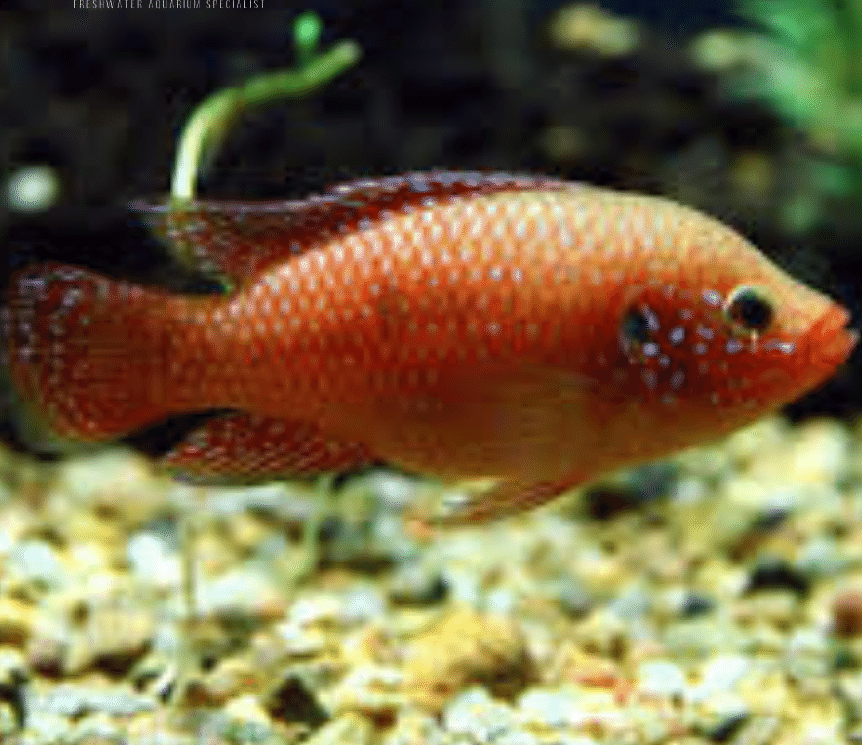
The ‘jewel’ that sells the species — deep cherry to blood-red body with bright sapphire-blue metallic dots scattered densely across the face, gill plate, flanks, dorsal fin and caudal fin. Both sexes express this coloration when a pair forms and begins spawning; intensity peaks right around egg-laying and fades slowly after fry are free-swimming.
🟥 Line-Bred Deep Red Strain
Some European and Asian breeders have line-bred for year-round deep red colour expression with reduced dependence on breeding trigger. Fish from these lines show stronger background red even in non-breeding states. Rarely imported to Australia but increasingly available from specialist breeders.
The single most important thing to understand about Red Jewel Cichlid colour is that what you see in the shop is almost certainly not what you will eventually see at home — and this goes both ways. A young, shop-kept Red Jewel sitting in a crowded tank with no territory, no pair, and no breeding trigger will look genuinely dull: a mottled grey-brown fish with a couple of dark blotches on the flank and a faint dusting of whitish flecks. New keepers regularly call shops asking if their fish is sick because ‘it doesn’t look like the photo on the website’. It is not sick. It is simply in its baseline non-breeding phase, which is the natural camouflage coloration of an unpaired jewel cichlid in the wild. Any time you see a photograph of a Red Jewel online in jaw-dropping blood-red with sapphire spots blazing all over — that is breeding-phase colour, triggered by pair formation, territorial establishment, and the hormonal cascade that accompanies spawning. Getting your fish into that phase at home requires patience, correct setup, and ideally a bonded pair rather than a single solo fish.
Colour development timeline at home looks roughly like this: week one to four after purchase, the fish stays drab while it acclimates. Week four to twelve, as territory is claimed and a pair forms (if two fish are present and compatible), you will start to see red wash develop along the flanks, particularly when the fish faces off against another jewel or a mirror. By the time a pair is ready to spawn — which could be as little as two months or as long as eight months after setup — both fish will be in full breeding dress, with the female often deeper red than the male because her body is preparing for egg production. The red persists through the 5-6 week breeding-and-fry cycle, then slowly fades over two to four weeks after fry are independent. Then the cycle resets. In a well-fed, well-kept pair the breeding cycle can repeat every 6-10 weeks, which means your fish will spend most of the year displaying at least partial breeding colour.
There is no stable ‘colour morph’ system in Hemichromis the way there is in peacock cichlids or discus. A ‘Red Jewel’ is a Red Jewel, and the colour intensity comes from biology (breeding state, age, sex, health) rather than from genetic strain. The exception is a handful of line-bred ‘super red’ or ‘ruby’ strains developed by European breeders that push background red colour even in non-breeding fish; these are uncommon in Australia and tend to be sold as ‘Red Jewel — German line’ or similar. Unless you are buying from a breeder who can produce pedigree documentation, assume you have a standard Hemichromis lifalili or hybrid, which will express full colour only under correct conditions and proper pair dynamics.
Creating the Perfect Habitat
A Red Jewel Cichlid setup is all about territory management. These are intensely territorial fish, and the way you lay out the tank has a direct effect on how aggressive they are, whether a pair will form, and whether any tank mates will survive the breeding cycle. The cardinal principle is: break up line-of-sight within the tank. A 120 L tank that is one long empty box with a couple of plants is a death trap, because a breeding jewel pair will patrol the entire footprint as a single territory and attack anything that enters it. That same 120 L tank, divided by rockwork stacks, driftwood clusters, and planted background into three or four visually distinct zones, can successfully house a breeding pair plus a couple of robust dither fish because the pair’s defended territory shrinks to the zone around their chosen spawning site.
Substrate should be fine gravel or coarse sand — jewel cichlids occasionally dig, particularly during breeding conditioning, and they appreciate being able to move substrate around. A 3-5 cm layer is plenty. The single most important piece of hardscape is a flat, smooth spawning stone — ideally a piece of slate, river stone, or even a large ceramic tile laid flat in a clear, visible spot not too far from a cave entrance. This is where the pair will lay eggs; without a suitable flat surface they will improvise on the tank glass or a filter intake, neither of which is ideal. Around that spawning stone, arrange caves (overturned terracotta flowerpots work fine, or stacked smooth river rock to form overhangs) that provide shelter for the female and, later, hiding spots for the fry when they first become free-swimming. Avoid sharp or rough hardscape — jewel cichlids in full territorial display will sometimes slam into decor when chasing off rivals, and rough edges cause fin damage.
Driftwood is optional but useful: a piece or two of well-soaked driftwood adds tannin colour to the water (which jewel cichlids appreciate — it is close to their native tea-stained river water) and provides additional line-of-sight breaks. Plants are compatible but require some planning. Jewel cichlids do not typically eat or dig up plants, but they will dig at the base of newly planted stems during breeding setup. Use robust, anchored plants — Anubias, Java fern (Microsorum pteropus), Amazon sword (Echinodorus) well-established in clay — or float hardy stems like Hornwort. Avoid fragile species like Rotala or delicate Cryptocoryne varieties for a first setup.
Lighting should be moderate — too bright and the fish stay hidden during the day and colour fades; too dim and you do not get to appreciate the jewel-spot iridescence. A standard freshwater LED around 3000-5000 K is ideal. Floating plants or a scattering of plant cover across part of the surface gives the fish confidence and encourages natural colour display. A fitted hood is essential — jewel cichlids are strong swimmers and occasional jumpers, particularly during breeding chases, and an open-top tank is a recipe for finding a fish on the floor.
Tank
120 L (60 cm / 2 ft) absolute minimum for a bonded pair species-only; 200-250 L (90 cm / 3 ft) strongly recommended if any tank mates
Filter
Canister filter rated for one tank size up, or oversized HOB with foam pre-filter on intake (protects jewel fry from being sucked in)
Heater
150-200 W adjustable heater set to 26 °C; ensure guard/protection to prevent accidental burns during breeding chases
Substrate
Fine natural-colour gravel or coarse sand, 3-5 cm deep; dark substrate intensifies the fish’s red colour dramatically
Spawning Stone
A flat, smooth slate, river stone, or ceramic tile positioned visibly near a cave — this is where eggs will be laid
Caves & Shelter
Terracotta pots (cut or inverted), stacked smooth rocks, or commercial cichlid caves — at least 3-4 separate shelter points
Driftwood
1-2 pieces of pre-soaked driftwood for tannin release and line-of-sight breaks
Lid / Hood
Fully fitted lid — jewel cichlids are jumpers, especially during territorial pursuit. Open-top tanks are not safe
Sexual Dimorphism
Sexing Hemichromis lifalili outside of breeding condition is genuinely difficult and a common source of frustration for beginners. Sub-adult fish at 5-7 cm, which is when they are most commonly sold, look nearly identical regardless of sex — same mottled brown-grey colour, same body shape, same fin profile. There is no reliable visual sex marker until the fish matures sexually at roughly 8 cm or 6-8 months of age, and even then the dimorphism is subtle: males are slightly larger and more streamlined, females slightly shorter and rounder. Experienced keepers can often make a call on adults by body profile alone, but if you want certainty on sub-adults you essentially need to buy a group of 5-6 juveniles and grow them out, then watch for natural pair formation.
In breeding condition the differences become immediately obvious — and counter-intuitively, it is often the female that looks more spectacular. Female Red Jewels in breeding dress can develop a more saturated, almost uniform blood-red body colour particularly on the belly and lower flank, where the male tends to keep more patterning and flank-spot detail. The female’s belly swells visibly as eggs develop, and a short tubular ovipositor (genital papilla) becomes visible 24-48 hours before egg-laying; the male’s equivalent genital pore remains flush with the body. Fin extensions are also a useful sex indicator in mature fish — males develop pointed, filamentous tips on the dorsal and anal fins, while females retain shorter, rounder fin profiles.
The most reliable sexing method of all is simply pair behaviour. Buy a group of 5-6 juveniles from the same tank, grow them out in a 200 L+ tank with plenty of caves and hiding spots to reduce aggression, and wait. By 8-10 cm, one pair will naturally form — you will see two fish that hang out together, defend a piece of rock or cave together, and chase all the other fish away. That is your bonded pair, and they are definitionally male + female (Hemichromis does not form same-sex pair bonds). At that point you can re-home the remaining 3-4 fish or move the pair to their own tank. This approach is far more reliable than trying to hand-pick a sexed pair from a shop tank, and it is how most successful Red Jewel breeders work.
| Feature | Male | Female |
|---|---|---|
| Adult Size | 11-12 cm, slightly larger and more robust body | 9-11 cm, noticeably smaller particularly in body depth |
| Body Shape | More elongated, slightly deeper through the shoulders | Stockier mid-body, becomes visibly rounder/fuller during breeding as eggs develop |
| Breeding-Phase Colour | Deep cherry-red body, brilliant blue-white spots especially on gill plate and upper flank, long pointed fin tips | Often deeper and more uniform red than the male during peak breeding, with more intense red on the ventral area (belly) |
| Fins (Dorsal & Anal) | Dorsal and anal fins end in longer, pointed extensions, especially in mature individuals | Fins shorter and more rounded; pelvic fins typically more rounded |
| Ventral Area | Flatter underline, no visible ovipositor | Rounder, fuller belly when ready to spawn; short white genital papilla (ovipositor) becomes visible 1-2 days before egg-laying |
| Behaviour (Pair Formed) | Lead territorial defence, chase intruders to tank glass and attack; flaring display | Guards eggs/fry closer to the nest; also fiercely aggressive but to a smaller radius |
What to Feed
Red Jewel Cichlids are straightforward carnivorous feeders in the wild: they eat aquatic insects, insect larvae, small crustaceans, worms, small fish and fish fry opportunistically, and occasionally snatch terrestrial insects that fall onto the water surface. In the aquarium they are equally straightforward — they will eat practically anything of appropriate size that moves or smells like protein, with an enthusiasm that is occasionally comical. The challenge is not getting them to eat; it is feeding them a balanced enough diet that they stay in good condition over the five to eight years of their lifespan without developing the fatty-liver and digestive issues that plague cichlids fed a monotonous high-fat diet.
The staple food should be a high-quality sinking cichlid pellet formulated for carnivorous mid-size cichlids — look for whole fish meal, krill meal, or insect meal as the primary protein source. Brands like Hikari Cichlid Gold (medium pellet), Northfin Cichlid Formula, New Life Spectrum Thera-A, and Fluval Bug Bites Cichlid Formula are all well-regarded. Feed 2-3 pellets per fish per meal, twice a day. The fish should finish the meal in under 60 seconds — if pellets are sitting on the substrate 2-3 minutes later, you are overfeeding. Supplement the pellet staple with frozen protein two to three times a week: frozen krill (whole adult krill, a favourite food of Red Jewels and visibly intensifies red colour), frozen prawn/shrimp pieces, frozen mysis shrimp, and frozen bloodworm. Frozen krill and prawn are particularly good — the carotenoid pigments in crustacean shells feed directly into the fish’s red colour expression, and a pair fed regular krill consistently shows deeper red than a pair fed only pellets.
Live food is optional but very well-received — live blackworms (from a reputable source, to avoid disease), live brine shrimp, live mosquito larvae, or even the occasional feeder insect. Earthworms are excellent if you can source them clean; chop a garden earthworm (pesticide-free) into small pieces and the fish will explode with enthusiasm, and earthworms happen to be close in nutritional profile to the native insect-larvae diet of the wild jewel cichlid. What you should avoid is feeder goldfish (disease risk, nutritionally imbalanced) and mammalian meats (beef heart, chicken, pork) as anything more than very occasional treats — jewel cichlids, like most tropical fish, struggle to digest mammal fats and proteins. A weekly fast day (no food at all) is good practice for this species and helps prevent the digestive issues that are the commonest cause of premature death in well-kept jewel pairs.
Tank Mate Guide
The honest recommendation for a first-time Red Jewel Cichlid keeper is simple: keep them as a species-only tank. A 120-150 L tank with a bonded male-female pair, appropriate hardscape, and no other fish is the setup that produces the best colour, the most reliable breeding behaviour, and the fewest problems. You will see the full range of natural jewel cichlid behaviour — pair bonding, spawning, parental care — without spending your time rescuing other fish from aggression. This is a species that rewards a dedicated species tank, and many experienced keepers who have tried both setups eventually conclude that the species tank is not just the safest option but the most interesting one. There is plenty to watch with just two jewel cichlids; you do not need other species to fill the tank.
If you insist on a community setup — and the desire is understandable, because a single pair of jewels in an otherwise empty tank can feel sparse — upsize to at least 250 L and plan the community carefully. The larger the tank, the more territory options exist, and the more a jewel pair’s defended radius shrinks relative to the total tank footprint. In a 250 L 120 cm tank, a pair will typically defend one-third to one-half of the tank during normal territorial behaviour, leaving enough ‘neutral zone’ for fast, robust tank mates like Congo tetras or Silver Dollars to live safely. During active breeding, however, the territorial radius will expand dramatically, and you must be prepared to temporarily remove the community fish to a separate holding tank until fry are independent and the parents settle back to baseline. This is not a hypothetical concern — jewel pairs in breeding mode have killed even robust, fast-swimming tank mates that they tolerated perfectly well for six months prior. The seasonality of jewel aggression is the single most under-appreciated aspect of their behaviour, and it catches out most new keepers the first time they breed.
Avoid at all costs: other Hemichromis species (absolute worst compatibility in the hobby), small soft-bodied fish, shrimp, slow-moving species like angelfish or gouramis, and any other territorial cichlid below 15 cm adult size. If you are set on a mixed-cichlid tank with Red Jewels as a centrepiece, the safest additional species are larger West African Kribensis (Pelvicachromis taeniatus) in a 300 L+ tank, or Synodontis catfish that occupy different parts of the tank. Do not be fooled into thinking a second jewel pair in the same tank will ‘work out’ — two breeding jewel pairs in anything less than a 500 L tank typically results in one pair killing the other. These fish are stunning, intelligent and fascinating, but they are also committed territorial actors, and your community plan needs to respect that reality rather than optimistically work around it.
| Species | Why | |
|---|---|---|
| ✅ | Bonded Conspecific Pair (M+F Red Jewel) | By far the best ‘community’ for a Red Jewel is another Red Jewel of the opposite sex in a bonded pair. This is a species-tank recommendation rather than a mixed-community one, and it is how the fish are most successful kept long-term |
| ✅ | Congo Tetra (Phenacogrammus interruptus) | Larger robust tetra species from same West/Central African region; fast enough to avoid most jewel aggression in a 250 L+ tank. Still not safe during active breeding — plan to remove before a brood |
| ✅ | Silver Dollar (Metynnis argenteus) | Large, fast-moving schooling fish that upper-tier occupy the water column where jewels rarely patrol. Requires 300 L+; remove during breeding brood period |
| ✅ | Larger Catfish (Synodontis nigriventris ‘Upside-Down’, S. eupterus) | Nocturnal, armoured, and too robust to be bullied successfully by a jewel pair. Synodontis species from West/Central Africa are biotope-appropriate too. Keep separate sheltered caves |
| ✅ | Bristlenose Pleco (Ancistrus sp.) | Bottom-level, armoured, and generally ignored by jewels outside of breeding. During a brood a jewel pair may harass a bristlenose that wanders too close to the nest — give the pleco its own cave at the far end of the tank |
| ✅ | Other Large West African Cichlids (in 400 L+ only) | Kribensis, Pelvicachromis, or larger Congo cichlids can coexist with Red Jewels in very large tanks with multiple territories. Not for beginners — aggression management is challenging |
| ❌ | Other Hemichromis Species (H. bimaculatus, H. guttatus, H. stellifer) | Jewel-on-jewel territorial wars are the most brutal fights this species fights. Different Hemichromis species see each other as direct rivals and will fight to exhaustion or death. Never mix species |
| ❌ | Small Tetras, Rasboras and Schooling Nano Fish | Neon Tetra, Rummy Nose, Cardinal, Chili Rasbora and similar will be either killed outright during breeding or harassed to stress-death during normal territorial behaviour. Too small, too slow, wrong energy for a jewel tank |
| ❌ | Shrimp and Soft-Bodied Invertebrates | Cherry shrimp, Amano shrimp, snails (most) — jewels are opportunistic carnivores and will pick off shrimp whenever the opportunity arises. Snails may survive but shells get harassed |
| ❌ | Other Mid-Size Cichlids (Angelfish, Rams, Apistogramma, Kribensis in small tanks) | Most other cichlid species at similar size are seen as territorial rivals and will be attacked. Angelfish in particular are slow and broad-bodied targets. Only mix with other cichlids in very large tanks with multiple separated territories |
| ❌ | Timid or Slow-Moving Fish (Gourami, Discus, Fancy Goldfish) | Any slow-moving fish with flowing fins will be torn up by a jewel pair. Gouramis in particular are completely incompatible — slow, surface-oriented, and defenceless against a territorial jewel attack |
Reproduction & Breeding
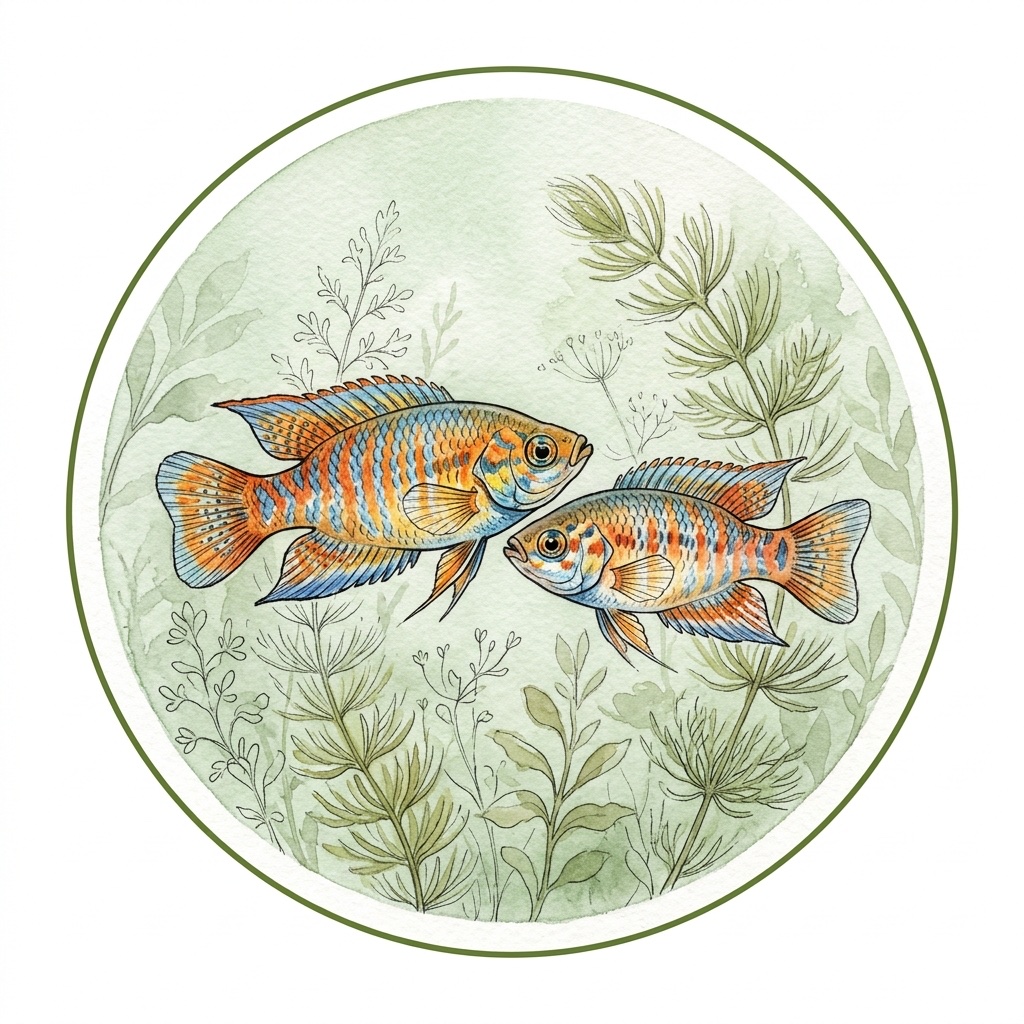
Day -7 to 0
Pair Formation & Site Selection
Bonded pair selects and meticulously cleans a flat spawning stone; both fish intensify in red colour
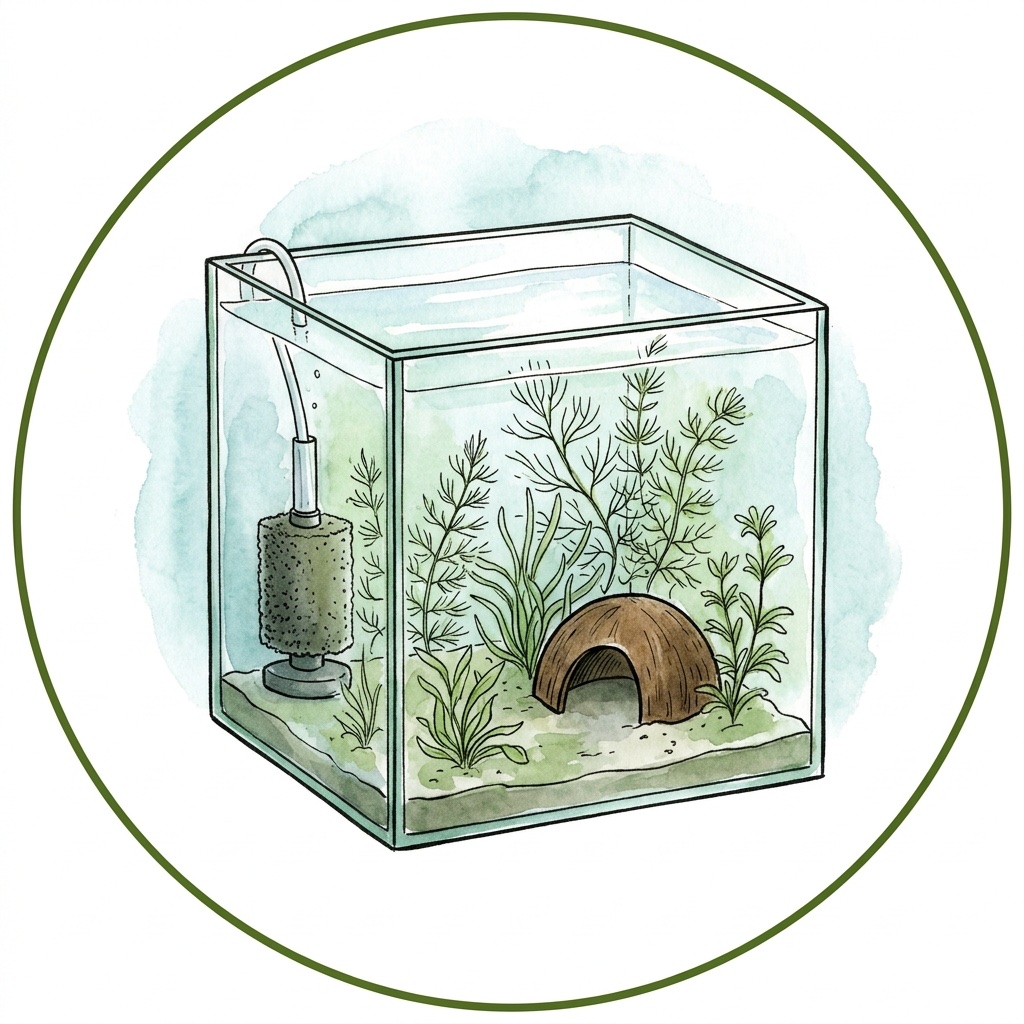
Day 0
Egg-Laying
Female lays 200-500 eggs in neat rows on the cleaned stone; male follows directly behind to fertilise
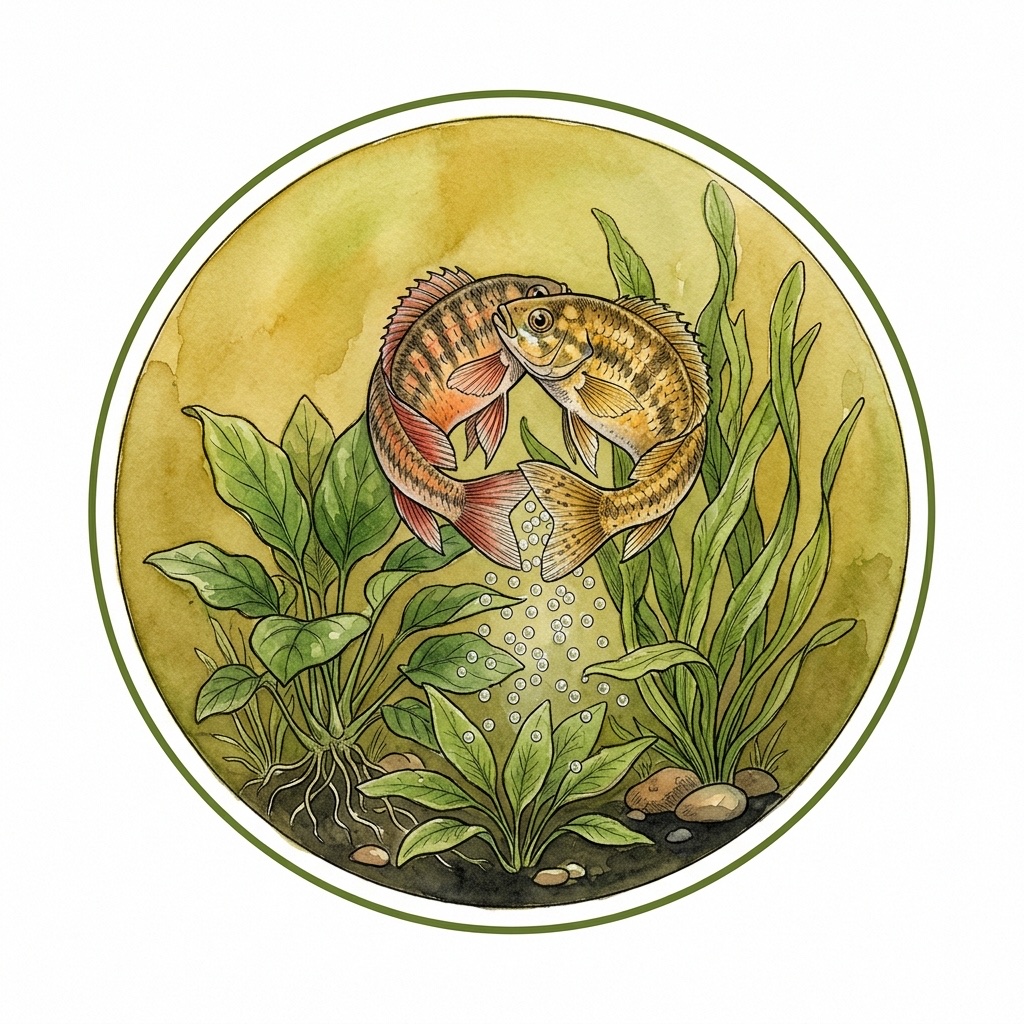
Day 1-3
Egg Guarding & Fanning
Both parents guard eggs and fan water across them to oxygenate; territorial radius extends to ~50 cm around the nest
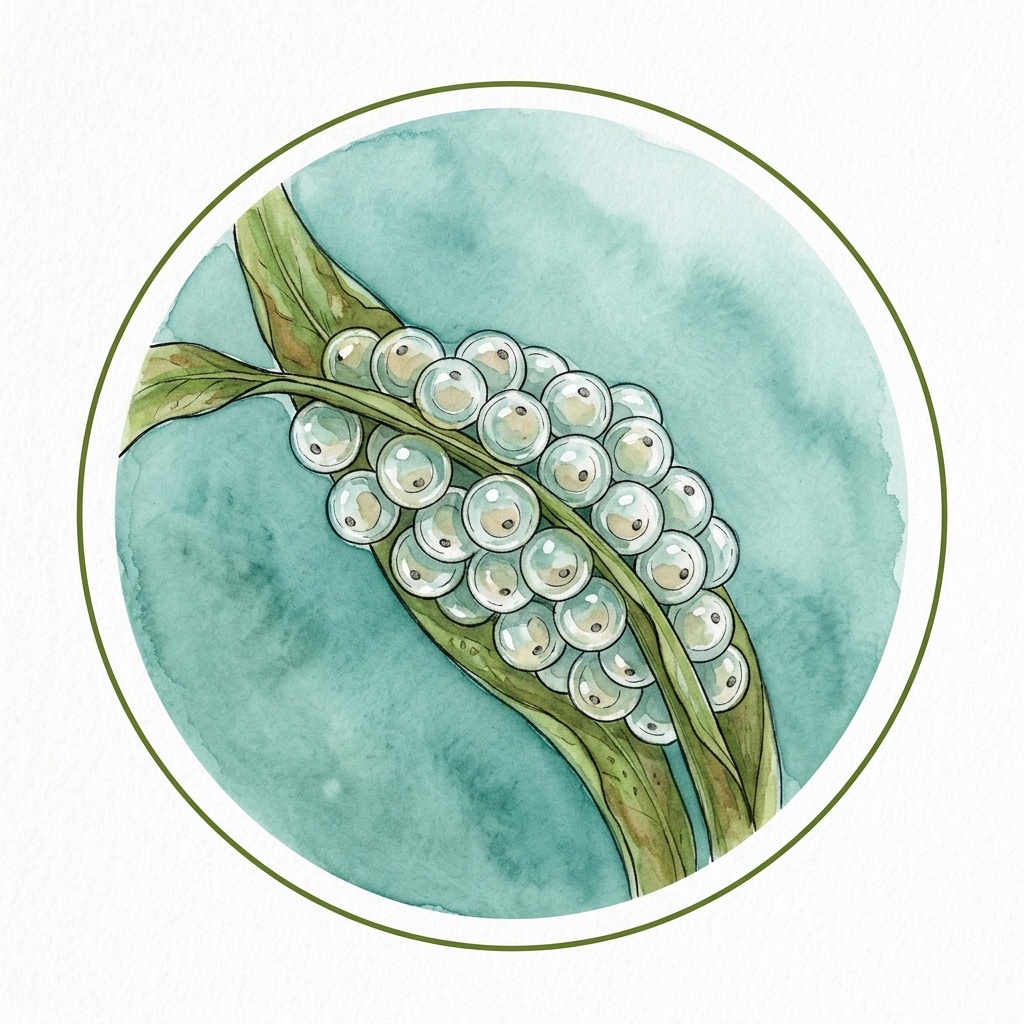
Day 3-5
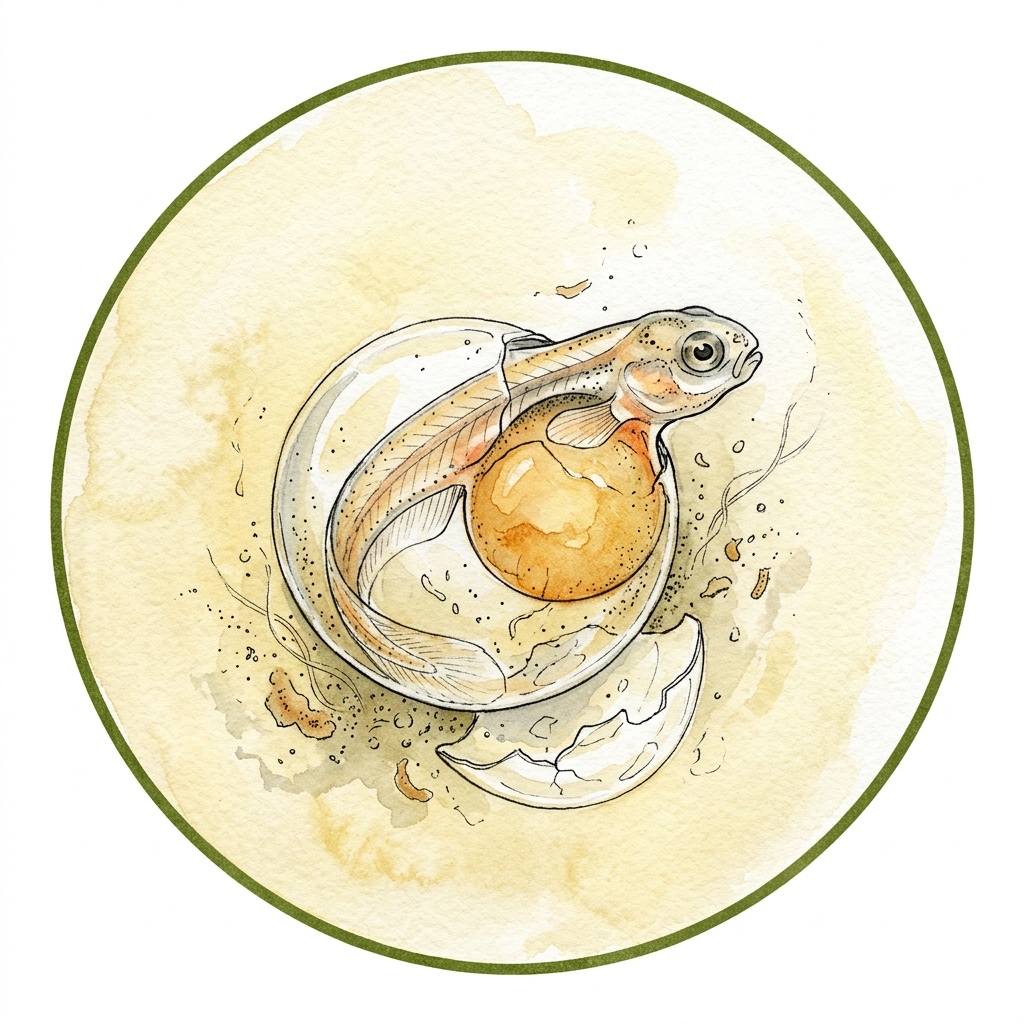
Hatch & Wriggler Stage
Eggs hatch into tiny wrigglers; parents move them into a pre-dug pit or cave; non-swimming yolk-sac fry
Day 6-8
Free-Swimming Fry
Fry become free-swimming; parents lead a dense ‘cloud’ of fry around the tank foraging
Pair Formation & Site Selection
In the lead-up to spawning a bonded pair of Red Jewels becomes a two-fish unit: they swim together, chase other fish together, and start inspecting candidate spawning sites. You will see the pair orbiting a particular flat rock or slate and spending 15-30 seconds at a time mouthing and scrubbing the surface with their lips — cleaning it of algae, biofilm, and debris. Both fish deepen in red colour over this week; the female’s belly visibly swells as eggs develop internally, and a short white tubular ovipositor becomes visible 24-48 hours before actual egg-laying. Aggression toward any other fish in the tank ramps up dramatically during this phase — if you were planning to re-home tank mates before breeding, this is the last moment to do it without risk of injury to the dither species.
The pair will often inspect and reject several candidate stones before settling on one. They seem to prefer a stone that is flat on top, in a semi-sheltered spot (not fully in the open, not deep in a cave), and near enough to a hiding cave that the female can retreat to brood. If you want to influence site selection, place a preferred spawning stone (a 10-15 cm flat slate works well) in this kind of semi-sheltered position before introducing the pair, and there is a very good chance they will choose it.
Egg-Laying
Egg-laying is a coordinated two-fish ritual that typically takes 30-90 minutes to complete. The female makes a slow pass over the cleaned stone, dragging her ovipositor across the surface and depositing a single row of 8-15 eggs in a tight line. The male follows immediately behind her, dragging his own genital pore over the same line of eggs to fertilise them. Then the female turns, makes another pass a millimetre or two adjacent to the first row, and lays another line. This repeats for the duration of the spawning — the final clutch will be a neat, regular mosaic of 200-500 eggs arranged in parallel rows covering a 5-10 cm patch of the stone. A first-time female may lay only 100-200 eggs; a mature female in prime condition can produce 500+ in a single spawning.
Both fish are at their absolute peak of colour intensity during this phase — the male’s red is at deepest cherry, the female often shows a uniform blood-red underside that contrasts stunningly with the blue-spotted flanks. This is the moment most keepers photograph. Aggression toward any tank mate still present in the tank is now extreme; a small tetra that swims within sight of the spawning stone will be killed almost instantly. If you planned to leave dither fish in and you see spawning beginning, net out the dithers immediately — at this point leaving them in is a welfare failure, not a gamble.
Egg Guarding & Fanning
Once eggs are laid the pair transitions into guard mode. One parent (usually the female) hovers directly over the eggs, using gentle pectoral-fin movements to fan fresh water across the clutch — this oxygenates the eggs and prevents fungal infection. The other parent (usually the male) patrols a wider territorial circle, roughly 40-60 cm in radius around the nest, and aggressively chases or attacks anything that enters it. The two parents swap roles regularly; you will see coordinated ‘changing of the guard’ behaviour where the male approaches the nest, fans for a few seconds, and the female peels off to patrol. This coordinated biparental care is one of the things that makes Hemichromis such a fascinating genus to observe — it is true pair-bonded cooperation.
Eggs develop visibly over these three days. At 24 hours post-laying they are translucent amber-yellow; by 48 hours you can see the dark dots of developing embryo eyes through the egg membrane; by 72 hours the embryos are clearly fish-shaped, twitching occasionally inside the shell. Any infertile eggs (usually 5-15% of a clutch) turn white with fungal growth; the parents will eat these off the clutch routinely, which prevents the fungus from spreading to healthy eggs. Do not intervene with the clutch at this stage — keep the tank calm, keep water quality high, and let the parents do their job.
Hatch & Wriggler Stage
Hatching typically occurs 72-96 hours post-fertilisation. The parents do not simply leave the hatched wrigglers on the spawning stone; instead, they scoop the tiny (~3 mm) yolk-sac fry up in their mouths, carry them a short distance, and spit them into a shallow pit they have dug in the substrate adjacent to the spawning stone or into the depths of a cave. This behaviour is extraordinary to watch — a cichlid carrying dozens of wrigglers in its mouth without eating them. The wrigglers remain in this ‘nursery pit’ for the next two to three days, squirming and digesting their yolk sacs but not yet able to swim. Both parents continue to guard the pit, fanning water across the fry and attacking any intruders.
During this phase the pair’s territorial aggression reaches absolute peak — an adult community fish wandering within 30 cm of the pit will be attacked with full commitment, and the jewels are fast and strong enough to injure or kill fish twice their size. If there is any tank mate still in the tank at this point that you care about, it is gone. This is, operationally, the critical reason why we recommend a dedicated species tank or a very large tank with defined separate territory zones for Red Jewel pairs.
Free-Swimming Fry
This is the moment every Red Jewel keeper hopes to see — a cloud of hundreds of tiny fish following two adult parents around the tank, like miniature pilot fish around a pair of moving reefs. At around day six to eight post-spawn, the fry have absorbed their yolk sacs and become free-swimming. Initially they cluster in a tight ball near one of the parents; as they grow more confident over the following days they spread into a looser cloud that the parents herd and direct using body language and fin signals. If a fry strays too far from the group, a parent will swim out, scoop it up in its mouth, and spit it back into the main cloud. Watching this is one of the genuinely moving experiences in freshwater fishkeeping — it is true parental care, and it is on display in your living room.
Fry are tiny (3-4 mm at free-swim stage) but grow fast. Start feeding them immediately: crushed flake rubbed to powder, commercial fry food (Sera Micron or Hikari First Bites), and — ideally — live baby brine shrimp (BBS) hatched from decapsulated eggs, starting around day 8. A pair will raise a brood of several hundred fry in a tank without intervention, but if you want maximum survival and fast growth, do three things: (1) keep feeding the parents well throughout the brood (a starved female may eat the fry in desperation), (2) feed the fry at least twice daily with appropriately small particle food, and (3) do gentle small daily water changes (10%) to keep water quality high while the fry are developing. Expect fry to reach 1 cm at about 3 weeks, 2-3 cm at 6-8 weeks, and 5 cm (with the first hints of adult pattern) around 4-5 months. The parents will continue guarding the brood for roughly 4-6 weeks after free-swim, at which point they typically begin to lose interest and may even become aggressive toward the now-larger fry — at this point either remove the fry to a grow-out tank or accept natural culling.
Quick Reference
| Scientific Name | Hemichromis lifalili (also bimaculatus / guttatus / stellifer complex) |
| Group | West/Central African riverine cichlid — ‘Jewel cichlid’ genus |
| Adult Size | 10-12 cm (males slightly larger) |
| Lifespan | 5-8 years |
| pH | 6.5-7.8 (ideal 7.0) |
| Temperature | 24-28 °C (ideal 26 °C) |
| Hardness | 6-15 dGH (soft to medium-hard, adaptable) |
| Min Tank Size | 120 L for bonded pair species tank; 250 L+ for any community |
| Group Ratio | Bonded male + female pair only — never two of the same sex |
| Diet | Carnivore — cichlid pellet + frozen krill/prawn/bloodworm + occasional live food |
| Care Level | Intermediate (temperament management, not water chemistry) |
| Temperament | Peaceful outside breeding; extremely aggressive during brood |
| Tank Position | All levels — active, territorial swimmers |
| Breeding | Biparental substrate spawner — 200-500 eggs on flat rock, 21-day brood cycle |
| Price (Juvenile) | $22.50 AUD |
Related Products
Reviews
Clear filtersThere are no reviews yet.