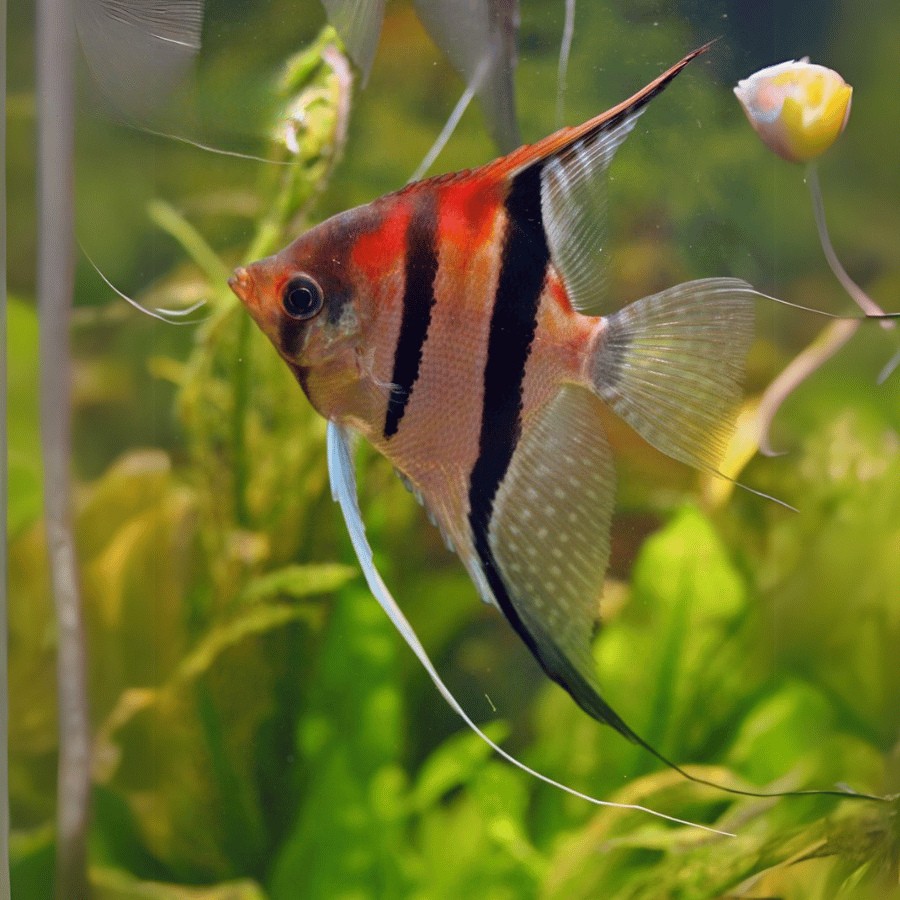
🪨 Species at a Glance
| Scientific Name | Pterophyllum scalare (Manacapuru locality) |
| Common Name | Red Shoulder Manacapuru Angelfish |
| Family | Cichlidae |
| Order | Cichliformes |
| Origin | Rio Manacapuru, Amazonas, Brazil — tributary of the Solimões/Amazon |
| Bloodline | Wild-type locality form (not line-bred, not hybrid) |
| Current Size | 4-5 cm body height (juvie colour stage) |
| Adult Size | 12-15 cm body height, 15-20 cm tall including fins |
| Lifespan | 8-12 years with correct water |
| pH Range | 5.0-6.8 (blackwater, ideal 6.0) |
| Temperature | 26-30 °C (79-86 °F) |
| Hardness (dGH) | 1-4 — very soft |
| Diet | Omnivore — varied frozen, pellet and live; sensitive to monotony |
| Minimum Tank Size | 150 L for juvies, 200 L+ for adult pair, 300 L+ for group of 6 |
| Care Level | Intermediate (wild-type demands stable blackwater) |
| Temperament | Peaceful in group, territorial when paired |
| Breeding | Substrate spawner — wild-type pairs harder to form than line-bred |
| Tank Position | Mid to upper, preferring vertical structure |
Name & Origin
The genus *Pterophyllum* is Greek for ‘winged leaf’ — *pteron* (wing) and *phyllon* (leaf) — a poetic nod to the way these fish drift vertically through submerged branches as if they were leaves caught on a slow current. *Scalare* is Latin for ‘like a flight of stairs’, referring to the graduated dorsal spines that step up along the back. The scientific name is therefore an almost perfect description of the animal: a leaf-shaped, ladder-finned drifter of the flooded forest. The common-species name ‘angelfish’ comes from the trailing ventral filaments that nineteenth-century European aquarists imagined resembled the flowing robes of an angel. *Pterophyllum scalare* was formally described in 1824 by Austrian naturalist Martin Lichtenstein, though the fish did not reach the European aquarium trade in meaningful numbers until the 1910s, when German importers began bringing them up the Amazon via Manaus.
The ‘Manacapuru’ suffix, however, is the critical part of this fish’s identity. It names the Rio Manacapuru, a tannin-black tributary that joins the Solimões (upper Amazon) just west of the city of Manaus in Amazonas state, Brazil. Unlike the Rio Negro proper, which is even darker and more acidic, the Manacapuru carries a chemistry somewhere between blackwater and clearwater — pH around 5.5 to 6.2, very low dissolved minerals, and a heavy seasonal flood that inundates the surrounding igapó forest. The wild angelfish that evolved in these waters developed a distinctive colour signature: a pronounced reddish-orange wash along the upper shoulder, directly behind the gill plate and above the pectoral fin base. In the trade this is simply called the ‘red shoulder’, and it has become the single most sought-after wild locality trait in the *scalare* complex. The trait is thought to have evolved as a sexually selected signal — mature males in breeding condition show the most intense red, suggesting the patch functions as a fitness indicator during mate choice in the low-visibility tannin waters of the Manacapuru drainage.
It is important to understand that Manacapuru is not a morph or a line-bred strain — it is a geographical race, a population whose appearance has been shaped by thousands of generations of natural selection in one particular river system. When you buy a Manacapuru, you are not buying a designer genotype crossed in a Southeast Asian farm; you are buying an unbroken thread back to those flooded forests. For this reason, serious angelfish keepers treat Manacapuru stock as foundation material — the kind of fish you build a breeding programme around, not the kind you impulse-buy alongside a handful of tetras. Breeders in Germany, the United States, Czechia, and a handful of Australian specialists maintain locality-pure Manacapuru lines with the same care that koi keepers apply to named bloodlines, because once a wild locality strain is crossed with line-bred stock, it cannot be recovered. Every fish sold under a locality name is either a genetic asset to the global hobby or a step toward losing that asset forever, depending on how it is managed.
Male vs. Female
Let us be completely honest about juvenile angelfish sexing: at 4-5 cm it is not possible to reliably tell males from females, and anyone who tells you otherwise is guessing. The gonads are still undeveloped, the fin extensions have not yet elongated, and the subtle skeletal differences that distinguish adults simply have not appeared. This is actually an advantage for the hobbyist — because if you buy a group of six juvies, you are statistically almost guaranteed to have at least one natural pair by the time they reach maturity around 10-12 months of age. The classic angelfish strategy is to raise a group, let them pair naturally, and then move the bonded pair to a dedicated breeding tank. Resist the temptation to buy a ‘pair’ that a seller claims to have sexed at juvenile size — even experienced breeders cannot reliably sex wild-type angelfish below 7-8 cm body height, and wild-type fish in particular take longer than line-bred strains to show dimorphic cues.
Once adults, a few reliable cues emerge. Males develop a prominent ‘forehead bump’ (correctly called the nuchal hump or frontal ridge) as they mature, which females rarely show to the same degree. The ventral (pelvic) filaments on males are longer and more gracefully trailing. The overall body of a male tends to be slightly larger and more robust, with dorsal and anal fin rays extending further beyond the body outline. At spawning time, the only truly reliable difference is the genital papilla: the male’s is a narrow, pointed cone, while the female’s is a blunt, wider ovipositor. If you see a pair cleaning a vertical surface together and one of them has a visibly thicker, shorter ‘tube’ extended from the vent, that is the female about to lay eggs.
One additional tip for wild-type Manacapuru: in an adult group, mature males often show a slightly more saturated red shoulder than females of the same age under identical conditions. This is not a universal rule — well-fed gravid females in peak breeding condition can match male intensity — but as a general pattern the trait is sexually dimorphic in expression. If you have a group of 8+ adults and one fish consistently shows the most dramatic red while the others remain slightly subtler, that fish is statistically more likely to be a dominant male.
| Feature | Male | Female |
|---|---|---|
| Current Stage (4-5 cm) | Unreliable — too young to sex | Unreliable — too young to sex |
| Ventral Fin Extensions | In adults, longer and more filamentous | In adults, slightly shorter and stouter |
| Forehead Profile (Adult) | Develops a noticeable frontal hump (‘nuchal ridge’) at maturity | Forehead stays smoother, sloping more gently into the dorsal |
| Body Outline (Adult) | Slightly larger overall, longer dorsal and anal rays | Marginally smaller, rounder belly when gravid |
| Genital Papilla (Spawning) | Pointed, narrow, visible only at spawning | Blunt, wider tube — the clearest reliable cue |
| Behaviour in Group | Slightly more assertive, may claim vertical territory | Often shoals centrally until a pair forms |
Colour Varieties
🟠 Manacapuru (Red Shoulder)
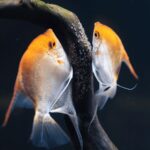
The fish you are looking at. Silver body, red-orange shoulder patch behind the gills, subtle vertical barring that deepens under stress or during courtship. The red develops progressively from 4 cm onward and saturates by 12 months.
🟡 Rio Nanay (Peruvian)
A Peruvian locality from the Nanay drainage near Iquitos. Tends toward a taller, more kite-shaped body with prominent black vertical bars and a subtle golden cast — no red shoulder. Highly prized but rarer in Australia.
⚫ Rio Negro (Upper Rio Negro)
Deep blackwater form from above Barcelos. Very tall body, strong bar contrast, often develops a smoky bluish sheen on the flanks. No red shoulder; the showpiece is the sheer elegance of the body outline.
🔶 Santa Isabel
Named for the town of Santa Isabel do Rio Negro. Shares some red-shoulder traits with Manacapuru but shows a cooler, more amber-toned shoulder wash and a taller body. Some ichthyologists consider it part of the same *scalare* cline.
🔴 Rio Manacapuru (this fish)
Restated here to emphasise: you are receiving the genuine Manacapuru bloodline, not a hybrid or a ‘red-shouldered’ marketing name. Expect clean silver flanks, strong red development by 10-14 months, and the taller-than-wide body profile of a true wild-type *scalare*.
Wild locality angelfish are a fundamentally different animal from the line-bred strains (marble, koi, platinum, zebra, pinoy) that most aquarists encounter. Line-bred fish have been selected for dramatic, immediate colour and predictable pairing — they look spectacular at 6 cm and will breed in tap water with minimal fuss. Wild locality fish, by contrast, are bred for authenticity: the colour develops slowly, the behaviour is closer to what you would observe in the Amazon itself, and the genetic diversity is intact. The Manacapuru red-shoulder trait is expressed through diet, water chemistry, and age — a juvenile in hard alkaline water will never show the full red, while the same fish in tannin-rich pH 5.8 water with a varied carnivorous diet will colour up dramatically by its first birthday.
For this reason, it is essential not to confuse a Manacapuru with a line-bred ‘red-shoulder angelfish’ that is sometimes sold under similar names. A true Manacapuru comes from stock traceable to the Rio Manacapuru; a line-bred red-shoulder is typically a cross-bred farmed fish selected for shoulder colour without locality integrity. The difference matters enormously if you intend to breed, because only the wild locality animal will produce offspring with the reliable Manacapuru phenotype. When you buy from Amazonia you are buying locality-traceable stock — ask us about the broodstock line at any time.
A note on albino and leucistic forms: there is no true albino Manacapuru. Any ‘albino Manacapuru’ sold in the trade is almost certainly a cross between line-bred albino stock and wild-type, which produces interesting-looking fish but completely loses the locality integrity. If albinism is what you want, choose dedicated albino strains (the Albino Dantum is an excellent example) rather than a hybridised Manacapuru. Keep your wild locality lines pure — the hobby as a whole benefits when keepers treat these fish as genetic heritage rather than raw material for cross-breeding experiments. Compared to the Assorted Angelfish (commercial line-bred mix for display tanks) or the Albino Dantum (deliberate albino line-bred strain with orange-gold pigmentation and no dark melanin), the Manacapuru is positioned as the premium wild-type authentic option — a different category of fish entirely, priced and valued accordingly by serious keepers.
Water Parameters
5.0–6.8
ideal 6.0
26–30 °C
ideal 28 °C
1–4 dGH
Very soft water essential — blackwater conditions
This is the single most important section of this guide. Wild-type Manacapuru angelfish come from authentic blackwater — pH in the high 5s, dissolved minerals so low that a TDS meter struggles to register, temperatures warm enough to make most community fish uncomfortable, and water stained amber-black by decomposing leaves and wood. If you keep this fish in typical Australian tap water (pH 7.4-7.8, GH 6-10, no tannins), it will survive, but it will never colour up properly, it will show reduced immunity, and it will almost certainly never breed. Survival is not the benchmark for this fish; thriving is.
The target is soft, acidic, tannin-rich water. Start with rainwater, RO water, or a 70/30 RO-to-tap blend, then reconstitute with a trace mineral supplement designed for blackwater setups (brands like Seachem Equilibrium used at a quarter-dose, or dedicated products like Fluval Discos/Blackwater). Buffer slightly downward using Indian almond leaves, alder cones, oak leaves, and high-quality driftwood — these release tannins that act as natural pH buffers, lower GH gradually, and carry mild antibacterial properties. Your target parameters: pH 5.8-6.2, GH 1-3, KH 0-1, TDS 40-80 µS/cm, temperature 27-28 °C. These numbers may look intimidating on paper, but they are genuinely achievable for any keeper willing to invest in a basic RO unit (around $200-300 AUD) or collect rainwater consistently.
Stability trumps perfection. A rock-steady pH of 6.5 is far better than a pH that swings between 5.8 and 7.2 because you are chasing an ideal number with erratic dosing. Perform 20-25% water changes weekly, pre-matching the new water’s temperature, pH, and TDS to the tank within a narrow margin before adding it. Never do large sudden water changes with significantly different chemistry — wild-type angelfish are especially sensitive to osmotic shock. Test weekly: pH (a liquid test kit is fine; electronic probes drift unless calibrated monthly), GH, KH, ammonia, nitrite, and nitrate. Nitrate should stay below 20 ppm; keep it there with planted surfaces and consistent water changes.
Temperature matters more than many Australian keepers realise. These are equatorial fish from a river that sits at the equator; they are comfortable at 28 °C and genuinely thrive at 29-30 °C for short conditioning periods before breeding. Anything below 25 °C for sustained periods suppresses their immune system and makes them vulnerable to hexamita (hole-in-the-head), flagellate infections, and gill flukes. Do not cold-keep wild-type Manacapuru. In an unheated Australian winter, a dropped heater or a home-heating failure can push a tank into the low 20s very quickly — budget for a reliable heater with an external thermostat, and if you are running multiple tanks consider a whole-room ambient heater rather than relying on individual tank heaters alone.
Diet & Feeding
Wild-type angelfish are omnivores in the truest sense of the word — in the Rio Manacapuru they prey on insect larvae, small crustaceans, planktonic invertebrates, occasional small fish, and plant material they scrape from submerged wood. Line-bred domestic angelfish have been selected over decades to accept a pellet-only diet without issue, but wild-type Manacapuru retain much more of their ancestral nutritional sensitivity. Feed them a monotonous flake-only diet and you will see reduced colour, listless behaviour, and long-term susceptibility to hole-in-the-head disease (caused by the combination of *Hexamita* parasites and poor nutrition).
Build the diet on three pillars. First, a high-quality staple: a premium cichlid or angelfish-specific pellet with whole fish or insect meal as the first ingredient, kelp and astaxanthin for colour, and at least 40% protein. Good options widely available in Australia include Hikari Cichlid Gold, NLS (New Life Spectrum) Cichlid Formula, and Fluval Bug Bites Cichlid. Second, frozen foods three to four times per week: bloodworms, mysis shrimp, brine shrimp, daphnia, and black mosquito larvae. Mysis and daphnia are particularly valuable — the chitin acts as gut roughage and supports natural digestion. Third, live foods weekly when available: live adult brine shrimp, black worms (soaked to purge), and live daphnia. Live foods trigger the most powerful feeding response and are essential when conditioning a pair for breeding.
Feed small amounts twice daily rather than one heavy meal. Juvies at 4-5 cm are still growing rapidly and need three small feedings per day for the first two months in your care. Turn off the filter intake for a few minutes during feeding so food is not immediately sucked away. Fast the fish one day per week — this mimics the natural feast-famine rhythm of the wild river and noticeably improves long-term health.
A note on colour-enhancing foods: the red shoulder of the Manacapuru is primarily structural-plus-pigment, with carotenoid pigments deposited in the skin from dietary sources. Foods rich in astaxanthin (krill, cyclops, high-quality colour pellets) and beta-carotene (spirulina, daphnia fed on algae) will measurably intensify the red wash over 8-12 weeks of consistent feeding. Some breeders supplement with a weekly feeding of soaked colour-enhancing pellet crushed and mixed with a small amount of live brine shrimp; the fish receive the pigment while enjoying the feeding trigger. Avoid cheap ‘colour flakes’ — these often rely on artificial dyes that produce an unnatural orange tint rather than the deep warm red the Manacapuru should develop.
Tank Setup
The goal is to recreate the flooded igapó forest of the Rio Manacapuru, and you can do this more faithfully than almost any other biotope because the raw materials are all legally available to Australian aquarists. Start with tank size: at 4-5 cm your juvies are happy in a 150 L grow-out tank for the first six months, but you must plan to move them up to 200 L+ for an adult pair or 300 L+ for a peaceful group of six. Height matters even more than volume — angelfish are vertical swimmers, and a 60 cm tall tank allows them to display natural posturing behaviour that a 40 cm shallow tank never will. If you can stretch to 70-80 cm height, you will be rewarded with adult fish that carry themselves more proudly, with fuller fin extensions and more confident territorial behaviour.
Substrate should be fine natural river sand, either silica-based or a dark neutral substrate like Fluval Stratum (which also gently buffers pH downward, a bonus for Manacapuru). Avoid bright white sands — the colour contrast drives juveniles to wash out their own pigmentation to blend in, which permanently dulls their adult colour development. The hardscape is where you commit to the biotope: use tall, angular pieces of *Mangrove* or *Spiderwood* driftwood arranged vertically, mimicking the submerged roots and trunks of the flooded forest. This vertical structure is non-negotiable — angelfish orient to vertical surfaces for everything from resting to spawning, and without them they display constant low-grade stress. Think of the aquascape as a cathedral of vertical lines, not the horizontal valleys of a Japanese-style iwagumi.
Layer the tank floor with Indian almond leaves (Terminalia catappa), oak leaves, magnolia leaves, and alder cones. Replace every 4-6 weeks, allowing them to decompose naturally. Do not over-clean; a lightly detritus-rich substrate is closer to the Rio Manacapuru than a hospital-sterile bottom. Plants are optional but beautiful — Amazon swords (*Echinodorus amazonicus*) are biotope-appropriate, and floating plants like Amazon frogbit or red root floaters provide the dappled overhead light that angelfish evolved under. Avoid aggressive-rooted plants and anything requiring hard alkaline water. Lighting should be subdued: low-to-moderate LED with a warm colour temperature (5500-6500K), set to 6-8 hours per day. Bright cool lighting washes out the red shoulder and makes the fish hide during daytime hours. A simple ‘tea-coloured tank’ rule applies — if the water looks slightly amber under your light, the fish will relax and display; if it looks crystal clear and brightly lit, they will hide.
Maturity is also a critical factor. Do not introduce your juvies to a brand-new tank. The nitrogen cycle should be fully established (ammonia 0, nitrite 0, nitrate under 20), the driftwood leached of initial tannins for a week or two, and the botanicals already softening the water. Ideally, the tank is at least six weeks mature before the angelfish arrive. Wild-type fish are especially intolerant of ‘new tank syndrome’ ammonia spikes.
Tank
Minimum 150 L for juvies (grow-out), 200 L+ for adult pair, 300 L+ for group of 6. Height must be at least 50 cm — taller is better
Filtration
Canister filter rated 2x tank volume/hour, with spray bar to diffuse flow. Pre-age with seeded media before adding fish
Heater
Reliable adjustable heater, 1 W per litre minimum, with external controller as backup. Target 28 °C
Lighting
Low-to-moderate LED, warm spectrum (5500K), 6-8 hours daily. Use floating plants to diffuse
Substrate
Fine natural river sand or dark buffering substrate (Fluval Stratum / ADA Amazonia). Avoid bright white
Hardscape
Vertical driftwood (spiderwood, mangrove) — tall angular pieces for territory and spawning sites
Botanicals
Indian almond leaves, oak leaves, alder cones, casuarina cones — essential for tannins and pH buffering
RO Unit or Rainwater Source
Non-negotiable for long-term Manacapuru keeping if tap water is above GH 4 or pH 7.2
TDS Meter
Cheap digital meter to monitor dissolved minerals — target 40-80 µS/cm
Airstone or Sponge Backup
Secondary aeration/biofilter — failure tolerance matters for sensitive fish
Community Tank Mates
The Manacapuru angelfish is happiest in an authentic Amazon blackwater community — not a ‘generic tropical’ mixed tank. Every other species in the tank should also prefer warm, soft, acidic, tannin-stained water, because anything less compromises the water chemistry that keeps the angelfish itself thriving. This is the opposite of how many Australian keepers approach community tanks; the usual advice is to pick species that ‘tolerate’ a middle-ground water chemistry, but with wild-type Manacapuru you should flip the logic and pick species that genuinely love the same water the angelfish needs.
The gold-standard community looks like this: a central group of 5-6 Manacapuru angelfish, a large mid-water school (20+ cardinal tetras or rummy noses), a surface-level school of hatchetfish, a bottom cleanup crew of 8+ sterbai cories and 1-2 bristlenose plecos, and perhaps a pair of apistogramma in the lower front zone. Everything in this list wants the same water: pH 5.8-6.5, GH 1-4, 27-29 °C, tannin-rich. The result is a tank that looks and behaves like a slice of the flooded igapó forest — and you will notice that every species looks better in this water than it would in ‘community compromise’ conditions. The cardinals colour more intensely, the rummy noses carry a brighter red nose, the cories spawn more readily, and the apistogramma show the kind of territorial complexity you rarely see in harder water.
Stocking strategy also matters. Add the angelfish last, after the community has fully settled and the schooling fish have established their territorial patterns. This reduces the angelfish’s tendency to claim too much tank as personal territory and ensures smooth long-term coexistence. If you plan to keep a group of six, add all six at once rather than introducing them gradually — this prevents the first-arrival fish from monopolising and bullying later arrivals.
Avoid at all costs: any fish small enough to be eaten (neons, chili rasboras, ember tetras under 2.5 cm), any known fin-nipper (tiger barbs, serpae tetras in small groups, most puffers), anything requiring hard water (African cichlids, most livebearers), and anything aggressive enough to outcompete a peaceful angelfish at feeding time (most Central American cichlids, adult Oscars). Also avoid mixing Manacapuru with line-bred angelfish strains in the same tank — if a wild-type male pairs with a line-bred female, the resulting fry lose locality integrity and contribute to the slow erosion of pure bloodlines in the hobby. Keep your wild-type lines in dedicated display or breeding setups.
Finally, a word on Discus. The dream Amazon biotope for many advanced keepers is a combined Manacapuru-Discus display. The two species share near-identical water requirements (soft, acidic, warm, tannin-rich) and occupy visually complementary vertical space — angelfish in the mid-to-upper column, Discus in the mid column. This combination is absolutely achievable in a 400+ L tank with experienced keepers, but it is not a beginner setup: you are managing two sensitive wild-type cichlids simultaneously, and any water chemistry failure affects both. If you can execute it, few display tanks in the hobby are more breathtaking.
| Species | Why | |
|---|---|---|
| ✅ | Cardinal Tetra | The definitive Amazon biotope companion. Shares identical soft acidic water preferences and occupies the mid-water, visually complementing the angelfish without territorial overlap |
| ✅ | Rummy Nose Tetra | Tight schooling behaviour creates dynamic contrast with the slow drifting angelfish. Extremely soft-water tolerant and non-threatening |
| ✅ | Sterbai Corydoras | One of the few cories truly comfortable at 28-30 °C — most others prefer cooler water. Peaceful bottom-dwellers that keep substrate detritus in check |
| ✅ | Discus | The classic Amazon pairing. Both species thrive in identical hot, soft, acidic water and occupy overlapping but non-conflicting niches. Requires a minimum 400 L tank to execute properly |
| ✅ | Hatchetfish (Marbled or Silver) | True surface-dwellers from the same blackwater system, occupying a vertical niche angelfish completely ignore. Beautiful additions to a biotope |
| ✅ | Otocinclus | Peaceful algae-grazers that thrive in soft acidic water and are too small to threaten anything. Handle biofilm on driftwood and plants |
| ✅ | Apistogramma (Cacatuoides, Agassizii, Borellii) | Dwarf cichlids from the same river systems. Occupy the bottom zone that angelfish never visit. Requires careful selection to avoid territorial overlap at spawning time |
| ✅ | Bristlenose Pleco | Tolerates soft acidic water well and provides excellent algae and biofilm management. Slow enough not to stress the angelfish |
| ❌ | Neon Tetra (small adults or juvies) | Despite the classic pairing in books, adult angelfish will eat small neon tetras — their mouths are large enough to swallow a 2 cm neon whole. Only pair with fully grown cardinals, never neons |
| ❌ | Tiger Barb, Serpae Tetra | Notorious fin-nippers that will destroy the trailing ventral and dorsal filaments that define angelfish beauty. Incompatible regardless of tank size |
| ❌ | African Cichlids (Malawi/Tanganyikan) | Require hard alkaline water (pH 7.8-8.6, GH 10-20) — the exact opposite of Manacapuru water. Also aggressive enough to bully a peaceful angelfish to death |
| ❌ | Central American Cichlids (Convicts, JDs, Firemouths) | Prefer harder water and are dramatically more aggressive than peaceful South American species. Size and temperament mismatch in both directions |
| ❌ | Goldfish & Cold-Water Species | Completely incompatible temperature requirements (Manacapuru need 28 °C, goldfish thrive at 20 °C) plus hard alkaline preferences. Never mix |
Breeding
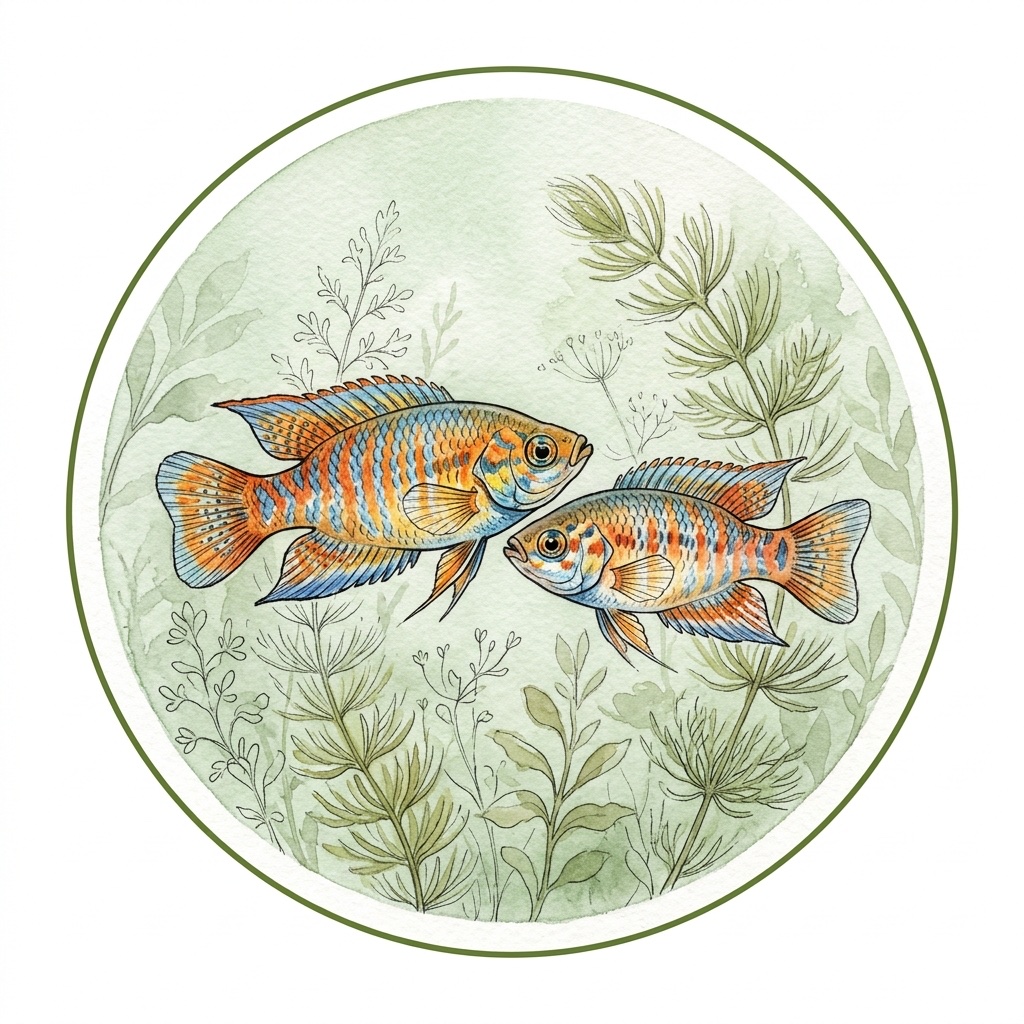
Months 0-8
Grow-Out & Social Formation
Raise 5-6 juvies together in a stable blackwater grow-out tank
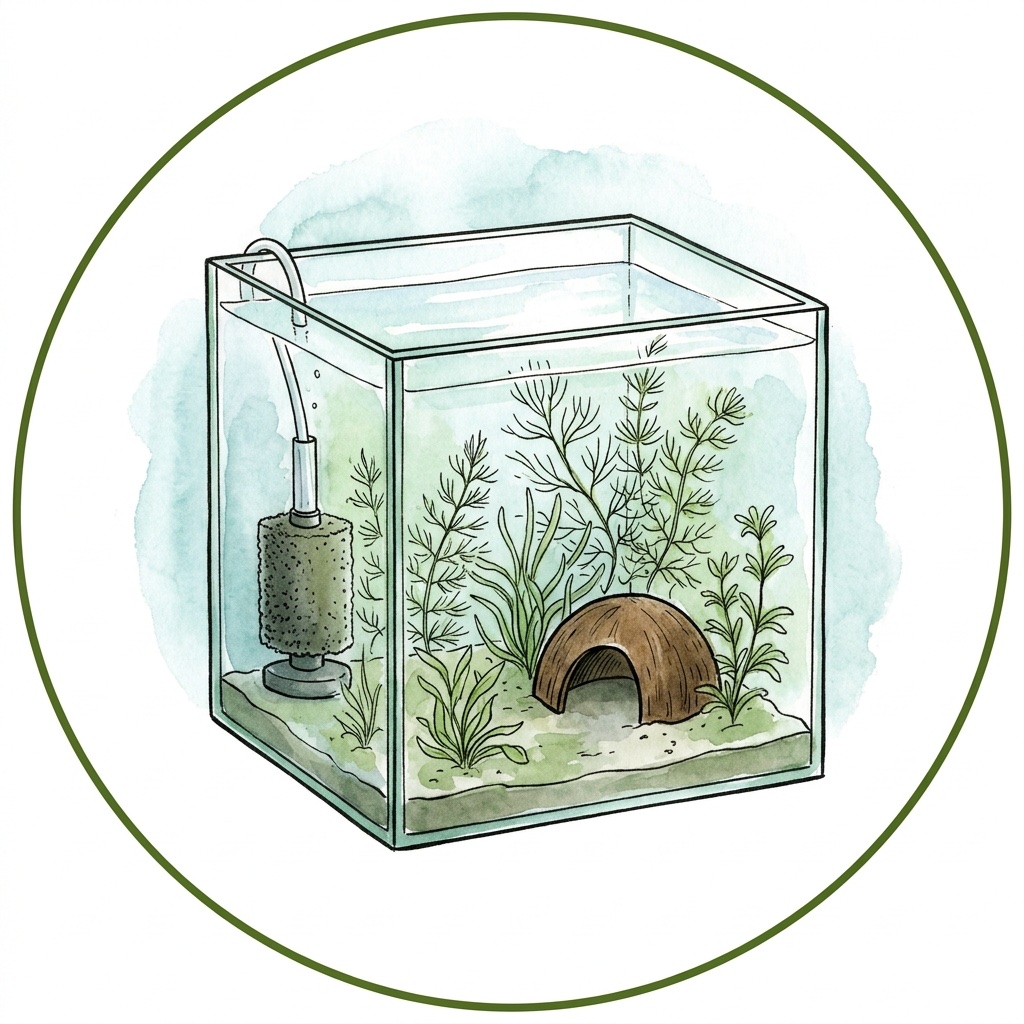
Months 8-12
Pair Bonding & Separation
Identify the bonded pair and move to a dedicated breeding tank
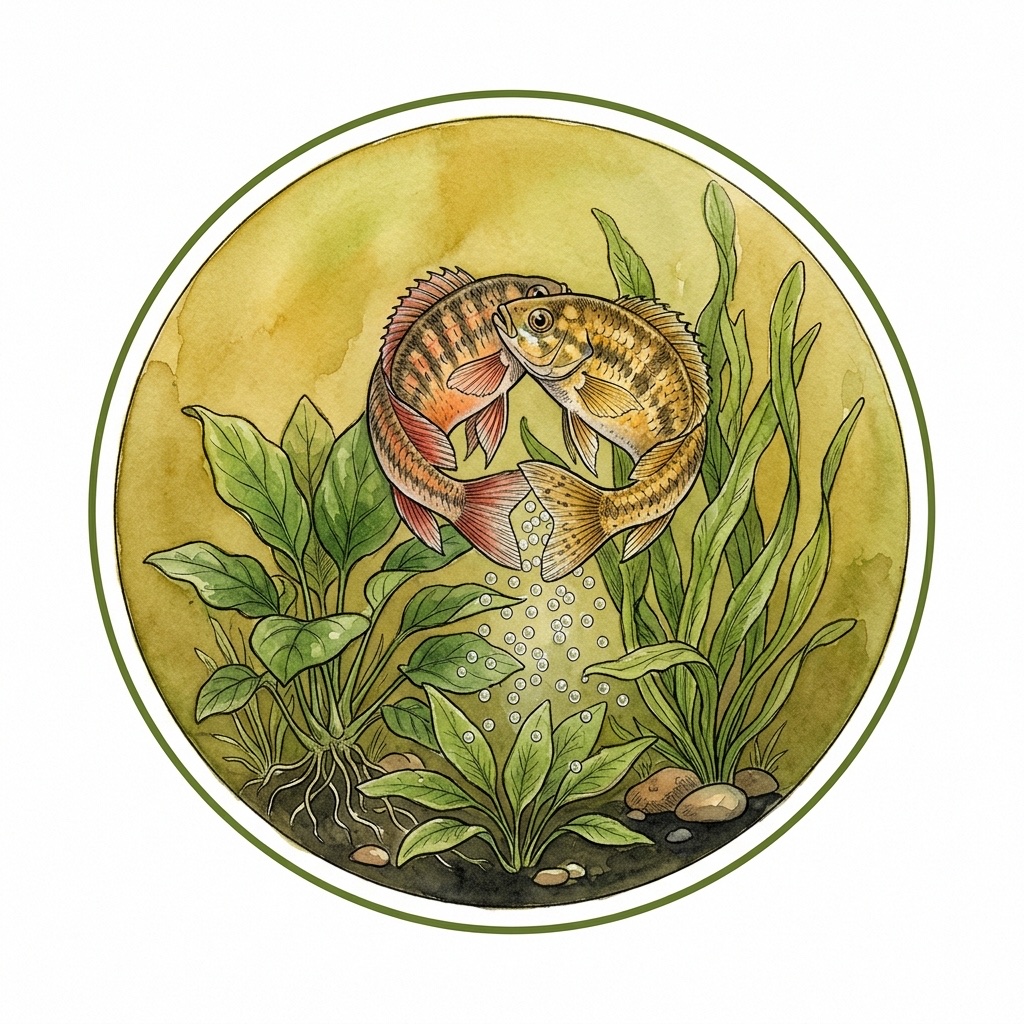
Day 0
Courtship & Cleaning
Pair cleans spawning surface obsessively; colours intensify
Day 1
Spawning
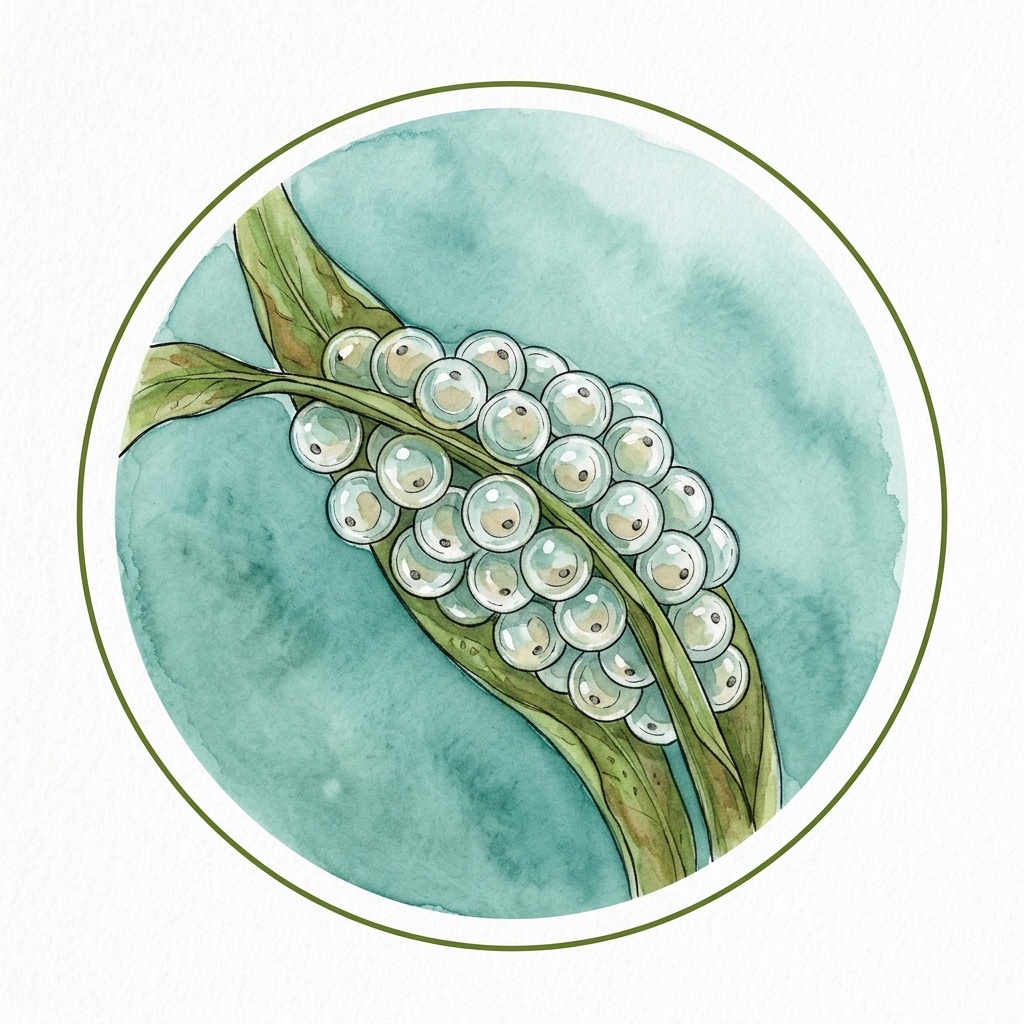
200-800 eggs laid in neat vertical rows
Days 2-3
Egg Care & Hatching
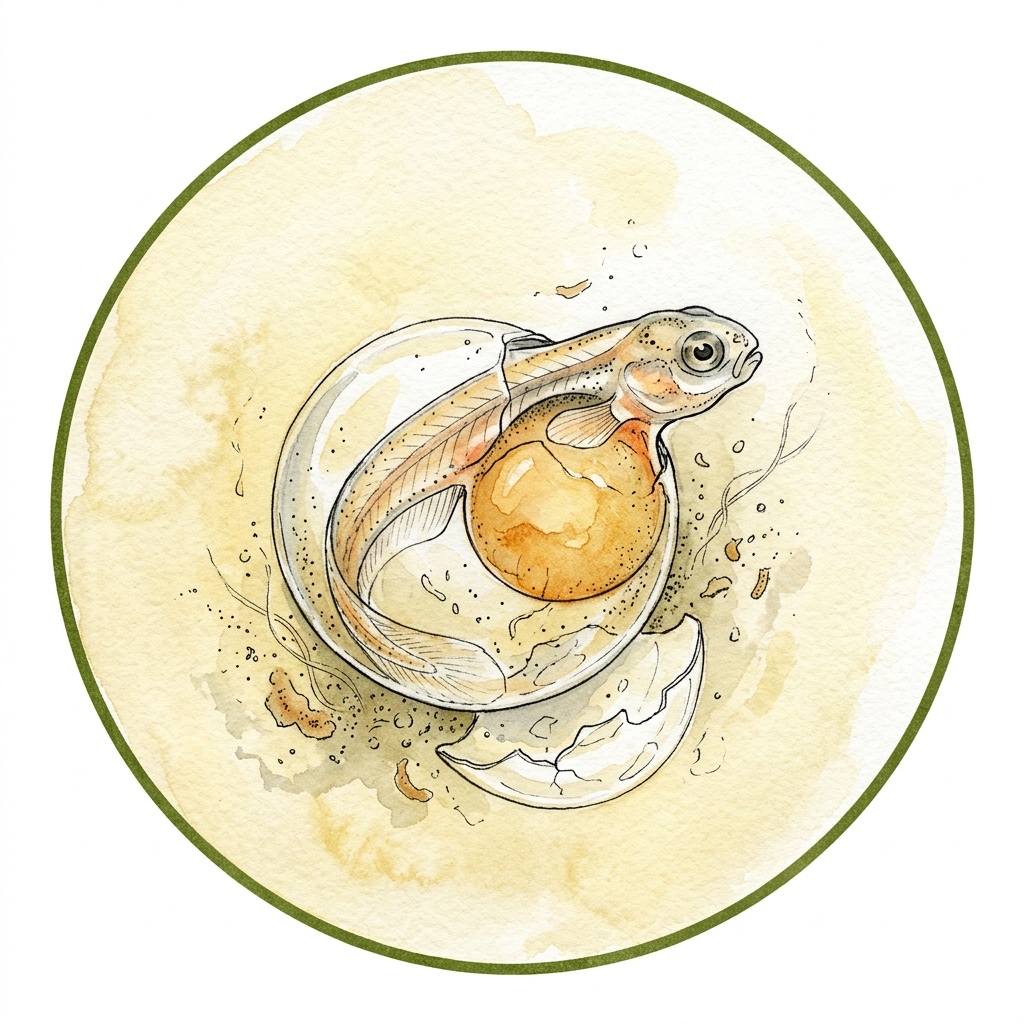
Parents fan eggs constantly; wrigglers emerge at 60-72 hours
Days 7-10
Free-Swimming Fry & First Food
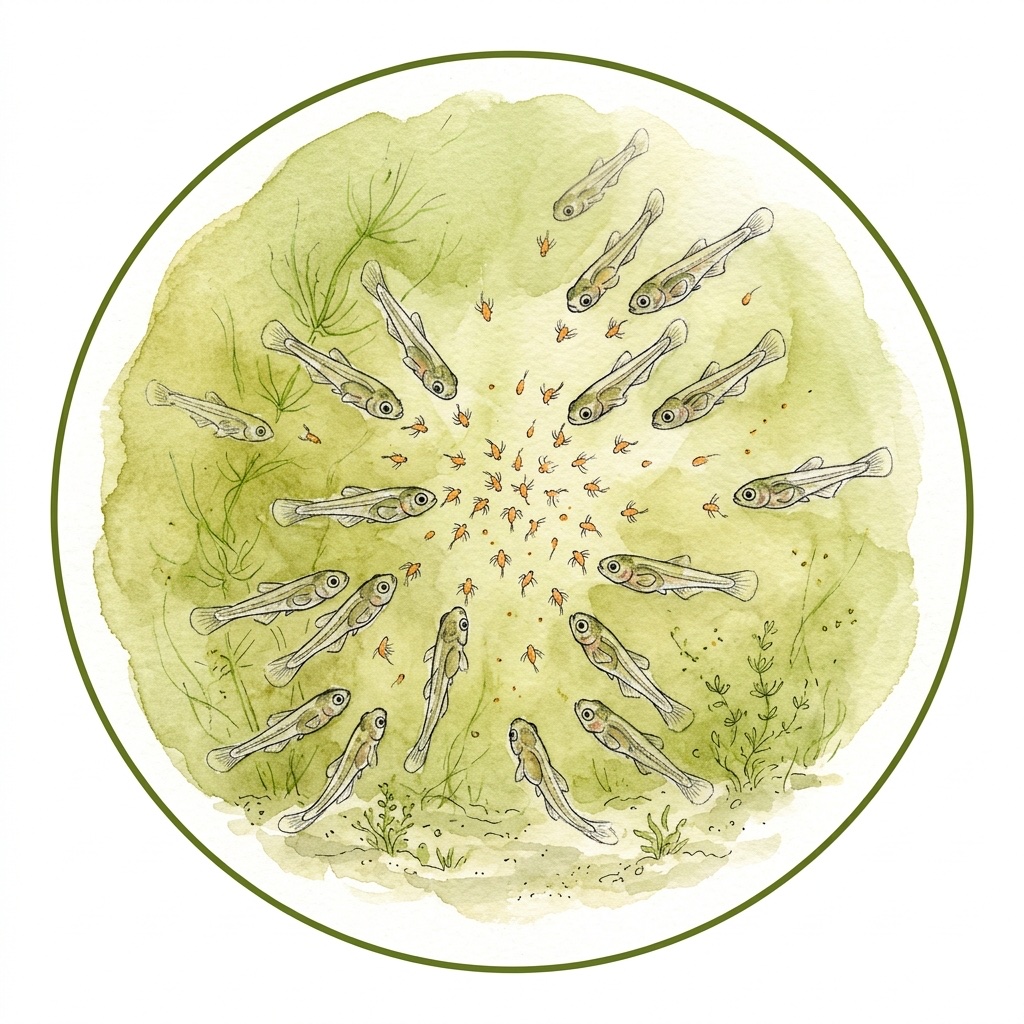
Fry swim freely; feed newly-hatched brine shrimp
Grow-Out & Social Formation
Angelfish pair naturally, and the single most important decision you will make is to raise a group and let them self-select a partner rather than trying to force two strangers together. Keep your six juvies in a 200+ L grow-out tank with soft acidic water, vertical structure, and a varied diet. Observe social behaviour from month 6 onward: you will start to see two fish drift together, defend a vertical surface, and display to each other. This is a natural pair forming. Do not intervene yet — let them settle.
Pair Bonding & Separation
Wild-type pairs are often more difficult to form than line-bred pairs — they are choosier about partners, and the bond takes longer to solidify. Once you see consistent paired behaviour over two or three weeks (swimming together, defending a shared patch of wood, threat displays aimed at other group members), move the pair into a quieter 150-200 L dedicated breeding tank. Water should be even softer than the display: pH 5.8, GH 1-2, TDS 40-60. Introduce a vertical slate, a broad piece of Amazon sword leaf, or a length of PVC pipe at 45° as a spawning surface.
Courtship & Cleaning
Condition the pair heavily on live and frozen foods for two weeks before triggering a spawn. The trigger is usually a large water change with water 1-2 °C cooler than the tank, mimicking a seasonal rain event. Within 24-48 hours you will see the pair cleaning the chosen surface, mouth-picking at the same spot, and displaying intensified red shoulders (the male’s especially). The female will show a visibly extended ovipositor; the male’s genital papilla will be narrower and more pointed.
Spawning
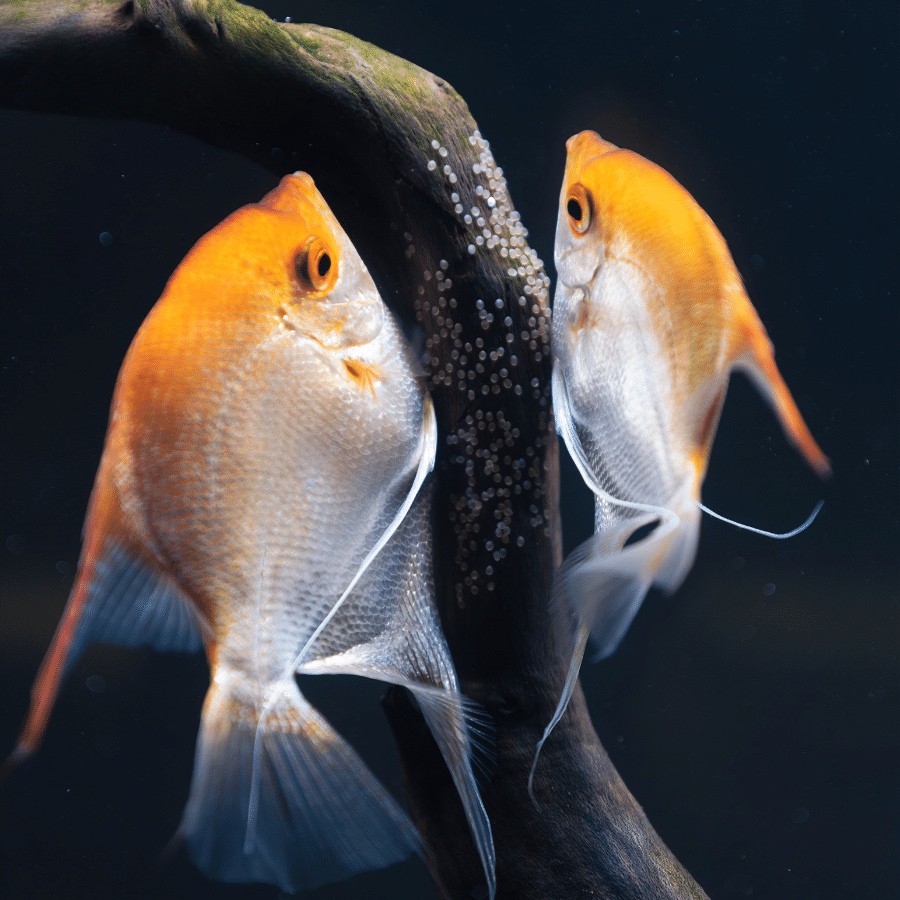
Spawning is a graceful, almost choreographed event. The female passes up the cleaned surface laying a row of translucent, slightly amber eggs; the male follows immediately behind, fertilising as he goes. They repeat this for 30-60 minutes, producing anywhere from 200 eggs (young pair) to 800+ eggs (mature pair in good condition). Wild-type pairs tend toward smaller, higher-quality spawns. Do not disturb — first-time pairs are notoriously skittish, and any interruption often ends in them eating the clutch.
Egg Care & Hatching
Both parents fan the eggs with their pectoral fins to maintain oxygenation, and pick off any infertile (white/fuzzy) eggs to prevent fungal spread. At 28 °C, eggs hatch in 60-72 hours into tiny tailed ‘wrigglers’ that attach to the spawning surface by a sticky thread from their heads. Parents will often move the wrigglers to a new surface or a shallow pit. This is a critical stress window — if the parents panic, they will eat the fry. Maintain dim, stable lighting and no external disturbance.
Free-Swimming Fry & First Food
Around day 7-10 (depending on temperature), the fry detach, swim upward as a cloud, and begin accepting food. Feed newly hatched baby brine shrimp (BBS) three to four times per day, supplemented with microworms or liquid fry food for the first week. Parents will continue to guard and herd the fry for another 2-3 weeks. After that, you can decide whether to leave them with parents, move them to a grow-out tank, or artificially raise them. At 6-8 weeks the fry will show the first hint of the red shoulder — the moment most wild-type breeders have been waiting 14 months for.
Quick Reference
| Scientific Name | Pterophyllum scalare ‘Manacapuru’ |
| Origin | Rio Manacapuru, Brazil (wild locality) |
| Current Size | 4-5 cm (juvie colour stage) |
| Adult Size | 12-15 cm body, 15-20 cm with fins |
| Lifespan | 8-12 years |
| pH | 5.0-6.8 (ideal 6.0) |
| Temperature | 26-30 °C (ideal 28 °C) |
| Hardness | 1-4 dGH (very soft) |
| Min Tank (Juvies) | 150 L |
| Min Tank (Adult Pair) | 200 L+ |
| Min Tank (Group of 6) | 300 L+ |
| Diet | Omnivore — varied pellet, frozen, live |
| Care Level | Intermediate |
| Temperament | Peaceful in group, territorial when paired |
| Breeding | Substrate spawner; wild-type pairs harder to form |
| Signature Trait | Red-orange shoulder patch (develops 6-14 months) |
| Price Point | $45 AUD — juvie colour, 4-5 cm |
Related Products

Reviews
Clear filtersThere are no reviews yet.