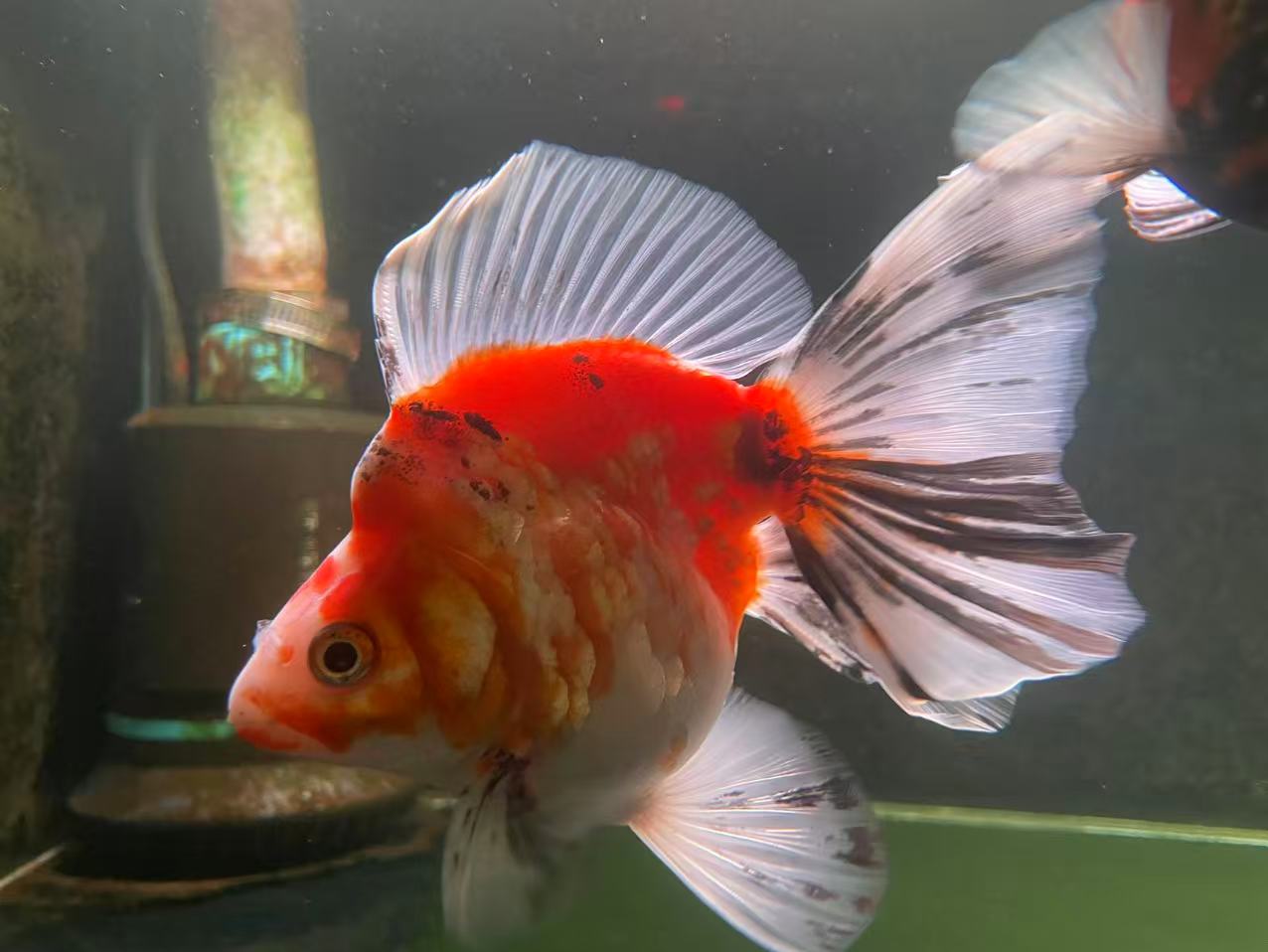
🪨 Species at a Glance
| Scientific Name | Carassius auratus (Ryukin long-tail calico morph) |
| Family | Cyprinidae |
| Order | Cypriniformes |
| Origin | Ryukyu Islands (Okinawa), Japan — derived from Chinese Wakin goldfish lines |
| Adult Body Size | 15–20 cm (6–8 in) body; up to 25 cm total with long caudal fin |
| Lifespan | 10–15 years typical; 20+ years with excellent care |
| pH Range | 7.0–8.4 |
| Temperature | 18–24 °C (64–75 °F) — temperate, not tropical |
| Hardness (dGH) | 8–20 (hard water preferred) |
| Diet | Omnivore — high-quality sinking pellet staple with blanched vegetables |
| Minimum Tank Size | 150 L (40 gal) for one adult; +75 L per additional fish |
| Care Level | Intermediate — demanding on filtration and tank size |
| Temperament | Peaceful, slow-moving, sociable with its own kind |
| Breeding | Egg scatterer — seasonally triggered by temperature cycling |
| Tank Position | All levels — typically mid to bottom |
| Colour Form | Calico — red, black, and blue-white on nacreous (pearl) scale base |
Meet the Species
The name Ryukin combines two Japanese root words: *ryu* from Ryukyu, the island chain stretching south-west from Kyushu toward Taiwan, and *kin* meaning gold. Literally, “gold of Ryukyu.” The variety takes its name from the trade route that brought it to mainland Japan in the late 18th century, when deep-bodied fancy goldfish were imported from China through the Ryukyu Kingdom and landed at the port of Satsuma in what is now Kagoshima Prefecture. At the time, the Ryukyu Kingdom operated as a semi-independent tributary state between China and Japan, and its merchants handled much of the luxury goods trade between the two empires — including ornamental fish destined for noble households. The first Ryukins to reach Japan were deep-bodied goldfish from the Chinese Wakin lineage, and Japanese breeders immediately prized the deep body and pronounced shoulder hump, selecting for ever more dramatic profiles over the following two centuries. By the late Meiji era (early 1900s), the Ryukin had become the quintessential Japanese fancy goldfish, depicted on postcards, lacquerware, and in woodblock prints alongside koi and carp as a symbol of prosperity and aesthetic refinement.
The scientific name *Carassius auratus* is shared with every other goldfish variety, from the humble common comet to the most elaborate Ranchu. All of them descend from a single species of Asian crucian carp — a drab olive-bronze wild fish that still exists across East Asia — first domesticated in China more than a thousand years ago during the Song Dynasty. Early keepers selected spontaneous orange mutants (a recessive trait) and bred them in temple ponds, eventually producing the first yellow, red, and variegated goldfish. Over centuries these base colours were combined with selectively bred body shape mutations — shortened spines, compressed bodies, elongated fins, head growths, eye modifications — to produce the sixty-plus distinct fancy varieties recognised today. What distinguishes the Ryukin from its cousins is a specific suite of selectively-bred traits: the pronounced dorsal hump rising immediately behind the head, the foreshortened body producing an almost round side profile, the paired anal fin inherited from all shortened-spine fancies, and — in long-tail lines like ours — the elongated, flowing caudal that can trail as long as the body itself. The hump itself is a result of a shortened vertebral column forcing the shoulder muscles to bunch upward, combined with fatty tissue deposition. It develops gradually over the first two years of life, reaching its final form around age three.
Unlike the Oranda, another deep-bodied fancy goldfish often confused at first glance by newcomers, the Ryukin has no *wen* — the raspberry-like head growth that crowns the Oranda and gives it its other common name, the Lionhead-like goldfish. A Ryukin’s head is smooth, clean, and tapers into that signature hump without any fleshy overgrowth. If you see a goldfish with a deep round body and a cauliflower-textured head growth, that is an Oranda, not a Ryukin. Unlike the Ranchu — another popular Japanese fancy — the Ryukin keeps its dorsal fin; the Ranchu is dorsal-less, with a smoothly arched back and a heavy wen. And unlike the slender-bodied Comet or Wakin, the Ryukin’s body is dramatically compressed front-to-back, giving it the distinct “humpback” silhouette that instantly identifies the variety from across the room. This combination of clean head, pronounced hump, deep body, full dorsal fin, and flowing long caudal makes the Long Tailed Calico Ryukin one of the most visually complete fancy goldfish varieties — and one of the easiest to identify correctly once you have seen a few quality specimens.
Spot the Difference: Male & Female
Outside of the breeding season, sexing Ryukins is genuinely difficult and most keepers cannot reliably tell males from females — the species is considered essentially monomorphic in non-breeding condition. This is typical of all goldfish varieties, not a quirk of the Ryukin specifically. The fundamental problem is that goldfish are a temperate egg-scattering species with no elaborate courtship display or permanent external sexual dimorphism — unlike, for example, tropical cichlids or livebearers, where males often differ dramatically in colour, fin shape, or size. In a Ryukin, the same body shape, same colour genetics, and same fin structure are shared across both sexes. The one dependable cue is seasonal: during spawning season (typically spring, as water warms from winter lows), mature males develop small, white, sandpaper-like bumps called breeding tubercles on the leading edge of the pectoral fins and across the gill covers. These are actually modified skin cells that thicken and keratinise under the hormonal influence of rising testosterone, and they serve the practical purpose of giving the male traction as he nudges the female’s flanks during spawning. Run a finger gently along a male’s gill plate in spring and you can feel these tubercles as a fine roughness — the texture of extra-fine sandpaper. Females never develop them, and on close inspection a mature female’s gill plate remains perfectly smooth.
Outside that spring window, the only other clue is body shape viewed from above at feeding time: gravid females appear noticeably rounder than males, and their vents protrude slightly. The vent of a breeding-ready female looks almost like a small pink bead, while a male’s vent remains flat or slightly recessed. Some experienced keepers claim they can distinguish sexes year-round by subtle pectoral fin shape — males tending toward pointed pectorals and females toward rounded — but this distinction is subtle and unreliable without side-by-side comparison of known-sex fish. If you plan to breed Ryukins, it pays to buy a group of six or more as juveniles so that natural pair formation can occur without you having to sex them individually. Goldfish naturally form loose social groups anyway, and a group of six gives you statistical near-certainty of multiple individuals of each sex. In practice, most dedicated Ryukin breeders simply buy young from quality stock, grow them out together for eighteen months, and then observe behaviour through the first spring to identify which fish are males (tubercles, chasing behaviour) and which are females (rounded belly, being chased). Only at that point do they sometimes separate the sexes for targeted pair breeding.
| Feature | Male | Female |
|---|---|---|
| Body Shape | Slightly slimmer when viewed from above | Fuller, rounder belly — especially when mature and in breeding condition |
| Vent | Small, slightly concave, narrow | Rounded, slightly protruding, especially when full of eggs |
| Breeding Tubercles | Develops small white bumps on gill covers and leading pectoral fin rays during breeding season | No tubercles ever |
| Pectoral Fin Shape | Slightly pointed, stiffer leading edge | More rounded leading edge |
| Behaviour (Breeding) | Actively chases females, nudging the vent area | Slows as eggs ripen; is chased by males through plants or spawning media |
| Colour (Non-Breeding) | No reliable difference | No reliable difference |
Visual Varieties
🎨 Calico (this fish)
Nacreous scales (part matte, part metallic pearl) patterned in red, black, orange, and blue-white patches — no two calicos are alike.
🔴 Red
Solid deep orange-red across the entire body and fins; the traditional and most common form in Japan.
🏳 Red & White (Sarasa)
Classic two-tone pattern with bold red patches on a bright white base — an auspicious colour combination in Japanese culture.
⚫ Black
Uniform matte black across body and fins; young blacks often fade toward bronze or orange as they mature, so stable adults are prized.
🍫 Chocolate
Rich warm brown body, often with a velvety sheen under good lighting — a less common variety with a devoted following.
🌈 Tri-Colour
Distinct red, white, and black patches on a metallic scale base — similar to calico but on fully metallic rather than nacreous scales.
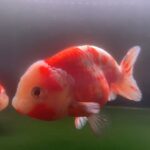
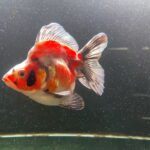
Our specimens are the Long Tailed Calico Ryukin — the long-fin variant of one of the most visually striking Ryukin forms. Calico colouration in goldfish arises from a specific scale type called nacreous, which mixes matte (non-reflective) and metallic (reflective) pigment cells in irregular patches, producing the characteristic mottled, almost stained-glass appearance that earned this pattern its Western name. The Japanese call the same pattern *sanshoku* or *sanke* (literally three-colour), borrowing the terminology from koi colour classification — and indeed, a well-patterned calico Ryukin and a well-patterned Sanke koi share the same visual language of red, white, and black on a flowing body. The red comes from carotenoid pigments deposited in the skin (which the fish cannot synthesise — it must come from diet), the black from melanin in melanophore cells, the orange from a mix of both, and the blue-white shimmer from guanine crystals scattered beneath the matte scales in the nacreous regions. This last effect — the pearl-blue patches that seem to glow from within — is what truly separates calico from simple tri-colour, and it is the single trait breeders work hardest to fix and intensify.
Because calico patterning is genetically unstable compared to solid colours, each fish is effectively one-of-a-kind — you pick your specimen for its pattern the way you might pick a painting. Even fish from the same spawn show wildly different distributions of colour, which is why calico Ryukins command such loyalty from collectors: your fish is genuinely unlike any other in the world. Traditional Japanese calico judging rewards balanced distribution (no one colour dominating more than roughly half the body), crisp edges between colour patches rather than muddy transitions, and a clean bright red sitting against a snowy nacreous base with well-defined black accents. Fish that show these traits fetch premium prices in the Japanese domestic market and are typically exported only as proven show-quality specimens.
Colour intensity in calico Ryukins is sensitive to both diet and light. A colour-enhancing pellet with spirulina and astaxanthin will deepen reds and oranges within a few weeks, while adequate natural or full-spectrum artificial lighting keeps the blue-white tones crisp. A tank kept in dim light or under warm-toned bulbs alone will see reds fade gradually and the nacreous blue-white regions lose their shimmer. Consider 6–8 hours per day of moderate full-spectrum LED lighting with a strong blue component as the optimum. Expect some pattern drift over the first two years — blacks often spread or recede, and young calicos can look surprisingly different at one year versus three. A fish that arrives with modest black markings may bloom into heavy charcoal patches by its second summer, or vice versa. This is part of the charm of keeping calico goldfish: your painting slowly repaints itself over the life of the fish. By age four or five, the pattern usually stabilises and the mature calico Ryukin settles into its final distribution, at which point it often enters its most photogenic years.
Water Quality Requirements
7.0–8.4
ideal 7.5
18–24 °C
ideal 21 °C
8–20 dGH
Hard water preferred — goldfish are carp and thrive in mineral-rich conditions
The single biggest mistake new goldfish keepers make is treating them like tropical fish. Ryukins are a temperate species — descended from Asian crucian carp native to cool streams and rice-paddy ditches across East Asia — and they thrive in cool, oxygen-rich, hard alkaline water. The ideal temperature sits around 20–22 °C, which most unheated indoor tanks in southern Australia and similar temperate climates will hold naturally for much of the year. They can tolerate short dips to 10 °C in winter (do not chill deliberately indoors — the swim bladder of a deep-bodied fancy is vulnerable to rapid temperature changes) and brief peaks to 26 °C in summer, but sustained temperatures above 26 °C cause real distress. The physiological reason is straightforward: warm water holds less dissolved oxygen exactly when the fish’s metabolism demands more of it. At 18 °C fresh water holds roughly 9.5 mg/L of dissolved oxygen; at 28 °C it holds barely 8.0 mg/L, while the fish’s oxygen demand has nearly doubled. This oxygen gap is why you often see goldfish gasping at the surface on hot summer days — they are effectively suffocating in their own tank. Beyond oxygen, bacterial populations in the substrate explode at higher temperatures, raising the risk of fin rot, bacterial gill disease, and opportunistic skin infections. Fancy goldfish with long delicate fins are particularly vulnerable. Do not keep Ryukins in a heated tropical community tank, regardless of what old aquarium books or some online guides may suggest.
Summer cooling is a real concern in Australian conditions. If your tank consistently exceeds 26 °C during summer, consider a small aquarium chiller (used by marine reef keepers), a room air conditioner set to cool the ambient air, or in extremis a fan-over-surface setup that uses evaporative cooling to drop tank temperature 2–3 °C. Keep the tank out of direct sunlight year-round — not only does sunlight overheat the water, it also triggers aggressive algae blooms that cloud the water and further complicate husbandry.
PH should sit firmly on the alkaline side — between 7.0 and 8.4, with 7.5 being ideal. This is the opposite of what many tropical aquarists are used to, and it is one reason why goldfish and tropical community fish cannot share a tank: their water chemistry preferences are fundamentally incompatible. Hard water (8–20 dGH) with good buffering capacity keeps pH stable and supports healthy scale and bone development. Goldfish originated in hard mineral-rich waters and their calcium metabolism, scale integrity, and bone structure depend on adequate dissolved minerals. If your tap water is soft and acidic, add crushed coral or aragonite to the filter to buffer upward — a 500g mesh bag of crushed coral in the canister filter will raise hardness and pH gradually and stably. Some keepers also add a small amount of aquarium salt (1 gram per litre) as a mild tonic; this is optional and somewhat controversial, but it harms nothing at low doses and may support slime coat health.
Weekly water changes of 25–30% are non-negotiable — goldfish produce copious ammonia and organic waste, and even a powerful filter cannot compensate for infrequent water changes. Many experienced Ryukin keepers perform 50% changes weekly on heavily stocked tanks. Temperature-match replacement water to within 2 °C of tank temperature to avoid stressing the fish, and always dechlorinate municipal water with a quality conditioner before adding it. Test ammonia, nitrite, and nitrate weekly for the first six months after setup; ammonia and nitrite should always read zero, and nitrate should stay below 40 mg/L. A single goldfish in an under-sized tank can push nitrate past 100 mg/L within a week — a silent chronic toxicity that slowly damages the fish’s kidneys and shortens its lifespan by years.
Feeding Schedule & Diet
Ryukins are classic goldfish omnivores with a pronounced appetite for plant matter. In the wild, their crucian-carp ancestors eat a mix of small invertebrates, insect larvae, crustaceans, algae, and soft aquatic plant matter — and domesticated goldfish retain this broad dietary flexibility. The staple of a good captive Ryukin diet is a high-quality sinking pellet formulated specifically for fancy goldfish — sinking rather than floating, because deep-bodied fancies that gulp air from floating food are prone to swim bladder disorders. The physical mechanism is straightforward: when a fancy goldfish rises vertically to snatch a floating pellet, it often gulps air along with the food, and this air becomes trapped in the complex folded intestine (goldfish have no true stomach) and disrupts the delicate swim bladder’s gas balance. The fish then struggles to maintain buoyancy, floats sideways or upside-down, and can die if the condition becomes chronic. Sinking pellets eliminate this risk entirely. Look for pellets with whole fish or shrimp as the first ingredient, wheat germ for digestibility, moderate protein (30–35% for fancy varieties, lower than tropical pellets), and added spirulina or astaxanthin for colour. Hikari Saki and Saki-Hikari Fancy Goldfish, Repashy Super Gold gel-food, Xtreme Goldfish Pellets, and Northfin Goldfish Formula are all excellent commercial options well-regarded by serious fancy goldfish keepers worldwide.
Supplement the pellet staple two to three times per week with blanched vegetables. Deshelled peas (microwaved 30 seconds, squeezed out of the skin, broken in half) are the single most useful vegetable supplement — they are gentle on the digestive tract and actively help clear constipation, a common Ryukin problem in a fish that is fed an all-pellet diet. Blanched zucchini rounds (attached to a vegetable clip on the tank glass), blanched spinach and kale (briefly, to soften the cell walls), and thin slices of blanched broccoli stem are all relished. Cucumber is fine but offers little nutrition. Avoid lettuce, which has almost zero nutritional value and fouls the water quickly. Fresh vegetables should be blanched (dipped in boiling water for 20–30 seconds then plunged into cold water) to break down cellulose and make the nutrients available — raw vegetables pass through the goldfish’s gut largely unused. Occasional frozen or live foods add variety and conditioning value, especially before breeding season: frozen bloodworms, daphnia, and brine shrimp once or twice a week are well received. Live blackworms and chopped earthworms from a clean source are relished and rich in protein. But do not overdo animal protein. Goldfish are not tropical carnivores and a diet too rich in animal protein — especially from bloodworms and beef heart — contributes directly to swim bladder issues, fatty liver disease, and reduced lifespan. Follow the Japanese breeder rule of thumb: roughly 70% pellet, 20% vegetable, 10% frozen or live protein.
Feed two to three small meals per day rather than one large feeding. A portion the fish can clear in about 90 seconds is the right amount — anything uneaten after two minutes should be netted out before it fouls the water. Skip one day per week entirely; a weekly fast allows the long gut of a goldfish to clear and significantly reduces digestive problems. Many experienced Ryukin keepers fast their fish every Sunday, a simple discipline that adds years to a goldfish’s life. Goldfish lack a true stomach and digest food slowly through a long, continuous intestine, which is why overfeeding is the number one health problem in the hobby and the leading indirect cause of early death in fancy goldfish. Your instinct will be to feed the fish more — they beg at the glass convincingly and always act hungry — but resist. An underfed goldfish recovers within a day; an overfed goldfish can develop chronic swim bladder disease, fatty degeneration of internal organs, and water quality collapse from uneaten food. When in doubt, feed less.
Tank Requirements & Layout
Tank size is non-negotiable with Ryukins. The rule of thumb is 150 litres for the first adult Ryukin, plus 75 litres for each additional goldfish. A 150 L tank (roughly 90x45x40 cm) is the realistic minimum for a single adult; 250–300 L is far better and lets you keep a small group of three or four. Deep bodies and long fins need swimming space in both horizontal and vertical dimensions — narrow, tall tanks are a poor choice. Favour long, low footprints: a 120 cm x 50 cm base is ideal. The classical Japanese show tank for Ryukins is even shallower and longer than that, often 150 cm long and only 30–40 cm deep, designed to be viewed from above — because the characteristic Ryukin hump and tail spread are most dramatic in overhead view, which is how they are traditionally judged in Japan. You can compromise with a standard side-view tank, but know that you are seeing the fish in a secondary aspect; invest in a shallow wide tank if you can, and you unlock a new dimension of visual appreciation for your Ryukins.
Substrate should be smooth fine gravel or sand with no sharp edges — Ryukins forage the bottom constantly, sifting food and plant matter through their downward-pointing mouths, and sharp substrate damages their mouths and gills over time. Black or dark brown sand makes calico colours pop dramatically compared to pale gravel, and many keepers prefer a bare-bottom tank for show fish: it maximises water volume, simplifies waste cleanup, and highlights the fish rather than competing decor. If you do use substrate, keep the layer shallow (2–3 cm) to avoid anaerobic pockets, and vacuum it weekly during water changes. Rocks and driftwood are fine if they have no sharp edges or tight gaps where a long fin can tear. Run a finger slowly across every surface of every piece of hardscape before adding it; if the finger catches or scrapes, sand the edge smooth or reject the piece. Even a small sharp edge can shred a $158 long caudal fin overnight.
Live plants are generally a losing battle: goldfish treat most aquatic plants as salad and will uproot, nibble, or destroy Anacharis, Amazon swords, and anything else you try. The biology is simple — goldfish are omnivorous cyprinids with a strong vegetable component to their natural diet, and they have been seeing green plants as food for a thousand years of domestication. If you want greenery, use tough synthetic silk plants (not plastic — plastic edges can tear fins) or commit to heavily eaten Anubias and Java fern tied to rocks, which at least survive because their tough leaves and rhizome-rooted attachment resist uprooting. Some keepers have success with Hornwort or Elodea as deliberate salad plants — grown in a separate tank and rotated into the goldfish tank weekly to be eaten, providing natural vegetable nutrition. Most dedicated Ryukin keepers, though, skip plants entirely and create an elegant minimalist look with smooth river stones, driftwood pieces, and an open swimming foreground. The Japanese show-tank aesthetic is pointedly sparse: a clean glass tank, a few carefully placed rocks or a single piece of driftwood, and the fish as the singular focal point. This minimalism is not laziness — it is an explicit aesthetic choice that puts the fish’s shape and colour first.
Filtration is the defining piece of kit for a goldfish tank. Aim for turnover of at least 5x tank volume per hour, ideally 8–10x with baffled output so the current is spread rather than jetting. A large canister filter with mechanical, biological, and chemical media, paired with a secondary sponge filter for extra bio-capacity and redundancy, is the professional setup. Consider something like an Eheim Classic 2217 or Fluval 407 on a 250 L Ryukin tank — both are workhorses that hobbyists run for a decade or more with only impeller replacements. Media should lean heavily toward biological (ceramic rings, sintered glass media, or bio-balls); goldfish produce such high ammonia loads that bio-capacity is the limiting factor, not mechanical filtration. Always fit a sponge guard over any intake — long-finned Ryukins can trap their caudal fins against a bare intake strainer and lose fin tissue overnight, and the slow steady damage of a fin caught against an intake for several hours is a heartbreaking and entirely preventable injury. Finally, plan for redundancy: a backup sponge filter driven by a separate air pump ensures that if your primary filter fails — a power cut, a worn impeller, a clogged intake — biological filtration continues without interruption until you can restore the main system.
Tank
Minimum 150 L (40 gal) for one adult; 250+ L for a group of 3. Long footprint preferred over tall.
Filter (primary)
Canister filter rated for 2–3x actual volume per hour, e.g. a 1200 L/h unit on a 400 L tank.
Filter (secondary)
Large sponge filter driven by an air pump — adds bio-capacity and keeps running if main filter fails.
Air Pump & Airstone
Extra surface agitation and oxygenation — critical on warm summer days.
Substrate
Smooth fine gravel or sand; no sharp edges. Bare-bottom is also popular with show keepers.
Lighting
Moderate full-spectrum LED, 6–8 hours/day; enhances calico colour without overheating.
Thermometer
Digital or glass — verify the tank stays below 26 °C, especially in summer.
Water Test Kit
Liquid-reagent kit for ammonia, nitrite, nitrate, pH, and GH — strips are too inaccurate for heavy stocked tanks.
Intake Guard
Sponge pre-filter over every intake to protect long caudal fins from suction damage.
Choosing Tank Mates
The golden rule of Ryukin keeping is simple: a species tank with other slow-swimming fancy goldfish, or no tank mates at all. Fast single-tail goldfish such as Common Goldfish, Comets, and Shubunkins should never share a tank with Ryukins — they swim two or three times faster, out-eat the fancies at every feeding, and eventually bully them into chronic stress and underfeeding. This is one of the most commonly ignored rules in goldfish keeping, and it is one of the most damaging: many a beloved Ryukin has been slowly starved to death in a tank alongside energetic Comets that looked perfectly peaceful on the surface. The Comet did not attack the Ryukin; it simply ate first, ate more, and left the slow fancy with the scraps, meal after meal, for months. Tropical fish are ruled out by temperature preference alone. What remains is a small, elegant club of fancy goldfish varieties that all share the same body shape, swimming pace, and water requirements — and that club is where your Ryukin’s community tank mates must be drawn from.
Among the approved fancy goldfish tank mates, compatibility is generally excellent. Orandas, Ranchus, Fantails, Pearlscales, Telescope Eyes, Bubble Eyes, and Black Moors all share the Ryukin’s deep body, slow pace, and cool hard alkaline water preference. Most of them can live together in any combination, with only minor caveats: Bubble Eyes and Telescope Eyes have physical limitations (fragile eye sacs, reduced vision respectively) that mean they need extra care and are outcompeted at feeding by the healthier-visioned fancies, so hand-feed them or scatter food widely; Pearlscales have delicate scales that are easily knocked off, so avoid rough decor; and Ranchus without dorsal fins cannot outpace other fancies over distance, which is rarely an issue in a properly-sized tank.
A group of four to six fancies — a Ryukin, an Oranda, a Ranchu, and a telescope moor, for example — in a well-filtered 300 L tank is a classic setup that produces a gallery of living calligraphy, each fish drifting at its own unhurried pace. The aesthetic effect is meditative: rather than the frenetic schooling of a tropical community, a fancy goldfish tank moves in slow currents, the fish hovering, pivoting, drifting in soft arcs. It is an explicitly different mode of aquarium keeping, closer to a Japanese stone garden than a rainforest biome. Keep the decor smooth, the water cool and hard, and feeding generous but controlled, and your Ryukin will anchor this peaceful community for a decade or more — often outliving the tank itself, moving from one generation of equipment to the next as you upgrade over the years. A well-kept Ryukin bought today may still be with you in 2040, and a well-kept group of fancy goldfish will provide some of the most sustained and rewarding aquarium keeping in the hobby. Start with tank size and filtration capacity; everything else follows from there.
| Species | Why | |
|---|---|---|
| ✅ | Oranda (any colour) | The classic wen-headed fancy goldfish — similar swimming speed, same water parameters, identical diet. A Ryukin and Oranda pair is one of the most popular fancy goldfish combinations. |
| ✅ | Ranchu | Dorsal-less fancy goldfish with a similar slow pace; both varieties thrive in the same hard alkaline water and appreciate the same quiet tank environment. |
| ✅ | Telescope Eye (Moor / Demekin) | Slow-swimming telescope goldfish with protruding eyes — compatible, though their reduced vision means food must land in front of them before Ryukins outcompete them. |
| ✅ | Fantail Goldfish | Close cousin of the Ryukin with a less pronounced hump but similar deep body; excellent tank mate with identical needs. |
| ✅ | Pearlscale Goldfish | Round-bodied fancy with domed scales; slow-swimming and compatible, though fragile scales mean no rough decor. |
| ✅ | Bubble Eye Goldfish | Very slow-swimming fancy with fluid-filled eye sacs; only compatible with the calmest Ryukins in a completely smooth-decor tank. |
| ✅ | Weather Loach (Dojo Loach) | One of the few non-goldfish that suits a goldfish tank — same cool temperate water preference, peaceful bottom-dweller, active and entertaining. |
| ✅ | White Cloud Mountain Minnow | Cool-water nano schooling fish tolerant of low temperatures. Only suitable if the goldfish are young enough that the minnows cannot be swallowed. |
| ❌ | Common Goldfish / Comet / Shubunkin | Fast-swimming single-tail goldfish will outcompete slow deep-bodied fancies at every feeding, leading to underfed and chronically stressed Ryukins. Never mix fancies with single-tails. |
| ❌ | Koi | Koi grow far too large for any indoor tank, swim far too fast for a Ryukin to keep up at feeding time, and eventually outgrow the Ryukin physically. |
| ❌ | Tropical Community Fish (Tetras, Guppies, Gouramis) | Tropical species require warm water above 24 °C — incompatible with a Ryukin’s cool temperate preference. Long-term co-housing compromises both sides. |
| ❌ | Cichlids (any) | Aggressive cichlids will nip the flowing caudal fins of a long-tail Ryukin and may attack the fish directly. Completely incompatible temperaments. |
| ❌ | Pleco (Common / Sailfin) | Large plecos are known to suck on the slime coat of slow-moving fancies at night, causing open wounds and severe infections. Avoid entirely. |
Breeding in Captivity
Winter (Dec–Feb)
Cooling Period
Allow temperature to drop naturally to 10–15 °C
Early Spring
Conditioning
Water warms to 15–18 °C; increase feeding to heavy 3x daily
Day 0
Spawning Trigger
Temperature rises to 20–23 °C; males chase females
Day 0–1
Egg Release
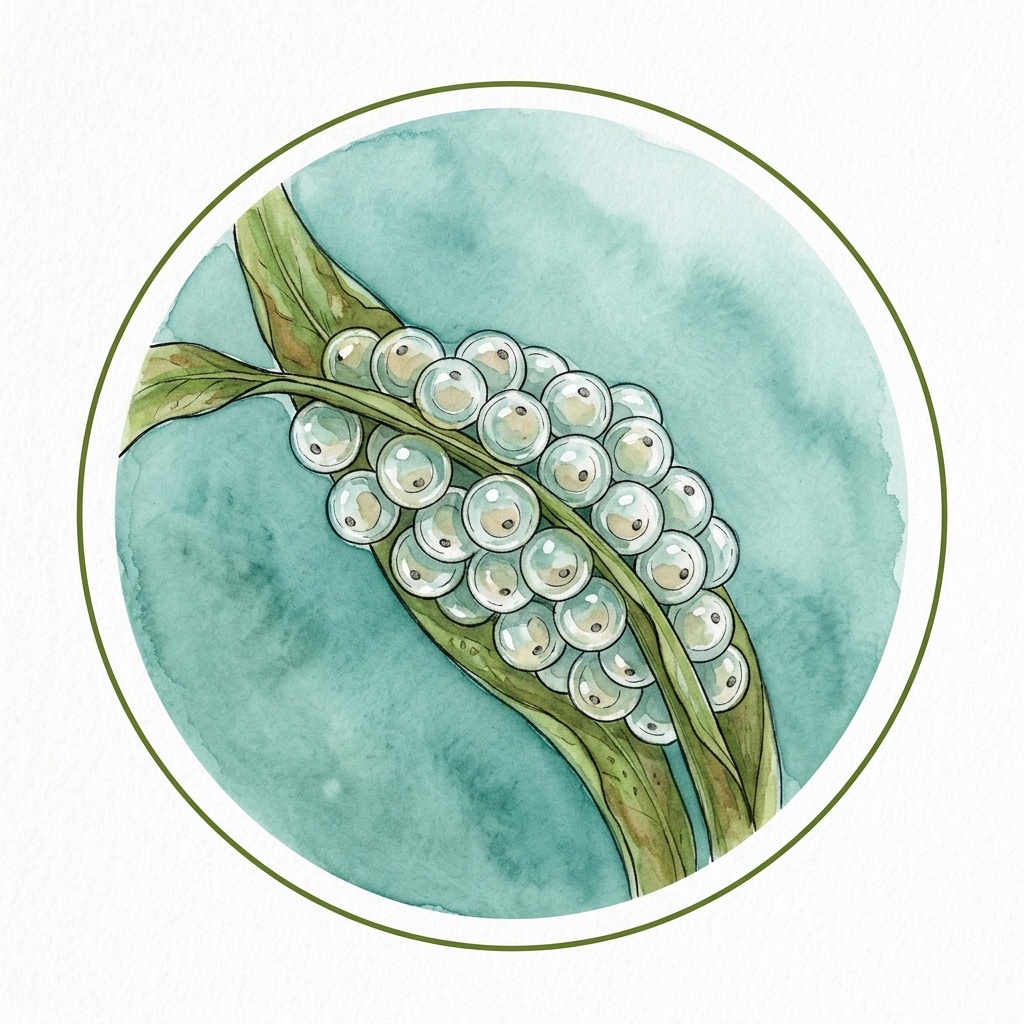
1,000–10,000 adhesive eggs scattered across spawning media
Day 3–7
Hatching
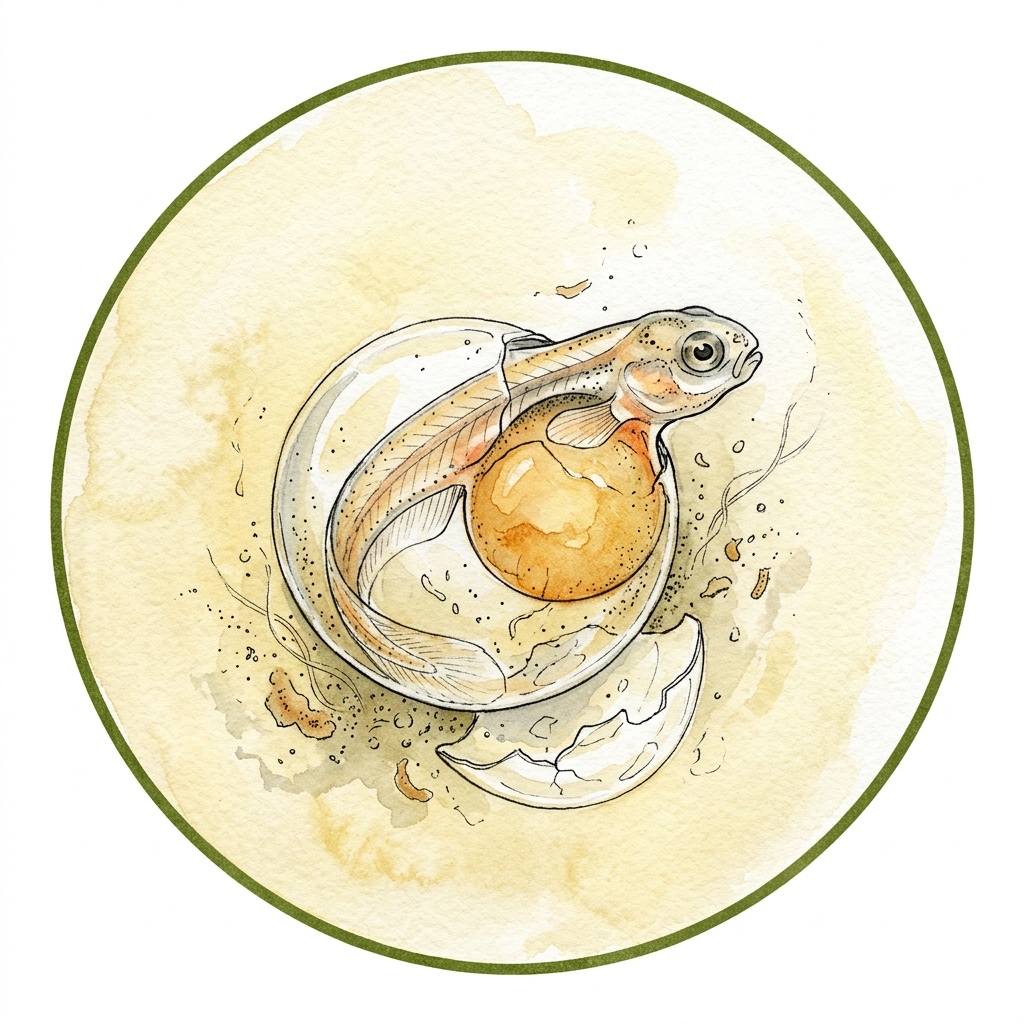
Fry emerge depending on temperature
Day 7 onward
Free-Swimming Fry
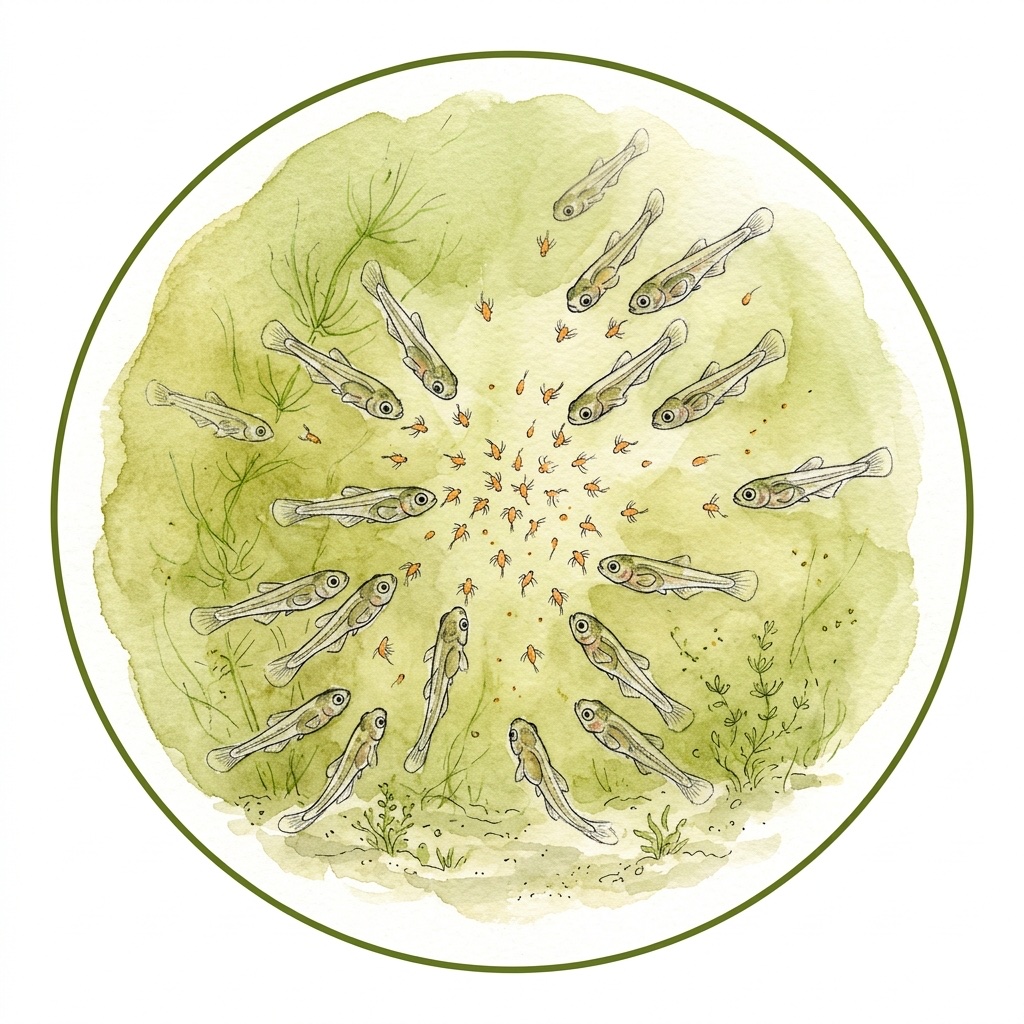
Begin feeding infusoria, then baby brine shrimp
Cooling Period
Ryukins, like all temperate goldfish, need a seasonal cool-down to trigger breeding the following spring. In an unheated indoor tank or outdoor pond in temperate climates, winter temperatures naturally drop to 10–15 °C. During this period, the fish eat little, become less active, and their reproductive systems prime for the coming breeding cycle. Reduce feeding to once every two or three days with a smaller wheat-germ-based winter food, and do not force warmth with a heater. The cool period is biologically essential — goldfish kept at constant warm temperatures year-round often never breed.
Conditioning
As spring water temperatures climb naturally from winter lows, gradually increase feeding frequency and variety. Offer protein-rich frozen bloodworms, daphnia, and chopped earthworms in addition to the pellet staple. Females rapidly fill with eggs and become visibly rounder from above. Males begin to show breeding tubercles on gill covers and pectoral fin leading edges. This conditioning phase typically lasts two to four weeks.
Spawning Trigger
When water temperature crosses roughly 20 °C in spring, males begin actively chasing gravid females, nudging them in the flanks and vent area. The chase is vigorous and often lasts several hours — do not mistake it for aggression, though you should make sure the tank has refuge spaces. Provide a spawning mop (bundled nylon yarn) or dense floating plant mass like hornwort or water sprite where the female can release eggs and they can stick safely.
Egg Release
A mature female Ryukin can release 1,000 to 10,000 eggs in a single spawning session, scattered across plants and spawning mops throughout the morning. The eggs are small, clear to pale yellow, and strongly adhesive — they stick to whatever they first touch. Remove the parents immediately once spawning is complete, as goldfish will eat their own eggs without hesitation. Alternatively, move the spawning mop with eggs to a separate hatching tank.
Hatching
Eggs hatch in three to seven days depending on temperature — warmer water accelerates development, but keep the hatching tank below 24 °C. Newly hatched fry are tiny, almost transparent, and spend their first 48 hours attached to glass or plants absorbing their yolk sacs. They do not need food yet. Infertile white eggs should be picked out with a pipette to prevent fungus spread.
Free-Swimming Fry
Once fry become free-swimming and begin actively foraging, feed infusoria or commercial liquid fry food for the first week. By week two, they can take freshly hatched baby brine shrimp and crushed flake. Growth is slow and development into recognisable Ryukin shape takes six months to a year — the characteristic hump only begins to appear around four to six months, and full adult body depth develops over two years. Cull aggressively for body shape: less than ten percent of fry will display the classic deep body and pronounced hump. Most commercial Ryukin breeders cull ruthlessly at three months, four months, and six months, keeping only the most promising body shapes at each stage and rehoming or humanely culling the rest. This is one reason quality Ryukins command a premium price — from a spawn of five thousand eggs, perhaps fifty will be worth keeping for another breeding generation, and only a dozen will reach show-quality standards. Colour development is separate from body development: calico patterns often do not show their final distribution until ten to twelve months of age, and patient breeders hold judgement on colour until the second summer. A calico Ryukin fry that looks drab at six months may bloom into a stunning tricolour adult by its second year — part of the slow reward of breeding these fish.
Quick Reference
| Scientific Name | Carassius auratus (Ryukin long-tail calico) |
| Common Name | Long Tailed Ryukin (Calico) |
| Adult Size | 15–20 cm body, up to 25 cm with long caudal |
| Lifespan | 10–15 years (20+ with excellent care) |
| pH | 7.0–8.4 (ideal 7.5) |
| Temperature | 18–24 °C (ideal 21 °C) — temperate, not tropical |
| Hardness | 8–20 dGH (hard water preferred) |
| Min Tank Size | 150 L per adult; +75 L per additional fish |
| Filtration | Heavy — 5–10x tank volume turnover per hour |
| Diet | Sinking pellet staple + blanched vegetables + occasional frozen food |
| Care Level | Intermediate — demanding on tank size and filtration |
| Temperament | Peaceful, slow-moving, sociable with own kind |
| Tank Position | All levels — mostly mid to bottom |
| Breeding | Egg scatterer — requires winter cool-down to trigger spring spawning |
| Price | $158 AUD |
Related Products

Reviews
Clear filtersThere are no reviews yet.