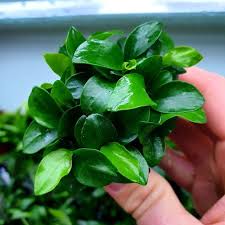
🪨 Species at a Glance
| Scientific Name | Anubias barteri var. nana ‘Petite’ |
| Common Name | Anubias Nana Petite, Petite Anubias, Bonsai Anubias |
| Family | Araceae (arum family) |
| Origin | Cultivar selected ex West African parent stock, Cameroon and Nigeria |
| Mature Height | 3-5 cm (1.2-2.0 in) |
| Leaf Size | 1-2 cm elliptical blades |
| Growth Rate | Very slow — one new leaf every three to six weeks |
| Light Requirement | Low to medium (30-60 PAR at leaf level) |
| CO2 Requirement | Not required; optional for slightly faster growth |
| Planting Method | Rhizome attachment to driftwood, rock, or mesh |
| Placement | Foreground to midground, shade tolerant |
| Difficulty | Beginner — arguably the easiest aquarium plant in existence |
Planting & Placement
Rhizome
Anubias barteri var. nana ‘Petite’ is an epiphyte in the aquarium, which means that unlike stem plants and carpeting species it does not root into substrate for anchorage or nutrition. Its thick, horizontal, pale-green to tan rhizome is the true stem of the plant, and it is from the rhizome that both leaves and a fine mat of white feeder roots emerge. The single most important cultural rule for this species — the rule that separates a thriving specimen from a slow-rotting one — is that the rhizome must never be buried in gravel, sand, aquasoil, or any other substrate. When the rhizome is covered it is cut off from oxygen exchange at its surface, bacterial activity builds up along the hidden portion of the tissue, and rot sets in within a matter of weeks. The plant will shed leaves, the rhizome will turn from firm pale green to soft mushy brown, and recovery from advanced rhizome rot is rarely possible. Every experienced aquarist has witnessed this mistake and it is responsible for the great majority of Anubias failures seen in the hobby.
The correct way to install a ‘Petite’ bunch is to first remove it from the plastic pot and rockwool plug it usually arrives in, teasing the rockwool away gently from the roots under a stream of dechlorinated water. Individual plantlets can then be separated where the rhizome has natural junctions — these are visible as narrow constrictions between growth fronts. Each plantlet or small cluster is attached to a piece of driftwood, lava rock, dragon stone, seiryu stone, or even a ceramic suction cup by one of three methods. Cotton thread works well for beginners because it decomposes harmlessly within four to six weeks, by which time the plant’s own roots will have gripped the hardscape surface. Dark-coloured cyanoacrylate superglue gel is the professional’s choice: a small dab on the underside of the rhizome, pressed firmly against the hardscape for ten seconds, creates an instant permanent bond and the glue is entirely inert once cured. Fine fishing line or thin nylon thread is a third option, though it must be removed later because it does not decompose. Each method has its place, and experienced aquarists often mix them depending on the specific hardscape piece and the desired permanence of the attachment.
Once attached, the plantlet should be oriented so that the rhizome lies flat or at a slight angle against the hardscape, with leaves pointing outward into the water column and feeder roots free to trail or burrow behind the hardscape where they wish. The plant can be installed upright on a vertical rock face, upside-down under a driftwood overhang, or tucked into crevices — all positions are viable because the rhizome determines orientation, not gravity. This three-dimensional placement freedom is one of the plant’s greatest aquascaping strengths, allowing Anubias to populate parts of the tank that no rooted plant could ever occupy. Within three to four weeks new white roots will extend out of the rhizome and begin gripping the hardscape surface, at which point the tie-down material can be removed if desired. From that moment the plant is permanently installed and will happily remain in the same spot for five, ten, or even fifteen years with no further intervention.
Common installation mistakes to avoid include: pushing the rhizome deep into the substrate in the belief that it needs rooting like a stem plant; using excessive amounts of superglue that drown the plant in cyanoacrylate and block leaf emergence points; attaching plants with leaves pointing downward into shadow where they cannot photosynthesise; and clustering plantlets so densely that the rhizomes rest on one another and develop contact rot. A clean, confident installation with one to three centimetres of breathing space between adjacent rhizomes and a clear orientation toward available light will pay dividends for the lifetime of the specimen.
Illumination Requirements
LOW LIGHT
PAR: 30-60 PAR at leaf level
High
Anubias barteri var. nana ‘Petite’ is among the most shade-tolerant plants in the aquarium hobby, a direct inheritance from its wild ancestors which grow along the forested banks of slow West African rivers and streams, often semi-submerged beneath a dense overhanging canopy that may filter out ninety percent or more of the incident sunlight. In aquarium terms this translates into a plant that is perfectly content under low-intensity LED lighting measuring as little as thirty PAR at the leaf surface, and that will happily live in the deep shade cast by larger plants, floating plants, or overhanging driftwood. The practical implication is liberating for the aquascaper: ‘Petite’ can be tucked into shadowed nooks where no other plant will grow, and used to decorate the undersides of driftwood branches, the backs of caves, and the gaps between stacked rocks where light barely penetrates. This shade tolerance is what makes Anubias the universal garnish plant of the aquarium hobby — there is almost no layout that cannot be improved by a strategically placed ‘Petite’ in one of its darker corners. Biotope aquarists working on blackwater tanks, where floating plants and dense surface vegetation block much of the overhead light, find ‘Petite’ one of very few plants that will actually grow vigorously under such dim conditions and thus one of very few genuinely authentic options for the shaded understory of a West African or Amazonian forest-stream reproduction.
The upper end of useful light intensity is roughly sixty to seventy PAR at the leaf surface. The plant itself will not refuse to grow above this level, and indeed growth rate does accelerate modestly as light increases toward eighty or ninety PAR, but the law of diminishing returns kicks in quickly and the problems begin to outweigh the benefits. Where things go wrong at high intensity is that Anubias leaves become a preferred substrate for green spot algae and, in particular, for the notorious black beard algae. The tough thick cuticle that makes Anubias leaves so durable also makes them very slow to shed algal colonists once established, so the leaves steadily accumulate algae, lose their glossy appearance, and within three to six months look unsightly enough that aquarists begin trimming them off. A plant that should last a decade can be reduced to a bare rhizome in a year if exposed to excessive light without careful algae management. This algae-susceptibility issue is the single most common complaint heard from aquarists who consider themselves to have had poor results with Anubias — almost invariably the root cause is either too much direct light or too low water flow, or both in combination.
The solution is either to site ‘Petite’ in the shadow of faster-growing plants, or to reduce overall light intensity and photoperiod if Anubias is to feature prominently in the layout. A daily photoperiod of eight to ten hours is appropriate in low-tech setups where CO2 is not injected and plant mass is modest, while high-tech tanks should keep photoperiod closer to six to seven hours to match the elevated growth demands of stem plants without pushing Anubias into an algae-prone regime. There is no need for a separate dimmer or siesta period — the plant does not benefit from it and the complexity is unwarranted. If you observe early signs of green spot algae appearing on Anubias leaves, the most reliable remedy is to physically reduce light at the plant’s specific location using a well-placed companion plant or a shift in position, rather than reducing whole-tank lighting and penalising the stem plants that actually need it. Another effective tactic is to introduce algae-grazing fauna such as Neocaridina shrimp, Amano shrimp, nerite snails, or small otocinclus catfish, all of which will graze the tough Anubias leaves without damaging them and will keep early algae colonisation in check before it becomes established. Under ideal light conditions ‘Petite’ produces deep saturated green leaves with a faintly waxy sheen, and any loss of this characteristic gloss in combination with surface film or fuzzy growth is the first warning sign that the lighting budget needs adjustment.
Recommended Photoperiod: 8-10 hours for low-tech tanks; 6-8 hours in high-light high-tech tanks
Feeding Your Plant: CO2 & Ferts
CO2 OPTIONAL
Pressurised CO2 injection is categorically not required to grow Anubias barteri var. nana ‘Petite’, and a great many successful long-term specimens live out their decade-long lives in tanks that have never seen a CO2 cylinder. The plant evolved to photosynthesise efficiently at the naturally low dissolved carbon concentrations found in slow-flowing rainforest streams, where CO2 levels at the plant surface are typically between two and six parts per million, and its thick cuticle and slow metabolism mean it does not require the accelerated carbon uptake that drives faster species. In a non-injected tank it will produce roughly one new leaf every four to six weeks, which is the baseline expectation for this cultivar in typical home aquarium conditions and which represents a perfectly healthy growth rate for a plant whose mature size is measured in single-digit centimetres. For hobbyists seeking a low-maintenance display that does not demand the pressurised CO2 hardware, automated dosing pumps, and constant parameter monitoring of high-tech planted tanks, ‘Petite’ is effectively the perfect plant: visually appealing, utterly undemanding, and content to sit on its hardscape for a decade at a time without complaint.
That said, ‘Petite’ responds measurably to supplemental carbon when it is available. A tank running pressurised CO2 to a concentration of twenty to thirty parts per million will push leaf production up to roughly one new leaf every two to three weeks, will produce slightly larger and glossier blades, and will occasionally encourage the plant to send up a cream-coloured spadix flower — a pleasant curiosity that does not indicate stress or dormancy and which can even produce viable seed under emersed conditions. In high-tech tanks ‘Petite’ also tends to develop a more intense leaf colouration with subtle bronze undertones that appear particularly attractive under warm-temperature LED lighting, and the overall plant form becomes more compact with shorter internodes between successive leaves. Liquid carbon supplements such as Seachem Excel or Easy-Life EasyCarbo are an acceptable middle-ground for aquarists who do not wish to run a pressurised system; dosed at manufacturer’s recommended rates they will produce a modest growth boost and, as a useful side effect, help suppress black beard algae on older leaves where it tends to be most problematic. Overdosing liquid carbon can damage Anubias, so dose conservatively and never exceed label directions — the plant tolerates liquid carbon better than most delicate species such as Vallisneria or Cabomba, but damage does occur at high concentrations and presents as rapid yellowing of older leaves followed by leaf drop within seven to ten days. If damage is observed, halve the dose or suspend dosing entirely for a fortnight and the plant usually recovers without lasting harm.
Fertilisation
Because it is an epiphyte and does not draw nutrients from substrate, Anubias ‘Petite’ depends entirely on water-column fertilisation for its nitrogen, phosphorus, potassium, and trace element supply. In a well-stocked community aquarium this demand is often fully met by fish waste and uneaten food, and many long-term specimens receive no supplementary fertiliser at all and grow perfectly well for years on end. The macronutrients released by fish metabolism — ammonia converted to nitrate by the nitrogen cycle, phosphate from uneaten flake food, and potassium leached from plant matter and fish pellets — accumulate in the water column between water changes at concentrations more than sufficient for a slow-growing rhizome plant. In leaner or lightly-stocked tanks, a weekly dose of a complete all-in-one liquid fertiliser such as Seachem Flourish Comprehensive, Tropica Specialised Nutrition, or a generic APT Complete at roughly half the manufacturer’s recommended rate will keep leaves a deep saturated green and encourage steady rhizome extension. The plant does not require the heavy EI-style dosing regimes beloved of high-tech Dutch aquarists and will actually grow slightly worse under such regimes due to elevated algae pressure on its slow-growing leaves, as excess nitrates and phosphates fuel green spot algae and green dust algae on the tough Anubias cuticle faster than the plant can outpace the colonisation.
Root tabs are entirely unnecessary for this species and should not be placed directly beneath a ‘Petite’ specimen — the concentrated nutrient pocket they create can encourage substrate anaerobic activity close to the rhizome, raising rot risk. If root tabs are being deployed in the tank for other rooted species, simply site them away from where Anubias is attached; a gap of five or more centimetres is entirely adequate. Iron-rich fertilisers are worth a small additional dose if leaves begin to pale or develop interveinal yellowing, though in practice this is rare because the plant’s demand is so modest; in hard alkaline water where iron availability is reduced, a dedicated iron supplement such as Seachem Flourish Iron used weekly at half-strength is a reasonable insurance policy and typically produces a visible deepening of leaf colour within two to three weeks of starting the regime. A potassium supplement is occasionally worthwhile if you observe pinhole perforations developing in older leaves, which is the classic potassium deficiency signature across aquatic plants and presents on Anubias as small circular holes in the leaf blade that gradually enlarge. Beyond these simple interventions, the fertilisation regime for ‘Petite’ is refreshingly forgiving and tolerates long periods of neglect without visible decline, a characteristic that makes it the ideal plant for the busy hobbyist or the traveller who cannot dose weekly on schedule. Missing a month of dosing will have no visible effect; missing six months will produce only a mild fade in leaf colour that reverses within weeks of resuming a normal regime.
Water Quality for Plants
6.0–7.8
ideal 6.8
22–28 °C
ideal 25 °C
3–15 dGH
Soft to moderately hard; tolerates harder water than most aquarium plants
The water parameter tolerance of Anubias barteri var. nana ‘Petite’ is one of the broadest in the aquatic plant world, which is the principal reason it features in so many otherwise unlikely tanks — from acidic Amazonian blackwater biotopes through neutral community tanks to mildly alkaline African Rift Lake cichlid setups, and from cool temperate low-tech tanks through hot tropical discus tanks. pH values between 6.0 and 7.8 are all well-tolerated, and although the plant shows a mild preference for slightly acidic to neutral water around pH 6.5 to 7.0, it grows perfectly well at pH 7.5 or higher. The species is unusual among aquarium plants in this alkaline tolerance, and alongside Vallisneria and a handful of cryptocorynes it is one of the very few plants that will grow in Lake Malawi and Lake Tanganyika mbuna tanks without chemical water softening, making it the go-to planting choice for hobbyists who want a touch of live greenery in an otherwise rock-only rift lake biotope. In blackwater tanks stained deep tea-brown by catappa leaves and driftwood, the dark glossy leaves of ‘Petite’ seem to glow against the tannin-rich backdrop, and the plant’s acid-water tolerance combined with its willingness to grow under the dimmer lighting favoured in such biotopes makes it almost the definitive blackwater plant.
Temperature tolerance is equally broad, from a cool twenty-two degrees Celsius up to a warm twenty-eight degrees Celsius, with a sweet spot around twenty-four to twenty-six. This range covers essentially every tropical community tank in existence, and ‘Petite’ has been reported to survive brief excursions outside these boundaries without permanent damage. It is however not a true cold-water plant and should not be kept long-term below twenty degrees Celsius, where metabolism slows to near-stasis and the plant becomes susceptible to fungal problems on its leaves. At the upper end, sustained temperatures above twenty-nine degrees combined with bright light will accelerate algae pressure and can cause older leaves to brown at their edges, but this is a nuisance rather than a threat to the plant’s survival. Discus keepers running their tanks at twenty-nine or thirty degrees Celsius report that ‘Petite’ continues to grow steadily at these elevated temperatures, though slightly smaller leaves and slower rhizome extension are typical, and the plant is one of the very few suitable for discus biotopes alongside Amazon sword plants and certain Echinodorus hybrids.
Hardness is a non-issue: the plant grows in soft water of three dGH as readily as in hard water of fifteen dGH, making it a safe choice regardless of local tap water chemistry. This broad hardness tolerance extends to a similar tolerance for carbonate hardness, so the plant is equally at home in low-KH aquasoil blackwater tanks and in high-KH limestone tanks. It also tolerates mild elevations in dissolved salts and is one of the very few aquarium plants that will survive in a low-end brackish aquarium at specific gravity up to roughly 1.005, though growth slows considerably in such conditions and the plant should not be considered a true brackish species. Tannins from driftwood, almond leaves, and peat extracts are entirely welcome and can even improve leaf colour modestly by shifting the plant’s chlorophyll balance toward a darker emerald tone that looks particularly rich under warm LED lighting. Chlorine and chloramine in untreated tap water will damage new leaves and can trigger partial leaf drop, so standard water dechlorination is essential during water changes as it is for any aquarium. Medications used to treat fish disease, particularly copper-based treatments for external parasites, should be used with caution around Anubias; while the plant tolerates therapeutic doses better than many sensitive species, copper above 0.5 ppm sustained for more than a week will cause leaf yellowing and eventual drop.
Caring for Your Plant
SLOW GROWTH
Anubias barteri var. nana ‘Petite’ grows very slowly even by the modest standards of the parent variety, and this slow pace is the central characteristic that governs how the plant should be used, bought, and appreciated. Under typical low-tech home aquarium conditions — moderate light, no CO2, occasional liquid fertilisation — the plant produces roughly one new leaf every four to six weeks, which means a healthy single plantlet might develop from three leaves to ten leaves over the course of a full year. Under high-tech conditions with pressurised CO2 and active fertilisation this rate accelerates to roughly one new leaf every two to three weeks, but even then ‘Petite’ will never approach the explosive growth of stem plants, carpet plants, or even its faster relatives such as Anubias barteri var. nana ‘Gold’ or Anubias coffeefolia. This slowness is not a deficiency but a design feature of the cultivar, carefully selected over generations of tissue culture propagation to produce the smallest and slowest-growing Anubias available in the hobby.
This slow growth is the plant’s single greatest practical virtue. It remains in scale with nano aquariums for years without trimming, it does not outcompete slower neighbours, and it keeps a carefully-designed aquascape looking exactly as designed for month after month. While a fast-growing stem plant like Rotala rotundifolia will need trimming every ten to fourteen days to stay in bounds, a ‘Petite’ specimen installed in a specific position will still look almost identical six months later, with perhaps two or three additional leaves added to its canopy. This makes it the ideal anchor plant for Iwagumi-style aquascapes and for minimalist nano tanks where the hardscape and the sparse planting are the visual focus.
Mature leaf size tops out at roughly one to two centimetres in length, making ‘Petite’ the smallest Anubias cultivar commonly available in the hobby and one of the smallest rhizome plants of any kind. A specimen plant reaches mature size with roughly ten to fifteen leaves clustered along three or four centimetres of branching rhizome; at this point the rhizome has often split naturally into two or three growth fronts, each tipped with a fresh leaf-producing apex. The overall plant footprint remains compact, rarely exceeding six centimetres in width and four centimetres in height even at full maturity, which is why ‘Petite’ features in nano contests down to pico-tank scale of five litres or less.
Maintenance requirements are correspondingly minimal. Old leaves will occasionally yellow, brown, or accumulate black beard algae; these can be snipped off cleanly at the rhizome using sharp scissors, leaving the rhizome itself entirely intact. Never cut into the rhizome — always leave the attachment node intact, because the rhizome cannot regrow across a significant cut and a damaged rhizome is an entry point for rot. Algae-affected leaves should be removed promptly rather than treated in situ, as BBA on Anubias is notoriously persistent and easier to eliminate by leaf removal than by spot treatment. The feeder roots occasionally grow into filter intakes or drift across the substrate — they can be trimmed back freely without harming the plant and the plant regrows them within weeks. Beyond these occasional trims, ‘Petite’ needs no maintenance whatsoever, and mature specimens can be left entirely untouched for six months at a time with no visible decline. This resilience is what makes the plant so popular in office aquariums and in aquariums kept by people who travel frequently. It is also the plant of choice for public display tanks in veterinary clinics, dentist’s offices, and corporate reception areas, where live plants must survive irregular maintenance schedules and occasional weeks of outright neglect between professional service visits.
One particular habit of mature ‘Petite’ specimens worth understanding is the tendency of the rhizome to branch into multiple growth axes as the plant matures, creating a small cluster of closely packed growth fronts each producing its own slow stream of new leaves. This branching behaviour is healthy and desirable and is what eventually allows the plant to be divided for propagation. A three-year-old specimen in good conditions will typically present three to five distinct growth apices clustered along five to seven centimetres of rhizome, and will carry twenty to thirty leaves in total — at which point the plant reads visually as a handsome miniature shrub rather than a single plantlet. Mature fish-safe specimens of this size command premium prices in the secondhand aquatic plant market for precisely this reason: they take years to grow and cannot be rushed, and a well-developed mature clump is effectively irreplaceable at any price less than several years of patient cultivation.
Inspect and prune old leaves
Every 4-6 weeks — snip yellowed, browned, or algae-affected leaves flush with the rhizome using sharp scissors. Never cut into the rhizome itself, which cannot regenerate across a significant cut.
Trim feeder roots
Every 2-3 months — trim back feeder roots that have grown into filter intakes, across substrate, or into neighbouring plants. The plant is unharmed by aggressive root pruning and quickly regrows them.
Algae wipe on mature leaves
Monthly — gently wipe green spot algae from healthy leaves using a soft cloth or your fingertip during water changes. Early intervention prevents algae from establishing a firm grip on the tough leaf cuticle.
Spot-treat persistent BBA
As needed — remove affected leaves entirely. Spot dosing with liquid carbon applied directly onto the BBA patch via a fine syringe during a water change is an alternative but less reliable treatment.
Relocate or divide specimen
Every 2-3 years — divide mature rhizome clumps to refresh the specimen and distribute daughter plants to new hardscape locations. This also prevents the parent from outgrowing its original display position.
Gentle rhizome clean
Every 6 months — use a soft brush to dislodge detritus accumulated on top of the rhizome, which can otherwise encourage localised algae or rot. Pay particular attention to the junction between rhizome and hardscape.
Reproduction & Division
Division
Propagation of Anubias barteri var. nana ‘Petite’ is straightforward and almost entirely failure-proof, which is useful because the slow growth rate of the species makes mature specimens quite valuable on the secondhand market and a single healthy mother plant can generate a steady supply of daughters over its lifetime. The method is rhizome division, and it works identically to the propagation of full-sized Anubias barteri, of Bucephalandra, and of the closely related genus Microsorum. A mature specimen develops visible junctions along its rhizome, points where the tissue narrows slightly and where a fresh growth apex has emerged alongside the parent axis. These natural division points are identified visually by examining the rhizome under good lighting — each junction usually sits at a slight angle and marks the boundary between two otherwise continuous rhizome sections.
The rhizome is cut cleanly through the narrow junction with a sterile razor blade or sharp scissors, ensuring each divided section retains at least three to four healthy leaves, an intact rhizome segment of one to two centimetres, and ideally some established feeder roots. Division can be performed with the plant still attached to its hardscape, by carefully working scissor blades between the two growth fronts, or by removing the entire specimen, dividing it on a working surface, and then re-attaching the daughters. The latter approach is gentler on the plant tissues and is recommended for large specimens or for dividing into more than two pieces. A clean cut heals quickly and the plant does not bleed or stress visibly — within an hour the cut surfaces have callused and the daughter plants are effectively independent.
The two or more resulting daughter plants are each re-attached to hardscape using cotton thread or cyanoacrylate gel exactly as for a fresh plantlet, and placed into the tank immediately. There is no recovery period, no acclimatisation, and no special care requirement — the daughter plants resume growth within two to four weeks and are indistinguishable from the mother plant within a year. A well-established mother plant can typically be divided every eighteen to twenty-four months, producing two to four daughter plants per division event, meaning a single purchased bunch can reasonably be expected to populate an entire small collection of nano tanks over the course of five to seven years. For aquarists running multiple tanks this is a meaningful hobby economy: a starter bunch of ‘Petite’ can pay for itself in daughter plants several times over.
Flowering occasionally occurs underwater and produces a pale cream spadix enclosed in a green-and-cream spathe; this is not a practical propagation route because seed development requires emersed conditions and hand pollination, and commercial propagation of this cultivar is almost entirely by tissue culture in specialist laboratories. The underwater flowers are a pleasant curiosity worth photographing but should be trimmed away before they decay, as decomposing flower tissue in the aquarium can trigger localised algae blooms and represents wasted energy the plant would otherwise put into leaf production.
For aquarists curious about the commercial side of Anubias propagation, it is worth knowing that virtually all ‘Petite’ sold in the hobby today originates from tissue culture laboratories in Denmark, the Netherlands, Sri Lanka, Singapore, and Vietnam, where meristematic tissue is cultured on nutrient agar under sterile conditions and then multiplied through many generations of vegetative division before being rooted into rockwool plugs and grown on emersed in greenhouses prior to shipping. This tissue-culture origin is why modern ‘Petite’ plantlets are remarkably free of snail eggs, algae, hydra, and planaria — all common hitchhikers on nursery-grown aquatic plants and all absent from properly produced tissue-cultured stock. Aquarists introducing tissue-cultured plants to a new tank can do so with confidence that they will not be importing pests, which is a significant practical advantage over traditional nursery-grown Anubias. The tradeoff is that tissue-cultured plants arrive in emersed form and must transition to submerged growth once installed, which typically involves the loss of the first few original leaves and replacement by underwater-adapted new growth over the first four to six weeks after planting. This transition is cosmetically unappealing but entirely harmless and should not be mistaken for plant failure — patience during the transition period is rewarded with a fully adapted underwater specimen within two months.
Aquascaping with This Plant
Midground
Anubias barteri var. nana ‘Petite’ is one of the most versatile plants in modern aquascaping and has earned a near-permanent place in the plant lists of Iwagumi, Nature Aquarium, Dutch-inspired, jungle, biotope, and paludarium style tanks alike. Its small scale makes it the natural choice for nano and pico aquariums from five to thirty litres, where a full-sized Anubias nana would overwhelm the hardscape but ‘Petite’ remains perfectly in proportion. Because it is attached to hardscape rather than rooted in substrate, the plant can be placed in positions that would be impossible for conventional rooted species — clinging to vertical rock faces, tucked under driftwood overhangs, attached to suction cups on the rear glass, or even glued to the undersides of crossing branches where leaves dangle downward into the water. This three-dimensional versatility is the plant’s signature aquascaping strength and the reason it appears in so many award-winning nano tanks at the IAPLC, the AGA, and other international contests. Competition aquascapers prize ‘Petite’ specifically because it allows them to dress hardscape with genuine living foliage at a scale where other options would look like miniature trees in a railway diorama — out of proportion and visually wrong.
Classical placement is in the midground, framing a focal rock or driftwood feature, where the dark glossy leaves provide a quiet contrast to the more active textures of mosses, bucephalandras, and stem plants. The leaves of ‘Petite’ catch and reflect light in a distinctive waxy way that differentiates them from both the matte surface of mosses and the translucent freshness of new stem plant growth, adding a subtle material contrast that enriches layouts visually even before planting composition is considered. Under side lighting the waxy cuticle produces small highlights that animate the leaves visually, and the overall effect is that a well-sited cluster of ‘Petite’ reads as a miniature shrub or bush — small in absolute terms but carrying the visual weight of a much larger feature. In smaller nano tanks ‘Petite’ can take over the foreground and serve as the primary ground-level feature, particularly when arranged in loose clusters along the front of a layout where its tiny leaves read as well-proportioned miniature foliage against the scale of the tank itself.
Grouping three to five plantlets on a single piece of hardscape creates a more convincing visual impression than scattering isolated specimens, and odd numbers look more natural than even following the classical Japanese aquascaping aesthetic of asymmetric rule-of-thirds composition. When grouping, vary the plantlet heights slightly and angle each one subtly differently so that the final arrangement reads as a natural colony rather than a regimented row. The leaves of individual plantlets should be allowed to gently overlap and interleave, creating a layered canopy effect that reads much more organically than a clipped hedge. ‘Petite’ pairs especially well with mosses — Christmas moss, flame moss, weeping moss — where the fine moss texture and the broader Anubias leaves create a pleasing foliage contrast, and it associates well with small bucephalandras, which share its epiphytic habit and low-light tolerance and can be attached to the same piece of hardscape for a harmonious arrangement. The famous Green Aqua and ADA layouts frequently combine ‘Petite’ with a single species of moss and a background of dwarf hairgrass or Monte Carlo carpet, a palette restraint that lets the hardscape speak and that has informed several decades of nature-aquarium style. In shaded biotopes it is effectively the only true plant that will thrive alongside botanicals and leaf litter, and in Rift Lake tanks it provides a splash of live green amid otherwise plantless rockwork, softening the harshness of the rock-only scape.
For large tanks over one hundred litres, ‘Petite’ should generally be used in clustered group plantings rather than as isolated specimens, because its small scale tends to get visually lost against a larger backdrop. A cluster of twenty or thirty plantlets across a driftwood structure reads powerfully at that scale, while three lone plantlets scattered across the same structure read as an afterthought. The cost of bulk plantings can be reduced considerably by sourcing tissue-cultured ‘Petite’ in one-two-grow pots or in bulk starter bags, and by dividing mature specimens aggressively over the first two years of the tank’s life to multiply the initial stock. In paludarium and ripariums where the tank has an above-water component, ‘Petite’ grows equally well emersed and often flowers more readily in this state, making it a genuine dual-habitat plant worth considering for semi-terrestrial displays. Emersed specimens develop slightly smaller but more densely packed leaves, and the rhizome often branches more freely when above water, producing bushier compact colonies that make attractive miniature terrarium plantings.
| Plant | Why | |
|---|---|---|
| 🌿 | Bucephalandra sp. | Shared epiphytic habit, low-light tolerance, and rhizome attachment method — can be attached to the same piece of driftwood for a harmonious grouping with complementary leaf shapes and colours. |
| 🌿 | Christmas Moss (Vesicularia montagnei) | Fine-textured moss provides a beautiful foliage contrast against the broader Anubias leaves, and both species thrive under identical low-light low-CO2 conditions without competing for resources. |
| 🌿 | Java Moss (Taxiphyllum barbieri) | Undemanding companion moss that drapes over hardscape and softens the visual edge where Anubias meets rock or wood, creating a natural mossy-rainforest feel. |
| 🌿 | Microsorum pteropus ‘Trident’ (Trident Java Fern) | Another rhizome epiphyte with a complementary upright leaf form; both share water parameter preferences and planting style, making them natural partners on the same piece of driftwood. |
| 🌿 | Cryptocoryne parva | Tiny rooted crypt that accepts low light and provides a substrate-level counterpoint to Anubias on hardscape, creating layered low-tech scapes with both rooted and epiphytic elements. |
| 🌿 | Bolbitis heudelotii (African Water Fern) | Shares Anubias’s West African origin, low-light preference, and epiphytic habit; its larger feathered fronds make an architectural companion to the tiny Anubias leaves in biotope-style layouts. |
Quick Reference
| Scientific Name | Anubias barteri var. nana ‘Petite’ |
| Light | Low (30-60 PAR) |
| CO2 | Not required |
| Growth Rate | Very slow (1 leaf / 4-6 weeks) |
| Mature Height | 3-5 cm |
| pH Range | 6.0-7.8 |
| Temperature | 22-28 degC |
| Hardness | 3-15 dGH |
| Planting Method | Rhizome attached to hardscape (never buried) |
| Placement | Foreground to midground |
| Propagation | Rhizome division |
| Difficulty | Beginner (arguably the easiest aquarium plant) |
Reviews
Clear filtersThere are no reviews yet.