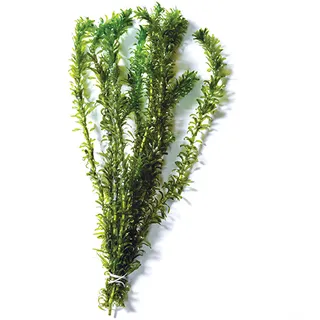
🪨 Species at a Glance
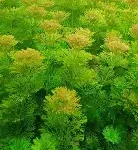
| Common Name | Elodea, Brazilian Waterweed, Egeria, Anacharis (all used interchangeably in the trade) |
| Scientific Name | Egeria densa (true Elodea is Elodea canadensis or E. nuttallii; names widely confused) |
| Family | Hydrocharitaceae (frogbit family) |
| Origin | South America — southeastern Brazil, Uruguay, Argentina; naturalised worldwide in temperate and warm-temperate waters |
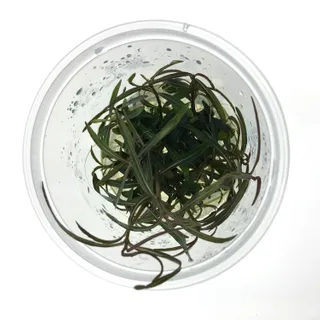
| Form Supplied | Loose bunch of bare stem cuttings, typically banded (NON-TC) |
| Planting Method | Stem — push cut ends into substrate, or let float freely |
| Light Level | Low to medium (low is adequate; medium accelerates growth) |
| CO2 | Not required — grows robustly without any supplemental carbon |
| Growth Rate | Very fast — one of the fastest-growing aquarium plants known |
| Temperature | 10-26 degrees C — exceptionally cold-hardy, suitable for unheated tanks and cool rooms |
| Propagation | Stem cuttings — every dropped cutting roots immediately at nodes |
| Difficulty | Beginner — arguably the most forgiving aquatic plant in the hobby |
Planting & Placement
Stem
Egeria densa is the classic loose-bunch stem plant of the aquarium hobby, and its planting method is correspondingly simple. Each bunch arrives as a cluster of cut stems, usually ten to fifteen centimetres long, held together with a small lead weight, rubber band, or foam collar around the base. The first step once the bunch is home is to remove that band entirely. Although it serves a useful purpose in transit — keeping the stems together and preventing them from drifting apart during shipping — if left in place in the aquarium the band crushes the lower stems, cuts off circulation, and quickly causes those bottom few centimetres of tissue to rot. Rot at the base of one stem will happily spread to the stems tightly bundled alongside it, so the entire bunch can be lost within a fortnight if the band is not removed. Simply cut the band with scissors and let the stems separate. You now have a small pile of individual cuttings, each of which is a complete, independent plant ready to grow.
Inspect each stem and use a sharp pair of aquascaping scissors to make a fresh, clean cut roughly one centimetre above the original cut end. This removes any crushed or air-exposed tissue at the base and exposes a fresh node, which is where new roots will emerge fastest. Strip the leaves from the bottom two to three centimetres of each stem by pinching them off between thumb and forefinger — these buried leaves would otherwise decompose once inserted into the substrate and feed nuisance bacteria at the plant’s base. Using aquascaping tweezers, push each prepared stem two to three centimetres deep into the substrate at a slight angle, spacing the stems roughly one to two centimetres apart so that each plant has breathing room as it puts on new foliage. Tight clustering is tempting for the instant full-tank look but leads to shaded lower leaves that yellow and drop within weeks; wider spacing produces healthier long-term plants that fill in naturally as each stem branches out from its growing tip.
An attractive alternative for this species is to skip substrate planting altogether and let the bunch float freely at the surface. Egeria densa is native to slow-moving waters where broken-off fragments routinely drift and continue to grow in rafts, and in the aquarium it will photosynthesise just as happily with its stems trailing horizontally beneath the surface as with its roots buried in substrate. Floating culture is in fact how many pond keepers grow the plant, and it is arguably the cleanest way to run Elodea in a fry-rearing tank or shrimp breeding tank where the dense tangle of stems creates superb cover for tiny livestock. Floating plants also receive the maximum possible light intensity, which translates directly into the fastest possible nutrient uptake from the water column — a genuinely useful property if you are using the plant as a biological filter in a freshly cycling tank or to counter nitrate build-up in a heavily stocked aquarium. The downside of floating culture is purely aesthetic: the plant looks less intentional than when neatly planted in the substrate, and the surface mat can shade plants below it.
A third option, particularly useful in aquascaped tanks with an inert sand or gravel base that makes stem planting awkward, is to weight a small bundle of stems with a fishing weight or ceramic plant anchor and simply lay it on the substrate. The stems will grow upward toward the light, send out roots that wander across the substrate surface, and develop into a healthy clump without ever being formally planted. This method is particularly popular in coldwater goldfish tanks where heavy substrate disturbance from foraging fish would uproot conventionally planted stems within hours.
Caring for Your Plant
FAST GROWTH
Egeria densa is, by general agreement among aquatic botanists and hobbyists alike, one of the fastest-growing aquarium plants in the entire hobby — and its growth rate is one of the defining features that made it so useful historically and so problematic as an invasive species in some regions. Under medium light with adequate water-column nutrients and no CO2 supplementation, a planted stem will elongate by eight to fifteen centimetres per week during active growth. Under medium to high light with some additional nutrients, elongation can exceed twenty centimetres per week, and under the full high-tech treatment (bright light, CO2 injection, EI dosing) growth can reach an almost comical twenty-five to thirty centimetres per week. This extraordinary growth rate has important practical consequences that every keeper needs to understand. First and foremost, the plant will rapidly outgrow any aquarium regardless of how large you planted the initial bunch. A ten-centimetre starter stem will reach the water surface of a standard forty-five centimetre tank within two to four weeks and begin growing horizontally along the surface, forming a dense surface mat that shades the tank below. Second, the plant demands regular trimming to maintain an attractive appearance and to prevent the lower stems from self-shading and rotting. Third, it will outcompete slower-growing plants for water-column nutrients, which is a feature when using it as a nitrate sponge but a bug when trying to establish a mixed planted layout.
The standard maintenance regime for Egeria is straightforward. Every two to four weeks, depending on growth rate, take aquascaping scissors and trim the tops off every stem roughly ten to fifteen centimetres below the growing tip. Lift the cut tops out of the tank with a net, and either replant them (they root immediately from any cut end) or discard them carefully in the kitchen bin — never rinse trimmings down the sink or flush them into any waterway, for reasons discussed in the Aquascaping chapter below. After trimming, the remaining lower stems will branch from nodes below the cut within a week, producing a denser, bushier regrowth than the original uncut single stem. Over two to three successive trims, a row of Egeria transforms from thin individual sticks into a lush dense thicket that carpets the back wall of the tank beautifully. The older, lower portions of stem that have been in place for several months will eventually lose their lower leaves regardless of how well the plant is maintained — this is normal stem-plant aging and not a problem with your setup. Pull up the oldest stems periodically and replace them with fresh cuttings from your trimmings to maintain long-term thicket health.
When stems grow past the water surface and begin to emerge as floating tips, the plant transitions to an emersed growth mode in which it produces smaller, paler, atmosphere-adapted leaves and, under sufficient light and stable conditions, may flower. Egeria densa flowers are small, three-petalled, white or very pale pink, and are borne on short stalks above the water surface on emergent stems — a charming oddity that many hobbyists enjoy but which has no practical significance in the aquarium. Emergent growth does not harm the plant, and in fact the larger leaf surface area above the water can boost overall photosynthetic output, but it is aesthetically untidy and most keepers trim emergent tips promptly.
Common growth problems with Egeria are almost always traceable to one of three causes: insufficient light (stems become thin, pale, and widely spaced), nutrient deficiency in a very lightly stocked tank (new growth pales, old leaves yellow and drop), or water temperature exceeding twenty-eight degrees (stems become brittle and the plant generally loses vigour). Each is correctable by adjusting the obvious variable. What Egeria almost never suffers from is disease, pest infestation, or genuine failure to thrive in well-maintained aquarium conditions — it is simply too tough, too opportunistic, and too chemically flexible to fail under anything short of gross neglect or extreme temperatures.
A specific long-term maintenance consideration worth highlighting is the accumulation of organic debris in the base of a dense Egeria thicket. Over months the oldest lower stems gradually decompose, detritus settles into the substrate at the base of the planted clump, and this accumulated organic load can cause localised anaerobic activity and substrate gassing. Every few months, pull up the oldest rearmost stems, siphon the loose debris from the base of the planting, and replace the pulled stems with fresh-cut tops from the canopy. This keeps the thicket vigorous and prevents the substrate zone from becoming stagnant. Think of it as tending a hedge rather than installing a permanent fixture: regular renewal from the trimmings is how this species maintains its appearance long-term.
Daily
Quick visual check for stems reaching the surface; observe colour and vigour of new growth; watch for any floating fragments that should be removed before they root in the substrate
Weekly
Perform a 25-30 percent water change; remove any loose leaves and debris from the substrate base of the clump; check that flow is reaching through the thicket
Every 2-4 Weeks
Trim stem tops back to the desired canopy height (10-15 cm below current tips); replant cut tops or carefully discard in bin; trimmed stems will branch and thicken within a week
Every 2-3 Months
Pull up the oldest rearmost stems that have begun to bare their lower sections; replant fresh-cut tops from recent trimmings as replacements; siphon any accumulated detritus from the base
As Needed
Promptly net and remove any broken fragments floating at the surface (each broken piece will root and grow if left in place); dispose of trimmings in the household bin only, never near waterways
Illumination Requirements
LOW LIGHT
PAR: 20-60 PAR at plant level (20-30 PAR sufficient for survival; 40-60 PAR optimal for vigorous growth)
High
Egeria densa is one of the least light-demanding stem plants in the aquarium hobby, a characteristic inherited from its native habitat in shaded, tannin-stained South American river margins and from the huge range of temperate pond environments into which it has been introduced around the world. It will grow adequately under almost any planted-tank light, including the modest LED strips that come bundled with beginner aquarium kits and the old-fashioned T8 fluorescent fixtures that still illuminate many school classroom tanks. Minimum useful light levels sit around twenty PAR at the plant’s canopy, which corresponds to a low-wattage generic LED on a 45 to 60 centimetre tank at standard water depth. At this light level the plant will survive comfortably, produce modest quantities of new growth, and exhibit the lanky, slightly pale green appearance typical of shade-grown aquatic plants. It will not refuse to grow and it will not die off — it simply ticks over slowly, which is perfectly acceptable for a beginner tank or a refuge tank where the plant’s role is primarily functional rather than decorative.
At medium light intensities of roughly forty to sixty PAR, Egeria densa comes into its own as a display plant. Leaves turn a richer, more saturated green, internodes shorten so the whorled foliage looks denser and more attractive, and growth rate climbs to perhaps ten to fifteen centimetres of stem elongation per week during active growth. Side shoots begin to branch from lower nodes, the overall plant form becomes bushier, and the aquarium reads as a fully planted environment rather than a collection of thin individual stems. This is the light regime used by most hobbyists who want the plant to serve both as biological filtration and as an attractive background or midground mass. Full-spectrum planted-tank LED fixtures such as the Fluval Plant 3.0, Nicrew ClassicLED Plus, Chihiros A-Series, or AquaSky LED all deliver this mid-range intensity without difficulty on tanks up to about forty-five centimetres deep.
Beyond sixty to seventy PAR the plant begins to reveal its cool-water origins. Under very high light — intensities that suit demanding carpet plants and red stem plants — Egeria densa actually grows too fast to maintain its appearance, pushing rapidly upward toward the surface, dropping lower leaves as the canopy shades them, and often developing algae-colonised older growth because it cannot consume water-column nutrients fast enough to outpace algae in the well-lit lower tank. Where a Rotala or Ludwigia species would reward the aquarist with intense red colouration under high light, Egeria simply shoots upward and becomes a maintenance burden. High-tech aquascapers generally do not use this plant in competitive-style layouts for precisely this reason: it outgrows itself and becomes untidy within days of a trim.
Photoperiod should be set at six to ten hours per day depending on the rest of the tank. Coldwater goldfish tanks and other low-tech setups do well at eight to ten hours, which gives the plant ample time to consume nitrogenous waste from a typical fish load. Moderately stocked planted community tanks with medium lighting should run six to eight hours to balance plant demand against algae pressure. Consistency matters more than absolute duration — set the photoperiod on a reliable digital timer and leave it alone rather than adjusting week to week. Signs that lighting is too intense for your setup include rapid upward stem elongation with widely spaced leaf whorls, floating fragments that have snapped off near the substrate because the lower stem has rotted in shadow, and conspicuous algae on older basal leaves. The fix in every case is to reduce either intensity or duration; Egeria is patient and quickly recovers.
Recommended Photoperiod: 8-10 hours per day in low-tech coldwater tanks; 6-8 hours in medium-light planted community tanks
Feeding Your Plant: CO2 & Ferts
CO2 OPTIONAL
Pressurised CO2 injection is categorically not required for Egeria densa and offers only modest benefits that are usually outweighed by the drawbacks. The plant is a remarkably efficient opportunistic photosynthesiser and has evolved a biochemical trick unusual among aquatic plants: under conditions where dissolved CO2 runs low, it can switch to harvesting bicarbonate ions directly from the water, a mode of carbon uptake that most aquarium plants cannot access. This alternative carbon source is why Egeria thrives in hard alkaline water where other stem plants falter from carbon starvation, and why it has been recommended for a century as the ideal plant for unmodified tap water tanks that have not been softened or CO2-injected. In practical terms this means a typical home aquarium running with no CO2 hardware at all will support robust Egeria growth purely on the trace dissolved CO2 generated by fish respiration, bacterial decomposition of organic matter, and atmospheric diffusion at the water surface. Add a modest fish load and a weekly water change regime and the plant has all the carbon it will ever use.
For hobbyists who run injected CO2 systems primarily for other plants, Egeria will of course respond with somewhat faster growth — perhaps fifteen to twenty centimetres of weekly elongation rather than ten — but the plant simply does not need it and the acceleration is usually unwelcome given how fast the baseline growth already runs. Liquid carbon supplements such as Seachem Flourish Excel or Easy-Life EasyCarbo are a more interesting case. At manufacturer-recommended doses Egeria tolerates glutaraldehyde-based liquid carbon products without issue and will grow slightly faster when it is present. At elevated doses, however, this species — like its cousin Vallisneria — can suffer damage from glutaraldehyde, with older leaves yellowing and stems becoming brittle within a week of dosing above label rate. If you keep both Egeria and delicate liquid-carbon-sensitive species such as Vallisneria, Cabomba, or Riccia, err on the low-dose side of the label range.
The practical guidance for most keepers is therefore to skip the carbon question entirely. Egeria densa will do its job as an oxygenator, nitrate reducer, shrimp refuge, and decorative mass without any supplemental carbon at all, which is exactly why it became the default pond and classroom plant in the first place.
Fertilisation
Fertilisation for Egeria densa is almost as optional as CO2 supplementation. The plant is a prolific water-column feeder, drawing nutrients directly through the surfaces of its stems and leaves rather than relying on its modest root system, which means the ambient nutrient level of your aquarium water is effectively the plant’s food supply. In a well-stocked community tank the nitrogen cycle alone delivers more than enough nitrate, phosphate, and potassium to support vigorous growth, and the plant is so effective at consuming these nutrients that it is frequently recommended specifically as a nitrate-reduction tool in tanks struggling with elevated nitrate from heavy fish loads. Goldfish keepers in particular have relied on Elodea for generations to soak up the prodigious ammonia and nitrate output of their bioload-heavy fish, and many a goldfish tank running with no other filtration than an air-driven sponge filter has maintained crystal water chemistry simply because of a thriving Elodea thicket.
In leaner setups — lightly stocked display tanks, shrimp-only breeders, and planted aquascapes where careful dosing is the norm — a modest weekly addition of a complete all-in-one liquid fertiliser such as Seachem Flourish, Tropica Specialised Nutrition, APT Complete, or a generic aquarium plant food will keep the plant vibrantly green and maintain growth rate. Dose at the manufacturer’s recommended rate or slightly below; Egeria does not benefit from heavy EI-style dosing and simply produces longer, lankier stems rather than denser foliage when over-fertilised. Trace-element deficiencies are uncommon in this species but can appear as pale new growth (iron deficiency) or pinhole leaf perforations (potassium deficiency); both are correctable with targeted supplementation of Seachem Flourish Iron or a potassium-sulphate product respectively, though in practice most keepers never see either problem.
Because Egeria is an efficient nutrient sponge it will compete successfully with algae for water-column nitrate and phosphate when grown in sufficient mass, which is one reason it is often suggested as a companion plant for tanks that have struggled with green water or other algae outbreaks. A dense thicket of fast-growing Egeria can turn a green-water bloom clear within two to three weeks by consuming the dissolved nutrients the algae are feeding on. This filter-plant function is most effective when the Egeria mass represents at least ten to twenty percent of tank volume and when it is positioned in the best-lit zone to maximise photosynthetic rate. Root tabs are entirely unnecessary for this species and should not be placed near it; the modest root system cannot make meaningful use of concentrated substrate nutrients and the elevated ammonia near a dissolving tab can actually harm the plant’s base.
Water Quality for Plants
6.0–8.0
ideal 7.0
10–26 °C
ideal 20 °C
3–20 dGH
Soft to very hard — one of the most hardness-tolerant aquarium plants available
Egeria densa is one of the most parameter-tolerant plants in the entire aquarium hobby, a direct result of its aggressive pioneer ecology and its remarkable success as an invasive species on every inhabited continent except Antarctica. It thrives across a pH range from mildly acidic (around 6.0) to distinctly alkaline (around 8.0), with the sweet spot sitting right around neutral pH 7.0 where most community tap water naturally sits once CO2 has outgassed to equilibrium. Soft-water keepers running reverse-osmosis or rainwater-based tanks at pH 6.2 will see vigorous Egeria growth just as readily as hard-water keepers running unfiltered tap at pH 7.8. The plant is equally indifferent to water hardness, tolerating three dGH up to twenty dGH with no meaningful change in growth rate or leaf colour, which makes it one of very few aquarium plants genuinely at home in hard-water tanks stocked with livebearers, African Rift Lake cichlids, goldfish, or similar hard-water-loving fauna.
Temperature tolerance is where Egeria densa really sets itself apart from most other aquarium stem plants and where its enormous value as a coldwater species becomes evident. The plant tolerates temperatures from ten degrees Celsius up to twenty-six degrees, with optimum growth around eighteen to twenty-two degrees — a temperate range that perfectly matches unheated indoor aquariums, coldwater fancy-goldfish setups, and outdoor ornamental ponds in temperate climates including much of southern Australia. This cold tolerance is remarkable among aquarium stem plants, nearly all of which are tropical species requiring twenty-four degrees or more to grow adequately. Egeria is in fact a superior choice for the vast population of Australian hobbyists who keep unheated goldfish, white cloud mountain minnow, or native rainbowfish tanks, because many of the standard tropical stem plants simply stall or slowly melt at the cooler temperatures such tanks maintain. For outdoor ponds, Egeria is a classical oxygenator species: it releases substantial quantities of dissolved oxygen during daylight photosynthesis, which supports fish and insect life through warm weather when oxygen solubility drops.
Above twenty-six degrees the plant begins to lose vigour; it continues to grow but shows symptoms of heat stress including accelerated leaf drop, brittle stems, and reduced side-shoot branching. Sustained temperatures above twenty-eight degrees will kill the plant within weeks. This is why Egeria is not a great choice for discus tanks, warm-tropical community tanks running at twenty-seven or twenty-eight degrees, or Asian blackwater biotope tanks kept at elevated temperatures. Hobbyists wanting a similarly easy, fast-growing background plant for warmer tropical tanks should look instead at Hygrophila polysperma, Ludwigia repens, or Cabomba caroliniana, all of which handle twenty-eight degrees without complaint while still filling the same oxygenator and refuge roles. Conversely, if your concern is the opposite — an unheated winter tank that drops to twelve or thirteen degrees — Egeria will simply slow its growth to a crawl and wait for warmer months to resume vigorous elongation, still delivering oxygen and shelter throughout the cold period.
Water changes benefit Egeria as they benefit most aquarium plants, but the plant is tolerant of irregular maintenance schedules and will continue to grow through long stretches of missed water changes by simply consuming accumulated nitrate and phosphate faster than they build up. A weekly 25 to 30 percent water change is ideal; monthly changes are tolerable; and some of the most famous classroom tanks and goldfish breeding tubs have run for months between changes with nothing but a dense Egeria thicket keeping the water chemically stable. This resilience is exactly why the species became the default aquatic plant for educational use, backyard ponds, and beginner aquariums more than a century ago.
Reproduction & Division
Cuttings
Propagation of Egeria densa is so effortless that the plant essentially propagates itself whether you want it to or not. Every cut or broken stem, from any part of the plant, from a tiny two-centimetre node fragment to a thirty-centimetre full cutting, will root and grow into a new independent plant given nothing more than water and light. This extreme propagation vigour is the biological trait that has made the species one of the most successful aquatic invaders on the planet and the reason it merits the disposal cautions discussed later in this guide. In the aquarium setting, however, this same trait is a gift to the hobbyist: you can produce an unlimited supply of new stems simply by trimming the plant you already have.
The standard propagation technique is trivial. When performing a regular trim, instead of discarding the cut tops, take each ten to fifteen centimetre length, strip the leaves from the bottom two to three centimetres, and push the bare end into the substrate two to three centimetres deep. Within two to four days, fine white rootlets will emerge from the submerged nodes and begin to anchor the cutting in place. Within a week the cutting is a fully rooted independent plant, indistinguishable in behaviour from the original parent stem. A single bunch purchased from this store can, within three months of home cultivation, be multiplied into forty or fifty individual stems with zero specialised equipment or technique. For hobbyists stocking a new large tank, this makes Egeria an exceptionally economical way to establish a substantial planted background using just one or two starter bunches.
A charming quirk of Egeria propagation is that even fragments that never touch substrate will still grow perfectly well. A stem broken off during substrate maintenance and left floating at the surface will root into the water column itself within a week, producing long trailing roots that hang down from the floating stem and absorb nutrients directly from the water. These floating plants can be caught up in a net whenever convenient and either replanted or disposed of, but the spectacle of a newly independent floating plantlet developing its own root system in midwater is an appealing demonstration of aquatic plant biology that many aquarists enjoy showing to children or curious visitors. Schoolroom biology experiments have used Egeria for precisely this purpose for more than a century.
For hobbyists seeking to propagate specifically in order to trade or gift stems to other keepers, the best stems to cut are the youngest, most vigorous top sections from actively growing plants. These cuttings root fastest, establish in the recipient’s tank most quickly, and are most likely to survive the stress of being shipped or transported in a plastic bag to a fellow hobbyist. Older bottom sections will also root but take longer to establish and are more prone to shedding leaves during the transition. When gifting or trading Egeria, be absolutely scrupulous about making sure the recipient knows the species name, understands the disposal-caution rules discussed in the final chapter of this guide, and commits to never releasing the plant into any waterway under any circumstances.
Aquascaping with This Plant
Background
In aquascaping terms, Egeria densa is a classic background plant — the tall, rear-wall mass that forms the visual boundary of the layout and frames the more finely detailed midground and foreground elements. Plant it in a row along the back glass of the tank, with stems spaced one to two centimetres apart, and within four to six weeks you will have a lush green curtain that reads as a genuine thicket rather than a loose collection of stems. Over time, as each stem branches and the thicket fills in, the row becomes a dense, attractive, deep-green wall that hides filter intakes, heaters, and other aquarium hardware while providing a rich visual backdrop for fish to school against. For larger tanks, particularly the long shallow coldwater goldfish tanks that benefit most from this plant’s cool-water tolerance, a double row of Egeria along the back wall creates a lush pondlike thicket that echoes the species’ natural habitat of pond margins and slow stream edges.
Beyond its decorative role, Egeria serves several functional aquascaping roles that many competitive-style layouts overlook. First, it is a superb oxygenator. Because of its very high photosynthetic rate, a well-lit Egeria mass releases substantial quantities of dissolved oxygen into the water column during daylight hours — enough to visibly pearl under good conditions, with tiny oxygen bubbles streaming upward from the leaf surfaces during peak photosynthesis. This oxygen production is why pond keepers have used Egeria (and its close relatives the true Elodeas) as the default pond oxygenator for more than a century, and why it is invaluable in heavily stocked goldfish tanks where oxygen demand runs high. Second, it is a premium refuge plant for shrimp and fry. The dense tangle of fine-textured whorled leaves creates countless microhabitats where newly hatched shrimplets, newly born livebearer fry, or egg-scattered fish eggs can hide from predators. Neocaridina shrimp colonies in particular do exceptionally well in tanks featuring a thick Egeria mass — the shrimplets cling to the stems and graze on the biofilm that forms on the leaf surfaces, and a single established Egeria thicket can support a breeding colony of hundreds of shrimp with essentially no direct human intervention beyond basic water chemistry management.
Third, Egeria is a nitrate sponge of almost unrivalled power in the freshwater plant world. A dense mass of actively growing stems will consume nitrate at rates that measurably reduce nitrate accumulation in heavily stocked tanks, which is why it is so often recommended for goldfish tanks, African cichlid tanks with relaxed hardscape, and other scenarios where fish bioload is high relative to the aquarium volume. This combination of oxygen production and nitrate consumption makes the plant a genuine biological-filtration partner rather than merely a decorative element. Many successful low-tech aquariums owe their long-term stability specifically to a thriving Egeria mass that balances the ammonia-nitrate-oxygen equation without the keeper needing to think actively about it.
For design, think carefully about scale and pairing. Egeria’s fine whorled texture contrasts beautifully with broad-leaved midground plants such as Echinodorus species (swords), Cryptocoryne wendtii, or Anubias barteri attached to driftwood. It pairs particularly well with dense floating plants such as Amazon frogbit or water lettuce, which further shade the tank, reduce algae pressure on the Egeria’s older lower leaves, and create the sort of multi-layered planted environment that invertebrates and small fish find most habitable. Livestock pairings that work particularly well in Egeria-heavy tanks include coldwater species such as common goldfish, fancy goldfish, white cloud mountain minnows, rosy red minnows, and native rainbowfish; temperate community species such as zebra danios, gold barbs, and paradise fish; and warm-temperate to lower-tropical community species such as platies, swordtails, guppies, and mollies. The dense shrub-like form of a mature Egeria planting is not well suited to aggressive substrate-digging fish such as large cichlids or clown loaches, which will uproot the stems faster than they can re-anchor.
A CRITICAL AND LEGALLY IMPORTANT NOTE FOR AUSTRALIAN KEEPERS: Egeria densa is a declared invasive aquatic weed in significant parts of Australia, including listed status under various biosecurity and noxious-weed legislation in Victoria, New South Wales, and Western Australia, and it is subject to movement and sale restrictions in some states. The reason for its invasive classification is directly tied to the same traits that make it such an effective aquarium plant: extreme growth rate, effortless propagation from any fragment, tolerance of temperate Australian water conditions, and aggressive competition for nutrients with native aquatic flora. Once established in a natural waterway, Egeria can completely dominate the aquatic plant community, blocking navigation, reducing native biodiversity, and causing catastrophic oxygen crashes when large mats decompose in late summer. For this reason every single piece of plant material you bring into your aquarium must be managed with the absolute rule that NOT ONE FRAGMENT MAY EVER REACH A NATURAL WATERWAY OR MUNICIPAL WATER SYSTEM. This means: never rinse the plant, its water, or any trimmings into a sink, toilet, stormwater drain, creek, river, pond, lake, or dam. Never dispose of trimmings in garden compost where runoff during rain can carry fragments to nearby waterways. Never release surplus plant to a pond, natural water body, or even a garden water feature that could overflow during flooding. Trimmings must be wrapped in newspaper, sealed in a plastic bag, dried out thoroughly, and placed in general rubbish destined for landfill. Any water poured off during tank maintenance must be disposed of down the household drain into the sewerage system, where it will be processed through sewage treatment rather than released to waterways. Hobbyists moving house or ending an aquarium hobby should double-bag all plant material for landfill disposal rather than attempting to rehome it casually. Keep the plant only in sealed, indoor aquaria — never in outdoor ponds in Australia regardless of state, because even indoor aquaria that drain to outdoor ground can release fragments during cleanup operations. This plant is an outstanding aquarium species and a genuinely excellent oxygenator for indoor tanks, but the responsibility of keeping it lies squarely with the keeper to ensure it never escapes into the Australian environment where it can cause severe ecological damage. If you are uncertain about state-specific regulations in your jurisdiction, check with your state biosecurity authority or primary industries department before purchase; in some specific local areas sale or possession may be restricted or prohibited outright and this store cannot supply to those areas.
| Plant | Why | |
|---|---|---|
| 🌿 | Hornwort (Ceratophyllum demersum) | Another fast-growing oxygenator and nitrate sponge with similar coldwater tolerance; creates layered background texture alongside Egeria and shares the same shrimp-refuge function |
| 🌿 | Amazon Frogbit (Limnobium laevigatum) | Floating plant that shades the tank from above, reducing algae pressure on Egeria’s lower leaves and adding multi-layered habitat complexity for fry and shrimp |
| 🌿 | Anubias barteri var. nana ‘Petite’ | Slow-growing rhizome plant attached to hardscape in the midground; contrasts Egeria’s fine texture with broad glossy leaves and shares the same undemanding care profile |
| 🌿 | Cryptocoryne wendtii | Slow-growing rosette midground plant tolerant of the same low-light, no-CO2 conditions Egeria prefers; broad leaves provide excellent textural contrast |
| 🌿 | Java Fern (Microsorum pteropus) | Epiphytic rhizome plant for the midground attached to driftwood; shares Egeria’s forgiving low-light profile and adds structural variety to the layout |
| 🌿 | Java Moss (Taxiphyllum barbieri) | Foreground and hardscape-attached moss; loves the same cool-to-temperate water Egeria prefers and provides additional refuge habitat for shrimp and fry alongside the Egeria thicket |
Quick Reference
| Scientific Name | Egeria densa (sold as Elodea) |
| Common Name | Elodea / Brazilian Waterweed / Anacharis |
| Light | Low to medium (low sufficient) |
| CO2 | Not required |
| Growth Rate | Very fast — trim every 2-4 weeks |
| pH | 6.0-8.0 |
| Temperature | 10-26 degrees C (cold-hardy) |
| Hardness | 3-20 dGH |
| Placement | Background mass / oxygenator / floating |
| Propagation | Stem cuttings — roots at every node |
| Difficulty | Beginner — extremely forgiving |
| AU Biosecurity | DECLARED INVASIVE WEED in parts of VIC/NSW/WA — never release to waterways, dispose in bin not compost |
Reviews
Clear filtersThere are no reviews yet.