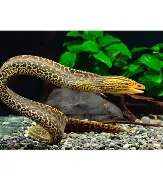
🪨 Species at a Glance
| Scientific Name | Gymnothorax polyuranodon / Gymnothorax tile |
| Family | Muraenidae |
| Order | Anguilliformes |
| Origin | Indo-Pacific estuaries, mangroves and lower river reaches — India, SE Asia, northern Australia, PNG, Melanesia |
| Adult Size | 60-100 cm (24-40 in); polyuranodon up to 150 cm in the wild |
| Lifespan | 10-20 years in well-managed brackish systems |
| pH Range | 7.5-8.2 |
| Temperature | 24-28 degC (75-82 degF) |
| Hardness (dGH) | 12-20 (hard, mineralised) |
| Specific Gravity | 1.005-1.015 (brackish — NOT freshwater long-term) |
| Diet | Strict carnivore — fish fillet, prawn, mussel, squid, crab |
| Minimum Tank Size | 500 L (130 gal); 750 L+ strongly preferred |
| Care Level | Advanced |
| Temperament | Predatory, nocturnal, will eat any tank mate that fits its gape |
| Breeding | Effectively never bred in captivity — marine larval stage |
| Tank Position | Bottom / cave-dwelling |
Species Background
The genus name *Gymnothorax* comes from the Greek *gymnos* (naked) and *thorax* (chest), a nod to the fact that moray eels lack the pectoral and pelvic fins you see on ordinary fish — their bodies really do look bare-chested and serpentine. The species epithet *polyuranodon* breaks down as *poly* (many), *ouranos* (roof or palate) and *odon* (tooth), literally ‘many palate teeth’, because a second set of pharyngeal jaws lives in the roof of the mouth and drags swallowed prey down the throat. *Gymnothorax tile*, meanwhile, takes its name from the Bengali vernacular *tila*, used for these eels in the Ganges delta where they are commonly caught in fish traps. Put together, the scientific names paint a brutally accurate picture: a tooth-lined, long-bodied ambush predator known to the people who have fished alongside it for centuries.
The common name ‘Freshwater Tiger Moray’ is where trouble starts. Both species do appear in the lower, less salty reaches of tropical rivers, and juveniles are often trapped many kilometres inland in truly fresh water. Exporters collect them there, ship them there, and retailers quite naturally list them as freshwater fish. The problem is physiological: while a juvenile Gymnothorax can survive fresh water for weeks or even months, adult specimens kept in pure freshwater steadily develop osmoregulatory stress, skin ulcers, bacterial infections around the vent, loss of appetite and eventual organ failure. In every serious long-term report, specimens kept in brackish at SG 1.005-1.015 live dramatically longer and healthier lives than freshwater-only specimens. The ‘tiger’ half of the name refers to the black-on-yellow barring of *G. polyuranodon* — the colour form most people picture when they hear the trade name.
The pharyngeal jaws mentioned in the etymology deserve special note because they are genuinely unusual among vertebrates. Most bony fish use suction to draw prey into the mouth, expanding the buccal cavity like a rapid bellows. Morays cannot do this effectively — their tubular skulls do not flex enough. Instead, they evolved a second set of toothed jaws deep in the throat that shoots forward when the front jaws close on prey, seizes the struggling animal, and retracts, ratcheting the meal down the oesophagus. This is the same mechanism famously described in the 2007 *Nature* paper by Rita Mehta and Peter Wainwright, and it is the anatomy hinted at in the name *polyuranodon*. It is also one of several reasons we insist you never hand-feed: even if you pull your finger back from the front teeth, the pharyngeal jaws can latch on and make the bite extraordinarily difficult to release.
For the sake of clarity, this guide will use ‘Freshwater Tiger Moray’ as the accepted retail name, but please read it with mental quote marks. Everywhere in this document where water chemistry is discussed, the honest answer is: keep them brackish. The single most important thing a prospective keeper can do is unlearn the ‘freshwater’ in the retail name before the fish arrives. Every decision that follows — tank glass, filter media, substrate, tank-mate choice, long-term disease treatment — flows from whether you accepted that single reality up front. Retailers will not correct you. The hobbyist forums will argue with you. The label on the box will say ‘freshwater’. Believe the physiology, not the label.
Sexual Dimorphism
The honest answer is that Freshwater Tiger Morays are functionally monomorphic to the aquarist’s eye. No reliable external sexual dimorphism has been published for either Gymnothorax polyuranodon or Gymnothorax tile, and the few studies that have looked hard have had to rely on gonad dissection rather than any visible cue. Some keepers report that a gravid female (in marine research facilities, never home aquaria) may appear very slightly fuller behind the vent in the lead-up to spawning, but this is subtle, inconsistent, and overlaps entirely with a well-fed specimen of either sex. For practical purposes, treat the sex of your moray as unknowable. The good news is that this is an animal almost nobody is attempting to breed at home, so the question rarely matters — stocking decisions, cave count and diet are identical regardless of sex.
The lack of dimorphism has a biological explanation worth understanding. Most fish with strong sexual dimorphism invest heavily in mate selection displays — bright male colours, fin elongation, nest-building behaviour, territorial defence. Morays do none of this. They are solitary cave predators that encounter conspecifics only rarely and only briefly, usually during the offshore spawning migration. In evolutionary terms, there has been no pressure to evolve visible signals that a potential partner could use to assess fitness; the entire reproductive strategy relies on timing and location rather than courtship. Add to that the fact that several moray species are protogynous hermaphrodites (females that can change to males as they grow), and the idea of a clean male/female diagnostic fades entirely. Gymnothorax polyuranodon has not been confirmed as a sex-changer in published literature, but the possibility exists and is another reason home-aquarium ‘pair bonding’ claims should be treated with heavy scepticism.
If you genuinely need to know the sex of a specific specimen — for a research project, say — the only reliable route is laparoscopic or ultrasound examination by a vet familiar with eel anatomy, and even then results are only trustworthy in fully mature adults. For the home aquarist keeping a single moray as a centrepiece animal, none of this matters. Choose the specimen with the best body condition, clearest skin, clearest eyes, and most alert response to movement. Its sex is effectively irrelevant to its care.
| Feature | Male | Female |
|---|---|---|
| External Appearance | Indistinguishable from female | Indistinguishable from male |
| Body Shape | No reliable difference | No reliable difference |
| Head Profile | No reliable difference | No reliable difference |
| Colour Intensity | No reliable sexual dichromatism reported | No reliable sexual dichromatism reported |
| Size at Maturity | Similar to female within population | Similar to male within population |
| Behaviour | No reliable behavioural difference in captivity | No reliable behavioural difference in captivity |
| Vent Appearance | Marginally slimmer in some reports — not diagnostic | Marginally plumper when gravid — not diagnostic |
The Colour Spectrum
🟡 Gymnothorax polyuranodon — True Tiger Moray
Bright canary to mustard-yellow body heavily splashed with irregular jet-black spots and blotches that merge into tiger-like bars along the flanks. The classic ‘tiger moray’ look; can reach 150 cm in the wild.
🟫 Gymnothorax tile — Indian Mud Moray / Snowflake Freshwater
Slender body in olive-brown to slate-grey with diffuse paler flecks or faint pale banding — understated, snakelike, often mistakenly sold as the tiger form. Tops out nearer 60-80 cm.
🌞 Juvenile Yellow Phase
Young G. polyuranodon under 25 cm display the most intense yellow-and-black contrast; the yellow softens toward cream with age.
🍂 Mature Olive Phase (G. tile)
Older G. tile specimens often darken to a uniform olive-brown with only hint-of-pale belly banding, easily mistaken for a Fimbriated moray in poor light.
The two species routinely end up in the same retail tank under the same label, which is one reason buyers get very different-looking animals when they order ‘a freshwater tiger’. If you want the showy yellow tiger-print specimen, you want *Gymnothorax polyuranodon* specifically, and you need to ask the seller to confirm species by photograph before you commit. *G. tile* is still a fantastic display animal, but it is the understated slate-grey one, not the tiger. Colour intensity in both species is strongly tied to diet and water quality — astaxanthin-rich foods (fresh prawn heads, shrimp with the shell on, good quality krill) will keep the yellows saturated and the skin glossy. Specimens kept in marginal water rapidly fade to a dull tobacco-brown, and persistent duskiness is usually the first visible sign that brackish specific gravity has been allowed to drop too far.
A second, less obvious cause of poor colour is chronic subclinical stress — a tank that is too bright, too exposed, or too small for the animal’s cave-dwelling instincts. Morays are ambush predators that spend daylight hours wedged into crevices; a specimen with nowhere adequate to hide will produce excess cortisol, darken protectively, and eventually stop eating. When a yellow *G. polyuranodon* starts to look washed out within a few weeks of arriving, do not immediately reach for medication. Check SG first, then check hiding places, then check feeding consistency. Nine times out of ten one of those three variables is the real culprit, and fixing it restores colour within four to six weeks without any treatment at all.
A final note on identification: the spots on a true tiger moray are individually variable — think of them like fingerprints. Photograph your specimen in good side lighting the day you bring it home. Re-photographing the same animal a year later against the earlier image is a quick way to confirm it really is the same individual (useful if you ever suspect a swap at a shop holding tank) and to track colour changes over the first year of acclimation to brackish water. Most keepers notice a noticeable brightening of the yellow base colour in the first two to three months after proper salinity is established, which is one of the more satisfying validations of getting the husbandry right.
Water Chemistry Guide
7.5–8.2
ideal 8.0
24–28 °C
ideal 26 °C
12–20 dGH
Hard, highly mineralised brackish water (SG 1.005-1.015)
This is the section where we have to be brutally honest with you. The Freshwater Tiger Moray is one of the most aggressively mislabelled fish in the whole ornamental trade. Despite the retail name, despite being shipped in freshwater, despite thriving for several months in a freshwater community tank, these fish are truly brackish animals. Adult *Gymnothorax polyuranodon* and *Gymnothorax tile* kept long-term in pure freshwater develop chronic osmoregulatory stress: skin ulcers along the lateral line, fuzzy patches behind the gill openings, loss of the slime coat, bacterial infections around the vent, hunger strikes and eventual organ failure. The decline is slow enough (6-18 months) that many hobbyists never connect the death back to salinity. Keep them brackish from day one. Target specific gravity 1.005-1.010 for everyday maintenance; you can run up to 1.015 to help a sick specimen recover. Use marine-grade reef salt (not aquarium tonic salt) mixed to an accurately calibrated hydrometer or refractometer.
The physiology behind this is simple but important. All bony fish regulate the balance of water and salt across their gills and skin. Fully freshwater fish constantly pump salt in and excrete excess water; fully marine fish constantly drink water and excrete concentrated salt. Brackish fish sit in the middle and have evolved gill and kidney machinery tuned to a specific intermediate salinity. When you keep a brackish-evolved animal in pure fresh water, its cells spend metabolic energy every single minute just maintaining internal salt balance. For a few weeks or months that energy cost is survivable; for years it is not. The first symptoms are usually subtle — slightly reduced appetite, an occasional white patch on the skin, a day-long hiding spell — and are easily blamed on ‘new tank stress’ or ‘that cory died last week’. By the time the damage is obvious, the kidneys and gills have often already sustained permanent injury. The cheapest, simplest, most humane preventive measure is to start the tank brackish and never run it any other way.
pH should sit firmly in the alkaline range — 7.5 to 8.2, ideally 8.0. The crushed coral or aragonite component of a brackish substrate helps buffer this naturally. Hardness follows the salinity: expect 12-20 dGH and a KH above 8. Temperature is tropical but not extreme: 24-28 degC, with 26 degC the sweet spot. Avoid sharp temperature swings, and do not let the tank drop below 23 degC in winter — these are equatorial animals and cold water depresses immune function within days. Filtration must be over-specced. Morays are messy carnivores; uneaten prawn falls into rockwork and rots. Aim for 3-4x tank turnover through a large external canister, add mechanical pre-filtration you can rinse weekly, and keep a second backup filter running in case the primary fails. A protein skimmer becomes useful from around SG 1.010 upward and is close to mandatory at SG 1.015.
Water change protocol is slightly more involved than a standard freshwater tank. Pre-mix all new water in a separate large bin at least 24 hours in advance — brackish salt needs time to fully dissolve and equilibrate, and cold freshly mixed salt water will stress the moray. Match the new water to the tank for temperature (within 1 degC), specific gravity (within 0.001), and pH (within 0.2) before transferring. Twenty to twenty-five per cent fortnightly is a sensible baseline for a large, mature, under-stocked tank; go to weekly 20 per cent if you are running higher SG or if the moray is eating heavily. Always test ammonia and nitrite weekly for the first two months after introducing the moray, and monitor nitrate monthly thereafter — these fish produce a surprising amount of waste for their apparent size, and their bioload is closer to a full-grown oscar than to a fish of equivalent weight.
What to Feed
In the wild, Freshwater Tiger Morays are ambush predators that hunt by smell and short lunges from rock cover. They eat small fish, prawns, crabs, juvenile crayfish, soft-bodied worms and anything injured or dying that drifts past their cave. In captivity, the single best diet is a rotating selection of fresh (or freshly thawed) marine-origin seafood: whole prawns with the shell on, squid rings, mussel meat on the half-shell, whitebait, silverside, pieces of cocktail fish fillet (snapper, mackerel, sardine), and occasional live freshwater prawn. Variety is essential — a moray fed exclusively on one food type (especially goldfish or plain whitefish fillet) develops thiamine deficiencies and fatty liver disease over time. Avoid feeder goldfish entirely: they carry parasites and vitamin B1-destroying thiaminase, and they are strongly associated with long-term moray mortality.
A good weekly template looks something like this: whole prawn with the shell on (twice), squid ring or tentacle pieces (once), a chunk of white fish fillet dusted with a reptile-grade multivitamin powder (once), and one session of mussel meat on the half shell. Rotate in occasional treats such as raw crab leg segments or a small live freshwater prawn. Keep fatty foods (salmon, mackerel oil fillets, liver) to roughly one meal in ten — morays store fat in their livers rather than under the skin, and a chronically over-fed specimen develops fatty liver disease well before it looks externally overweight. If you notice the moray’s body becoming visibly deep and sausage-like rather than gently tapered, reduce meal size and frequency immediately.
Feed with long stainless steel or wooden tongs, never by hand. Moray eyesight is poor and they strike at any warm moving shape near the surface; a hand offered in a feeding frenzy is almost certain to be bitten, and the bite is bacterial-loaded, deep, and slow to heal. Train your moray to tong-feeding from day one, always from the same corner of the tank. Adults eat surprisingly little — one generous meal every 2-3 days is plenty, and some specimens voluntarily skip a week. Juveniles under 40 cm benefit from smaller portions 3-4 times a week. Remove any uneaten food within 30 minutes: rotting prawn in a warm brackish tank will spike ammonia fast.
New arrivals frequently refuse food for the first one to three weeks. This is normal and rarely a cause for panic. Do not dump uneaten food in hopeful piles — this fouls water and conditions the moray to associate the tank with bad chemistry rather than meals. Instead, offer small, single, high-value items (a single unshelled prawn is ideal) on tongs at the same time each evening, with the tank lights dim. If the moray refuses, remove the food within fifteen minutes, wait two days, and try again. Persistent refusal beyond a month warrants a review of water chemistry (especially specific gravity) before any assumption of illness; most long hunger strikes in newly imported specimens resolve once the SG is raised properly into brackish range and the animal’s osmotic stress relaxes.
Creating the Perfect Habitat
Start with space. Absolute minimum tank size for a single Freshwater Tiger Moray is 500 litres, and 750-1000 litres is strongly preferred once the animal reaches full adult length. Length and footprint matter far more than height: a 180 cm x 60 cm x 60 cm footprint is infinitely better than a tall 120 cm cube of the same volume, because morays need horizontal swimming lanes and long rock walls to patrol. The tank must be sealed tight. Morays are exceptional escape artists: they can slip through a 2 cm gap around a filter hose, shove aside glass covers with their snout, and find the one corner where the lid doesn’t quite meet. Assume your moray will test every seam and plan accordingly. A weighted glass lid with silicone gap-fillers around every cable and hose entry is non-negotiable; many experienced keepers add a fine mesh secondary barrier.
The escape problem is not a theoretical concern. Moray escape is the single most common cause of death in home-kept Gymnothorax, more common than disease and more common than water chemistry failures. Every keeper-forum archive contains the same story: a happy moray, a small gap behind a filter hose, a dried-out animal found under the sofa two days later. Morays actively test their enclosure at night, probing along the waterline with their snouts. They can squeeze through gaps narrower than their apparent body diameter by collapsing the spaces between their ribs, and they will absolutely find the weak point. Before you add water, lie on the floor and look at your tank lid from below — you will typically find at least two gaps you did not expect. Fill every one. Use plastic mesh behind cable pass-throughs, silicone the glass strips, weigh down the lid with a heavy book or a brick wrapped in cling film, and do a nightly lid-check for the first week.
Substrate should be a mixture of aragonite sand and coarse coral rubble, 3-5 cm deep. This buffers pH upward and looks appropriate for a mangrove-estuary biotope. For aquascaping, think of it as building a reef for a snake: huge, stable, interlocking pieces of lace rock, texas holey rock or dry reef rock stacked into a genuine labyrinth of tunnels, overhangs and exit holes, not just a decorative pile. Every tunnel must be wide enough that the adult moray can turn around inside it, and every stack must be stable enough to survive a 1 kg animal wriggling through it — use aquarium-safe epoxy or cable-tied underpinnings on the lower tiers. Provide at least three separate cave systems so the moray can choose a different hide with changing mood. Live plants are almost impossible — the salinity and the eel’s powerful wriggling uproot everything — but you can add salt-tolerant mangrove propagules (*Rhizophora*) emergent from the surface, or fake/silk plants for visual coverage. Lighting should be subdued, on a regular day/night cycle, with moonlight LEDs for viewing the moray’s natural nocturnal activity.
One small but meaningful detail: do not stack rockwork directly against the glass silicone seams. A bored adult moray pushing against a rock pile over months can apply surprisingly focused pressure on a pane, and there are documented cases of tank failures from exactly this mechanism. Leave a thumb-width gap between the rear of the rockwork and the back pane, held in position with aquarium-safe cable ties or epoxy spots anchored to the hardscape rather than the glass. The gap also gives you emergency access if you ever need to net the moray or retrieve a dropped piece of equipment. Plan your entire aquascape around the assumption that you may, one day, need to break it down quickly to medicate or relocate the animal. A hardscape held together with silicone on glass is a nightmare to dismantle under time pressure; a hardscape built as interlocking epoxy-reinforced modules can be lifted out in pieces.
Tank
500 L minimum; 750-1000 L (180 cm+ length) strongly preferred. Must have a tight-sealing, weighted lid with NO gaps — moray escape is the #1 cause of death in home aquaria.
Filter (Primary)
Large external canister rated for 3-4x tank volume turnover. Fluval FX6 or equivalent for tanks over 600 L. Feed into a spray bar to diffuse flow.
Filter (Backup)
Secondary canister or large internal filter running in parallel. Moray bioload is enormous — redundancy saves lives during equipment failure.
Protein Skimmer
Brackish/marine rated, recommended from SG 1.008 upward, essentially required at SG 1.012+. Removes dissolved protein before it breaks down.
Heater
Two heaters of 200-300 W each on separate thermostats, both guarded with stainless steel cages. Two smaller heaters are safer than one large one.
Refractometer
Calibrated refractometer (NOT a floating hydrometer) for accurate specific gravity measurement. Check weekly.
Substrate
Aragonite sand + coral rubble blend, 3-5 cm deep. Buffers pH and suits the brackish biotope look.
Rockwork
Aquarium-safe dry reef rock, lace rock or texas holey rock. Enough volume to build 3+ separate cave systems with through-tunnels large enough for an adult to turn around.
Lid & Seals
Glass or acrylic lid with foam-strip or silicone seals around every cable, hose and equipment pass-through. Weight the lid or clip it down.
Tank Mate Guide
The Freshwater Tiger Moray is best thought of as a solo centrepiece for a dedicated brackish predator display. If you absolutely want tank mates, choose only large, size-matched, robust brackish species that occupy different parts of the tank from the cave-dwelling moray: adult green spotted puffers, scats, monos, archerfish, or adult Colombian shark catfish. The rules are strict: nothing smaller than the moray’s head, nothing slow, nothing thin-bodied, nothing that shares the rockwork niche, and absolutely nothing invertebrate. Assume that any fish you add may eventually be eaten; if you are not prepared to accept that outcome, keep the moray alone. Never house two Freshwater Tiger Morays in the same tank — they are solitary by nature and will fight to the death, often with both animals dying of stress-related infections even when no visible winner emerges. A 500-litre footprint is the minimum if you intend to include any tank mates at all; for a multi-species brackish predator display, 1000 litres plus is far more realistic.
The order in which you add animals matters more than most keepers realise. Establish the moray first, alone, in its fully mature and cycled brackish tank. Give it at least two months to settle into a feeding routine, claim its preferred caves, and reach stable body condition. Only then introduce tank mates, and add them all at once rather than one at a time — a single new introduction arriving into the moray’s established territory is far more likely to be treated as prey than a small group arriving together in a distracting burst of new activity. Lights-off introductions at the end of the day are gentler than lights-on ones. Observe carefully for the first 72 hours: night-time harassment, missing fish in the morning, or a moray who suddenly stops eating (because it ate a full tank-mate in the night and is now digesting) are the signals to separate immediately.
A word on ‘success stories’ you will read online. Every keeper who has successfully housed a Freshwater Tiger Moray with smaller or more delicate fish will eventually lose one of those fish — usually in the middle of the night, usually without witnesses, usually blamed on ‘a jump’ or ‘old age’. The moray is doing exactly what evolution designed it to do; there is no training it out of its nature. If you love your tetras or your puffer fry, do not put them in a moray tank. If you can accept that a beloved tank-mate may vanish without warning and that the moray will not feel guilty, you can enjoy a mixed brackish display. Either is a valid choice. Pretending the risk is not there is not.
| Species | Why | |
|---|---|---|
| ✅ | Green Spotted Puffer (adult, Tetraodon nigroviridis) | Robust brackish coexister of similar size; thick-skinned and too armoured/puffed to be easy prey. Still requires a large footprint to keep both animals out of each other’s cave. |
| ✅ | Fahaka Puffer (large adult, Tetraodon lineatus) | Extremely tough, size-matched tank partner for very large systems. Both are bulky predators occupying different micro-habitats (open bottom vs cave) and generally ignore each other. |
| ✅ | Scat (Scatophagus argus) | Mid- to upper-water brackish schooler of 25-30 cm adult size; too big and too deep-bodied for an adult moray to easily swallow. Keep in a group of 3+ to spread any interest. |
| ✅ | Silver Mono (Monodactylus argenteus) | Tall, fast, open-water brackish schooling fish that stays well out of the moray’s strike zone. Adds visual movement to a tank otherwise dominated by a stationary predator. |
| ✅ | Archerfish (Toxotes jaculatrix, adult) | Surface-oriented, fast, and big enough at adult size (20+ cm) to stay out of trouble. Occupies a totally different niche from the bottom-dwelling moray. |
| ✅ | Colombian Shark Catfish (adult, Ariopsis seemanni) | Large, active mid-water brackish catfish that generally ignores and is ignored by cave-dwelling morays. Keep in a small shoal for their own social needs. |
| ❌ | All small community fish (tetras, guppies, mollies, rasboras) | Will be eaten, no exceptions. Any fish small enough to fit sideways through the moray’s jaw gape is food, and morays have a startlingly wide gape for their apparent head size. |
| ❌ | Freshwater shrimp (Neocaridina, Amano, ghost shrimp) | Eaten instantly. Shrimp are one of the natural prey items of wild Gymnothorax morays and any added to the tank will be hunted methodically until none remain. |
| ❌ | Gobies, bumblebee gobies, dragon gobies | Small bottom-dwelling species share exactly the moray’s habitat niche. They will be ambushed at the cave entrance within days. Absolutely not compatible at any tank size. |
| ❌ | Dwarf and medium cichlids, angelfish | Wrong water chemistry (most need fresh, soft) and usually eaten once lights go out. Even larger cichlids that could physically survive are stressed by the constant presence of an ambush predator. |
| ❌ | Other morays, single-species conspecifics | Freshwater Tiger Morays are solitary in the wild and will usually fight to the death in captivity. Keep strictly one per tank regardless of tank size. |
Reproduction & Breeding
Stage 1 — Wild Spawning
Offshore Migration
Adults leave estuaries and move to marine offshore waters to spawn
Stage 2 — Larval Phase
Leptocephalus Drift
Eggs hatch into transparent leaf-shaped leptocephalus larvae that drift as marine plankton for many months
Stage 3 — Juvenile Return
Settlement & Estuary Entry
Metamorphosed juveniles (glass eels) enter coastal waters and ascend into brackish estuaries and rivers
Offshore Migration
Field data for *Gymnothorax polyuranodon* and *Gymnothorax tile* indicate that mature adults migrate from their usual brackish river-mouth and mangrove habitats out to fully marine, often comparatively deep offshore waters for spawning. This migration alone is essentially impossible to replicate in home aquaria — it involves kilometres of movement, a steady salinity gradient from SG 1.010 to full marine 1.025, and environmental cues (moon phase, seasonal temperature shift) that cannot be triggered in a closed glass box. No reliable record of spawning exists from home aquaria for either species. Even in public aquarium settings with massive, properly-salinified display tanks, Gymnothorax species very rarely reproduce; the handful of moray spawnings documented in captivity worldwide involve completely different marine species bred in specialised fisheries-research facilities, not the Freshwater Tiger Moray.
Leptocephalus Drift
Like all eels in the order Anguilliformes, Gymnothorax morays have a long, open-ocean leptocephalus larval phase. The transparent, willow-leaf-shaped larva drifts in marine plankton for what is currently believed to be many months, feeding on marine snow and gelatinous particulates while carried by offshore currents. Rearing leptocephali has only ever been achieved for a handful of eel species at enormous cost in public marine research facilities, and even there success is limited and expensive. Rearing Gymnothorax leptocephali at home is not meaningfully possible with current hobby technology. The Japanese eel (*Anguilla japonica*) larval-rearing programme — the most advanced in the world and the result of decades of government-funded research — still operates at success rates and costs that make it economically marginal even for commercial eel farming. No moray-specific equivalent exists, and the dietary and flow-regime requirements of drifting leptocephali are genuinely not known in detail.
Settlement & Estuary Entry
After metamorphosis from the leptocephalus stage, tiny transparent ‘glass eel’ juveniles settle in coastal habitats, gradually developing pigment and moving up-river into brackish estuaries and the lower fresh reaches of tropical rivers. This is the stage at which collectors catch them, and essentially every Freshwater Tiger Moray in the ornamental trade is a wild-caught juvenile that entered the trade at this point. Home breeding from captive adults skipping all three of the above stages has, to this author’s knowledge, never been documented for either G. polyuranodon or G. tile. Because every specimen sold is wild-caught, buying responsibly is the main form of conservation any hobbyist can practise: ask your retailer where the fish came from, prefer animals that have been held long enough to prove they are feeding and healthy, and commit to keeping your single specimen for its full decades-long lifespan rather than treating it as replaceable.
Quick Reference
| Scientific Name | Gymnothorax polyuranodon / Gymnothorax tile |
| Adult Size | 60-100 cm (G. polyuranodon up to 150 cm wild) |
| Lifespan | 10-20 years in proper brackish setup |
| pH | 7.5-8.2 (ideal 8.0) |
| Temperature | 24-28 degC (ideal 26 degC) |
| Hardness | 12-20 dGH, hard alkaline |
| Specific Gravity | 1.005-1.015 BRACKISH — not freshwater |
| Min Tank Size | 500 L (750-1000 L preferred) |
| Stocking | Strictly 1 per tank, or with size-matched brackish predators only |
| Diet | Carnivore — prawn, squid, mussel, fish fillet on tongs |
| Care Level | Advanced |
| Temperament | Predatory, nocturnal, escape artist |
| Tank Position | Bottom / cave-dwelling |
| Breeding | Effectively impossible — marine leptocephalus larval phase |
| Price (AUD) | $350 |
Related Products

Reviews
Clear filtersThere are no reviews yet.