🪨 Species at a Glance
| Scientific Name | Pterophyllum scalare (albino ‘Dantum’ strain) |
| Common Name | Albino Dantum Angelfish |
| Family | Cichlidae |
| Order | Cichliformes |
| Origin | Line-bred; wild ancestors from Amazon basin (Peru, Brazil, Colombia) |
| Current Size (Juvenile) | 7–8 cm body height |
| Adult Size | 12–15 cm body, fins extending to 20 cm tall |
| Lifespan | 8–12 years with good care |
| pH Range | 6.5–7.5 (ideal 7.0) |
| Temperature | 25–29 °C (77–84 °F) |
| Hardness (dGH) | 3–10 (soft to medium) |
| Diet | Omnivore — high-protein flake, frozen bloodworm, brine shrimp |
| Minimum Tank Size | 250 L tall (60 cm+ height) |
| Care Level | Intermediate — albino requires attention to lighting |
| Temperament | Peaceful-semi-aggressive; territorial when paired |
| Breeding | Substrate spawner on vertical surfaces — moderately easy |
| Tank Position | Middle to upper |
Name & Origin
The scientific name *Pterophyllum scalare* dissects into three evocative Greek and Latin roots: *pteron* meaning ‘wing,’ *phyllon* meaning ‘leaf,’ and *scalare* meaning ‘like a staircase’ — a reference to the way the dorsal fin rays step upward in graduated lengths. Put together, the name describes a ‘leaf-winged stairway fish,’ which is as poetic a description as taxonomy ever produced. The genus was formally erected by Johann Jakob Heckel in 1840, nearly two hundred years after early European naturalists first brought angelfish specimens back from the Amazon in the 1820s. The first specimens caused a sensation in European scientific circles, and the fish’s unusual body shape — taller than it is long, flattened laterally, with fins that triple its apparent size — had naturalists debating for decades whether it was more closely related to scats, discus, or to its true cousins the cichlids.
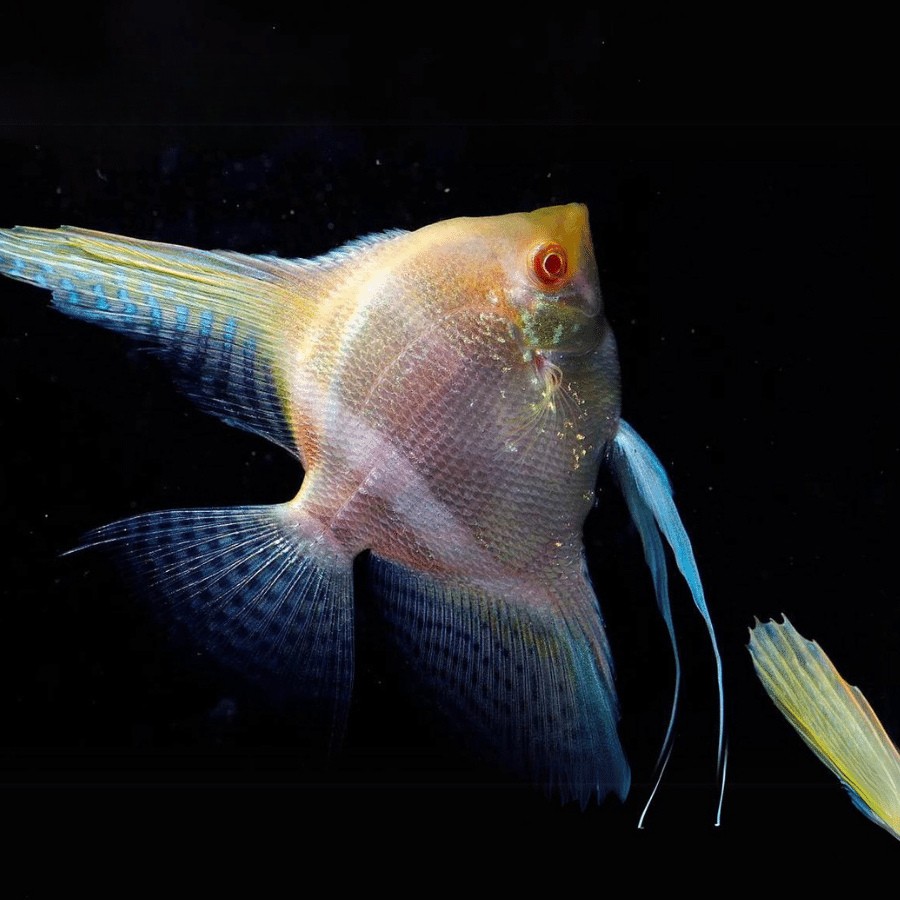
The ‘Albino’ part of the common name refers to the genetic absence of melanin, the dark pigment responsible for the classic silver-and-black vertical bars of the wild-type scalare. Without melanin, the fish’s underlying iridophore layer — the same reflective cells that produce shimmer in neon tetras — is revealed in all its pearly glory, while the eyes, lacking pigment to mask the blood supply of the retina, display the characteristic ruby-red colour. This same genetic mechanism produces albino forms in countless species across the animal kingdom, from mice to peacocks, but in angelfish the effect is unusually beautiful because the species already carries a naturally reflective undercoat of guanine crystals beneath the normally-dark scales.
‘Dantum’ is neither a Latin species epithet nor a geographic marker — it is the surname of the line’s originator. Dantum-strain angelfish emerged from a dedicated European breeder programme in the 2000s that set out to fix the weak albino gene into a vigorous, disease-resistant line. Earlier albino angelfish from the 1980s and 1990s were notoriously delicate: poor feed response, weak immunity, and a short lifespan that rarely exceeded three years. By cross-breeding selected albino specimens with robust wild-type stock across many generations — then back-breeding to recover the albino phenotype through carefully tracked heterozygous carriers — the programme produced fish that retained the stunning platinum look while shedding the notorious fragility earlier albino angels were known for. Today, ‘Dantum’ is a trade-mark of quality among angelfish enthusiasts worldwide, signalling fish with superior finnage, body symmetry, growth potential, and a working lifespan that matches the best wild-type angels.
The ‘Dantum’ name has since been used somewhat loosely by less scrupulous breeders as a marketing term, but the genuine article is recognisable by three things: a perfectly symmetrical body outline with no spinal or fin deformities, a pink-blushed shoulder patch behind the gills, and a feeding response as vigorous as any wild-type angel. The juveniles we stock trace their lineage directly to a documented Australian breeding facility that maintains the Dantum line with strict quality control — no inbreeding shortcuts, no hormone-accelerated growth, and a minimum grow-out period before fish leave the breeder.
Male vs. Female
Angelfish are one of the great frustrations of cichlid sexing. Outside of active spawning, even experienced breeders struggle to tell males from females with any reliability. The textbook cues — nuchal hump, ventral fin length, body angularity — are probabilistic rather than definitive; you can find soft-featured males and hump-crowned females that break every rule. Commercial fish farms dealing in hundreds of breeding pairs often simply raise large grow-out groups and let pairs announce themselves rather than attempt pre-selection. Even professional aquaculture research labs studying angelfish reproduction rely on dissection or endoscopic examination when precise sexing is needed — external features alone are unreliable.
The only truly reliable indicator is the *ovipositor* (also called the breeding tube or papilla), a small protrusion that extends from the vent of a spawning-ready fish during the final twelve to twenty-four hours before eggs are laid. The female’s ovipositor is broad, blunt, and cylindrical — think of a pencil eraser. The male’s is narrow and pointed, like the pencil’s lead. Once the spawn is complete, both structures retract and the fish are again visually indistinguishable. If you see these tubes on two fish simultaneously cleaning a vertical surface, you have a confirmed pair and you can expect eggs within hours.
For hobbyists who want a breeding pair without waiting for ovipositors to reveal themselves, the practical approach is to buy a group of six to eight juveniles and let them pair off naturally as they mature. Angelfish are monogamous and self-selecting: a bonded pair will consistently stay close to each other, chase other angels away from a chosen spawning site (usually a vertical leaf, piece of driftwood, or the filter intake), and defend a small territory. This behavioural signature is more reliable than any anatomical guess. In the Albino Dantum line specifically, the subtle forehead-hump trait that sometimes helps sex wild-type angels is even less visible because the lack of dark pigment reduces surface shadow contrast — so the group-grow-out method is especially recommended for albino keepers serious about breeding.
| Feature | Male | Female |
|---|---|---|
| Overall Appearance | Nearly monomorphic outside breeding | Nearly monomorphic outside breeding — sexing by eye is unreliable |
| Forehead / Nuchal Hump | Slight crown/hump may develop with age in dominant males | Flatter forehead profile |
| Body Shape | Slightly more angular, deeper-chested when mature | Rounder belly profile, more pronounced when carrying eggs |
| Ventral (Pelvic) Fins | Longer, filament-like, often tipped with extra length | Slightly shorter and sometimes thicker at the base |
| Ovipositor / Papilla | Pointed, narrow, pencil-shaped — visible only hours before spawning | Blunter, wider, tube-like — visible only hours before spawning |
| Pair Behaviour | Chases rivals, defends territory more aggressively | Inspects and cleans spawning surfaces, dominant in site selection |
| Courtship Display | Locks lips, flares gills, ‘boxes’ the female | Signals readiness by trembling and angling body |
Colour Varieties
⚪ Albino Dantum (this fish)
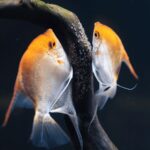
Pure platinum-white body with a faint pinkish undertone, trailing white fins, and vivid ruby-red eyes; the premium line-bred albino form.
🤍 Wild-Type Silver
The classic scalare: silver-grey body crossed by four bold black vertical bars, with subtle yellow-gold shoulder tones.
⚫ Zebra
A high-contrast morph with five to seven dense black stripes over a silver body — more stripes and more uniform than the wild type.
🔴 Koi Angelfish
Orange, white, and black patchwork evoking Japanese koi — juveniles often display vivid red caps that pale with age.
🌀 Marble Angelfish
Irregular swirling black patterns across a silvery white body; no two individuals are identical.
🖤 Black Lace / Veil
Deep black or charcoal body with delicate lace-like finnage; often crossed with veil genes for extended fin rays.
✨ Platinum (Blushing)
Pigment-reduced morph similar to albino but with normal black eyes; a soft pearlescent sheen across the whole body.
Angelfish genetics is one of the best-documented polymorphism systems in the aquarium hobby, with more than a dozen distinct genes mapped across dominant, recessive, and co-dominant expression patterns. The Albino Dantum owes its appearance to a pair of recessive albino alleles — when an albino is crossed with a non-carrier wild-type, the offspring all look silver, but they carry one hidden albino gene each. Breed two such carriers together and roughly one in four of their fry emerge as pure albinos. This Mendelian ratio, familiar to any high-school biology student, means that serious albino breeders must track parentage meticulously to keep the line pure and vigorous.
The platinum-white body colour of the Dantum line is not simply the absence of pigment. Close inspection reveals a subtle pinkish bloom across the head and shoulders (caused by blood flow visible through the translucent scales), and the fins carry a faint yellow-cream warmth, especially in the dorsal and anal fin extensions. The ventral ‘filament’ fins often carry a hint of translucent gold, while the caudal fin edge sometimes shows a thin champagne stripe where residual carotenoid pigments concentrate. Under subdued planted-tank lighting, mature Dantum angels seem to glow from within — a quality that dark-substrate, densely-planted tanks showcase to dramatic effect.
The red-eye colour, often described as ‘ruby’ or ‘rose,’ is actually produced by two optical effects combined. First, the complete lack of melanin in the iris means nothing masks the blood vessels of the retina, so the eye reveals its underlying vascular colour. Second, the lens and vitreous humour in albino fish scatter light in slightly different ways than in pigmented eyes, giving the characteristic backlit glow that is unmistakable under aquarium lighting. This same optical property is why albino fish — and albino humans — have genuine photosensitivity: without melanin to absorb scattered internal light, the retina receives an overload of signal under bright conditions. Avoid bright overhead lighting without plant cover: it washes out the subtle tonal range of the fish and, more importantly, causes the red-eyed fish visible discomfort, sometimes manifesting as nervous hiding behaviour, loss of appetite, or increased stress-related disease susceptibility.
Water Parameters
6.5–7.5
ideal 7.0
25–29 °C
ideal 27 °C
3–10 dGH
Soft to medium — tap water is usually suitable in most of Australia
Unlike their blackwater-dwelling neon tetra cousins, angelfish thrive across a surprisingly broad pH range. Generations of farm breeding have made the commercial scalare populations — including the Dantum albino line — far more tolerant of neutral and even slightly alkaline water than their wild forebears. A pH of 6.5 to 7.5 is the practical sweet spot, with 7.0 being ideal. Hardness between 3 and 10 dGH covers nearly all municipal tap water in Australia, meaning most keepers can run these fish straight on conditioned tap water without any RO blending. This is a marked contrast with wild-caught *Pterophyllum* species such as *P. altum*, which demand extremely soft, acidic blackwater and refuse to thrive otherwise.
Temperature is where angelfish are less forgiving. They are genuinely warm-water fish — 25 to 29 °C is the healthy range, and long periods below 24 °C invite immune suppression and a cascade of parasite and bacterial infections. The most common angelfish health problem among Australian keepers is ‘hole-in-the-head’ disease (hexamitiasis) triggered by chronic low temperatures combined with poor water quality; it is almost entirely preventable with a properly-set heater. A quality adjustable heater set to 27 °C, paired with a reliable thermometer, should be considered non-negotiable equipment. During winter in unheated rooms, consider an oversized or redundant second heater — a failed heater on a cold night can devastate an angelfish tank within hours.
Stability beats numerical perfection. Angelfish acclimated to pH 7.4 will thrive indefinitely at that value, but a sudden swing to pH 6.5 can trigger stress and bacterial breakouts. Weekly 25% water changes using temperature-matched, dechlorinated water keep nitrates in check and parameters steady. Test kits for ammonia, nitrite, nitrate, and pH are worthwhile investments for anyone keeping angels long-term. Angelfish are mid-sized fish with corresponding bioloads — a pair in a 250 L tank will produce enough waste to warrant a weekly schedule and a filter rated at least 1.5× the tank volume per hour in turnover.
For Albino Dantum specifically, pay extra attention to chlorine and chloramine in tap water. Red-eyed fish appear marginally more sensitive to oxidative stress from residual chlorine, probably because their sensory systems are already closer to threshold from the photosensitivity baseline. Always use a high-quality water conditioner (one that neutralises both chlorine and chloramine) and give the new water a minute or two to fully dose before adding it to the tank. For large water changes on a reliable schedule, a Python-style drain-and-fill with inline dosing works well, but always verify chloramine neutralisation is complete if your local water supply uses chloramine rather than straight chlorine.
Diet & Feeding
Angelfish are opportunistic omnivores with a strong predatory lean. In the wild, adults hunt small fish, shrimp, insect larvae, and zooplankton among the flooded root systems of the Amazon; they will also browse on algae, detritus, and occasional plant matter but get most of their calories from animal protein. Stomach content studies of wild angelfish have found everything from tetra-sized fish fry to adult freshwater shrimp, with aquatic insect larvae (especially chironomid midges and mosquito larvae) forming the consistent bulk of the diet across sampled populations. In the aquarium, this translates to a diet built around a high-quality flake or pellet staple enriched with at least 40% animal protein, supplemented generously with frozen and occasional live foods.
For the staple, choose a cichlid-specific formula or a premium community flake. Look for whole fish meal, krill, and shrimp as leading ingredients, plus added astaxanthin and carotenoids for colour. Astaxanthin is the same pigment that gives salmon their pink flesh and flamingos their colour; in angelfish it concentrates in the fin edges and the shoulder blush area. Albino angels in particular benefit from astaxanthin-rich foods, which deepen the pink blush across the shoulders and head that distinguishes premium-conditioned Dantum stock from paler, poorly-fed specimens. Hikari Cichlid Gold, NLS Cichlid Formula, and Omega One Cichlid Flakes are all proven options widely available in Australia; rotate between two brands to hedge against any single manufacturer’s recipe change.
Supplement two to four times weekly with frozen bloodworms, brine shrimp, Mysis shrimp, and daphnia. Bloodworms are especially valued as a trigger food for reluctant feeders and recent arrivals to a new tank. Mysis shrimp provide a good balance of protein and crude fibre, which helps with digestive regularity. Daphnia act as a natural laxative and should be offered once a week even to well-fed fish. Occasional live foods — live brine shrimp, blackworms, or white worms — trigger enthusiastic hunting behaviour and are especially valuable for conditioning breeding pairs. Live foods from reputable suppliers only; avoid pond-collected insects or worms, which can carry parasites.
Feed adults twice daily in small portions they finish within two minutes. Juveniles at 7–8 cm are still in a growth phase and benefit from three or four small feedings per day. Avoid freeze-dried tubifex worms, which have been linked to intestinal blockages and bacterial infections in cichlids. Avoid also any warm-blooded animal proteins (beef heart, liver) that were popular in older breeding literature — they cause fatty degeneration of the liver over time. A weekly fasting day (skipping one feed entirely) helps prevent bloat and constipation — the two most common angelfish dietary complaints. A well-conditioned Albino Dantum should have a full, smoothly-curved belly that extends just past the body outline, a clean and streaming vent, and visible enthusiasm at feeding time. Any loss of appetite lasting more than 48 hours deserves attention — usually water quality, occasionally disease, and very rarely stress from new tank mates.
Tank Setup
Angelfish are the rare freshwater species where tank *height* matters more than footprint. Their body shape and trailing finnage demand vertical swimming space. A 250-litre tank that is 60 cm wide and 120 cm long but only 40 cm tall will feel cramped to an adult angel, whose fins alone can span 20 cm top to bottom. Instead, look for tanks at least 60 cm tall — the classic ‘show’ proportions of 120 × 45 × 60 cm (324 L) are ideal, and the 90 × 45 × 60 cm (243 L) cube is a strong minimum for a pair. If you are planning the tank from scratch specifically for angelfish, spring for 65 or 70 cm height if your space and budget allow. Every extra centimetre of vertical swimming room translates into a noticeably more dignified, relaxed fish.
Aquascape with verticality in mind. Tall pieces of Malaysian driftwood or Manzanita stood upright mimic the submerged root systems and fallen branches of flooded Amazon forest, providing natural sight-breaks and territorial anchors. The classic angelfish aquascape uses a ‘triple-stump’ approach: three tall pieces of driftwood arranged asymmetrically to create three overlapping territorial zones. Broadleaf plants — Amazon sword (Echinodorus amazonicus), Anubias barteri, and large-leafed cryptocorynes — are excellent, not just aesthetically but functionally: female angels lay their eggs on the flat undersides of these leaves, and even non-breeding pairs will regularly clean and claim a ‘home leaf.’ Avoid sharp-edged rockwork; an angel spooked into a rapid turn can easily tear a fin on jagged lava rock. Smooth river stones and seiryu stone with rounded edges are safer choices if you want some hardscape variety.
For the Albino Dantum specifically, consider a floating-plant canopy — Amazon frogbit, red root floaters, or water lettuce. Floating plants diffuse overhead lighting to the gentle, dappled quality that these red-eyed fish strongly prefer, and they also help suppress algae growth by competing for nutrients. Without floating cover, you should dim your LED, use a blue/actinic-heavy spectrum rather than full-spectrum white, and run a daily ‘dusk’ period of reduced lighting so your fish can retreat comfortably. Many keepers find that albino angelfish settle into their tanks within a day or two when the lighting is right, but remain persistently nervous for weeks in overlit setups — a clear signal the environment is working against their visual comfort. Fine sand or dark aquasoil makes the best substrate — it shows off the platinum-white body dramatically and is gentle on fins that occasionally brush the bottom while exploring.
One often-overlooked aspect of angelfish tanks is the lid and surface. Angels are surprisingly capable jumpers when startled, particularly when a new tank mate is added or during thunderstorms that stress them. A close-fitting lid or a tightly-placed glass canopy is essential. Leave a small gap for cables and the filter spray bar, but nothing larger than 2 cm. Surface turbulence should be moderate — enough to ensure gas exchange and break up any oily surface film, but not so vigorous that it creates wave patterns that catch on the long fins as the angel swims near the surface.
Tank
Minimum 250 L, tall format (60 cm+ height); 324 L (120×45×60 cm) recommended for adults or pairs
Filter
Canister rated for 1.5–2× tank volume per hour, or a baffled HOB. Gentle, dispersed flow — no narrow jet streams
Heater
Adjustable, 150–300 W depending on volume. Set to 27 °C. Consider a second redundant heater in colder climates
Lighting
Dimmable LED with blue-leaning spectrum or shaded by floating plants. Avoid bright white spotlights over albino fish
Substrate
Fine dark sand or aquasoil for best colour contrast and fin safety
Driftwood
Tall vertical pieces of Malaysian or Manzanita driftwood — create natural territorial markers
Broadleaf Plants
Amazon sword, Anubias, large cryptocorynes — potential spawning surfaces and visual anchors
Floating Plants
Amazon frogbit, red root floaters, or water lettuce to diffuse light for sensitive red eyes
Thermometer
Digital or stick-on — verify heater daily, especially in winter
Test Kit
Liquid-reagent kit for pH, ammonia, nitrite, nitrate — essential for any cichlid keeper
Community Tank Mates
A well-planned angelfish community is one of the most elegant aquariums you can build. Think of angels as gentle giants: peaceful by cichlid standards, but large enough that any tank mate smaller than a neon tetra’s body length will eventually be seen as food. The twin rules of angelfish community design are simple: **nothing small enough to swallow, and nothing aggressive enough to nip fins.** Within those bounds, there is enormous latitude — schooling tetras at or above 4 cm, peaceful bottom-dwellers, gentle dwarf cichlids, and calm labyrinth fish all work beautifully. The classic South American biotope — angels as centrepiece, Rummy Nose Tetras or Congos as dither school, a group of Corydoras on the floor, and an Apistogramma pair or pair of Keyhole Cichlids occupying separate caves — is so harmonious and time-tested that it remains the default recommendation for most experienced angelfish keepers.
The single most common angelfish community mistake is keeping them with neon or cardinal tetras. It ‘works’ while the angels are juveniles and the neons are adults roughly the same size, but within 6–12 months the angels grow out and begin picking off neons one by one at night. You may not even witness the predation; you simply notice the neon school shrinking week by week, usually starting with the slower or weaker individuals, until only a handful remain. If you already have a neon school and want to add angels, rehome the neons first or accept that they will slowly disappear. Cardinal tetras, which grow to 4 cm at maturity, are marginally safer but still risky — plan on upgrading to larger Rummy Nose, Black Phantom, or Lemon Tetras if you want tetra company for your angels.
The second most common mistake is adding a lone tiger barb to an established angelfish tank — a single tiger barb is even more aggressive than a school and can reduce a pair of angels to fin-less stumps within a week. Some keepers claim success with a large school of twelve or more tiger barbs that ‘police each other’ and leave the angels alone. In practice, the risk-reward calculus rarely favours this; better to choose cherry barbs or gold barbs for a safer barb-family addition.
For the Albino Dantum specifically, consider that their red eyes and slightly reduced visual acuity compared to wild-type angels make them marginally slower to react to fast-moving tank mates. Calm, predictable companions suit them best. A community of five to seven Rummy Nose Tetras, a small group of Sterbai Corydoras, a pair of Albino Dantum angels as the visual centrepiece, and perhaps a single Bristlenose Pleco makes for a stunning, stable, and easy-to-maintain display that will thrive for years. The visual palette — silver-and-red tetras, bronze-and-olive corys, dark Bristlenose, and the ghostly platinum-white of the Albino Dantum at the centre — creates one of the most striking colour contrasts available in freshwater aquascaping.
One final note on angelfish temperament worth understanding: once your Albino Dantum pair bonds and claims a spawning territory, their sociability drops sharply. A pair defending eggs or fry will chase virtually anything — including each parent chasing the other off from time to time — within a radius of roughly 30 cm of the nest site. Plan accordingly: either keep the breeding pair in a dedicated tank, or ensure enough space and visual breaks in the community tank that other residents have clear refuge zones. Outside of breeding cycles, Albino Dantum pairs return to their easy-going default and tolerate a full community without complaint.
| Species | Why | |
|---|---|---|
| ✅ | Rummy Nose Tetra | Large enough not to be seen as prey, tight schooling behaviour provides visual interest, and shares soft-water preference |
| ✅ | Congo Tetra | Large, peaceful, iridescent tetra occupying similar swimming space; excellent dither fish for angels |
| ✅ | Lemon Tetra | Robust, peaceful, and too large to be swallowed by adult angelfish — a classic angel tank companion |
| ✅ | Corydoras (Sterbai) | Warm-water-tolerant corys occupy the bottom zone, stay peaceful, and clean up fallen food without bothering angels |
| ✅ | Bristlenose Pleco | Effective algae grazer that holds its ground without aggression; gentle enough not to rasp angelfish slime coat |
| ✅ | Apistogramma cacatuoides | Bottom-dwelling dwarf cichlid occupying a completely separate territory; shared water parameters and peaceful disposition |
| ✅ | Keyhole Cichlid | One of the most peaceful cichlids available; shares angel water parameters and never crowds the upper swimming levels |
| ✅ | Pearl Gourami | Calm, graceful labyrinth fish that occupies the upper water column; stunning contrast with Albino Dantum platinum |
| ✅ | Silver Dollar | Large, peaceful schooling fish that won’t be mistaken for prey; shares tall-tank requirements with angels |
| ✅ | Otocinclus | Tiny, non-aggressive algae grazers that stay on plant leaves and glass; too small to be seen as threats by angels |
| ❌ | Neon Tetra | Angelfish mouths are large enough to swallow neons whole — adult angels will hunt them relentlessly. Same applies to ember, green neon, and other nano tetras |
| ❌ | Tiger Barb | Notorious fin-nippers; long angelfish fins are an irresistible target and become shredded within days |
| ❌ | Serpae Tetra | Aggressive tetra known for fin-nipping even larger tank mates; incompatible with the long finnage of Albino Dantum |
| ❌ | Oscar & Large Cichlids | Far too aggressive and predatory; will bully or outright kill angelfish regardless of tank size |
| ❌ | African Cichlids | Require hard alkaline water, are highly aggressive, and inhabit completely different ecological niches — never mix |
Breeding
Week -4 to 0
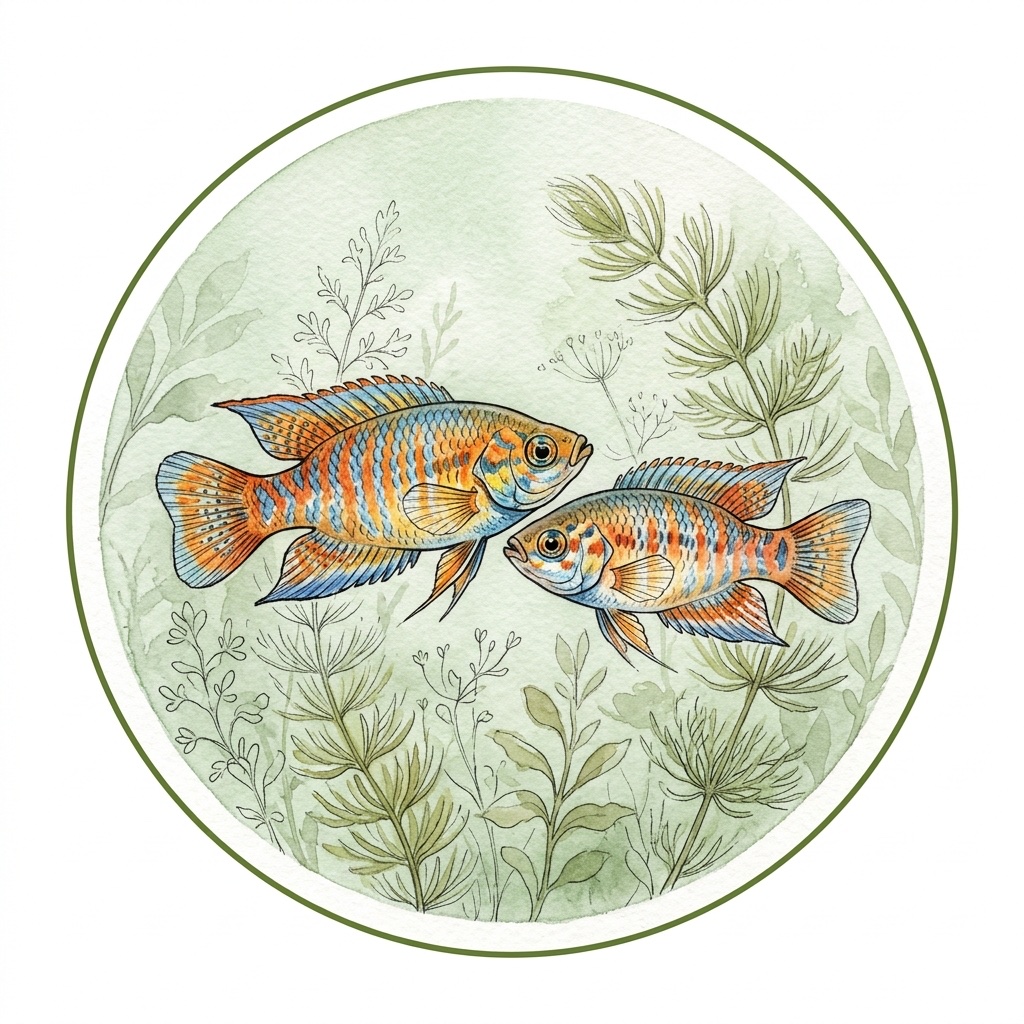
Pair Formation
Juveniles grown out together self-select bonds
Day -2 to -1
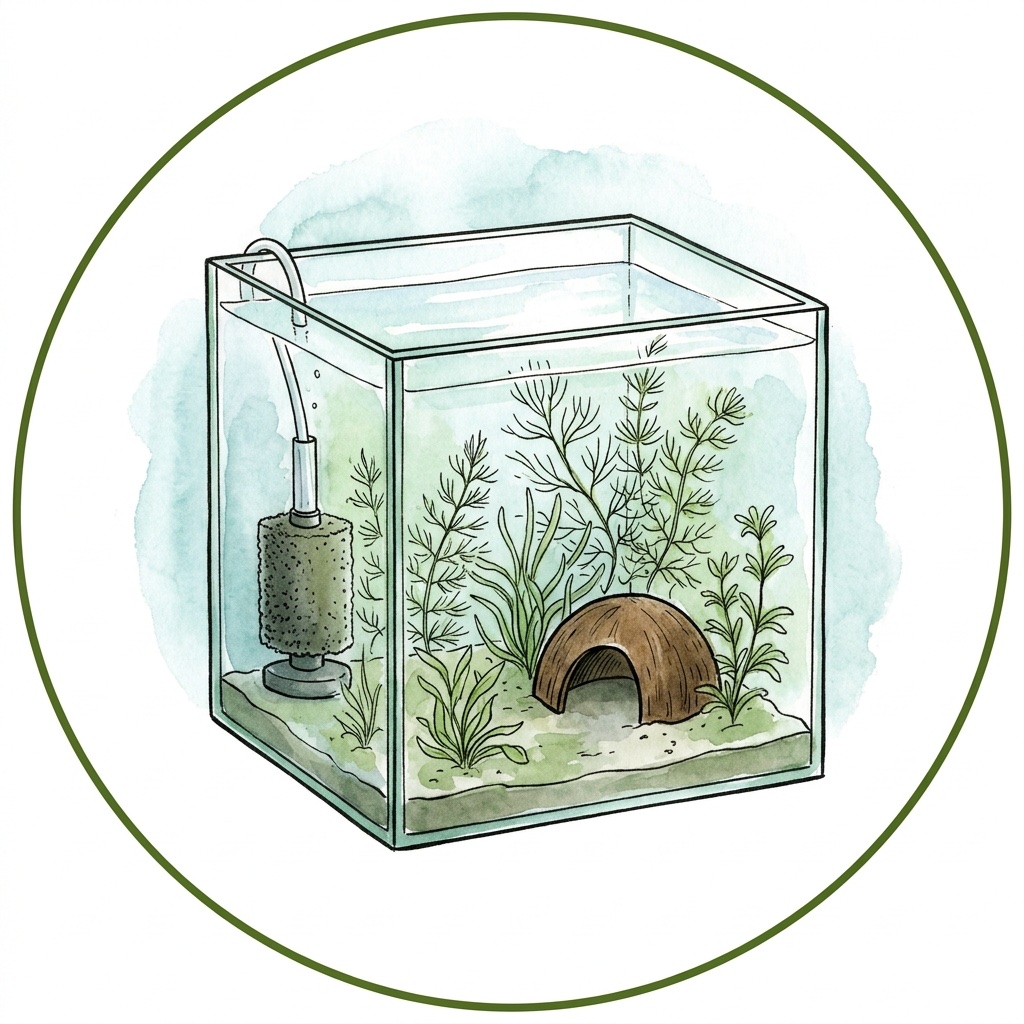
Courtship & Site Preparation
Pair cleans a vertical surface; ovipositors descend
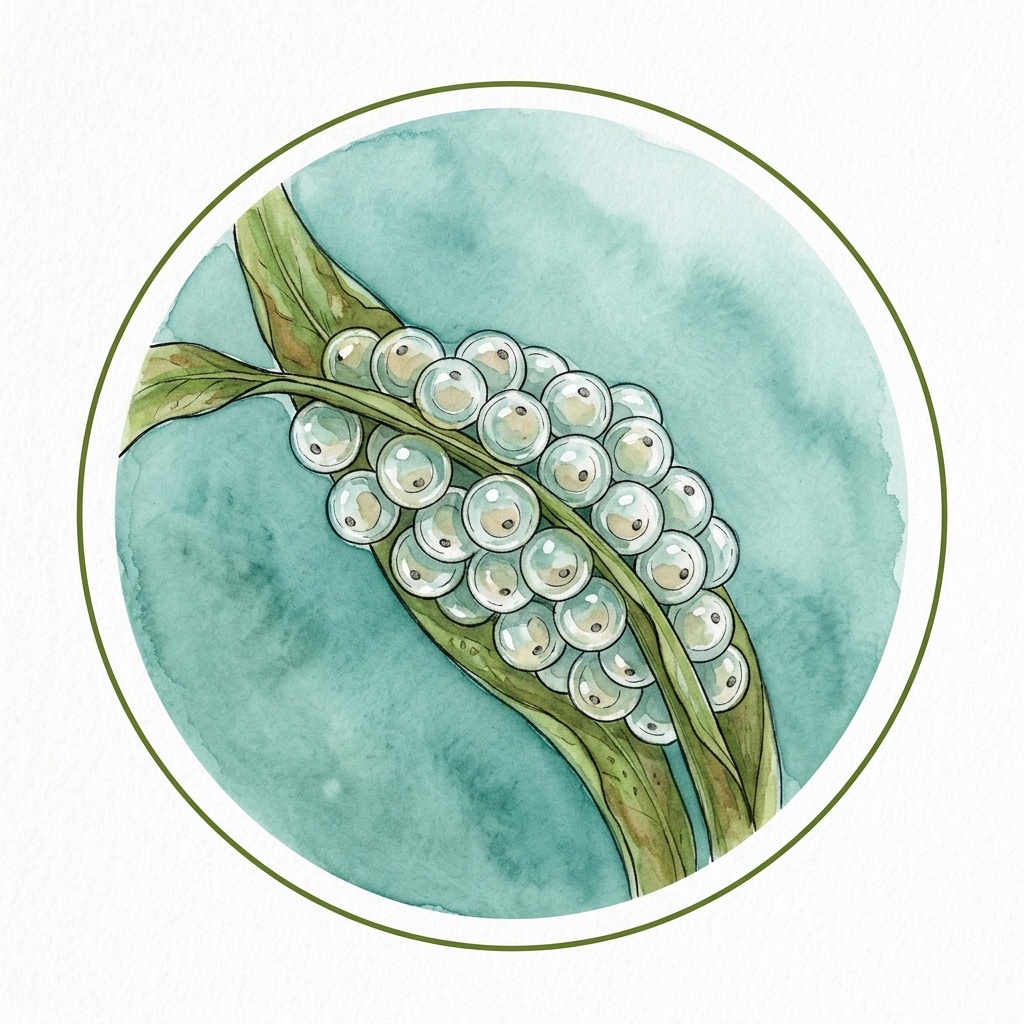
Day 0
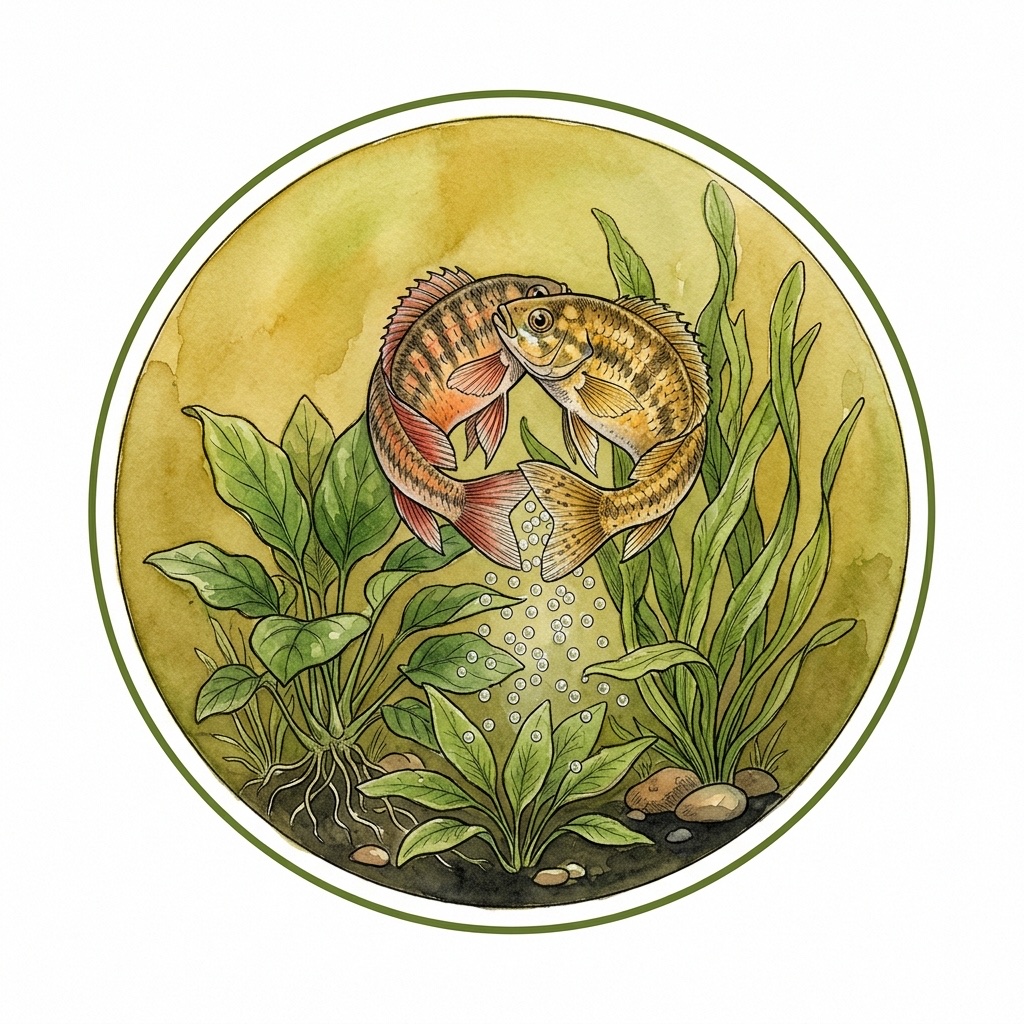
Egg Laying
200–800 eggs laid in neat rows on vertical surface
Day 1–2
Egg Guarding
Parents fan eggs, pick off infertile ones
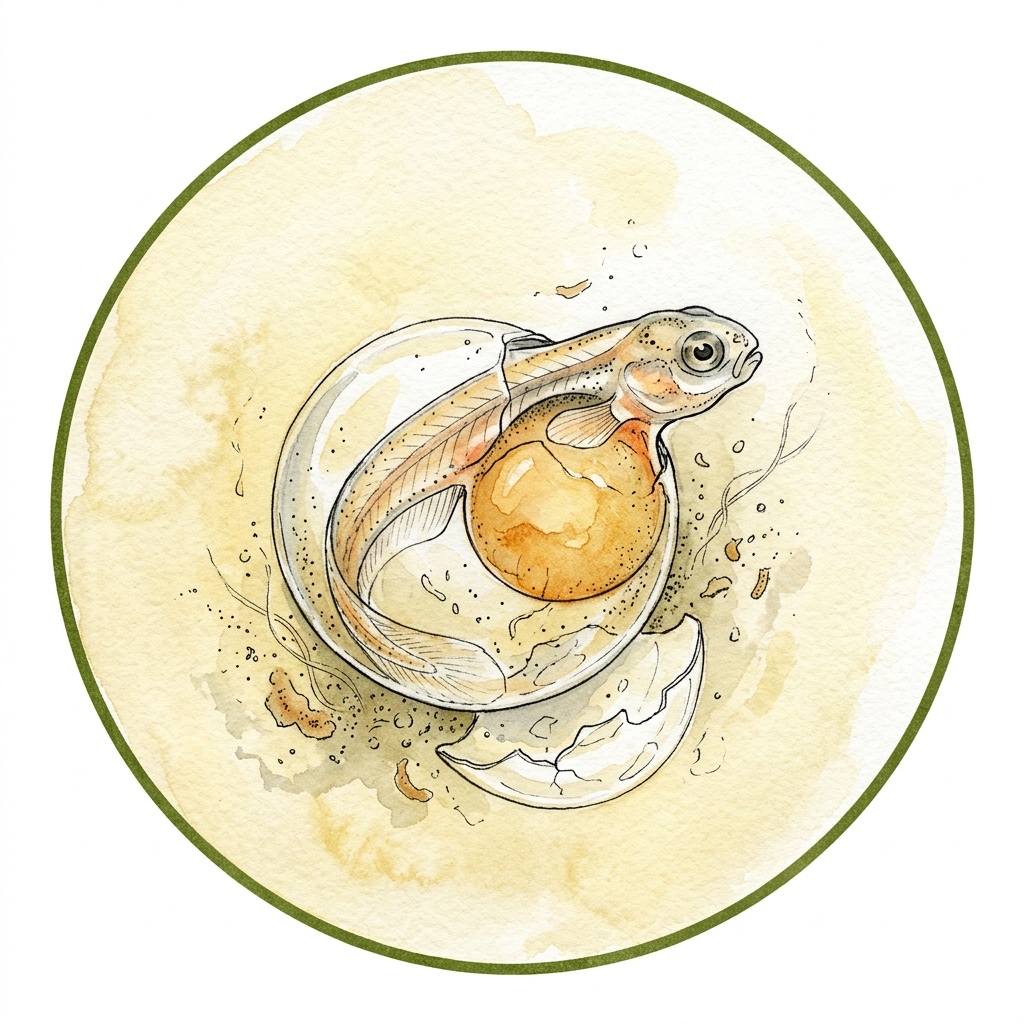
Day 2–3
Wriggler Stage
Eggs hatch into attached larvae
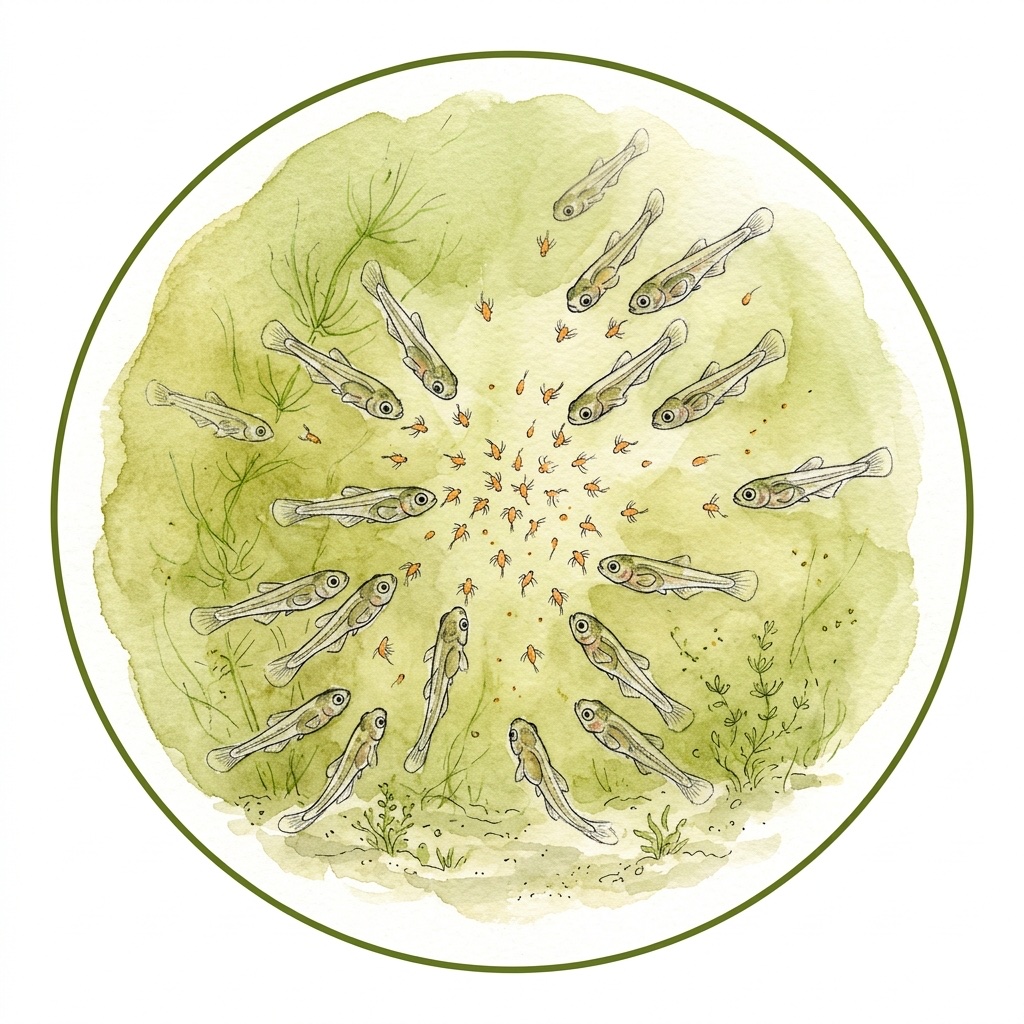
Day 6–8
Free Swimming
Fry school tightly around parents, first feedings begin
Pair Formation
The most reliable way to get a breeding pair of angelfish is to raise six to eight juveniles together in a generous tank (at least 250 L) and let them pair off naturally as they reach sexual maturity at around 8–10 months. A bonded pair becomes obvious: two fish consistently swim together, shoulder-to-shoulder, and begin driving other angels away from a chosen section of the tank. At this point, it’s worth separating the pair into their own dedicated breeding tank of 150–200 L, which reduces stress and simplifies fry rearing.
At 7–8 cm, the Albino Dantum juveniles we supply are about 3–4 months from sexual maturity, so this phase is where new keepers should set expectations. Do not expect spawning for at least half a year after purchase, and possibly longer if conditions aren’t spot-on.
Courtship & Site Preparation
Forty-eight hours before spawning, the pair becomes intensely focused on a chosen vertical surface — typically a broad plant leaf, a slab of slate leaned against the tank wall, a piece of upright driftwood, or (to the amusement of many keepers) the front glass or filter intake tube. Both parents scour the surface clean with their mouths, picking off algae and debris until it gleams. The male begins lip-locking with the female, flaring gills and showing his broadside. Twelve to twenty-four hours before spawning, the ovipositors descend: a short tube-like protrusion from the vent of each parent. The female’s is blunt and wide, the male’s narrow and pointed — this is the only moment sexing becomes unambiguous.
Egg Laying
Spawning itself is a choreographed marvel. The female makes a series of passes up the chosen surface, laying a neat row of adhesive eggs — typically 200 to 800 for a mature pair, though first-time spawns can be under 100. The male follows immediately behind each pass, fertilising the fresh row. The whole process takes one to two hours and the result is a tidy rectangular patch of translucent amber eggs, glistening on the leaf or slate. Both parents remain on constant guard afterwards, driving off any intruder, including the keeper’s fingers during water changes.
Egg Guarding
For the first 48 hours, the parents tend the eggs with remarkable precision. They fan the clutch continuously with their pectoral fins to circulate oxygenated water, and systematically pick off any egg that fungused white or failed to develop. Infertile eggs turn cloudy white within 12 hours, and parents remove them before fungus can spread. Water quality is critical in this window; maintain temperature at 27–28 °C, perform only gentle water changes (5–10% daily if at all), and keep lighting subdued. A filter sponge over the intake prevents fry from being sucked in later.
Wriggler Stage
Around 60 hours after spawning, the eggs hatch into tiny wrigglers — larval fish still attached by a thin thread of mucus to the spawning surface, their yolk sacs clearly visible beneath. The parents now take the wrigglers in their mouths and move them to a new clean surface, usually a ‘nursery pit’ they’ve excavated in the substrate or the underside of a different leaf. This chewing-and-moving behaviour looks alarming to first-time breeders who often think the parents are eating their young; they are not. The wrigglers absorb their yolk sacs over the next 3–5 days and cannot yet swim freely.
Free Swimming
By the end of the first week, the fry become free-swimming and form a dense, shimmering cloud around the parents — one of the most rewarding sights in all of fishkeeping. Both parents herd the school back together whenever it disperses, using their bodies like sheepdogs. Start feeding newly hatched baby brine shrimp (Artemia nauplii) four to six times daily; angelfish fry are relatively large and skip the infusoria stage that plagues tetra breeders. Growth is fast with clean water and heavy feeding — fry reach 1 cm within three weeks and can be moved to a grow-out tank at 5–6 weeks. Expect full albino phenotype expression (red eyes and white bodies) to be visible immediately; you will not see silver/albino segregation as with other selectively-bred morphs because both Dantum parents carry the pure recessive genes.
Quick Reference
| Scientific Name | Pterophyllum scalare (albino ‘Dantum’ strain) |
| Current Size | 7–8 cm (juvenile) |
| Adult Size | 12–15 cm body; 20 cm tall with fins |
| Lifespan | 8–12 years |
| pH | 6.5–7.5 (ideal 7.0) |
| Temperature | 25–29 °C (ideal 27 °C) |
| Hardness | 3–10 dGH (soft to medium) |
| Min Tank Size | 250 L tall (60 cm+ height) |
| Group Size | Pair or small group of 4–6 |
| Diet | High-protein omnivore — flake, frozen bloodworm, brine shrimp |
| Care Level | Intermediate |
| Temperament | Peaceful to semi-aggressive; territorial when paired |
| Tank Position | Middle to upper |
| Breeding | Substrate spawner on vertical surfaces |
| Special Note | Red eyes light-sensitive — use dimmed or diffused lighting |
Related Products
Reviews
Clear filtersThere are no reviews yet.