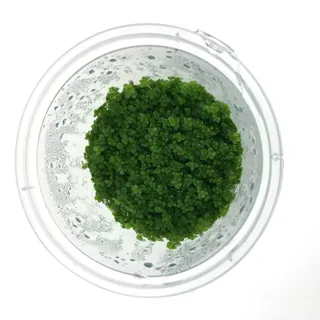
🪨 Species at a Glance
| Scientific Name | Hemianthus callitrichoides ‘Cuba’ |
| Common Names | HC Cuba, HC, Dwarf Baby Tears, Cuba Pearlweed |
| Family | Linderniaceae (formerly Scrophulariaceae) |
| Origin | Western Cuba — shallow coastal streams |
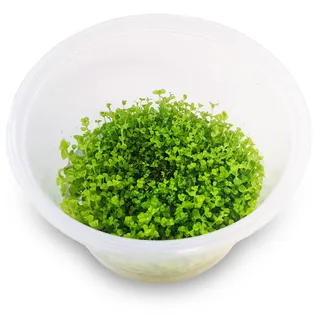
| Form Supplied | Tissue Culture (TC) cup, pest-free and algae-free |
| Planting Method | Carpet — foreground lawn |
| Adult Height | 1-3 cm fully grown in |
| Leaf Size | Under 1 mm — the smallest of any aquarium plant |
| Light Requirement | High — 80-150 PAR at substrate |
| CO2 | Mandatory — pressurised injection, 30 ppm+ |
| Growth Rate | Slow to moderate once established |
| Difficulty | Advanced |
| Carpet Time | 3-4 weeks from planting to full coverage |
Planting & Placement
Carpet
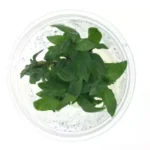
HC Cuba arrives as a tissue-culture cup containing dozens of tiny plantlets grown on a clear nutrient gel. Tissue culture is the preferred delivery format for this species for three important reasons, and each one has saved countless carpets from failure in the first weeks. First, the plantlets arrive completely free of snails, snail eggs, hydra, planaria, algae spores and the emersed-form pests that routinely hitchhike on potted or net-pot plants — a critical advantage because HC’s tiny leaves are a favourite grazing target for bladder snails and pond snails, and because algae gets a foothold at precisely the moment when a newly planted carpet cannot yet outcompete it. Second, each cup holds far more individual plantlets than a potted equivalent of the same price, giving you enough starting material to cover a 30 cm to 45 cm foreground from a single cup if you plant efficiently. Third, the sterile starting condition gives HC a clean head start in the difficult first fortnight: with no competing microflora on the plantlets themselves, the only algae and bacterial populations in the tank are those already balanced in the water column and substrate, and the young plantlets can root and extend runners without simultaneously fighting off a diatom film or a cyanobacteria mat.
Before planting, remove the plug from the cup and rinse the gel away thoroughly under a gentle stream of lukewarm dechlorinated water. Any gel left on the roots will cloud the tank water and, more seriously, will feed a bloom of mould on the substrate surface that can smother the new carpet within 72 hours. The rinsing should be patient and methodical — work the plug between your fingertips under the running water until the water runs clear and the roots are visibly clean, not just coated in a thinner layer of gel. A small kitchen sieve held under the tap works well, and the whole rinse usually takes two to three minutes per cup. Do not skip this step to save time; more first-week failures trace back to unrinsed TC gel than to any other single cause.
The plug should now look like a green-topped disc the size of a coin. Using sharp planting tweezers — curved tweezers are far easier to use than straight for foreground work — divide this disc into small portions of roughly pinch-sized clumps of six to ten plantlets each. Do not plant the whole disc as one lump: HC Cuba carpets by outward lateral spread, and many small starting points will fill in faster, more evenly and more reliably than a few large ones. A single cup divided into thirty to forty portions will carpet a 45P tank in three weeks; the same cup planted as five or six large clumps will still have visible gaps at week six. Space the portions in a staggered grid with roughly two to three centimetres between clumps across the foreground, and do not be tempted to plant them closer — the runners will reach across the gap more quickly than you expect, and over-crowded starting portions compete with each other rather than spreading outward.
Push each clump just deep enough that the crowns sit flush with the substrate surface; leaves buried more than a millimetre will rot, while clumps floating above the surface will detach the first time the filter pulses or a fish swims low over the foreground. The tweezering technique is specific: grip the plantlet clump at its base, push the tweezers vertically into the substrate up to the wrist of the clump, open the tweezers slightly while still buried, then slide them straight back out. The substrate should close around the roots on its own. Practise on a blank area of substrate before committing to the final layout — the first two or three attempts are usually clumsy.
For the first five to seven days keep the water level low — no more than two to three centimetres above the substrate — or use the dry-start method and skip filling entirely until the carpet has knitted. Low water means the plantlets are not buffeted by current while their roots anchor, and a high-humidity environment above the surface mimics the emersed conditions in which tissue-cultured HC was grown. During this period a thin layer of condensation on the cover glass is normal and desirable; if condensation is absent, mist the carpet lightly with dechlorinated water once a day using a clean spray bottle. The dry-start approach in particular has become very popular in the last decade because it eliminates algae competition entirely for the first three to four weeks, but it does require discipline: the substrate must stay moist (never sodden and never dry) and the tank must be covered with glass or plastic wrap throughout. Once the carpet has closed under dry-start conditions, slow-flooding the tank over 24 to 48 hours lets the plants transition to submerged form without shock.
A brief word on tools, because new HC keepers often try to plant with equipment that is not up to the job. Straight household tweezers from a medicine cabinet will not work — their grip is too blunt and they open with too much force, tearing rather than releasing the clump. Invest in a dedicated pair of 27 cm or 32 cm aquascaping planting tweezers (curved for foreground work, straight for stem plants in the background) made of 304 stainless steel; the ADA Pro-Pinsette and the UNS ProScape tweezer are the industry references, but there are solid lower-cost alternatives from Chihiros and various generic brands. Also prepare curved wave scissors for the first trim, a soft fine-mesh net for catching clippings, and a baster or small pipette for spot-rinsing any gel residue after planting. Having all tools to hand in front of the tank before you open the TC cup saves you from trying to improvise with wet fingers halfway through a ninety-minute planting session.
Illumination Requirements
HIGH LIGHT
PAR: 80-150 PAR at substrate
High
HC Cuba is a strictly high-light species, and there is no workaround. Below approximately 60 PAR at the substrate it will stretch vertically, lose its characteristic flat carpet habit, thin out and pale in colour, and collapse in a matter of weeks — the textbook failure mode that new aquarists mistake for disease and try to treat with more fertiliser or more CO2 when the true limiting factor is photons. The target range at the foreground floor of the tank is 80 to 150 PAR, which in practice means a modern planted-tank LED fixture sized appropriately for the tank’s footprint and running at or very near full output. For a 45 cm wide tank a single high-quality LED such as the Chihiros WRGB II Pro, Twinstar S-Line II, Week Aqua L-Series or ADA Solar RGB at 80 to 100 percent brightness will meet the requirement; shallower tanks of 30 cm or less are actually easier to light correctly for HC than tall display aquariums, which is why iwagumi and nano cube layouts dominate the HC carpet genre. A tank deeper than 50 cm measured from fixture to substrate is genuinely challenging territory and will usually need either two full-spectrum fixtures run in parallel, a suspended pendant lamp of 60-80 watt rating, or a reduction in other demands on the system — lower fish load, simpler companion planting — so that the light budget can concentrate on the carpet.
The recommended photoperiod is eight to ten hours per day, ramped up and down at the start and end rather than switched on in a single step. A sunrise ramp of 30 to 60 minutes gives CO2 and pH time to settle before the lights hit peak intensity, and a matching sunset ramp prevents the abrupt photosynthesis shutdown that otherwise leaves excess CO2 and nutrients sitting unused in the water column. A long photoperiod above eleven hours does not produce a thicker carpet; instead it invites algae, which is HC Cuba’s most persistent competitor. Diatoms in the first three weeks, green dust algae in the second month, and black beard algae after month three are the classic progression of algae pressures on a new HC tank, and all three are accelerated by extended photoperiod. If algae starts to appear, the correct first response is almost always to shorten the photoperiod to six or seven hours and hold the rest of the parameters steady until the tank catches up, rather than to cycle through chemical treatments.
Healthy HC leaves are a bright, saturated green and lie flat along horizontal runners; leaves that arch upwards and elongate are signalling that they are reaching for light, and the fixture should be raised in intensity or lowered in height accordingly. A mature, well-lit HC carpet should pearl visibly — produce streams of small oxygen bubbles from the leaves — within two to three hours of the lights reaching peak intensity each day. Pearling is not merely pretty; it is a reliable real-time indicator that the photosynthesis machinery is running at close to its maximum rate, meaning that CO2, nutrients and light are all balanced. A carpet that never pearls, even at peak light, is telling you that something in the trio is limiting it. Equally, leaves that bleach to pale yellow-green under a dense pearling are receiving more light than the current CO2 or fertiliser supply can support, and the correct fix is to increase CO2 and iron dosing rather than reduce the light.
Spectrum matters less than raw intensity for HC Cuba, but it is not irrelevant. Full-spectrum LEDs with a peak around 6500 K produce the most natural green colour from the carpet and reveal the subtle tonal variation between older and younger leaves. Strongly red-shifted ‘plant bulbs’ in the 3000 K range will grow HC just as effectively but visually flatten the green, making the whole layout look dull even when the plants themselves are thriving. If you have RGB-capable fixture, a balanced setting with slightly elevated green and red and neutral blue (rather than a heavily blue-shifted ‘reef tank’ preset) shows the scape best. Sunlight through a window, by contrast, is almost always too variable in both intensity and spectrum to be useful for HC and will usually drive algae faster than it drives the plant.
Recommended Photoperiod: 8-10 hours with 30-60 minute sunrise/sunset ramps
Feeding Your Plant: CO2 & Ferts
CO2 INJECTION REQUIRED
Pressurised CO2 injection is absolutely mandatory for HC Cuba. This is not a recommendation that can be softened by liquid carbon supplements, by extra surface agitation, or by ‘low-tech’ patience: HC without pressurised CO2 invariably collapses, usually within two to four weeks, regardless of how much light or fertiliser is thrown at the tank. The reason is fundamentally physiological. HC is adapted to streams where dissolved CO2 is naturally elevated by decomposing leaf litter upstream, and its thin, sub-millimetre leaves have very little internal carbon reserve. Combined with the high light levels the plant needs for its bright colour, the carbon demand per leaf is extraordinary relative to size, and atmospheric equilibrium CO2 (roughly 2-3 ppm in still water, 4-5 ppm in a well-agitated aquarium) simply cannot supply it fast enough. The target dissolved CO2 concentration is 30 ppm or slightly above, measured either with a permanent drop checker with 4dKH reference solution (which should sit a confident lime-green colour at peak injection, not yellow-green, blue-green or yellow) or by observing a pH drop of approximately one full unit between lights-off equilibrium and peak injection.
CO2 should come on thirty to sixty minutes before the lights and shut off one to two hours before lights-out, to avoid overnight acidification when the plants are not photosynthesising. A quality solenoid regulator on a timer is the correct way to achieve this; manual on/off is guaranteed to fail the moment you travel for a weekend. Diffusion method matters too — an in-tank glass diffuser on the opposite side from the filter return, an in-line atomiser, or a reactor plumbed into the canister output can all achieve the target concentration, but the in-line options give the most consistent distribution across a wide foreground. For new carpets, stable CO2 is more important than peak concentration. A wobbling bubble count that oscillates between five and twenty bubbles per second does more damage than a steady lower rate — HC responds to sudden CO2 drops by melting at the base, and a melted base is almost impossible to recover because there is no runner material left to regrow from.
A solenoid regulator and a known-accurate needle valve are strongly recommended; DIY yeast systems cannot hold HC Cuba long-term, although they can sometimes sustain a small established patch if nothing else is available during a temporary outage. For tanks under 60 litres, a standard paintball or sodastream CO2 cylinder with a dedicated aquarium regulator is the most cost-effective setup; for anything larger, a 2 kg or 5 kg fire-extinguisher-style cylinder from a local gas supplier will run the tank for a year or more and reduce bottle-swap anxiety. Liquid carbon (Seachem Excel, APT Fix, UNS Liquid Carbon, Easy-Life EasyCarbo) can be useful as a supplementary algaecide during the establishment phase, and a light daily dose will suppress the black beard algae that otherwise colonises hardscape edges, but liquid carbon does not replace gaseous CO2 for photosynthesis and should never be considered a substitute. Note also that at full daily-dose concentration, some liquid carbons stress Vallisneria, Anacharis and certain mosses — if you have those present, start at half dose.
Fertilisation
Fertilisation for HC Cuba follows the Estimative Index or ADA dosing philosophy — a steady, slightly surplus supply of all macronutrients and micronutrients so that CO2 and light remain the limiting factors, never the ferts. The underlying logic is that at high light and strong CO2 the plants grow so fast, and the cost of a deficiency is so disproportionate (melt, carpet lift-off, algae invasion), that keeping every nutrient safely above the minimum is the correct trade-off even if some is exported in the weekly water change.
On a fresh ADA Amazonia substrate the first four to six weeks often need only a trace micro mix and a light potassium dose, because the soil itself supplies abundant ammonium, nitrate and phosphate leaching out of the new aquasoil granules. In fact, over-dosing macronutrients during this initial window can trigger the infamous Amazonia ammonia spike with an associated algae bloom. A safer first-month regimen is: 5 ml of a commercial all-in-one such as APT Complete or Tropica Specialised three times per week, combined with daily half-doses of a micronutrient mix heavy in iron and chelated trace elements. After the tank enters its second month, begin full EI or ADA Green Brighty dosing: nitrate around 10-20 ppm, phosphate 1-2 ppm, potassium 20-30 ppm, plus a comprehensive trace mix containing iron, manganese, boron, zinc, copper and molybdenum. Iron deserves special attention — pale new leaves across the carpet almost always indicate an iron or overall micro deficiency rather than a macro problem, and HC responds within days to a well-targeted DTPA or Fe-gluconate booster dose.
Root tabs are generally unnecessary under active aquasoil; column dosing is more than sufficient for a plant with such small, shallow roots, and tabs pushed under a newly planted carpet can actually dislodge clumps when they dissolve. If the substrate does eventually exhaust (usually after 12-18 months of active use) a single tab of a balanced product such as ADA Iron Bottom or Tropica Nutrition Capsules placed at the rear of the foreground per 30 cm of tank length is the correct refresh; spread them widely rather than in clusters. Finally, remember that fertilisation is a conversation, not a recipe. Watch the leaves each week, compare against last week’s photos, and adjust one variable at a time. If new leaves come in pale, raise iron. If older leaves yellow and drop, raise nitrogen. If the tips curl inwards, raise calcium via GH booster. If algae appears on glass before it appears on leaves, your dosing is fine and something else (usually CO2 stability or photoperiod length) is the real problem.
A weekly photo in identical lighting conditions, taken from the same angle, is the single most valuable diagnostic tool for an HC carpet. Growth across a single day is almost invisible, but week-on-week the photographic record will show you exactly which areas are advancing, which are stalling, and where any colour shifts are starting. Use the phone’s grid overlay to shoot from the same position each time, turn off HDR or ‘portrait mode’ so the colour is not auto-adjusted, and shoot at peak light when the carpet is pearling. Review the previous week’s photo before you dose anything new or change any parameter. This discipline is the single habit that separates aquarists who eventually master HC from those who lose it repeatedly, because it removes the feedback delay between action and consequence and turns fertilisation from guesswork into a controlled experiment.
Caring for Your Plant
SLOW GROWTH
Under textbook conditions HC Cuba takes approximately three to four weeks from plug planting to full carpet closure in a 30-45 cm tank, and proportionally longer in larger layouts — figure six to eight weeks for a 60P (60 x 30 x 36 cm) and ten weeks or more for a 90P. The first seven to ten days are visually quiet — the plantlets are extending roots into the aquasoil and look almost unchanged from the day of planting, which is the single most demoralising stretch of the whole process. Around day fourteen the first horizontal runners appear, sending new nodes out along the surface just millimetres from the parent clump, and from day twenty onwards the carpet fills in visibly from one water change to the next. Patience during the slow first fortnight is the single most common failing of new HC keepers; there is a strong temptation to ‘do something’ by raising the lights, increasing CO2, adding more fertiliser or re-planting the plug deeper, when in fact holding all variables steady is exactly what the young plantlets need. The plants are not dormant during those first two weeks — they are investing their entire energy budget into root extension, which is invisible above the substrate but critical for every leaf that comes after.
Once the carpet has closed, regular trimming is essential and cannot be deferred. A carpet allowed to grow beyond roughly three centimetres in depth will begin to lift away from the substrate as the bottom layer is shaded out, dies, and decomposes into gas bubbles that buoy the whole mat upward — the dreaded HC carpet lift-off that can undo months of careful establishment overnight. The mechanism is subtle and catches even experienced aquascapers: the upper leaves remain perfectly green, so visually the carpet looks healthy, while underneath the lower layer has already rotted out and is producing methane and hydrogen sulphide pockets that expand during warm afternoons and eventually detach entire palm-sized chunks of carpet at a time. Trim the carpet every two to three weeks back to a height of around one centimetre, using sharp curved scissors in short, overlapping passes rather than long sweeps. Remove every clipping immediately with a net or siphon; HC clippings left drifting will re-root in random places across the scape — on driftwood, against the filter intake, between stones — and produce an uneven patchwork that is very difficult to tidy up later.
After trimming, the carpet looks dramatically thinner for three to five days before it fills back in, and this is normal. The freshly exposed runners respond to the renewed light by pushing new shoots immediately, and the lawn is usually thicker after recovery than before the cut. A useful rule is that the first trim should happen no later than eight weeks after planting even if the carpet has not reached three centimetres, simply to encourage the lateral branching that produces a dense lawn rather than a patchy one.
Snails are the most common pest problem for HC Cuba. Bladder snails (Physella acuta), pond snails (Lymnaea stagnalis) and ramshorn snails (Planorbidae) all graze happily on HC’s tiny leaves, and because the leaves are so small, even moderate snail populations can produce visible damage — ragged edges, missing leaves along a runner, patches where the carpet never quite closes up. The single best prevention is to start with tissue-cultured HC in a new tank and to quarantine every other plant added afterwards, dipping potted and bunched plants in a 1:19 dilution of Seachem Excel or a standard bleach dip (20 seconds in 1:19 bleach, followed by a thorough dechlorinator rinse) to kill snail eggs before introducing them. Once snails are in an HC tank, they are very hard to eliminate without stripping the tank; assassin snails (Clea helena) will reduce but not eradicate the population, and copper-based snail killers should never be used in a tank housing shrimp or delicate species. Shrimp, despite fears, generally do not damage HC — Neocaridina and Caridina graze only the surface biofilm, and their constant activity is actually helpful for keeping detritus off the carpet. Fish that burrow or dig (most loaches, Corydoras feeding on the foreground, large South American cichlids) are a different problem entirely, and any of those species will uproot a young carpet in hours.
Algae management during the grow-in period deserves its own note. Diatoms — a brown dust film — are almost inevitable in the first three weeks, appearing on glass, substrate, and eventually leaf surfaces. They are not a sign of failure; they are a sign of a new tank cycling through its silicate load, and they disappear on their own after two to four weeks as the silicate runs out and as higher plants establish competition for nutrients. Resist the temptation to chemically attack diatoms during this window; a soft toothbrush and weekly water changes are all that is needed. Green dust algae on glass and green hair algae on hardscape are more serious and usually indicate that CO2 is fluctuating or that photoperiod is too long. Black beard algae appearing in tufts on the rim of the carpet, on filter outputs, or on hardscape edges is the classic ‘your CO2 is unstable’ signal; tighten your bubble count, add an extra diffuser if needed, and treat existing tufts with a liquid carbon spot-dose. Blue-green algae or cyanobacteria — a dark slimy mat, typically blue-black or dark green, with a distinctive earthy smell — is a sign of dead flow zones and usually requires a combined treatment of manual removal, a three-day blackout, and in persistent cases a dose of a targeted antibiotic such as Maracyn (erythromycin).
Weekly Water Change
30-50% RO water change, gravel-vacuum above (not through) the carpet to remove detritus without disturbing the runners
Carpet Trim
Every 2-3 weeks once established; trim back to approximately 1 cm height with curved scissors, removing all clippings immediately with a fine net
CO2 Drop-Checker Review
Weekly visual check against a lime-green target; refill 4dKH reference solution every 4-6 weeks to keep readings accurate
Fertiliser Dosing
Daily or every-other-day EI/ADA schedule; iron-rich micronutrient mix 3 times per week minimum on high-light setups
Glass and Surface Cleaning
Weekly glass scrape and surface film skim; a clean surface lets the full light spectrum reach the carpet and boosts gas exchange
Filter Maintenance
Canister filter rinse every 6-8 weeks in old tank water only — never tap water, which will kill the biofilm and destabilise the tank
Water Quality for Plants
6.0–7.0
ideal 6.5
20–26 °C
ideal 23 °C
2–8 dGH
Soft water strongly preferred (2-8 dGH)
HC Cuba tolerates a moderately wide pH window of 6.0 to 7.0, but it is unambiguously happiest on the soft, slightly acidic side — around pH 6.3 to 6.7 with total hardness below 8 dGH. This is no coincidence: the western Cuban streams from which the species was originally collected are low-mineral, softwater habitats fed by limestone-filtered runoff and shaded by a dense canopy of tropical forest, producing cool, tannin-tinged waters whose chemistry HC has evolved to exploit. Hard tap water above 12 dGH, while not immediately lethal, dramatically slows the carpet’s spread and encourages a dull, pale leaf colour instead of the saturated emerald of a healthy stand. If your tap water is hard, you have two practical options. The first is to cut it with reverse-osmosis water to a 50:50 blend; this is cheaper, requires no remineralisation expertise, and works well in most urban supplies. The second, which produces the most consistent results and is the standard in contest tanks, is to run 100 percent RO water with a quality remineraliser such as Salty Shrimp GH/KH+, Seachem Equilibrium or ADA Mineral Supplement, remineralising to a target of 4-6 dGH and 1-2 dKH. The low dKH is deliberate: it lets the injected CO2 pull the pH down into the 6.3-6.7 sweet spot without needing absurd injection rates, and it keeps the water responsive so that the pH drops cleanly at lights-on and recovers at lights-off.
Temperature sits in a surprisingly cool band of 20 to 26 C, with 22-24 C being the true sweet spot. HC is often kept warmer by accident in tropical community tanks running 27-28 C for cardinal tetras, rams or discus, but prolonged exposure above 27 C weakens the carpet, invites cyanobacteria blooms under the leaves, and accelerates CO2 loss to the atmosphere. A quality heater with good thermostat accuracy, set firmly in the low-twenties, is a better companion for HC than for most fish keepers’ tropical instincts would suggest, and the species naturally pairs with cooler-water fish such as cardinal tetras (which prefer 22-25 C anyway), ember tetras, celestial pearl danios or dwarf shrimp, all of which also thrive in the 22-24 C range. In tropical climates where ambient room temperature already sits at 28 C or higher, an aquarium chiller is not a luxury but a practical requirement for long-term HC success; a small thermoelectric chiller rated for the tank volume, or in larger setups a dedicated inline chiller plumbed into the filter return, is a far better investment than any additional lighting or fertiliser.
Flow distribution is the final water-parameter variable that aquarists often overlook. HC Cuba needs the CO2 and nutrient-rich water to reach every square centimetre of the carpet, and that only happens if the flow sweeps in a wide arc across the foreground. A spot where the flow dies — usually in a front corner or directly behind a stone — is where the carpet will thin first, where cyanobacteria will start first, and where the first detritus pockets will form. Use a small powerhead or a lily pipe aimed along the diagonal of the tank to eliminate dead zones, and after any hardscape change take five minutes to drop a pinch of fine particulate food into the tank and watch where it settles; any spot where it lingers is a spot that needs better flow before the carpet arrives there.
Aquascaping with This Plant
Foreground
HC Cuba is, without serious competition, the foreground plant of the iwagumi style — the minimalist Japanese aquascape in which a small group of rocks (most often three, five or seven Seiryu, Ryuoh or Ohko stones arranged according to strict asymmetric compositional rules) stands alone on a carpet of a single low plant species. Takashi Amano’s most famous iwagumi layouts, including the late-career Lisboa Oceanario 40-metre aquascape that is generally regarded as the largest Nature Aquarium ever built, feature HC Cuba almost exclusively as the foreground carpet precisely because of its extraordinarily fine texture and uniform low growth habit: at viewing distance it reads not as a plant but as a velvet mat of green, allowing the stones to become the unambiguous focal point. In Nature Aquarium terminology, HC establishes the ‘ground plane’ against which the rocks’ vertical lines, the ‘golden ratio’ of stone placements, and the implied topography of the underlying substrate slope are all measured. Without a uniform fine carpet the compositional logic of iwagumi collapses, which is exactly why the style could never be fully realised before HC Cuba was introduced to the hobby.
Beyond strict iwagumi, HC Cuba is a superb foreground for any high-tech planted layout that features stone, driftwood, or both. It pairs beautifully with mid-ground mosses such as Christmas moss, Flame moss or Weeping moss tied to branching wood at the transition from foreground to midground; with small-leaved stem plants such as Rotala ‘H’ra’, Rotala rotundifolia ‘Colorata’ or Ludwigia ‘Super Red’ as a background colour accent; and with shoals of small schooling fish — cardinal tetras, green neons, ember tetras, chilli rasboras or celestial pearl danios — drifting above the carpet at mid-water to give life and scale to the composition. Neocaridina shrimp and Caridina shrimp both love a mature HC carpet; the leaves are too small for the shrimp to damage even when they graze the surface biofilm, and the shrimp in turn help keep detritus off the carpet surface. Avoid planting HC near aggressive root-feeders such as large Echinodorus swords or fast-spreading Cryptocoryne species, which will outcompete it at the substrate and shade it from above, and avoid any fish species known to dig (most loaches, Corydoras feeding patterns, big cichlids) because even a single digging session can uproot a whole corner of a young carpet in minutes.
A few layout tips specific to HC: place it only on flat or gently sloped substrate areas, never on steep slopes where the carpet will slide downhill over the following weeks under its own growing weight and the minor disturbance of water changes. Use hardscape to create the steepness, and keep HC as the flat baseline between the hardscape elements. Plan for scale — because HC is so fine-textured, a traditional trick in large-tank photography is to use HC in the foreground, a slightly larger carpet plant such as Monte Carlo in the midground, and small-leaved stem plants in the background, creating forced perspective that makes the scape look deeper than it actually is. Finally, remember that HC’s green is a cool, slightly yellow-shifted hue; if you are selecting companion plants for colour composition, reds and oranges contrast with it best, whereas other greens need to be deliberately contrasted in texture (broad leaves versus fine) rather than in colour to avoid a flat, monotone overall look.
| Plant | Why | |
|---|---|---|
| 🌿 | Monte Carlo (Micranthemum ‘Monte Carlo’) | The easier, slightly larger cousin of HC — often planted as a backup carpet or in transition zones where light drops near the tank edges |
| 🌿 | Eleocharis mini (Dwarf Hairgrass ‘Mini’) | Classic iwagumi partner; pairs as a taller midground grass rising behind the HC foreground, creating a two-layer lawn effect |
| 🌿 | Christmas Moss (Vesicularia montagnei) | Tied to stones or wood for mid-layer texture contrast against the fine HC carpet; loves the same CO2 and lighting regime |
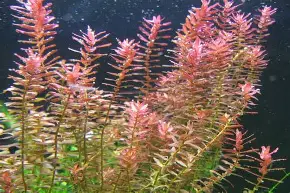
| 🌿 | Rotala ‘H’ra’ | Red stem background plant whose orange-red colour pops dramatically against an emerald HC foreground in photographs and in person |
| 🌿 | Anubias nana ‘Petite’ | Dark-green dwarf rhizome plant for attaching to hardscape without competing for foreground space; requires no substrate contact at all |
| 🌿 | Bucephalandra ‘Wavy Green’ | Slow-growing, rhizome-attached accent plant that thrives in the same CO2-injected high-light environment and adds a textured leaf form |
Reproduction & Division
Runners
HC Cuba propagates naturally through lateral runners — horizontal stolons that creep across the substrate surface, rooting at each node and producing new plantlets that in turn send out further runners. This is the mechanism by which the carpet closes after planting, and it is also the mechanism the aquarist uses deliberately to propagate new portions for a second tank or to fill in gaps left by trimming, shrimp grazing, or the occasional patch that simply fails to establish for no obvious reason. The propagation process has two reliable methods, one specialist and one casual, and both are worth learning.
To harvest a propagation square, use sharp scissors to lift a small section of carpet — roughly two by two centimetres — along with its substrate mat, cutting straight down through the substrate at the edges so that the runners stay intact on the underside of the square. A pair of long, fine-tipped planting tweezers then presses that square into the target location in the same way as the original TC plugs. The ‘pressing’ technique is the standard propagation method used in Japanese Nature Aquarium contest tanks and can fill a 60P layout’s foreground with a single TC cup plus one subsequent harvest at week six. The pressed squares should settle in within 48 hours and start sending new runners within one week; if a square is still visibly loose after a fortnight, lift it and replant a thinner slice. Donor areas in the parent tank regrow within three to four weeks, so this technique does not leave lasting bald patches if the parent carpet is otherwise healthy.
The second propagation approach is simply to relocate long trimmings after a hard carpet cut. After a heavy trim, select the longer, paler runners with visible white nodes showing adventitious roots, lay them flat on the target substrate, and pin them down with a few substrate granules, a small piece of stainless-steel mesh, or crossed bamboo toothpicks until they anchor — usually within seven to ten days. This method is less reliable than lifting a whole square but is useful for reaching tight spots between stones where tweezers cannot work. Successfully propagated HC should show new leaf growth within two weeks; plantings that remain static for more than three weeks should be removed, as they are almost certainly dead and will only decompose and foul the substrate.
Quick Reference
| Light | High — 80-150 PAR |
| Photoperiod | 8-10 hours with ramp |
| CO2 | Mandatory, 30 ppm+ pressurised |
| Growth Rate | Slow to moderate |
| Position | Foreground carpet |
| Height | 1-3 cm |
| pH | 6.0-7.0 (ideal 6.5) |
| Temperature | 20-26 C (ideal 22-24 C) |
| Hardness | 2-8 dGH (soft) |
| Substrate | ADA Amazonia or equivalent aquasoil (mandatory) |
| Propagation | Lateral runners; press harvested squares |
| Pest Warning | Snails (bladder, ramshorn) will graze the tiny leaves — go TC to avoid |
| Difficulty | Advanced — beginners frequently lose the carpet |
Reviews
Clear filtersThere are no reviews yet.