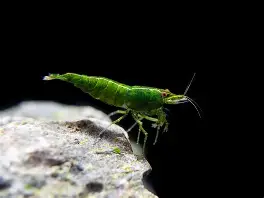
🪨 Species at a Glance
| Scientific Name | Neocaridina davidi ‘Green Jade’ |
| Common Names | Green Jade Shrimp, Neon Green Shrimp, Jade Green Shrimp |
| Family | Atyidae |
| Order | Decapoda |
| Origin | Line-bred variant of Neocaridina davidi (wild form Taiwan/southern China) |
| Adult Size | 2.5–3.5 cm (1.0–1.4 in) |
| Lifespan | 1–2 years |
| Temperature | 18–28 °C (64–82 °F), ideal 22–24 °C |
| pH Range | 6.5–7.8, ideal 7.0–7.4 |
| Hardness (dGH) | 6–15 dGH |
| Diet | Omnivore — biofilm, soft algae, blanched vegetables, shrimp pellets, leaf litter |
| Minimum Tank Size | 20 L (5 gal) for a small colony |
| Care Level | Intermediate (care easy; line stability hard) |
| Temperament | Completely peaceful |
| Breeding | Egg-carrying (berried female); no larval stage |
| Colour Stability | Low — aggressive culling required to prevent reversion |
Visual Identification Guide
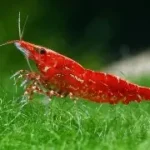
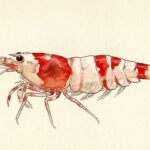
Green Jade Shrimp share the exact anatomy of every other Neocaridina davidi variant — every structural feature, appendage, and sense organ is identical to a Red Cherry or a Blue Dream. The body is split into the cephalothorax, a fused head-and-thorax unit sheathed in a rigid carapace, and a flexible, segmented abdomen that curls beneath the body and ends in the telson and uropods, a fan-shaped tail used for brief bursts of reverse swimming when startled. Six pairs of thoracic appendages project from the underside of the cephalothorax: two pairs of small chelipeds tipped with fine tufts of setae for scraping biofilm off leaves and hardscape, and four pairs of walking pereiopods used for slow, constant exploration of the substrate. Beneath the abdomen, five pairs of feathery pleopods serve both as swimming paddles for short bursts of movement and, in berried females, as the living cradle that fans and carries developing eggs until they hatch. A pair of long, whip-like antennae projects from the head, sweeping the surrounding water for chemical and mechanical cues, while a shorter pair of antennules handle close-range chemoreception. The compound eyes sit on short stalks at the front of the carapace, giving the shrimp near-panoramic awareness that compensates for its near-total lack of other defences.
What makes the Green Jade visually distinct is the pigmentation, not the structure. The colour is produced by a combination of yellow-green carotenoid pigments stored in specialised chromatophore cells in the carapace and cuticle, overlaid by a slightly reflective translucent layer that gives the characteristic ‘jade glow’. Unlike the red pigments of Cherry Shrimp, which are metabolically easy for Neocaridina to produce and deposit densely across the entire cuticle, green pigmentation sits at the outer edge of the species’ genetic colour palette. It is the product of a precise balance of yellow and blue-shifted pigments layered together, and any small shift in that ratio — whether driven by genetics, diet, or environmental stress — will tip the shrimp toward translucent, yellowish, or wild-type grey-brown. High-grade Green Jade specimens display an even, opaque green that extends from the rostrum to the telson and down onto the pereiopods, with a polished, slightly reflective sheen that gives the variety its name. Lower-grade individuals show a paler, more translucent green with visible internal organs through the carapace, a duller cast on the abdomen, and sometimes patchy depigmentation around the joints of the legs.
Sexual dimorphism matches the rest of the species. Mature females reach 2.8–3.5 cm, are visibly larger and deeper-bodied than males, and show a broader, more rounded abdomen — an adaptation for carrying a clutch of eggs beneath the pleopods. Females also express colour more intensely than males and typically display a yellow or pale-green ‘saddle’ visible through the carapace just behind the head: this is the ovarian tissue where eggs are matured before being transferred to the abdomen for brooding. Males stay smaller at 2.0–2.5 cm, have a notably slimmer abdomen without the rounded brood pouch shape, and usually show a more transparent, patchier green colouration with visible internal anatomy. Watching a male on a freshly moulted female during a mating swarm is the single clearest demonstration of sexual dimorphism in the colony; once keepers have seen it twice they rarely confuse the sexes again. One further useful identification tip for Green Jades specifically: females tend to carry the green pigment more densely and evenly than males even at equivalent grade levels, so a tank dominated visually by ‘high-grade looking’ shrimp is often simply a tank with a healthy sex ratio skewed slightly toward females. Males in the same tank will often appear to be one grade lower at a glance, but their offspring will express the full colour range of both parents. Tracking individual animals over time — noting which shrimp moult, which become berried, which emerge from moss with newly brighter colour — is one of the quietly rewarding aspects of keeping a colour line, and gives the keeper a much deeper understanding of the colony than is possible from a simple visual sweep.
🍂 Wild Type (Reverted)
Translucent grey-brown with dark speckling and a faint longitudinal stripe. The ancestral form of Neocaridina davidi and the default state that all colour lines revert to without culling. Must be culled from any Green Jade breeding colony — these individuals are healthy and useful as algae grazers in a separate tank, but they break the line if left in.
🌿 Low-Grade Green
Pale, translucent olive-green with visible internal organs through the carapace and patchy depigmentation on the legs; common in unculled retail stock and the first visible symptom of a line drifting back toward wild-type. Usable as colony starters for aquascapers who only want colour in the foreground, but should be removed from breeding groups.
🟢 Jade Green (Mid Grade)
Opaque, consistent mid-green across carapace and abdomen with only minimal translucency on the pereiopods; the benchmark grade most commonly sold at retail and the minimum grade most keepers use for breeding. A full tank of this grade already looks striking against dark substrate.
💎 High-Grade Jade
Deep, saturated green extending onto the legs, pleopods, and underside, with the characteristic polished-jade sheen in direct light. Prized breeding stock — commanding double or triple the price of mid-grade. Retains colour reliably in successive generations when kept in a tightly culled, species-only tank.
✨ Neon Green (Top Grade)
Brilliant, almost luminous green with full-body coverage and a reflective quality under white LED lighting that reads as genuinely green rather than olive or yellow-green. The pinnacle of the Green Jade line, commanding premium prices and typically only produced by experienced breeders after several generations of selective culling.
🔴 Red Cherry / Sakura / Fire Red
The opposite end of the Neocaridina davidi colour spectrum — red carotenoid line, completely stable and easiest to breed. Listed here only as a warning: never house with Green Jades, as interbreeding between any two Neocaridina colour morphs produces muddy wild-type offspring within one generation.
🔷 Blue Dream / Blue Velvet
Blue-pigmented Neocaridina line with comparable stability challenges to Green Jade. Like all other colour morphs, must be kept in a strict single-colour tank to prevent hybridisation and colour collapse. Visually stunning but equally demanding in terms of line management.
Keeping the Water Safe
6.5–7.8
ideal 7.2
18–28 °C
ideal 23 °C
6–15 dGH
Moderately hard — minerals essential for molting and carotenoid expression
Green Jades share the full Neocaridina sensitivity profile, and colour-line shrimp reveal parameter problems earlier than hardier retail grades: poor water will first dull the green pigment before any other visible symptom appears. A noticeable fade across the colony over a week or two, with no mortalities and no obvious illness, is almost always the first sign of water chemistry drift and should prompt a full round of testing for pH, ammonia, nitrite, nitrate, GH, KH, and TDS before any other troubleshooting. This early-warning behaviour is actually one of the hidden advantages of keeping a colour line: they function as a biological bioassay for water quality that a tank of hardier Cherries would fail to reveal until mortality began.
The absolute rule, for all Neocaridina but especially for colour-lines, is zero copper. Copper sulfate and related compounds are acutely lethal to all invertebrates at concentrations that are harmless or even beneficial to fish. Read every label on every product before it enters the tank: medications (particularly those targeting ich and fin-rot), algaecides, snail treatments, and a surprising number of plant fertilisers contain copper. Some municipal tap water also carries copper leached from household pipes, particularly where the water sits overnight in older copper plumbing — if in doubt, test with a sensitive copper kit or route incoming water through an activated carbon filter before it enters the tank. A single use of a copper-containing medication in a shrimp tank almost always wipes out the entire colony within 48 hours.
Ammonia and nitrite must be undetectable at 0 ppm. Any measurable reading indicates an incomplete or crashing nitrogen cycle and should be corrected immediately with partial water changes and reduced feeding. Nitrate is best kept below 20 ppm; higher values stress the colony, suppress breeding, and contribute to chronic colour fade. Chlorine and chloramine in tap water must be neutralised with a dechlorinator before water is added — shrimp gills are far more delicate than fish gills, and a direct chlorine exposure event is frequently fatal within minutes. pH swings of 0.5 units or more within a day can be fatal regardless of the absolute value; aim for stability over any specific ‘perfect’ number within the 6.5–7.8 range. Water on the softer, slightly acidic side of the range tends to produce deeper green expression, but only if total hardness remains high enough for reliable molting. Extremely soft water (GH below 4) almost guarantees molt failures regardless of other parameters and should be avoided even if it visually enhances colour.
One further sensitivity worth highlighting is the cumulative effect of trace contaminants in an older, under-maintained tank. Green Jades and other colour-line Neocaridina reveal this slow decline earlier and more clearly than hardier lines: a colony that was once visibly thriving will, over several months of mildly elevated nitrates and creeping mineral imbalances, gradually fade, breed less, and eventually stop reproducing entirely without a single dramatic parameter spike ever being recorded. The fix is boring but effective — small, consistent, well-prepared water changes (20 percent per week with pre-mineralised water matched closely to tank TDS and temperature), careful feeding, and routine testing rather than relying on visual inspection. A healthy Green Jade colony that has not been kept this way for more than a few months is a warning that the tank is drifting, not a sign that everything is fine.
Molting: What to Expect
Green Jade Shrimp molt exactly like every other crustacean. The rigid chitin-and-calcium exoskeleton cannot grow, so it must be shed at regular intervals in a process called ecdysis. A healthy adult molts roughly every 3–6 weeks; juveniles, because of their rapid growth, molt considerably more often — sometimes as often as every 7–10 days in the first few weeks after hatching. In the 24–48 hours before a molt the shrimp appears pale, eats less, and retreats into moss or leaf litter; this pre-molt behaviour is so consistent that experienced keepers can tell when a colony is about to molt simply by the visible reduction in grazing activity. The molt itself takes only seconds: the carapace splits along the dorsal midline just behind the head, and the shrimp flexes its abdomen rapidly to back out of the old shell, leaving behind a perfect transparent replica. New keepers frequently mistake these shed exoskeletons for dead shrimp — a quick check for the absence of internal organs through the transparent husk confirms it is just a shell.
Calcium and magnesium availability during the pre-molt window determines whether the molt succeeds or fails. Soft, mineral-poor water is the primary cause of the so-called ‘white ring of death’ — a visible pale band around the thorax indicating that the shrimp has failed to free itself from the old shell mid-molt. Affected shrimp almost never recover; the constriction cuts off nerve and muscle function and the shrimp dies within hours. Keeping general hardness at 6–15 dGH, supplementing with cuttlebone, crushed coral, a dedicated shrimp mineral, or a GH/KH booster, and avoiding large sudden water changes greater than 20 percent at a time dramatically reduces failed molts. Some keepers add a pinch of cuttlebone powder or a fragment of a Wonder Shell to the tank whenever they notice a cluster of shed exoskeletons, as a prophylactic top-up. TDS (total dissolved solids) is a useful proxy for mineral content: most Green Jade keepers target 180–280 ppm as a stable working range.
Newly molted shrimp are soft, pale, and extremely vulnerable for 12–24 hours after the shell is shed. During this window they cannot defend themselves against even minor physical contact and are the preferred target of any predatory tank mate. Dense moss cover, leaf litter, and driftwood crevices are essential — a soft shrimp that has nowhere to hide will be picked off by tank mates that normally ignore hard-shelled adults. This post-molt vulnerability window is also the only time females can be fertilised, so a healthy breeding colony will often show a flurry of mating swarm activity immediately after any mass moulting event triggered by a water change. Experienced keepers intentionally time moderate water changes to encourage this synchronised moulting and breeding behaviour, though care must be taken to avoid triggering a molt under poor water conditions, since a stress-induced molt into soft, under-mineralised water is one of the most reliable ways to produce a cluster of failed molts and a sudden drop in colony numbers. The safest approach is to keep water parameters consistently in-range at all times, so that any moulting event — spontaneous or triggered — happens under conditions that reliably support a successful ecdysis.
Tank Requirements & Layout
A 20-litre nano is the absolute minimum for a small Green Jade colony, but 40–60 litres is strongly preferred: larger water volumes dampen parameter swings, and a bigger tank gives the keeper room to cull selectively without depleting the breeding population. Stability, not size, is the real currency — a well-cycled, heavily planted 40 L will keep more shrimp healthier than a shakily cycled 100 L. Mature the tank for at least four weeks before introducing any shrimp; mature biofilm is both their primary food source and a buffer against water chemistry swings, and a freshly set-up tank lacks both. If possible, ‘seed’ the new tank with a cup of filter squeezings or a handful of moss from an established, healthy shrimp tank to accelerate biofilm colonisation.
The substrate should be dark — inert black sand, black gravel, or a neutral aqua soil. Dark substrate is not just aesthetic: it triggers the shrimp’s camouflage response, which deepens and intensifies the green pigmentation in a way pale substrate never will. Pale or white substrates cause shrimp to lighten their colour in an attempt to blend in, and can make lower-grade individuals look almost colourless; they also wash out even top-grade Neon Green specimens until they appear merely mid-grade. Avoid active (pH-buffering) soils with strong acid buffering unless you are targeting the softer, slightly acidic end of the parameter range and can reliably add GH boosters to keep mineral content high. Inert substrates paired with a cuttlebone or crushed coral additive are the easiest starting point for most keepers.
Hardscape should lean heavily on driftwood and fine-leaved moss. Spiderwood, Manzanita, and Malaysian driftwood all look beautiful with green shrimp and release tannins that soften water, support biofilm growth, and produce the slightly tea-coloured water that subtly enhances green pigmentation under warm-white LED lighting. Java moss, Christmas moss, Flame moss, and Weeping moss all provide dense foraging territory and critical refuge for shrimplets — at least 30 percent of the tank footprint should be moss cover, and more is better. A layer of Indian almond (Catappa) leaves and alder cones on the substrate seeds the tank with biofilm, releases gentle antifungal tannins, and provides long-duration snacking surfaces for the colony. Replace leaves as they break down completely, typically every 3–6 weeks. Avoid sharp lava rock or jagged hardscape — delicate abdomens catch easily during the startled escape dashes that Neocaridina perform when alarmed, and wounds on a soft-bodied shrimp are almost always fatal. Keep the tank tightly covered; Green Jades are enthusiastic climbers, especially immediately after water changes, and overnight escapes onto the carpet are a leading cause of loss in new setups.
Lighting is often overlooked in Green Jade setups but has a real effect on both colour expression and colony health. Moderate-intensity full-spectrum LED lighting with a slight warm bias (around 6500 K with a touch of red) brings out the green pigmentation most flatteringly and supports healthy plant and biofilm growth without driving nuisance algae. Photoperiods of 6–8 hours daily are ideal; longer photoperiods primarily benefit algae at the expense of the plants, which in turn starves the biofilm that the shrimp depend on. A separate ‘moonlight’ blue LED channel running for a couple of hours after the main lights switch off gives keepers a chance to observe the colony during its most active grazing period without stressing the shrimp with sudden bright light. Finally, plan tank placement carefully before setting up: a shrimp tank in a high-traffic area with frequent vibration, slamming doors, or direct afternoon sunlight will never settle into the calm, stable routine that a colour line needs to thrive. A quiet corner with diffuse indirect light and minimal foot traffic is almost always the right answer.
Sponge Filter
Essential — protects shrimplets from impeller suction that would mince them in a power filter, and cultivates the dense biofilm colony that feeds the shrimp. Two sponge filters provide redundancy and double the grazing surface; air-driven dual-sponge units are ideal for larger colonies.
Heater
Adjustable 25–50 W heater with external thermostat sized to the tank; target a stable 22–24 °C. Cooler temperatures (20–22 °C) deepen colour expression but slow breeding rates; warmer temperatures (25–27 °C) speed breeding but shorten individual lifespans and visibly fade green pigment over time.
Digital Thermometer
Daily temperature monitoring is non-negotiable. Sustained temperatures above 28 °C are stressful, suppress breeding, cause a visible fade in green pigment within days, and in extreme cases trigger mass moulting events that can overwhelm a small colony.
Aquascape: Dense Moss Mat
Java, Christmas, Flame, or Weeping moss covering at least 30 percent of the tank footprint; the single most important feature for shrimplet survival and for providing post-molt refuge for soft-bodied adults. Moss also serves as a primary biofilm substrate and a natural grazing surface.
Dark Fine Substrate
Inert black sand or neutral aqua soil at 3–5 cm depth. Dark substrate intensifies green pigment expression by triggering the shrimp’s natural camouflage response; pale substrate dulls it regardless of genetic grade. Depth of 3–5 cm supports rooted plants without creating anaerobic pockets.
Tight-Fitting Lid
Green Jades are escape artists, especially after water changes. Glass lid or fine mesh cover over every opening — including filter cable gaps, heater cable gaps, and any notched corners. Losing a top-grade breeding female to a ten-centimetre dry-tank excursion is one of the most expensive mistakes in the hobby.
Mineral Supplement
Cuttlebone, crushed coral, Wonder Shell, or a liquid GH booster to keep general hardness in the 6–15 dGH target band. Mineral content is especially important during the pre-molt phase and for juvenile development, where calcium and magnesium drive successful exoskeleton formation.
TDS Meter
A simple handheld TDS meter (target 180–280 ppm stable) is the easiest single instrument for tracking mineral stability in a shrimp tank. A sudden drop in TDS after a water change indicates new water is softer than tank water and needs to be pre-mineralised; a slow creep upward indicates mineral accumulation from supplements or evaporation top-offs.
Cull Tank (secondary)
A dedicated 10–20 L secondary tank to house low-grade and wild-type culls. Culled shrimp are perfectly healthy — they are simply removed from the breeding pool to protect colour purity in the main colony. A cull tank also serves as useful quarantine for new stock and backup space during main-tank maintenance.
Feeding Schedule & Diet
Green Jades are opportunistic omnivores that spend most of their waking hours grazing on biofilm — the thin living layer of bacteria, microalgae, fungi, and detritus that colonises every hard surface in a mature aquarium. In a well-cycled, lightly stocked tank with adequate lighting and plenty of moss and driftwood, biofilm and soft green algae alone can sustain a small colony indefinitely; the shrimp are essentially grazers on a microscopic pasture. Observing a colony in a mature tank reveals the constant, almost meditative pattern of feeding — shrimp work methodically across leaves, glass, and wood surfaces with their tiny chelipeds, picking at the biofilm mat invisibly from the human perspective but clearly highly nutritious from theirs. As the colony grows past 20–30 individuals, targeted supplementation becomes necessary to prevent cumulative nutrient deficiencies that show up first as faded pigmentation, slower growth in juveniles, and poor molt quality in adults.
Supplemental feeding should happen 3–4 times per week, never daily. Small portions only — whatever the colony can finish within two hours. Blanched zucchini, cucumber, spinach leaves, and parboiled carrot slices all work well and are readily accepted by adult shrimp. Commercial shrimp pellets, especially those formulated with spirulina, Mulberry leaf, plant protein, and added calcium, provide dense nutrition and often visibly improve colour saturation within a fortnight when introduced to an undernourished colony. Indian almond (Catappa) leaves, alder cones, banana leaves, and Mulberry leaves all serve double duty as long-duration biofilm substrate and gentle water conditioner — drop one leaf every few weeks and allow it to break down naturally on the substrate; shrimp will graze it continuously from the moment it sinks until it is fully consumed, which may take two to four weeks. A colour-specific note: foods rich in carotenoids such as paprika, Krill, and spirulina-heavy blends enhance red lines by providing precursor pigments for astaxanthin deposition, but they do essentially nothing for green pigmentation, which is driven by different biochemical pathways. Feed for overall health and stable nutrition, not colour, in Green Jades — the colour depends on genetics, substrate contrast, lighting, and water quality, not diet.
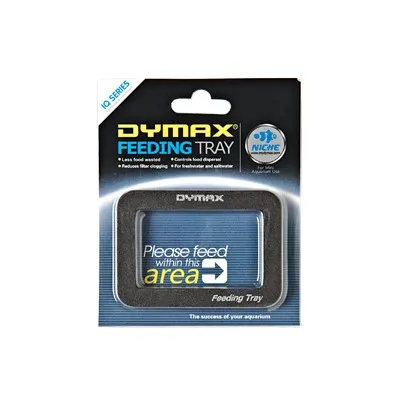
Overnight snacks such as blanched vegetables should be removed in the morning if not finished; left to decompose over days they will spike ammonia in what are usually small, lightly filtered nano tanks. A consistent feeding routine (always the same days, always similar amounts) produces faster, more visible colony growth than erratic heavy feeding followed by lean periods. Many experienced Green Jade keepers keep a dedicated ‘feeding dish’ — a small glass or ceramic dish on the substrate where pellets and vegetables are placed — which makes clean-up of leftovers straightforward and prevents food from becoming lost among moss and hardscape.
Choosing Safe Companions
For any aquarist serious about preserving the Green Jade line, the correct answer to ‘what can I add?’ is almost always ‘nothing’. A species-only tank is the only configuration that reliably maintains colour quality, breeding rates, and shrimplet survival — the three things that matter most for a line that is already under genetic pressure to revert. Even fish that are technically ‘shrimp-safe’ with hardier Cherry grades will opportunistically pick off freshly moulted or juvenile Green Jades, and the small genetic pool of a single-colour line cannot absorb those losses without fading over generations. Every shrimplet lost to a fish is a potential high-grade individual removed from the breeding population, and when the breeding population is already being tightly culled for colour, the cumulative effect is a slow but steady decline in colour quality that eventually becomes irreversible.
Snails and Otocinclus are the only additions most serious Green Jade keepers tolerate, and even these are weighed carefully against the small but real risk of indirect harm through competition for food, disturbance of berried females, or contribution to bioload in a small tank. If a mixed community is non-negotiable, a second dedicated shrimp tank for Green Jades is almost always the right compromise — keep community fish in the display tank and the colour colony secure in its own small, heavily planted species-only setup. The cost of a second 40 L tank, sponge filter, heater, and minimal aquascape is less than the cost of a single top-grade breeding group, and the colour quality preserved by the separation repays the investment many times over in the long run.
For keepers who absolutely insist on some visible movement in the Green Jade tank beyond the shrimp themselves, a small group of Malaysian Trumpet Snails and one or two horned Nerite Snails is the most widely accepted compromise. The snails spend their time on glass and hardscape rather than hunting, contribute meaningfully to algae control, and pose no predation risk. Even then, the keeper should be prepared for the possibility that a Nerite will, over a long lifespan, occasionally surprise them by laying a hard white egg capsule on driftwood or glass. Nerite eggs cannot hatch in fresh water, so the capsules are purely cosmetic and can be scraped off during maintenance. The only animal absolutely, categorically not compatible with a Green Jade tank is another Neocaridina — that rule admits no exceptions, no ‘just for a week’, and no ‘just this one pretty Blue Dream’. Every time the rule is broken, a line is lost.
| Species | Why | |
|---|---|---|
| ✅ | Horned Nerite Snail | Completely non-aggressive algae grazer that cannot breed in fresh water, so it will not overrun the tank. Shares cleaning duties on glass and hardscape without competing for shrimp food, and is completely indifferent to shrimp at all life stages. |
| ✅ | Otocinclus Catfish | Exclusively algae-feeding and too small-mouthed to threaten adult shrimp. Generally ignores even shrimplets once settled into a well-planted tank, though a very hungry individual may opportunistically pick at a newly hatched shrimplet — keep the tank well-fed. |
| ✅ | Pygmy Corydoras (Corydoras pygmaeus) | Tiny, strictly peaceful bottom dweller that mostly ignores adult shrimp. Shrimplet predation risk is low but non-zero; keep tank densely planted with moss to provide refuge. A reasonable choice for a mixed shrimp-and-fish community, but not ideal for a dedicated breeding line tank. |
| ✅ | Malaysian Trumpet Snail | Nocturnal substrate-turner that aerates the bottom layer and eats detritus, improving substrate health in a way that indirectly benefits the entire tank. Completely harmless to shrimp and shrimplets; only caveat is population management, as they breed readily in most shrimp tanks. |
| ✅ | Ramshorn Snail | Peaceful algae eater; breeds in fresh water so population must be managed through manual removal or food restriction, but does not threaten shrimp at any life stage. Often arrives as a hitchhiker on plants and is tolerated or even welcomed by many shrimp keepers as an indicator species. |
| ❌ | Any other Neocaridina colour morph | THE critical incompatibility for Green Jades — interbreeding with Red, Blue, Yellow, Black, Chocolate, or any other Neocaridina line causes immediate colour collapse back to wild-type within one generation. Lose the entire line. This is a non-negotiable rule for anyone serious about preserving green colour quality. |
| ❌ | Betta Fish (Betta splendens) | Most bettas actively hunt shrimp; they are visual predators with a particular interest in any brightly coloured prey, which makes Green Jades especially attractive targets. Not reliably safe even with individuals marketed as ‘shrimp-friendly’ — temperament can change without warning. |
| ❌ | Gouramis (Trichopodus / Trichogaster spp.) | Readily consume shrimp; even dwarf gouramis pick off shrimplets and smaller adults opportunistically. The slow, deliberate hunting style of gouramis is particularly effective against shrimp that rely on quick dashes for escape. Not compatible with any Neocaridina line. |
| ❌ | Dwarf Cichlids (Apistogramma, Mikrogeophagus) | Actively hunt shrimp as preferred live food and teach young fry to do the same. Even the smallest species treat a shrimp colony as a buffet and will systematically work through the colony over days or weeks. |
| ❌ | Assassin Snail (Clea helena) | Primarily hunts other snails, but will opportunistically kill and consume molting or weakened shrimp, particularly shrimplets. A colony of assassins in a shrimp tank will slowly pick off the vulnerable individuals until the breeding rate drops to zero. |
Breeding in the Aquarium
Egg Carrying
Green Jade Shrimp breed exactly like any other Neocaridina davidi — the species-level biology is identical and remarkably straightforward. Sexual maturity arrives at 60–75 days; females develop a visible yellowish saddle of ovarian tissue behind the head, which darkens to a richer yellow or pale green as the eggs mature. During each post-molt window, the female releases pheromones into the water that trigger a brief, frantic ‘mating swarm’ during which multiple males search the tank rapidly for the receptive female — a distinctive event easily recognised after seeing it once, as the normally languid colony suddenly explodes into high-speed movement for two to five minutes. Eggs are fertilised and immediately transferred from the saddle to the pleopods beneath the abdomen. A berried female carries 15–30 eggs for roughly 25–35 days at 22–24 °C (faster in warmer water, slower in cooler), fanning them continuously with her pleopods to oxygenate them and prevent fungal growth. Eggs hatch directly into 1–2 mm miniature adults — there is no free-swimming larval stage characteristic of many other shrimp genera, and the shrimplets begin foraging on biofilm within minutes of leaving the mother’s pleopods. Shrimplets that are born into a well-established colony with dense moss cover and abundant biofilm survive at rates above 80 percent; shrimplets born into bare, lightly planted tanks or tanks with fish survive at far lower rates, sometimes below 20 percent.
Where Green Jades diverge dramatically from Red Cherries is in line stability. Green pigmentation is recessive, polygenic, and at the outer edge of Neocaridina’s colour expression range. It is the product of a precise combination of genes affecting pigment production, pigment deposition, and the reflective layer that gives the ‘jade glow’; any drift in any of those genes away from the carefully selected line produces a lower-grade individual. Left unmanaged, an unculled Green Jade colony will produce a noticeable percentage of lower-grade, translucent, or outright wild-type grey-brown offspring in the very first generation — typically 10–20 percent in a mid-grade colony and 5–10 percent even in a tightly managed high-grade colony. By the third generation without intervention, the majority of the colony will look wild-type, and the deep green expression will be effectively lost — a phenomenon often called ‘colour collapse’ or ‘reversion’. Once collapsed, a line almost never recovers on its own; the keeper typically has to restart by purchasing fresh top-grade breeding stock.
The only defence is aggressive culling. Identify lower-grade and wild-type individuals early — as soon as colour grade is visually apparent, which is usually around 4–6 weeks of age when juveniles have developed enough pigmentation to be assessed — and remove them from the breeding population to a separate ‘cull tank’. This is not a cruelty: culled shrimp are perfectly healthy, and they continue to live normal lives as algae grazers in the secondary tank. Most serious keepers cull roughly 20–40 percent of each generation during the first year of a new line, dropping to 10–20 percent by the third or fourth generation as the line stabilises through consistent selection for the highest-grade individuals. Equally important: NEVER house Green Jades with any other Neocaridina colour morph. Cross-colour interbreeding is not additive — it collapses both lines straight back to muddy wild-type within a single generation, permanently destroying breeding stock that may have taken years to develop. This also applies to apparent ‘safe’ pairings like Green Jade with a yellow or orange Neocaridina: there are no safe Neocaridina-to-Neocaridina pairings, full stop. Caridina species (Crystal Red, Crystal Black, Taiwan Bee) cannot interbreed with Neocaridina and are safe in terms of genetics, though they typically prefer different water parameters and are usually kept separately for that reason.
A practical breeding regimen that works well for Green Jades goes roughly as follows. Start with at least 10–15 high-grade individuals with a balanced sex ratio (roughly 1 male to 2 females), and stock them in a mature, heavily planted, species-only 40 L tank that has been running fishless for a minimum of six to eight weeks. Feed lightly and consistently, monitor TDS and general hardness weekly, and resist the temptation to adjust parameters frequently — stability matters more than precision. Expect the first berried females within 4–8 weeks of introduction, and the first visible shrimplets two to three weeks after that. Let the first generation grow to roughly 4–6 weeks of age before assessing colour and culling aggressively; lower-grade individuals move to the secondary tank, where they live out their lives peacefully as algae grazers. Select the top 30–50 percent of each generation as breeding stock going forward, and over three to five generations the line will stabilise noticeably, with culling rates dropping and the proportion of high-grade offspring steadily rising. This disciplined approach is what separates a keeper who has a small flicker of Green Jades for six months from a keeper who has a thriving, visually stunning colony for years.
Quick Reference
| Scientific Name | Neocaridina davidi ‘Green Jade’ |
| Adult Size | 2.5–3.5 cm |
| Lifespan | 1–2 years |
| pH | 6.5–7.8 (ideal 7.0–7.4) |
| Temperature | 18–28 °C (ideal 22–24 °C) |
| Hardness | 6–15 dGH |
| Min Tank Volume | 20 L (5 gal), 40 L+ preferred |
| Care Level | Intermediate (line stability) |
| Breeding Difficulty | Easy biology; hard colour retention |
| Gestation Period | 25–35 days (berried female) |
| Copper Tolerance | NONE — lethal at trace levels |
| Single-Colour Tank | MANDATORY — never mix Neocaridina morphs |
| Culling Regimen | Aggressive — remove low-grade & wild-type juveniles |
| Filter Type | Sponge filter required |
Related Products
Reviews
Clear filtersThere are no reviews yet.