🪨 Species at a Glance
| Scientific Name | Caridina cantonensis var. ‘Crystal Red’ |
| Common Names | Crystal Red Shrimp, CRS, Red Bee Shrimp, Red Bee |
| Grade Offered | SS grade (one tier below SSS / Double Hood) |
| Family | Atyidae |
| Order | Decapoda |
| Origin | Japan — selectively bred from wild Bee Shrimp (Caridina cantonensis) by Hisayasu Suzuki in 1996 |
| Adult Size | 2.5-3.2 cm (1.0-1.25 in); females slightly larger |
| Lifespan | 14-20 months in optimal soft-water conditions |
| Temperature | 20-24 degC (68-75 degF); ideal 22 degC |
| pH Range | 5.8-6.5; ideal 6.0-6.2 (actively acidic) |
| Hardness (GH) | 4-6 dGH — soft but mineralised |
| Carbonate (KH) | 0-1 dKH — effectively zero |
| TDS | 120-160 ppm (RO/DI water remineralised with GH+ or Salty Shrimp) |
| Diet | Biofilm specialist + premium shrimp foods + blanched vegetables |
| Minimum Tank Size | 40 L (10 gal); 60 L+ strongly recommended for colony |
| Tank Maturity Required | 3+ months fully cycled on active soil |
| Care Level | Intermediate to advanced — strict parameters required |
| Temperament | Completely peaceful; shy around faster species |
| Breeding | Egg-carrying (berried female); non-parental; direct hatch (no larval stage) |
Visual Identification Guide
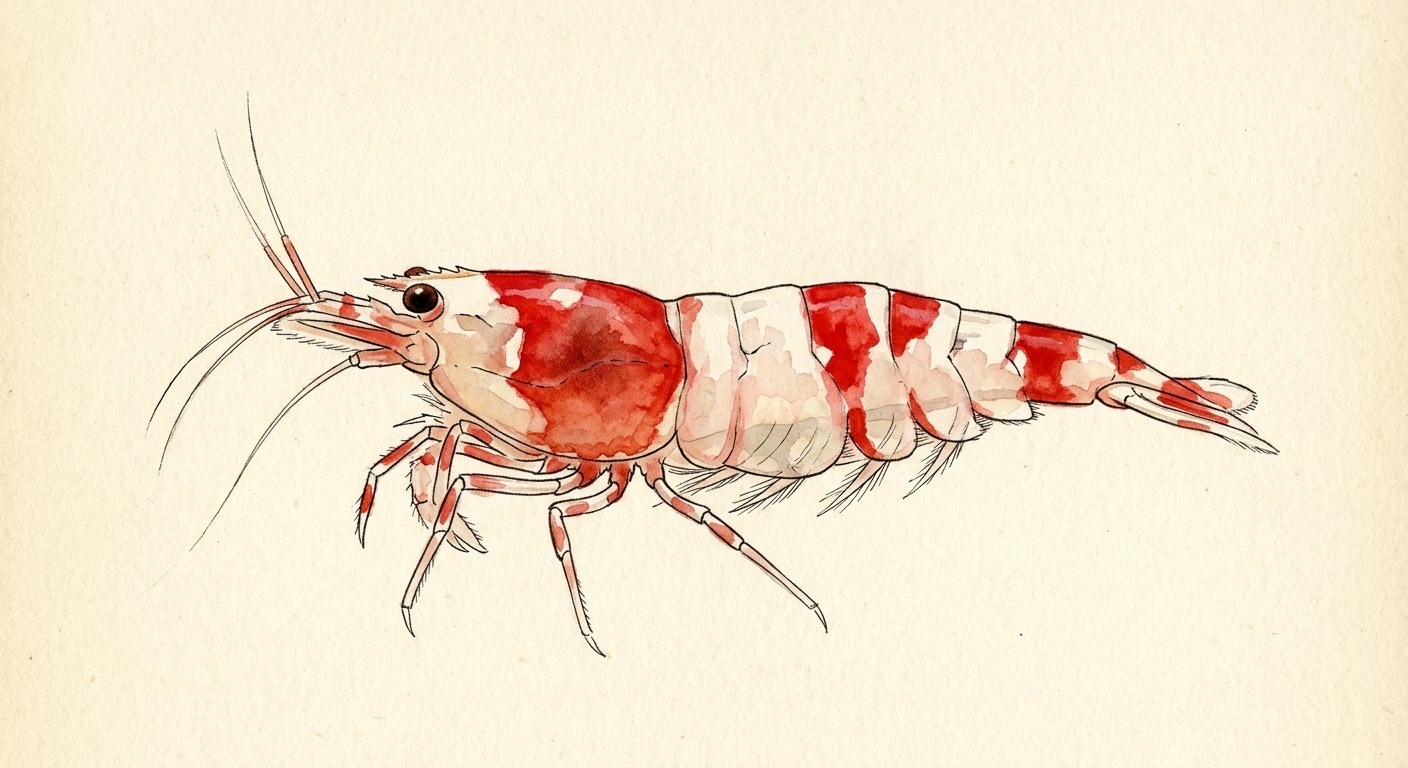
The Crystal Red Shrimp shares the characteristic Atyidae body plan of its wild Bee Shrimp ancestor: a compact, laterally compressed body divided into cephalothorax and segmented abdomen, terminating in a broad fan-shaped telson and uropods. Six pairs of thoracic appendages emerge from beneath the carapace — two pairs of delicate chelate claws (chelipeds) tipped with feathery setae that sweep biofilm into the mouthparts, and four pairs of walking legs (pereiopods). Five pairs of pleopods line the underside of the abdomen, used for swimming and, in females, for fanning and carrying the developing egg clutch. A short rostrum projects forward between the compound eyes, which sit on short stalks and deliver near-panoramic vision. The antennules and long antennae sweep constantly across every surface, detecting chemical signals that guide feeding, mating, and predator avoidance — the primary sensory system of a species that relies almost entirely on smell and taste rather than vision.
The story of the Crystal Red Shrimp pattern begins in 1996, when Japanese breeder Hisayasu Suzuki noticed a single red-and-white individual among a batch of wild-type Bee Shrimp (Caridina cantonensis) he was keeping. Standard Bee Shrimp carry a brown-and-white or black-and-white striped pattern, but this one mutant expressed its white as brilliant opaque chalk and its dark areas as rich translucent red rather than brown-black. Suzuki isolated the individual, inbred its offspring carefully, and over several generations stabilised a line of pure red-and-white shrimp. He named them ‘Crystal Red’ for the jewel-like quality of the pattern. Within a few years CRS had spread from Japan to Taiwan, Germany, and the global shrimp-keeping community, launching what is now a thirty-year high-end shrimp hobby and establishing the grade-based selection system that governs every Caridina cantonensis colour line today. Every Crystal Red Shrimp sold anywhere in the world descends from Suzuki’s original mutant female.
What sets CRS apart from all other shrimp visually is the pattern, not the anatomy. Every surface of the body is painted in either opaque cherry-to-burgundy red or chalk-white — there is no translucency in a good specimen. SS grade individuals typically exhibit three broad white bands separated by solid red segments, with the white portion covering roughly 70-80% of the body and showing strong opacity rather than the thin, watery white of lower grades. The head carapace (or ‘hood’) on SS grade CRS is partially white with a clean red facial mask, though not the fully white dorsal hood demanded by SSS and Double Hood tiers. Look for the V-band (an inverted V of red crossing the white second abdominal segment), a distinct Mosura (all-white abdomen with only red head), a Tiger Tooth (spiked red intrusions into the white band), or a Crown pattern (white hood with distinctive red crown-like markings) — these named pattern variants trade between SS and SSS tiers depending on opacity, clean band edges, and the evenness of the white coverage.
Sexual dimorphism becomes clear around 3-4 months of age, noticeably later than the 2 months of Neocaridina Cherry Shrimp. Females are noticeably larger and broader, with a distinctly curved, deeper abdomen that forms a cupped ‘cradle’ for carrying eggs. Behind the head, a yellow, orange, or cream-coloured ovarian ‘saddle’ is visible through the carapace in maturing females preparing for their next reproductive moult. Males are slimmer, with a straighter, shallower abdomen and are often more translucent in the red portions compared to gravid females. The antennae of Crystal Red Shrimp are white-tipped — a charming signature feature that makes even faded lower-grade CRS instantly recognisable in a mixed tank. At rest, a healthy CRS sits upright on its walking legs with antennae flicking rapidly and pleopods gently fanning; a shrimp that lies on its side, keeps its antennae tucked, or holds still for extended periods is showing clear signs of stress or parameter shock.
🌹 C / B / A Grade (Entry Tier)
Thin, broken red-white bands with translucent patches showing through the shell; the white appears watery rather than chalk-opaque. Pattern edges are soft and irregular. Typically sold cheaply as colony starter stock at $3-6 each; not suitable for pattern breeding programs, but useful for first-time keepers learning CRS water chemistry without risking expensive stock.
🌺 S Grade (Standard Crystal Red)
Clear three-band pattern with solid opaque white bands covering roughly 50-65% of the body, but the head hood remains fully red rather than white and the edges between red and white may be slightly soft or feathered. Typical price $10-14. The working-grade CRS for most hobbyists and a completely respectable tank colony foundation.
⭐ SS Grade (This Listing — High Quality)
Broad opaque white bands covering 70-80% of the body, clean sharp boundaries between red and white, partial white hood with a defined red facial mask. Features named patterns such as V-band (inverted V of red across white), Tiger Tooth (serrated red intrusions), or high-grade Mosura approaching SSS purity. Priced $15-22 per shrimp. Genuinely high-quality pattern — ideal for serious hobbyists starting their first breeding project.
💎 SSS Grade (Top Shelf)
Fully opaque white covering 85%+ of the body, chalk-like rather than translucent with zero see-through regardless of light angle. Complete or near-complete white hood with only a small red facial mask. Priced $30-50 per shrimp. Sold at premium pricing for serious breeders who want to establish an elite pattern line.
👑 Double Hood (DH) / Mosura
Two distinct white hood bands on the head and shoulder (DH), or a pure Mosura where the entire abdomen is solid chalk-white with only a red head cap. Considered the highest traditional CRS grades and often priced $50-150 per individual. Specialist pattern variants that trade at shrimp auctions and international specialist shrimp expos.
🤍 King Kong / Panda (Crossbreed Lineage)
Crystal Red crossed with Black Bee or Pinto lineage produces all-red, red-black, or spotted pattern variants known as King Kong, Panda, Wine Red, or Pinto. These are classified as separate lines under the wider Taiwan Bee umbrella and should absolutely never be bred with pure CRS — doing so would downgrade offspring of both lines into unsaleable mischlings within a single generation.
Keeping the Water Safe
5.8–6.5
ideal 6.1
20–24 °C
ideal 22 °C
4–6 dGH
Soft, actively acidic, KH 0-1 — mineralise RO water with GH+ only
Crystal Red Shrimp are substantially more demanding than their hardy Neocaridina cousins (Cherry, Blue Dream, Yellow Goldenback), and attempting to keep them in standard community-tank water will lead to steady attrition even if the individual numbers seem ‘close enough’ on a test kit. The single most important rule is to start with pure RO or RO/DI water and remineralise it deliberately — never use straight tap water, even after dechlorination. Tap water in most municipal supplies carries chlorine or chloramine, copper from plumbing, phosphates, nitrates, and trace heavy metals that may pass unnoticed in a fish tank but accumulate lethally in a shrimp-only system. Invest in a small countertop RO unit (typically 50-100 gallons-per-day capacity is more than sufficient for a 60-100 L tank) and keep a dedicated 20 L storage container for pre-matched replacement water.
Crystal Reds require pH 5.8-6.5, and maintaining that stable acidic pH is only possible with an active buffering substrate such as ADA Amazonia, Fluval Stratum, Akadama, or a dedicated shrimp soil. These soils absorb hardness cations (calcium, magnesium) and release humic acids, actively pulling pH downward and holding it there for 12-24 months before their buffering capacity exhausts. Once soil exhausts, pH drifts upward toward neutral, colour fades, and the tank must eventually be rebuilt with fresh soil — this is a planned multi-year cycle rather than a failure mode, and savvy keepers begin preparing a second mature tank around month 12-15 so that the colony can be smoothly transferred before parameters slip.
Copper is acutely fatal to all freshwater shrimp at trace concentrations and CRS are among the most sensitive species in the hobby. Check every single product you introduce: medications, algaecides, fertilisers, plant treatments, even some snail removers and shrimp foods of dubious origin contain copper compounds. Aquascaping fertilisers labelled ‘shrimp-safe’ from reputable brands (Seachem Flourish Comprehensive at reduced doses, Tropica Specialised at reduced doses) are generally acceptable but should still be introduced cautiously and observed over 48 hours before repeating. Crystal Reds also react badly to ammonia (keep at 0 ppm), nitrite (0 ppm), and nitrate above 10 ppm — half the tolerance of Neocaridina. TDS instability is another killer: sudden drops or rises of more than 20 ppm can trigger mass moults that end in failure. Chlorine, chloramine, and even tap water impurities that seem harmless to fish can decimate a CRS colony overnight, so always run replacement water through RO followed by remineralisation, never through a dechlorinator alone.
Molting: What to Expect
Like all crustaceans, Crystal Red Shrimp grow exclusively by shedding their exoskeleton in a process called ecdysis. A healthy adult CRS moults every 4-6 weeks, with juveniles moulting far more frequently — every 7-14 days — during rapid growth phases. In the 24-48 hours before a moult, a shrimp becomes reclusive, loses appetite, and may appear paler or more matte as the new soft shell forms beneath the old one. The moult itself takes only seconds: the carapace splits along the dorsal suture between the cephalothorax and first abdominal segment, and the shrimp rapidly backs out through the gap in one fluid motion, leaving behind a perfect, glass-clear husk that looks so much like a dead shrimp that many new keepers have panicked at the sight. For the next 24-48 hours the shrimp remains soft and vulnerable, often hiding deep in moss or behind hardscape until the new shell hardens. During this post-moult window, the shrimp is also reproductively receptive — which is why moulting females trigger the mating swarm described in the breeding section.
Crystal Red Shrimp moulting is uniquely demanding because they live in very soft, acidic water (pH 5.8-6.5, KH 0-1) — conditions that naturally resist calcium uptake. The trick that separates a thriving CRS tank from a failing one is dosing the right balance of minerals: use Salty Shrimp GH+ (the GH-only, KH-free formulation), Mosura Mineral Plus, or Shirakura Mineral Stone to remineralise RO/DI water to GH 4-6 without raising KH above 1. This delivers the calcium and magnesium necessary for healthy shell formation while preserving the acidic buffering behaviour of active soil substrate. The infamous ‘white ring of death’ — where a shrimp becomes stuck mid-moult at a pale constriction around the thorax — is almost always caused by mineral deficiency, unstable TDS, or sudden water change shock. Once a shrimp develops the white ring it cannot recover and usually perishes within 24-48 hours.
Prevention is the only treatment: keep TDS between 120-160 ppm, change no more than 10-15% of the water weekly with pre-matched RO remineralised replacement at identical GH, KH, pH, and temperature, and never top up with tap water regardless of how tempting it looks when evaporation drops the waterline. Always pre-mix replacement water in a separate container at least 24 hours before use, stir thoroughly to oxygenate, and verify TDS with a calibrated pen before adding. Signs of a colony with mineral problems include multiple shrimp dying around the same time, visible white ring constrictions on recent moult shells, delayed moult cycles (8+ weeks between moults), and shrimplets failing to mature past 5 mm. The solution is almost always a slow remineraliser adjustment over 2-3 weeks rather than a dramatic single correction.
Tank Requirements & Layout
Crystal Red Shrimp deserve a dedicated species-only tank — they are not a community fish species and they are not an impulse addition to a planted display aquarium. The minimum viable tank is 40 litres, but 60-100 litres is strongly recommended because larger water volumes stabilise parameters and buffer against TDS or pH swings that can be catastrophic in a 20-litre nano. A long, shallow tank footprint (40x30x30 cm or larger) provides more floor space for grazing and makes observing pattern quality easier than a tall narrow cube. Place the tank away from direct sunlight, draughts, heating vents, and speakers — temperature stability and low vibration both matter for a shrimp colony.
The foundation of every successful CRS tank is an active shrimp soil at 4-6 cm depth: ADA Amazonia (aged or new version), Fluval Stratum, Akadama, Brightwell Rio Escuro, or Dennerle Scaper’s Soil all work. These soils are non-negotiable — they actively pull pH into the acidic range and hold it there for 1-2 years by releasing humic acids and absorbing hardness cations. Rinse gently before use (avoid aggressive swirling that breaks down the granules) and expect a 2-4 week ammonia spike during initial cycling followed by a full 3-month maturation period before adding any shrimp. During maturation, run the tank with lights on, dose a tiny amount of fish food or pure ammonia to feed the cycling bacteria, and let the biofilm and microfauna establish naturally. Adding CRS to a tank that is less than 3 months matured is the single most common reason newcomers lose their first colony.
Aquascape heavily with fine-leaved mosses: Java moss, Christmas moss, Flame moss, Weeping moss, Peacock moss, and Fissidens are all excellent. These provide dense biofilm foraging territory and critical refuge for shrimplets in their first vulnerable weeks. Attach moss to cholla wood, stones, or mesh mats rather than letting it float — anchored moss grows into a dense mat that newborn shrimplets can navigate safely. Driftwood (spiderwood, mopani, cholla) adds surface area, tannins, and natural beauty that deepens the tank’s acidity; Indian almond leaves (Terminalia catappa), alder cones, and dried oak or beech leaves release humic acids that support the acidic environment and provide slow-release biofilm substrate. Keep the lighting moderate — CRS colour pops against a dark substrate under soft warm light (4000-5500 K) rather than blasting reef-bright LEDs, and lower light suppresses algae that would otherwise compete with the beneficial biofilm. A tight-fitting lid is essential because shrimp will climb CO2 tubing, heater cables, and filter uplifts in search of a way out, and a desiccated shrimp on the floor next to the tank is a grim but common discovery in open-top setups. Consider covering lid cutouts for cables and airlines with aquarium-safe foam to seal every gap.
Sponge Filter (x2)
Essential and non-negotiable. Dual air-driven sponge filters protect shrimplets from intake suction, support vast colonies of nitrifying bacteria, and provide enormous biofilm grazing surface. A matten-filter (covering an entire end wall with 5-8 cm of coarse foam behind a sliding panel) is the hobbyist gold standard for serious CRS keepers because it delivers mature biofilm across an entire tank wall while running silent on a single air pump.
Active Shrimp Soil
4-6 cm layer of ADA Amazonia (aged preferred for lower initial ammonia), Fluval Stratum, Akadama, Dennerle Scaper’s Soil, Brightwell Rio Escuro, or Mr. Aqua shrimp soil. Actively buffers pH downward to 5.8-6.5, absorbs hardness cations, releases humic acids. Plan on rebuilding the tank every 18-24 months as buffering capacity exhausts — do not layer new soil on top of old, start fresh.
RO/DI Water System
Reverse-osmosis unit is effectively mandatory unless your tap water is exceptionally soft, pure, and copper-free. A basic 50-100 GPD undersink RO unit costs under $100 and pays for itself within months in shrimp saved. Remineralise RO output with Salty Shrimp GH+ (not the GH/KH+ version), Mosura Mineral Plus, or Shirakura Mineral Stone to GH 4-6, TDS 120-160 ppm.
TDS Meter
Inexpensive digital TDS pen (e.g. HM Digital TDS-3, less than $15). Check tank TDS twice weekly and measure replacement water before every change; any drift above 170 ppm or below 110 ppm warrants investigation. TDS is the single most useful daily health indicator in a CRS tank and the most reliable early warning of soil exhaustion or mineral drift.
Adjustable Heater (Inline or Mini)
25-50 W thermostatically controlled heater set to 22 degC. Temperature stability matters more than absolute value — swings above 24 degC suppress breeding and weaken colour intensity. Consider an inline external heater to remove risk of shrimp being burned by internal heater contact, especially juveniles and shrimplets.
Java / Christmas / Fissidens Moss
Dense moss mats cover every surface: substrate, driftwood, walls. Provide biofilm grazing territory, critical refuge for shrimplets in their first weeks, and the visual backdrop that makes red-and-white CRS pattern pop. Anchor moss to mesh mats, cholla wood, or stones with cotton thread (dissolves naturally) rather than letting it float loose.
Indian Almond Leaves & Alder Cones
Release tannins and humic acids that support acidic water chemistry, provide slow-release biofilm, shelter shy shrimp, and deliver natural antifungal compounds that reduce disease pressure. Replace every 4-6 weeks as they break down. Drop into tank whole; shrimp will graze and decompose them progressively over 4-8 weeks.
Tight-Fitting Lid
CRS climb heater cables, CO2 tubing, filter uplifts, and airline tubing in search of a way out. A full glass lid, acrylic cover, or fine mesh with foam-sealed cable cutouts prevents overnight desiccation deaths. Open-top aquascapes are not suitable for shrimp without active monitoring.
Bacter AE / GlasGarten Powder
Microbial booster powder that accelerates biofilm establishment in newly-cycled tanks and maintains biofilm density in mature colonies. Pinch-dose daily in shrimplet-heavy tanks; weekly in adult-dense tanks. Supports newborn shrimplet survival dramatically during the critical first 2 weeks of life when shrimplets depend entirely on microbial food and cannot consume pellets.
Feeding Schedule & Diet
Crystal Red Shrimp are obligate biofilm grazers supplemented by opportunistic omnivory. In a well-established mature tank (3+ months cycled), the layer of microbial biofilm covering the soil, moss, driftwood, leaves, and even the glass can support a small colony indefinitely with minimal supplemental feeding. Biofilm is a composite of bacteria, microalgae, protozoa, fungi, and organic detritus that forms spontaneously on every submerged surface in a matured aquarium, and for Crystal Reds this is their primary and preferred food source. Adult shrimp spend 16+ hours per day grazing slowly across substrate and moss, sweeping biofilm into their mouthparts with the feathery setae on their chelipeds — a behaviour so characteristic that a CRS tank where shrimp hide rather than graze signals a water quality problem.
As colony density grows, targeted feeding becomes essential to prevent undernutrition and to support the reproductive output that makes a CRS project financially and visually rewarding. The premium Japanese, German, and Taiwanese shrimp food market is tailored specifically for Caridina cantonensis and is genuinely superior to generic shrimp pellets. Recommended staples include Shrimp King Complete and Shrimp King Mineral (Dennerle, Germany), Mosura Excel and Mosura Specialty (Singapore/Malaysia), BorneoWild Frenzy, BorneoWild Barnacle, and BorneoWild Color (Malaysia), Shirakura ChiChi and Ebi Dama (Japan), Genchem Bee Max, and GlasGarten Shrimp Dinner — all deliver calibrated protein, mineral, and chitin profiles that outperform generic fish pellets and contain calcium and trace minerals formulated for soft-water Caridina metabolism.
Feed sparingly 4-5 times per week in quantities the colony consumes within 2-3 hours; remove any uneaten food promptly to prevent ammonia spikes in these small, sensitive systems. A classic beginner error is feeding ‘just a bit more’ because the shrimp seem hungry — they always seem hungry, and excess food rots fast. Rotate between staple pellets (Monday, Wednesday, Friday), powder foods for shrimplets (Bacter AE, GlasGarten Bacter AE, Mosura Old Sea Mud, Shirakura Ebi Ball powder — sprinkled daily in tiny pinches), blanched vegetables (zucchini, spinach, kale, carrot, spinach — blanched for 30 seconds then cooled), and occasional protein boosts (freeze-dried Daphnia, Snowflake food, protein-enriched pellets once weekly). Dried Mulberry, Nettle, Walnut, Stinging Nettle, and Indian almond leaves serve as slow-release biofilm substrates that shrimp graze over 1-3 weeks before fully consuming. Avoid overfeeding protein: excess animal protein destabilises water chemistry far faster in a CRS tank than in a Neocaridina tank, and it encourages planaria and hydra outbreaks that are difficult to eradicate without copper-based treatments that would kill the shrimp.
Choosing Safe Companions
The golden rule of Crystal Red Shrimp keeping is that they are best kept alone. Every fish species that can physically fit a shrimplet or a soft freshly-moulted adult into its mouth eventually will, and the economic and emotional cost of losing a breeding colony to a ‘peaceful’ Cardinal Tetra is not worth the aesthetic gain of mixed tankmates. Professional CRS breeders run species-only tanks almost without exception — if you walk into any high-end Japanese or Taiwanese shrimp farm, you will see rack after rack of single-species tanks with nothing but moss, wood, and shrimp. If you must add other inhabitants for variety, restrict choices to peaceful nano fish under 3 cm with small mouths (Chili Rasbora, Ember Tetra, Phoenix Rasbora) and accept that shrimplet recruitment will drop significantly; you will still get a viable colony, but the explosive reproductive growth that characterises a healthy species-only CRS tank will be muted.
The second iron rule is genetic isolation: never house Crystal Reds with Tiger, Black Bee, Panda, King Kong, Wine Red, or any other Caridina cantonensis variant regardless of colour pattern. These will all hybridise freely and collapse your grade ladder in a single generation, producing grade-collapsed ‘mischlings’ with muddy colouration and no market value. Shadow Panda Shrimp in particular are a classic black-and-white Caridina cantonensis counterpart to Crystal Reds; the two are strikingly attractive together visually but should absolutely never share a tank. Neocaridina davidi species (Cherry, Blue Dream, Yellow Goldenback, Green Jade, Rili) do not hybridise with Caridina cantonensis because they belong to a different genus clade, but they cannot share water chemistry (Neocaridina want harder, more alkaline water) and Neocaridina will also outcompete Caridina at feeding time due to their faster growth and larger size. Keep each species in its own dedicated tank and enjoy watching them side-by-side through the glass rather than mixing them.
Frequently asked question from buyers: What does ‘SS grade’ actually guarantee versus ‘SSS’ or ‘Double Hood’? SS grade CRS show broad opaque white bands covering 70-80% of the body, clean band edges, and a partial white hood with a defined red facial mask. SSS grade takes the same pattern template and intensifies it: white coverage pushes to 85%+, the white appears chalk-like rather than translucent, and the hood is substantially or fully white. Double Hood (DH) and Mosura are specialist pattern variants at or above SSS quality where the head carries two distinct white bands or the entire body is white except for a red head. If you want to grade your own offspring, observe them at 2-3 months of age under bright indirect light against a dark substrate: hold a quality SSS reference photo alongside and compare the sharpness of band boundaries, the opacity of the white (translucent = downgrade), and the coverage ratio. An honest SS grade CRS at $18 is a superb starting point for a serious breeding project — you can realistically expect to produce a small fraction of SSS-grade offspring from an SS x SS pairing, especially if you select the two best individuals in your colony as a founder pair.
| Species | Why | |
|---|---|---|
| ✅ | Species-Only Tank (Strongly Recommended) | The safest and most productive option. No fish means no predation on shrimplets, zero risk of disease or parasite transfer from fish stock, all feeding goes to the colony rather than being snatched by fish, and you can optimise water chemistry purely for CRS without any compromise. Every serious CRS breeder runs species-only tanks and almost without exception the highest-quality colonies in the world are maintained this way. |
| ✅ | Horned / Zebra Nerite Snail | Pure algae grazers that are completely non-aggressive, share broadly similar water chemistry preferences (they tolerate soft-acidic water though they prefer harder alkaline conditions long-term), and help keep the glass and hardscape clean of algae film. Their eggs on hardscape are cosmetic but harmless and will not hatch in freshwater. Gentle coexistence with shrimp of all sizes. |
| ✅ | Ramshorn and Bladder Snails | Tiny, harmless detritivore snails that share biofilm and detritus grazing duties. Populations self-regulate in a lightly-fed tank and crash cleanly if overfeeding stops. Some CRS keepers consider them beneficial tankmates because they indicate biofilm health and help process uneaten food before it rots. Others consider them aesthetic nuisances; both views are reasonable. |
| ✅ | Amano Shrimp (Caridina multidentata) | Larger (4-5 cm) peaceful algae shrimp native to Japan. Tolerate similar soft water but naturally prefer slightly firmer conditions; acceptable in generously sized tanks though they will outcompete CRS for premium pellets at feeding time. Amanos do not interbreed with CRS (they require brackish water larvae to reproduce) so there is no genetic risk to mixing them aesthetically. |
| ✅ | Chili Rasbora (Boraras brigittae) | Micro-fish (1.5-2 cm) with very tiny mouths; tolerate soft-acidic water comfortably and rarely touch adult shrimp once established. Shrimplets remain at some risk so only suitable for maintenance colonies where you have already established a mature adult population, not for active breeding-focused tanks where shrimplet recruitment is the priority. |
| ✅ | Ember Tetra (Hyphessobrycon amandae) | Small, peaceful, shoaling nano fish that tolerates soft-acidic water well. Mouths are generally too small to consume adult shrimp but will pick off shrimplets opportunistically. Use only in already-established adult colonies where shrimplet survival is a bonus rather than a necessity, never in breeding-focused tanks where you want every shrimplet to reach maturity. |
| ❌ | Any Fish Over 3 cm | Will consume shrimplets and any freshly moulted adult shrimp, guaranteed, over a long enough timeline. Even nominally peaceful species like Cardinal Tetras, Harlequin Rasboras, Neon Tetras, or Dwarf Gouramis will pick off small shrimp and shrimplets progressively over weeks or months, quietly erasing your recruitment and leaving you with a slowly shrinking adult-only colony. |
| ❌ | Assassin Snail (Clea helena) | Predatory snail that will attack and consume weakened or moulting shrimp once it has depleted its primary pest-snail prey. Absolutely not compatible with a valuable shrimp colony — the risk is low day-to-day but non-zero, and when it happens it happens during the most vulnerable post-moult window. Use a separate quarantine tank if you need to deal with a bladder snail outbreak. |
| ❌ | Crayfish and Dwarf Crayfish (Cambarellus, Procambarus) | Crayfish are opportunistic omnivores and active shrimp predators, and they hunt most aggressively at night when the keeper is not watching. Even ‘peaceful’ dwarf crayfish (CPO, Cambarellus patzcuarensis) will hunt moulting CRS regularly. Never house together under any circumstance regardless of how small or docile the crayfish species is claimed to be. |
| ❌ | Neocaridina davidi (Cherry, Blue Dream, Yellow, Rili) | Although they will not hybridise with Caridina (they belong to a different genus clade with no reproductive compatibility), Neocaridina thrive in harder alkaline water (GH 6-15, pH 7.0-8.0) that is actively harmful to CRS and they will aggressively outcompete Caridina at feeding time because they grow faster, larger, and are more assertive. Keep species strictly separated in dedicated tanks. |
| ❌ | Tiger, Tangerine Tiger, and Black Bee Caridina | These share the Caridina cantonensis genome and WILL hybridise freely with CRS, producing grade-collapsed ‘mischlings’ with murky mottled pattern and effectively zero market value. Hybridisation happens immediately on first female moult — you cannot prevent it by hoping the shrimp will self-select their own kind. Keep each line in its own tank — this is the iron rule of Caridina keeping and there are no exceptions. |
| ❌ | Shadow Panda, King Kong, Wine Red, Pinto Caridina | Black-based or dark-pattern Caridina cantonensis variants. Will interbreed freely with CRS and destroy both bloodlines simultaneously by producing unpredictable mixed-pattern offspring with no commercial value. Shadow Panda Shrimp are the black-and-white counterpart to Crystal Reds — visually complementary but genetically identical; absolutely never share a tank. Dedicated tank required for each colour line. |
Breeding in the Aquarium
Egg Carrying
Crystal Red Shrimp reach sexual maturity around 90-120 days of age — noticeably longer than the 60-75 days of Neocaridina species — and individuals continue growing slowly for another month or two after first reproduction. Once mature, a well-kept colony breeds continuously given three conditions: rock-solid water parameters, adequate nutrition, and a female-biased sex ratio of roughly 2:1. Breeding begins when a mature female moults and releases pheromones that trigger a dramatic ‘mating swarm’ in which every male in the tank frantically searches for her, swimming in erratic zig-zag patterns with antennae fully extended. Fertilisation takes place within hours of the moult, and the female transfers eggs from her ovarian saddle down to the pleopods (swimmerets) beneath her abdomen, becoming ‘berried’ — so named because the egg cluster resembles a tight bunch of tiny berries nestled under her tail.
A berried female carries 20-30 large eggs for approximately 28-35 days depending on temperature — faster at the upper end of the 22-24 degC range, slower below 20 degC. The eggs progress through a visible developmental sequence: initially bright yellow or orange, then darkening through rust and reddish-brown as the embryos develop. In the final week, tiny black eye spots become visible through the transparent egg membrane, and by day 28-32 the eggs appear almost entirely dark as the fully-formed shrimplets prepare to hatch. Throughout this period the female fans the eggs continuously with her pleopods to oxygenate them and remove debris, pausing only to feed briefly. Crucially, CRS are non-parental: once the eggs hatch, the female provides no further care and will not defend, feed, or tend the shrimplets. Unlike many marine species or Amano shrimp (Caridina multidentata), Crystal Reds have no free-swimming planktonic larval stage — the eggs hatch directly into 1.5-2 mm fully-formed miniature adults that are immediately capable of grazing biofilm and hiding in moss. This direct-hatch strategy is what makes freshwater Caridina so suitable for small-tank breeding, and it is why shrimp tank moss density and biofilm richness are so critical: shrimplets must find food and shelter in their first hours of life without any parental guidance.
SS grade breeding genetics are polygenic and imperfect, and even a perfectly matched SS x SS pair will produce a range of offspring grades. Expect roughly 60-70% SS or higher grade offspring (a meaningful fraction of which will be true SSS), 20-30% S grade, and 10% A or lower grade throwbacks from an SS x SS pairing. Culling low-grade offspring into a separate tank (rather than destroying them) is the standard practice — lower-grade CRS are still beautiful animals and sell easily to beginners. Serious breeders typically run two or three parallel tanks: an SS/SSS ‘elite’ tank for high-grade pair matching, a working tank for A/S grade throwback progeny, and occasionally a third tank for experimental line work. Never house CRS with any other Caridina cantonensis variant (Tiger, Black Bee, Panda, King Kong, Wine Red) because they will hybridise freely and destroy grade purity within a single generation.
Quick Reference
| Scientific Name | Caridina cantonensis var. ‘Crystal Red’ |
| Grade Offered | SS (second tier; below SSS / Double Hood) |
| Adult Size | 2.5-3.2 cm |
| Lifespan | 14-20 months |
| pH | 5.8-6.5 (ideal 6.0-6.2) |
| Temperature | 20-24 degC (ideal 22 degC) |
| GH | 4-6 dGH |
| KH | 0-1 dKH |
| TDS | 120-160 ppm |
| Min Tank Volume | 40 L (60 L+ recommended) |
| Tank Maturity Required | 3+ months cycled on active soil |
| Care Level | Intermediate to Advanced |
| Breeding Difficulty | Moderate (given correct water) |
| Gestation Period | 28-35 days (berried female) |
| Copper Tolerance | NONE — lethal at trace levels |
| Substrate Required | Active shrimp soil (ADA / Fluval Stratum / Akadama) |
| Water Source | RO/DI remineralised with GH+ only |
Related Products
Reviews
Clear filtersThere are no reviews yet.