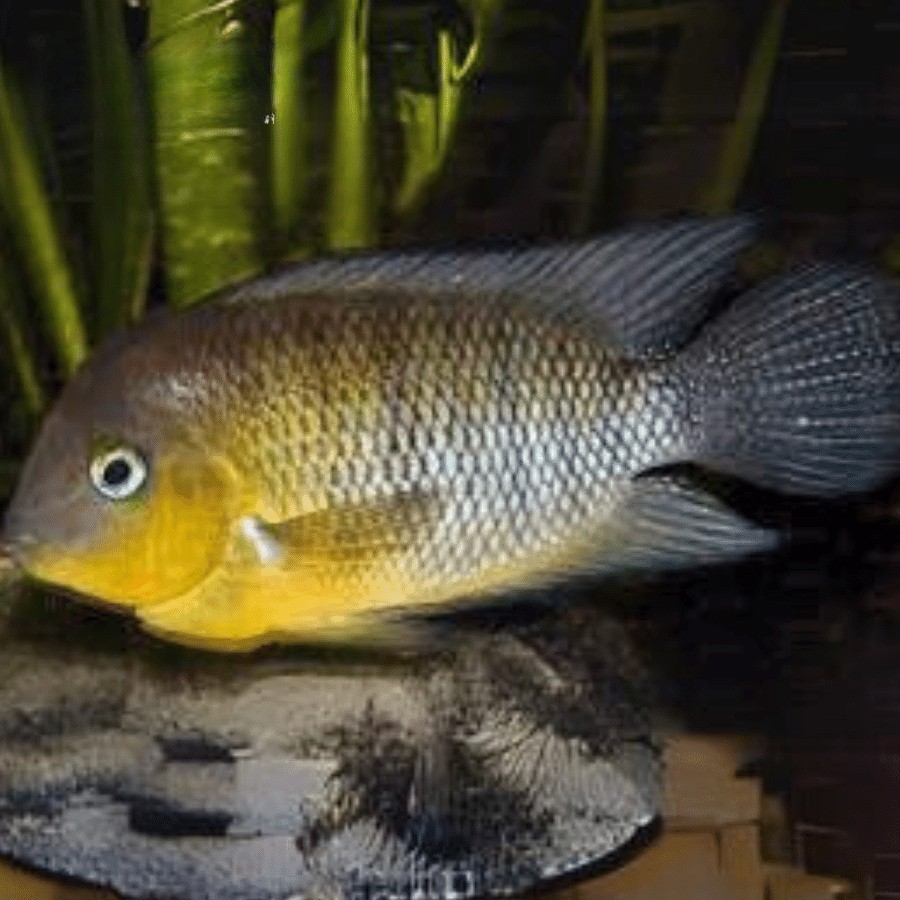
🪨 Species at a Glance
| Scientific Name | Cribroheros rostratus (formerly Cichlasoma rostratum) |
| Family | Cichlidae |
| Order | Cichliformes |
| Origin | Nicaragua, Costa Rica — Atlantic slope karst rivers and lakes |
| Size Offered | 4 cm early juvenile (approx. 2-3 months old) |
| Adult Size | 15-18 cm (6-7 in) at 18-24 months |
| Time to Adult | 12-18 months with good feeding |
| Lifespan | 10-15 years with good husbandry |
| pH Range | 7.0-8.0 (neutral to alkaline) |
| Temperature | 24-28 degC (75-82 degF) |
| Hardness (dGH) | 10-20 (hard water) |
| Diet | Carnivore — high-protein juvenile pellet + frozen brine + bloodworm |
| Starting Tank (now) | 100 L grow-out, bare-ish layout |
| Final Tank (in 12-18 months) | 250 L+ single / 400 L+ pair |
| Care Level | Intermediate — juvenile phase is easy, adult phase is demanding |
| Temperament Now | Curious, social, non-aggressive with size-matched tank mates |
| Temperament Later | Predatory, territorial, will eat smaller tank mates |
| Sex at 4 cm | Impossible to determine visually |
Origin & Etymology
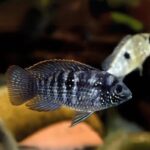
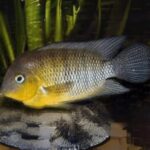
At 4 cm, the fish swimming around your grow-out tank looks almost nothing like the photograph on the species page. The body is a muted silver with a faint gold wash, the lateral bars are soft greys rather than dark charcoal, the snout is only mildly elongated, and the iris of the eye — the celebrated ‘blue eye’ that gives the species its common name — is a barely-there pale sheen with, at best, the faintest hint of blue when the light catches it just right. This is normal, it is developmental, and it is worth understanding before you decide whether a 4 cm juvenile is the right purchase for you. Cribroheros rostratus develops its adult ornamentation slowly. The electric blue iris is a structural-colour feature, built from layers of iridophore cells that only mature and organise themselves into their final reflective configuration as the fish approaches 8 to 10 cm. Before that size, the iridophores are present but sparse and disorganised, producing at most a dim pearlescent gleam. The blue intensifies steadily between 8 and 12 cm, reaches near-adult brilliance by 14 cm, and locks in fully once the fish is mature and confident in its territory.
The scientific name explains the anatomy you can see today, even if you cannot see the colour yet. The genus Cribroheros — erected in 2016 when the enormous Central American Cichlasoma was finally split into coherent smaller genera — combines the Latin cribrum meaning ‘sieve’ (a reference to the pattern of sensory pores on the skull of this clade) with the classical Greek heros used across the cichlid family. The species epithet rostratus means ‘beaked’ or ‘with a prominent snout’, and even at 4 cm you can already see the beginnings of it: the head is subtly longer and more pointed than on, say, a convict or a firemouth juvenile of the same size, with a slight downward curve to the snout line that will exaggerate over the next year as the predator anatomy matures. Until 2016 this fish was sold as Cichlasoma rostratum and much of the older aquarium literature still uses that name, so it pays to search both when researching care.
The common name situation adds one more complication that every keeper of this species should know about. ‘Blue Eyed Cichlid’ is also used in parts of the hobby for completely unrelated small South American dwarf cichlids — most often Laetacara araguaiae (the dwarf flag cichlid or Buckelkopf) which shows a blue iris highlight. Those fish stay under 8 cm adult, are peaceful community dwarfs from soft acidic South American waters, and have nothing in common with Cribroheros except the two-word common name. When a 4 cm juvenile is sitting in front of you it can actually be hard to distinguish these species on size alone, so trust the supplier’s scientific name and the head shape: if the snout is subtly elongated and the body is already showing that slightly arrow-headed profile, you are looking at the Central American predator you ordered, not a South American dwarf. The care pathways are completely different, and a 4 cm Cribroheros placed into a soft-water community tank intended for a Laetacara will not thrive.
Getting the Water Right
7.0–8.0
ideal 7.5
24–28 °C
ideal 26 °C
10–20 dGH
Hard, mineral-rich water — neutral to alkaline
Cribroheros rostratus evolved in the karst-influenced, mineral-rich rivers and lakes of the Atlantic slope of Nicaragua and Costa Rica — a drainage system dominated by limestone, volcanic basalt and calcite-rich sediments where water chemistry runs distinctly hard and slightly alkaline year-round. Typical habitat readings from Lake Nicaragua and the Rio San Juan system show pH 7.5-8.0, carbonate hardness above 10 dKH, and general hardness between 12 and 18 dGH. This is the polar opposite of the soft acidic blackwater that suits most South American dwarf cichlids, and it is non-negotiable for long-term health of this species even at 4 cm. If you have been keeping apistos, rams, discus or tetras, your water-chemistry strategy needs to completely reverse: you want to add mineral content, not strip it out, and you want buffering upward, not downward.
Here is the thing that is sometimes under-emphasised in juvenile care guides: the juvenile phase is when water parameter mistakes cause the most lasting damage. A 4 cm juvenile growing in subtly wrong water — too soft, drifting too acidic, pH swinging around, nitrates creeping up — will still technically survive and grow, but its skeletal development, its fin condition, its eventual colour intensity, and its long-term disease resistance will all be subtly compromised in ways you will only notice years later when the adult fish underperforms the potential of well-raised siblings. Get the water right now, in the first six months, and you set the fish up for a strong adult decade. Get it wrong now and you cannot really retroactively fix it later.
For Australian keepers, the species is genuinely convenient. Most Sydney, Melbourne, Brisbane and Adelaide tap water settles around pH 7.2-8.0 and 8-16 dGH after overnight aging to drive off chlorine, which is close enough to the ideal range that no RO, no buffering salts and no blackwater extract is required. If your local tap water tests on the soft side, drop a small bag of crushed coral into the filter or place a piece of honeycomb limestone in the hardscape — both passively buffer pH upward and supplement hardness in the kind of slow continuous way that keeps parameters stable. Ignore any old forum advice telling you to add ‘cichlid salt’ at marine concentrations; this is a freshwater Central American, not a rift lake African, and it does not need brackish-level additions.
Test weekly during the first six months and for the duration of any tank upgrade transition. A basic liquid test kit covering pH, ammonia, nitrite, nitrate, KH and GH is sufficient; dipsticks are too imprecise for a long-term predator grow-out. Perform 25-30 percent water changes every 7 days — slightly more frequently than you might for an adult, because a juvenile grow-out tank is proportionally more heavily loaded per litre than an adult tank with one mature fish in it. Aim for nitrates under 15 ppm as a grow-out target (stricter than the 20 ppm ceiling for adults, because growing fish benefit from extra-clean water). Ammonia and nitrite must read zero; any deviation is a stop-feeding, big-water-change situation, not something to monitor and see.
Temperature sits in the 24-28 degC band with 26 degC as the sweet spot. A juvenile grow-out tank can nudge slightly warmer — 26.5 to 27 degC — to modestly accelerate growth without sacrificing oxygen, provided the filtration is strong and surface agitation is adequate. Avoid the 28-30 degC range that some discus keepers use; it drops dissolved oxygen as metabolic demand is rising, pushes the fish into a hotter shorter lifecycle, and is not the right baseline for a decade-plus predator. Australian keepers in southern states need a properly sized heater set to 26 degC through winter — unheated tanks dropping below 22 degC in cold months is a common cause of juvenile stress-related illness. A 100 watt heater is fine for a 100 litre grow-out tank; size up with the tank upgrades as you go.
Available Colour Grades
⚪ Juvenile Phase (4 cm — what you are receiving now)
Drab silver-grey body with a faint gold wash, 5-6 soft grey lateral bars rather than dark blotches, no visible blue iris yet beyond a pale pearlescent sheen, and a fin profile that is fully rounded with no trailing filaments. This is how every healthy juvenile looks — do not judge the species by it.
🟡 Sub-Adult Phase (8-12 cm, 6-10 months from now)
Body deepens to gold-silver, lateral bars begin to darken and consolidate into blotches, the snout elongation becomes obvious, and the blue iris finally appears as a clear thin ring around the pupil — still soft in intensity but unmistakably blue under overhead light.
🔵 Adult Form (15-18 cm, 12-18 months from now)
The full display: brassy gold-olive flanks dusted with 5-7 dark charcoal blotches, sharply defined charcoal face bars, long trailing dorsal and anal fin filaments (more pronounced in males), and the signature electric blue iris at its full structural-colour intensity. Some individuals also flash red/orange undertones in the iris.
With Cribroheros rostratus there are no line-bred aquarium morphs to choose between — no Super Red, no Albino, no Gold, no Koi. What you have is the wild fish and three clear life phases to grow through. That framing matters specifically for 4 cm buyers because you are buying into the earliest phase of the sequence, and the single most important mental adjustment you need to make is accepting that the fish will look unremarkable for its first few months in your care. New keepers sometimes panic at this point, assume they bought the wrong fish or that their water is wrong, and start chasing colour with intense lighting, strong pigment-boosting pellets, or dramatic tank changes. Resist that urge completely. Juvenile drabness is not a husbandry failure; it is a developmental stage, as inevitable as a kitten’s eyes being blue before they settle into their adult colour.
The elements that will matter over the next twelve months — the elements you can actually influence to produce a spectacularly coloured adult — are the same ones that matter for any Central American cichlid: clean hard alkaline water, a varied diet heavy on aquatic proteins and naturally astaxanthin-rich foods like whole frozen brine shrimp and chopped krill, a calm tank with pale sand substrate and dark rock contrast to let the fish see its own silhouette and respond to it, moderate warm lighting that does not wash out colour, and minimal stress from territorial pressure or over-frequent tank mate changes. Do those five things consistently between 4 cm and 10 cm and the colour will arrive on schedule. A well-kept Cribroheros at 10 cm already shows the blue iris clearly and unmistakably; by 12 cm it is striking; by the time the fish hits adulthood at 15-18 cm, the flanks, the face bars, and the trailing fin filaments all fill in to produce the finished look. Your job in the juvenile phase is not to force colour; it is to build the biology that will carry the colour.
Aquarium Setup Guide
The question that every 4 cm Cribroheros rostratus buyer asks — ‘what size tank do I need?’ — has an answer that changes twice over the next eighteen months. Right now, for a 4 cm juvenile (or a group of 3-6 juveniles), a 100 litre grow-out tank is perfectly appropriate and even arguably better than a huge adult-sized tank. A small tank lets a 4 cm juvenile feel secure, lets you see and observe the fish instead of losing them behind a mountain of rockwork, concentrates feeding cues so the fish learns to associate your presence with food quickly, and keeps heating/filtration costs manageable during the slowest growth months. A 60 cm x 30 cm x 30 cm tank (about 55 L) is the absolute minimum for a single 4 cm juvenile and does fine as a starter; a 75 cm x 35 cm x 35 cm tank (about 90 L) is comfortable for a solo juvenile or a pair; a 90 cm x 40 cm x 40 cm tank (around 140 L) fits a group of 4-6 juveniles through the first growth phase with room to spare.
By 8 cm — roughly 5-8 months from now if you feed well — the fish has roughly doubled in length and increased body mass by something like eight to ten times. At that point the 100 L grow-out has become genuinely too tight, water quality will be harder to hold, and territorial jostling among a group becomes more pronounced. This is the first upgrade point: plan to move the fish to a 200-250 L tank, minimum, around the 8 cm mark. Then at roughly 12 cm, a year to 15 months from now, the fish is fully entering adult territorial behaviour and the final upgrade to 250-300 L for a single adult or 400 L+ for a pair or group becomes mandatory. We include an explicit upgrade schedule below as a separate reference; plan your budget and your tank real estate with these two future upgrades in mind before you buy the 4 cm juvenile, because the ongoing commitment is meaningfully larger than the sticker price of the fish itself.
Scape-wise, a grow-out tank for this species should be functional rather than showy. Pale fine sand substrate (2-3 cm deep, silica or aragonite), a handful of waterworn river stones and two or three small caves sized for a 4-8 cm fish, a piece or two of driftwood for visual cover, and plenty of open swimming space in the middle of the tank. Skip fine-leaved live plants — they will be dug up or shredded as the juvenile develops its adult substrate-moving behaviours. Anubias barteri tied to a rock, Java fern on driftwood, or a bit of Vallisneria in a rear corner are the plants that reliably survive a Cribroheros, and they carry forward into the adult tank unchanged. Do not build a maze of rockwork in the 100 L grow-out; keep sightlines open, caves simple, and focus on feeding interaction and growth monitoring rather than biotope aesthetics. Save the elaborate rockscape for the 250 L adult upgrade.
Lighting should be moderate and warm rather than intense. An 8-9 hour photoperiod with a single-channel warm-white LED fixture is more than enough. Grow-out tanks can actually benefit from slightly dimmer lighting than adult tanks, because juveniles feel more confident and feed more aggressively when they do not feel exposed — bright overhead light on a bare-ish 100 L tank can push a new juvenile into hiding. Floating plants or a small piece of emergent driftwood to break up the surface helps diffuse the light and calms the fish. Crucially, a tight-fitting lid is non-negotiable even for a 4 cm juvenile — small cichlids jump too, particularly during tank setup stress, water changes, or power outages. Do not let cost or effort talk you out of a proper cover.
Grow-Out Tank (now)
90-140 L (90 cm x 40 cm or similar). Solo juvenile can go smaller; a group of 4-6 juveniles fits a 140 L comfortably until ~8 cm.
Upgrade Tank (in 6-8 months)
200-250 L minimum for the 8-12 cm growth phase. Plan and budget for this before you buy the juvenile.
Final Tank (in 12-18 months)
250-300 L single adult / 400 L+ pair or group. 120 cm x 50 cm footprint strongly preferred over tall narrow tanks.
Filtration
Canister filter rated 2x grow-out volume/hour (e.g. Fluval 207 or equivalent on 100 L), or pair of sponge filters plus small HOB. Over-filter; juveniles are surprisingly heavy feeders.
Heater
100 W heater set to 26 degC for 100 L grow-out. Upgrade to 200-300 W when you move to 250 L+.
Substrate
Fine pale silica or aragonite sand, 2-3 cm deep. Carry the sand forward when you upgrade tanks.
Hardscape (grow-out)
3-4 waterworn stones, 1-2 small caves, optional driftwood. Keep it simple — save elaborate scape for the adult tank.
Lighting
Moderate warm-white LED, 8-9 hours/day. Dimmer is better for juvenile confidence; save the bright lights for when the adult colour fills in.
Cover
Full tight-fitting lid even for a 4 cm juvenile. Small cichlids jump when spooked.
Water Test Kit
Liquid test kit covering pH, KH, GH, ammonia, nitrite, nitrate. Weekly testing during grow-out catches overfeeding and filter issues early.
How to Sex This Species
Let us be completely honest with you up front: at 4 cm, Cribroheros rostratus cannot be sexed visually by anyone. There is no reliable size difference between male and female juveniles from the same spawn, no meaningful fin-shape cue, no colour dimorphism, no body-profile tell, and no venting technique that works at this size. Any shop, breeder or online source claiming to sell ‘sexed’ 4 cm juveniles is either guessing, mistaken, or selling you a story. Do not pay a premium for sexed juveniles at this size under any circumstances. Wait — the fish will tell you.
This is actually a feature of buying at 4 cm, not a bug. Because you cannot force a pair out of sexed adults at this stage, you are pushed toward the technique that works best with this species anyway: buy a small group of 3 to 6 juveniles, grow them together through the critical development window, and let a natural pair emerge as the fish mature. The cost of buying multiple juveniles is modest at the 4 cm price point (this is the cheapest entry into the species), the shared tank space up to 8 cm is minimal (they are still small fish happy in a 100-150 litre grow-out together), and the payoff down the line is enormous: a naturally paired adult couple dramatically outperforms a force-paired one on breeding success, female survival, and long-term stability. If you have any interest at all in eventually breeding this species, buying multiple 4 cm juveniles and letting them pair themselves is unambiguously the best approach on the market. You will need to be ready to rehome the ‘spare’ fish once the pair declares itself at 12-14 cm, but at that point the spare fish will have grown into attractive 10-12 cm subadults that are easy to sell or trade.
The full sex differences only become clear once the fish are in the back half of their growth curve. Somewhere around 12 cm — roughly a year from now for a well-fed 4 cm juvenile — you will start to notice that a few fish in the group carry their fins a little longer, stand a little taller in the shoulder, and start to claim space more insistently. Those are your males. The females stay more compact, rounder in the belly, and shorter-finned, and in a maturing group they will often partner up with a specific male before either fish shows any breeding behaviour. By the time the pair is spawning-ready at 14-15 cm, the differences are unmistakable: males carry a modest nuchal hump (never flowerhorn-sized, just a gentle dome on the forehead), trailing dorsal and anal fin filaments that extend a centimetre or more past the caudal peduncle, a darker and more contrast-rich face-bar pattern, and a noticeably more intense blue iris. Females are smaller, rounder, shorter-finned, and when in breeding condition show a clear pre-spawn belly swell as the eggs develop. All of this is 10 to 14 months in your future. For now, in the juvenile phase, simply accept that you are raising unsexed babies and enjoy the growth itself.
| Feature | Male | Female |
|---|---|---|
| At 4 cm (now) | Visually identical to female | Visually identical to male |
| At 8 cm (in ~6 months) | Still largely indistinguishable — faint size and fin-length cues at best | Still largely indistinguishable |
| At 12 cm (in ~12 months) | Deeper body, longer fin ray tips beginning, slightly bolder iris | Rounder belly profile, shorter fin ray tips |
| Adult (15-18 cm) | 16-18 cm, subtle nuchal hump, long trailing dorsal/anal filaments, electric blue iris, darker face bars | 13-15 cm, rounder belly, shorter fins, slightly softer iris intensity |
Nutrition & Diet
The juvenile phase is the one period in a Cribroheros rostratus’s life where feeding frequency and protein density genuinely matter for long-term outcomes, and getting it right at 4 cm pays dividends for years. A growing cichlid laying down muscle, bone and ornamentation needs significantly more calories per gram of body weight than a mature adult; it also has a smaller gut capacity, so it cannot take those calories in a single daily feed the way an adult can. The standard adult prescription of ‘one feeding a day plus a fasting day per week’ is completely wrong for a 4 cm juvenile — follow that plan and you will see stunted growth, pale colour, and an adult that never quite fills out to its genetic potential.
The juvenile feeding target is small portions, 3 to 4 times a day, heavy on aquatic protein, lightly varied across food types. Each feeding should be what the fish can comfortably consume in 20-30 seconds — for a 4 cm juvenile, that is a genuinely tiny amount (3-5 small crushed pellets, or a pinch of thawed brine shrimp). The goal is steady continuous fuelling of the growth process, not occasional large meals. Feeding four small portions across the day, spaced roughly every 3-4 hours during your awake hours (say, 7am, 11am, 3pm, 7pm), will see a 4 cm juvenile visibly grow week-over-week and hit 8 cm around the 6-month mark in good conditions.
Build the juvenile diet around three layers. The staple, roughly 60 percent of feedings, is a high-protein sinking cichlid pellet crushed between your fingers into a size the 4 cm mouth can actually handle. Good choices include New Life Spectrum (NLS) Cichlid Formula, Hikari Cichlid Staple Baby, Fluval Bug Bites Growth Formula, or Omega One Super Colour Cichlid Pellets — any of these have the roughly 45-50 percent protein content juveniles need. Crush the pellet until the fragments are no larger than the fish’s pupil; a whole 3 mm pellet is still too big for many 4 cm juveniles to swallow cleanly. The second layer, roughly 30 percent of feedings, is frozen high-protein foods thawed in a small cup of tank water before adding: frozen baby brine shrimp, frozen bloodworm (chopped finer for small mouths), frozen mysis, or frozen cyclops. These deliver the natural pigments and varied amino acids that drive colour development and varied gut biome, and they mimic the insect-larvae-and-shrimp diet that juvenile Cribroheros naturally take in Nicaraguan streams. The third layer, roughly 10 percent, is occasional enrichment: a small amount of live baby brine shrimp (easy to hatch yourself from eggs), live micro-worms, or cultured whiteworms. Live food at the juvenile stage is enrichment and training — it sharpens the hunting response and makes the fish interactively excited about feeding — rather than a primary calorie source.
Avoid two categories entirely, even at the juvenile stage. First, do not feed mammalian meat — no beef heart, no chicken, no pork — at any life stage. Saturated fats from warm-blooded animals cause cumulative fatty liver disease (hepatic lipidosis) in tropical cichlids, and damage accumulated during juvenile high-feeding windows is particularly hard to recover from. The old beef-heart-for-growth trick from the 1980s discus and flowerhorn scene is now understood to shorten lifespan significantly, and modern best practice across serious large-cichlid keeping is to skip it entirely. Second, avoid live feeder fish from any source, ever. Feeders are the commonest vector for internal parasites (camallanus, capillaria, Spironucleus) and fish tuberculosis, and a juvenile that picks up one of these during the critical early growth window may never fully recover. Culture your own brine shrimp or micro-worms if you want live food — do not buy feeder guppies.
Watch the body condition weekly as you feed. A healthy growing juvenile has a gently rounded belly that is visibly fuller immediately after feeding, a firm muscular dorsal line, bright clear eyes, and pink healthy gills visible through the operculum. An overfed juvenile has a persistently distended belly even hours after feeding, a disproportionately bulky profile, and lethargic behaviour between meals — cut feeds back to three a day. An underfed juvenile shows a visibly sunken belly profile, slower growth than siblings, duller colour, and constant begging behaviour at the glass — increase feed quantity per meal slightly, not feeding frequency. Four small feedings a day is the target; the portions should be small enough that all four get eaten cleanly and nothing reaches the substrate.
Community Compatibility
Community planning for a 4 cm Cribroheros rostratus has one critical twist that makes it different from almost every other species guide: the tank-mate calculus changes dramatically as the fish grows. What is compatible today will not be compatible in eighteen months, and keepers who ignore this end up watching their beloved community tetra shoal get eaten one by one as their cichlid grows up. Build the community plan with the future fish in mind, not just the present one.
In the juvenile phase (now, 4-8 cm), you actually have meaningful flexibility. A 4 cm Cribroheros is not a terror — it is a curious, moderately social, non-territorial juvenile that coexists reasonably with size-matched tank mates. You can reasonably combine a juvenile Cribroheros with small juvenile convicts or firemouths, a shoal of robust tetras or rainbowfish (Buenos Aires tetra, Congo tetra, Australian rainbow), a group of giant danios, and a bristlenose pleco or two. For the 6-8 month window between 4 and 8 cm, this kind of mid-sized Central American plus dither community tank works beautifully, shows off the juvenile’s growth process, and teaches the fish to coexist with movement and activity rather than hiding.
By 8 cm, however, the calculus shifts. The Cribroheros mouth gape has increased dramatically, the predatory instinct starts to assert itself, territorial behaviour emerges, and fish under 5-6 cm that were perfectly safe for months suddenly become snacks. Rehome the smaller community fish — the smaller tetras, any juvenile convicts that have not kept pace, small rainbowfish — before they become food. Keep only the tank mates that will scale with the adult fish: robust upper-water dither like giant danios and silver dollars, the armoured bristlenose pleco, and (in a larger tank) a size-matched adult Central American like a firemouth or a salvini that can hold its own.
By adulthood (15-18 cm), the compatible-fish list has narrowed significantly. You are now keeping a 15+ cm predator with a mouth gape that can swallow anything under 8 cm in a single strike. The appropriate adult community is either a species tank with a solo fish or bonded pair, a Central American biotope with 2-3 size-matched robust species in a 400 L+ tank with strong territorial separation, or a predator tank with large upper-water dither (silver dollars, giant danios, large rainbow fish). Every fish in the tank at that stage must be either too large to be eaten or physically defended (pleco armour, shoal speed, etc.). Plan your tank mates now with this end-state in mind; do not stock species you will have to rehome in a year because you did not think ahead.
The upgrade table below maps the transition explicitly, so you can see at a glance which tank size and which tank mates belong at each size milestone.
Upgrade Schedule — Quick Reference:
– At 4 cm (today): 100 L grow-out. Solo or group of 3-6 juveniles. Can include small robust tetras, rainbows, giant danios, small cons/firemouths, bristlenose pleco.
– At 8 cm (6-8 months from now): Upgrade to 200-250 L tank. Rehome small tetras and rasboras. Keep giant danios, silver dollars, size-matched adult firemouths, bristlenose pleco.
– At 12 cm (12 months from now): Still in the 250 L tank, but territorial behaviour emerging. Rehome anything smaller than 6 cm. Prepare the 300-400 L final tank if keeping a pair.
– At 15-18 cm (18+ months from now): Final adult tank 250-300 L solo or 400 L+ pair. Compatible: large dither (silver dollar, giant danio), Central American pair-matches in biotope tanks (400 L+), bristlenose pleco. Incompatible: anything under 8 cm.
This table is not optional planning — it is the actual roadmap of the next eighteen months of your tank. Print it out, stick it on the tank stand, and revisit it every time the fish hits a new size milestone.
| Species | Why | |
|---|---|---|
| ✅ | Small Convict Cichlid (Amatitlania nigrofasciata) — juveniles matched size | At 4 cm juvenile sizes, a convict of similar size makes a reasonable tankmate — same water chemistry, similar hardiness, comparable temperament. Both will grow; plan to reassess at 8 cm. Do not pair an adult convict with a juvenile Cribroheros. |
| ✅ | Small Firemouth Cichlid (Thorichthys meeki) — juveniles matched size | Juvenile firemouths share the Central American hard-water biotope and are broadly compatible with juvenile Cribroheros of matched size. Both species mature into mid-sized cichlids around the same timeframe; can grow up together in parallel. |
| ✅ | Giant Danio (Devario aequipinnatus) | Fast, robust, tolerates hard alkaline water, occupies the upper water column. A shoal of 6-8 is an excellent dither fish choice for both the grow-out phase and the eventual adult tank — too quick and too large to be eaten even by an adult Cribroheros. |
| ✅ | Silver Dollar (Metynnis argenteus) — adult-sized only | For long-term planning. Adult silver dollars are large enough that an adult Cribroheros cannot eat them, and they occupy the upper water column. Best added later, at the 250 L upgrade stage, not to the 100 L grow-out. |
| ✅ | Robust Tetra Community (Buenos Aires, Congo, Australian Rainbow) | LIMITED-TIME compatibility. Fast, robust, 5+ cm tetras and rainbows can cohabit with juvenile Cribroheros in the grow-out phase. However — and this is critical — you MUST rehome them by the time your Cribroheros reaches 8 cm. Any tetra under 8 cm is adult-Cribroheros food. |
| ✅ | Bristlenose Pleco (Ancistrus sp.) | Hardy, hard-water tolerant, armoured enough that a Cribroheros will not mess with it. Works across all life phases and tank sizes — a safe choice from the 100 L grow-out all the way through to the 400 L adult tank. |
| ❌ | Neon Tetra, Cardinal Tetra, small Rasboras, Ember Tetra — anything under 4 cm | Even now, at 4 cm, your Cribroheros has a mouth large enough to take small tetras under 3 cm. By the time it reaches 6 cm it can eat most rasboras. By adulthood it can eat anything under 8 cm. Skip this category entirely — there is no size window where small tetras are safe. |
| ❌ | Shrimp (Cherry, Amano, Crystal), freshwater snails | Shrimp and soft-shelled snails are a natural wild prey item for Cribroheros — even juveniles will hunt them. Any shrimp added will be eaten within days. Skip entirely. |
| ❌ | Discus, Angelfish, South American dwarf cichlids (Apistogramma, Rams) | Complete water-chemistry mismatch — these need soft acidic water, Cribroheros needs hard alkaline. Even setting aside the future size and predation issues, the environmental requirements are incompatible from day one. |
| ❌ | Adult Cichlids Larger Than Your Juvenile Cribroheros (adult Jack Dempsey, adult Oscar) | For now, in the juvenile phase, any cichlid substantially larger than your 4 cm fish is a predator or a bully. An adult Oscar or adult Jack Dempsey will eat or harass a 4 cm juvenile. Wait until your Cribroheros reaches adult size before considering equal-sized adult Central Americans. |
| ❌ | African Rift Lake Cichlids (Mbuna, Peacocks) | Water chemistry is compatible in broad terms but behaviour is not. Mbuna aggression is constant and boundaryless, Central Americans are spike-aggressors around spawning. Combining them leads to chronic stress for both groups regardless of life stage. |
How to Breed
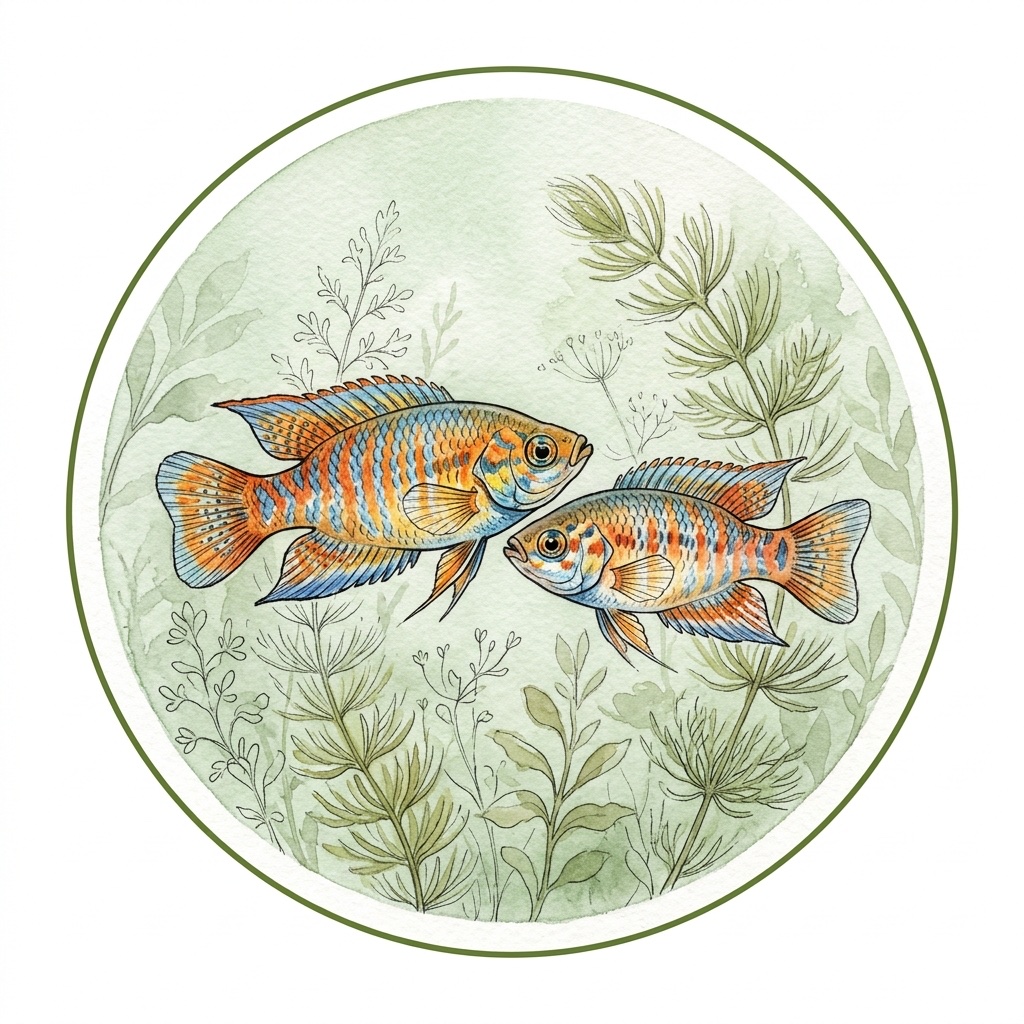
Month 0 (now)
4 cm Juveniles in Grow-Out
Fully sexually immature; cannot be sexed
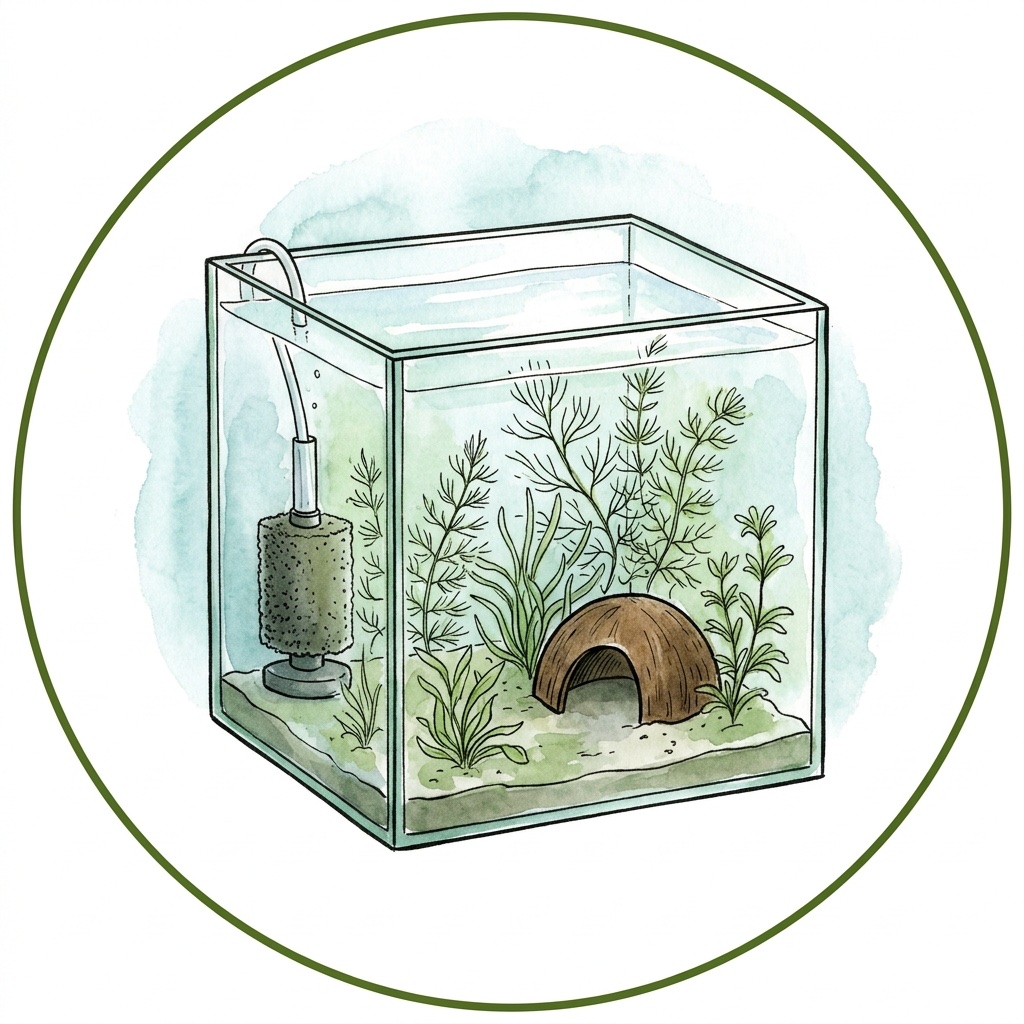
Month 6-8
Subadult — First Pair Hints
Fish hit 8-10 cm, blue iris visible, subtle size/fin differences appear
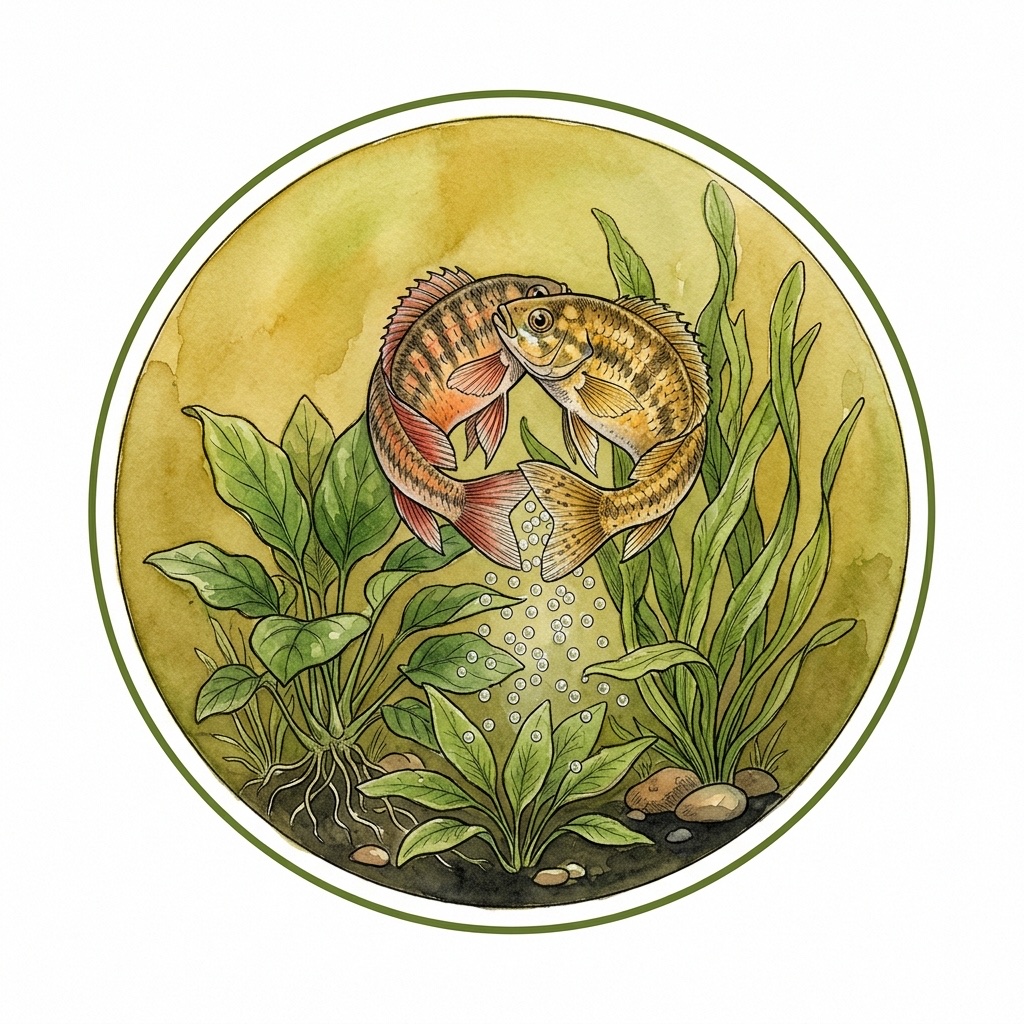
Month 10-14
Pair Declaration
A male and female consistently hang together and defend shared space
Month 14-18
First Spawn
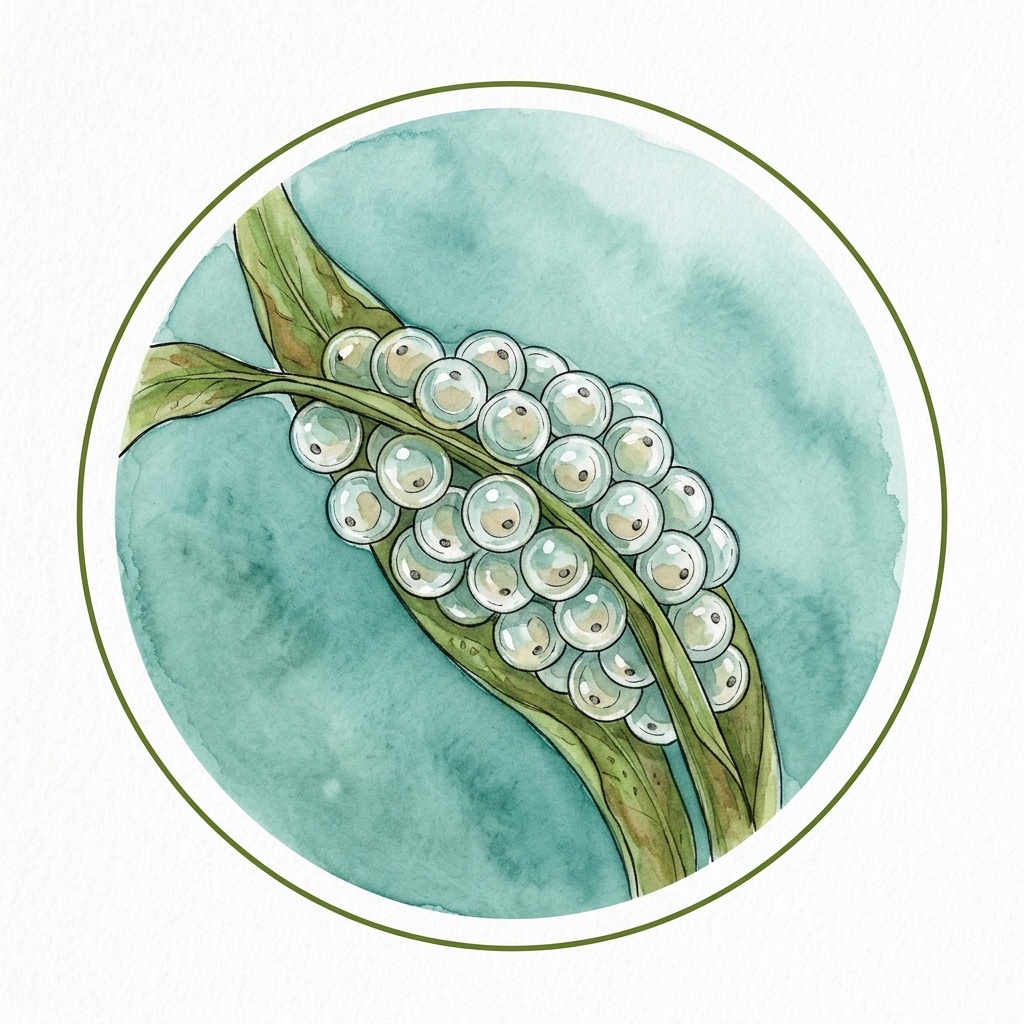
200-500 eggs on a cleaned flat rock, biparental defence
4 cm Juveniles in Grow-Out
Your 4 cm juveniles are roughly 2-3 months out of the spawning pit and are still almost a year from their first sexual maturity. Sex cannot be determined visually. Focus on growth, water quality, and diet during this phase — any time spent speculating about sex ratios is wasted. If you have bought a group of 3-6 juveniles with eventual breeding in mind, simply raise them together and check back in a year.
Subadult — First Pair Hints
Somewhere between 8 and 10 cm — typically 6-8 months of good feeding from the 4 cm starting point — the first subtle dimorphism cues appear. A handful of fish in the group stand marginally taller, carry slightly longer fin tips, and start to claim favoured rocks or corners more insistently. These are likely males beginning to express dominance. Still not reliable for confident pairing decisions, but worth starting to note who associates with whom. THIS is the point at which you must have moved the fish to the 200-250 L upgrade tank; trying to observe pairing behaviour in a cramped grow-out will not work.
Pair Declaration
At around 12-14 cm, typically 10-14 months after you bought the 4 cm juvenile, a natural pair will usually declare itself inside a group. Two fish consistently swim together rather than with the group, occupy the same rock or cave, defend a shared radius against siblings, and may begin rough courtship with jaw-locking and lateral displays. This is the moment to separate the pair into their own dedicated 300-400 L breeding tank and rehome the ‘spare’ fish (now attractive 10-14 cm subadults that sell easily). Your grow-out tank has now done its job and can be re-tasked or sold.
First Spawn
In the dedicated breeding tank, with pristine hard alkaline water and a varied high-protein diet, a bonded pair typically spawns for the first time within a few months of pair formation. The pair cleans a flat horizontal rock surface for 2-5 days, then spawns in the morning with the female laying sticky amber eggs in neat rows and the male fertilising immediately behind. 200-500 eggs is a typical first spawn. Both parents defend the clutch aggressively. Eggs hatch at 72 hours, fry become free-swimming around day 7-8, and parents herd the cloud together for several weeks. At this point the fish you bought as a 4 cm juvenile is a fully mature adult raising its own 4 cm juveniles — a full biological cycle completed in your care.
Quick Reference
| Scientific Name | Cribroheros rostratus (ex. Cichlasoma rostratum) |
| Common Name | Blue Eye Cichlid (4 cm juvenile) |
| Size Offered | 4 cm early juvenile, approx. 2-3 months old |
| Adult Size | 15-18 cm at 18-24 months |
| Lifespan | 10-15 years |
| pH | 7.0-8.0 (ideal 7.5) |
| Temperature | 24-28 degC (ideal 26 degC) |
| Hardness | 10-20 dGH — hard water |
| Starting Tank | 90-140 L grow-out now |
| Upgrade at 8 cm | 200-250 L (6-8 months away) |
| Final Tank | 250 L+ single / 400 L+ pair (12-18 months away) |
| Juvenile Diet | 3-4x daily — crushed cichlid pellet + frozen brine + bloodworm |
| Sex at 4 cm | Indistinguishable — wait until 12 cm+ |
| Care Level | Intermediate (juvenile easy, adult demanding) |
| Price | $22.50 AUD (4 cm juvenile — cheapest entry point) |
Related Products
Reviews
Clear filtersThere are no reviews yet.