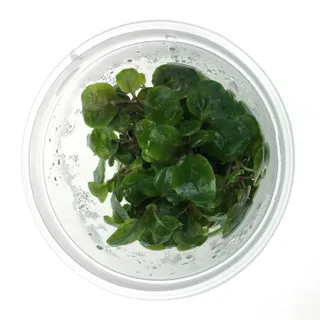
🪨 Species at a Glance
| Scientific Name | Lobelia cardinalis (dwarf aquatic form) |
| Common Names | Dwarf Lobelia, Cardinal Plant, Cardinal Flower (terrestrial form) |
| Family | Campanulaceae (bellflower family) |
| Origin | Eastern and central North America (wild type, emergent habitat) |
| Natural Habitat | Marginal and bog plant along streams, wet meadows, seasonally flooded ditches |
| Form | TC (Tissue Culture, lab-grown, pest-free); aquarium dwarf cultivar |
| Plant Type | Stem plant with compact branching habit |
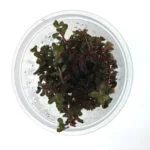
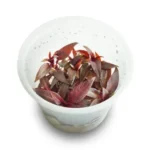
| Leaf Appearance | Oval to spoon-shaped; green top, red-purple underside (two-tone) |
| Max Height | 10-20 cm submerged |
| Placement | Midground; red-purple accent between carpet and background |
| Light Level | Medium |
| CO2 | Not strictly required; helpful for compact colour-rich growth |
| Growth Rate | Slow to medium |
| Propagation | Stem cuttings; side shoots from lower nodes |
| Difficulty | Intermediate |
How to Plant
Stem
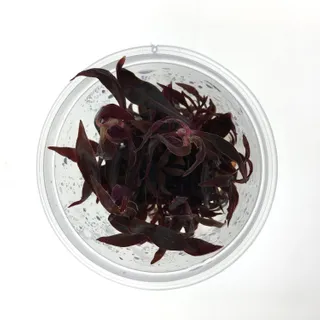
Lobelia cardinalis is planted as individual stems, each cut cleanly at a node and pushed into the substrate so the bottom 2-3 cm of stem (including at least one dormant node buried beneath the surface) can put out adventitious roots within the first 10-14 days. Unlike rosette plants such as sword-type Echinodorus or Helanthium, whose crown must sit precisely at the substrate surface, or rhizome epiphytes like Anubias and Bucephalandra, whose rhizome must never be buried at all, a stem plant thrives precisely because its nodes are buried: each buried node becomes a root-producing site, and the more nodes you tuck under the substrate, the more stable and fast-rooting the plant becomes. For this species specifically, a 3 cm planting depth is the sweet spot: shallower and the stem will float loose on its first water change or the first time a curious fish or shrimp nudges it, while deeper than 4 cm risks the buried leaves rotting against the stem and fouling the substrate pocket with bacterial decay.
When your TC cup arrives, peel back the foil lid carefully and remove the sealed gel puck holding the plantlets in a dense cluster. Rinse the agar gel gently off the base of each plantlet under lukewarm dechlorinated water (22-25 degrees Celsius) so you do not thermally shock the tissue. The agar gel is a sugar-and-vitamin-rich medium designed to feed the plant during lab propagation, and it is also a perfect food source for opportunistic bacteria once introduced to a non-sterile aquarium. Leaving gel attached to the stem base will fog your water on day one and can seed a short-lived bacterial bloom that lingers for a week or more, sometimes triggering a secondary diatom outbreak that settles on your plant’s new leaves. Work the gel away between your fingers gently but thoroughly, and gently tease apart the tightly packed plantlets. A single TC cup of Lobelia cardinalis typically yields 12-20 individual small stems or 8-12 usable small bouquets, enough to plant a midground cluster in a 45-60 cm tank or to seed several distinct accent groups in a 90 cm display tank.
Using fine-tipped aquascaping tweezers (24 cm curved tips work best for most mid-size tanks, 30 cm straight for deeper display aquariums), grip each stem just above the lowest leaves and push it into the substrate at a shallow 30-45 degree angle, then release the tweezers carefully so the stem settles upright. Space individual stems 1.5-2.5 cm apart; this species branches readily from its lower nodes once established, so what starts as a sparse-looking planting fills in over 8-12 weeks into a dense, textural bush. Avoid the common beginner mistake of planting an entire TC cup as one giant bouquet jammed together: this stresses every stem in the cluster through root and light competition, and almost always results in the inner stems rotting away within a month while the outer stems barely hold on. Give each stem its own root zone. If you intend the planting to read as a single coherent colour mass, plant in a loose grid of individual stems 2 cm apart rather than as a single bundled clump; the grid fills in over weeks as each stem branches, and the final result is markedly healthier and more uniformly coloured than any clump-planting approach.
Expect a transition period that is normal, expected, and sometimes alarming for hobbyists new to TC stems. Lobelia cardinalis is emersed-grown on the lab bench, with thicker, waxier, slightly larger leaves optimised for atmospheric gas exchange at 100 percent humidity under bright emersed lighting. Over the first 2-4 weeks fully submerged, the original emersed leaves will progressively soften, yellow, sometimes develop translucent patches, and eventually melt away, while the plant pushes out smaller, thinner, truly submerged leaves from the growing tip that display the characteristic two-tone green-top, red-purple-underside colouration far more vividly than the emersed leaves ever showed. This is not plant death; this is leaf-form transition at the cellular level, and trying to rush it with extra fertiliser or extra light simply increases the risk of algae outbreaks on the struggling emersed leaves. Trim any fully melted leaves with sharp scissors at the base to keep them from fouling the water column, and the tank will stabilise on its own within three to four weeks. By week 5-6 you will see the first new submerged leaves emerge in tight rosettes at the growing tip, announcing that your plants have completed the transition and are ready to grow on into the mature dwarf submerged form.
Growing & Trimming
MEDIUM GROWTH
Healthy Lobelia cardinalis in its dwarf aquarized form grows at a slow-to-medium pace that rewards patience and steady care rather than fast-paced stem-plant hobbyists used to the rampant growth of Rotala, Ludwigia, or Hygrophila. Under medium light and balanced fertilisation without CO2, expect a stem to reach 10-15 cm within 3-4 months, pushing a new pair of leaves every 7-12 days once past the initial emersed-to-submerged transition period. With pressurised CO2 injection added to the same tank at 20-30 ppm, the plant roughly doubles its pace, reaching 15-20 cm within 6-8 weeks and producing new leaves every 3-5 days while branching from lower nodes to build a bushier structure.
In a freshly planted tank, the first 4-6 weeks are dominated by the emersed-to-submerged transition, so do not judge growth rate or consider the plant ‘stalled’ until it is firmly producing its new submerged leaf form and the original emersed leaves have fully melted away. Many hobbyists abandon TC Lobelia during this window believing it is failing, which is a common and preventable disappointment; patience during weeks 2-6 is the single biggest difference between success and unnecessary frustration with this species.
Maintenance is refreshingly straightforward for a stem plant, because Lobelia cardinalis does not grow fast enough to demand weekly top-trimming the way Rotala or Hygrophila species do. The main routine tasks are top-trimming every 4-6 weeks once stems reach your desired height, and selectively removing old outer leaves at the bottom of stems that have started to yellow or have been overtaken by green spot algae. To top-trim, snip the main stem cleanly with sharp aquascaping scissors 1-2 cm below your target height, just above a leaf pair; the plant will push out two new side shoots from the node immediately below the cut within 2-3 weeks, and the result is a bushier plant with more stems overall. The cut tops can be replanted into the substrate nearby to densify the cluster, or discarded if the planting is already at its target density. This ‘cut and replant’ cycle every 1-2 months is how you transform an initial TC cup into a dense, mature midground cluster over 6-12 months.
Avoid the beginner trap of pulling entire stems out by the roots ‘to replant them straight’. Stem plants invest substantially in their buried root systems once established, and ripping a plant out to reset its angle sets it back 3-4 weeks while it regrows the destroyed root system. If a stem has fallen over or is growing at an unwanted angle, either top-trim it and let a fresh vertical shoot emerge, or gently work the stem straight with tweezers while leaving the roots in place. Only uproot stems when you need to restart with a cluster that has become thoroughly algae-covered, rotted at the base, or has failed to establish over a long observation period. Regular observation during weekly water changes catches most problems early and keeps maintenance light; the price of letting issues accumulate for a month is always higher than the price of a weekly five-minute check.
Weekly inspection and debris clearing
Scan the stem bases during weekly water changes for trapped mulm, yellowing outer leaves, or signs of stem-base rot; gently fan debris away with your hand or a turkey baster and snip any obviously melted leaves at the base
Biweekly leaf audit for algae
Check mid-age and lower leaves for green spot algae or black brush algae; snip affected leaves cleanly at the base rather than pulling them by hand, which can tear the stem and leave an infection site open for bacterial decay
Monthly top-trim when at target height
Once stems reach desired height, trim the top 1-2 cm just above a leaf pair to trigger side-branching from the node below; replant trimmings into the cluster to densify, or discard if cluster is already dense enough
Quarterly root tab refresh
Push a nutrient capsule (Seachem Flourish Tab, Tropica Plant Growth Capsule, ADA Multi Bottom) approximately 2 cm below each stem cluster every 3 months to maintain substrate fertility, using long tweezers to bury the tab fully
Quarterly cluster thinning
If the cluster has become so dense that inner stems are shaded out and yellowing, selectively remove 20-30 percent of the oldest stems to restore light penetration and water flow through the midground
Seasonal temperature check
During summer months in warm climates, check tank temperature daily and deploy a surface fan or adjust lighting to prevent sustained temperatures above 28 Celsius, which is the single most common cause of catastrophic Lobelia cardinalis melt
Lighting Guide
MEDIUM LIGHT
PAR: 40-80 PAR at substrate level (moderate LED intensity at roughly 55-70 percent dimmer)
High
Lobelia cardinalis is a medium-light plant in its aquarized dwarf form, which in practical terms means a modern LED fixture delivering 40-80 micromols of PAR (Photosynthetically Active Radiation) measured at the substrate surface where new side shoots will emerge and where the lower canopy of mature stems receives its share of illumination. On aquariums up to 45 cm tall, popular fixtures such as the Chihiros WRGB II, Twinstar S-series, ONF Flat Nano+, Fluval Plant 3.0, and Week Aqua M-series reach this target range at approximately 55-70 percent of their maximum dimmer setting, which is a sensible default starting point for a newly planted tank. If your fixture has no published PAR data and you do not own a PAR meter, aim for approximately 25-45 lumens per litre or 0.4-0.7 watts of modern LED per litre on a standard 35-45 cm tall tank.
Light intensity interacts in a specific, observable way with this plant’s signature two-tone colouration. Under low light below 30 PAR, the upper leaf surface fades from bright crisp green to a tired yellowish-green, internodes stretch longer as the stem reaches for the light, and the red-purple underside pigment thins out to a muted pinkish tone that loses much of its visual impact in the tank. Under medium light of 40-80 PAR, the upper surface holds a vivid clean green, internodes stay short and compact giving the classic dwarf bushy habit, and the underside pigment saturates to the rich red-purple for which this cultivar is prized. Push into high-light territory above 100 PAR without correspondingly strong CO2 and complete fertilisation, and you will see the classic signs of too-much-light-for-the-growth-rate: pinholes in mid-age leaves, edge browning on new growth, and green spot algae (GSA) or black brush algae (BBA) colonising the slowly-photosynthesising leaves. Light is a lever to adjust downward, not upward, for this species; if anything looks off, the first diagnostic question is ‘is the light perhaps too strong for current CO2 and fertilisation?’ rather than ‘should I add more light?’.
A stable, consistent photoperiod is more important than raw intensity. A 7-9 hour photoperiod is the safe sweet spot for this species; going to 10 hours works only if CO2 is injected and fertilisation is dialled in with weekly water tests to verify no deficiency is developing during the longer photosynthetic window. Use a smart plug or a fixture-built-in timer to hold the schedule to the minute, because this plant responds to erratic lighting with algae before it responds with growth. Watch the newest leaves at the growing tip as a living diagnostic tool: if they emerge pale, small, and with stretched internodes, light is too low or the plant is shaded by overgrown neighbours; if they emerge cupped, reddish-brown on the top surface with visible algae on day five, light is excessive relative to the current CO2 and fertiliser balance. A siesta schedule (4 hours on, 4 hours off, 4 hours on) is a viable option for algae-prone tanks and is well tolerated by Lobelia cardinalis, because the dark midday period allows CO2 to rebuild and algae to experience a mid-day stress that slows their colonisation, before the plant receives a second photosynthetic burst in the afternoon.
Recommended Photoperiod: 7-9 hours (8 hours is a sensible default for most setups); 4+4 hour siesta schedule with a 4-hour dark midday also well tolerated and algae-suppressing
Carbon & Nutrients
CO2 OPTIONAL
Pressurised CO2 injection is not strictly required for Lobelia cardinalis to survive and grow in its dwarf aquarized form, but it is genuinely helpful in a way that sets this species apart from truly low-demand plants like Anubias or Java Fern where CO2 injection adds marginal cosmetic gain. Without CO2, in a balanced medium-light tank with regular fertilisation, this plant grows at a slow pace, produces new leaves every 7-12 days, maintains a modest underside blush that is visible but muted, and slowly densifies its midground cluster over the course of 3-6 months. With pressurised CO2 injection at 20-30 ppm (a drop checker holding a pale lime-green colour during the photoperiod), everything accelerates and intensifies in a visibly measurable way within 10-14 days of switching from non-CO2 to injected CO2: internodes tighten, leaves become thicker and more rigid, the red-purple underside deepens toward a saturated magenta, new growth appears every 3-5 days, and the plant’s overall habit shifts from ‘pleasantly present’ to ‘eye-catching colour accent’ in the scape.
The decision is genuinely optional and depends on the tank’s other plants, livestock, and your own preferences as an aquascaper. If your tank houses other medium-demand stems (Ludwigia, Rotala, Bacopa, Hygrophila) that all benefit from CO2, you will almost certainly already have CO2 injection running, and Lobelia cardinalis will simply thrive within that existing system with no additional intervention. If you are running a low-tech tank with primarily rhizome epiphytes, Cryptocoryne, and easy-care stems, Lobelia cardinalis will grow acceptably but will not express its full aesthetic potential, and a liquid carbon supplement (Seachem Excel, Easy Carbo, UNS Plant Fuel) dosed at manufacturer’s standard rate provides a measurable boost, though it never fully matches pressurised injection. Dose liquid carbon in the morning roughly an hour before lights-on for best uptake; this species tolerates liquid carbon well and does not show the leaf damage that some sensitive species (Vallisneria, certain mosses, Riccia) exhibit under daily glutaraldehyde-based dosing.
One CO2-related caution specific to this plant: Lobelia cardinalis is more sensitive to sudden CO2 swings than most stems. A CO2 timer failure where CO2 pumps continuously for 24 hours at normal injection rate will drop tank pH sharply and can damage the stem tips of this species more quickly than it will harm Rotala or Ludwigia growing nearby. Use a solenoid on a fixture-synced timer so CO2 stops overnight, and confirm solenoid function monthly with a visual check of your drop checker in the morning (should be blue, not yellow) and at peak photoperiod (should be lime-green, not yellow) to catch any creeping injection rate creep before it damages your plants.
Fertilisation
Fertilisation strategy depends on substrate choice and overall tank goals, and the correct approach balances water-column and substrate feeding. In a nutrient-rich aquasoil tank during the first 6 months of setup, no water-column dosing is generally necessary: the substrate supplies almost everything the stem roots need, and the plant’s moderate root development allows it to exploit substrate nutrients efficiently. After 6 months, or immediately if using inert sand or gravel, begin an all-in-one liquid regimen (Tropica Specialised Nutrition, ADA Green Brighty Neutral, Seachem Flourish Comprehensive, or any comparable product) dosed at manufacturer rate, adjusted down to 50 percent for a light-stocked tank with low fish load, or at full 100 percent rate for a medium-stocked tank with regular feeding and visible fish activity. Overdosing liquid ferts in a low-bioload tank is the single most common cause of green spot algae and green dust algae outbreaks; err toward under-dosing and observe the plant’s response over 2-3 weeks rather than piling in a full manufacturer-recommended dose from day one of a new tank when biomass is low and demand is still minimal.
This species responds particularly strongly to iron dosing for underside colour saturation, and learning to tune iron levels is one of the most satisfying fertilisation skills you can develop around this plant. A dedicated Fe+ supplement such as Seachem Flourish Iron or Tropica Premium, dosed at 1 ml per 40 litres two to three times per week, saturates the red-purple underside pigment visibly within 7-10 days when starting from an iron-depleted baseline. Overdoing iron pushes the underside almost burgundy and can spill onto the top surface, which looks muddy rather than crisp; the target is a clean bright green top and a warm red-purple underside, not an overall purple-tinged plant. Macro nutrients (N, P, K) need to be in reasonable balance; nitrate in the 10-20 ppm range, phosphate in the 0.5-1.5 ppm range, and potassium not limiting. Trace micronutrients from an all-in-one or from a dedicated micro blend keep the leaves producing chlorophyll without interveinal chlorosis.
Root tabs placed beneath each stem cluster every 3 months are a worthwhile addition in any substrate, inert or aquasoil: push a Seachem Flourish Tab, Tropica Plant Growth Capsule, or ADA Multi Bottom approximately 2 cm below the base of a cluster every quarter. Use long tweezers (at least 25 cm for most tanks) to push the tab fully into the substrate; tabs left on the surface or partially buried leach straight into the water column and feed algae rather than the plant roots.
Signs of deficiency on this species are diagnostic and specific, and worth learning. Yellowing between the veins of young leaves while the veins themselves stay green (interveinal chlorosis) indicates iron deficiency and responds within 5-7 days to a Fe+ supplement. Pale green new growth with noticeably smaller leaves suggests nitrogen is the limiting nutrient; check nitrate on a drop test or test strip and raise it toward 10-20 ppm by dosing KNO3 from a stock solution or feeding fish slightly more generously. Pinholes appearing in mid-age leaves with ragged edges and no direct physical cause point to potassium deficiency and respond to higher K+ dosing via an all-in-one fert at higher dose or via a dedicated potassium supplement. Loss of underside red-purple colour in otherwise healthy-looking leaves is the earliest sign of trace-element (especially iron and manganese) deficiency, and is the ‘canary’ to watch if you are trying to fine-tune a dosing regimen; the underside colour returns quickly once the deficiency is corrected.
Ideal Water Conditions
6.0–7.5
ideal 6.8
18–26 °C
ideal 23 °C
4–15 dGH
soft to moderately hard water tolerated across the full range
Lobelia cardinalis in its aquarized dwarf form is flexible across a broad range of water chemistries, which is one of the traits that makes it a useful species for community tanks and mid-complexity aquascapes alike. In aquarium culture it tolerates pH from 6.0 to 7.5 and General Hardness from 4 to 15 dGH without visible stress, making it suitable for almost any freshwater community setup short of hardwater African Rift Lake tanks where pH above 8.0 and hardness above 18 dGH are sustained year-round. A livebearer community tank (guppies, platies, swordtails) with pH 7.2-7.5 and GH 10-12 grows this plant just fine, as will a South American soft-water biotope with pH 6.2 and GH 5. The plant’s underlying metabolic flexibility comes from its terrestrial heritage as a marginal bog plant along stream-banks and seasonally wet meadows, where water chemistry shifts widely between wet and dry seasons, and the plant has retained adaptability at the physiological level that many purely aquatic species lack.
Temperature is the single most important water parameter to monitor for this species, and this is where Lobelia cardinalis differs critically from the more tropical plants with which it often shares a tank. This is a species of temperate eastern and central North America in the wild, not a species of tropical South America or Southeast Asia, and that geographic distinction shows up clearly in its heat tolerance. Lobelia cardinalis performs best between 18 and 26 degrees Celsius, with 23 Celsius being a practical sweet spot that happens to align well with the lower end of the range preferred by many community fish. Prolonged exposure above 28 Celsius, even by just one or two degrees for a few consecutive days, is a genuine problem for this plant: growth slows, leaves begin to melt from the lower stems upward, and in a tank that sits at 29-30 Celsius for a summer week, you can lose an established Lobelia cluster entirely while the Anubias, Cryptocoryne, and Rotala next to it show no distress at all. This heat sensitivity is the single most common failure mode for new growers of this species in tropical climates or in tanks with high-powered lighting that runs warm, and it catches many hobbyists by surprise because the plant looks healthy right up until the catastrophic melt begins.
If you live in a hot climate or your tank routinely reaches 28 Celsius during summer months, take this as a serious planning consideration before committing to Lobelia cardinalis in your scape: consider a clip fan blowing across the surface to evaporatively cool 2-3 degrees, a small chiller in extreme cases, or simply choosing a different species that handles tropical heat better (an aquarized Hygrophila, a Bacopa caroliniana, or a Ludwigia variant are all better picks for tanks that spike above 28 Celsius in summer). In cooler climates or in tanks kept at community-fish-friendly temperatures in the 22-25 Celsius range year-round, this plant thrives without any special intervention. Weekly water changes of 20-30 percent with temperature-matched, dechlorinated water help keep dissolved organic carbon (DOC) and nitrates in check, and this species specifically appreciates regular water changes with visibly brighter green growth and more vivid underside pigmentation in the weeks following the establishment of a consistent water change schedule.
How to Propagate
Cuttings
Lobelia cardinalis propagates easily and reliably from stem cuttings, which is the standard and strongly preferred method for expanding an existing cluster or seeding a new tank with this species. Every top-trim yields a viable cutting: the 1-2 cm segment you snip from a mature stem, with its growing tip intact and at least one pair of leaves, can be immediately replanted into the substrate in the same tank or bagged in temperature-matched tank water and transported for a few hours to another aquarium. Strip the bottom 1-2 cm of leaves from the cutting before planting so the buried portion of stem has no rotting leaves underground, push the stripped stem into the substrate 2-3 cm deep so at least one buried node is under the surface, and space the cutting about 2 cm from its nearest neighbour. Within 10-14 days, the cutting will develop adventitious roots from the buried node, and within 3-4 weeks it will be producing new leaves from its growing tip in exactly the same pattern as the parent plant.
This species also produces side shoots from lower nodes naturally once established, especially after a top-trim has triggered branching. These side shoots can be snipped off the parent stem once they reach 3-4 cm long and have at least two leaf pairs, and replanted as cuttings in their own right. Harvesting side shoots is a low-impact way to expand your cluster without disturbing the root system of the parent stem, which makes it particularly valuable in mature scapes where you do not want to uproot established plants. A well-maintained mother cluster of 10-15 stems can produce 20-30 side-shoot cuttings over a year, enough to populate a new tank or to trade with other aquarists. Because Lobelia cardinalis is a tissue-cultured species that is not always available from retailers, trading or gifting cuttings is a good way to keep this plant circulating in local hobby circles, and to share a cultivar that some hobbyists may never have tried before.
For longer-distance transport of cuttings to another aquarium or to an aquarium club meeting, bag the cuttings in clean, temperature-matched tank water with a 2 to 1 water-to-air ratio, and insulate the bag in a styrofoam box if the journey exceeds 90 minutes or crosses a large temperature gradient. Harvest in the afternoon after lights have been on for several hours, when plant turgor is strongest, and the cuttings travel much better than morning-harvested stems. On arrival, rinse cuttings briefly in dechlorinated water, strip the lower leaves, and plant immediately; delayed planting of several hours can dehydrate the cut stem base and reduce establishment success.
Aquascaping & Design
Midground
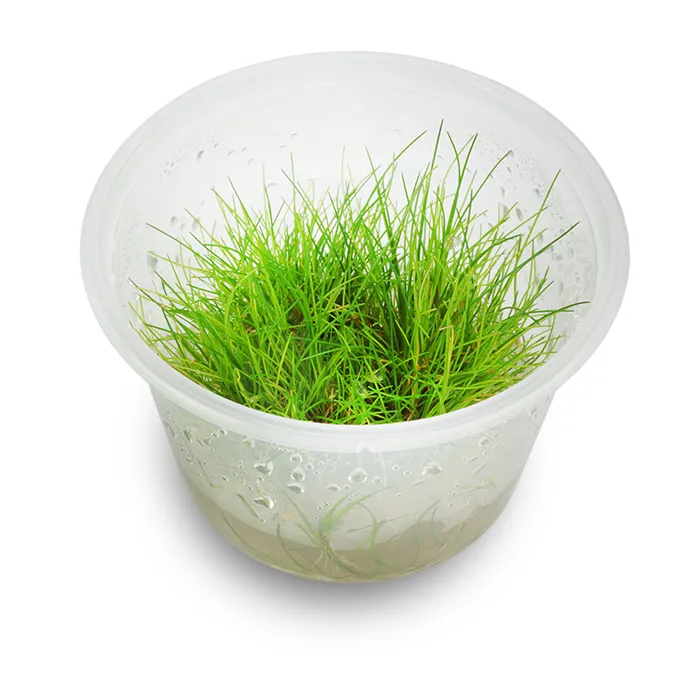
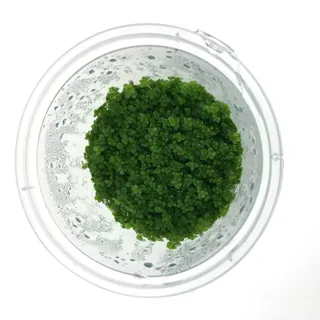
Lobelia cardinalis in its dwarf aquarized form fills a genuinely useful niche in the aquascaping toolkit: a compact midground stem plant with an unusual two-tone colour effect that adds visual interest without demanding the high light and CO2 regimen of the ruby-red stems most aquascapers reach for when they want colour. At a mature 10-20 cm, it is too tall to compete with true carpet plants such as Monte Carlo, Dwarf Hair Grass, or Cuba (Hemianthus callitrichoides), but it is significantly shorter than background stems like Rotala rotundifolia, Ludwigia palustris, or Hygrophila that can reach 40-50 cm in a tall tank. This makes it a textbook midground plant, with the added advantage of the red-purple underside colour that is visible when viewing the tank from the front at eye-level or slightly below, because the leaf underside faces downward and outward and catches the viewer’s angle beautifully. In a tank viewed from slightly above (looking down into the water from standing height), the underside colour is less visible and the top surface’s green dominates; in a tank at eye level on a stand, the colour effect is at its most dramatic. Consider viewing angle when you design your scape around this plant.
Planted as isolated clusters of 5-10 stems separated by hardscape or open substrate, this species creates visual rhythm and focal bushes along a Nature Aquarium style pathway or between rockwork in an Iwagumi-inspired layout, drawing the eye along lines of composition. Planted densely as a broader band of 15-25 stems in a gentle curve, it reads as a textural colour belt of green-tops-with-red-purple-undersides at mid-height, which is a look difficult to achieve with any other single species and lends itself beautifully to layouts that want a colour accent without the dominance that a full bed of Ludwigia palustris or Alternanthera reineckii would impose on the scene.
Stylistically, this species works well in a variety of layout styles. In a South American biotope, it coexists happily with Echinodorus swords, Helanthium chain swords, Cryptocoryne species that tolerate the medium-temperature range, and Amazonian fauna such as tetras, corydoras, and dwarf cichlids. In an Iwagumi-inspired layout, a single midground cluster of Lobelia cardinalis between stones provides scale, softness, and an unexpected colour accent against the neutral hardscape and bright green foreground carpet. In a Dutch-style aquascape with tightly organised plant groups in ‘streets’ of contrasting species, this plant provides a reliable red-purple-underside group that contrasts effectively with the lime-green of Bacopa caroliniana or the olive tones of Hygrophila pinnatifida.
Pair with contrasting leaf shapes and colours for maximum visual impact. Broad-leaved neighbours (Anubias barteri nana for dark green, Cryptocoryne wendtii ‘Brown’ or ‘Tropica’ for bronze tones) provide textural counterpoint to the small oval leaves of Lobelia. Fine-textured stems (Rotala rotundifolia, Pogostemon erectus, Limnophila aromatica) in the background amplify the visual contrast and emphasise the distinctive leaf shape of this species. For colour-driven scapes, pair with brighter reds (a background cluster of Rotala macrandra or Ludwigia palustris ‘Super Red’) and rich greens (Hemianthus callitrichoides ‘Cuba’ in the foreground, Monte Carlo spilling over stones) to build a multi-layered colour composition where Lobelia cardinalis sits as the warm red-purple accent at mid-height.
From a composition perspective, think of this plant as the ‘feature supporting actor’ of your scape. It is not dominant enough to be the visual centrepiece of the layout, but it is distinctive enough that the eye returns to it repeatedly as you scan the tank. In the rule-of-thirds framework that underpins most Nature Aquarium layouts, positioning a cluster of Lobelia cardinalis at one of the two lower third-intersection points creates a natural focal anchor in the midground without needing a hardscape feature or a dramatic red plant to carry the visual weight alone. For tanks photographed for contests or social media, the two-tone colour effect photographs particularly well under RGB lighting, with the red-purple underside catching warm light spectra and the green top catching cool-to-neutral spectra, producing a colour-shift effect across the canopy as leaves tilt in the flow. For display tanks in a home or office setting where the tank is viewed at eye level throughout the day, this species is one of the most rewarding midground plants you can own: it reads clearly from the front, adds colour without shouting, and stays small enough that it never outgrows its assigned zone in the scape and crashes into the aquarium lid.
Finally, consider the time dimension. Lobelia cardinalis in its dwarf form is a patient plant that rewards long-term stewardship. A cluster planted today and maintained carefully for 12-18 months will densify, self-propagate through cuttings, and mature into something dramatically more impressive than what you can buy in a single initial TC cup. The best aquascapes in this hobby are the ones given time to settle, fill in, and develop their own character, and this species is an ideal companion for the patient long-form approach to aquascaping as slow-maturing art rather than instant gratification.
| Plant | Why | |
|---|---|---|
| 🌿 | Cryptocoryne wendtii ‘Brown’ | Similar medium light and water parameter preferences; the broad bronze crypt leaves provide textural and colour contrast against the small oval two-tone leaves of Lobelia cardinalis in an adjacent midground position |
| 🌿 | Anubias barteri var. nana | Low-demand epiphyte attached to wood or stone at the midground-to-background transition; dark broad leaves contrast with Lobelia cardinalis and the shared tolerance for medium light makes them natural companions |
| 🌿 | Monte Carlo (Micranthemum tweediei) | Classic bright-green foreground carpet; Lobelia cardinalis bridges up from this carpet foundation toward background stems, creating a three-tier layered composition with clean colour separation |
| 🌿 | Rotala rotundifolia | Slim-leaved background stem plant that contrasts with the broader oval leaves of Lobelia cardinalis in the midground, while sharing the similar medium-light and soft-to-moderate hardness preferences |
| 🌿 | Bucephalandra sp. | Slow-growing rhizome plant for crevices and stone faces; shares soft-water preference with Lobelia cardinalis and provides a compact dark accent without competing for substrate nutrients |
| 🌿 | Hemianthus callitrichoides ‘Cuba’ | Premium fine-leaved foreground carpet; the bright yellow-green tone of Cuba beautifully contrasts with the green-top red-purple-underside leaves of Lobelia cardinalis immediately behind it |
Quick Reference
| Light | Medium (40-80 PAR at substrate) |
| CO2 | Not required; helpful for compact dense growth |
| Photoperiod | 7-9 hours standard; siesta works |
| Growth Rate | Slow to medium |
| Max Height | 10-20 cm submerged dwarf form |
| Placement | Midground; red-purple colour accent |
| Leaf | Oval, green top with red-purple underside |
| pH | 6.0-7.5 (ideal 6.8) |
| Temperature | 18-26 C (ideal 23 C; avoid 28 C+) |
| Hardness | 4-15 dGH (soft to moderately hard) |
| Substrate | Aquasoil preferred; inert + root tabs works |
| Propagation | Stem cuttings from top-trims or side shoots |
| Difficulty | Intermediate |
Reviews
Clear filtersThere are no reviews yet.