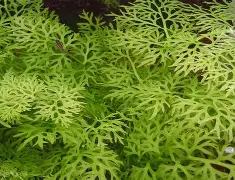
🪨 Species at a Glance
| Scientific Name | Bolbitis heudelotii |
| Common Name | African Water Fern, Lace Fern, Congo Fern |
| Family | Dryopteridaceae (wood-fern family) |
| Origin | West Africa — fast-flowing rivers and forest streams from Senegal through the Congo basin |
| Mature Height | 15-40 cm fronds; rhizome creeps horizontally 20+ cm |
| Leaf Form | Finely pinnate dark-green fronds, deeply divided and lace-like |
| Growth Rate | Slow — one new frond every three to six weeks in typical conditions |
| Light Requirement | Low to medium (40-70 PAR at frond level) |
| CO2 Requirement | Not required; highly recommended for lush growth and deeper colour |
| Planting Method | Rhizome attachment to driftwood or porous stone (never buried) |
| Placement | Midground to background; dramatic against dark driftwood |
| Difficulty | Intermediate — easy if soft water and flow are respected, challenging otherwise |
Planting Guide
Rhizome
Bolbitis heudelotii is a true epiphyte — a plant that, in its native West African rivers, grows clinging to the surfaces of boulders and submerged branches rather than rooting into streambed sediment. Its horizontal, dark-brown to nearly black rhizome is the main stem of the plant and it is from this rhizome that both the striking lace-like fronds and a mass of fine wiry black anchoring roots emerge. The rhizome is adapted to sit fully exposed in the water column, bathed in the oxygen-rich current that characterises its natural habitat. This anatomy dictates the single most important cultural rule for the species, the rule that separates a thriving long-term specimen from a dying one: the rhizome must never be buried in gravel, sand, aquasoil, or any other substrate. When the rhizome is covered it loses access to dissolved oxygen at its surface, anaerobic bacteria multiply in the hidden tissue, and rot sets in within two to four weeks. The plant sheds fronds progressively from oldest to newest, the rhizome softens and discolours from firm dark brown to mushy black, and recovery from advanced rhizome rot is effectively impossible. This is by far the most common cause of Bolbitis failure in the hobby, and it is entirely avoidable with correct installation.
The correct method for installing a new Bolbitis specimen is to remove it from its retail pot or rockwool plug, gently rinse the rockwool away from the root mass under a stream of dechlorinated water, and inspect the rhizome for any soft or damaged sections. Any genuinely rotten portion should be trimmed away cleanly with a sterile razor blade back to firm healthy tissue before installation. The cleaned plantlet or small division is then attached to a piece of hardscape using one of three standard methods. Dark-coloured cyanoacrylate superglue gel is the professional’s preferred method: a small dab placed on the underside of the rhizome, pressed firmly against the hardscape surface for ten to fifteen seconds, creates an immediate permanent bond that is entirely inert once cured and invisible beneath new root growth within a few weeks. Cotton thread is an excellent alternative for beginners because it decomposes harmlessly within four to six weeks, by which time the plant’s own wiry black roots will have gripped the hardscape surface strongly enough that no further anchoring is required. Thin fishing line or dark nylon thread is a third option, workable but requiring manual removal later because it does not decompose in the tank.
Choice of hardscape matters aesthetically and slightly culturally. Lace Fern looks genuinely spectacular tied to dark driftwood — Malaysian driftwood, mopani, or spider wood — where the near-black lace of the fronds reads dramatically against the rich tannic browns of the wood grain. It also attaches well to porous textured stones such as dragon stone, Seiryu stone, and lava rock, though the stronger contrast with driftwood is usually preferred in nature-aquarium layouts. In biotope setups recreating West African streams, attaching Bolbitis to large smooth river-rounded pebbles is the most authentic option and closely mirrors how wild specimens grow. Whatever the hardscape, the rhizome should be oriented so that it lies flat or at a gentle angle against the surface, with fronds free to arc outward and downstream in the direction of water flow. Bolbitis looks most natural when its fronds are allowed to sway in a clearly unidirectional current, an effect that mimics its native habitat of flowing rivers and that immediately communicates the plant’s identity to the viewer. Installation positions that work especially well include the tops and leeward sides of large driftwood features where fronds can cascade downward, and the flanks of central hardscape arrangements where the plant can act as a flowing canopy between higher and lower design elements.
Common installation mistakes to avoid include burying any part of the rhizome beneath substrate in the belief that it needs rooting like a stem plant; using so much superglue that it drowns the rhizome tissue and suffocates emerging fronds; attaching the plant in slack dead zones with no water flow, where it will gradually melt; clustering multiple rhizomes so tightly against one another that contact rot develops at the points of contact; and orienting the fronds into persistent shadow where they cannot photosynthesise. A confident clean installation with one to two centimetres of breathing space around the rhizome and a clear orientation toward both light and current will produce a specimen that thrives for many years in the same position. Within four to eight weeks after installation the wiry black feeder roots will extend visibly from the rhizome and begin gripping the hardscape surface, at which point any temporary tie-down material can safely be removed. From that point forward the plant is permanently installed and will happily inhabit the same piece of hardscape for the life of the aquarium, growing steadily larger and more impressive year by year.
How Much Light?
LOW LIGHT
PAR: 40-70 PAR at frond level
High
Bolbitis heudelotii is an adaptable plant in terms of lighting, reflecting the variable conditions of its natural habitat where specimens grow both in brightly lit stretches of open rapids and in the deep shade beneath overhanging forest canopy. In aquarium terms this translates into a plant that tolerates a wide range of light intensities, from as low as thirty to forty PAR at the frond surface up to a useful ceiling of roughly seventy to eighty PAR. Within this range the plant shows a clear preference for the lower-to-middle portion: fronds grown under moderate light of forty to sixty PAR develop the deepest saturated green colour, the most strongly divided lace-like blade structure, and the most elegant overall form, while fronds grown under very bright light of eighty PAR or more tend to become pale, slightly yellowed, and increasingly vulnerable to algae colonisation on their finely divided blades. This preference for moderate light makes Bolbitis an excellent companion for low-tech and medium-tech planted tanks, and it is one of the reasons the plant features so heavily in nature-aquarium designs where low to medium light is standard.
Because the fronds of this species are so finely and intricately divided, they present an unusually large surface area for their modest mass, and this makes them both efficient photosynthesisers in dim conditions and disproportionately vulnerable to algae colonisation when light and nutrients are out of balance. Green spot algae, green dust algae, and most dangerously black beard algae can all establish quickly on the delicate leaflets of a Bolbitis frond, and once established they are very difficult to remove without damaging the lace structure itself. The solution is not to starve the plant of light but rather to match lighting intensity to overall tank productivity and to ensure that adequate flow passes through the fronds continuously. A daily photoperiod of seven to nine hours at moderate intensity produces better long-term results than ten to twelve hours at high intensity. In high-tech setups with pressurised CO2 and active fertilisation, photoperiods should be held at the lower end of this range and lighting intensity kept moderate, allowing the stem plants in the scape to drive growth while Bolbitis sits comfortably under the lower portion of the light budget.
Positioning within the tank matters as much as overall light intensity. Bolbitis placed in the direct vertical column beneath a bright LED panel will often struggle, while the same specimen placed to the side of the fixture or in the partial shade of an overhanging driftwood branch will thrive. In many successful nature-aquarium layouts the plant is deliberately positioned beneath an arching piece of spider wood or behind a taller background feature, so that the fronds receive diffuse rather than direct illumination. This mimics the dappled light of its native forest streams and produces the richest, most saturated leaf colour. Early signs of light stress include pale or yellowing newer fronds, loss of the characteristic deep-green saturation, and rapid accumulation of green spot algae along frond edges; remedies are to reduce photoperiod by one or two hours, shift the specimen into partial shade, or add fast-growing stem plants elsewhere in the tank to absorb excess nutrients that are driving algae growth. Algae-grazing fauna such as Amano shrimp, Neocaridina shrimp, otocinclus catfish, and nerite snails are particularly valuable in tanks featuring Bolbitis, as they will graze the delicate frond surfaces without damaging the lace structure and will prevent early algae colonisation from becoming established. Under well-matched lighting conditions Bolbitis produces strikingly beautiful deep-green fronds with a subtle almost black-green midrib and finely divided leaflets that catch light with a subtle semi-matte sheen, and any loss of this characteristic richness is the first warning sign that the lighting regime needs adjustment.
Recommended Photoperiod: 7-9 hours for most setups; shorter in high-light high-tech tanks with intense LED
CO2 & Nutrient Guide
CO2 OPTIONAL
Pressurised CO2 injection is not strictly required to keep Bolbitis heudelotii alive in the aquarium, and many low-tech tanks sustain the plant perfectly well for years without any supplemental carbon. In a non-injected environment Lace Fern will produce roughly one new frond every four to six weeks, maintain a modest but respectable specimen size, and live out a full decade without ever seeing a CO2 cylinder. However, supplemental carbon has a more dramatic effect on this species than on most other aquarium plants, and a Bolbitis grown under pressurised CO2 at twenty to thirty parts per million looks almost like a different plant compared to the same specimen grown without it. Fronds become noticeably larger, the divisions of the lace pattern become more pronounced and more densely ruffled, leaf colour intensifies toward a rich deep emerald green, and growth rate doubles to roughly one new frond every two to three weeks. For aquarists who want the maximum visual impact from their Bolbitis — particularly in competition-grade aquascapes or in showcase display tanks — pressurised CO2 is effectively transformative and strongly recommended.
Liquid carbon supplements such as Seachem Excel, Easy-Life EasyCarbo, or equivalent glutaraldehyde-based products are a useful middle-ground option for aquarists who do not wish to commit to a pressurised system. Dosed at manufacturer-recommended rates they produce a meaningful growth boost, deepen leaf colour, and as a practical side effect help suppress black beard algae on older fronds — a particularly valuable benefit since BBA is the one algae that most reliably spoils a Bolbitis specimen over time. Liquid carbon should however be dosed conservatively around Lace Fern, as the delicate fronds can show damage at overdose levels that would not faze tougher species like Anubias. Damage appears as rapid browning and disintegration of leaflet tips within three to five days of overdose; if observed, halve the dose or suspend dosing entirely for a week and the plant typically recovers without lasting harm. Never combine a heavy liquid carbon dose with reduced flow, as this compounds the risk; keep flow steady and photoperiod moderate when liquid carbon is in the regime. Some aquarists successfully use liquid carbon as a spot treatment applied directly onto BBA patches via a fine syringe during water changes, which works well on hardscape and substrate but should be avoided on Bolbitis fronds directly because of the sensitivity noted above.
Fertilisation
As an epiphyte that draws no nutrients from substrate, Bolbitis heudelotii depends entirely on water-column fertilisation for its nitrogen, phosphorus, potassium, iron, and trace elements. In well-stocked community aquariums with active fish populations, bioload from feeding and waste can meet much of this demand passively, and many successful Bolbitis specimens receive only modest supplemental fertilisation throughout their lives. For most setups however, a weekly dose of a complete all-in-one liquid fertiliser such as Seachem Flourish Comprehensive, Tropica Specialised Nutrition, APT Complete, or NilocG Thrive at manufacturer-recommended rates will keep fronds deeply saturated in colour and encourage steady production of new fronds from the rhizome apex. The plant responds particularly well to adequate iron supply, and in hard alkaline water where iron availability is naturally reduced, a dedicated iron supplement such as Seachem Flourish Iron used weekly at half strength often produces a visible deepening of frond colour within two to three weeks. Pale or slightly yellowish fronds are often a signal of iron deficiency rather than of a broader problem and respond quickly to targeted supplementation.
Root tabs are unnecessary for Bolbitis itself since the plant has no roots in the substrate, but they can be placed elsewhere in the tank for neighbouring rooted species without concern, provided they are not inserted directly beneath or adjacent to the rhizome. A gap of five to ten centimetres between a root tab and a Bolbitis rhizome is entirely adequate to avoid any risk of substrate-localised reducing conditions reaching the rhizome. Nitrate levels of five to twenty parts per million and phosphate levels of one to three parts per million represent a comfortable target range for Bolbitis; the plant will tolerate higher values without obvious damage but algae pressure on the delicate fronds increases noticeably above these thresholds. Heavy EI-style dosing regimes favoured by some high-tech aquarists are not ideal for Bolbitis, as the elevated nutrient concentrations tend to feed algae on the frond surfaces faster than the slow-growing plant can outpace the colonisation. Leaner PPS-Pro or APT-style regimes dosed daily in smaller quantities produce better long-term results in tanks where Lace Fern is a feature species. Potassium supplementation is occasionally worthwhile if pinhole-type perforations appear in older fronds — a classic potassium deficiency signature across aquatic plants — and a targeted potassium dose of roughly ten to twenty parts per million weekly will usually resolve the problem within a month. Beyond these considerations, the fertilisation regime for Bolbitis is forgiving and tolerates occasional missed doses without visible decline. Consistency matters more than absolute magnitude: a modest, steady weekly dose beats a heavy occasional one every time for this species.
Water Chemistry Guide
5.5–7.0
ideal 6.5
22–26 °C
ideal 24 °C
2–8 dGH
Soft — a strong preference for genuinely soft water reflecting its West African river origins
Bolbitis heudelotii is a species with clear and definite water parameter preferences, and unlike the remarkably tolerant Anubias it is not content to grow in just any aquarium environment. Its natural habitat is the soft, acidic, mineral-poor rivers and streams of West African rainforests, where pH typically sits between 5.5 and 6.8, total hardness rarely exceeds six degrees, and dissolved solids are very low. The plant’s physiology is tuned to these conditions and attempts to keep it in hard alkaline water — even moderately so — almost always produce poor results. In the aquarium, Lace Fern performs best at pH values between 5.5 and 7.0, with a clear sweet spot around 6.3 to 6.7. Values above 7.2 cause progressively slower growth, smaller fronds, and a gradual fade from deep emerald green toward a pale yellowish tone that never quite recovers, while values above 7.5 frequently result in outright stagnation and eventual decline even if all other parameters are optimal. Aquarists with naturally hard alkaline tap water should consider either reverse osmosis filtration blended with tap water for Bolbitis-featured tanks, the addition of peat or catappa leaves to gently acidify the water column, or switching to a different plant species better suited to the water they have. There is no workaround: the pH preference is genuine and firm.
Temperature preferences are similarly clear, and slightly on the cooler side compared to most tropical community tanks. Bolbitis thrives between twenty-two and twenty-six degrees Celsius, with an ideal around twenty-four. It does not perform well in warm discus-style tanks running at twenty-nine or thirty degrees; under sustained warm conditions the fronds melt progressively from their tips inward, growth essentially stops, and the rhizome becomes vulnerable to bacterial infections. Cooler tanks sitting at twenty-two to twenty-four degrees, typical of many dwarf cichlid and tetra community setups, are ideal. The plant is remarkably at home in tanks kept slightly cool by ambient conditions without heating, provided they do not drop below twenty-one degrees for sustained periods. Biotope aquarists reproducing specific Congo or Cameroon stream environments frequently target twenty-three to twenty-four degrees as an authentic temperature range, and Bolbitis fits this regime perfectly.
Hardness preferences are strict: the plant wants soft water, ideally between two and six degrees general hardness, with eight dGH as the practical upper limit before growth and colour begin to degrade noticeably. Carbonate hardness should be similarly low, with values below four dKH optimal and values above eight dKH problematic. This preference for soft water naturally pairs with the preference for acidic pH, since maintaining stable low pH requires low buffering capacity. Aquarists working with naturally soft tap water are in an excellent position to grow Bolbitis with no further modification, while those with hard water must make a conscious choice to soften it for this species. Reverse osmosis water remineralised with a low-dose GH-and-KH booster, or blended fifty-fifty with tap water and supplemented with catappa leaves for pH buffering, both work well.
Tannins and blackwater conditions are actively beneficial for Bolbitis. A light tea-brown water column stained by driftwood, catappa leaves, or peat extracts provides gentle acidification, delivers useful organic compounds to the rhizome, and produces a visually stunning contrast with the deep green fronds of the plant — the lace-like frond structure seems to glow against tannic water in a way that no other aquarium plant quite matches. West African biotope tanks featuring heavy botanical loads of leaves, seed pods, and branches pair beautifully with Bolbitis and represent perhaps the most authentic and visually successful use of the species in modern aquascaping. Flow is the final non-negotiable parameter: Bolbitis evolved in fast-flowing rapids where its fronds stream downstream constantly in the current, and it genuinely requires moving water across its blade surfaces to thrive long-term. Stagnant dead zones — even small pockets of still water within an otherwise well-flowing tank — cause Bolbitis to decline, because the plant depends on flow to deliver dissolved nutrients, remove waste products from the frond surfaces, and discourage algae colonisation on the delicate leaflets. Filtration should be strong enough that the fronds visibly sway in the current, and positioning should place the plant in clearly moving water rather than behind a rock or piece of driftwood that creates a downstream wake.
Maintenance Guide
SLOW GROWTH
Bolbitis heudelotii is a slow-growing plant by any measure, and this slow pace is the fundamental characteristic that governs how it should be used, bought, and appreciated in the aquarium. Under typical low-tech home aquarium conditions — moderate light, no pressurised CO2, weekly liquid fertilisation, soft acidic water, and steady flow — the plant produces roughly one new frond every four to six weeks from each growth apex on the rhizome. Under high-tech conditions with pressurised CO2 and active daily fertilisation, this rate accelerates to roughly one new frond every two to three weeks. Even at this accelerated pace, Bolbitis will never approach the explosive growth of stem plants or the rapid spread of carpeting species, and expectations should be calibrated accordingly. A single plantlet installed in good conditions will develop from perhaps three to four fronds at purchase into a handsome specimen of ten to fifteen fronds over the course of eighteen months to two years, and will reach its full dramatic mature form of twenty-five to forty frond-length over three to five years of patient cultivation. This is not a plant for the impatient aquarist seeking quick results, and it should never be purchased in insufficient quantity with the expectation that it will rapidly fill out a larger display.
One habit particularly worth understanding before first purchase is that Bolbitis very commonly experiences a significant melt when first installed in a new aquarium, particularly when transferred from emersed tissue-culture or nursery-grown form into a submerged environment, or when moved between tanks with different water chemistry. This melt presents as progressive browning and disintegration of existing fronds over the first two to four weeks, and can be alarming to aquarists who are not expecting it. The correct response is not to panic but to understand that the emersed-grown fronds cannot persist under submerged conditions and will always be replaced by new submerged-adapted growth emerging directly from the rhizome. Trim away the dying old fronds cleanly at their bases as they decline, leaving the rhizome and any healthy new frond buds intact, and within four to eight weeks new underwater-adapted fronds will begin emerging. These new submerged fronds are the true face of the plant and will persist and grow for years; the original emersed fronds are essentially disposable. This melt-and-regrow transition is normal, expected, and not a sign of failure. Aquarists who trim away the decaying old fronds promptly and resist the urge to disturb the rhizome during the transition period are rewarded with a fully adapted specimen within two months; those who dig the plant up in worry during the melt almost always kill it.
Mature fronds reach fifteen to forty centimetres in length depending on tank conditions and cultivar, with leaf divisions becoming progressively more elaborate on larger and more mature plants. Under optimum conditions the fronds cascade outward and downstream from the rhizome in a flowing curtain that is one of the most distinctive visual effects available in freshwater aquascaping. The rhizome itself extends slowly horizontally along the hardscape, typically advancing three to six centimetres per year under good conditions and branching into multiple growth apices as it matures. A well-established three-to-four-year-old specimen will typically present five to eight distinct growth apices along fifteen to twenty centimetres of rhizome, each producing its own slow stream of new fronds, and will carry twenty-five to forty fronds in total at any given time — visually reading as a dramatic miniature tree or bush rather than a simple single plant.
Maintenance requirements are modest but specific. Old fronds occasionally yellow, brown, or accumulate black beard algae; these should be snipped off cleanly at the base using sharp scissors, leaving the rhizome itself entirely untouched. Never cut into the rhizome — always leave the attachment node intact, because the rhizome cannot regenerate across a significant cut and a damaged rhizome is a common entry point for rot. Algae-affected fronds should be removed promptly rather than treated in situ, as BBA on the delicate Bolbitis lace is notoriously persistent and is far easier to eliminate by removing the affected frond entirely than by any spot treatment that risks damaging the surrounding healthy tissue. The wiry black feeder roots occasionally grow into filter intakes or drift across substrate — they can be trimmed back freely without harming the plant and the rhizome regrows them within weeks. Beyond these occasional trims, Bolbitis requires remarkably little ongoing intervention. Pay close attention to flow patterns over the first few months and adjust outflow direction if any portion of the plant appears to be sitting in a dead zone; once good flow is established the plant essentially takes care of itself. This resilience under correct conditions makes Bolbitis one of the most rewarding fern-style plants in the hobby for aquarists willing to respect its preferences.
Inspect and prune old fronds
Every 4-6 weeks — snip yellowed, browned, or algae-affected fronds flush with the rhizome using sharp scissors. Never cut into the rhizome itself, which cannot regenerate across a significant cut.
Trim wiry feeder roots
Every 2-3 months — trim back feeder roots that have grown into filter intakes, across substrate, or into neighbouring plants. The plant is unharmed by root pruning and regrows them within a few weeks.
Manage initial melt
First 4-8 weeks after installation — trim away melting original fronds cleanly at their bases as they decline. Do not disturb the rhizome. New submerged-adapted fronds will emerge directly from the rhizome apex within a month.
Remove algae-affected fronds
As needed — any frond showing established BBA or green dust algae should be removed entirely rather than spot-treated. The delicate lace structure is easily damaged by chemical algae treatments.
Divide mature specimens
Every 2-3 years — divide mature rhizome clumps to refresh the specimen and distribute daughter plants to new hardscape positions. Natural rhizome junctions are the correct division points.
Check flow and clean rhizome
Every 2-3 months — verify that current still flows cleanly across the fronds, and use a soft brush to dislodge detritus accumulated on top of the rhizome. Detritus buildup is a classic precursor to rhizome rot.
Propagation Guide
Division
Propagation of Bolbitis heudelotii is accomplished by rhizome division, a straightforward and essentially failure-proof technique that works identically to the propagation of Anubias, Bucephalandra, and Microsorum. A mature specimen develops visible junctions along its rhizome, points where the tissue narrows slightly and where a fresh growth apex has emerged alongside the parent axis. These natural division points are easy to identify by eye under good lighting — each junction typically sits at a slight angle and marks the boundary between two otherwise continuous rhizome sections. Planning a division ahead of time by observing the rhizome and identifying the best cut points is the hallmark of a careful propagation rather than a hasty one.
The rhizome is cut cleanly through the narrow junction using a sterile razor blade or sharp scissors, with each divided section retaining at least three to four healthy fronds, an intact rhizome segment of one to two centimetres, and ideally some established feeder roots. Division can be performed with the plant still attached to its hardscape, by carefully working scissor blades between the two growth fronts, or more commonly by removing the entire specimen, working on a tray or dish of clean tank water, and then re-attaching the daughter plants to fresh hardscape. The latter approach is gentler on the plant tissues, allows for a careful inspection of the rhizome for any hidden damage, and is strongly recommended for large specimens or for dividing into more than two pieces. A clean cut heals quickly and the plant does not bleed or stress visibly; within a few hours the cut surfaces have callused over and the daughter plants are effectively independent of one another.
The resulting daughter plants are each re-attached to hardscape using cotton thread or cyanoacrylate gel exactly as for a fresh plantlet, and placed back into the tank immediately. There is no extended recovery period or acclimatisation process, and the daughter plants resume growth within three to six weeks. They are indistinguishable from the mother plant within about a year of successful division. A well-established mother plant in good conditions can typically be divided every two years, producing two to three daughter plants per division event, meaning a single starter purchase can reasonably be expected to populate an entire small collection of tanks over the course of five to eight years. The slow growth of this species means that mature divided specimens also command premium prices on the secondhand market, so careful propagation can be a meaningful hobby economy for aquarists running multiple display tanks.
Spore propagation does occur in nature, and mature Bolbitis plants occasionally develop fertile fronds carrying reproductive spore-producing sori on their undersides — these fertile fronds look visibly different from the lace-like sterile fronds, being smaller, narrower, and brownish due to the mass of spores on their surface. Spore propagation is however not practical in the home aquarium because spore germination requires very specific emersed conditions on constantly moist substrate, and the resulting sporelings take many months to develop into usable plants. Essentially all commercial propagation of Bolbitis is done by rhizome division in dedicated nurseries, or by meristematic tissue culture in specialised laboratories. Tissue-cultured Bolbitis, sold in small clear cups as emersed-grown starter plants free of snails, algae, and other pest organisms, has become the standard form for retail sale in recent years, and aquarists purchasing tissue-cultured Lace Fern should expect the melt-and-regrow transition described earlier as the emersed fronds give way to submerged-adapted new growth over the first month or two after installation.
Layout & Placement
Midground
Bolbitis heudelotii is one of the most visually distinctive plants available in the modern aquascaping palette and has earned a prominent place in nature-aquarium, West African biotope, and jungle-style layouts for its dramatic presence and unmistakable lace-like fronds. Its natural habit of throwing long fronds into the water column like streamers of living rainforest foliage makes it a natural midground-to-background feature plant, and it is most effective visually when given enough space to let its fronds extend and cascade freely. Cramped placements where the plant cannot fully express its form undersell its dramatic qualities; generous placements where fronds can arc outward into open water or trail downstream in visible current let the plant demonstrate exactly why it is so prized among serious aquascapers. The finely divided fronds catch and filter light in a distinctive semi-matte way that differentiates them from the glossy waxy leaves of Anubias and the bright translucent greens of stem plants, adding a material contrast that enriches layouts visually even before compositional considerations come into play.
Classical placement is in the midground, attached to the upper flanks or summits of central driftwood features, where the fronds can cascade downward and outward in a flowing curtain. This position mimics the plant’s native habit of clinging to submerged branches in forest streams and produces a characteristically dramatic silhouette. Background placement on a single large driftwood feature, with fronds extending upward and outward toward the light, is equally effective and often preferred for larger tanks where the plant needs to carry visual weight across a longer horizontal axis. Whatever the placement, Lace Fern reads most strongly against dark driftwood — Malaysian driftwood, mopani, spider wood, and dark African ironwood all work beautifully — where the near-black depth of the fronds contrasts richly with the tannic browns of the wood grain. Lighter woods such as azalea root or pale spider wood also work but produce a softer, less dramatic contrast. In West African biotope layouts with generous botanical loads of catappa leaves, seed pods, and leaf litter, Bolbitis is effectively the signature plant species, producing an immediate sense of rainforest-river authenticity that no other aquarium plant can match.
Grouping of multiple plantlets on a single large driftwood feature, or across a connected hardscape arrangement of two or three pieces, produces the most powerful visual effect for this species, particularly in tanks over one hundred litres where a single specimen can get lost against the larger scale. Three to seven plantlets clustered along a main driftwood branch, with fronds angling outward in related but non-identical directions, reads as a genuine riverside colony rather than a regimented specimen planting. Odd numbers work better than even following the classical Japanese aesthetic of asymmetric composition, and varying plantlet sizes slightly across the grouping adds visual depth. Bolbitis pairs particularly well with mosses such as weeping moss, Christmas moss, and flame moss, which provide a fine foliage contrast and share its preference for shaded positions on hardscape. It also associates very well with Anubias species of various sizes, particularly Anubias barteri var. nana and Anubias barteri var. coffeefolia, which share its epiphytic growth habit and can be attached to the same piece of hardscape for a composed grouping with complementary leaf textures. Microsorum pteropus — especially the Narrow and Trident cultivars — also pairs naturally with Bolbitis, and the two species together produce a richly textured rhizome-fern layering effect that is one of the classic foundations of nature-aquarium design.
In smaller nano tanks below thirty litres, Bolbitis is generally too large to use as a primary feature without dominating the scape, and should either be avoided entirely in such tanks or used as a single specimen placed as a deliberate focal feature with the rest of the layout built around it. For aquarists specifically wanting a smaller African water fern for nano work, the cultivar Bolbitis heudelotii ‘Difformis’ produces more compact fronds and is a better choice for smaller displays. In paludarium and riparium setups where the tank has an above-water component, Bolbitis grows equally well emersed and often produces larger, more elaborate fronds above water than below, making it a genuine dual-habitat plant worth considering for semi-terrestrial displays of rainforest-stream character. West African biotope ripariums featuring emergent branches, leaf litter, and seed pods combined with submerged Bolbitis fronds below the waterline reproduce perhaps the most authentic visual evocation of the plant’s native habitat that is achievable in a display tank, and are among the most rewarding projects an experienced aquarist can undertake.
| Plant | Why | |
|---|---|---|
| 🌿 | Anubias barteri var. nana | Fellow West African rhizome epiphyte with shared water parameter preferences and planting style; can be attached to the same driftwood for a composed African biotope grouping with complementary leaf textures. |
| 🌿 | Microsorum pteropus ‘Trident’ | Another rhizome fern with a narrow upright leaf form that contrasts beautifully with the cascading fronds of Bolbitis; both thrive under identical low-to-medium light and soft-water conditions. |
| 🌿 | Bucephalandra sp. | Small rhizome epiphyte that shares Bolbitis’s preference for soft acidic water and flowing current; pairs at a smaller scale along the lower flanks of the same hardscape for a layered rhizome-plant arrangement. |
| 🌿 | Weeping Moss (Vesicularia ferriei) | Fine cascading moss that drapes over hardscape and complements the flowing character of Bolbitis fronds; both species thrive in soft acidic water and moderate flow conditions. |
| 🌿 | Cryptocoryne wendtii | Rooted crypt that thrives in soft acidic water and low-medium light, providing a substrate-level foliage counterpoint to Bolbitis on hardscape; together they create layered biotope-style scapes with both rooted and epiphytic elements. |
| 🌿 | Christmas Moss (Vesicularia montagnei) | Classic fine-textured moss that contrasts the broader lace-like Bolbitis fronds and shares the same low-light soft-water preferences, making them natural partners on shared driftwood features. |
Quick Reference
| Scientific Name | Bolbitis heudelotii |
| Light | Low to medium (40-70 PAR) |
| CO2 | Optional but highly recommended |
| Growth Rate | Slow (1 frond / 3-6 weeks) |
| Mature Height | 15-40 cm frond length |
| pH Range | 5.5-7.0 (soft acidic preferred) |
| Temperature | 22-26 degC |
| Hardness | 2-8 dGH (soft) |
| Flow | Moderate to strong (river origin) |
| Planting Method | Rhizome attached to driftwood or stone (never buried) |
| Placement | Midground to background |
| Propagation | Rhizome division |
| Difficulty | Intermediate |
Reviews
Clear filtersThere are no reviews yet.