🪨 Species at a Glance
| Scientific Name | Helanthium tenellum (formerly Echinodorus tenellus) |
| Common Names | Pygmy Chain Sword, Chain Sword, Micro Sword (sometimes) |
| Family | Alismataceae |
| Origin | North, Central and South America |
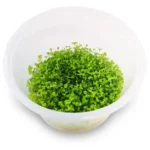
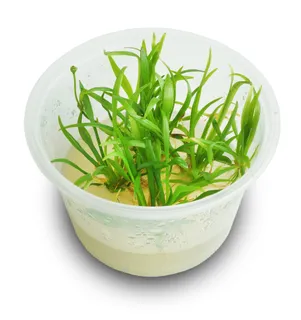
| Form Supplied | Tissue Culture (TC) cup, pest-free and algae-free |
| Mature Height | 5-10 cm |
| Leaf Width | 2-4 mm (fine ribbon blades) |
| Placement | Foreground to midground carpet |
| Light | Medium (30-50 PAR at substrate) |
| CO2 | Beneficial, not essential |
| Growth Rate | Medium |
| Propagation | Runners (daughter plantlets) |
| Difficulty | Easy to Moderate |
Planting Guide
Carpet
Helanthium tenellum is a true rosette plant that develops a compact crown of slim, ribbon-like leaves rising directly from a short central base, from which fine white roots anchor into the substrate. Unlike stem plants that can simply be pushed into soil and expected to root along buried nodes, tenellum requires careful, intentional planting at the crown level if it is going to establish successfully and spread laterally into a uniform carpet. When you first open a tissue culture cup from your Amazonia shipment, you will typically find a dense mat of thirty to fifty plantlets held together by clear nutrient-rich agar gel. The very first task is to rinse this gel away thoroughly under lukewarm tap water, working gently with your fingers to break the mass apart. Gel residues left on the roots can cloud aquarium water, feed opportunistic bacterial blooms and, in extreme cases, trigger a minor ammonia spike as they decompose in the tank. Once clean, tease the mat apart into small bunches of three to five plantlets each; planting plantlets as one large clump will suppress carpet formation and encourage the plant to grow upward in competition for light rather than spreading outward as intended.
To produce a true lawn effect, plant each small bunch around two to three centimetres apart in a grid pattern across the foreground and midground, using fine-tipped aquascaping tweezers to push the crown just below the substrate surface while keeping the actual growing point of the rosette exposed above the substrate line. Spacing is absolutely critical to the success of a tenellum carpet: plants placed too far apart will take many months to close the gaps between them, leaving bare substrate visible for a frustratingly long time, while plants packed too densely will compete aggressively with one another for light and nutrients, pushing the entire planting upward into a taller, leggier form that never properly carpets. A good rule of thumb is to aim for visual consistency at the time of planting rather than trying to stretch limited plantlets across a larger zone than they can cover. If you only have a single cup and a sizeable foreground area, concentrate the planting in a smaller dense zone and let the runners do the work of expanding outward over the following weeks. Once planted, the plantlets will spend the first one to two weeks establishing their roots in their new substrate before pushing out the lateral runners that knit the carpet together.
Because tenellum is a relatively shallow-rooting species compared to larger sword plants like Echinodorus amazonicus or Echinodorus bleheri, it does not require an enormously deep substrate bed. A planted tank substrate depth of four to six centimetres is entirely comfortable for tenellum, although slightly more depth at the back of the scape can be used to create terraced designs that gently lead the eye down toward the front glass. For best results, place tissue culture portions into wet substrate on the same day you open the cup; TC plantlets are far more delicate than emersed-grown nursery stock and they will not tolerate drying out or prolonged exposure to air. Avoid burying the crown, which is the point where the leaves meet the roots, as a crown that has been pushed below the substrate line will rot within a matter of days and the entire plantlet will collapse. A useful trick employed by experienced aquascapers is to plant each bunch at a very slight angle rather than straight down into the substrate, which allows the crown to sit just above the substrate line naturally while the roots still reach deep enough to hold the plantlet firm against water flow. After planting, gently fill the tank or top up the water level, taking great care to avoid direct jets of flow onto the fresh plantings, and dose a full water-column fertiliser alongside any root tabs you have pre-installed beneath the planting zones.
One of the most commonly overlooked planting considerations for tenellum, and the most frequent source of panic among first-time carpet aquarists, is the transition from emersed to fully submerged growth. Many tissue culture cups are grown in semi-emersed conditions in sterile laboratory environments to maximise plantlet density and reduce contamination risk, so you should fully expect the first generation of leaves to melt or yellow progressively within the first two to three weeks after submersion as the plant rebuilds its cellular structure for underwater life. Do not pull out plantings that look sad and sickly in week two; as long as the central crown is still white and firm to the gentle touch of tweezers, the plant is very much alive and is simply shedding emersed tissue that is no longer fit for purpose. The new submerged leaves that emerge from the crown will be slightly thinner, more flexible and noticeably greener than the emersed originals, and this second generation of growth is what builds the foundation of the carpet. During this critical transitional phase, resist any temptation to trim, fertilise heavily or otherwise interfere beyond the normal water change schedule, and let the plant decide which tissue to keep and which to shed on its own natural timeline.
How Much Light?
MEDIUM LIGHT
PAR: 30-50 PAR at the substrate
High
Light is by far the most important factor in whether tenellum forms a dense, photogenic, competition-worthy carpet or a sparse, leggy and disappointing groundcover, and it is also the single variable most commonly underestimated by first-time aquascapers setting up their first planted tank. The species will technically survive in low-light environments and in heavily shaded zones of the tank, but what is consistently observed in underlit setups is a plant that stays alive while growing tall, stretching its blades up toward the distant light source with leaves reaching eight to twelve centimetres or even higher, rather than hugging the substrate as aquarists intend. To achieve the classic pristine lawn of five to seven centimetre blades, PAR measurements at the substrate level should sit firmly in the medium light band, which corresponds roughly to a full-spectrum LED fixture running at around sixty to seventy percent power above a standard sized planted tank with a depth of thirty to fifty centimetres from substrate to water surface. Higher light levels, up to around eighty PAR at the substrate, will drive even tighter and shorter carpet formation with leaves as short as three to four centimetres, but tenellum also responds aggressively to high light by triggering visible pearling, significantly faster runner production and, crucially, by needing a commensurate increase in CO2 supply and fertilisation to stay ahead of the algae pressure that high light inevitably generates.
Photoperiod stability matters just as much as raw light intensity, and is often the hidden factor behind carpets that seem to stall after initial promise. Running a consistent daily photoperiod rather than dimming or shifting schedules week by week allows the plant to settle into a predictable, repeatable rhythm of photosynthesis and respiration, and helps shift the competitive balance in the tank firmly in favour of higher plants over algae. A six to eight hour core photoperiod at full intensity, bookended by short one-hour ramp-up and ramp-down phases at dawn and dusk, mimics a natural tropical day and is gentle on both plants and the fish or invertebrates sharing the tank. If you observe yellowing older leaves at the base of the rosettes, a visible stalling of runner production compared to the first few weeks, or the beginnings of algae film on exposed substrate, the first parameter to audit should be light duration rather than nutrition, as excessive light hours directly fuel algae bloom while providing only diminishing returns for the plant itself. Many planted tank veterans have found that dialling back from ten or twelve hours of daily light down to seven or eight hours actually improves carpet density because it reduces the energy demand on the plant during weeks when CO2 or fertilisation might be slightly undersupplied.
Spectrum and colour temperature also play a noticeable role in the final appearance of the carpet. Tenellum displays its vibrant grass-green colouration best under full-spectrum LEDs in the 6500 to 7500 Kelvin range, which approximates bright midday tropical sunlight in equatorial regions. Warmer lights in the 4000 to 5000 Kelvin range will produce a slightly duller, more yellow-toned green, while cooler lights above 8000 Kelvin can push the appearance toward a slightly bluish cast that, while not harmful to the plant in any biological sense, is less visually pleasing in most aquascapes and can make the whole tank feel clinical rather than naturalistic. Modern RGB-equipped LED fixtures allow for fine-tuning of the spectrum to emphasise greens and reds, which is particularly valuable if you are pairing tenellum with red stem plants and want both plant groups to pop visually side by side. When dialling in your lighting, use the tank with fresh water and clean glass for accurate visual assessment, and make spectrum adjustments in small increments over days rather than dramatic shifts, since plants can show temporary stress responses to sudden spectrum changes.
Finally, it is worth thinking about light distribution across the tank rather than just total power output. A single strong LED bar centred above the tank will deliver significantly more light to the central carpet zone than to the corners, and this uneven distribution often results in carpets that are dense in the middle but sparse along the edges. If you are working with a tank wider than fifty centimetres, consider either a wider LED bar, twin bar fixtures, or supplemental corner lighting to ensure even PAR delivery across the entire footprint. Reflective backgrounds and white side panels can also help bounce light back into otherwise shadowed zones, significantly improving carpet uniformity without needing to increase overall wattage.
Recommended Photoperiod: 7-9 hours
CO2 & Nutrient Guide
CO2 OPTIONAL
Helanthium tenellum occupies a useful and very approachable middle position on the CO2 dependency spectrum that divides aquarium plants into rough categories. It is emphatically not a CO2-obligate plant in the way that many demanding, high-tech carpet species such as Hemianthus callitrichoides ‘Cuba’ or Glossostigma elatinoides are; tenellum will grow, spread and carpet successfully in a non-injected planted tank, provided that lighting is appropriate for the depth of the tank and that substrate fertilisation is solid and consistent. That said, adding pressurised CO2 injection genuinely transforms the plant’s performance in ways that are hard to overstate. With CO2 dosed to a steady twenty-five to thirty parts per million throughout the photoperiod, new runners appear noticeably faster, often within three to five days of the previous one, the leaf colour deepens from pale green to vibrant saturated green, and the plant closes gaps in the carpet weeks earlier than it would in a non-injected equivalent setup. For aquascapers chasing a competition-grade lawn in the shortest possible timeframe, such as for an upcoming aquascape competition deadline, CO2 injection is the single highest-impact upgrade you can make to your setup.
If pressurised CO2 is not available to you, whether due to cost, space or simple personal preference for low-tech tanks, liquid carbon supplements such as Seachem Excel or Easy Life Easy Carbo provide a modest but real middle-ground boost. These products contain glutaraldehyde, which the plant can uptake as an alternative carbon source for photosynthesis. Dose according to the manufacturer’s label instructions and be aware that certain sensitive plants, particularly Vallisneria species, and some shrimp species can react poorly to overdoses, so introduce liquid carbon gradually over a week or two rather than jumping to full dose on day one. Another often overlooked alternative is to simply accept a slower carpet formation; tenellum planted into a non-injected tank will still form a lush, attractive carpet given three to four months of consistent conditions, which for most home hobbyists who are not racing toward a competition deadline is a perfectly acceptable timeline and allows the rest of the tank to mature alongside the plant.
Surface agitation and its relationship with CO2 is a detail worth considering carefully. CO2-injected tanks benefit from a quieter water surface during the photoperiod to retain CO2 in solution, but at night, when the lights are off and photosynthesis has stopped, the plant actively respires and consumes oxygen. Running a surface skimmer on a timer, or using a wavemaker that increases flow and surface agitation at night, helps maintain healthy oxygen levels during the dark hours. This matters especially in densely carpeted tanks, where the large mass of plant tissue consumes proportionally more oxygen overnight than would be the case in a sparsely planted setup. A common mistake is to run very high CO2 with low surface agitation twenty-four hours a day, which can gradually stress fish and shrimp as dissolved oxygen levels drop into the pre-dawn hours; a simple night-time air stone or timer-controlled wavemaker solves this entirely and costs very little to implement.
Monitoring CO2 levels accurately is best done with a drop checker filled with four degree KH reference solution, which provides a consistent visual indication of dissolved CO2 that does not drift with general tank KH fluctuations. A properly tuned drop checker should read lime green during the photoperiod, indicating the target range of twenty-five to thirty parts per million, and shift toward blue-green as photosynthesis draws CO2 down during the day. Relying on bubble counter rates alone is misleading because diffusion efficiency varies significantly between setups, and the drop checker provides ground-truth visual feedback on actual dissolved levels in the tank water where the plant is consuming them.
Fertilisation
Because tenellum is primarily a root-feeding species that spreads via runners travelling horizontally through the substrate, the most valuable fertilisation input by a significant margin is a nutrient-rich substrate combined with targeted root tabs placed directly beneath the planting zones. Root tabs should be refreshed every three to four months, pushed two to three centimetres into the substrate to avoid exposing them to the water column, and spaced roughly every ten centimetres throughout the carpet zone in a grid pattern. These tabs deliver iron, potassium, phosphate, magnesium and a full suite of trace minerals right at the root line where the plant is actively uptaking nutrients, which is absolutely critical for strong chlorophyll production in the leaves and for supplying the significant energy demand required to push new runners through the substrate. A tank running on an aged, depleted substrate will show its deficiencies in tenellum sooner than in most other plants, because the species draws so heavily on root-zone nutrition.
Water column fertilisation complements substrate feeding rather than replacing it, and should not be neglected even in tanks with rich soil substrates. A standard all-in-one liquid fertiliser, dosed daily in micro amounts or every other day in slightly larger amounts, provides the nitrogen, potassium, phosphorus and micronutrients that the leaves uptake directly from the water surrounding them. Iron is by a clear margin the single most important trace element for tenellum aesthetics, as iron deficiency presents first as pale, almost yellow new leaves emerging from the crown and eventually progresses to stunted overall growth. If you notice lighter than expected colouration on newly emerging blades that does not correct itself within a week, a targeted iron supplement such as Seachem Flourish Iron dosed two to three times per week is often the corrective lever that brings the carpet back to its vibrant green baseline. For high-tech, CO2-injected tanks, the Estimative Index (EI) approach with abundant weekly macro and micro dosing pairs beautifully with the plant’s fast growth response and prevents any single nutrient from becoming the limiting factor.
A final fertilisation consideration worth noting is the balance between nitrates and phosphates. Tenellum benefits from nitrates in the five to twenty parts per million range and phosphates around one to two parts per million. Very low nitrate levels, often seen in tanks stocked lightly with fish and without supplementation, will slow growth and cause older leaves to yellow and drop prematurely, robbing the carpet of its visual density and creating a cascading decline that takes weeks to reverse. Very high nitrate levels above forty parts per million will not directly harm the plant, and tenellum is in fact tolerant of elevated nitrate in a way that many more sensitive species are not, but such levels will fuel algae growth that can quickly overwhelm the fine blades of the carpet and turn a pristine lawn into a green-algae-smothered mess in a matter of days. Testing water parameters every two weeks during the establishment phase of a new tenellum carpet helps you dial in the correct dosing rate for your specific setup, and once the carpet has been established for a few months most hobbyists can transition to testing once a month as the tank finds its long-term biological equilibrium.
Micronutrient deficiencies beyond iron are worth understanding in detail because they each produce distinctive visual symptoms on tenellum that a trained eye can diagnose quickly. Potassium deficiency presents as pinhole-sized holes in older leaves that gradually enlarge, magnesium deficiency appears as interveinal yellowing while the leaf veins themselves remain green, and manganese deficiency shows up as pale yellow patches on new growth alongside stunted runner production. A comprehensive all-in-one liquid fertiliser prevents all of these by default, but if you are running a minimalist dosing regime targeting only nitrogen and phosphorus via fish waste and food, you may need to supplement individual elements when symptoms appear. Keeping a simple photo log of your carpet every two weeks during the first six months is an excellent diagnostic tool because subtle changes in colour and leaf shape become obvious when you compare images a month apart.
Water Chemistry Guide
6.0–7.5
ideal 6.8
22–28 °C
ideal 25 °C
4–15 dGH
Soft to moderately hard
Helanthium tenellum is genuinely remarkable among carpet plants for its wide tolerance of varying water chemistry parameters, which is a significant part of why the species remains so popular decades after its first introduction to the hobby. A pH range from 6.0 at the acidic end to 7.5 at the alkaline end is comfortably handled by the plant, and this span covers nearly every community planted tank configuration you are likely to encounter in a typical hobbyist setup. Ideal pH sits slightly on the soft and acidic side at around 6.8, which also happens to be the optimal range for dissolved CO2 efficiency in injected tanks and for most South American tetras, pencilfish and dwarf cichlids commonly kept in biotope-inspired planted scapes that feature tenellum. If your local tap water runs notably hard and alkaline, consider mixing in reverse osmosis water during water changes to bring the pH down gradually, rather than chasing rapid pH shifts with acid-dosing products that can destabilise the tank.
Temperature-wise, the species thrives between twenty-two and twenty-eight degrees Celsius, making it compatible with virtually every tropical community setup you could conceive of, from cool-water Asian community tanks through standard South American biotopes up to warmer discus-keeping ranges at the higher end of its tolerance. At the upper end of the temperature range, oxygen saturation levels drop noticeably and the plant’s own respiration accelerates, so careful attention to surface agitation and overall oxygenation becomes even more important if you are running a warm tank. Below twenty-two degrees Celsius, growth slows significantly but the plant does not actively suffer, making it viable even in lightly heated or unheated subtropical setups kept in warm homes.
Hardness tolerance is impressively broad, with the plant performing well from four to fifteen degrees of general hardness. It will live in harder water than this upper bound, and anecdotal reports from hobbyists in very hard-water regions confirm the plant persists, but you may observe slower runner production and occasional tip browning on the leaves as the plant works harder to uptake certain key nutrients in mineral-rich water environments. If you are running a tank with very high GH of twenty or more, consider increasing iron and micronutrient trace element supplementation to offset the reduced uptake efficiency. Carbonate hardness (KH) is less critical for the plant itself, but worth watching in CO2-injected tanks because very low KH leads to unstable pH that can swing rapidly during the photoperiod as CO2 levels fluctuate, stressing both plants and fish.
Water change routine is also worth mentioning in the context of tenellum carpet maintenance. Weekly water changes of twenty to thirty percent are the industry standard for planted tanks and work perfectly well for tenellum, replenishing micronutrients while diluting accumulated organic waste. When performing water changes, take care to refill slowly using a hose or a clean bucket poured carefully to avoid disturbing the carpet, and ensure that the temperature of the replacement water closely matches tank temperature. Thermal shock from cold tap water poured directly onto a warm tank carpet can cause melting along the blade edges that takes weeks to recover from. Dechlorinator must always be added, as chlorine and chloramine damage the delicate root hairs of tenellum faster than most other plants and can cause unexplained stunting if untreated water reaches the substrate.
Maintenance Guide
MEDIUM GROWTH
Helanthium tenellum is a medium-growth species that establishes slowly in the first two weeks after planting, accelerates sharply through weeks three to eight as the root network takes hold and the initial runners begin to push, and then settles into a steady rhythm of runner production and carpet densification thereafter for the remainder of the tank’s lifespan. Expected mature blade height under medium light sits squarely in the five to seven centimetre range for well-established plantings, with higher light levels pushing that height down toward four to five centimetres and lower light allowing the plant to stretch upward toward eight to ten centimetres as it reaches for more photons. Compared to its close relative Helanthium bolivianum, which matures at ten to fifteen centimetres and takes on a more open, airy rosette form suitable for midground rather than foreground use, tenellum is noticeably more compact, tighter-packed and better suited to true foreground carpeting roles where a uniform visual ground plane is the goal.
Maintenance of an established tenellum carpet is refreshingly simple compared to the weekly hair-trimming rituals demanded by faster-growing stem plants or more finicky carpet species. Because tenellum grows laterally via runners rather than upward like stem plants, you will not be trimming weekly to control height, and the plant will not shoot up above its design-intended height even in periods when you are away and unable to tend the tank. Instead, the main maintenance task is occasional thinning of overly dense patches where runners have tripled or quadrupled up and the carpet has grown thick enough to begin trapping detritus underneath the dense mass. Every two to three months, gently pull up a handful of excess plantlets from the densest areas, either to replant in sparse zones of the same tank or to give away to fellow hobbyists and friends. This thinning also prevents anaerobic black pockets from forming under a very dense carpet, which can release hydrogen sulphide when disturbed and stress tank inhabitants.
Dead or yellowing leaves should be removed promptly by pinching at the base of the leaf with tweezers rather than pulling upward, which can disturb the neighbouring plantlets and even uproot adjacent runners that have not yet fully anchored. A soft siphon or a small turkey baster used across the carpet surface during water changes helps lift trapped detritus out of the blades and keep the lawn looking fresh and vibrantly green. Some aquarists like to run a fine mesh net gently across the top of the carpet weekly to knock loose any debris that has settled there, after which the filter intake captures the suspended particles. Algae on the blades, particularly green spot or beard algae, is an early warning sign that light, CO2 or fertilisation balance has drifted; addressing the underlying parameter is always more effective than trying to physically scrub algae off the delicate ribbon leaves, which inevitably damages the blade surface and invites further algal colonisation on the roughened tissue.
Long-term carpet maintenance over a period of years deserves specific attention because tenellum, like most carpet plants, benefits from occasional renewal rather than being left untouched indefinitely. After roughly twelve to eighteen months of continuous growth, the oldest runner sections at the core of the carpet can become woody, less vigorous and prone to yellowing as new runners concentrate toward the outer edges of the planting. When this happens, a full carpet refresh is the most effective intervention: lift out the central zone with tweezers, discard the oldest plantlets, and replant with fresh daughter plantlets harvested from the outer edges or from your propagation farm. The carpet will look somewhat bare for two to three weeks after refreshing, but the new growth that follows will be denser, more uniform and more vigorous than anything the aged original carpet could produce. Adding fresh root tabs at the same time as the refresh ensures the new generation has all the resources it needs to establish quickly.
Detritus Siphon
Weekly gentle siphon across the carpet surface during water change to lift accumulated detritus out of the blades and keep the lawn visually clean.
Yellow Leaf Pruning
Every 2 weeks, pinch off yellowing or browning older leaves at the base of the rosette with aquascaping tweezers.
Root Tab Refresh
Every 3-4 months, insert fresh root tabs every 10 cm across the carpet zone to replenish substrate nutrients.
Carpet Thinning
Every 2-3 months, remove excess plantlets from overly dense patches to improve light and flow penetration and prevent anaerobic pockets.
Runner Redirection
Monthly, gently guide visible surface runners into bare or thinly-planted spots with tweezers to accelerate gap closing.
Substrate Health Check
Quarterly, probe for black anaerobic pockets near the base of the densest growth and spot-siphon if detected to release trapped gases safely.
Propagation Guide
Runners
The defining and most charismatic growth habit of Helanthium tenellum, and the very origin of its popular common name Chain Sword, is its characteristic reproduction via horizontal runners. A healthy mature mother plant sends out thin horizontal stolons just below the substrate surface, along which daughter plantlets emerge at regular intervals in an unmistakable chain-like pattern that gives the species its name. Each individual daughter plantlet quickly develops its own roots and its own crown, establishes itself as an independent rosette within a matter of weeks, and in turn sends out its own runners a few weeks later once it has stored enough energy to spawn the next generation. This chain reaction of daughter plantlets producing granddaughters producing great-granddaughters is precisely what turns a handful of freshly planted tissue culture bunches into a continuous carpet over the course of a few months, and it is an entirely self-driven biological process requiring no intervention from the aquarist beyond providing adequate light, substrate nutrition and CO2 where desired.
For hobbyists who wish to actively propagate tenellum for use in another tank elsewhere in the house, or to share with friends and local aquarium club members, the process is straightforward and very forgiving. Wait patiently until a runner has produced a daughter plantlet with at least three fully-developed leaves and its own visible roots of one to two centimetres in length, then gently sever the runner between the mother and daughter with a pair of sharp, curved aquascaping scissors. Lift the freshly separated daughter plantlet carefully with tweezers, taking great care to keep the young root mass intact and free from damage, and replant it in its new location at the same depth as the parent was planted. Daughters separated in this way typically establish within a week in good conditions and begin pushing their own runners within two to three weeks, allowing for remarkably rapid multiplication across multiple tanks if that is the goal.
It is also worth noting that tenellum will occasionally flower under good conditions, particularly if grown emersed in a paludarium or under very strong submerged light. The small white three-petalled flowers are borne on slender stalks above the water surface, and in nature these flowers are pollinated by insects and produce viable seed that disperses on the water’s surface during flood seasons. In the closed aquarium environment, flowering is essentially a curiosity rather than a practical propagation route, as seed production is rare in submerged conditions and runner propagation is vastly more efficient in any case. If you notice flower spikes emerging, they can be left for their aesthetic value or trimmed back to preserve the plant’s energy for further runner production.
For hobbyists interested in long-term propagation strategy, consider dedicating a small five-litre tank or even a clear plastic tub as a tenellum farm, kept under a cheap LED lamp on a twelve-hour timer and dosed with basic liquid fertiliser weekly. Tenellum grown in such a farm setup is under no aesthetic pressure, so you can plant it densely and let it sprawl, harvesting daughter plantlets as needed for the display tank or for trades with local hobbyists. This approach pays for itself many times over the first year and ensures a steady supply of fresh, healthy plantlets whenever you need to repair or extend the display carpet. Many long-time planted tank hobbyists cite their propagation tubs as among the most useful pieces of infrastructure in their fishroom, and tenellum is one of the most forgiving candidates to start a propagation farm with thanks to its ease and prolific runner production.
Layout & Placement
Foreground
Helanthium tenellum is tailor-made for the foreground and transitional midground zones of planted aquariums, where its five to ten centimetre mature height forms a bright, fresh green lawn that draws the viewer’s eye into the scape and establishes a clear visual ground plane against which the rest of the aquascape composition is built. In nature-style aquascapes inspired by the work of Takashi Amano, tenellum works beautifully flowing around stones and driftwood to imply wind-swept grassland or a mountain meadow seen from a distance, and the slight variation in blade height across an established carpet gives a natural, unforced look that pure Monte Carlo carpets sometimes lack. In Dutch-style layouts, where plant groupings are selected for contrast and arranged with almost geometric precision, tenellum provides the low, uniform foreground band that contrasts beautifully with taller rosette plants and stem plant groupings behind it. The plant also features prominently in iwagumi rock arrangements, the minimalist Japanese aquascape style, where a dense carpet of tenellum between carefully placed boulders evokes a Japanese mountain meadow in miniature and creates a serene, contemplative atmosphere.
For more advanced design compositions, consider planting tenellum as a gradient that is tightly spaced at the front glass of the tank and gradually spaced out as it retreats toward the midground, so that the carpet naturally thins and reveals the substrate in a way that implies depth and distance for the viewer. This foreshortening trick works especially well in longer, shallower tanks where creating an illusion of depth is otherwise difficult. Pair the fresh green blades of tenellum with deliberately contrasting textures and colours to make both plants stand out: fine-leaved stem plants like Rotala rotundifolia or Ludwigia arcuata provide reddish backdrops that complement the greens, the broader leaves of Cryptocoryne species offer textural contrast in the midground, and vertical elements such as Vallisneria or tall Echinodorus sword plants create a layered vertical story above the low horizontal carpet. Negative space also deserves respect and consideration in composition; leaving small intentional areas of substrate or coloured gravel exposed between tenellum clumps can enhance the aquascape’s visual rhythm and breathing room rather than overwhelming the eye with uniform green.
From a fish-keeping perspective, a dense tenellum carpet provides genuine ecological value as well as aesthetic value. Juvenile shrimp and small fry find shelter among the grass blades, surface-feeding fish like hatchetfish appreciate the open swimming space above the low carpet, and bottom-dwelling cories and loaches use the carpet edges as a natural boundary for their foraging patterns. The carpet also serves as a biological filter of sorts, with beneficial bacteria colonising the leaf surfaces and contributing to overall tank stability in ways that are difficult to measure but consistently reported by hobbyists running densely planted tanks. In competitive aquascape judging, a well-executed tenellum carpet is often cited as a signature of a mature, balanced tank and can dramatically lift the overall score of a scape that might otherwise feel unfinished.
When planning a tenellum carpet for a new tank, think carefully about flow patterns, hardscape placement and viewing angles before you open the first cup. A carpet works best when viewed from roughly the same angle at which it was designed, and subtle tricks like tilting the front of the carpet slightly downward using substrate contouring can dramatically improve the perceived scale of the scape. Avoid placing large hardscape elements directly in the middle of the intended carpet zone, as these create permanent bare patches where the carpet cannot colonise; instead, integrate hardscape along the perimeter of the carpet or in rear zones where its absence of foreground greenery reads as negative space rather than as a planting failure. Over time, as the tank matures, feel free to restructure the carpet boundaries by removing plantlets from one zone and replanting elsewhere, which allows the aquascape to evolve aesthetically alongside the natural growth patterns of the plants.
| Plant | Why | |
|---|---|---|
| 🌿 | Cryptocoryne wendtii | Midground textural contrast with broader, darker bronze-green leaves framing the bright green carpet beautifully. |
| 🌿 | Rotala rotundifolia | Background stem plant providing vertical reddish-pink contrast above the horizontal green lawn of tenellum. |
| 🌿 | Anubias nana petite | Attaches to hardscape above the substrate, adding layered height and rhizome texture without competing with tenellum for substrate nutrients. |
| 🌿 | Bucephalandra sp. | Hardscape-mounted epiphyte offering rich leaf texture and subtle colour variation alongside the uniform tenellum lawn. |
| 🌿 | Vallisneria nana | Tall background grass that echoes the ribbon-leaf form of tenellum at a larger vertical scale, creating visual harmony. |
| 🌿 | Helanthium bolivianum | Taller midground cousin of tenellum creating a natural seamless transition from short foreground carpet to the fuller rosette zone behind. |
Quick Reference
| Scientific Name | Helanthium tenellum |
| Former Name | Echinodorus tenellus |
| Common Name | Pygmy Chain Sword |
| Family | Alismataceae |
| Mature Height | 5-10 cm |
| Placement | Foreground Carpet |
| Light | Medium (30-50 PAR) |
| CO2 | Beneficial, not required |
| Growth Rate | Medium |
| pH Range | 6.0-7.5 |
| Temperature | 22-28 degrees C |
| Hardness | 4-15 dGH |
| Propagation | Runners |
| Difficulty | Easy to Moderate |
Related Products
Reviews
Clear filtersThere are no reviews yet.