🪨 Species at a Glance
| Scientific Name | Hydrocotyle verticillata |
| Common Name | Whorled Pennywort, Shield Pennywort, Water Pennywort |
| Family | Araliaceae (ginseng family) |
| Origin | Southeastern United States, Central and South America wetlands |
| Mature Height | 3-10 cm depending on light and placement |
| Leaf Size | 0.5-1.5 cm peltate circular discs |
| Growth Rate | Medium — creeping runners extend 1-2 cm per week |
| Light Requirement | Medium (40-80 PAR at leaf level) |
| CO2 Requirement | Not required, but strongly beneficial for compact growth |
| Planting Method | Creeping rhizome / runners across substrate |
| Placement | Foreground to midground, carpet-adjacent or upright |
| Difficulty | Easy to moderate — forgiving once established |
Planting Method
Rhizome
Hydrocotyle verticillata is a creeping rhizome plant whose growth habit sits somewhere between a true carpet species and a conventional rooted stem plant, which gives it a planting method unlike any other species in common aquascaping use. The plant grows from a thin horizontal rhizome — sometimes called a runner or stolon — that creeps across the substrate surface, extending one to two centimetres per week under good conditions and sending down a small tuft of white roots at regular intervals along its length. From each rooted node, a cluster of three to six upright petioles emerges, each carrying a single circular leaf at its tip in the characteristic whorled arrangement that gives the species its common name. The critical planting principle is that the rhizome itself must rest on or just beneath the substrate surface, never buried deeply, because the nodes require light contact with both substrate and water column to produce their characteristic upright shoots. A rhizome buried two or three centimetres deep under aquasoil will often struggle, producing weak etiolated petioles or rotting at the growth apex, while a rhizome laid on the surface and lightly anchored with a few grains of substrate will establish quickly and begin extending within a fortnight.
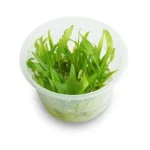
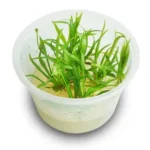
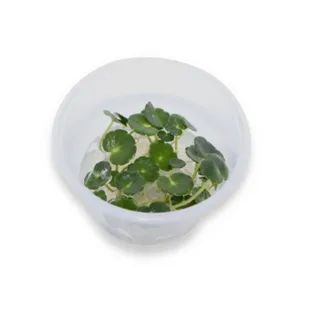
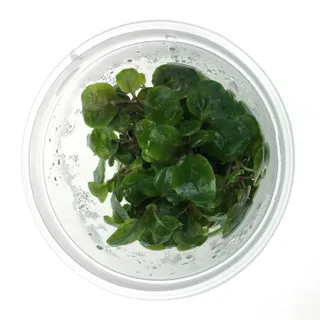
Tissue-cultured H. verticillata arrives from the laboratory in small rockwool cubes or agar-based cups, typically containing a dense cluster of five to fifteen small plantlets each with two or three leaves and a short length of rhizome. The correct preparation procedure is to rinse the plant thoroughly under dechlorinated water to remove all traces of rockwool, agar, or nutrient gel, and then separate the cluster into individual plantlets or small groups of two to three by gently teasing the interconnected rhizomes apart with fingertips or fine tweezers. Each plantlet should retain at least one intact growth apex — visible as the greenest and most turgid leaf tip — and a short fragment of rhizome with at least one node. These small divisions are then planted individually across the intended coverage area, spaced two to three centimetres apart, using aquascaping pinsettes to press each plantlet gently into the substrate so that the rhizome lies flat and the roots are buried but the leaves and petioles remain above the substrate surface. The most common beginner mistake is to plant single leaves as if they were stem cuttings, pushing the petiole deep into substrate and leaving only the circular leaf disc visible — this almost always results in rot within ten days because the petiole is not a stem and cannot form roots from its buried length.
The substrate of choice is a nutritious aquasoil such as ADA Amazonia, Tropica Aquarium Soil, or Landen Shrimp Soil, because H. verticillata is a moderate nutrient feeder that responds well to rich substrate conditions during its establishment phase. Inert substrates such as pool filter sand or plain gravel will work with supplementary root tabs and active water-column fertilisation, but growth will be measurably slower and the creeping runners tend to be thinner and less vigorous than those produced in an aquasoil-based setup. Substrate depth of three to five centimetres is adequate at the planting position; deeper substrate is not required because the rhizome stays near the surface and the roots themselves penetrate only one to two centimetres. If the intended layout places H. verticillata at the top of a slope or terrace, ensure the substrate is well-retained by hardscape or a planting border so that the creeping runners do not tumble downslope as they extend. Once all plantlets are seated, water should be added slowly and gently using a bag or plate to diffuse the inflow, to avoid disturbing the freshly planted divisions before their roots have taken hold. The first fortnight after planting is the most vulnerable period, and during this phase the tank should not be subjected to strong flow, heavy fertiliser dosing, or major water parameter changes that could stress the transitioning plantlets.
One feature of this species that confounds first-time keepers is that it can be grown in two quite different styles depending on light level and trimming discipline. Under strong light and aggressive trimming, runners hug the substrate tightly and the plant forms a low creeping carpet-adjacent mat of three to five centimetres in height, with leaves held close to the substrate on short petioles of barely one to two centimetres. Under moderate light or with looser trimming, the same plant grows upright with petioles extending six to ten centimetres or more, producing a taller leafy midground feature with distinctly visible whorled leaf columns. Both presentations are valid aquascaping outcomes and the grower should decide at the outset which style the layout calls for, because the two forms are not easily convertible once the plant has established its growth habit. A tall specimen that is suddenly flooded with high light and trimmed short will often stall or thin out before readapting, while a low creeping mat raised under dimmer light often stretches unattractively if the layout later demands a taller form. Experienced aquascapers commit to a target form early in the layout process and align their light, flow, and trimming regime to maintain that target consistently over the lifetime of the scape, rather than attempting to renegotiate the plant’s form mid-cycle.
One additional consideration during the initial planting is that the tissue-cultured plantlets arrive in an emersed growth form, meaning their leaves and petioles have developed in air rather than underwater. These emersed leaves are biochemically adapted to atmospheric gas exchange and will gradually melt or senesce as the plant transitions to submerged leaf production over the first two to four weeks in the tank. This is a normal transition and not a sign of plant failure; the grower should resist the urge to panic-dose fertiliser or change tank parameters during this period and should simply maintain stable conditions while the plant produces its first underwater-adapted leaves. New growth emerging at the runner tips after the first fortnight is the reliable indicator that the transition is proceeding correctly, and complete adaptation is typically visible by the end of the first month, after which the plant will run reliably on its submerged growth regime for the indefinite future.
Growth & Maintenance
MEDIUM GROWTH
Hydrocotyle verticillata grows at a medium pace that places it comfortably between the glacial slowness of Anubias or Bucephalandra and the runaway speed of true stem plants such as Rotala or Ludwigia. Under typical medium-light low-tech conditions, the creeping rhizome extends roughly one centimetre per week and produces one new leaf node every eight to ten days along the runner, which translates to a single plantlet covering an area of roughly ten by ten centimetres within four to six months of planting. Under high-light CO2-injected conditions, runner extension roughly doubles to two centimetres per week and leaf production accelerates to one new node every four to six days, with full coverage of the same ten-by-ten area achievable within two to three months. This medium growth rate is one of the species’ greatest practical virtues because it gives the plant time to establish a balanced root system and adjust to its tank conditions without overwhelming the layout between water changes, while still being fast enough to establish visible coverage within a reasonable planting timeframe.
Maintenance of H. verticillata focuses primarily on controlling its lateral spread once the plant has filled its intended coverage area, because the creeping runners will continue to extend indefinitely if left untrimmed and can encroach on neighbouring plant positions or climb up onto hardscape. The simplest control technique is to trim runners flush at the margin of the intended coverage area using sharp aquascaping scissors, ideally once every two to three weeks during active growth, removing the trimmed runner fragments from the tank rather than leaving them to float around and take root elsewhere. Trimmed runner fragments containing at least one intact leaf node can be replanted elsewhere as fresh propagation material, which is the source of one of the plant’s greatest practical advantages for aquarists stocking multiple tanks. The pace of trimming required varies considerably with light and CO2 levels; a high-light CO2-injected tank may need weekly intervention to keep the plant within bounds, while a low-tech moderate-light tank may go a full month between trims.
Within the established coverage area, individual petioles that have grown excessively tall above the intended canopy height can be pinched off at the base using fingertips or fine scissors, encouraging lateral growth rather than vertical extension. This is particularly useful when the plant is being maintained as a low carpet-adjacent foreground and any petiole above three centimetres represents an aesthetic flaw; aggressive trimming of tall petioles combined with adequate light and CO2 will typically maintain a compact canopy of two-to-three centimetres height indefinitely. Older leaves at the base of established petioles occasionally yellow and drop naturally as the plant matures, which is a normal senescence pattern and not a sign of disease; simply remove the dropped leaves from the substrate during regular maintenance to prevent them from decomposing in place and encouraging localised algae blooms. Melting of new growth is uncommon in this species once established but can occur during the first two to four weeks after planting from tissue culture, as the plant transitions from its emersed laboratory growth form to its submerged aquarium form; this is not a cause for concern provided the rhizome itself remains firm and green, and new underwater-adapted leaves will appear at the runner tips within a fortnight as the transition completes.
Trim runner margins
Every 2-3 weeks — trim runners that have extended beyond the intended coverage area using sharp aquascaping scissors. Remove trimmed fragments from the tank rather than leaving them to float and root elsewhere.
Pinch tall petioles
Weekly in compact carpet-style plantings — pinch off any petioles that have grown excessively tall above the intended canopy height to maintain a low uniform profile.
Remove yellowed older leaves
Every 3-4 weeks — remove naturally senescing leaves at the base of older petioles to keep the canopy fresh and prevent decomposing foliage from fuelling algae in the understory.
Rejuvenate aged patches
Every 6-12 months — lift the oldest section of the patch, divide into fresh plantlets, and replant the strongest divisions to refresh the specimen and eliminate accumulated detritus.
Inspect root tabs
Quarterly — replenish root tabs along the runner path if growth begins to slow or leaf colour pales, particularly in older aquasoil beyond the twelve-month mark.
Clean leaf surfaces
As needed — gently wipe any algae accumulation from the upper leaf surfaces during water changes, using a soft cloth or fingertip; the broad flat leaves are particularly prone to green spot algae in high-light tanks.
Light Requirements
MEDIUM LIGHT
PAR: 40-80 PAR at leaf level
High
Hydrocotyle verticillata is a medium-light species that shows one of the clearest and most instructive light-dependent morphological responses in the aquascaping hobby. Under strong light of roughly sixty to eighty PAR at the substrate surface, the plant grows compactly with short petioles of one to three centimetres, leaves held close to the creeping rhizome, and runners that hug the substrate and extend laterally rather than reaching vertically. This is the compact carpet-adjacent presentation favoured in Iwagumi-style and Dutch foreground layouts, where the plant functions almost like a conventional low carpet but with the distinctive visual signature of its umbrella-shaped whorled leaf columns rising just a few centimetres above the substrate. Under moderate light of roughly forty to fifty PAR, the same plant stretches noticeably upward, with petioles extending five to ten centimetres or more and leaves held aloft above the rhizome in clearly visible columns. This taller form is the upright midground presentation that gives H. verticillata its most unique visual character, with individual leaf columns reading as miniature palm trees or sculpted floral displays above the substrate.
Below roughly thirty-five PAR the plant begins to show clear signs of insufficient light. Petioles stretch excessively to ten or twelve centimetres and become thin and pale, leaves grow smaller and yellower than usual, and the rhizome extension rate drops considerably. New runners become sparse and the plant loses its tight whorled structure, instead taking on a ragged legggy appearance with visible gaps between leaf nodes. This is a classic etiolation response and is not a disease but simply a signal that the light budget is insufficient for the plant’s metabolic demands; increasing photoperiod or raising intensity by repositioning the light fixture closer to the water surface will usually restore vigorous growth within three to four weeks. Conversely, under extremely bright light above ninety PAR the plant can grow almost flat against the substrate but becomes vulnerable to green spot algae accumulation on the upper leaf surfaces, particularly in combination with insufficient CO2 or excess nutrient levels. The medium-light window of forty to eighty PAR at leaf level is the goldilocks zone where the plant produces its characteristic balanced form without either etiolating or becoming an algae magnet.
Photoperiod of eight hours is a reliable starting point for tanks running moderate light levels, extendable to nine or ten hours in strongly planted low-tech tanks without CO2 to compensate for the lower carbon availability. In high-tech tanks running pressurised CO2, photoperiod should be held to roughly seven to eight hours to match the elevated growth demand without triggering excessive algae pressure across the whole tank. The plant does not respond strongly to siesta-period lighting schedules and the complexity of such schemes is unwarranted for this species; a simple single block of uniform lighting is entirely adequate. One useful diagnostic tool is the size and spacing of new leaves emerging from the growth apex at the end of each runner: healthy leaves in a well-lit tank should be a deep saturated green, roughly one centimetre across, and spaced at regular two-to-three-centimetre intervals along the runner; if new leaves are smaller, paler, or more widely spaced than older leaves, light is the likely limiting factor and should be addressed before other adjustments. Aquascapers who wish to maintain the plant in its compact form specifically should err on the higher side of the PAR range and commit to regular trimming of any overly tall petioles, while those who want the taller upright midground presentation should deliberately run slightly lower PAR and allow the petioles to reach their natural unstressed length.
Recommended Photoperiod: 8-10 hours in low-tech tanks; 7-8 hours in high-tech CO2-injected tanks
CO2 & Fertilisation
CO2 OPTIONAL
Pressurised CO2 injection is not strictly required for Hydrocotyle verticillata, and the species will grow in non-injected tanks with nothing more than ambient carbon from surface gas exchange and fish respiration. However, the difference between a non-injected specimen and a CO2-injected specimen is more pronounced in this species than in most aquarium plants, and serious aquascapers who want the compact carpet-adjacent form with tight spacing and densely packed whorled leaves will find CO2 injection all but essential to achieve that look. In a tank without CO2, expect creeping runner extension of roughly one centimetre per week, petioles stretching toward five to eight centimetres as the plant reaches for ambient light, and leaf density along the runner of roughly one leaf node every three centimetres. Under twenty to thirty parts per million of pressurised CO2, the same plant under the same light produces runner extension of roughly two centimetres per week, petioles staying compact at two to four centimetres even under moderate light, and leaf density increasing to one node every one to two centimetres. The difference between these two growth regimes is night and day visually, and hobbyists who have attempted both regimes inevitably comment that their CO2-injected H. verticillata looks like a completely different species from their earlier non-injected specimens.
Liquid carbon supplements such as Seachem Excel or Easy-Life EasyCarbo are an acceptable alternative for aquarists not running pressurised CO2, dosed at manufacturer’s recommended rates or slightly below. H. verticillata tolerates liquid carbon well at moderate doses and shows a useful growth boost of perhaps thirty to fifty percent compared to untreated tanks, though it does not match the results of proper pressurised CO2 injection. Overdosing liquid carbon above label rates can cause leaf melt, particularly on the tender young leaves at the runner tips, which appear water-soaked and translucent before dropping entirely; if this occurs, halve the dose immediately and the plant typically recovers new growth within two to three weeks. For hobbyists who want the best results without the expense of pressurised CO2 hardware, a consistent daily dose of liquid carbon combined with strong medium-to-high lighting and a nutritious aquasoil substrate is a respectable middle-ground regime that produces good although not championship-level results. A useful compromise for aquarists who are unsure whether to commit to pressurised CO2 is to begin the tank on liquid carbon only, evaluate the plant’s response over three to four months, and upgrade to pressurised injection if tighter compact growth is desired. The plant tolerates the transition between liquid carbon and pressurised CO2 regimes without stress, and a gradual upgrade is a lower-risk path than an all-at-once switch.
Fertilisation
Hydrocotyle verticillata is a moderate feeder that draws significant nutrition from both the substrate through its root system and the water column through its leaves, making it more forgiving of dosing gaps than purely water-column feeders such as epiphytic rhizome plants or floating species. In a nutritious aquasoil setup during the first six months after planting, no supplementary fertilisation is usually required because the fresh aquasoil releases ample macronutrients and micronutrients to support vigorous early growth. As the aquasoil ages beyond six to twelve months and begins to deplete, a regular fertilisation regime becomes essential to maintain vigorous creeping runner extension and healthy leaf colour. A weekly or twice-weekly dose of a complete all-in-one liquid fertiliser such as Seachem Flourish Comprehensive, Tropica Specialised Nutrition, or APT Complete at manufacturer’s recommended rate is the simplest approach and works well in moderately stocked community tanks running moderate light. In high-tech tanks running CO2 and stronger lighting, a more aggressive EI-style dosing regime of separate macronutrients and micronutrients will better match the plant’s elevated demand, with typical weekly targets of ten to twenty parts per million nitrate, one to two parts per million phosphate, and ten to twenty parts per million potassium.
Root tabs are moderately beneficial for H. verticillata because the plant does develop a genuine root system at each node along the creeping rhizome, and a small tab placed every fifteen to twenty centimetres along the runner path will provide a useful localised nutrient boost that translates into noticeably stronger growth. This is particularly useful as aquasoil ages and its nutrient reserves decline, and dedicated root-feeder brands such as Seachem Flourish Tabs, Tropica Nutrition Capsules, or APT Jazz produce measurable improvements in creeping runner vigour when deployed on a quarterly schedule. Iron is the single most visible trace element for this species because iron deficiency manifests as distinctive yellowing of new leaves at the runner tips, which progresses to interveinal chlorosis and eventual leaf drop if left uncorrected. A dedicated iron supplement such as Seachem Flourish Iron used twice weekly at half the label dose is an excellent insurance policy in hard alkaline water where iron availability is naturally reduced, and typically produces a visible deepening of leaf colour within ten days of starting the regime. Potassium deficiency is occasionally observed on older leaves as small circular pinhole perforations that gradually enlarge, identical to the classic potassium-deficiency signature across all aquatic plants; a potassium supplement or increased macro dosing will reverse the symptom and prevent further damage. Beyond these straightforward fertilisation targets, H. verticillata is not a particularly demanding plant and tolerates considerable dosing irregularity without visible distress. A typical practical dosing schedule for a sixty-litre moderately planted tank with H. verticillata as a foreground feature would consist of twice-weekly dosing of an all-in-one liquid fertiliser at label rate, a supplementary weekly iron dose at half label rate, and a quarterly root-tab refresh along the runner coverage area. This simple regime is well within the maintenance budget of a hobbyist aquarist and produces consistently healthy plants without the complexity of full EI-style separate-component dosing schedules.
Water Parameters
6.0–7.5
ideal 6.8
20–26 °C
ideal 24 °C
4–15 dGH
Soft to moderately hard; prefers slightly soft water but tolerates harder conditions well
Hydrocotyle verticillata tolerates a broad range of water conditions typical of planted community aquariums, which is one of the reasons it has achieved such wide popularity in the aquascaping hobby despite its relatively recent introduction as a submerged aquarium plant. pH values between 6.0 and 7.5 are all acceptable, and although the plant shows a mild preference for slightly acidic to neutral water around pH 6.5 to 7.0, it grows perfectly well at pH 7.5 and adapts without difficulty to the standard conditions of most community tanks. In softer acidic water typical of aquasoil-based high-tech planted tanks with pressurised CO2, the plant tends to produce slightly richer leaf colour and tighter compact growth, while in harder neutral water typical of non-injected low-tech tanks it grows slightly more loosely and with subtly paler leaves. Both conditions are viable and the species does not require chemical water softening or pH buffering to thrive; simply use whatever water chemistry the rest of your livestock and plants require, and H. verticillata will adapt around it without complaint.
Temperature tolerance runs from a cool twenty degrees Celsius up to a warm twenty-six degrees Celsius, with a sweet spot around twenty-three to twenty-five. This range is slightly cooler than the tropical community tank norm, and the species is actually one of the better choices for cooler-water community tanks built around zebra danios, white cloud mountain minnows, and cool-tolerant shrimp species. It will survive in warmer tanks up to twenty-eight degrees but growth becomes noticeably looser and petioles tend to stretch more at the upper end of the temperature range, while below twenty degrees growth slows markedly and new leaf production nearly stops. For tanks running at typical tropical community-tank temperatures of twenty-four to twenty-six degrees the plant performs reliably, and it is a good match for discus tanks only at their lower temperature ranges of twenty-six to twenty-seven rather than the elevated twenty-nine or thirty degrees favoured for the fish. Hardness from four to fifteen dGH is all well-tolerated, and the plant adapts to the full range of typical community-tank water chemistry without requiring special preparation. Chlorine and chloramine in untreated tap water will damage tender new leaves and can cause immediate leaf drop, so standard dechlorination during water changes is essential as it is for any aquarium plant. Tannins from driftwood and almond leaves are welcome and do not negatively affect the species, and the plant can be used successfully in mild blackwater tanks where the dark-tinted water creates a striking visual backdrop for the bright green whorled leaves. The species is moderately tolerant of mineral-heavy shrimp-tank remineralisation regimes such as GH+ and GH/KH+ salts used in caridina or neocaridina shrimp-focused tanks, and can be grown alongside high-end shrimp species without difficulty, making it a useful dual-purpose species for aquascape-and-shrimp setups where plant beauty and shrimp husbandry must both be prioritised.
Propagation
Division
Propagation of Hydrocotyle verticillata is almost embarrassingly easy, to the point where many aquarists find themselves producing more trimmings than they can reasonably distribute within their tank collection or local aquascaping community. The primary propagation method is runner division, which is nothing more than cutting the creeping rhizome into smaller sections and replanting each section as an independent plantlet. A single mature patch of twenty by twenty centimetres typically generates fifty or more viable divisions per major trimming session, each capable of establishing a new coverage area of its own within three to four months of replanting.
The technique is straightforward. Using sharp scissors or a sterile razor blade, cut the creeping rhizome into segments of two to four centimetres each, ensuring every segment includes at least one intact growth apex — the greenest and most turgid leaf tip — and ideally one or two intermediate leaf nodes along its length. Each segment should also retain some of the small white feeder roots that emerged from the nodes during growth; if the roots have been damaged during division, the segment will still root from scratch but will take roughly two weeks longer to establish than a segment with intact roots. The divided segments are then planted individually across the intended new coverage area using aquascaping pinsettes, spaced two to three centimetres apart exactly as in the original planting procedure, and pressed gently into the substrate so that the rhizome lies flat and any roots are buried while the leaves and growth apex remain above the substrate surface. Establishment is typically complete within two to three weeks under good conditions, by which point the segments will have begun extending new runners of their own.
The propagation rate is such that a single initial purchase of one tissue culture pot containing roughly ten to fifteen small plantlets can reasonably be expected to populate a two-by-two-metre total coverage area across multiple tanks within a year of purchase, making H. verticillata one of the most economically generous plants in the aquascaping catalogue. Aquascapers running multiple display tanks or selling divisions to local clubs find it an excellent starter investment, and a well-established mother patch can supply fresh divisions for years on end with no noticeable decline in vigour.
Flowering does occur rarely in submerged conditions but does not produce viable seed in aquarium settings, and commercial propagation of this species is entirely by tissue culture or by runner division in emersed nursery setups. The underwater flowers, when they do appear, are tiny cream-white umbels on short stalks emerging from the leaf axils and are a pleasant curiosity worth photographing; they do not harm the plant in any way and can either be left in place until they senesce naturally or trimmed off as a precaution against decaying flower tissue triggering localised algae. Emersed cultivation in paludariums or open-top shallow setups produces more robust flowering with visible umbels of the family Araliaceae, and aquarists interested in botanically accurate displays may find emersed growth of this species a rewarding project in its own right. For aquarists hoping to maintain a steady supply of fresh propagation material, the recommended workflow is to establish a dedicated mother patch in a well-lit corner of the display tank or in a separate propagation tank, trim divisions from the mother patch on a fortnightly schedule, and replant or distribute the divisions as required. A well-managed mother patch of twenty by twenty centimetres under strong light with CO2 can sustainably produce twenty to thirty viable divisions per fortnight indefinitely, which is more than adequate for most hobbyist-scale propagation needs and which also generates a modest surplus suitable for trading with other aquarists or donating to local aquarium clubs.
Aquascaping
Foreground
Hydrocotyle verticillata occupies an unusual and highly valued niche in the aquascaping palette because its unique whorled leaf arrangement allows it to function both as a carpet-adjacent foreground plant and as an upright midground feature, depending on light levels and trimming discipline. This dual-role versatility is relatively rare among aquarium plants, most of which commit clearly to either carpet, stem, or rosette morphologies with limited flexibility, and it makes H. verticillata one of the most useful utility plants for aquascapers designing complex layouts that need a visually distinctive element capable of bridging the foreground and midground zones of the tank. Under strong light with regular trimming, the plant forms a loose low carpet of two-to-three centimetres height that functions as a textural foreground alternative to more conventional carpet species such as Monte Carlo, Glossostigma, or dwarf hairgrass. The resulting visual effect is unmistakably different from those carpet species; where Monte Carlo reads as a rolling mat of tiny round leaves and Glossostigma reads as a tight bright green carpet of spoon-shaped blades, H. verticillata reads as a miniature forest of tiny umbrella tops held just above the substrate, creating a distinctive sculptural texture that catches the eye at any tank-viewing distance.
Under moderate light with looser trimming, the plant stretches into its upright midground form with petioles of five to eight centimetres carrying circular leaf discs above the substrate in visible columns. This presentation reads almost like a miniature palm grove or a stand of tiny lily pads on stalks, and it works particularly well as a featured foreground-to-midground transition plant in taller tanks where the visual journey from foreground to background needs a distinctive midpoint. Aquascapers designing Nature Aquarium-style layouts often use this upright form in the middle zones of the tank to break the visual monotony of typical midground plantings, with the whorled leaf columns providing a clear focal texture that neither stem plants nor rosette plants can replicate. In Iwagumi-style minimalist aquascapes featuring a small number of well-placed rocks, H. verticillata clustered around the base of each rock creates a charming naturalistic fringe that softens the hard rock edges and adds visual interest at ground level without competing with the rocks themselves for dominance.
As a creeping foreground plant, H. verticillata pairs exceptionally well with complementary carpet species that offer contrasting leaf forms. A foreground combination of Monte Carlo at the front edge with H. verticillata behind creates a beautiful textural progression from tight mossy-looking round leaves to the distinctive whorled umbrella columns, and adds visible depth to even relatively flat foreground compositions. Similarly, a transition from dwarf hairgrass to H. verticillata works well because the linear blades of hairgrass contrast sharply with the rounded peltate leaves of the pennywort, creating strong visual interest at the foreground-midground boundary. In midground groupings the plant associates well with rosette species such as dwarf Cryptocoryne parva or small Echinodorus tenellus, providing a textural contrast while sharing similar light and water-parameter preferences. Stem plant backgrounds such as Rotala rotundifolia or Staurogyne repens pair well with an H. verticillata midground transition, with the round flat leaves providing a clear visual counterpoint to the vertical stems of the backdrop.
For nano aquariums under thirty litres, H. verticillata can take over as the primary feature plant, occupying the bulk of the substrate as a loose creeping carpet while hardscape and perhaps one or two companion species provide visual anchoring. The small scale of individual plantlets means the species remains proportionate even in very small tanks, and the distinctive whorled leaves photograph exceptionally well under nano-tank conditions where larger plants would overwhelm the compositional frame. Paludarium and riparium aquascapers should note that H. verticillata is one of the better species for emersed cultivation and grows enthusiastically in moist air above the waterline, producing slightly larger and more robust leaves than its submerged form. This dual submerged-emersed capability makes it a genuine workhorse for layouts that span water and air, and a well-executed transition of H. verticillata from submerged to emersed across the waterline is one of the most striking visual effects achievable in ripariums where the plant grows seamlessly across both media without interruption.
| Plant | Why | |
|---|---|---|
| 🌿 | Monte Carlo (Micranthemum tweediei) | Classic carpet companion with tight round leaves that contrast beautifully with H. verticillata’s whorled umbrellas; both share medium-light CO2-friendly preferences and create a rich textural foreground progression. |
| 🌿 | Dwarf Hairgrass (Eleocharis parvula) | Linear grass blades provide strong vertical contrast against the round peltate leaves of H. verticillata, making an ideal foreground-to-midground transition combination under similar medium-light conditions. |
| 🌿 | Cryptocoryne parva | Tiny rooted rosette crypt sharing water parameter preferences and offering a substrate-level counterpoint to the creeping whorled pennywort, creating layered low-tech foreground compositions with multiple plant forms. |
| 🌿 | Staurogyne repens | Compact low stem plant that grows at similar height to upright-form H. verticillata, providing foliage contrast with narrow leaves against the pennywort’s broad round discs in midground plantings. |
| 🌿 | Anubias barteri var. nana ‘Petite’ | Shade-tolerant rhizome epiphyte for hardscape attachment that adds a third textural element to layouts featuring H. verticillata as the creeping foreground and stem plants as the background, creating complete three-zone compositions. |
| 🌿 | Rotala rotundifolia | Popular stem plant background whose fine linear leaves contrast sharply with the round whorled discs of H. verticillata at the midground transition, a proven pairing in Nature Aquarium-style compositions. |
Quick Reference
| Scientific Name | Hydrocotyle verticillata |
| Light | Medium (40-80 PAR) |
| CO2 | Not required but strongly recommended for compact form |
| Growth Rate | Medium (runners extend 1-2 cm / week) |
| Mature Height | 3-10 cm depending on light |
| pH Range | 6.0-7.5 |
| Temperature | 20-26 degC |
| Hardness | 4-15 dGH |
| Planting Method | Creeping rhizome / runners across substrate |
| Placement | Foreground (compact) or midground (upright) |
| Propagation | Runner division |
| Difficulty | Easy to moderate |
Reviews
Clear filtersThere are no reviews yet.