
🪨 Species at a Glance
| Scientific Name | Staurogyne repens |
| Common Names | Staurogyne repens, S. repens, Staurogyne, Creeping Staurogyne |
| Family | Acanthaceae |
| Origin | Brazil — Rio Cristalino, southern Amazon basin |
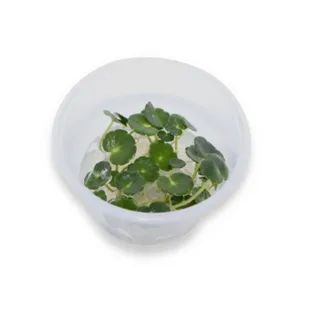
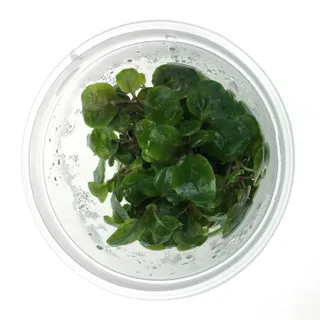
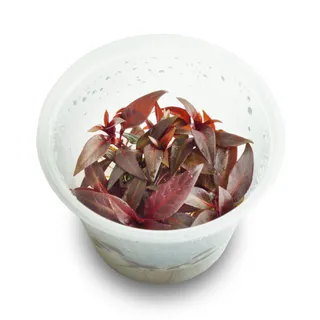
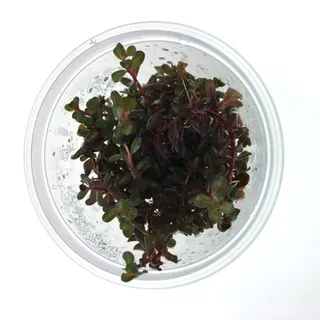
| Form Supplied | Tissue Culture (TC) cup, pest-free and algae-free |
| Planting Method | Stem with creeping horizontal habit |
| Adult Height | 5-10 cm fully grown in |
| Leaf Shape | Lance-shaped, fresh green, 1-2 cm long |
| Light Requirement | Medium — 40-80 PAR at substrate |
| CO2 | Helpful but not required |
| Growth Rate | Medium |
| Difficulty | Easy to moderate — beginner-friendly |
| Aquascape Role | Midground bushy lawn, foreground-to-midground transition |
Getting Started: Planting
Stem
Staurogyne repens is classified as a stem plant in formal botany because each upright shoot emerges from a horizontal creeping rhizomatous stem, but in practice it behaves quite differently from the vertical-growing stems such as Rotala, Ludwigia or Bacopa that most aquarists picture when they hear the phrase ‘stem plant.’ The parent stems grow horizontally along the substrate, pushing out new roots at every node that touches the soil, and sending up short vertical side-shoots that eventually form the visible ‘bushy lawn’ canopy that gives the species its distinctive look. Understanding this horizontal-creeping habit is essential for correct planting, because the temptation for new aquarists is to treat Staurogyne repens like a conventional stem plant and push long single stems vertically into the substrate, which produces a scattered, wispy result rather than the dense hedge that the plant is capable of if planted correctly.
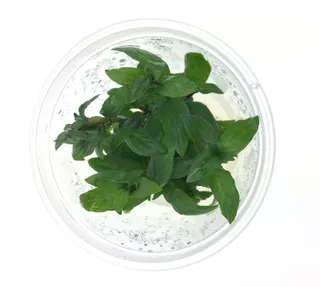
The tissue-culture cup arrives containing a dense mat of young Staurogyne repens plantlets grown on a clear nutrient gel, typically forty to seventy individual plantlets in a single 60 ml cup. Before planting, lift the entire plug from the cup with clean tweezers or fingers and rinse the gel away thoroughly under a gentle stream of lukewarm dechlorinated water. The rinse is less critical for Staurogyne repens than it is for HC Cuba — the species is more forgiving of minor gel residues because its leaves are larger and less prone to being coated and smothered — but the rinse should still be performed patiently, working the plug between your fingertips until the water runs clear and the tiny roots are visibly free of gel. A kitchen sieve held under the tap works well, and the whole rinsing process takes two to three minutes.
After rinsing, divide the plug into small portions of roughly pinch-sized clumps containing four to eight plantlets each, using curved planting tweezers or sharp scissors to cut through the mat. The optimum planting density for Staurogyne repens is notably tighter than for most stem plants but slightly looser than for HC Cuba: aim for clumps spaced two to three centimetres apart in a staggered grid across the planting area. This spacing produces a fully closed hedge within four to six weeks under typical conditions. Spacing more widely than three centimetres leaves visible gaps that take months to close, while crowding clumps closer than two centimetres means the plantlets compete with one another for light and produce spindly rather than bushy growth. Unlike HC Cuba, which carpets primarily by creeping runners extending outward from the parent clump, Staurogyne repens fills in through a combination of horizontal creeping stem extension and new upright shoots pushing up from buried nodes along those stems, so tight planting produces a faster and more uniform establishment.
The specific tweezering technique for Staurogyne repens matters because of its horizontal growth habit. Grip each clump at its base with a pair of curved 27 cm or 32 cm planting tweezers, push the tweezers vertically into the substrate until the crown of the clump — where the first leaves emerge — sits just at or slightly below the substrate surface, open the tweezers slightly while still buried, and withdraw them straight back out. The substrate should close around the roots on its own. Do not bury the crown more than five millimetres below the surface, because leaves pushed too deep will rot, nor leave the crown floating above the substrate, where the clump will detach the first time the filter pulses or a fish swims low across the planting. The roots of TC Staurogyne repens are tiny and white at the moment of planting, but they anchor quickly — within three to five days the clumps will be firmly rooted, and by the end of the first week the first new upright shoots should be visible.
Unlike HC Cuba, Staurogyne repens does not require a dry-start method or a particularly low water level during the establishment phase, and it tolerates full submerged planting straight from the tissue-culture cup with no measurable loss of success rate. This makes it considerably more convenient to plant than HC Cuba, which often responds best to a two- or three-week dry start. For Staurogyne repens, normal tank filling is fine, though if you have the option to fill gently and direct the initial flow away from the freshly planted area for the first forty-eight hours, the clumps will settle more securely. A useful compromise if you have other plants in the same tank that prefer a low-water start is to keep the water level at roughly half tank height for the first week; this also has the side benefit of making fertilisation adjustments easier to observe in the early days.
Tools for planting Staurogyne repens are the standard aquascaping kit: a pair of curved planting tweezers in the 27 to 32 cm range, a pair of straight tweezers for precision adjustments, sharp curved wave scissors for the first trim a few weeks later, a fine-mesh net for catching any stray clippings, and a small pipette or baster for spot-rinsing any gel residue after planting. The ADA Pro-Pinsette, UNS ProScape and several generic brands all produce adequate tweezers; Staurogyne repens is forgiving enough that even entry-level tools will work. Unlike HC Cuba, which can be ruined by blunt household tweezers because its leaves tear easily, Staurogyne repens has noticeably tougher stems and broader leaves that handle imperfect tools without much damage. If you have not planted a tissue-culture species before, Staurogyne repens is an excellent first experience because it forgives most of the small errors that trip up new planters.
Light Needs & Photoperiod
MEDIUM LIGHT
PAR: 40-80 PAR at substrate
High
One of the most practical advantages of Staurogyne repens over demanding carpet plants such as HC Cuba or Eleocharis ‘Mini’ is that it thrives comfortably under medium light rather than requiring the high-PAR lighting that makes carpet aquascaping so expensive and technically demanding for beginners. The target PAR range at the substrate for Staurogyne repens is roughly forty to eighty PAR, which in practical terms means a mid-range planted-tank LED fixture running at normal output. A Chihiros WRGB II at seventy percent, a Twinstar S-Line at medium brightness, a Week Aqua M-Series, a Fluval 3.0 at the stock planted preset, or a Kessil A80 all meet the requirement comfortably on tanks up to sixty centimetres wide. In many cases the same fixture that would be undersized for HC Cuba is exactly right for Staurogyne repens, and this makes the species an unusually good match for aquarists who want the visual impact of a dense foreground or midground planting without investing in contest-grade lighting.
Staurogyne repens tolerates lower light of around thirty PAR with reduced vigour, producing somewhat thinner, lankier growth and slower lateral spread but not collapsing the way HC Cuba or Monte Carlo would. It also accepts higher light of up to one hundred PAR without complaint, typically responding with faster growth, slightly smaller and more compact leaves, and a pronounced horizontal bushy habit — high light actually enhances the species’s signature low-hedge form by encouraging more side-shoots from each node. This unusual flexibility across the PAR range is what makes Staurogyne repens one of the few species that genuinely suits both low-tech and high-tech tanks, and it is one of the reasons experienced aquascapers return to it again and again across many very different layouts.
The recommended photoperiod is eight to ten hours per day, with a thirty-minute ramp at the beginning and end rather than switching the lights on in a single step. The species does not punish slightly longer photoperiods as severely as HC Cuba does, but longer photoperiods still favour algae growth more than plant growth, so there is no benefit to running the lights more than ten hours. If algae begins to appear on glass, hardscape, or older Staurogyne repens leaves, shortening the photoperiod to seven or eight hours is usually the most effective first response, paired with a brief review of whether CO2 and nutrient levels have slipped.
Healthy Staurogyne repens has medium-green, lance-shaped leaves that lie mostly horizontal or at a gentle upward angle along each upright shoot. Leaves that stand straight up, point vertically, and elongate into narrow straps are signalling insufficient light and stretching to find more; the fix is to either raise the fixture output or lower the fixture height. Leaves that bleach to pale yellow or lime green under otherwise healthy growth suggest an iron or overall micronutrient shortage rather than too much light, and the fix in that case is to boost the dosing schedule — especially the iron and chelated micro mix — rather than reduce photoperiod. Under strong light with good CO2 and a full fertiliser regime, Staurogyne repens can develop a subtle bronze or copper tint on the newest leaf tips, particularly under RGB-spectrum fixtures, and this is a sign of thriving rather than stress.
Spectrum matters less than raw intensity for Staurogyne repens, but like most aquarium plants the species looks best under a full-spectrum white-light fixture with a peak around 6500 K, which reveals the fresh-green colour of the leaves without flattening the visual interest into monotone. RGB-capable fixtures such as the Chihiros WRGB II or Twinstar S-Line can render the leaves slightly more vividly if the colour balance is set to neutral or slightly biased toward green and red; heavily blue-shifted ‘reef’ spectrums will grow the plant effectively but tend to wash out the natural colour visually. Sunlight through a window, unlike for HC Cuba, is not actively harmful for Staurogyne repens and the species will survive in a windowsill tank with indirect daylight, but algae will usually outpace the plant under variable natural light and a dedicated LED fixture remains the stronger choice for most aquascapes.
Recommended Photoperiod: 8-10 hours with 30-minute sunrise/sunset ramps
Fertilisation & CO2
CO2 OPTIONAL
Pressurised CO2 injection is not required for Staurogyne repens, and this is one of the single most important practical points about the species because it puts the plant firmly in the category of ‘achievable without a full planted-tank investment’ alongside Anubias, Bucephalandra and the Cryptocoryne family. The species grows perfectly well in low-tech tanks that rely on atmospheric CO2 supplemented by occasional liquid carbon dosing, and in such setups a healthy Staurogyne repens hedge establishes within eight to twelve weeks rather than the four to six weeks typical of a CO2-injected tank. This makes the species a rare and valuable option for aquarists who want a lush, planted-looking aquascape without committing to the capital expense and ongoing operating cost of a pressurised CO2 system.
That said, Staurogyne repens responds vigorously to CO2 when it is available, and a CO2-injected tank will produce a visibly denser, brighter, faster-establishing hedge than the same tank run as low-tech. Under injected CO2 at the standard thirty-ppm target, with the drop-checker sitting a confident lime green at peak injection, the species will develop compact, tightly packed bushes with slightly smaller but considerably more numerous leaves per shoot, and the lateral creeping stems will push outward noticeably faster. For aquarists already running CO2 for other species, there is no reason to modify the injection schedule for Staurogyne repens; the standard one-hour pre-lights-on start and one-hour pre-lights-off stop works fine. For aquarists considering whether to add CO2 specifically to improve their Staurogyne repens results, the honest answer is that a full pressurised system will produce visibly better results but is not necessary; a simpler route that captures most of the benefit at a fraction of the cost is daily dosing of liquid carbon such as Seachem Excel, APT Fix, UNS Liquid Carbon or Easy-Life EasyCarbo. Liquid carbon is not chemically equivalent to dissolved CO2 gas but supplies glutaraldehyde derivatives that plants can use as a simplified carbon source, and Staurogyne repens responds well to full daily doses.
Whether or not CO2 is injected, Staurogyne repens strongly benefits from stable water chemistry throughout the photoperiod, and this is worth emphasising because stability matters more to this species than absolute peak concentration. A tank whose CO2 level swings from five ppm at lights-on to twenty-five ppm at midday and back down overnight will grow less vigorous Staurogyne repens than a tank held steady at fifteen ppm all through the photoperiod, even though the peak concentration is lower. The same principle applies to pH, temperature, and nutrient availability: Staurogyne repens grows best under conditions it can predict from day to day, and sudden shifts in any parameter, including overly aggressive water changes, can trigger a two-to-three-day growth pause even when the new conditions are in principle better than the old ones.
Fertilisation
Fertilisation for Staurogyne repens follows the standard Estimative Index or Tropica dosing philosophy on high-tech tanks, and a much lighter schedule on low-tech tanks. The species is a moderately heavy feeder relative to Anubias or Cryptocoryne but lighter than Rotala or Ludwigia under equivalent light, and the ideal dosing target is a steady low-surplus supply of all macronutrients and a slightly richer supply of micronutrients, particularly iron, across the full photoperiod.
On a fresh aquasoil substrate the first four to six weeks usually need only a light trace micro mix and a small potassium dose, because the soil itself supplies abundant ammonium, nitrate and phosphate during its initial leaching phase. Over-dosing macronutrients in the first month can accelerate the well-known aquasoil ammonia spike and invite an algae bloom that will settle on the young Staurogyne repens leaves. A safe first-month regimen is five millilitres of a commercial all-in-one such as APT Complete, Tropica Specialised or Aquario Neo Easy three times per week, combined with a full daily dose of a chelated micronutrient mix. After the tank enters its second month, begin full Estimative Index dosing: nitrate held around ten to twenty ppm, phosphate one to two ppm, potassium twenty to thirty ppm, plus a comprehensive trace mix containing iron, manganese, boron, zinc, copper and molybdenum.
Iron deserves specific attention for Staurogyne repens: pale new leaves across the hedge almost always indicate an iron or overall micro deficiency rather than a macro problem, and the species responds within days to a well-targeted DTPA iron booster dose. Pale or yellow-tipped new leaves are the canary for trace-mix problems in this species, and aquascapers who have not grown Staurogyne repens before are often surprised by how quickly iron-targeted dosing corrects an otherwise baffling pale-leaf pattern. Conversely, symptoms of macro deficiency in Staurogyne repens tend to appear as older leaves going yellow from the tip inward and dropping, while the new leaves at the growing tip remain a healthy fresh green; this pattern is characteristic of nitrogen deficiency and responds to boosting the macro dose or reducing the frequency of water changes.
Root tabs are useful under Staurogyne repens even on active aquasoil, because the species sends roots down several centimetres and will readily use additional root-zone nutrition. A single balanced tab such as ADA Iron Bottom, Seachem Flourish Tabs or Tropica Nutrition Capsules placed under each cluster of clumps at planting gives the species a very strong start, and a refresh of root tabs every six to nine months keeps the hedge dense and vigorous in the long term. Unlike HC Cuba, where root tabs pushed under a newly planted carpet can dislodge the clumps when they dissolve, Staurogyne repens is tough enough that root tabs placed near the clumps at planting time do no harm.
Finally, remember that fertilisation for Staurogyne repens is a long-term conversation rather than a weekly recipe. Watch the hedge each week, compare against the previous week’s growth, and adjust one variable at a time. A weekly photo taken from the same angle under the same lighting conditions is the most reliable diagnostic tool for spotting subtle changes that daily observation misses. Review the previous week’s photo before you change any parameter; this single discipline distinguishes aquarists who master the species from those who repeatedly chase symptoms in the wrong direction.
Getting the Water Right
5.5–7.0
ideal 6.5
22–28 °C
ideal 25 °C
3–10 dGH
Soft to moderately hard (3-10 dGH)
Staurogyne repens tolerates a remarkably wide range of water chemistry, which is another reason it has become one of the most reliable choices in the hobby for aquarists who do not want to run remineralised RO water. The species accepts pH anywhere from 5.5 to 7.0 and hardness from three to ten degrees of general hardness, and within this window it grows without visible distinction. The ideal sweet spot is pH 6.3 to 6.8 and hardness around four to seven dGH, matching the conditions of the Rio Cristalino drainage from which the species was originally collected — soft, slightly acidic blackwater tributaries with abundant leaf litter contributing tannins and natural CO2 from upstream decomposition. Tap water in most cities falls somewhere in this ideal band or just outside it, and for a great many aquarists a simple conditioned tap-water tank meets Staurogyne repens’s needs without any remineralisation or RO dilution. This tolerance is a significant practical advantage over species such as HC Cuba, which genuinely struggles in hard tap water, or certain Rotala cultivars, which fail to colour up without soft remineralised water.
If your tap water is harder than about twelve degrees of general hardness, you will notice a slight reduction in Staurogyne repens’s vigour and colour intensity, but the plant will not collapse. The practical choices are either to cut the tap water fifty-fifty with reverse-osmosis water, which is often enough to bring a very hard supply into the workable range; or to remineralise one hundred percent RO water with a quality product such as Salty Shrimp GH/KH+, Seachem Equilibrium or ADA Mineral Supplement to a target of four to six dGH. Either approach produces excellent results with Staurogyne repens, and the species does not appear to have a strong preference between a pure-RO remineralised setup and a diluted-tap setup provided the final hardness is in the soft-to-moderate band.
Temperature for Staurogyne repens sits in a tropical band of 22 to 28 degrees Celsius, with 24 to 26 C being the sweet spot. This is a notably warmer range than HC Cuba’s 20 to 26 C preference, and it means that Staurogyne repens pairs very naturally with tropical community fish such as cardinal tetras, rummy-nose tetras, ram cichlids, dwarf gouramis and most small to medium South American species that prefer water in the mid-twenties. Staurogyne repens tolerates brief excursions up to 30 C during summer heatwaves without long-term damage, though growth slows and algae pressure increases at sustained temperatures above 28 C. Below 22 C the plant continues to grow but visibly more slowly, and it may lose its characteristic bushy compactness in favour of a more open habit. Cooler-water tanks running at 20 to 22 C for coldwater fish or for certain dwarf shrimp can still grow Staurogyne repens successfully but should expect longer establishment times.
Flow distribution matters less for Staurogyne repens than for true carpet species because the hedge sits higher in the water column where flow is naturally stronger, but it still matters enough to plan for. Use a spray bar or lily pipe aimed along the diagonal of the tank to sweep flow across the planted area, and after any hardscape change watch where debris settles in the first few days; any spot with visible detritus accumulation between shoots is a candidate for better circulation. A dedicated powerhead is rarely needed for Staurogyne repens unless the main filter is significantly undersized or the tank is much deeper than sixty centimetres.
Growth Rate & Upkeep
MEDIUM GROWTH
Staurogyne repens grows at a steady medium pace that sits comfortably between the slow, delicate progress of HC Cuba or Eleocharis ‘Mini’ and the explosive vertical growth of fast stems such as Rotala rotundifolia or Ludwigia repens. Under typical conditions — medium light, injected CO2 or adequate liquid carbon, a full fertiliser schedule, and stable water parameters — a freshly planted TC cup should show clear new-shoot growth within five to seven days, horizontal stem extension between clumps by the end of the second week, and visible hedge closure between four and six weeks after planting. In low-tech tanks without CO2, the same progression takes roughly twice as long: the first new shoots appear in week two, lateral extension by week three, and full hedge closure around week ten or twelve. This predictable, steady growth is one of the most satisfying aspects of the species for aquascapers accustomed to the invisible first fortnight of HC Cuba establishment, because with Staurogyne repens there is something visible to track almost every week.
Once the hedge has closed, regular trimming is essential to maintain the signature low bushy form. The species is characterised by its unusual response to trimming: unlike a true stem plant, which after trimming sends up a single new shoot from below each cut, Staurogyne repens responds to trimming by sending out multiple side-shoots from the node below the cut and by pushing additional horizontal creeping stems outward along the substrate. In practice this means that every trim makes the hedge denser and lower rather than simply reducing its height, and disciplined regular trimming is what produces the signature carpet-like dense lawn that makes the species so visually distinctive. Trim every three to four weeks in high-tech setups and every six to eight weeks in low-tech tanks, cutting back to roughly three to five centimetres in height using sharp curved scissors in short, overlapping passes rather than long sweeps. The trim encourages horizontal lateral spread; this is the key growth habit that produces the low bushy lawn effect unique to this species.
Remove every clipping immediately with a net or siphon. Staurogyne repens clippings left drifting in the tank will often re-root in unexpected places — on driftwood, against the filter intake, between stones, in the corners of the hardscape — producing an uneven patchwork of small clumps that can be difficult to tidy up later. Some aquarists deliberately exploit this habit to propagate new plantings from trimmings, but if that is not your intention, remove clippings promptly to avoid surprise colonisation elsewhere in the tank.
After trimming, the hedge looks dramatically thinner for three to seven days before it fills back in, and this is entirely normal. The freshly exposed lower stems respond to renewed light exposure by pushing new side-shoots immediately, and within a week or two the hedge will be both denser and more compact than it was before the cut. A useful rule is that the first trim should happen no later than eight weeks after planting even if the hedge has not reached its target height, simply to encourage the lateral branching that produces a dense mat rather than a scattered patchwork of tall individual shoots. Aquarists who defer trimming in the hope of letting the hedge ‘fill in on its own’ usually end up with a thinner, taller, less attractive result than those who trim early and often.
Snails cause much less damage to Staurogyne repens than they do to small-leaved carpet species. The species’s leaves are tougher, thicker and larger than those of HC Cuba, and bladder snails, pond snails and ramshorn snails rarely produce visible damage on a healthy plant. Staurogyne repens in a snail-infested tank will show minor grazing marks on older leaves but continues to grow normally, which is another reason the species is a better choice than HC Cuba for aquarists who cannot fully control their snail population. Shrimp are entirely compatible with Staurogyne repens; Neocaridina and Caridina shrimp graze only the surface biofilm and never damage the plant itself. Fish that burrow or dig — most loaches, some corydoras species feeding aggressively on the substrate, and large South American cichlids — can uproot young Staurogyne repens clumps during the first few weeks before they have anchored, but a well-established hedge is almost impossible to dislodge.
Algae management on Staurogyne repens is generally straightforward because the species outcompetes most algae once established. Black beard algae can occasionally colonise the edges of older leaves in tanks with fluctuating CO2, and the standard treatment of stabilising CO2 delivery and spot-dosing liquid carbon at the edge of the hedge usually clears it within a fortnight. Green dust algae on nearby glass and hardscape is more a sign of the tank’s overall nutrient balance than of any problem with the Staurogyne repens specifically, and the response is the same as for any planted tank: shorten the photoperiod by an hour or two, increase water change frequency briefly, and review the dosing schedule for any over-supply. Cyanobacteria, a slimy blue-green mat with a distinctive earthy smell, occasionally appears in dead-flow zones along the substrate edge of the hedge and requires manual removal, a three-day blackout, and in persistent cases a targeted antibiotic such as Maracyn (erythromycin) to clear.
Weekly Water Change
30-50% water change with temperature-matched water during the first two months; 30% fortnightly once the hedge is established
Lateral Trim
Every 3-4 weeks in CO2 tanks, every 6-8 weeks in low-tech; trim back to 3-5 cm with curved scissors, removing all clippings immediately with a fine net
Fertiliser Dosing
Full EI or Tropica schedule daily or every other day; full trace mix three times per week minimum, with iron-rich micronutrient booster if new leaves go pale
Root Tab Refresh
Single balanced root tab per cluster at planting; refresh every 6-9 months beneath the hedge to keep growth vigorous long-term
Glass and Surface Cleaning
Weekly glass scrape and surface film skim; a clean surface lets the full light spectrum reach the planting and boosts gas exchange
Filter Maintenance
Canister filter rinse every 6-8 weeks in old tank water only — never tap water, which will kill the biofilm and destabilise the tank
Multiplying Your Plant
Cuttings
Staurogyne repens is one of the easiest planted-aquarium species to propagate, and the propagation process is so reliable that many aquascapers buy a single tissue-culture cup at the start of a new layout and subsequently supply themselves entirely from cuttings for years. The species propagates through simple stem cuttings that root readily when replanted in fresh substrate, with a success rate approaching one hundred percent for properly prepared cuttings planted in an established aquasoil substrate.
To take propagation cuttings, wait until the hedge has established itself for at least six weeks and has a visible creeping horizontal habit with tall upright side-shoots. Using sharp curved scissors, snip off the top three to five centimetres of a vigorous upright shoot, ideally one that shows at least two or three visible leaf nodes along its length. These leaf nodes are where new roots will emerge once the cutting is replanted. Strip away the bottom one or two pairs of leaves by pinching them off with your fingers or cutting them away with fine scissors, leaving a bare stem segment one to two centimetres long below the remaining leaves. Using curved planting tweezers, push this bare stem segment into the substrate of the target planting area to a depth of roughly one centimetre, so that the exposed leaf nodes are buried in the substrate and the leafy upper portion stands just above the substrate surface. The cutting should anchor within three to five days as new adventitious roots emerge from the buried nodes, and the first new upright growth should appear within ten to fourteen days.
A faster but slightly less tidy alternative is to lift small pieces of the horizontal creeping stem with its attached side-shoots intact — essentially a miniature version of the plug-lifting technique used for HC Cuba. Slide sharp scissors horizontally under a small section of hedge at substrate level, lift out a piece containing three to five upright shoots with their connected horizontal stem, and replant this entire piece in the target location, burying the horizontal stem just below the substrate surface. This method produces a more developed starting cluster in the new location and is especially useful for filling bare patches or expanding the hedge into adjacent areas quickly.
Cuttings can also be taken opportunistically from post-trim clippings rather than from dedicated propagation sessions. After a hard trim, select the longest and most vigorous clippings with visible leaf nodes, strip the lower leaves, and replant as cuttings in the same manner. This effectively turns every trim into a propagation session at no extra cost, and many aquascapers build up reserve stocks of Staurogyne repens this way in secondary tanks or in separate corners of the main tank for use in future layouts or to share with other hobbyists.
Successfully propagated Staurogyne repens cuttings should show new leaf growth within two weeks and begin pushing out new horizontal creeping stems within three to four weeks. Cuttings that remain static for more than three weeks without new growth are almost certainly dead and should be removed, as they will only decompose and foul the substrate. Unlike propagations of some stem plants, Staurogyne repens cuttings are very rarely lost to melt if the basic protocol is followed, which is another reason the species is popular among aquascapers running commercial or contest tanks where reliable propagation is a practical requirement.
Design Ideas & Placement
Midground
Staurogyne repens occupies a genuinely unique niche in aquascape design that no other commonly available species fills, and understanding that niche is the key to getting the best out of the plant compositionally. The species reads as a low bushy lawn — taller than a true foreground carpet such as HC Cuba or Monte Carlo, yet much lower and denser than a conventional midground stem planting such as Ludwigia or Rotala — and this unusual height band of five to ten centimetres lets it occupy the visual transition zone between foreground and midground more cleanly than any other plant in the hobby. In Nature Aquarium terms, Staurogyne repens creates a soft, dense middle tier that reads from a viewing distance as a thick, richly textured ground-hugging mat, and up close reveals itself as a miniature forest of individual small shrubs with visible structure, giving the whole aquascape a sense of depth and scale that is much harder to achieve with flat carpets alone.
This distinctive position makes Staurogyne repens especially valuable in three very different aquascape styles. In the Dutch style, which traditionally layers different species of stem plants in coloured bands at increasing heights from front to back, Staurogyne repens occupies the front band as a fresh-green counterpoint to the reds and pinks of Rotala ‘H’ra’ or Ludwigia ‘Super Red’ behind it. In the Nature Aquarium or iwagumi style, it can serve as a compact midground transition between a true carpet of HC Cuba or Monte Carlo in the extreme foreground and the vertical-growing stems or mosses in the midground; this tiered composition — carpet, bushy lawn, stems — produces the forced-perspective depth effect that makes high-quality iwagumi photography so striking. In the jungle or biotope style, where deliberate wildness is the goal rather than geometric control, Staurogyne repens planted in irregular patches between driftwood and stones produces a convincing low-lying riparian brush that resembles the natural Rio Cristalino habitat from which the species was originally collected.
Staurogyne repens pairs beautifully with a wide range of companion plants. In the foreground, Monte Carlo or HC Cuba as a true carpet plant in front of a Staurogyne repens hedge creates a visually rich two-layer lawn effect. Along the midground, species with contrasting leaf shapes such as Bucephalandra, Anubias nana ‘Petite’ tied to stones, or Cryptocoryne wendtii provide textural contrast against the fine lance-shaped leaves of Staurogyne repens. In the background, any tall stem plant works as a complement — Rotala ‘H’ra’ for red contrast, Rotala rotundifolia ‘Colorata’ for orange-red warmth, Limnophila sessiliflora or Hygrophila corymbosa for lush green depth, or Vallisneria species for vertical line and movement. Among moss species, Christmas moss or Weeping moss attached to driftwood or stones at the boundary between foreground and midground is a particularly elegant pairing because the moss’s soft drooping texture contrasts pleasingly with the crisp upright form of Staurogyne repens.
For fish and invertebrates, Staurogyne repens is one of the most compatible planted-tank species in the hobby. Shoaling tetras such as cardinal tetras, rummy-nose tetras, ember tetras and chilli rasboras drift gracefully above the hedge and highlight its scale. Dwarf shrimp — Neocaridina, Caridina, and the various Tiger and Crystal variants — thrive in a Staurogyne repens tank because the hedge provides endless grazing surface for biofilm and countless small hiding places between shoots, especially valued by molting shrimp and newly hatched shrimplets. Peaceful dwarf cichlids such as Bolivian rams and Apistogramma species enjoy the sheltered sight lines the hedge provides. Even bottom-feeders such as Otocinclus and small corydoras species coexist with Staurogyne repens without damage, though the larger and more actively digging species of corydoras may occasionally uproot young clumps during their first few weeks.
A few layout tips specific to Staurogyne repens: plant it in sweeping curves rather than straight lines whenever the layout permits, because the species’s slightly irregular bushy habit looks natural in curved plantings but artificial in geometric ones. Use groupings of at least fifteen to twenty clumps rather than scattered singles, because isolated clumps read as stray debris rather than as deliberate composition. Plan for scale — in a shallow nano tank of twenty litres or less, Staurogyne repens can function as the main feature plant; in a larger tank of one hundred litres or more, it works best as one element in a layered composition with both a true foreground carpet and a background of taller stems or rhizome plants. Finally, remember that the species’s fresh-green colour sits in the middle of the chromatic range for planted aquaria, and is therefore an excellent neutral ground against which deliberately vivid colour accents — reds, oranges, the occasional bronze or copper tone on redder cultivars — can be showcased most effectively.
| Plant | Why | |
|---|---|---|
| 🌿 | Monte Carlo (Micranthemum ‘Monte Carlo’) | True carpet in the extreme foreground beneath the Staurogyne repens hedge, creating a visually rich two-layer lawn effect |
| 🌿 | Hemianthus callitrichoides ‘Cuba’ | The finest-textured carpet in the hobby; paired in the foreground with Staurogyne repens midground produces the classic contest-grade layered look |
| 🌿 | Anubias nana ‘Petite’ | Dark-green dwarf rhizome plant for attaching to hardscape without competing for substrate space; textural contrast against the lance-shaped Staurogyne leaves |
| 🌿 | Bucephalandra ‘Wavy Green’ | Slow-growing, rhizome-attached midground accent; thrives in the same water parameters and adds bold leaf contrast |
| 🌿 | Christmas Moss (Vesicularia montagnei) | Tied to stones or wood at the foreground-to-midground boundary; soft drooping moss texture pairs beautifully with the crisp upright Staurogyne form |
| 🌿 | Rotala ‘H’ra’ | Red stem background plant whose colour pops dramatically against a fresh-green Staurogyne midground in both photography and in person |
Quick Reference
| Light | Medium — 40-80 PAR |
| Photoperiod | 8-10 hours with ramp |
| CO2 | Helpful but not required |
| Growth Rate | Medium |
| Position | Midground bushy lawn, foreground-midground transition |
| Height | 5-10 cm |
| pH | 5.5-7.0 (ideal 6.5) |
| Temperature | 22-28 C (ideal 24-26 C) |
| Hardness | 3-10 dGH (soft to moderately hard) |
| Substrate | Aquasoil preferred; inert substrate with root tabs workable |
| Propagation | Cuttings; strip lower leaves, replant directly in substrate |
| Difficulty | Easy to moderate — beginner-friendly |
Reviews
Clear filtersThere are no reviews yet.