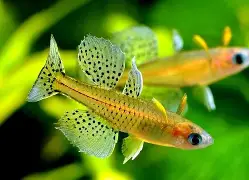
🪨 Species at a Glance
| Scientific Name | Pseudomugil gertrudae |
| Author & Year | Weber, 1911 |
| Family | Pseudomugilidae |
| Order | Atheriniformes |
| Origin | Northern Australia (NT Top End, QLD Cape York) and southern Papua New Guinea |
| Adult Size | 3–4 cm (1.2–1.6 in) |
| Lifespan | 2–3 years |
| pH Range | 5.5–7.5 |
| Temperature | 22–28 °C (72–82 °F) |
| Hardness (dGH) | 4–12 |
| Diet | Micro-carnivore — crushed flake, micro-pellets, frozen daphnia & baby brine shrimp |
| Minimum Tank Size | 40 L for a pair or trio; 60 L+ for a school of 10 |
| Care Level | Beginner to intermediate |
| Temperament | Peaceful, schooling, mild intra-male display |
| Breeding | Daily egg scatterer — eggs attach to fine-leaved plants |
| Tank Position | Top to middle |
Origin & Etymology
The genus name Pseudomugil is a Latinised compound that translates roughly as ‘false mullet’ — a reference to the superficial resemblance of these tiny rainbowfish to the streamlined body shape of true mullets (family Mugilidae), despite being completely unrelated. When the Dutch-German ichthyologist Max Wilhelm Carl Weber first examined specimens from the Aru Islands and northern Australia in the early twentieth century, he chose the species epithet gertrudae to honour a specific person in his life: Gertrude, his wife and frequent collaborator, who accompanied him on several of his expeditions through the Indo-Australian archipelago. That dedication, formally published in 1911, makes the Gertrudae Blue-Eye one of the relatively small number of fish species named not after a scientific colleague or a geographic feature, but after a spouse — a quiet gesture that has carried forward through more than a century of ichthyological literature.
The common name, Gertrudae Blue-Eye Rainbowfish, layers three separate references onto that original Latin. ‘Gertrudae’ retains the specific name. ‘Blue-Eye’ is universal across the small rainbowfishes of the family Pseudomugilidae — every species in the group, from the salt-tolerant Pseudomugil signifer to the electric Pseudomugil luminatus, shares that distinctive iridescent blue ring around the iris, produced by light-refracting guanine crystals much like those that light up a neon tetra’s stripe. In Pseudomugil gertrudae, the blue-eye is particularly intense, often described as lime-blue or electric lime, and it seems to shine against the otherwise translucent head. ‘Rainbowfish’ situates the species within the broader Melanotaeniidae/Pseudomugilidae assemblage of Australian and New Guinean fishes that radiated across the monsoonal tropics after ancestors became isolated in inland freshwater systems millions of years ago.
In the Australian hobby, you will often see this fish sold simply as ‘Gerts’ or ‘Gertrude’s Blue-Eye’. Both are correct. What matters to keepers is recognising that all of these names point to the same small, sparkling, fully native Australian rainbowfish — not one of the more common Papua New Guinean imports, but a fish whose natural range extends from Arnhem Land and Kakadu across to the tip of Cape York, with additional populations across the Torres Strait in the southern lowlands of Papua New Guinea. The species sits firmly within the Australian native freshwater heritage, and that is a point of genuine pride for aquarists who value provenance.
Taxonomically, Pseudomugil sits in the family Pseudomugilidae — the Blue-Eyes — which is closely related to but distinct from the larger rainbowfish family Melanotaeniidae. Both families belong to the order Atheriniformes, the silversides, and both radiated extensively across the freshwaters of northern Australia and New Guinea as the continent drifted north and successive sea-level changes isolated inland river systems. The Blue-Eyes are distinguished by their smaller adult size, more slender body shape, prominent iridescent eye ring, and reduced lateral line. Within the genus Pseudomugil, the roughly twenty described species range from tiny brackish-tolerant coastal specialists to jewel-toned freshwater-swamp dwellers like Pseudomugil gertrudae. They are among the most rewarding nano fish in the Australian native hobby precisely because they carry the full gracefulness of a rainbowfish in a body small enough for a 40-litre tank.
Available Colour Grades
🟡 Northern Territory (Top End) Form
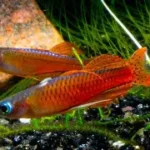
The most frequently seen wild form, collected from seasonal floodplain billabongs around Kakadu and Arnhem Land. Metallic gold flanks with a subtle greenish sheen, strong black-and-white fin edging in mature males, and an unusually bright lime-blue eye ring.
🟠 Cape York (QLD) Form
Populations from the lagoons and pandanus creeks of far north Queensland. Often slightly warmer in overall tone, with a faint orange flush along the dorsal musculature in courting males. Fin patterning is very similar to the NT form but tends to show slightly more yellow in the outer fin rays.
🟢 Southern Papua New Guinea Form
Lowland populations from the trans-Fly region south of the Fly River mouth. Similar body shape, with slightly more pronounced black fin margins and a tendency toward greener flanks. Rarely imported into Australia — most Australian stock is native-sourced or captive-bred from NT and QLD lineages.
🔵 Related: Pseudomugil cyanodorsalis
A close cousin — the Blue-Backed Blue-Eye — native to coastal northern Australia but tolerant of brackish water. Similar nano size but with a striking cobalt stripe along the dorsal surface. Mentioned here as a sibling species for framing only; not a variety of P. gertrudae.
🔴 Related: Pseudomugil luminatus
The Red Neon Blue-Eye from Papua New Guinea — a neighbouring species with blazing red-orange flanks and the same blue eye ring. Often confused by beginners; compare finnage and body base colour to tell them apart in stores.
Within the species Pseudomugil gertrudae itself, you will not find the riot of line-bred morphs that defines farmed species like bettas or guppies. This is a wild fish, and its beauty lies in subtle regional variation rather than selectively bred colour forms. What you choose between in practice is whether to keep a Northern Territory lineage or a Cape York lineage — both are equally Australian, both will thrive in the same aquarium conditions, and both display the signature combination of gold flanks, transparent belly, lime-blue eye, and patterned fins. Captive-bred stock in the Australian hobby is often a mix of these two geographic populations, and for most aquascapers that mix is perfectly acceptable. For purists who want a single-locality line — say, pure Magela Creek or pure Jardine River — speciality native-fish breeders and groups such as ANGFA (Australia New Guinea Fishes Association) are the best source, and are worth seeking out if you plan to eventually breed your fish and share offspring with the native-fish community. Colour intensity in all forms responds dramatically to a tannin-stained, softly lit, densely planted tank: the gold flanks deepen, the eye ring sharpens, and male fins take on a smokier contrast between the white and black bands.
The metallic gold colouration of Gertrudae’s flanks is produced by iridophores — platelets of crystalline guanine embedded in the scales that reflect and refract incident light. The same optical physics lights up a neon tetra’s blue stripe and a damselfish’s electric spots. Because these are structural colours rather than pigment-based, they are extremely stable with age and cannot bleach out the way some pigment-based colours can in old or stressed fish. What can vary dramatically, however, is how bright those structural colours appear in a given tank. Overhead light that is too bright causes the fish to hug the bottom and turn away from the viewer, presenting flanks from an angle that minimises reflection. Soft, diffused, dappled light — the kind produced by a moderate LED shining through a layer of floating plants — hits the flanks from a range of angles and causes the full shimmer to display. This is why experienced Gertrudae keepers almost always recommend heavy floating plant cover: the fish genuinely look like different animals under diffused light versus bright light.
How to Sex This Species
Sexual dimorphism in Pseudomugil gertrudae is one of the great pleasures of keeping the species — and it is one of the clearest of any small Australian native. From the moment a young fish reaches about 2.5 cm in length, male fin development begins to diverge visibly from female fin development. Males grow the dorsal and anal fin rays into trailing filaments, and they develop the characteristic black-outer-with-white-inner edging on those fins and on the upper and lower lobes of the caudal. Watching a group of five or six mature males compete in a densely planted tank is a signature Gertrude experience: each male rises slightly, flares his median fins fully, flashes the lime-blue eye ring toward his rival, and performs a slow, sideways lateral display with trembling fins. No fin damage results — this is pure visual combat, and it stops as soon as one male withdraws a few centimetres.
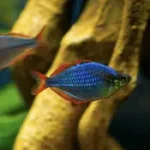
Females, by contrast, are more uniform in their subtlety. Their bodies are slightly shorter and significantly more rounded, especially around the belly, which plumps visibly when they carry eggs (as mature females do nearly every day in good conditions). Their fins remain short, gently rounded, and pale gold with no filament extension. They school more tightly among themselves, often staying mid-water while the males perform above and around the plant thickets. For a display tank, the best ratio is generally two females per male — this spreads male attention and encourages more frequent male-to-male display without creating harassment of any single female.
One subtle but useful indicator is fin shape in juveniles. At about 2 cm — roughly two to three months post-hatch — young males begin to show the first hint of a pointed rear edge on the anal fin, and their dorsal fin ray starts to extend slightly beyond the base of the fin. Juvenile females remain uniformly rounded in all fins. This early dimorphism means that by the time you are ready to select breeding pairs from a batch of captive-raised juveniles, you can sex them reliably before they reach full adult size. For store-bought adult fish, dimorphism is always obvious to an experienced eye, but beginners should ask the store to point out a clear male and a clear female for comparison — once you have seen the difference in person, it becomes immediately recognisable in any future purchase.
| Feature | Male | Female |
|---|---|---|
| Overall Size | Slightly larger, up to 4 cm including fin extensions | Marginally smaller, 3–3.5 cm with rounder body profile |
| Body Colour | Bright metallic gold with strong greenish-gold flank sheen | Paler gold, more muted and pastel, often with a silvery undertone |
| Dorsal Fin | First and second dorsal rays extended into elegant trailing filaments, edged in white and black | Short, rounded dorsal fins with minimal filament; edging subtle or absent |
| Anal Fin | Elongated with clearly visible white leading edge and dark outer border | Short, rounded, uniformly pale |
| Caudal (Tail) Fin | Upper and lower lobes extended into flowing points with black and white striping | Gently forked, all rays of equal length, pale golden |
| Eye Ring | Bright lime-blue, often flashed during display | Still blue, but slightly less intense and rarely ‘flashed’ |
| Behaviour | Frequent lateral fin-spreading displays toward other males and females; mild intra-male sparring | Calmer, more tightly schooling, moves in a loose group with other females |
| Body Depth When Gravid | Slim, torpedo-like | Noticeably rounder belly when full of eggs, especially viewed from above |
Getting the Water Right
5.5–7.5
ideal 6.5
22–28 °C
ideal 26 °C
4–12 dGH
Soft to moderately soft water preferred
In its native range, Pseudomugil gertrudae lives in seasonally flooded wetlands, pandanus-lined creeks, and rainforest swamps where the water is stained a rich tea colour by leaf tannins, pH commonly drops into the 5.5 to 6.5 range during the dry season, and dissolved minerals are low to moderate. Temperatures in these habitats swing widely over the year — nights in the dry season may fall to 18 °C in the NT Top End, while stagnant afternoon pools can climb well above 30 °C. This broad natural tolerance is exactly why Gertrudae are forgiving in the home aquarium: anywhere from pH 5.5 to 7.5, 22 to 28 °C, and 4 to 12 dGH will keep them healthy. The sweet spot — and the range where their colours are deepest, their fin displays most frequent, and their breeding most reliable — is approximately pH 6.5, 26 °C, and 6 to 8 dGH.
For Australian keepers in tropical cities like Darwin, Cairns, or Townsville, tap water is often already soft and neutral to slightly acidic, meaning Gertrudae can be kept on unadjusted tap with nothing more than dechlorinator. In Sydney, Melbourne, Adelaide, and Perth, tap water runs harder and more alkaline, and the fish will still survive — but for best display and breeding results, consider blending with a portion of reverse osmosis water or using a simple aquasoil substrate that gently reduces pH through cation exchange. A handful of Indian almond leaves (Terminalia catappa) or dried Melaleuca bark in the tank will add natural tannins and nudge both pH and dissolved organics toward the blackwater conditions the fish evolved in. Stability matters more than an exact target — a rock-steady pH of 7.0 is healthier than a pH that swings between 6.0 and 7.2 week to week.
Water-change routine is simple. Plan on 20 to 25 percent weekly for a moderately stocked 40 to 60 litre tank, temperature-matching the incoming water to within one degree of the tank temperature. Use a dechlorinator that neutralises both chlorine and chloramine, and — if your tap water is particularly hard or high-TDS — pre-age the replacement water in a bucket for a few hours so that temperature, dissolved gases, and pH settle before addition. Gertrudae are not as fragile as many true blackwater species, but they respond beautifully to stable, clean, tannin-tinted conditions, and their colours respond visibly within days to a cleaner water-change regime. Ammonia and nitrite must always read zero; nitrate should stay under 20 ppm, ideally under 10 ppm in a breeding tank where fry will be present. A simple aquarium test kit is enough — weekly testing is sufficient for a stable tank, and monthly is acceptable once the tank is well-established and nitrogen-cycle stability is proven.
Aquarium Setup Guide
Pseudomugil gertrudae thrives in a planted nano tank that mimics its seasonal blackwater habitat. A 40-litre tank is the realistic minimum for a pair or trio, but a 60 to 90 litre aquascape is far better if you intend to keep a school of ten or more and display their full social behaviour. Width and length matter more than height: these fish move mostly laterally, in the upper and middle levels of the water column, so a long, shallow footprint reads their schooling far better than a tall, narrow cube.
For substrate, choose either a fine dark sand or an active aquasoil such as ADA Amazonia, Tropica Aquarium Soil, or a similar planted-tank soil. Dark substrate dramatically intensifies the gold flanks and lime-blue eye of the fish by contrast. Aquasoil has the added benefit of gently buffering pH downward and providing long-term nutrition for rooted plants. Avoid coarse white gravel at all costs — the fish will still live in it, but the visual effect is a completely washed-out version of what this species can look like.
Dense planting is not optional. Gertrudae are visual fish: they feel secure, school properly, and display most vibrantly when surrounded by fine-leaved vegetation. Plant the back and sides heavily with stem plants — Cabomba caroliniana, Myriophyllum, Limnophila sessiliflora, Hygrophila pinnatifida, and local native favourites such as Ludwigia repens all work well. Add epiphytes (java fern, Anubias nana, Bucephalandra) attached to driftwood. Most importantly, include floating plants: Amazon frogbit, red root floater, or salvinia. Floating plants do two critical jobs — they diffuse overhead light into the subdued, dappled lighting Gertrudae prefer, and their trailing roots become one of the key egg-attachment sites for breeding. Leave an open swimming corridor down the front-centre of the tank so the school has a runway for display.
Driftwood completes the biotope. A single piece of spiderwood, malaysian driftwood, or dried mangrove root provides vertical structure, anchors epiphytes, and slowly releases the tannins Gertrudae evolved with. Keep lighting on the dimmer side — a low-to-moderate planted-tank LED, ideally dimmable, is perfect. Very bright light without floating-plant cover will wash out the fish’s colours and make the school hug the bottom half of the tank rather than displaying openly.
Think about circulation carefully. In their wild habitat, Gertrudae live in near-still water during the dry-season months, and even during the monsoon flush the currents in the lagoons and side channels they occupy are gentle. A strong canister filter with its outflow pointed directly into the tank will create enough current to disturb their natural behaviour — females will spawn less, males will display less frequently, and the school will spend more time huddled in sheltered pockets. Aim for very gentle circulation. An air-driven sponge filter in a nano tank is almost always the right choice. In a larger tank, use a small internal filter or a baffled hang-on-back with the outflow directed against the front glass so the current spreads out and loses velocity before reaching the fish.
A realistic equipment budget for a new 60-litre Gertrudae setup in Australia, buying everything new, is approximately: 120–180 AUD for the tank and stand; 40–60 AUD for an LED light; 40 AUD for a heater and thermometer; 25–40 AUD for a nano sponge or hang-on-back filter; 60–100 AUD for aquasoil or sand; 80–150 AUD for a generous planting of stems, epiphytes, and floaters; 30–50 AUD for driftwood and botanicals; plus water-conditioner, test kit, and dechlorinator. Everything added up, a beautiful planted Gertrudae biotope can be built for around 450 to 600 AUD including a starter school of ten fish. It is one of the most cost-effective full native-fish displays you can put together.
Tank
Minimum 40 L for a pair/trio; 60–90 L recommended for a proper school of 10 or more
Filter
Sponge filter or small nano hang-on-back with adjustable or baffled flow — gentle current is essential
Heater
25–50 W submersible heater set to 26 °C; keep year-round in temperate Australian cities
Lighting
Low to moderate planted LED, dimmable ideal. Use floating plants to soften the light further
Substrate
Fine dark sand or aquasoil (ADA, Tropica, or similar) for colour contrast and gentle pH buffering
Plants
Stem plants (Cabomba, Myriophyllum, Ludwigia), epiphytes (java fern, Anubias), floating plants (frogbit, salvinia)
Driftwood
Spiderwood, malaysian driftwood, or dried mangrove root for structure and tannins
Botanicals
Indian almond leaves, alder cones, or dried Melaleuca bark for blackwater tannins
Thermometer
Digital or glass — verify heater accuracy weekly, especially in tropical Australian summer heat
Spawning Mop (optional)
A loose mop of acrylic yarn or fine java moss for collecting eggs if you intend to breed
Nutrition & Diet
Pseudomugil gertrudae is a micro-carnivore with a small, upturned mouth that is genuinely adapted to picking at small prey items in the middle and upper water column. In the wild, its diet consists almost entirely of small invertebrates: mosquito and midge larvae, water fleas (Daphnia and related cladocerans), copepods, small bloodworms, tiny crustaceans, mite larvae, and whatever else drifts within striking distance. Plant matter and detritus barely feature. This dietary profile dictates exactly how to feed them in the aquarium.
The single most important rule is that every food item must be small. Standard tropical flakes, crushed between your fingers into a fine dust, are an acceptable staple. A high-quality micro-pellet designed for small rainbowfish or killifish is even better — look for pellets around 0.5 mm in diameter with whole fish or insect meal as the first ingredient. Crumble any flake before dropping it in; a whole flake that floats intact will simply be ignored and foul the water.
Supplement two to four times a week with frozen or live foods. Frozen baby brine shrimp (Artemia nauplii), frozen daphnia, frozen cyclops, and frozen micro-worms are all ideal — all are correctly sized and all trigger the enthusiastic snapping response that makes Gertrudae feeding time a joy to watch. Live foods produce the most dramatic response: a culture of grindal worms, live baby brine shrimp, or walter worms will reliably condition females into daily egg production. Avoid any large-pellet, wafer, or bottom-feeder food; Gertrudae will not eat it, and it will only rot at the substrate.
Feed small amounts two to three times a day rather than one large meal. Their stomachs are very small, and a nano tank with overfeeding quickly develops water-quality issues that Gertrudae — as soft-water, low-organic-tolerance fish — dislike. A good rule: feed only as much as the school can clear from the water column within thirty seconds.
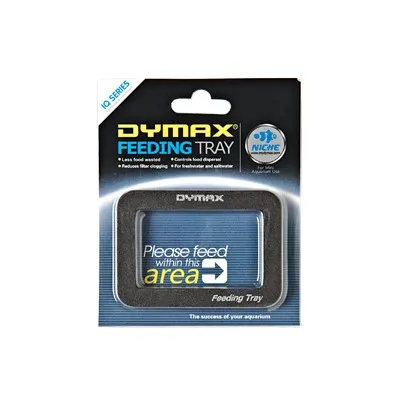
Gertrudae are also notoriously upper-column feeders. They rarely pick at food once it hits the substrate, so any food that sinks past the mid-water is effectively wasted — and that wasted food is what degrades water quality in a planted nano tank. When feeding frozen or live foods, thaw frozen cubes in a small cup of tank water and use a pipette to deliver the food near the water surface. Turn off the filter flow briefly, drop the food, and let the school snap at it as it drifts downward. Once most of the food is consumed, turn the filter back on. This single trick alone dramatically reduces the waste load in a Gertrudae tank and is one of the reasons experienced keepers favour sponge filters over strong HOBs for this species.
For long-term colour and condition, variety is more important than any single premium food. A rotation of crushed flake, nano pellets, frozen daphnia, frozen baby brine shrimp, and (if you can culture them) live micro-worms or grindal worms will produce markedly deeper gold tones and bolder fin display than a single-food diet ever will. Beta-carotene and astaxanthin from frozen cyclops and from good quality colour-enhancing flake foods visibly intensify the gold flank sheen over several weeks of consistent feeding.
How to Breed
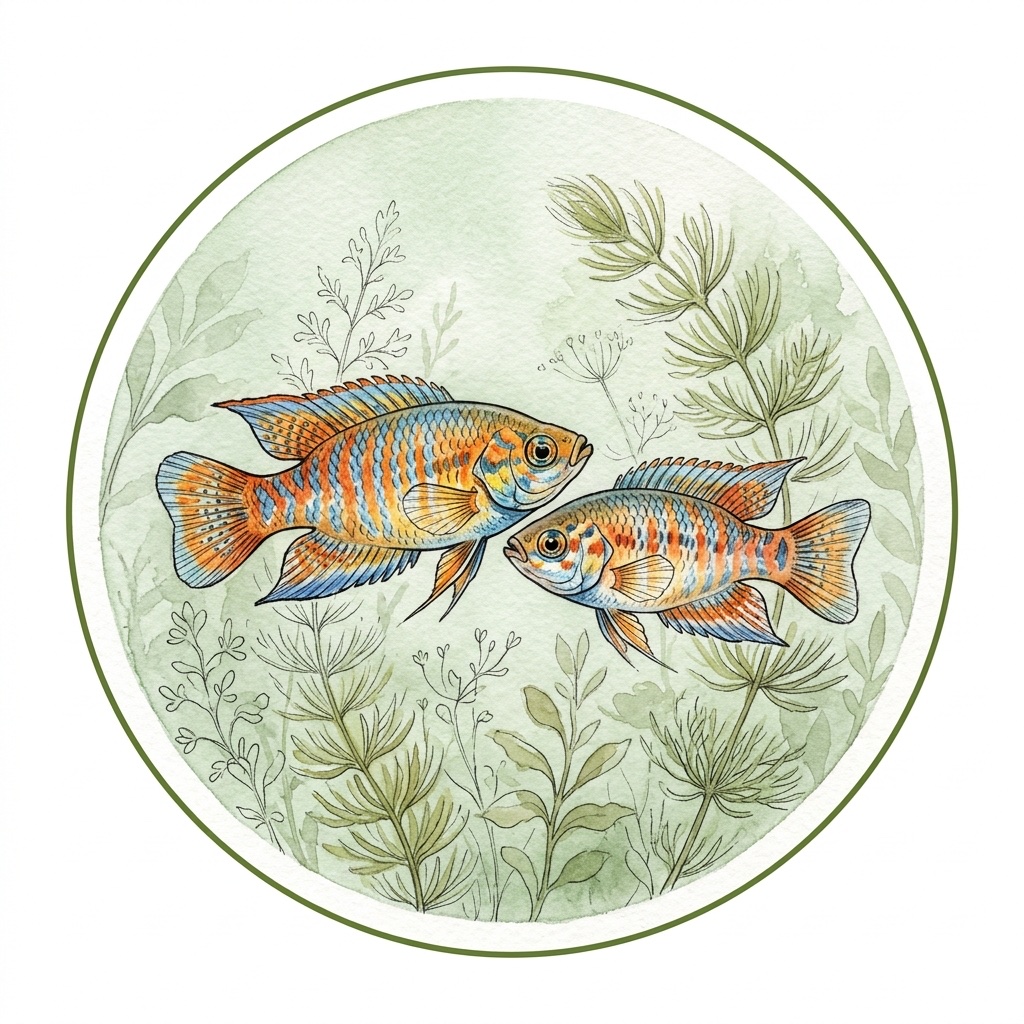
Week -1
Conditioning
Feed live and frozen foods heavily for 5–7 days
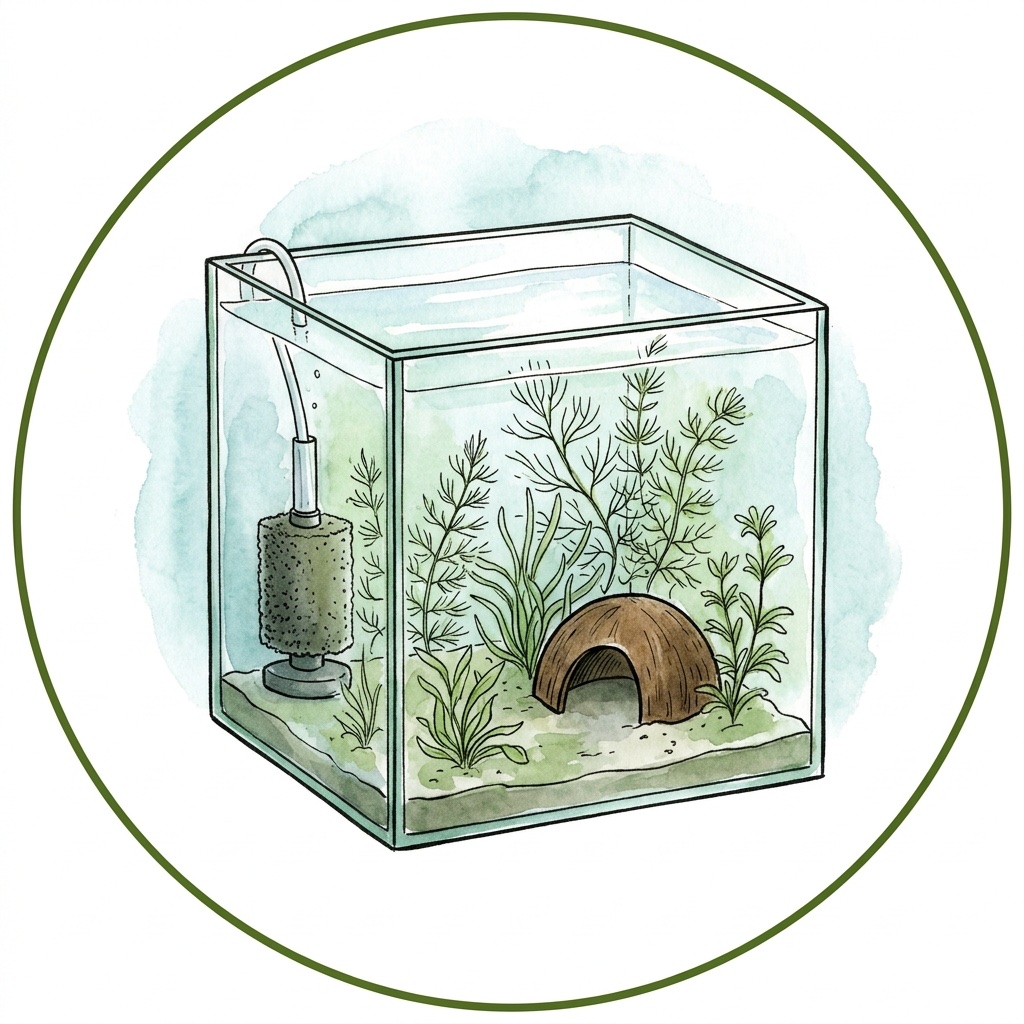
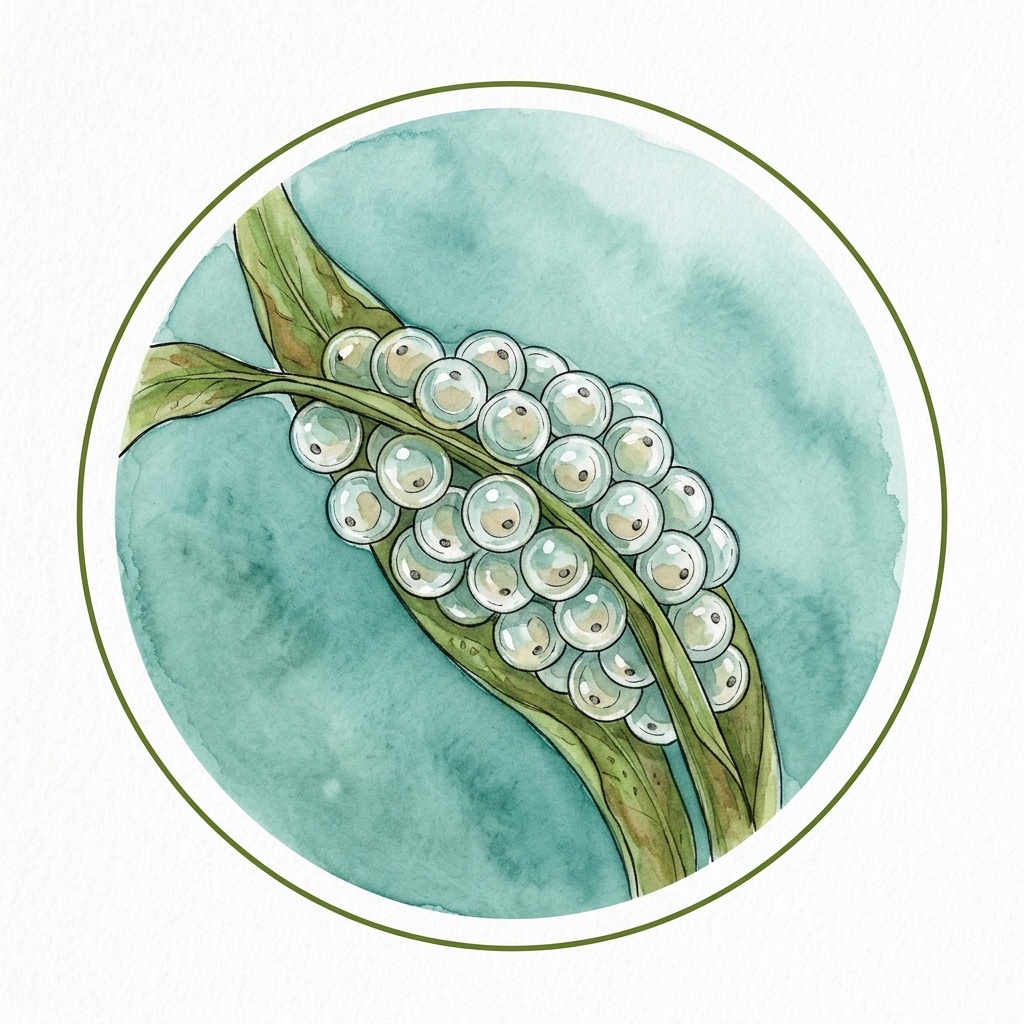
Day 0
Courtship & Spawning
Male displays, female approaches, eggs are deposited one to three at a time on plant leaves and roots
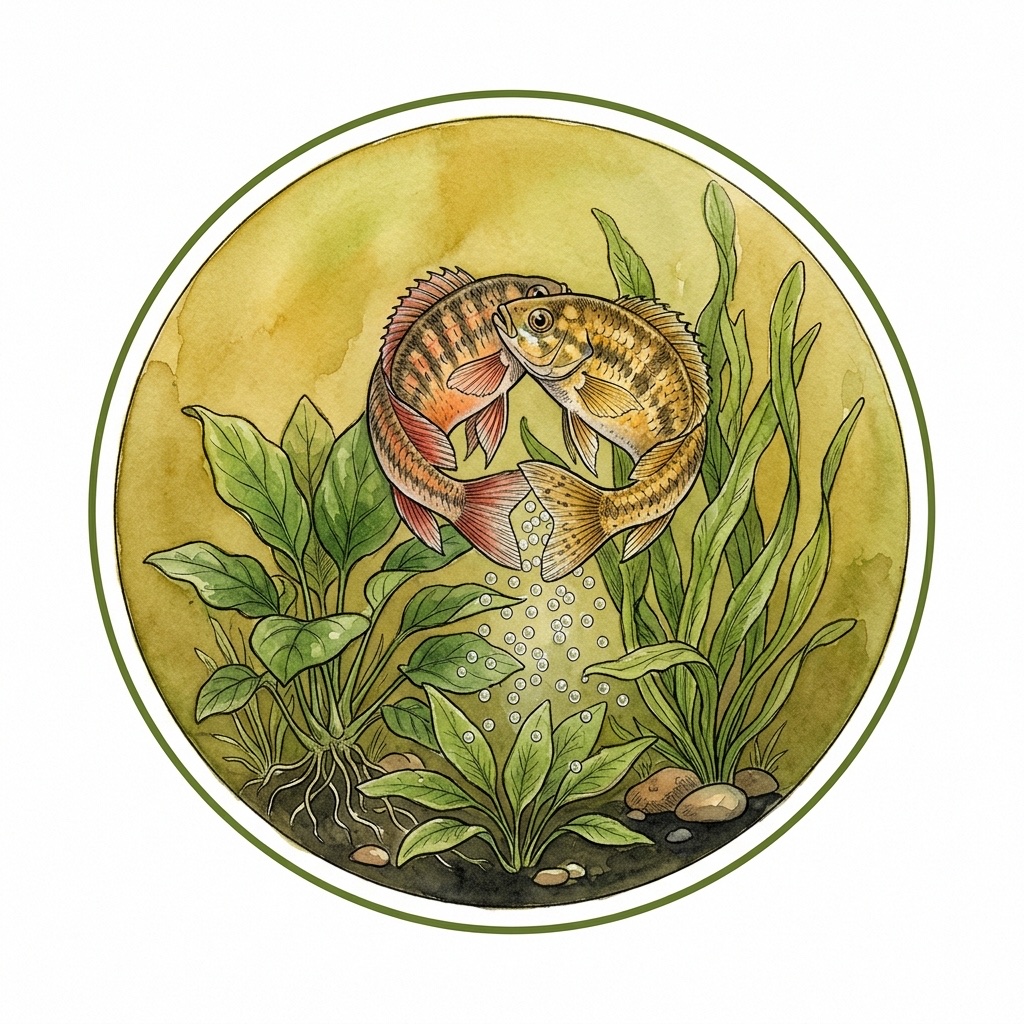
Day 1–10
Egg Incubation
Eggs harden, embryos develop; keep dim and fungus-free
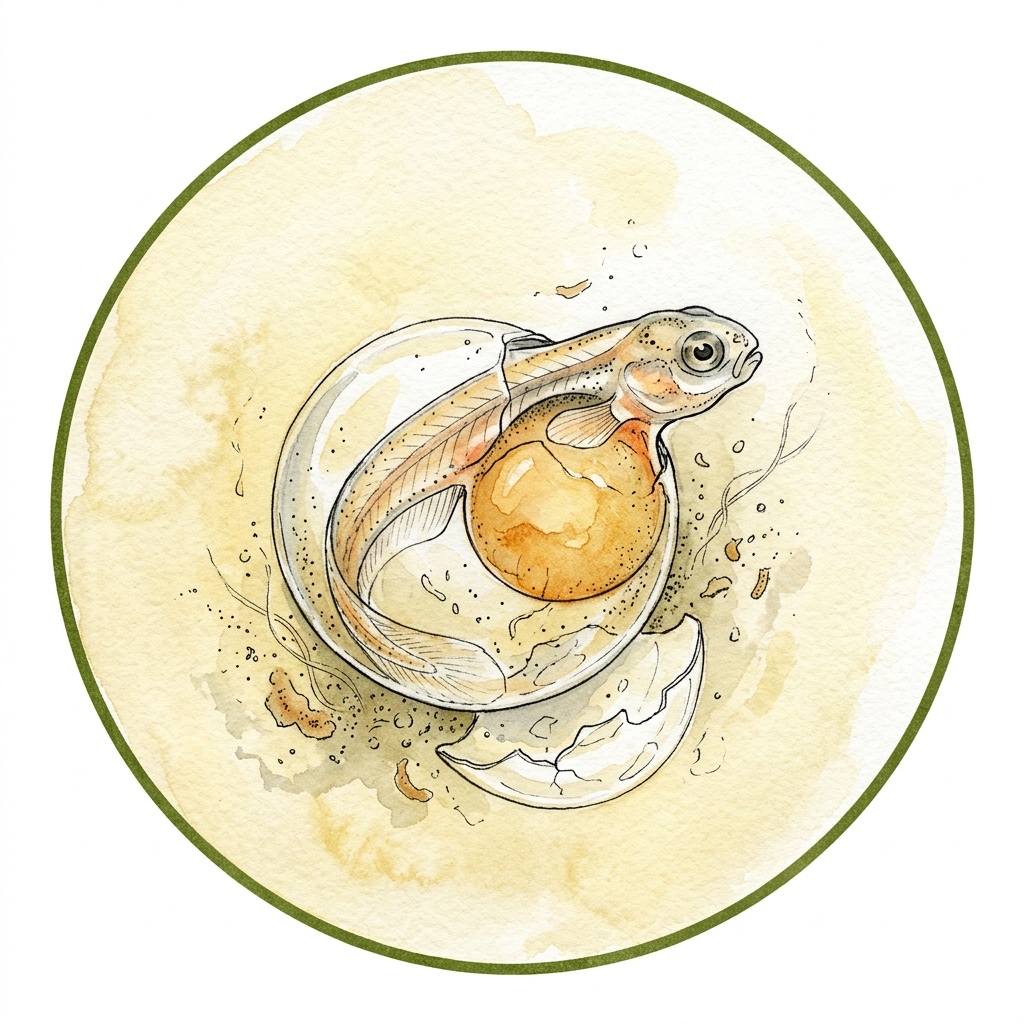
Day 10–14
Hatching
Tiny, near-invisible fry emerge and cling to plants
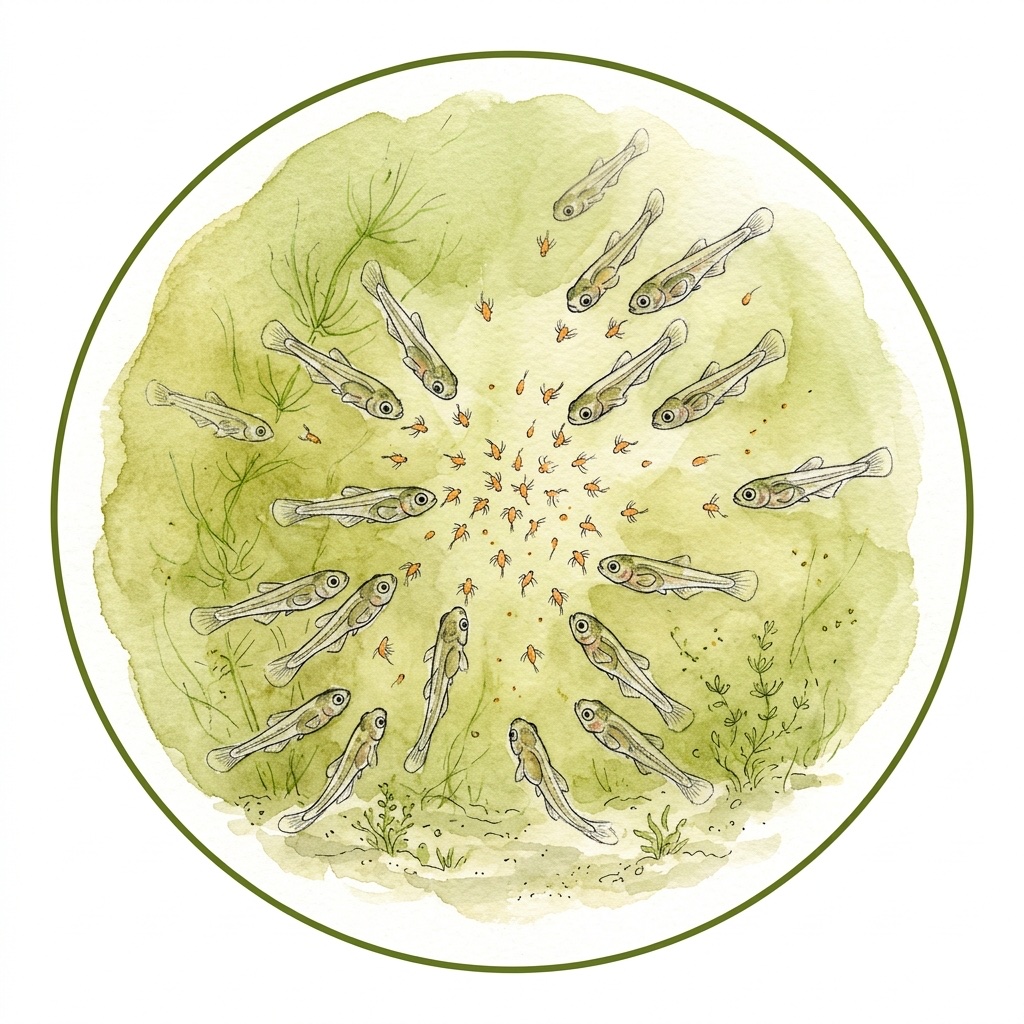
Day 14–45
First Feeding & Early Growth
Feed infusoria, then vinegar eels and baby brine shrimp
Day 45–120
Juvenile Development
Gold sheen appears; fin dimorphism begins to show at 2.5 cm
Conditioning
Unlike many rainbowfish, Pseudomugil gertrudae does not require a dramatic conditioning period. In a well-fed display tank, mature females already produce eggs nearly every day. Still, a week of heavy feeding on live baby brine shrimp, grindal worms, frozen daphnia, and bloodworms significantly increases egg output and improves egg viability. Aim for pH around 6.5, hardness 6 to 8 dGH, and temperature held steadily at 26 °C. Ensure the tank has both fine-leaved plants (Java moss, Cabomba, Myriophyllum, or a commercial spawning mop) and floating plants with trailing roots — both will serve as egg-attachment sites.
Courtship & Spawning
Spawning in Gertrudae is delightful to watch because it happens almost every morning for a mature pair rather than as a single dramatic event. Just after the tank lights come on, the dominant male will rise into the upper water column, flare all his median fins fully, flash his lime-blue eye ring, and perform a trembling lateral display in front of a ripe female. If she is receptive, she follows him into a thicket of fine-leaved plant or into the trailing roots of a floating plant. There, the pair press briefly side by side, and she deposits one to three adhesive eggs — each about 1 mm in diameter — onto the plant material. The eggs hang from the leaf by a thin adhesive thread. The pair separates and repeats the process a few more times over the course of the day. A single healthy female typically drops between 5 and 15 eggs per day over an active spawning stretch of one to two weeks.
Egg Incubation
Gertrudae eggs are unusually robust compared to most blackwater fish — they are adhesive, slightly translucent amber, and highly resistant to fungus when tannins are present in the water. Incubation takes between 8 and 14 days at 26 °C. If you want to maximise fry survival, carefully transfer the plant material (or the full spawning mop) into a separate 5 to 10 litre rearing tank with the same water parameters as the main tank. Add a gentle sponge filter and a couple of Indian almond leaves. If left in the main tank, many eggs will still survive thanks to the dense planting, but parents and tank mates will eat a significant portion of the fry once they hatch.
Hatching
Newly hatched Gertrudae fry are extremely small — approximately 3 mm long, with nearly transparent bodies and a large dark eye being the only visible feature. They cling to plant surfaces and the tank glass for the first 24 to 36 hours, surviving on their yolk sac. They are strong swimmers almost immediately once the yolk is absorbed, and they will start searching the upper water column for food on day two or three post-hatch. Keep lighting very dim during this phase.
First Feeding & Early Growth
First foods must be extremely small. A culture of infusoria or commercially available liquid fry food is ideal for the first week of active feeding. After five to seven days, fry can take vinegar eels, micro-worms, or commercially cultured walter worms. By the tenth day of active feeding, they are large enough to hunt freshly hatched baby brine shrimp — at which point growth accelerates noticeably. Fry grow slowly compared to livebearers; expect about 1 cm of growth in the first month.
Juvenile Development
By around 1.5 to 2 cm, juvenile Gertrudae begin to show the metallic gold flank sheen and the lime-blue eye ring that define the species. Fin dimorphism — the first extension of dorsal and anal fin rays in males — becomes visible at approximately 2.5 cm, generally around three to four months post-hatch. Full adult colour and fin filaments are achieved at 3 to 4 cm, typically five to six months from spawning. At this point, juveniles can safely be introduced to the main display tank.
Community Compatibility
Pseudomugil gertrudae is fundamentally a peaceful schooling species. In a group of six or more, you get the best of both worlds: mild intra-male lateral displays among the males (which never damage fins), and tight cohesive schooling behaviour overall. They never bully smaller tank mates. The real community risks run in the opposite direction — anything big enough to eat them, or anything aggressive enough to harass them, is inappropriate. A good mental rule is: no tank mate whose mouth is wider than the Gertrudae’s body, and no species known for fin-nipping. Within those boundaries, Gertrudae fit beautifully into a soft-water, planted nano or medium community tank with other small peaceful species such as ember tetras, chili rasboras, pygmy corydoras, honey gouramis, and peaceful shrimp. Keep them in groups of six or more — ideally ten — for the strongest schooling behaviour and the most frequent male display activity.
If you live in northern Australia and want to build a genuinely biotope-correct native tank, consider pairing Pseudomugil gertrudae with other small native species from the same habitat. The tiny Rhadinocentrus ornatus (Ornate Rainbowfish) from southeast Queensland makes a superb companion in a slightly larger tank, as does the Empire Gudgeon (Hypseleotris compressa) provided the individuals are small and peaceful. Small native glass perchlets (Ambassis sp.) and freshwater shrimp from northern Australian creeks (Caridina spp.) complete the picture. A true native-only display built around Gertrudae celebrates Australian freshwater heritage in a way that imported-species tanks simply cannot match, and it is a conversation-starter for any visitor who has never considered that Australian fish can be just as beautiful as their South American or Southeast Asian counterparts.
The native-Australian angle is genuinely important. Every Gertrudae in your tank — if ethically sourced from an Australian native-fish breeder, or responsibly collected under permit from NT or QLD waters — is a fish that never crossed an international border, never travelled through an airline cargo hold, and never carried the quarantine and disease risks that come with imported stock. The carbon footprint is minimal. The bloodlines are local. And supporting the small network of Australian native-fish breeders, through organisations like ANGFA, keeps that captive-breeding infrastructure alive for the next generation of hobbyists. For aquarists who care about provenance — and increasingly, that is most of us — stocking a tank with Australian natives is a choice that matters.
| Species | Why | |
|---|---|---|
| ✅ | Chili Rasbora (Boraras brigittae) | Tiny peaceful nano schooler, identical water parameter preference, similar temperament — schools loosely alongside Gertrudae and occupies the same middle water column without conflict |
| ✅ | Honey Gourami (Trichogaster chuna) | Calm surface-level centrepiece fish that adds a golden accent without ever bothering nano rainbowfish; shares the soft-water, densely planted, gentle-flow setup Gertrudae prefer |
| ✅ | Pygmy Corydoras (Corydoras pygmaeus) | Active, tiny bottom-dwelling shoaler that stays at substrate level and cleans up fallen food without competing for space or disturbing Gertrudae courtship |
| ✅ | Ember Tetra (Hyphessobrycon amandae) | A warm orange-red nano tetra whose tone contrasts beautifully with Gertrudae’s gold and blue; identical water, diet, and temperament requirements |
| ✅ | Galaxy Rasbora / Celestial Pearl Danio | Another spotted nano species of similar size and temperament; shares the soft, densely planted, dim-lit biotope and never competes for food with Gertrudae |
| ✅ | Amano Shrimp (Caridina multidentata) | Peaceful freshwater algae-eating shrimp too large to be eaten and too calm to threaten the fish. Shrimp and Gertrudae ignore each other completely |
| ✅ | Cherry Shrimp (Neocaridina davidi) — adults only | Adult cherry shrimp are completely safe with Gertrudae. Tiny shrimplets may occasionally be picked off, so a densely planted tank with moss cover protects the colony |
| ✅ | Endler’s Livebearer (male only) | A peaceful nano livebearer whose colour complements Gertrudae without aggression; keep male-only to avoid excessive fry in a nano setup |
| ✅ | Pseudomugil luminatus / Pseudomugil cyanodorsalis | Other nano Blue-Eyes of the same genus. Can be mixed with care in a larger tank (90 L+); expect some cross-species male display but no damage |
| ❌ | Angelfish | Adult angelfish grow large enough to easily swallow a 3 cm Gertrudae whole. The mouth-gape rule: anything whose mouth is wider than the Gertrudae’s body is a predator, not a tank mate |
| ❌ | Tiger Barb | Notorious fin-nippers. Gertrudae males’ elongated filaments make them a prime target. Harassment will cause constant stress and destroy the fin display that is the whole point of the species |
| ❌ | Serpae Tetra | Another fin-nipping characin that will harass rainbowfish with flowing fins. Completely incompatible in any tank size |
| ❌ | Large Gouramis (Pearl, Three-Spot) | Territorial surface-dwellers that will occupy the same upper water column Gertrudae need for courtship display; stress-inducing even when not directly aggressive |
| ❌ | African Cichlids | Require hard, alkaline water the opposite of Gertrudae preferences, and are aggressive predators. Never combine |
Quick Reference
| Scientific Name | Pseudomugil gertrudae |
| Common Name | Gertrudae Blue-Eye Rainbowfish |
| Origin | Northern Australia (NT, QLD) and southern Papua New Guinea |
| Adult Size | 3–4 cm (1.2–1.6 in) |
| Lifespan | 2–3 years |
| pH | 5.5–7.5 (ideal 6.5) |
| Temperature | 22–28 °C (ideal 26 °C) |
| Hardness | 4–12 dGH |
| Min Tank Size | 40 L for pair/trio; 60 L+ for school of 10 |
| School Size | 6+ (10+ recommended for best display) |
| Diet | Micro-carnivore — tiny foods only |
| Care Level | Beginner to intermediate |
| Temperament | Peaceful, schooling, mild male display |
| Tank Position | Top to middle |
| Breeding | Daily egg-scatterer — easy in planted tanks |
| Native Pride | Genuinely Australian — a local species for local aquascapes |
Related Products
Reviews
Clear filtersThere are no reviews yet.