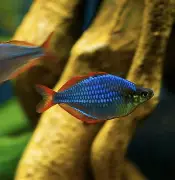
🪨 Species at a Glance
| Scientific Name | Melanotaenia praecox |
| Common Names | Neon Blue Rainbowfish, Dwarf Neon Rainbowfish, Praecox Rainbow |
| Family | Melanotaeniidae |
| Origin | Mamberamo River basin, West Papua (New Guinea), Indonesia |
| Adult Size | 6–8 cm (2.4–3.1 in) |
| Lifespan | 4–6 years |
| Care Level | Easy to Intermediate |
| Temperament | Peaceful, very active schooling fish |
| Water Type | Tropical Freshwater |
| pH Range | 6.5–8.0 (wide tolerance) |
| Temperature | 22–27 °C (72–81 °F) |
| Minimum Tank Size | 80 L / 20 gal (80 cm long) |
| Minimum School Size | 8 (10–12 recommended) |
| Diet | Omnivore — small flake, micro-pellet, frozen, live |
| Breeding | Egg scatterer on fine plants; easy in captivity |
| Tank Position | Upper to Middle |
Meet the Species
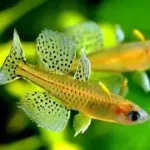
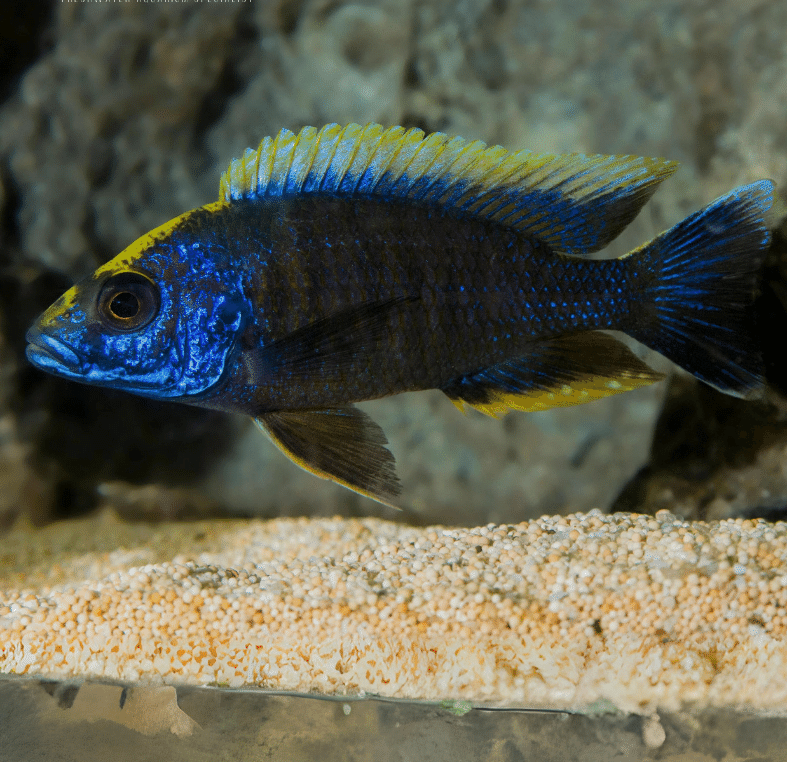
The common name is charmingly literal. In the right light, a healthy adult male Melanotaenia praecox genuinely does look like a living neon sign — the body panels flash pale blue, the scales glitter with an almost metallic polish, and the unpaired fins catch the light in a way that borders on fluorescent. Combined with the fish’s compact, laterally-compressed body, the overall impression is of a small piece of stained glass swimming sideways through the aquarium. ‘Praecox’, the specific epithet chosen by Max Weber and Lieven de Beaufort when they formally described the species in 1922, is Latin for ‘premature’ or ‘early’ — a reference to the fish’s unusually small adult size and the fact that it reaches sexual maturity at a significantly smaller size than its Melanotaenia cousins. Where a Boesemani or a Turquoise Rainbow might not spawn until 8–10 cm, praecox is ready to breed at 4–5 cm, and it rarely grows much beyond 7 cm even in ideal conditions. The genus name Melanotaenia translates to ‘black-banded’ (Greek melano- meaning dark, taenia meaning ribbon), referring to the subtle dark lateral stripe visible in most members of the family. In neon blue specimens this stripe is largely washed out by the blue iridescence of the flanks but becomes visible when the fish is stressed or viewed from certain angles.
In Australian stores, Melanotaenia praecox is frequently shelved under the broad marketing label ‘Australasian Rainbow’ or ‘Native Australian Rainbow’. That label is misleading and worth correcting. Despite the regional grouping used in the trade, this species is not native to Australia. Its actual home range is the Mamberamo River system in the northern lowlands of West Papua (Irian Jaya), Indonesia — specifically small, clear tributaries and forest streams on the island of New Guinea. The ‘Australasian’ umbrella covers the zoogeographic region that includes New Guinea, the Aru Islands, and northern Australia, which is why the grouping exists; but if you are keeping a true Australian biotope, species like Melanotaenia fluviatilis, M. splendida or M. trifasciata are the correct choices. Melanotaenia praecox is a New Guinean fish through and through, and the regional label should not be read as a literal statement of origin.
In the wild, praecox lives in clear, gently flowing streams with sandy or gravel bottoms, dense aquatic vegetation, and moderate current. Water in the Mamberamo system is mildly alkaline to neutral and relatively soft compared to the lake-dwelling Boesemani — which explains why this species copes so well with a much wider pH window in captivity than many of its relatives. The species reached the aquarium trade in the mid-1990s and quickly became a staple of the planted-tank community, prized for its small size, easy breeding, and genuinely spectacular colour in a fraction of the tank volume required by its larger cousins.
Spot the Difference: Male & Female
Sexual dimorphism in Melanotaenia praecox is one of the clearest in the dwarf rainbowfish group, which is excellent news for hobbyists because it makes buying a balanced school straightforward. Once fish reach about 4 cm, the differences are obvious even to beginners. Males are larger, deeper-bodied, and more laterally compressed — from the side they look almost disc-shaped compared to the slimmer female profile. The most reliable indicator, however, is the fins. Male dorsal, anal, and caudal fins carry a bright amber-to-red margin that is completely absent in females, whose fins remain transparent or carry only a soft yellow wash. The body blue is also deeper and more saturated in males, with a characteristic darker band running along the upper flank just below the dorsal fin.
The real visual payoff is the male display behaviour. Dominant males will ‘light up’ during courting — their entire body intensifies in colour over the course of a second or two, with the blue deepening to electric cobalt and the fin margins burning a saturated orange. This behaviour is most visible in the morning, when the tank light first comes on, and during any moment of social stimulation (a rival male approaching, a female swimming past). In a well-kept school, males will take turns performing parallel side-by-side displays, flaring fins and pulsing colour. The display is ritualised, not aggressive — fin damage is extremely rare, and the interaction rarely escalates beyond posturing. For the most spectacular behaviour, always keep multiple males. Two or three males in a group of eight or more will display constantly; a single male with only females becomes surprisingly dull, because there is no rival to trigger the colour show. A common mistake is buying six praecox with the assumption of a ‘balanced school’ but ending up with four females and two males, where the males never develop full colour. The fix is easy: just buy more fish. Aim for at least 8–12, ideally slightly more males than females, and the tank will reward you with near-continuous display behaviour throughout the day.
| Feature | Male | Female |
|---|---|---|
| Size | 7–8 cm at maturity | 6–7 cm at maturity |
| Body Shape | Deeper body, more laterally compressed with age | Slimmer, more torpedo-shaped profile |
| Body Colour | Deep iridescent sky-to-cobalt blue with indigo dorsal band | Paler blue with a slight greenish or silver cast |
| Dorsal Fin | Taller, pointed tips, edged in bright amber-orange | Shorter, rounded, largely transparent with pale yellow tint |
| Anal Fin | Elongated, bright orange-red margin | Shorter, clear to pale yellow, no strong margin |
| Caudal Fin | Upper and lower lobes edged in red-orange | Clear to faintly yellow, no coloured margin |
| Display Behaviour | Frequent ‘flashing’ — body lights up during courtship and sparring | Calmer, does not display; responds to male courting with side-by-side swimming |
| Sexual Maturity | Ready to court at 4–5 cm | Ready to spawn at 4–5 cm |
Visual Varieties
🔵 Wild-Type Melanotaenia praecox
The classic form: iridescent sky-blue body with a slightly deeper indigo line along the dorsal ridge. Males carry amber-orange to red margins on the dorsal, anal and caudal fins — the trademark neon blue look.
🟠 High-Colour Dominant Male
Mature, well-fed males in active display literally ‘light up’ — the blue deepens to electric cobalt and the fin margins burn a saturated orange-red. This is a behavioural phase, not a separate strain.
🔴 Melanotaenia trifasciata (Banded Rainbow)
A comparison species — also small (around 9–12 cm), with a bold dark lateral band and multiple colour forms (Goyder River, Blyth River). Often kept alongside praecox for contrast.
🟦 Melanotaenia lacustris (Lake Kutubu Rainbow)
Another blue-dominant cousin, but significantly larger at around 11–12 cm, with a more aquamarine body tone. Illustrates the trade-off between size and colour intensity within the genus.
Melanotaenia praecox is one of those fish where the difference between a shop tank and a mature home aquarium is genuinely striking. Juveniles sold at 2–3 cm look almost silver-grey with only faint hints of blue — this is normal and should not discourage a purchase. Within a few months, and especially once the school is established and feeding well, the colour develops rapidly. Adult males carry a saturated sky-to-cobalt blue across the flanks, with a deeper blue-indigo band running just below the dorsal ridge. The unpaired fins — dorsal, anal, and caudal — are edged in a clean ember-orange to brick-red, and during active display the entire colour palette intensifies in rapid pulses. Females are always more muted: the blue is paler and often has a slightly greenish cast, while the fins are largely transparent or show only a soft yellow tint. The difference between a displaying male and a resting female is dramatic, which is why the species is so visually interesting in a mixed-sex school.
It is important to understand that unlike domesticated fish such as guppies or bettas, Melanotaenia praecox has not been selectively bred into a rainbow of named colour strains — essentially all specimens in the hobby are wild-type or only a generation or two removed from it. The listings above therefore compare praecox against its closest dwarf-to-small rainbowfish relatives (M. trifasciata, M. lacustris) rather than showing artificial colour morphs. This comparison is useful because these species are frequently offered alongside praecox and all three can cohabit happily, creating a multi-species blue/red rainbow display in a single aquarium.
Diet influences colour expression significantly. Regular offerings of carotenoid-rich foods — spirulina flake, astaxanthin-enriched micro-pellets, live daphnia, and frozen cyclops — noticeably deepen the orange in the fin margins. Clean water, stable parameters, and a group of at least eight fish are the other three factors that most strongly affect colour. A lonely or under-stocked praecox will remain dull and nervous; an eight-to-twelve fish school in a planted aquarium will colour up within weeks. Tank background colour also plays a subtle but noticeable role: against a dark substrate and densely planted rear, the blue flanks appear luminous and the orange fin trim pops; against a bright white or unpainted rear glass, the same fish looks washed-out by comparison. This is a species where aquascape choices directly translate into perceived colour intensity. Finally, lighting quality matters more than lighting intensity — a softly diffused light through a layer of floating plants brings out the iridescence far more effectively than harsh, direct LED beams, which tend to flatten the scale shimmer into something closer to matte sky-blue.
Water Quality Requirements
6.5–8.0
ideal 7.2
22–27 °C
ideal 25 °C
8–20 dGH
Moderately soft to hard water — unusually wide tolerance
One of the defining practical advantages of Melanotaenia praecox is its genuinely wide parameter tolerance. Where the Boesemani Rainbowfish insists on alkaline, moderately hard water and discus demand soft acidic conditions, praecox sits comfortably in between. It thrives anywhere from pH 6.5 to 8.0 and from 8 to 20 dGH, making it a plug-and-play choice for almost any Australian tap water profile. This is a species that genuinely does not need you to fuss with the chemistry. Dechlorinate the tap water, cycle the tank, and the fish will almost certainly be fine.
Temperature is where newcomers most often go wrong. Praecox is adapted to highland and lowland streams in New Guinea with a notably cooler thermal range than tropical lake species like Boesemani. The ideal window is 22–27 °C; prolonged exposure above 28 °C compresses lifespan and reduces colour. A common mistake is placing praecox in a mixed community at 28–29 °C (discus or ram territory) and wondering why the fish look pale and listless. Keep them at 24–26 °C and the difference is immediate. A reliable heater with a visible thermostat is essential; a lower-wattage heater that holds temperature steady is preferable to a high-wattage unit with large swings.
Water quality matters more than exact parameter values. Praecox are active, high-metabolism swimmers that produce a moderate bioload. Weekly water changes of 25–30% with temperature-matched water are the single most effective maintenance task. Ammonia and nitrite must always read zero; nitrate should stay below 20 ppm. Interestingly, this species responds very visibly to large water changes — a 40–50% change with slightly cooler, fresh water will often trigger an immediate display burst and, in conditioned pairs, a spawning response within 24 hours. Aquarists deliberately exploit this ‘rain response’ when trying to induce breeding.
Filtration should be moderate rather than aggressive. A canister rated at 5–7× tank volume per hour, or a well-sized HOB, is plenty. Sponge pre-filters are a good idea if you intend to breed — fry are tiny and will be pulled into unprotected intakes. Good oxygenation matters; surface agitation and gentle current are more important than brute filter capacity.
Feeding Schedule & Diet
Melanotaenia praecox is an enthusiastic omnivore with one important quirk: the mouth is small. Adult fish have a notably small terminal mouth compared to their body size, which means food must be sized appropriately. Standard large tropical flake is often too coarse for praecox to handle comfortably, and large pellets designed for cichlids will be completely ignored. This is a species that prefers fine, small-particle food — the same grade you would feed to adult cardinal tetras or harlequin rasboras is ideal.
The staple diet should be a high-quality micro-pellet or finely crumbled tropical flake formulated for small tropical omnivores. Look for products with spirulina, astaxanthin, and krill meal in the ingredients — these carotenoid-rich components directly enhance the orange tones in the fins. Feed two or three small meals per day rather than one large feed; this matches the natural grazing pattern of stream-dwelling rainbowfish and reduces waste. The food should be small enough that the fish can take individual particles into their mouths without difficulty. If you see fish picking up, spitting out, and re-attacking a piece of flake, the flake is too large — crumble it finer between your fingers before the next feed, or switch to a dedicated micro-pellet formulation. Slow-sinking micro-pellets work particularly well because they give the whole school time to feed; fast-sinking pellets tend to favour the boldest individuals while shy fish miss out.
Frozen and live foods should be offered two to three times per week for optimal condition. Daphnia, cyclops, micro-worms, baby brine shrimp, frozen bloodworms (chopped small if needed), and frozen cyclops are all excellent. Live daphnia is a particularly effective conditioning food before breeding — the movement triggers hunting behaviour, the natural pigmentation enhances colour, and the soft exoskeleton is digested easily. Avoid large, chunky foods like full-sized mysis shrimp; they are technically accepted but the fish struggle to swallow them, leading to the grab-and-spit cycle that wastes food and muddies the water.
Vegetable content is important. A varied diet including some spirulina flake, blanched vegetable matter, or algae-based micro-pellets keeps the digestive system healthy and mimics the mixed plant-and-invertebrate diet of wild fish. In nature, Melanotaenia praecox is an opportunistic feeder that consumes small insect larvae, drifting zooplankton, soft algae, and fallen terrestrial insects — a genuinely mixed diet. Replicating that balance in captivity produces healthier, longer-lived, and more colourful fish than a heavily protein-skewed diet. Fry and juvenile foods are discussed in the breeding section; once fish reach about 3 cm they transition to the adult diet described here. A useful rule of thumb: if your praecox are eating the same staple food for months without any variety, the fins will start to show it before the body does — fin margin colour loses saturation first, long before overall body condition declines. Vary the diet weekly and this never becomes an issue.
Tank Requirements & Layout
Melanotaenia praecox is a schooling fish first and foremost, and the aquascape must be designed around that fact. A group of eight to twelve adults needs a tank at least 80 cm long; 90–100 cm is significantly better. Volume alone is misleading — a tall 100 L cube is far worse than a shallow, elongated 80 L tank because praecox swim horizontally in fast, sweeping arcs through the middle and upper water column. Prioritise tank length above all other dimensions. In practical Australian sizing terms, a standard 3-foot (90 cm) community tank of around 120 L is the sweet spot for this species — enough length for natural schooling behaviour and enough water volume for stable parameters, while still fitting in a standard living room.
The ideal layout pairs dense side and background planting with a generous open swimming corridor through the front and centre of the tank. Vallisneria spiralis or Vallisneria nana works beautifully at the rear, providing tall green curtains that the school will weave in and out of. Medium-height plants such as Hygrophila polysperma, Limnophila sessiliflora, or larger Cryptocoryne wendtii fill the midground, while shorter foreground plants — Staurogyne repens, Eleocharis, or Marsilea — keep the front open. Floating plants such as Amazon Frogbit, Salvinia, or Water Lettuce are particularly valuable: they dapple the light, give males a ‘ceiling’ to display under, and make the blue iridescence of the fish pop against the shadowed surface. Floating plants also serve a practical breeding function — fine trailing roots catch scattered eggs naturally and can be harvested into a hatching tank.
Substrate is a matter of aesthetics. A dark fine gravel or black planted-tank soil makes the neon blue bodies almost luminous by contrast; a pale sand substrate gives a softer, more naturalistic look but mutes the colour impact. Driftwood and smooth river stones placed along the sides and rear create visual structure and provide natural sight-lines without blocking the swim lanes. A biotope-accurate layout would feature sandy or fine gravel substrate, scattered smooth river stones, a few pieces of weathered driftwood, and dense marginal vegetation — a reasonable approximation of the clear, moderately-flowing forest streams of the Mamberamo basin.
Lighting should be moderate — not as intense as a high-tech planted tank designed for red plants, but bright enough that the iridescent body scales catch the light. A simple dimmable LED with a dawn/dusk ramp is ideal. Avoid glaring, overly harsh lighting; praecox display best in soft, evenly diffused light, which is why the floating plant canopy works so well. A photoperiod of 8–10 hours is sufficient — longer photoperiods encourage algae without benefiting the fish.
A final non-negotiable: the tank must have a tight-fitting lid or cover glass. Rainbowfish are exceptional jumpers, and praecox are no exception. Even a startled individual in a mature community can launch itself out through a gap of 2 cm. Open-top tanks are strongly discouraged for this species; at minimum, ensure any cable or feeding cutouts are blocked with mesh or foam. A surprising number of praecox losses in home aquariums come not from disease or aggression but from jumps during cleaning or during startle responses to unexpected lighting or household noise.
Tank
Minimum 80 L / 20 gal, 80 cm (32 in) long — prioritise length over height for horizontal swimming space
Filter
Canister or good-quality HOB rated 5–7× tank volume per hour; moderate flow, not a torrent
Heater
Reliable 100–150 W heater with accurate thermostat; set to 25 °C
Lid / Cover Glass
Tight-fitting lid essential — praecox are capable jumpers, especially when startled or displaying
Lighting
Moderate LED with dawn/dusk ramp; floating plants diffuse harsh light beautifully
Substrate
Dark fine gravel or planted-tank soil for maximum colour contrast
Background Plants
Vallisneria, Hygrophila, or Cryptocoryne — dense sides and back, open centre
Floating Plants
Amazon Frogbit or Salvinia — provides display ‘ceiling’ and softens lighting
Thermometer
Digital thermometer to verify heater accuracy; stability matters more than precision
Sponge Pre-filter
Recommended if breeding — protects tiny fry from being pulled into filter intakes
Choosing Tank Mates
Melanotaenia praecox is a peaceful community fish that sits comfortably in the upper-middle water column. It ignores tank mates that don’t compete directly for food, does not nip fins, and does not hold territory. The only real community caveats are behavioural: praecox are fast, boisterous, and constantly in motion during feeding, which can overwhelm slow or timid fish. The solution is to match the species with tank mates of similar energy level — other peaceful schoolers, mid-sized tetras and rasboras, robust corydoras, and other small-to-medium rainbowfish.
The ideal community is a multi-rainbow display. Melanotaenia praecox, M. lacustris, and a group of Pseudomugil gertrudae in a 150 L planted tank is one of the most visually impactful small-rainbowfish setups you can build — three blue-dominant species at different sizes, all schooling simultaneously, all displaying their own variation of the rainbow courtship behaviour. Adding a school of cardinal tetras at mid-level and a group of sterbai corydoras at the bottom completes a spectacular five-species community that fills every water column zone without any species crowding another.
Water parameter compatibility is unusually easy with this species. Because praecox happily tolerates pH 6.5–8.0 and temperatures 22–27 °C, it overlaps with almost every other popular community fish in the hobby. Cardinal tetras (prefer slightly acidic, soft) and praecox can meet in the middle at pH 7.0, 24–25 °C and both thrive. Corydoras (prefer neutral, cooler) and praecox overlap perfectly. The few species that genuinely don’t work are either parameter extremists (discus at 29 °C, African cichlids at pH 8.5+) or behavioural mismatches (known fin-nippers, very timid micro-fish, slow long-finned specialists).
School size is critical. A group of 4–6 praecox is the absolute minimum and will look noticeably more nervous and less colourful than a group of 8–12. Males need rivals to display against, and females need safety in numbers. If you only have budget for a handful of fish on day one, plan to add more over the following weeks — the difference between a 6-fish and a 10-fish school is dramatic. Always aim for mixed sexes; an all-male school can be tense and dull, while an all-female school has no display activity at all. The single strongest predictor of a great-looking praecox tank is not filtration, not aquascape, and not water chemistry — it is school size and sex ratio. Get the social structure right and the rest of the husbandry is forgiving.
| Species | Why | |
|---|---|---|
| ✅ | Boesemani Rainbowfish | Fellow Melanotaeniid with matching water parameters; the blue/orange Boesemani and the blue/red-fin praecox create a stunning multi-species rainbow display |
| ✅ | Turquoise Rainbowfish (M. lacustris) | Slightly larger blue-dominant rainbow from New Guinea; shares ideal parameters and occupies the same mid-upper water column |
| ✅ | Pseudomugil gertrudae (Gertrude’s Blue-Eye) | Smaller cousin from the same zoogeographic region; stays in the upper water column and gives a different scale of rainbow colour without competing |
| ✅ | Sterbai Corydoras | Peaceful bottom-dwelling schooler that tolerates the same temperature range and stays completely out of the rainbowfish’s space |
| ✅ | Peppered Corydoras | Classic community corydoras that thrives in the cooler 22–25 °C range praecox prefers; excellent floor cleanup crew |
| ✅ | Cardinal Tetra | Similarly-sized mid-level schooler with complementary red-blue colouration; handles the wide pH range praecox tolerates |
| ✅ | Rummy Nose Tetra | Tight-schooling mid-level tetra that adds a different shape and movement pattern; robust enough to coexist with active rainbowfish |
| ✅ | Harlequin Rasbora | Peaceful copper-orange schooler with similar activity level and parameter preferences; visually complements the blue praecox well |
| ✅ | Dwarf Gourami | Slow-moving surface feeder that occupies a different behavioural niche; as long as the tank has plenty of plants and sight breaks, coexistence is easy |
| ✅ | Otocinclus | Gentle algae grazer that is completely ignored by praecox and keeps plant leaves clean without competing for food |
| ❌ | Long-finned Bettas and Fancy Guppies | Praecox are boisterous, fast schoolers whose courting activity stresses slow-moving, long-finned fish; fin damage is rare but stress-induced illness is not |
| ❌ | Tiger Barbs and Serpae Tetras | Known fin-nippers that will target the flowing male rainbowfish fins, especially the pointed dorsal and anal fins during display |
| ❌ | Very Small or Timid Micro-fish (Chili Rasbora, Celestial Pearl Danio) | The praecox school’s vigorous movement and surface-feeding enthusiasm frightens small, shy species into permanent hiding |
| ❌ | Dwarf Shrimp (Neocaridina, Caridina) | Adult praecox will eat shrimp fry and small juveniles; only large, well-established Amano shrimp coexist reliably |
| ❌ | Aggressive Cichlids (Convicts, Jewel Cichlids, African Cichlids) | Territorial cichlids will bully the peaceful rainbowfish and monopolise feeding; parameter mismatches also make this pairing difficult |
Breeding in Captivity
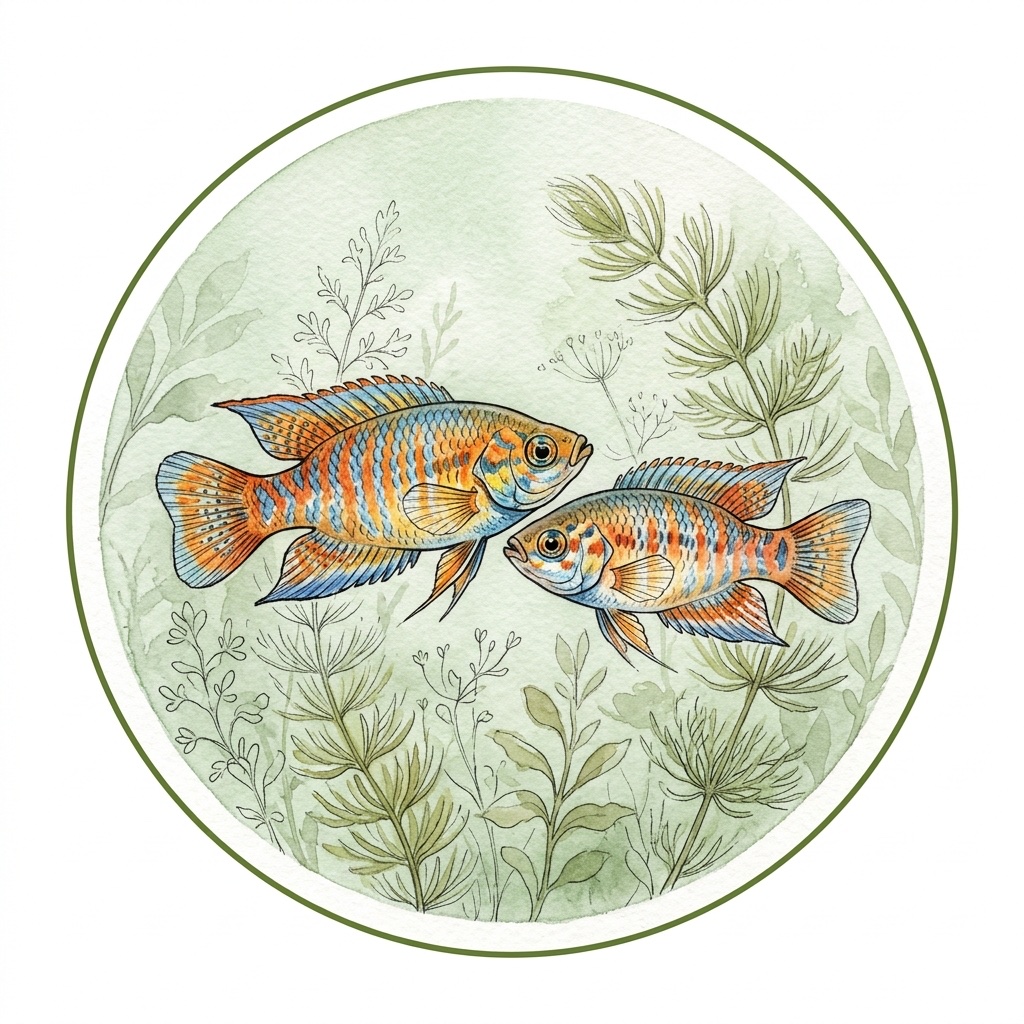
Day 0
Conditioning
Increase live and frozen foods for 1–2 weeks; hold temperature 25–26 °C and nitrate below 10 ppm
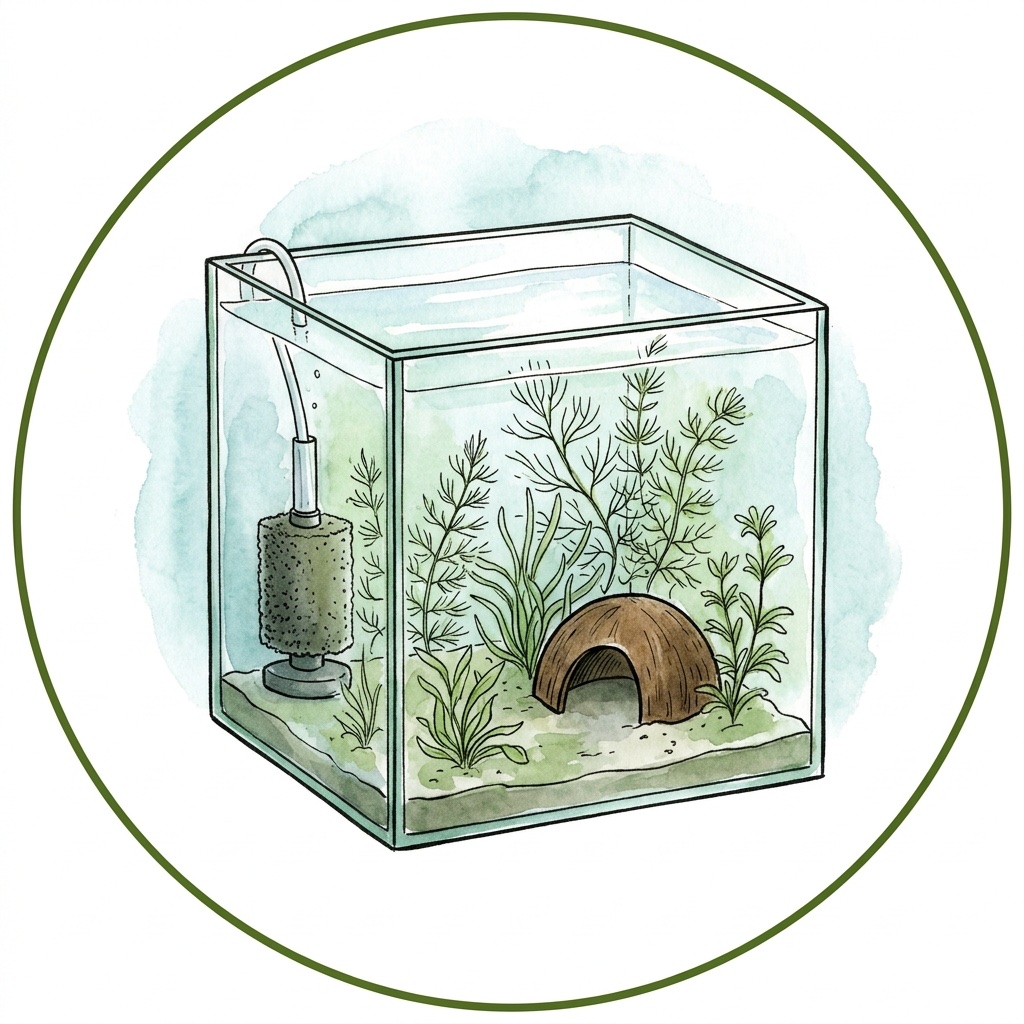
Day 7–14
Spawning Trigger
Large cooler water change triggers display; eggs scattered on fine-leaved plants or a spawning mop
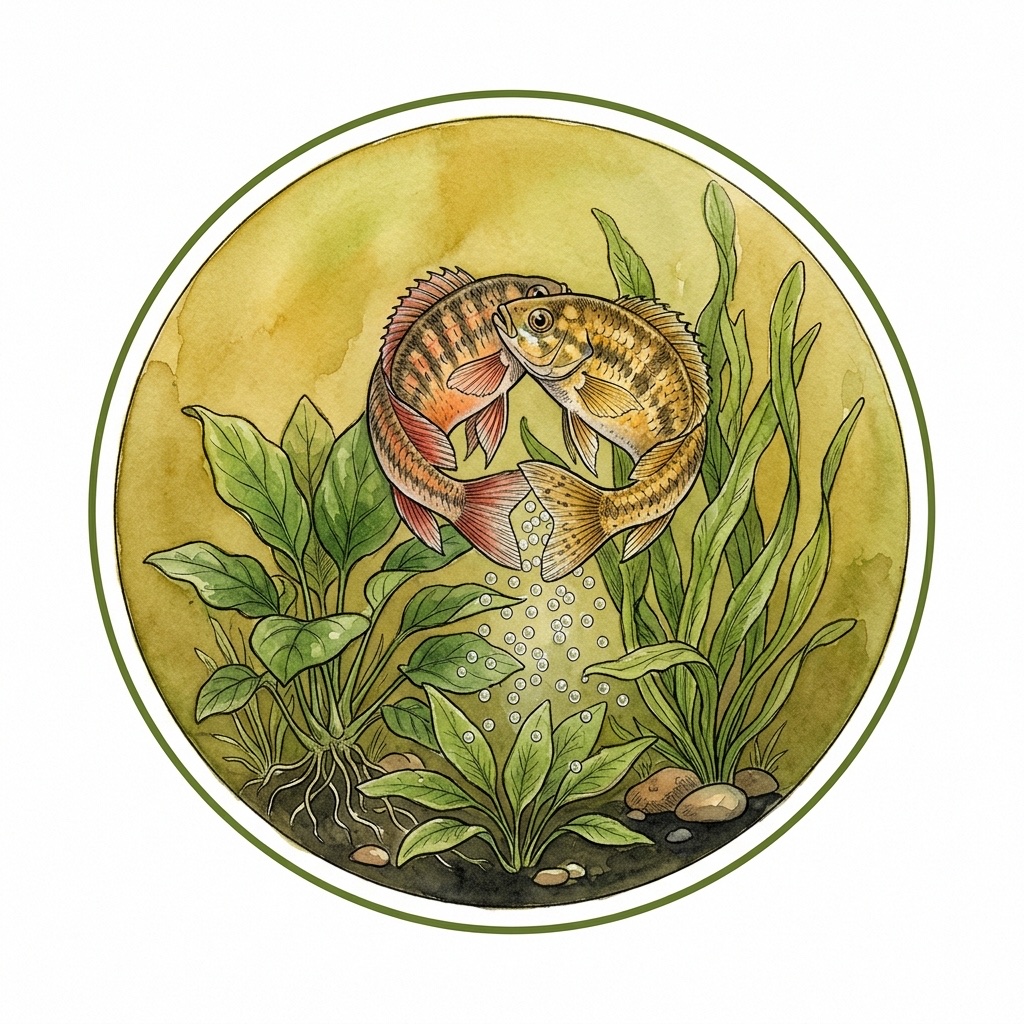
Day 14–21
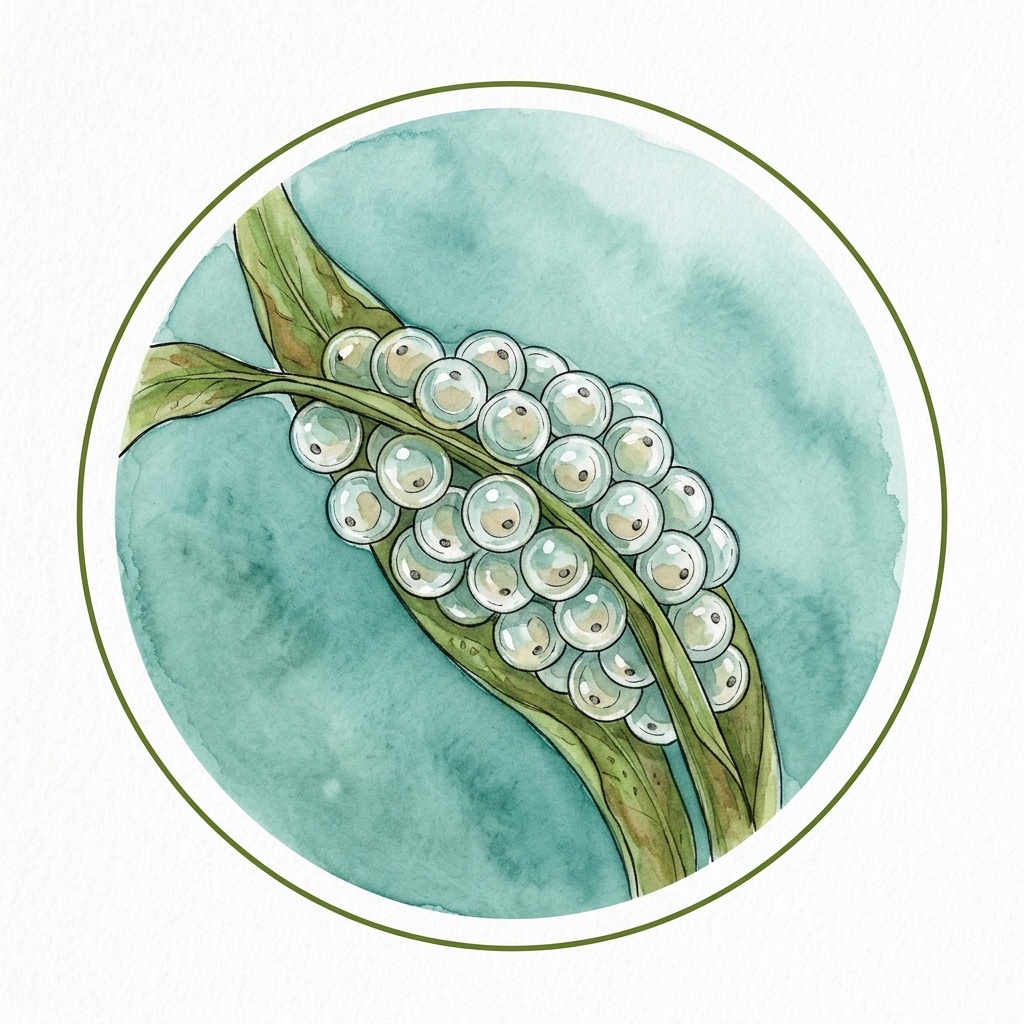
Egg Collection & Incubation
Remove mops to a separate hatching tank; eggs hatch in 7–10 days at 26 °C
Day 21–28
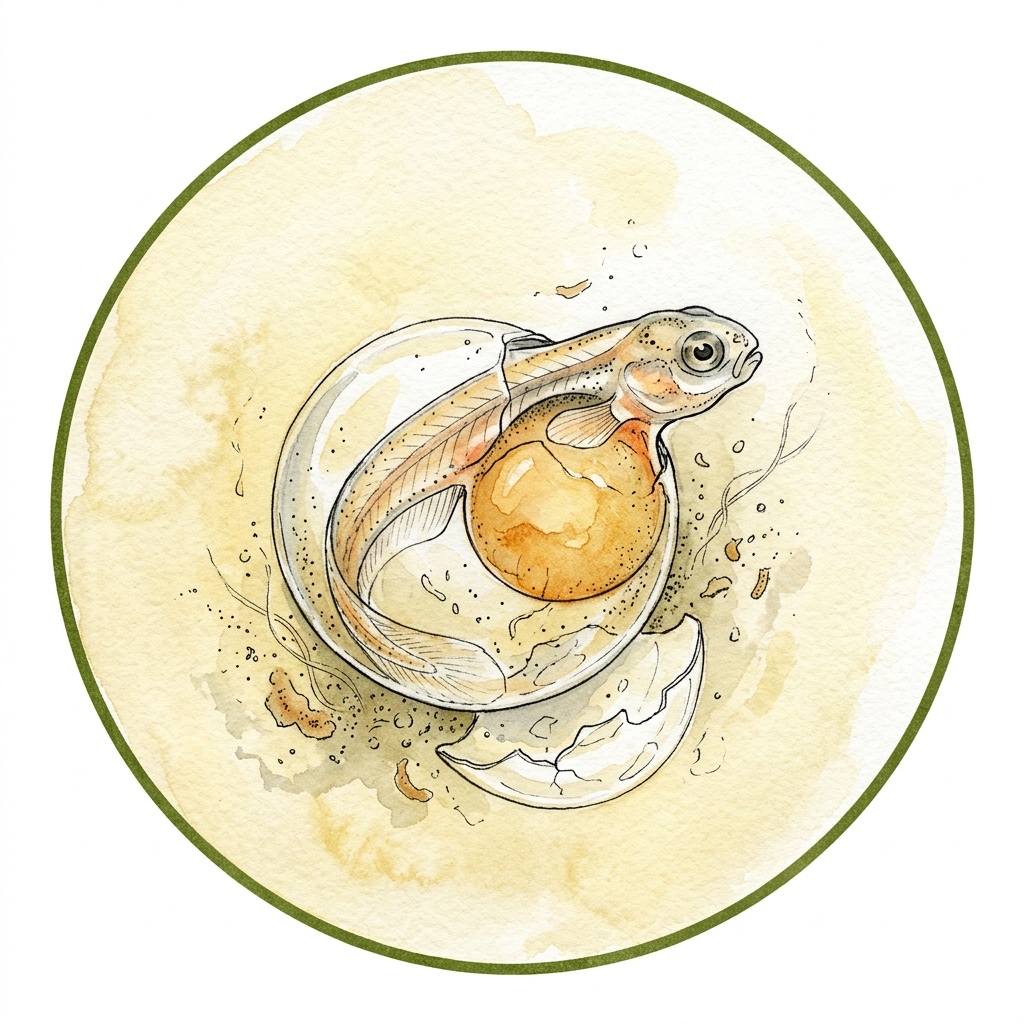
Fry Emerge
Newly hatched fry are tiny — feed infusoria, paramecium, or liquid fry food
Day 28–60
Growing On
Transition to baby brine shrimp and micro-worms; growth is slow but steady
Conditioning
Breeding preparation for Melanotaenia praecox is straightforward because this is one of the easiest rainbowfish species to spawn in captivity. Condition adults on a heavy diet of live and frozen foods — daphnia, baby brine shrimp, cyclops, and bloodworms — for one to two weeks. Keep the temperature steady in the 25–26 °C range and maintain pristine water quality with nitrate below 10 ppm. Well-conditioned females become noticeably plumper when viewed from above, and dominant males intensify in colour even before spawning begins. Males ‘light up’ during this phase almost continuously, which is a reliable sign the school is ready. A dedicated breeding tank is not strictly necessary — praecox will spawn happily in a community tank provided spawning mops or fine-leaved plants are offered and the eggs are harvested before the adults eat them. For serious breeders, a bare-bottom 40–60 L tank with a mature sponge filter and a few floating spawning mops gives the cleanest, highest-yield results.
Spawning Trigger
Once the school is well-conditioned, the most reliable spawning trigger is a large water change with slightly cooler water — a 40–50% change with water 1–2 °C below tank temperature, followed by a gradual recovery over the next hour, mimics the rainfall cue this species responds to in the wild. Within minutes, dominant males will intensify colour and begin performing parallel courtship swims alongside females. Spawning occurs among fine-leaved plants — Java Moss, Myriophyllum, Cabomba, or a synthetic yarn spawning mop all work well. Each adhesive egg is approximately 1 mm across and carries a fine filament that anchors it to the plant surface. A conditioned female will scatter 5–20 eggs per day over a week or more, rather than dumping a single large batch. This makes praecox ideal for hobbyists who want a steady trickle of fry rather than a single large spawn.
Egg Collection & Incubation
Adult rainbowfish will eat their own eggs and fry given any opportunity, so spawning mops or plant bundles should be harvested and moved to a separate incubation container every 2–3 days. A small 10–20 L container with gentle sponge filtration, parameters matching the main tank, and a few drops of methylene blue to suppress fungus works perfectly. At 26 °C, healthy eggs develop visible eyes by day 4–5 and hatch around day 7–10. Because females spawn daily, you end up with multiple age cohorts in rotation — label each mop with its harvest date to keep fry at different stages separated. This rolling harvest approach produces far more surviving fry than waiting for a single big spawn.
Fry Emerge
Newly hatched praecox fry are extremely small and remain near the water surface for the first 24–48 hours, absorbing the remainder of their yolk sac. First foods must be correspondingly tiny. Infusoria cultures, paramecium, or commercial liquid fry foods are appropriate for the first 4–7 days. Green water (phytoplankton-rich water) is an excellent natural first food if you can produce it. Keep the water shallow (10–15 cm) during this stage so fry can locate food easily without exhausting themselves. Mortality is highest in the first week; after that, survival rates improve substantially. Daily small water changes (10%) with temperature-matched water keep parameters stable without stressing the fry.
Growing On
After about two weeks, fry are large enough to accept freshly hatched Artemia (baby brine shrimp) and micro-worms. This is the moment growth visibly accelerates — a well-fed fry will double in size within a week of taking BBS. Continue with multiple small feeds per day (3–4 times) and small frequent water changes. At two months, fry are typically 1.5–2 cm long and can be moved to a grow-out tank or back into the main school if adults are peaceful. Blue body colour begins showing faintly around 3 cm; the characteristic orange fin margins on males emerge around 4–5 cm along with sexual maturity — remarkably early for a rainbowfish, which is exactly what ‘praecox’ in the species name refers to.
Quick Reference
| Scientific Name | Melanotaenia praecox |
| Adult Size | 6–8 cm (2.4–3.1 in) |
| Lifespan | 4–6 years |
| pH | 6.5–8.0 (ideal 7.2) |
| Temperature | 22–27 °C (ideal 25 °C) |
| Hardness | 8–20 dGH |
| Min Tank Size | 80 L / 20 gal (80 cm long) |
| Minimum School Size | 8 (10–12 recommended) |
| Diet | Omnivore — small flake, micro-pellet, frozen, live |
| Temperament | Peaceful, very active schooler |
| Tank Position | Upper to Middle |
| Breeding | Egg scatterer on fine plants; easy, daily small batches |
| Origin | Mamberamo River, West Papua (New Guinea) — NOT Australian native |
| Community Safe | Yes — with similarly-sized active tank mates |
| Key Tip | Keep multiple males for peak colour display |

Reviews
Clear filtersThere are no reviews yet.