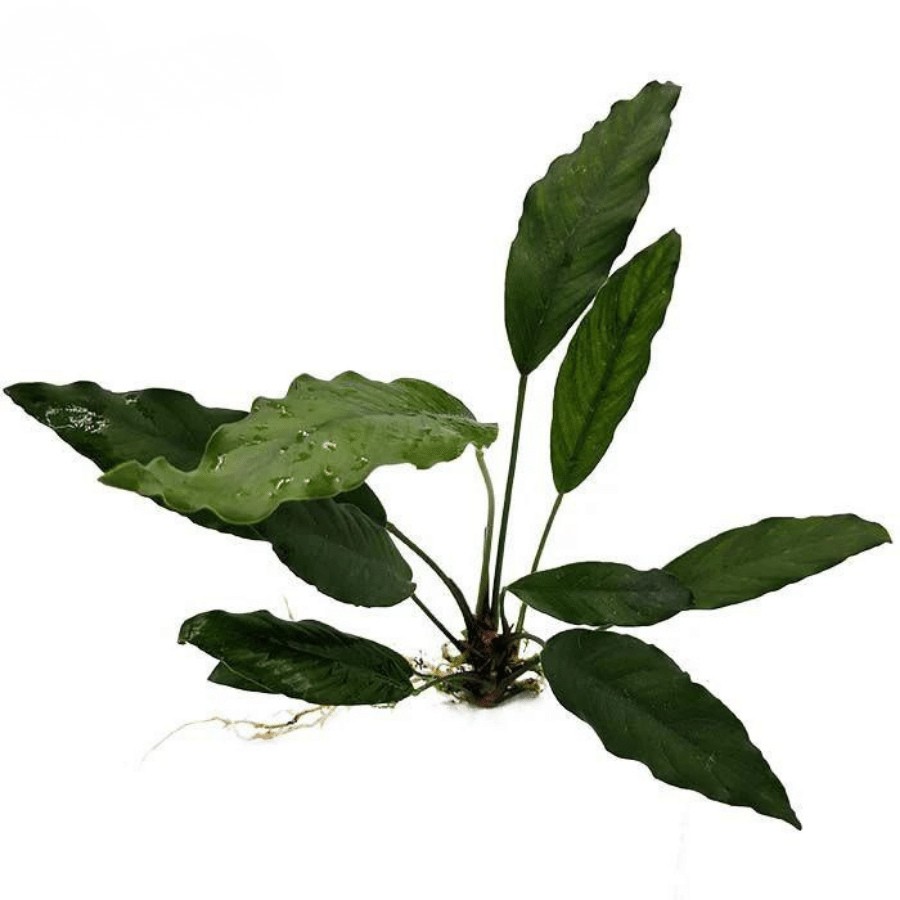
🪨 Species at a Glance
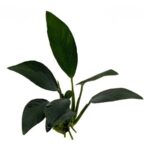
| Scientific Name | Anubias afzelii (wavy form) |
| Common Name | Anubias Afzelli Wavy |
| Family | Araceae |
| Origin | West Africa (Senegal, Guinea, Sierra Leone) |
| Adult Size | 30-40 cm tall, 20-30 cm wide |
| Planting Method | Rhizome attachment (epiphyte) |
| Light Requirement | Low to medium |
| CO2 Requirement | Not required |
| Growth Rate | Slow (1 leaf every 2-4 weeks) |
| Temperature Range | 22-28 degrees Celsius |
| pH Range | 6.0 – 8.0 |
| Placement | Mid-ground to background |
Planting Method
Rhizome
Anubias afzelii is an obligate epiphyte, meaning its rhizome is designed by nature to creep along hard surfaces rather than to be buried in substrate. This distinction is not a stylistic preference — it is a hard rule, and ignoring it is the single most common reason hobbyists lose otherwise healthy Anubias specimens. The thick green rhizome that runs horizontally between the leaf petioles must remain completely exposed to the water column. If you bury it under gravel, soil, sand or aquasoil, the rhizome tissue will begin to rot within a few weeks. Once rot sets in, it typically spreads along the entire length of the rhizome faster than the plant can grow new tissue, and the whole specimen collapses. The correct approach is simple but deliberate: you attach the plant to a piece of hardscape and let the roots do the work of anchoring over the following weeks. The rhizome itself is a specialised stem structure that houses the plant’s growing points (meristems), its carbohydrate reserves, and its connection between the roots and the leaves; covering it cuts off gas exchange at the stem surface and creates the anaerobic conditions in which decay bacteria thrive. Think of the rhizome as similar to a tree’s trunk: you would not bury the trunk of a tree halfway up and expect it to survive, and Anubias operates on the same biological principle at a much smaller scale.
The best attachment surfaces are driftwood (particularly Mopani, Malaysian driftwood, or Spider Wood) and porous stones such as lava rock, dragon stone or Seiryu stone. Any surface with texture and crevices will work, because the roots of Anubias afzelii are aggressive gripping tools that will probe into even the smallest fissures. Smooth river pebbles or polished glass decorations are poor choices because the roots cannot find purchase; even mature specimens will eventually detach from smooth surfaces and float free. There are three common ways to fix a fresh specimen in place. The first and most traditional is cotton thread wound gently around the rhizome and hardscape — it holds for a few weeks and then biodegrades, by which time the roots have taken over. The second is dark-coloured fishing line or sewing thread, which holds indefinitely but is nearly invisible once algae starts to colonise it. The third is superglue gel (cyanoacrylate) applied in a small dot directly between the underside of the rhizome and the hardscape; the glue cures instantly on contact with water, is completely non-toxic once cured, and produces the strongest bond. Whichever method you use, ensure that only the rhizome contacts the hardscape — keep the leaves and the crown angled upward toward the light. Do not wrap thread tightly over the growth points at the nodes, and do not apply superglue across the entire underside of the rhizome; a small anchoring dab is sufficient and leaves the rhizome free to grow roots unimpeded.
Because Anubias afzelii is a large species, plan your placement carefully before you commit glue or thread. A fully mature specimen has a leaf spread of 25 to 30 centimetres, and the rhizome itself will elongate by several centimetres per year. Position it with room to grow outward without shading smaller foreground plants or colliding with the aquarium glass. Many aquascapers use a single large Anubias afzelii as a focal-point plant on a hero piece of driftwood rather than as a repeating mid-ground element, because its architectural form commands attention on its own. If you are setting up a fresh tank, install the plant on the hardscape before you fill the tank with water — it is far easier to work on dry wood than to wrestle with a floating specimen in 60 centimetres of water. For planted tanks that are already running, you can attach the plant by carefully lifting the hardscape partially out of the water (taking care not to expose sensitive substrate-dwelling plants), or by working fully submerged using superglue gel, which cures almost instantly underwater and allows you to glue the rhizome to driftwood without drying anything off. When handling a bare-root specimen before attachment, keep the roots wet at all times — Anubias roots can dry and die quickly if left exposed for more than ten to fifteen minutes. If you need to store the plant briefly before planting, submerge it completely in a bowl of conditioned water at tank temperature.
A small but important practical note: when you receive a loose specimen like this one from a supplier, the roots will often arrive in a tangled mass and may include some brown or soft older roots that were damaged during packing. Before attachment, trim away any obviously soft, dark or mushy roots with clean scissors, leaving the firm white or pale cream roots intact. Do the same with any yellowed or damaged leaves, cutting them at the petiole base. This bit of pre-planting hygiene dramatically speeds up establishment, because the plant is not wasting energy trying to revive tissue that will never recover. Within two to three weeks of correct attachment, you will typically see fresh white root tips emerging from the rhizome and probing into the hardscape — that is the visual signal that your Anubias has successfully settled in and has begun the slow patient business of building its permanent home.
Light Requirements
LOW LIGHT
PAR: 30-80 micromoles of photons per square metre per second (PAR) at plant level, with a recommended sweet spot of 40-60 PAR for dark green leathery leaves without algae pressure
High
Anubias afzelii evolved in the dappled understorey of West African gallery forests, where overhanging vegetation and seasonal turbidity filter the tropical sun down to a gentle working light. As a result, it is one of the most forgiving aquarium plants on the market when it comes to illumination. A basic LED strip that delivers 30 to 50 PAR at the rhizome level is more than sufficient to sustain healthy slow growth, and the plant will happily live in tanks where stronger light-demanding species would fail outright. This is a genuinely low-light plant in the strict sense of the word; it performs well in setups where a PAR meter reads just 25 micromoles of photons per square metre per second at the leaf surface, which is below the threshold most commercially available stem plants need to even survive. At the other end of the range, Anubias afzelii can tolerate up to 80 PAR without burning, but pushing beyond that is usually counterproductive — bright light on a slow-growing plant almost always means one thing: algae. Green spot algae, black brush algae and green dust algae all love to colonise Anubias leaves if the light intensity exceeds what the plant can actually use, because the excess photons go to the algae on the leaf surface rather than to the leaf tissue itself. Because Anubias leaves are leathery and long-lived, any algae attached to them tends to persist and accumulate over months and years, which means a mistake in light dosing takes a long time to correct once it shows up.
The photoperiod you choose matters more than raw intensity for this species. Aim for 8 to 10 hours per day on a timer and be consistent; erratic lighting schedules are far more stressful to slow-growing plants than a modest but steady schedule. If you are running a high-tech tank with strong lights for faster-growing companion species, consider placing your Anubias afzelii in the shadow of tall stem plants, behind driftwood overhangs or tucked into rock crevices where it will receive indirect light. This is not just acceptable placement — it is how the plant actually prefers to grow in the wild. In the rivers of Sierra Leone and Guinea, wild specimens are typically found in positions where direct sunlight reaches them for only an hour or two per day, with the rest of the photoperiod spent in the diffuse greenish light that filters through the forest canopy and through the surface film of the river itself. Replicating that pattern in the aquarium is both easy and rewarding: the plant responds to slightly shaded positioning by producing slightly larger, darker leaves than it would in bright positions, which is exactly the ornamental form most aquascapers are looking for. Signs that you are giving it too much light include pinpoint green spots appearing on the older leaves, dark wiry black brush algae along the leaf margins, a slightly yellow-green cast to new growth, and in severe cases, a gradual thinning of the leaves such that you can see the leaf veins through the blade. Signs of too little light are subtler because the plant is so slow: new leaves may come in smaller and more elongated, the overall pace of leaf production drops toward one leaf every six to eight weeks instead of every two to four, and the rhizome may begin to etiolate slightly, producing leaves with unusually long petioles as the plant stretches to reach more light. Both extremes are easy to diagnose once you know what to look for, and both are easy to correct — just move the plant to a slightly shadier or brighter position on the hardscape rather than changing your light fixture.
Recommended Photoperiod: 8-10 hours per day on a consistent timer, with a noon-centred schedule. Avoid split photoperiods (morning-off-evening cycles) for Anubias, which responds better to a single continuous daily lighting window matching the natural equatorial day length at its West African origin.
CO2 & Fertilisation
CO2 OPTIONAL
Pressurised CO2 injection is absolutely not required for Anubias afzelii and offers marginal benefit relative to its cost and complexity. The plant evolved in natural waters where dissolved CO2 fluctuates from near zero during the dry season to modestly elevated levels in forest streams, and it has optimised its metabolism for the lower end of that range. In a standard aquarium running at 2 to 5 ppm of ambient CO2 — which is what you get from fish respiration, bacterial activity and atmospheric diffusion alone — Anubias afzelii will grow at its characteristic slow, steady pace and produce healthy leathery dark green leaves. Adding injected CO2 at 20 to 30 ppm will speed growth up perhaps 20 to 30 percent, which still means one leaf every 10 to 14 days rather than every 14 to 28 days. For most keepers, this is not worth the equipment investment when the plant is already doing what it is supposed to do. If you have a CO2 system already running for other reasons, by all means keep it going; if you do not, there is absolutely no need to install one for the sake of this species.
If your tank has stocking of CO2-demanding plants such as HC Cuba, Glossostigma, or fast-growing stem plants, the CO2 injection you run for them will not harm your Anubias afzelii at all. The plant is perfectly happy in high-tech setups and will simply grow a bit faster than it would otherwise. One subtle effect worth noting: in high-CO2 tanks, mature Anubias afzelii specimens sometimes produce slightly larger, slightly lighter-green leaves than they do in low-tech tanks, because the increased carbon availability lets the plant invest more heavily in leaf area. Some hobbyists prefer the deeper, more saturated green colour of low-tech Anubias and specifically avoid CO2 injection for aesthetic reasons. A more cost-effective alternative for low-tech tanks is liquid carbon supplements (glutaraldehyde-based products such as Seachem Excel or API CO2 Booster), dosed at the standard label rate. These provide a small usable carbon boost and have the useful side effect of suppressing black brush algae — the single most common algae on Anubias leaves. A word of caution: never overdose liquid carbon beyond label directions, because concentrated glutaraldehyde can burn sensitive plants, and some reports suggest that aggressive dosing can occasionally damage older Anubias leaves. If you are specifically using liquid carbon as a spot treatment against stubborn black brush algae on Anubias leaves, the safer approach is to turn off the filter, use a syringe to squirt a small amount of liquid carbon directly onto the affected leaves for one to two minutes, then restart the filter. The algae will whiten within 24 hours and die off within a week, while the Anubias leaf itself will remain unharmed at that dosage.
Fertilisation
Because Anubias afzelii is an epiphyte with its roots in the water column rather than buried in nutrient-rich substrate, it feeds almost entirely through its leaves and exposed roots from the surrounding water. Root tabs are therefore irrelevant for this species — the plant is not in contact with the substrate, so any nutrients released there will not reach its roots directly. What matters is a baseline concentration of dissolved macro and micronutrients in the water column itself. A weekly dose of a comprehensive liquid all-in-one fertiliser (Seachem Flourish Comprehensive, Tropica Premium, or an equivalent) at the standard dosing rate is sufficient for a low-tech tank with Anubias afzelii as the main plant. The critical nutrients to ensure coverage of are potassium, iron, and the full suite of trace elements — deficiencies in these show up as yellowing between leaf veins, pale new growth and pinpoint holes in older leaves. Iron deficiency is particularly common in tanks with Anubias, because the plant has a higher than average iron requirement for producing chlorophyll-rich dark green leaves. If your new leaves are coming in pale or yellow-tinged, add a dedicated iron supplement (Seachem Flourish Iron or equivalent) at half the label dose once or twice per week, and you should see the next leaf emerge in its proper dark green within three to four weeks.
In a planted tank with multiple fast-growing companions, you will likely need to increase dosing to keep up with overall plant demand, but you do not need to separately target Anubias afzelii; it will take what it needs from the general water column nutrition. Nitrate levels of 10 to 20 ppm and phosphate levels of 0.5 to 2 ppm are ideal and will support healthy dark green leaves. If your tank is lightly stocked and nitrate stays below 5 ppm, consider supplementing with a small dose of liquid nitrogen fertiliser (potassium nitrate solution) to avoid nutrient starvation. Conversely, if your tank runs persistently high nitrates (above 40 ppm), you are more likely to encounter algae on the leaves than nutrient problems in the plant itself, because Anubias afzelii has a remarkable tolerance for elevated dissolved nutrients and will keep growing happily in conditions that would trigger diatom blooms and cyanobacteria in more sensitive setups. One common mistake keepers make is assuming this plant needs no feeding at all because it is so slow-growing. That is not true — it grows slowly, but steadily, and a weekly small dose of fertiliser over years of cultivation makes the difference between a thriving specimen with rich dark green leaves and a pale, stunted one that barely holds on. Another common mistake is heavy spot-dosing of fertiliser directly onto the plant, which does no harm but also does no particular good — Anubias roots and leaves absorb nutrients from the general water column, not from localised plumes, so you gain nothing by aiming your dose at the rhizome. The standard approach of adding fertiliser to the tank after your weekly water change, letting the filter distribute it through the water column, is both simpler and just as effective.
Water Parameters
6.0–8.0
ideal 7.0
22–28 °C
ideal 25 °C
3–15 dGH
Soft to moderately hard water
Anubias afzelii is one of the most chemically adaptable plants you can put in an aquarium, tolerating an extraordinary range of water conditions that would kill most other species outright. It will grow in pH anywhere from a blackwater-soft 6.0 up to a limestone-hard 8.0, and it does so without any measurable change in growth pattern or leaf colour across that range. The plant originates from a region of West Africa with highly variable water chemistry — the same stream can swing from acidic tannin-stained flow during the wet season to near-neutral or slightly alkaline conditions in the dry season when groundwater seepage dominates — so its native adaptability is already baked in at the genetic level. For aquarists, this means you can keep Anubias afzelii in almost any functional freshwater tank, from a soft-water tetra biotope to a hard-water rift-lake community. That alone makes it one of the most versatile species for any collection. It is one of the very few plants that is genuinely compatible with African Rift Lake cichlid setups (Malawi and Tanganyika biotopes), which typically run pH 7.8 to 8.6 and dGH 10 to 20 — a combination that melts the vast majority of aquarium plants, but which Anubias afzelii survives with only a slightly slower growth rate than it would show in more neutral conditions.
Temperature is similarly forgiving. The plant thrives between 22 and 28 degrees Celsius, with an ideal around 24 to 26 degrees. It can tolerate brief excursions up to 30 degrees and down to 20 degrees without permanent damage, but sustained temperatures at either extreme will slow growth to a crawl and may cause older leaves to yellow and drop. Prolonged temperatures above 29 degrees are particularly stressful because they accelerate respiration without a matching increase in photosynthesis (given that light is usually the limiting factor for this species), leaving the plant energy-negative over time and prone to losing older leaves. If your tank runs warm because of ambient house temperature or because it houses heat-loving fish like discus, compensate by ensuring higher dissolved oxygen through good surface agitation, and consider positioning your Anubias in the cooler mid-water zone rather than near heat-generating equipment. Hardness is where this species really distinguishes itself — it happily grows in water from 3 to 15 dGH, covering the entire practical range of aquarium hardness. In very soft water, ensure your general fertilisation includes adequate calcium and magnesium, because these are the two minerals most easily depleted in soft-water tanks. Filtration should be gentle to moderate; the large leaves of this species act like sails in strong current and can be mechanically damaged over time if placed directly in front of a powerhead or filter outflow. A baffled spray bar, a canister filter outlet pointed along the length of the tank, or a sponge filter all work beautifully. One additional note on water quality: Anubias afzelii is sensitive to chronic ammonia and nitrite exposure, even at levels below what would harm fish. If you are planting into a newly cycled tank or one that has suffered a mini-cycle, watch for signs of ammonia stress (leaves turning black from the margin inward, rapid leaf drop) and either delay planting or perform a large water change to restore proper conditions.
Growth & Maintenance
SLOW GROWTH
Anubias afzelii is a slow-growing plant, and understanding what that means in practice will save you a great deal of confusion in the first few months of ownership. Expect new leaves to emerge at a rate of roughly one every two to four weeks under healthy conditions, with faster rates possible under high light with CO2 and fertilisation, and slower rates common in deeply shaded or nutrient-poor setups. A fresh bare-rooted specimen that starts with 4 to 6 leaves will typically have 10 to 14 leaves after a year of growth, and may eventually develop 20 to 30 leaves on a mature rhizome that has branched into multiple growing points. Individual leaves are extraordinarily long-lived — two to three years is not unusual for a single leaf on Anubias afzelii, and some leaves persist for five years or more under stable conditions. This longevity is part of what makes the plant such a reliable performer; you are not replacing your Anubias every six months the way you might with stem plants. The leaves themselves are thick and leathery, with a waxy cuticle that gives them their characteristic glossy appearance and also makes them surprisingly resistant to physical damage from fish, shrimp, and even cichlids that might otherwise dig up or shred more delicate plants.
Newly emerging leaves follow a predictable pattern that is worth watching: each new leaf emerges as a tightly rolled pale-green scroll from a node near the growing tip of the rhizome, and over a period of roughly two weeks it unfurls, expands, and darkens to match the mature leaves around it. During the unfurling phase the new leaf is soft and vulnerable — avoid disturbing the plant with rescaping, aggressive water changes, or heavy spot-algae treatment during these windows. In the wavy form specifically, the undulating leaf margins only become fully defined after the leaf has expanded and firmed up; a newly emerging leaf may look almost flat at first, then develop its characteristic waves as the leaf tissue matures. Mature specimens reach 30 to 40 centimetres in height from the rhizome to the tip of the tallest leaf, and a leaf spread of 25 to 30 centimetres across. This is significantly larger than most hobbyists expect based on their experience with the compact Anubias barteri var. nana, which rarely exceeds 10 centimetres. Plan your aquascape accordingly: Anubias afzelii is a mid-ground to background plant in a standard 60 centimetre tank, and a mid-ground plant at most in a larger 90 or 120 centimetre setup.
As the rhizome ages and extends, you will occasionally need to trim back older leaves that have become algae-covered or damaged. This is done with sharp scissors by cutting the petiole as close to the rhizome as possible, leaving a small stub of perhaps two to three millimetres that will dry and drop off naturally over the following weeks. Do not pull leaves off by hand — this can tear the rhizome tissue and invite infection at the wound site. Never cut the rhizome itself unless you are deliberately propagating (see propagation section below). The roots of this plant become quite extensive over time, extending in long ropes that can wrap around hardscape, run across the substrate and even climb up adjacent driftwood. This is normal and healthy; trim back only the roots that become visually distracting or interfere with neighbouring plants. One maintenance consideration unique to Anubias afzelii: its broad glossy leaves are effective dust collectors in the same way that houseplant leaves are, slowly accumulating a fine film of detritus, biofilm and algae spores over months. Once a month, during your regular water change, use a soft toothbrush or a specialised algae scrubber pad to gently wipe each leaf on both surfaces. This simple act dramatically reduces the plant’s tendency to accumulate green spot algae and black brush algae over the long term, and takes only a few minutes for an entire mature specimen. Pay particular attention to the undersides of the leaves, which are often ignored but are prime real estate for biofilm and algae colonies that will eventually spread to the upper surface if left unchecked.
Monthly leaf inspection
Check all leaves for algae accumulation, physical damage and yellowing. Remove any leaf that is more than 50% algae-covered or damaged.
Quarterly leaf pruning
Cut away oldest and largest algae-affected leaves at the petiole base to encourage fresh leaf production from the rhizome.
Biannual root trimming
Trim back excessive root growth that extends beyond the hardscape, especially roots invading the substrate or tangling with other plants.
Weekly fertiliser dose
Apply comprehensive liquid fertiliser weekly after water change; no substrate feeding required.
As-needed algae wipe
Use a soft toothbrush during water changes to gently scrub pinpoint algae spots on leaves without damaging the waxy cuticle.
Annual rhizome inspection
Once a year check rhizome health for dark spots, softness or rot. A healthy rhizome is firm, pale green to tan, with visible white root emergence points. If a section appears dark, soft or mushy, isolate it by cutting away the affected portion with a clean blade and treating the wound as you would a propagation cut.
Bi-weekly water column fertiliser
Dose half the standard label amount of a comprehensive fertiliser midweek between water changes, to smooth out the nutrient availability curve for slow but steady leaf production.
Seasonal repositioning
Once or twice per year, evaluate whether the Anubias is shading smaller companion plants or being shaded by faster-growing stem plants, and reposition the hardscape piece or trim surrounding plants accordingly.
Propagation
Division
Propagating Anubias afzelii is one of the most beginner-friendly aquarium plant propagation techniques, requiring only a sharp clean blade, some time, and a bit of patience. The method is rhizome division, and it works on the same biological principle that lets the plant branch and spread naturally. Once your specimen has developed a rhizome that is at least 10 to 15 centimetres long, with multiple growth points visible as swollen nodes between the leaves, it is ready for division. A growth point looks like a small pale-green bump or swelling on the rhizome, usually located directly opposite or slightly offset from an existing leaf petiole; when the rhizome is ready to branch, you will sometimes see a miniature leaf already beginning to unfurl from one of these nodes. Remove the plant from its hardscape if possible (or work in place if firmly attached), and use a sharp scalpel, razor blade or pair of dedicated plant scissors to cut through the rhizome between two nodes. Make your cut clean and single-pass — do not saw back and forth, because that crushes rather than cleanly severs the rhizome tissue and increases the risk of infection at the wound. Each division you create must have a minimum of 3 to 4 healthy leaves and at least one visible growth point (the small bud where a new leaf or branch will emerge), plus a section of root system. Divisions with fewer than 3 leaves often fail to establish because they lack enough photosynthetic capacity to regrow, and divisions without a growth point cannot produce new leaves at all and will eventually starve as their existing leaves age and drop.
After cutting, the cut surfaces of the rhizome will ooze clear sap briefly. This is normal. Let the divisions sit in tank water for a minute or two before attaching them to their new hardscape locations. Some aquarists apply a light coat of cinnamon powder to the cut surface as a natural antifungal, though this is optional and not strictly necessary in a healthy aquarium; a clean blade and a healthy parent plant give you all the protection you need in most cases. Attach each division to its new driftwood or rock using the same methods as for a fresh specimen — thread, fishing line, or superglue gel. The divisions will look slightly stressed for two to three weeks, with perhaps no new leaf growth and a possible slight yellowing of one or two older leaves. This is expected, and it does not indicate failure; the plant is simply redirecting its energy from leaf maintenance to root establishment during this adjustment period. After about a month, you should see a new leaf emerge from the main growth point of each division, signalling successful establishment. From there, each division becomes an independent plant that will grow at the standard pace of one leaf every 2 to 4 weeks. If you are propagating for the first time, start with just one or two divisions from a single mature parent plant rather than trying to split it into five or six pieces at once. A single parent that is divided too aggressively may lose so much of its leaf area that none of the divisions have enough reserves to recover. It is better to divide modestly, wait six to twelve months for each division to mature, and then divide again — a slow but reliable route to expanding your collection or gifting specimens to other hobbyists.
Aquascaping
Midground
Anubias afzelii is a statement plant. Its size, leaf shape and slow reliable growth make it an ideal mid-ground to background anchor in almost any aquascape style. Because it is epiphytic and grows attached to hardscape, it is particularly well-suited to nature aquarium and jungle-style layouts that feature substantial driftwood or stone structures as the core visual elements. Mounted on a bold piece of Spider Wood or Mopani driftwood, a single mature specimen can serve as the hero plant of a 60 to 120 centimetre tank, with supporting plants arranged around and behind it. In larger tanks (120 centimetres and above), multiple specimens placed at different depths create a layered forest-like effect that gives the aquascape a sense of scale and depth that is difficult to achieve with smaller plants alone. The trick to making Anubias afzelii work as a focal plant is to resist the temptation to surround it with equally bold elements. Give it negative space on one or both sides, let the leaves be the visual anchor, and use finer-textured companion plants (Java moss, small-leaved Bucephalandra, carpeting Cryptocoryne parva) to create textural contrast around it. A single well-placed Anubias afzelii on a good piece of driftwood surrounded by smaller plants delivers far more visual impact than three average specimens placed symmetrically across the tank.
The wavy leaf form adds a layer of textural contrast that distinguishes this cultivar from the flat-leaved standard Anubias afzelii. Use that wavy texture deliberately in your design: place the plant where water flow will cause the leaves to gently move, and where ambient light will catch the undulating margins and throw interesting shadows. The wavy edges also soften the overall leaf silhouette, which is useful when you are pairing Anubias afzelii with fine-leaved species — the undulations create a visual transition that feels more natural than the stark contrast between broad flat Anubias leaves and lacy fronds of Bolbitis or feathery stems of Limnophila. Do not plant Anubias afzelii in the strict foreground of a display tank; at 30 to 40 centimetres tall, it will overwhelm small foreground carpeting plants and break the visual sense of scale. For a biotope-style tank referencing West African rivers, Anubias afzelii is essentially mandatory — pair it with African species such as Congo Tetras, Kribensis, or various West African Synodontis catfish for a geographically authentic display. In a mixed community planted tank, it pairs beautifully with Cryptocoryne species in the foreground, Microsorum pteropus (Java Fern) on other hardscape pieces, and any mid-water fish that appreciate shaded cover under the large leaves. Tough leaves also mean that Anubias afzelii is one of the very few aquarium plants compatible with plant-chewing or plant-digging fish like silver dollars, African cichlids, large goldfish, and oscars; the waxy cuticle makes the leaves unpalatable and the rhizome attachment to hardscape prevents the plant from being uprooted. If you have been unable to keep plants in a tank because of persistent fish damage, Anubias afzelii is often the first and sometimes the only species that will survive long-term in that environment.
For Iwagumi-style rock-only layouts, Anubias afzelii is generally too large and too organic-feeling to work well; stick to smaller Anubias nana petite or Bucephalandra for that style. For Dutch-style aquascaping, the plant can serve as a structural anchor between terraced rows of colourful stem plants, particularly if you want a dark green visual break between contrasting red and yellow stem groups. For paludarium or ripariam setups with partial emergence, Anubias afzelii is outstanding — the plant will happily grow in an emergent form when the rhizome is positioned right at the waterline, producing even larger and thicker leaves with fully developed flower spathes far more readily than it does submerged. In this emergent form, the leaves develop a more matte finish and the wavy margins become even more pronounced, making it a striking feature plant for open-top aquariums and hybrid setups. When combining with fish, consider the habitat preferences of your stocking: shade-loving species such as hatchet fish, pencil fish, apistogrammas and discus all appreciate the overhead cover that mature Anubias leaves provide, and you will often see these fish positioning themselves directly under or between the leaves when resting. Shrimp colonies also benefit from Anubias afzelii: the broad leaves collect biofilm and detritus that shrimp graze on, and the complex root system offers hiding places for shrimplets that would otherwise be preyed on by adult fish. A mature Anubias afzelii in a shrimp-focused tank is not merely decorative — it is a functional piece of the food web and shelter system. Over the years you will watch the plant quietly expand, sending roots deeper into every crevice of its hardscape mount, and you will find that it becomes one of the most photographed and remarked-upon elements of your aquascape, precisely because it does the one thing that most aquarium plants fail to do: it stays put, it stays healthy, and it slowly becomes more impressive with every passing month.
| Plant | Why | |
|---|---|---|
| 🌿 | Microsorum pteropus (Java Fern) | Shares identical care requirements — low light, no CO2, rhizome attachment to hardscape. Visual contrast between Anubias broad leaves and Java Fern narrow leaves. |
| 🌿 | Cryptocoryne wendtii | Low-light tolerant substrate plant that fills the foreground beautifully beneath the taller Anubias silhouette. |
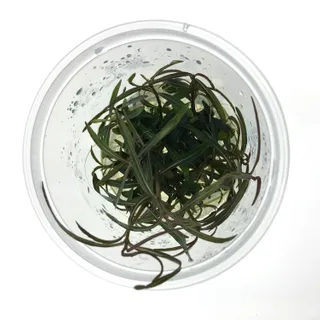
| 🌿 | Bolbitis heudelotii (African Water Fern) | Another West African epiphyte with identical care needs; creates a biotope-accurate West African planted display. |
| 🌿 | Bucephalandra species | Fellow rhizome epiphyte, compact, attaches to the same hardscape, and thrives in the same low-light no-CO2 conditions. |
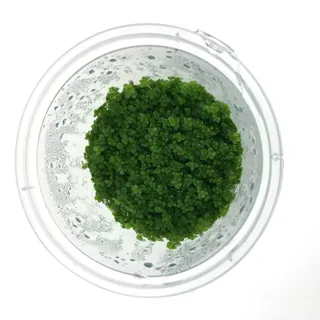
| 🌿 | Java Moss (Taxiphyllum barbieri) | Softens hardscape transitions and creates a lush understory at the base of Anubias mounts. |
| 🌿 | Anubias barteri var. nana | A smaller cousin that creates tiered scale on the same hardscape piece, with identical water and light requirements and a lovely size contrast with the larger Anubias afzelii above it. |
| 🌿 | Christmas Moss (Vesicularia montagnei) | A fine-textured moss that attaches to the same hardscape and provides a soft green understorey at the base of Anubias mounts. |
| 🌿 | Cryptocoryne parva | A miniature Crypt species ideal as a low foreground carpet, offering strong textural contrast with the broad Anubias leaves above. |
Quick Reference
| Light | Low to medium (30-80 PAR) |
| CO2 | Not required (optional) |
| Growth Rate | Slow |
| pH | 6.0 – 8.0 |
| Temperature | 22 – 28 degrees C |
| Hardness | 3 – 15 dGH |
| Adult Height | 30 – 40 cm |
| Planting | Rhizome on driftwood or rock |
| Propagation | Rhizome division |
| Placement | Mid-ground to background |
| Fertilisation | Weekly comprehensive liquid fertiliser |
| Difficulty | Easy — ideal for beginners |
| Origin Region | West Africa (Senegal to Sierra Leone) |
| Leaf Lifespan | 2-5 years per leaf under stable conditions |
| Fish Compatibility | Universal — tough leaves resist herbivory |
Reviews
Clear filtersThere are no reviews yet.