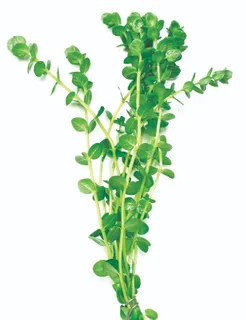
🪨 Species at a Glance
| Scientific Name | Hydrocotyle leucocephala |
| Common Name | Brazilian Pennywort, Green Pennywort, Water Pennywort |
| Family | Araliaceae (ginseng family) |
| Origin | Brazil and tropical South America, stream margins and flooded forest wetlands |
| Mature Height | Up to 30 cm rooted, indefinite as a creeping floating stem |
| Leaf Size | 2-4 cm kidney-shaped reniform discs |
| Growth Rate | Fast — stems extend 3-5 cm per week under good conditions |
| Light Requirement | Low to medium (30-60 PAR at leaf level) |
| CO2 Requirement | Not required — grows vigorously without injection |
| Planting Method | Stem planting in substrate or free-floating surface creeper |
| Placement | Background, midground trailer, or floating surface mat |
| Difficulty | Very easy — ideal beginner plant |
How to Plant
Stem
Hydrocotyle leucocephala is a true stem plant, though one with an unusually flexible relationship to the substrate that differentiates it from the more conventional background stems such as Rotala, Ludwigia, or Bacopa. The plant grows from fleshy semi-translucent stems of roughly three to five millimetres diameter that can be planted upright in substrate in the traditional stem-plant style, laid horizontally across the substrate to creep along the surface, allowed to trail out of the tank and across the water surface as a floating mat, or simply dropped into the tank entirely untethered and left to float as an oxygenating surface canopy. All four modes of use are equally valid and the plant thrives in each of them without any adjustment to technique or husbandry, which is one of the principal reasons the species has become a staple recommendation for first-time aquarists who are still working out their preferences and tank aesthetics. The beginner who is not yet certain where they want the plant in their tank can simply float a bunch on arrival and make decisions about permanent placement a week or two later, by which time the plant will have settled into the tank and begun producing new stems from which the aquarist can select the strongest for formal replanting.
When planted in substrate as a background or midground stem plant, the standard technique is to group three to five individual stems together into a small planted bunch and push the bundled stem ends two to three centimetres into a nutritious aquasoil or sand substrate, using aquascaping pinsettes to grip the bundle firmly as it goes in. The stems will root readily from the buried nodes within a fortnight, producing small white feeder roots that anchor the bunch against normal water flow and begin drawing nutrients from the substrate. Planted bunches should be spaced at least five to seven centimetres apart to give each bunch room to grow laterally as well as vertically, and rows of bunches along the back wall of the tank will fill in within six to eight weeks under moderate light to produce a classic lush stem-plant backdrop with the distinctive rounded bright green leaves gently swaying in the flow. Under stronger light and with adequate fertilisation, the planted stems will grow vertically at roughly three to five centimetres per week, eventually reaching the water surface, where they will either break through and begin producing emersed leaves in the air gap above the water, or bend over and begin trailing horizontally just below the water line in a creeping floating presentation that is one of the species’ signature aquascaping looks.
When used as a floating plant, H. leucocephala requires essentially zero planting effort because the stems are naturally buoyant and will float in any orientation on the water surface. Simply remove the bunch from its packaging, rinse it under dechlorinated water to remove any loose fragments, and lay the entire bunch on the water surface where flow is moderate to low. Within a few days the stems will settle into a horizontal orientation with leaves held flat on the water surface and small white feeder roots hanging down into the water column like a hydroponic aerial root system. This floating presentation is enormously popular in dedicated breeding tanks for livebearers, shrimp, and surface-dwelling fish such as hatchetfish, because the floating stems and their root canopy create ideal ambush cover, diffuse incoming surface light into pleasant dappled shade below, and aggressively absorb dissolved nutrients from the water column to out-compete algae in tanks with heavy biological loads. Hobbyists running dirt-simple low-tech setups with no filtration beyond air-driven sponge filters frequently use floating H. leucocephala as a living filter and find it more effective at nitrate reduction than most dedicated filtration media.
The substrate of choice when the plant is rooted in the tank is a nutritious aquasoil such as ADA Amazonia, Tropica Aquarium Soil, or Landen Shrimp Soil, because H. leucocephala responds very visibly to high-quality substrate with larger leaves, richer colour, and faster stem extension than it produces in inert substrates. However, unlike many high-demand stem plants, this species grows perfectly well in plain aquarium gravel or pool filter sand with a modest root-tab fertiliser regime, and beginner aquarists working with inert substrates should not feel pressured to upgrade to aquasoil specifically for this plant. Substrate depth of three to four centimetres is adequate at the planting position, and deeper substrate is not required because the root system is shallow and widely spreading rather than deeply penetrating. The stems should be planted so that at least two nodes are below the substrate surface, which maximises the surface area available for root emergence and produces noticeably stronger rooting than planting with only a single node buried. The most common beginner mistake is to push only the bare stem into substrate without any nodes buried, which results in the stem either floating loose within days as its buoyancy reasserts itself, or rooting slowly and with low vigour because no nodes are in contact with substrate for feeder-root production.
One feature of this plant that experienced aquarists particularly value is its extraordinary tolerance for transitional abuse. Stems can be uprooted, relocated, split, trimmed aggressively, left floating for weeks, replanted, and generally knocked around far more roughly than any other stem plant in the hobby, and they will nearly always bounce back with fresh growth within a fortnight. This resilience makes the species an ideal choice for tanks that undergo frequent rescapes, for aquarists who like to reconfigure their layouts regularly, or simply for beginners who are still learning how to plant stems correctly and will produce a lot of accidental uprooting in their first few months. A good rule of thumb is that if the stem is still green and firm when cut across, it will probably recover no matter how mangled it looks; only stems that have gone brown, soft, or translucent can be considered truly failed, and even those can sometimes produce viable side shoots from a remaining intact node if given time to try.
Lighting Guide
MEDIUM LIGHT
PAR: 30-60 PAR at leaf level
High
Hydrocotyle leucocephala is a low-to-medium light species that thrives across a remarkably broad range of illumination levels and is one of the most light-tolerant plants available to the freshwater aquarist. Under moderate light of roughly forty to sixty PAR at the substrate surface, the plant produces its classic presentation of saturated bright green kidney-shaped leaves held flat along a vigorous upright stem, with internodes of two to three centimetres and rapid vertical growth that rewards planting efforts with visible results within days. This is the sweet-spot window for ornamental display aquariums where leaf shape, colour, and stem vigour all need to be strong, and most successful planted tanks hit this target naturally with a basic fluorescent or LED fixture running a standard photoperiod over a sixty-litre or larger tank. Under somewhat lower light of thirty to forty PAR, the plant continues to grow perfectly well but with slightly longer internodes of three to five centimetres and slightly paler leaves, producing a more open leggy stem presentation that reaches the surface more quickly and which many aquascapers actually prefer for the floating-canopy look. Under dim light below twenty-five PAR the plant will still survive, though it becomes noticeably thin and etiolated with widely spaced leaves and pale colouration, and at very low light levels new leaf production slows to the point where the plant is maintaining rather than growing.
One particularly useful characteristic of H. leucocephala is its strong tolerance of low-light conditions that would defeat most other attractive stem plants, which makes it one of very few species suitable as a background plant for low-tech tanks running minimal lighting budgets. Aquarists setting up simple community tanks with basic off-the-shelf LED lighting can confidently plant H. leucocephala at the back of the tank and expect it to thrive where Rotala rotundifolia or Ludwigia repens would struggle and where Cabomba or Myriophyllum would fail outright. Under stronger light above seventy PAR the plant responds with extremely vigorous growth, short compact internodes of one to two centimetres, and intensely saturated emerald-green leaf colour that many aquascapers consider the most beautiful presentation of the species, though at these light levels the plant may need CO2 and active fertilisation to fully realise its potential and may outgrow its intended space within weeks if not aggressively trimmed.
Photoperiod of eight hours is a reliable starting point for low-tech community tanks with this plant as a background stem, extendable to ten or even eleven hours in very low-light tanks to compensate for the reduced intensity with additional duration. High-tech CO2-injected tanks should run a slightly shorter photoperiod of seven to eight hours to keep algae pressure in check, since H. leucocephala does not especially benefit from longer photoperiods at higher light intensities and the risk-reward calculation tips toward algae control. The plant does not require or benefit from siesta-period lighting schedules, and a simple uniform block of daytime illumination is entirely adequate. Floating specimens operating as a water-surface canopy are essentially unaffected by in-tank light intensity because they are receiving full unattenuated light directly at the surface and grow at near-maximum rate regardless of what is happening several centimetres below; this is one of the reasons floating H. leucocephala is such an effective shade-cover plant, as the upper leaves continue to grow vigorously even while shading the plants below to whatever extent the aquascaper requires.
Recommended Photoperiod: 8-10 hours in low-tech tanks; 7-8 hours in high-tech CO2-injected tanks
Carbon & Nutrients
CO2 OPTIONAL
Pressurised CO2 injection is genuinely unnecessary for Hydrocotyle leucocephala, which stands in refreshing contrast to the many aquascaping stem plants that technically grow without CO2 but visibly struggle and look their best only when injected. This species is one of the minority of truly low-tech-friendly plants that produces excellent results on nothing more than ambient atmospheric CO2 diffusing through the water surface plus the respiratory CO2 contributed by fish and invertebrates in a normally stocked community tank. A planted tank with no CO2 injection and only basic lighting will produce vigorous healthy H. leucocephala stems extending three to four centimetres per week with saturated green leaf colour and acceptable branching vigour, and most hobbyists who rely on this species as a background plant in low-tech setups never feel any pressure to upgrade their tank to CO2 specifically for the plant. The floating form of the plant benefits even less from CO2 injection because floating leaves absorb carbon directly from the atmosphere through their upper surfaces, and CO2 dissolved in the water column is largely irrelevant to their growth rate; floating H. leucocephala grows at near-maximum rate regardless of water-column CO2 concentration.
Under pressurised CO2 injection at twenty to thirty parts per million, H. leucocephala does respond positively with tighter internodes of one to two centimetres instead of two to three, slightly larger individual leaves, and stem extension accelerating from three to four centimetres per week to five to seven, but the absolute growth difference is less dramatic than it is for CO2-hungry species such as Rotala or Ludwigia. Aquascapers running existing CO2 setups for their other plants will certainly see benefits in their H. leucocephala, but those contemplating whether to invest in CO2 equipment primarily to improve this species should know that the value proposition is marginal and that their money is better spent on lighting upgrades or substrate improvements. Liquid carbon supplements such as Seachem Excel at standard label doses are well tolerated and produce a modest boost in growth rate and leaf density of perhaps twenty to thirty percent compared to entirely untreated tanks, and this is the most cost-effective carbon supplementation option for low-tech aquarists who want to squeeze a little more performance out of the plant without committing to pressurised gas hardware. Unlike some sensitive species that show leaf melt at high liquid-carbon doses, H. leucocephala tolerates liquid carbon well even at slightly above label rates, though routine overdosing should still be avoided because it can stress other plants in the tank even if the pennywort itself remains unaffected.
Fertilisation
Hydrocotyle leucocephala has modest nutritional demands and is less hungry than most fast-growing stem plants, a characteristic that aligns perfectly with its low-tech beginner-friendly identity. In a nutritious aquasoil setup, no supplementary fertilisation is typically required during the first six to nine months after planting because the fresh substrate releases ample nutrients to support vigorous growth of this and most other plants in the tank. As the aquasoil ages beyond the twelve-month mark and begins to deplete, a simple weekly dose of an all-in-one liquid fertiliser such as Seachem Flourish Comprehensive, Tropica Specialised Nutrition, or APT Complete at the manufacturer’s recommended rate is adequate to maintain healthy growth in moderately stocked community tanks. In heavily stocked tanks with strong fish bioload, supplementation may even prove unnecessary for longer periods because fish waste provides significant nitrogen and phosphorus that the plant readily absorbs through both roots and leaves.
The floating form of H. leucocephala is particularly effective at stripping nutrients directly from the water column through its dangling feeder roots, and in tanks with nitrate accumulation problems a generous floating canopy of this species can single-handedly bring weekly nitrate readings back down from concerning levels of forty parts per million into the healthy ten-to-twenty range within a fortnight. This nutrient-stripping capability is a major practical reason aquarists keep the plant in shrimp tanks and breeding setups where elevated nitrate is a concern, and it functions essentially as a living biological filter in addition to its aesthetic role. Root tabs provide a noticeable but not essential boost when the plant is grown rooted in inert substrates such as gravel or sand, with placement of a tab every fifteen to twenty centimetres along the stem-plant row yielding visibly stronger growth and richer leaf colour within two to three weeks. Iron is the most visible trace element for this species, and iron deficiency produces distinctive yellowing of new leaves at the stem apex that progresses to interveinal chlorosis if allowed to persist; a dedicated iron supplement such as Seachem Flourish Iron used twice weekly at half the label dose solves this reliably, and is cheap insurance against cosmetic deficiencies in hard alkaline water where iron availability is naturally reduced. Potassium deficiency is occasionally seen on older leaves as small pinhole perforations identical to the classic potassium-deficiency signature across all aquatic plants, and a potassium supplement or increased macro dosing will reverse the symptom. Beyond these straightforward adjustments, H. leucocephala makes essentially no special nutritional demands and tolerates months of dosing irregularity without dropping out, which is exactly the kind of low-maintenance behaviour that earns a plant a permanent place in the recommendation list for beginner aquarists.
Growing & Trimming
FAST GROWTH
Hydrocotyle leucocephala is a fast-growing species that places it at the vigorous end of the aquascaping palette, a category it shares with other beginner-friendly workhorses such as Hygrophila polysperma, Ceratopteris thalictroides, and Elodea. Under moderate low-tech conditions without CO2, rooted stems extend three to four centimetres per week and produce one new leaf node every four to five days, meaning a freshly planted bunch will reach the water surface in a forty-centimetre-tall tank within ten to twelve weeks and will require its first major trim within three to four months of planting. Under high-light CO2-injected conditions this growth rate roughly doubles, with stems extending five to seven centimetres per week and new nodes appearing every two to three days, and a tank planted from fresh can look fully established with visible lush background coverage within six to eight weeks, which is an unusually quick turnaround for a genuinely attractive stem plant. The floating form grows even faster because it has unlimited atmospheric CO2 access and full unattenuated light at the surface, and a small starter bunch can spread into a tank-wide floating canopy of forty to fifty centimetres across within six to eight weeks of introduction.
Maintenance of H. leucocephala focuses almost entirely on controlling its vigorous growth to prevent it overwhelming neighbouring plants and blocking light from reaching the rest of the tank. The simplest and most effective technique is regular trimming of the tops of rooted stems, cutting each stem at the desired height with sharp aquascaping scissors and discarding or replanting the trimmed top section. Stems respond to topping by producing two or three side shoots from the next leaf node below the cut, so each round of trimming results in bushier denser growth below the cut line and progressively fuller background coverage over multiple trimming cycles. The topping cycle should run roughly every two to three weeks in well-lit tanks under CO2, or every four to six weeks in low-tech tanks without CO2. For floating specimens, trimming takes the form of simply lifting a handful of the mat and discarding or transplanting excess stems to keep the surface coverage within the aquascaper’s desired bounds, a task that takes perhaps two minutes per week once the canopy is well established.
Beyond trimming, the plant requires essentially no other maintenance intervention. Older leaves at the base of rooted stems occasionally yellow and drop naturally as the plant matures and the upper canopy shades them from sufficient light, which is normal senescence and not a sign of disease; simply remove the dropped leaves from the substrate during regular maintenance to prevent them decomposing in place and fuelling algae in the lower water column. In heavily trimmed tanks that have been running for a year or more, the original planted stems may become gnarled and bare at their bases from repeated topping, and in such cases the cleanest approach is to uproot the entire bunch, select the strongest two or three fresh top sections from the current growth, and replant those in place of the original bunch as a complete rejuvenation. This rescape-in-place maintenance is typically required only once a year and produces a visibly refreshed stand of H. leucocephala within four to six weeks of replanting. Melting of new growth is extremely rare in this species once it is established and is almost always traceable to chlorine exposure from insufficiently dechlorinated water changes rather than any inherent plant problem; addressing the dechlorination practice resolves the issue reliably.
Top tall stems
Every 2-4 weeks depending on light and CO2 — cut stems at the desired height to encourage branching and prevent stems from blocking tank light to other plants. Replant or discard topped fragments as preferred.
Thin floating canopy
Weekly in tanks with established floating canopy — lift a handful of surface stems and remove to prevent excessive shading of submerged plants below. Trimmed floating stems can be gifted, traded, or composted.
Remove yellowed leaves
Every 3-4 weeks — pinch off naturally senescing lower leaves from rooted stems to keep the stand visually clean and prevent decomposing leaves fuelling substrate algae.
Rejuvenate bare-based bunches
Every 9-12 months — uproot old bunches whose bases have become bare from repeated topping, replant the strongest fresh top sections, and discard the old bases to refresh the stand completely.
Clean aerial feeder roots
As needed on floating specimens — trim any excessively long feeder roots that dangle too far into the water column and interfere with swimming fish or tank visibility; the plant is unharmed by root trimming.
Inspect for algae on leaves
As needed during water changes — gently wipe any green spot algae from the upper leaf surfaces of floating specimens; the broad reniform leaves are particularly prone to algae in bright-lit tanks.
Ideal Water Conditions
6.0–7.8
ideal 6.8
18–28 °C
ideal 24 °C
4–20 dGH
Very tolerant — soft through hard water all well-handled, with mild preference for slightly soft conditions
Hydrocotyle leucocephala tolerates one of the broadest ranges of water chemistry of any commonly cultivated aquarium plant, which is a major reason it has found its way into aquascaping catalogues around the world despite the huge variations in tap water chemistry across different regions and countries. pH values between 6.0 and 7.8 are all entirely acceptable, and although the plant shows a mild preference for slightly acidic to neutral water around pH 6.5 to 7.0 typical of its Amazon basin origin, it grows perfectly well at pH 7.8 in hard alkaline tap water of the kind common in London, Munich, Berlin, and much of the western United States. This unusual pH tolerance means the species can be used successfully in essentially any freshwater aquarium regardless of whether the aquarist has invested in water chemistry adjustment equipment, which is a tremendous practical advantage for beginners working with whatever water comes out of their tap. In softer acidic water typical of aquasoil-based high-tech planted tanks with pressurised CO2, the plant produces slightly richer leaf colour and subtly tighter internodes, while in harder alkaline water it grows perhaps slightly faster and with more open internode spacing. Both presentations are viable and the species does not require chemical water softening or pH buffering to thrive.
Temperature tolerance is equally broad, running from a cool eighteen degrees Celsius suitable for goldfish and white cloud mountain minnow tanks up to a warm twenty-eight degrees Celsius suitable for discus and Asian cichlid setups, with a generous sweet spot around twenty-three to twenty-six. This very wide thermal range makes the plant one of very few aquarium species that can be kept successfully in both coldwater and tropical aquariums without adjustment, and it is one of the strongest reasons to recommend H. leucocephala to aquarists keeping white clouds, paradise fish, hillstream loaches, or other cool-tolerant livestock where plant options can otherwise be limited. It also handles the elevated temperatures of discus tanks, Asian arowana community tanks, and other warm-water aquariums well, extending its working range into territory where more sensitive species begin to falter. Hardness from four to twenty dGH is all well-tolerated, which is a wider range than most aquarium plants, and the species adapts to essentially the full spectrum of typical community-tank water chemistry without special preparation. Chlorine and chloramine in untreated tap water will damage tender new leaves and cause immediate stem melt at the growth apex, so standard dechlorination during water changes is essential. Tannins from driftwood and almond leaves are welcome and do not negatively affect the species, and the plant can be used successfully in mild blackwater tanks, apistogramma breeding setups, and wild-Betta biotopes where tannin-stained water is part of the target aesthetic. It tolerates mineral-heavy shrimp-tank remineralisation regimes such as GH+ and GH/KH+ salts used in caridina shrimp tanks, and can be grown alongside high-end shrimp species without difficulty, making it a useful dual-purpose species for aquascape-and-shrimp setups.
Aquascaping & Design
Background
Hydrocotyle leucocephala is one of the most versatile plants in the aquascaping palette because it can credibly occupy three entirely different aquascaping roles depending on how the aquarist chooses to deploy it: a classic rooted background stem plant, a creeping midground trailer that wanders horizontally across the substrate and hardscape, or a floating surface canopy that functions as both a biological filter and a visual ceiling for the tank. Very few aquarium plants offer this level of presentational flexibility, and experienced aquascapers often keep H. leucocephala in stock specifically for its ability to fill whichever role the current layout demands without requiring a different species purchase for each use case. In its background role, a row of rooted bunches planted along the rear wall of a standard rectangular tank produces a lush informal backdrop of saturated green kidney-shaped leaves that pairs well with almost any hardscape style, from Iwagumi-rock minimalism to driftwood-heavy jungle aesthetics. The plant is particularly well-suited to jungle-style Amazon-biotope layouts where its native South American origin and loose informal growth habit align perfectly with the biotope aesthetic, and it is a common background choice for angelfish tanks, discus tanks, and tetra community setups that reference the flooded forest environments of the Amazon basin.
As a midground trailer, H. leucocephala can be planted at the edge of a raised substrate terrace or on the top of a rock-stack hardscape feature and allowed to trail downward across the face of the hardscape, producing a cascading foliage effect that softens the hard lines of rocks or driftwood and adds organic visual movement to the layout. This trailing presentation is particularly striking in iwagumi-style layouts featuring a small number of prominent hardscape elements, where the trailing stems create a visual bridge between the rocks and the substrate plane below and prevent the hardscape from reading as an isolated feature disconnected from the rest of the layout. In larger tanks with complex multi-level terraced hardscape, running H. leucocephala across multiple levels creates a unifying vegetative element that ties the whole scape together visually. The trailing form works equally well as a ground creeper when the plant is laid horizontally on substrate rather than planted vertically; in this mode it creeps along the substrate surface at roughly the same rate as it would climb vertically, producing a shaggy informal midground carpet that reads very differently from conventional low carpet species.
The floating canopy presentation is perhaps the most distinctive use of H. leucocephala, and is one of the unique applications in the aquascaping hobby. Allowed to float freely on the water surface, the plant forms a dense mat of kidney-shaped leaves with trailing white feeder roots dangling below, producing a visual ceiling to the tank that diffuses incoming light into soft dappled patterns and creates a sense of genuine depth and atmospheric shelter below the surface. Fish respond very positively to this surface cover, particularly surface-dwelling species such as hatchetfish, halfbeaks, and African butterfly fish, which consider the floating canopy an authentic replica of their natural rainforest-pool overhead cover. Livebearers use the floating roots and stems as breeding shelter for their young, and shrimp tanks benefit from the additional grazing surface provided by the dangling roots and from the nutrient-stripping effect that keeps water quality stable. The floating canopy also creates strong contrast with the submerged planting below when viewed from the side of the tank, with the floating mat reading as a distinct visual band that separates the air column from the water column and adds compositional layering to photographs and side views of the tank.
Companion plant compatibility is extremely broad because H. leucocephala is tolerant of essentially any water chemistry and light level used by other aquarium plants. It pairs well with classic stem-plant backgrounds such as Rotala rotundifolia, Ludwigia repens, or Bacopa caroliniana, with its broad round leaves providing textural contrast to the narrower or needle-leaved stems of those companion species. In the midground it associates well with Cryptocoryne species, Anubias barteri, or Echinodorus varieties, offering a different leaf form that breaks the visual monotony of typical midground plantings. Floating companions such as Salvinia, Pistia stratiotes, or Limnobium laevigatum can share the surface with floating H. leucocephala, though the aquascaper should select only one dominant floating species because otherwise they will compete for the same surface real estate and eventually one will crowd out the other. For nano aquariums under thirty litres the plant may be too vigorous for permanent use unless the aquascaper is committed to regular aggressive trimming, but it works beautifully as a short-term grow-in plant during the first months of a new tank when the scape is still cycling and building biological stability.
| Plant | Why | |
|---|---|---|
| 🌿 | Rotala rotundifolia | Classic stem plant background pairing where the fine needle-like leaves of Rotala contrast sharply with the broad round reniform leaves of H. leucocephala, creating strong textural variety in background plantings under similar low-to-medium light conditions. |
| 🌿 | Ludwigia repens | Red-orange stem plant whose warm leaf colour creates striking visual contrast against the bright green of H. leucocephala when planted together in the background, with both species thriving in identical low-tech community tank conditions. |
| 🌿 | Cryptocoryne wendtii | Rosette midground crypt sharing water parameter preferences and offering a substrate-level counterpoint to the trailing stems of H. leucocephala, a classic Amazon-biotope pairing that works reliably in low-tech community tanks. |
| 🌿 | Anubias barteri var. nana | Shade-tolerant rhizome epiphyte for hardscape attachment that pairs beautifully with floating H. leucocephala canopies, thriving in the dappled light below the surface mat where most other plants would struggle. |
| 🌿 | Echinodorus bleheri (Amazon sword) | Large rosette centrepiece from the same Amazon biotope, providing a strong vertical focal feature that contrasts with the trailing horizontal growth habit of H. leucocephala, with both species sharing identical origin and water parameter preferences. |
| 🌿 | Vallisneria spiralis | Tall linear background plant whose strappy ribbon-like leaves contrast sharply with the round peltate leaves of H. leucocephala at the background, and which thrives in identical hard-water-tolerant low-tech conditions alongside the pennywort. |
How to Propagate
Cuttings
Propagation of Hydrocotyle leucocephala is the easiest of any plant in the standard aquascaping catalogue, full stop. The propagation method is simple stem cuttings, and every routine trimming session produces dozens of viable cuttings as a natural byproduct of ordinary plant maintenance, so the practical question for most hobbyists is not how to generate propagation material but what to do with the excess fragments that accumulate faster than the aquarist can use or give away. A single well-established background bunch of five planted stems can produce twenty to thirty viable cuttings per month during the active growing season, and a floating canopy of comparable size produces even more as its trailing stems fragment naturally under their own weight.
The technique is trivially straightforward. Using sharp aquascaping scissors or a sterile razor blade, cut stems into sections of eight to twelve centimetres each, ensuring every section includes at least two or three leaf nodes along its length. The cutting can be made anywhere along the stem, because H. leucocephala produces roots readily from essentially any submerged node and does not require cuttings to include a growth apex to be viable. Cuttings with the existing growth apex at their top will simply continue extending upward from that apex, while cuttings made from a mid-stem section without any apex will sprout new side shoots from the topmost node and continue growing from the newly emerged shoot within a fortnight. The cut fragment is then either replanted directly in substrate as a new bunch using standard planting technique, with the bottom two nodes buried to maximise rooting, or dropped into the tank as a free-floating stem that will root laterally in the water column and can be left to float or collected and planted later at the aquarist’s convenience. Establishment is typically complete within ten to fourteen days under good conditions, by which point the cutting will have produced small white feeder roots from its buried nodes and will have begun extending new leaves from its growth apex.
The plant also propagates spontaneously through natural stem fragmentation in any tank where it has been established for more than a few months. Older stems occasionally break at a lower node under their own weight or during routine tank maintenance, and the broken fragments simply continue to grow wherever they fall, rooting into substrate if they land on it or floating indefinitely if they drift to the surface. This self-propagation is actually how aquarists usually discover they have far more H. leucocephala than they need, because the number of stray floating fragments multiplies silently over months until the aquarist suddenly realises the surface is covered and the tank light is being significantly attenuated by the accumulated canopy. A useful management practice for aquarists who want to keep the plant within sensible bounds is to do a quick floating-fragment harvest during every weekly water change, pulling any stray floating stems out of the tank before they can establish into a proper canopy. The harvested fragments can then be composted, donated to a local fishkeeping club, gifted to beginner aquarists in online communities, or simply discarded.
Flowering does occur rarely in submerged conditions but does not produce viable seed in aquarium settings, and commercial propagation of this species is entirely by stem cuttings in emersed nursery setups. The underwater flowers, when they do appear, are tiny white umbels on short stalks emerging from the leaf axils and are a pleasant visual curiosity that gives rise to the species epithet leucocephala, which translates from Greek as ‘white-headed’ in reference to the pale flower clusters. Emersed cultivation in paludariums or riparium setups produces more robust flowering with visible Araliaceae-family umbels above the water line, and aquarists running bi-media tanks can enjoy a much richer flowering display in emersed conditions than submerged. For hobbyists specifically seeking to build up a large propagation stock quickly, the recommended approach is to float a starter bunch for two to three months under strong light until it develops an extensive surface canopy, then harvest the entire canopy, cut it into ten-centimetre segments, and replant the segments as seed stock for further propagation. A single initial purchase of one bunch of ten stems can reasonably be scaled up to a propagation stock of several hundred stems within six months using this approach, which is genuinely unmatched among commercially available aquarium plants.
Quick Reference
| Scientific Name | Hydrocotyle leucocephala |
| Light | Low to medium (30-60 PAR) |
| CO2 | Not required — grows vigorously without injection |
| Growth Rate | Fast (stems extend 3-5 cm / week) |
| Mature Height | Up to 30 cm rooted, indefinite as floating stem |
| pH Range | 6.0-7.8 |
| Temperature | 18-28 degC |
| Hardness | 4-20 dGH |
| Planting Method | Stem planting or free-floating |
| Placement | Background, midground trailer, or floating canopy |
| Propagation | Stem cuttings |
| Difficulty | Very easy — ideal beginner plant |
Reviews
Clear filtersThere are no reviews yet.