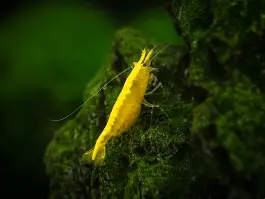
🪨 Species at a Glance
| Scientific Name | Neocaridina davidi var. “Yellow Neon” |
| Common Names | Yellow Neon Shrimp, Yellow Fire Shrimp, Golden Shrimp, Yellow Sakura |
| Family | Atyidae |
| Order | Decapoda |
| Origin | Captive-bred colour form; wild ancestors from Taiwan and southern China |
| Adult Size | 2.5–3.5 cm (1.0–1.4 in) |
| Lifespan | 1–2 years (typical 15–18 months) |
| Temperature | 18–28 °C (64–82 °F), ideal 22–24 °C |
| pH Range | 6.5–7.8, ideal 7.0–7.4 |
| Hardness (dGH) | 6–15 dGH (minerals critical for molting) |
| Diet | Omnivore — biofilm, algae, blanched vegetables, shrimp pellets, leaf litter |
| Minimum Tank Size | 20 L (5 gal) for a starter colony |
| Care Level | Beginner — one of the most forgiving Neocaridina colours |
| Temperament | Completely peaceful; constant grazer |
| Breeding | Egg-carrying (berried female); no larval stage, fully-formed shrimplets |
Visual Identification Guide
Yellow Neon Shrimp share the streamlined, laterally compressed body plan common to every member of the family Atyidae. The body is partitioned into two primary regions: the cephalothorax, a fused head-and-thorax segment protected by a hard chitinous carapace, and the flexible, muscular abdomen that curves beneath the body and terminates in a fan-shaped tail formed by the telson and two pairs of uropods. Six pairs of thoracic appendages extend from the cephalothorax — two pairs of small chelate feeding claws (chelipeds) that constantly sweep biofilm into the mouth, and four pairs of walking legs (pereiopods) that provide the characteristic skittering movement across leaf and glass surfaces. The underside of the abdomen bears five pairs of feathery pleopods that propel the shrimp forward during short bursts of swimming and, crucially in females, cradle the developing egg mass during the berried phase. Behind the carapace, the gills are concealed within a branchial chamber and ventilated by the rhythmic beating of the scaphognathites — small paddle-like appendages that drive a continuous stream of oxygenated water over the gill filaments. This arrangement is highly efficient but also explains why even mild oxygen deprivation or elevated carbon-dioxide concentrations hit shrimp harder than most fish species.
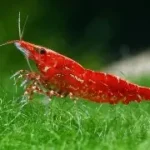
The yellow colouration itself is produced by a layer of xanthophore pigment cells embedded in the epidermis directly beneath the transparent cuticle, supplemented by a more diffuse deposit of yellow carotenoid molecules — chiefly lutein and zeaxanthin — stored in the hypodermal tissue. Unlike the red of a Cherry Shrimp, which is generated by both red carotenoid pigments (astaxanthin, canthaxanthin) and erythrophore cells that concentrate those pigments into visible patches, the yellow is built primarily from accumulated dietary carotenoids that the shrimp cannot synthesise itself. This is precisely why diet plays a disproportionately important role in maintaining colour intensity in Yellow Neon stock: a colony fed predominantly on plain fishkeeper flake will steadily fade over two or three generations, while a colony supplemented with spirulina, paprika-enriched shrimp pellets, and marigold-petal powder will maintain an almost fluorescent canary-lemon that appears to glow under aquarium lighting. A well-fed adult female displays this almost uniform canary-to-lemon yellow across the entire carapace and abdomen, with only faint translucency remaining on the underside of the pleopods and the tip of the tail. Under strong aquarium lighting the colour appears to glow, giving rise directly to the “neon” half of the common name. Sexual dimorphism becomes apparent at 60–75 days of age: females are visibly larger (2.8–3.5 cm vs 2.0–2.5 cm for males), more opaque, and display a wider, deeper abdomen whose pleural plates flare outward to accommodate an egg mass of 20–35 eggs. The “saddle” — a patch of pale orange-yellow ovarian tissue visible through the carapace immediately behind the head — is an unmistakable indicator of a maturing or reproductively active female and is often more visible in Yellow Neons than in Red Cherries because of the contrast between the orange-saturated ovary and the lemon-yellow body. Males remain consistently slender, noticeably more transparent along the flanks, and typically show slightly duller, patchier yellow pigmentation concentrated along the dorsal surface; in older males the colour can take on a faint greenish cast, which is harmless but sometimes mistaken by newcomers for disease.
The rostrum (a short forward-projecting spine between the eyes) is modest in Neocaridina compared to Caridina species such as the Crystal Red, and carries a small number of dorsal and ventral teeth that are sometimes used as a species-confirmation feature in academic taxonomy. Two pairs of long antennae and two shorter antennules project from the front of the head and serve as the primary chemosensory organs, constantly tasting the water for food cues, mating pheromones, conspecific alarm signals, and predator signatures. The antennae are also used as tactile probes — a Yellow Neon exploring a new piece of driftwood or a clump of moss will lead with the antennae almost exclusively, making initial contact up to five or six times before the shrimp itself will step forward. The compound eyes are mounted on short, independently mobile stalks and provide near-360-degree vision — a vital defensive adaptation in a species that has no other defences beyond camouflage, reactive speed, and sheer reproductive output. In the Yellow Golden Back sub-strain, an additional longitudinal strip of reflective guanine crystals forms a metallic gold dorsal stripe running from the back of the carapace to the base of the telson, a feature inherited from the same selective pressures that produced Blue Velvet and Blue Jelly variants in the blue line. Golden Back individuals often command a 30–50 % price premium over standard Yellow Neons in hobbyist markets and are particularly prized in the European and East Asian scaping communities, where the reflective dorsal stripe catches strong planted-tank lighting in a way that the solid-yellow form cannot. Behaviourally, Yellow Neons are identical to every other Neocaridina davidi colour form: they are relentlessly social, constantly active during daylight hours, and completely non-aggressive toward conspecifics or other invertebrates. A healthy adult will spend its day grazing, molting, grooming, and — in the case of mature females — carrying and fanning eggs. Nocturnal activity is reduced but not absent; under a red observation light or moonlight LED, you will frequently see shrimp continuing to graze slowly on moss and leaf litter through the night. Unlike some Caridina species, Yellow Neons do not establish territories, do not squabble over food, and do not exhibit any kind of hierarchical behaviour — the colony functions as a loose grazing aggregation rather than as a structured social group, which makes behavioural observation very straightforward and also makes the species exceptionally well-suited to mixed-colour displays (so long as the keeper accepts the inevitable hybridisation discussed in the community chapter below).
🟡 Yellow (Low Grade)
Translucent body with scattered pale-yellow patches concentrated along the dorsal surface; common in hobbyist breeding tanks and used as colony starter stock.
🌻 Yellow Sakura (Mid Grade)
More consistent yellow colouration covering the majority of the body, with some translucency visible on the legs and underside — equivalent in grade to the Sakura Cherry line.
🌞 Yellow Neon (High Grade)
Deep, opaque canary yellow across the full body including the legs and tail fan; the benchmark for serious Yellow Neocaridina keepers and the name most commonly attached to the colour form in retail stock.
✨ Yellow Golden Back (Sub-Strain)
Solid yellow body overlaid with a brilliant metallic-gold dorsal stripe running from the rear of the carapace to the base of the telson; a distinct selectively-bred sub-strain prized for its reflective back line.
🔥 Yellow Fire (Highest Grade)
Intense, saturated yellow covering every surface of the body including antennae and the undersides of the pleopods; the pinnacle of the Yellow Neocaridina line and the equivalent of Painted Fire Red.
🍋 Lemon Drop (Pale Morph)
A paler, softer-yellow morph with a slight greenish undertone, occasionally produced as a secondary line; not to be confused with true Green Jade stock, which is genetically distinct.
Keeping the Water Safe
6.5–7.8
ideal 7.2
18–28 °C
ideal 23 °C
6–15 dGH
Moderately hard — essential minerals for molting and egg development
Yellow Neon Shrimp are significantly more sensitive to water chemistry than most tropical community fish, and sudden parameter shifts are the single most common cause of unexplained colony losses. The cardinal rule is absolute: never expose shrimp to copper in any form. Copper is acutely lethal to all freshwater invertebrates, including at trace concentrations (below 10 parts per billion) present in many fish medications — especially ich and parasite treatments based on copper sulfate — algaecides, aquatic plant fertilisers containing copper-chelate micronutrients such as CSM+B and most complete aquatic plant trace-element mixes, and even some regional tap-water supplies where aging copper plumbing is in use. Always read the full ingredient list of any product before introducing it to a shrimp tank; if the label mentions copper sulfate, copper-EDTA, copper gluconate, or any other copper compound, do not add it under any circumstances. When in doubt about tap water, use a dedicated copper test kit (Salifert or Red Sea) or simply run the first 30 seconds of the tap to flush any copper that leached into stagnant pipes before collecting water for changes. Keepers in older houses with pre-1980s copper plumbing should consider running all shrimp-tank top-up water through a sediment-and-carbon prefilter or using RO/DI water reconstituted with shrimp-specific GH/KH+ salts.
Beyond copper, Yellow Neons are sensitive to ammonia and nitrite (both should read a stable 0 ppm in a cycled tank with any standard hobby test kit) and prefer nitrate to stay below 20 ppm, ideally below 10 ppm for a breeding colony. Chlorine and chloramine in untreated tap water must always be neutralised with a quality dechlorinator such as Seachem Prime, API Tap Water Conditioner, or Tetra AquaSafe before use; chloramine in particular cannot be removed by sitting water out overnight and requires chemical neutralisation. pH swings are particularly dangerous: a shift of 0.5 units or more within a 24-hour window can trigger stress molts, dropped eggs in berried females, or outright death within hours. Soft or acidic water below pH 6.5 is problematic because it impairs the shrimp’s ability to absorb dissolved calcium for shell construction, directly producing failed molts and — over longer periods — reduced egg-clutch sizes and thinner, more fragile cuticles. Equally, rapidly rising pH above 8.0 shifts ammonia-nitrogen into its more toxic un-ionised NH3 form, which is far more damaging to gill tissue than the NH4+ ion that predominates in neutral and acidic water. Yellow Neons tolerate the 6.5–7.8 band comfortably but strongly prefer a stable 7.0–7.4 maintained by crushed coral in the filter, aragonite-buffered substrate, or a regular dose of mineral-remineralising salts during water changes. Total Dissolved Solids (TDS) is another useful parameter to monitor: a healthy Yellow Neon tank typically runs at 180–300 ppm TDS, and any drift outside 150–400 ppm over a short period should prompt immediate investigation of the remineralising source and water-change protocol. Many serious keepers use a simple weekly routine that minimises chemistry surprises: test pH, GH, KH, and TDS every Sunday morning, perform a 15–20 % water change with pre-matched remineralised water, and record the before-and-after values in a simple notebook or spreadsheet. Over a few months this builds up a baseline picture of how the tank behaves between maintenance cycles and makes it easy to spot the early warning signs of remineraliser exhaustion, pH drift from ageing aqua soil, or KH depletion from active buffering substrates. A final practical tip: when performing water changes, always drip the new water in slowly over 10–15 minutes rather than pouring it directly, especially if there is any possibility of a parameter gap between change water and tank water — shrimp tolerate gradual change extremely well but react badly to abrupt shifts of any kind.
Tank Requirements & Layout
A 20-litre nano tank is the absolute minimum for establishing a productive Yellow Neon Shrimp colony, but a 40–60 litre setup offers far greater stability in water parameters — an important consideration given shrimp sensitivity to sudden swings in pH, temperature, and dissolved minerals. Larger water volumes buffer against the small day-to-day fluctuations that are inevitable even in well-tended tanks, and they also allow for larger colony sizes that exhibit the full range of natural shrimp behaviours such as synchronised mass molting, competitive grazing, and the frenetic mating swarms that only really happen once a colony exceeds 30–40 adult individuals. The foundation of any successful shrimp tank is a fully mature, cycled nitrogen cycle with an established biofilm layer on every submerged surface. Never add shrimp to an uncycled tank, and ideally wait four to eight weeks after the initial nitrogen cycle completes before introducing your first colony; a more mature tank produces richer biofilm, which is both the primary natural food source and an important trigger for breeding behaviour. Experienced shrimp keepers often “seed” a new tank with a handful of mulm or a squeezed-out sponge from an established shrimp tank to accelerate biofilm colonisation; the “dirty” look that results is not a sign of poor husbandry but of a mature shrimp-friendly environment. Dark or natural-coloured fine substrates are strongly preferred: inert black sand, ADA-style aqua soil, or a neutral sand-and-fine-gravel mix all provide excellent contrast against the yellow bodies of the shrimp, causing the colour to appear noticeably more saturated under aquarium lighting. White, pale tan, or bright gravel substrates have the opposite effect and should be avoided — they cause Yellow Neons to fade through chromatic adaptation, in which the shrimp gradually reduce pigment production to better match their surroundings. Active buffering soils such as ADA Amazonia, Tropica Aquarium Soil, or Fluval Stratum gently hold the pH in the 6.8–7.2 range that Yellow Neons prefer and also provide beneficial humic compounds that support biofilm development.
Java moss, Christmas moss, flame moss, weeping moss, and other fine-leafed aquatic mosses are practically mandatory in a Yellow Neon tank and should cover at least 25–40 % of the tank footprint. Moss provides dense foraging territory rich in microorganisms, critical refuge for newborn shrimplets during their vulnerable first three weeks, and thousands of square centimetres of extra surface area for biofilm colonisation. Floating plants such as frogbit, red-root floater, Amazon frogbit, and dwarf water lettuce help reduce light intensity at the substrate level (strong lighting can cause yellows to pale through photobleaching of the surface pigments) and export nitrogenous waste through their fast-growing root systems. Stem plants such as Bacopa, Rotala, and Ludwigia add visual depth and provide additional surfaces for biofilm; carpeting plants such as Monte Carlo or dwarf hairgrass create the kind of low-level foraging landscape that Yellow Neons spend most of their day grazing across. Leaf litter — particularly Indian almond (Catappa) leaves, oak leaves, beech leaves, and alder cones — breaks down slowly over several weeks, releasing tannins and humic acids that buffer pH, provide a secondary biofilm substrate, offer natural antibacterial and antifungal protection, and mimic the leaf-covered forest streams where wild Neocaridina originate. Avoid any hardscape with sharp or jagged edges that could damage the delicate cuticle of molting shrimp. Cholla wood and driftwood with smoothly worn surfaces are ideal choices that also provide additional biofilm real estate, while lava rock and Seiryu stone offer structural complexity without the mineral-leaching concerns of many other aquarium rocks — although Seiryu does raise GH and KH slightly, which Yellow Neons generally tolerate or even appreciate.
Sponge Filter
Essential rather than optional — protects shrimplets from being sucked into impellers and provides a massive surface for nitrifying bacteria and biofilm. Two independently run sponge filters are ideal for redundancy in case one fails.
Heater (25–50 W)
Adjustable thermostatic heater to keep temperature stable at 22–24 °C. Inline or external heaters eliminate the small but real risk of shrimp crawling onto the heater element during a power cycle. Use a digital thermostat controller for extra safety.
Digital Thermometer
Daily temperature monitoring is non-negotiable; sustained temperatures above 28 °C stress Yellow Neons, suppress breeding, and increase susceptibility to bacterial infections.
Aquascape: Java Moss / Christmas Moss
Dense moss mats covering at least 25 % of the tank footprint provide biofilm foraging territory, hiding places for molting adults, and critical refuge for newborn shrimplets during their first three weeks of life.
Substrate (Black Sand or Active Soil)
Inert fine black sand at 3–5 cm depth for a non-buffered setup, or an active buffering soil such as ADA Amazonia to gently hold pH toward the ideal 6.8–7.2 range. Dark substrates significantly intensify perceived yellow colour.
Lid or Mesh Cover
Yellow Neons are surprisingly accomplished escape artists, particularly when berried females become restless before releasing shrimplets. A tight-fitting lid or fine mesh cover prevents overnight losses.
Mineral Supplement
Cuttlebone, crushed coral in the filter media chamber, Wonder Shell, or a dedicated shrimp GH/KH+ powder (Salty Shrimp, SL-Aqua Mineral Plus) to maintain the 6–15 dGH range required for reliable molting.
Indian Almond Leaves
Two to four Catappa leaves per 20 L of tank volume, replaced every 3–4 weeks as they break down. Release tannins that buffer pH, provide natural antibacterial compounds, and serve as a slow-release biofilm substrate.
Molting: What to Expect
Like every crustacean, Yellow Neon Shrimp cannot grow while confined inside their rigid chitinous exoskeleton; instead, they must periodically shed it in a physiological event called ecdysis, more commonly known as molting. A healthy Yellow Neon adult molts approximately every 3–6 weeks, with the frequency varying inversely with temperature — molts occur closer to every 3 weeks at the upper end of the temperature range (25–27 °C) and closer to every 6 weeks at the lower end (19–21 °C). Juveniles molt far more frequently, sometimes every 5–7 days during their rapid early growth phase between weeks two and six of life. In the days preceding a molt the shrimp may appear slightly paler than usual, eat noticeably less, and spend more time hiding among moss or behind hardscape; some keepers learn to predict an imminent molt from a subtle pre-molt restlessness in which the shrimp repeatedly flexes its abdomen and grooms the edges of its carapace with the chelipeds. The actual molt takes only seconds to minutes: the carapace splits along the dorsal midline just behind the head, the shrimp tenses its tail, and it backs out of the old shell in one rapid explosive movement, leaving behind a near-perfect transparent husk that is often mistaken for a dead shrimp by newcomers to the hobby. Immediately after the molt the shrimp is extremely vulnerable — the new exoskeleton is soft and rubbery for roughly 24–48 hours while it hardens through calcification, and the animal will typically remain hidden until the cuticle has firmed up. Leave the empty exoskeleton in the tank — the shrimp and tankmates will consume it within 24–48 hours, recycling the valuable calcium, magnesium, and trace minerals that were locked up in the old shell.
Calcium and magnesium availability in the water column is one of the single most important factors in successful molting, and inadequate mineralisation is the leading cause of molt failure in both Yellow and Red Neocaridina colonies. Soft, mineral-poor water produces a condition colloquially known as the “white ring of death,” in which a shrimp becomes stuck mid-molt at a visible whitish constriction around the thorax, unable to free itself from the old shell because the new exoskeleton beneath has not calcified enough to provide the leverage needed to escape. Affected shrimp are almost invariably lost within 12–24 hours; there is no reliable rescue technique once the white ring has formed, although raising GH immediately may help the shrimp complete its next molt successfully if it survives. Maintaining adequate water hardness (6–15 dGH, ideally 8–12 for breeding colonies), supplementing with cuttlebone floated in the filter, crushed coral mixed into the substrate or filter media, or a dedicated shrimp mineral product such as Salty Shrimp GH/KH+ or SL-Aqua Mineral Plus, and avoiding sudden large water changes (greater than 30 % at a time) dramatically reduces molt fatalities. A second contributing factor to molt failure is iodine deficiency: while required only in trace amounts, iodine is essential for the proper synthesis of chitin. Many commercial shrimp mineral mixes now include iodine, and a small weekly dose of seaweed powder or spirulina flake provides an adequate dietary source. Because Yellow Neons are slightly more forgiving than the Green Jade line and noticeably more stable than Caridina species such as Crystal Red, they tolerate modest parameter swings better — but the underlying biology of molting is identical, and complacency with minerals is always punished eventually, often in the form of clustered losses during a mass molting event triggered by a larger-than-usual water change.
Feeding Schedule & Diet
Yellow Neon Shrimp are opportunistic omnivores that spend roughly 90 % of their waking hours grazing on biofilm — the thin, almost invisible layer of bacteria, microalgae, protozoa, fungal filaments, diatoms, and suspended organic particulates that colonises every submerged surface in a mature aquarium. Biofilm is in many ways the perfect shrimp food: it is continuously regenerating, nutritionally complete (containing proteins, lipids, carbohydrates, and trace minerals in roughly the ratios a shrimp requires), non-polluting, and self-distributing across every surface the shrimp can reach. In a well-established planted tank with adequate lighting and a moderate fish-food supplementation schedule, biofilm alone can comfortably support a starter colony of ten to twenty shrimp without any dedicated shrimp feeding — indeed, many experienced keepers running large, heavily-planted shrimp tanks report zero supplemental feeding for months at a time with excellent colony health and productivity. As the colony grows beyond roughly thirty adults and competition for grazing territory increases, however, targeted supplementation becomes important for preventing subtle malnutrition, maintaining optimal breeding rates, and preserving the intensity of the yellow pigmentation itself. Because the yellow colour is built primarily from dietary carotenoids (xanthophylls such as lutein and zeaxanthin), Yellow Neon Shrimp respond particularly well to foods rich in these pigments — spirulina, paprika powder, marigold petals, and dried stinging-nettle leaf are all well-documented colour-enhancers for yellow and gold colour morphs in the aquarium hobby. A simple but effective supplementary regime is to offer a spirulina-enriched shrimp pellet twice per week, a blanched vegetable twice per week, and one dose of a biofilm-inoculant powder such as Bacter AE weekly.
Supplemental foods should be offered 3–4 times per week in small quantities that the entire colony can consume within 2–3 hours. Blanched vegetables are excellent and inexpensive: slices of zucchini (courgette), spinach leaves briefly boiled to soften the cell walls, cucumber, carrot, green beans, and sweet potato all work well; always blanch before offering to improve digestibility and remove any surface pesticide residues. Secure vegetable pieces with a stainless-steel vegetable clip or a thin chopstick pushed into the substrate to keep the food in one place rather than floating around the tank and decomposing in unreachable corners. Commercial shrimp pellets, wafers, and powders provide concentrated, balanced nutrition — look for formulas from reputable brands (Shrimp King, Bacter AE, SL-Aqua, Dennerle Shrimp King, Ebi Dama, GlasGarten) that emphasise spirulina, kelp, wheatgerm, and added calcium. For colour enhancement specifically, the GlasGarten Paprikaflocken (paprika flakes) and Shrimp King Colour products produce visibly deeper yellow in Yellow Neons within 2–3 weeks of regular use. Indian almond leaves and alder cones serve the double duty of food substrate and water conditioner; a single large Catappa leaf can feed a 20-shrimp colony for up to four weeks as it slowly decomposes and grows a rich layer of biofilm on its surface. Avoid overfeeding at all costs — uneaten food decomposes rapidly in the small, lightly filtered tanks typical of a shrimp-only setup, producing ammonia spikes that can wipe out a colony within hours. A useful rule of thumb: if supplemental food is still visible after three hours, you are feeding too much, and the next feeding should be halved until consumption matches output. Many keepers also implement one or two complete fasting days per week; this mimics natural boom-and-bust feeding cycles, clears any accumulated waste from the shrimps’ digestive tracts, and actively encourages biofilm grazing rather than dependence on prepared foods.
Breeding in the Aquarium
Egg Carrying
Yellow Neon Shrimp are among the easiest freshwater invertebrates to breed in captivity and will reproduce reliably in any stable, well-cycled tank containing both sexes, adequate nutrition, and 6–15 dGH of water hardness. Because the colour is genetically stable (yellow-on-yellow breeds true in well over 95 % of offspring, with only occasional translucent or pale individuals appearing that can be either kept as genetic diversity or culled for grade maintenance), a Yellow Neon colony will maintain its canary-lemon appearance across many generations without the active culling that is required in mixed-grade Cherry lines or in the notoriously unstable Green Jade line. Breeding is triggered primarily by good water quality, consistent temperature in the 22–24 °C range, and adequate feeding — the shrimp themselves handle the rest without intervention from the keeper. Females reach sexual maturity at approximately 60–75 days of age and develop a visibly yellow-orange saddle (the pigmented ovarian tissue visible through the carapace) behind the head that becomes more pronounced, larger, and darker in hue as the eggs develop over a period of roughly seven to ten days. During the post-molt window — a narrow 12–24 hour period during which the newly-softened cuticle allows fertilisation — the female releases a pulse of pheromones into the water column that triggers an unmistakable “mating swarm” in which every adult male in the tank swims frantically in all directions trying to locate her by chemical trail; fertilisation occurs within minutes of physical contact, and the female then transfers the fertilised eggs from the saddle to the pleopods beneath her abdomen within a further few hours.
A “berried” female — so named because the egg cluster resembles a clutch of tiny yellow-orange berries — carries 20–35 eggs for approximately 25–35 days depending on temperature (closer to 25 days at 25–26 °C, closer to 35 days at 20–21 °C). Throughout this incubation period she continuously fans the eggs with her pleopods to oxygenate them and remove waste particles and fungal spores, and she becomes considerably more secretive, spending long periods tucked into dense moss or behind hardscape. In the final few days before hatching the eggs change colour from bright yellow-orange through darker orange to almost black as the embryos develop visible eye spots — a reliable hatching cue that experienced keepers use to time targeted feeding. Unlike most saltwater and brackish shrimp species, Neocaridina have no free-swimming larval stage whatsoever: the eggs hatch directly into fully-formed, 1–2 mm miniature adults that are immediately capable of foraging on biofilm from the moment they leave the mother’s pleopods. These newborn shrimplets are essentially identical in shape to their parents and require no special zoea-stage feeding, which dramatically simplifies breeding compared to Amano shrimp or any marine species.
Shrimplets are extremely vulnerable during their first three weeks of life. They can be readily consumed by almost any small fish, sucked into power-filter intakes through openings as small as 3 mm, and crushed against glass or hardscape by careless adult tankmates. Sponge filters (ideally with a fine-pore prefilter sock over the intake of any additional filtration), dense moss coverage providing hundreds of tiny refuge spaces, and ideally a species-only breeding tank provide the best possible protection. Feeding a powdered shrimplet food such as Shrimp Baby or Bacter AE during this first-month window is optional in a well-established tank with abundant biofilm, but can significantly improve growth rates and survival in newer setups. Under optimal conditions population growth can be astonishing: a founder colony of ten Yellow Neons can easily expand to eighty or a hundred individuals within three months and reach a mature equilibrium population of 200–400 adults in a 40–60 litre tank within six to nine months, making this species an ideal first breeding project for hobbyists moving beyond simple community tanks and looking for the satisfaction of watching a self-sustaining colony develop from a handful of founders.
Choosing Safe Companions
Yellow Neon Shrimp are effectively defenceless and must be housed with extreme care when considering tankmates. The single most reliable rule for any shrimp-keeper is this: if a fish can physically fit a shrimp in its mouth, it will eventually eat one, and if it cannot fit an adult shrimp, it will almost certainly eat every shrimplet it encounters. Most commonly available community fish — standard tetras, danios, livebearers such as guppies and platys, barbs, rasboras, and virtually every popular centrepiece species — will opportunistically consume shrimp, particularly during the vulnerable immediate post-molt period when the new exoskeleton has not yet hardened and the shrimp is effectively paralysed in the tank for several minutes. The bright yellow colour of a Yellow Neon makes it particularly conspicuous to predators against green foliage, so if anything these shrimp are slightly more visible and therefore slightly more vulnerable than a Red Cherry in the same setup, although the difference is small in practice. For a genuinely shrimp-safe community tank, restrict tankmates strictly to species under 3 cm with visibly tiny mouths: Ember Tetras, Pygmy Corydoras, Celestial Pearl Danios, Chili Rasboras, Phoenix Rasboras, and Otocinclus catfish are the most commonly recommended choices, all six of which have been kept successfully alongside Neocaridina colonies in thousands of hobbyist setups across multiple generations of breeding. Alternatively — and for breeding purposes almost always preferably — keep Yellow Neons in a species-only tank where shrimplet survival rates routinely approach 100 % and colony growth happens at its biological maximum rather than being suppressed by ongoing predation pressure. Dense planting and moss coverage provide essential refuge that significantly improves survival rates even in a mildly-populated community, and a clear visual contrast between the bright yellow shrimp and a dark, leaf-littered substrate makes counting the colony and spotting berried females straightforward from across the room. Keepers who want to maintain multiple Neocaridina colour variants should be aware that all Neocaridina davidi colour forms will readily interbreed, and the offspring of mixed-colour crosses tend to revert toward the wild-type brown-grey coloration within two to three generations — so either commit to a single colour line or accept the steady aesthetic drift. Finally, bear in mind that any tankmate introduced to a Yellow Neon tank must never have been treated with copper-based medication in the recent past — copper residues can persist in live rock, driftwood, sponge filters, and even many plants for months and remain lethal to shrimp at vanishingly low concentrations, so always quarantine new fish through at least one full month in a completely copper-free system before considering adding them to a mixed shrimp tank.
| Species | Why | |
|---|---|---|
| ✅ | Pygmy Corydoras (Corydoras pygmaeus) | Tiny, peaceful bottom-dwellers with mouths too small to threaten adult shrimp; pygmies and Yellow Neons generally ignore each other entirely in practice. |
| ✅ | Otocinclus Catfish (Otocinclus cocama / vittatus) | Exclusively algae-feeding herbivores; completely non-predatory and safe around both adults and shrimplets. Excellent co-cleaners on glass and leaf surfaces. |
| ✅ | Ember Tetra (Hyphessobrycon amandae) | Nano tetra with a mouth too small to consume adult shrimp; generally safe for a Yellow Neon colony, though very young shrimplets remain at slight risk during the first week. |
| ✅ | Celestial Pearl Danio (Danio margaritatus) | Small, peaceful, slow-moving danio that coexists well with adult Neocaridina; may occasionally pick at shrimplets but rarely hunts them actively. |
| ✅ | Horned Nerite Snail (Neritina spp.) | Fellow algae grazer; completely non-aggressive toward shrimp, does not breed in freshwater, and shares foraging duties on glass and hardscape without competing for supplemental food. |
| ✅ | Amano Shrimp (Caridina multidentata) | Larger but non-predatory filter- and biofilm-feeding shrimp; ignores Neocaridina entirely and complements the Yellow Neon colony visually with its silvery-green contrast. |
| ✅ | Red Cherry Shrimp (Neocaridina davidi var. Red) | Identical species, different colour form — Yellow and Red Neocaridina readily interbreed, however, so only house together if you are prepared for the resulting offspring to revert to wild-type brown over several generations. |
| ❌ | Betta Fish (Betta splendens) | Many bettas actively hunt shrimp, particularly the brightly-coloured Yellow Neon which stands out vividly against a planted background; long fins may be nipped by shrimp in return. Not reliably safe even with individual bettas that seem placid. |
| ❌ | Dwarf Gouramis (Trichogaster spp.) | Most gouramis readily consume shrimp; even the so-called dwarf gouramis will pick off smaller adults and every shrimplet they can locate within days of introduction. |
| ❌ | Any Cichlid (including German Blue Ram) | Will immediately and systematically consume every shrimp in the tank. Even smaller cichlids such as German Blue Rams, Bolivian Rams, and Apistogramma target shrimp actively as a preferred prey item. |
| ❌ | Assassin Snail (Clea helena) | Primarily hunts other snails, but will attack and kill weakened or freshly-molted shrimp when other prey becomes scarce; not worth the risk in a dedicated Yellow Neon colony. |
| ❌ | Goldfish (Carassius auratus) | Omnivorous and will eat shrimp of any size, and also prefer cooler temperatures and very different water chemistry incompatible with optimal Yellow Neon conditions. |
Quick Reference
| Scientific Name | Neocaridina davidi var. “Yellow Neon” |
| Adult Size | 2.5–3.5 cm |
| Lifespan | 1–2 years (typical 15–18 months) |
| pH | 6.5–7.8 (ideal 7.0–7.4) |
| Temperature | 18–28 °C (ideal 22–24 °C) |
| Hardness | 6–15 dGH |
| Min Tank Volume | 20 L (5 gal) |
| Care Level | Beginner — more stable than Green Jade, as robust as Red Cherry |
| Breeding Difficulty | Very easy; colour breeds true |
| Gestation Period | 25–35 days (berried female) |
| Clutch Size | 20–35 eggs per berry cycle |
| Copper Tolerance | NONE — lethal at trace levels |
| Filter Type | Sponge filter strongly recommended |
| Colour Enhancer | Spirulina and carotenoid-rich foods intensify yellow pigment |
Related Products
Reviews
Clear filtersThere are no reviews yet.