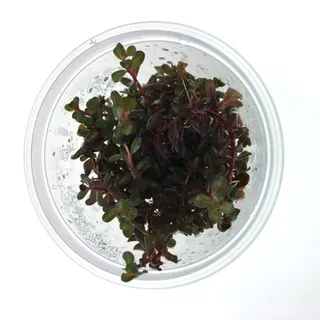
🪨 Species at a Glance
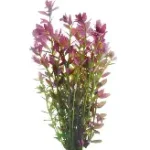
| Scientific Name | Rotala rotundifolia ‘Colorata’ (also ‘H’ra’) |
| Common Name | Rotala Colorata, Red Rotala, TC Rotala H’ra |
| Family | Lythraceae (loosestrife family) |
| Origin | Selectively bred deep-red cultivar of Southeast Asian wetland parent stock (Vietnam, Thailand, Laos) |
| Mature Height | 25-45 cm stems (trimmable to any height) |
| Leaf Form | Narrow linear leaves 2-3 cm long, 3-4 mm wide, in opposing whorls |
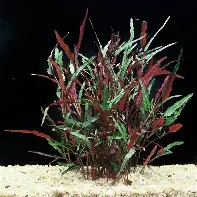
| Colour Under CO2 | Deep saturated red to crimson across upper two-thirds of stem |
| Colour Without CO2 | Olive green to bronze with only pinkish apical tips |
| Growth Rate | Fast with CO2; slow to moderate without |
| Light Requirement | High (80-150 PAR at leaf surface for full red expression) |
| CO2 Requirement | Required for saturated red colouration |
| Planting Method | Stem cuttings rooted into nutrient-rich substrate |
| Placement | Background group planting; midground if front-trimmed |
| Difficulty | Intermediate — easy to grow green, harder to grow truly red |
Getting Started: Planting
Stem
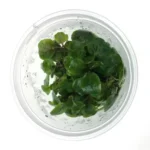
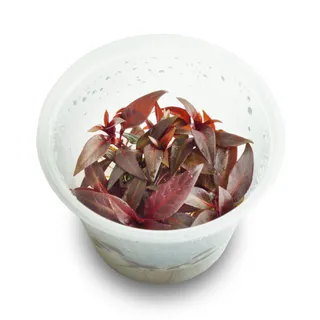
Rotala rotundifolia ‘Colorata’ is a classic stem plant in every respect, and the standard planting protocols developed over the last thirty years of Nature Aquarium practice apply to it without modification. Each tissue-cultured cup contains between twenty and forty individual plantlets, each consisting of a short section of stem two to four centimetres long bearing several whorls of small emersed-form leaves and a cluster of fine white roots emerging from the basal node. To plant, first rinse the entire cup contents gently under dechlorinated water to remove the nutrient agar from the roots, then separate the individual plantlets one at a time using thumb and forefinger or a fine pair of aquascaping tweezers. Do not attempt to plant large clumps as single units — the central stems will receive insufficient light and flow, will rot within two weeks, and will destabilise the entire planting. Each plantlet goes in individually, spaced one to one and a half centimetres from its neighbour, pushed gently into the substrate with long aquascaping tweezers held at a shallow twenty to thirty degree angle to the substrate surface. The tweezers are inserted with the plantlet pinched between the tips, pushed down into the substrate to a depth of roughly one and a half centimetres, then opened and withdrawn smoothly, leaving the plantlet buried to the first or second node with the remaining leaves above the substrate surface.
The shallow-angle technique is critical and worth practising. A plantlet pushed vertically straight down into the substrate will often float back up as the tweezers withdraw because of the buoyancy of the emersed-form leaves and the minimal root mass available to anchor it. A shallow-angle insertion traps the plantlet under a small shelf of substrate and holds it firmly in place until the plant produces fresh underwater roots, usually within four to seven days of planting. Plantlets that do float free in the first day or two must be replanted promptly — left adrift they will not re-establish and will simply decay in the water column, adding avoidable nutrient load and potentially triggering algae blooms during the vulnerable first weeks of the tank cycle. A common beginner’s mistake is to plant the tissue-culture plantlets too densely, cramming thirty plantlets into a ten by ten centimetre square in the belief that a thick carpet of red will develop immediately. In practice this density suffocates the lower internodes of every plant, the central stems rot, and the display collapses within a month. Appropriate spacing is one to one and a half centimetres between plantlets, which allows each stem to access light, CO2-enriched water, and fertilisation independently, and which produces a visibly healthier and denser-looking final grove once the stems reach trimming height at five to seven weeks.
Substrate choice has a direct bearing on the intensity of colouration that ‘Colorata’ will eventually develop. Nutrient-rich aquasoils such as ADA Amazonia, Tropica Aquarium Soil, Fluval Stratum, and Aqua Design Amano La Plata Sand over a power sand base all work well because they release a steady supply of ammonium, iron, and trace elements into the root zone, and ammonium in particular is the form of nitrogen that drives the most intense red expression in Rotala species. Inert gravel substrates such as quartz or coloured ceramic gravel can support ‘Colorata’ but require aggressive root tab supplementation with iron-rich tabs every six to eight weeks to replicate the nutrient release of a true aquasoil, and in practice the red colouration achieved on inert substrates tends to be less saturated than on aquasoil even under identical light and CO2. For the hobbyist specifically chasing the showpiece deep-red look that gives ‘Colorata’ its name, a fresh aquasoil layer at least five centimetres deep is effectively mandatory; substituting inert substrate is a compromise that reliably produces a plant more olive-bronze than crimson. The substrate depth matters because Rotala stems develop extensive adventitious root systems once established and these roots penetrate four to six centimetres into the substrate in search of the ammonium-rich interstitial water pockets that form within aquasoil; a shallow three-centimetre substrate layer physically limits root development and caps the plant’s ability to feed itself.
Light Needs & Photoperiod
HIGH LIGHT
PAR: 80-150 PAR at leaf surface
High
The defining question every aquarist grows Rotala rotundifolia ‘Colorata’ to answer is how red can I push this plant, and the primary lever controlling that answer is light intensity at the leaf surface. ‘Colorata’ develops its celebrated deep crimson to burgundy colouration as a direct response to high-intensity lighting combined with the accompanying CO2 and fertilisation regime, and the relationship between light and red expression is essentially linear across the range of aquarium-relevant intensities. At low light of twenty to forty PAR the plant survives but stays entirely green with only a pale pink blush on the apical leaves, effectively indistinguishable from wild-type Rotala rotundifolia and wasting the cultivar’s entire genetic potential. At medium light of fifty to seventy PAR colour intensifies to a warm bronze with pink apices, which is already attractive but still far from the photograph-perfect display red that gives the cultivar its name. Full saturated red expression begins at roughly eighty PAR and peaks somewhere between one hundred and twenty and one hundred and fifty PAR at the leaf surface, which in typical sixty-centimetre aquariums corresponds to a high-quality planted-tank LED such as the Chihiros Vivid 2, Twinstar S Series, or ADA Solar RGB running at eighty to one hundred percent output for a six to eight hour photoperiod. Above one hundred and fifty PAR the plant does not colour any further but algae pressure rises sharply and the practical costs begin to outweigh the diminishing colour benefit; most experienced red-stem aquarists cap their peak intensity at roughly one hundred and twenty PAR measured at substrate level to keep the algae-light-CO2 balance sustainable over months of continuous operation.
Photoperiod for ‘Colorata’ should be kept shorter and more intense rather than longer and dimmer. A classic high-tech red-plant regime runs six to seven hours of peak-intensity lighting with a ramp-up and ramp-down of twenty to thirty minutes on each side, producing a total photoperiod of seven to eight hours but with only six hours at full output. This shorter intense regime maximises net photosynthesis relative to algae growth, pushes colouration hard during the central hours of the day, and reduces the total energy budget required by the tank’s other subsystems. Running twelve-hour photoperiods in an effort to extract more growth is a classic beginner mistake with ‘Colorata’ and other red stem plants — it does not produce measurably more growth past the first eight hours and it consistently triggers cyanobacteria, green dust algae, and diatoms during the extended low-intensity morning and evening periods. The colour response of ‘Colorata’ to the combination of high intensity and short photoperiod appears within seven to ten days of switching from a green-capable regime to a red-capable regime, and mature stems can shift from olive bronze to full crimson in as little as a fortnight when conditions are right, a visible and rewarding transformation that reinforces just how directly environmental conditions drive colour expression in this cultivar.
Light spectrum also influences the perceived redness of the final display. Planted-tank LED fixtures with a high red-channel component — those marketed as plant-grown or full-spectrum RGB with adjustable channels — will not only drive more photosynthesis at the optimal wavelengths but will also render the red leaves with greater perceived saturation under the human eye, effectively doubling the visual payoff of the cultivar’s genetic red capacity. Cool-white-only LEDs, or older T5 tubes with a heavy blue-green bias, render red foliage as a muted brown-orange that underwhelms even when the plant itself is objectively just as red chemically, and hobbyists with such fixtures often report disappointing colour despite having apparently adequate intensity. Investing in a modern planted-tank LED with strong red and warm-white channels is probably the single most cost-effective upgrade for any aquarist struggling to extract the full visual potential of ‘Colorata’ and similar red stem plants.
It is also worth observing how the light gradient within a mature ‘Colorata’ grove affects colour distribution along the length of each stem. The upper leaves closest to the light source experience the highest PAR and develop the most intense red colouration, while the lower leaves receive substantially reduced light both from the distance from the fixture and from the self-shading produced by the upper canopy. The practical result is a natural vertical colour gradient from deep crimson at the apex through burgundy and bronze in the middle stem down to a bronze-green at the basal leaves, a gradient that reads visually as a rich three-dimensional colour volume rather than a flat monochrome block. Some aquascapers enhance this natural gradient deliberately by orienting the tallest part of the ‘Colorata’ planting directly under the brightest zone of the fixture and allowing the gradient to shade down toward the tank edges, producing a glowing central crimson that fades naturally into the surrounding greenery. This is the visual language of a well-composed red planting and is worth studying in photographs of award-winning layouts where the gradient effect is often the single most memorable visual feature.
Recommended Photoperiod: 6-8 hours at peak intensity (short and intense beats long and dim for red expression)
Fertilisation & CO2
CO2 INJECTION REQUIRED
Pressurised CO2 injection is required to produce the saturated deep-red colouration that defines Rotala rotundifolia ‘Colorata’. This is the single most important condition of cultivation that separates a successful red ‘Colorata’ display from a disappointing green or bronze one, and no amount of light intensity, iron dosing, or substrate quality will compensate for insufficient dissolved CO2 in the water column. The target concentration is twenty to thirty parts per million of dissolved CO2 sustained throughout the photoperiod, achieved by running a pressurised cylinder through a regulator, solenoid valve, bubble counter, and a high-quality inline diffuser or atomiser on the filter output. Drop checker indication should show a bright lime green during the main photoperiod, shifting toward yellow-green in the final hour of lights-on as CO2 accumulates slightly; a persistent blue or dark green reading indicates insufficient concentration and will visibly suppress the red expression of ‘Colorata’ within two to three days. The solenoid should open one to two hours before lights-on to prime the water column and should close thirty to sixty minutes before lights-off to avoid overnight accumulation that stresses fish.
Without pressurised CO2 the plant survives perfectly well and produces reasonable growth but the leaves colour at best to a modest olive-bronze with faint pink apices — effectively reverting to the visual character of wild-type Rotala rotundifolia and losing the entire practical advantage of having paid the premium for the ‘Colorata’ selection. Liquid carbon supplements such as Seachem Excel or Easy-Life EasyCarbo are a frequently suggested alternative but in practice they deliver only a fraction of the carbon uptake that pressurised CO2 provides and their ability to drive red colouration in this cultivar is modest at best. A tank relying entirely on liquid carbon will produce a pale pink-bronze ‘Colorata’ at best, and overdosing liquid carbon in pursuit of more red will damage the sensitive apical shoots before it drives any further colour improvement. For the aquarist not yet committed to pressurised CO2, a low-tech ‘Colorata’ is entirely viable as a green-to-bronze plant and will behave identically to wild-type rotundifolia, but the cultivar premium is effectively wasted and the hobbyist should simply buy wild-type rotundifolia instead.
The link between CO2 and red colouration in ‘Colorata’ operates through plant stress physiology: high light drives high photosynthetic demand, pressurised CO2 allows the plant to meet that demand without running into carbon limitation, and the resulting surplus of metabolic energy is channelled into anthocyanin production in the upper leaves, which is what we see as red colouration. Remove either high light or pressurised CO2 from the equation and the plant falls back to conservative green-leaf metabolism that prioritises survival over display chemistry. This is why the three cultural variables — light, CO2, and iron fertilisation — must move together as a coherent package. Running high light without CO2 produces algae; running CO2 without high light produces green growth; running both without iron produces faded bronze. Getting all three right simultaneously is the culture challenge, and getting all three right is what produces the award-winning crimson displays that aquascaping competition photographs celebrate.
Fertilisation
Fertilisation for red expression in Rotala rotundifolia ‘Colorata’ is the third leg of the culture tripod alongside high light and pressurised CO2, and iron availability is its single most important variable. The plant requires a comfortable supply of all macronutrients — nitrogen, phosphorus, potassium — dosed at moderate levels appropriate to a planted tank following an EI-lite or lean-dosing philosophy, plus a deliberately generous supply of iron delivered weekly via a dedicated iron supplement. The standard Tropica Premium or Seachem Flourish Comprehensive alone will not provide sufficient iron to push ‘Colorata’ to peak red, and a separate iron supplement such as Seachem Flourish Iron, Aquarium Plants Fertiliser Iron Gluconate, or a DIY chelated iron solution should be dosed two to three times per week at or slightly above manufacturer recommendations. The visible response to added iron is rapid — within five to seven days of starting a focused iron regime the apical growth of ‘Colorata’ will darken perceptibly from pink to crimson, and continuing the regime for three to four weeks produces the stable deep-red colouration across the upper two-thirds of each stem that is the cultivar’s showcase look. Backing off iron dosing for even a week will produce a visible fade, which is a useful diagnostic if you are trying to confirm that iron is the active lever for your particular tank chemistry.
On the macronutrient side, nitrate concentrations in the water column should be kept in the five to fifteen parts per million range measured by API liquid test. Nitrate levels above twenty to twenty-five parts per million push ‘Colorata’ toward greener foliage because the plant has ample nitrogen to build chlorophyll and does not need to rely on anthocyanin light-screening for leaf protection, which is the physiological mechanism that drives red colouration in this and most other red aquatic plants. The nitrate-starvation trick is sometimes pushed to extremes in red-plant competition tanks where nitrate is kept below five parts per million to maximise red intensity, but at this level stem plants in general and ‘Colorata’ specifically begin to show signs of nitrogen deficiency including yellowing lower leaves and reduced new growth, so the target range of five to fifteen represents the best practical compromise between maximum red and sustained healthy growth. Phosphate should run at one to two parts per million and potassium at ten to twenty parts per million, both easily achieved with a weekly dose of an EI-style macro solution or a complete all-in-one fertiliser at manufacturer-recommended rates for high-tech planted tanks.
Micronutrients other than iron should be dosed at routine rates using a comprehensive trace mix such as Tropica Specialised or APT Micro. Zinc, manganese, boron, molybdenum, and copper at normal trace levels support all metabolic functions without specific colour consequences. The one additional micronutrient worth attention for aggressive red expression is magnesium, which at six to ten parts per million supports chlorophyll function in lower leaves and keeps the stem structurally healthy while the apical leaves push their anthocyanin production — magnesium deficiency produces pale yellowing lower leaves that look unsightly against the crimson upper stems. A weekly dose of magnesium sulphate heptahydrate (Epsom salts) at roughly one quarter teaspoon per hundred litres is a cheap and effective insurance policy that most competition aquascapers apply as routine practice.
Growth Rate & Upkeep
FAST GROWTH
Under high-light, CO2-injected, well-fertilised conditions Rotala rotundifolia ‘Colorata’ is a fast-growing stem plant that can extend three to five centimetres per week during active growth, and under ideal conditions a fresh planting of tissue-culture plantlets will reach trimming height at the water surface within six to nine weeks of introduction. The growth habit is upright and stiffly vertical with a slight outward lean at the apex, and each stem produces a whorl of four to six narrow linear leaves every five to eight millimetres of stem extension during the fastest growth phase. At full growth velocity a hundred-stem planting can produce several hundred grams of wet plant mass per month, which sounds impressive but is also a reminder that fast-growing stem plants are high-maintenance by nature and require active management to stay in the designed form of the layout.
Without CO2 injection the growth rate drops by roughly sixty to seventy percent, producing stems that extend perhaps one centimetre per week and reach trimming height only after four to six months. Low-tech ‘Colorata’ is perfectly viable as a slow background plant, but the combination of slower growth with reduced red colouration means the cultivar loses most of its advantage over simpler, cheaper plants in this context and dedicated low-tech aquarists are generally better served by choosing wild-type Rotala rotundifolia for green-to-bronze contexts or by switching to naturally-slow red plants such as Bucephalandra sp. ‘Red Brownie’ for a genuine red feature without the CO2 overhead.
Trimming is the central maintenance activity for ‘Colorata’ and the quality of the trim directly determines the visual quality of the final display. The first trim is typically performed when the fastest stems reach within five to eight centimetres of the water surface, usually six to nine weeks from planting. A sharp pair of stainless steel aquascaping scissors — curved tips for contoured layouts, straight for flat hedgerows — is used to cut each stem cleanly at the designed height, producing a level hedge of evenly-cut stems that will regenerate from the cut node within four to seven days. The cut tops are removed from the tank or replanted to fill gaps in the hedge. Subsequent trims become progressively more frequent as the plant’s basal mass builds up — by the third or fourth trim the hedge may require trimming every ten to fourteen days to stay in scale. After four to five trim cycles the plant’s original planted bases typically begin to thin and lose vigour, at which point a complete replant using healthy fresh tops from the most recent trim refreshes the display and restores full growth vigour for another several months. This trim-and-replant rotation is the standard Dutch-style maintenance cycle and should be budgeted into the aquarist’s time commitment from the outset.
Trimming technique influences both the visual character of the hedge and the plant’s colour response. A single horizontal cut across all stems produces a flat regimented hedge that regrows with uniform new apices, a look favoured in Dutch-style layouts where precision and regularity are design virtues. A contoured cut following a gentle wave or slope produces a more naturalistic hedge shape favoured in Nature Aquarium contest layouts. Cutting at a slight downward angle at the cut site (rather than flat horizontal) encourages lateral branching at the first node below the cut, producing a bushier denser regrowth that fills in gaps and produces visibly more saturated colour at the surface because every stem is an actively growing apex. Experimenting with different trim geometries is part of the craft of growing ‘Colorata’ well and experienced red-plant aquarists develop a signature trim style over many tank cycles.
First trim (establishment)
6-9 weeks post-planting, when stems approach within 5-8 cm of water surface. Cut all stems to uniform 15-20 cm height with sharp stainless scissors. Remove cuttings or replant to fill gaps.
Maintenance trims
Every 10-14 days in mature planting. Level hedge at designed height using single clean horizontal cuts. Remove all floating debris and trimmings promptly to avoid nutrient spike.
Replant cycle
Every 4-6 months, pull mature stems from substrate, cut fresh 8-10 cm apical tips, discard old woody bases, replant fresh tops at original spacing. Restores growth vigour and colour saturation.
Algae wipe on lower leaves
Weekly — inspect lower leaves for GSA or BBA and remove affected leaves immediately by pinching at the node. Increase flow if lower-leaf algae is recurrent.
Dose iron supplement
2-3 times per week — Seachem Flourish Iron or equivalent at or slightly above manufacturer recommended rate. Critical for maintaining deep-red colouration week after week.
Drop checker verification
Daily visual check — confirm bright lime green during photoperiod. Dark green or blue indicates insufficient CO2 and will produce visible colour fade within 2-3 days.
Getting the Water Right
5.5–7.0
ideal 6.3
22–28 °C
ideal 25 °C
2–8 dGH
Soft to moderately soft; suppressed colour in harder water above 10 dGH
Rotala rotundifolia ‘Colorata’ develops its deepest colouration in soft, slightly acidic water that mirrors the parameters of its Southeast Asian wetland ancestry. The ideal range sits between pH 5.5 and pH 7.0 with a natural sweet spot around pH 6.3 to 6.5 that is easily achieved by combining a nutrient-rich aquasoil with pressurised CO2 injection; aquasoil alone will drop tap water by half a pH unit to a full pH unit, and the CO2 injection drops a further full pH unit during the photoperiod, producing the target acidic envelope without need for chemical adjustment or RO water. Tanks running at pH 7.5 or higher can grow ‘Colorata’ but will produce noticeably less red and more olive colouration because iron availability drops sharply in alkaline water — dissolved iron precipitates out of solution as insoluble iron hydroxide above pH 7.2 and is no longer bioavailable to the plant’s roots and leaves. This alkaline-water suppression of iron is the single most common reason aquarists on hard tap water struggle to achieve the advertised red of ‘Colorata’, and the fix is either to soften water with RO or distilled water dilution down to a carbonate hardness below five degrees KH, or to move to a more alkaline-tolerant red plant such as Ludwigia palustris ‘Super Red’ which is less sensitive to iron precipitation.
Temperature tolerance is the normal tropical range of twenty-two to twenty-eight degrees Celsius. The cultivar colours slightly more intensely at the cooler end of the range around twenty-three to twenty-four degrees, where stress chemistry shifts marginally in favour of anthocyanin production, but the difference is subtle and does not justify chilling a tank that is otherwise running healthily. Sustained temperatures above twenty-eight degrees will visibly bleach the upper leaves and shift colour from crimson toward pink-orange within a week or two; the plant is not badly stressed at these elevated temperatures but the colour intensity simply will not reach the deep saturated red the cultivar is capable of. Cool-water tanks below twenty-one degrees slow the plant’s growth rate considerably but do not harm it, and occasionally produce interesting near-purple tones on the apices that some aquascapers find even more attractive than the standard red.
Hardness should be kept in the soft to moderately soft range of two to eight degrees general hardness (dGH), and carbonate hardness should be kept below five degrees KH for optimum CO2 solubility and pH stability during injection. Harder water above ten dGH and eight KH will support survival and green growth but will visibly suppress red expression through the iron-precipitation mechanism described above. Tannin-rich water from driftwood and catappa leaves is entirely welcome and often mildly beneficial, both because the tannins bind residual alkalinity and soften water effective hardness, and because the deep tea-stained backdrop visually amplifies the perceived redness of ‘Colorata’ against the tannin-amber water. Conversely, a sterile clear-water tank with cold-toned LED lighting can make even well-coloured ‘Colorata’ look more orange than red through pure visual contrast effects. Weekly water changes of thirty to forty percent using temperature-matched and remineralised RO water, or dechlorinated soft tap water where available, maintain parameter stability and flush accumulated organics that would otherwise fuel algae competition on the slow-growing lower leaves.
Design Ideas & Placement
Background
Rotala rotundifolia ‘Colorata’ is one of the most widely used background stem plants in modern aquascaping and has featured in countless award-winning layouts at the International Aquatic Plants Layout Contest, the Aquatic Gardeners Association contest, and national competitions worldwide. Its role in the aquascape is almost always the same: a dense vertical group planting positioned at the back of the tank or in the back corners, providing a crimson chromatic backdrop against which the greens of foreground and midground plants stand out with heightened visual contrast. The complementary colour relationship between red Rotala and green Monte Carlo or dwarf hairgrass carpets is the classic chromatic axis of the Nature Aquarium style as pioneered by Takashi Amano and his disciples at ADA, and ‘Colorata’ is one of the two or three cultivars most commonly selected to deliver the red half of that chromatic pairing.
Group planting is essential and non-negotiable. A single isolated stem of ‘Colorata’ in a large tank reads as a straggly weed rather than as a feature, and even ten widely-spaced stems produce a weak thin effect. Density is what makes the plant work visually — a minimum of thirty to fifty stems planted at one-centimetre spacing across a twenty to thirty centimetre area of the background creates the solid visual mass that reads as a true red feature, and many competition aquascapes use one hundred or more stems in a single background grouping. The density produces several benefits at once: it reads as a solid colour block rather than as scattered individuals, it naturally self-shades its own lower leaves producing an architectural rising-hedge effect, and it provides enough mass that cosmetic losses of individual leaves or stems are not visible in the overall effect. The visual lesson is that red stem plants reward commitment to scale — doubling the number of stems more than doubles the visual impact because the group effect is nonlinear in density.
Background placement along the rear glass is the classical position, typically paired with a darker hardscape of Seiryu or Dragon Stone boulders in the midground and a fine-textured green carpet of Monte Carlo, dwarf hairgrass, or glossostigma in the foreground. The Rotala rises vertically behind the hardscape, drawing the eye upward and creating depth by implying that the layout continues back into space beyond the red hedge. Alternative placements include the back-left or back-right corner as a major red accent against otherwise green planting, or a pair of matching ‘Colorata’ groups at both rear corners framing a lower central focal point — a compositional strategy sometimes called the ‘flame column’ layout in aquascaping circles because the two red columns rising on either side of a central stone arrangement evoke the glow of a fireplace.
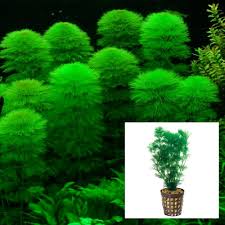
‘Colorata’ pairs particularly well with fine-leaved green background companions such as Rotala wallichii (thinner needle-form leaves), Limnophila sessiliflora (feathery ambulia), and Myriophyllum ‘Guyana’ (wispy bronze fronds) for textural contrast within the rear planting. It contrasts beautifully with broader-leafed red plants such as Alternanthera reineckii ‘Mini’ in the midground, creating a graduated red composition from the background Rotala through the midground Alternanthera down to a foreground that can be either green for high contrast or subtly red-flushed via ground cover plants like Staurogyne repens with Hygrophila pinnatifida accent leaves. Avoid pairing ‘Colorata’ with orange-toned or bronze-toned background plants such as Rotala rotundifolia ‘Orange Juice’ or Ludwigia glandulosa, which compete visually for the same warm-colour niche and dilute the impact of each individual cultivar by splitting the colour focus.
For large tanks of one hundred and twenty centimetres and above, a single mass of ‘Colorata’ can be scaled up to several hundred stems occupying the full rear wall of the tank, producing a genuinely breathtaking red backdrop against which the rest of the layout plays out like figures before a scarlet theatre curtain. In nano tanks of thirty centimetres and below, ‘Colorata’ is scaled down to a tight cluster of fifteen to twenty stems occupying a back corner and trimmed short at ten to fifteen centimetres — still effective but modest rather than dramatic. The cultivar’s versatility across tank scales, from pico tanks to showpiece one hundred and eighty-centimetre displays, is another reason it has become so thoroughly integrated into the modern aquascaping toolkit.
| Plant | Why | |
|---|---|---|
| 🌿 | Monte Carlo (Micranthemum tweediei) | Classic green carpet foreground that provides the complementary green half of the red-green chromatic pairing; shares high-light and CO2 requirements with ‘Colorata’ for a coherent high-tech layout. |
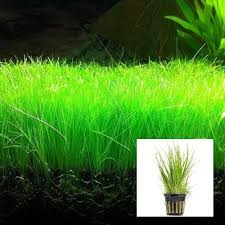
| 🌿 | Dwarf Hairgrass (Eleocharis acicularis) | Fine-textured grassy carpet that contrasts beautifully with the broader stem-plant form of ‘Colorata’ and shares identical high-light CO2-demanding cultural requirements. |
| 🌿 | Alternanthera reineckii ‘Mini’ | Broader-leaved red midground companion that creates a graduated red composition from background to midground, building visual depth through colour repetition at different scales. |
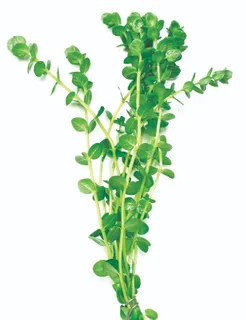
| 🌿 | Rotala wallichii | Needle-leaved green-to-pink Rotala with finer texture than ‘Colorata’; pairs beautifully as a textural contrast within the same background planting and enjoys identical cultural conditions. |
| 🌿 | Staurogyne repens | Low-growing bushy green foreground plant that fills the transition zone between carpet and background, creating depth while maintaining a clean green counterpoint to the red Rotala behind. |
| 🌿 | Bucephalandra sp. ‘Kedagang’ | Slow-growing rhizome plant for hardscape accents in the midground; its dark bronze-green foliage reads as a quiet architectural element against the vibrant red background of ‘Colorata’. |
Multiplying Your Plant
Cuttings
Propagation of Rotala rotundifolia ‘Colorata’ is accomplished entirely through stem cuttings and is among the simplest propagation methods in the aquatic plant hobby, which combined with the plant’s fast growth rate means a small starter cup of tissue-cultured plantlets can populate a full ninety-centimetre planted tank within three to four months of initial planting. The method exploits the plant’s natural ability to root from any intact node — every whorl of leaves along the stem has the dormant capacity to produce adventitious roots once detached from its parent stem and placed in contact with substrate, and this ability means that every trim cycle is also a propagation event.
The standard workflow is to trim healthy stems to the target height of the display, gather the trimmings, cut each trimming to a standardised replant length of eight to ten centimetres, strip the leaves from the bottom two to three centimetres to expose the bare nodes that will sit in the substrate, and replant the prepared cuttings using the same tweezer technique described for initial planting. Each cutting roots within four to seven days under CO2-injected high-light conditions and begins producing fresh apical growth within ten to fourteen days, resulting in a usable replant within one month of the original cutting. This cycle can be repeated indefinitely, and experienced aquascapers often use their regular trim cycles to build up stockpiles of ‘Colorata’ cuttings which they either bank in a dedicated nursery tank, trade with other local hobbyists, or sell through social media aquascaping groups to recoup part of the initial investment in tissue culture stock.
The apical tops — the fresh growth at the top of each stem — produce the fastest and most vigorous replants because they are already in active growth mode and retain their full colour expression from the outset. Middle stem sections also root successfully but take slightly longer to resume active apical growth because they must first activate a dormant lateral bud into the new apical meristem. Old woody basal sections should generally be discarded rather than replanted because they tend to stall indefinitely and rarely produce vigorous new growth; they are better composted or added to a shrimp tank where they will decompose slowly and release nutrients to shrimp-suitable plants.
A useful refinement for aquarists wanting to maximise the visual impact of a major replant is to grade the cuttings by colour intensity before replanting — the deepest-red cuttings go to the front or centre of the planting where they will catch the eye, while the less intensely coloured cuttings go to the back corners where they contribute visual mass without competing for the focal attention. This approach produces a visibly more dramatic colour gradient in the finished hedge than a random replant would achieve and is worth the extra ten minutes at the tank.
A further propagation refinement worth mentioning is the option to stage replants across two or three weekly sessions rather than doing an entire group in a single event. Staged replanting avoids the temporary visual gap that a complete uprooting inevitably creates, maintains a continuous live mass of healthy stems in the display at all times, and distributes the biological disturbance over several weeks so that the tank’s nitrogen cycle is not challenged by a sudden collapse in active plant uptake. The staged approach is especially valuable in mature high-tech tanks where sudden changes in plant mass can trigger algae blooms from the accompanying nutrient surplus, and it is the method favoured by professional maintenance services working on client display tanks where aesthetic continuity between service visits is a contractual expectation.
Quick Reference
| Scientific Name | Rotala rotundifolia ‘Colorata’ (‘H’ra’) |
| Light | High (80-150 PAR for full red) |
| CO2 | Required for saturated red (20-30 ppm) |
| Growth Rate | Fast with CO2; slow without |
| Mature Height | 25-45 cm stems (trimmable) |
| pH Range | 5.5-7.0 (ideal 6.3) |
| Temperature | 22-28 degC |
| Hardness | 2-8 dGH (soft) |
| Planting Method | Stem cuttings in nutrient-rich substrate |
| Placement | Background group planting |
| Propagation | Stem cuttings (fast, foolproof) |
| Iron Dosing | 2-3x weekly, critical for red expression |
| Difficulty | Intermediate (easy to grow green, harder to grow truly red) |
Reviews
Clear filtersThere are no reviews yet.