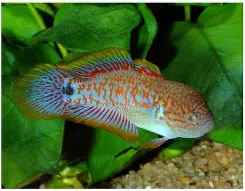
🪨 Species at a Glance
| Scientific Name | Tateurndina ocellicauda |
| Family | Eleotridae (sleeper gobies) |
| Order | Gobiiformes |
| Origin | Papua New Guinea — lowland streams and rainforest creeks |
| Adult Size | 6–7 cm (2.4–2.8 in) |
| Lifespan | 4–5 years with good care |
| pH Range | 6.5–7.8 |
| Temperature | 22–26 °C (72–79 °F) — runs cooler than most tropicals |
| Hardness (dGH) | 5–15 |
| Diet | Micropredator — live/frozen micro foods; often refuses flake |
| Minimum Tank Size | 60 L (16 gal) for a pair |
| Care Level | Beginner-intermediate |
| Temperament | Peaceful; kept as pair or trio, not a school |
| Breeding | Cave spawner — one of the easiest egg-layers for hobbyists |
| Tank Position | Lower-mid, hovering near cover |
Where the Name Comes From
The scientific name *Tateurndina ocellicauda* is an almost poetic little construction. The genus honours George Henry Hamilton Tate, the Australian-American mammalogist whose collecting expeditions through New Guinea in the 1930s brought back a trove of freshwater fish specimens — *Tateurndina* literally means ‘Tate’s small fish’. The species name splits into two Latin roots: *ocellus*, meaning a small eye or eye-like marking, and *cauda*, meaning tail. Put together, *ocellicauda* translates as ‘eye-spotted tail’, a precise reference to the prominent dark ocellus that sits at the base of the caudal fin on both males and females. This false eye-spot likely functions as a predator decoy in the wild, encouraging a strike at the expendable tail rather than the vulnerable head — a survival trick shared with many other tropical fish species, from butterflyfish on coral reefs to some cichlids in the Amazon.
The common name ‘peacock gudgeon’ is pure aquarist marketing, but it earns its keep. Peacocks are famous for two things: iridescent blue-green plumage and eye-shaped markings on their tail feathers. The peacock gudgeon delivers both. Its body, in good condition and subdued light, shimmers with a pale turquoise-blue sheen that catches the light the way peacock feathers do, and of course the ocellus on the tail completes the visual pun. ‘Gudgeon’ is a broader English fishing term for small bottom-oriented freshwater fish — historically applied to European *Gobio* species favoured by 19th-century match anglers — that has been stretched to cover these New Guinean sleeper gobies, a distant but ecologically similar group. In the older German and Czech hobby literature you may also see this species listed as the ‘Pfauenaugen-Schläfergrundel’ (peacock-eye sleeper goby) — longer, more literal, and arguably more accurate.
Taxonomically, *T. ocellicauda* sits in the family Eleotridae, the sleeper gobies, distinguished from true gobies (Gobiidae) by having two separate, non-fused pelvic fins. True gobies use those fused pelvic fins as a suction cup to cling to rocks in strong currents; sleeper gobies do not need that trick because they live in quieter water. The ‘sleeper’ label refers to their habit of resting motionless on the substrate or perching in caves, watching — a behaviour you will see in your own tank every evening as they claim favourite spots and defend them politely but firmly. *Tateurndina* is actually a monotypic genus: *T. ocellicauda* is the only species currently placed in it, which is part of the reason it looks and behaves so unlike anything else in the hobby. Its closest relatives are other New Guinean and Australian eleotrids like the empire gudgeon and the purple-spotted gudgeon, species that are larger, hardier, and far less colourful — peacock gudgeons are the small, pretty, peaceful outlier of an otherwise utilitarian family.
In its native range, *T. ocellicauda* occupies a fairly restricted set of lowland freshwater habitats on the eastern side of Papua New Guinea — principally clear, slow-moving rainforest creeks, stream pools, and overflow ponds along the coastal lowlands. It is not found in fast torrents, in coastal brackish water, or in highland streams above about 100 metres elevation. Populations are reasonably stable in the wild, and virtually all specimens in the Australian hobby are captive-bred rather than wild-caught, which is both ethically preferable and practically useful: tank-bred peacock gudgeons adapt more easily to aquarium water chemistry and community conditions than wild-caught fish would.
Setting Up Your Aquarium
Set up a peacock gudgeon tank and you will end up with one of the most atmospheric nano aquariums possible — dim, green, and full of quiet activity around caves. The minimum practical tank for a single bonded pair is 60 litres (roughly 60 × 30 × 35 cm). A 90-litre tank opens up room for a trio or for adding a small cleanup crew and a handful of other small community fish. A 120-litre tank comfortably hosts a small community of two or three peacock gudgeons plus a single school of small tetras or rasboras. Footprint matters more than depth: peacock gudgeons hover in the lower and middle zones of the tank and patrol a small horizontal territory, so a longer shallower tank is preferable to a tall narrow one. A tall cube of the same volume will leave them feeling cramped horizontally even if the numbers on the side of the box look right.
Substrate should be dark and fine — black sand (pool filter sand works well and is cheap), dark aquasoil, or a dark inert gravel all work and make the blue and red markings pop. Bare bottoms and bright-white gravel will leave your fish washed out and nervous. Depth of substrate matters less than colour; 2–3 cm is plenty for rooted plants and looks natural. If you are running aquasoil for planted-tank dosing purposes, it will lower the pH slightly and soften the water over the first few months, which peacock gudgeons appreciate.
The tank needs plenty of cover overhead to diffuse the light: a thick cover of floating plants (Amazon frogbit, red root floater, or a mat of salvinia) dramatically reduces stress and triggers natural out-and-about behaviour. Under full open lighting, peacock gudgeons tend to hide in caves all day and only emerge at dusk; under dappled light filtered by floating plants, they patrol openly and display their colours from mid-morning onward. Plant densely under the cover — Cryptocoryne wendtii and parva in the midground, Anubias nana on driftwood, java fern on rocks, small Bucephalandra on stones, and stem plants like Hygrophila or Ludwigia along the back give the tank the layered, shaded ‘rainforest creek’ feel peacock gudgeons respond to. Avoid very demanding carpeting plants that require blasting light and heavy CO2; those conditions work against the dim, gentle tank peacock gudgeons want.
Caves are non-negotiable. Every adult male will claim one, and the female needs somewhere to spawn. Provide at least one cave per fish, ideally more. Small terracotta plant-pot shards, purpose-made ceramic breeding caves (sold for apistogrammas and small catfish — the Apisto-Caves brand and equivalents work perfectly), short lengths of PVC pipe about 2.5 cm in diameter with one end partially closed, and natural cave-like arrangements of slate and Seiryu stone all work well. Orient cave entrances slightly downward or sideways so fine debris does not settle inside; this matters because eggs will be laid on the cave ceiling and need to stay clean. If you are using PVC, sand down the cut edges so they are smooth and non-reflective. Bury or hide the caves partially among plants and wood — peacock gudgeons prefer caves that feel secluded, not caves sitting openly in the centre of the tank.
Finish with a layer of Indian almond leaves and alder cones on the substrate — they tint the water slightly, release gentle tannins, encourage microfauna growth that wild-imported gudgeons appreciate, and complete the biotope appearance. Replace leaves every four to six weeks as they decompose; the slow release of tannins helps keep the tank slightly acidic and provides mild antibacterial support. A single piece of driftwood (spiderwood, Malaysian driftwood, or a small mopani branch) anchors the scape and gives the gudgeons a vertical line to patrol along.
Tank
Minimum 60 L for a pair; 90 L for a trio or small community
Filter
Sponge filter or nano HOB with baffled/spray-bar output — gentle flow, no blasting currents
Heater
25–50 W adjustable heater set to 24 °C. In hot climates, a small USB fan for summer cooling is more useful than a bigger heater
Lighting
Low to moderate intensity; dimmable LED ideal. Floating plant cover is essential to diffuse overhead light
Substrate
Fine dark sand or dark aquasoil. Avoid bright gravel or bare glass bottoms
Caves
Minimum one per fish: terracotta shards, ceramic breeding caves, short PVC, or stacked slate. Entrances angled sideways or down
Plants
Dense midground (crypts, anubias), epiphytes on wood (java fern, Bucephalandra), floating cover (frogbit, salvinia)
Botanicals
Indian almond leaves, alder cones, small pieces of spiderwood — for tannins, foraging surface, and a natural look
Ideal Water Conditions
6.5–7.8
ideal 7.2
22–26 °C
ideal 24 °C
5–15 dGH
Neutral, moderately soft to moderately hard
Peacock gudgeons come from lowland rainforest creeks in eastern Papua New Guinea, where the water drifts slowly through overhanging vegetation and leaf litter. These creeks are not blackwater in the Amazonian sense — pH tends to sit near neutral, between 6.8 and 7.4, and hardness is moderate rather than extreme. Field measurements from the Milne Bay and Central Province streams where *T. ocellicauda* is most commonly collected show total dissolved solids in the 80–150 ppm range and conductivity around 150–250 µS/cm. That means peacock gudgeons are forgiving of ordinary Australian tap water in most cities, provided the pH is not wildly alkaline and hardness is not at reef-tank levels. They adapt comfortably to a range of pH 6.5 to 7.8 and hardness of 5 to 15 dGH, which covers most Sydney, Melbourne, and Brisbane tap water after basic conditioning.
The parameter most keepers get wrong with peacock gudgeons is temperature. They are often sold as ‘tropical fish’ and kept at 27–28 °C alongside discus or German blue rams, and this is a mistake. Peacock gudgeons are best thought of as subtropical or cool-tropical: their natural streams run between 22 and 25 °C year-round, and prolonged exposure above 27 °C shortens their lifespan significantly, increases susceptibility to bacterial infections, and suppresses breeding. Aim for 24 °C as your steady-state tank temperature. In a Melbourne or Sydney winter you may not even need a heater set above 22 °C; in a Brisbane or northern-Australian summer you may need a small fan across the open top to keep the tank from climbing past 27 °C, or a room air-conditioner running on the worst days. This cool-water preference is the main reason peacock gudgeons should not be kept in a shared tank with true tropicals like discus, wild-type German blue rams, or most loricariid plecos that prefer 28–30 °C.
Water chemistry stability, as always, matters more than hitting a perfect number. A steady pH of 7.5 is far better for peacock gudgeons than a pH that swings between 6.8 and 7.6 with water changes. Do gentle weekly water changes of 20–25%, temperature-matched within one degree, and avoid sudden parameter shifts from overzealous CO2 injection or heavy botanical additions. If you are running CO2 injection on a planted tank housing peacock gudgeons, keep the diffusion steady through a solenoid on a timer rather than pumping heavily during the day — big pH swings from CO2 are one of the common causes of mysterious gudgeon deaths in otherwise well-run planted tanks.
Nitrogen compounds deserve special mention. Peacock gudgeons are moderately sensitive to ammonia and nitrite — not as fragile as corydoras or loaches, but not as tolerant as livebearers either. Never add them to a tank that is not fully cycled; expect rapid colour loss and possible death if ammonia rises above 0.25 ppm or nitrite above 0.5 ppm. Long-term nitrate should stay under 20 ppm for best breeding response; they tolerate up to about 40 ppm but will stop spawning and show reduced colouration at those levels. A densely planted tank with good filtration and weekly water changes easily achieves those targets without any special effort.
Feeding Guide
Peacock gudgeons are small, ambush-oriented micropredators. In the wild they patrol slow patches of creek, snapping up mosquito larvae, small crustaceans, aquatic insect nymphs, copepods, ostracods, and the occasional worm or fly that falls onto the water surface. Their mouths are slightly upturned and their eyes are positioned for forward-and-upward vision — both adaptations for spotting small moving prey just above them and striking upward at it. In the aquarium they retain those preferences strongly, and this is the single most common reason keepers struggle with the species: they are not reliable flake eaters. Many peacock gudgeons will ignore dry flake food entirely, treat crushed flake as inedible debris, and some will accept sinking micro-pellets only grudgingly. If you try to keep them on a flake-only diet, they will slowly lose condition, stop breeding, and become more prone to bacterial skin infections and fin erosion.
The fix is simple: build the diet around live and frozen foods, with dry food as a supplementary backup rather than the staple. The core menu should include frozen daphnia, frozen or live baby brine shrimp, frozen bloodworm, frozen cyclops, and — when available — small live blackworm (grindal worms), live whiteworm, or live microworms. Daphnia and baby brine shrimp are ideal everyday foods: small enough for the gudgeons’ mouths, high in roughage and protein, and easy to source frozen in Australian aquarium shops (Fish Fuel Co, San Francisco Bay Brand, and Hikari frozen cubes are all widely stocked). Bloodworm is excellent for conditioning breeding pairs but should not be the only protein source — it is rich and can cause digestive issues if fed exclusively. Rotate daily rather than feeding the same thing every day: a weekly rotation through daphnia, baby brine, bloodworm, and cyclops keeps nutrition varied and mimics the changing menu of a wild stream.
For a dry-food backup on days when frozen runs low, try premium slow-sinking micro-pellets (Hikari micro pellets, Fluval Bug Bites micro formula, Tetra Colour Bits, or similar). Some individual peacock gudgeons will eat these readily, others will not. Do not take rejection personally; this is a species where dietary preferences are strongly individual. A useful trick is to soak dry food briefly in garlic extract (Seachem Garlic Guard or equivalent) before feeding — the smell often triggers a feeding response in fish that would otherwise ignore the pellets.
Peacock gudgeons are deliberate, slow eaters compared to tetras or danios. They watch food drift down, make short darts, and often ignore a single flake. Feed small amounts twice a day rather than one large meal, and spread food across the tank surface so every fish gets a chance. If you keep them with faster, greedier tank mates like tetras or rasboras, target-feed the gudgeons with a pipette or turkey baster — dropping frozen food directly in front of their caves guarantees they eat. A healthy peacock gudgeon has a full but not bulging belly and maintains the pale yellow belly wash; skinny individuals with sunken stomachs are a sign that faster tank mates are intercepting food and the gudgeons are going hungry. In a community tank, feeding the tetras at the surface with a flake sprinkle while simultaneously dropping frozen food in the gudgeon zone is a reliable way to give everyone a fair share.
One under-discussed benefit of live cultures: breeding a small daphnia or whiteworm culture at home is both cheaper than buying frozen food and genuinely better for the gudgeons. A 5-litre bucket of green water with a daphnia culture sitting on a sunny balcony produces more daphnia than you can use, and the gudgeons respond to live daphnia with a visible increase in colour and activity within a week. If you are serious about breeding peacock gudgeons, a small live-food culture setup is the single highest-leverage investment you can make.
Colour Forms & Morphs
🦚 Wild Type
The standard and almost exclusive form in the hobby: turquoise-blue body, five to seven vertical red bars along the flanks, yellow wash across the belly and face, and the diagnostic black ocellus at the tail base.
🤍 Albino (rare)
Occasionally appears from captive-bred lines: lacks dark pigment, producing a pale cream body with pink-red bars and washed-out yellow. Rare, delicate, and commands a premium — most stores will never stock it.
Unlike apistogrammas, bettas, or guppies, the peacock gudgeon has not been extensively line-bred for colour morphs — and frankly, it did not need to be. The wild type is one of the most perfectly pigmented small fish in the freshwater hobby, combining structural blue iridescence with carotenoid-based reds and yellows to hit three complementary colour families on a single six-centimetre canvas. Virtually every peacock gudgeon you will see in Australian shops is the wild type, typically captive-bred in Indonesia, Thailand, or Czech hobbyist breeding rooms rather than wild-caught from PNG. A handful of European breeders have been working on a longer-finned line for about a decade, but it remains vanishingly rare in Australia, and most specialists argue that the longer fins actually dilute rather than enhance the species’ compact, stocky profile.
The biology behind the colour is worth a moment. The turquoise-blue sheen is structural — it comes from iridophores, microscopic stacks of guanine crystals in the skin that interfere with light at specific wavelengths. Because it is structural rather than pigment-based, this blue does not fade with age or with poor diet, though it does appear duller in stressed or sick fish because the crystals sit flatter against the skin. The red bars and yellow bellies, in contrast, are carotenoid-based pigments that the fish acquires entirely from its diet. A peacock gudgeon on a varied live and frozen diet rich in daphnia, baby brine shrimp, and chopped bloodworm will redden within weeks; one kept on bland flake alone will gradually wash out to a pale peach. Supplementing the diet with astaxanthin-enriched pellets (common in colour-enhancing micro-pellets) produces measurable gains in red saturation within two to three weeks.
Colour intensity also depends strongly on condition and environment. A peacock gudgeon kept in a bright, bare tank with hard water will show washed-out blue and muddy red bars even on the best diet. The same fish moved to a dimly lit, densely planted tank with dark substrate, botanicals in the water, and a live/frozen diet will colour up within two to three weeks — the blue sheen deepens, the red bars sharpen to almost crimson, and the yellow belly on gravid females becomes luminous. This is a species where small upgrades to the tank environment translate directly into visible colour gains, and it is one of the reasons peacock gudgeon keepers tend to run the same kind of densely-planted, dimly-lit, botanical-rich tank regardless of what else they are keeping.
Telling Males from Females
Peacock gudgeons are one of the easiest small tropical species to sex confidently — something that cannot be said for most tetras, rasboras, or corydoras, where you are squinting at belly shape and hoping. Once the fish are mature (around four to five months old), the differences are obvious at a glance. Males are noticeably bigger, with a deeper body, more intense cheek striping, and — most distinctively — a nuchal hump, a rounded fatty bulge on the forehead that develops gradually as they mature and as they reach breeding condition. The hump is not a bony structure but a fatty deposit that enlarges in response to good nutrition and breeding hormones; a well-fed adult male in a low-stress tank will develop a very visible hump, while a stressed or underfed male may show only a slight forehead curve. Females stay slim, keep a smooth forehead profile, and carry a bright yellow vertical bar on the belly just in front of the anal fin that intensifies dramatically when they are carrying eggs.
A second behavioural cue is charming and unusual for the hobby: in peacock gudgeons, the female is the active courter. While the male sets up and defends a cave, it is the gravid female who approaches him, displays her swollen yellow belly band, and performs a swaying, body-curling dance in front of the cave entrance. This role reversal — female-initiated courtship, male parental care — is reliable and entertaining to watch. If you see a peacock gudgeon dancing in front of another one, the dancer is almost certainly female and very close to spawning. It is one of the visual markers most experienced keepers use to predict a spawn 24–48 hours before it happens, so they can have a separate rearing tank ready.
Juvenile peacock gudgeons (under about three months) are notoriously difficult to sex — at that age all fish look like small, slim, relatively pale females. Buying juveniles from a shop and hoping to get a pair is a gamble: you may end up with six of the same sex, which defeats the purpose. The safer approach is to buy adults that are clearly sexed, or to buy a known bonded pair from a breeder who has already sorted them. A reputable aquarium shop will usually have at least one obvious male (hump visible, deeper body, stronger head stripes) and will be willing to pair him with a clear female (yellow belly band visible, smaller body, smooth forehead) before you take them home.
For a mixed-sex group, a single pair is ideal in a 60-litre tank. A trio of one male and two females works well in 90 litres or more, giving the male two partners to alternate with and reducing any pressure on a single gravid female. Avoid keeping two adult males together in anything under 120 litres with heavy planting and multiple caves — they will not usually seriously injure each other, but the subordinate male will be chased constantly, will hide in the back corner, and will not colour up properly. In larger tanks with clearly separated cave zones at opposite ends, two males can coexist peacefully, each maintaining his own territory and pretending the other does not exist.
| Feature | Male | Female |
|---|---|---|
| Size | Larger, 6.5–7 cm at maturity | Smaller, typically 5–6 cm |
| Body Shape | Slimmer, more elongated profile | Rounder belly, especially when gravid |
| Forehead / Head | Develops a distinct nuchal hump (fatty forehead bump) with age | Smooth, flat forehead — no hump at any age |
| Head Markings | Red stripe patterns on the cheeks and gill plates are more intense and extensive | Head markings present but fainter, less saturated |
| Vertical Yellow Stripes | Strong, saturated vertical yellow bars along the body flanks | Yellow tone mostly on the belly, not as vertical-striped on the flanks |
| Belly Colour | Belly yellow, uniform | Distinct bright-yellow vertical band on the belly, just forward of the anal fin — this is the most reliable single cue |
| Gravid Signs | No change | Yellow belly band expands dramatically and the abdomen visibly swells when carrying eggs |
| Behaviour | Claims and defends a cave; flares fins at other males and courts females | Approaches and inspects male caves; does the active courting in peacock gudgeon pairs |
Breeding Guide
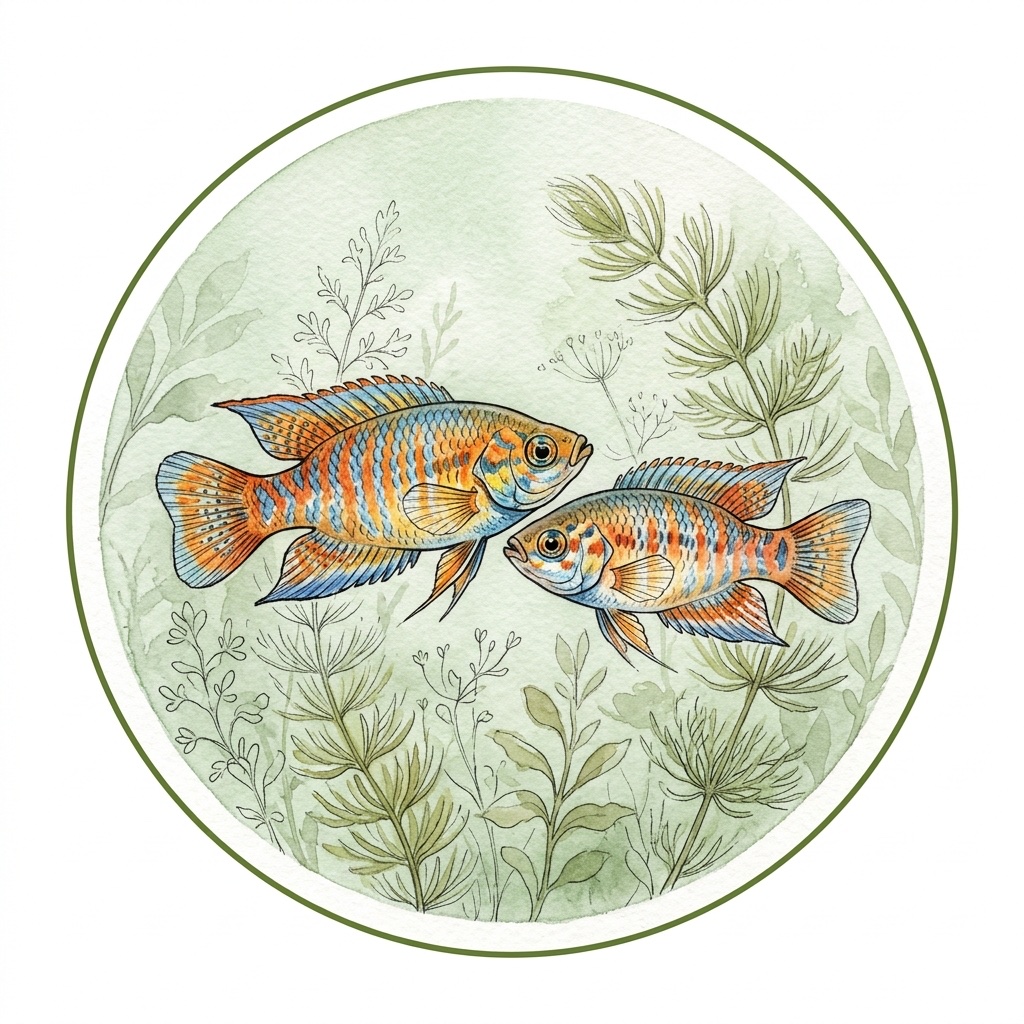
Week -2 to -1
Conditioning
Feed the pair heavily on live and frozen micro foods
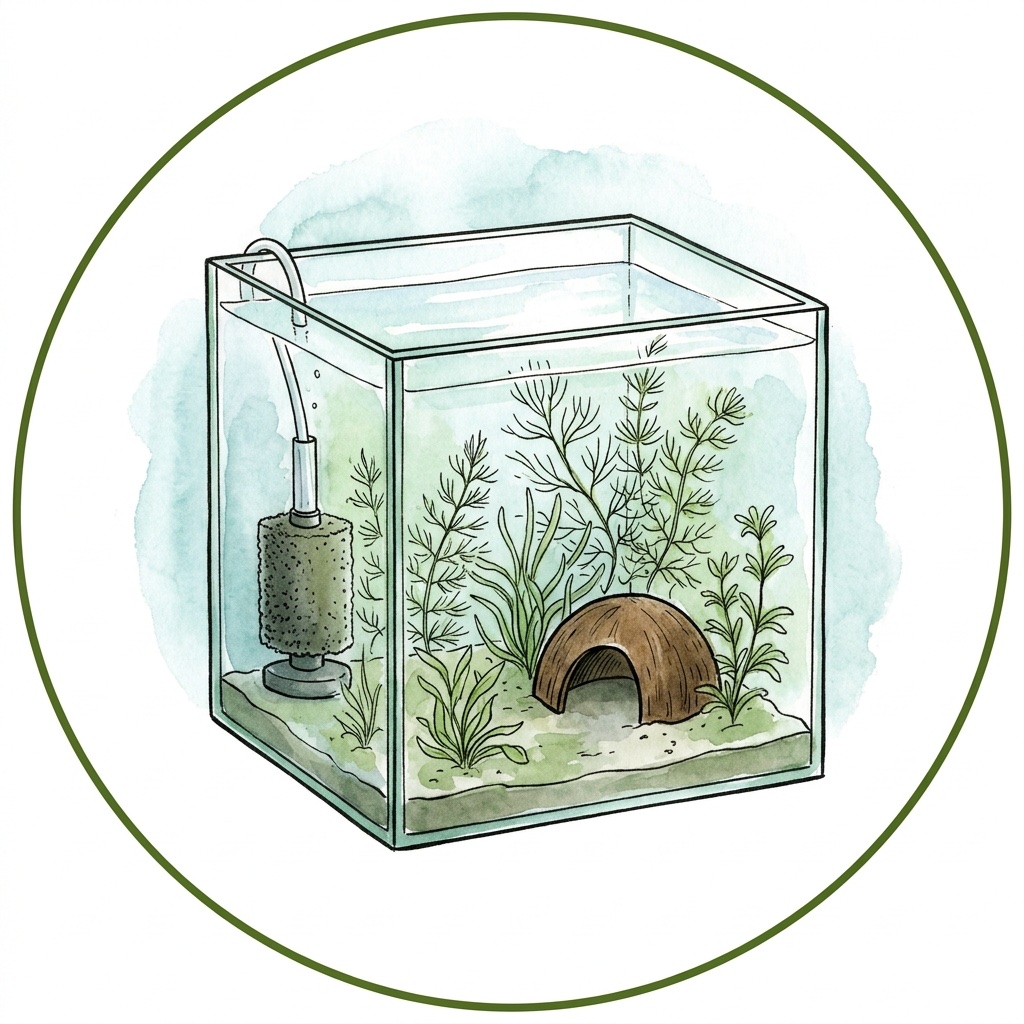
Day 0
Cave Claim & Courtship
Male claims a cave, female performs the courtship dance
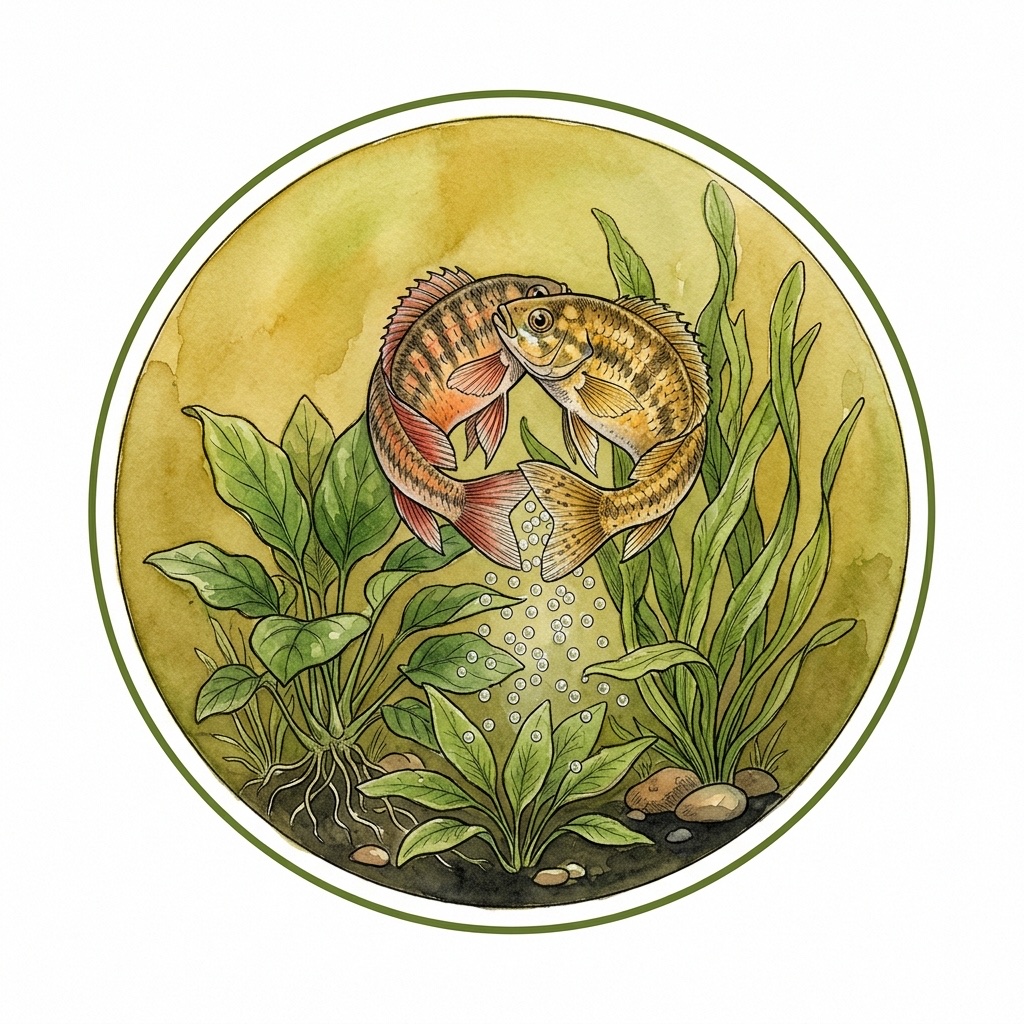
Day 1
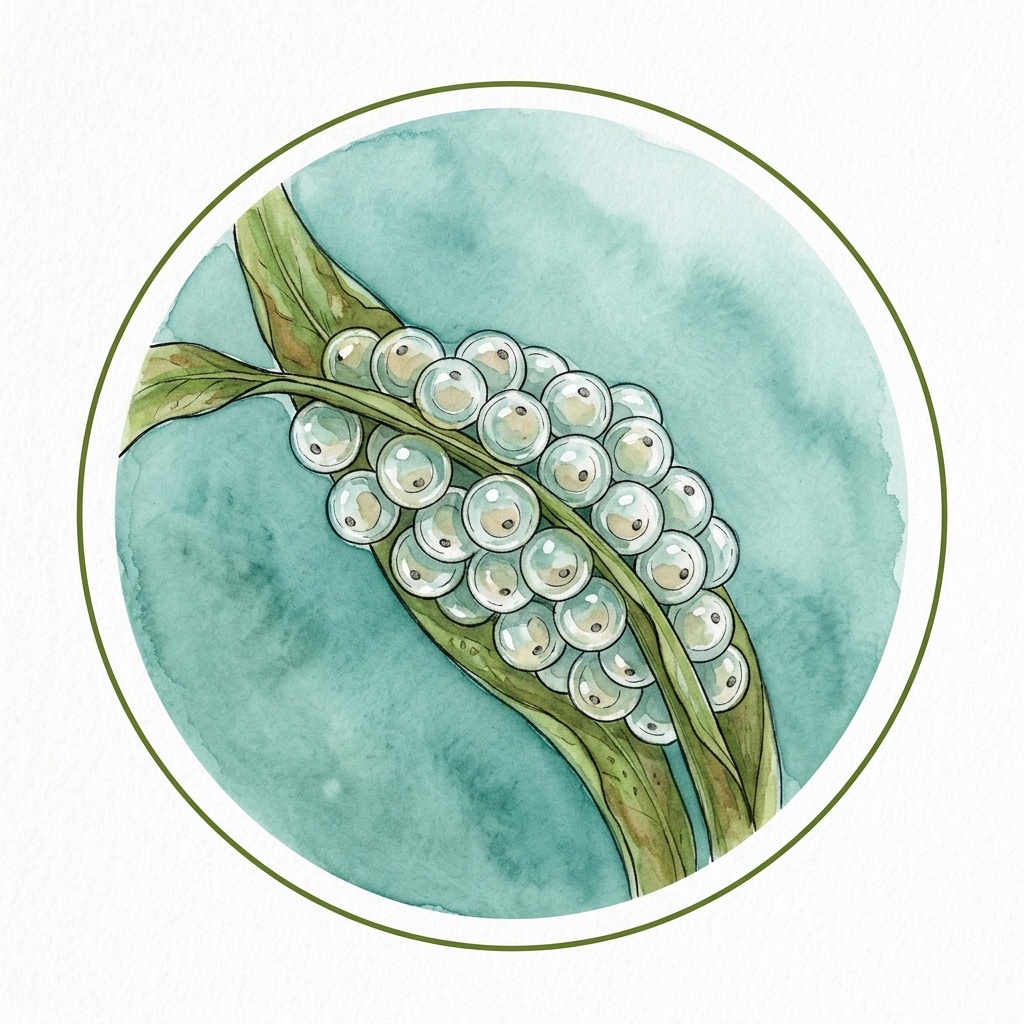
Spawning in the Cave
50–100 adhesive eggs laid on the cave ceiling
Day 2 – 9
Male Guards & Fans Eggs
Male stays in the cave, fanning the eggs with his pectoral fins
Day 9 – 12
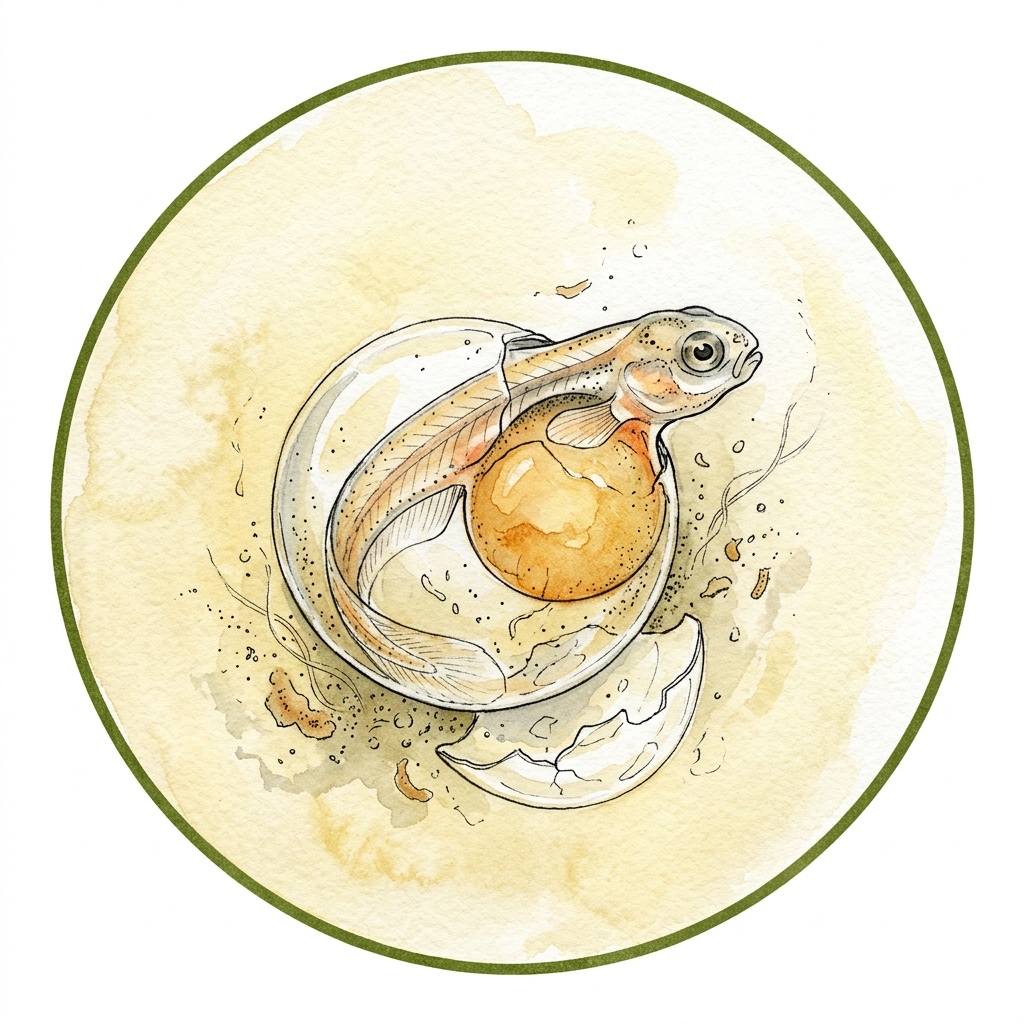
Hatching
Fry emerge from eggs but stay in the cave initially
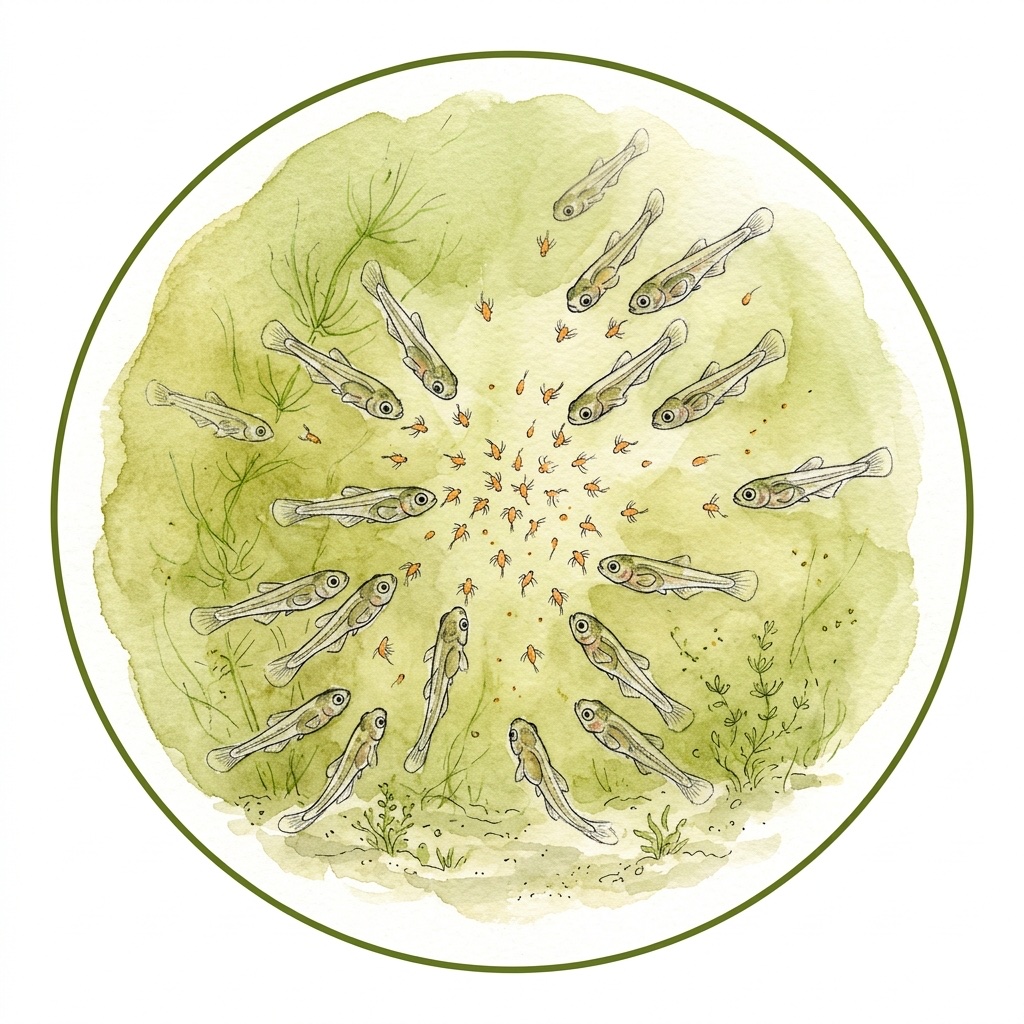
Day 12 – 28
Free-Swimming Fry & First Foods
Feed infusoria, then baby brine shrimp
Conditioning
Peacock gudgeons condition quickly. A bonded pair fed twice daily on a rotation of frozen daphnia, baby brine shrimp, bloodworm, and occasional live blackworm will be in breeding condition within a week or two. The female’s belly will round out visibly and her yellow ventral stripe will intensify into a broad, almost glowing yellow patch extending forward from the anal fin. Do a slightly larger than usual water change (about 30%) with temperature-matched water at 24 °C to simulate a rainfall event — this often triggers the pair to start cave-hunting.
Cave Claim & Courtship
A mature male will pick a cave (usually the smallest one he can comfortably fit in) and begin cleaning its inner walls with his mouth. He will chase other males away from it but allow the gravid female to approach. The female initiates courtship — this is unusual and part of what makes the species charming — by swimming in front of the cave entrance, flaring her fins, and performing a slow S-curve swaying dance that shows off her yellow belly band. The male responds by entering the cave; if the pair is compatible, the female follows him inside.
Spawning in the Cave
Spawning takes place inside the cave, typically lasting one to two hours. The female turns belly-upward and lays rows of small, elongated adhesive eggs along the cave ceiling; the male follows and fertilises each row. A typical spawn produces 50 to 100 eggs, occasionally more from a well-conditioned older female. Once spawning ends the female leaves the cave and the male takes over. From this point, her role is finished — she should be well-fed and given space to recover.
Male Guards & Fans Eggs
The male becomes a full-time dad. He stays in or hovering just outside the cave almost continuously, using his pectoral fins to fan fresh water across the egg clutch to keep it oxygenated and free of debris. He will occasionally mouth the eggs gently to clean them and remove any that have fungused. He barely eats during this period, so do not worry if he looks thin. Keep other fish away from the cave entrance — at this stage the male will chase anything that approaches, including the female. Temperature 24 °C gives reliable development without stress.
Hatching
After 9 to 12 days (closer to 12 at cooler temperatures, 9 at warmer), the eggs hatch. The larvae are tiny and transparent, clinging to the cave walls and absorbing their yolk sacs over the next day or two. The male continues to guard the cave. At this point, many breeders choose to gently remove the cave with fry to a separate rearing tank with matching water, because the fry are extremely small and will be eaten by most tank mates — including, eventually, the parents themselves as their parental instinct fades.
Free-Swimming Fry & First Foods
Free-swimming fry are minuscule — smaller than newly-hatched tetra fry are — and need genuinely tiny first foods. Start with infusoria, commercial liquid fry food, or vinegar eels for the first four to five days. Around day 5 to 7 post-swim, they will be large enough to accept freshly hatched baby brine shrimp, which should then become the daily staple. Growth is steady but not fast; expect clear peacock gudgeon markings to appear around six to eight weeks, and sellable juvenile size around three months. Small frequent water changes (10% every two to three days) on the rearing tank keep water quality high without stressing fry.
Compatible Species
Peacock gudgeons are genuinely peaceful — they are not tetras that flit constantly, not cichlids that patrol aggressively, and not barbs that nip. They hover near cover, make short patrols around a cave, and generally ignore anything smaller than they are that does not invade their immediate territory. That makes them an excellent centrepiece-adjacent species for a small planted community: add one pair or trio of gudgeons, one school of small tetras or rasboras in the midwater, a small corydoras or otocinclus crew on the bottom, and the tank is effectively complete. The gudgeons become the quiet visual focus — the fish everyone leans in to watch — while the midwater schoolers provide movement and the bottom-dwellers handle cleanup.
Three rules guide tank-mate choice. First, size: nothing in the tank should have a mouth larger than a peacock gudgeon’s body (rules out angelfish, larger gouramis, most cichlids, and larger loaches such as clown loaches). Second, temperament: no fin-nippers, no boisterous chasers, no mouth-sparring cichlids (rules out tiger barbs, serpae tetras, most new-world cichlids, and large or aggressive rainbowfish). Third, temperature: peacock gudgeons want 22–26 °C, which rules out hot-water species like discus, wild rams, and many plecostomus species. Within those three filters, peacock gudgeons get along with just about everything small and peaceful, including dwarf shrimp as adults — expect shrimp fry and very small juveniles to be picked off, which is normal and fine for a self-regulating colony; the adults will be left alone once they exceed about a centimetre.
A few specific combinations work particularly well. Neon or ember tetras in a school of 10+ in the midwater give excellent contrast against gudgeon blue and occupy a completely non-overlapping niche. Galaxy rasboras (celestial pearl danios) match the gudgeons’ preference for cooler water and complement them visually. Pygmy corydoras add hovering midwater activity that larger corydoras species do not provide, and stay small enough to never compete for cave space. Kuhli loaches also work in a planted gudgeon tank as long as the tank has enough floor space and the kuhlis are not forced to compete for the same caves.
The main combinations to avoid beyond the obvious aggressive species: other territorial cave-spawners in small tanks. Two male peacock gudgeons can share a 120-litre+ tank with multiple caves and heavy visual barriers, but in anything smaller the subordinate male will be constantly stressed. Similarly, mixing peacock gudgeons with small apistogrammas in a 60–90-litre tank often produces cave-competition conflicts, because both species want the same caves for the same reason. If you want both species in the same tank, go to at least 150 litres and provide clearly separated cave zones at opposite ends.
A final note on numbers: peacock gudgeons are not schoolers. Do not buy six of them expecting a shoal. Buy one bonded pair (one male, one female) for a 60-litre tank, or a trio (one male, two females) for a 90-litre tank, or — the advanced option — two males with at least three females in a 150-litre tank with multiple caves and heavy planting. A single peacock gudgeon is perfectly viable and will settle in well, but it misses out on the courtship and cave-defence behaviour that makes the species entertaining; a pair is almost always better than one. Buying them in pairs from a reputable source (captive-bred Australian or imported stock from a shop that sexed them honestly) saves you the frustration of buying six juveniles and ending up with six males.
| Species | Why | |
|---|---|---|
| ✅ | Neon Tetra | Mid-water schoolers that occupy a different zone and temperature overlap; peaceful and small enough to be ignored by peacock gudgeons |
| ✅ | Ember Tetra | Small orange schooling tetra; peaceful, similar soft-water preference, and the colour contrast against gudgeon blue is striking |
| ✅ | Pygmy Corydoras | Tiny bottom-dwelling schoolers that occupy the substrate without competing for the gudgeons’ cave territory |
| ✅ | Corydoras (Sterbai) | Tolerates similar temperatures, peaceful bottom presence, cleans up any sunken food the gudgeons miss |
| ✅ | Otocinclus | Gentle algae-grazers that stick to leaves and glass; no territorial or food overlap with peacock gudgeons |
| ✅ | Galaxy Rasbora | Nano-scale, peaceful, similar temperature range, and the spotted pattern plays nicely against gudgeon colouration |
| ✅ | Amano Shrimp | Adult amanos are too large for gudgeons to harass and provide excellent algae control; fully safe once past juvenile size |
| ✅ | Cherry Shrimp (adults) | Adult cherries are usually ignored in heavily-planted tanks; expect shrimp fry to be eaten, which is normal and keeps the colony in balance |
| ❌ | Angelfish | Too large and prefer warmer water; adult angelfish can and will pick off peacock gudgeons |
| ❌ | Tiger Barb | Notorious fin-nippers that stress slow-moving gudgeons and cause chronic hiding |
| ❌ | Cichlids (Jack Dempsey, Oscar, African Rift cichlids) | Too aggressive, too large, and in the case of African cichlids require incompatible hard alkaline water |
| ❌ | Large Gouramis (Giant, Kissing) | Too large, too boisterous, and surface-dominant in a way that stresses peacock gudgeons out of their caves |
| ❌ | Discus | Require 28–30 °C tank temperatures, which is too warm for peacock gudgeons and shortens their lifespan |
Quick Reference
| Scientific Name | Tateurndina ocellicauda |
| Adult Size | 6–7 cm |
| Lifespan | 4–5 years |
| pH | 6.5–7.8 (ideal 7.2) |
| Temperature | 22–26 °C (ideal 24 °C) — runs cool |
| Hardness | 5–15 dGH |
| Min Tank Size | 60 L for a pair |
| Group Size | Pair or trio — NOT a schooling fish |
| Diet | Micropredator — frozen/live micro foods; often refuses flake |
| Care Level | Beginner-intermediate |
| Temperament | Peaceful; territorial around caves only |
| Tank Position | Lower-mid, near cover |
| Breeding | Cave spawner — one of the easiest egg-layers |
| Price (AUD) | $38 |
Related Products

Reviews
Clear filtersThere are no reviews yet.