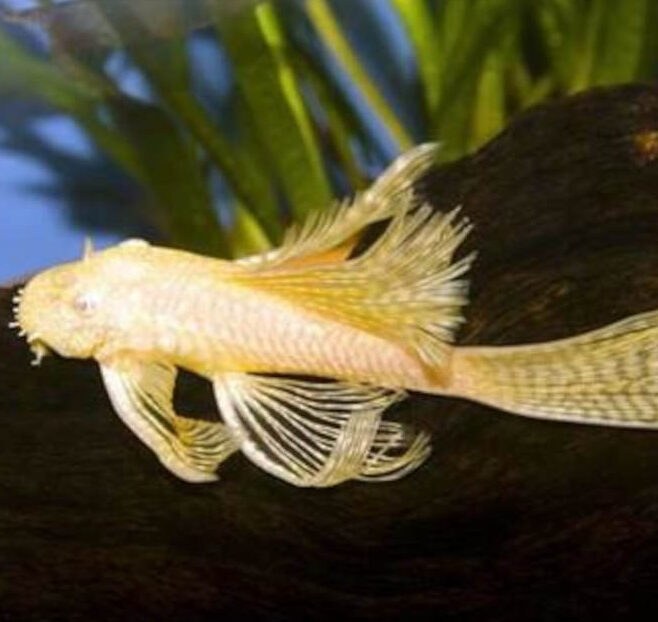
🪨 Species at a Glance
| Scientific Name | Ancistrus sp. (trade ‘Bristlenose’) |
| Common Names | Albino Longfin Bristlenose, Albino Longfin Bushynose, Albino LF BN Pleco |
| Family | Loricariidae |
| Order | Siluriformes |
| Origin | Commercial line-bred (wild ancestors: Amazon & Orinoco basins) |
| Adult Size | 10–13 cm (4–5 in); current stock 7–8 cm |
| Lifespan | 8–12 years with good care |
| pH Range | 6.5–7.8 (very tolerant) |
| Temperature | 22–28 °C (72–82 °F) |
| Hardness (dGH) | 4–20 (soft to fairly hard) |
| Diet | Herbivore-leaning omnivore — driftwood fibre, algae/veggie wafers, blanched vegetables, occasional protein |
| Minimum Tank Size | 100 L (26 gal) for one adult pair |
| Care Level | Beginner to Easy-Intermediate |
| Temperament | Peaceful; males territorial with other male plecos |
| Breeding | Cave spawner — one of the easiest plecos to breed at home |
| Tank Position | Bottom / on hardscape |
Meet the Species
The genus name *Ancistrus* comes from the Greek *ankistron*, meaning “fishhook” — a reference to the hook-like odontodes that sprout from the cheeks and, most famously, from the heads of mature males. These tiny hooked bristles are not decorative; they are modified skin denticles, structurally similar to shark skin and teeth, and they serve both as sensory organs and as visual signals of maturity and breeding condition. In nature, *Ancistrus* species inhabit a wide band of South American rivers stretching from the Orinoco drainage of Venezuela and Colombia, through the Amazon basin of Brazil and Peru, and south into the Paraguay system. Taxonomically, the fish sold everywhere in the trade simply as “Bristlenose” or “Bushynose” is not one clean species but a commercial complex. Decades of mixed imports and farm crosses have blended *Ancistrus cirrhosus*, *A. triradiatus*, *A. dolichopterus*, and several closely related species into a single line-bred pool, which is why most reputable sources now use the cautious label *Ancistrus sp.* DNA studies on farmed stock usually turn up multiple lineages within the same batch of fry. The fish in front of you is a farmed descendant of that pool, not a wild collection — and it is no worse for it. Generations of breeding have, if anything, made the commercial bristlenose hardier, more tolerant of variable water, and easier to breed than any single wild species would be.
The common name “bristlenose” needs no detective work: adult males grow a tangled antler-crown of fleshy, branching tentacles across the top of the snout. Juveniles of both sexes may show a hint of the structure along the lip, but it is the male’s bristle display — used to advertise health and territory in cave-dense environments — that gives the whole group its nickname. “Bushynose” means the same thing; the two terms are interchangeable, with “bristlenose” more common in the UK and Australian trade and “bushynose” more common in the North American trade. Biologists have long debated the function of these bristles. The leading hypothesis is that they mimic the appearance of newly-hatched fry clustered around a cave entrance: females prefer to spawn with males who appear to already be raising broods (a signal that he is a competent father), and the bristles provide exactly that visual cue. Whatever their true function, they are also beautiful, and it is no accident that bristlenose have become one of the most visually iconic small catfish in the hobby.
“Albino” and “longfin” are the two recessive cosmetic traits that together make this variant so striking. Albinism removes melanin, leaving only the underlying yellow-pink xanthophores visible, and exposes the blood vessels of the eye as red. Unlike some albino fish, which can be fragile or prone to tumours, albino bristlenose are fully as robust as wild-type siblings — albinism in this species has been stable in commercial lines for more than forty years and no negative linkage with viability has ever been documented. Longfin is an entirely separate recessive mutation first documented in farmed bristlenose during the late 1990s; it lengthens each fin ray, producing veiled pectorals and a flowing caudal that fan out like silk as the fish grazes. Because longfin is genetically independent of colour, any colour form (wild, albino, calico, super red) can occur with or without the longfin trait. Because both traits are recessive, a pair of albino longfin parents breed true — every fry inherits both genes and looks exactly like the parents — which is why this combination has become one of the most popular dedicated pleco projects for home breeders. If you cross an albino longfin to a wild-type short-fin, none of the F1 fry will show either trait, but every F1 fry will be a carrier of both; cross two of those F1 carriers and roughly one in sixteen of the F2 fry will be albino longfin again, with the remainder showing every possible combination of the four alleles. Breeding recessive plecos, in other words, is a slow hobby, but a rewarding one — and this stock has done all the hard work for you.
Visual Varieties
🤎 Wild Brown (Common)
The original mottled chocolate-brown form with pale speckling; the baseline from which every line-bred colour has been selected.
🤍 Albino
Recessive melanin-free form: creamy yellow to peach body with pink undertones and ruby-red eyes. The base colour of this listing.
🎨 Calico
Patchwork blend of cream, orange, and black — a heterozygous expression that produces unique marbling on every individual.
🎈 Longfin
Separate recessive trait that elongates every fin ray into veil-like trailing extensions. Combines freely with any colour form.
🍋 Super Red / Lemon
Selectively bred line with a deeper, more saturated warm-yellow to orange body; often red-eyed, sometimes black-eyed (dark-eye red).
✨ Albino Longfin (this fish)
Double recessive combination: albino colouration plus flowing longfin extensions — the most visually showy form in the common bristlenose complex.
Every colour you see in the bristlenose trade today is the result of dedicated hobbyist and farm breeding over the past thirty years. The wild brown form still dominates commercial cleanup-crew sales because it’s hardy and cheap to produce, but the ornamental forms — albino, calico, super red, and the longfin versions of each — are where breeders spend their time and where retail prices climb. Because longfin is inherited separately from colour, you will see “albino longfin”, “calico longfin”, and “super red longfin” offered as distinct listings at markedly different price points; at the time of writing, an albino longfin at 7–8 cm typically sells for two to three times the price of a wild-brown short-fin of the same size, reflecting both the rarity of the double-recessive combination and the longer grow-out time breeders need to produce it. When you buy an albino longfin, both traits are homozygous recessive: pair two of them and every fry will be albino longfin too, which makes this variant especially rewarding for hobbyist breeders looking for a first pleco-breeding project. The colour in all bristlenose forms deepens with age, diet, and environment. Albinos kept on black sand under dim lighting, fed a varied diet with carotenoid-rich vegetables such as carrot and red bell pepper, develop a noticeably warmer peach tone than individuals kept on bright bare-bottom tanks. If the colour looks washed out, check the lighting before you check the diet — albinos simply don’t display well under bright overhead light, and part of their appeal is how they glow in a dim, planted aquarium. The longfin trait, similarly, displays best when the fish has unobstructed water around it; crowded tanks or strong currents will tatter the fin extensions slightly, though they always regrow within a few weeks of being moved to calmer water.
Spot the Difference: Male & Female
At 7–8 cm, your fish are right on the edge of sexual maturity — exactly the size at which differences become easy to read. The single most reliable cue is the bristles. A male of this size will already be pushing a visible antler of fleshy tentacles up and back from his snout, often reaching between the eyes and sometimes all the way to the first dorsal ray; a female of the same length shows only a thin line of short stubs along the upper lip and nothing above the nostrils. If the bristles are confined to the lip, it’s a female; if they branch across the top of the head, it’s a male. This is the rule that sells pleco pairs at auction and it holds true across every colour form. Body shape is a useful secondary check: females thicken behind the pectorals and round out across the belly, while males stay narrower but develop a broader, more boxy head with more pronounced cheek odontodes. Pick up the fish gently in a soft net (never by hand — suckermouth plecos clamp and pulling them off damages the lip) and view both the top of the head and the side profile for a complete sexing picture.
The cheek odontodes are a third, confirmatory cue. On a mature male these are prominent spines that can be flared outward from the gill cover when the fish is defensive — often visible as tiny white-tipped spikes projecting from the rear of the head. Females have the odontodes too, but they are shorter, softer, and rarely flared. If you flip the fish gently in a clear container and look at the pectoral fins under a torch, mature males also show a thickened leading edge on the first pectoral ray with its own tiny row of odontodes; females have a smooth, slimmer leading ray. Combined, the three cues — head bristles, body shape, and pectoral ray thickness — sex bristlenose at this size with near-perfect accuracy.
Because juveniles sometimes show a hint of lip bristles on both sexes, it’s worth waiting another few weeks if you’re unsure. By 9 cm the antler growth is unambiguous, and by 10 cm pairing decisions are easy. If you want a breeding pair, aim for one clearly bristled male and two or three smaller-bristled females — this ratio spreads the male’s attention and gives each female recovery time between spawns, which at good temperatures can occur as often as every three to four weeks. Two males in the same tank under 150 litres will fight over caves; if you intend to keep multiple males, plan for multiple caves spaced well apart (at least 40 cm) and be prepared to separate a losing individual if bristles get torn.
| Feature | Male | Female |
|---|---|---|
| Head Tentacles (Bristles) | Long, highly branched, extending across the top of the snout and up between the eyes | Short, unbranched, restricted to a narrow row along the upper lip only |
| Body Shape | Slightly slimmer, longer profile | Rounder belly when mature, especially when carrying eggs |
| Head Width | Broader, slightly more boxy when viewed from above | Narrower, more streamlined skull |
| Cheek Odontodes | Prominent, stiff, flare when defending cave | Present but much shorter and less mobile |
| Pectoral Fin Rays | First ray noticeably thickened, with small odontodes along the leading edge | First ray slimmer, smooth |
| Behaviour (Cave) | Claims a cave, fans it, guards eggs and fry single-handedly | Approaches the cave only to inspect the male and spawn |
| Adult Size | 10–13 cm, often the larger sex | 9–12 cm, slightly smaller on average |
Water Quality Requirements
6.5–7.8
ideal 7.0
22–28 °C
ideal 25 °C
4–20 dGH
Soft to fairly hard — very tolerant
If you have been shopping for difficult blackwater plecos and bracing for an RO-water project, relax — this fish is the opposite. Decades of commercial line-breeding on Southeast Asian and European farms have acclimated the common bristlenose complex to an unusually wide envelope of water chemistry. Aquariums across Australia, Europe, and North America keep healthy, breeding bristlenose in everything from soft Amazon-style blackwater at pH 6.3 to moderately hard Sydney tap water at pH 7.6, and the fish genuinely do not mind. What matters far more than the absolute numbers is stability and oxygenation. A pH that drifts steadily between 6.8 and 7.2 over the course of a week is fine; a pH that crashes from 7.4 down to 6.0 over a single afternoon, because a buffered substrate suddenly exhausted or a large CO2 injection was mismanaged, is potentially fatal. Buy a basic test kit, check pH and nitrate weekly for the first month after adding your bristlenose, and only move to monthly testing once you are confident the tank is stable.
Aim for a pH somewhere between 6.5 and 7.8, a temperature of 22–28 °C (with 24–26 °C being the sweet spot for daily keeping, and 26–27 °C for conditioning breeders), and hardness anywhere from 4 to 20 dGH. Weekly 25–30% water changes, matched to within a degree of tank temperature, keep nitrate in check and supply the trace minerals these fish use to armour their skin plates. Bristlenose are surprisingly sensitive to nitrate creep despite being described as “bulletproof” in many beginner guides — nitrate above 40 ppm over sustained periods produces reduced growth, pale colour, and suppressed breeding, even when the fish appear outwardly healthy. Aim for nitrate below 20 ppm, and below 10 ppm if you are actively breeding.
Because bristlenose produce a noticeable amount of waste (they are efficient grazers and efficient poopers), a filter rated for at least 1.5× the tank volume and a brisk current across the substrate is cheap insurance against cloudy water. The waste stream is different in character from a cichlid tank — bristlenose produce long, stringy, fibrous waste that can clog fine sponge filters faster than most keepers expect. Clean the filter media monthly in old tank water (never in tap), and pay particular attention to the first mechanical sponge, which will usually carry the bulk of the load. A second, parallel filter of any type (internal, sponge, HOB) adds redundancy and is highly recommended for any tank housing breeding bristlenose: if the primary filter fails during a spawn, the backup will save the eggs and fry while you diagnose the problem.
Oxygen deserves its own mention. Bristlenose come from well-oxygenated running water and are more sensitive to low dissolved oxygen than most of the community fish they are kept with. In a warm tank at 27 °C, with many plants and a still surface, oxygen can drop below comfortable levels overnight — the first symptom is bristlenose hanging at the surface gulping air, which for a normally bottom-dwelling species is a serious warning sign. Keep enough surface agitation to maintain a gentle ripple at all times, and consider an air stone for insurance in summer if your tank temperature climbs above 27 °C.
Tank Requirements & Layout
A 100-litre (26-gallon) tank with a footprint of at least 80 × 35 cm is the practical minimum for a single pair of adult albino longfin bristlenose, and going up to 120–150 litres gives you room for a small community alongside them. Floor space matters far more than height for this species — these are bottom dwellers that patrol the substrate and hardscape, not mid-water swimmers, and a tall narrow tank wastes most of its volume on empty water column. Use a fine to medium open sand or smooth fine gravel; coarse or sharp gravel abrades the belly and tears longfin extensions. Black or tan sand both work well and show the fish’s albino cream colour beautifully. If you already have gravel substrate, consider switching at least the areas around the driftwood and breeding cave to sand — these are the places the fish will spend 90% of its time, and soft substrate there pays dividends in intact fins and unmarked bellies.
The single non-negotiable piece of hardscape is driftwood. Bristlenose rasp and ingest wood fibre as a regular part of their diet — it provides roughage their gut needs to process plant matter, and depriving them of it produces bloated, constipated fish over the long term. This is not optional decoration: a bristlenose tank without driftwood is a bristlenose tank with a digestive problem waiting to happen. Offer at least one substantial piece of aquarium-safe softwood (mopani, Malaysian driftwood, or spiderwood are all excellent), scaled so that the fish can clamp along its length. Size the wood roughly to the adult fish — a 30 cm piece for a pair is a sensible minimum, and larger pieces are better. If your driftwood is brand new and still leaching tannins, expect a week or two of brown-tinted water after adding it; this is harmless and in fact slightly beneficial (tannins have mild antibacterial properties), though if you want clear water faster you can pre-soak the wood in a bucket of changed-daily water for two weeks before installation.
Add a dedicated breeding cave — a terracotta half-flowerpot laid on its side, a purpose-made ceramic pleco cave, or a length of PVC pipe closed at one end — tucked into a shaded corner. The male will claim it, fan it clean, and defend it. Pleco caves come in standard internal diameters (2 cm, 2.5 cm, 3 cm, 4 cm) and the rule is to pick one that is a snug fit for the male’s body — he should be able to enter but have to wriggle slightly, because a cave that is too wide won’t feel secure and he will abandon it. For a 7–8 cm bristlenose growing toward 10–13 cm adulthood, a 3 cm or 3.5 cm internal diameter cave is about right. Depth should be 8–12 cm; too shallow and he can’t fully enclose himself, too deep and water circulation to the eggs becomes a problem.
Planting is forgiving. Hardy epiphytes like anubias and java fern, attached to the driftwood rather than buried, survive bristlenose attention perfectly — in fact, the slow-growing waxy leaves are ideal grazing surfaces for biofilm that the fish will clean without damaging. Cryptocoryne clumps, amazon swords, and vallisneria are also safe; their root balls are too well-anchored for a bristlenose to dislodge once established, and the fish will happily graze the undersides of swordplant leaves for algae film. Skip delicate stem plants with soft leaves, and avoid tall hairgrass or other carpeting plants — bristlenose won’t actively eat healthy leaves, but they will clamp on and their suckermouths can dislodge roots, and the constant low-level disturbance is enough to keep delicate carpets from ever establishing. Keep at least one open swimming lane; long flowing fins need room to drift without catching on sharp decor or narrow plant gaps. Review the tank layout after a week of observation and remove or reposition anything the fish consistently snags a fin on.
Tank
100 L (26 gal) minimum for a pair; 120–150 L preferred for a small community with bristlenose
Filter
Canister or oversized HOB rated at 4–6× tank volume per hour; moderate surface agitation for oxygen
Heater
100–150 W adjustable, set to 25 °C; use a heater guard so bristles don’t rasp on the element
Lighting
Low to moderate intensity — dimmable LED or single T5; albino eyes are light-sensitive, so add floating plants if lighting is bright
Substrate
Fine sand or smooth fine gravel; avoid sharp or coarse gravel that damages fins and belly
Driftwood (essential)
At least one large piece of aquarium-safe softwood (mopani, Malaysian, or spiderwood) — non-negotiable fibre source
Breeding Cave
Terracotta flowerpot half, ceramic pleco cave, or capped PVC pipe; inner diameter 3–4 cm for this size fish
Thermometer
Digital stick-on or glass — verify heater accuracy weekly
Plants
Anubias, java fern, cryptocoryne, amazon sword, vallisneria — all pleco-safe
Water Flow Accessory
Small powerhead or spray bar to supplement filter current, especially in larger tanks
Feeding Schedule & Diet
Bristlenose are primarily herbivores with a strong need for fibre. Their natural diet, in the fast-flowing tributaries their ancestors came from, is a mix of biofilm grazed off rocks and submerged wood, soft algae, rasped wood pulp, and the occasional small invertebrate or insect larva that drifts past. A healthy captive feeding plan mirrors this order of priorities: fibre first, vegetables second, and protein in small quantities as a weekly treat. Most pleco deaths in the aquarium hobby — especially among fish that have otherwise been kept in pristine water — trace back to dietary mistakes, and almost all of those mistakes are some version of the same error: feeding bristlenose the same way you feed your tetras and cichlids.
The foundation of the diet is the driftwood itself. A bristlenose in a tank with a good piece of wood is continually grazing wood fibre and the biofilm that grows on it — you won’t see this as “feeding” because it happens 24 hours a day, but it is doing more nutritional work than any wafer you drop in. You can confirm the fish is using the wood by looking at the wood’s surface every week: a well-used piece of driftwood in a bristlenose tank develops visible rasp marks, clean patches where the fish has scraped biofilm, and small piles of wood-pulp waste on the substrate nearby. These are all signs of a healthy, well-fed fish.
On top of that baseline, offer a high-quality sinking algae or vegetable wafer once a day in the evening. These fish are primarily nocturnal, and food dropped at lights-out is eaten, not swiped by dither fish. Look for wafers with spirulina, kelp, or mixed algae as the first ingredient, not fish meal or wheat — the ingredient list on the back of the container matters far more than the brand name on the front. A single wafer sized roughly to the diameter of a small coin is enough for one adult fish per night. Break it into smaller fragments if you are feeding multiple individuals, so that a dominant fish can’t hoard the whole piece.
Rotate in blanched vegetables two or three times a week: zucchini medallions, cucumber slices, carrot rounds, and sweet potato strips are all favourites, along with occasional blanched spinach or kale for variety. Blanch them for 60 seconds in boiling water, cool under cold running water, and anchor with a vegetable clip or a stainless steel fork. The boiling softens the cell walls and makes the nutrients far more accessible than raw vegetable would be — a raw piece of zucchini will often be ignored entirely, while the same piece blanched is grazed down to the skin within 12 hours. Remove any uneaten vegetable within 24 hours to prevent fouling; vegetable matter breaks down far faster than commercial wafers and can spike ammonia if ignored.
Protein is necessary but easy to overdo. Once a week, offer a small portion of frozen bloodworm, mysis, or daphnia — enough to be gone in five minutes across the whole tank. A single cube of frozen bloodworm is plenty for a tank with one or two adult bristlenose plus a small community of tetras. Excess protein bloats the gut, triggers bacterial infections, and shortens pleco lifespans dramatically. A bristlenose fed a high-protein cichlid diet will often look outwardly fine for six to twelve months and then die suddenly with a swollen abdomen and pale colour; the underlying cause is chronic liver and gut damage from an inappropriate diet. If you are conditioning a pair for breeding, you can lift protein to twice weekly for two or three weeks, but return to once-weekly thereafter. If you need a visual check for protein balance, look at the fish from above: a healthy bristlenose’s belly line should be barely wider than its head, not visibly bulging outward. Persistent belly bulge in a bristlenose is almost always a dietary problem.
Breeding in Captivity
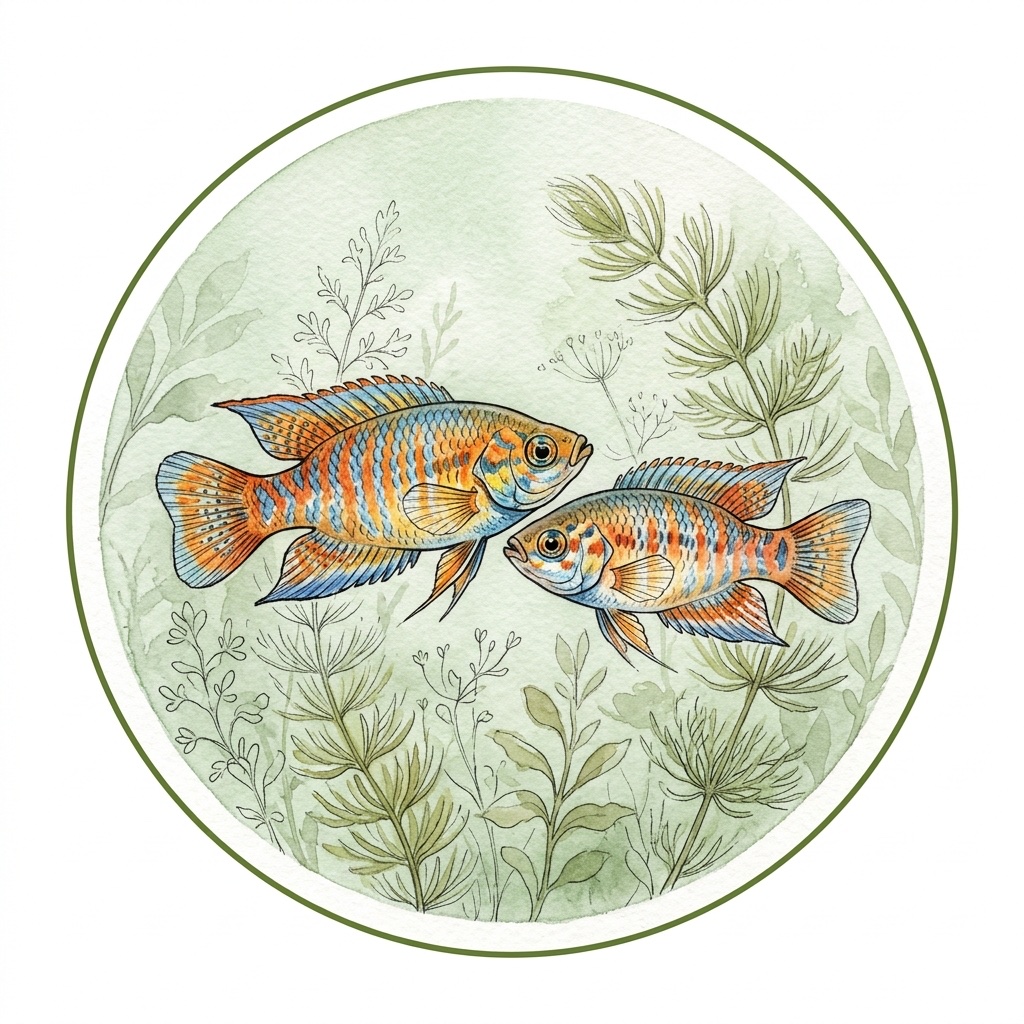
Week -2
Conditioning & Pairing
Raise temperature slightly, increase protein and vegetable variety
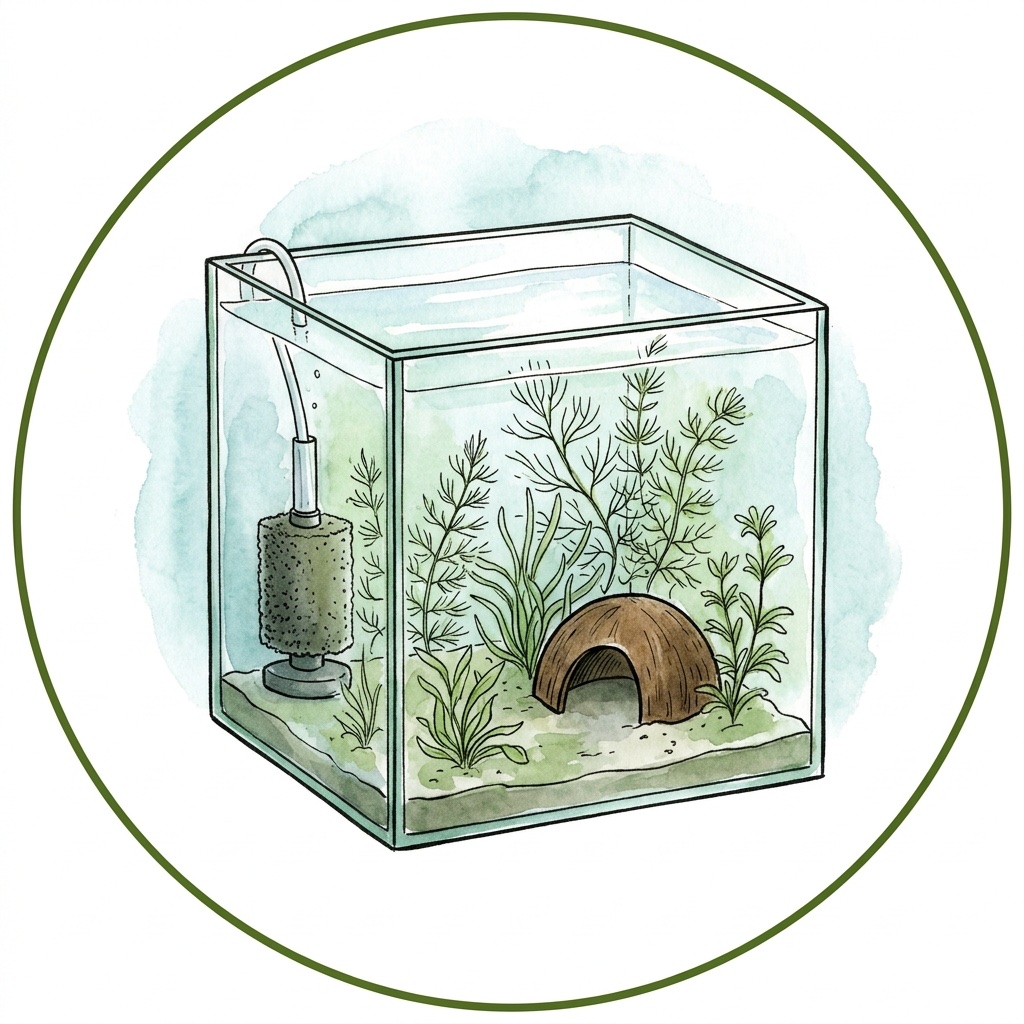
Day 0
Male Claims & Advertises Cave
Male sits at cave entrance, bristles flared, fanning water through
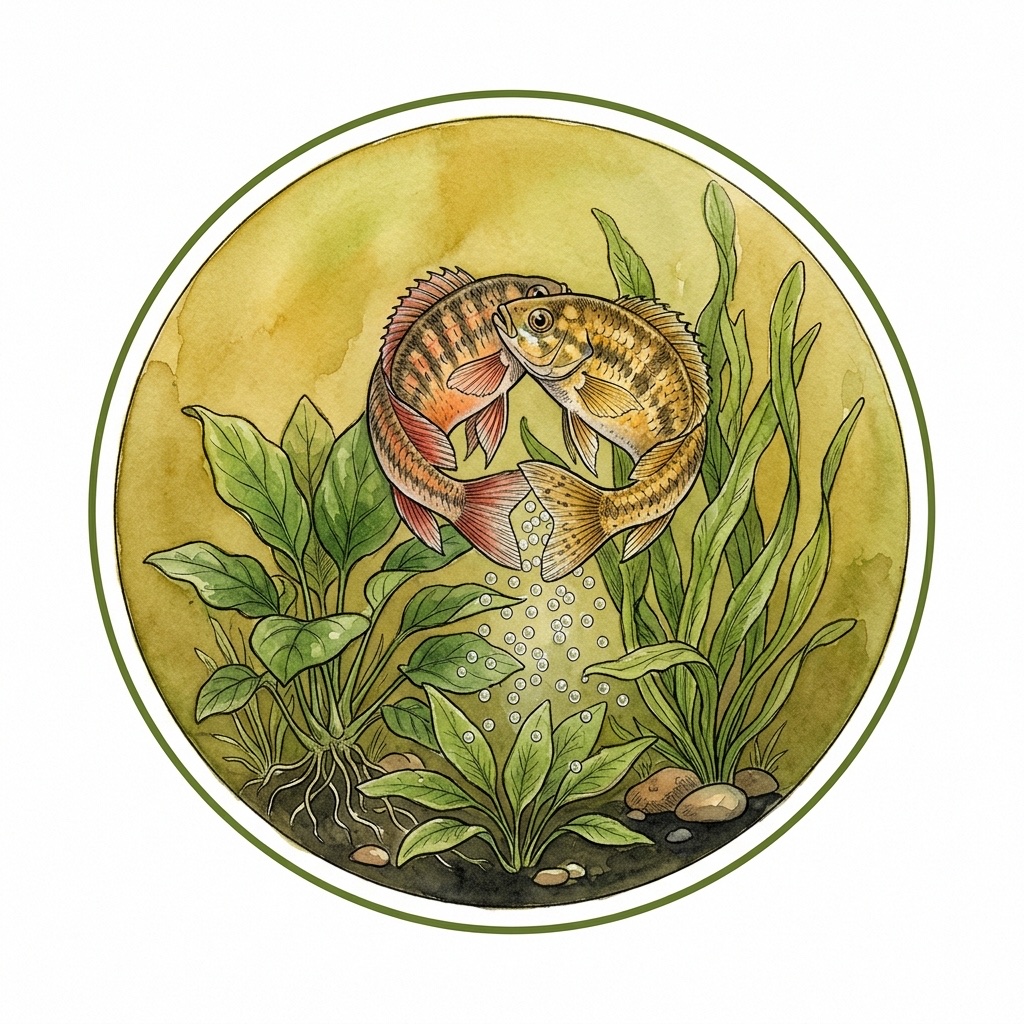
Day 1–3
Female Inspects & Spawns
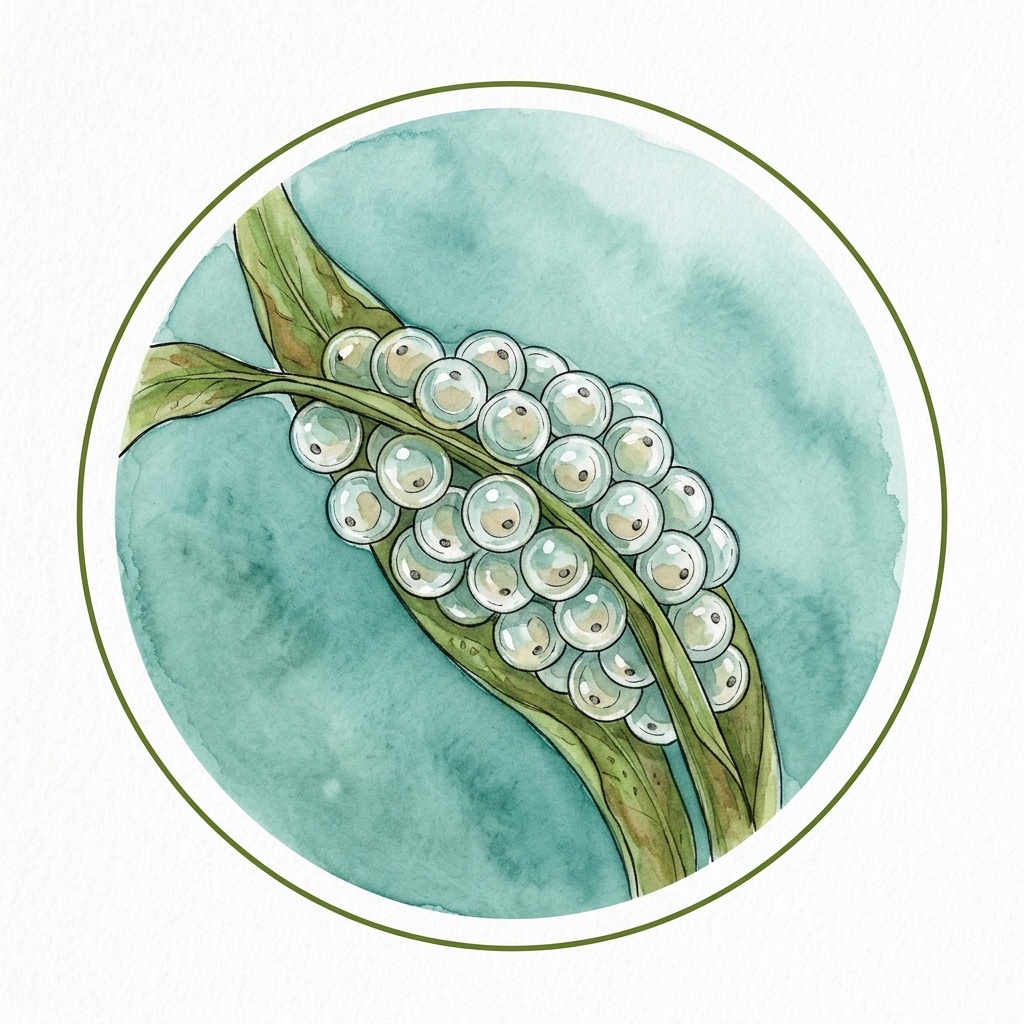
Female enters cave, lays 30–80 orange eggs on the ceiling, then leaves
Day 4–7
Egg Guarding & Fanning
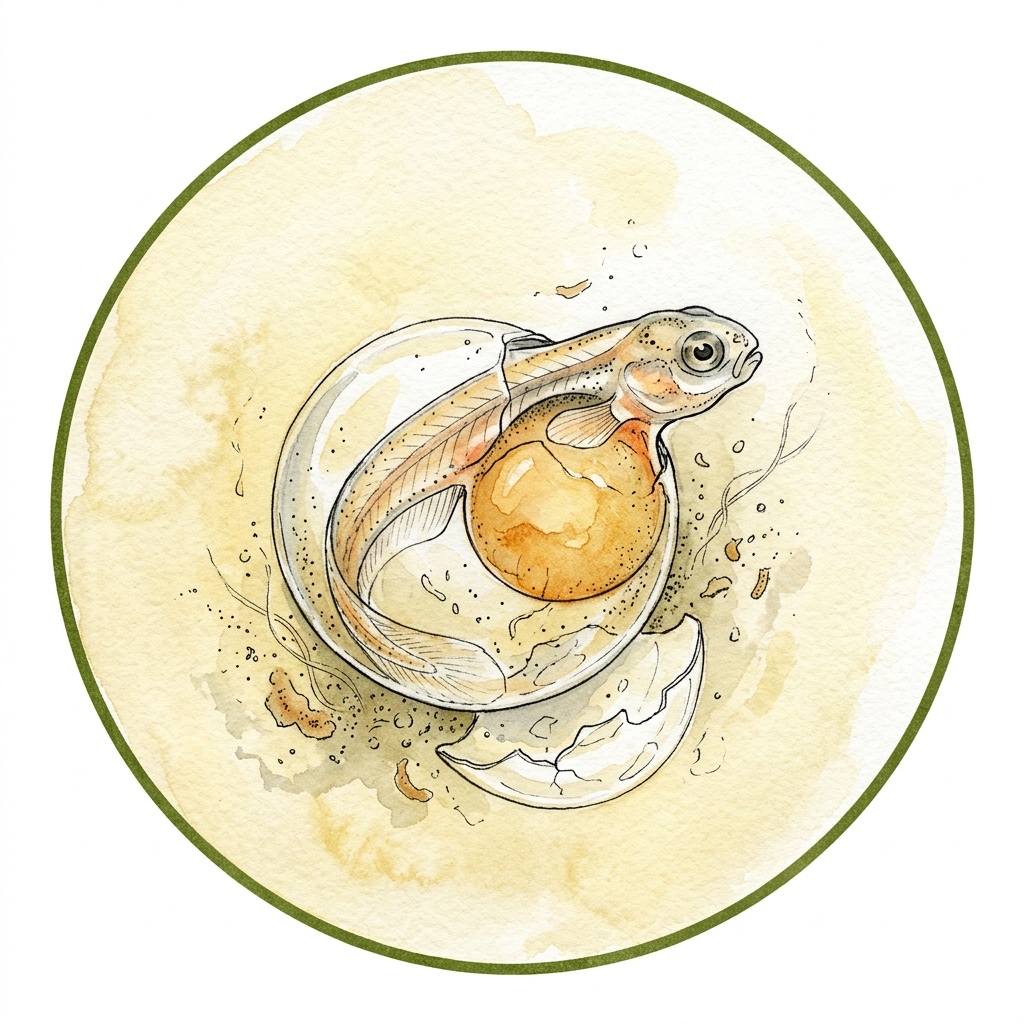
Male fans eggs continuously, drives off intruders
Day 5–8
Hatching — Yolk-Sac Fry
Fry emerge, cling to cave walls, survive on yolk sac
Day 12–15
Free-Swimming & First Food
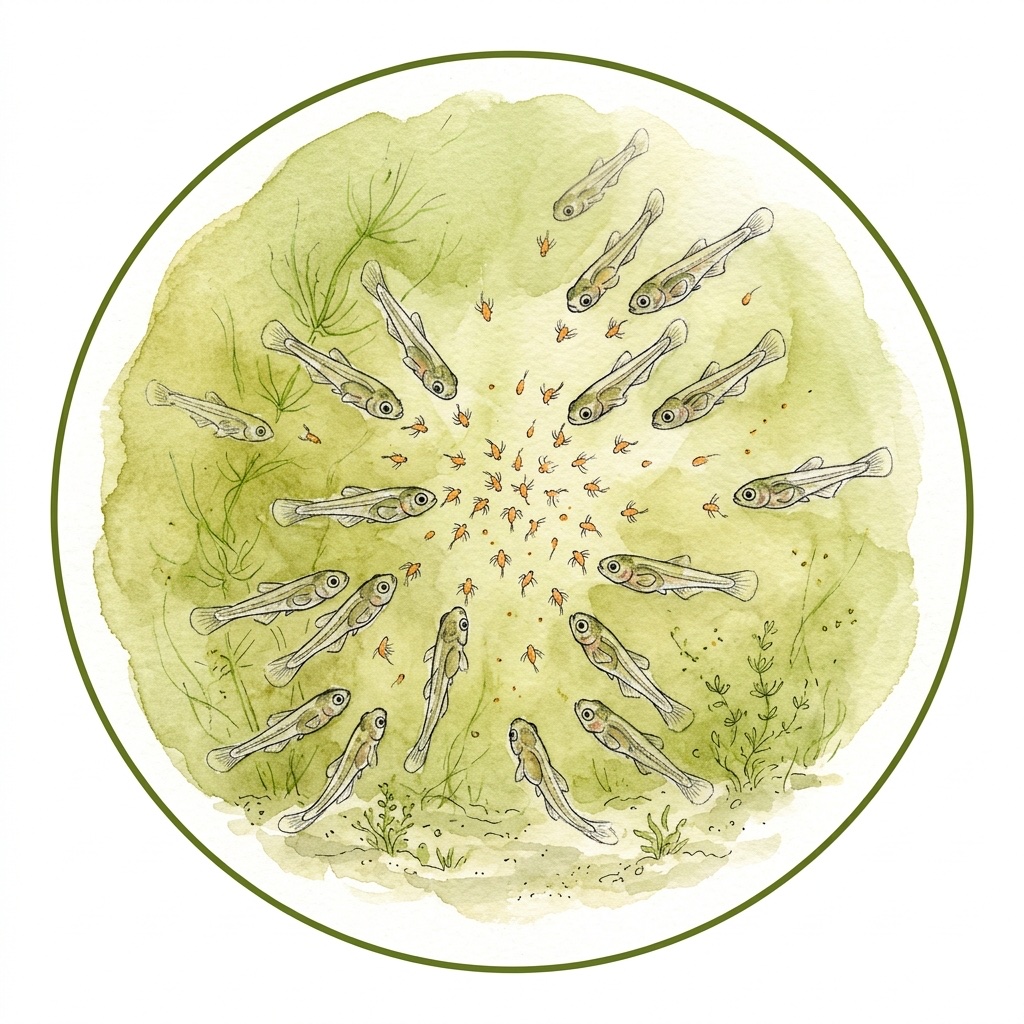
Fry leave cave, begin grazing biofilm and algae wafers
Conditioning & Pairing
Select a clearly bristled male and one or two plump females. In a species tank or a calm community, nudge temperature to 26–27 °C and offer a slightly richer diet: daily vegetables, an extra weekly portion of frozen bloodworm or mysis, and a high-quality sinking wafer. Keep water quality pristine — a 30% water change three days before you expect spawning, using water two degrees cooler than tank temperature, often triggers the male to begin cave preparation. Within a week or two he will pick a cave, spend long periods fanning and cleaning it with his tail, and refuse to leave it except to feed briefly.
Male Claims & Advertises Cave
A mature, conditioned male will stake out a cave and advertise his ownership. You’ll see him pressed against the entrance with his head facing outward, bristles flared, pectoral fins extended, and tail pumping a steady current through the cave. This is both a territorial display (warning other males) and a courtship invitation (signalling to females that the cave is clean, well-oxygenated, and ready for eggs). Do not rearrange the tank during this phase — a disturbed male will abandon the cave for days.
Female Inspects & Spawns
A receptive female approaches the cave and inspects it, sometimes over several visits spread across a day or two. When she commits, she enters the cave alongside the male — there is often a brief, gentle struggle as the male manoeuvres her into position — and deposits a compact cluster of bright orange, 2–3 mm eggs on the inside roof of the cave. A typical clutch is 30 to 80 eggs for a fish this size, with larger, older females producing up to 150. Once she has finished, she leaves; all further care is the male’s responsibility.
Egg Guarding & Fanning
The male now becomes a full-time father. He positions himself over the egg cluster, fins extended, and pumps a steady current across the eggs with his tail and pectorals to deliver oxygen and remove waste. He will not leave the cave for more than a few seconds at a time, even to feed, for the next four to five days. Any fish or shrimp that approaches the cave entrance will be driven off with a quick flare of bristles and a rush. Resist the urge to peek — a torch pointed into the cave can stress the male enough to eat the clutch.
Hatching — Yolk-Sac Fry
Eggs hatch into tiny, orange, comma-shaped fry with huge yellow yolk sacs attached. They cling to the cave ceiling and walls alongside the remaining unhatched eggs, propped up by their bellies. At this stage they do not feed — the yolk sac supplies everything they need for the next 4 to 7 days. The male continues to fan and guard. Water quality is critical now; keep nitrate below 20 ppm and avoid large water changes that shift temperature.
Free-Swimming & First Food
Roughly a week after hatching, the fry absorb their yolk sacs and begin to venture out of the cave in short exploratory trips. At this point they start grazing — on biofilm, soft algae, and finely crushed sinking wafers. Offer powdered algae wafer, crushed Repashy, blanched and softened zucchini skin, and live infusoria if available. They are small but tough, and in a mature planted tank with driftwood and biofilm, they can essentially raise themselves. Expect survival rates of 70–95% in a dedicated species tank, or 30–50% in a community where they are sight-predated on.
Choosing Tank Mates
The albino longfin bristlenose is, at heart, the same easy-going community pleco the brown form has always been — with one caveat added by its fins. The fish itself is peaceful toward anything that is not another male pleco competing for the same cave. It doesn’t school, doesn’t shoal, and doesn’t even particularly socialise with its own kind outside of spawning; it simply occupies the lower third of the tank, grazes its way around the hardscape, and ignores the mid-water community entirely. This makes it compatible with almost every classic community fish: tetras, rasboras, corydoras, gouramis, hatchets, pencilfish, danios (the small peaceful species, not giant or zebra danios in tight schools), and most medium peaceful cichlids such as apistogramma, rams, and kribensis. In practice, if the tank’s water parameters fall within the bristlenose’s broad comfort range and the other residents are not aggressive fin-nippers, the bristlenose will integrate silently and invisibly.
The one thing you must plan around is the longfin trait. Those trailing pectoral and caudal extensions are a magnet for fin-nippers, and torn fins on an albino show up as pink, ragged patches that take weeks to regrow and — in a stressed fish — can become entry points for fungal or bacterial infection. Avoid tiger barbs, serpae tetras, adult rosy barbs, large adult danios, and any Puntius species known for nipping. Also be cautious of otherwise gentle species kept in insufficient numbers: a group of six or more tetras is a peaceful school, but three tetras without the security of a proper group can become nippy out of stress. If you add the longfin bristlenose to an existing community, watch the first two weeks carefully — if you see any of the other fish making passes at the trailing fins, re-home one party before the damage escalates.
Equally, stock only one adult male bristlenose per tank under 150 L — two males will compete for caves, flare bristles, and eventually fight, with the longfin trailing in the loser’s mouth being the first casualty. A single male with one or two females, or a pair with fry, is the ideal bristlenose social unit in a community tank. Multiple males can coexist peacefully in larger tanks (180 L and up) with multiple caves distributed well apart, but even then expect occasional territorial disputes during spawning periods. If you want to keep a larger colony for breeding purposes, plan the hardscape around distinct, visually separated territories — a piece of driftwood breaking each sightline, a cave in each section, and plenty of floor space between them. The fish will sort out their own hierarchy and, once settled, maintain it for years.
Shrimp are worth addressing specifically because many community keepers ask about them. Large Amano shrimp (4 cm+) are perfectly safe with adult bristlenose — they are too large to be swallowed accidentally, active enough to avoid being trapped, and useful as a complementary cleanup crew. Small dwarf shrimp (Neocaridina cherry shrimp, Caridina crystal shrimp) are a different story. Adult bristlenose won’t actively hunt them, but the grazing motion of a suckermouth on a flat surface will occasionally engulf a baby shrimp, and over time this prevents a dwarf shrimp colony from establishing a reproducing population. If you want to keep breeding cherry shrimp, keep them in a dedicated shrimp tank, not with bristlenose. If the shrimp are cleanup-only and you don’t care about breeding them, cherries and bristlenose coexist fine.
| Species | Why | |
|---|---|---|
| ✅ | Neon Tetra | Classic small mid-water schooler that ignores bottom-dwellers entirely; shares the same temperature range |
| ✅ | Cardinal Tetra | Similar to neons but tolerates slightly warmer water — a great match for bristlenose at 26 °C |
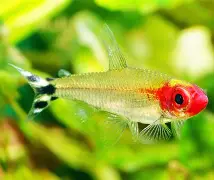
| ✅ | Rummy Nose Tetra | Tight schoolers that use the middle of the tank; leave hardscape and fry alone |
| ✅ | Harlequin Rasbora | Hardy, peaceful mid-water fish that tolerates the broader pH range bristlenose enjoy |
| ✅ | Corydoras (Bronze, Sterbai, Panda) | Ideal floor companions — occupy the open sand while bristlenose patrol hardscape; completely non-competitive |
| ✅ | Honey Gourami | Calm surface-to-mid-water centrepiece; no interest in bottom dwellers and doesn’t nip trailing fins |
| ✅ | Kuhli Loach | Nocturnal like bristlenose but stays in substrate crevices; zero territorial overlap |
| ✅ | Dwarf Gourami | Peaceful surface dweller that adds colour without bothering the catfish |
| ✅ | Amano Shrimp | Large enough (4 cm+) to avoid being swallowed by fry-curious bristlenose; excellent co-janitors on algae |
| ✅ | Mystery Snail | Large inert grazer that bristlenose completely ignore; helps with biofilm and leftover food |
| ❌ | Other Adult Male Plecos (any species) | Bristlenose males are territorial with other cave-dwelling plecos; fights over caves cause injuries and stress. One male per tank under 150 L |
| ❌ | Common Pleco (L. pardalis) | Reaches 40+ cm, outcompetes bristlenose for food and hardscape, and will eventually bully a smaller cousin |
| ❌ | Dwarf / Cherry Shrimp (Neocaridina) | Shrimp fry small enough to be accidentally sucked up by a grazing bristlenose — population won’t establish in-tank |
| ❌ | Tiger Barb / Serpae Tetra | Notorious fin-nippers; longfin extensions are an irresistible target and will be shredded within days |
| ❌ | Large Aggressive Cichlids (Oscars, Jack Dempsey, Flowerhorn) | Too aggressive and large; will harass or kill a bristlenose trying to graze their territory |
| ❌ | African Rift Lake Cichlids | Require hard alkaline water outside bristlenose comfort range and are territorially aggressive toward bottom dwellers |
Quick Reference
| Scientific Name | Ancistrus sp. (trade ‘Bristlenose’) |
| Morph | Albino + Longfin (double recessive) |
| Current Size | 7–8 cm |
| Adult Size | 10–13 cm |
| Lifespan | 8–12 years |
| pH | 6.5–7.8 (ideal 7.0) |
| Temperature | 22–28 °C (ideal 25 °C) |
| Hardness | 4–20 dGH (very tolerant) |
| Min Tank Size | 100 L for a pair |
| Hardscape | Driftwood essential + cave per male |
| Diet | Fibre-first: wood, algae wafer, blanched veg; weekly protein |
| Care Level | Beginner to Easy-Intermediate |
| Temperament | Peaceful; one male per tank under 150 L |
| Breeding | Cave spawner — one of the easiest plecos to breed at home |
| Tank Position | Bottom / on hardscape |
| Price | $55 AUD |
Related Products
Reviews
Clear filtersThere are no reviews yet.