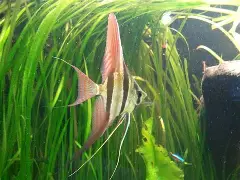
🪨 Species at a Glance
| Scientific Name | Pterophyllum altum (Pellegrin, 1903) |
| Common Name | Altum Angel / Orinoco Altum / Deep Angel |
| Family | Cichlidae |
| Order | Cichliformes |
| Origin | Upper Orinoco basin — Venezuela (Atabapo, Inirida confluence) & eastern Colombia |
| Habitat Type | Blackwater igapó forest, flooded root systems, seasonal floodplain lagoons |
| Adult Body Length | 15–18 cm snout to caudal peduncle |
| Total Height (with fins) | 40–50 cm from dorsal tip to ventral filament |
| Lifespan | 10–15 years in well-maintained blackwater conditions |
| pH Range | 4.5–6.0 (ideal 5.0–5.5) — STRICTLY acidic |
| Temperature | 28–31 °C (82–88 °F) — warm even by tropical standards |
| Hardness (dGH) | 1–4 (ultra-soft, near RO purity) |
| Diet | Omnivore leaning carnivorous — frozen, live, eventually prepared foods |
| Minimum Tank Size | 300 L tall (80 cm+ height; 400 L+ for a group) |
| Care Level | Advanced — experienced blackwater keepers only |
| Temperament | Peaceful, nervous, easily stressed by movement or bright light |
| Breeding in Captivity | Extremely rare; almost no documented Australian home spawns |
| Trade Availability | Sporadic wild imports; F1 captive-bred from specialist breeders |
| Price Guide | A$100–300+ per fish (price on request; subject to import) |
Name & Origin
The specific epithet altum is Latin for ‘tall,’ ‘deep,’ or ‘lofty,’ and it refers unambiguously to the extraordinary vertical proportions of this fish. While the common scalare angelfish has a body roughly as tall as it is long (fins excluded), Pterophyllum altum takes that vertical tendency to an almost architectural extreme. A mature adult standing still in the water column looks less like a typical fish and more like a living stained-glass panel — hence the affectionate nickname ‘cathedral angel’ used by European aquarists since the 1960s. The French-Swiss ichthyologist Jacques Pellegrin formally described P. altum in 1903 from specimens collected in the Atabapo River of southern Venezuela, distinguishing it from the already-known P. scalare on the basis of body proportions, the characteristic notch above the eye, and its restricted Orinoco distribution.
Here is the hard truth every Australian buyer needs to understand before writing a cheque: the overwhelming majority of fish sold in this country under the label ‘Altum Angel’ are not Pterophyllum altum at all. They are tall-finned line-bred strains of Pterophyllum scalare — sometimes called ‘high-body angels,’ ‘Peruvian scalare,’ or simply ‘altum-type scalare.’ These fish can look genuinely impressive (some approach 30 cm total height) and they are much easier to keep, but they are a fundamentally different species with wildly different needs. Misidentification is rampant, sometimes accidental and sometimes deliberate, because the true altum commands multiples of the scalare price and most shops cannot reliably source the real thing. If you are paying $30–60 for an ‘Altum,’ you are buying a scalare. Full stop.
So how do you identify a genuine Pterophyllum altum? There are five reliable markers, and a true Altum will display all five. First, the frontal notch — an unmistakable concave indentation on the forehead directly above the eye, sometimes called the ‘eye notch’ or ‘Altum notch.’ Scalare angels have a smooth, convex forehead curve; Altums have a pronounced hollow there that gives the face a distinctively hooked or Roman-nosed profile. Second, three strong vertical body bars — not four or five as in most scalare varieties. Juvenile Altums display these three bars with crystal clarity; the pattern becomes subtler as they mature but remains discernible. Third, body proportions — adults measure about 15–18 cm in body length but 40–50 cm tall including fins, giving them a height-to-length ratio approaching 3:1, whereas scalare typically sits closer to 2:1. Fourth, the overall colouration — true Altums display iridescent red-brown to coffee-gold tones across the upper body, often with subtle red speckles along the flanks under blackwater lighting, while scalare tends towards silver-gray. Fifth, and most definitively, the red-orange speckling on the ventral fins and gill-cover of breeding-age adults, which scalare simply does not produce.
Beyond the identification problem, there is the difficulty gap. A true Altum is roughly ten times harder to keep than a scalare. They demand extreme blackwater conditions that scalare tolerate but do not need — pH in the 4.5–6.0 range, temperatures of 28–31 °C, hardness under 4 dGH, and tannin-rich tea-brown water achieved through heavy leaf litter and botanical decoction. Put a true Altum in an average community tank at pH 7.2 and 25 °C and it will linger nervously for a few weeks before succumbing to fin rot, bloat, or mysterious ‘wasting syndrome.’ Altum-keeping is a serious commitment and deserves genuine respect for the species; this is not a fish to impulse-buy because it looks striking in a photograph.
Colour Varieties
🏞️ Wild Altum (Orinoco form)
The true species — coffee-gold upper body with three bold vertical bars, red speckling along lateral line, iridescent blue shimmer across the forehead notch. No line-bred varieties exist; every specimen is either wild-caught or F1 captive-bred.
⚖️ Peruvian Scalare (for comparison only)
Tall-finned P. scalare from the Nanay and Ucayali rivers — often mislabelled as Altum in the trade. Four vertical bars, smooth forehead (no notch), body height-to-length ratio under 2:1.
Unlike the line-bred Pterophyllum scalare — which the aquarium hobby has sculpted into koi, marble, platinum, albino, zebra, ghost, smokey, pinoy, and dozens of other selectively-bred morphs — the true Pterophyllum altum exists only in its wild form. There are no albino Altums, no koi Altums, no marble Altums. Every reputable Altum offered in the trade is either collected from the Orinoco drainage or produced as an F1 captive-bred fish from wild parents held by specialist European breeders. This is a deliberate choice by the serious Altum-keeping community: the species is so demanding and so difficult to breed in captivity that nobody has managed to establish stable selectively-bred lines, and most enthusiasts would consider line-breeding a kind of sacrilege given the fish’s rarity and status.
What you get instead is natural variation across collection localities within the Orinoco basin. Fish from the Atabapo River tend to have the deepest red-brown body colour and the most pronounced eye notch; those from the Inirida confluence carry a slightly more silvered body with brighter red fin speckling; and specimens from the lower Rio Negro tributaries (though these are arguably a different population requiring separate taxonomic treatment) tend to be shorter-finned and more olive-toned. In practice, wild Altums arriving in Australia are usually mixed-origin and individual variation dominates. A well-conditioned Altum in a proper blackwater tank develops a remarkable iridescent shimmer across the upper flanks — blue to violet in cool light, gold to bronze under warmer spectra — that shifts with the fish’s angle to the observer and is genuinely impossible to photograph accurately. Seeing it in person, especially in a dim tannin-stained tank with gentle backlighting, is one of the most rewarding sights in the freshwater hobby.
The three vertical bars deserve special mention. Juvenile Altums display them as crisp, inky-black lines with no gradient or softening; this is a key juvenile identification feature. As the fish matures past its second year, the bars soften and can fade substantially under bright lighting, though they remain visible as tonal shifts on the body. Stressed Altums intensify their bars dramatically — if your fish suddenly shows jet-black bars against a pale body, treat it as an alarm signal (water quality, temperature, or social stress), not an attractive colour response. Relaxed, well-housed Altums display moderately visible bars with a warm golden-bronze body tone. A fish constantly showing maximum bar intensity is a fish in trouble.
The red-orange speckling on the ventral fins and gill cover is the most reliable marker of a sexually mature, well-conditioned Altum. It develops gradually from around eighteen months of age and intensifies dramatically during courtship. In strong wild specimens, the ventral filament fins carry bright orange-red spots that run from the base almost to the tips, and the gill cover takes on a rusty red wash visible from a metre away. This trait is genetically tied to the wild Altum lineage and is one of the easiest ways to distinguish a mature true Altum from even the best tall-finned scalare impostor.
Male vs. Female
If sexing Pterophyllum scalare is difficult, sexing Pterophyllum altum is nearly impossible outside active breeding. The species is among the most monomorphic cichlids in the trade — every external feature that sometimes gives scalare away (nuchal hump, angular chest, ventral fin length) is either absent or weakly expressed in altum, and what little dimorphism exists is masked by the sheer individual variation in wild-caught stock. Even the most experienced European altum breeders — the handful of specialists who have managed sustained F1 production — acknowledge that they cannot reliably sex young altums by eye and rely instead on the group-grow-out method.
That method is the only practical approach for the Australian hobbyist. Buy a group of four to six juvenile altums (assuming you can actually source that many, which is often the limiting factor), grow them out together in a suitably large tank at proper water parameters for at least eighteen to twenty-four months, and allow natural pair formation to declare itself. Altums are slow to mature — expect sexual readiness no earlier than two years, and often closer to three. Once a pair forms, their behaviour becomes unmistakable: two fish consistently swim shoulder-to-shoulder, defend a chosen area together, and begin inspecting potential spawning surfaces. Unpaired altums in a group will usually retreat to the tank periphery and swim in loose company without the tight, coordinated movement of a bonded pair.
The ovipositor — the small protrusion from the vent in the final hours before spawning — is the only truly reliable external sex marker, and it is visible for just twelve to twenty-four hours per spawning cycle. The female’s ovipositor is blunt, wide, and cylindrical (like a pencil eraser); the male’s is narrow and pointed (like the pencil lead). Once the spawn is complete, both structures retract and the fish are again visually indistinguishable.
Three practical consequences flow from this extreme monomorphism. First, you cannot buy a ‘breeding pair’ of altums with any confidence — anyone selling a guaranteed pair is either mistaken or optimistic. Second, attempted altum breeding starts with a group-purchase commitment (four to six minimum), which compounds the already-high per-fish cost into a substantial investment. Third, once you do get a pair, hold onto it — altum pair bonds are reportedly even stronger than scalare bonds, and a confirmed pair is worth its weight in gold to any serious breeding program. A bonded pair separated and re-paired with different partners will often refuse to breed at all, sometimes for years.
| Feature | Male | Female |
|---|---|---|
| Overall Appearance | Monomorphic outside breeding — virtually indistinguishable | Monomorphic outside breeding — virtually indistinguishable |
| Forehead Slope | Slight additional pronouncement of eye notch in dominant males | Eye notch present but usually marginally less pronounced |
| Body Depth | Slightly more angular chest when mature | Rounder profile just above ventrals when carrying eggs |
| Ventral Fin Filaments | Often (not always) longer and more delicate, frequently branched tips | Usually slightly thicker at base, less ornate branching |
| Ovipositor / Breeding Tube | Narrow, pointed, pencil-lead shape — visible only hours before spawning | Broad, blunt, cylindrical — visible only hours before spawning |
| Pair Behaviour | Drives off rivals, patrols territory edge, locks lips with female in courtship | Inspects spawning site, signals readiness by trembling and angling body |
Water Parameters
4.5–6.0
ideal 5.2
28–31 °C
ideal 29 °C
1–4 dGH
Ultra-soft — RO or rainwater required across most of Australia
Water chemistry is where altum-keeping sinks or swims, and there is no shortcut. The species evolved in some of the softest, most acidic freshwater on Earth — the upper Orinoco, Atabapo, and Inirida rivers, where pH readings in the wild routinely sit between 4.0 and 5.5, hardness barely registers on test kits, and the water is stained brown as strong tea by dissolved tannins and humic acids from decaying leaf litter. A true altum placed in average Australian tap water (pH around 7.2–8.0, hardness 8–15 dGH, typical Sydney or Melbourne municipal supply) will survive for a while on sheer constitution, but will never thrive, never colour up, and almost certainly never breed. You will see the fish becoming progressively duller, more reclusive, thinner-bodied, and eventually prone to lateral-line erosion and fin melt — a slow decline that keepers often misattribute to ‘altums being delicate’ rather than to a fundamental water mismatch.
The practical approach for Australia is reverse osmosis (RO) water, blended with a small percentage of tap water to restore minimal mineral content, and then acidified through botanical inputs — Indian almond leaves (Terminalia catappa), oak leaves, alder cones, Rooibos bags, or proprietary blackwater extracts. A typical altum tank water-change recipe looks like this: 90–95% RO water, 5–10% dechlorinated tap water, conditioned over a bed of Indian almond leaves and driftwood until the water takes on a deep amber-to-tea colour, pH drifts down to 5.0–5.5 naturally, and hardness settles at 1–3 dGH. Pre-mix this in a dedicated storage drum 48 hours before water-change day and maintain it at tank temperature with a submersible heater. Sudden cold water changes are one of the fastest ways to kill altums.
Temperature is equally non-negotiable. Altums are true warm-water fish from a tropical floodplain that sits within ten degrees of the equator, and their optimum sits between 28 and 31 °C. At temperatures below 27 °C, immune function declines sharply and parasite susceptibility skyrockets — hexamita, Ich, and opportunistic bacterial infections all find easy purchase on a cold altum. Your heater should be an adjustable, quality unit (Eheim Jäger, Fluval E-series, or equivalent) sized at roughly 2 watts per litre for winter reliability, and in cold Australian climates a redundant second heater is not paranoia — it is sensible insurance. Temperature sensor accuracy matters: verify your heater against a separate lab-grade thermometer at least monthly.
Water stability beats water perfection. A tank held rock-steady at pH 5.8, hardness 4 dGH, and 29 °C will produce happier altums than one that swings between ‘ideal’ values and back again. Rapid pH crashes are particularly dangerous at the low end — the carbonate buffering system that stabilises neutral-to-alkaline tanks is absent at pH under 6, so a lightly buffered blackwater tank can swing from pH 5.5 to 4.2 in a matter of hours if heavy feeding or a filter failure allows ammonia to accumulate. Weekly small water changes (15–20%) with pre-matched new water are safer than large infrequent changes. Test kits for pH (low-range, such as the JBL pH 4.0–7.0), hardness (dGH/KH), ammonia, and nitrite should be in every altum-keeper’s toolkit, and testing should be routine rather than reactive.
One further caveat specific to wild-caught altums: newly-imported fish carry a natural microbiome adapted to acidic blackwater, and putting them straight into a ‘clean’ new tank at pH 7 can collapse that microbiome and trigger bacterial infections. Always pre-condition a tank with live blackwater for at least two to three weeks before introducing wild altums, ideally with some mature filter media from an established blackwater tank to seed the right nitrifying bacterial community. F1 captive-bred altums are somewhat more forgiving on this point but still benefit from proper blackwater conditioning.
Tank Setup
Altum tanks are defined by one word: height. A mature altum stands 40–50 cm from dorsal tip to ventral filament, and it needs at least 20 cm of clear swimming room above and below that span to feel comfortable. That translates to a minimum tank height of 80 cm, and ideally 90–100 cm, for adult altums. This is significantly taller than standard ‘tall’ aquariums sold in Australia (most of which top out at 60 cm), which means altum keepers often commission custom-built tanks or source specialist blackwater display tanks from European or Asian manufacturers. A practical minimum configuration for a group of four to six altums is 300 litres at 120 × 50 × 80 cm (length × width × height); serious keepers go larger still, with 120 × 60 × 100 cm (720 litres) representing a genuinely comfortable long-term home.
The aquascape should evoke a flooded igapó forest — the seasonally inundated Amazonian blackwater environment in which altums evolved. Vertical driftwood is essential. Tall pieces of Malaysian driftwood or Manzanita stood upright create the forest-floor trunks and submerged root structures altums use for shelter, orientation, and (in rare breeding events) vertical spawning surfaces. A common arrangement is three to five vertical driftwood pieces distributed across the tank to create overlapping sightlines and shaded zones. Broadleaf plants that tolerate low pH — Anubias barteri var. nana, Microsorum pteropus (Java fern), and Bolbitis heudelotii — are appropriate; most stem plants will struggle in true altum water chemistry, so expect a fairly hardscape-dominated tank with epiphytic plants attached to wood rather than a lush planted aquascape.
Leaf litter is mandatory, not decorative. A substantial bed of Indian almond leaves, oak leaves, beech leaves, or magnolia leaves (all aquarium-safe and widely available in Australia) should carpet at least half the tank floor. This leaf litter is a functional component of the tank’s chemistry — continuous slow decomposition feeds tannins and humic acids into the water column, maintains pH stability, provides microbial habitat, and gives the tank its characteristic tea-brown colour. Expect to top up the leaf litter every six to eight weeks as older leaves break down. Botanical supplements — alder cones, catappa bark, coconut husk fibre, banana leaves — extend the blackwater palette and provide further tannin variety.
Lighting should be subdued and spectrum-shifted warm. Forget bright white planted-tank LEDs; altums evolved under a dim forest canopy where light reaches the water after filtering through layers of leaf litter. A dimmable LED set to 20–30% of its capacity, biased towards the warm/yellow end of the spectrum, is appropriate. A layer of floating plants — Amazon frogbit, Pistia, or Salvinia — further diffuses overhead light and provides the sense of overhead cover that altums strongly prefer. With blackwater tannins in the water and floating plants above, your tank will take on a characteristic golden-amber glow when lit, and the altums will display their best colour and most relaxed behaviour.
Carbon dioxide supplementation is unnecessary and in fact counterproductive for altum tanks. In pH 5 water, the carbonate buffering system is already minimal, and CO2 injection can cause dangerously rapid pH shifts. Plants that belong in an altum tank (Anubias, Java fern, Bolbitis, and floating plants) grow perfectly well without CO2. Save the CO2 rig for a separate planted community tank.
One practical note on tank lid design: altums are not significant jumpers but they are tall, and a low lid over a tall tank can force them into cramped swimming geometry. Ensure at least 10 cm of clear air space between water surface and lid, and keep the lid closed against evaporation (blackwater tanks lose water to evaporation faster than clear-water tanks because of reduced surface tension from tannins). Top-off with pure RO, not mineralised water, to avoid hardness creep over time.
Tall Display Tank
Minimum 300 L at 80 cm+ height; 500–720 L with 90–100 cm height strongly recommended for adult groups. Custom fabrication often required.
Canister Filter
Rated 1.5–2× tank volume per hour. Output baffled through spray bar or lily pipe. Add peat granulate or Rooibos bags to media trays.
Redundant Heater System
Two independently-controlled heaters rated 2 W per litre combined. Set to 29 °C. Verify with separate lab-grade thermometer monthly.
RO/DI Unit
Four-stage or five-stage RO unit producing minimum 150 L per day. Essential for water changes in all Australian municipalities.
Water Storage Drum
120–200 L food-grade drum with submersible heater and air stone for pre-conditioning water changes over 24–48 hours.
Vertical Driftwood
3–5 tall Malaysian or Manzanita pieces standing 40–70 cm; create forest-floor sightlines and vertical spawning surfaces.
Leaf Litter Bed
Indian almond, oak, or magnolia leaves covering 50%+ of tank floor; top up every 6–8 weeks as leaves decompose.
Low-pH Plant Selection
Anubias, Java fern, Bolbitis attached to wood; floating plants (Amazon frogbit, Salvinia) for light diffusion and overhead cover.
Dimmable LED Lighting
Warm-spectrum LED with full dimming control. Run at 20–30% intensity; daily dusk ramp for altum comfort.
Blackwater Test Kits
Low-range pH (4.0–7.0), dGH, KH, ammonia, nitrite. Essential because standard pH kits start at 6.0 and won’t read true blackwater.
Diet & Feeding
Altums in the wild are opportunistic drift-feeders that hunt small fish, shrimp, insect larvae, and emergent insects from the tangled root systems of flooded forest. Their diet is predominantly animal protein with a modest plant and detritus component picked up incidentally while foraging. In captivity, this translates to a high-protein omnivore-leaning-carnivore menu built around frozen and live foods, with prepared foods introduced gradually and serving a supporting rather than primary role — especially for wild-caught stock.
For newly arrived wild-caught altums, expect a feeding learning curve. Wild fish have never seen flake, pellet, or freeze-dried food, and many will refuse prepared foods entirely for the first several weeks. Start with frozen bloodworms, frozen brine shrimp, frozen Mysis, and frozen krill — all accepted readily by hungry wild altums. Live foods, where obtainable and parasite-safe, accelerate feeding response dramatically: live black worms, live brine shrimp, and cultured daphnia are gold-standard starter foods for new wild altums. Avoid pond-collected insect larvae, tubifex worms from unknown sources, or any feeder fish that could introduce parasites. A clean, high-quality frozen feed program builds the altum’s condition through the critical first two to three months of quarantine and acclimation.
Once wild altums are feeding reliably on frozen foods, prepared foods can be introduced as supplementary rather than staple. Choose cichlid-specific pellets with krill, shrimp meal, and whole fish as leading ingredients — brands like Hikari Cichlid Gold, NLS Cichlid Formula, or the European Tropical Cichlid D-50 work well. Soak pellets briefly in tank water before feeding so they don’t swell inside the fish. F1 captive-bred altums, having been raised on prepared foods from fry stage, generally accept pellets without hesitation and can be maintained on a pellet-plus-frozen rotation from day one.
A mature altum’s weekly feeding schedule might look like this: Monday pellets, Tuesday frozen bloodworms, Wednesday pellets, Thursday frozen Mysis, Friday live brine shrimp or black worms, Saturday pellets, Sunday fast day. Adults are fed once or twice daily in small portions finished within two to three minutes. Juveniles at 7–10 cm are still in a growth phase and benefit from three smaller feedings per day. Wild-caught individuals may benefit from slightly heavier live-food rotations during their first six months to build condition and confidence.
Avoid absolutely the following: freeze-dried tubifex worms (associated with bacterial enteritis and blockages in cichlids), beef heart and warm-blooded meats (cause fatty liver degeneration), live feeder goldfish or minnows (notorious parasite vectors, nutritionally poor, and often carry thiaminase that degrades B1), and any pond-collected live food from unknown sources. A weekly fasting day (skipping one feed entirely) supports digestive health and is standard practice in serious altum keeping.
Watch body condition closely. A well-fed altum has a full but smoothly curved belly outline, clear and alert eyes, flat white faeces (not stringy or whitish — which indicates parasite burden), and a strong feeding response at the surface or mid-water when food appears. Loss of appetite lasting more than 48 hours in an altum is a warning sign worth investigating — water quality first, then parasite screen, and only last consider social stress or tank disturbance. Altums are stress-sensitive, and feeding behaviour is the most reliable early indicator that something in the environment is off.
Breeding
Year 0 to 2
Group Grow-Out & Pair Formation
4-6 juveniles raised together until natural bonding emerges
Day -7 to 0
Site Selection & Pre-Spawn Conditioning
Pair chooses vertical surface, intensifies cleaning behaviour
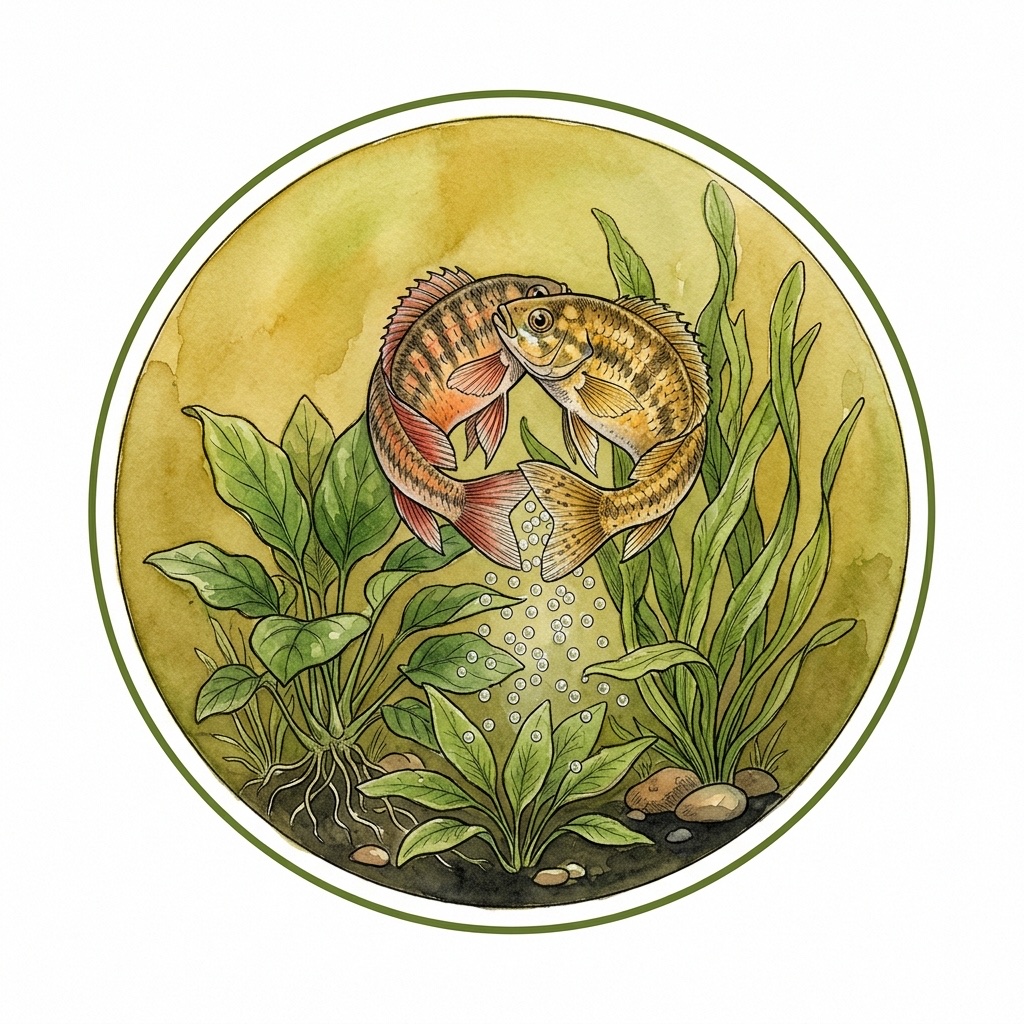
Day 0
Spawning
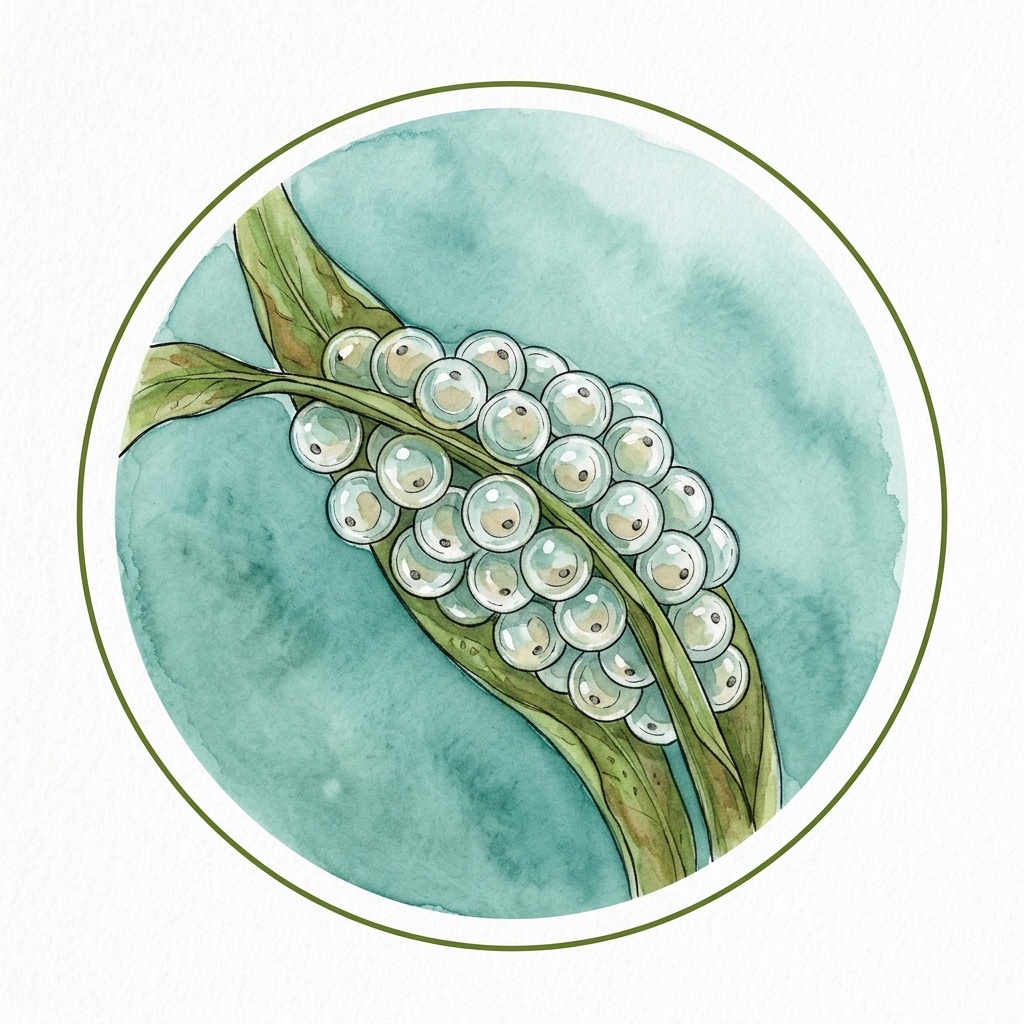
200-400 eggs laid in rows on chosen vertical surface
Day 1 to 8
Parental Care Attempt — Frequently Fails in Captivity
Eggs hatch to wrigglers; free-swimming fry emerge around day 6-8
Group Grow-Out & Pair Formation
Unlike scalare, which can pair at eight to ten months, altums are slow-maturing and require a minimum of eighteen to twenty-four months before any breeding readiness appears. Most confirmed pairs form at around two to three years of age. Because sexing is effectively impossible outside of spawning, the only viable approach is to buy a group of four to six juveniles and grow them out together in a large blackwater tank (400 L minimum at correct water parameters) until natural pair formation declares itself. Expect substantial patience — this is the slowest setup-to-spawn timeline in the cichlid hobby.
During the grow-out years, focus on condition rather than pressuring pair formation. Ensure water parameters are rock-steady, feed a protein-rich varied diet, maintain stable temperature and lighting patterns, and minimise disturbance. A bonded pair becomes obvious when two fish consistently swim together shoulder-to-shoulder, defend a chosen area of the tank, and begin inspecting potential vertical spawning surfaces together.
Site Selection & Pre-Spawn Conditioning
In the week before spawning, the bonded pair becomes intensely focused on a specific vertical surface — typically a tall piece of driftwood, the flat side of a slate slab leaned against the tank wall, or occasionally a broad Anubias leaf. Both fish scour the chosen surface repeatedly with their mouths, stripping algae and debris until it shines. Colour intensity deepens noticeably in both parents, and the red-orange ventral-fin speckling becomes particularly vivid. Water changes should be minimised during this window — 5–10% only if needed — and any disturbance (tank mate introduction, décor rearrangement) avoided entirely. Even confirmed pairs can abandon a spawn cycle if stressed in this critical pre-spawn phase.
Spawning
Spawning itself follows the familiar angelfish choreography. The female makes a series of ascending passes up the vertical surface, depositing a row of translucent amber eggs with each pass. The male follows immediately behind, fertilising each row. A mature altum spawn is smaller than a typical scalare spawn — 200 to 400 eggs is a good clutch for a healthy wild pair, compared to 500–800 for scalare. The entire spawning process takes one to two hours. Both parents remain on constant guard afterwards.
Parental Care Attempt — Frequently Fails in Captivity
This is the stage where captive altum breeding most commonly falls apart. In pristine blackwater at correct temperature and pH, eggs hatch at around 48–60 hours post-spawning, and wrigglers become free-swimming around day six to eight. In captivity, even confirmed pairs frequently eat their first several spawns — sometimes a dozen consecutive attempts — as they learn parenting skills. Environmental imperfection compounds the problem: eggs fungus readily at pH above 6 or in water lacking sufficient tannin antifungal activity, and wrigglers starve without adequate infusoria or appropriately tiny first foods (Artemia nauplii are marginally too large for altum fry’s first mouthfuls).
Successful captive altum breeding has been documented only by a handful of European and Asian specialist breeders, using dedicated species tanks at pH 4.5–5.2, heavy leaf litter for infusoria cultivation, and either artificial rearing with methylene blue and airstones or extraordinarily attentive parental care from experienced adult pairs. In Australian home aquaria, successful altum spawns to free-swimming fry are vanishingly rare — fewer than a dozen documented cases nationally, to our knowledge.
Community Tank Mates
Our strong recommendation for anyone keeping true altums — especially first-time altum keepers — is a dedicated species tank. A group of four to six altums alone in a 500-litre blackwater biotope with appropriate leaf litter, driftwood, and subdued lighting is a magnificent display in its own right and removes the variable of tank-mate stress from an already-demanding setup. You will see altums at their most relaxed, most colourful, and most naturally behaved in a species-only configuration, and many specialist keepers never progress beyond this arrangement by choice.
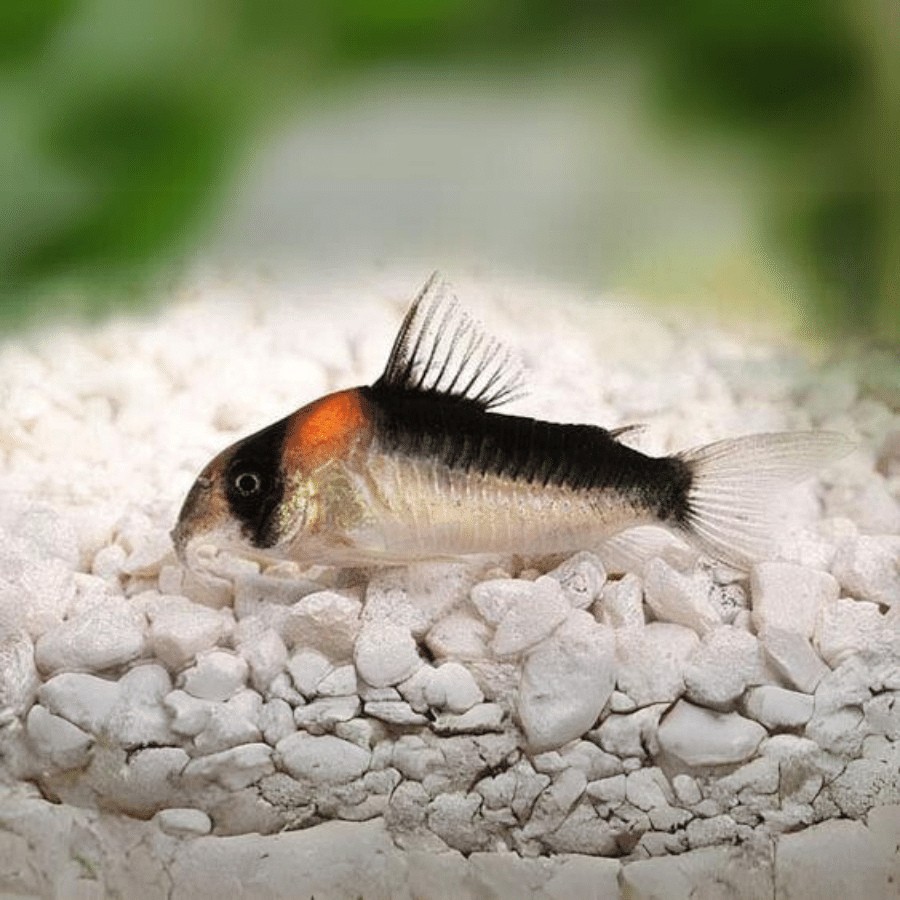
If you must have companions — and the temptation is understandable, because a large altum tank has plenty of visual room for a dither school — then limit yourself to carefully chosen blackwater-compatible species that share the altum’s water preferences and pose no threat to their fins or young. Cardinal tetras, rummy nose tetras, marbled hatchetfish, and L-number plecos are the four most trustworthy choices. A group of fifteen to twenty cardinals or rummy noses provides excellent dither effect — altums that see tetras swimming calmly feel safer and emerge from shaded zones more readily. Add Sterbai corydoras for bottom-zone company. Avoid every angelfish-community staple that works with scalare but fails with altum: no neon tetras, no pearl gouramis (pearl gouramis tolerate 28 °C poorly), no keyhole cichlids (too temperamental in true blackwater), no Apistogramma species (they thrive in altum water but compete aggressively for bottom territory during breeding).
The single most important community rule for altum keepers: never, under any circumstance, mix altums with any variety of Pterophyllum scalare. The two species will hybridise readily in captivity, and hybrid offspring dilute the genetics of both species irrevocably. Serious altum keepers worldwide treat scalare/altum mixing as a cardinal sin of the hobby, and for good reason — every hybrid produced is one more fish that muddies the gene pool of an already-rare species with wild populations under pressure from habitat loss and over-collection. If you keep both species, keep them in completely separate tanks, and ensure no cross-breeding can occur.
A second practical note: altums are nervous fish. Even in a well-designed community, sudden tank mate movements, fast-swimming dither fish, or aggressive feeders at the surface can stress altums and cause them to retreat into cover and refuse food. Choose companion species deliberately for their calm, predictable behaviour. Rummy noses are excellent because they school tightly and move as a unit; scattered, erratic swimmers (like zebra danios — which also cannot tolerate altum temperatures) are poor altum companions regardless of water chemistry compatibility.
Finally, on tank mate quantity: err on the low side. An altum tank is not a Dutch planted tank packed with a hundred fish of fifteen species; it is a wilderness diorama showcasing four to six magnificent centrepiece altums against a blackwater backdrop. A dither school of fifteen rummy noses, six Sterbai corys, and perhaps a single L-number pleco is a plenty-full community around a group of altums. Additional species add stress, compete for oxygen in warm low-pH water (which holds less dissolved oxygen than cooler neutral water), and distract from the altums themselves.
| Species | Why | |
|---|---|---|
| ✅ | Cardinal Tetra | Classic blackwater companion. Shares low-pH soft-water preference and tannin-stained environment. Occupies mid-water column without crowding altums. Schools of 15+ provide essential dither and calming visual effect. |
| ✅ | Rummy Nose Tetra | Large enough (5 cm adult) to avoid predation by mature altums, tight schooling behaviour, and a stable dither species that thrives in true blackwater. One of the best altum community choices available in Australia. |
| ✅ | Marbled Hatchetfish | Surface-dwelling blackwater specialist that occupies the top 5 cm of the water column — zero competition with altums. Share low-pH preference and the tannin-stained habitat altums demand. Require a tightly-sealed lid (hatchets are notorious jumpers). |
| ✅ | Discus | Compatible on water parameters (though discus typically prefer slightly higher pH around 6.0–6.8), temperature, and tank profile. Both species are nervous, so dual-species displays work only in very large tanks (500 L+) with careful spatial planning. Experienced keepers only. |
| ✅ | Royal / L-number Plecos (e.g. L200) | Tolerate blackwater conditions, occupy the substrate/driftwood zone, and don’t compete with altums for space or food. Choose smaller plecos (L200 Royal Blue, L397); avoid aggressive large species that could harass altums at rest. |
| ✅ | Corydoras sterbai | Warm-water-tolerant cory that handles 28–30 °C (most corydoras struggle above 27 °C). Bottom-dwelling, peaceful, and occupies a completely separate territory from altums. A group of 6+ works well in an altum display tank. |
| ❌ | Neon Tetra / Ember Tetra / any nano tetra | Adult altums have mouths large enough to swallow 3 cm fish whole. Neons, ember tetras, green neons, and other nano-sized tetras will disappear one by one. Also — many nano species tolerate blackwater poorly. |
| ❌ | Pterophyllum scalare (any variety) | ABSOLUTE NO. Scalare and altum will interbreed in captivity, producing hybrid offspring that dilute both gene pools. Any serious altum keeper treats altum/scalare mixing as sacrilege. Also, scalare tolerate altum water but prefer higher pH, creating parameter compromise. |
| ❌ | Tiger Barb / Serpae Tetra / any fin-nipper | Altum fin filaments are 25–30 cm of trailing ornament — an irresistible target for fin-nippers. Within days, your altums will have shredded finnage, and the fin damage often becomes chronic. No exceptions, even in large schools. |
| ❌ | African Cichlids (Mbuna, Haps, Peacocks) | Hard alkaline water specialists incompatible with blackwater parameters, highly aggressive, and territorial. Never mix under any circumstances. |
| ❌ | Oscar / Jaguar / large aggressive cichlids | Predatory or extremely aggressive; will bully or kill altums regardless of tank size. Altums are peaceful by cichlid standards and cannot defend themselves against dedicated aggressors. |
Quick Reference
| Scientific Name | Pterophyllum altum |
| Adult Body Length | 15–18 cm |
| Total Height | 40–50 cm (with full fin extensions) |
| Lifespan | 10–15 years |
| pH | 4.5–6.0 (ideal 5.0–5.5) — strict |
| Temperature | 28–31 °C (ideal 29 °C) |
| Hardness | 1–4 dGH (ultra-soft) |
| Min Tank Size | 300 L tall (80 cm+ height) — 500 L+ for a group |
| Group Size | 4–6 minimum for group grow-out; pairs possible thereafter |
| Diet | Omnivore-carnivore; frozen + live + high-protein pellet |
| Care Level | Advanced — experienced blackwater keepers only |
| Temperament | Peaceful, nervous, slow to adapt |
| Tank Position | Middle to upper; vertical column fish |
| Breeding | Extremely rare in captivity; minimum 2-year maturation |
| Availability | Sporadic wild imports; F1 captive-bred from specialists |
| Price Guide | A$100–300+ per fish (price on request) |
| Special Note | NEVER mix with P. scalare — hybridisation is irreversible |
Related Products
Reviews
Clear filtersThere are no reviews yet.