🪨 Species at a Glance
| Scientific Name | Hyphessobrycon bentosi |
| Common Names | White-Fin Ornate Tetra, Ornate Tetra, Bentos Tetra, White-Fin Rosy Tetra |
| Family | Characidae |
| Origin | Central Brazilian Amazon — Rio Amazonas and southern tributaries |
| Adult Size | 4 cm (1.6 in) |
| Lifespan | 4-6 years in aquaria |
| Care Level | Beginner to Intermediate |
| pH | 5.5-7.2 |
| Temperature | 22-27 °C (72-81 °F) |
| Hardness | 2-10 dGH (soft to medium) |
| Min. Tank | 60 L (16 gal) for a school of 6+ |
| Diet | Omnivore — flake, micro pellet, frozen daphnia and bloodworm |
| Tank Position | Middle to upper-middle |
| Community Safe | Yes — peaceful, but avoid fin-nippers |
| Schooling | Yes — keep in groups of 6 or more, ideally 8-10 |
| Sexual Dimorphism | Marked — males develop long white-tipped dorsal and anal filaments |
Where the Name Comes From
The scientific name Hyphessobrycon bentosi was formally described by Durbin in 1908, and the species epithet bentosi honours the collector who supplied the type specimens to early ichthyologists working in the central Amazon basin. The genus name Hyphessobrycon itself is a Greek construction meaning roughly “smaller Brycon” — Brycon being a larger characin genus — and it now gathers together dozens of related small-bodied tetras that share a general body plan of compressed sides, a small adipose fin, and a characid tooth structure. Within that genus sits a small cluster of species collectively known to ichthyologists as the “bentosi complex”: Hyphessobrycon bentosi, Hyphessobrycon rosaceus (the Rosy Tetra), Hyphessobrycon socolofi (Socolof’s Tetra), and a handful of regional variants and forms. All share a similar rhomboid body outline, pale pink or rose coloration, and extended fins in the males. Telling them apart at the retail counter is notoriously difficult, which is why the common names overlap so confusingly in the hobby.
The common name “Ornate Tetra” is a nod to the decorative, almost baroque quality of the finnage on a mature male. When the long dorsal streams up and back over the body, and the anal fin trails below like a pennant, the fish really does look ornamented rather than utilitarian — as if it were wearing the aquarium equivalent of a frock coat. The alternative “Bentos Tetra” simply anglicises the species epithet and is more common in European literature. “White-Fin” was added to the trade name in recent decades to distinguish the fish from its close cousin, the classic Rosy Tetra, whose fins tend more toward red or coral. In H. bentosi, the fin edges are cooler — the leading and trailing rays of the dorsal, anal, and caudal lobes are rimmed in a chalky white that stands out sharply against a thin black accent band. Some specimens, particularly from line-bred or selected strains, push this white even further, producing strikingly pale, almost translucent fin trailers.
The confusion between Ornate, Bentos, Rosy, and White-Fin Rosy names is not going away anytime soon, and it helps to understand why. Wholesale fish from the Amazon are typically collected in mixed nets of small tetras, bagged, and shipped in bulk to exporters in Manaus or Belém, and from there on to international wholesalers. Precise species-level identification at any point in that chain is economically impractical, so the shipments are labelled by trade name rather than by scientific name. “Rosy Tetra” and “Ornate Tetra” in particular are often used almost interchangeably at wholesale, with the specific epithet assigned downstream by the retailer based on visible appearance. The upshot is that a bag of “Ornate Tetras” at your local fish shop may well contain a mix of H. bentosi and H. rosaceus, with the occasional H. socolofi stowaway. For the identification-minded aquarist, the primary diagnostic features are the fin colour balance — cooler white-black rim in bentosi, warmer red-black rim in rosaceus — and the overall body flush, which runs pink-white in bentosi and coral-pink in rosaceus. In practice most hobbyists simply enjoy whatever they get, because the care requirements are essentially identical.
For the working aquarist, the important thing to take away from this taxonomic tangle is that the care requirements for the entire bentosi complex are almost identical. Whether you have true H. bentosi, a H. rosaceus, or a H. socolofi, you will keep them the same way: soft, slightly acidic to neutral water, a planted tank with tannin-stained light, a proper school of at least six, and peaceful mid-water tank mates. Beyond that, enjoy the quiet puzzle of watching your own group and noticing the subtle cues — fin length, body flush, edge colour — that reveal which form you actually have. Many long-term keepers of this group report that the more attention they pay to the individual differences in their school, the more they come to appreciate the subtle gradations of colour and finnage across what initially looks like a uniform group of pink tetras. This is a fish that rewards observation.
Colour Forms & Morphs
⚪ White-Fin Ornate Tetra (H. bentosi)
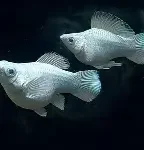
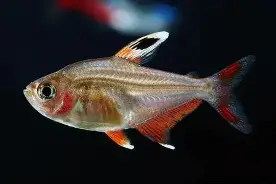
The subject species: pale pink-white body with a subtle silvery sheen, a small black humeral spot, and long dorsal, anal, and caudal fin extensions in males edged crisply in white over a fine black margin.
🌸 Rosy Tetra (H. rosaceus)
Close cousin and frequent trade substitute. Body flush runs warmer and deeper pink-red, fins are more coral toned than white, and the black submarginal band on the dorsal is typically broader.
🤍 Socolof’s Tetra (H. socolofi)
Another bentosi-complex member with a slightly stockier build, subtler pink flush, and black edging that can extend further along the anal fin. Frequently mixed in with shipments of Rosy and Ornate.
🔴 Red Phantom Tetra (H. sweglesi)
A related Hyphessobrycon often kept alongside Ornate Tetras. Deep red body with a vertical dark humeral bar. Shares water preferences but looks entirely different.
⚫ Black Phantom Tetra (H. megalopterus)
Another Hyphessobrycon cousin. Smoky grey-black body with a teardrop humeral mark and the same extended finnage in males. A natural tonal counterpoint to the paler Ornate.
Unlike some aquarium tetras that have been pushed through decades of selective breeding into dozens of colour strains, the White-Fin Ornate Tetra is still essentially the wild form. The “white-fin” designation refers to a line-bred or selected strain in which the already-present white fin edging is emphasised, but you will not typically find neon variants, long-fin mutations outside of the naturally occurring male finnage, or colour morphs in other directions. That restraint is arguably an asset: the fish is at its most beautiful when its natural features are allowed to develop fully, and that development is a function of water quality, tank setup, and social context rather than genetics.
The body coloration itself is worth examining closely. At first glance the fish looks simply “pink” or “rose”, but a healthy specimen under good light reveals a more sophisticated palette. The flanks carry a fine silvery sheen beneath the pink flush, and along the lateral line there is often a faint iridescent band that shifts from pale gold to soft blue depending on the angle of light. The dorsal surface is a little deeper in tone, running toward a warm olive when the fish is relaxed. The small black humeral spot, positioned just behind the gill cover roughly at eye level, is a consistent identifier of the species and a useful anchor for the rest of the coloration: it is always cleanly edged, never smudged, and in display specimens it darkens noticeably as the fish flushes. Adding a darker substrate and filtering overhead light through floating plants exaggerates all of these colour subtleties; running the fish in a bright, bare, gravel-bottomed tank washes them out almost completely.
When selecting specimens at a shop, look for fish that are actively swimming in the upper middle of the tank, not hanging listlessly near the filter. The body should show a faint but clean pink flush rather than a washed-out grey. Check the fins carefully — even juvenile males will show the beginnings of a pointed, elongated dorsal, and the white fin edging should be visible as a clean line rather than a smudged haze. A clearly visible small black humeral spot just behind the gill cover is normal and in fact a good sign; it means the fish is well-pigmented and in condition. Avoid any fish with clamped fins, torn fin rays (a signal of prior fin-nipping damage or poor transport), or a hollow-belly profile behind the head, which can indicate internal parasites or chronic starvation. Buy a group of at least six, and mix visibly different sizes if you can — a mix of mature males, younger males, and females produces the most dynamic schooling and display behaviour in the long term.
Once the fish are home, expect colour to develop gradually over the first two to four weeks. Freshly imported stock often looks pale, with fin filaments that have not yet reached full length. Given stable soft water, good food, and a proper school size, the pink flush will deepen, the silver sheen will intensify, and the fin filaments on males will continue to grow out well into the second and third month of settled aquarium life. This slow ripening is one of the particular pleasures of keeping this species — you do not see the finished product at the shop; you grow it in your own tank.
Telling Males from Females
Hyphessobrycon bentosi is one of those happy cases where sexual dimorphism is genuinely useful at the shop. Mature males are almost unmistakable: the dorsal fin reaches back in a long, pointed blade that tapers into a fine trailing filament, often extending well past the adipose fin. The anal fin follows suit, drawn out into a sickle shape with a long leading point and a flowing trailing margin. The white fin edging is sharper on males, contrasting against a finer black submarginal band, and during display the whole body takes on a warmer, pinker cast. Females, by contrast, show a more standard rhomboid tetra outline — deeper through the belly, rounder in profile, with shorter and more symmetrical fins. Both sexes have the small black humeral spot, though it can look slightly more prominent in males simply because the surrounding body colour is paler.
You will find that males devote a surprising amount of energy to displaying to each other. Two or three mature males in a 60-litre tank will routinely parade side by side, fins fully spread, leading edges quivering, each trying to out-posture the other. These contests are almost entirely ritual — actual fin damage is rare, the loser simply peels off and rejoins the school — but they are one of the real visual rewards of keeping this species. The behaviour is also a reliable indicator of health and comfort: males in poor water, under-schooled, or stressed by harassment simply will not bother to display. If your males are throwing fins at each other, you are doing something right.
The display behaviour itself follows a recognisable script. Two males approach each other at a slight angle, slow their swimming, and fan all their unpaired fins to full extension. They then glide forward in parallel for a few seconds, each trying to keep his dorsal higher and his anal further extended than his rival’s. At the apex of the display the bodies arch very slightly, the pink flush intensifies, and the white fin edges appear to vibrate as fine tremors run through the rays. Then, almost always without contact, one male yields and peels off. In a healthy mature group you will see this play out dozens of times each day, especially in the morning hours around feeding and in the soft light of early evening. If your tank is well planted and you sit quietly in front of it for ten minutes at dusk, you will see the species at its best.
Young fish under about 3 cm are harder to sex, as the male filaments have not yet developed. Juveniles of both sexes look generally similar: a pale silvery-pink body, short triangular fins, and the beginning of the humeral spot. Filaments begin to show on males around the 3 cm mark and continue to grow out until roughly 12-16 months of age, by which point the full adult finnage is typically established. If you are buying juveniles and care about sex ratio, the safest approach is simply to take a group of eight to ten. Statistics will almost always deliver a mixed group, and the school behaves better for it regardless. A rule of thumb many long-term keepers follow is to aim for at least two males in the group — a single dominant male with no rival to posture against will often simply stop displaying, and you lose half the reason for keeping the species.
| Feature | Male | Female |
|---|---|---|
| Size | 3.5-4 cm, slimmer build | 3.5-4 cm, deeper and more rounded body |
| Dorsal fin | Long, pointed, often extending well past the adipose with a trailing filament | Shorter, triangular, no trailing filament |
| Anal fin | Extended, sickle-shaped with long front rays and flowing trailing edge | Shorter, straighter, with a more even trailing edge |
| Caudal fin | Slightly more pointed lobes, crisp white rimming along the edges | Rounder lobes, white rimming present but less pronounced |
| Body colour | Brighter pink-white flush, especially along the flanks during display | Subtler rose tint, more silver overall |
| Belly profile | Flat or gently curved along the ventral line | Notably rounded when mature or in spawning condition |
Ideal Water Conditions
5.5–7.2
ideal 6.5
22–27 °C
ideal 25 °C
2–10 dGH
Soft to medium-soft water preferred
Hyphessobrycon bentosi is a genuinely flexible fish where chemistry is concerned. In its native range — the central Brazilian Amazon, the Rio Amazonas proper, and southern tributaries feeding into it — the species lives in a mosaic of whitewater and clearwater habitats, typically alongside accumulating leaf litter, submerged roots, and overhanging vegetation. That means the water is soft, slightly acidic, and stained amber with tannins in most of the locations it actually comes from. Well-acclimated aquarium stock, however, will happily live and even breed at a pH anywhere between 5.5 and 7.2, and in hardness values between 2 and 10 dGH. What they do not tolerate well is instability: sharp pH shifts, sudden temperature drops, or swings in nitrate caused by erratic maintenance will bring out stress symptoms quickly, often visible first as clamped fins and faded body colour.
For best results, aim for a slightly acidic, soft target: pH around 6.5, GH around 5, temperature around 25 °C. If your tap water is hard and alkaline, cut it with RO water in roughly a 1:1 ratio and let the tank self-buffer downward via driftwood and leaf litter. Indian almond leaves, alder cones, and oak leaves all slowly release tannins that lightly acidify the water, soften perceived hardness, and carry mild antibacterial and antifungal properties. The side effect of a faintly tea-coloured water column is precisely the aesthetic this fish evolved in, and the amber light genuinely brings out the warm pink flush of the body and the crispness of the white fin edges.
If you are working from hard tap water, the easiest way to soften it reliably is to invest in a small reverse-osmosis unit. A modest 50-gallons-per-day RO unit is inexpensive, produces water at low ppm total dissolved solids, and takes only a few minutes of space management per week. Mix RO water with tap water in whatever ratio your target hardness requires — typically 50/50 or 60/40 RO-to-tap for most Australian and European tap water sources — and remineralise if needed using a commercial blackwater or South American remineralisation salt. Alternatively, peat filtration in a canister bag can lower both pH and hardness slowly over time, though it requires replacement every two to three months. Whichever method you choose, the critical rule is consistency: match the parameters of your water change water to the parameters of the tank. A thirty percent water change with water at radically different pH or hardness will stress the fish far more than the difference is worth.
Temperature deserves careful attention. H. bentosi is comfortable between 22 and 27 °C, but it is noticeably happier in the middle of that range — around 24 to 25 °C. Running chronically hot (27 °C+) accelerates metabolism, shortens lifespan, and reduces the likelihood of male display behaviour. Cooler end of the range, meanwhile, slows the fish down and can expose it to fungal problems if prolonged. A reliable adjustable heater and an accurate thermometer you actually glance at each day are both essential. Weekly water changes of 25-30% with dechlorinated, temperature-matched water will keep nitrates low and chemistry stable; more frequent but smaller changes are preferable to occasional large ones.
Nitrate management is particularly worth emphasising. H. bentosi can tolerate nitrate levels up to about 30 ppm without visible problems, but colour and fin development begin to suffer noticeably above 20 ppm. Aim to keep nitrate below 15 ppm as a standard target. A planted tank with healthy stem growth will do most of the nitrate work itself; a non-planted tank will require more aggressive water change schedules and possibly supplementary biological filtration. Test weekly during the first month of a new setup and monthly thereafter once a stable pattern emerges. The fish will tell you, through faded flush and clamped fins, long before a nitrate test strip does.
Setting Up Your Aquarium
A tank for White-Fin Ornate Tetras should aim to echo the quiet stretches of the Amazon floor where the species actually lives: shaded, softly lit, densely planted at the edges, with an open mid-water lane for the school to cruise and display. The minimum footprint is 60 litres for a group of six, but realistically this fish shows its best behaviour in a 75- to 100-litre planted tank with a length of at least 60 cm. Long tanks are much better than tall ones for this species — they swim horizontally, not vertically, and benefit hugely from a clear midwater swimming corridor.
Substrate should be fine to medium-grained, in a dark tone. Natural river sand, black aquasoil, or a mix of dark gravel and sand all work. Dark substrate reduces bottom reflections, makes the fish feel less exposed, and dramatically enhances the visual contrast between the pale pink body and the background. Plant the back and side walls densely with broad-leaved and stem species: Amazon sword plants (Echinodorus), Cryptocoryne wendtii and undulata, Vallisneria for vertical structure at the back, and a few stem plants like Rotala rotundifolia or Ludwigia repens for colour accents. Floating plants — Amazon Frogbit, Red Root Floaters, or dwarf water lettuce — are strongly recommended. They filter the overhead light, mimic the forest canopy that shades the species in nature, and give the fish a reassuring sense of cover that encourages them out into the open mid-water.
Driftwood is not optional for the best results. A few pieces of spiderwood, mopani, or manzanita arranged along the back and sides provide visual structure, break sightlines for territorial males, and slowly leach tannins into the water column. Indian almond leaves and alder cones scattered on the substrate complete the blackwater botanical layer. Keep lighting on the modest side — a planted-tank LED running at maybe 40-50% intensity, or a lower-output fixture filtered through floating plants, is ideal. Overly bright overhead light washes the fish out, encourages algae, and makes the fish hide more than swim. Avoid sharp rockwork or hardscape with narrow crevices that could catch a trailing fin filament during a rapid dart.
An often-overlooked aspect of setup is the positioning of the tank itself. H. bentosi is a moderately shy fish until it settles, and a tank placed in a high-traffic area with frequent people movement in front of the glass will see a more nervous, less colourful school than one placed in a quieter corner where the fish have time to acclimate to a stable routine. If possible, choose a location where the tank has at least one side against a wall, place it at roughly eye-seated height, and avoid setting it where sudden motion (doors opening, pets passing, televisions flashing) is a constant feature. A stable environment allows the school to develop the confident mid-water cruising behaviour that the species is famous for.
Water flow needs balancing carefully. The species does poorly in stagnant water — stale conditions encourage bacterial issues and dull colour — but it equally struggles in strong currents. The long male fin filaments are aerodynamically vulnerable, and a fish constantly having to swim against a powerful outflow will tire, clamp its fins, and never fully relax. Aim for a gentle, diffuse flow across the tank, with no single jet pointed directly into the mid-water swimming zone. If your filter outlet is too strong, use a baffle, spray bar, or lily-pipe diffuser to soften it. A sponge filter in a dedicated species tank solves this problem by default, which is part of why it is the recommended option for a 60 L Ornate-focused setup.
Filter
Sponge filter for a 60 L species tank; small canister or baffled HOB for larger community setups. Aim for 3-5x tank volume turnover per hour with gentle output.
Heater
Adjustable heater appropriately sized for your volume. Set to 24-25 °C for ideal colour and long-term health.
Thermometer
Digital or glass thermometer positioned away from the heater. Check daily; temperature stability matters more than the exact number.
Lighting
Moderate planted-tank LED. Use floating plants, a timer, and a gentle ramp to mimic dawn and dusk transitions.
Substrate
Fine dark sand, black aquasoil, or a dark gravel blend. Avoid sharp-edged or pale substrates.
Botanicals
Indian almond leaves, alder cones, oak leaves, and at least one sizeable piece of driftwood for tannin release and natural buffering.
Plants
Dense background planting (Vallisneria, Cryptocoryne, Amazon sword) plus floating cover (frogbit, red root floaters) to shade the water column.
Test kit
Liquid test kit for pH, KH, GH, and nitrate. Essential for catching parameter drift before the fish flag it with fin clamping and faded colour.
Feeding Guide
White-Fin Ornate Tetras are unfussy omnivores that will accept almost any appropriately sized food offered, but getting the best colour and fin development out of them is a matter of variety rather than quantity. The backbone of the diet should be a high-quality micro pellet or crushed tropical flake, offered once or twice daily in small amounts that the school can consume within two minutes. Look for foods that list spirulina, astaxanthin, krill meal, or similar carotenoid-rich ingredients in the first five items — these pigments are what give the body its pink flush, and a diet that skips them produces paler, washed-out fish even in perfect water.
Supplement the dry staple with frozen foods two to three times a week. Frozen daphnia is arguably the single best supplemental food for this species — it is easily digestible, encourages active hunting behaviour, and the pigments in the live daphnia’s gut carry through into the fish’s colour. Frozen bloodworm, brine shrimp, and cyclops all also work well; rotate between them so no single food dominates. For live foods, freshly hatched brine shrimp nauplii are the gold standard for conditioning adults (especially for breeding) and an excellent occasional treat for the whole school. Grindal worms, micro worms, and vinegar eels are all also well received, especially by breeding pairs and young fry.
Food size matters as much as food type. The mouth of an adult H. bentosi is small — barely 2-3 mm across — and anything larger than that is simply too big to swallow comfortably. Flake food should be crushed to roughly the size of a pinhead before it hits the water; pellets should be of the micro variety, ideally no larger than 0.5-1 mm diameter. Frozen bloodworm cubes often contain worms that are too large for the species and should be broken up with a pair of tweezers or a clean fingertip before thawing. A mistake many beginners make is to buy a “tetra-sized” flake at the pet shop that is actually formulated for larger community tetras and ends up oversized for the Ornate. When in doubt, crush finer than you think you need to.
Feeding behaviour is a reliable health gauge for this species. A school of H. bentosi in good condition will swarm to the front of the tank the instant it sees a keeper approach, with all fish taking food from mid-water as it drifts down. Fish that hang back, let food sink past them, or approach slowly are telling you something — check water parameters first, then look for signs of disease or stress. A once-weekly fast day is beneficial for the whole tank’s nitrogen balance and harmless to the fish, but otherwise steady twice-daily feeding on small portions is the simplest pattern that works.
Plant matter deserves a mention. Although H. bentosi is not a dedicated herbivore, its diet in the wild includes a non-trivial proportion of plant material, decomposing leaf litter, and biofilm grazed off submerged surfaces. In the aquarium this role is partially filled by flake foods containing spirulina or algae meal, but it is worth occasionally offering a small piece of blanched spinach, zucchini, or cucumber, or a pinch of dedicated spirulina flake. Some keepers add a slice of blanched pea fortnightly; the school will peck at it until it is gone, and the extra fibre seems to aid digestion visibly. This small vegetal component is one of the subtle variables that separates acceptable colour from genuinely excellent colour in a long-term kept group.
Breeding Guide
Week 1-2
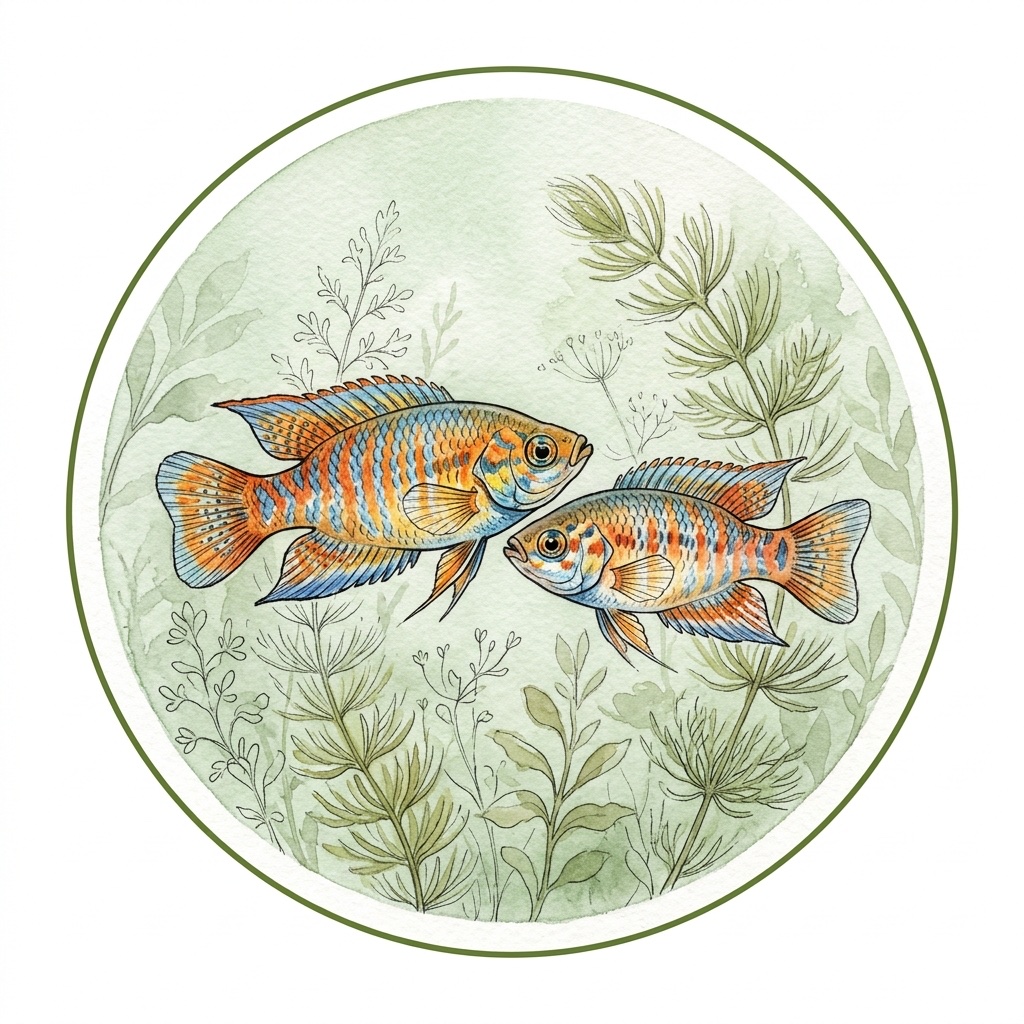
Conditioning
Separate sexes and feed heavily
Day 0 (evening)
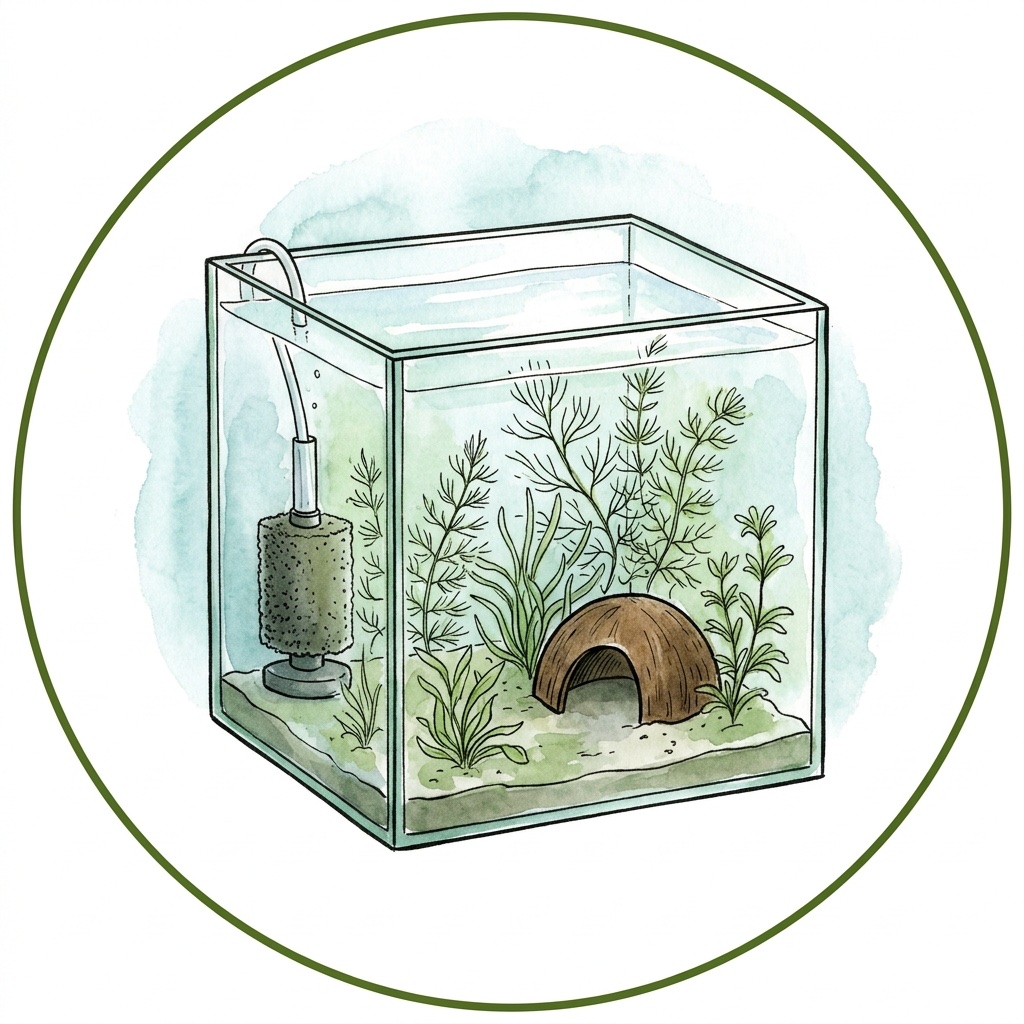
Introduction to Spawning Tank
Move pairs to soft, acidic setup
Day 1 (dawn)
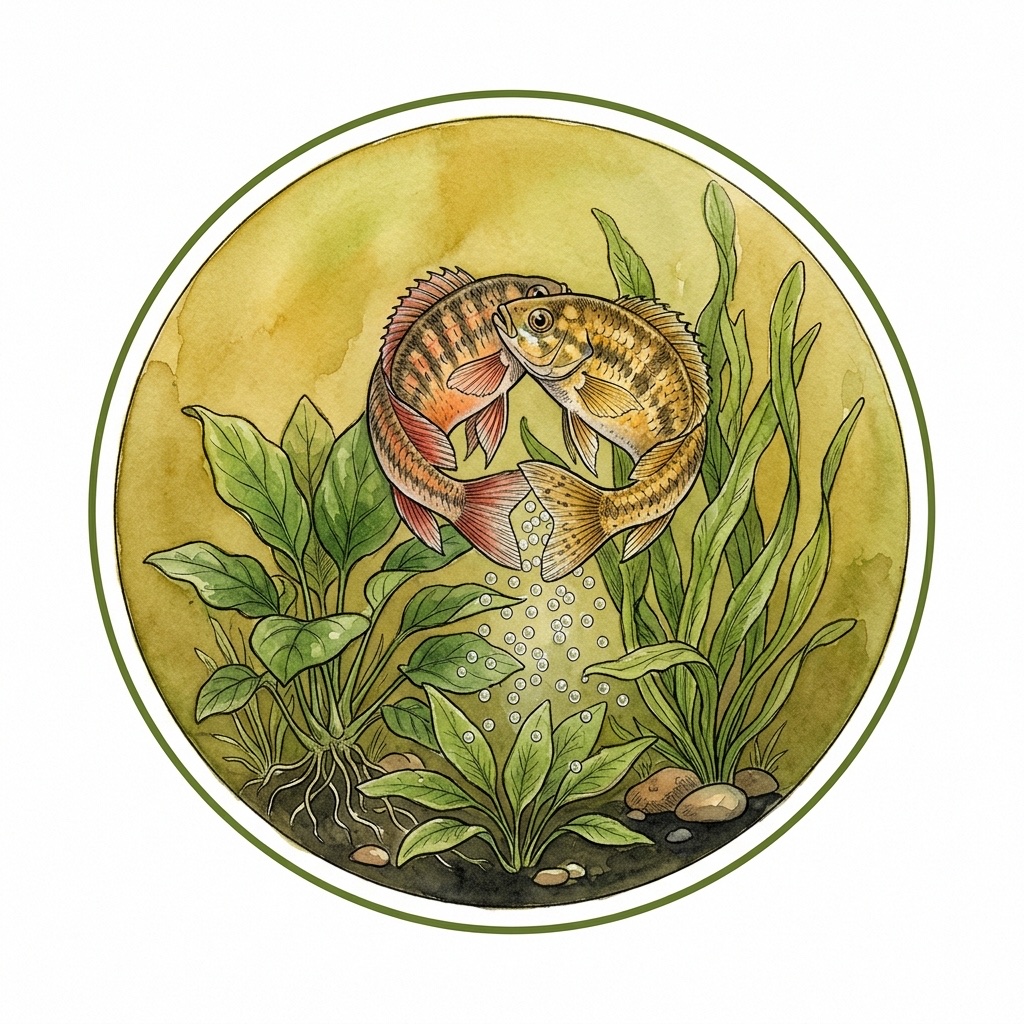
Spawning
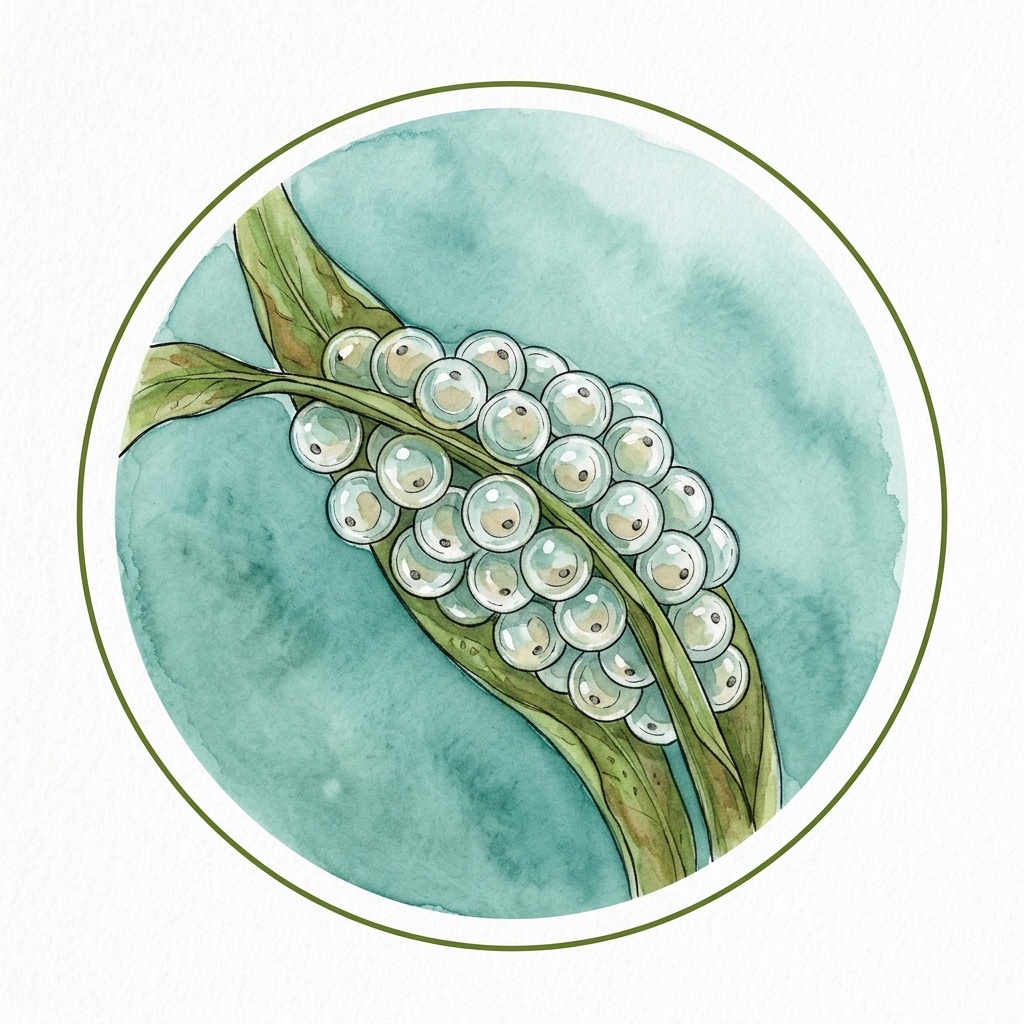
Eggs scattered among plants
Day 1-2
Incubation
Dim tank, add methylene blue
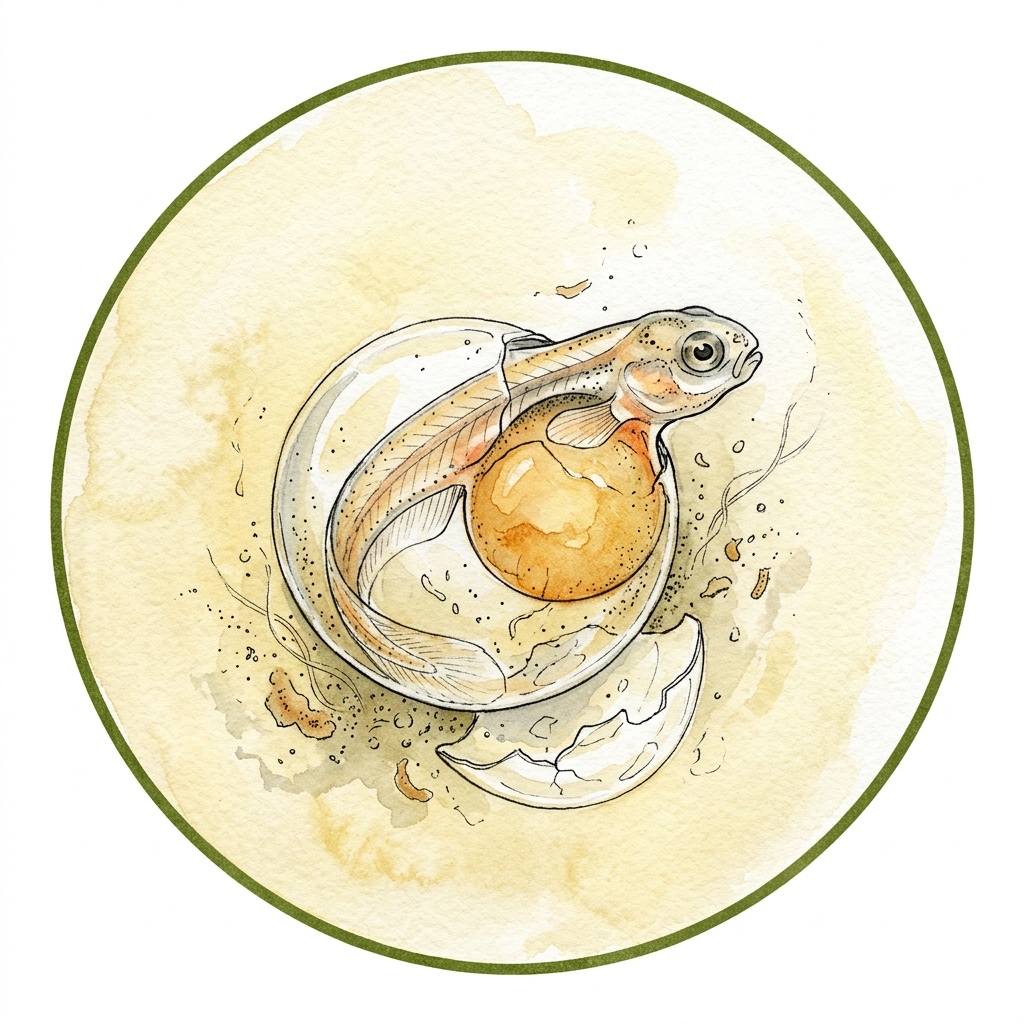
Day 2-3
Hatching
Larvae attach to surfaces
Conditioning
Identify two to three of your best males (those with the longest, cleanest fin filaments and strongest pink flush) and three to four mature, well-filled females. House them in separate conditioning tanks if possible, or at opposite ends of a divided tank. Feed heavily on a rotation of live and frozen foods — daphnia, brine shrimp nauplii, bloodworm, grindal worms — twice daily for at least 10-14 days. Females should visibly round out with eggs; males should begin displaying more frequently and show peak fin colour.
Introduction to Spawning Tank
Set up a 30-40 L bare-bottomed spawning tank with very soft water (2-4 dGH, pH 6.0-6.5, temperature 26-27 °C), dim lighting, and a generous spawning mop or mass of Java moss on the bottom. A gentle sponge filter provides aeration without current. Introduce one or two males and two to three females in the evening. Cover the tank sides with paper or a cloth drape to reduce disturbance.
Spawning
Spawning almost always occurs at first light. Males chase females through the moss in a driving, serpentine pattern, and the female releases small clusters of translucent, adhesive eggs that settle among the plant or mop fibres. A receptive female may release 100-250 eggs in total across the morning. Remove all adults immediately after spawning activity subsides — H. bentosi are enthusiastic egg-eaters and will clear the spawn within hours if left in place.
Incubation
Keep the tank dark or heavily shaded — the eggs are light-sensitive and fungus develops quickly in bright conditions. A few drops of methylene blue in the water inhibits fungal growth on unfertilised eggs and does not harm the fertile ones. Maintain the sponge filter at minimal flow and check daily for white, fuzzy eggs that need removing with a pipette.
Hatching
Tiny translucent larvae emerge and immediately attach themselves to plants, mop fibres, and glass by their yolk sacs. They are very nearly invisible at this stage and should not be fed — the yolk sac supplies all needed nutrition for the first 48 hours. Continue to keep the tank dim and minimise disturbance; the fry are fragile for the first few days.
Compatible Species
The White-Fin Ornate Tetra is at its best in a peaceful South American community tank, ideally one assembled with an Amazon biotope theme in mind. The ideal community stacks species across vertical zones to maximise visual interest without creating competition: Hatchetfish at the surface, the Ornate school plus a Rummy Nose school through the mid-water, an Apistogramma pair holding a small cave at the bottom, a group of Corydoras working the substrate, and a single Bristlenose Pleco doing night duty on the glass. A community composed this way not only looks spectacular but also runs stably — each species has its own niche, food stays well distributed, and territorial conflicts are minimal.
The overriding rule, however, is absolute: no fin-nippers. The extended fin filaments on mature male Ornate Tetras are what make the species special, and they are also extraordinarily vulnerable to harassment. Tiger Barbs, Serpae Tetras, large danios, and anything else with a reputation for nipping will shred those fins within days, often so thoroughly that they never regrow properly. Similarly avoid anything aggressive enough to break up the school or large enough to view the tetras as food — larger cichlids, predatory catfish, and oversized gouramis are all non-starters. When in doubt, imagine how the proposed tank mate would behave if trapped in a 60 L tank with six delicate, pink, trailing-finned fish, and let your imagination tell you whether the pairing is wise.
It is worth spending a moment on why the fin-nipping problem is especially acute for this species. Many small community tetras have fins short enough to be uninteresting targets for fin-nippers — a Neon Tetra’s anal fin is simply not long enough to attract attention. The Ornate male, by contrast, parades through the mid-water with what amounts to a banner of fin tissue trailing behind him. To a fin-nipping species this is an irresistible target, and the damage tends to cascade: once the filament is broken, the white-black rim frays, the surrounding tissue becomes vulnerable to bacterial or fungal infection, and the male loses both his ornamentation and his social standing within the school. Even a single Tiger Barb mixed into an otherwise perfect community will, within a week, reduce every male Ornate in the tank to a ragged silhouette. There is no meeting-in-the-middle with this combination; the two species simply cannot share water.
Schooling size is another quiet determinant of community success. A group of three or four Ornate Tetras in a community tank will not school properly, will hide most of the time, and will rarely display. A group of six or more begins to behave naturally; eight to ten or more is better still, and is the size at which the males truly start throwing fins at each other in the confident, ritualised way the species is famous for. If space permits, always err on the side of more, not fewer. In a tank of 120 litres or more, a group of fifteen to twenty Ornate Tetras forming a single loose school is one of the genuinely grand sights in the planted aquarium hobby, especially in an Amazon biotope setup with the amber water and dim overhead light that bring their colour fully to life.
A final note on acquisition and introduction. When adding Ornate Tetras to an established community, float and drip acclimate them over at least thirty minutes to match temperature and chemistry. Dim the tank lights for the first day or two after introduction, and ensure that the dominant species in the existing community are well fed before you release the new fish, to reduce initial harassment. The school will typically school tightly together in a single corner for the first few hours, then begin to expand across the tank over the course of the first day. Full settled behaviour — loose schooling, male display, active mid-water feeding — usually emerges within a week to ten days in a well-prepared community.
| Species | Why | |
|---|---|---|
| ✅ | Corydoras (Sterbai, Panda, or Bronze Cory) | Peaceful bottom-dwellers from the same biotope. They sift the substrate for leftover food, occupy a completely different zone from the mid-water Ornate school, and share identical water preferences. |
| ✅ | Rummy Nose Tetra | A superb visual complement. The Rummy Nose’s tight schooling and red head contrast beautifully against the pale pink-white of the Ornate, and their water preferences overlap almost perfectly. |
| ✅ | Pencilfish (Nannostomus species) | Gentle mid-to-upper dwellers that occupy a slightly different feeding niche. Their slow, deliberate swimming style is a good foil to the more active Ornate school. |
| ✅ | Dwarf Cichlid (Apistogramma cacatuoides or A. agassizii) | Ideal centrepiece fish for an Ornate Tetra community. They hold small bottom territories without bothering mid-water schoolers and share the same soft, acidic water preferences. |
| ✅ | Small Pleco (Bristlenose or clown pleco) | Nocturnal or crepuscular bottom-grazer that does its algae work overnight and poses no threat to the tetras. Bristlenoses in particular stay small enough not to destabilise the tank. |
| ✅ | Neon Tetra or Cardinal Tetra | Classic community partners. Their blue-red stripe adds a completely different colour note alongside the Ornate’s pink-white glow, and both share the same mid-water niche without competing. |
| ✅ | Otocinclus | Tiny, harmless algae grazers that keep plant leaves and glass clean. They are completely peaceful and share soft-water preferences with the Ornates. |
| ✅ | Hatchetfish (Carnegiella strigata) | Strict surface dwellers from the same Amazon biotope. They occupy a layer the Ornates never use, making them effectively invisible to each other. |
| ❌ | Tiger Barbs | The single most problematic companion for this species. Tiger Barbs are notorious fin-nippers and will relentlessly target the long trailing filaments of mature male Ornate Tetras, shredding the fins within days. |
| ❌ | Serpae Tetras | Despite being closely related, Serpae Tetras have a strong fin-nipping reputation and will attack the trailing filaments of the Ornates when housed together. Avoid them even in a large tank. |
| ❌ | Large cichlids (Oscars, Jack Dempseys, Firemouths) | At 4 cm, Ornate Tetras are bite-sized prey for any medium or large cichlid. They will be eaten or chronically stressed to death by intimidation alone. |
| ❌ | Aggressive or territorial fish (Red-Tail Shark, larger loaches) | Chase and harass the school, prevent display behaviour, and cause chronic stress. The trailing fins are particularly vulnerable to any fish inclined toward fin-nipping or intimidation. |
| ❌ | Fast competitive feeders (large danios, giant danios) | Although not aggressive in the classical sense, they will outcompete the Ornates for food at every feeding and stress the school into reduced colour and behaviour. |
Quick Reference
| Scientific Name | Hyphessobrycon bentosi |
| Common Names | White-Fin Ornate Tetra, Bentos Tetra, Ornate Tetra |
| Adult Size | 4 cm |
| pH | 5.5-7.2 (ideal 6.5) |
| Temperature | 22-27 °C (ideal 25 °C) |
| Hardness | 2-10 dGH (soft to medium) |
| Min. Tank | 60 L for a school of 6+ |
| Diet | Omnivore — flake, micro pellet, frozen daphnia and bloodworm |
| Tank Position | Middle to upper-middle |
| Schooling | Keep in groups of 6+, ideally 8-10 |
| Community | Rummy Nose, Corydoras, Apistogramma, Pencilfish, small Pleco |
| Avoid | Tiger Barbs, Serpae Tetras, large cichlids, any fin-nipper |
| Breeding | Egg-scatterer, dedicated soft-water spawning tank required |
| Lifespan | 4-6 years |
| Signature Feature | Long white-tipped dorsal and anal fin filaments in mature males, shown best in soft tannin-stained water |
| Best Observed | Morning and dusk hours, when male display activity peaks |
Related Products

Reviews
Clear filtersThere are no reviews yet.