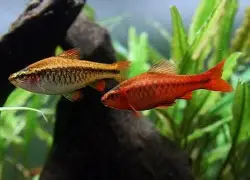
🪨 Species at a Glance
| Scientific Name | Puntius titteya |
| Family | Cyprinidae |
| Order | Cypriniformes |
| Origin | South-western Sri Lanka — Kelani and Nilwala river basins |
| Variety | Wild-type — natural colour form, not line-bred |
| IUCN Status | Near Threatened (wild populations) — tank-bred preferred |
| Adult Size | 4–5 cm (1.6–2 in) — males slightly smaller, leaner |
| Lifespan | 5–7 years in well-kept tanks |
| pH Range | 6.0–7.5 (ideal 6.8) |
| Temperature | 22–27 °C (72–81 °F) |
| Hardness (dGH) | 4–15 — soft to moderately hard |
| Diet | Omnivore — micro-pellet, flake, frozen, live, occasional veg |
| Minimum Tank Size | 60 L (16 gal) for a school of 8+ |
| Care Level | Easy — beginner-friendly, peaceful community fish |
| Temperament | Peaceful schooling fish; no fin-nipping, no aggression |
| Breeding | Egg scatterer on fine plants and java moss — beginner-friendly |
| Tank Position | Middle to lower — prefers shaded, planted zones |
Species Background
The common name “Cherry Barb” is one of the most direct in the hobby. Take a mature, conditioned male in breeding colour, place him against a dark planted background under warm LED lighting, and the flanks glow with the exact saturated red of a fresh ripe cherry. The name dates to the species’ first exports from Ceylon (now Sri Lanka) in the 1930s, when European aquarists — starved for unusual soft-water community fish after decades of livebearers and characins — seized on this small, ember-coloured cyprinid as something new. Early trade catalogues photographed peak-condition males almost exclusively, and generations of hobbyists bought their first Cherry Barbs expecting every fish in the school to look like the glowing red creature on the shop sign. The disappointment on discovering that the females are tan-brown with a dark lateral stripe, and that even males only colour up fully under the right conditions, is a rite of passage that has persisted for eighty years. The cherry hue is real, but it is strictly a male-in-condition phenomenon; a newly-arrived juvenile or a stressed, under-fed, over-lit, or ill-schooled adult may never show more than a faint pink blush.
The scientific name Puntius titteya has its own story. The genus Puntius is a large, long-contested Old World cyprinid grouping that has been repeatedly split and reassembled by systematic ichthyologists over the last two decades. In 2012, a major revision by Pethiyagoda, Meegaskumbura, and Maduwage moved several species into new or resurrected genera such as Dawkinsia, Systomus, Haludaria, and Pethia. The Cherry Barb briefly circulated under Systomus titteya in some literature, but subsequent work has largely settled the species back into Puntius titteya as the accepted binomial. You may still encounter Barbus titteya and Systomus titteya on older shop labels, aquarium books, and hobby websites — all refer to the same fish. The species was first formally described by Sri Lankan scientist P. E. P. Deraniyagala in 1929.
The species epithet titteya is a transliteration of the Sinhalese word “titteya”, the local common name used in Sri Lanka for this and several related small barbs found in lowland streams. It is one of a small handful of aquarium fish whose scientific name preserves an indigenous common name from the country of origin — a detail worth noting, because it reminds us that Puntius titteya is not a generic tropical fish that happens to be red. It is an ecological specialist, endemic to a specific and threatened band of south-western Sri Lankan lowland rainforest streams. In the wild, titteya are found in the Kelani, Kalu, Bentota, Gin, and Nilwala river basins — shaded blackwater streams flowing through the remnants of the Sinharaja rainforest biosphere reserve, with soft, slightly acidic water, dense bankside vegetation, and thick leaf-litter substrates. They school in modest groups of ten to thirty, grazing on aufwuchs, insect larvae, and fallen vegetation, and rarely move far from overhanging marginal plants.
That native range is now under serious pressure. Sinharaja and the surrounding south-western lowlands have lost the majority of their pre-colonial rainforest cover to tea estates, rubber plantations, rice paddies, and expanding settlements. The streams that remain face silt loading from deforested hillsides, nutrient runoff from agriculture, and in some areas direct pollution. Historic overcollection for the aquarium trade — at its worst in the 1960s and 1970s, before commercial tank-breeding operations took over — added substantial local pressure. The cumulative effect is that the IUCN Red List currently categorises Puntius titteya as Near Threatened, with wild populations declining across most of their native range. The species survives comfortably in captivity thanks to decades of commercial breeding in Sri Lanka, Southeast Asia, and Eastern Europe, but the wild population is no longer the inexhaustible resource it was once assumed to be. For this reason, the wild-type Cherry Barbs offered at Amazonia are tank-bred stock, not wild-caught, and any responsible keeper should insist on the same from any supplier — a polite question to the shop staff (“is this tank-bred or wild-caught?”) is a free conservation contribution that makes a real difference over time.
Water Chemistry Guide
6.0–7.5
ideal 6.8
22–27 °C
ideal 25 °C
4–15 dGH
Soft to moderately hard — soft preferred for colour
Wild Puntius titteya live in slow-flowing, heavily shaded lowland streams draining the Sinharaja rainforest and neighbouring south-western Sri Lankan catchments. These waters are soft (typically under 4 dGH), slightly acidic (pH 6.0–6.8), stained amber-brown by tannins from decomposing leaf litter, and moderately warm — usually 24–26 °C year-round. Cherry Barbs thrive when you reproduce something close to this chemistry. That said, decades of commercial tank-breeding across Sri Lanka, Southeast Asia, and Eastern Europe have produced lines that tolerate a much broader range: pH from 6.0 to 7.5, hardness 4 to 15 dGH, and temperature anywhere between 22 and 27 °C all work. The ideal sweet spot for colour and breeding condition lands at pH 6.8, 25 °C, and 6–8 dGH — achievable from most Australian tap water with modest conditioning.
Soft, slightly acidic, tannin-stained water matters for this species in a way it does not for tiger barbs or zebra danios. Cherry Barbs in soft blackwater-inflected conditions colour up more deeply, breed more reliably, and show their full natural behaviour (tight schooling, gentle grazing, active male display) more readily. The single cheapest and most effective way to simulate blackwater conditions is leaf litter: a handful of Indian almond (Catappa) leaves, alder cones, or oak leaves dropped into the tank releases tannins that soften and acidify the water, tint it a natural amber, and deliver mild antimicrobial benefits. Two to three almond leaves in a 60-litre tank, replaced monthly, deliver visible colour improvements in the shoal within four to six weeks. If your tap water is genuinely hard and alkaline (as in much of Adelaide and Perth), blend 30–50% RO water with dechlorinated tap water, or use a peat-based substrate additive to buffer gently downward over time.
Stability matters far more than hitting a perfect number. A rock-steady pH of 7.2 is much better than one that swings between 6.5 and 7.5 every week. Perform 20–25% weekly water changes, temperature-matching the new water to within one degree, and avoid any change that moves pH by more than 0.3 or temperature by more than 1 °C in a single session. Cherry Barbs dislike rapid shifts — swings trigger stress colouration (pale blotchy flanks, enhanced lateral stripe in males, reduced appetite) and occasionally outbreaks of ich in winter when tap water arrives cold. A timer-controlled inline heater on the water change bucket solves this in five minutes of setup.
Filtration should be gentle. Cherry Barbs are not strong swimmers — they evolved in shaded stream margins with modest flow, not in fast torrents — and heavy filter output pushes them into tank corners where they school poorly. A sponge filter run by an air pump is arguably the best match for a dedicated Cherry Barb tank. If you prefer a canister or hang-on-back, install a spray bar or baffle on the return and aim for 3–5 times tank turnover per hour (not the 6–8 you would run for tiger barbs). A tank of eight adults in a well-cycled 60–80 litre planted setup produces a modest bioload within the capacity of almost any nano-rated filter — oversizing and excessive current is much more common than undersizing.
For Australian keepers, a few regional notes. Melbourne and Sydney tap water sits comfortably within Cherry Barb tolerances with only dechlorination required. Brisbane summer temperatures can push unheated tanks above the 27 °C upper limit in February — float a sealed bag of ice and angle a small fan across the surface for evaporative cooling during heatwaves. Perth and Adelaide tap water is harder and more alkaline; blend with 25–40% RO water or condition via peat and leaf litter to keep the shoal in their comfort zone.
The Colour Spectrum
🍒 Wild-Type Cherry Barb (THIS GUIDE)
The natural form: tan-pink base body with a defined dark brown-black lateral stripe running eye to caudal peduncle. Males in breeding colour deepen to a glowing saturated cherry-red across the whole body; females stay tan-brown with the stripe preserved. Original blood of the Sri Lankan endemic population.
🤍 Albino Cherry Barb
A line-bred recessive variant with no melanin — the lateral stripe is entirely absent, the eyes are red, and the body is a soft peach-pink that deepens to warm rose-gold in males. Genetically the same species but behaviourally and visually distinct — see our separate Albino Cherry Barb guide.
🏳 Long-Fin Cherry Barb
A selectively bred form with extended dorsal, anal, and caudal fins. Available in wild-type or albino base colours. Uncommon in the Australian trade; attractive but harder to breed cleanly as fin length is moderately heritable.
🔴 Super-Red / Show-Grade Cherry Barb
Commercial farm strains selectively bred from wild-type stock for earlier, deeper red saturation in males. Not a distinct variety per se — just the tail end of a selective breeding programme. Good males of this line colour up at 3 cm rather than the 4 cm standard.
⚫ Black Ruby Barb (Puntius nigrofasciatus)
A close relative from the same Sri Lankan endemic genus, not a Cherry Barb variant but often stocked alongside. Breeding males develop an almost black head and deep purple-red body; excellent biotope companion to wild-type titteya.
The wild-type Cherry Barb is a master class in how light, diet, substrate, and mood combine to produce what hobbyists casually call “colour.” At rest in a bare shop tank with bright overhead light and a pale substrate, a mature male may show nothing more than a dusty pink blush along the flank and a faint dark lateral stripe. Move the same fish to a well-planted tank with a dark substrate, floating plants dimming the overhead light, tannin-stained blackwater from Indian almond leaves, and a diet enriched with carotenoid-bearing foods like paprika-supplemented pellets, frozen daphnia, and live baby brine shrimp, and four to six weeks later the transformation is genuinely startling. The lateral stripe fades or dissolves into the surrounding red wash, the flanks deepen from pink through salmon to saturated cherry, and the dorsal and anal fins develop a warm red-orange edging. A peak-condition male chasing a rival through Rotala in a Sri Lankan biotope is one of the most colour-saturated images a nano aquarium can produce.
Females, by contrast, remain determinedly understated. A healthy mature female shows a tan-brown to pale fawn base colour with the lateral stripe intact as a crisp dark line from gill plate to caudal peduncle, often with faint iridescent silver-green along the upper back in good light. Her belly rounds out visibly when she is carrying eggs, and she may develop a faint pink or golden flush along the lower flanks — but even a fully gravid female is never as red as a conditioned male. This is one of the most strongly dimorphic small barbs in the hobby, and the contrast is a feature: a mixed-sex school of eight Cherry Barbs with two to three vividly red males patrolling among five to six calmer brown-striped females produces a far more naturalistic and visually layered display than a monoculture of hyper-coloured males. Resist the urge to select only males at purchase — many shops will try to sell you five males on the basis that “they look better,” but the result is a stressed, constantly sparring cluster that rarely colours up because they have no females to display to.
A critical comparison for prospective buyers: the wild-type Cherry Barb in this guide is not the same fish as the albino Cherry Barb sold elsewhere in the store. The albino is a line-bred recessive morph without melanin — no lateral stripe, red eyes, a softer rose-gold male colour, and higher photosensitivity. The wild-type retains full melanin pigmentation, tolerates normal aquarium lighting without issue, and hits a deeper, more saturated red in peak condition because the underlying dark lateral stripe and scale edges add contrast and optical depth. Both are Puntius titteya. Both share the same water chemistry, diet, temperament, and breeding behaviour. But the wild-type is the original, genetically unaltered blood of the species — the form you would see in a Kelani-basin stream — while the albino is a selectively propagated aquarium morph. Many keepers prefer the wild-type on aesthetic grounds (the stripe-to-red transformation is visually more dramatic) and on conservation grounds (the wild-type preserves the original phenotype of a Near Threatened species). Others prefer the albino for its softer warmer glow. There is no wrong answer, but they are not interchangeable.
Colour saturation in the wild-type also shifts predictably across the day. Early morning fish, before the tank lights come on, are often at their palest — the red fades to coppery pink, the stripe re-emerges, and the shoal looks like a different species entirely. As the light rises and feeding begins, colour deepens within an hour. Peak saturation usually hits mid-afternoon under a well-diffused planted-tank lighting regime. A male who has just lost a dominance dispute may pale briefly as a stress response; a male who has just successfully displayed to a female reaches peak red within minutes. Long-term trends follow diet: a well-fed shoal in clean stable water deepens steadily over the first two months after purchase and peaks through the next year of adulthood. Under carotenoid-deficient flake-only diets, even the best genetic males stall at a dusty pink and never hit full cherry. Patience and the right environment are the two levers that matter.
Creating the Perfect Habitat
The ideal Cherry Barb tank is a gentle Sri Lankan biotope — shaded, densely planted along the back and sides, with open swimming corridors through the middle, a dark substrate, a piece or two of soaked driftwood, and a carpet of Indian almond leaves on the bottom to create the amber-tinted blackwater aesthetic the species evolved in. A 60-litre tank is the practical minimum for a school of eight adults, with 80–100 litres giving the shoal more room. A long, shallow footprint (60 cm+ length, 30–40 cm depth) suits them better than a tall narrow cube — Cherry Barbs are horizontal schoolers and make much better use of length than height. Lighting should be subdued: unlike the albino strain, wild-type Cherry Barbs are not especially photosensitive — their eyes carry normal melanin pigmentation — but they show their best colour under moderate warm-spectrum LED in the 5500–6500 K range, diffused by floating plants across one third to one half of the surface. Run the light on an 8–10 hour photoperiod with a 30-minute dawn-and-dusk ramp.
Substrate choice is flexible but matters for colour. Dark, fine substrates — black basalt sand, dark aquasoils like Fluval Stratum or ADA Amazonia, or fine natural-coloured river gravel — bring out the deep cherry-red of breeding males in a way pale substrates cannot. A pale substrate bounces light back up and washes out the whole shoal; a dark substrate absorbs ambient light and provides the black-background contrast that makes saturated reds pop. If you want to plant densely (as you should), an aquasoil or nutrient-rich sand underlay is worth the extra cost for vigorous long-term plant growth.
Plant densely along the back and sides, leaving the front 50–60% of the tank open for swimming. Sri Lankan biotope species are rarely imported, so most keepers build a generic soft-water Asian biotope using readily available plants: Cryptocoryne wendtii, Cryptocoryne parva, Anubias barteri on driftwood, java fern on rocks and wood, Rotala rotundifolia, Ludwigia repens, Hygrophila polysperma, and a floating layer of Amazon frogbit, red root floaters, or dwarf water lettuce. Java moss draped over driftwood provides excellent shelter for fry if breeding is on the agenda, and sets off the red of mature males beautifully.
Driftwood is the single most impactful hardscape element. One or two pieces of soaked spiderwood, manzanita, or mopani at the back or sides break sight lines, release modest tannins, and provide the overhanging root-system aesthetic Cherry Barbs instinctively congregate around. A piece of driftwood draped with java moss or Bucephalandra is one of the best visual anchors for this species. Leaf litter on the substrate — three or four Indian almond leaves plus a handful of oak or alder cones, replaced every four to six weeks — completes the biotope look and delivers ongoing tannin release for free.
Do not neglect the tank lid. Cherry Barbs are capable of small jumps when startled, especially in the first week after introduction. A glass or mesh lid, with cutouts for filter returns and heater cords sealed off with foam, prevents the occasional tragic loss of a fish found dried on the floor.
On health, Cherry Barbs are robust when kept in the correct soft, slightly acidic water with gentle flow and good planting. The most common issues are white spot disease (ich), occasional fin rot secondary to poor water quality, and very rarely bacterial infections following injury. Ich usually follows a temperature drop or the introduction of unquarantined new fish — treat by raising temperature gradually to 28 °C for two weeks with an ich medication. Fin rot resolves with improved water quality and more frequent changes. Cherry Barbs respond poorly to chronic high nitrate (over 30 ppm) — keep up the 20–25% weekly water changes and nitrates will not become an issue. Quarantine new additions in a separate tank for two weeks before introducing them to an established shoal — a habit that prevents most disease outbreaks in home aquariums.
Tank
60 L minimum for a school of 8; 80–100 L preferred. Long footprint (60 cm+) beats a tall cube
Filter
Sponge filter, nano canister, or baffled HOB rated 3–5x tank turnover. Gentle flow — not heavy current
Heater
50–100 W adjustable heater set to 25 °C; size generously for winter in southern states
Lighting
Moderate, warm-spectrum LED (5500–6500 K). Pair with floating plants to diffuse. 8–10 hr photoperiod
Substrate
Fine dark sand, aquasoil, or dark natural gravel — darker tones dramatically improve male colour contrast
Plants
Dense back and side planting: Cryptocoryne, Anubias, java fern, Rotala, Ludwigia; floating plants up top; java moss on driftwood
Hardscape
One or two pieces of soaked driftwood (spiderwood, manzanita, mopani); optional smooth river rocks for variety
Botanicals
3–4 Indian almond leaves, a handful of alder cones, optional banana or oak leaves — replace every 4–6 weeks
Lid & Test Kit
Glass or mesh lid to prevent occasional jumps; liquid test kit for ammonia/nitrite/nitrate/pH
Sexual Dimorphism
Sexing wild-type Cherry Barbs is among the easiest tasks in the hobby once the fish are mature, which is why this species is often the first recommendation to beginners who want to practise sexing before moving on to more challenging groups like apistogramma or small tetras. In any school of eight or more adults kept for at least two months in well-maintained conditions, the males and females will be instantly identifiable at a glance. The males sit somewhere on the spectrum between “salmon-pink with fading stripe” and “glowing solid cherry red, stripe entirely invisible”; the females sit stubbornly at “tan-brown with a crisp dark lateral line.” No amount of conditioning will ever make a female look like a male, and no amount of stress will make a male’s stripe reappear as crisply as a female’s. The dimorphism is absolute in well-kept adults — far more reliable than in the related albino Cherry Barb, where the missing lateral stripe and reduced overall contrast make sexing subtler and dependent mostly on body profile and fin colouration.
Juveniles are a different story. Cherry Barbs sold at 2–3 cm are essentially impossible to sex reliably, because the adult male colouration does not develop until sexual maturity at around 3.5–4 cm and roughly four to six months of age. Juveniles of both sexes look like small pale females — tan-brown with a lateral stripe — and only gradually reveal their sex as they grow out. This is not a problem for most keepers: the standard advice for Cherry Barbs is always the same, namely to buy a group of eight to ten juveniles as an unsexed shoal and let them sort themselves out over the first two to three months. Shops almost never have perfectly balanced batches anyway, and attempting to buy “four males and four females” from a shop tank of mixed juveniles is a pointless exercise that just wastes the shop owner’s time and yours.
The single most important detail in Cherry Barb sex ratios is the 1:2 male-to-female principle. Mature males are strongly territorial towards each other in breeding condition and will display constantly to the available females; in a male-heavy shoal, the males direct their entire display repertoire at each other in an endless unproductive loop, producing a stressed school in which no one colours up properly and females (if any) spend their lives pursued by frustrated suitors. The corrective is a ratio of roughly one male to two females — so a school of nine might comprise three males and six females, a school of twelve might be four males and eight females. This is the same ratio that works for the albino strain and indeed for most small dimorphic barbs. If you have purchased a juvenile shoal and discover on grow-out that you have ended up with more males than you wanted, the honest solution is to return the extras to the shop for credit, rehome them to a friend, or combine two schools into a larger community tank where there is simply more room for male-male displays to dissipate harmlessly.
Size alone is not a reliable sexing cue in this species — the size difference between sexes is real but small, and juveniles of both sexes overlap so heavily in length that size gives no useful information. Body depth is a better cue: mature females are genuinely deeper-bodied, with a rounder silhouette when viewed from above, and this difference is visible well before full breeding colour develops. View a school from above at feeding time, and the females are the broader, deeper-bodied fish, while the males are the slimmer, more torpedo-shaped ones darting in and out of the group. This trick works with juveniles as young as 3 cm and is the most reliable early-sex indicator available.
| Feature | Male | Female |
|---|---|---|
| Base Body Colour | Deep saturated cherry-red at peak; pale salmon-pink off-condition | Tan-brown to fawn; never red under any condition |
| Lateral Stripe | Fades or disappears entirely when in breeding colour | Strong, crisp, permanently visible dark stripe eye to tail |
| Body Shape | Slimmer, leaner, more torpedo-shaped | Fuller, deeper-bodied; markedly rounder belly when gravid |
| Adult Size | Slightly smaller, ~4 cm typical | Slightly larger and heavier, ~4.5–5 cm |
| Fin Colour | Dorsal, anal, caudal edged with warm red-orange | Fin edges pale hyaline to very faintly pink |
| Behaviour | Actively displays, chases rival males, flares fins in courtship | Calmer, sits in the main body of the shoal, grazes steadily |
| Colour Stability | Colour shifts with mood, time of day, and stress level | Colour largely constant year-round |
What to Feed
Cherry Barbs are classic small omnivores. In the wild they graze on insect larvae, tiny crustaceans, zooplankton, algae films on submerged roots, aufwuchs, and fallen vegetation that drifts down from the overhanging riparian canopy. In the aquarium they accept virtually anything small enough to fit their mouths, and they are notably responsive to diet in a way that makes feeding one of the most enjoyable levers a keeper can pull. Get the diet right and a healthy school of wild-type Cherry Barbs will deepen measurably in colour over four to six weeks; get it wrong and even the best water and aquascape cannot produce a full cherry-red male.
A high-quality micro-pellet or crushed tropical flake should form the staple diet. Look for a product with whole fish meal, insect meal, or shrimp meal as the first ingredient, at least 40% crude protein, some plant matter, and ideally added carotenoid pigments — astaxanthin, paprika extract, or spirulina. Cheap colour-enhancing flakes packed with wheat and soy fillers may produce bright packaging but do not produce bright fish; a small tub of a reputable enhanced micro-pellet (Hikari Micro Pellets, Fluval Bug Bites micro, Tetra Colour, Omega One) is the best single investment you can make for Cherry Barb colour. Feed twice daily in small amounts — only what the school can clean up within 60 seconds.
Supplement the staple two or three times a week with frozen or freeze-dried meaty foods: baby brine shrimp, daphnia, cyclops, mysis, and finely chopped bloodworms are all accepted enthusiastically. Live foods — micro-worms, grindal worms, newly hatched brine shrimp, black worms — trigger the most spectacular feeding responses and are particularly valuable for conditioning breeders. Once a week, offer a small vegetable component: blanched spinach, crushed peas with the skin removed, or a spirulina-based flake. This helps digestion, reduces any tendency to graze on softer plants, and contributes plant-based carotenoids that deepen red colouration.
The single biggest dietary mistake new keepers make is overfeeding. Cherry Barbs attack food eagerly enough to look permanently hungry, but they are small fish with small stomachs and modest metabolisms. Two small meals a day is ideal. Excess food plunges to the substrate, spikes ammonia, and contributes to the chronic nitrate creep that washes out Cherry Barb colour over months. A weekly skip-day gives their gut a chance to clear and sharpens the feeding response. If the shoal starts ignoring food at feeding time, cut back — they are telling you they are overfed.
Feeding technique matters too. Rather than dropping a single pinch of flake in one corner, sprinkle food across the full width of the tank so the shoal spreads out and slower individuals get their share. During breeding conditioning, shift towards more live and frozen foods — three live-food meals a week is appropriate for pre-spawn conditioning, cutting back once the spawn has occurred.
Tank Mate Guide
Cherry Barbs are the textbook peaceful community fish. They mind their own business, school loosely when they feel secure (tightening dramatically when threatened), and never bother tank mates — no fin-nipping, no food aggression, no territorial displays outside their own shoal. The key to a successful Cherry Barb community is avoiding anything aggressive enough to stress them, anything large enough to eat them, and anything with water-chemistry requirements incompatible with soft, slightly acidic blackwater conditions. Within those broad constraints, Cherry Barbs pair well with the vast majority of peaceful tropical community fish.
The absolute best biotope companion is the Black Ruby Barb (Puntius nigrofasciatus), another Sri Lankan endemic from the same genus, with the same care requirements, the same peaceful temperament, and a completely complementary colour palette (deep purple-black head and body in conditioned males, against the Cherry Barb’s cherry-red). A mixed school of six Cherry Barbs and six Black Rubies in a well-planted 100-litre tank is one of the most visually striking and ecologically authentic small-tank setups possible, giving Australian keepers a rare opportunity to build a dual-species Sri Lankan endemic biotope at home. Rasbora daniconius is a third Sri Lankan native occasionally imported into the Australian trade and fills the upper water column if available. Beyond the Sri Lankan biotope, broader Southeast Asian peaceful community fish work excellently: harlequin rasboras, galaxy rasboras, neon and cardinal tetras, pearl and honey gouramis, corydoras catfish, otocinclus, dwarf chain loaches, and peaceful snails like nerites and mystery snails all mix beautifully.
School size matters. Cherry Barbs kept in groups smaller than six become nervous, pale, and barely display their full colour or schooling behaviour; eight is the safe floor, ten to twelve is ideal, and larger schools (15–20) in bigger tanks produce breathtaking displays. The 1:2 male-to-female ratio applies — target roughly one male for every two females to keep male display energy focused on females rather than on each other. A school of twelve (four males and eight females) is a classic configuration and works perfectly in a 100-litre planted tank.
The forbidden list is short but firm. Avoid any fin-nipper (tiger barbs, rosy barbs or serpae tetras in small schools, black skirt tetras): Cherry Barbs are slow enough and gentle enough that nipping species will harass them relentlessly. Avoid large cichlids (adult angelfish, severum, discus, oscars, convicts): adults will eat adult Cherry Barbs, and even smaller cichlids will stress them at feeding time. Avoid African Rift Lake cichlids on water-chemistry grounds alone. Avoid large predatory catfish. Be cautious with male bettas — they can work in large densely planted tanks but often fail in small nano setups where the betta perceives male Cherry Barbs as rivals. Shrimp are broadly compatible: adult cherry shrimp usually survive fine, though shrimplets may be picked off by the larger barbs in open water. A densely planted tank with java moss thickets allows a reasonable shrimp population to coexist indefinitely.
FAQ — Wild-Type vs Albino Cherry Barb: Three differences matter in practice. First, colour: wild-type males hit a deeper, more saturated red at peak condition because the residual melanin in scale edges and the underlying (now-dissolved) lateral stripe add optical contrast; albino males reach a softer warmer rose-gold. Second, behaviour: identical — both morphs school, feed, breed, and interact with tank mates the same way. Third, light tolerance: wild-type fish handle normal aquarium lighting without issue; albinos are modestly more photosensitive due to reduced retinal melanin shading, and benefit from slightly dimmer lighting or heavier floating-plant cover. Mixing the two morphs in one school is possible — they interbreed freely since albino is a simple recessive — though many keepers prefer separate tanks to preserve the wild-type phenotype for conservation and aesthetic reasons. For most keepers the choice is purely aesthetic: glowing cherry-red-against-planted-dark versus soft-pastel-rose-gold-against-bright-planted. Both are beautiful; neither is wrong.
A final note on introduction order. When setting up a new Cherry Barb community, you can add Cherry Barbs first or later with equal success — they are not territorial and do not claim the tank against newcomers the way tiger barbs do. Standard practice is to add bottom-dwellers (plecos, corydoras, loaches) first, let them settle for a week, then add the Cherry Barb school, and finally add any centrepiece fish (gouramis, apistogramma) a week after that. Always quarantine new fish in a separate tank for two weeks before introducing them to an established display — a standard practice that prevents most disease outbreaks and costs nothing but patience.
| Species | Why | |
|---|---|---|
| ✅ | Black Ruby Barb (Puntius nigrofasciatus) | Same Sri Lankan endemic genus, same water parameters, same peaceful temperament — the single best biotope companion. Male colour contrast (deep purple-black vs cherry-red) produces a spectacular mixed-school display |
| ✅ | Rasbora daniconius | Sri Lankan native rasbora, shares identical habitat and water chemistry in the wild. Gentle, elongated schooling fish that occupies the upper water column nicely |
| ✅ | Harlequin Rasbora | Peaceful Southeast Asian schooler with near-identical care requirements. The orange-triangle pattern complements Cherry Barb red beautifully without competing |
| ✅ | Neon Tetra | Similar peaceful temperament, similar soft-water preference, similar size. Occupies the mid-column like Cherry Barbs but with minimal overlap in feeding behaviour |
| ✅ | Cardinal Tetra | Same gentle temperament as neons, slightly better soft-water colour. Blue-red contrast alongside Cherry Barbs produces one of the most visually striking soft-water community tanks |
| ✅ | Corydoras (Sterbai, Panda, or Pygmy) | Gentle bottom-dwellers that occupy a different zone, clean up fallen food, and share ideal soft-water parameters. Completely non-competitive with Cherry Barbs |
| ✅ | Otocinclus | Tiny non-aggressive algae eaters that share the same soft-water preference and absolutely ignore the Cherry Barb shoal. Good algae control in planted tanks |
| ✅ | Honey Gourami | Calm, peaceful centrepiece labyrinth fish. Uses the upper water column where Cherry Barbs rarely go, and shares gentle temperament. Unlike tiger-barb tanks, the honey gourami’s fins are completely safe here |
| ✅ | Galaxy Rasbora (Celestichthys margaritatus) | Tiny, peaceful, jewel-spotted nano-rasbora. Pairs visually with Cherry Barbs in a densely planted nano tank and produces one of the most beautiful small-fish combinations in the hobby |
| ✅ | Dwarf Chain Loach | Active, small, peaceful loach that stays bottom-zone, controls snails, and completely ignores Cherry Barbs. Same temperature and water chemistry |
| ❌ | Tiger Barb and Related Semi-Aggressive Barbs | Fin-nippers that will harass the slower, more gentle Cherry Barbs. Tiger Barbs are simply too fast, too food-aggressive, and too confrontational to share a tank with this species long-term |
| ❌ | Large or Adult Cichlids (Angelfish, Severum, Discus) | Adult angelfish or severum will eventually eat adult Cherry Barbs — their mouths are more than large enough. Discus merely outcompete them for food and stress them. Keep Cherry Barbs only with cichlids smaller than 5 cm (e.g. apistogramma) and never with medium-to-large species |
| ❌ | African Rift Lake Cichlids | Wrong water chemistry entirely — hard alkaline water of Lakes Malawi and Tanganyika is the opposite of Cherry Barb requirements. Aggressive temperament compounds the problem |
| ❌ | Large Catfish (Red-Tail, Giant Pleco, Predatory Species) | Any catfish with a mouth wider than the Cherry Barb’s body is a potential predator. Large predatory catfish will systematically pick off small schoolers overnight |
| ❌ | Male Bettas in Small Tanks | While peaceful in spirit, male bettas in under-planted tanks under 60 L can become aggressive towards small colourful schoolers they interpret as rivals — Cherry Barb males with their red colouration are prime targets. A large densely planted tank can sometimes work; a small one almost never does |
Reproduction & Breeding
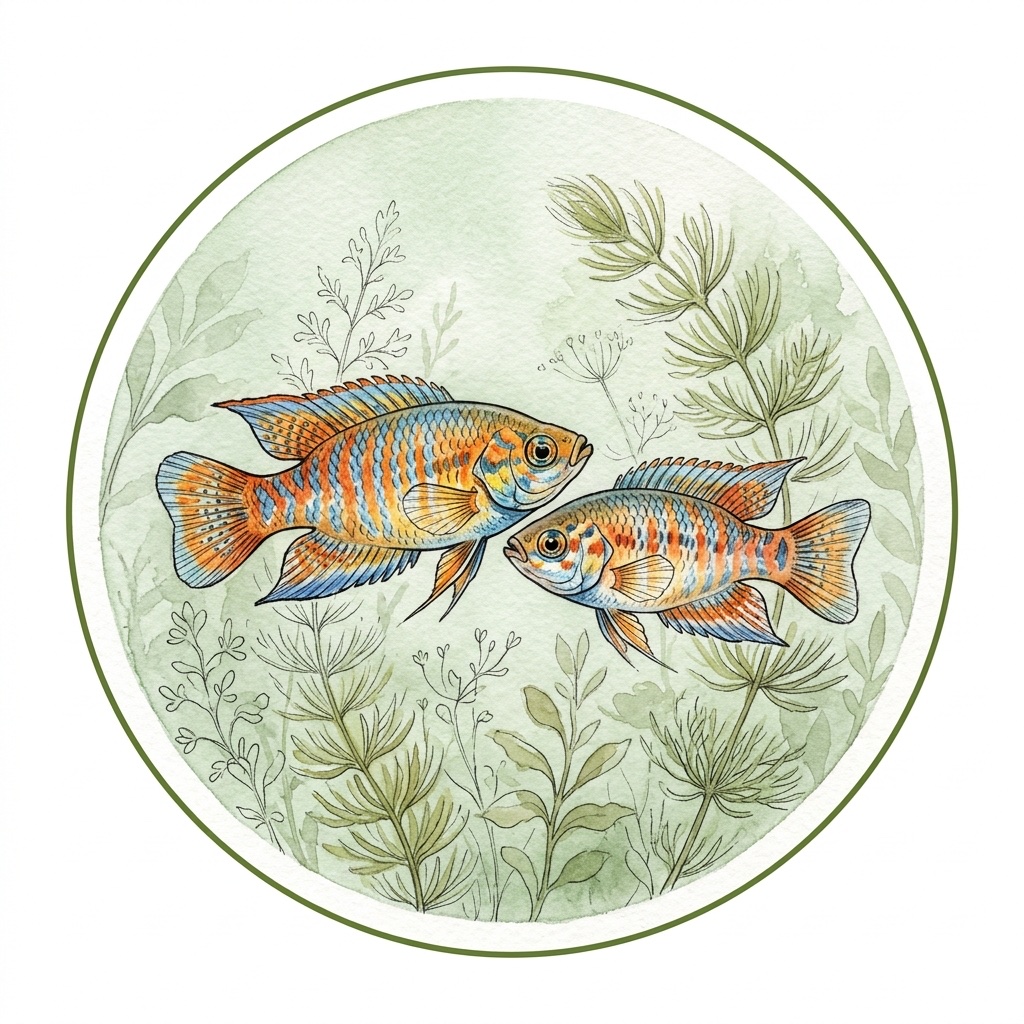
Week -2 to -1
Conditioning
Separate a plump female and a vivid male, feed live foods heavily
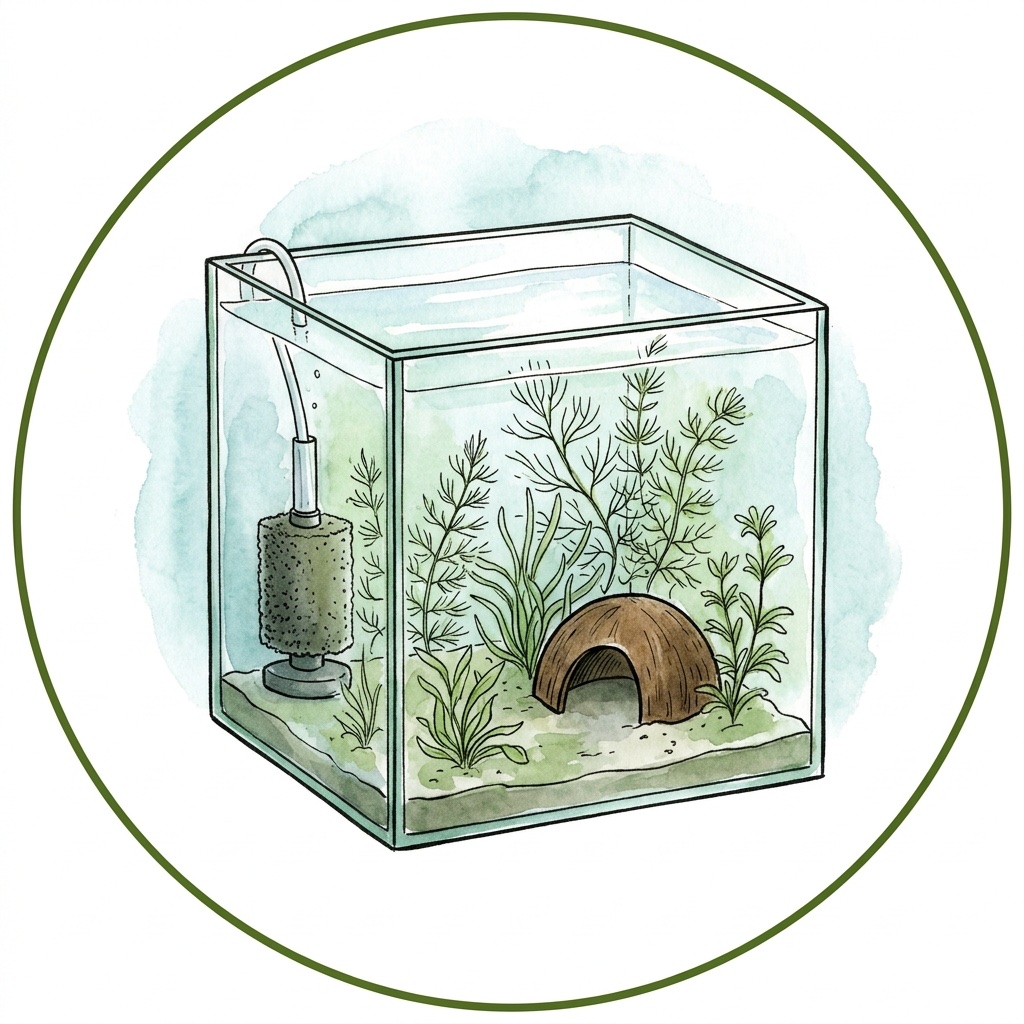
Day 0
Spawning Tank Setup
Prepare a bare-bottom breeding tank with dense java moss or spawning mop
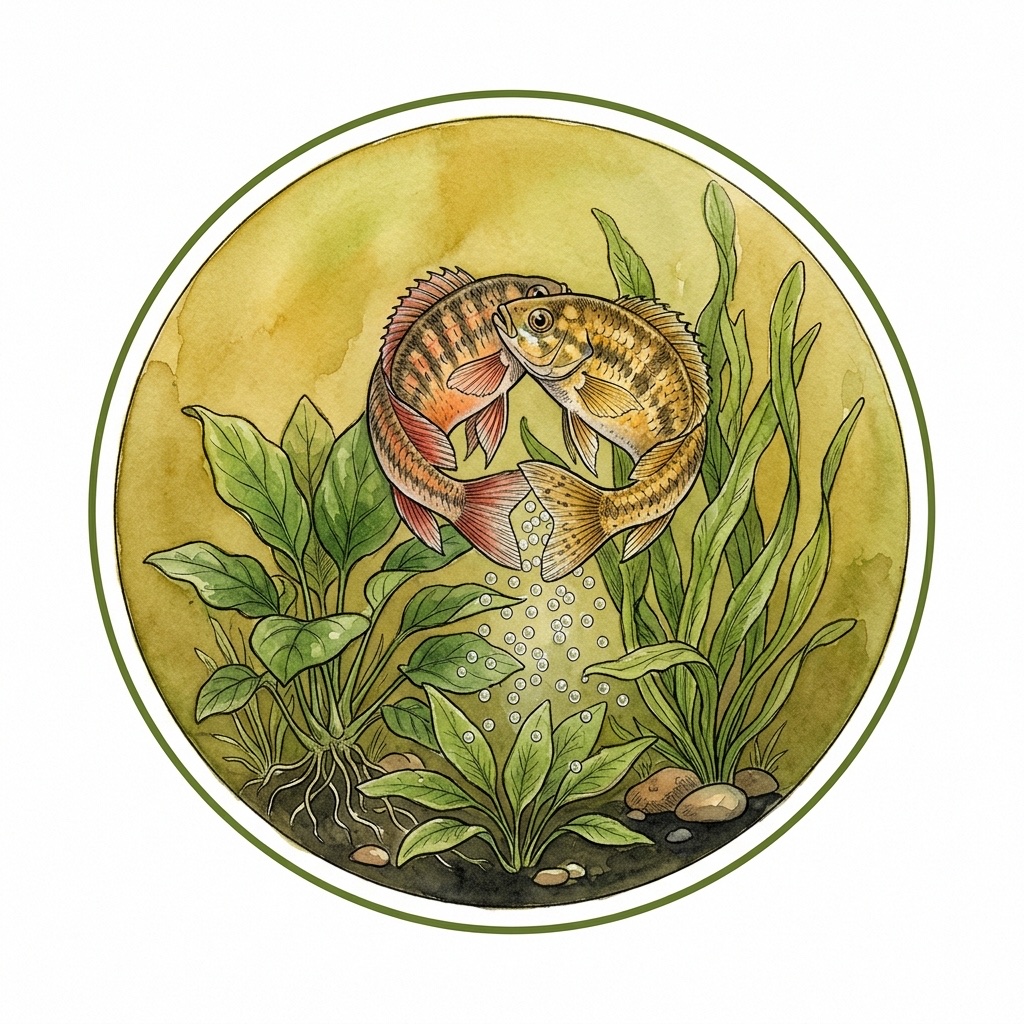
Day 1 (morning)
Spawning
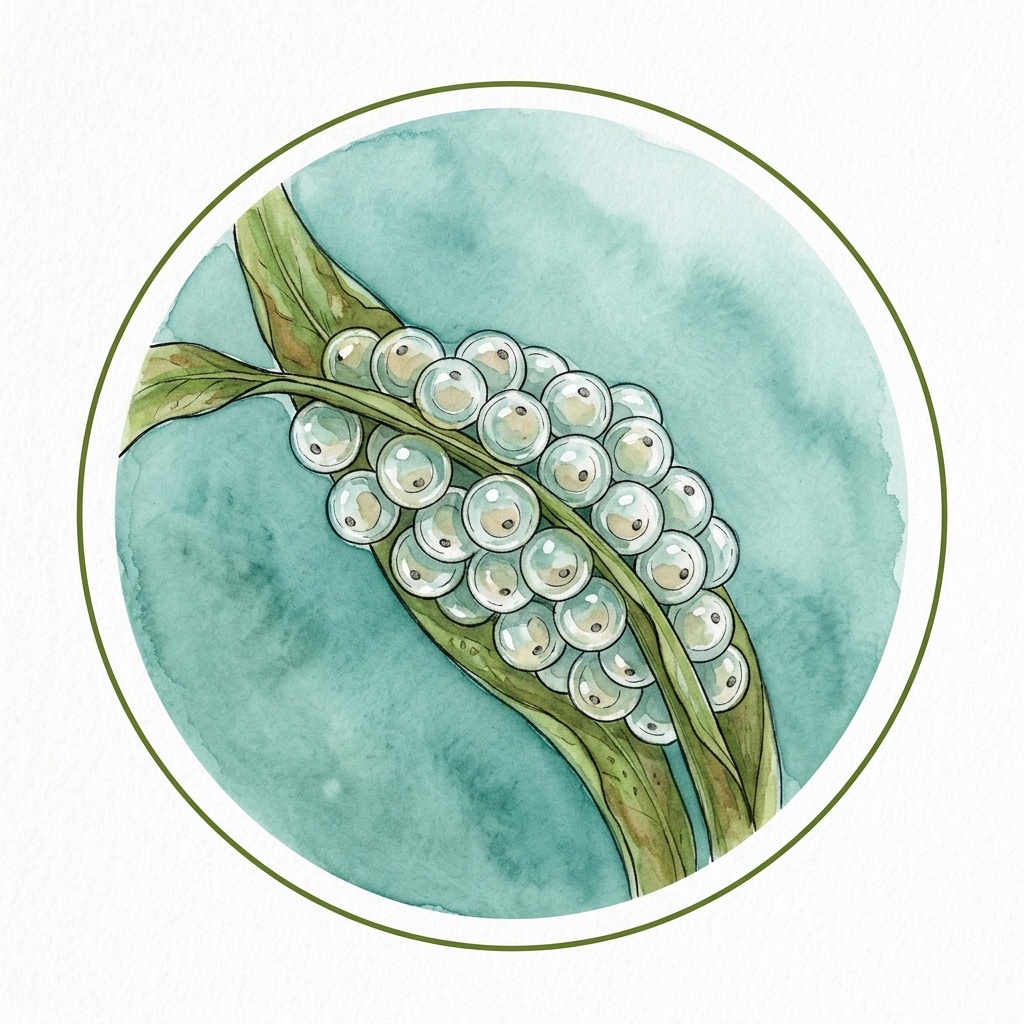
Male drives female through moss; 200–300 eggs scattered
Day 1 (immediately after)
Remove Parents
Parents will eat eggs — remove promptly
Day 2–3
Hatching
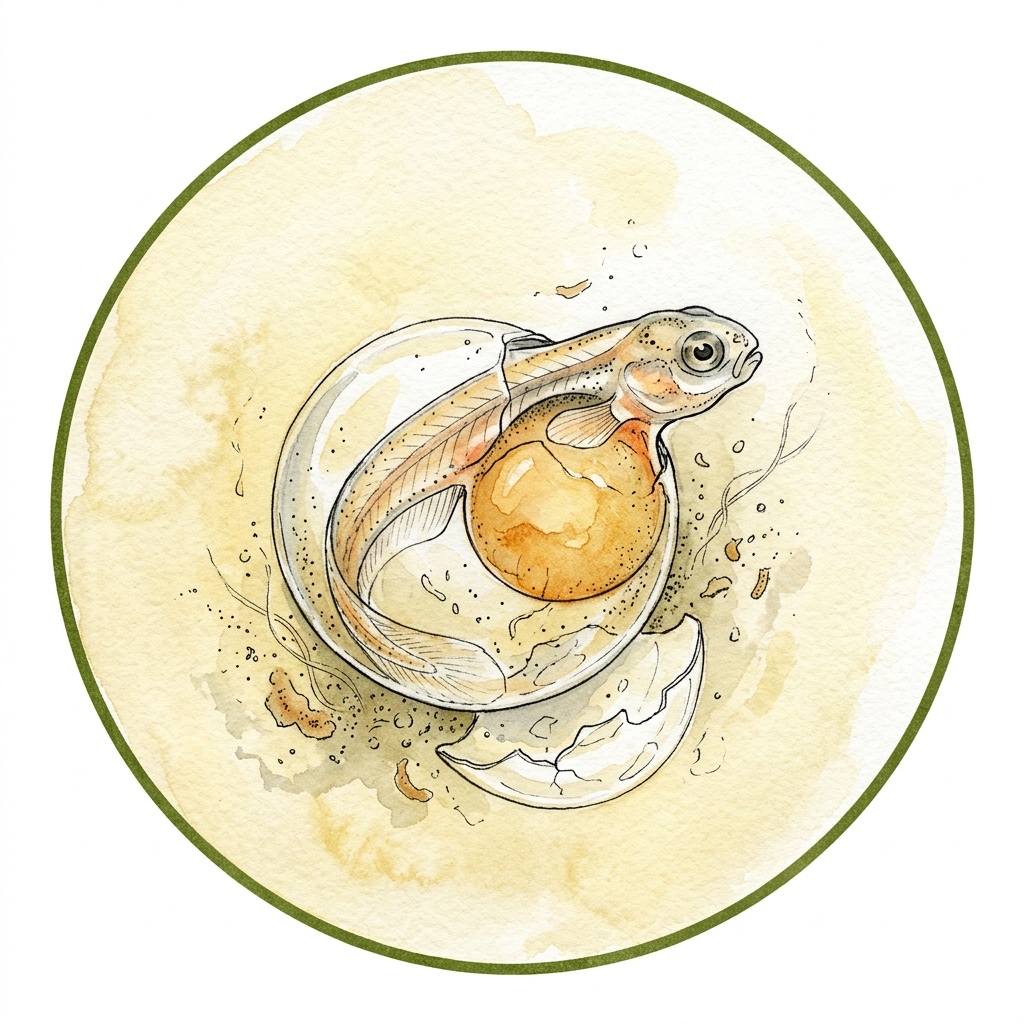
Eggs hatch within 24–36 hours; tiny fry cling to surfaces
Day 4–6
Free Swimming & First Foods
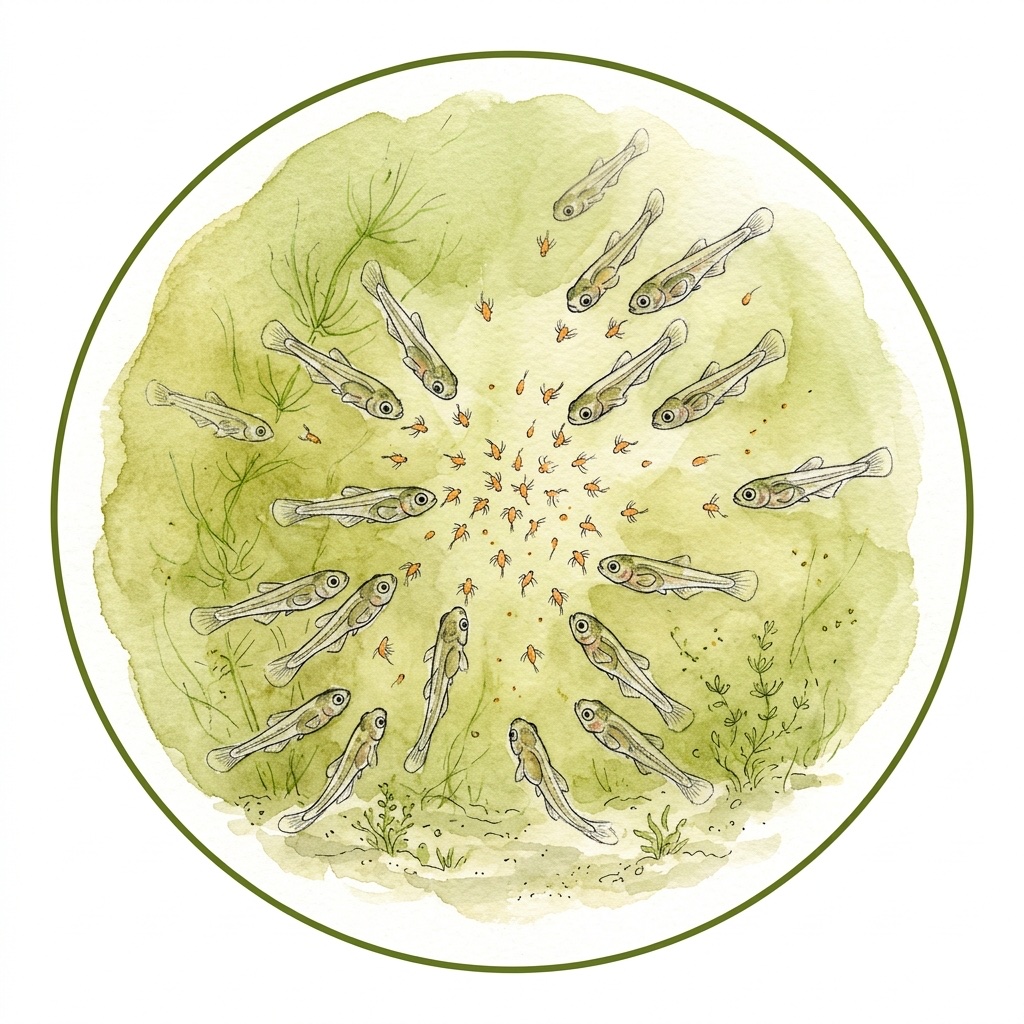
Begin feeding infusoria, then baby brine shrimp
Conditioning
Select the deepest-coloured, most active male from the shoal and the plumpest, most visibly gravid female. If your main tank has a balanced school, you can condition them in-tank by simply upgrading the entire shoal’s diet for seven to ten days — heavy live foods (baby brine shrimp, grindal worms, micro-worms), frozen bloodworms and daphnia, and a daily topping of vitamin-enriched flake. Alternatively, move the intended pair to a small 20-litre conditioning tank with the same water parameters as the main tank. The female should round out noticeably with eggs; the male’s colour will deepen to its most saturated red. Water during conditioning should be very clean — small daily 10–15% changes simulate the pre-monsoon freshening that triggers breeding in the wild. Unlike many small-fish breeding projects, Cherry Barbs do not require extreme soft water or dramatic pH drops to spawn; they will breed readily at the same parameters they live in, which makes them one of the most beginner-friendly breeding projects in the hobby.
Spawning Tank Setup
Set up a dedicated 20–40 litre breeding tank with the same water chemistry as the conditioning tank — pH 6.5–7.0, 6–8 dGH, 25–26 °C. Fill the bottom densely with java moss, fine-leaved plants (Cabomba, Myriophyllum, Ceratophyllum), or a commercial yarn spawning mop. The eggs are adhesive and will stick to fine plant surfaces, falling through into the dense mat where the parents cannot easily reach them. Alternatively, place a plastic spawning grid (mesh size 5–6 mm) over the bottom so eggs fall through into a protected zone below. Use a gentle sponge filter only; never a powered filter that could suck up eggs or fry. Keep lighting dim and the tank covered on three sides to reduce stress. Introduce the conditioned pair in the evening, feed lightly, and leave them alone overnight. Spawning typically occurs at first light the next morning.
Spawning
Spawning begins shortly after first light. The male drives the female through the moss, flashing his fins sideways and nudging her flanks in the characteristic small-barb courtship display. She releases batches of small, slightly adhesive, pale yellow-translucent eggs — 200 to 300 in a session — which the male fertilises as they drift down through the plant mat. The whole spawning event typically lasts one to two hours. Wild-type Cherry Barbs are more orderly spawners than many related small barbs, with less of the frantic chase-and-grab of tiger barbs; the process looks almost choreographed.
Remove Parents
Like most egg-scattering cyprinids, Cherry Barb parents do not guard their spawn and will eat the eggs if given the chance. Remove both parents the moment spawning activity stops — usually visible as the end of active chasing and a return to normal cruising. Net the pair gently and return them to the main shoal. Lower the breeding-tank lighting to very dim, maintain temperature at 26 °C, and leave undisturbed. Cherry Barb parents are less enthusiastic egg-eaters than tiger barbs, but prompt removal is still the safe default.
Hatching
Viable eggs hatch approximately 24 to 36 hours after spawning at 26 °C. The newly hatched fry are tiny and nearly translucent, initially lying on the bottom or clinging to plant surfaces and tank walls as they absorb their yolk sacs over the first 24–48 hours. Infertile eggs turn opaque white within about 12 hours — siphon these out gently with a pipette or flexible airline tube to prevent fungal bloom spreading to viable eggs. A very few drops of methylene blue in the water immediately after spawning can help suppress fungus without harming the embryos. Keep the tank lights very dim or off entirely during this stage; Cherry Barb eggs are modestly light-sensitive though not to the same extent as neon tetra eggs.
Free Swimming & First Foods
Fry become free-swimming around day four to six post-spawn and begin hunting for food. Start with infusoria or a commercial liquid fry food for the first three to five days, then transition to freshly hatched baby brine shrimp as soon as the fry are large enough to take them — usually within a week. Feed small amounts four to six times daily. Gentle 10% water changes every other day keep nitrates low, which is critical in the first three weeks; cycled sponge filtration and daily siphoning of detritus from the bare floor are essential. Growth is steady — fry reach roughly 1 cm at five to six weeks, 2 cm at ten weeks, and can be introduced to the main tank once they clear 2.5 cm and can no longer be mistaken for food by the adults.
Quick Reference
| Scientific Name | Puntius titteya (wild-type) |
| Origin | South-west Sri Lanka (endemic) |
| IUCN Status | Near Threatened — tank-bred preferred |
| Adult Size | 4–5 cm |
| Lifespan | 5–7 years |
| pH | 6.0–7.5 (ideal 6.8) |
| Temperature | 22–27 °C (ideal 25 °C) |
| Hardness | 4–15 dGH |
| Min Tank Size | 60 L for a school of 8+ |
| School Size | 8+ (10–12 recommended), 1M:2F ratio |
| Diet | Omnivore — micro-pellet, flake, frozen, live, weekly veg |
| Care Level | Easy — excellent beginner community fish |
| Temperament | Peaceful schooling fish — no nipping, no aggression |
| Tank Position | Middle to lower; shaded planted zones |
| Breeding | Egg scatterer on fine plants/java moss — beginner-friendly |
| Price | Price on request — please enquire in store |
Related Products


Reviews
Clear filtersThere are no reviews yet.