
🪨 Species at a Glance
| Scientific Name | Anubias afzelii Schott, 1857 |
| Common Name | African Anubias, Afzel’s Anubias (Smooth Standard Form) |
| Family | Araceae (arum family, same lineage as peace lily and philodendron) |
| Origin | West Africa — Guinea, Senegal, Mali, Sierra Leone, Gambia, Guinea-Bissau, Liberia |
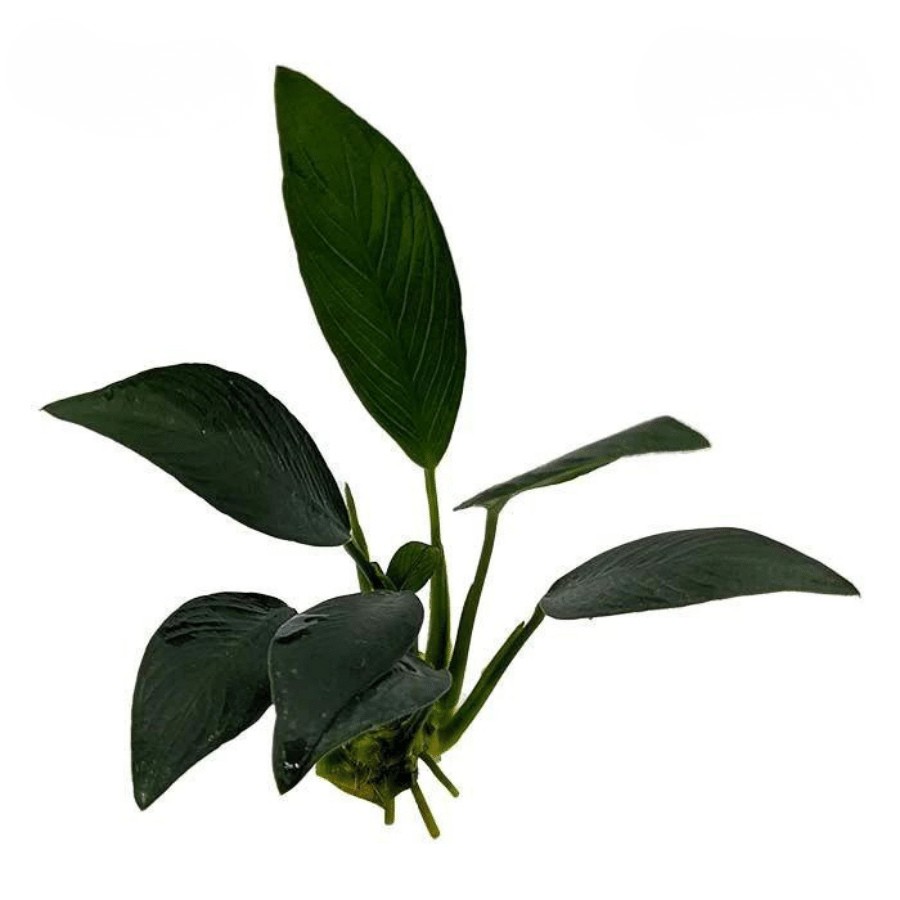
| Leaf Form | Smooth standard — flat, lance-shaped, entire unrippled margin; classic wild-type |
| Adult Height | 30-40 cm with leaves fully expanded above the rhizome |
| Leaf Size | Mature blades 20-30 cm long on petioles of similar length |
| Light Requirement | Low (50-80 PAR at leaf), naturally a shade plant |
| CO2 Requirement | Not required; responds modestly to optional supplementation |
| Growth Rate | Slow — one new leaf every 3-5 weeks at baseline conditions |
| pH Range | 6.0 – 8.0, ideal around 6.8 |
| Temperature | 22 – 28 degrees Celsius, ideal around 25 |
| Placement | Midground to lower-background feature plant |
How to Plant
Rhizome
Anubias afzelii grows from a thick horizontal rhizome, the pale green-brown creeping stem you can see running along the very base of the plant where leaves and roots both emerge. This rhizome is the plant’s engine room and its single most important feature from a planting perspective: it must never, under any circumstances, be buried beneath substrate. Bury the rhizome and within a few weeks it will rot from the inside out no matter how perfect your water chemistry might otherwise be, because the rhizome is an aerial organ that relies on direct contact with oxygenated water and on the constant subtle drying and wetting that epiphytic African stream plants experience in the wild. Instead, the plant is designed to be anchored to a hard surface — driftwood, lava rock, dragon stone, seiryu, cholla branches, ceramic ornaments, pipe intakes, or even the bare glass edge of a rimless tank — with its roots free to grope through the water column and into crevices until they find their own grip and chemistry of choice.
To attach a freshly unpacked smooth-form afzelii, gently rinse any residual substrate, gel, or packing medium from the roots under tank-temperature water, trim any blackened or mushy root tips with clean sharp scissors, and lay the rhizome along your chosen hardscape in the orientation you want the leaves to face. The plant produces leaves unilaterally along one face of the rhizome, so placing the rhizome so that face orients outward toward the viewer pays aesthetic dividends later. Use dark cotton thread or small dabs of cyanoacrylate superglue gel (the standard black-cap hobby glue) on the rhizome’s underside only, never on cut surfaces or on visible growth buds, to hold the plant firmly against the hardscape. Cotton thread is the gentler of the two options and dissolves naturally in about four to eight weeks; by then the roots will have physically wrapped the wood or stone and the plant is self-anchoring for its entire remaining life. Superglue sets in seconds and gives an immediately secure mount but can leave a small pale scar on the rhizome surface.
Placement height and hardscape context matter unusually much for the smooth form specifically, because the flat lance-shaped leaves project outward in a classic symmetrical fan and any visual awkwardness in the rhizome’s angle becomes immediately obvious. Afzelii reads best when its rhizome is tucked slightly into a cranny, a shadow, or the base of a vertical hardscape element so that the leaf blades do the visible work while the rhizome itself remains half-hidden. Avoid perching the plant on top of a high rock where the rhizome is exposed to direct overhead light — not only is this where algae will first colonise the plant, but the standard form’s flat leaves look most natural when they appear to emerge from a concealed base, echoing how the plant grows along the shaded undercuts of West African streams. If your scape has a main central driftwood piece, consider tucking the afzelii rhizome into the V where a branch leaves the main trunk; the fan of leaves will project outward and the rhizome disappears entirely.
A final consideration worth mentioning is the plant’s orientation relative to water flow. In the wild, afzelii grows with the direction of current running parallel to the rhizome axis so that leaves present their narrow edge to the flow rather than the broad face of the blade, minimising drag and reducing the risk of leaf tearing during seasonal flood events. Replicating this orientation in the aquarium by aligning the rhizome along the natural flow line from filter return toward intake produces noticeably cleaner, more undamaged leaves over time and reduces the incidence of leaf detritus collection on blade surfaces. The plant can of course tolerate being planted crosswise to flow and will grow healthy leaves regardless, but orientation parallel to flow is a small free win that experienced aquascapers exploit for both aesthetic and practical reasons. Over the first two to three months after attachment, monitor the rhizome to confirm it is producing fresh roots — visible as pale white or slightly pink root tips emerging from the underside of the rhizome and exploring outward toward any available surface. Active root production is the single best indicator of a successful attachment; if after eight weeks you see no new root activity, gently inspect the rhizome for signs of rot or lift the plant and reposition it to a slightly more sheltered location with better water contact.
Lighting Guide
LOW LIGHT
PAR: 50-80 PAR at the leaf surface
High
Anubias afzelii is a true shade-loving plant and the smooth standard form expresses this heritage more visibly than any of the cultivated variants. In its wild habitat across West Africa the plant grows under a dense tropical gallery-forest canopy along watercourses and seasonally flooded forest floors, receiving only filtered, dappled, shifting light for most of the day and never being exposed to direct overhead sun. In aquarium conditions this translates to a very low light requirement of roughly 50 to 80 PAR measured at the leaf surface, which every modern LED fixture from entry-level to high-end can deliver easily, particularly when dimmed or when the plant is positioned somewhere in the scape that is naturally shaded by taller plants, floating plants, hardscape overhangs, or the rim of the tank itself. A common and highly effective low-tech approach is simply to let floating plants such as Amazon frogbit, red root floater, salvinia minima, or pistia stratiotes cast a mottled roaming shadow over the afzelii zone of the tank — the smooth leaves develop their richest, deepest green colour under exactly this kind of broken, biologically appropriate light, and the floating plants themselves contribute to nutrient balance and algae prevention.
Too much light is the single most common problem with any Anubias in the aquarium hobby and afzelii is absolutely no exception to this rule. Under prolonged high-light exposure the smooth leaves begin to accumulate green spot algae (GSA) as tiny hard flecks that eventually cover the leaf surface like a fine green dust, and in more severe cases black brush algae (BBA) will colonise leaf margins, petioles, and rhizome crevices where it becomes very difficult to remove without physically cutting the affected tissue away. If you observe either form of algae beginning on afzelii leaves, the correct response is almost never stronger liquid algaecide or aggressive chemical treatment — it is simply less light. Reduce your daily photoperiod, dim the fixture by twenty to forty percent, move the plant deeper into the shadow cast by nearby hardscape or taller plants, or add floating plants to break up the overhead beam. A photoperiod of eight to ten hours is plenty for afzelii; there is no productive benefit to running the lights longer than this for a plant whose leaf turnover is measured in weeks rather than days, and real risk of algae proliferation triggered by the mismatch between a fast photoperiod and a slow metabolism.
Colour temperature and spectrum matter less than intensity. Afzelii grows fine under cool daylight LEDs in the 6500 to 7500 Kelvin range, under warmer plant-specific spectra around 5000 to 6000 Kelvin, or under the pinkish high-red aquascaping spectra. The one spectrum choice worth considering is that warmer tones make the leaves look richer and more authentically biotope in a display tank, while cooler whites make the plant look slightly paler and more clinical. This is a purely aesthetic consideration, not a horticultural one — the plant itself does not meaningfully care.
One subtle lighting principle worth keeping in mind is that afzelii responds more strongly to total daily light integral — the cumulative amount of photosynthetically active radiation delivered across the whole photoperiod — than to peak intensity at any given moment. This means a six-hour burst of intense light is worse for the plant than a ten-hour gentler photoperiod of the same cumulative integral, because the slow-metabolism plant simply cannot use the peak intensity and the excess energy ultimately feeds algae rather than the plant. If your fixture offers a ramp-up and ramp-down dimming schedule, use it; a gentle dawn-to-dusk curve that peaks at moderate intensity for only two to three hours in the middle of the day replicates natural forest canopy light better than a brute-force on-off schedule and produces visibly healthier afzelii over months.
Recommended Photoperiod: 8-10 hours
Carbon & Nutrients
CO2 OPTIONAL
Pressurised CO2 injection is never required for Anubias afzelii smooth form and the plant will grow perfectly healthily and produce its classic long lance-shaped leaves in a tank that has no gas injection at all for its entire multi-year life. This is one of the primary reasons afzelii has become such a popular choice across multiple aquascape philosophies: for simple community tanks, for low-tech beginner setups, for paludarium margins where gas injection is impractical, for Walstad-style dirt-substrate ecosystems, and for nano and pico tanks where a full CO2 system would be both disproportionate in cost and impractical in space. The plant’s extremely slow growth rate means its total carbon demand is genuinely modest, and the small amount of atmospheric CO2 that dissolves into aquarium water through normal surface agitation combined with the respiration of fish and beneficial bacteria is usually more than sufficient to keep afzelii leaves forming at the normal baseline rate.
That said, afzelii does respond measurably and visibly to carbon supplementation when you have reason to want faster leaf production — for example when growing a small specimen into a large focal plant faster, or when producing divisions to sell or trade, or when balancing afzelii in a mixed high-tech scape where other plants are already receiving CO2. Adding liquid carbon supplements such as Seachem Excel, API CO2 Booster, Easylife EasyCarbo, or Aquario Neo CO2 Liquid at the bottle’s recommended tank-volume dose will accelerate new leaf emergence from the baseline rate of roughly one leaf every four to five weeks down to roughly one leaf every two to three weeks. If you run pressurised CO2 for other plants in the scape, afzelii will benefit incidentally from the dissolved gas — expect slightly deeper green leaf colour, marginally larger adult leaves, and somewhat faster rhizome extension, though you will never convince the plant to grow anywhere close to as fast as a stem plant or a fern. Never dose liquid carbon directly onto the rhizome from a syringe at point-blank range, as concentrated contact with the growing points can scorch or melt young leaf buds; always dose into the water column near flow return and let circulation distribute the supplement evenly throughout the tank volume.
For aquarists who run mixed-tech aquariums where some plants want full CO2 and others such as afzelii do not strictly need it, the practical compromise is simple: run CO2 at the rate your demanding plants require and let afzelii benefit incidentally. Afzelii will tolerate CO2 concentrations from 0 ppm up through the 25 to 35 ppm target typical of aquascaping display tanks without any sign of distress, and indeed under such conditions the plant simply produces marginally larger leaves at slightly faster pace. The only operational note is that in heavily planted high-tech tanks where CO2 reaches the 35 to 40 ppm upper limit overnight before dropping back during the day, occasional leaf tip melt can appear on older afzelii leaves; if observed, simply reduce CO2 slightly or accept the mild leaf turnover as a trade-off for faster overall scape growth.
Fertilisation
Anubias afzelii feeds primarily through its roots via whatever substrate they have access to, and secondarily through foliar uptake of dissolved nutrients directly from the water column across the large surface area of its leaves. Its low baseline metabolic rate means that heavy fertiliser dosing is unnecessary and in many cases actively counterproductive, since excess water-column nutrients in a slow-growth environment tend to accumulate and ultimately feed algae on the very leaves you are trying to feed. A sensible weekly dose of a comprehensive liquid fertiliser such as Tropica Specialised Nutrition, Seachem Flourish Comprehensive, Aquario Neo Plants Gold, Dennerle Scapers Green, or any equivalent broad-spectrum product at roughly half of the bottle’s recommended dose is generally plenty for a tank in which afzelii is the dominant or sole plant. If the plant’s roots are trailing into a nutrient-rich aquasoil such as ADA Amazonia, UNS Controsoil, or Tropica Aquasoil, or into a gravel bed that has been supplemented with root tabs such as Seachem Flourish Tabs or API Root Tabs, supplemental water-column fertilisation can often be skipped entirely — the afzelii will simply feed from the substrate via its freely hanging roots and appear as healthy as it ever was.
The one nutrient worth singling out for attention with afzelii is iron. The smooth standard form occasionally displays pale or yellow-green new leaves in very soft, heavily planted tanks where dissolved iron is being out-competed by faster-growing plants such as ludwigia, rotala, or stem species that hog trace elements as they grow. A targeted iron supplement such as Seachem Flourish Iron, Tropica Ferro, Easylife Ferro, or any chelated iron product dosed once weekly will restore deep leaf colour within two to three new leaf cycles, which admittedly is a slow feedback loop given this plant’s pace but is reliable. Avoid aggressive macro-nutrient dosing (nitrate and phosphate estimative-index style programs intended for high-tech stem-plant scapes) in any tank where afzelii is the dominant plant. The species tolerates such regimes without visible stress, but algae colonisation on the slow-turnover leaves very often worsens under nutrient-rich water conditions because the leaves remain in place long enough for algae spores to germinate, attach, and mature. A leaner, more minimal dosing approach nearly always produces better afzelii results than a rich one.
Root tabs deserve one specific recommendation for afzelii keepers. If your plant is anchored to wood or stone sitting directly on a gravel or sand substrate (as opposed to aquasoil), pushing a single root tab into the substrate within three to five centimetres of the hardscape base, positioned so the plant’s hanging roots can reach it, provides substantially better long-term leaf quality than relying on water-column dosing alone. Replace the tab every two to three months as it is depleted. This approach mimics the natural nutrient pulse afzelii evolved to exploit in leaf-litter-rich forest streams where decomposing organic matter releases nutrients episodically rather than continuously, and the plant’s deeply probing roots are purpose-built to find and extract exactly this kind of localised nutrient pocket. For planted paludariums or emersed setups, standard houseplant liquid fertilisers diluted to approximately one quarter of label dose and applied to the root zone weekly work perfectly well.
Growing & Trimming
SLOW GROWTH
Anubias afzelii is genuinely among the slowest-growing commonly-available aquarium plants you will ever keep, and the smooth standard form is no exception to this species-level pace. Under low-tech conditions — no injected CO2, modest lighting in the fifty to eighty PAR range, standard community-tank fertilisation — a healthy mature specimen produces one new leaf every three to five weeks, with occasional seasonal pulses where two leaves may open in quick succession followed by longer rest periods. With pressurised CO2 supplementation and richer fertilisation, you can realistically push this rate to a new leaf every two to three weeks, but no management regime, lighting upgrade, or nutrient program will ever turn afzelii into a fast-growing plant. This fundamental slowness is a virtue, not a drawback, for the way most aquarists actually use the plant — it means afzelii holds its shape within a scape for months or years, never overtakes its neighbouring plantings, never needs the aggressive weekly trimming that stem plants demand, and asks almost nothing of your maintenance time beyond routine algae prevention.
At full adult size, smooth-form afzelii reaches approximately 30 to 40 centimetres tall from substrate to leaf tip, with mature leaf blades of 20 to 30 centimetres in length carried on lance-shaped petioles of similar length that arch gently outward. The classic silhouette is a near-symmetrical vase-like fan of lance-shaped blades radiating from the horizontal rhizome. In smaller tanks of say 40 to 60 litres, the plant simply produces smaller leaves and settles at a proportionate, scaled-down size without protest — afzelii’s leaf size is genuinely responsive to available space, light, and tank volume in a way that many aquarium plants are not. In large display tanks of 200 litres and above it can eventually form imposing single specimens that anchor an entire layout as a true featured focal plant. The rhizome itself creeps forward slowly along its attached wood or stone, adding perhaps one to two centimetres per year under ordinary conditions, and can be divided into multiple daughter plants every one to two years as a reliable propagation method. Older leaves eventually yellow and should be removed at the rhizome with clean sharp scissors by cutting cleanly through the petiole base; never tear a leaf off with force, as a clean cut heals within days while a ragged wound can invite rot that spreads back into the rhizome itself.
Overall maintenance of afzelii is essentially reactive rather than scheduled. Unlike fast stem plants that need weekly topping and replanting, afzelii simply sits where you placed it and quietly grows, needing attention only when an individual leaf yellows, when algae begins to colonise the plant’s surface, or when the mature specimen has outgrown its allotted space and wants dividing. Most months you will touch the plant only to wipe occasional debris off leaf surfaces during water changes.
A single long-lived specimen of smooth-form afzelii can easily reach an age of a decade or more in the aquarium, outlasting most fish, most hardscape wood (which eventually softens and needs replacing), and often the aquarist’s own evolving design tastes. This longevity is one of the most underappreciated features of the plant. An afzelii specimen purchased today, properly mounted and lightly cared for, will quite plausibly still be the anchor feature of your aquarium in the late 2030s, having been divided and rearranged across several scape iterations in the meantime. Very few aquarium plants offer this kind of generational presence, and smooth-form afzelii’s reliability makes it an excellent investment for aquarists building long-term planted collections. Treat the plant as a permanent fixture rather than a seasonal planting, and it will reward you accordingly.
Leaf inspection and wipe
Weekly during routine water change — wipe any algae film from smooth leaves with fingertips or a soft aquarium toothbrush; check for fresh green spot algae before it hardens
Old leaf removal
Every 2-3 months as needed — cut fully yellowed, holed, or heavily algae-covered leaves at the rhizome with sharp scissors; never tear or twist them off
Root trim
Every 4-6 months as needed — shorten excessively trailing roots if they invade neighbouring plantings, block filter intakes, or disrupt aquascape flow
Rhizome clearance check
Every 6 months — confirm rhizome remains fully above substrate and free of mulm accumulation; re-anchor with fresh thread or glue if it has worked loose
Division opportunity
Every 12-24 months — split mature rhizome into pieces with 3-5 leaves each to propagate daughter plants or trade divisions
Algae spot-clean
As needed when GSA or BBA appears — treat with shaded spot placement plus reduced photoperiod plus manual leaf-by-leaf wipe during water changes
Ideal Water Conditions
6.0–8.0
ideal 6.8
22–28 °C
ideal 25 °C
3–15 dGH
Tolerates soft through moderately hard water; slight preference for 4-10 dGH
Anubias afzelii smooth form is astonishingly forgiving across a broad water-parameter envelope, which is the main reason the species has spread from dedicated biotope specialists into community aquariums representing every imaginable aquascape philosophy. The natural habitat across the plant’s West African range includes watercourses that run slightly acidic to near-neutral in pH, soft to moderately hard in dissolved mineral content, and consistently warm year-round with little seasonal temperature variation, and afzelii tolerates essentially anything within a generous buffer around those natural conditions without complaint. pH anywhere in the range of 6.0 to 8.0 is acceptable for this plant, with visible indicators suggesting the plant looks slightly happier — richer green leaves, marginally faster rhizome extension, and cleaner new leaves without stress-mottling — in the range of approximately 6.5 to 7.2. Temperature tolerance is equally broad from 22 to 28 degrees Celsius covering nearly every tropical community tank you might encounter, and while afzelii will survive brief excursions to 30 degrees Celsius during summer heatwaves in unconditioned rooms, sustained temperatures above 28 are associated with rhizome stress, slowed root production, and occasional melt of older leaves and should be avoided where possible through room ventilation, tank fans, or seasonal temperature controllers.
Hardness is rarely a limiting factor for afzelii in practice. The smooth form handles soft-water Amazon-style tanks with a general hardness of 3 dGH just as readily as harder West African biotope tanks running up to 15 dGH, which conveniently spans almost every tap-water source and every remineralised reverse-osmosis setup in the hobby. The plant can be kept in tanks treated with typical aquascape buffering substrates like aquasoil (which actively softens and acidifies tap water) as well as tanks running on unbuffered inert substrates with tap water straight through with no intervention. More important than any single parameter number is parameter consistency: afzelii genuinely dislikes sudden large parameter swings, particularly in temperature and pH. During routine water changes aim to match the incoming water’s temperature to within about two degrees Celsius of tank temperature, and avoid changing more than approximately fifty percent of the total water volume on any single day if your tap water differs significantly in hardness or pH from established tank water. Old-tank syndrome — where parameters have drifted significantly from tap baseline over months of slow evaporation and topping-off — is the most common trigger for sudden afzelii leaf melt when a large corrective water change finally happens.
Nitrogen cycle stability and ammonia-free conditions are the final non-negotiable. Afzelii can and will tolerate moderately high nitrate readings up to about 40 ppm without visible distress, but any measurable ammonia or nitrite due to cycling problems, filter failure, or over-stocking crashes will damage the rhizome quickly and produce visible blackening at the growing points. Always establish the nitrogen cycle fully before adding afzelii to a new tank, and respond quickly to any cycle disruption by removing the plant to a cycled tank temporarily if necessary.
One water chemistry situation worth specifically mentioning is tanks that use chemical pH buffers to maintain low pH for fish such as discus or Apistogramma. Afzelii handles acidic water down to pH 6.0 without any problem, so the plant-fish compatibility is perfect for these setups, but some commercial pH buffers and peat-based water-softening methods simultaneously strip out trace minerals that afzelii mildly benefits from. In such tanks, supplementing with a dedicated trace element additive like Seachem Flourish Trace alongside routine comprehensive fertiliser often makes the difference between merely surviving afzelii and thriving specimens. The plant is also fully compatible with blackwater tannin-rich setups where driftwood or botanical leaf litter stains the water tea-coloured; the slight reduction in light penetration from tannin-stained water simply means afzelii grows in conditions even closer to its natural habitat, and the dissolved tannins themselves appear to offer mild antibacterial and fungal-suppressing benefits at the leaf surface.
Aquascaping & Design
Midground
The smooth standard form of Anubias afzelii is without exaggeration the defining midground plant of any authentic West African biotope aquascape, and it is also one of the single most versatile midground accent plants available across general aquascaping styles. Its flat lance-shaped leaves, upright-arching posture, and symmetrical vase-like silhouette combine to create a calm, architectural visual presence that the wavy cultivated form never quite achieves on account of its ornamental rippled leaf edges drawing the eye toward pattern rather than form. The smooth edges of the standard form read to the observer as natural, unmanipulated, and biotope-honest — the way the plant genuinely looks in the shaded undercuts of the Gambia, the Konkoure, the Cavally, or any of the other West African watercourses where it has grown for millennia. For dedicated biotope scapes attempting to faithfully represent a specific West African habitat this makes afzelii the near-mandatory mid-layer plant, sitting between lower foreground plantings of Anubias barteri var. nana or Crinum thaianum on the stones and lower driftwood, and taller background specimens of Crinum calamistratum, Bolbitis heudelotii in larger forms, or emergent paludarium Cyperus haspan behind.
In general Nature Aquarium or Iwagumi-inspired scapes that are not deliberately biotope-accurate, smooth afzelii still works beautifully as a shaded midground accent plant tucked into the crevice between two stones, into the overhang of a main driftwood branch, or at the base of a central focal hardscape element. Its classic architectural profile pairs especially elegantly with understated hardscape materials — dragon stone, seiryu, lava rock, Manzanita driftwood, or Malaysian driftwood — where the flat leaves read as sculptural rather than ornamental and contribute to a sense of restraint and considered placement. Avoid the temptation to crowd afzelii with visually busy neighbouring plants such as fluffy dense carpets of hair grass, brightly variegated crypt species, or multi-coloured stem plants clustered directly behind; the smooth form asks for clean negative space around its silhouette and rewards this restraint by doing all the design work itself. The rule of thumb that experienced aquascapers follow is roughly one afzelii specimen per 40 to 60 centimetres of tank length as the feature plant, with lower complementary plantings around its base and visual negative space to either side.
In paludarium and wabi-kusa layouts the smooth form is equally at home, tolerating the emersed growth conditions found where the plant sits at or slightly above the water line with roots in water and leaves in humid air. Under emersed conditions the leaves shift subtly in appearance to a darker, slightly glossier green with marginally thicker leaf texture, and the plant can even occasionally produce a flower spathe under good conditions, which is essentially impossible under fully submersed aquarium conditions. Many dedicated Anubias growers maintain dual collections in both submersed and emersed setups for exactly this reason. For planted ripariums and for open-top Dutch-style tanks the smooth form functions beautifully as a tall accent sitting just below the water surface with its upper leaves occasionally reaching above it as the rhizome creeps forward. Whichever presentation you choose, give afzelii the shaded position and the clean surrounding composition it was designed for, and it will reward you with years of quiet, dignified, architectural presence in your scape.
For aquascapers specifically pursuing the authentic African biotope look, several design principles help the smooth standard form shine at its best. First, use warm-coloured hardscape materials — tannin-rich Malaysian or Mopani driftwood, dark lava rock, or aged and tea-stained pieces rather than the cold grey seiryu or white marble popular in Iwagumi-style scapes — so that the plant’s deep forest-green leaves read against a naturalistic brown-and-black palette rather than against cool modern minimalism. Second, introduce a thin layer of botanical leaf litter such as catappa (Indian almond) leaves, magnolia leaves, or oak leaves across part of the substrate at the base of the afzelii specimen; this not only looks biotope-accurate but releases mild tannins and humic substances over time that benefit both the plant’s leaf health and the biofilm ecology around its roots. Third, stock the tank with West African fish species that evolved alongside afzelii in the wild — kribensis, African butterfly cichlids, Phenacogrammus interruptus (Congo tetras, admittedly Central African but aesthetically compatible), or various Aphyosemion killifish — so that the complete scene reads as a coherent ecosystem rather than as a randomly assembled collection. When all three principles are applied together, the smooth standard form of Anubias afzelii stops looking like a plant in an aquarium and starts looking like a living fragment of a West African stream transplanted into your living room — which is, after all, the entire point of keeping this species rather than any of its more ornamental cultivated cousins.
| Plant | Why | |
|---|---|---|
| 🌿 | Anubias barteri var. nana | Complementary lower-growing same-genus Anubias creates a unified African feature group with attractive size variation; identical care requirements |
| 🌿 | Bolbitis heudelotii (African Water Fern) | Native West African biotope companion; both are rhizome epiphytes that attach to wood and share low-light low-CO2 preferences for authentic biotope scapes |
| 🌿 | Crinum calamistratum | Tall African background bulb plant; its dramatically twisted ribbon-like leaves contrast beautifully against the flat architectural afzelii silhouette |
| 🌿 | Microsorum pteropus (Java Fern) | Another slow-growing rhizome epiphyte with matching low-light low-CO2 requirements; its different leaf shape prevents visual overlap with afzelii |
| 🌿 | Cryptocoryne wendtii | Shaded midground substrate crypt that tolerates afzelii’s shadow zone and adds textural undergrowth complexity at a different visual layer |
| 🌿 | Amazon frogbit (Limnobium laevigatum) | Floating plant that casts the mottled dappled shade afzelii thrives under; also removes excess water-column nutrients that would otherwise trigger algae on slow-turnover leaves |
How to Propagate
Division
Anubias afzelii propagates entirely by division of its horizontal rhizome, which is the same method that commercial growers in tissue-culture and traditional greenhouse operations use to produce every single cutting you will ever buy from a retailer. Because the smooth standard form grows true from vegetative divisions — as opposed to seed propagation, which happens only when the plant flowers and is then pollinated, and which is entirely impractical in the home aquarium environment — every daughter plant you produce by dividing a healthy smooth-form parent will perfectly retain the classic flat lance-shaped leaves and will never drift or revert toward the wavy cultivated variant or any other morphology. This clonal fidelity is one of the reasons the smooth form has remained stable in the hobby for decades despite being grown alongside the wavy variant in the same commercial greenhouses; the two forms simply do not cross-contaminate when propagated vegetatively. The division process itself is straightforward, low-risk, and highly rewarding provided you respect the rhizome’s absolute dislike of burial and always cut cleanly with a sterile instrument.
To divide a specimen, first lift a mature healthy plant with at least eight to ten leaves out of the tank and place it on a clean wet work surface such as a damp towel or a plastic tray filled with shallow tank water. Examine the rhizome carefully from both the top face (where leaves emerge) and the underside (where most of the roots originate), identifying natural constriction points that appear roughly every three to five leaves along the rhizome length. At these constriction points the stem is visibly slightly narrower than the main rhizome thickness and dormant lateral growth buds sit visible as pale off-white bumps ready to activate. Using a clean, sharp scalpel, craft knife, or sterile pair of dedicated plant scissors — ideally rinsed beforehand in aquarium-safe disinfectant or simply in boiling water — cut straight through the rhizome at one of these constriction points in a single clean motion so that each division retains at least three to five healthy leaves and a generous portion of intact roots. Rinse the cut ends briefly in tank-temperature water, let any clear sap exudate dry for a minute or two in the open air (this natural drying helps seal the wound against bacterial entry), and attach the divisions to new wood, stone, or hardscape elements in the tank exactly as you would a fresh retail purchase. New vegetative growth from the cut rhizome end typically begins within four to six weeks as the previously dormant buds activate and push out their first new leaves. Expect a very slight slowdown in overall leaf production across both the mother specimen and the new division for roughly two to three months while each separate piece re-establishes root pressure and vascular flow; after that adjustment period both plants will grow at the full species baseline rate and both will mature into full-sized specimens over the subsequent year or two.
A common question from aquarists new to dividing rhizome plants is whether extremely small divisions with only one or two leaves can be viable. The honest answer is yes, but with significant caveats: single-leaf divisions of afzelii do root and grow, but the recovery period is much longer and the risk of complete loss to rot or stress is substantially higher than with three-to-five-leaf divisions. For reliable propagation results, always err on the side of larger divisions with generous root mass retained; you will produce fewer daughter plants per mother specimen but every single division will survive and mature at normal pace. Experienced growers treat afzelii division as a biennial rather than annual activity for exactly this reason — the plant appreciates patience in propagation just as it does in every other aspect of its cultivation. Finally, note that divided rhizome pieces can be stored temporarily out of an aquarium for up to several days in a sealed bag with damp paper towels surrounding the roots, which makes afzelii divisions easy to ship between hobbyists, trade at local aquarium society meetings, or carry home from an aquascaping workshop.
Quick Reference
| Light | Low (50-80 PAR at leaf) |
| CO2 | Not required; optional supplementation |
| Growth Rate | Slow — one leaf every 3-5 weeks |
| pH Range | 6.0 – 8.0 (ideal 6.8) |
| Temperature | 22 – 28 degrees C (ideal 25) |
| Hardness | 3 – 15 dGH |
| Adult Height | 30 – 40 cm |
| Placement | Midground feature plant |
| Planting Method | Rhizome attached to wood or stone; never buried |
| Propagation | Rhizome division every 12 – 24 months |
| Photoperiod | 8 – 10 hours daily |
| Difficulty | Very easy — beginner suitable |
Reviews
Clear filtersThere are no reviews yet.