🪨 Species at a Glance
| Scientific Name | Riccia fluitans |
| Common Name | TC Riccia, Crystalwort, Riccia, Floating Crystalwort |
| Family | Ricciaceae (thallose liverwort family, NOT a true plant) |
| Origin | Cosmopolitan — temperate and tropical still waters of Europe, Asia, Africa, North America, Australia |
| Plant Type | Aquatic liverwort (bryophyte) — no roots, no true leaves |
| Growth Form | Branching green thalli, dichotomous forks, lace-like cushion mat |
| Mature Size | Individual thalli 1-2 mm wide; mats can spread indefinitely |
| Growth Rate | Medium to fast under high light and CO2 |
| Light Requirement | High (60-120 PAR at mat surface) |
| CO2 Requirement | Required for submerged tied-bush form; optional if floating |
| Planting Method | Floating by default; tied to rock with fishing line or hairnet for submerged bush/carpet |
| Placement | Floating cover, or submerged foreground/midground as a tied bush or carpet |
| Difficulty | Intermediate — easy to keep floating, more demanding as a submerged carpet |
Planting & Placement
Floating
Riccia fluitans is, by its wild biology, a floating plant — an aquatic liverwort with no roots whatsoever, drifting on the surface of still waters where its thalli can harvest the atmospheric CO2 and direct sunlight that fuel its comfortable photosynthesis. The first planting choice any aquarist makes with Riccia is whether to accept this natural habit and let the plant float freely at the surface, or to override nature and force it into submerged service as a carpet or an accent bush using one of the tying techniques pioneered by Japanese aquascapers in the 1990s. Both modes have their place, and understanding the differences between them is the single most important piece of practical knowledge a new Riccia keeper can acquire.
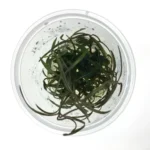
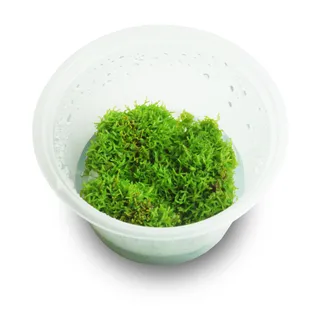
The simplest mode of cultivation is the floating form. A tissue-cultured cup of TC Riccia is simply rinsed under dechlorinated water to dislodge the nutrient gel in which the cultivars arrived, broken into small fragments between the fingers, and tossed onto the water surface. Within hours the fragments spread out and form a loose raft at the water surface, and within two to three weeks a small starter dose has expanded into a dense floating mat several centimetres thick. This mode of cultivation is effortless, requires no CO2 injection whatsoever because the thalli sit directly in contact with atmospheric CO2, and produces a lush shade-giving green canopy that shy fish species such as bettas, apistogrammas, gouramis, and killifish find deeply reassuring. For breeding tanks and fry tanks the floating Riccia raft is effectively a magic carpet, offering both infusoria-rich grazing for tiny fry and dense concealment from predatory tankmates. The only maintenance a floating mat requires is occasional thinning with a fine net when it begins to block so much light that substrate plants below start to suffer.
The second and much more demanding mode of cultivation is the submerged tied-bush technique made famous by Takashi Amano. In this technique Riccia is bound tightly to a porous piece of hardscape — typically a flat slab of lava rock, a piece of Seiryu or Dragon stone, or a purpose-cut ceramic Riccia stone — using either fine transparent fishing line wrapped firmly around the mass, or a purpose-made fine nylon hairnet stretched over the top of the Riccia cushion and secured underneath. A thin layer of Riccia, roughly three to five millimetres thick, is pressed onto the top of the wet hardscape, and the fishing line or hairnet is then worked back and forth over the mass and around the rock several times, pulling the thalli tight against the stone and holding them down in place. The finished assembly is then placed submerged in its target position in the aquascape, where the light intensity and CO2 concentration must be sufficient to support the thalli in their new unnatural submerged state. Under correct conditions new thalli begin to grow outward and upward from the original mass, producing the characteristic dense bubbling bush that aquascapers prize. After three to six weeks the hairnet or fishing line is entirely hidden by the new growth and the bush reads visually as a pure Riccia cushion clinging to the rock.
Common mistakes to avoid when installing tied Riccia include: tying too loosely, which allows the mass to lift away as it grows and inflates with oxygen bubbles; tying too tightly on top, which crushes the thalli and causes the underlayer to rot; placing tied Riccia into inadequate light where the submerged thalli cannot sustain themselves and begin to slough off within a fortnight; and failing to trim the bush regularly once established, which allows the mass to outgrow its hardscape and eventually detach in large floating chunks. A tied Riccia bush is a living sculpture that demands weekly attention, and the aquarists who succeed with this technique are those who accept that obligation as part of the reward. Those who prefer a lower-maintenance display are better served by the floating form, which delivers much of the visual charm of Riccia with none of the submerged upkeep.
A third hybrid technique deserves mention for aquascapers who want some of the visual impact of submerged Riccia without committing to the full tied-bush regime: the Riccia-stone technique. In this method a small porous pumice stone or a ceramic Riccia disc is wrapped in a thin pad of Riccia secured by fishing line, and the stone is simply placed loose on the substrate or tucked into the hardscape arrangement rather than being permanently tied down to a feature rock. Because the stone can be moved freely, aquascapers can reposition their Riccia feature as the layout evolves, remove it entirely for trimming in a water-filled bowl at the kitchen sink, and replace it cleanly trimmed back into the tank. This technique trades permanence for flexibility and is particularly well-suited to nano tanks where a single removable Riccia stone can serve as a focal accent that the hobbyist rearranges every few months as their aesthetic eye develops. The cost is that the Riccia stone never quite reads as fully integrated into the hardscape the way a tied feature does, but for many hobbyists the tradeoff is worthwhile.
Water Quality for Plants
5.5–7.5
ideal 6.5
20–26 °C
ideal 23 °C
2–10 dGH
Soft to moderately hard; strong preference for soft water
Riccia fluitans is a cosmopolitan plant that in the wild inhabits a broad range of still freshwater habitats across every continent except Antarctica, and its water parameter tolerance reflects this wide natural range. pH values between 5.5 and 7.5 are all well-tolerated, with a mild preference for slightly acidic to neutral water around pH 6.3 to 6.8 where CO2 dissociation is optimal for plant uptake and where aquasoil-driven blackwater chemistry typically sits. The plant copes with pH excursions up toward 7.8 without obvious harm but growth rate does slow at alkaline pH because dissolved CO2 increasingly converts to bicarbonate, a form that Riccia cannot use as efficiently as free CO2. For aquarists running hard alkaline tap water, Riccia is workable but will not deliver the explosive growth and pearling that soft-water high-tech keepers achieve, and alternative surface plants such as Salvinia or Frogbit may be more rewarding choices.
Temperature tolerance runs from a cool twenty degrees Celsius up to twenty-six, with the sweet spot around twenty-two to twenty-four. This is notably lower than the tropical range preferred by most aquarium plants, and it reflects Riccia’s origin in temperate standing waters. The plant is not well-suited to hot discus tanks running at twenty-nine or thirty degrees, where it struggles to photosynthesise efficiently and where the bush tends to develop algae problems on its older thalli. Keepers of cooler community tanks, shrimp breeding tanks, and white cloud mountain minnow setups will find Riccia exceptionally well-suited to the twenty-two to twenty-four degree range these tanks typically run. Above twenty-six degrees growth slows visibly and pearling becomes less reliable; above twenty-eight the plant often begins to disintegrate within weeks and should be considered beyond its practical envelope.
Hardness between two and ten dGH is the comfortable range, with a distinct preference for soft water at the lower end of that window. Soft water supports the acidic pH and elevated CO2 availability that drive vigorous Riccia growth, and the great majority of high-tech Riccia showcases run on RO water reconstituted to roughly four to six dGH with a mineral supplement such as Salty Shrimp GH+ or Seachem Equilibrium. In hard water above twelve dGH the plant survives but never really thrives, and aquarists with hard tap water who want to grow display-quality Riccia should expect to invest in an RO unit. Carbonate hardness follows the same pattern: low KH of two to four is ideal for supporting the pH-CO2 regime that Riccia prefers, and high KH tanks are less suited to the plant. Tannins from driftwood and botanicals are tolerated without harm but do not particularly favour Riccia as they do some other plants; the liverwort is neutral to mildly positive toward blackwater chemistry and can feature in blackwater biotopes without drama.
Illumination Requirements
HIGH LIGHT
PAR: 60-120 PAR at mat surface for submerged cultivation; 30+ PAR adequate for floating form
High
Riccia fluitans is one of the most light-hungry plants in common aquarium cultivation when grown submerged, and the sheer intensity of light required to sustain a tied-bush Riccia carpet is one of the principal reasons the technique has a reputation for being advanced. In its wild floating form Riccia sits at the water surface where it receives the full unattenuated spectrum of sunlight, and its photosynthetic machinery is calibrated to this high-light environment. When the plant is forced underwater and bound to a rock, it continues to demand the same intense illumination that it would receive at the surface, and if that light is not provided the thalli simply cannot produce enough sugar to sustain themselves against the metabolic cost of being submerged. The practical floor for sustained submerged Riccia cultivation sits at roughly sixty PAR at the mat surface, and most successful Iwagumi Riccia displays run at eighty to one hundred and twenty PAR — a range that comfortably exceeds what the great majority of low-tech planted tanks ever provide. This is why tied-bush Riccia is almost exclusively seen in high-tech show tanks equipped with professional-grade LED systems such as the Chihiros WRGB II Pro, the ADA Solar RGB, or the Twinstar 900E, all of which can deliver the intense photon flux Riccia needs to produce the pearling effect that has made it famous.
The pearling phenomenon itself deserves a paragraph of its own, because it is the visual signature that defines Riccia in the aquarium hobby and the single feature that has made the plant an icon. Pearling is the accumulation of pure oxygen bubbles on the surface of a photosynthesising plant tissue, produced when the plant’s photosynthetic output exceeds the dissolved gas carrying capacity of the surrounding water. In most plants pearling produces small sporadic bubbles on leaf edges, but in Riccia the bubbles cling in vast numbers to every fork of every thallus, producing a mat that appears to be sprinkled with tiny silver beads under the aquarium lighting. Under the correct combination of high light, high CO2, and saturated nutrition, a healthy Riccia bush pearls continuously through the photoperiod, with individual bubbles swelling, detaching, and drifting upward to the surface in a slow rising stream that aquascaping photographers have spent decades trying to capture in video. This is the effect Amano chased in his Iwagumi layouts and it is why tied Riccia sits at the heart of so much aquascaping history.
The floating form of Riccia is much more forgiving of modest lighting because the thalli are in direct atmospheric contact with CO2 and receive the full intensity of the tank’s lighting without attenuation by the water column. Even a modest thirty PAR at the water surface is generally sufficient to sustain a healthy floating mat, and shaded sections of a tank can host Riccia alongside other floating plants without competition problems provided at least some fragment of the mat receives strong light. The photoperiod for floating Riccia can be kept at a relaxed eight to ten hours daily in low-tech setups; submerged Riccia is more demanding and benefits from a six to eight hour photoperiod delivered at high intensity rather than a longer duller period, since the plant responds to peak photon flux rather than cumulative light dose. Signs of insufficient light in submerged Riccia are unmistakable and appear quickly: the thalli lose their bright grass-green colour and turn pale yellowish, new growth slows or ceases, and within two to three weeks the underlayer of the bush begins to rot and slough off in floating fragments. At the first warning sign of inadequate light the answer is almost always to increase intensity rather than extend duration. Conversely, signs of excessive light are rare in Riccia and usually confined to modest green algae accumulation on the older thalli; these are cosmetic and easily managed with shrimp grazing rather than light reduction.
Recommended Photoperiod: 6-8 hours at high intensity for submerged tied-bush; 8-10 hours at modest intensity for floating form
Feeding Your Plant: CO2 & Ferts
CO2 INJECTION REQUIRED
Pressurised CO2 injection is genuinely required, not optional, for the submerged tied-bush form of Riccia fluitans, and any aquascaper considering this technique must commit to a functional CO2 system before attempting it. The biological reason is straightforward: Riccia is a liverwort adapted to the atmospheric CO2 concentrations it encounters at the water surface in its natural floating form, roughly four hundred parts per million in the air, and when forced underwater it must make do with whatever dissolved CO2 is available in the water column. In a non-injected tank that dissolved concentration sits at one to three parts per million, roughly a hundredth of what the plant evolved to use, and under such conditions submerged Riccia simply cannot photosynthesise at a rate that sustains life. Within two to three weeks of installation the tied bush begins to pale, then yellow, then disintegrate, and within six weeks the entire mass has sloughed off the hardscape in drifting fragments. This is the single most common failure mode among aquarists attempting tied Riccia for the first time, and it has soured many on the plant unnecessarily when the actual issue is a simple lack of carbon.
Under correct CO2 injection — typically twenty-five to thirty-five parts per million dissolved through a ceramic diffuser or an in-line atomiser — Riccia responds with explosive pearling and steady outward growth from the original tied mass, producing the iconic bubbling bush effect within two to three weeks of installation. The high CO2 concentration combined with high light is the magical combination that produces peak pearling, with bubbles erupting from every thallus fork and a continuous rising stream of oxygen drifting upward from the bush throughout the photoperiod. A drop checker placed near the Riccia feature should read a clear yellowish-green, indicating CO2 above twenty-five parts per million, throughout the lit hours. CO2 should be shut off at lights-out to preserve the day-night gas balance that fish and invertebrates depend on. Liquid carbon supplements such as Seachem Excel or Easy-Life EasyCarbo are not a substitute for pressurised CO2 with Riccia — the plant’s carbon demand is too high to be met by liquid carbon at safe dosing rates, and aquarists who attempt to run tied Riccia on liquid carbon alone invariably watch their bush disintegrate. Liquid carbon can serve as a useful supplement to pressurised CO2, boosting the effective carbon availability slightly and helping suppress black beard algae that occasionally colonises older Riccia thalli, but it is not a primary carbon source for this demanding species.
The floating form of Riccia, by contrast, has no CO2 requirement whatsoever and will happily grow in a tank that has never seen a pressurised cylinder. The thalli float in direct atmospheric contact and draw their carbon from the air above the water surface, bypassing the dissolved CO2 bottleneck entirely. This is why floating Riccia is so much easier to keep than submerged Riccia, and it is the single most important piece of advice for aquascapers new to the plant: if you do not have a functional CO2 system, do not attempt the tied-bush technique — accept the floating form and enjoy the plant as nature intended.
Fertilisation
Riccia fluitans is a moderate feeder by aquatic plant standards, requiring steady availability of all major macronutrients and a full complement of micronutrients to support its rapid photosynthetic output under high light. In a well-stocked community tank with regular fish feeding the baseline nutrient load from fish waste is usually sufficient to support a floating mat, and many long-term floating Riccia displays receive no supplementary fertilisation whatsoever. For submerged tied-bush cultivation, however, the combination of high light and high CO2 drives accelerated nutrient consumption, and dedicated fertilisation becomes necessary. A weekly dose of a complete all-in-one liquid fertiliser such as Tropica Specialised Nutrition, APT Complete, or an EI-style dry salts mix at roughly three-quarters of the manufacturer’s recommended rate will keep the thalli a bright saturated green and support the continuous growth demanded by a pearling bush.
Nitrate should be maintained at ten to twenty parts per million in the water column and phosphate at roughly one part per million; these are standard high-tech planted tank targets and are well-served by most commercial liquid fertilisers at weekly or split-dose schedules. Potassium should ride along at ten to twenty parts per million, with dedicated supplementation if pinhole deficiency signs appear on older thalli — though in Riccia these present as generalised thallus thinning rather than discrete holes, because the thalli are too narrow for classic potassium hole symptoms. Iron and the full range of trace elements are supplied by the weekly all-in-one dose and rarely need separate attention. The plant does not benefit from root tabs, which are entirely wasted on a rootless liverwort, and the substrate-targeted nutrition that drives heavy-feeding rooted plants such as Amazon sword or Eriocaulon has no role here. All of Riccia’s nutrition comes from the water column, delivered directly through the surface of the thallus, and the practical implication is that high-quality water circulation across the Riccia mass is essential — dead spots where water stagnates against a tied bush will see the local thalli starve even as the rest of the tank thrives. An outflow lily pipe or spray bar oriented to bathe the Riccia feature in gentle flow pays significant dividends in growth and colour.
Water changes are particularly important for tied-bush Riccia because the accumulation of organic wastes and algae-promoting compounds in the water column disproportionately affects this fast-growing plant. A weekly thirty to fifty percent water change is the standard regime in high-tech Riccia displays, and skipping this routine for more than two to three weeks will typically result in visible algae accumulation on the older thalli and modest growth slowdown. In floating Riccia setups the water change schedule can be relaxed to standard community tank intervals of every two to three weeks without adverse effect, as the plant’s direct atmospheric CO2 access buffers it against most water chemistry fluctuations.
Caring for Your Plant
MEDIUM GROWTH
Riccia fluitans grows at a medium to fast rate under good conditions, considerably faster than the slow rhizome plants like Anubias or Bucephalandra and moderately slower than the explosive stem plants like Rotala or Ludwigia. In a well-lit, CO2-injected tank with adequate fertilisation a freshly tied bush will roughly double in mass every two to three weeks, with new thalli forking outward and upward from the original mat surface and producing the characteristic three-dimensional cushion shape that aquascapers value. Over a period of two to three months a starter tie-down the size of a small coin can develop into a substantial bush the size of a fist, completely obscuring the original tying material and reading visually as a free-standing Riccia feature on the hardscape. Under floating cultivation the growth rate is often even faster because the thalli receive unobstructed atmospheric CO2, and a starter cup of TC Riccia can populate the entire surface of a sixty-litre tank within four to six weeks.
This rapid growth is both the plant’s principal virtue and its principal maintenance burden. For tied-bush cultivation, regular trimming is essential to prevent the bush from outgrowing its hardscape and detaching in floating chunks. The standard practice is a weekly haircut using sharp aquascaping scissors, reducing the bush back to a cleanly defined cushion shape of two to three centimetres depth, removing all the long straggly thalli that have begun to lift away from the mass, and preserving the dense core that is tightly packed against the hardscape. Trimmings can either be siphoned out with a net at the time of trimming, used to seed new tied-bush features on other hardscape, or simply allowed to float to the surface where they can contribute to a separate floating mat. Aquascapers producing contest-grade Riccia features trim as often as every four to five days during peak growth periods, which keeps the bush shape immaculate but demands a level of commitment that not every hobbyist can sustain.
For floating mats the maintenance obligation is less demanding but still real. A mature floating mat several centimetres thick begins to cast significant shade on substrate plants below, and if not thinned regularly can cause the loss of light-demanding species in the tank. A monthly thinning with a fine net, removing roughly half the floating mass and disposing of it or composting it, keeps the mat at a sustainable thickness and preserves light transmission to the substrate. Shedding thalli, which occur naturally as older portions of the mat die back and new growth takes over, can be removed at the same time by running the net across the surface to collect drifting fragments. Left alone an uncontrolled floating mat will become so thick that its underlayer is cut off from light and begins to rot, producing a layer of decomposing material that fouls the tank and releases ammonia; regular thinning entirely prevents this failure mode.
Shedding is in fact the one consistent complaint heard from Riccia keepers. Individual thalli and small clumps of thalli regularly detach from both tied bushes and floating mats as part of the plant’s normal growth cycle, and in the tied form these fragments rise to the surface and contribute to the floating mat or accumulate along the water line where they can look untidy. Surface skimmers and regular weekly siphoning usually control this shedding effectively, but aquarists who cannot tolerate any floating plant material should seriously consider whether Riccia is the right choice for their tank, as shedding cannot be entirely eliminated no matter how carefully the bush is tied down. The shedding rate is highest in the first three to four weeks after a tie-down as the bush adjusts to submerged conditions, and generally reduces once the bush is established.
Weekly haircut for tied bushes
Every 5-7 days — trim submerged Riccia bushes back to 2-3 cm depth using sharp curved aquascaping scissors, removing long straggly thalli that have begun to lift away from the mass. Preserves shape and prevents detachment of large chunks.
Skim floating fragments
Every 3-4 days — use a fine net to skim loose Riccia fragments drifting at the surface, shed from tied bushes as part of normal growth. Surface skimmers automate this task effectively.
Thin floating mats
Monthly — remove roughly half the floating mat using a fine net when thickness exceeds 2-3 cm, to prevent the underlayer rotting from insufficient light and to preserve light transmission to substrate plants below.
Inspect tying materials
Monthly — check that fishing line or hairnet remains taut and is not visibly cutting into the thallus mass. Re-tie sections that have loosened, and replace degraded hairnets every 6-12 months if using the hairnet method.
Re-tie aged bushes
Every 6-9 months — a mature tied bush eventually outgrows its original tie-down so completely that the underlayer rots and the entire mass detaches in a single piece. Plan on redoing the tie-down from fresh material before this point.
Algae control on older thalli
As needed — shrimp (Neocaridina, Amano) and nerite snails graze algae from Riccia thalli without damaging them; seeding a new Riccia display with a dozen shrimp provides long-term algae defence. Badly algae-colonised sections are best trimmed out rather than treated in place.
Aquascaping with This Plant
Floating
Riccia fluitans occupies a unique and celebrated position in the history of aquascaping, a direct legacy of Takashi Amano’s pioneering Iwagumi layouts of the 1990s where tied Riccia bushes were used as the principal plant feature on sparse volcanic rockscapes. The visual language Amano created with Riccia — vivid green cushions of pearling foliage clinging to the flanks of angular stones, against a background of empty substrate and occasional dwarf hairgrass — has become one of the defining aesthetics of the Nature Aquarium style, and any aquascaper interested in Iwagumi or Ryoboku layouts has at some point considered whether tied Riccia should feature in their next tank. The plant’s unique capacity to pearl continuously under good conditions sets it apart visually from every other aquarium plant, and a well-established tied-bush Riccia feature is genuinely one of the most striking sights in the hobby when it is performing at its best. Aquascaping photographers have spent entire afternoons attempting to capture the bubble-stream of a fully pearling Riccia bush in still photography, and the resulting images have filled magazine covers and contest galleries for three decades. Few planted tank phenomena photograph as dramatically as a pearling Riccia cushion caught mid-photoperiod with a dense cloud of silver oxygen droplets shimmering against the bright green thallus mass. For aquascaping contests the plant remains a powerful tool, particularly in the smaller nano and pico categories where a single well-executed Riccia feature can carry an entire layout.
Classical placement in the Iwagumi style is as the primary plant on a focal stone, typically the Oyaishi or main stone of the layout, tied into a generous cushion that completely covers the top and upper flanks of the stone and provides the principal living green mass of the composition. Secondary stones may carry smaller Riccia features or be left bare depending on the aesthetic intent, and the substrate around the stones is usually planted with a hairgrass, Monte Carlo, or Glossostigma carpet that provides a lower-level green horizon against which the Riccia bushes read as discrete raised features. The colour contrast between the bright grass-green of Riccia and the darker more muted greens of typical carpeting plants is a signature of the style, and the pearling bubbles of active Riccia against the still surface of the carpet completes the composition. In larger tanks or busier layout styles, Riccia can be tied to secondary hardscape features such as driftwood branches or accent rocks, but it generally loses impact when scattered across multiple features rather than concentrated on a single focal piece.
The floating form of Riccia serves an entirely different aquascaping function: as a canopy plant providing surface shade, reducing glare from overhead lights, softening the visual edges of the tank, and creating reassuring cover for shy fish species. In paludaria and biotope tanks featuring labyrinth fishes such as bettas and gouramis, surface-spawning killifish, or small shy cichlids such as apistogrammas, a floating Riccia canopy transforms the behavioural habits of the fish by providing the surface cover they naturally seek in the wild. Fish fry find the floating mat an ideal nursery, grazing on the infusoria that develop within the mat and hiding from potential predators among the thalli. For breeding tanks the floating form of Riccia is very nearly essential and is widely used by serious fish breeders even when aesthetics are not the primary concern. In aesthetic terms a partial floating canopy — covering perhaps thirty to forty percent of the surface area — introduces interesting dappled light effects to the tank below as sunlight filters through the gaps between thalli, creating a forest-stream atmosphere that works particularly well in blackwater and South American biotope displays.
Riccia pairs beautifully with a carefully chosen set of companion plants that match its preferences and complement its visual texture. For submerged Iwagumi layouts the classical pairing is with a hairgrass or Monte Carlo carpet providing the ground layer, and perhaps a small accent of Hemianthus callitrichoides Cuba or Glossostigma providing additional carpeting texture. For floating canopy layouts Riccia associates well with Phyllanthus Fluitans, Salvinia Natans, and Amazon Frogbit, which together can create a layered floating community with different leaf sizes and colours providing visual interest at the surface. The one combination to approach with caution is Riccia plus dense surface-feeding fish such as goldfish or mbuna cichlids, which will actively shred a floating Riccia mat for both food and nesting material; in such tanks Riccia simply cannot be maintained.
| Plant | Why | |
|---|---|---|
| 🌿 | Hemianthus callitrichoides ‘Cuba’ (Dwarf Baby Tears) | Classic Iwagumi carpet partner — shares the high-light, high-CO2, soft-water requirements of tied Riccia and provides the ground-layer green horizon against which a Riccia-topped stone feature stands out dramatically. |
| 🌿 | Eleocharis acicularis mini (Dwarf Hairgrass) | Amano’s signature Iwagumi companion for Riccia; the fine vertical texture of hairgrass contrasts beautifully with the cushion form of Riccia and both share soft-water high-light preferences. |
| 🌿 | Micranthemum Monte Carlo | Easier and more forgiving carpet than HC Cuba, with bright green round leaves that complement the grass-green thalli of Riccia; excellent modern Iwagumi pairing where a bulletproof carpet is wanted. |
| 🌿 | Salvinia Natans (Floating Fern) | Floating companion that together with Riccia creates a layered surface canopy with contrasting leaf shapes and sizes — Salvinia contributes larger round pads while Riccia provides the fine lace texture between them. |
| 🌿 | Phyllanthus fluitans (Red Root Floater) | Floating partner that adds a striking red underside and red root colour against the bright green of Riccia; both thrive at the surface without competing for resources and together produce a richly coloured floating community. |
| 🌿 | Amazon Frogbit (Limnobium laevigatum) | Larger floating plant that pairs well with Riccia in breeding and biotope tanks; Frogbit’s dangling roots provide additional fry cover below the surface while Riccia provides the lace-canopy cover above and within the mat. |
Reproduction & Division
Division
Propagation of Riccia fluitans is one of the easiest in the entire aquarium plant world, a direct consequence of the liverwort’s simple body plan. There are no roots to preserve, no crown to damage, no rhizome junction to respect — the plant is effectively a self-propagating lace of branching thalli, and every individual fragment of thallus is a fully viable independent plantlet the moment it separates from the parent mass. In practical terms this means that propagation is accomplished by the simplest technique imaginable: take a handful of the plant, tear it into smaller pieces with your fingers or a pair of scissors, and distribute those pieces wherever you want new growth to appear. Within hours the torn edges heal and the fragments begin to grow, forking outward into the characteristic dichotomous branching pattern and producing visible new mass within a week.
For floating propagation, the technique is almost absurdly simple. A handful of Riccia from an existing mat or a fresh TC cup is broken into fragments of roughly half a centimetre across and scattered across the water surface of the receiving tank. The fragments immediately float because of the air spaces trapped within the thalli, and within a week they have begun to expand laterally and fork into new growth. Within three to four weeks the fragments have coalesced into a loose interconnected mat, and within six to eight weeks the mat fills the available surface area of the tank. For aquarists establishing a new floating mat this is the straightforward route, and a single TC cup of Riccia is more than enough to seed a mid-sized tank.
For submerged tied-bush propagation, the technique is to take a trimming or a freshly divided section of an existing bush and immediately re-tie it to new hardscape using the same fishing-line or hairnet technique described in the planting section. Fragments from an established bush are already fully adapted to submerged conditions, which gives them a significant advantage over fresh tissue-cultured Riccia, which arrives in emersed form and must transition to submerged growth over the first two to three weeks. Aquarists who want to accelerate a new tied-bush feature should where possible beg or barter trimmings from another aquascaper with an established display, rather than starting from TC cups, because the submerged-adapted trimmings will outgrow the emersed-origin TC fragments by a factor of two or three in the first month.
Spore propagation via the gametophyte-sporophyte life cycle that all liverworts follow is theoretically possible but essentially irrelevant to aquarium cultivation. In wild Riccia populations sporulation occurs on emersed plants in late summer, producing sporangia embedded in the thallus surface that release spores when the plant dries out; these spores germinate in wet mud the following spring to produce new gametophyte colonies. Under permanently submerged aquarium conditions sporulation does not occur, and all aquarium propagation is vegetative through fragmentation. This is not a limitation — vegetative fragmentation is so effective that spore propagation would offer no advantages even if it were practical, and commercial tissue-culture laboratories propagate Riccia by vegetative multiplication of carefully selected strains rather than by spore sowing.
A curious observation about Riccia propagation is that different geographic strains, all nominally the same species, differ markedly in aquarium behaviour. Some strains — particularly those cultivated by ADA and other Japanese tissue-culture producers — form notably denser and more compact bushes with shorter thalli and a more reliable pearling response, while wild-collected strains from temperate Europe or North America often grow taller, looser, and less photogenically. For aquarists serious about tied-bush display quality, sourcing TC Riccia from a reputable brand with a track record of producing the dense short-thallus aquascaping strain is worth the modest premium over generic Riccia of uncertain provenance. The differences are not merely cosmetic — the compact strains are simply easier to tie down, stay tied down longer, and require less trimming to maintain a clean bush shape.
Quick Reference
| Scientific Name | Riccia fluitans |
| Plant Type | Thallose aquatic liverwort (NOT a true plant) |
| Light | High (60-120 PAR submerged; 30+ PAR floating) |
| CO2 | Required for submerged tied-bush; not required for floating |
| Growth Rate | Medium to fast under high light and CO2 |
| pH Range | 5.5-7.5 |
| Temperature | 20-26 degC |
| Hardness | 2-10 dGH (prefers soft) |
| Planting Method | Floating by default; tied to rock with fishing line or hairnet for bush form |
| Placement | Floating canopy, or submerged foreground/midground tied-bush |
| Propagation | Fragmentation — tear into pieces and redistribute |
| Difficulty | Intermediate — easy floating, demanding as tied bush |
Reviews
Clear filtersThere are no reviews yet.