🪨 Species at a Glance
| Scientific Name | Pomacea bridgesii (gold form, syn. P. diffusa) |
| Common Names | Gold Mystery Snail, Yellow Apple Snail, Spike-Topped Apple Snail |
| Family | Ampullariidae (distinct from invasive Pomacea canaliculata) |
| Supplied Size (Small Grade) | 1-2 cm shell diameter — juvenile starter stage |
| Maximum Adult Size | 5-6 cm shell diameter after 9-15 months of grow-out |
| Life Stage at Supply | Juvenile — pre-sexual-maturity, active shell building phase |
| Origin | South America — Amazon, Paraguay, and Orinoco river basins |
| Species Lifespan | 1-3 years (essentially full lifespan from Small stage onward) |
| Grow-Out Timeline | 9-15 months from 1-2 cm juvenile to 5-6 cm breeding adult |
| Temperature | 18-28 C (ideal 24-26 C for active juvenile grow-out) |
| pH Range | 7.0-8.2, ideal 7.6-8.0 (alkaline for shell formation) |
| Hardness (dGH) | 8-25 dGH — upper half preferred at juvenile stage |
| Diet | Herbivore / grazer — biofilm, algae, blanched veg, calcium wafers |
| Minimum Tank Size | 20 L+ grow-out tank (40 L+ if community stocked) |
| Quarantine | MANDATORY — 2-3 week QT before community introduction |
| Care Level | Beginner-friendly with mandatory cuttlebone + stable chemistry |
| Price Point | AUD $8 — cheapest entry to the species (Large adult AUD $28) |
Visual Identification Guide
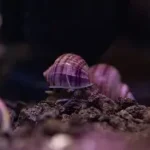
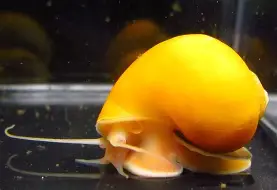
A 1-2 cm Small Gold Mystery Snail shows all of the diagnostic features of Pomacea bridgesii in miniature, but with several quirks specific to the juvenile stage that new keepers often misread. The shell is a rounded, dextral (right-coiling) spiral with a moderately elevated spire and a large body whorl that dominates the overall profile; at Small size the snail has completed roughly two to three visible whorls, and the apex is still perfectly intact — the wear and erosion commonly seen at the tip of older adult shells has not yet had time to occur. Because the shell is still thin and semi-translucent, it can look disconcertingly fragile held up to the light, and that impression is essentially correct: juvenile shell has less deposited calcium carbonate per unit area than adult shell and is genuinely more vulnerable to acidic water, rough handling, and shell-nipping tank mates. The growing lip at the aperture edge is particularly delicate — a smooth, translucent band of the very newest shell, laid down in the last few days by the mantle edge, which will thicken and pigment over the coming weeks as more material is deposited behind it. Many first-time Small-grade buyers mistake that pale translucent lip for erosion or chipping; in fact it is the single healthiest feature of a thriving juvenile, a real-time indicator that the mantle is actively secreting new shell and that water chemistry is supporting the build.
The gold colour form at Small size presents as a pale lemon-yellow to soft honey-yellow shell, often with very faint darker spiral banding just visible on the body whorl. Compared to the finished adult form at 5-6 cm, this juvenile yellow is noticeably less saturated, sometimes reading almost cream under aquarium lighting rather than the signature warm gold of a mature specimen. That understated palette is a correct feature of the juvenile stage, not a defect: gold Pomacea bridgesii deposit pigment into newly laid shell throughout grow-out, and the richer, deeper yellow of an adult shell is a cumulative record of 9-15 months of calcium-rich diet, stable alkaline water, and steady mantle activity. A keeper who buys at Small grade is literally purchasing the opportunity to watch that colour deepen from pale cream to saturated honey-gold over the following year, visible as a subtle growth-stripe banding on the shell where each month’s new deposition records the state of that month’s husbandry. The body — foot, head, and tentacles — is a cream-to-pale-yellow colour at Small size, often with a faint pink-grey undertone on the foot edge, and will deepen toward adult butter-yellow as melanin deposition increases with sexual maturity. Both the body and shell colour shifts are gradual and cumulative; side-by-side comparisons of monthly grow-out photographs taken from directly above make the trajectory obvious and are one of the distinctive pleasures of juvenile-grade keeping.
The operculum, the hard protein-and-calcareous plate that seals the aperture when the snail retracts, is proportionally smaller on a Small specimen — roughly 5-10 mm across — but functionally complete from the moment of hatching. When the snail withdraws it flush-seals the shell mouth, protecting the vulnerable foot and visceral mass against predators, desiccation, and short-term parameter shocks. This trapdoor is unique to the family Ampullariidae among commonly kept freshwater snails and is entirely absent in the pest species (Physa, Melanoides, bladder, ramshorn) that occasionally appear unannounced in community tanks; if there is ever any doubt about whether a small unidentified snail in your aquarium is a baby Mystery Snail or a pest, the presence of an operculum is the single definitive diagnostic. Pomacea bridgesii also possesses a remarkable dual-breathing system that is fully functional even at Small size: the left side of the mantle cavity contains a true lung for aerial respiration, while the right side houses a ctenidium (gill) for aquatic respiration. When dissolved oxygen drops, or when the snail simply needs a top-up, it extends a long retractable siphon up to the water surface and draws atmospheric air directly into the lung. On a 1-2 cm juvenile the siphon is proportionally long relative to body size, giving the snail an almost comically slender breathing posture when it surfaces; new keepers sometimes mistake the siphon for a worm, parasite, or escape attempt, but it is entirely normal and a healthy sign of active gas exchange. Expect to see the juvenile surface two to four times per day under typical tropical tank conditions, with greater frequency in warmer or more heavily planted tanks where night-time oxygen dips further.
Sexual differentiation in Pomacea bridgesii is essentially impossible at the Small 1-2 cm stage. The reproductive anatomy is present but embryonic in its development, and the external and internal cues that would let an experienced keeper sex an adult — operculum concavity, visible penis sheath inside a fully extended male’s mantle cavity, behavioural mounting during mating attempts — are not available on a juvenile. This has one practical consequence only: a Small specimen cannot be purchased as a known male or known female. Keepers planning to establish a breeding pair at the adult stage should therefore either buy several Small specimens together (a group of four to six gives excellent statistical odds of including both sexes by the time the group matures) or plan to add a second Small snail some months later with the intention of selecting for opposite sex once both have grown to 4 cm and show observable mating behaviour. For a single-snail grow-out project, the question of sex simply does not arise until approximately month ten of the journey, at which point the snail will either begin producing pink egg clutches (indicating female, paired previously at point of sale with a male sibling, sperm stored) or not (male, or unpaired female).
A final identification note that applies across the whole life cycle of the species but is especially important for Small-grade buyers: Pomacea bridgesii must not be confused with Pomacea canaliculata, the Giant Apple Snail, which is a biosecurity-restricted invasive pest banned or restricted in many countries including most of Australia. Small juveniles of the two species can look superficially similar to an untrained eye, but the shell outline differs clearly even at 1-2 cm: P. bridgesii shows the characteristic raised spire (hence the common name Spike-Topped Apple Snail) even on a juvenile shell, while P. canaliculata juveniles already show the flatter, more angular spire and the sharply channelled suture that gives the species its scientific name. Always verify the species identifier at point of purchase and reject any animal whose profile is obviously flat-topped rather than spike-topped. The gold Pomacea bridgesii supplied through this guide carries the correct raised-spire profile and has been sourced from legal captive-bred stock with no biosecurity concerns.
🟡 Gold (this specimen)
Bright golden-yellow shell and cream-to-yellow body; the benchmark Mystery Snail morph worldwide. At Small size the colour is still cream-leaning and will deepen to warm honey-gold over 6-10 months of calcium-rich grow-out. Stunning against dark substrate and in planted tanks.
🟣 Purple
Deep violet to blue-purple shell, often gold-speckled on the foot at mature size. The most visually striking Mystery Snail colour form; starts pale at Small size and darkens dramatically across grow-out.
🔵 Blue
Pale to medium blue shell with a grey-blue foot; develops a subtle pearlescent sheen at adult size. Pairs beautifully with green planted aquascapes.
⚪ Ivory / White
Creamy off-white shell with a pale ivory body. A recessive genetic morph that reads almost pearl-like against dark leaf litter; juvenile shell can appear almost glassy before thickening.
🌸 Magenta / Pink
Pinkish-red to magenta shell. Relatively uncommon compared to gold or blue and often premium-priced; closely related genetically to the purple form and frequently line-bred alongside it.
⭕ Albino
A near-white albino variant lacking most melanin; pinkish translucent body and palest of cream shells. Rarely seen in the Australian trade but occasionally produced from gold lineages.
⚫ Black / Jade / Wild-Type
Very dark olive to near-black shell with heavy melanin deposition, sometimes showing chestnut highlights at the spire. The closest available morph to wild-caught Pomacea bridgesii phenotype.
Tank Requirements & Layout
A 20 L aquarium is a sensible absolute minimum for a single Small Mystery Snail and works particularly well as a dedicated grow-out tank for the first 3-4 months of the juvenile journey. A 40 L+ setup is preferable if the snail will share water with even a few tank mates, giving the parameters real buffer against the unpredictability of a still-developing biological filter. Substrate choice is open but two guidelines matter: it must be inert (non-buffering, so it will not push pH down), and it must be smooth (fine sand or rounded small gravel, nothing sharp). Fine sand is particularly kind to the foot as the juvenile drags its still-growing shell across the bottom. Strongly avoid active buffering aquasoils (ADA Amazonia, Fluval Stratum, UNS Controsoil) because they pull pH downward into the low-to-mid sixes, working directly against the alkaline hard-water conditions a juvenile snail needs. If you already run such a soil for a planted tank and want to add a Small Mystery Snail, house the juvenile in a separate grow-out tank for the first 3-4 months; do not compromise the critical early shell-building window to accommodate your substrate choice.
The single most important physical feature of any Mystery Snail tank — and emphatically so at the Small grade, because juveniles are hyperactively exploratory and will test any gap — is a strict, well-sealed lid combined with 5-10 cm of humid airspace above the waterline. Apple snails are accomplished climbers and escape artists; a juvenile will glide to the top of the glass within its first evening in the tank and investigate the rim. A gap of just 1 cm around a heater cable, filter hose, or HOB cutout is enough for even a 2 cm snail to squeeze through, and desiccation on the carpet is the single most common avoidable cause of death for Small-grade stock. Plug every gap with filter sponge, aquarium-safe silicone, or fine mesh; cover HOB cutouts completely; and verify the lid sits flush across the entire tank perimeter before the snail goes in. Do not fill the tank to the brim — the mandatory airspace above the waterline is needed both for the siphon to surface cleanly and, some months from now, for egg-laying once the snail reaches maturity. A lidless open-top tank is unequivocally unsuitable for Mystery Snails at any life stage and especially so for juveniles, which are light enough to escape through openings adults might ignore.
For the first 2-3 months of juvenile grow-out, a minimalist bare-bottom or lightly-decorated grow-out tank delivers the best outcomes. A 20 L tank with a cycled sponge filter, a piece of cuttlebone, one or two Anubias tied to driftwood, and nothing else lets you monitor the juvenile’s feeding, siphon behaviour, and shell growth with full visibility every time you look at it. Once the snail reaches 3 cm and is clearly thriving, the grow-out tank can be upgraded with additional decor and tank mates, or the juvenile can be transferred to its permanent display tank. This staged approach — grow-out tank first, display tank second — is the approach experienced Mystery Snail keepers and breeders use, and it is especially useful for first-time invertebrate keepers who benefit from the visibility and parameter control a simple setup provides. Live plants are welcome once the tank is stable but should be limited to hardy species (Anubias, Java Fern, Vallisneria, Cryptocoryne, Bucephalandra) that the snail will reliably leave alone even during hungry periods. Soft-leaved fast-growing stems (Bacopa, Rotala, tender Hygrophila) may see occasional nibbles from a hungry juvenile and should be avoided or planted in the display tank rather than the grow-out tank. Provide at least 2-3 vertical climbing surfaces — driftwood, rock, or the tank walls themselves — because juveniles are noticeably more active than settled adults and benefit visibly from a rich surface topology to explore and graze.
Strict Lid with 5-10 cm Airspace
Tight-fitting glass or mesh lid with every cable and hose cutout sealed with sponge or aquarium-safe silicone. Small juveniles escape through gaps adults would ignore — be stricter than you think necessary. 5-10 cm of humid airspace above the waterline is mandatory for future egg-laying and siphon surfacing.
20 L+ Grow-Out Tank
Dedicated juvenile grow-out tank, cycled before stocking. 40 L+ recommended if community stocked. Bare or minimally decorated setup for the first 2-3 months aids observation and parameter control.
Sponge Filter (juvenile-safe)
Sponge filter strongly preferred at Small size — no powerful intake that can pin a 1-2 cm snail. HOB or canister acceptable only with a pre-filter sponge covering the strainer. Cycled biological filtration non-negotiable.
Adjustable Heater
Maintain 24-26 C for best juvenile grow-out pace. Stable temperature matters more than exact value; use a heater with a reliable thermostat and verify with a separate aquarium thermometer.
Cuttlebone (CRITICAL at Small grade)
Absolutely non-negotiable during juvenile grow-out. A thumbnail-sized piece per 20 L, replaced every 2-3 weeks or when visibly consumed. Single most effective calcium source for building thick, well-pigmented adult shell.
Crushed Coral or Aragonite
Supplementary calcium and buffering source — mesh bag in the filter, or blended into substrate. Raises pH and GH simultaneously and stabilises parameters between water changes.
Fine Sand or Smooth Gravel Substrate
Inert, non-buffering, smooth-grained substrate. Avoid active aquasoils that push pH down. Smooth grains prevent abrasion of the foot during active juvenile exploration.
Liquid pH and GH Test Kit
Essential during juvenile grow-out. Test pH and GH weekly for the first month, then fortnightly thereafter. Strip tests are too imprecise for shell-critical chemistry at this stage.
Monthly Growth-Tracking Kit
A small ruler and a phone camera. Photograph the snail from directly above once a month against the ruler to document shell-diameter progression. A visual record across 9-15 months is both educational and an early-warning system for unnoticed slow growth.
Keeping the Water Safe
7.0–8.2
ideal 7.8
18–28 °C
ideal 25 °C
8–25 dGH
Hard and mineral-rich — mandatory for juvenile shell building (1-2 cm stage)
Small Mystery Snails at 1-2 cm are the most water-sensitive grade of this species sold in the Australian trade, by a clear margin. The reasons are straightforward: juvenile body mass is small, juvenile shell is thin, and the mantle tissue laying down new shell is in continuous direct contact with the surrounding water at the aperture edge. Adults have accumulated shell as a physical buffer; juveniles have not. Any water-chemistry problem that a mature Large-grade adult would shrug off with minor shell pitting can stunt a Small specimen permanently or kill it outright. For this reason, the water parameters required for Small Mystery Snails are not aesthetic preferences or gentle recommendations — they are the minimum conditions under which the juvenile grow-out program can biologically proceed. pH must remain between 7.0 and 8.2, with an ideal target of 7.6 to 8.0. Hardness must remain between 8 and 25 dGH, with the upper half of that range strongly preferred. Temperature should sit at 24-26 C for best grow-out pace; a stable value matters more than an exact one, and both wild swings and a room-temperature 18-20 C tank slow shell deposition noticeably. Ammonia and nitrite must both read 0 ppm, continuously — the small body mass of a juvenile has essentially no buffer against nitrogen toxicity, and even brief spikes during a newly cycled tank or a filter outage can cause irreversible harm.
Copper is acutely lethal to all molluscs, including Mystery Snails of every life stage, and the juvenile Small grade is no exception. Never add any product containing copper sulfate, copper gluconate, chelated copper, or copper EDTA to a tank housing this species. This includes most snail-killing medications (obviously), many ich and velvet treatments, some planted-tank fertilisers, some trace-element supplements, and a number of algae treatments. Always read the ingredients label on every water conditioner, medication, fertiliser, and algaecide before use. Even residual copper from a previous tank treatment can remain bioavailable for weeks and harm newly introduced snails; if a tank has ever been copper-treated in the past, do multiple large water changes, run activated carbon for at least a week, and ideally wait 4-6 weeks before adding Mystery Snails. For a Small juvenile, the margin for error on copper exposure is effectively zero — unlike a mature 5 cm adult with some bodily reserves, a 1-2 cm juvenile can die within hours of a copper exposure event.
Water change technique is especially important at the juvenile stage. Sudden large changes (50%+) that drop temperature or shift pH will trigger a stress-retraction response that can last 24-72 hours, during which feeding halts and grow-out pauses. A juvenile that loses a week of feeding during every water change will grow noticeably more slowly than one handled gently. Match replacement water to within 1-2 C of the tank before adding; if your municipal water is significantly softer or more acidic than the tank, pre-treat the replacement water in a separate container with crushed coral or a commercial GH booster so it arrives close to tank chemistry rather than pulling parameters downward with every change. A drip-refill approach — airline tubing tied off to throttle flow, refilling over 45-60 minutes — is gentler still, and pays for itself in uninterrupted feeding time over the full grow-out window. Weekly 20-25% water changes are the correct baseline for a cycled grow-out tank; larger changes are only appropriate in response to a specific parameter emergency and should otherwise be avoided during the juvenile period.
Feeding Schedule & Diet
Pomacea bridgesii is a genuine herbivore-omnivore that grazes almost constantly when active, using a rasping tongue (the radula) to scrape algae and biofilm from glass, hardscape, and plant surfaces. For a Small juvenile this natural grazing is the dietary foundation — biofilm is rich in protein, calcium, and trace minerals, and a well-matured tank with four or more weeks of established biofilm provides something like 40-60% of the juvenile’s caloric needs by default. The critical qualifier is ‘well-matured’: a brand-new cycled tank with bare glass and fresh substrate has essentially no biofilm for a juvenile to graze, and a Small snail introduced to such a tank can lose condition quickly unless the keeper compensates with more frequent supplemental feeding. This is a strong argument for stocking juveniles only after a tank has been running with some light bioload (a few shrimp, or a small school of nano fish) for at least a month, so that the biofilm the juvenile depends on is already established when it arrives.
Supplemental feeding for a Small juvenile is somewhat higher in frequency and lower in portion size than for adult grades. The per-gram appetite is at a lifetime peak, but the absolute body mass is small, so feeding little-and-often produces better results than large intermittent meals. The best supplemental foods are blanched vegetables and calcium-fortified sinking wafers. Zucchini (courgette), cucumber, spinach, kale, green beans, and blanched carrot are all readily accepted at Small size — blanch briefly (30-60 seconds in boiling water, then rinse cold to halt cooking), cool to room temperature, and sink with a vegetable clip or small ceramic weight. For a 1-2 cm juvenile, a piece of blanched zucchini the size of a ten-cent coin is plenty for 24 hours; remove any uneaten remnant after a day to prevent ammonia accumulation in the small tank volume. Commercial sinking wafers designed for bottom-dwelling invertebrates, especially those fortified with added calcium carbonate and spirulina, are an excellent staple supplement — offer one small wafer (or a broken quarter-wafer) every 2-3 days and remove any uneaten portion. Cuttlebone serves double duty as both calcium source and direct rasping food; the juvenile will often be observed rasping visibly on cuttlebone surface, leaving fine feeding marks.
A useful juvenile-oriented weekly feeding pattern looks like this. Monday: small sinking calcium/spirulina wafer; Tuesday: blanched zucchini disc; Wednesday: sinking calcium wafer; Thursday: blanched spinach leaf; Friday: blanched cucumber slice; Saturday: sinking wafer; Sunday: rest day (biofilm grazing only, opportunity to inspect tank for uneaten food and check parameters). This rotation delivers protein, calcium, and plant matter in balanced proportions while keeping the bioload manageable in a 20 L tank and exposing the juvenile to the varied micronutrient profile that supports even shell pigmentation over the long grow-out window. Rotate vegetables across the week rather than feeding only one: monoculture feeding (zucchini every day) can produce subtle deficiencies that show up as uneven colour banding on the adult shell six months later.
Observe the juvenile’s feeding response carefully during the first month. A healthy Small Mystery Snail should find and mount food within 10-20 minutes of placement, using the siphon and tentacles to locate it. A snail that consistently ignores food for 24-48 hours after placement is either stressed, too cold, or in early illness — test water parameters immediately and check for obvious stressors (power failure, heater malfunction, chemical exposure from a recent medication). Refusal to feed is one of the earliest and most reliable warning signs of a problem during juvenile grow-out, much earlier than visible shell symptoms, and responsive keepers who catch it within a day or two can usually correct course without lasting damage. Crucially, Pomacea bridgesii does NOT eat healthy, firm-leaved aquatic plants when adequately fed — this is the most important dietary distinction between this species and its invasive cousin Pomacea canaliculata. A juvenile kept in a biofilm-rich, well-fed tank will leave your Anubias, Java Fern, Vallisneria, and Cryptocoryne entirely alone; it will graze algae off their leaves and consume any decaying tissue but will not initiate damage on healthy living material. If you do see nibbling on healthy plants, the near-certain explanation is underfeeding — increase the blanched-vegetable rotation and the behaviour will stop within a week.
Molting: What to Expect
Snails do not moult. Unlike shrimp and crabs, a Mystery Snail’s shell is permanent and is secreted continuously by the mantle tissue that lines the inside of the aperture. At Small size the snail is in the single most calcium-intensive phase of its entire life: the shell volume scales roughly as the cube of the diameter, which means the 1-2 cm juvenile on the way to a 5 cm adult must deposit something close to fifteen to thirty times its current shell mass over the next nine to fifteen months. Every whorl laid down during that period takes its raw material directly from dissolved calcium carbonate in the water, from calcium rasped off cuttlebone and other mineral surfaces, and from calcium liberated by digestion of biofilm and vegetables. When any of those supplies runs short during grow-out, the result is not a temporary setback that can be corrected later; it is a permanent feature of the adult shell. Thin, pitted, chalky, weakly-pigmented shell laid down at the Small stage stays that way for the rest of the snail’s life, even if calcium supply improves after sexual maturity. This permanence is what makes the juvenile stage the most important window in the snail’s entire lifespan to get husbandry right, and it is why every decision about water hardness, pH, cuttlebone replacement cadence, and diet made during the first six months compounds visibly in the finished adult.
The principal threat to juvenile shell is acidic water. Below pH 7.0, calcium carbonate begins to dissolve chemically from the exposed shell surface — producing the characteristic chalky-white pitting and ragged aperture lip seen on neglected snails — and in soft acidic conditions the dissolution rate can exceed the mantle’s deposition rate, meaning the juvenile actually loses shell faster than it grows. Alkaline water (pH 7.6-8.0) combined with hard water (8-25 dGH, with the upper half of that range strongly preferred during juvenile grow-out) stops the chemical attack and gives the mantle tissue all the dissolved calcium and bicarbonate it needs to build. Calcium supplementation is effectively mandatory in most municipal water supplies that do not naturally test 12+ dGH out of the tap. The single most effective and affordable intervention is a piece of cuttlebone placed directly in the tank. Cuttlebone — the internal skeleton of the cuttlefish, sold in any pet store as budgerigar supplement — dissolves slowly to release calcium and bicarbonate into the water, buffers pH upward as it goes, and the snail will rasp directly on its surface as both mineral source and supplemental food. A thumbnail-sized piece per 20 L of juvenile grow-out tank, replaced every two to three weeks (more often if visibly consumed), is the recommended baseline for Small Mystery Snails; err on the side of over-supplementing rather than under-supplementing during this window, because the cost of a spare piece of cuttlebone is trivial and the cost of a permanently scarred shell is a snail you will still be looking at a year from now. Supplementary options include crushed coral in a mesh bag inside the filter, aragonite mixed into the substrate, or commercial dissolving products like Wonder Shell — any of these, combined with cuttlebone, creates a permanent mineral reservoir that stabilises pH and hardness between water changes.
A practical juvenile-stage monitoring routine looks like this. Once a week for the first month, and once every two weeks thereafter, inspect the aperture lip under good lighting. A healthy growing lip is smooth, slightly translucent at the very edge, and shows faint concentric growth lines as older material is progressively overlain by newer. A ragged, flaking, or visibly chalky aperture lip is an early warning of calcium stress and warrants immediate action: test pH and GH the same day, add a fresh piece of cuttlebone, and consider a 20-30% water change with harder fresh water if parameters have drifted. Also photograph the snail from directly above once a month against a ruler for scale, tracking shell-diameter progression in millimetres. Healthy juvenile grow-out produces approximately 3-5 mm of new shell diameter per month under good conditions, with the first month after purchase sometimes slightly slower as the snail acclimates to new water chemistry. Over twelve months of such photographs you will have built a direct visual record of the grow-out journey, and — much more practically — you will have caught any calcium-stress symptoms within days rather than weeks, avoiding the permanent damage that late-identified shell problems cause at this critical stage.
One further juvenile-specific observation: the colour banding visible on the Small shell at purchase is an honest record of the hatchery water chemistry the snail was raised in before shipment, and the next several months of banding will record your water chemistry. Under warm alkaline hard-water conditions with continuous cuttlebone availability, the new shell laid down in your tank will emerge consistently well-pigmented with the deep honey-gold tone characteristic of adult specimens. Under acidic soft water or erratic calcium supply, the new shell emerges uneven, chalkier, and paler. This growth-banding feedback loop is one of the strongest educational aspects of the Small grade — the snail is literally showing you the quality of its own husbandry as it grows, and a keeper who pays attention can adjust course within weeks of identifying a problem rather than months.
Breeding in the Aquarium
Egg Laying
Pomacea bridgesii is gonochoric, meaning there are distinct males and females and the species cannot self-reproduce. A lone Mystery Snail, or a same-sex group, will never produce young regardless of how well it is fed — a useful reassurance for keepers coming from shrimp or fish stocking where unexpected populations can run away quickly. For this particular Small specimen, however, breeding is firmly off the agenda for many months. At 1-2 cm shell diameter the snail is sexually immature; it has functional but undeveloped reproductive anatomy, and will not produce viable gametes or attempt mating until it reaches approximately 3.5-4 cm in shell diameter, with full fecundity arriving only at 4.5-5 cm. The estimated grow-out window from the supplied 1-2 cm Small size to first viable breeding is therefore 9-15 months under good conditions, varying with temperature, water hardness, and feeding. At the low end of that range (warm tropical tank at 26 C, upper-range hard water, generous calcium and varied diet), a juvenile can reach maturity in nine months. At the high end (cooler 21 C room-temperature tank, minimum-range hardness, intermittent feeding), reaching maturity may take fifteen months or longer. Either outcome is biologically normal; both produce healthy adult snails at the end of the journey.
This deferred-breeding timeline is not a downside of the Small grade but is arguably its principal appeal. The keeper gets to raise the snail through its entire sexual development rather than inheriting a pre-matured adult of unknown provenance, and the grow-out phase itself becomes the project. The full timeline unfolds in four approximate stages. Stage 1 (current — Small, 1-2 cm, sexually immature): no breeding behaviour; focus entirely on grow-out, calcium, parameter stability, and biofilm access. Stage 2 (2-3 cm, approximately 3-5 months from purchase — young-adult): sexing remains impossible; the snail shows no courtship behaviour but may begin appearing in close proximity to other snails. Stage 3 (3.5-4 cm, approximately 6-9 months from purchase — approaching maturity): sexing becomes possible by operculum shape and mantle-cavity inspection; first tentative mating attempts may be observed if both sexes are present; early clutches may be laid but fertility is often low and many clutches fail. Stage 4 (4.5+ cm, approximately 9-15 months from purchase — full breeding): robust, consistent pink clutches of 50-250 eggs at 2-4 week intervals when a mated pair is present; full species-typical fecundity achieved. Egg-laying itself follows the distinctive five-step apple-snail pattern: copulation underwater with the male mounted on the female’s shell; the gravid female crawls out of the water onto the tank wall or underside of the lid; she deposits a compact hard calcified pink-to-salmon cluster of 50-250 eggs glued firmly to the dry surface; the clutch incubates in the humid airspace above the waterline for 2-3 weeks, darkening from pink to purple-grey as the embryos develop; and finally the newly hatched 2-4 mm juveniles drop straight into the water below and begin grazing biofilm within hours of hatching.
In the wild, Pomacea bridgesii inhabits slow-moving floodplains and seasonally flooded vegetation along the Amazon, Paraguay, and Orinoco basins. Egg-laying above the waterline is a direct adaptation to that habitat — the pink clutches are glued to emergent vegetation and the undersides of overhanging leaves, where they are protected from aquatic predators (fish, insect larvae, predatory snails) and from submergence during rising flood stages. A clutch laid below the waterline will simply drown; the species evolved to keep its eggs dry, and a captive female with nowhere dry to lay may retain her eggs with negative consequences for her own health. For the keeper of a Small juvenile this is simply useful context for the moment, years away, when the snail finally becomes reproductive — the mandatory 5-10 cm of humid airspace above the aquarium waterline is not optional tank decor but the species’ natural nesting substrate. The grow-out journey from 1-2 cm juvenile to 5 cm breeding adult, with its visible shell growth, deepening colour saturation, first siphon-surfacing behaviours, first pink egg clutches, and first miniature juveniles dropping into the water, is itself the reward of keeping Small-grade Mystery Snails. A keeper who commits to that journey at AUD $8 will have witnessed the full life cycle of one of the most rewarding freshwater invertebrates available in the hobby, at a fraction of the price of ready-matured stock.
Choosing Safe Companions
Mystery Snails are genuinely peaceful and will not harm fish, shrimp, or plants under normal circumstances — but Small juveniles are significantly more vulnerable than adult grades to both direct predation and the subtler harms of competitive feeding and chronic stress. Two principles govern community planning for a Small-grade specimen: mandatory quarantine before introduction, and a conservative peaceful-nano community thereafter.
Quarantine is not optional for Small Mystery Snails. A 2-3 week QT period in a bare-bottom 10-20 L tank with a sponge filter, cuttlebone, and no other livestock serves three essential functions. First, it allows any hitchhiking pests or pathogens (planaria, hydra, residual parasites from the supplier tank) to be identified and managed before they enter your established display tank. Second, it gives the juvenile a stress-free window to recover from shipping and acclimate to your specific water chemistry without having to compete with tank mates for food. Third, and most practically, it lets you confirm the snail is feeding, moving, and laying down healthy shell before you commit to mixing it into a community where illness would be harder to diagnose and treat. Two to three weeks of quarantine is the minimum; extend to four weeks if the juvenile shows any slow-feeding or shell-symptom concerns during the initial window. Because the grow-out timeline runs 9-15 months, the additional weeks spent in QT are a small investment relative to the total lifespan of the project.
After quarantine, the ideal community for a Small-to-growing juvenile consists of peaceful nano-to-small species under 6-7 cm adult length: neon tetras, ember tetras, harlequin rasboras, Corydoras, Otocinclus, Endler’s livebearers, small gouramis, and Neocaridina shrimp. Avoid dedicated snail predators entirely — assassin snails, pea puffers, and clown loaches will kill a Small specimen with complete certainty — and be cautious with larger cichlids, crayfish, goldfish, and aggressive feeding fish even if they are not specialist mollusc predators, because chronic stress and food competition can stunt grow-out and permanently reduce adult shell size and colour quality. Competitive feeding dynamics matter disproportionately at the Small stage: a mature 5 cm adult can muscle through a crowd of tetras to reach a sinking wafer, but a 1-2 cm juvenile is easily out-raced to food by even modestly competitive tank mates. If you observe the juvenile consistently failing to reach blanched vegetables or wafers before they are consumed, feed at night when many fish are resting, place food directly next to the snail rather than broadcasting it, or use a small dedicated feeding dish the snail can mount. An underfed Small specimen will grow slowly, develop thin pale shell, and may never reach the full adult size and colour potential of a well-fed sibling — so ensure nutrition is actually reaching the snail, not just entering the tank.
For planted community tanks specifically, a Small Gold Mystery Snail (post-QT) combined with a group of 6-10 Neocaridina shrimp and a small school of 8-10 peaceful tetras or rasboras is an excellent all-ages community that will carry the snail right through its grow-out and into its first breeding cycle. The shrimp pick detritus and smaller biofilm off every leaf; the juvenile snail grazes larger biofilm patches from glass and hardscape; the fish occupy the mid-water column and provide movement and colour. All three groups thrive in the same hard alkaline water at 24-26 C, all three require no special food beyond a quality staple flake or micro-pellet plus occasional blanched vegetables, and all three can be maintained by a 25% weekly water change and a cuttlebone. Six months into the journey the Small juvenile will have visibly grown through the young-adult stage; twelve months in it will be matured and possibly laying pink egg clutches on the underside of the lid. That arc — from AUD $8 juvenile to mature centrepiece adult, documented in your own monthly photographs, raised in your own community of choice — is the unique reward of committing to the Small grade and the full grow-out journey.
| Species | Why | |
|---|---|---|
| ✅ | Neon Tetra (Paracheirodon innesi) | Small, peaceful schooling fish that ignore snails completely. Share the mid-water column without competition; ideal community partner once the juvenile has grown past 2 cm and cleared quarantine. |
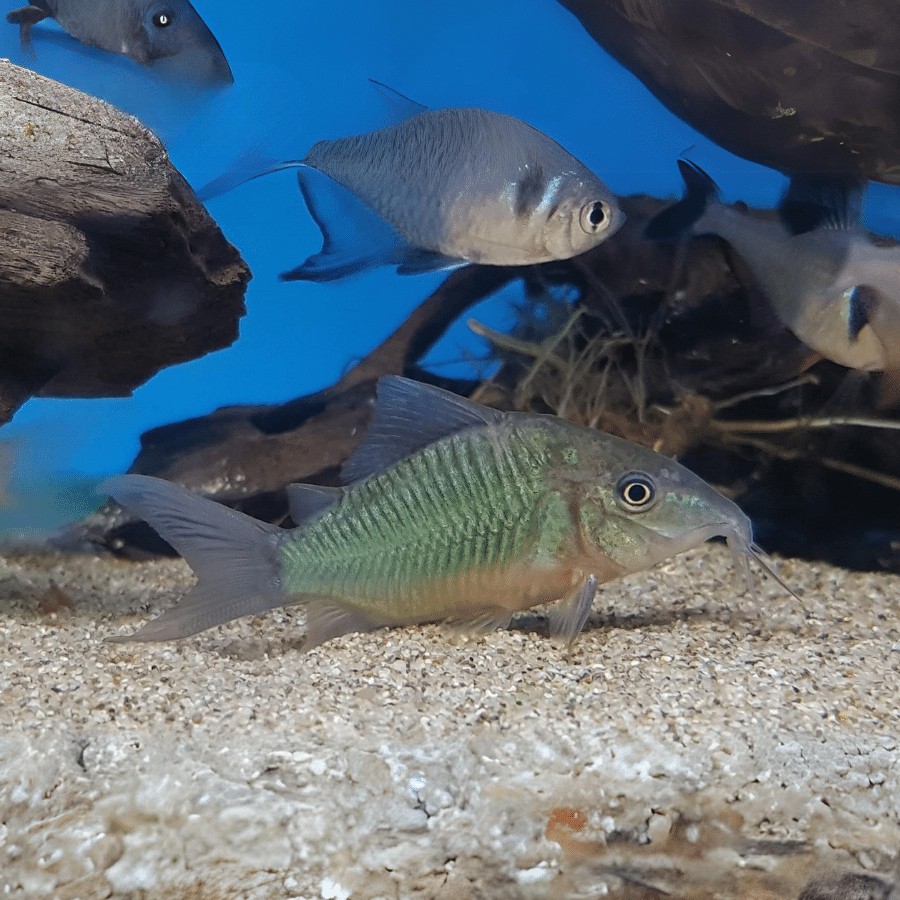
| ✅ | Corydoras Catfish (panda / pygmy / sterbai) | Peaceful bottom-dwellers that coexist perfectly with Mystery Snails; both benefit from sinking foods and neither competes for the same grazing niche on glass and hardscape. |
| ✅ | Otocinclus Catfish | Dedicated algae-eating catfish that share the snail’s cleaning role without conflict. Both species need stable mature water so both thrive in the same setup. |
| ✅ | Red Cherry Shrimp (Neocaridina davidi) | Completely non-aggressive; different feeding niches. Shrimp will pick leftover food around the snail, improving overall tank hygiene during juvenile grow-out. Shares the same hard alkaline water requirement. |
| ✅ | Harlequin Rasbora (Trigonostigma heteromorpha) | Peaceful mid-water schooling fish that never interact with bottom-dwelling snails; tolerates the same pH 7.0-8.0 range the juvenile prefers. |
| ✅ | Endler’s Livebearer (Poecilia wingei) | Small peaceful livebearer that thrives in the hard alkaline water Mystery Snails require; completely ignores snails and adds movement and colour to a grow-out display tank. |
| ✅ | Sparkling Gourami (Trichopsis pumila) | Peaceful nano anabantoid that shares similar tank requirements and ignores snails. A calm, photogenic tank mate for a Small grow-out specimen, especially in a planted setup. |
| ❌ | Assassin Snail (Clea helena) | Specialist predator of other snails — will systematically hunt and kill a Small Mystery Snail by attacking the exposed foot when the operculum cannot seal in time. A 1-2 cm juvenile is eaten rapidly. Absolute incompatibility. |
| ❌ | Pea Puffer / Dwarf Puffer (Carinotetraodon travancoricus) | Obligate mollusc predator with beak-like teeth evolved specifically to crack snail shells. Even a thick Large-grade adult is damaged by pea puffers; a 1-2 cm juvenile is dispatched in a single encounter. |
| ❌ | Clown Loach (Chromobotia macracanthus) | Efficient snail predator with specialised pharyngeal teeth for crushing shells. A Small Mystery Snail would be eaten within days of introduction. |
| ❌ | Crayfish (Cherax and Procambarus spp.) | Aggressive omnivores that grab and crush snail shells with their claws. A 1-2 cm juvenile is an effortless meal; even adults are vulnerable. |
| ❌ | Larger Cichlids (Oscars, Jack Dempsey, Convicts) | Many cichlids are capable of and interested in attacking Mystery Snails of any size. Even smaller cichlids may harass the snail relentlessly, and chronic stress stunts juvenile grow-out even if direct killing is avoided. |
| ❌ | Goldfish (Carassius auratus) | Relentlessly nip at snail tentacles, eyes, and foot; also require cooler, softer water than Mystery Snails thrive in, slowing juvenile grow-out even in the absence of direct harm. |
Quick Reference
| Scientific Name | Pomacea bridgesii (gold form) |
| Supplied Size | Small — 1-2 cm shell diameter (juvenile) |
| Target Adult Size | 5-6 cm after 9-15 months of grow-out |
| Price | AUD $8 — cheapest entry to the species |
| Grow-Out Window | 9-15 months to breeding maturity |
| pH | 7.0-8.2 (ideal 7.6-8.0) |
| Temperature | 18-28 C (ideal 24-26 C for juvenile grow-out) |
| Hardness (dGH) | 8-25 dGH (upper half preferred at juvenile stage) |
| Minimum Tank Size | 20 L+ grow-out tank (40 L+ if community stocked) |
| Calcium Source | Cuttlebone CRITICAL + crushed coral supplementary |
| Quarantine | MANDATORY 2-3 week QT before community introduction |
| Plant-Safe? | YES when adequately fed — P. bridgesii is NOT P. canaliculata |
| Breeding Readiness | Not yet — needs 9-15 months further grow-out |
| Copper Tolerance | NONE — lethal at trace levels (all molluscs) |
| Breathing | Dual — gill (aquatic) + lung (aerial via siphon) |
| Three Juvenile Rules | Cuttlebone always + strict lid + quarantine first |
Reviews
Clear filtersThere are no reviews yet.