🪨 Species at a Glance
| Scientific Name | Hygrophila polysperma |
| Common Name | Indian Swampweed, Dwarf Hygrophila, Miramar Weed, ‘Poly’ |
| Family | Acanthaceae (acanthus family) |
| Origin | India, Bhutan, Myanmar, southern China, parts of Malaysia — now naturalised invasively across Florida, Texas, Mexico, and parts of Australia |
| Legal Status | US FEDERAL NOXIOUS WEED (illegal to possess). AU: prohibited/restricted in VIC, WA, NT; regional restrictions in NSW. Aquarists MUST verify local law before purchase. |
| Mature Height | 20-50+ cm (8-20 in) unchecked; trimmed to any size |
| Growth Rate | VERY FAST — can gain 3-5 cm per week under decent conditions |
| Light Requirement | Low to medium (20-50 PAR) — exceptionally forgiving |
| CO2 Requirement | Not required — thrives in low-tech unheated tanks |
| Planting Method | Stem, planted directly into substrate; also floats successfully |
| Placement | Background mass planting |
| Difficulty | Beginner (among the easiest aquarium stem plants available) |
Planting & Placement
Stem
Hygrophila polysperma is a classical stem plant and is planted into substrate using the simplest technique imaginable, which is one of the principal reasons it has been a beginner favourite for more than fifty years. The plant typically arrives as a bundled bunch of six to twelve stems held together with a small lead weight or rubber band, or as a tissue-cultured cup of compact emersed-grown starters. Remove the bundle from packaging, cut off and discard the lead weight or band — never plant stems while still bundled, as the compressed bases rot within days — and inspect each stem individually. Healthy stems are bright apple-green or occasionally flushed with pale pink at the growing tip, carrying pairs of opposite oval-lanceolate leaves roughly two to five centimetres long. Any stems with obvious rot at the base, blackened interiors, or extensive leaf melt should be trimmed back to healthy tissue or discarded outright.
Each individual stem is planted into substrate using long aquascaping tweezers or simply fingertips in shallow tanks. Grip the stem gently about two centimetres from its base, push the base straight down into the substrate to a depth of three to four centimetres, and release. That is genuinely all there is to it — there is no need to bury multiple nodes, no special root-side-down orientation to worry about, no rooting hormone or mist-frame nursery technique. H. polysperma is so vigorous that it will root from virtually any portion of stem that contacts moist substrate, and even stems inserted upside down will typically right themselves within a week by producing adventitious shoots that grow upward toward the light. Space planted stems three to five centimetres apart if creating a background mass; tighter spacing produces an immediate lush look but leads to self-shading and lower-stem browning within a month, while wider spacing looks sparse at first but allows each stem to branch and fill in naturally over the first few weeks.
Substrate requirements are minimal. Plain inert gravel works perfectly well; nutrient-rich aquasoils produce faster growth but are not remotely necessary for this species. The plant draws nutrients efficiently from the water column through leaf and stem surfaces and will thrive even in tanks with no substrate fertility at all, relying entirely on fish waste and dosed liquid fertilisers. A substrate depth of three to four centimetres is adequate; deeper substrates are fine but bring no particular benefit. Unlike many aquarium plants, H. polysperma will also grow successfully as a floating plant with no substrate contact at all, producing dense rafts of stems at the water surface that can serve as refuge for fry or as a shade structure for light-sensitive tankmates. Aquarists who struggle to keep other stem plants rooted, due to digging fish or boisterous loaches uprooting them repeatedly, can simply let a portion of the H. polysperma float and will find it thrives just as well as the planted portion.
The emersed-to-submerged transition for tissue-cultured starters is very mild compared to other species — the plant barely notices the switch from atmospheric to dissolved gas exchange, and new submerged leaves typically emerge within a week without any significant dropping of emersed foliage. Bunched stems taken straight from a seller’s submerged-grown display tank are effectively ready to go and will resume normal growth within days of planting. This exceptionally smooth transition, combined with the plant’s forgiveness of planting errors and poor conditions, is precisely why H. polysperma has been recommended as a first stem plant for generations of beginner aquarists — and precisely why its extreme hardiness becomes a catastrophic liability once the plant escapes cultivation into natural waterways, as detailed in the Name Origin and Legality section that opens this guide.
Illumination Requirements
LOW LIGHT
PAR: 20-50 PAR at canopy (tolerates 15-100+ PAR)
High
Hygrophila polysperma is one of the most light-flexible aquarium plants in the hobby, growing successfully across a range of photosynthetic photon flux that would kill most other stem plants at either extreme. At the low end, the plant will survive and slowly grow at just fifteen to twenty PAR at the canopy — roughly the light output of an unassuming single T8 fluorescent tube over a sixty-litre tank, or an entry-level LED running at minimum output. Under these dim conditions the plant takes on a leggy form with longer internodes and smaller, paler green leaves, but it persists indefinitely and continues to produce modest growth, something virtually no other stem plant of comparable hardiness can claim. At twenty to fifty PAR — the typical range of a decent aquarium LED in a low-tech setup — H. polysperma grows vigorously, produces thick bushy stems with strong apple-green colouration, and requires trimming every two to three weeks to keep it from overtopping the tank. This is the sweet spot for most keepers and what the plant is best suited to. The practical implication is that a hobbyist running mid-range aquarium LEDs at default manufacturer settings over a standard planted tank of sixty to a hundred litres will deliver exactly the right light budget for this species without any need for special fixtures, reflectors, or staged intensity ramps.
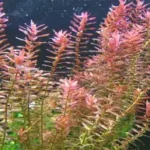
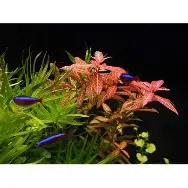
At higher light levels of fifty to a hundred PAR, typical of high-tech CO2-enriched aquascapes, H. polysperma shifts character entirely. Growth accelerates to remarkable speeds — two to three centimetres of vertical extension per week, with prolific axillary branching that can produce five to seven side shoots per week per mature stem. The leaves also undergo an interesting colour transformation: the basic olive-green of the low-tech plant gives way to a warmer leaf tone with pink to salmon flushing at the growing tips and along the upper stem, and under very strong light with abundant iron supplementation the plant’s ‘Sunset’ and ‘Rosanervig’ cultivars develop brilliant pink and salmon-red leaf colouration that rivals many dedicated red stem plants. This high-light performance is what attracts aquascapers to the cultivated colour forms despite their invasive reputation, and is discussed further in the Aquascaping section. It is worth noting that the base-form H. polysperma does not develop dramatic red colouration regardless of light intensity — only the cultivar forms do so, and even then only under the combination of strong light and ample iron supplementation.
Photoperiod requirements are similarly forgiving. A daily photoperiod of six to ten hours works fine, with the typical hobby standard of eight hours being ideal. Dramatically shortened photoperiods of four hours will slow growth without killing the plant; extended photoperiods of twelve hours or more tend to accelerate algae in the tank overall without producing additional benefit to H. polysperma growth. Unlike many plants, H. polysperma does not exhibit any meaningful ‘shock’ response to light schedule changes — new keepers can adjust their photoperiod by two or three hours without inducing any visible plant stress. Signs of genuinely too much light are limited to algae colonisation of the older lower leaves as the upper canopy shades them out; signs of genuinely too little light are legginess, pale colouration, and eventually lower leaf drop. In both cases the plant adapts over a period of weeks to whatever light regime is in force and continues to grow. Keepers transitioning from a dim shop tank to a brighter home display, or vice versa, can expect a two-to-three week adjustment period during which older leaves may partially fade or drop while new growth adapts to the new intensity; this is normal and not cause for alarm, and no intervention beyond patience is required.
Recommended Photoperiod: 6-10 hours, 8 hours standard; forgiving of adjustments
Feeding Your Plant: CO2 & Ferts
CO2 OPTIONAL
Hygrophila polysperma does not require pressurised CO2 injection and will thrive across the full range of hobby setups from bare-bones low-tech tanks with ambient dissolved CO2 of two to four parts per million up to pressurised high-tech tanks running twenty-five to thirty-five ppm. The plant’s ability to utilise bicarbonate ions in addition to free dissolved CO2 gives it a metabolic edge over species that can only use CO2 directly, and this is one of the several mechanisms that allow it to outcompete native aquatic plants when it escapes into natural waterways where CO2 is often limiting. In the home aquarium this translates to reliable growth in tanks where other plants struggle, and for a beginner setting up their first planted tank without CO2 equipment this is a decisive advantage. Aquarists who have struggled to grow more demanding stem plants like Rotala macrandra, Ludwigia ‘Super Red’, or Eriocaulon cinereum without CO2 will find H. polysperma uncomplaining in the same setup, and can use it to build planted tank experience and confidence before eventually moving on to more demanding species when CO2 equipment is within budget.
Adding liquid carbon supplements such as Seachem Excel, Easy-Life EasyCarbo, or UNS Easy Carbon at manufacturer’s recommended doses will accelerate growth by roughly thirty to fifty percent and produces visibly thicker stems and darker leaves within a fortnight. H. polysperma tolerates liquid carbon at normal doses without complaint and does not exhibit the glutaraldehyde sensitivity that troubles delicate species such as Vallisneria, Cabomba, Egeria, or Riccia — a convenient feature when dosing mixed planted tanks. Pressurised CO2 injection produces even more dramatic acceleration: growth rates double or triple, leaves enlarge, stem internodes shorten into a more compact form, and colour forms like ‘Sunset’ develop their brightest pink expression. For aquarists specifically growing the colour cultivars, pressurised CO2 is worth considering even though the base species does not need it at all. Note however that pressurised CO2 on H. polysperma transforms an already-fast plant into an almost-unmanageably fast one, and keepers choosing to pair high light with CO2 should be prepared for weekly or twice-weekly trimming sessions to keep the planting in bounds.
Fertilisation
Fertilisation requirements are minimal for base-form Hygrophila polysperma. In a reasonably stocked fish tank the plant will draw enough nitrogen and phosphorus from fish waste and decaying food that supplemental macronutrients are not strictly necessary, and it extracts trace minerals from tap water well enough that many low-tech tanks run successfully with no liquid fertilisation at all. For keepers who want to optimise growth and colour, a standard all-in-one liquid fertiliser such as Seachem Flourish Comprehensive, Tropica Specialised Nutrition, APT Complete, or UNS Plant Food dosed at half the manufacturer’s recommended rate produces noticeably lusher growth and deeper green colouration within two to three weeks. Full-rate dosing is appropriate for higher-light tanks and tends to bring out the pink flushing in the growing tips.
For the ‘Sunset’ and ‘Rosanervig’ cultivars, iron supplementation is the single most impactful fertilisation variable. Iron is the limiting nutrient for the pink and salmon-red leaf colouration these cultivars can achieve, and a dedicated iron supplement such as Seachem Flourish Iron or Tropica Plant Growth Specialised (which carries enhanced iron) dosed at twice weekly produces visible deepening of pink expression within two weeks. Iron deficiency presents in both base-form and cultivar plants as pale yellow-green new growth with visibly reduced leaf size; resolving it requires either iron supplementation or a switch to a substrate that releases iron naturally. Potassium deficiency occasionally appears in very soft water tanks as small pinholes in older leaves, and is resolved within a fortnight by dosing a potassium-rich supplement. Root tabs are not necessary for this species in water-column-fertilised tanks but do no harm if used; the plant will take up whatever nutrition is made available to it from whatever source.
Water Quality for Plants
6.0–8.0
ideal 7.0
22–28 °C
ideal 25 °C
4–18 dGH
Very wide tolerance; thrives in soft, medium, and hard water alike
Hygrophila polysperma tolerates a range of water chemistry that is quite simply wider than any other popular aquarium stem plant. The pH range of six point zero to eight point zero covers essentially every freshwater tank likely to be set up in the hobby, and the plant grows well across this entire span without any of the species-specific preferences that narrow the usable range for more particular plants. Acidic, neutral, and alkaline tanks are equally acceptable; growth rate and leaf size scarcely shift across this range. Even extreme values well outside the ideal range — down to pH five point five in blackwater biotope setups, or up to pH eight point five in African cichlid tanks — usually still produce acceptable growth, though colouration may shift and some leggy growth may appear at the extremes. This tolerance makes H. polysperma one of the few aquarium plants that can be incorporated into African rift lake cichlid tanks running pH above eight, a setting where the alkalinity and hard water typically preclude most stem plants; the plant survives and grows, if more slowly, and can provide useful cover for rock-dwelling cichlids.
Temperature tolerance spans twenty-two to twenty-eight degrees Celsius with a sweet spot at twenty-four to twenty-six degrees, though the plant survives considerably outside this range as well. Coldwater goldfish tanks at sixteen to twenty degrees grow the plant successfully, just more slowly, and tropical discus tanks at twenty-nine to thirty degrees work fine as long as light and CO2 are adequate to support the higher metabolic demand. Below fourteen degrees the plant enters dormancy and stops producing new growth; above thirty-two degrees it begins to shed older leaves but the growing tips persist. This temperature flexibility is another of the traits that makes H. polysperma such a problematic invasive plant in natural waterways across climate zones, and a tremendously easy plant in the home aquarium. It is precisely this capacity to persist through cool winters in warm-temperate climates — southern Florida, parts of Texas, south-eastern Queensland, and northern New South Wales — that has enabled wild colonisation in these regions, where the plant forms dense monocultures that crowd out native submerged vegetation and disrupt aquatic food webs.
Hardness tolerance is similarly broad, from soft water of four dGH up through hard water of eighteen dGH. Very soft water can occasionally produce potassium deficiency symptoms on older leaves but the plant itself is otherwise unconcerned; very hard water with elevated calcium and magnesium suits the plant fine and often produces thicker, sturdier stems. Carbonate hardness across the normal hobby range of one to fifteen dKH is fine; higher KH does not harm the plant. Chlorine and chloramine in tap water must be removed at water changes as for any aquarium plant, but H. polysperma is more forgiving than most of occasional lapses in dechlorination — it takes considerable neglect before chlorine damage becomes visible. Copper-based fish medications should still be avoided or used with caution as with all aquatic plants; while H. polysperma is hardier than most aquarium plants in the face of chemical insults, copper remains phytotoxic to it at therapeutic doses. In short, the water parameter conversation for this species is really a non-conversation: use whatever chemistry suits your other livestock, and the plant will adapt.
Caring for Your Plant
FAST GROWTH
Hygrophila polysperma is among the fastest-growing stem plants commonly available in the hobby, and this single characteristic — more than any other — defines both its appeal as a beginner plant and its ecological menace as an invader. Under modest conditions with standard aquarium LED lighting and no CO2, the plant produces roughly two to three centimetres of vertical stem extension per week, with a new pair of opposite leaves unfurling every four to six days on each growing tip and axillary branching beginning within two to three weeks of initial planting. Under high-tech conditions with strong light and pressurised CO2, growth rates double or triple: three to five centimetres of vertical extension per week, new leaf pairs every two to three days, and prolific branching that can produce five to seven side shoots per stem per week. A single planted bundle of six stems can become a dense background mass of thirty or more stems within a month of planting, and can fill an entire sixty-litre tank within three months if left entirely unchecked.
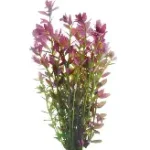
Mature height under aquarium conditions is effectively unlimited — the plant will keep extending upward until it reaches the water surface, at which point it will lie sideways along the surface and continue producing growth horizontally across the air-water interface. Emersed growth above water continues indefinitely if the plant breaks the surface in an open-top tank, producing entirely different leaf morphology with broader, tougher leaves and the characteristic small violet flowers in leaf axils. Leaf dimensions under submerged conditions are typically three to five centimetres long and one to two centimetres wide, oval-lanceolate, with entire or slightly toothed margins and a visible midrib and lateral venation. The ‘Rosanervig’ cultivar is distinguished by prominent pale pink to cream-coloured leaf veins set against a deeper green leaf blade, producing a striking network-veined appearance; the ‘Sunset’ cultivar produces whole-leaf salmon-pink to warm orange colouration across the upper stems.
Maintenance requirements centre entirely on restraint — trimming the plant to prevent it taking over the tank. In a low-tech tank, weekly to fortnightly trimming of the upper stems by five to ten centimetres keeps the plant in bounds and forces dense branching. In a high-tech tank, trimming every four to seven days is typical. The standard technique is to use sharp aquascaping scissors to snip each stem just above a leaf node, leaving a clean horizontal cut; the plant responds by activating axillary buds below the cut and producing two to three side shoots within a fortnight. Discarded cuttings themselves root freely and can be replanted to expand the display, donated to other hobbyists, or — critically — disposed of responsibly, never released to the wild or flushed down drains.
The plant does shed older lower leaves as it grows upward and the canopy shades the bottom of each stem, and mature plantings develop leggy bare stem at the base within two to three months. This is addressed by periodic replanting: the top ten to fifteen centimetres of each healthy stem is cut off and replanted in fresh substrate, while the leggy parent stems are removed and composted or otherwise responsibly discarded. This rejuvenation cycle, performed every two to four months, keeps a H. polysperma planting looking its best indefinitely. Algae pressure on older leaves is occasionally an issue in high-light tanks and is managed by preventive trimming of shaded lower growth before algae can establish a foothold, rather than by any chemical intervention.
One caution worth emphasising applies uniquely to this species: the trimming cycle generates a substantial volume of healthy stem fragments every week, and improper disposal of these fragments is how H. polysperma has historically escaped cultivation to colonise natural waterways. Even a single healthy fragment one to two centimetres long is capable of rooting and establishing a colony if it reaches a suitable freshwater environment. Flushing trimmings down drains, rinsing trimming scissors outdoors over grass or gardens, or composting cuttings in outdoor compost heaps that may connect to drainage systems are all vectors for release. The responsible disposal protocol is strict: dry all trimmings thoroughly on newspaper for at least twenty-four hours to kill the plant tissue completely, then dispose in sealed general waste destined for landfill; never dispose of wet live trimmings, never release to any water body whatsoever, and never give cuttings to anyone you cannot trust to follow the same disposal discipline.
Top growing tips for branching
Every 4-14 days depending on light and CO2 — snip each stem 1-2 cm above a leaf node to force axillary branching and maintain a bushy form. High-tech tanks need weekly trimming; low-tech tanks every 2 weeks is usually sufficient.
Replant top cuttings, discard leggy parents
Every 2-4 months — trim the top 10-15 cm of each healthy stem and replant into fresh substrate; remove and responsibly dispose of leggy bare parent stems. Keeps the display lush from top to bottom.
Remove lower shaded and yellowing leaves
Weekly — snip off any yellowed, browned, or algae-affected lower leaves flush with the stem during routine maintenance. Prevents decaying tissue from fuelling localised algae.
Wipe algae from older leaves
Weekly during water changes — gently wipe green spot algae or green dust algae from established leaves. Preventive trimming of shaded lower growth is more effective than curative algae removal.
Dry and responsibly dispose of trimmings
CRITICAL for this species — dry all trimmings on newspaper for at least 24 hours to kill plant tissue, then dispose in sealed general waste destined for landfill. Never flush trimmings, never release to any waterway, never put wet cuttings in outdoor compost heaps.
Inspect filter intakes and overflow areas
Monthly — check filter intakes, overflow chambers, and any tank plumbing for stray H. polysperma fragments that may have rooted in unexpected places. Remove any found and dispose of as above.
Reproduction & Division
Cuttings
Propagation of Hygrophila polysperma is extraordinarily simple, which is both the practical convenience that makes it a beginner favourite and the biological feature that makes it such a catastrophic invader. The standard stem-cutting technique that works for virtually every stem plant works at maximum efficiency for this species: a healthy mature stem is identified, a terminal section of five to ten centimetres is snipped using sharp scissors just below a leaf node, and the cutting is planted directly into substrate using the same technique as the original starter stem. Roots typically appear within three to five days, visible new growth resumes at the terminal tip within a week, and the cutting is indistinguishable from the parent within three weeks. Success rate under ordinary aquarium conditions approaches one hundred percent; it is genuinely easier to kill this plant through drying or freezing than through any failure of propagation technique.
More remarkable still, and more ecologically dangerous, is the plant’s capacity to root from virtually any fragment — not just deliberate terminal cuttings. A single intact leaf node left behind on a trimmed stem will sprout new growth from its axillary bud; a fragment carried off by a digging fish and deposited elsewhere in the tank will root in whatever substrate it settles in; even partially damaged stem sections with no apparent growing tip will regenerate new tips from axillary nodes. In natural waterways this regenerative capacity means that any disturbance that fragments an existing H. polysperma stand — floods, boat propellers, wildlife activity, manual removal attempts — creates many new propagules that each become the founder of a fresh colony downstream. Eradication of established invasive populations has proven essentially impossible short of complete habitat destruction, which is the core reason for the federal and state-level prohibitions on this species in the United States and parts of Australia.
Inside the aquarium, the hobbyist managing an established H. polysperma planting should expect the plant to attempt to colonise every surface and every open space it can reach. Fragments that escape the intended planting area and settle on hardscape, in substrate corners, or on filter media will root and begin growing, and will need to be removed during routine maintenance. This is easy work in the home aquarium — simply pull up unwanted volunteers during weekly tank cleaning — but it reinforces how extraordinarily vigorous the plant is and why disposal discipline is non-negotiable.
Tissue culture propagation in commercial laboratories is also common and produces clean pest-free starters, though given the plant’s ease of propagation from any cutting, most hobby-scale stock circulates as bunched or loose trimmings traded between aquarists rather than through tissue culture supply chains. This informal trade is itself part of how the plant has escaped cultivation historically; once a cutting enters an unregulated hobby network it becomes impossible to track and nearly impossible to ensure responsible eventual disposal. In jurisdictions where the plant is lawful to keep, the responsible aquarist extends the disposal discipline outlined earlier to any trimmings they give away — recipients must be informed of the disposal protocol, and must be trusted to follow it.
Aquascaping with This Plant
Background
Hygrophila polysperma occupies a classical niche in aquascape composition: the background mass plant, the lush green wall at the back of the tank that provides the visual depth and ‘jungle’ texture against which midground and foreground features are composed. In this role the plant excels, producing thick bushy growth reaching twenty to fifty centimetres tall in a dense curtain that fills the back third of a tank within weeks of planting. For the beginner aquascaper with a low-tech sixty to hundred-litre tank, modest lighting, and no CO2 equipment, no other background plant delivers an equivalently lush result for equivalent effort; species such as Vallisneria, Limnophila sessiliflora, Mayaca fluviatilis, and Bacopa caroliniana approach the functional role but none matches H. polysperma for combined speed, light-flexibility, and outright hardiness.
Classical placement is a dense row of twelve to twenty planted stems along the rear glass of the tank, spaced three to five centimetres apart and allowed to grow up and outward to form a solid green mass. A full-width back planting of this style provides the visual anchor for a Dutch-style arrangement of descending plant blocks in front, or the shaded green backdrop for a classical Nature Aquarium hardscape of driftwood and stones in the foreground. In larger tanks of two hundred litres and above, a back planting can be three or four stems deep rather than a single row, producing an even more substantial mass effect that reads as a true wall of green. The cultivars ‘Sunset’ and ‘Rosanervig’ are often used in this role specifically for their warmer colour tones, which provide a welcome contrast against the predominantly green palette of most planted tanks; ‘Sunset’ in particular can produce nearly salmon-pink foliage across the upper stems under strong light, and rivals dedicated red stem plants like Ludwigia repens or Alternanthera reineckii in visual warmth without demanding the same level of cultivation skill.
Companion planting should emphasise contrast through leaf shape, texture, and colour. The relatively broad oval-lanceolate leaves of H. polysperma pair beautifully with finer-textured foreground plants such as Dwarf Hairgrass (Eleocharis parvula), Monte Carlo (Micranthemum tweediei), or Dwarf Baby Tears (Hemianthus callitrichoides), which provide a fresh fine-textured green carpet below the bulk of the background mass. Midground rhizome plants such as Anubias barteri var. nana, Java Fern (Microsorum pteropus), or small Bucephalandra species attached to driftwood or stones break up the expanse of H. polysperma behind them and provide the focal-point detail that the rapid background growth lacks. Slower-growing stem plants in the midground zone — species such as Hygrophila lancea ‘Araguaia’, Staurogyne repens, or small Rotala cultivars — also work well as contrast features against the fast, lush, high-volume H. polysperma backdrop. Avoid planting other fast-growing background stems such as Bacopa, Cabomba, or Limnophila directly alongside H. polysperma, because the H. polysperma will invariably win the competition for light and space, often within weeks, and the neighbour species will become shaded and sparse.
For biotope-oriented aquascapers specifically building reproductions of Indian, Bhutanese, or Myanmar stream habitats, H. polysperma is a genuine native option and represents one of the relatively few widely-available aquarium plants that is truly authentic to South Asian biotopes. In such biotope projects the plant can be grown alongside native Indian species such as Pogostemon helferi, Cryptocoryne species of the Cognata and Affinis groups, and local crypt hybrids, producing an aquascape with genuine ecological coherence. Biotope purists may also wish to note that Hygrophila polysperma in the wild grows in seasonally flooded marginal habitats that dry out in dry seasons, and an emersed paludarium setup reproducing these conditions is an interesting advanced biotope project — though again subject to the same legal restrictions that govern submerged cultivation in restricted jurisdictions.
For the vast majority of aquascapers pursuing contemporary Nature Aquarium, Dutch, or jungle-style aquascaping in jurisdictions where the plant is lawful, H. polysperma is simply one of the most useful and forgiving background plants available — a plant that can be relied upon to fill a back wall within weeks, tolerate the inevitable errors of new aquascapers, and bounce back from almost any setback from poor lighting to algae outbreaks to complete neglect during holidays. The key disciplines — frequent trimming, responsible disposal of trimmings, and awareness of regulatory status — are easy to internalise and routine for experienced keepers. The plant’s ubiquity in older aquarium literature and its reputation among hobby elders as ‘the plant that cannot be killed’ remain well earned, and for the right tank in the right jurisdiction it continues to be a first-rate choice more than fifty years after its commercial introduction.
One final aesthetic note worth making: because H. polysperma grows so quickly and branches so enthusiastically, mature plantings have a slightly unkempt ‘jungle’ quality to them that some aquascapers love and others dislike. It does not lend itself to the disciplined geometric arrangements favoured in formal Iwagumi stone compositions, and it will overgrow its intended space in minimalist aquascapes within weeks no matter how patient the keeper is. For aquascapers who prefer controlled, slow-developing compositions with precise proportional relationships between elements, choose a slower background species such as Hygrophila lancea ‘Araguaia’ or a compact Rotala cultivar instead. For aquascapers who embrace lush abundant ‘Amazon jungle’ aesthetics and want a plant that will reliably fill the space with green energy, H. polysperma is unmatched.
For aquarists specifically weighing the cultivated colour forms — ‘Sunset’ and ‘Rosanervig’ — against dedicated red stem alternatives, the trade-offs are worth summarising briefly. Dedicated red stems such as Ludwigia ‘Super Red’, Rotala macrandra, Alternanthera reineckii ‘Mini’, and Ammannia gracilis produce more intensely saturated and pure red colouration under high-tech conditions, but all are considerably more demanding in their requirements for strong light, stable CO2, iron-rich fertilisation, and soft acidic water chemistry. The H. polysperma cultivars deliver a softer, warmer salmon-pink to orange-pink expression rather than true crimson red, but do so in lower-tech setups where the dedicated reds would fail outright. For the beginner aquascaper who wants a warm colour accent without the investment in high-tech equipment, ‘Sunset’ is the obvious choice; for the experienced aquascaper running a top-tier high-tech tank, a dedicated red stem is usually the better pick. The cultivars also share all the invasive-species concerns of the base form and must be handled with the same disposal discipline, a point sometimes overlooked by keepers who assume that the horticultural selections are somehow less hazardous than wild-type plants — they are not; ‘Sunset’ and ‘Rosanervig’ are the same species biologically and the same invasive threat ecologically.
| Plant | Why | |
|---|---|---|
| 🌿 | Anubias barteri var. nana ‘Petite’ | Slow-growing midground rhizome plant whose compact dark green leaves provide focal-point detail against the fast lush H. polysperma background; both tolerate low-tech conditions and undemanding water parameters. |
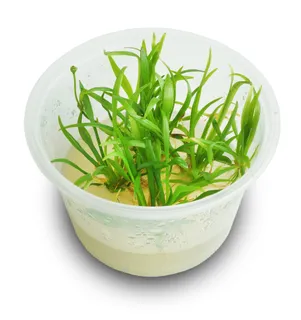
| 🌿 | Monte Carlo (Micranthemum tweediei) | Fine-textured green carpeting plant that forms a fresh foreground beneath the bulk of an H. polysperma background, creating classic Nature Aquarium depth through a three-zone composition. |
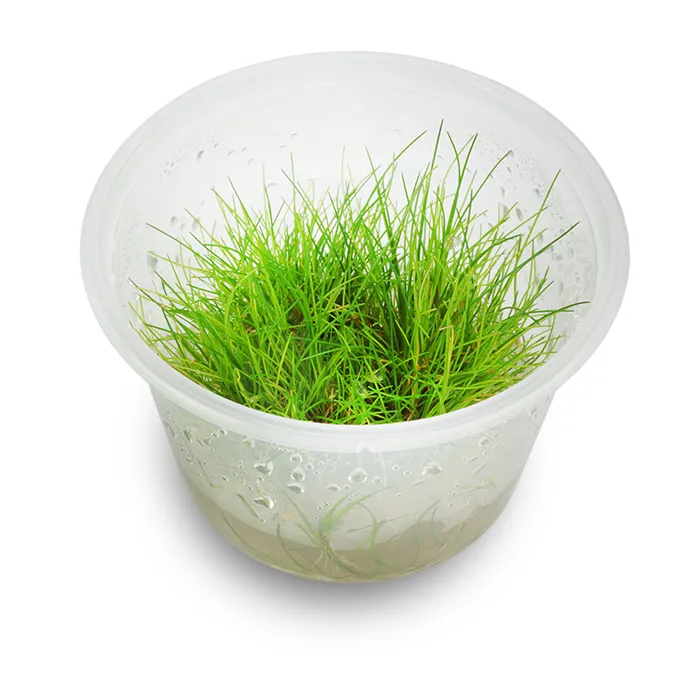
| 🌿 | Dwarf Hairgrass (Eleocharis parvula) | Grassy foreground carpet that grounds the composition visually and anchors the H. polysperma background mass; both species are forgiving of low-tech tank conditions. |
| 🌿 | Java Fern (Microsorum pteropus) | Epiphytic midground rhizome plant attached to driftwood that breaks up the H. polysperma backdrop and provides structural detail; also undemanding and thrives in the same water parameter range. |
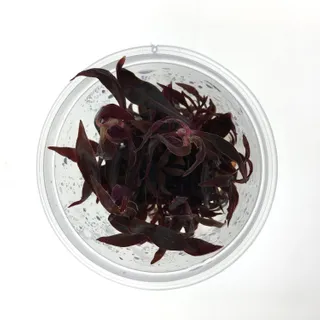
| 🌿 | Hygrophila lancea ‘Araguaia’ | Slow-growing reddish-brown midground sibling species from the same genus — provides dramatic colour and texture contrast against the fast green H. polysperma behind it, while sharing the same Acanthaceae family aesthetic. |
| 🌿 | Cryptocoryne wendtii | Broad-leaved rooted midground crypt that tolerates the same wide water parameter range as H. polysperma and provides a leaf-shape contrast to the oval-lanceolate H. polysperma leaves behind it. |
Quick Reference
| Scientific Name | Hygrophila polysperma |
| Light | Low to medium (20-50 PAR; tolerates wider) |
| CO2 | Not required |
| Growth Rate | Very fast (2-5 cm/week) |
| Mature Height | 20-50+ cm; trim to any size |
| pH Range | 6.0-8.0 |
| Temperature | 22-28 degC |
| Hardness | 4-18 dGH |
| Planting Method | Stem (or floating) |
| Placement | Background mass |
| Propagation | Stem cuttings (extremely easy) |
| Difficulty | Beginner (ideal first stem plant where legal) |
| Legal Status | US: FEDERAL NOXIOUS WEED (illegal). AU: prohibited/restricted in VIC, WA, NT; check NSW/QLD regional rules. Aquarium only, zero release to waterways. |
| Cultivars | ‘Sunset’ (salmon-pink leaves), ‘Rosanervig’ (pink-veined leaves) |
Reviews
Clear filtersThere are no reviews yet.