

🪨 Species at a Glance
| Scientific Name | Micranthemum tweediei ‘Monte Carlo’ (often mislabelled M. umbrosum in trade) |
| Common Names | Monte Carlo, Micranthemum Monte Carlo, MC, New Large Pearl Grass |
| Family | Linderniaceae |
| Origin | Monte Carlo region, Argentine Patagonia — stream banks and margins |
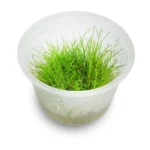
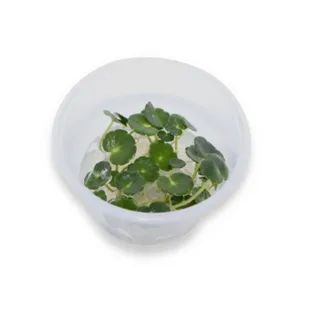
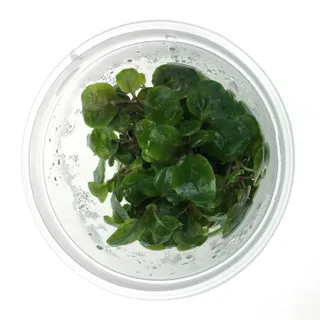
| Form Supplied | Tissue Culture (TC) cup, pest-free and algae-free |
| Planting Method | Carpet — foreground and foreground-to-midground transitions |
| Adult Height | 2-5 cm when carpeted, up to 8 cm if allowed to stack |
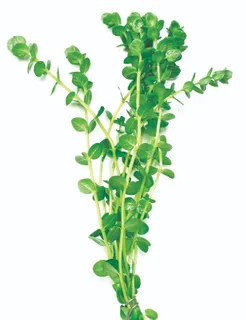
| Leaf Size | 3-5 mm rounded — visibly larger than HC Cuba |
| Light Requirement | Medium — 40-80 PAR at substrate (tolerates low-medium) |
| CO2 | Optional but very beneficial — thrives without, explodes with |
| Growth Rate | Medium to fast once established |
| Difficulty | Easy to Intermediate — the beginner-friendly carpet |
| Carpet Time | 4-8 weeks from planting to full coverage (tank-size dependent) |
Getting Started: Planting
Carpet
Monte Carlo arrives as a tissue-culture cup containing a single dense mat of plantlets grown on clear nutrient gel, the same delivery format used for HC Cuba and for the same fundamental reasons: the plantlets are pest-free, algae-free, and densely packed enough to carpet a medium-sized foreground from a single cup if divided carefully. However, Monte Carlo is meaningfully easier to plant than HC because its leaves are visibly large enough to handle without magnification, its runners are thick enough to grip with ordinary planting tweezers, and a few bruised or buried leaves here and there will not compromise the entire mat. This is the plant on which to learn the physical skills of foreground planting without the emotional and financial pressure of working with HC Cuba.
Before planting, pop the plug out of the cup and rinse the gel away under a gentle stream of lukewarm dechlorinated water. Unrinsed gel will cloud your tank, seed mould on the substrate, and can attract a brown film within 48 hours, so take the three minutes needed to rinse each plug thoroughly — when the water runs clear from the roots, you are done. A kitchen sieve or a clean piece of filter floss makes this easy. Although Monte Carlo is more forgiving of imperfect rinsing than HC Cuba, gel residue still does nothing positive, and skipping this step will measurably slow your first-week establishment.
Once rinsed, lay the plug on a clean surface and use planting tweezers — curved for the front of the tank, straight for the rear — to divide it into portions of roughly one square centimetre each. A cup of Monte Carlo will typically yield twenty-five to forty workable portions, which is enough to plant a 45P (45 x 27 x 30 cm) tank comfortably or to fill the foreground of a 60P with a second cup. Unlike HC Cuba, which needs very small starting clumps to trigger horizontal spread, Monte Carlo is happy with slightly larger portions and will spread outward confidently from one-to-two centimetre starting islands — this saves time at planting and reduces the number of individual insertions needed. Space the portions two to four centimetres apart in a staggered grid, pushing each just deep enough that the base of the stems sits flush with the substrate surface. Avoid burying entire leaves: they will rot and release nutrients that algae will consume before your carpet can.
Tweezering technique is identical to HC Cuba: grip the clump at its base, push the tweezers vertically into the substrate up to the gripped portion, open the tweezers slightly to release, then slide them straight back out. The substrate will close around the roots on its own. Because Monte Carlo’s stems are stiffer and more visible than HC’s, beginners find the physical act of planting significantly less intimidating — you can actually see what you are doing, and a missed stab that leaves the clump floating is easy to re-plant without stress. A 45P foreground generally takes sixty to ninety minutes to plant from one cup, depending on how methodical you are about spacing.
Monte Carlo is a particularly good candidate for the dry-start method — a technique where the tank is kept shallowly flooded or merely damp under a sealed cover for two to four weeks until the carpet has fully knitted before flooding to operating level. In dry-start mode Monte Carlo runs essentially zero algae competition because there is no free-water column for algae spores to colonise, and the plant grows in a denser, more compact form that transitions beautifully to its submerged form after flooding. The key to a successful dry-start is patience: keep a thin film of water just below the substrate surface, cover the tank with cling film or a sheet of glass to maintain 95 percent humidity, mist once a day with dechlorinated water if condensation on the cover is absent, and keep the lights running on their normal photoperiod. After three to four weeks of dry-start the carpet should be visibly denser than it was at planting, and you can slow-flood over 24 to 48 hours by topping up with aged dechlorinated water until the tank reaches operating level.
Getting the Water Right
6.0–7.5
ideal 6.8
20–26 °C
ideal 23 °C
2–10 dGH
Soft to moderately hard water (2-10 dGH)
Monte Carlo’s water parameter tolerance is one of the widest in its class, and this breadth is the second key reason (after its lower light requirement) that the plant has become the default recommendation for beginner carpets. The species accepts pH from 6.0 to 7.5, with an ideal range around 6.5-7.0; total hardness from 2 to 10 dGH covers soft to moderately hard tap water without any need for RO mixing; and temperature from 20 to 26 C comfortably overlaps with the preferences of most community fish including cardinal tetras, ember tetras, celestial pearl danios, chilli rasboras, Apistogramma, dwarf shrimp, and most Corydoras species. In practical terms, most UK, North American, Australian and Japanese urban tap water supplies can keep Monte Carlo without any remineralisation or RO blending at all, which is a genuine financial and operational simplification compared with HC Cuba’s requirement for soft, acidic water.
That said, Monte Carlo’s best appearance is still achieved on the softer, slightly acidic side — around pH 6.5-6.8 with 4-8 dGH — where the leaves take on a noticeably richer green colour and the growth rate picks up by roughly 25 percent over hard-water values. If your tap water is very hard (above 15 dGH) or alkaline (pH above 8), a 50:50 RO blend with remineralisation to 4-6 dGH will transform the look of the carpet without requiring you to go fully RO. For contest-grade tanks, 100 percent RO water with a quality remineraliser (Salty Shrimp GH/KH+, Seachem Equilibrium, ADA Mineral Supplement) remineralised to 4-6 dGH and 1-2 dKH is the standard; the low dKH allows injected CO2 to pull pH down into the mid-six sweet spot without absurd injection rates.
Temperature sits comfortably in the low-to-mid 20s Celsius, with 22-24 C being optimal. Prolonged exposure above 27 C weakens the carpet, encourages cyanobacteria in dead-flow zones, and accelerates CO2 outgassing in injected tanks — a classic summer-only failure mode for Mediterranean, Australian, or tropical-climate aquarists who do not run a chiller. A small thermoelectric chiller sized to tank volume is the cleanest solution for tanks that routinely sit above ambient 26 C; the lower-cost alternative of a clip-on cooling fan blowing across the water surface will drop the tank 1-2 C but at the cost of roughly one to two litres of evaporation per day, which must be topped up with dechlorinated water daily rather than weekly. Below 20 C Monte Carlo does not die but slows to a crawl, which is why cold-water unheated tanks running at 18-20 C rarely produce good carpets even if everything else is in order.
Flow distribution is modestly important but nowhere near the make-or-break factor it is for HC Cuba. Monte Carlo tolerates dead-flow zones that would kill a fine HC carpet, and the main symptom of poor flow is localised cyanobacteria or detritus accumulation rather than outright plant death. A simple lily pipe or spray bar aimed to rip gently across the water surface gives good enough distribution for most tanks up to 90P. Above 90P, consider adding a small powerhead or a second return outlet to guarantee complete coverage.
Finally, filtration: biological filtration matters more than mechanical for Monte Carlo. A canister filter rated for 4-6 times tank volume per hour, loaded with ceramic bio media, is the correct choice for tanks over 30 litres. Smaller tanks can run hang-on-back filters or sponge filters, though the latter provide noticeably weaker flow and should be supplemented with a small powerhead if the foreground is wider than 45 cm. Filter maintenance is six-to-eight-weekly rinses in old tank water only — never tap water, which will kill the established biofilm overnight and trigger a mini-cycle with its associated algae bloom.
Light Needs & Photoperiod
MEDIUM LIGHT
PAR: 40-80 PAR at substrate (tolerates 30 PAR at slower pace)
High
Monte Carlo’s most celebrated advantage over HC Cuba is its dramatically wider light tolerance. Where HC demands 80-150 PAR at the substrate and visibly suffers below 60, Monte Carlo will maintain a genuine flat carpet down to around 40 PAR and can survive at 30 PAR, albeit with slower spread and noticeably taller, looser growth. The ideal range is 40-80 PAR, which in practical fixture terms means any modern planted-tank LED at medium brightness — a Chihiros WRGB II Pro, Twinstar S-Line II, Week Aqua L-Series or Fluval Plant 3.0 at 50-75 percent output will meet the requirement on tanks up to 60 cm long, and shallower 45P nanos can often run such fixtures at 40-50 percent intensity and still produce a tight carpet. This lower light requirement is not just a ‘nice to have’ convenience — it is the feature that transforms carpet aquascaping from a high-budget, high-energy specialty into a viable option for apartment aquarists, nano-tank enthusiasts, and anyone running a tank off a single mid-priced LED fixture.
The recommended photoperiod is eight to ten hours with 30-60 minute sunrise and sunset ramps. A longer photoperiod of eleven or twelve hours does not speed up carpeting and simply invites algae, while a shorter photoperiod of six or seven hours produces noticeably leggier growth — the plant stretches upward trying to capture more light per second and loses its flat carpet habit. Eight hours with ramps is the sweet spot for the vast majority of setups and should be your starting point unless you have a specific reason to deviate.
Under healthy medium light Monte Carlo shows a fresh grass-green colour, lies flat with new runners visible at the perimeter of each clump, and in CO2-injected tanks will pearl lightly in the final hours of the photoperiod. If the leaves start arching upward and the carpet begins to look shaggy rather than flat, light is too low and the fixture should be raised in intensity, lowered closer to the water, or run for a longer fraction of the day at higher output. Conversely, if the carpet takes on a pale yellow-green washed-out cast and algae starts to appear simultaneously on the leaves and hardscape, you have pushed the light beyond what the current CO2 and fertiliser supply can support — the correct response is to either raise CO2 injection or reduce light intensity until balance is restored.
Spectrum-wise, full-spectrum LEDs around 6500 K produce the most natural green colour from Monte Carlo. RGB-capable fixtures can be tuned to emphasise the rich green tones by slightly boosting green and red channels; avoid the heavily blue-shifted ‘reef’ presets that wash the green into a muted aqua. Unlike HC Cuba, Monte Carlo also does well under cheaper or older planted-tank LEDs that lack perfect colour balance — it will grow under a warm 3000 K ‘grow light’ or a cool 10000 K daylight-style LED equally, just with visually different results. If your priority is ornamental appearance, invest in a quality mid-range full-spectrum LED. If your priority is simply growing the carpet, almost any honest planted-tank LED will do.
A word on low-light setups: Monte Carlo will survive at roughly 30 PAR at substrate — the sort of level produced by a basic unbranded LED strip or a single 24 W T5 tube on a 60 cm tank — but at this intensity the plant grows tall and loose rather than flat and tight, producing a meadow-like look that some aquarists actually prefer for a naturalistic biotope rather than a formal iwagumi style. If you deliberately want the taller, looser look, run the plant at 30-40 PAR and trim to 4-5 cm rather than back to 1 cm. If you want a traditional tight carpet, make sure the substrate PAR is above 50 and accept that there is a light floor below which the classic appearance simply is not achievable.
Recommended Photoperiod: 8-10 hours with 30-60 minute sunrise/sunset ramps
Fertilisation & CO2
CO2 OPTIONAL
This is the single biggest practical difference between Monte Carlo and HC Cuba: pressurised CO2 injection is helpful but not mandatory for Monte Carlo, where for HC Cuba it is strictly required. Monte Carlo genuinely thrives in low-tech, CO2-free tanks provided light, fertiliser and water parameters are in range, and it is the only classic carpet plant of which this can honestly be said. Expect a low-tech Monte Carlo carpet to close in eight to twelve weeks rather than four to six, to sit at the taller end of its height range (3-5 cm rather than 2 cm), and to pearl less dramatically than a CO2-injected counterpart. Many aquarists find this visual result more naturalistic and less ‘contest polished’ — a legitimate aesthetic choice rather than a compromise.
If you do choose to add pressurised CO2, the effect on Monte Carlo is transformative. The carpet closes in half the time, leaves shrink slightly and darken to a richer saturated green, pearling begins within two hours of peak light, and the overall density increases to roughly 1.5 to 2 times that of the low-tech equivalent. A target of 20-30 ppm dissolved CO2 is sufficient, which can be verified with a drop-checker holding 4dKH reference solution showing a confident lime-green colour at peak injection. Notably, Monte Carlo is far less sensitive to CO2 instability than HC Cuba — a bubble-count wobble that would melt HC will merely slow Monte Carlo’s growth, and a total CO2 outage for a weekend while you refill a cylinder will not destroy a mature Monte Carlo carpet. This forgiveness is why Monte Carlo is also the default recommendation for first-time CO2-injection setups: you learn the skills of CO2 management on a plant that will survive your learning-curve mistakes.
Liquid carbon products (Seachem Excel, APT Fix, UNS Liquid Carbon, Easy-Life EasyCarbo) at standard daily dose are a reasonable substitute in a no-pressurised-CO2 setup and will produce a modest boost in growth rate and density. Unlike in HC tanks, where liquid carbon is more useful as an algaecide than as a carbon source, in Monte Carlo tanks it genuinely contributes measurable growth — the plant processes it more efficiently because it is not starving for peak-photosynthesis carbon as HC is. Dose according to the product’s instructions, preferably at lights-on, and note that certain companion species (Vallisneria, Anacharis, some mosses) are sensitive to full daily doses and may need you to dose at half-strength if they are present.
Diffusion method matters if you go pressurised: an in-tank glass diffuser on the opposite side of the tank from the filter return, an in-line atomiser, or a reactor plumbed into the canister output are all workable. For Monte Carlo specifically, in-line diffusion tends to produce the most uniform growth because the CO2-saturated water is distributed evenly by the filter return rather than concentrated in the vicinity of an in-tank diffuser. A solenoid regulator on a timer is strongly recommended even for casual setups — running CO2 overnight stresses fish and livestock, and manual on-off control is almost guaranteed to fail the first weekend you travel.
Fertilisation
Monte Carlo is a moderately hungry plant by the standards of beginner-friendly species but nowhere near as demanding as HC Cuba. On fresh ADA Amazonia or a comparable aquasoil, the first six to eight weeks often need only a light trace element mix and half the normal macronutrient dose, because the substrate is leaching ammonium, nitrate and phosphate into the water column faster than the plants can consume. In fact, overdosing macros during this initial window almost guarantees an algae bloom that the young carpet cannot outcompete. A safer starting regimen is 3-5 ml of a commercial all-in-one such as APT Complete, Tropica Specialised, or Seachem Flourish three times per week, combined with daily half-doses of a micronutrient mix emphasising iron and chelated trace elements.
From roughly the second month onwards, increase to a full dosing regimen: target 10-20 ppm nitrate, 1-2 ppm phosphate, 15-25 ppm potassium, and a full trace mix with iron, manganese, boron, zinc, copper and molybdenum. Iron is the single micro most worth watching on Monte Carlo: a pale yellow-green cast on new leaves across the carpet almost always indicates iron or overall micro deficiency rather than a macro problem, and the plant responds within a week to a targeted DTPA-iron or Fe-gluconate booster. Unlike HC Cuba, where EI-style overdosing is the standard recommendation, Monte Carlo grows happily at half-EI levels in most aquarium setups and is a good candidate for the lean Estimative Index (lean EI) or PPS-Pro dosing philosophies, which provide just enough fertiliser to meet the plants’ needs without the safety margin that drives algae growth.
Root tabs are optional on an active aquasoil and mandatory only on inert sand or gravel setups. If you are running sand, a tab grid of one tab per 10 by 10 cm square, refreshed every three months, will maintain steady growth. On aquasoil, tabs become useful after 12-18 months as the soil begins to exhaust, at which point a single tab per 30 cm of tank width placed at the rear of the foreground will revive the carpet. Spread tabs widely rather than clustering them, and push them in firmly to avoid dislodging the carpet when they dissolve.
Water change schedule interacts with fertilisation in an important way. During the first four to six weeks, a 30-50 percent water change weekly helps export the ammonium spike from new aquasoil and keeps algae pressure down. After the tank has matured, 25-30 percent fortnightly is generally sufficient for Monte Carlo, though many keepers maintain weekly changes purely for the stability benefits. Always match water-change water to tank temperature and GH-KH within reasonable tolerance — a plant that does not actively mind a small pH swing will still show sulking behaviour if cold tap water is dumped into a warm tank, and temperature shocks are the single most common cause of ‘mysterious’ dieback of an otherwise healthy carpet.
Finally, a comment on the diagnostic rhythm. Take a weekly photograph of the carpet from the same angle under peak lighting, with grid overlay on your phone for consistent framing and HDR turned off so the colour is not auto-adjusted. Compare each photo against last week’s before making any dosing or parameter change. Monte Carlo grows fast enough that weekly change is visible, which makes it an excellent plant on which to learn the rhythms of planted-tank diagnostics — unlike HC Cuba, where the signal-to-noise ratio of weekly change is often too low to guide action reliably.
Growth Rate & Upkeep
MEDIUM GROWTH
Under ideal conditions Monte Carlo carpets a 45P foreground in four to six weeks from plug planting, a 60P in six to eight weeks, and a 90P in ten to twelve weeks. In a low-tech no-CO2 setup, expect these timescales to roughly double. The first seven to ten days are visually quiet — the plantlets are establishing roots in the aquasoil and look nearly unchanged from the day of planting. This quiet period is shorter and less anxious for Monte Carlo keepers than for HC Cuba keepers because Monte Carlo’s larger leaves make the plants visibly present in the scape from day one; there is no stretch of weeks where the foreground looks empty. Around day ten to fourteen the first horizontal runners appear, and from week three onwards the carpet fills in visibly between water changes. The psychological difference this makes during the establishment period is considerable and is another under-recognised reason for Monte Carlo’s popularity.
Once the carpet has closed, regular trimming is essential. Unlike HC Cuba, which must be trimmed to prevent the fatal carpet-lift-off failure mode, Monte Carlo trimming is more a matter of ornamental discipline: if left uncut, Monte Carlo will continue to stack upward, producing a mossy meadow look that climbs to six or even eight centimetres. This is acceptable in naturalistic biotopes but destroys the classic tight-carpet aesthetic. Trim every three to four weeks back to a height of one to two centimetres, using sharp curved scissors in short, overlapping passes. Remove every clipping immediately with a fine net; Monte Carlo clippings will absolutely re-root if left drifting, and an unkempt scape will within a month acquire random tufts growing out of driftwood crevices, between stones, and against the filter intake.
After a heavy trim the carpet looks dramatically thinner for three to five days, with the exposed stem bases visible across the foreground, but within a week it fills back thicker and tighter than before the cut. Monte Carlo responds to trimming with aggressive lateral branching, so each trim actually improves the density of the carpet over time — a well-managed, regularly trimmed Monte Carlo lawn is visibly thicker at month six than at month two, which is the opposite of what many other carpet plants do. The first trim should happen no later than week six from planting even if the carpet has not reached two centimetres, simply to trigger the lateral branching that builds long-term density.
Snails are a lesser problem for Monte Carlo than for HC Cuba because the larger leaves are less vulnerable to grazing damage — a moderate bladder-snail population will barely affect a healthy Monte Carlo carpet, whereas the same population will riddle an HC carpet with visible pinholes. That said, starting with tissue-cultured stock and dipping all other introduced plants (20 seconds in 1:19 bleach, followed by a thorough dechlorinator rinse; or a 1:19 dilution of Seachem Excel for a gentler alternative) remains best practice. Shrimp (Neocaridina and Caridina) are entirely compatible and actively helpful for keeping detritus off the carpet. Fish that burrow or dig — most loaches, Corydoras feeding patterns on soft substrate, larger South American cichlids — will disturb a young Monte Carlo carpet but are generally less destructive than on HC Cuba because Monte Carlo’s thicker roots hold their clumps more firmly in the substrate.
Algae management during establishment follows the standard new-tank progression: diatoms (brown dust) in weeks two to four, green dust algae on glass around weeks four to six, and occasional green spot algae or black beard on hardscape edges from month two onwards. Monte Carlo’s advantage is that it is robust enough to outcompete these pressures if the rest of the tank is balanced, unlike HC Cuba which is often algae’s first casualty when a tank loses balance. Tools for algae management are the standard set: soft toothbrush for diatoms, reduced photoperiod and increased CO2 stability for green algae, spot-dosing of liquid carbon for black beard. Cyanobacteria (slimy blue-black or dark green mats with an earthy smell) appears in dead-flow corners and is treated by manual removal, improved flow, and if persistent a three-day blackout combined with a targeted dose of erythromycin.
Weekly Water Change (establishment)
25-40% during weeks 1-8; gravel-vacuum above the carpet (not through it) to remove detritus without uprooting young plants
Fortnightly Water Change (mature)
25-30% after the carpet has closed; many keepers maintain weekly changes anyway for stability and algae prevention
Carpet Trim
Every 3-4 weeks once established; trim back to 1-2 cm height with curved scissors, removing all clippings immediately with a fine net
Fertiliser Dosing
3 times per week all-in-one such as APT Complete or Tropica Specialised, plus daily or every-other-day trace micronutrient mix with emphasis on iron
CO2 Drop-Checker Review (if injecting)
Weekly visual check against a lime-green target; refill 4dKH reference solution every 4-6 weeks for accurate readings
Glass and Surface Cleaning
Weekly glass scrape and surface-film skim; a clean water surface lets the full light spectrum reach the carpet and boosts gas exchange
Filter Maintenance
Canister filter rinse every 6-8 weeks in old tank water only — never tap water, which destroys the biofilm
Design Ideas & Placement
Foreground
Monte Carlo has significantly broader aquascaping applicability than HC Cuba thanks to its forgiving light requirements, larger leaf size, and its ability to function across a foreground-to-midground transition. Where HC Cuba is locked into the strict front-of-tank role in formal iwagumi layouts, Monte Carlo is equally at home as a traditional flat foreground, as a taller mossy meadow in a naturalistic jungle-style scape, and even climbing partway up mid-tank rockwork where it functions as a midground ground-cover that bridges the visual gap between the bare foreground substrate and the taller stem plants in the background. This flexibility is why Monte Carlo appears across more style categories in international aquascaping competitions than any other carpet plant, including in biotope, Dutch, jungle, and even paludarium entries where pure HC Cuba would be out of place.
In a classic iwagumi (a minimalist Japanese aquascape of a small odd-numbered group of stones on a carpet), Monte Carlo replaces HC Cuba in tanks of 60P and above where the texture scale of HC Cuba becomes too fine to read visually from a normal viewing distance. Monte Carlo’s 3-5 mm leaves remain visible and textured from two metres away, where HC Cuba’s sub-millimetre leaves blur into a uniform green plane. For a 45P tank HC Cuba is arguably still superior for pure iwagumi, but above 60P the balance tips in Monte Carlo’s favour. When pairing with stone, Seiryu, Ryuoh and Ohko stones all look excellent against the Monte Carlo foreground; lighter stones like Frodo or Zhang Fei stones can appear washed out against the saturated green and are generally better matched with HC Cuba’s cooler, paler green.
Outside iwagumi, Monte Carlo is the standard foreground carpet in Nature Aquarium jungle-style layouts that feature heavy driftwood, moss attachment, and dense stem-plant back-drops. The slightly looser, taller growth habit of Monte Carlo under medium light fits the jungle aesthetic perfectly, producing a meadow-under-forest look that HC Cuba’s rigid flat carpet cannot achieve. In Dutch-style layouts — which are defined by terraced street-of-plants compositional rules rather than by stone or wood hardscape — Monte Carlo serves as the base layer behind which terraces of Lobelia cardinalis, Alternanthera reineckii and Rotala species are stepped up toward the back.
A particularly valuable Monte Carlo technique is the deliberate use of the plant as a midground bridge. By allowing a band of Monte Carlo to climb partway up a gently sloped rock or log, you create a visual linkage between the foreground substrate and the midground hardscape that reads as a naturalistic moss-like invasion rather than a geometric terrace. This is a signature look in contemporary European aquascaping and one of the standout features of Belgian aquascaper Serge Van Ginderbeuren’s award-winning tanks. To achieve it, attach small Monte Carlo portions to the hardscape with thin cotton thread or fast-setting cyanoacrylate glue; within four to six weeks the runners anchor into the crevices of the stone or wood and the thread dissolves or becomes invisible under the growth.
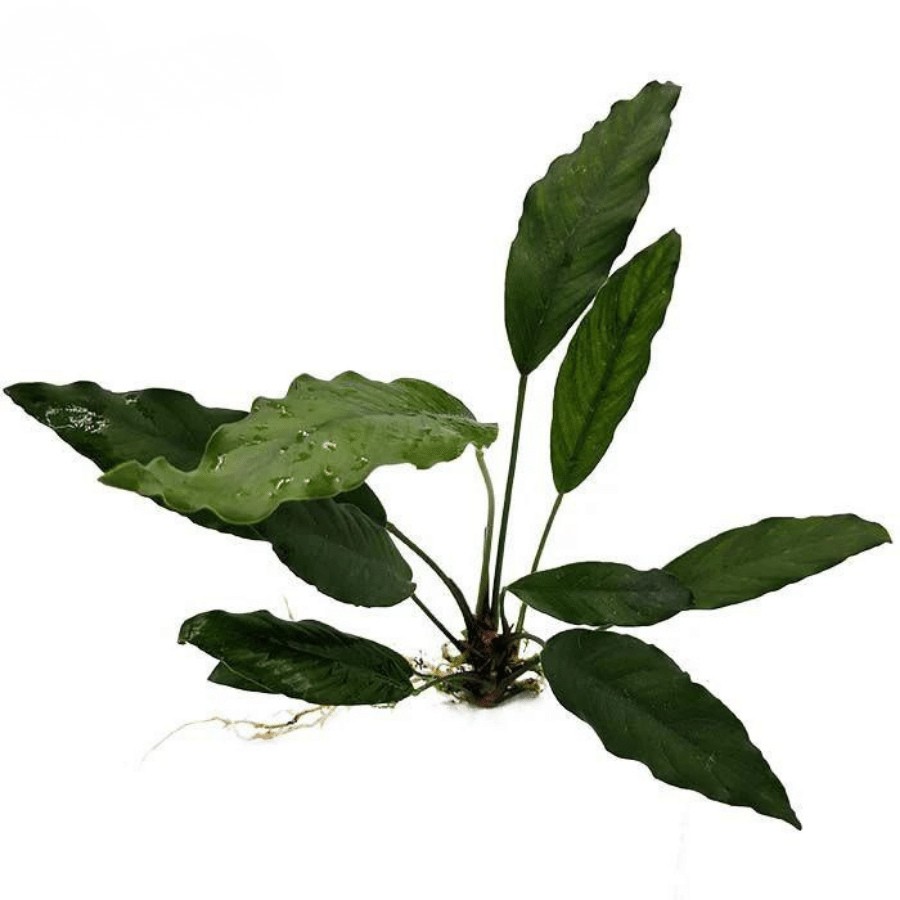
Companion planting is straightforward given Monte Carlo’s broad parameter tolerance. Mid-ground mosses (Christmas moss, Flame moss, Weeping moss, Mini Fissidens) pair beautifully on attached hardscape. Small-leaved stem plants (Rotala ‘H’ra’, Ludwigia ‘Super Red’, Myriophyllum ‘Guyana’) give red-orange colour contrast against the saturated green. Rhizome plants (Anubias nana ‘Petite’, Bucephalandra ‘Wavy Green’, Bolbitis heudelotii) provide textured dark-green accents on the hardscape. Avoid aggressive root-feeders such as large Echinodorus or fast-spreading Cryptocoryne that will outcompete the foreground, and avoid fish known to dig (most loaches, larger cichlids, Geophagus species) which will uproot young carpets.
Finally, Monte Carlo combines beautifully with HC Cuba in layered carpet compositions: HC Cuba in the immediate foreground, Monte Carlo in the near-midground, and Eleocharis mini (dwarf hairgrass) as a tall transitional grass behind both. This three-tier carpet creates dramatic forced perspective that makes the scape look significantly deeper than its actual dimensions, and is a common trick in large-tank contest photography. The technique requires that the HC Cuba area receive genuinely high light (80+ PAR), which may mean adjusting fixture position to concentrate output on the front third of the tank, but the visual payoff is substantial.
For aquarists who want the reliability of Monte Carlo with a slightly different visual character, consider deliberately varying leaf size across the scape by pairing Monte Carlo with its close relative Micranthemum ‘Monte Carlo Mini’ (a compact selection with smaller leaves) in strategic locations — for example, a Mini patch in the very front row with standard Monte Carlo filling the rest of the carpet. The transition is invisible to casual viewers but reads at a subconscious level as a gradient of scale that enhances depth perception. This is a recent aquascaping technique pioneered in competitive nano-tank categories at the 2023 IAPLC and AGA contests and is becoming increasingly visible in published contest photography. Monte Carlo also pairs with Staurogyne repens in a wholly different register: where Monte Carlo provides the low carpet, S. repens provides a 5-10 cm tall dense midground of upright stems that stays compact with regular trimming, creating a two-layer green foundation against which taller red stem plants at the rear can be placed for maximum colour drama. Both species share Monte Carlo’s tolerance of medium light and medium CO2 and are genuinely stable under low-tech conditions once established, making this combination the sensible default for a first ambitious planted tank that aims for a contest look without the advanced-tech budget.
| Plant | Why | |
|---|---|---|
| 🌿 | HC Cuba (Hemianthus callitrichoides) | The more advanced smaller-leaved cousin; pairs in the front third of the tank for a two-tier carpet forced-perspective effect in larger scapes |
| 🌿 | Eleocharis mini (Dwarf Hairgrass ‘Mini’) | Taller transitional grass rising behind the Monte Carlo foreground; creates the classic three-tier carpet-meadow look |
| 🌿 | Christmas Moss (Vesicularia montagnei) | Attached to driftwood at the midground transition; provides textural contrast and shares Monte Carlo’s medium-light preference |
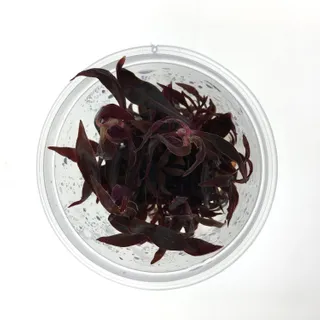
| 🌿 | Rotala ‘H’ra’ | Red stem background plant whose orange-red tones create striking contrast against Monte Carlo’s saturated green in contest photography |
| 🌿 | Anubias nana ‘Petite’ | Dark-green rhizome plant for attaching to hardscape; requires no substrate contact and tolerates identical light and parameters |
| 🌿 | Bucephalandra ‘Wavy Green’ | Slow-growing rhizome accent with textured leaf form; thrives in the same medium-light, moderate-flow conditions as Monte Carlo |
Multiplying Your Plant
Runners
Monte Carlo propagates naturally through lateral runners — horizontal stolons that creep across the substrate surface, root at each node, and produce new plantlets that themselves send out further runners. This is the mechanism by which the carpet closes after planting, and it is also the mechanism the aquarist exploits to produce new stock for a second tank, to fill in bare patches, or to share starter clumps with other hobbyists. Monte Carlo’s runners are visibly thicker and more robust than those of HC Cuba, which makes the propagation process significantly easier both to execute and to inspect. A runner two to three centimetres long with three or four nodes is a perfect standalone cutting that will establish a new patch within seven to ten days of replanting.
The easiest propagation method is simply to relocate long trimmings after a hard cut. After a heavy trim, select the longer runners with visible white roots emerging from the nodes along their length. Lay these flat on the target substrate and pin them down with a few substrate granules, a small piece of stainless-steel mesh, or a pair of crossed bamboo toothpicks until they anchor — typically within seven to ten days. The anchor mechanism matters: floating trimmings that wash around the tank will re-root in unpredictable places and produce visible tufts growing out of driftwood or between stones, which is neither the aesthetic nor the controlled-carpet result most aquarists want. Always pin or press cuttings rather than trusting them to drift to a desirable location.
The second method, used by aquascapers in formal contest preparation and by anyone filling in a bare patch in an otherwise mature carpet, is to lift a square of established carpet from a donor area with scissors, cutting straight down through the substrate at the edges to keep the runners intact on the underside of the slice. Roughly two-by-two-centimetre squares work well for contest contexts, and the harvested square is then pressed into the target location in the same way as the original TC plugs. Donor areas typically refill within three to four weeks without visible long-term effects on the parent carpet. This ‘pressing’ technique gives far more predictable results than scattering loose trimmings and is the correct method when you need a guaranteed fill in a specific spot before a photograph or a show.
A third method, less commonly discussed but useful in certain situations, is direct division of the TC cup at arrival. Rather than planting the whole cup immediately in one tank, split it into two halves and stagger the plantings by two weeks across two different tanks — the second half can be stored in a sealed container of aged tank water at room temperature with the lid off for up to two weeks without losing viability, provided you change the water every three days and keep it lightly lit. This is particularly useful for aquarists setting up multiple tanks in sequence and unwilling to pay for two separate TC cups.
Successfully propagated Monte Carlo should show visible new leaf growth within two weeks; plantings that remain static for more than three weeks are almost always dead and should be removed before they decompose and foul the substrate. A dead clump is recognisable by the stems turning translucent brown rather than green — if you see this, extract the clump promptly and replant from a fresh donor.
Quick Reference
| Light | Medium — 40-80 PAR at substrate |
| Photoperiod | 8-10 hours with 30-60 min ramps |
| CO2 | Helpful but optional; 20-30 ppm if injected |
| Growth Rate | Medium to fast |
| Position | Foreground carpet, foreground-to-midground bridge |
| Height | 2-5 cm (up to 8 cm untrimmed) |
| Leaf Size | 3-5 mm rounded |
| pH | 6.0-7.5 (ideal 6.5-7.0) |
| Temperature | 20-26 C (ideal 22-24 C) |
| Hardness | 2-10 dGH (soft to moderately hard) |
| Substrate | Aquasoil preferred; inert sand + tabs acceptable |
| Propagation | Lateral runners; pin trimmings or press harvested squares |
| Difficulty | Easy to Intermediate — the beginner-friendly carpet |
Reviews
Clear filtersThere are no reviews yet.