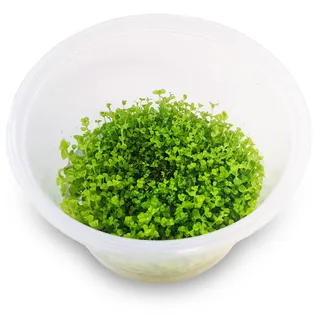
🪨 Species at a Glance
| Scientific Name | Micranthemum tweediei (sold as ‘Takashi Carpet’) |
| Family | Linderniaceae |
| Common Names | Takashi Carpet, Baby Tears (Amano strain), ADA Baby Tears |
| Origin | South America — Argentina, southern Brazil, Paraguay, Uruguay |
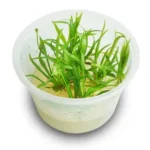
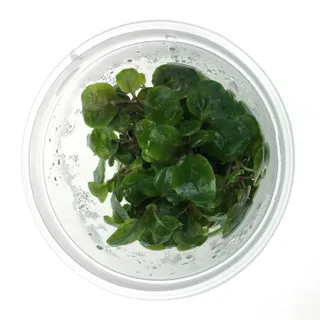
| Form Supplied | Tissue Culture (TC) — sealed cup, pest-free, snail-free, algae-free, submersed-form already |
| Planting Method | Carpet — divided into 1-2 cm portions, pushed into substrate with long tweezers |
| Placement | Foreground to low midground — full open-view carpet |
| Adult Height | 2-4 cm when trimmed as a carpet; up to 5-6 cm if left untrimmed |
| Leaf Size | 3-5 mm diameter, rounded, bright apple-green |
| Light Level | High — 60-100+ PAR at substrate surface |
| CO2 | Required — 25-35 ppm, pressurised injection |
| Growth Rate | Medium with full CO2 and ferts; slow to stalled without |
| Propagation | Spreading — lateral runners and node division |
| pH Range | 5.5-7.0 (soft acidic ideal, 6.2-6.8 target under CO2) |
| Temperature | 20-26 C (68-79 F), 22-24 C ideal |
| Hardness (GH) | 2-8 dGH — soft water preferred, 3-6 dGH ideal |
| Substrate | Nutrient-rich aquasoil (ADA Amazonia, Tropica Aquarium Soil, Fluval Stratum) |
| Difficulty | Intermediate — TC form removes pest risk, but lighting and CO2 must be dialled in carefully |
| Carpet Time | 6-10 weeks from planting to full coverage under correct conditions |
Planting & Placement
Carpet
The defining characteristic of Micranthemum ‘Takashi Carpet’ is that it is planted as a foreground carpet, and the defining advantage of the tissue culture form is that you never have to fight the pest, algae, and melt problems that plague pot-grown Baby Tears through the first month of a new scape. A sealed TC cup arrives with a flat disc of gel-embedded plantlets — typically 150 to 400 tiny rooted stems grown from a single parent culture in a sterile laboratory medium. The entire mass of plantlets is clean, already in submersed form, and ready to be split into 20 to 40 individual planting portions. Done correctly, the planting session takes 30 to 45 minutes for a 60 cm tank foreground, and by the end of the session the tank is uniformly dotted with tiny green puffs at 1-2 cm spacing, each sitting slightly below the substrate surface with its leafy crown level with the grain. Within 3 to 5 days these puffs anchor with new roots, within two weeks they begin sending out horizontal runners, and within 6 to 10 weeks they have knitted together into a dense carpet that reads as a continuous cushion of foliage.
The correct TC unpacking sequence matters more than most beginners expect. Pop the sealed lid, invert the cup carefully over a clean dish, and the agar gel disc will slide out intact. Rinse the disc gently under lukewarm dechlorinated water (or used tank water) to dissolve and wash away all remaining gel — any gel carried into the tank will cloud the water within hours and can feed a bacterial bloom during the first week that coats the new plantlets in biofilm. Rinse patiently, turning the disc several times, until the plantlets come away clean and you can see rooted stems rather than suspended gel. Use your fingers or soft aquascaping tweezers to tease the rinsed disc apart into small portions, each containing 3 to 6 rooted stems and measuring roughly 1 to 2 cm across. Resist the temptation to plant larger clumps: small, evenly distributed portions carpet faster and more uniformly than a few big chunks, because the centre of a large clump sits too shallow in the substrate to root, and the buried lower stems rot and release ammonia into the root zone. Small portions simply do not have that problem. A single ADA or Tropica cup yields 20 to 30 usable portions comfortably, 40 if you are patient and meticulous about dividing down to 3-stem minimum portions. Place planted portions in a moist shallow tray and keep them sheltered from direct light while you work through the whole cup — the plantlets are small enough to dry out quickly under aquarium lighting.
Planting technique uses long aquascaping tweezers, 27 to 32 cm for a standard 45 cm tank and longer for deeper tanks. For each portion, angle the tweezers at 30 to 45 degrees into the substrate rather than straight down — the angled approach plants the portion horizontally into the substrate rather than vertically, which means the portion lies flat against the grain rather than standing up. Grip the roots and the lower stem (never the fragile leaf tips), push the tweezer tips 1 to 1.5 cm into the substrate, open the tweezers gently, withdraw them at the same angle, and gently smooth the substrate over the base of the portion with your finger or the back of a spoon. The portion should sit with its crown — the point where roots meet leaves — level with the substrate surface. Too deep and the buried leaves rot, brown, and release ammonia into the substrate where it will drive a diatom bloom during the first two weeks. Too shallow and the portion floats free on the first filter-current surge, leaving a bare patch in the carpet that has to be replanted from cannibalised neighbours. Space portions at 1 to 2 cm apart on a roughly square grid across the intended carpet footprint; closer spacing speeds the carpet but wastes plant material and produces a thicker, more vertical carpet, wider spacing slows the carpet but extracts the maximum coverage per TC cup and produces a flatter, more laminar carpet. The target is a full dense carpet within 10 weeks of planting, so the spacing you choose should produce closed coverage at that timeline given your light and CO2 intensity.
Work from the back of the carpet footprint to the front so you do not have to reach over already-planted portions and disturb them. If your aquascape includes hardscape (stones, driftwood), plant tight against the hardscape first so the carpet will eventually flow up and around it, rather than leaving gaps that take weeks to close. Water the tank only after planting is complete — plant dry-start style if your tank is a new setup without water yet, or use the damp-substrate planting technique if the tank is already filled. For damp-substrate planting, drain the tank to 2-3 cm below the substrate surface, plant the entire carpet, then slowly refill using a plate or plastic bag laid on the substrate to diffuse the water stream so the fresh plantings are not blown out. Fill slowly over 20 to 30 minutes; a fast refill is the single most common reason for an uneven final carpet. For a brand new scape, consider the dry-start method: keep the tank at 95% humidity with the substrate damp but no standing water for 4 to 6 weeks before flooding. Takashi Carpet transitions from dry-start to submersed growth smoothly, and the method eliminates the entire first-month algae and melt risk window.
Illumination Requirements
HIGH LIGHT
PAR: 60-100+ PAR at substrate surface
High
Takashi Carpet is a high-light plant in the technical aquarium sense of the word — it needs 60 PAR at the substrate as an absolute floor for reliable carpeting, 80 to 100 PAR to carpet quickly and densely, and tolerates up to 150 PAR at the substrate if the rest of the balance (CO2, macro nutrients, trace elements, water change frequency) is dialled in to match. In practical terms, that means a full-spectrum planted-tank LED fixture such as the Chihiros WRGB II, Twinstar S-line, ONF Flat Nano+, ADA Solar RGB, or Kessil A360X running at 70-100% output over a 60 to 90 cm tank 30 to 40 cm tall. A floor-spec low-tech LED that runs a low-light tank of anubias, java fern, and crypts beautifully will simply fail to carpet this species — the plant survives, stays green, but never knits together into a dense lawn, and eventually stretches vertically as it reaches for more light, producing leggy stems and a patchy carpet riddled with bald zones where light could not penetrate to the substrate. Underestimating light is the single most common reason Takashi Carpet scapes fail to carpet in the first 10 weeks, and keepers who report ‘my Baby Tears just won’t carpet’ are almost always running lights at or below the 50 PAR threshold.
Signs of correct lighting balance are visible within two weeks of planting. Leaves stay small and tight, 3-5 mm in diameter, and a bright apple-green that looks almost glow-in-the-dark under aquarium lighting. Internodes stay very short — under 5 mm — which is what produces the dense compact carpet look characteristic of competition Takashi layouts. New runners appear at the base of each planted portion within 10-14 days and extend horizontally across the substrate, producing visible creeping stems that colonise the bare substrate between portions. The carpet reads as uniformly green from glass to hardscape. Signs of insufficient light are equally clear: leaves stay smaller than a millimetre or yellow off entirely, internodes stretch to 10 mm or more as the plant reaches upward instead of spreading outward, runners stall or fail to develop, and green dust or green thread algae appears on older leaves as the plant grows too slowly to outcompete algae for available nutrients. Signs of too much light in an otherwise out-of-balance tank are black brush algae (BBA) on leaf edges and on trimmed margins, green spot algae on substrate surface and on the glass near the carpet, and occasionally diatom outbreaks on older leaves. The fix for excess light is not necessarily less light — it is usually more CO2, more macronutrient dosing, and more frequent water changes to bring the rest of the system up to match the light intensity, since the plant clearly has the photosynthetic capacity to use what it is being given.
Light quality matters as much as intensity. Planted-tank LEDs in the 6500K-7500K range with a strong red and blue component produce the best carpet density and colour — red light drives photosynthesis, blue light keeps leaves compact rather than stretched. Pure white or warm-spectrum LEDs designed for display (fish-only) tanks are lower-efficiency for plant growth and tend to produce pale leggy carpets. A single-channel LED without adjustable intensity is acceptable but less flexible than a dimmable or full-RGB controllable fixture; the ability to ramp down lighting during the first 2-3 weeks of a new scape (to suppress algae while the carpet establishes) and to fine-tune spectrum as the tank matures is genuinely useful. Photoperiod should start at 6 hours per day for the first 2-3 weeks of a new scape, then extend to 7-8 hours by week 4, and settle at a final 8-9 hours by week 6-8. A 30-minute dawn and dusk ramp (soft fade-in and fade-out) reduces visual stress on fish and eases algae suppression during the photoperiod transition. Running lights longer than 9 hours per day is counterproductive — plant photosynthesis saturates after 8-9 hours and the extra light only feeds algae.
Recommended Photoperiod: 7-9 hours per day with a 30-minute dawn and dusk ramp; start at 6 hours for the first 2-3 weeks of a new scape to suppress algae while the carpet establishes
Feeding Your Plant: CO2 & Ferts
CO2 INJECTION REQUIRED
CO2 injection is not optional for Takashi Carpet — it is a structural requirement of the species, full stop. The plant can survive without CO2 but will never carpet; growth stalls within weeks of planting, leaves stay sparse and pale, the lateral runners that would otherwise produce the dense horizontal spread fail to develop, and algae eventually wins the competition for light and nutrients. Pressurised CO2 is the only approach that reliably delivers the 25-35 ppm concentration this plant needs during the photoperiod. DIY yeast systems (sugar-and-yeast fermenters) are too inconsistent in output — they produce most of their CO2 in the first 48 hours after a refill and taper off, causing the pH to swing daily and triggering BBA outbreaks on the carpet edges. Liquid carbon supplements (Seachem Flourish Excel, API CO2 Booster, Easy Life EasyCarbo) are not a substitute for gaseous CO2 at the concentrations required for carpeting — at best they suppress algae and provide a minor carbon boost that helps slow-growing plants like anubias and java fern, at worst they melt sensitive plants outright if overdosed. A pressurised CO2 rig for a 60-90 cm Takashi Carpet scape is a non-negotiable investment: a refillable 2 kg aluminium or steel cylinder (or a disposable-canister system for apartment keepers without refill access), a dual-stage regulator with built-in solenoid, a bubble counter, a check valve, a ceramic diffuser or inline reactor, and a drop checker filled with 4 dKH reference solution and bromothymol blue indicator.
Dial the CO2 in using the drop checker as your primary reference. The target colour is a clear lime-green (not blue, not yellow) at lights-on, indicating 25-35 ppm dissolved CO2. A blue drop checker at lights-on means under 15 ppm CO2 and the carpet will stall; increase the bubble rate by 5-10 bubbles per minute and recheck the following day. A yellow drop checker means over 40 ppm CO2 and puts fish at real risk of CO2 toxicity (gasping at the surface, lethargy, loss of equilibrium); reduce the bubble rate immediately. The drop checker lags the actual tank CO2 concentration by roughly 1-2 hours due to the diffusion rate through its membrane, so adjustments made in the morning show their result by afternoon. Start the CO2 solenoid 1-2 hours before the lights turn on, and shut it off 1 hour before lights-off so dissolved CO2 outgasses overnight — running CO2 continuously 24/7 is unnecessary and wastes gas since plants only photosynthesise under light, and outgassing overnight gives fish a full oxygen-rich period for respiration. Distribute CO2 evenly across the tank using an inline reactor plumbed into the filter return line (best option, maximum dissolution, no visible diffuser), a ceramic diffuser placed under the filter output spray bar (simple and effective for small-to-medium tanks), or a powered reactor-diffuser (for very large tanks). Dead zones with low CO2 produce patchy carpeting where the carpet grows thickly near the diffuser outlet and sparsely at the opposite corner; if you see uneven carpet density after 4-6 weeks, CO2 distribution is the first thing to audit, not lighting or fertiliser.
A pH controller or pH pen is a useful but not essential upgrade. The injected CO2 drops the tank pH by roughly 0.8 to 1.2 units during the photoperiod relative to the degassed overnight pH; monitoring this pH swing gives a second confirmation of CO2 concentration independent of the drop checker. A controlled, stable daily pH swing of -1.0 is the hallmark of a well-dialled planted tank; a pH swing of -0.3 indicates under-dosing, and a swing of -1.5+ indicates over-dosing and a fish risk.
Fertilisation
Water-column fertilisation must match the lighting and CO2 intensity — a high-light CO2-injected tank without matching fertilisation will simply develop algae rather than carpet. A full EI (Estimative Index) dosing regime or a commercial equivalent such as Tropica Specialised, ADA Green Brighty series (Step 1, Mineral, Iron, Nitrogen, and Potassium together), or the Seachem Flourish line (Flourish, Flourish Nitrogen, Flourish Phosphorus, Flourish Potassium, Flourish Trace) delivers the macro- and micronutrients the plant needs to sustain the pace set by the light-plus-CO2 combo. Dose NPK (nitrogen, phosphorus, potassium) and trace elements (iron, manganese, boron, zinc, copper, molybdenum) three times per week minimum, with 40-50% water changes weekly to reset nutrient levels and remove dissolved organics and decay products before they feed algae. EI dosing targets of 20 ppm nitrate, 2-3 ppm phosphate, 20-30 ppm potassium, and 0.5-1 ppm iron at the end of the dosing week are a reasonable baseline for a 60-90 cm Takashi scape; adjust up or down based on observed plant response and algae behaviour over the first month.
Aquasoil substrates release enough ammonia, phosphate, potassium, and trace elements into the root zone for the first 2-3 months that water-column dosing can be dialled back slightly during the startup phase. Too much water-column nitrogen and phosphate while the soil is still leaching heavily triggers diatom blooms, green-dust algae, and sometimes cyanobacteria patches on the carpet — none of which are fatal but all of which are ugly and slow the carpet down by blocking light. A sensible startup approach: for the first 4 weeks of a new aquasoil scape, dose only traces and potassium water-column-wise, skip N and P dosing entirely, and do 50% water changes twice weekly to export the excess ammonia the soil is releasing. From week 5, add back N and P dosing at half rates. From week 8-12, as the soil begins to deplete, ramp up to full EI dosing and settle into a weekly water change rhythm. This sequence produces the cleanest, algae-free carpet establishment most keepers will ever see.
Micronutrients matter more than most beginners expect in a high-tech carpet tank. Iron, magnesium, and potassium deficiencies all show up quickly in a Takashi Carpet and all look different enough to diagnose visually. Iron deficiency produces pale, yellowing new leaves at the top of the carpet — youngest growth whitens first because iron is not mobile within the plant and cannot be translocated from older leaves to new ones. Magnesium deficiency produces interveinal chlorosis on older leaves — yellowing between the veins with the veins themselves staying green, starting from the base of the carpet and working up. Potassium deficiency produces pinholes on older leaves — small, clean-edged perforations that enlarge and merge over time, again starting from the base. A comprehensive trace mix dosed 3 times weekly, a magnesium sulphate supplement (Epsom salts, 1 tsp per 50 L weekly) for tanks running pure RO water, and a dedicated potassium supplement (potassium sulphate or potassium nitrate) dosed to 20-30 ppm K all prevent these deficiencies cleanly. Root tabs — a fertiliser capsule or tab buried in the substrate near the plant roots — are a useful supplement in tanks running on inert substrate, delivered at 1 tab per 10-15 cm of carpet front every 4-6 weeks. In aquasoil tanks, root tabs become useful from month 4-6 onwards as the soil nutrient reserves deplete.
Caring for Your Plant
MEDIUM GROWTH
Under correct light-plus-CO2-plus-ferts balance, Takashi Carpet grows at a medium pace — visibly slower than stem plants like Rotala rotundifolia or Ludwigia repens which can double in height weekly, comparable to Micranthemum ‘Monte Carlo’ in speed and carpeting character, and noticeably faster than Hemianthus callitrichoides ‘Cuba’ which can take 12-16 weeks to carpet the same footprint. Expect full carpet closure in 6 to 10 weeks from a properly spaced TC planting in an aquasoil tank with adequate light and CO2, and a steady 5-10 mm per week of new runner extension once established. The plant produces short horizontal runners (stolons) that creep across the substrate and send down new roots at each node, creating the characteristic dense mat appearance. New vertical leaf shoots emerge from each node, thickening the carpet vertically as it spreads horizontally. Without CO2 the growth rate drops from medium to slow or stalled; the plant may survive for months without ever knitting into a carpet, which is the most common failure mode in low-tech tanks where keepers try to grow Takashi Carpet hoping liquid carbon will substitute for gaseous injection.
Maintenance is frequent but quick once the carpet is established. Every 2 to 3 weeks, trim the top of the carpet with sharp curved aquascaping scissors to encourage horizontal spread and keep the carpet tight against the substrate. Trim short and often rather than letting the carpet grow tall and then cutting it back hard — a hard cut exposes the brown lower stems that have been shaded by the upper leaves, and these brown sections take weeks to regreen as they produce new leaves, leaving the scape ugly during the regreening window. A light trim every fortnight keeps the carpet a uniform 2-3 cm tall and a uniform bright apple-green from edge to edge. Use the trim as an opportunity to reshape carpet edges against hardscape, trim away any runners escaping into unwanted areas, and thin any zones that are becoming too dense (dense centres eventually produce browning as light fails to reach the base).
After each trim, run the filter output at full power for 10 minutes to blow loose clippings out of the carpet into the water column, then net them from the surface with a fine mesh net. Clippings left embedded in the carpet rot, release ammonia locally, and feed algae — the one most avoidable form of post-trim algae outbreak. A fine brine shrimp net or a dedicated aquarium skimming net makes surface clipping removal much faster. Siphon the front glass and the visible carpet surface at each weekly water change to remove the fine detritus that settles on the leaves and reduces light penetration. A small turkey baster or dedicated planted-tank detritus blower is useful for gently agitating detritus out of the carpet without disturbing the rooted portions.
Expected long-term challenges: green spot algae on the glass (controlled by dosing 2-5 ppm phosphate weekly, not a carpet problem per se but a signal that phosphate is under-dosed relative to the light intensity); green dust algae on the glass during the first month (wipe weekly with a magnetic scraper, the outbreak passes within 6-8 weeks as the substrate matures); black brush algae (BBA) on trimmed carpet edges and on hardscape near the carpet (indicates CO2 instability — check for pH swings caused by CO2 timer drift or regulator issues); cyanobacteria (blue-green algae) as a slimy sheet across the carpet surface (indicates poor flow circulation in that zone or excess organics — increase filter flow and water changes, and spot-treat with Seachem Excel at recommended doses). Old leaves at the base of the carpet go brown and detach as the carpet thickens; this is normal maturation and should be siphoned out at water changes. A mature 6-month-old carpet will begin to lift away from the substrate as old detritus accumulates underneath and new growth concentrates on the top surface; this is the signal for a full rejuvenation trim (described below).
Weekly: glass and carpet surface clean
Wipe front and side glass with a magnet scraper; siphon detritus from the visible carpet surface using a turkey baster or detritus blower; perform a 40-50% water change with temperature-matched water; replace any lost evaporation with RO or tap water of matching chemistry
Every 2 weeks: light trim of carpet top
Cut 3-5 mm off the top of the carpet with sharp curved scissors to encourage lateral spread and maintain a tight uniform height; run filter at full power for 10 minutes after trimming and net all surface clippings immediately
Every 4 weeks: boundary trim
Trim the carpet edges against hardscape and neighbouring plants to maintain a clean visual boundary; use straight scissors for precise edge cuts; trim any escaping runners that have strayed beyond the intended carpet footprint
Every 6 weeks: thin the carpet base
Use tweezers to gently remove any brown or rotting material from the base of the carpet, which otherwise builds up over time and can produce pockets of hydrogen sulphide; replant any loose portions that come up during thinning
Every 3 months: full rejuvenation trim
Once the carpet is 6+ months old and has begun to lift away from the substrate as detritus builds underneath, pull up 30-40% of it in strips, rinse and replant fresh young portions from the lifted material, and let the new planting knit back in over 3-4 weeks — produces a fully refreshed carpet without replacing the tank
As needed: spot repair
Any bare patches, holes from dislodged portions, or dead zones from accumulated detritus should be replanted with freshly harvested runners from elsewhere in the carpet within a few days of noticing the gap
Water Quality for Plants
5.5–7.0
ideal 6.5
20–26 °C
ideal 23 °C
2–8 dGH
Soft water preferred — 3-6 dGH ideal
Soft, slightly acidic water is the native chemistry of every South American Micranthemum species and the parameter set under which Takashi Carpet colours up best, grows fastest, and sustains the densest foliage. Target pH 6.2 to 6.8 under CO2 injection during the photoperiod (the injected CO2 itself drops pH by 0.8 to 1.2 units relative to the overnight degassed baseline), 3 to 6 dGH, 0 to 3 dKH, and a stable temperature of 22-24 C year-round. The plant tolerates a considerably wider range than this — pH up to 7.0-7.2 without CO2 suppression, hardness up to 8 dGH, temperature up to 26 C — but each step away from the soft-acidic ideal costs a measurable amount of carpet density, growth pace, or colour intensity. Keepers in hard-water regions (Adelaide, Perth, and much of inland Australia) should plan for 40-60% RO water blended with dechlorinated tap water to bring hardness down into the target range; pure tap water at 14+ dGH will grow a passable carpet but never produce the showpiece density of a soft-water scape.
Temperature is a commonly missed parameter with Takashi Carpet and one of the most frequent causes of stalled carpets in Australian tanks. Takashi Carpet is a cool-water plant by aquarium standards — cooler than many of the fish species it is usually paired with. Above 26 C it becomes heat-stressed: leaves shrink from their normal 3-5 mm rounded disc to 1-2 mm, growth slows noticeably, and the carpet loses density even under otherwise correct lighting and CO2 conditions. Above 28 C the plant begins to melt — basal leaves brown off, the carpet thins, and the keeper often blames CO2 or ferts when the actual problem is ambient heat. Below 20 C growth stalls out almost completely but without damage; the plant simply sits and waits for warmer water. The sweet spot of 22-24 C lines up neatly with the preferred temperature range of several classic cool-water aquascape fish and invertebrates (cardinal tetras at 24 C, chili rasboras at 23 C, Amano shrimp at 22 C, crystal red shrimp at 22 C, green neons at 23 C), which makes building a cool-water planted community around this species straightforward. Australian summer tanks running at 28-30 C ambient without active cooling will visibly struggle by February; options include an aquarium chiller (expensive but reliable), a well-positioned clip-on surface fan for evaporative cooling (cheap, drops temperature 2-3 C at the cost of tank-water evaporation), or moving the tank to the coolest room of the house for the summer months.
Stability matters more than hitting a perfect number. A steady pH of 6.8 is better than a pH that swings between 6.2 and 7.2 daily; a stable temperature of 25 C is better than a temperature that moves between 22 and 27 C across the week. Weekly 40-50% water changes with temperature-matched RO or softened tap water deliver the consistency Takashi Carpet needs, while also flushing accumulated dissolved organics that otherwise feed algae and reduce light penetration to the carpet. Do not skip water changes in planted tanks running high-tech — the common shortcut of dosing more ferts and skipping water changes almost always ends in algae dominance within 6-8 weeks, regardless of how expensive the lighting or CO2 kit is. An automated water change system with an RO reservoir, a dosing pump, and a drain line is a worthwhile upgrade for any serious planted keeper running multiple high-tech tanks — it removes the one weekly chore that keepers miss most often, and it keeps water parameters rock-steady.
Hardness (GH and KH) should be soft. Takashi Carpet is happiest at 3-6 dGH (general hardness, the concentration of calcium and magnesium) and 0-3 dKH (carbonate hardness, the buffering capacity). At these levels the CO2-driven pH swing is clean and responsive — CO2 injection produces a clear pH drop during the photoperiod and a clean pH recovery overnight. Harder water (10-15 dGH) buffers against CO2 acidification, meaning that you need to inject significantly more gas to hit the same pH target, which wastes CO2 and risks fish toxicity at the high end of the photoperiod. Very soft water (under 2 dGH, under 1 dKH) can produce pH instability where a small injection change swings pH dramatically; keep KH at 1-2 to provide minimum buffering stability in very soft scapes. For keepers running pure RO water as the base, a remineralisation salt mix (Salty Shrimp GH+ or GH/KH+ for the Bee Shrimp range is a favourite) at a target of 4 dGH and 1 dKH delivers the exact soft-acidic profile this plant prefers.
Aquascaping with This Plant
Foreground
Takashi Carpet is a foreground plant in the traditional Amano Nature Aquarium sense — it covers the front substrate in a dense, uniform cushion, creates the open-view, depth-enhancing lawn that draws the eye from the tank glass through the hardscape to the background, and functions as the aquascape’s floor. This is the same visual role filled by Hemianthus callitrichoides ‘Cuba’, Micranthemum ‘Monte Carlo’, Glossostigma elatinoides, or Eleocharis parvula ‘Mini’, and it is the structural baseline of most IAPLC-style competition layouts. The finer rounded leaf of Takashi Carpet gives it a softer, cushion-like visual texture compared to the slightly larger coin-shaped leaf of Monte Carlo; keepers often pick one or the other based on scape scale and intended viewing distance. Takashi Carpet reads beautifully in 30 to 60 cm nano and small-to-medium tanks where the tiny leaves scale appropriately to the tank size. Monte Carlo reads better in 90 cm+ tanks where the slightly larger leaf is still recognisable as a leaf at typical viewing distance; the smaller Takashi leaves at that scale would read as an undifferentiated green smudge. For 60-90 cm tanks either works, and the choice comes down to personal aesthetic preference — Takashi Carpet for softness and delicacy, Monte Carlo for structure and visibility. Hemianthus callitrichoides ‘Cuba’ is the smallest of the common carpet species and is reserved for specialist keepers willing to accept its slower pace, finickier requirements, and higher susceptibility to melting and algae.
The classic Takashi Carpet composition is an Iwagumi layout — three to seven seiryu, dragon stone, or Ohko (dragon) stone rocks arranged in a Japanese-style triangular composition at the back two thirds of the tank, with a pristine Takashi Carpet flowing across the entire front substrate and creeping up the base of the stones. No stem plants, no background plants, no decorations — just rock, carpet, clear water, and a modest school of small schoolers cruising above the carpet. Executed correctly this is one of the most serene and meditative layouts the hobby can produce, and it is the single most common style on display at ADA showroom galleries and IAPLC finalist galleries. An Iwagumi requires rigorous discipline in rock placement (follow the Oyaishi / Fukuseki / Soeishi / Suteishi triangular arrangement principle), immaculate carpet density, clear algae-free water, and careful species choice for livestock. A 30-fish school of cardinal tetras or chili rasboras above an Iwagumi is one of the most visually striking small-tank setups the hobby offers.
An alternative is the Ryuboku (driftwood) layout with a single large piece of spiderwood, manzanita, or bogwood as the centrepiece, epiphyte plants (Bucephalandra, Anubias nana ‘Petite’, Micranthemum micranthemoides, Java moss, Fissidens fontanus) attached to the driftwood branches, and the Takashi Carpet flowing underneath and around the wood. This softer woodland style suits keepers who want a centrepiece biotope rather than the pure-minimal Iwagumi, and allows a broader range of supporting plants. A third style, the Dutch-adjacent mixed planted layout, uses Takashi Carpet as the foreground under a varied midground of low crypts and a background of red and green stem plants (Rotala, Ludwigia, Alternanthera, Hygrophila); this is less minimalist but much more colourful, and is a natural home for livestock beyond the small-schooler category.
Fish stocking should match the scale and aesthetic of the layout. A large school of 20-40 small schoolers — cardinal tetras, chili rasboras, ember tetras, green neons, or neon tetras — reads beautifully above a Takashi Carpet foreground and does not uproot plantings during feeding. A small group of 10-20 Amano shrimp or crystal red shrimp at the carpet surface adds life and contributes useful algae grazing (particularly against green dust and hair algae). A centrepiece fish such as a honey gourami, pearl gourami, or a pair of Apistogramma cacatuoides ‘Super Red’ provides a focal point in a Ryuboku or mixed layout. Bottom feeders that dig or stir substrate (corydoras, kuhli loaches, some catfish) can disturb freshly planted portions during the first month of a new scape and are best added once the carpet is fully established at week 8-10. Avoid large cichlids (angelfish, severums, discus in most cases) or anything that uproots plants as a matter of course — these will systematically destroy the carpet. Avoid goldfish, koi, and other coldwater species for obvious reasons (wrong temperature, wrong chemistry, and they eat plants).
| Plant | Why | |
|---|---|---|
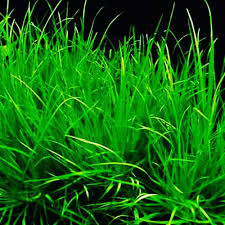
| 🌿 | Eleocharis acicularis ‘Mini’ (Dwarf Hairgrass) | Complementary thin-blade foreground carpet species; can be interplanted at the edges of the Takashi carpet to create a textural transition zone between cushion leaves and grassy blades. Same high-light-plus-CO2 requirements, same soft acidic water preference, similar pace |
| 🌿 | Cryptocoryne parva | Low midground crypt with small upright rosette leaves reaching 3-5 cm; provides vertical accent behind the Takashi carpet without competing for foreground light. Tolerates the same soft acidic water and grows well alongside high-tech carpets |
| 🌿 | Anubias nana ‘Petite’ | Attached to stones or driftwood above the carpet, the tiny dark-green anubias leaves give the scape vertical structure and year-round colour without demanding the high-light-plus-CO2 regime the carpet already gets. Rhizome plant that sits above the substrate and never competes with the carpet for root space |
| 🌿 | Bucephalandra ‘Mini Coin’ or ‘Kedagang’ | Small slow-growing epiphyte species from Borneo, glued or tied to driftwood; produces subtle deep-green to dark-purple accent colour that contrasts beautifully with the apple-green Takashi carpet beneath. Happy in the same soft acidic CO2-injected water |
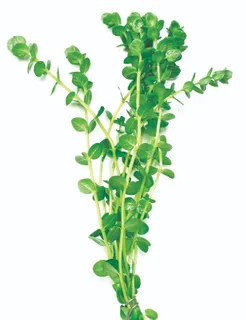
| 🌿 | Rotala rotundifolia | Classic background stem plant with bright green to deep pink-red colouration under high light; provides a vertical pink-red counterpoint to the green carpet and adds colour contrast. Trim regularly to maintain visual hierarchy and prevent the stems from shading the foreground |
| 🌿 | Vesicularia dubyana (Java Moss) or Fissidens fontanus | Tied or glued to driftwood branches above the carpet; adds shelter for shrimp and small fry without invading the foreground; contrasts the smooth cushion texture of the Takashi carpet with a rougher, wilder woodland layer. Grows slowly enough to never dominate the scape |
Reproduction & Division
Division
Takashi Carpet propagates naturally by spreading — each planted portion extends horizontal runners (stolons), and each node along each runner can develop into its own rooted plantlet. In an established carpet, propagation is simply a matter of harvesting portions of the carpet and replanting them elsewhere. Pull up a 2-3 cm square of established carpet with tweezers, rinse the roots clean of substrate by swishing gently in a bucket of tank water, snip it into 4-8 smaller portions with scissors or a sharp aquascaping razor, and replant each portion as you would a fresh TC portion using the same 30-45 degree angled tweezer technique. A 30 x 30 cm section of mature Takashi Carpet produces enough propagated material to cover a 60 x 30 cm foreground in a second tank with comfortable spacing, with no visible damage to the source carpet after 2-3 weeks of regrowth as the source grows back into the harvested zone.
Node division also works for deliberate propagation without disrupting an established carpet. Identify a runner crossing the substrate surface (these are easy to spot once the carpet is a month or two old — look for the tiny fresh green extensions creeping out of the main carpet zone), cut it between nodes with sharp scissors, lift the cut section with tweezers, and replant it in the new location. Each 3-5 node segment will root and spread within 10-14 days under the same light-plus-CO2 conditions as the parent carpet. This is the approach most aquascapers use when expanding a single TC cup across multiple tanks: plant one tank with TC portions, wait 4-6 weeks for establishment, then harvest runner sections and expand to a second and third tank without buying additional cups. A well-maintained mother tank can produce enough propagated material to carpet a new tank every 2-3 months indefinitely.
Emersed propagation is also possible and is a common technique in professional nurseries and aquaculture labs. Takashi Carpet can be grown emersed (above water, in very humid conditions) on a layer of damp aquasoil or sphagnum moss inside a sealed propagation tray or terrarium. Emersed growth is faster and denser than submersed, produces small white flowers, and allows mass-propagation without any risk of algae or pest transfer. Submerge emersed-grown material back into the aquarium after 4-6 weeks of emersed growth and the plantlets transition back to submersed form within 2-3 weeks, with some leaf melt during transition. This technique is more work than simple submersed division but yields ten to twenty times more plant material per starting portion.
Quick Reference
| Scientific Name | Micranthemum tweediei (Takashi Carpet strain) |
| Form Supplied | Tissue Culture (TC) — sealed, pest-free, snail-free |
| Planting Method | Carpet — 1-2 cm portions, 1-2 cm spacing on square grid |
| Placement | Foreground — full open-view carpet across front substrate |
| Light Level | High — 60-100+ PAR at substrate surface |
| Photoperiod | 7-9 hours/day with 30-minute dawn-dusk ramp |
| CO2 | Required — 25-35 ppm pressurised injection |
| Growth Rate | Medium with CO2 and ferts; slow or stalled without CO2 |
| pH | 5.5-7.0 (ideal 6.5 under CO2) |
| Temperature | 20-26 C (ideal 22-24 C) |
| Hardness (GH) | 2-8 dGH (soft preferred, 3-6 ideal) |
| Hardness (KH) | 0-3 dKH |
| Substrate | Nutrient-rich aquasoil (ADA Amazonia preferred, 4-6 cm depth) |
| Propagation | Spreading — node division from lateral runners |
| Carpet Time | 6-10 weeks from planting to full coverage |
| Difficulty | Intermediate — TC removes pest risk; balance demands skill |
| Price | $15 per TC cup |

Reviews
Clear filtersThere are no reviews yet.