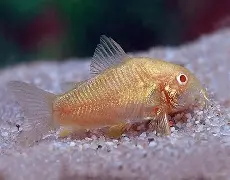
🪨 Species at a Glance
| Scientific Name | Corydoras aeneus (albino line-bred strain) |
| Common Names | Albino Corydoras, Albino Cory, Albino Bronze Cory, Gold Cory (sometimes confused) |
| Family | Callichthyidae |
| Order | Siluriformes |
| Origin | Wild ancestry: widespread across South America (Trinidad, Venezuela, Colombia, Brazil, Peru, Argentina); albino strain is commercial line-bred |
| Adult Size | 6–7.5 cm (2.4–3 in) |
| Lifespan | 8–15 years with good care (longer than most small aquarium fish) |
| pH Range | 6.0–8.0 (exceptionally tolerant) |
| Temperature | 20–28 °C (68–82 °F) — tolerates cool and tropical |
| Hardness (dGH) | 5–20 (very tolerant) |
| Diet | Omnivore bottom feeder — sinking pellets, wafers, frozen bloodworm, blanched vegetables |
| Minimum Tank Size | 60 L (16 gal) for a school of 6 |
| Care Level | Beginner — one of the easiest catfish in the hobby |
| Temperament | Peaceful, social; must be kept in groups of 6 or more |
| Breeding | Egg scatterer, T-position mating; the easiest corydoras to breed at home |
| Tank Position | Bottom / substrate |
| Light Sensitivity | Mildly photophobic — prefers subdued lighting due to albino eyes |
Meet the Species
The genus name *Corydoras* is a Greek compound meaning “helmeted skin” — from *kory* (helmet) and *doras* (skin or hide) — a clear reference to the two rows of overlapping bony scutes that armour the flanks of every corydoras and give the group its distinctive rigid, tank-like silhouette. Those plates are not decoration: they are the principal reason small corydoras can tolerate being picked up by predators as large as adult cichlids and, more often than not, be spat back out unharmed. The species name *aeneus* is Latin for “bronze” or “made of copper”, and it refers directly to the metallic sheen of the wild form, whose flanks catch light with a warm coppery shimmer that gave the fish its everyday English name, the “Bronze Cory”. *Corydoras aeneus* was formally described by the British-Austrian ichthyologist Theodore Gill in 1858, on the basis of specimens collected from Trinidad, and it is one of the earliest corydoras species to have entered the scientific literature. More importantly for the hobby, it is also one of the earliest corydoras species to have entered aquarium keeping: bronze corys were being exported to European hobbyists by the 1930s, were being bred commercially in Florida and Southeast Asia by the 1960s, and have never been out of production since. Nearly every bronze cory sold in Australia, Europe, or North America today is a farm-raised descendant of lines that have been captive-bred for fifty to sixty generations. Wild collection is now rare and commercially irrelevant — a good thing for wild populations, and a good thing for the hobby, because the commercial stock is far more tolerant of variable water than any freshly-imported wild fish would be.
The albino form first appeared spontaneously in commercial *C. aeneus* hatcheries in the early 1970s. Like most albino aquarium fish, the trait is a simple autosomal recessive: a single gene locus controls melanin production, and when a fish inherits two recessive copies it cannot produce the dark pigment at all. What remains — a body of creamy yellow-pink with red eyes — is not a separate species, not a hybrid, and not a weakened mutant. It is simply *Corydoras aeneus* without the dark paint. Breeders quickly recognised the commercial appeal of the pale form, selectively bred for it, and within a decade had stabilised homozygous albino lines that breed true — pair two albinos and every fry is albino. Because the trait has been selectively maintained for over fifty years without any associated decline in hardiness, vigour, or fecundity, albino *C. aeneus* today are every bit as tough as their bronze wild-type cousins. There is no documented link between the albino gene in this species and reduced lifespan, increased disease susceptibility, or impaired breeding — a reassurance keepers should bear in mind when older hobby literature occasionally repeats the long-debunked claim that “albinos are weaker”. They are not. In this particular species, they may in fact be the single hardiest fish a beginner can buy.
The only genuine consequence of the albino trait is ocular. Without melanin in the iris and retina, albino fish have reduced ability to filter bright light, and they are correspondingly more comfortable in dim or moderate lighting than under direct high-output LEDs. In practice this is trivial to accommodate: a planted tank with floating plants, a medium-output light, or a lid-mounted fixture positioned away from the bottom corner the fish rest in will all produce a perfectly comfortable environment. Tanks of albino cories kept under glaring bare-bottom bright-light setups will noticeably pale out, hide more, and feed less; move them to a subdued, tannin-stained, softly-lit planted environment and within a week they will be out and active from morning to night. This is not a medical problem, just a preference — and one every keeper can meet without effort.
Tank Requirements & Layout
A 60-litre (16-gallon) tank with a footprint of at least 60 × 30 cm is the practical minimum for a school of six albino corydoras, and going up to 90 or 120 litres gives you room for a larger school and a full community of mid-water dither fish. Floor space matters far more than height for this species. Corydoras are obligate bottom-dwellers that spend their entire active day exploring the substrate in foraging sweeps, and a tall narrow tank wastes most of its volume on empty water column the corys will never use. If you have the choice, pick a wide, shallow tank (60 × 30 cm and higher) over a narrow, tall one (45 × 25 cm and taller) every time. A single long piece of open sandy bottom is, for a school of corys, worth more than any amount of decor or plant mass.
Substrate is the single most important setup choice. Use only fine sand (tan aquarium sand, black sand, or light natural sand) or the smoothest, roundest fine gravel you can find. Never use crushed coral, aragonite, sharp commercial gravel, or any substrate with angular grains — these abrade the corys’ barbels and produce the hobby’s most commonly seen corydoras injury, eroded whiskers. Albino corys have delicate white barbels that stand out clearly against the cream body, and watching them twitch and dance over clean sand as the fish feeds is one of the genuine pleasures of keeping this species; protecting those whiskers by choosing sand once and never regretting it is worth doing from the start. A sand bed of 2–3 cm depth across the whole footprint is ideal. Deeper beds develop anaerobic pockets that the corys will stir up regularly and harmlessly, but for a low-maintenance setup 2–3 cm works perfectly.
Lighting should be low to moderate. Albino eyes are mildly photophobic, and a bright high-output planted-tank LED pointed straight at the substrate will cause the corys to hide in shaded corners for most of the day. Use a low-to-moderate output fixture, dim it if possible, and add floating plants (amazon frogbit, red root floaters, water lettuce, or salvinia are all good) to break up the light and produce shaded patches on the substrate. A heavily planted tank with a tall background of stem plants provides all the shade the corys need; a bare-bottom breeding tank under subdued light works equally well. The combination of fine sand, moderate planting, and dim light produces the richest body colour and the most relaxed, visible behaviour in this fish.
Hardscape is forgiving. A piece of driftwood or two, a few smooth river stones, some terracotta caves or overturned pots for shaded retreats — all are welcome but none are strictly necessary. Corys do not require caves for breeding (they lay eggs on glass, plants, and filter intakes, not in caves), but they do appreciate shaded loafing spots where the whole school can pile up to rest. A hollow piece of driftwood, a terracotta pot on its side, or a broad-leafed plant draping close to the substrate all serve this purpose. Keep at least 50–60% of the substrate open and accessible for foraging; the fish will spend every waking hour patrolling those open patches.
Planting is entirely compatible. Hardy epiphytes like anubias and java fern attached to driftwood are ideal. Cryptocorynes, amazon swords, and vallisneria all work beautifully and establish deep enough roots that the corys cannot dislodge them. Carpet plants (monte carlo, dwarf hairgrass, lilaeopsis) can be used but need time to establish — in the first few weeks while the roots are setting, corys sweeping across the carpet will occasionally pull up clumps. Once established, carpets are fine. Skip tall, delicate stem plants with very soft leaves if you want pristine foliage; corys won’t actively eat them but their constant foraging motion occasionally snags stems. Floating plants are unambiguously beneficial: they shade the light, absorb nitrates, and provide a visual ceiling that relaxes the school.
Tank
60 L (16 gal) minimum for a school of 6; 90–120 L preferred for a larger school and community
Filter
Sponge filter (ideal for fry survival) or canister/HOB with spray bar; gentle to moderate flow; 4–6× tank volume per hour
Heater
50–100 W adjustable set to 24 °C for standard tropical keeping; heater optional in rooms that stay above 18 °C year-round
Lighting
Low to moderate intensity — dimmable LED, single T5, or shaded fixture with floating plants; albino eyes prefer subdued light
Substrate
Fine sand (tan, black, or natural) or smooth fine gravel — never crushed coral, aragonite, or sharp grains
Driftwood (optional)
One or two pieces of aquarium-safe softwood for shaded resting spots and visual interest
Floating Plants
Amazon frogbit, red root floater, salvinia, or water lettuce — shade the tank and reduce light stress on albino eyes
Thermometer
Digital stick-on or glass to verify heater accuracy weekly
Air Stone (optional)
Useful insurance in warm weather; corys tolerate low flow but benefit from good oxygenation
Water Quality Requirements
6.0–8.0
ideal 7.0
20–28 °C
ideal 24 °C
5–20 dGH
Very tolerant — soft to moderately hard
If *Corydoras aeneus* has a single defining characteristic beyond its cheerful temperament, it is adaptability. This species and its albino colour form have been kept successfully by aquarists in water ranging from pH 5.8 (soft Amazonian blackwater) through pH 8.2 (hard Sydney tap water from limestone catchment) without distress, and at temperatures from 18 °C (a cool unheated tank in a cold European basement) to 30 °C (a warm discus tank in tropical Queensland summer). No other corydoras species in the trade tolerates a comparable range. The reason is evolutionary: wild *C. aeneus* has one of the largest natural geographic ranges of any freshwater fish in South America, extending from Trinidad in the north, down through Venezuela, Colombia, and the Guianas, across the entire Amazon basin, and south into the Paraná and Paraguay river systems of Argentina. Within that enormous range the species occupies everything from fast clear piedmont streams with rocky substrates at cool temperatures to slow, warm, turbid lowland rivers with soft mud and heavy leaf litter. Commercial breeding over the past sixty years has, if anything, broadened this tolerance further — today’s line-bred *C. aeneus* is arguably the hardiest corydoras on the planet.
For the keeper, this tolerance means you almost certainly already have water these fish will thrive in. Target a pH somewhere between 6.5 and 7.6 (the broader 6.0–8.0 range is safe but less than ideal for daily keeping), a temperature of 22–26 °C for standard tropical keeping (with room to push to 27 °C for conditioning breeders in warm tanks, or to drop as low as 20 °C in cool-water community setups with white cloud minnows or temperate tetras), and hardness anywhere from 5 to 20 dGH. Notably, *C. aeneus* is one of the few common tropical fish that genuinely tolerates cool water and can be kept without a heater in rooms that stay above about 18 °C year-round; this makes it a useful bridge species for keepers interested in subtropical or temperate community tanks. At the other end of the scale, the species tolerates warm tropical tanks up to 28 °C — so it fits just as well into a discus community or a warm Southeast Asian rainbowfish tank — though sustained temperatures above 28 °C do reduce its lifespan and should be avoided.
What matters far more than the absolute numbers is stability. A pH that drifts steadily between 6.8 and 7.4 over a week is completely fine; a pH that crashes from 8.0 to 6.2 overnight because a buffered substrate suddenly exhausted or a CO2 injection was mismanaged is genuinely dangerous. Test weekly during the first month after adding new fish, confirm that the tank’s parameters are stable under your normal maintenance routine, and thereafter monthly testing is sufficient for an established tank. An important husbandry note specific to this species: do not keep *C. aeneus* on crushed coral or aragonite substrates. Although the fish tolerate hard alkaline water well, the sharp carbonate grains abrade their delicate barbels over time and can cause the whiskers to erode, shorten, and eventually stump. Always use fine sand (tan, black, or natural) or smooth fine-grain gravel (nothing sharp), and reserve crushed-coral buffering for fish that genuinely need it.
Corydoras come from well-oxygenated environments and appreciate a clean tank with gentle current, but they do not need strong flow. A sponge filter sized for the tank, a moderately-rated HOB, or a canister with a spray bar positioned to produce a gentle ripple across the surface all work well. Aim for enough surface agitation to keep the water well-oxygenated without creating whirlpools or strong currents — in a small community tank you should see the fish occasionally dashing to the surface to gulp air (a normal behaviour mediated by their modified intestine, which functions as an accessory air-breathing organ) but spending most of their time rummaging calmly on the substrate. Nitrate management is routine: weekly 25–30% water changes, matched to within a couple of degrees of tank temperature, keep nitrate well below 30 ppm in a normally stocked community and produce visibly more active and colourful fish than tanks allowed to drift into chronic nitrate buildup.
Feeding Schedule & Diet
Albino *C. aeneus* are unfussy omnivorous bottom feeders with a healthy appetite and absolutely no nutritional drama. Their natural diet in the wild consists of small benthic invertebrates (chironomid larvae, tubifex worms, small crustaceans), organic detritus, biofilm scraped off submerged wood and leaf litter, and the occasional plant material. In the aquarium this translates to a genuinely easy feeding regime: a good quality sinking pellet or wafer as the staple, blanched vegetables a couple of times a week, and frozen or live protein foods as a weekly or twice-weekly treat. Unlike some herbivore-leaning catfish (bristlenose, otocinclus) that require a specialised high-fibre diet, corydoras thrive on generic community-fish pellets as long as the pellets sink and the corys get their share.
The key husbandry principle — and the most common mistake beginners make with corys — is making sure the food actually reaches the bottom. In a mixed community with tetras, rasboras, or cichlids, food flakes or floating pellets dropped at the surface will be hoovered up by the mid-water fish long before anything reaches the corys. The solution is sinking food: sinking micro-pellets, sinking wafers, algae and shrimp pellets, or frozen bloodworm thawed and dropped directly onto the substrate. Feed the corys deliberately, in a designated corner away from where the mid-water fish congregate, and always with food sized for their small downward-opening mouths. A single sinking wafer shared across six corys is about right once a day, or two smaller pellets broken in half. Feed just enough to be eaten within a few minutes — corys are tidy feeders and will happily clean up small bits of stray food for hours afterward, but a wafer left uneaten overnight fouls the water and attracts snails.
Vegetables are welcomed two or three times a week. Blanched zucchini medallions, cucumber slices, spinach leaves, and shelled peas are all readily eaten. Blanch them for 60 seconds in boiling water, cool under cold running water, and weigh them down with a clip or a stainless steel fork. The corys will work on the softened flesh and graze the biofilm that accumulates on the surface. Remove uneaten vegetable within 24 hours to prevent fouling.
Protein foods are essential for health, colour, and breeding condition. Offer frozen bloodworm, frozen daphnia, frozen brine shrimp, or live blackworms two or three times a week — enough to be gone in three to five minutes across the whole school. Live brine shrimp nauplii are especially valuable for conditioning breeding pairs. Avoid feeding protein as the exclusive diet: a cory kept on pure bloodworm will develop fatty liver and digestive issues over months, just as a human kept on pure steak would. The balance of sinking pellet as the staple, vegetables midweek, and protein on feast days produces visibly healthy, well-coloured, actively breeding fish. A useful diagnostic: a well-fed cory should have a belly that is slightly rounded but not bulging, and its sides when viewed from above should be gently convex — not flat (underfed) or grossly swollen (overfed).
Feeding frequency: once a day is plenty for adults, twice a day for actively growing juveniles under 4 cm. Corys will eat every time food is offered regardless of whether they’re hungry, so keeper discipline is the limiting factor on overfeeding. Skip one day a week for adults to prevent digestive issues and keep nitrate manageable; the school will not notice, and the tank will be visibly cleaner.
Visual Varieties
🟤 Bronze (Wild Type C. aeneus)
The original wild form: coppery-bronze metallic flanks over olive-brown base, paler belly, and a faint dark shoulder patch. The baseline from which every line-bred variety derives.
🤍 Albino (this fish)
Recessive melanin-free line: creamy peach to pink-cream body, ruby-red eyes, white whiskers. The most common albino corydoras in the trade.
⚫ Black Venezuela (C. aeneus ‘Black’)
A dark colour morph of C. aeneus from a Venezuelan collection locality — solid charcoal to near-black body with golden dorsal shoulder patch; a selectively bred line from wild-type black phenotypes.
🟢 Green Gold / Green Laser
Related species Corydoras melanotaenia — commonly confused with C. aeneus. Metallic olive-green flanks with a bright gold dorsal stripe. Sold alongside bronze corys at similar price points.
🎈 Longfin Bronze
Recessive longfin trait overlaid on bronze or albino C. aeneus — flowing extended dorsal, caudal, and pectoral rays. Rarer and more expensive than standard short-fin forms.
*Corydoras aeneus* is the common ancestor of a surprising number of colour forms in the modern trade, and the relationship between them is worth understanding so you know exactly what fish you are looking at in the shop. The wild bronze form is still produced in enormous numbers by Southeast Asian and Eastern European fish farms and remains the cheapest corydoras available in most markets. The albino form — which is the fish in front of you — is a simple recessive colour variant of the same species and is almost as ubiquitous. The Black Venezuela is a more recent arrival, derived from collections in a specific Venezuelan locality where the wild fish display a naturally dark phenotype; commercial breeders have stabilised the dark colour as a line and now produce it as a distinct trade form, though genetically it remains *C. aeneus* and interbreeds freely with bronze and albino. The so-called Green Gold Cory or Green Laser Cory is often sold alongside bronze corys and is frequently mistaken for another *C. aeneus* colour morph, but it is actually a closely related but separate species — *Corydoras melanotaenia* — that occupies a similar ecological niche and has a similar temperament and husbandry profile, but cannot interbreed reliably with *C. aeneus*. For the keeper this distinction rarely matters (they are fully compatible tank mates and school together readily in mixed groups), but for breeders it matters very much, because a “green” fish dropped into a bronze breeding tank will produce sterile or inviable hybrid fry. Finally, the longfin trait — a separate recessive mutation that elongates every fin ray — has been crossed into *C. aeneus* stock in the last two decades, producing flowing-finned bronze, albino, and black longfin variants that command a premium at retail.
Because the albino trait is homozygous recessive, a pair of albino parents will produce a clutch of 100% albino fry. This is the single most appealing feature of the albino form for hobbyist breeders: you do not have to keep track of carriers, run controlled crosses, or cull non-phenotype fry to maintain a breeding line. Buy two albinos, condition them, and every fry they raise will also be albino. If you cross an albino to a bronze, however, none of the F1 fry will be albino — they will all look bronze but carry one copy of the recessive albino allele. Cross two F1 carriers together and you will see the classic 1:3 ratio of albino to bronze fry in the next generation. Most commercial albino production keeps the two lines separate and avoids the carrier-line complexity entirely. For a keeper not interested in breeding, none of this matters; you can simply enjoy the fish for what it is — one of the most visually charming and behaviourally rewarding small catfish in the entire freshwater hobby. Colour intensity in the albino form varies with environment: on dark sand under subdued lighting, well-fed albinos develop a rich warm peach body and a coppery-gold shoulder blush over time, whereas on bright bare-bottom tanks they can look washed-out cream-white. The warm tone is partly diet-driven as well — carotenoid-rich foods like daphnia, spirulina-fortified wafers, and the occasional blanched sweet potato deepen the colour noticeably over weeks.
Spot the Difference: Male & Female
Sexing albino *C. aeneus* is done entirely by body shape, because the albino trait removes the subtle colour and pattern differences that sometimes help distinguish males and females in wild-type corydoras. The single most reliable cue is a view from directly above — the fish seen from the top reveals its width at a glance, and a mature female at 6 cm and up is obviously wider and rounder than a mature male of the same length. A pair sitting side by side on the substrate make this easy: the male looks like a torpedo, the female looks like a small egg with fins. If you are unsure of an individual fish, wait until feeding time and view it from above through the open tank lid; any adult over 5 cm will show its sex clearly once you know what to look for.
The belly profile from the side is a secondary check. Females in breeding condition develop a clearly rounded, full ventral line that extends from the throat nearly to the anal fin, and this profile becomes even more pronounced as she loads with eggs in the week or two before spawning. Males stay flat or only mildly convex across the belly throughout their lives. A third check — useful when you have a single fish and nothing to compare against — is total length: males of this species tend to top out around 5.5–6.5 cm, while females can reach 7.5 cm or occasionally a touch more. A fish approaching 7 cm is very likely a female; a fish stuck at 6 cm after a year of good feeding is very likely a male.
For a school intended for breeding, aim for a ratio of two females to every male — this gives each female a rest between spawns and prevents a single female from being pestered continuously by multiple males during conditioning. The classic albino breeding group is six fish: two males and four females. A school of six to eight of either sex will also school and school-breed happily, but the 2F:1M ratio is the reliable way to get consistent spawning from this species. In a mixed community, a group of six to eight corys will often contain two or three of each sex by chance, and spontaneous spawning events happen regularly without any deliberate breeder intervention.
| Feature | Male | Female |
|---|---|---|
| Body Shape (from above) | Slimmer, more torpedo-shaped; sides roughly parallel from gill to tail base | Noticeably wider and rounder; visibly plump across the shoulders when viewed from above |
| Adult Size | Slightly smaller, typically 5.5–6.5 cm | Slightly larger, typically 6–7.5 cm |
| Belly Profile (from side) | Flat to slightly convex ventral line | Rounded, fuller belly — especially pronounced when gravid with eggs |
| Colouration | Identical to female in the albino form — no reliable colour-based sex marker | Identical to male in the albino form — sexing is done by shape, not colour |
| Dorsal Fin | Leading spine sometimes slightly more pointed and elongated | Leading spine typically slightly shorter and rounder |
| Behaviour During Breeding | Actively chases, cleans, and nudges female; assumes T-position underneath her | Leads search for spawning surfaces; cups fertilised eggs in pelvic fins and deposits them on glass or plants |
Breeding in Captivity
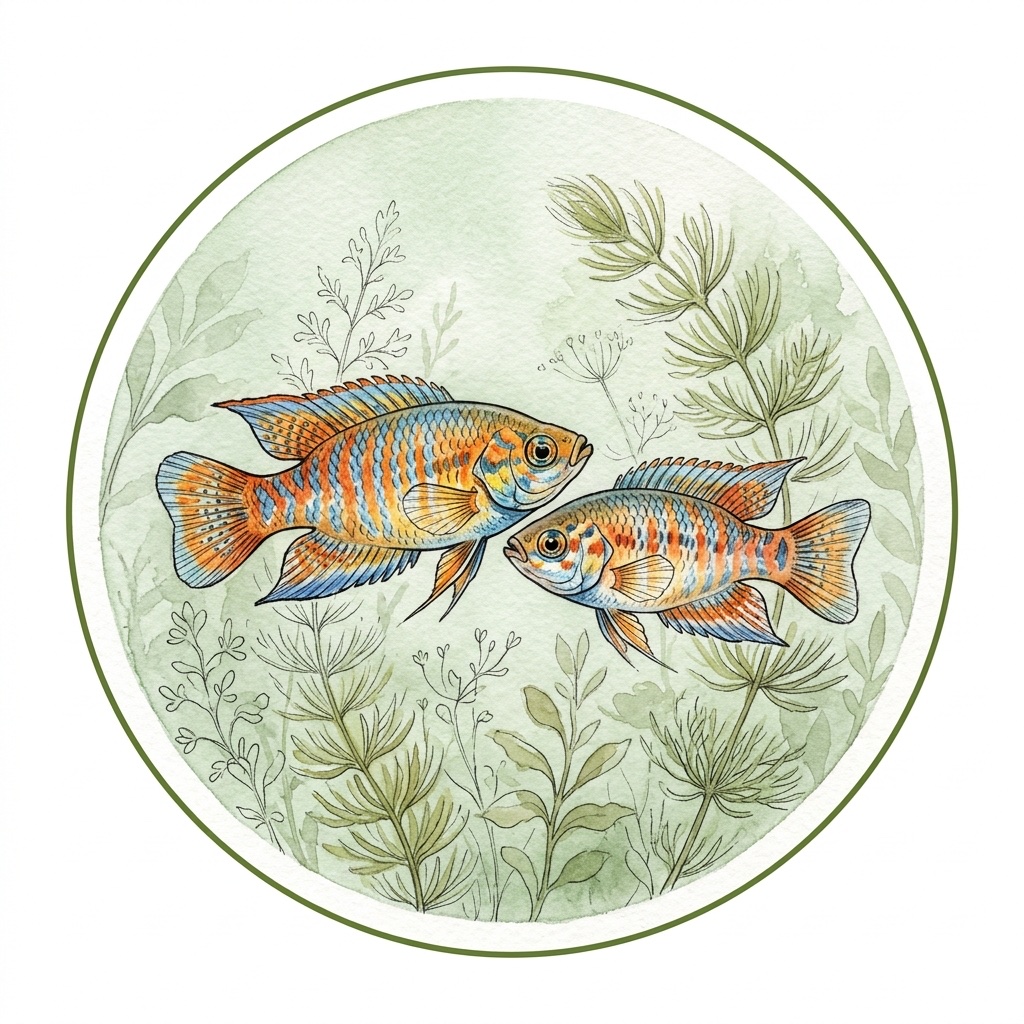
Week -2
Conditioning
Feed varied diet with live/frozen protein, build females into egg-loading condition
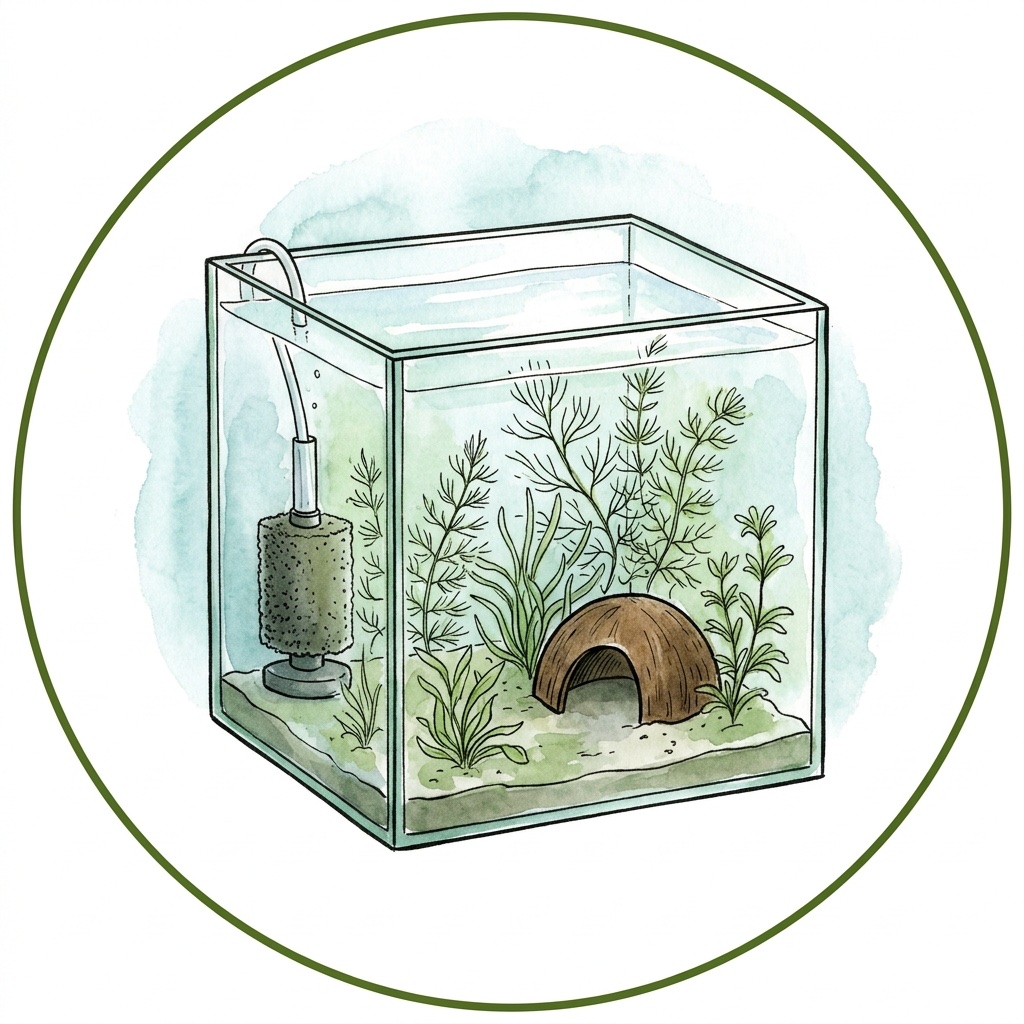
Day 0
Cool Water Change Trigger
Perform 50% water change with water 3–5 °C cooler than tank temperature
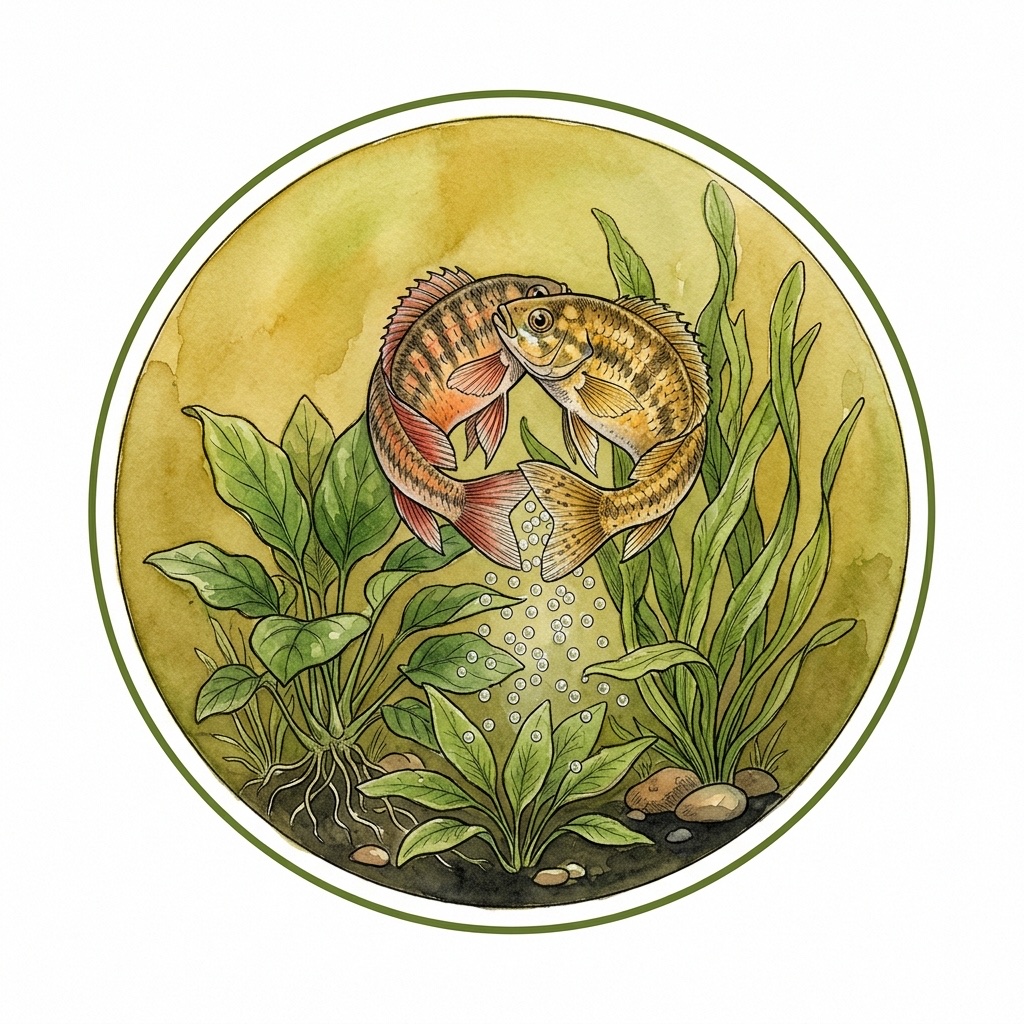
Day 0 (hours later)
T-Position Mating
Male lies sideways under female’s head; female receives sperm in mouth and fertilises eggs in pelvic-fin cup
Day 1–3
Egg Development
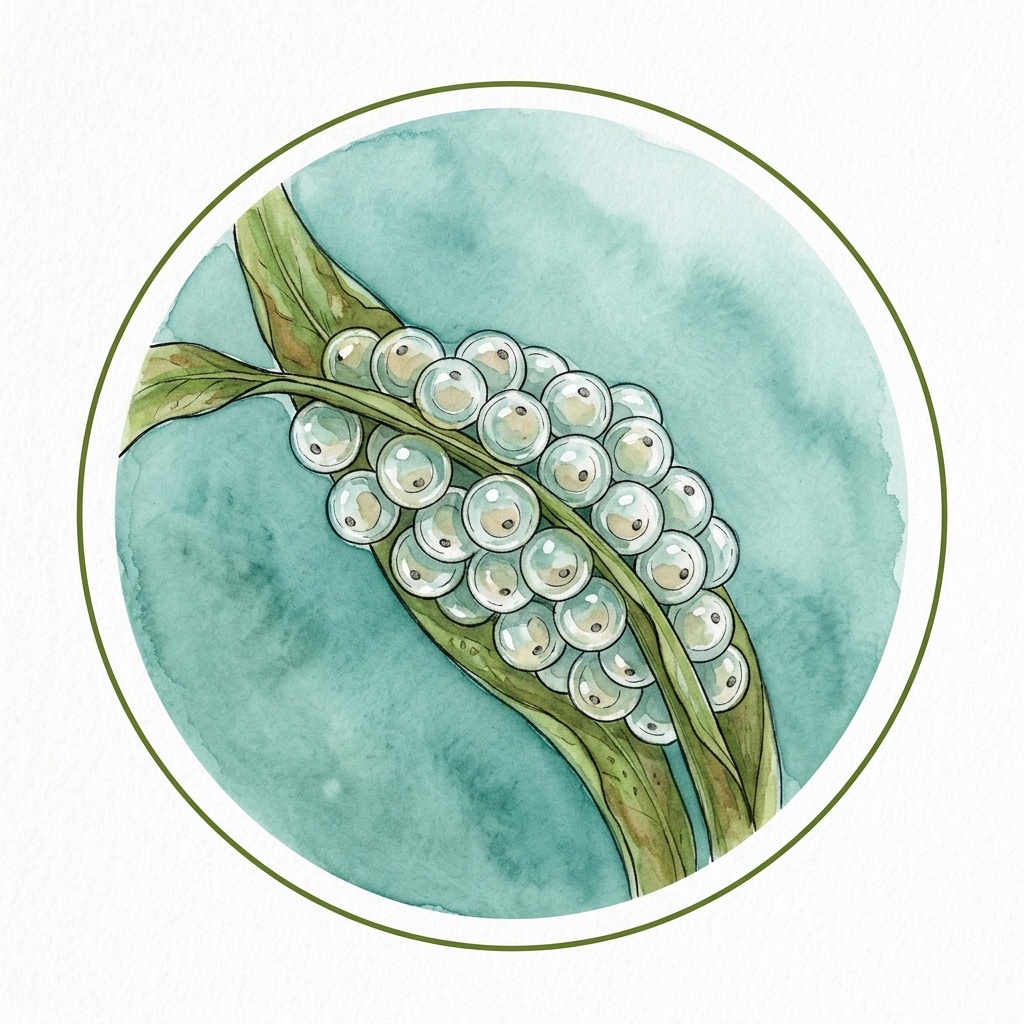
Eggs darken from clear-yellow to opaque amber as embryos develop
Day 4–6
Hatching & Yolk Sac
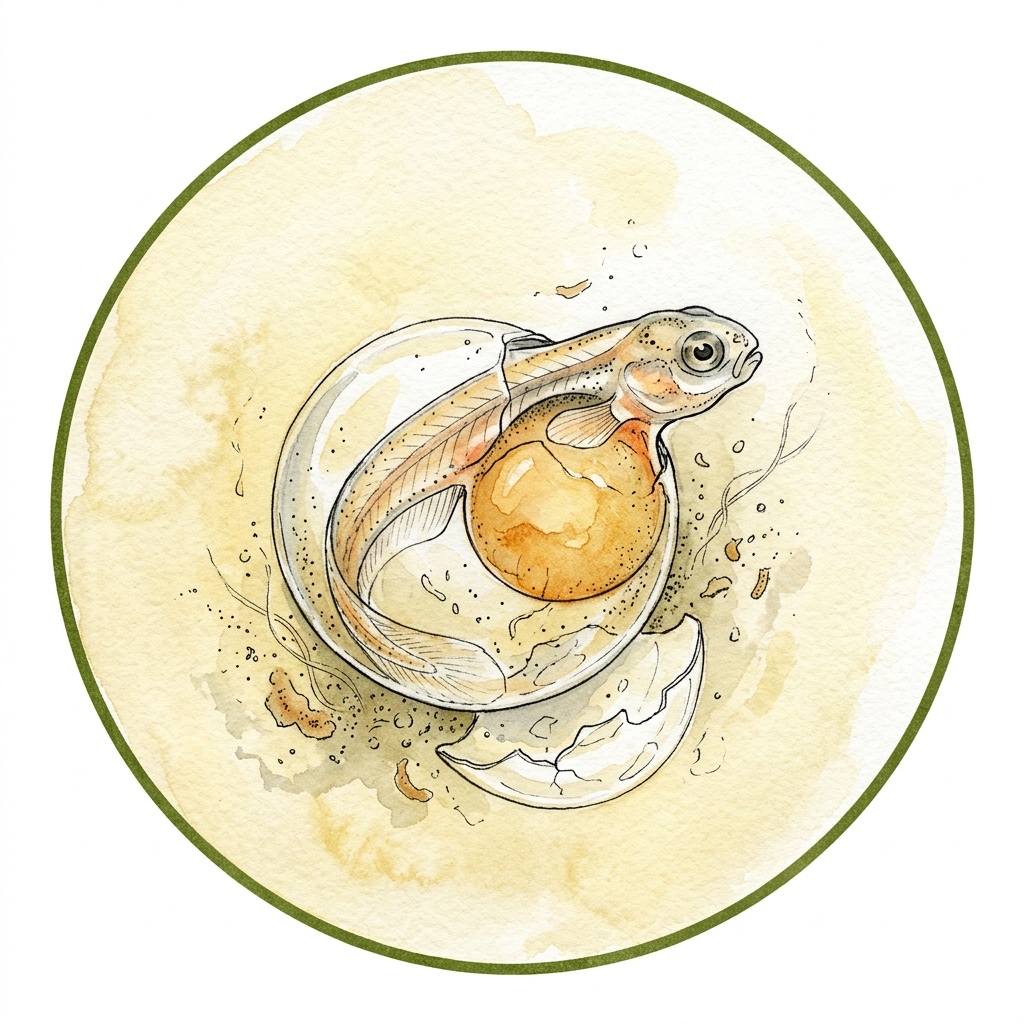
Fry emerge, transparent with visible yolk sac; survive on yolk for 2–3 days
Day 7–10
Free-Swimming Fry & First Food
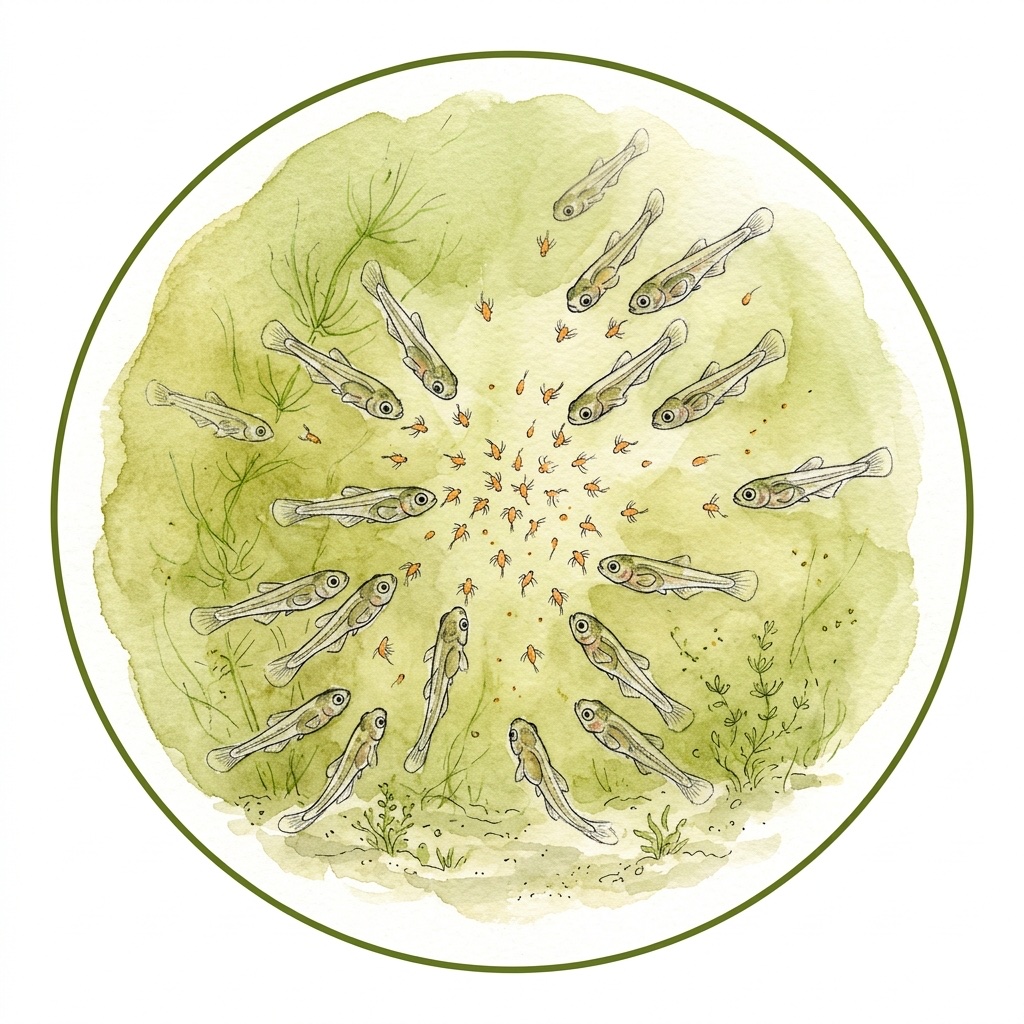
Offer microworm, live baby brine shrimp, powdered fry food
Conditioning
Select a breeding group of two or more males and two or more females. Over two to three weeks, feed heavily and variedly: live or frozen bloodworm, daphnia, brine shrimp, blackworms, plus the usual sinking wafer staple. Well-conditioned females will visibly plump up across the shoulders and develop the distinctive rounded belly profile. Males will become more active, more inclined to chase, and will begin displaying to the females. At this point the school’s behaviour changes noticeably — instead of the calm, constant foraging of daily life, you will see bursts of rapid chasing activity, especially in the morning and after water changes.
Cool Water Change Trigger
This is the classic corydoras spawning trigger and it works for *C. aeneus* more reliably than for any other species in the genus. Perform a large water change (40–50%) and refill with water that is noticeably cooler than the tank — 3 to 5 °C below the current temperature is ideal. This simulates the seasonal rainfall and cooling that triggers wild corys to spawn at the start of the wet season. Within an hour or two of the cool refill, the males in a well-conditioned group will visibly intensify their chasing, and within 4 to 12 hours the first spawning activity usually begins. If nothing happens after the first attempt, repeat the cool water change 24 hours later — this often works when a single change does not. Do not drop the tank below 20 °C even briefly; a 21-22 °C refill from a 25 °C tank is plenty of thermal signal.
T-Position Mating
Corydoras mating is one of the strangest and most distinctive behaviours in freshwater fish: the T-position. A male positions himself sideways, at right angles to the female, directly under her head so that his vent is pressed against her mouth. She takes his sperm into her mouth, passes it through her gills (research suggests the sperm travels through her digestive and circulatory system to reach her eggs, though the mechanism is still being studied), and simultaneously releases a clutch of 2–6 eggs into a pouch formed by cupping her pelvic fins. She then swims, with the eggs held in her pelvic cup, to a chosen clean surface — aquarium glass, a broad plant leaf, or the filter intake — and presses the fertilised eggs onto it where they adhere. The process is repeated dozens of times over a single spawning session, with the female eventually placing 100 to 300 eggs across multiple surfaces over several hours.
Egg Development
The eggs are 1.5–2 mm diameter pale yellow beads, initially clear and almost glassy. Over the first 24 to 48 hours they darken and become opaque as the embryo develops, and by the third day you can see the dark pigment of the developing eyes through the shell — the single most reliable sign that the eggs have been successfully fertilised. Unfertilised eggs stay clear and white, rapidly develop a fuzzy fungal bloom, and should be removed if practical to keep the fungus from spreading to viable eggs. Parents do not guard the eggs — in fact, they will often eat their own eggs if given the chance — so experienced breeders move the eggs to a separate hatching container (a shallow tub of tank water with an air stone and a drop of methylene blue) within a few hours of spawning. This dramatically increases fry survival rates.
Hatching & Yolk Sac
Eggs hatch into tiny transparent fry with a visible external yolk sac. They are 4–5 mm long at hatch, very fragile, and will lie on the bottom of the hatching container twitching periodically for the first day or two. During this time they do not feed — the yolk supplies everything they need. Keep the water clean, gently oxygenated by the air stone, and the methylene blue topped up to prevent fungal outbreaks. Do not feed yet. After 48 to 72 hours the yolk sac is absorbed and the fry will begin to swim actively and search for food.
Free-Swimming Fry & First Food
Once the yolk is absorbed, the fry need frequent small meals of high-quality food. The best first foods are live microworm and freshly-hatched baby brine shrimp — both produce explosive growth. Powdered dry foods (crushed flake, commercial fry powder) also work but grow fry more slowly. Feed two to four times a day, small amounts each time, and do a 25% water change every other day with dechlorinated tank-matched water. By the end of the first week of free-swimming the fry will have tripled in length and will have started to show the body shape of the adult fish. Over the next four to six weeks they graduate onto crushed flake, crushed sinking pellet, frozen baby brine shrimp, and eventually normal sinking wafer. They colour up as albinos from the start — the pink-cream hue is visible in fry as small as 8 mm — so there is no need to wait to see what you’ve got.
Choosing Tank Mates
Albino *C. aeneus* is, simply put, one of the most universally compatible fish in the freshwater hobby. Its permanent location on the substrate, its peaceful temperament, its tolerance of a broad parameter range, and its lack of interest in either attacking or being attacked by mid-water fish make it an almost ideal partner for nearly every classic community fish. If you are building a standard tropical community — tetras, rasboras, gouramis, rainbowfish, peaceful dwarf cichlids, bristlenose plecos, otocinclus, peaceful gouramis — an albino cory school slots in effortlessly and adds constant, cheerful bottom-level activity that most mid-water communities otherwise lack. Even in slightly less-than-ideal water, the corys tend to be the last fish in the tank to show stress, and often the last to die in a tank accident — they really are that hardy.
The key is to keep them in a proper school. A single cory or a pair of corys is a miserable thing — the fish are deeply social and pine in isolation, hiding continuously and eating reluctantly. A group of six or more transforms the behaviour completely: the fish pile up together at rest, forage in a loose coordinated line across the substrate, and engage in bursts of play-like activity that beginners often find enchanting. Six is the practical minimum; eight to ten is visibly better and well within the capacity of a 90-litre tank. The school does not need to be single-species, either — corys of different species readily mix and school together in captivity, so a group of three or four albino *C. aeneus* plus three or four panda corys or sterbai corys will form one multi-species school rather than two separate single-species groups.
The main incompatibilities are the usual suspects: large aggressive cichlids (oscars, large managuense, flowerhorns) that will harass and eventually kill small bottom-dwellers; notorious fin-nippers (tiger barbs, serpae tetras) that target sensory barbels and keep the corys stressed; aggressive bottom-dwellers (red-tailed sharks, large territorial pleco species) that bully their substrate neighbours; and rift-lake African cichlids, which both require incompatible hard alkaline water and display dedicated territorial aggression toward any bottom-dweller. Large predatory catfish (pictus, red-tailed catfish, shovelnose) will simply eat adult corys. These are all the standard community tank incompatibilities, and the list is short — in practice, avoid those five categories and the corys will be fine with almost anyone else.
Shrimp coexistence is worth mentioning. Large Amano shrimp (4 cm and up) live happily alongside adult corys; the two species occupy the same substrate zone but ignore each other. Small dwarf shrimp (Neocaridina cherries, Caridina crystals) are mostly ignored by adult corys as well, but baby shrimplets small enough to be accidentally scooped during a feeding foraging sweep will occasionally be eaten. If you want a reproducing shrimp colony, keep it in a dedicated shrimp tank, not with corys. If the shrimp are cleanup-only and you don’t mind slow reproduction, mixed cherry-and-cory tanks work fine and the shrimp population generally stabilises at a lower steady state than a dedicated shrimp tank would support.
Finally, a word on other corys. *C. aeneus* schools happily with other *Corydoras* species — panda, sterbai, adolfoi, julii, bronze, and the whole small corydoras complex. Mixed-species schools are visually interesting and behaviourally indistinguishable from single-species schools. If you want to breed, keep a single species at a time to avoid accidental hybridisation (though *C. aeneus* hybrids with other species are rare and usually infertile). For pure display purposes, a mixed school of albino *C. aeneus* plus panda corys or sterbai corys is one of the most visually charming bottom arrangements possible — the pale cream albinos against darker-spotted cousins produce a constant contrast that draws the eye across the tank floor all day.
| Species | Why | |
|---|---|---|
| ✅ | Neon Tetra | Classic mid-water schooler; ignores the substrate entirely and leaves corys to rummage in peace |
| ✅ | Cardinal Tetra | Peaceful mid-water fish with identical water parameter needs — a textbook cory community tank mate |
| ✅ | Harlequin Rasbora | Hardy peaceful mid-water schooler that tolerates the broad pH range corys enjoy; totally non-competitive |
| ✅ | Boesemani Rainbowfish | Active upper-level fish that adds colour and movement; uses a completely different zone of the tank |
| ✅ | Pearl Gourami | Calm mid-to-upper centrepiece fish; gentle temperament and broad parameter tolerance match corys perfectly |
| ✅ | Honey Gourami | Small, peaceful, surface-dwelling — ideal top-level partner for a cory-dominated community |
| ✅ | Bristlenose Pleco | Shares the bottom zone but occupies hardscape rather than open substrate; completely non-competitive with corys |
| ✅ | Amano Shrimp | Large (4 cm+) shrimp that works as cleanup crew; too big to be accidentally mouthed by a foraging cory |
| ✅ | Cherry Shrimp | Adult corys ignore adult shrimp, though shrimplets may occasionally be eaten — acceptable for cleanup tanks, imperfect for shrimp breeding |
| ✅ | Otocinclus | Gentle algae-eating catfish that occupies plant surfaces rather than open substrate; shares temperament and water parameter needs |
| ❌ | Large Aggressive Cichlids (Oscars, Jack Dempsey, Flowerhorn) | Will harass, injure, and eventually kill small corydoras; their territorial aggression and large mouth size make the combination dangerous |
| ❌ | Tiger Barb / Serpae Tetra | Notorious fin-nippers that target the sensory barbels of bottom-dwelling corys; constant stress and barbel damage result |
| ❌ | Red-Tailed Shark / Rainbow Shark | Aggressively territorial bottom-dwellers that bully and harass corydoras; incompatible in typical community tank sizes |
| ❌ | African Rift Lake Cichlids | Require hard alkaline water outside cory comfort range, and are territorially aggressive toward any fish entering their substrate territory |
| ❌ | Large Predatory Catfish (Pictus Cat, Red-Tail Cat) | Will eat any fish small enough to swallow; a 7 cm cory is well within the mouth size of an adult pictus |
Quick Reference
| Scientific Name | Corydoras aeneus (albino strain) |
| Common Name | Albino Corydoras / Albino Bronze Cory |
| Adult Size | 6–7.5 cm |
| Lifespan | 8–15 years |
| pH | 6.0–8.0 (ideal 7.0) |
| Temperature | 20–28 °C (ideal 24 °C) |
| Hardness | 5–20 dGH (very tolerant) |
| Min Tank Size | 60 L for a school of 6 |
| Substrate | Fine sand — never crushed coral or sharp gravel |
| Lighting | Subdued — albino eyes prefer dim light and floating plants |
| School Size | 6 minimum, 8–10 preferred |
| Diet | Omnivore — sinking pellets, blanched veg, weekly frozen protein |
| Care Level | Beginner — one of the hardiest catfish in the hobby |
| Temperament | Peaceful, social, universally compatible with community fish |
| Breeding | Cool water change trigger; T-position mating; easiest cory to breed |
| Tank Position | Bottom / substrate |
| Price | $12 AUD |
Related Products
Reviews
Clear filtersThere are no reviews yet.