🪨 Species at a Glance
| Scientific Name | Corydoras adolfoi |
| Describer | Burgess, 1982 |
| Family | Callichthyidae |
| Order | Siluriformes |
| Origin | Brazil — upper Rio Negro basin, tributaries near São Gabriel da Cachoeira |
| Habitat Type | Blackwater — soft, acidic, tannin-stained tributaries with leaf litter and sand |
| Current Size | ~3 cm (juvenile / sub-adult) |
| Adult Size | 4.5–5 cm (1.8–2.0 in) — small cory |
| Lifespan | 5–8 years in well-maintained blackwater |
| pH Range | 5.5–7.0 (ideal 6.0–6.5) |
| Temperature | 23–27 °C (73–81 °F) |
| Hardness (dGH) | 2–8 (soft water required) |
| Diet | Omnivore bottom feeder — sinking wafers/pellets + frozen bloodworm/daphnia |
| Minimum Tank Size | 60 L (16 gal) for a school of 6 |
| Care Level | Intermediate — soft water and clean sand required |
| Temperament | Peaceful, highly social; must be kept in groups of 6+ |
| Breeding | Egg depositor — classic T-position mating; captive-breeding documented but uncommon |
| Tank Position | Bottom / substrate |
| Price (3 cm) | $29 AUD |
Species Background
The species name *adolfoi* honours Adolfo Schwartz, the Brazilian ornamental fish exporter from Manaus whose decades of exploration on the upper Rio Negro were responsible for bringing this species — along with countless other South American catfishes and tetras — into the international aquarium trade. Schwartz first brought specimens of this striking little tricoloured cory to the attention of ichthyologist Warren Burgess, who formally described it as a new species in 1982 in the journal Tropical Fish Hobbyist. The type locality given by Burgess was a small tributary of the upper Rio Negro near São Gabriel da Cachoeira in Amazonas state, Brazil — a region of remote blackwater streams that to this day remains difficult to access and contributes a disproportionate number of the most desirable small ornamentals in the hobby. The name *adolfoi* is a graceful tribute to the working collectors who still form the link between the remote Amazonian headwaters and the aquarium shelves of Sydney, Tokyo, Berlin, and beyond.
The genus name *Corydoras* itself derives from the Greek *kory* (helmet) and *doras* (skin) — a reference to the distinctive double row of overlapping bony scutes that armour the flanks of every callichthyid catfish. These plates form a rigid, predator-resistant body that, combined with the locking pectoral spine, makes corydoras remarkably difficult for most predators to swallow. When you pick up an Adolfoi cory, you can feel the surprising hardness of its body beneath your fingertips — a tiny mosaic of bone under the skin. The family Callichthyidae, to which Corydoras belongs, is one of the most successful freshwater fish lineages in South America: over 170 Corydoras species have been formally described, with dozens more undescribed specimens circulating under provisional ‘C-numbers’ assigned by the German aquarium magazine DATZ as a stopgap identification system.
The more interesting chapter of the naming story concerns one of the most persistent identification muddles in the hobby: the near-identical twin species *Corydoras duplicareus*. Described separately by David Sands in 1995 from the nearby Rio Poço Fundo (another upper Rio Negro tributary less than 50 km from the adolfoi type locality), duplicareus has been sold mislabelled as adolfoi for decades, and vice versa. The two species share the exact same colour scheme: ivory body, wide black eye-mask, orange-red shoulder patch, dark dorsal fin base. The difference is subtle and comes down to the width of that shoulder stripe and the relative proportions of black, white, and orange on the dorsal surface. In **Corydoras adolfoi**, the orange-red shoulder patch is narrower and the black band running along the top of the back (from the head to the dorsal fin) is thinner — giving the fish a more ‘delicate’, lighter-looking profile. In **Corydoras duplicareus**, the orange shoulder patch is noticeably broader, thicker, and more dominant, with a correspondingly wider black dorsal band — the name *duplicareus* meaning ‘doubled’ in reference to this heavier dark patterning. The two species also differ very slightly in body proportion (duplicareus tends to be a little deeper-bodied) and in some meristic counts (scute counts along the lateral line), but these are microscopic differences no aquarist will notice without a loupe and a dead specimen.
In practice, many hobbyists cannot tell them apart even with both species side by side, and commercial exports from Brazil frequently mix the two — a shipment labelled ‘adolfoi’ may contain 80% adolfoi and 20% duplicareus, or the reverse, depending on which stream the collector actually fished that week. If you are obsessive about identification, photograph your fish from above with good lighting and compare the width of the orange shoulder band to the black dorsal band behind it; if the orange looks dominant and wide, you almost certainly have duplicareus. If it is a narrow, clean stripe sandwiched between white and black, you have true adolfoi. For most keepers, both species are kept identically and can even be schooled together without issue, as they are sympatric — collected from the same region, sharing the same water chemistry preferences, and sometimes even the same individual stream. Cross-species breeding in captivity has been reported, and the offspring appear intermediate in stripe width, which has further muddied the market gene pool. The upshot: buy for colour, keep for behaviour, and don’t lose sleep over the exact identification unless you’re planning to submit your fish to an ichthyological study.
Sexual Dimorphism
Sexing juvenile Corydoras adolfoi at 3 cm is honestly not reliable — at this size the fish are near but not quite at sexual maturity, and the body-shape difference that is the main ID cue has not yet fully developed. The most practical advice for anyone who wants a breeding group is to buy a school of at least six juveniles and let nature take its course; in a group of six, the odds of having at least two or three of each sex are overwhelmingly high. Within four to eight months of good feeding and stable blackwater conditions, the females will begin to fill out visibly and sexing will become simple.
For fish of 4 cm or larger, the reliable method is to view the school from directly above — through the open top of the tank or through the glass of an open-top setup. The females will show a clearly wider, more oval silhouette across the pectoral region and forward belly, while males remain slim and parallel-sided. Use your phone camera’s top-down view to photograph the school and compare the outlines at leisure — this is far more accurate than trying to side-view sex them in a glass tank.
Colour, fin shape, and pattern do not reliably differ between the sexes in Corydoras adolfoi — unlike, say, apistogrammas or guppies, there is no colour-based sex dimorphism. The fish are fully monochromatic in their dimorphism: only body shape and relative size will tell you who is who.
| Feature | Male | Female |
|---|---|---|
| Body Shape (from above) | Slimmer, torpedo-shaped when viewed directly from above | Noticeably wider and rounder across the pectoral and belly region, especially when carrying eggs |
| Adult Size | Slightly smaller at maturity — 4–4.5 cm | Slightly larger and fuller — 4.5–5 cm |
| Belly Profile (from side) | Flat or slightly concave ventral surface | Rounder, fuller belly — gravid females show a pronounced curve |
| Dorsal Fin Shape | Dorsal fin sometimes appears slightly more pointed, but unreliable | Dorsal fin typically more rounded, but this is not a consistent ID feature |
| Colouration | Identical pattern and colour to female — no sex-linked colour differences | Identical pattern and colour to male |
| Behaviour | Initiates T-position courtship; nuzzles and chases female during breeding condition | Receives male’s milt, carries eggs cupped in pelvic fins, selects and cleans spawning sites |
The Colour Spectrum
🤍 Wild Type Corydoras adolfoi
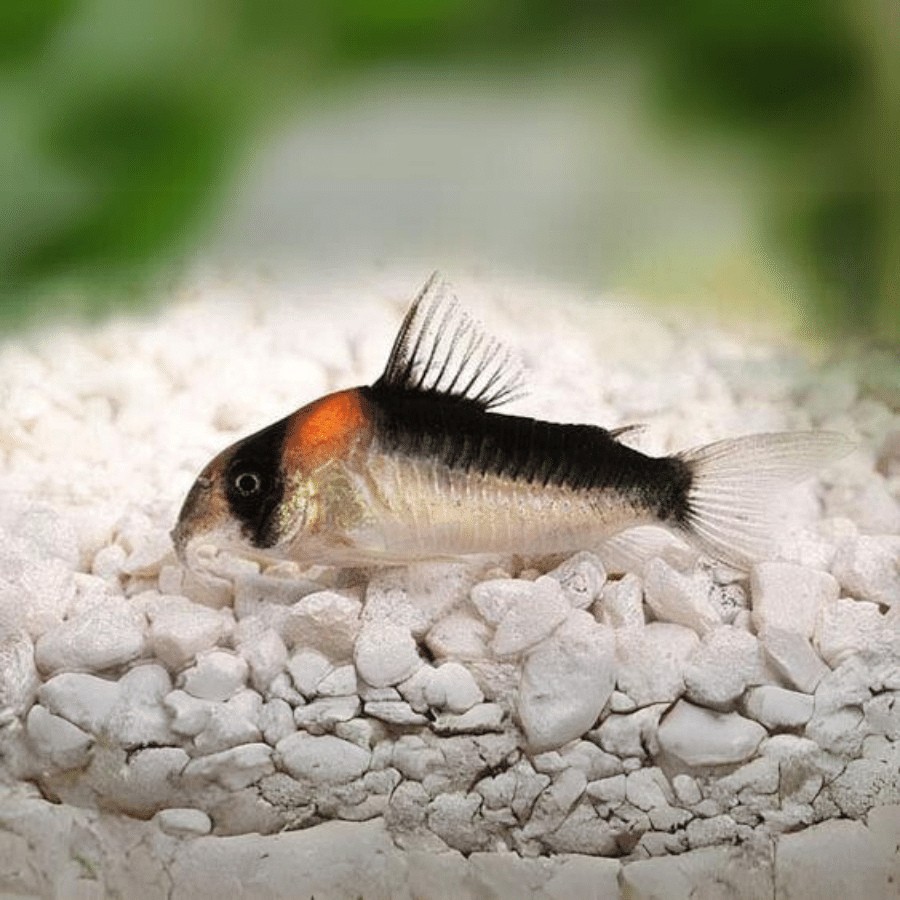
Ivory-white body base with wide black bandit mask through the eye, narrow deep orange-red shoulder patch between head and dorsal fin, and dark dorsal fin base — the true collector’s adolfoi.
🟠 Corydoras duplicareus (common confusion partner)
Almost identical to adolfoi but with a noticeably wider orange-red shoulder band and thicker black dorsal stripe — the ‘doubled’ pattern that gives the species its name. Sympatric with adolfoi and frequently sold mislabelled.
🤎 Corydoras imitator (less common lookalike)
A similar tricoloured Rio Negro cory but with a more pointed, elongated snout and a slightly longer body profile; the orange patch tends to sit further back and blend into the body.
⚫ Corydoras serratus (distant relative)
A related black-and-white Rio Negro species with a similar eye-mask but no orange shoulder patch — sometimes traded alongside adolfoi but easily distinguished by the absence of warm colouration.
The colour pattern of Corydoras adolfoi is what has made it one of the most desirable small corydoras species since its formal description in 1982. The combination of pure ivory-white base body, a sharply defined wide black eye-mask (running from gill cover through eye to snout), a deep orange-red ‘shoulder’ patch sitting between the head and the dorsal fin, and a black dorsal fin base, creates a tricoloured silhouette that is instantly recognisable even at small sizes. At 3 cm, our juveniles already show the full adult pattern — the shoulder patch colour will deepen and saturate further as they mature and settle into a blackwater tank with tannin-stained water.
Colour intensity depends strongly on environment. Adolfoi corys kept on pale gravel under bright lights look noticeably washed out — the white body merges with the substrate, the orange patch looks dull, and the contrast suffers. The same fish moved onto fine dark sand in a lightly tannin-tinted tank with Indian almond leaves and floating plants will transform: the ivory body becomes luminous, the orange shoulder patch glows a deep warm red, and the black markings become jet-black. This is emphatically a species that rewards the aquarist who builds them a proper blackwater biotope.
The duplicareus confusion is worth understanding before purchase. We have carefully sourced our fish as Corydoras adolfoi (the narrow-shoulder-band form), and they display the classic slim orange stripe. If you are building a dedicated biotope or planning to breed, identification accuracy matters; if you simply want the most beautiful small cory in the hobby, either species will give you the same visual effect and either can be kept with the other.
Water Chemistry Guide
5.5–7.0
ideal 6.2
23–27 °C
ideal 25 °C
2–8 dGH
Soft water required — a true Amazonian blackwater species
Corydoras adolfoi is one of the few popular corydoras species that genuinely requires soft, acidic water to thrive long-term — this is a true upper Rio Negro blackwater species, not a generalist. In its native tributaries near São Gabriel da Cachoeira, the water is stained deep tea-brown by fallen leaf litter and decaying vegetation, with pH measurements typically in the 4.5–5.5 range, hardness near-zero (GH often below 1 dGH, KH essentially zero), and temperatures between 24 and 27 °C year-round. The upper Rio Negro is one of the world’s largest blackwater systems, draining a huge area of podzolic sandy soils that release humic and fulvic acids but almost no dissolved minerals; the result is some of the most chemically extreme soft water that supports a rich and diverse fish community anywhere on Earth. While you do not need to replicate pH 5.0 to keep these fish successfully in the aquarium, the closer you get to soft, acidic blackwater conditions, the better they will look, feed, and breed.
A sensible, achievable target for a long-term adolfoi tank is pH 6.0–6.5, GH 2–6, KH 1–3, and a temperature of 25 °C. This is achievable in most areas with filtered tap water plus a handful of Indian almond leaves (Terminalia catappa) to provide natural tannins, or with RO/rainwater if your tap is hard. If your local water is very hard (GH above 10, KH above 6), cut it 50:50 with RO water — don’t try to chemically acidify hard water with pH-down products, as the high KH will cause unstable pH swings that stress fish far more than moderately hard water would. Avoid any substrate or decor that leaches calcium carbonate — no crushed coral, no coral sand, no crushed shells, no limestone or dolomite rock, no Texas holey rock, no cichlid stones. These will drive pH up and hardness up, and the Adolfoi will slowly lose colour, feed poorly, and become susceptible to disease. Driftwood, Indian almond leaves, alder cones, peat moss, and oak leaves all gently acidify and tint the water; they are cheap, natural, and the fish love the tannins. A well-matured blackwater tank with an established leaf litter carpet will self-regulate to around pH 6.2 with almost no effort once the balance is struck.
Like all corydoras, adolfoi are intolerant of high nitrate. Keep nitrates below 20 ppm (ideally under 10) with weekly 25–30% water changes and regular substrate cleaning. Corydoras are also more sensitive to nitrate than most community fish — chronic nitrate above 30 ppm causes the characteristic ‘eroded barbel’ syndrome, where the sensory whiskers around the mouth begin to shorten or disappear; this leads to feeding difficulty and secondary bacterial infection. They are also highly intolerant of ammonia and nitrite spikes — always fully cycle the tank before adding them, and never add them to a new setup. Dissolved oxygen should be reasonable; corydoras have a true accessory breathing organ (a modified intestine that absorbs atmospheric oxygen) and will occasionally dart to the surface for a gulp of air even in well-oxygenated tanks — this is normal. If you see your cory repeatedly dashing to the surface for a gulp of air far more than occasional, however, it means the tank is under-oxygenated and you should increase surface agitation.
Water changes should use water at the same temperature as the tank (or slightly cooler, which can be a breeding trigger — see the breeding chapter) and of matched or softer parameters. Never change water parameters suddenly on an established tank; adolfoi tolerate a range but hate instability.
What to Feed
Corydoras adolfoi is an opportunistic omnivore bottom-feeder that in the wild consumes a mixed diet of small invertebrates (worms, insect larvae, microcrustaceans), fallen plant matter, detritus, and biofilm scraped from leaves and submerged wood. In the aquarium, they require sinking foods specifically — they are physiologically poor competitors against mid- or surface-feeders and will steadily lose weight if the food does not reach the substrate where they forage. This is one of the most common reasons cory keepers fail: feeding flakes to a community tank and assuming the cory will ‘clean up’.
Feed a high-quality sinking wafer or micro-pellet formulated for small bottom-feeders as the staple — two or three times per week. Hikari Sinking Wafers, Bug Bites Cory/Pleco Sinking Pellets, and similar products are all excellent. Supplement with frozen bloodworm, frozen daphnia, or frozen tubifex two to three times per week — these are all eagerly accepted and provide excellent protein for growth and breeding condition. Live blackworms or microworms, if you can source them, are particularly appreciated. Occasional blanched vegetable (cucumber, zucchini, spinach) is accepted and provides fibre, though corys are not strict herbivores and this should not dominate.
At 3 cm our Adolfoi juveniles will readily take small sinking wafers, crushed micro-pellets, and frozen bloodworm (cut in half if the worms are large). Feed in the evening just before lights-out — corydoras are most active in low light, and feeding at this time ensures they get the food before any competing tankmates are fully settled. Feed small amounts that can be consumed within three to five minutes; uneaten food on the substrate will foul the water and is the number one cause of nitrate and ammonia problems in bottom-feeder tanks.
In a community tank, the tried-and-true method is to drop food in opposite corners — fast feeders at one end, cory food at the other — or to wait until the other fish have finished and then drop a sinking wafer directly in front of the cory school. These fish know their dinner bell; within days of regular feeding, they will gather at the food drop zone the moment they see you approach.
Creating the Perfect Habitat
The Adolfoi cory tank is one of the most rewarding biotopes to set up because the fish look their absolute best in exactly the kind of natural-looking Amazonian scape that is currently popular in aquascaping: fine pale sand with a carpet of Indian almond leaves, tangled driftwood, dim lighting, and gently tannin-stained water. Build this tank properly and the fish become living jewels against it.
Substrate is the single most important decision. Corydoras forage by poking their barbels into the substrate to detect buried food — if the substrate is coarse, sharp, or abrasive, the delicate sensory whiskers will erode, bacterial infections will take hold, and you will eventually lose the fish. Use only fine, smooth sand with a grain size of 0.1–0.5 mm. Silica pool filter sand, fine aquarium sand, or smooth natural river sand are all excellent choices — and pale sand shows off the ivory-and-orange body pattern far better than dark sand does. Crucially, avoid sharp gravel, crushed coral, or any substrate with angular edges. Adolfoi are constant foragers and any damage accumulates over weeks.
A 60-litre tank is the practical minimum for a school of six adult Adolfoi corys, but a 90-litre tank gives them more foraging territory and a much more natural-looking school. This is a small cory species that rarely exceeds 5 cm, so tank length matters more than height — a 60 x 30 cm footprint is ideal, with plenty of horizontal swimming space along the sand bed. For décor, provide several pieces of driftwood arranged to create sheltered nooks, some smooth Amazon-style roots or bogwood, and a handful of broad-leafed plants such as Amazon sword, java fern, or cryptocorynes. Floating plants (frogbit, red root floaters, salvinia) dim the light from above and make the fish feel secure; they also release tannins and help consume nitrate.
The single most important décor element is leaf litter — Indian almond leaves, oak leaves (dried and soaked), or magnolia leaves. Place six to ten leaves on the sand bed. They release tannins that soften water, acidify it mildly, and provide a natural food source as biofilm develops on the leaves. The leaves also give the tank an authentic Amazonian look and provide shelter for the fish. Replace them every four to six weeks as they break down.
Keep lighting dim. Corydoras adolfoi come from shaded, root-covered tributaries and bright overhead lighting stresses them and washes out their colour. Low-wattage LED on a timer for six to eight hours a day is ample — pair it with floating plants to break up the light further.
Tank
60 L (16 gal) minimum for a school of 6; 90 L (24 gal) recommended for 8–10 fish and a natural-looking biotope
Filter
Sponge filter (recommended) or low-flow canister with spray bar — gentle current, good oxygenation, no sharp intakes
Heater
50–100 W adjustable heater set to 25 °C; reliable thermostat is essential
Substrate
Fine pale sand (0.1–0.5 mm) — silica pool filter sand is ideal. Pale sand makes the tricolour pattern pop. Never use crushed coral or sharp gravel
Driftwood
2–3 pieces of Amazon-style wood (Malaysian driftwood, spider wood, or mopani) — provides shelter, tannins, and biofilm
Indian Almond Leaves
6–10 leaves on the sand bed — natural tannins, soft blackwater look, and biofilm for grazing. Replace every 4–6 weeks
Plants
Amazon sword, java fern, cryptocoryne, anubias; plus floating plants (frogbit, salvinia) to dim light and consume nitrate
Lighting
Low to moderate LED on a timer for 6–8 hours/day; dim light suits blackwater biotope and reduces stress
Thermometer
Accurate digital or glass thermometer — temperature stability matters, especially in winter
Tank Mate Guide
Corydoras adolfoi is one of the finest community citizens in the entire hobby — genuinely peaceful, constantly entertaining, and visually striking without being showy. Its natural companions are the soft-water Amazonian species it has evolved alongside for millennia: cardinal tetras, rummy nose tetras, pencilfish, hatchetfish, small apistogrammas, and otocinclus. A 90-litre Rio Negro biotope built around a school of eight Adolfoi corys, twelve cardinal tetras, and a pair of apistogramma cacatuoides — with fine sand, driftwood, Indian almond leaves, and tannin-stained water — is one of the most rewarding aquariums you can build, and the adolfoi is the perfect ground-level anchor for it. The fish become genuinely interactive over time: a school that has been in a tank for several months will learn the feeding routine, gather near the front glass at lights-out waiting for their evening sinking wafer, and develop distinct personalities within the group. There is usually one ‘scout’ individual who explores new objects first, and a huddle group that follows a minute or two later once the scout has confirmed the territory is safe.
School size matters more than most keepers appreciate. Six is the absolute minimum; eight to ten is noticeably better; twelve or more in a 120-litre tank produces genuinely natural behaviour where you see coordinated foraging, group resting, synchronised surface runs for air, and spontaneous ‘playful’ bursts of activity where the whole school suddenly zooms across the tank in a coordinated shoal. Keeping only two or three corys is cruel in the same way keeping a single goldfish is cruel — the animals are built for social life and they suffer visibly without it, becoming timid, reclusive, and reluctant to feed.
The key compatibility rules are simple: match water parameters (soft, acidic, 23–27 °C), avoid fast or greedy feeders who will monopolise food, avoid anything large enough to try to eat a 5 cm cory, and avoid fin-nippers or aggressive cichlids. Stick to the gentle blackwater cast and the adolfoi will flourish for years. A common mistake is to mix adolfoi with typical community ‘starter’ fish (guppies, platies, mollies) because they are cheap and easy — but livebearers require hard alkaline water, the opposite of what adolfoi wants, and the long-term compromise parameters are bad for both parties. Commit to the soft-water blackwater theme from the start and the fish you add will be genuinely compatible rather than merely surviving.
One practical handling note, which applies to all corydoras: the locking pectoral spines can tangle dangerously in fine mesh nets. When transferring adolfoi, use a plastic container to scoop rather than a net, or use a soft fine-weave ‘fry net’ and be gentle. The pectoral spine is mildly venomous (a sting from a stressed fish during netting can cause a brief sharp pain for a human — not dangerous, but surprising) and can lock in an extended position during handling, so avoid prodding or squeezing. If a cory’s spine does get tangled in a net, cut the net rather than trying to free the spine — it is safer for both you and the fish. Stressed corys can also release a mild toxin from their skin when severely distressed (a phenomenon called ‘self-poisoning’ when multiple corys are crammed into a bag without water changes during transport); avoid long shipping bags for corydoras and always unbag them promptly at home.
| Species | Why | |
|---|---|---|
| ✅ | Cardinal Tetra | The classic Amazon blackwater pairing. Cardinals share the exact same soft acidic preferences and occupy mid-water while adolfoi patrols the substrate — zero competition, zero conflict, and a visually stunning combination |
| ✅ | Neon Tetra | Peaceful schooling tetra that shares soft-water preferences; mid-water schooler leaves the substrate entirely to the corydoras |
| ✅ | Rummy Nose Tetra | Tight-schooling tetra that loves the same soft acidic water; mid-water occupancy and gentle temperament make them ideal blackwater companions |
| ✅ | Pencilfish (Nannostomus species) | Slow, elegant surface-and-upper-water swimmers from the same Rio Negro region; perfect biotope match, no competition for space or food |
| ✅ | Dwarf Cichlid (Apistogramma) | Soft-water dwarf cichlids like Apistogramma agassizii or cacatuoides coexist peacefully with corydoras; the cichlid claims a territory, the corys wander through without incident |
| ✅ | Otocinclus Catfish | Peaceful algae-eating catfish that occupies leaves and wood surfaces, not the substrate — zero territorial conflict with bottom-foraging adolfoi; both prefer soft water |
| ✅ | Hatchetfish (Carnegiella / Gasteropelecus) | Surface-dwelling schooler that uses the top 3 cm of the tank exclusively — completely different ecological niche and beautiful visual separation from the substrate-focused corys |
| ✅ | Small tetras (Ember, Black Neon, Green Neon) | Gentle, small-bodied tetras from soft-water habitats — all make excellent community partners with similar parameter preferences |
| ✅ | Other small Corydoras (pygmy, hastatus, habrosus) | Multi-species cory communities work well if all species prefer the same water; pygmy corys occupy mid-water while adolfoi sticks to substrate, creating interesting multi-level cory activity |
| ❌ | Large or Aggressive Cichlids (Oscars, Jack Dempsey, large Acaras) | Will attempt to eat, harass, or corner small corydoras. Even if the cichlid cannot swallow the armoured cory, the locked pectoral spine can cause serious injury to both fish |
| ❌ | Large Catfish and Plecos (Common Pleco, Redtail Catfish) | Outcompete small corys for substrate food, may physically injure them during feeding frenzy, and large plecos can latch onto the cory’s slime coat causing tissue damage |
| ❌ | Fast, Greedy Mid-Water Feeders in Large Numbers (Tiger Barbs, Serpae Tetras) | Will steal all food before it reaches the substrate; also fin-nipping species can stress peaceful corys. The corys will starve slowly in a tank dominated by fast feeders |
| ❌ | Goldfish and other Cold-Water Species | Incompatible temperature (goldfish prefer 15–22 °C vs adolfoi’s 23–27 °C); also typically kept in hard alkaline water, which is the opposite of what adolfoi requires |
| ❌ | Hard-Water Livebearers (Guppies, Mollies, Platies) | Incompatible water chemistry — livebearers prefer hard alkaline water (pH 7.5+, GH 10+) while adolfoi requires soft acidic conditions (pH 6.0–6.5, GH under 8). Long-term mixing stresses one or both species |
Reproduction & Breeding
Week -2 to -1
Conditioning
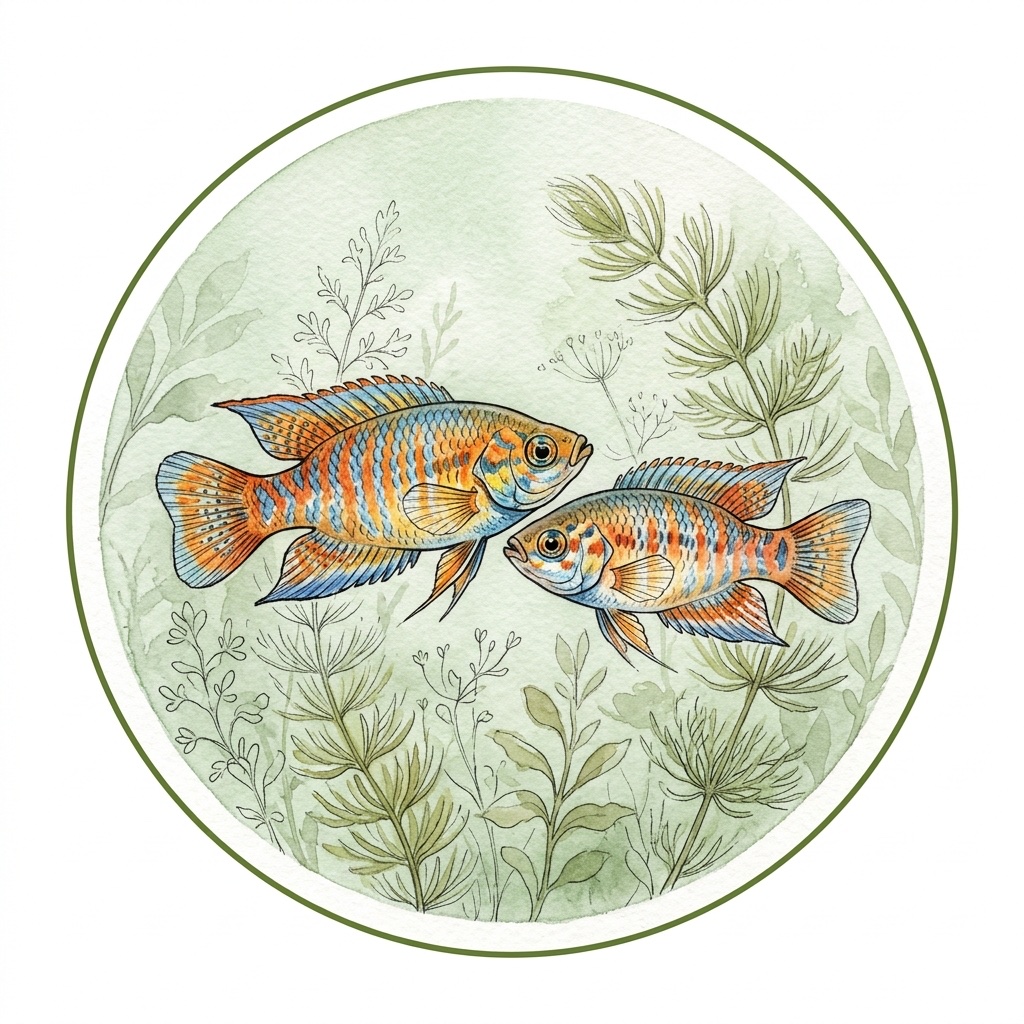
Feed live/frozen heavily; target stable blackwater conditions
Day 0
Rain-Drop Trigger — Cool Water Change
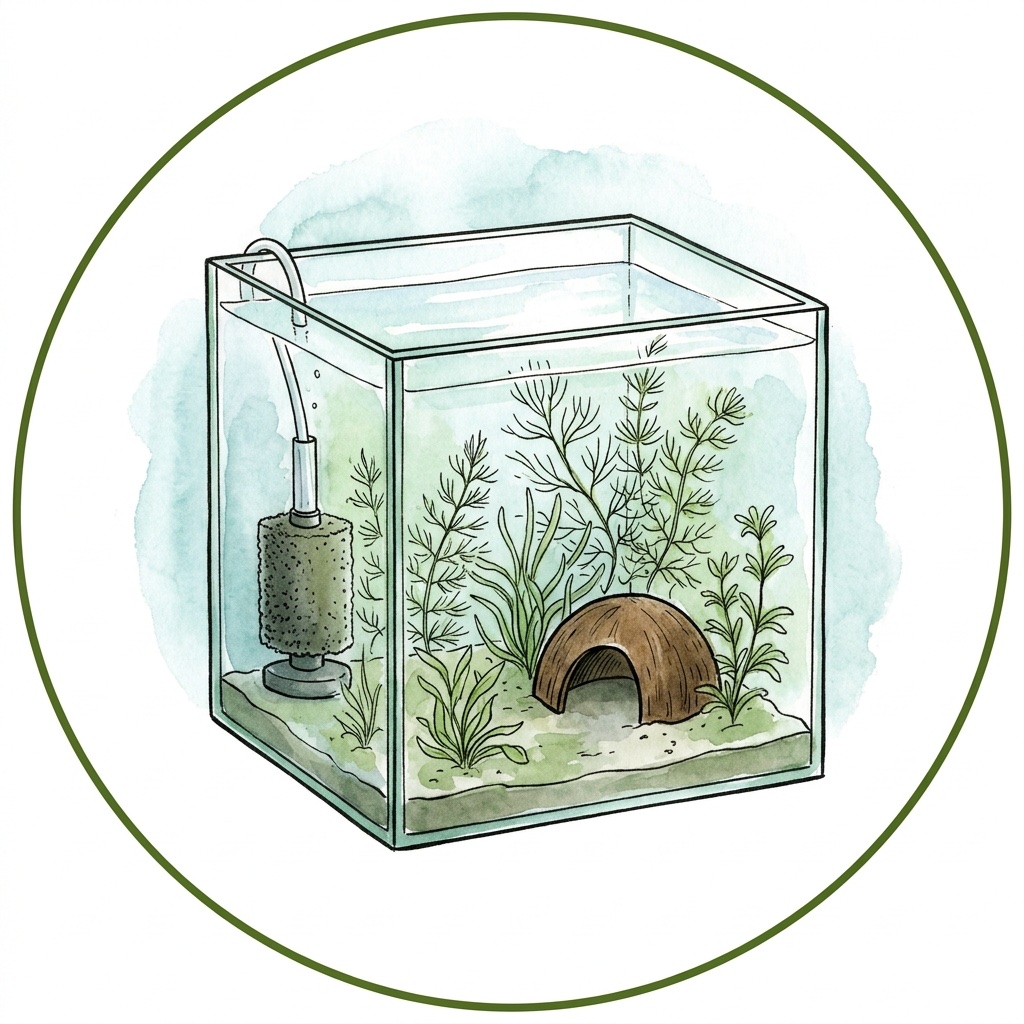
Large water change with cool, soft water mimics the wet season
Day 0–1
Courtship and T-Position Mating
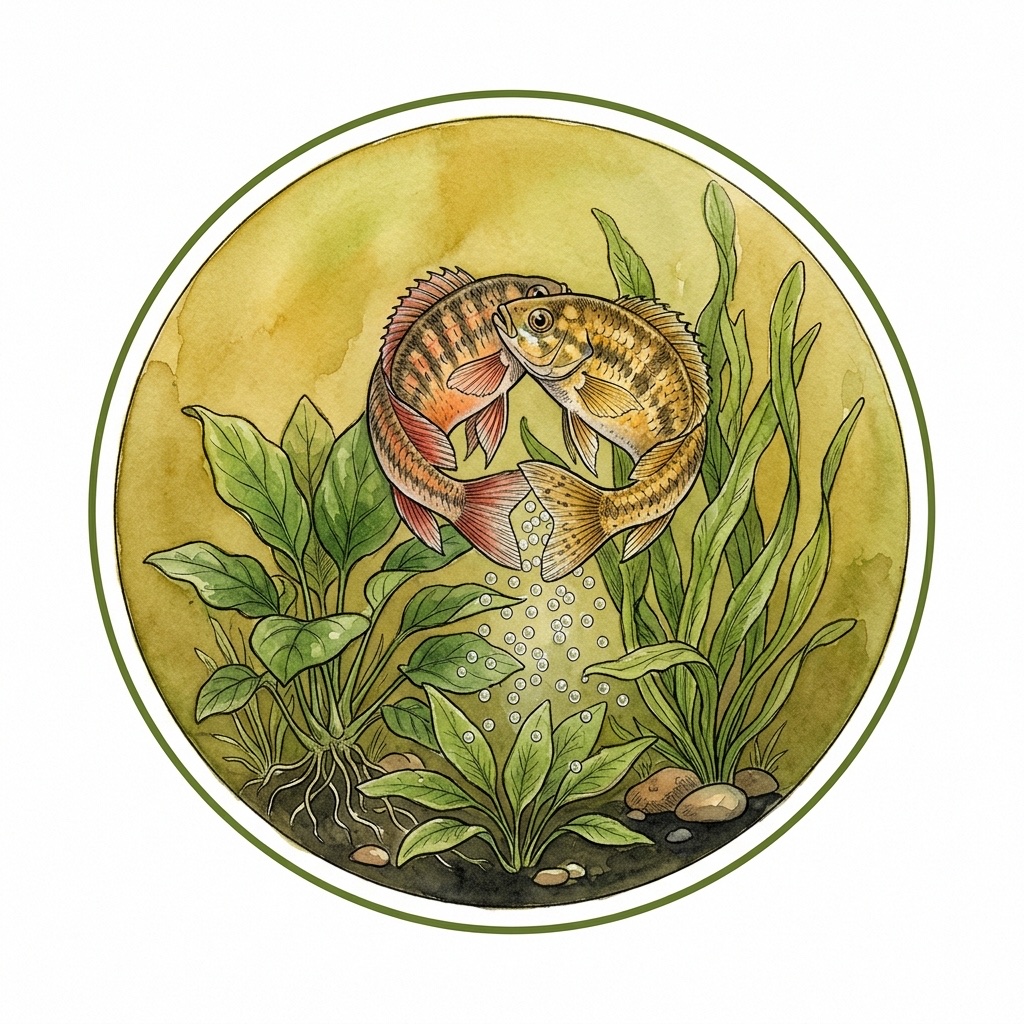
Male and female lock in the classic corydoras T-position; fertilisation occurs
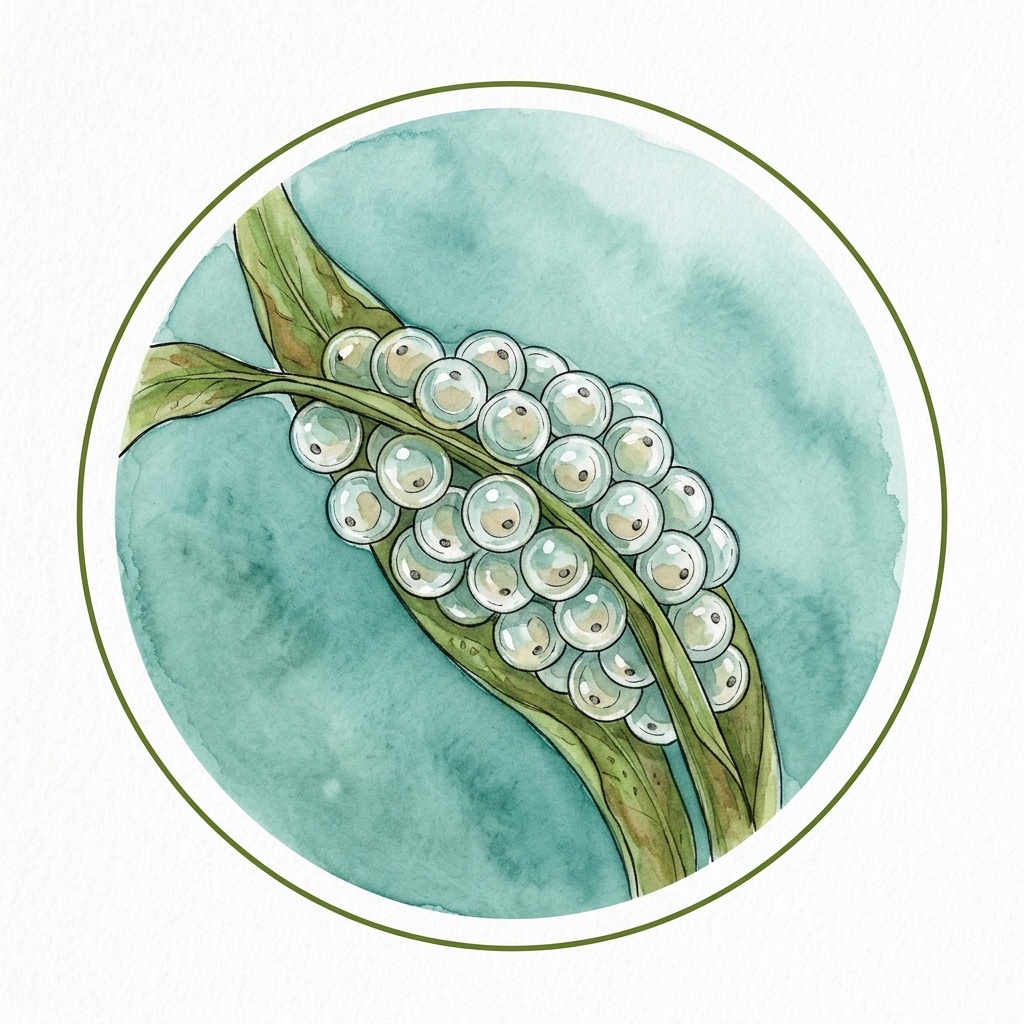
Day 1–3
Egg Incubation
Remove adults or transfer eggs; treat with anti-fungal and maintain flow
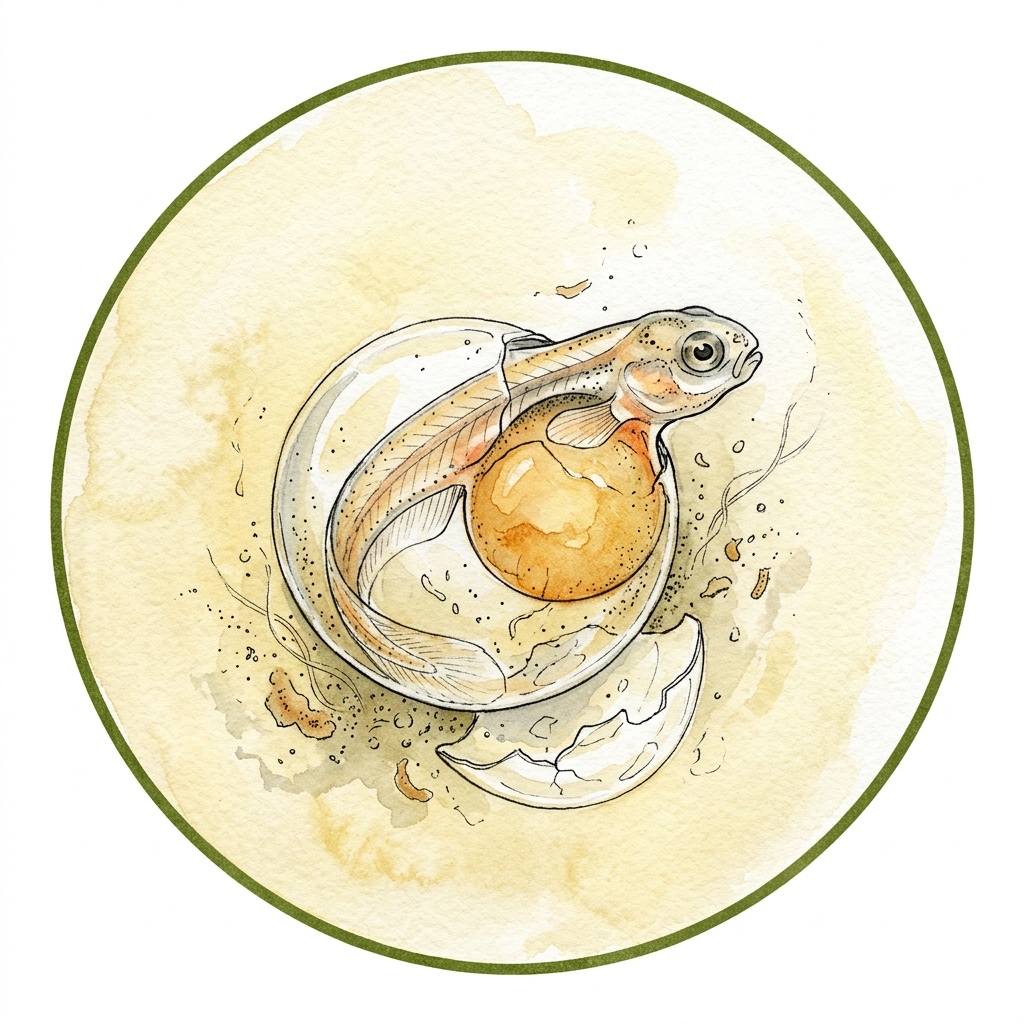
Day 3–5
Hatching
Fry emerge; yolk sac absorbed over next 48 hours
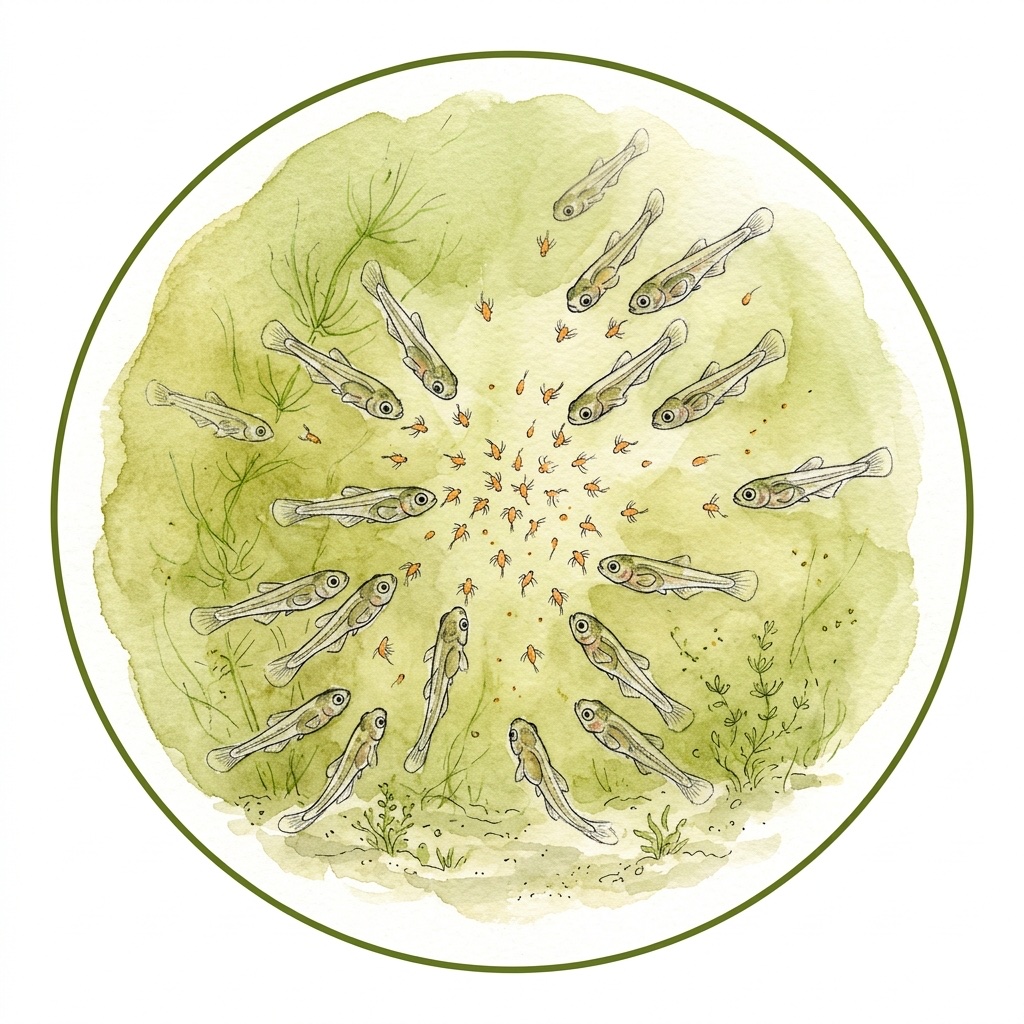
Day 5–7+
Free Swimming and First Feeding
Fry begin foraging; offer microworm and baby brine shrimp
Conditioning
Begin conditioning the breeding group two weeks before the intended spawning trigger. Feed generous portions of frozen bloodworm, daphnia, and — if available — live blackworms or microworms twice daily. Females should fill out visibly during this period, the belly profile broadening as eggs develop. Maintain pH 6.0–6.5, GH under 5, and temperature around 26 °C. Stability matters: the females must reach full gravid condition before the trigger, and fluctuating parameters during conditioning will set the process back.
Rain-Drop Trigger — Cool Water Change
The proven spawning trigger for Corydoras adolfoi is a simulated Amazonian rain event. Perform a 40–50% water change using water that is 3–5 °C cooler than the tank (so if the tank is at 26 °C, the replacement water should be 21–23 °C) and slightly softer than the existing water. Pour the new water in slowly over 10–15 minutes to drop the tank temperature gradually. After the change, keep the temperature at 23–24 °C for 12–24 hours. This mimics the cool, oxygen-rich runoff of the wet season that triggers spawning in the wild. Males almost always respond within hours — you will see them begin short, energetic chases around the tank, nuzzling and bumping females.
Courtship and T-Position Mating
Spawning follows the universal corydoras ritual: the male positions himself at a right angle to the female, pressing his body against her head to form a T-shape. In this position the male releases milt, which the female takes into her mouth. She holds the milt briefly, swims to a chosen clean surface — typically the front aquarium glass, a broad plant leaf, or a piece of flat decor — and presses her cupped pelvic fins (holding the fertilised eggs) against that surface, depositing the eggs in small batches. Adolfoi females typically lay 1–3 eggs per deposition, repeating the process many times over a spawning session that can last several hours. A healthy female may produce 30–60 eggs in a single spawning.
Egg Incubation
Adult corydoras do not guard their eggs and will eat them if left in the same tank. The reliable approach is either to remove the adults back to a main tank (leaving the eggs in the breeding tank), or to carefully peel the sticky eggs from the glass or decor and transfer them to a separate hatching container. Use a clean, soft-edged tool — a finger or the blunt edge of a razor blade — to roll eggs off the glass without crushing them. Keep the hatching vessel at 25–26 °C with gentle airstone circulation. Add methylene blue at low dose (or alder cones/Indian almond leaf for natural anti-fungal tannins) to prevent fungal attack on any infertile eggs, which will otherwise spread fungus to fertile ones.
Hatching
At 25–26 °C the eggs typically hatch after 3–5 days. Newly hatched Adolfoi fry are large and robust compared to fry of egg-scattering species like tetras — they are essentially miniature corys from birth. They rest on the bottom of the hatching vessel and absorb their yolk sac over the following 48 hours, during which they require no external food and should not be disturbed. Keep the hatching vessel clean by siphoning any unfertilised/fungused eggs.
Free Swimming and First Feeding
Once the yolk is absorbed, the fry begin their typical corydoras bottom-foraging — probing the substrate for food. Offer microworms, baby brine shrimp (BBS) nauplii, or commercially prepared liquid fry food three to four times per day. BBS are particularly effective and produce the fastest growth. Perform small daily water changes of 10–15% with matched parameters to maintain water quality in what is often a bare-bottom hatching tank. Growth is steady but not rapid — expect fry to reach 1 cm at about six weeks and 2 cm at around three months. Juveniles can be moved to a grow-out tank once they reach 1.5 cm.
Quick Reference
| Scientific Name | Corydoras adolfoi (Burgess 1982) |
| Family | Callichthyidae (armoured catfish) |
| Origin | Upper Rio Negro, Brazil — blackwater tributaries |
| Current Size | ~3 cm (near sub-adult) |
| Adult Size | 4.5–5 cm — small cory |
| Lifespan | 5–8 years |
| pH | 5.5–7.0 (ideal 6.0–6.5) |
| Temperature | 23–27 °C (ideal 25 °C) |
| Hardness | 2–8 dGH — soft water required |
| Min Tank | 60 L for a school of 6 |
| Group Size | 6+ mandatory; 8–10 recommended for best behaviour |
| Care Level | Intermediate — soft water + clean sand essential |
| Diet | Sinking wafers/pellets, frozen bloodworm, daphnia |
| Breeding | Cool water-change trigger; T-position; eggs on glass/leaves |
| Tank Zone | Bottom / substrate |
| Not to Confuse With | Corydoras duplicareus — same colours, wider orange stripe |
| Key Care Rule | Fine sand, soft acidic blackwater, Indian almond leaves, no crushed coral |
Related Products


Reviews
Clear filtersThere are no reviews yet.