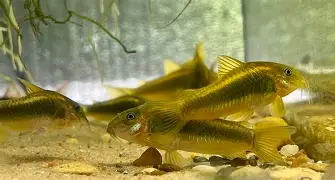
🪨 Species at a Glance
| Scientific Name | Corydoras sp. ‘CW010’ |
| Trade Name | Gold Laser Cory |
| Family | Callichthyidae |
| Order | Siluriformes |
| Status | Undescribed — trade-name species, CW-number system |
| Origin | Peru — upper Amazon basin, Loreto region |
| Adult Size | 5–6 cm (2.0–2.4 in) |
| Lifespan | 5–8 years |
| pH Range | 6.0–7.5 |
| Temperature | 22–26 °C (72–79 °F) |
| Hardness (dGH) | 3–12 |
| Diet | Omnivore bottom feeder — sinking pellets, wafers, frozen bloodworm, daphnia |
| Minimum Tank Size | 80 L (21 gal) for a school of 6+ |
| Care Level | Beginner–Intermediate |
| Temperament | Peaceful, social; must be kept in groups of 6 or more |
| Breeding | Achieved in home aquaria; requires cool-water trigger and large water change |
| Tank Position | Bottom / substrate |
| Availability | Uncommon — specialist import |
Species Background
The Gold Laser cory carries one of the more intriguing scientific labels in the hobby: Corydoras sp. ‘CW010’. The ‘sp.’ indicates that the species has been collected and identified by aquarists and exporters but has not yet been formally described and named in the scientific literature — meaning that no ichthyologist has yet published a peer-reviewed species description, holotype specimens, and formal diagnostic features that would anchor the fish under the standard binomial nomenclature. The ‘CW010’ is a coded placeholder assigned by Ian Fuller’s Corydoras World (hence CW), a dedicated reference project that has become the de facto registry for the hundreds of undescribed Corydoras, Scleromystax, and related catfish that continue to arrive in the trade faster than ichthyologists can process them. Each new distinct form is assigned the next sequential number, along with a trade name that usually highlights a visible feature — in this case the blazing gold lateral stripe that looks, under light, precisely like a laser beam etched along the fish’s flank. The Corydoras World system provides an enormously useful common vocabulary for a trade in which new Amazonian populations are collected and shipped to Europe, North America, and Asia long before scientific taxonomy can catch up.
The CW system is the most recent of three parallel numbering systems that aquarists use to keep track of undescribed South American catfishes, and understanding all three is genuinely useful for any serious catfish keeper. The oldest, the L-number system (from the German word Loricariidae, the family that includes plecos), was introduced by the magazine DATZ in the late 1980s to label plecos and related suckermouth catfish arriving in Germany; L-numbers like L046 (the zebra pleco), L134 (the leopard frog pleco), L333 (the king tiger pleco), and L397 (the Alenquer tiger pleco) remain household designations even after several have been formally described, because the trade simply refuses to give up the familiar codes. The C-number system, introduced by the same magazine shortly afterward, was used to label undescribed Corydoras and the closely related genus Aspidoras — but the C-number list was closed decades ago at C156, leaving a long tail of later discoveries without a formal code. Into that gap stepped the CW system, run by Corydoras World, which from 2006 onward has continued numbering new forms as they appear: CW001, CW010, CW021, CW045, and so on, now well past CW200. Each of the three systems coexists and is used in parallel by different segments of the hobby; the L-numbers are deeply entrenched among pleco keepers, the C-numbers survive on older fish, and the CW-numbers have become the working language for modern Corydoras.
So what exactly is CW010? In all likelihood, it is a distinct population of a wider complex that may eventually be formally described as a new species or as a regional colour variant of an existing one. Genetic work on the genus Corydoras has repeatedly shown that superficially similar fish from different Amazonian tributaries are often only distantly related, while fish from the same river system can look very different — meaning that visual classification alone is an unreliable guide to true relationships. For now, importers, hobbyists, and breeders rely on the CW010 label plus the trade name ‘Gold Laser’ to identify the specific fish, a combination that is remarkably stable across suppliers in Peru, Europe, and Asia. When you buy a Gold Laser cory, you should expect the same fish every time: a small Corydoras with a coal-black to dark-brown base body, a single bold horizontal stripe of iridescent gold running from gill plate to caudal peduncle, and clear to smoky fins. If the stripe is greenish rather than gold, you may have its close relative CW045, the Green Laser cory — collected from the same general region of the Peruvian Loreto and often mixed with Gold Lasers in exporter tanks, a fact worth knowing before buying a pure school. Responsible dealers separate the two forms on arrival and keep them in clearly labelled tanks; less careful importers allow them to mix, which is how ‘assorted laser cory’ shipments sometimes appear at lower prices in the retail trade.
The Colour Spectrum
🟡 Wild CW010 Gold Laser
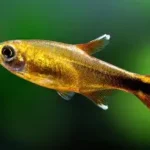
The standard form — dark brown to coal-black body with a single iridescent gold horizontal stripe running from operculum to caudal peduncle; fins clear to lightly smoky.
🟢 CW045 Green Laser
Sister form from the same general region — body colouration as CW010 but the lateral stripe is a cooler iridescent green rather than warm gold; often mixed with Gold Lasers at source.
🟠 CW021 ‘Orange Laser’
A warmer, more orange-toned stripe variant described from Peruvian tributaries; less iridescent than CW010, usually more matte copper-orange in tone.
🔘 Intermediate / Mixed Imports
Occasional shipments contain fish whose stripe tone is ambiguous — yellow-green or gold with a green flash at certain angles; likely intergrade populations from overlapping catchment areas.
The gold stripe on CW010 is not a pigment in the conventional sense — it is a structural, iridophore-based reflection, produced by microscopic platelets of guanine crystal arranged in dense layers within specialised cells in the skin. Light striking these platelets is partially reflected and partially transmitted, and the constructive interference between the reflected waves produces the brilliant metallic sheen characteristic of iridescent fish colouration. That is why the gold stripe shifts dramatically with angle and light: under direct overhead LEDs the stripe flashes a bright, metallic gold-yellow; viewed from the front or in diffuse light it appears more subdued, a warm honey tone against the dark body; at a grazing angle under cool blue light it can even briefly look silver-white. The contrast is highest when fish are kept over dark sand with a dark background, under moderate planted-tank lighting that emphasises yellow and red wavelengths; over pale gravel under harsh cool white lighting the stripe still glows, but the overall contrast is noticeably softer and the effect flatter. Keepers who want the maximum shimmer invariably end up with a black-sand, black-background, warm-tinted planted tank — a setup that is, not coincidentally, also the best biotope approximation of the Peruvian blackwater streams the fish come from.
It is worth understanding the relationship with CW045, the Green Laser cory, in detail. The two forms are collected from overlapping regions in the Peruvian upper Amazon and may represent colour-polymorphic populations of the same undescribed species, or sister species that co-occur in the same drainage. They will school together in the aquarium without any sign of stress — confident mixed schools settle together, rest together, and forage as a single unit — and they will even interbreed given the opportunity to spawn together, producing offspring of mixed or intermediate stripe colour. For display purposes, most keepers prefer either a pure Gold Laser school or a deliberate mixed school of equal numbers of Gold and Green Lasers, which produces a striking effect of alternating warm and cool stripes drifting through the same space. Buy the two forms from separate clearly labelled tanks if you want true pure lines, and avoid taking ‘mixed laser cory’ or ‘assorted CW’ lots as a shortcut — you have no way of knowing the ratio you will actually receive. Juvenile CW010 and CW045 look almost identical at small size, since the stripe iridescence develops gradually as the skin platelets mature; the stripe colour only becomes definitive past about 3 cm body length, so buying very young fish from an unreliable source risks ending up with an unintended mix that only reveals itself as the fish grow out. CW021, sometimes traded as Orange Laser, is a warmer copper-orange variant from a different tributary system and is less iridescent — a more matte appearance overall that some keepers prefer for its softer look against densely planted backgrounds.
Sexual Dimorphism
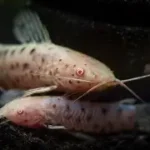
As with most Corydoras, the reliable way to sex mature Gold Lasers is to look down at the fish from directly above — ideally by photographing the tank from the top through the surface. A well-fed adult female is unmistakably wider across the shoulders and belly than a male of equivalent length. From the side, a gravid female shows a gently rounded underline, while males are notably flatter-bellied and longer-looking relative to their overall length.
Do not attempt to sex Gold Lasers below about 3.5–4 cm body length; the dimorphism only becomes reliable in sexually mature fish that have reached adult body shape. The stripe itself offers no sex cue — its brightness relates more to conditioning, diet, and lighting than to sex. For breeding work, the accepted approach is the same as for any other Corydoras: purchase a group of six to ten well-grown juveniles and allow them to mature together; a mixed-sex group is statistically near-guaranteed, and the natural sorting of behaviour inside the group quickly reveals which individuals are male and female once mature.
| Feature | Male | Female |
|---|---|---|
| Body Shape (from above) | Slimmer, more torpedo-shaped; parallel flanks when viewed from above | Clearly rounder and broader across the midsection, especially when gravid |
| Size | Slightly smaller, typically 4.5–5.5 cm at maturity | Slightly larger, typically 5–6 cm at maturity |
| Belly Profile | Flat ventral line from side view | Rounded, fuller ventral profile; clearly pronounced when carrying eggs |
| Colouration | Essentially identical — stripe may appear marginally crisper on fit, active males | Essentially identical; stripe unchanged by sex |
| Fin Shape | No reliable sexual dimorphism in fin shape or length | No reliable sexual dimorphism in fin shape or length |
| Behaviour at Spawning | Actively pursues female; initiates T-position | Carries fertilised eggs in cupped pelvic fins; selects spawning surface |
Water Chemistry Guide
6.0–7.5
ideal 6.8
22–26 °C
ideal 24 °C
3–12 dGH
Soft to moderately hard; soft water strongly preferred for best colour and breeding
CW010 Gold Lasers come from the upper Peruvian Amazon, where water is typically soft, slightly acidic, tea-stained with tannins, and steadily warm rather than hot — temperatures in their native streams generally sit in the low-to-mid 20s Celsius year-round, with modest seasonal variation driven by rainy-season inflows rather than by air temperature extremes. This is the profile to aim for in the aquarium: pH in the mid-6s to neutral, hardness below 12 dGH, temperature around 23–25 °C as a daily baseline. Unlike Sterbai and other discus-compatible corys, Gold Lasers are not especially heat-tolerant — prolonged exposure above 27 °C visibly stresses them, reduces oxygen availability in the water, accelerates metabolic demand, and ultimately shortens their life. Do not attempt to keep them in warm discus tanks; they are a classic community-temperature cory and belong with tetras, rasboras, dwarf rainbows, honey gouramis, and similar soft warm (but not hot) water community fish rather than with heat-loving cichlids. If you live in a climate where summer tank temperatures drift above 26 °C for weeks at a time, plan for cooling — a clip-on fan blowing across the water surface can drop tank temperature by 2–3 °C through evaporation, and is a cheaper and more reliable solution than a full aquarium chiller for a tank of this size.
Water quality is the other half of the equation, and arguably the more important half in practice. As bottom-dwellers spending every waking minute in direct contact with the substrate, Gold Lasers are the first fish in any tank to show the effects of accumulated waste — they live inside the settled layer of detritus, and they are the first to absorb its consequences into their bodies. Nitrate above 20 ppm causes barbel erosion over weeks; ammonia or nitrite spikes, which mid-water schoolers tolerate briefly, can kill an entire cory school overnight because the corys are gulping air at the surface precisely because the substrate is fouled. Weekly 25–30% water changes, regular gentle syphoning of the substrate surface (a turkey baster works beautifully over fine sand, allowing you to target specific debris without disturbing the whole substrate layer), and generous oxygenation through surface movement are non-negotiable parts of keeping this species healthy long-term. A tank set up and left running for months without serious substrate maintenance will steadily poison its cory school, even if the test strips still read ‘acceptable’ numbers. Botanicals such as dried catappa (Indian almond) leaves, alder cones, guava leaves, and a small amount of driftwood tannin improve the water chemistry in the direction Gold Lasers prefer — gently lowering pH, softening the water, and releasing mild natural antibacterials — and appear to enhance stripe contrast noticeably. A lightly tinted, tea-coloured tank brings out the metallic gold brilliantly against the darkened body; keepers moving their Gold Lasers from a plain clear-water setup into a tinted blackwater-style tank routinely report that the stripe looks ‘brighter’ within days, though of course what has actually changed is the contrast of the ambient light rather than the fish itself.
Creating the Perfect Habitat
The single most important decision in a Gold Laser tank is the substrate. In nature these fish forage by pushing their barbels into fine sand and sifting particles through the gill rakers, expelling indigestible material and swallowing anything edible. Coarse, angular, or sharp gravel — even aquarium substrate sold as ‘smooth’ — will erode the sensory whiskers (barbels) over time, leaving the fish with stumps, chronic low-grade bacterial infections, and a reduced ability to find food. Use a genuine fine sand: pool-filter sand, black sand specifically sold for planted aquariums, or rounded very-fine-grain substrates in the 0.1–0.5 mm range. Dark sand is doubly beneficial: it protects the barbels and simultaneously produces the highest visual contrast with the gold laser stripe. A dark background (matt black vinyl or painted glass) compounds the effect.
Eight to ten fish in an 80–90 litre planted tank is a lovely keeping size; a school of a dozen in a 120-litre display is magnificent and allows the natural resting, foraging, and schooling behaviour to play out fully. Provide cover in the form of spiderwood or mopani driftwood, smooth-edged rock caves, and densely planted midground — Gold Lasers use these retreat spaces between foraging bouts and appear visibly more relaxed in tanks that offer generous cover. Leaf litter (catappa, guava, or oak) on a small area of the substrate is a classic biotope touch that they graze through constantly.
Gold Lasers coexist beautifully with live plants. They do not rasp leaves or disturb roots, so stem plants, carpet plants, Anubias, Bucephalandra, crypts, java fern, and vallisneria are all excellent choices. Their only ‘damage’ to planted tanks is the constant substrate disturbance, which can unsettle delicate carpet plants such as dwarf hairgrass in the first weeks after planting — allow such plants to root fully before introducing the cory school. Lighting should be moderate; under high-intensity planted lighting the fish seek shadow more often, while gentler light encourages open swimming and more time in the display zones.
Tank
80 L (21 gal) minimum for a school of 6; 100–120 L strongly recommended to allow a natural group of 8–12
Filter
Canister with spray bar or a well-matched hang-on-back; alternatively a large, high-flow sponge filter. Prioritise gentle circulation and excellent oxygenation
Heater
50–100 W adjustable, set to 24 °C; keep below 26 °C in daily operation
Substrate
Fine-grain dark sand (0.1–0.5 mm) such as pool-filter sand or black planted-tank sand — critical for barbel health and for stripe contrast
Lighting
Moderate, colour-tuned planted lighting; warmer spectra enhance the gold stripe. Avoid harsh overhead spotlights
Driftwood / Decor
Spiderwood or mopani with crevices; smooth ceramic caves and PVC tubes for shaded resting
Plants
Densely planted midground and background: Anubias on wood, java fern, cryptocorynes, Vallisneria, stem plants — anything that tolerates low to moderate light
Leaf Litter
Catappa (Indian almond) or oak leaves in a small area of the substrate — releases tannins, supports microfauna, enhances biotope feel
Thermometer
Accurate digital or reliable stick-on; temperature drift upward in summer is the single biggest risk for this species
What to Feed
Gold Lasers are opportunistic omnivore bottom feeders and will accept almost any sinking food offered in the aquarium. In nature they scour the substrate for insect larvae, micro-crustaceans, worms, fallen plant matter, and the general biofilm that coats sand and leaf litter — a varied, protein-rich diet that their aquarium fare should do its best to replicate. In the home tank the staple diet should be high-quality sinking pellets and wafers formulated for bottom feeders, rotated between at least two or three brands and recipes to provide varied ingredients and nutrient profiles. Look for products that combine animal protein (shrimp, krill, fish meal) with plant content (spirulina, algae, vegetable matter), that list the actual ingredient content rather than just ‘fish meal’, and that sink reliably rather than crumbling into a fine cloud on entry. A single mono-diet of any one pellet, however premium, leads eventually to nutritional gaps that show up as dull colour, reduced activity, and eventually reproductive failure in a breeding group.
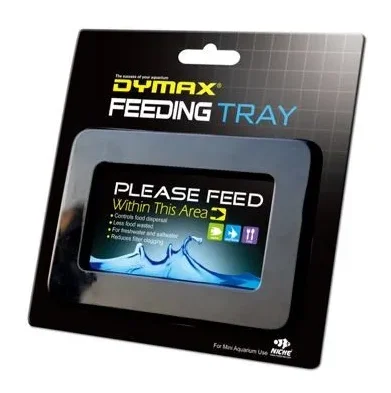
Supplement two to three times weekly with frozen or live foods: frozen bloodworm, daphnia, tubifex, and cyclops are all enthusiastically consumed by Gold Lasers, which will rush to the feeding spot the moment they sense bloodworm in the water. Live microworms, grindal worms, whiteworms (in moderation — they are fatty), and hatched brine shrimp nauplii are excellent conditioning foods for breeding work and are worth culturing at home for any serious cory keeper. Blanched vegetables — zucchini slices, de-stringed cucumber, briefly boiled spinach — are accepted occasionally and provide useful roughage; offer them pinned to a vegetable clip near the substrate and remove any uneaten pieces within 24 hours. The biggest practical feeding challenge is competition: in a community tank, mid-water and surface feeders (tetras, rasboras, angelfish) will sweep in for sinking food before it reaches the bottom, leaving a school of corys permanently under-fed while the upper levels of the tank grow plump. Feed corys in the evening just before lights-out when most community species have slowed down for the night, use larger sinking wafers that are too big for small tetras to steal whole, and consider placing a feeding station (a flat ceramic dish or a simple terracotta saucer tucked in a quiet corner under driftwood) that gives the school a protected feeding zone where food can settle undisturbed. A healthy Gold Laser shows a gently rounded belly, alert upright posture, and a stripe that glows with even intensity from end to end; a sunken, concave belly or a noticeably dulled stripe is the first sign of chronic underfeeding and demands immediate corrective action with heavier targeted feeding over the following week.
Reproduction & Breeding
Week -2 to 0
Conditioning
Feed live and frozen foods generously; females round out with eggs
Day 0 — Trigger
Cool Water Change
Large water change with cooler, softer water mimics rainy season
Day 1
Courtship and T-position
Males pursue female; T-position mating begins
Day 1
Egg Deposition
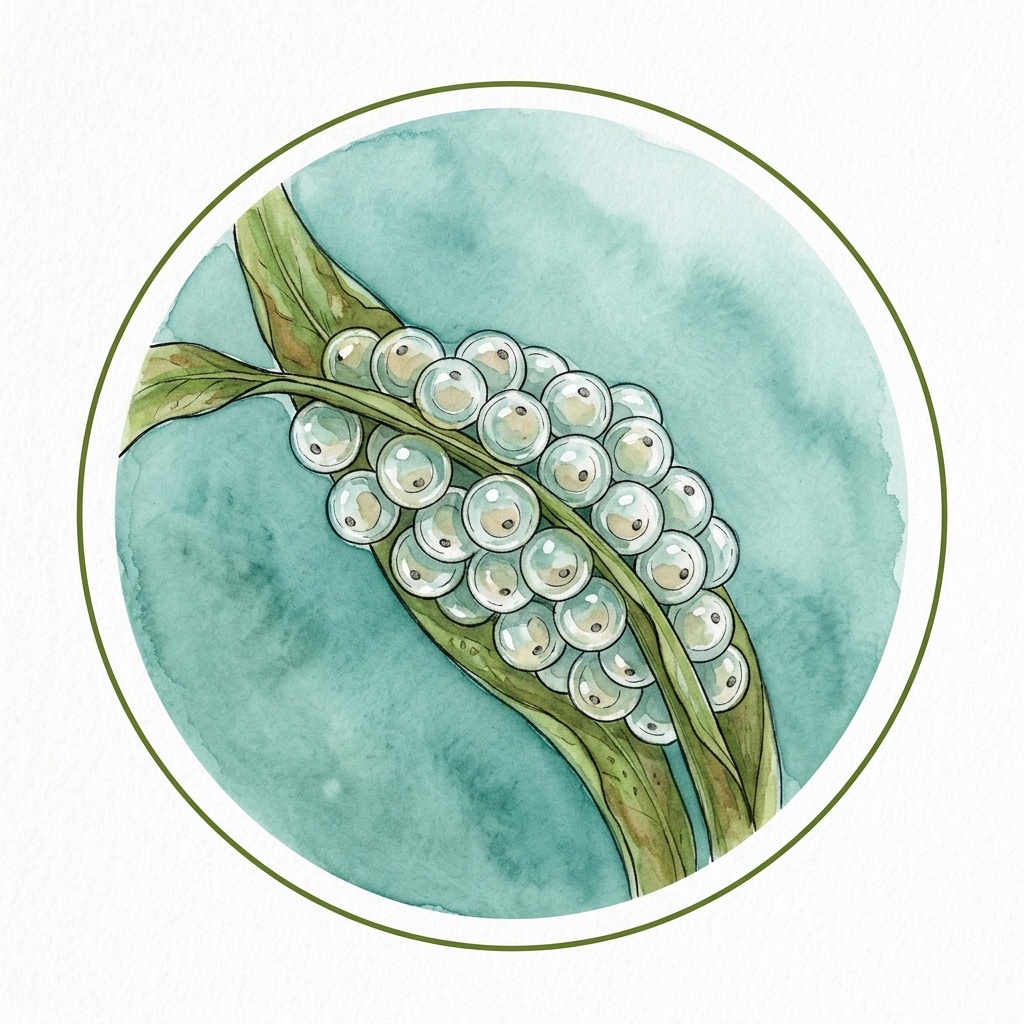
Female deposits batches of 2–6 eggs on chosen clean surfaces
Day 1–5
Incubation
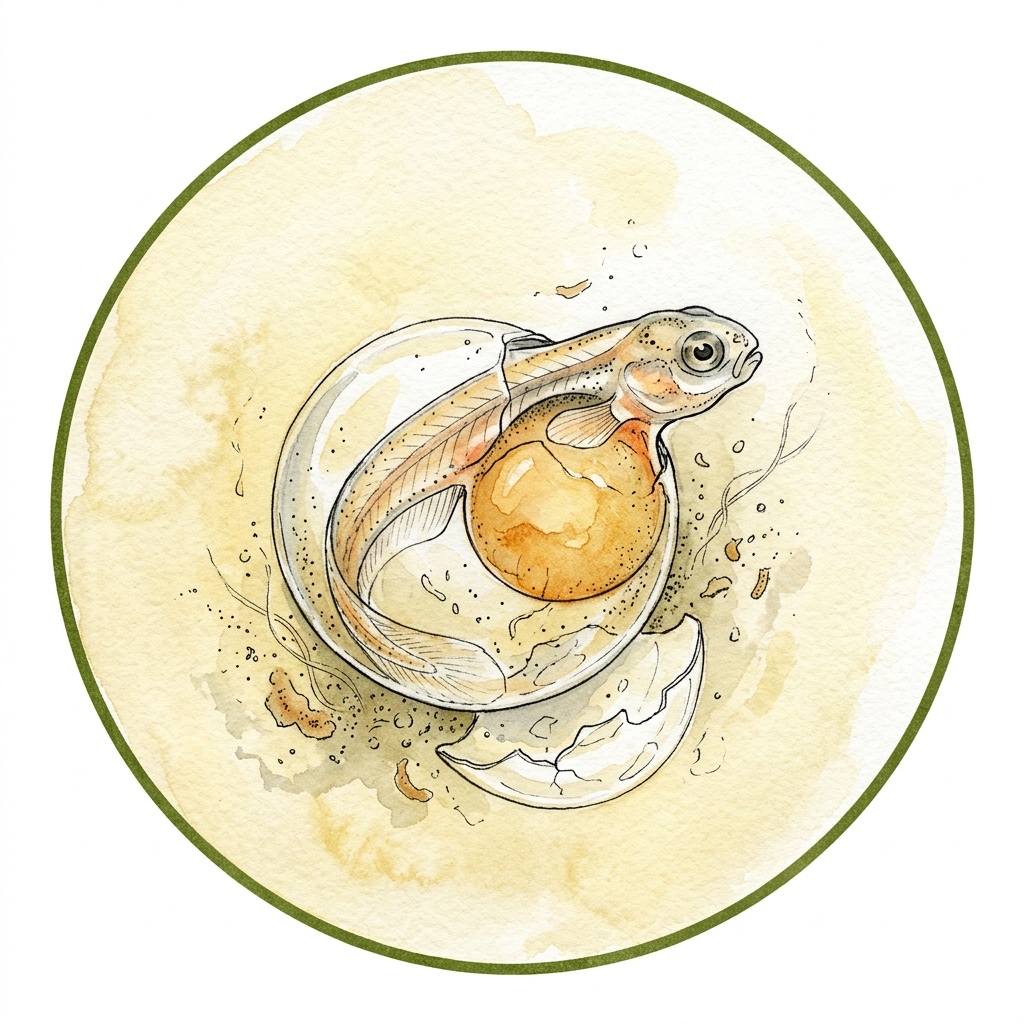
Transfer eggs or adults; eggs develop over 4–5 days
Day 5–8
Hatching and Free-Swimming
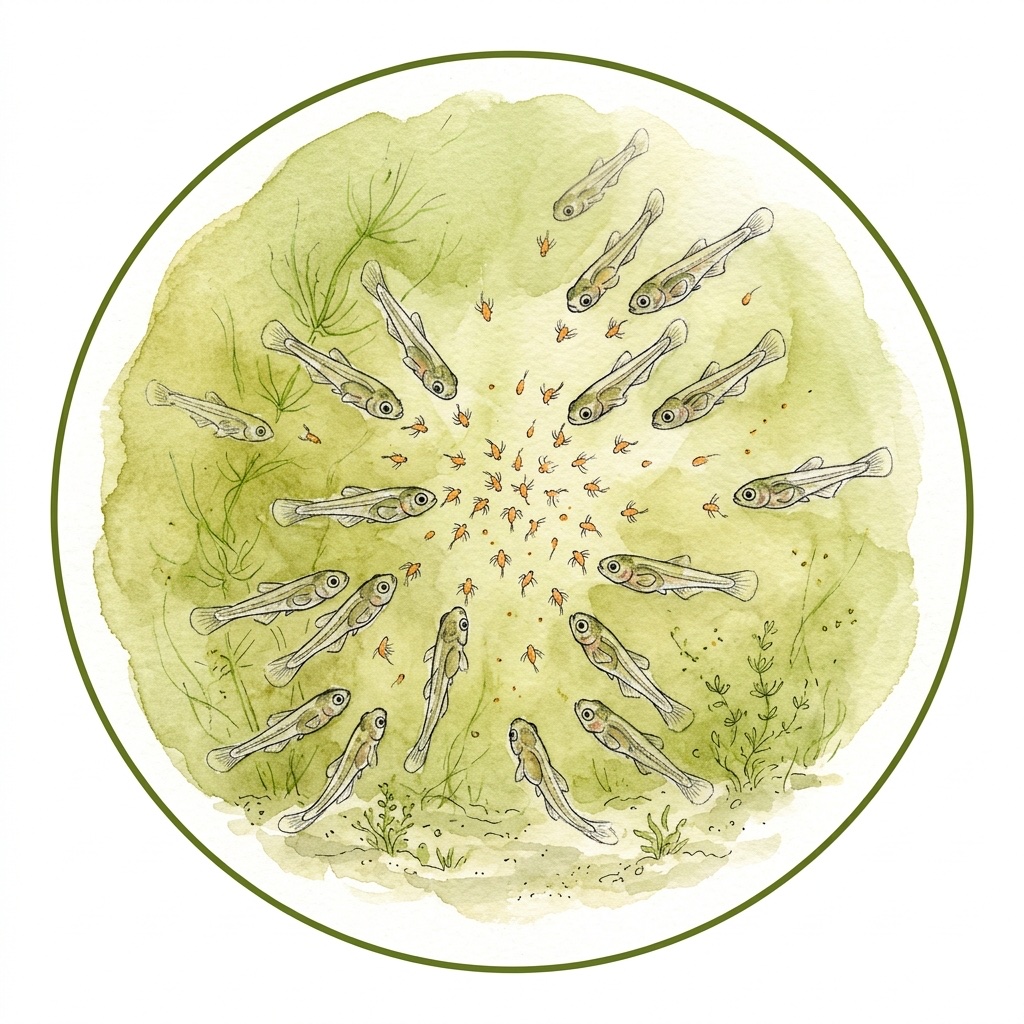
Fry hatch, absorb yolk sac, begin feeding on microworm and BBS
Conditioning
Begin conditioning the breeding group two weeks in advance. Feed generously with live and frozen foods — bloodworm, daphnia, tubifex, and grindal worms several times a day. Drop feeding intensity of dry staples slightly so that live/frozen forms the bulk of intake. Within ten days a well-fed female will visibly round out across the midsection when viewed from above. Maintain excellent water quality throughout conditioning; perform twice-weekly 20% water changes to keep nitrates low. Keep the tank at its standard temperature (24 °C) during conditioning — the temperature drop comes later as the trigger.
Cool Water Change
To initiate spawning, perform a large water change — 40 to 50 per cent of tank volume — replacing the removed water with fresh water several degrees cooler than the tank. A drop from 24 °C to 20–21 °C over the course of an hour, combined with rainwater or heavily diluted tap water softer than the existing tank water, is a highly effective trigger. This simulates the onset of the rainy season in the upper Amazon, when cooler, oxygen-rich runoff floods the main rivers and tributaries. Increase aeration immediately afterward — surface agitation should be visibly stronger. Many groups will spawn within 12 to 36 hours of this change; some require a second or third repeated trigger on consecutive days before they commit.
Courtship and T-position
Spawning behaviour is unmistakable. Males become markedly more active, chasing the female around the tank with short, rapid bursts. Eventually the pair adopts the characteristic corydoras T-position: the female positions herself perpendicular to the male, her head against his flank, and takes his released milt into her mouth. She holds it briefly — likely carrying fertilised sperm through the gill chamber to the eggs held in her cupped pelvic fins. She then swims to a pre-selected clean surface and deposits a small batch of adhesive eggs. The pattern repeats many times across a single spawning event, which can last several hours.
Egg Deposition
Each spawning cycle results in a small cluster of 2–6 eggs being pressed onto broad plant leaves (Anubias and Amazon sword leaves are favourites), the aquarium glass, flat rocks, or smooth driftwood. A healthy female will deposit 40 to 100 eggs over the course of a full spawning episode. Eggs are large for the fish size, approximately 1.5–2 mm diameter, and initially pale cream becoming opaque as they develop. Corydoras provide no parental care after spawning and will opportunistically eat their own eggs — so immediate action is required to preserve the clutch.
Incubation
There are two proven methods. Option one: remove the adult fish back to a main tank, leave the eggs in place, add a small airstone nearby for gentle flow, and dose a very small amount of methylene blue or alder cone extract to inhibit fungus. Option two: gently roll the adhesive eggs off the glass or plant surfaces with a fingertip (they are surprisingly robust) and transfer them to a small, dedicated hatching box or tank with the same water chemistry, strong gentle aeration, and mild antifungal treatment. Keep incubation temperature at 23–25 °C. Fertile eggs darken as the embryo develops; infertile eggs go chalky white within 24–36 hours and must be removed promptly before they fungus and contaminate the clutch.
Hatching and Free-Swimming
Eggs hatch in 4–5 days at 24 °C, with tiny darkly pigmented fry wriggling free and settling on the bottom. They absorb the yolk sac over the next 48 hours, during which they require no food. Once free-swimming and actively foraging, begin feeding with live microworms, freshly hatched brine shrimp (baby brine shrimp / BBS), and commercial liquid fry food. Feed small amounts multiple times a day and syphon waste carefully — clean water is the single biggest driver of survival at this stage. Fry grow quickly and begin to show their first faint stripe within 4–6 weeks; by 2 cm they are essentially miniature adults and can be moved to a grow-out tank. The gold iridescent stripe fully develops and brightens over the subsequent two to three months.
Tank Mate Guide
Gold Lasers are among the most agreeable community fish in the trade. They contribute visual interest at the bottom layer — constant, busy, shimmering activity — without disturbing any tankmates, without any aggression, and without competing ecologically with midwater or surface species. Their two practical constraints are size and water chemistry: they are small enough to be eaten by large cichlids and predatory catfish, so stocking choices must respect that. And they are classic soft, warm (but not hot) water fish — housing them with hard-water livebearers like platies and mollies, or with warm-water discus and altums, produces compromises that no one really thrives in.
In terms of stocking philosophy, the Gold Laser is a true display species that should be kept as a clearly visible school, never as a pair or trio. Six is the absolute minimum for normal, confident behaviour — below that number the fish become skittish, spend most of their time hiding, lose stripe brightness, and ultimately decline in condition. Eight to twelve in a well-planted tank of 100 litres or more is where the fish look and behave their best, with enough group confidence to forage openly across the full substrate and enough bodies in the school to produce the characteristic shimmering-gold effect as the group weaves between plants. Combine them with a contrasting schooling tetra (cardinal or rummy nose), one gentle midwater centrepiece species (honey gourami, peacock gudgeon, or a small rainbowfish group), and a healthy population of shrimp and snails on the fringes, and you have a classic peaceful planted community where the Gold Lasers are arguably the most consistently interesting fish in the tank. The one small handling note worth keeping in mind applies to all corydoras: when netting Gold Lasers, their pectoral fin spines can lock extended and tangle in fine mesh, and the mildly venomous sheath on the spine can deliver a sting sharp enough to leave a human hand throbbing for hours. Use a container rather than a net wherever possible, and wet your hands if you must handle them directly.
| Species | Why | |
|---|---|---|
| ✅ | Neon Tetra | Classic community match — small peaceful mid-water schooler sharing the same soft, slightly acidic water preference; occupies an entirely different tank level |
| ✅ | Cardinal Tetra | Peaceful schooler with broadly overlapping water requirements; the blue-red horizontal bar of cardinals complements the gold stripe of the corys beautifully |
| ✅ | Rummy Nose Tetra | Tight schooler with the same soft warm water preferences; their coordinated movement in the midwater pairs attractively with the busy substrate activity of the cory school |
| ✅ | Honey Gourami | Gentle surface-to-mid dweller; completely different niche from corydoras, no competition or aggression in either direction |
| ✅ | Peacock Gudgeon | Small peaceful rainbowfish-adjacent species that occupies mid-level cover among plants; shares water chemistry and has no interest in the substrate layer |
| ✅ | Boesemani Rainbowfish | Larger but entirely peaceful mid and upper-level species; their size and colour make an excellent visual counterpoint to the busy substrate activity below |
| ✅ | Red Cherry Shrimp | Adult shrimp coexist peacefully with Gold Lasers; corys occasionally nibble shed exoskeletons and the rare shrimplet but will not hunt adult shrimp actively |
| ✅ | Flame Tetra | Small and gentle schooling tetra; matches warm-water community requirements and adds a warm red colour accent to complement the gold stripe |
| ✅ | Kuhli Loach | Another peaceful substrate-level species; different enough in feeding style (kuhlis snake through cover, corys forage in the open) that they share rather than compete |
| ✅ | Dwarf Chain Loach | Peaceful small loach that occupies similar substrate zone with minor overlap; both species benefit from the same fine sand and dense cover |
| ❌ | Large Cichlids (Oscars, Jack Dempseys, Green Terrors) | Will predate on or harass small corys; even unsuccessful predation can end badly — the cory’s locking pectoral spines can fatally lodge in a cichlid’s throat, killing both fish |
| ❌ | Large Predatory Catfish (Red-tailed catfish, large pims) | Will eat Gold Lasers outright; any predatory catfish with a gape larger than a cory body is an immediate danger |
| ❌ | Freshwater Moray Eels | Obligate piscivorous predators; small bottom-dwelling corys are the exact prey profile a moray targets |
| ❌ | Fahaka Puffer | Large aggressive puffer that bites fins and attacks tankmates regardless of size; fundamentally incompatible with peaceful community species |
| ❌ | Goldfish | Cold-water species requiring 15–20 °C; Gold Lasers need a minimum of 22 °C — the temperature requirements cannot be reconciled in a single tank |
Quick Reference
| Scientific Name | Corydoras sp. ‘CW010’ |
| Trade Name | Gold Laser Cory |
| Family | Callichthyidae |
| Origin | Peru — upper Amazon, Loreto region |
| Adult Size | 5–6 cm |
| Lifespan | 5–8 years |
| pH | 6.0–7.5 (ideal ~6.8) |
| Temperature | 22–26 °C (ideal 24 °C) |
| Hardness | 3–12 dGH (soft preferred) |
| Min Tank | 80 L for a school of 6+ |
| Group Size | 6 minimum; 8–12 recommended |
| Care Level | Beginner–Intermediate |
| Diet | Sinking pellets, wafers, frozen bloodworm, daphnia |
| Breeding | Achievable at home — cool-water trigger + large water change |
| Tank Zone | Bottom / substrate |
| Special Note | Iridescent gold stripe is structural; dark sand + dark background + warm light = maximum shimmer. Pairs beautifully with CW045 Green Laser. |
Related Products
Reviews
Clear filtersThere are no reviews yet.