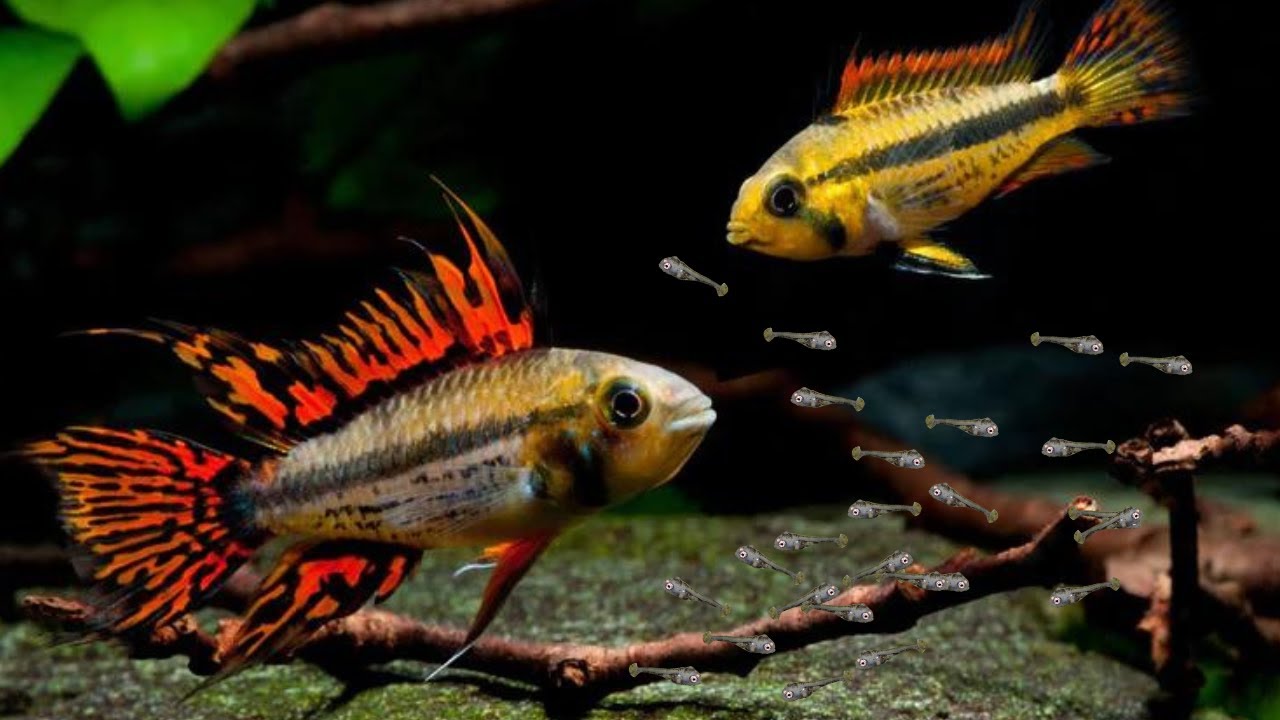
🪨 Species at a Glance
| Scientific Name | Apistogramma cacatuoides (Super Red line-bred strain) |
| Common Name | Super Red Cockatoo Cichlid, Cacatuoides Super Red |
| Family | Cichlidae |
| Order | Cichliformes |
| Origin (wild form) | Peru, Colombia, Brazil — upper Amazon & Ucayali basin |
| Strain Origin | Line-bred in European & Asian fish farms since the 1980s |
| Adult Size | Male 7–8 cm (3 in) · Female 4–5 cm (1.8 in) |
| Lifespan | 4–6 years with good care |
| pH Range | 6.0–7.5 (ideal 6.5) |
| Temperature | 24–28 °C (75–82 °F) |
| Hardness (dGH) | 2–12 (tolerant) |
| Diet | Omnivore with carnivore lean — pellets, frozen bloodworm, brine shrimp |
| Minimum Tank Size | 80 L (20 gal) for a single pair |
| Care Level | Beginner-friendly dwarf cichlid |
| Temperament | Peaceful to semi-aggressive when breeding — strongly territorial |
| Breeding | Cave spawner — one of the easiest dwarf cichlids to breed |
| Tank Position | Bottom to mid-level |
| Sold As | Bonded Male–Female Pair |
Origin & Etymology
The genus name *Apistogramma* is a compound of the Greek *apisto* (“uncertain” or “variable”) and *gramma* (“line” or “marking”), a nod to the bewildering array of stripes, bars, and spot patterns that shift from species to species and even from mood to mood within a single fish. Ichthyologist Johann Jakob Heckel coined the name in 1840, knowing full well that the genus would become a taxonomist’s headache. Today over ninety described species sit under this umbrella, with probably another thirty or so undescribed forms circulating among collectors under provisional names like ‘Apistogramma sp. Abacaxis’ or ‘Apistogramma sp. Pebas’.
The species epithet *cacatuoides* — literally “resembling a cockatoo” — comes from the mature male’s extravagant dorsal fin. The first four or five dorsal spines grow far longer than the rest, producing a crest that rises and flattens in perfect imitation of a cockatoo’s head feathers. When a male flares at a rival or courts a female, that crest stands fully erect: a sulfur-crested parrot in miniature, rendered in scarlet and ebony. The species was formally described in 1951 by Hoedeman from specimens collected in the Peruvian Amazon; it has been in the aquarium trade continuously since the 1960s, making it one of the longest-established Apistogrammas in the hobby.
The ‘Super Red’ qualifier is a commercial strain designation, not a scientific one. Wild *A. cacatuoides* males carry only modest red margins along the caudal and anal fins over a mostly grey-and-olive body. Starting in the 1980s, European breeders — most notably in Germany, the Czech Republic, and later Thailand — selectively line-bred the reddest individuals from each clutch. Generation after generation, red pigment expanded across the dorsal lappets, the entire caudal, and the anal fin. The ‘Super Red’ is today the most saturated red form readily available in the global hobby; the still-rarer ‘Double Red’ and ‘Triple Red’ strains push the red coverage further, while ‘Orange Flash’ and ‘Yellow’ represent parallel colour selections where breeders pursued different pigment axes. Importantly, line-breeding has not diminished the fish’s hardiness. Unlike line-bred bettas or discus, which have accumulated worrying genetic bottlenecks, Super Red cacatuoides remain essentially as robust as their wild ancestors — they breed readily, they accept a wide range of water parameters, and they retain the full behavioural repertoire that makes dwarf cichlids so engaging to keep.
How to Sex This Species
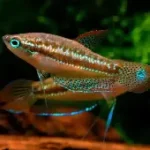
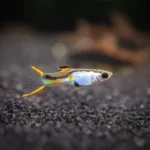
Sexing *A. cacatuoides* is one of the easiest jobs in the hobby — even as six-month juveniles the difference is obvious. The male grows nearly double the female’s length and develops those unmistakable cockatoo-crest dorsal spines. Everything about him is exaggerated: the lyretail caudal trails streamers, the anal fin tapers to a point, and the pelvics hang like tiny red flags. The female is an entirely different creature — compact, nearly half his length, and bright yellow with a heavy black band running from gill to tail. When she is ready to spawn or guarding fry, she darkens dramatically: the yellow saturates to near-gold, and five to six vertical black bars appear across her flanks like war paint. A female in this state is arguably more striking than the male, which is unusual among cichlids — most cichlid males steal the show and females fade into the background, but cacatuoides reverses the script when breeding begins.
This role reversal reflects how the species reproduces in the wild. Males hold large, loosely defended territories containing the best leaf-litter real estate, and females carve out small brood territories within those. When a female is guarding fry, she *needs* to be seen — she needs to warn rivals, signal her male partner to stay back, and guide her own brood. The black-bar warning pattern isn’t camouflage; it’s a billboard. Evolution has equipped her to switch visibility on and off depending on whether she is hiding or parenting.
The fish we are supplying is a sexed, bonded pair: one clearly visible male, one clearly visible female, already housed together and confirmed to be compatible. This avoids the most common disappointment with Apistogrammas — buying two juveniles and discovering six months later that they are the same sex, or pairing a male with a female who simply refuses him. Compatibility in this species is not guaranteed: dominant females sometimes flat-out reject a male, and aggressive males can kill a female they perceive as not-ready. Our pair has passed those filters.
| Feature | Male | Female |
|---|---|---|
| Adult Size | 7–8 cm total length | 4–5 cm total length |
| Body Colour | Pale cream/grey body with dark horizontal band | Bright yellow body, jet-black lateral band |
| Dorsal Fin | First 4–5 rays massively elongated (cockatoo crest) | Short, uniform height — no elongated rays |
| Caudal Fin | Lyretail (top and bottom rays extended) with red margin | Rounded fan shape, clear or faintly edged |
| Anal Fin | Pointed, trailing filament, fully red | Rounded, yellow to clear |
| Pelvic Fins | Long, pointed, often orange/red tipped | Shorter, rounded |
| Brood Markings | Intensifies lateral band when patrolling | Develops thick vertical black bars on body when guarding fry |
| Behaviour | Patrols the whole territory, flashes at rivals | Centred on the cave, leads fry once they free-swim |
Available Colour Grades
🟤 Wild Type
The original form: olive-grey body with a horizontal dark band, modest red margins only on the caudal and anal fins. Still traded, especially from wild-caught imports.
🔴 Super Red (this pair)
Vivid red saturation across the dorsal, caudal, and anal fins of the male. The most widely available commercial strain and the benchmark for red cockatoo cichlids.
🔥 Double Red
Deeper and more extensive red than Super Red — red pigment extends into the pectoral fins and across the rear half of the body. A premium line, typically 30-50% pricier.
💥 Triple Red
The reddest line currently produced. Red covers nearly the entire male, including dorsal spines, caudal, anal, and pelvic fins. Rare in Australia; collector-grade.
🟠 Orange Flash
An orange-pigment selection rather than red. Fins glow a warm tangerine, with a cleaner yellow body. A nice alternative if you’ve seen Super Red everywhere and want something different.
🟡 Yellow / Gold
Xanthic line with subdued red accents, producing a soft yellow overall appearance. Mellower than the reds but surprisingly striking under warm spectrum lighting.
💙 Blue / Neon (rare)
A much harder-to-find strain where blue iridophores dominate over red pigment. Usually sourced from specialist European breeders.
When you’re shopping for cockatoo cichlids, the strain name tells you roughly how much red pigment the male will carry and where. Crucially, all these commercial strains are the same species — they can and will interbreed, which is actually how many of them were developed. If you plan to raise fry and want to preserve the Super Red line, keep pairs separated from any other *A. cacatuoides* strain you own. The female of every strain looks broadly similar — yellow body with black lateral band and finely edged fins — so don’t judge a pair’s genetics by the female alone; the male’s fins are the giveaway. One reassurance: decades of line-breeding have not produced the genetic fragility seen in, say, line-bred bettas. A well-kept Super Red will live as long and breed as readily as any wild-type specimen.
Colour intensity is also strongly influenced by environment and diet, not just genetics. A Super Red male kept on pale gravel under cool white LED lighting with a flake-only diet will appear washed out — closer to a faded orange than a fiery red. Move the same fish into a tank with dark sand, warm-spectrum lighting, tannin-stained water, and a diet rich in astaxanthin (from frozen krill, premium colour-enhancing pellets, and live daphnia), and within four to six weeks the red deepens visibly. Photoperiod matters too: shorter, dimmer lighting encourages the male to display more often in an attempt to attract a partner, and the frequent flaring reinforces chromatophore activity. The fish you receive from us has already been conditioned with this kind of setup, so you’re starting from a high colour baseline.
Getting the Water Right
6.0–7.5
ideal 6.5
24–28 °C
ideal 26 °C
2–12 dGH
Soft to moderately hard — unusually tolerant for a dwarf cichlid
One of the reasons *A. cacatuoides* has remained a staple of the dwarf cichlid hobby for four decades is its genuinely forgiving nature. Unlike blackwater specialists such as *A. agassizii*, *A. elizabethae*, or *A. nijsseni* — which demand pH under 6.0 and hardness near zero — cacatuoides originates from clearer whitewater tributaries of the Ucayali and Amazon rivers, where the water is near-neutral and moderately soft. Field measurements from its native range typically record pH 6.4 to 7.2 and conductivity between 80 and 250 µS/cm, far from the extreme blackwater conditions other Apistos require. In captivity, it will thrive anywhere from pH 6.0 to 7.5 and hardness from 2 to 12 dGH. That means most Australian tap water — typically landing around pH 7.0 to 7.5 and 8 to 12 dGH in Sydney, Melbourne, and Brisbane — is entirely adequate, perhaps with a pinch of almond leaf to soften it aesthetically.
Temperature is the one parameter where you should not compromise: 24 to 28 °C, with 26 °C as the sweet spot for both colour and breeding readiness. Cooler water slows metabolism, dulls red pigment, and stalls reproduction; warmer than 29 °C depresses oxygen and shortens lifespan. A reliable heater with an external thermostat is worth the outlay — cheap in-line heaters often drift 2-3 °C from their dial setting, which is the difference between a thriving pair and a stalled one. Stability matters as much as the absolute number: a rock-steady 25 °C is healthier than a fluctuating 26–28 °C.
For breeding, nudge conditions slightly toward the acid/soft side — pH 6.2, hardness 3 to 5 dGH, 27 °C — but unlike many Apistos, cacatuoides will spawn even in neutral, moderately hard tap water. Reports of Super Red pairs spawning successfully in pH 7.6 tap water are common. That tolerance is precisely why it’s the recommended first dwarf cichlid for anyone stepping up from community tetras. If you live in an area with extremely hard tap water (above 15 dGH), mix 50:50 with RO water and add a handful of almond leaves; this gives you a stable mid-range parameter set that cacatuoides will breed in reliably.
Ammonia and nitrite should be undetectable, nitrate ideally below 20 ppm. Dwarf cichlids are more sensitive to accumulated nitrate than tetras are, and high nitrate is the single most common cause of failed broods — the fry absorb it through their developing skin and gills. A weekly 25-30% water change is non-negotiable; skip it at your pair’s expense.
Nutrition & Diet
In the wild, *A. cacatuoides* spends its day hunting micro-invertebrates in the leaf litter — insect larvae, small crustaceans, copepods, chironomid midge larvae, and annelid worms — supplemented with biofilm, algae grazings, and fallen plant material. Stomach content analyses from wild specimens show a diet roughly 70% animal, 20% plant matter, and 10% detritus. In the aquarium, they should receive a similarly protein-rich, varied diet. A high-quality sinking cichlid pellet or micro-pellet (look for whole-fish or insect meal as the first ingredient, plus astaxanthin for colour) forms the staple. Size matters: pellets should be small enough that the female can swallow them comfortably, generally under 2 mm. Brands like Hikari Vibra Bites, Fluval Bug Bites micro-granules, or Tetra Cichlid Colour Mini all suit cacatuoides well.
Frozen foods are not optional; they’re essential. Offer frozen bloodworms, brine shrimp, daphnia, cyclops, or mysis shrimp three to four times a week, rotating between at least two types. This variety triggers their natural feeding response — you’ll see the male flare and the female flash her black bars as they compete for the thawed cubes drifting down. Bloodworms in particular trigger intense feeding behaviour and are the single best food for conditioning a pair for spawning; however, they are also the richest food, so don’t feed them daily. Twice a week is the sweet spot. For conditioning the pair to spawn, live foods shine: freshly hatched baby brine shrimp (artemia nauplii), blackworms, grindal worms, or micro-worms will bring a pair into breeding condition within days. A small brine shrimp hatcher — a 2 L bottle with an air stone, one tablespoon of salt, and a pinch of cysts — costs almost nothing and is invaluable both for conditioning adults and feeding fry.
Avoid flake food as the primary diet — they’ll eat it, but it tends to foul water and provides uneven nutrition since the pair cherry-picks the largest pieces and the rest decays. Feed small portions twice daily; the female especially is prone to overeating if she’s not yet guarding a clutch, and an obese female carries eggs less successfully. Fast one day a week — this mimics the irregular feeding they’d experience in the wild and helps maintain lean body condition. A pinch each morning and evening, of a size the pair can finish within 2 minutes, is the right serving.
Aquarium Setup Guide
The single biggest mistake new cacatuoides keepers make is providing a tank that’s visually uninterrupted — one large open space with a few plants at the back. A bonded pair in that kind of layout will either spawn in a corner and panic every time you walk past, or the male will relentlessly chase the female because there is nowhere for her to retreat. Think of their natural habitat: a shallow leaf-littered stream bed criss-crossed with submerged branches and root mats, where sightlines are broken every 20 centimetres and every fallen log is a potential territory boundary. Recreate that sense of clutter and the pair will relax visibly within days of introduction.
For an 80-litre tank housing this pair, aim for at least three dedicated cave sites. A good cave is a coconut-half shell, a small terracotta flowerpot laid on its side with the drainage hole as a back door, or a commercial ceramic spawning cave — any cavity roughly 6–10 cm across with a single defensible entrance. Place caves at opposite ends of the tank so the female has options; she will choose one and declare it hers, often rejecting the others spectacularly. Surround the caves with leaf litter (Catappa, oak, or beech), a few bogwood or spiderwood pieces to fragment sightlines, and cluster plants such as *Cryptocoryne wendtii*, *Anubias nana*, or *Java fern* on wood above them. The goal is to create at least two distinct ‘neighbourhoods’ — the male’s patrol territory near the front, and the female’s brood territory around her chosen cave toward the back.
Substrate matters more than you’d expect. Fine sand — 1-2 mm, ideally dark-coloured — is mandatory. Cacatuoides constantly sift mouthfuls of substrate looking for food and, mistakenly, for nest-building material; coarse gravel frustrates them and can damage their gill rakers over time. Dark sand also dramatically lifts the red pigment of the male: on pale sand the red can look pink and flat, while on black sand the same fish appears to glow. Pool filter sand, Seachem Flourite Black, or aquasoil capped with dark sand all work well. Avoid crushed coral or limestone-based substrates; they buffer pH upward and undo all your soft-water efforts.
Plants serve dual duty as territorial markers and fry sanctuary. Use a mix of rooted plants (crypts, Amazon sword) to provide substrate shelter, epiphytes (Anubias, Java fern, Bucephalandra) on wood for mid-level structure, and floating plants (Amazon frogbit, red root floater, dwarf water lettuce) to dim overhead light. Floating plants are especially valuable — cacatuoides in well-lit tanks without overhead cover often hide perpetually, while the same fish under a canopy of frogbit come out, patrol openly, and display full colour.
Filter choice is a small but consequential decision. Sponge filters are the traditional dwarf-cichlid filter because they provide biological filtration without generating current strong enough to blow fry off the substrate, and because they cannot suck fry into the intake. A 200 L/h air-driven sponge filter is plenty for an 80L pair tank. If you prefer an internal or hang-on-back filter, make sure the intake is covered with a fine mesh or sponge pre-filter, and baffle the output against the glass.
Tank
Minimum 80 L (20 gal) — a footprint of roughly 60×30 cm matters more than depth
Filter
Sponge filter (most fry-safe) or baffled internal/HOB — gentle flow is critical
Heater
75–100 W adjustable, set to 26 °C; quality external thermostat recommended
Substrate
Fine dark sand, 1–2 mm grain, 3–4 cm deep — avoid sharp or coarse gravel
Caves
At least 2–3 per pair — coconut halves, terracotta pots, or ceramic spawning caves
Driftwood
Spiderwood or bogwood for sightline breaks and aesthetics
Plants
Cryptocorynes, Anubias, Java fern, Amazon sword — rooted or epiphytic, easy species
Botanicals
Catappa leaves and alder cones for tannins, biofilm, and mild antifungal effect
Lighting
Low to moderate; dimmable LED ideal. Full-spectrum with warm reds enhances colour
Thermometer
Digital or glass — verify heater accuracy weekly
Community Compatibility
Cockatoo cichlids have a reputation as dwarf cichlids that *do* work in a community tank, and with correct planning that reputation is deserved. Outside of breeding windows, a bonded pair of Super Red ignores upper-column dither fish and even tolerates small bottom-dwellers as long as no one gets too close to their cave. The caveat is clear: when the female is guarding fry, she becomes a bulldog. She will chase corydoras three times her size and drive tetras into the top corners of the tank. No permanent damage is done — cacatuoides lack the large teeth that would inflict serious injuries — but small, slow, or weakened fish can be stressed. Provide multiple hiding places so dither fish can escape, and make sure the tank is long enough (minimum 60 cm) that non-breeding territory actually exists. In a 60 cm / 80 L tank, the pair will usually claim one half as brood territory, leaving the other half for community fish; in a 30 cm nano they’ll claim the entire tank and community stocking fails.
Dither fish serve a real function beyond aesthetics. A small school of tetras at mid-water level signals to the Apistos that there are no large predators nearby, because predators would send the school fleeing. This calms the pair and encourages them to behave naturally — patrol, display, spawn — rather than perpetually hiding in a cave. Aim for a group of at least 8-10 dither fish; a handful feels incomplete and doesn’t deliver the same psychological reassurance.
Avoid stocking other dwarf cichlids entirely unless your tank is genuinely large (200 L+) and you can establish distinct, visually separated territories with substantial rockwork or wood dividers between them. The bonded pair you are buying will almost certainly attack any other dwarf cichlid introduced to their space, and the resident pair will win — it’s their tank. Similarly, avoid any fish that competes for the substrate-level cave real estate, such as larger plecos, kribensis, or rams. Above the substrate, however, the world is open — schooling tetras, rasboras, hatchetfish, and otocinclus all thrive alongside a breeding cacatuoides pair. Many hobbyists build their entire 80-120 L biotope around a single bonded Super Red pair plus a school of neons or ember tetras, and the result is one of the most complete and behaviourally rich small aquaria you can assemble.
One final note on fry survival: if you are running a community tank with tetras present, accept that fry survival will be low. Tetras will eat free-swimming fry any time the mother is not directly over them, and even a protective female can’t defend a cloud of 80 fry against 10 hungry neons. For serious fry production, move the pair to a dedicated breeding tank when they spawn, or accept the community tank will only yield a handful of fry per brood to the few that hide effectively.
| Species | Why | |
|---|---|---|
| ✅ | Cardinal Tetra | Classic mid-level dither fish — soft-water tolerant, fast enough to dodge a protective female, and their red/blue contrasts beautifully with Super Red fins |
| ✅ | Rummy Nose Tetra | Tight schooling behaviour signals ‘all is well’ in the tank, helping Apistos relax and breed more readily |
| ✅ | Neon Tetra | Small, peaceful, soft-water, and they occupy the upper column, staying out of the Apisto’s territory |
| ✅ | Sterbai Corydoras | Bottom-dweller but armoured and non-threatening — tolerates the warmer 26-28 °C cacatuoides enjoy, unlike some other Corydoras |
| ✅ | Pygmy Corydoras | Tiny and shoaling mid-to-bottom; their size means they can quickly get out of the female’s way during brooding |
| ✅ | Otocinclus | Perfect algae grazer; completely non-aggressive, sticks to plant leaves and wood, thrives in the same warm soft-water conditions |
| ✅ | Marbled Hatchetfish | Strict surface dweller — never enters the Apisto’s territory. Fills the vertical layer beautifully |
| ✅ | Harlequin Rasbora | Peaceful mid-level schooler, hardier than most tetras, excellent dither fish for shy breeding pairs |
| ✅ | Ember Tetra | Nano-sized, soft-water, and their warm orange glow echoes Super Red without competing with it |
| ✅ | Kuhli Loach | Nocturnal burrower, largely invisible to the Apistos; useful for clean-up duties without any territorial conflict |
| ❌ | Other Apistogramma species or cacatuoides strains | Will hybridise (same species) or fight for territory (other Apistos) — keep one cacatuoides pair per tank unless tank is 200 L+ with dedicated territories |
| ❌ | German Blue Ram / Bolivian Ram | Same ecological niche as cacatuoides — cave spawner, bottom-dweller, dwarf cichlid — guaranteed territorial conflict in anything under 150 L |
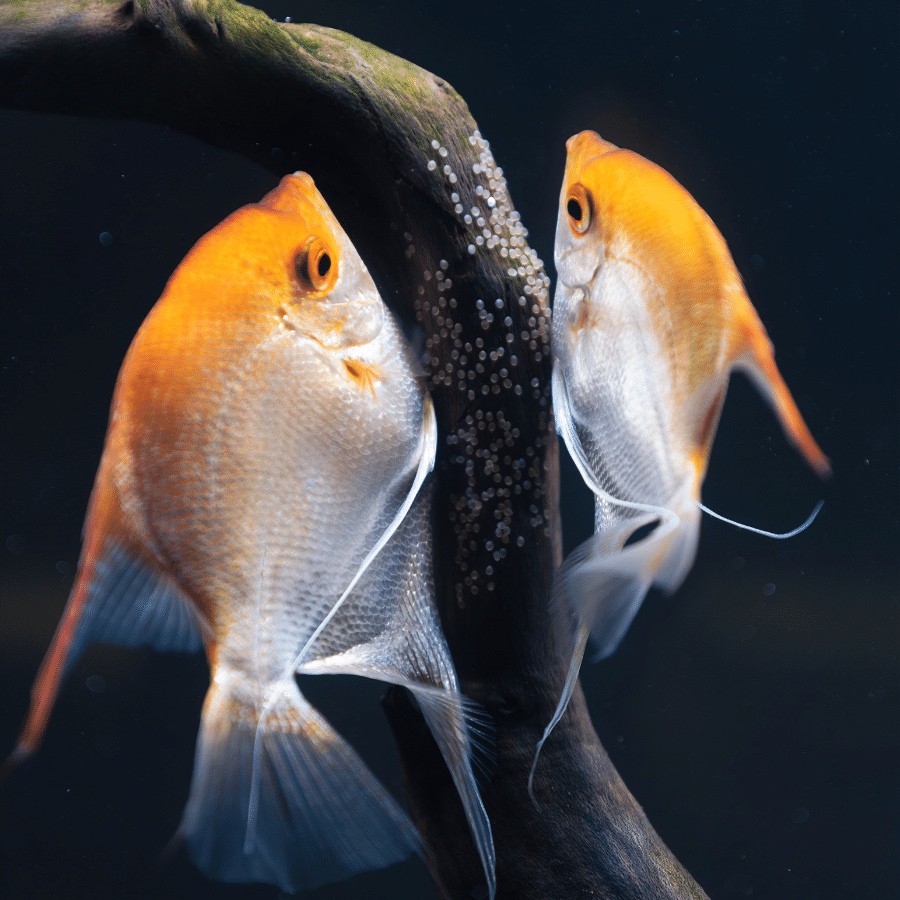
| ❌ | Angelfish | Large cichlid presence stresses dwarf cichlids; also may eat fry. Very high risk combination |
| ❌ | Large Bottom-Dwellers (Plecos, large Synodontis) | Compete for the same cave real estate; a big pleco will evict a female from her cave at night and destroy her clutch |
| ❌ | Tiger Barbs / Serpae Tetras | Persistent fin-nippers will shred the male’s elongated dorsal and lyretail caudal; also too aggressive for brooding females |
| ❌ | Shrimp (Cherry, Crystal, Amano) | Adult Amanos may survive, but Cherry and Crystal shrimp and especially their young will be hunted systematically. Avoid if you value your shrimp |
How to Breed
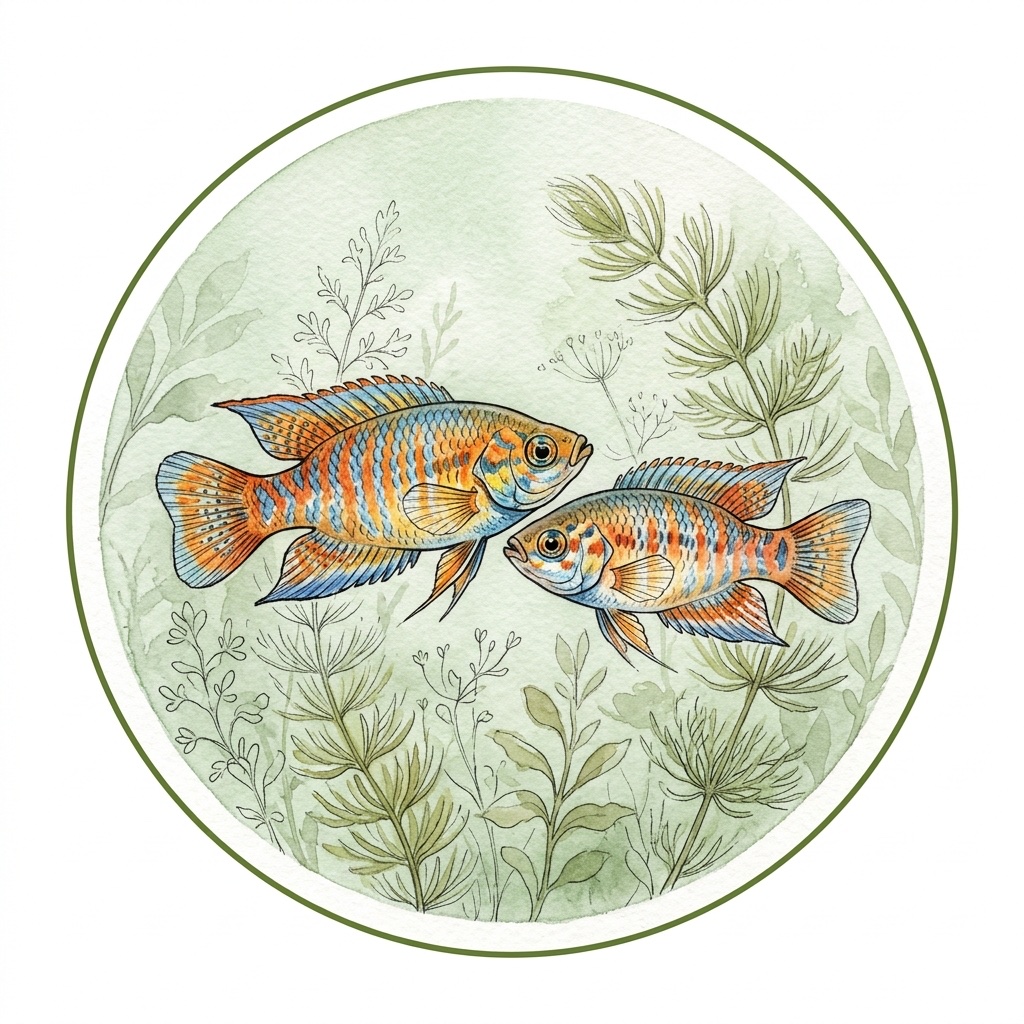
Week 0 — Arrival
Pair Acceptance
Bonded pair drops into their new tank together
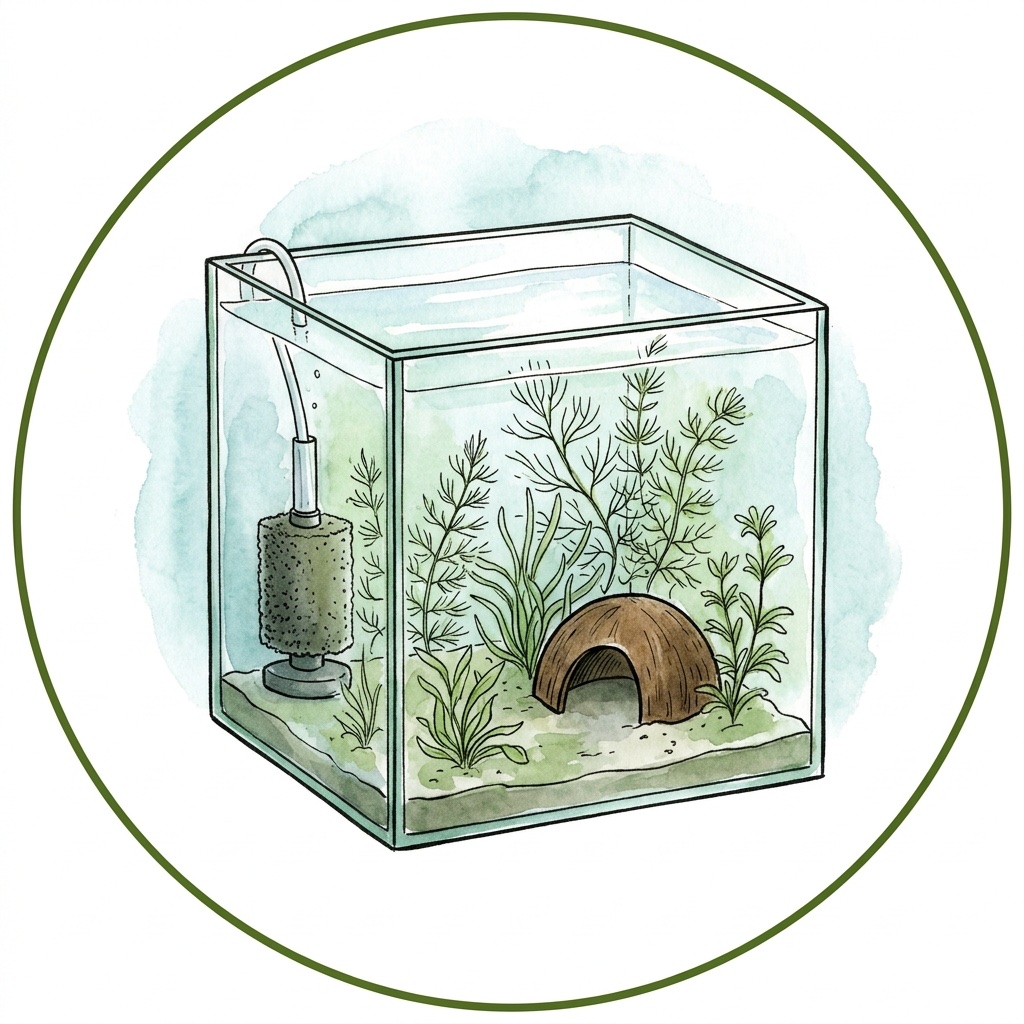
Week 1–2
Female Claims a Cave
Female darkens yellow, begins defending chosen cave
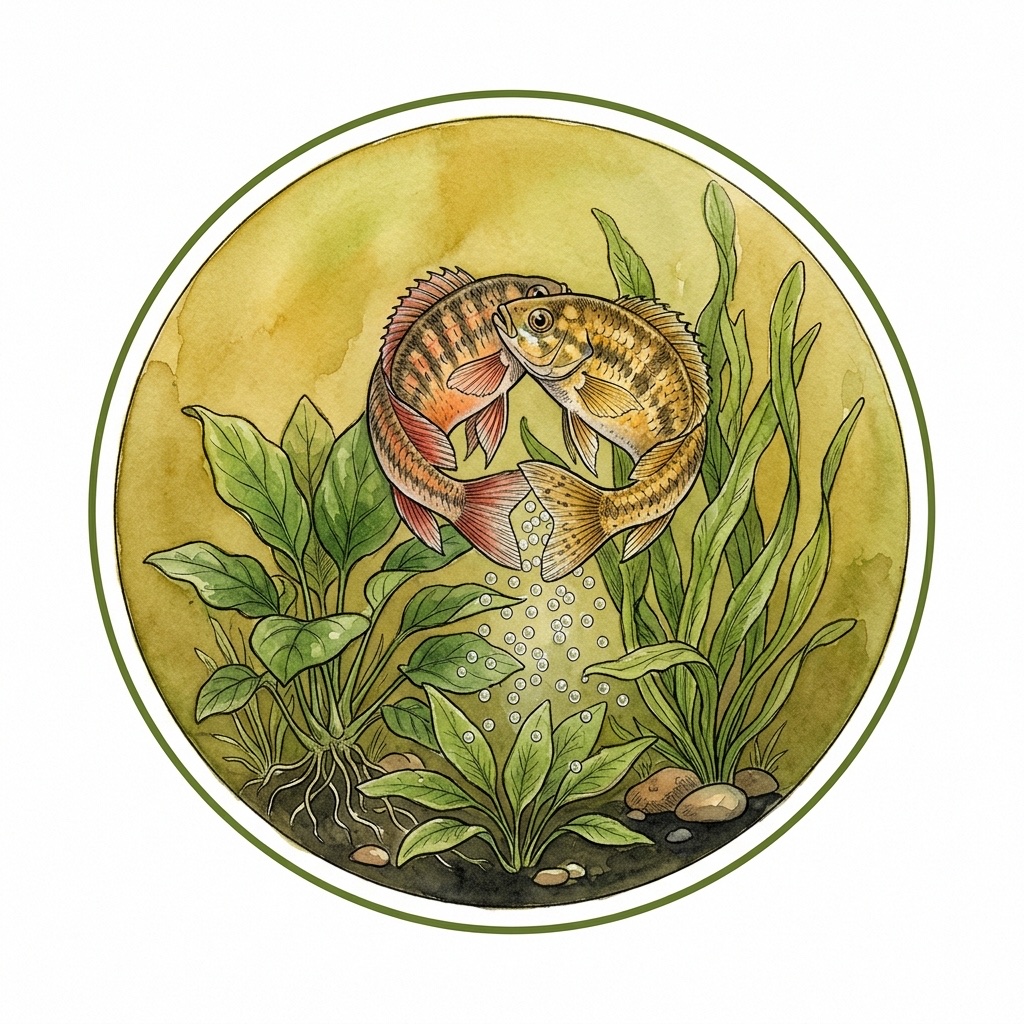
Week 2–3
Spawn in Cave
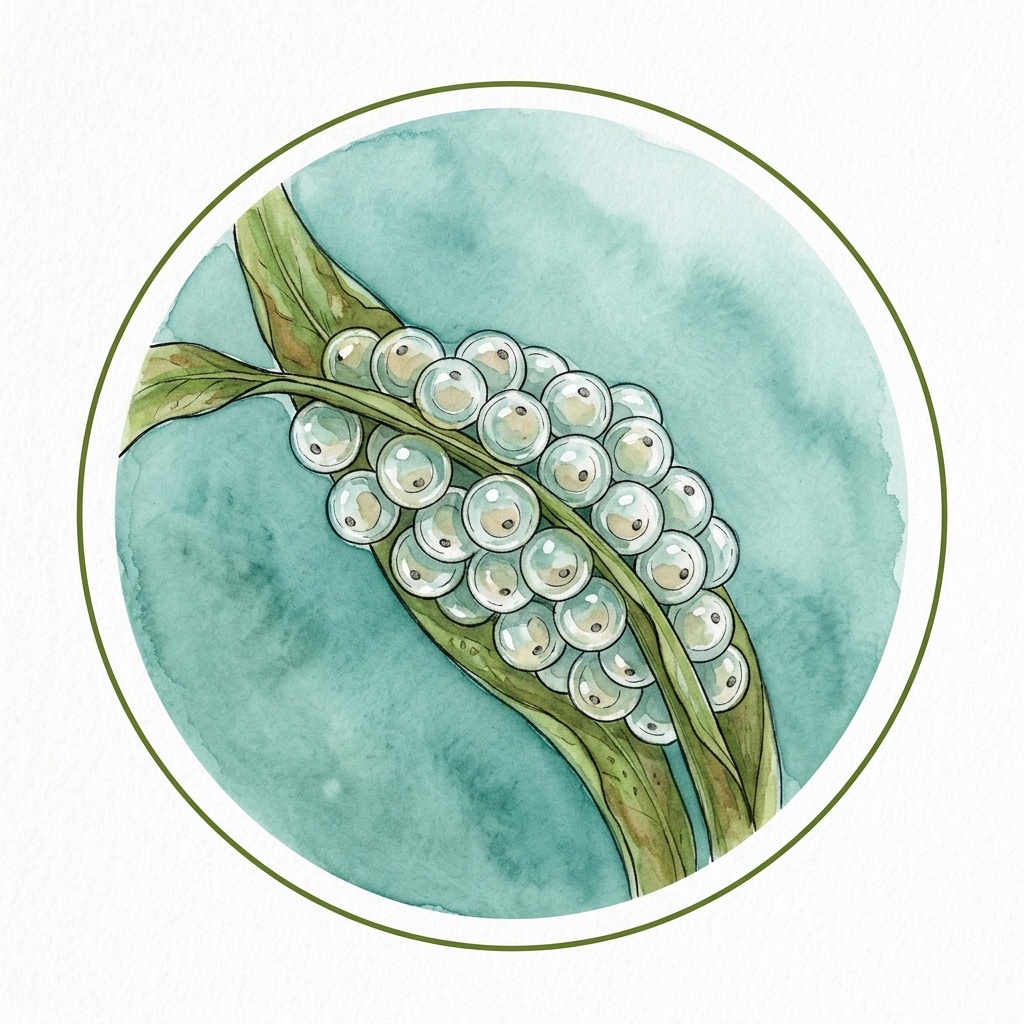
Female lays 40–100 eggs on cave roof; male fertilises
Day 3–4 after spawn
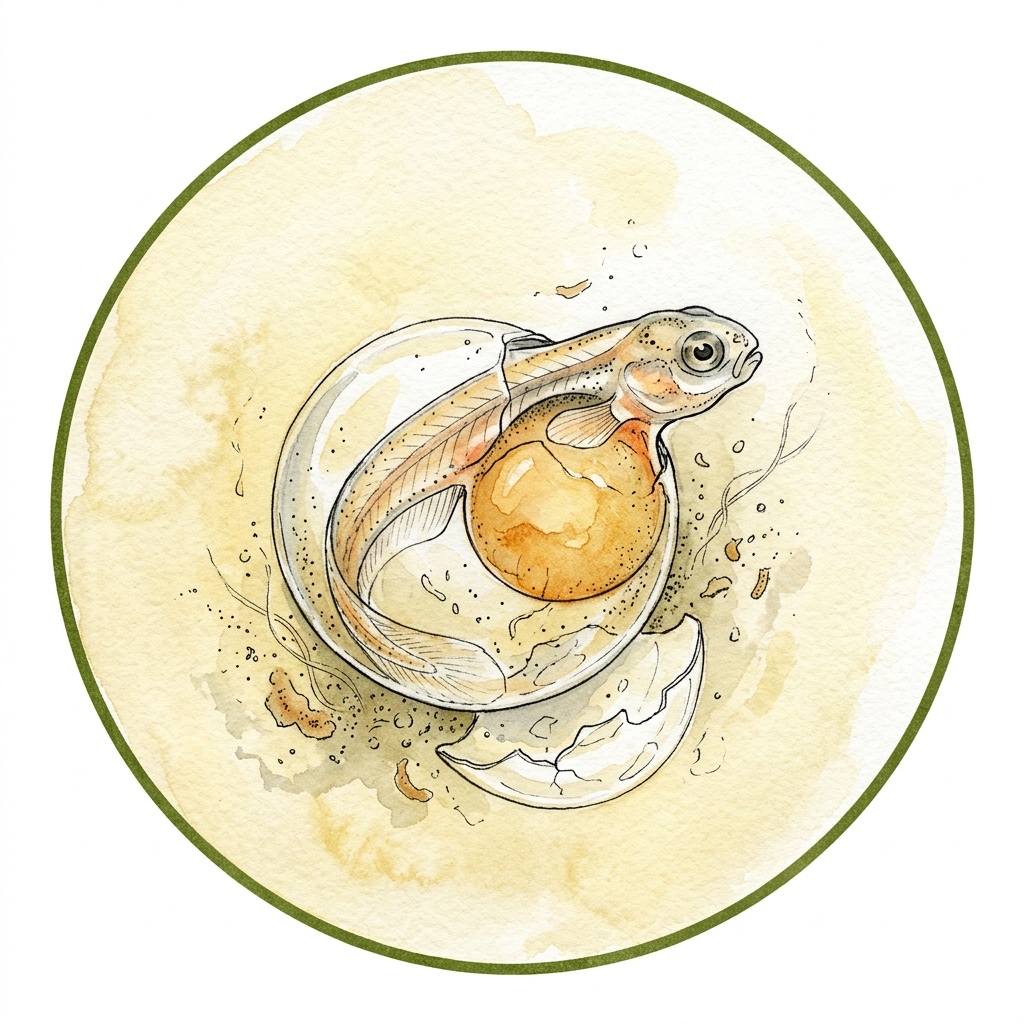
Eggs Hatch
Wrigglers appear on the cave floor
Day 6–8 after spawn
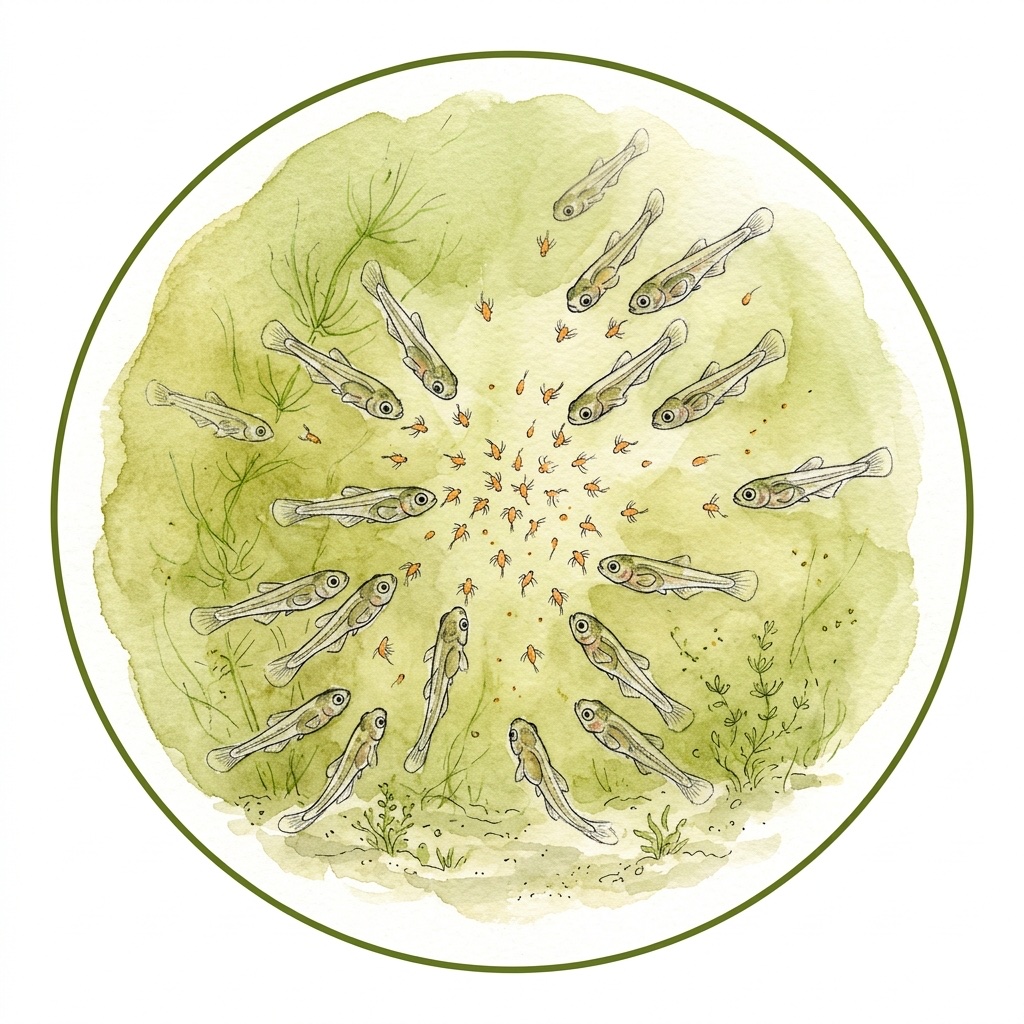
Fry Become Free-Swimming
Mother leads a cloud of tiny fry out of the cave
Week 3–6 after spawn
Fry Growth & Independence
Fry grow from 3 mm to ~1 cm, gradually leave mother
Pair Acceptance
Because we ship this as an established bonded pair, you skip the fraught introduction phase that causes most home-paired Apistos to fail. The pair is already mutually accepting: they’ve shared a tank, recognised each other as compatible, and settled whatever dominance negotiation needed to happen. On arrival, acclimate them slowly together using a drip line over 45-60 minutes, and release them into the display tank at the same time — never introduce one before the other, as this lets the first arrival claim the tank and potentially reject the second.
Expect the female to vanish into a cave within hours while the male patrols the perimeter. This is completely normal and a strong positive sign. Within 24-48 hours the male will be out exploring more openly; the female may stay hidden for up to a week as she assesses the environment. Don’t panic if you barely see her during that window.
Feed lightly for the first 48 hours — they’re stressed from transport — and keep lights subdued. Do not add other fish to the tank until the pair has fully settled, typically a week. If you plan to add dither fish (tetras, rasboras), add them *before* the pair arrives, not after; the pair will accept them as part of the existing landscape rather than as intruders.
Female Claims a Cave
Watch the female. Within 7–14 days of arrival she will commit to a single cave — often the one with the smallest entrance or most overhead cover, because a small entrance is easier to defend against predators and intruder males. You’ll know she has claimed it because she’ll sit at the entrance, fins flared, and chase the male away if he gets too close. Her body colour intensifies to a deeper, almost metallic yellow, and the black lateral band thickens. She will often spend hours doing what looks like housekeeping — mouthing the cave roof and walls, carrying out mouthfuls of sand from the floor, and refining the entrance diameter. All of this is a visible sign that a spawn is approaching.
Start offering live or frozen foods twice daily now — she needs the protein to develop eggs. The male will eat aggressively; don’t worry that he’s taking the lion’s share, he needs the condition too for fertilisation and territorial displays. You may see him do a dramatic courtship dance: he’ll flare all fins, tilt his body diagonally, vibrate, and approach the cave entrance with the red crest fully erect. The female’s response — either ignoring him, threat-displaying from inside the cave, or darting out in an S-curve invitation — tells you everything about how close the spawn is.
Spawn in Cave
The female will solicit the male by performing an S-curve display in front of the cave entrance, then dart inside. He follows. Inside the cave she lays clutches of bright yellow-orange eggs on the ceiling; he fertilises them. The whole process takes one to two hours. Afterward, the male is driven out of the cave entirely — his job is done, and for the next two weeks he is banned from even approaching the entrance.
The female is now in full brood-care mode. She will show striking vertical black bars on a canary-yellow body, and she will fan the eggs with her pectoral fins constantly. She will not eat much during this phase; don’t worry, this is normal.
Eggs Hatch
At 26 °C, eggs hatch in about 72–96 hours. The newly hatched fry are called ‘wrigglers’ — tiny translucent comma shapes with large yolk sacs attached, tails twitching. They remain inside the cave, and the female moves them around in her mouth from one spot to another, keeping them hidden. You will not see them yet from outside the cave, but the female’s increasingly frantic cave-guarding behaviour is the tell.
Fry Become Free-Swimming
Roughly a week after spawn, the yolk sacs are absorbed and the fry become free-swimming. This is the iconic moment: the female emerges from the cave leading 40 to 80 tiny dark specks, herding them into a loose cloud about her. She will patrol her feeding territory with them, flashing signals to direct them, and returning them to the cave at night or when danger approaches.
Start feeding freshly hatched baby brine shrimp twice daily. Deliver them near the fry cloud with a pipette. The female will also relay food to the fry — if you drop a pinch of crushed pellet, she’ll sometimes chew and spit it out in tiny pieces for them. This is one of the great behavioural privileges of keeping dwarf cichlids.
Fry Growth & Independence
Over the next month, fry graduate from baby brine shrimp to microworms, then to crushed flake and fine micro-pellets. Female-led escort behaviour gradually relaxes; by four to five weeks post-free-swimming the fry start ignoring mum and exploring independently. The female herself may already be prepping for a second spawn — the male’s exile is lifted, and within a week or two they may be spawning again. A mature pair can produce fry every 4–6 weeks under good conditions. If you want to maximise fry survival, remove the juveniles to a grow-out tank once they reach 10-12 mm; otherwise the female may cull the older brood to redirect attention to her next clutch. At around 8-10 weeks post-free-swimming, juveniles begin to show the first traces of sex-specific colouration — males start developing elongated dorsal spines and the first hints of red in the caudal. By 14-16 weeks they are sexable and saleable as juveniles.
Quick Reference
| Scientific Name | Apistogramma cacatuoides (Super Red) |
| Sold As | Bonded Male-Female Pair |
| Male Size | 7–8 cm |
| Female Size | 4–5 cm |
| Lifespan | 4–6 years |
| pH | 6.0–7.5 (ideal 6.5) |
| Temperature | 24–28 °C (ideal 26 °C) |
| Hardness | 2–12 dGH |
| Min Tank Size | 80 L per pair |
| Diet | Omnivore — pellets + frozen bloodworm, brine shrimp, daphnia |
| Care Level | Beginner-friendly dwarf cichlid |
| Temperament | Peaceful, territorial when breeding |
| Tank Position | Bottom to mid-level |
| Breeding | Cave spawner — very easy |
| Spawn Interval | Every 4–6 weeks once established |
| Brood Size | 40–100 fry per spawn |
Related Products
Reviews
Clear filtersThere are no reviews yet.