🪨 Species at a Glance
| Scientific Name | Hyphessobrycon flammeus |
| Common Names | Flame Tetra, Von Rio Tetra, Fire Tetra |
| Family | Characidae |
| Origin | Coastal rivers near Rio de Janeiro, southeastern Brazil |
| Adult Size | 3.5-4 cm (1.4-1.6 in) |
| Lifespan | 3-5 years in aquaria |
| Care Level | Beginner |
| pH | 6.0-7.5 |
| Temperature | 22-28 °C (72-82 °F) |
| Hardness | 3-15 dGH |
| Min. Tank | Nano/Small — under 40 L for a small school |
| Diet | Omnivore — flakes, micro pellets, frozen & live foods |
| Tank Position | Middle |
| Community Safe | Yes — one of the most peaceful tetras |
| Breeding | Egg scatterer — very easy to breed in captivity |
Name & Origin
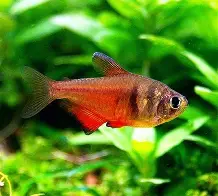
The common name writes itself. Hold a healthy male Flame Tetra against a dark background and the rear two-thirds of the body transitions from a warm gold into a deep, saturated orange-red that extends through the anal and caudal fins. The effect, particularly when a school catches the light at the right angle, genuinely resembles a cluster of small flames drifting through the water. It is one of those rare cases where a common name is neither exaggerated nor misleading.
The alternative common name — Von Rio Tetra — references the fish’s geographic origin. The type specimens were collected from small streams in the forested hills behind the city of Rio de Janeiro, in the Atlantic Forest biome of southeastern Brazil. This is notable because most popular aquarium tetras hail from the vast Amazon basin; the Flame Tetra is an Atlantic coastal species with a comparatively tiny native range. Urbanisation and deforestation have put serious pressure on wild populations, and the species is considered vulnerable in its native habitat. Fortunately, virtually every Flame Tetra sold in the aquarium trade today is captive-bred, ensuring no impact on wild stocks.
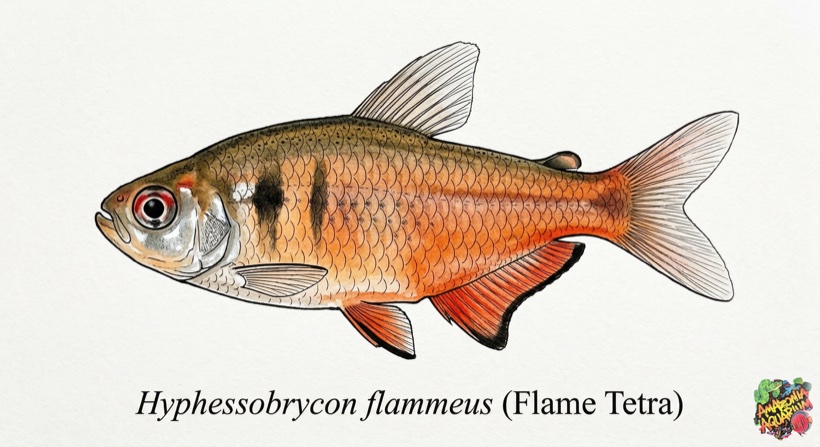
The scientific name Hyphessobrycon flammeus combines the genus name (meaning “small Brycon,” referencing a related fish group) with flammeus, Latin for “flaming” or “flame-coloured.” Science and common sense agree: this fish is named for fire.
Colour Varieties
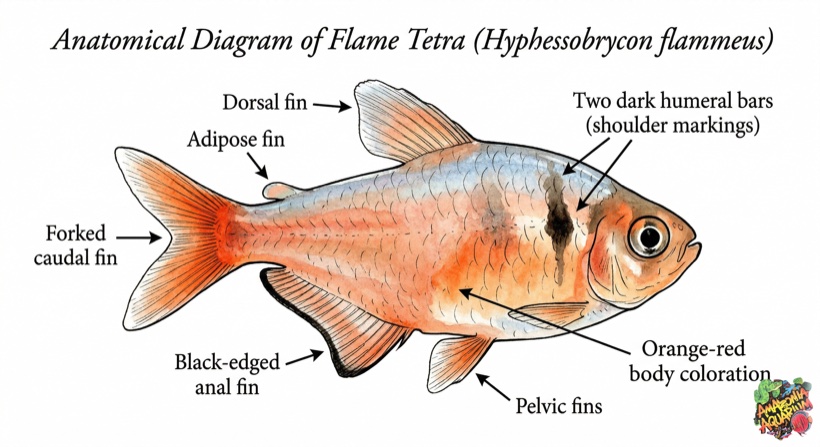
🔥 Wild Type
Silver-olive front half transitioning to warm orange-red on the rear body, anal fin, and lower caudal fin. Two dark vertical bars behind the gill cover.
🔴 High Red / Super Red
Selectively bred line with intensified red coloration extending further forward on the body. Males can appear almost entirely red-orange.
🟡 Gold / Albino
A less common variant lacking the dark pigmentation, resulting in an all-gold to pale orange fish. The signature bars are absent or faint.
In the wild type, the Flame Tetra’s colour is a study in gradients. The head and front quarter of the body are olive-silver, adorned with two distinctive vertical dark bars just behind the gill cover — a reliable identification feature that separates them from similar species. From the midpoint backward, warm orange suffuses the flanks, deepening into rich red-orange on the anal fin and the lower lobe of the caudal fin. Males in breeding condition intensify dramatically, with the red becoming almost opaque.
Selective breeding has produced “High Red” or “Super Red” strains where the coloration is more uniformly intense across the entire body. These are increasingly common in the trade and are visually stunning in a well-planted tank. Colour quality in Flame Tetras responds strongly to diet (carotenoid-rich foods like brine shrimp and spirulina-enhanced flakes boost red pigment), water quality, and background colour. Dark substrates and backgrounds consistently produce the most vivid display.
Male vs. Female
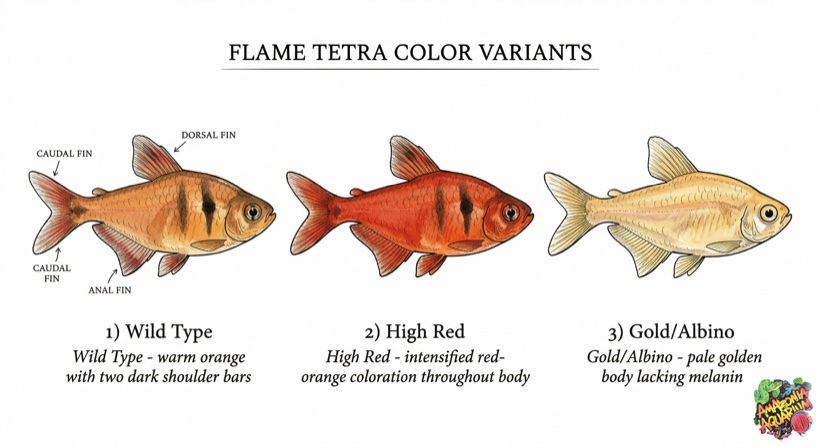
Compared to many tetra species where sexing requires a magnifying glass and wishful thinking, Flame Tetras are refreshingly dimorphic. The most reliable indicator is the anal fin: in males it is a vivid red-orange bordered by a crisp black margin, while in females it tends toward a washed-out yellow with little or no black edging. This difference is visible even in juvenile fish once they reach about 2 cm.
Body colour provides a second cue. Males in good condition display a noticeably more saturated orange-red across the entire rear half of the body, while females lean toward a softer, more golden tone. When viewed from above or from the side, females also appear plumper, particularly when carrying eggs. In a mixed school, the brighter, slimmer fish sparring near the front are almost certainly males, while the rounder, paler fish holding position mid-school are likely females.
This ease of sexing is one reason Flame Tetras are such excellent breeding candidates for beginners. You can visually select pairs or trios with confidence, which is half the battle when setting up a breeding project.
| Feature | Male | Female |
|---|---|---|
| Body colour | Intense orange-red, especially anal and caudal fins | Paler, more yellow-orange overall |
| Anal fin | Deep red with a distinct black edge | Yellowish with little or no black edging |
| Body shape | Slimmer, more streamlined | Fuller, rounder belly when mature |
| Size | 3.5-4 cm | 3.5-4 cm (similar, but appears larger due to girth) |
| Behaviour | More active, may display and spar with rival males | Calmer, tends to stay within the school |
Water Parameters
6.0–7.5
ideal 6.8
22–28 °C
ideal 25 °C
3–15 dGH
Soft to moderately hard water tolerated; soft preferred for breeding
The Flame Tetra’s greatest practical virtue is its tolerance. Originating from coastal Brazilian streams that experience seasonal variation in temperature and chemistry, this species has evolved to handle a wider range of conditions than many of its Amazonian cousins. A pH anywhere from 6.0 to 7.5 is perfectly acceptable, and they tolerate moderate hardness that would stress more sensitive tetras like Cardinals or Rummy Noses.
Temperature tolerance is equally impressive. Flame Tetras are comfortable from 22 °C all the way up to 28 °C, which means they can be kept in unheated tanks in many climates and are one of the few tropical tetras that genuinely thrive at room temperature in temperate homes. For breeding, aim for the warmer end of the range (26-28 °C), but for general keeping, 24-25 °C is a comfortable sweet spot that balances activity, colour, and metabolism.
Regular water changes remain important despite the species’ hardiness. A weekly 20-25% change keeps nitrates low and colours bright. The Flame Tetra will not punish a missed water change the way a discus would, but consistent maintenance is always rewarded with better colour and more active behaviour. For breeding, softer and slightly more acidic water (pH 6.0-6.5, 4-8 dGH) significantly improves egg viability.
Tank Setup
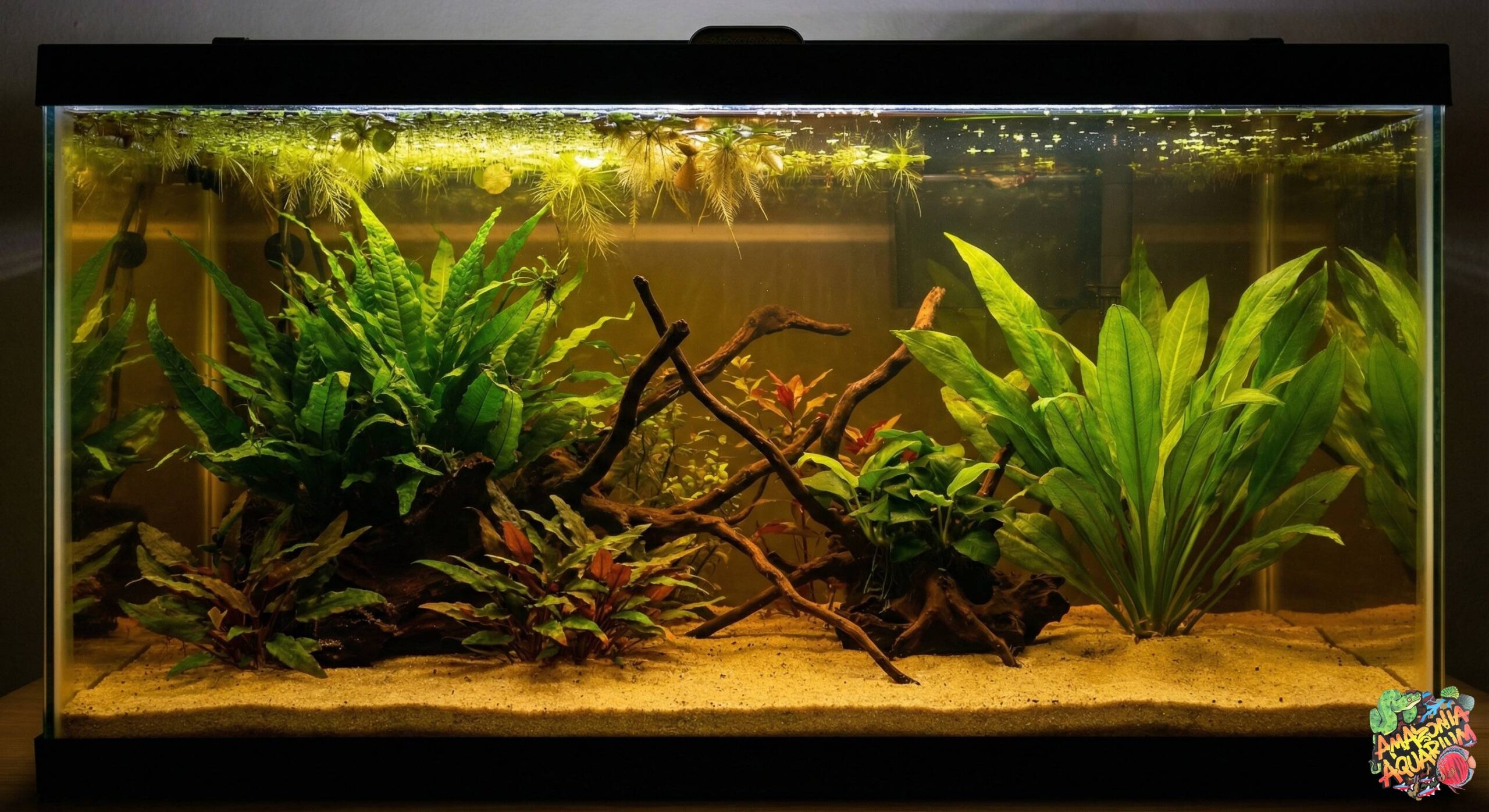
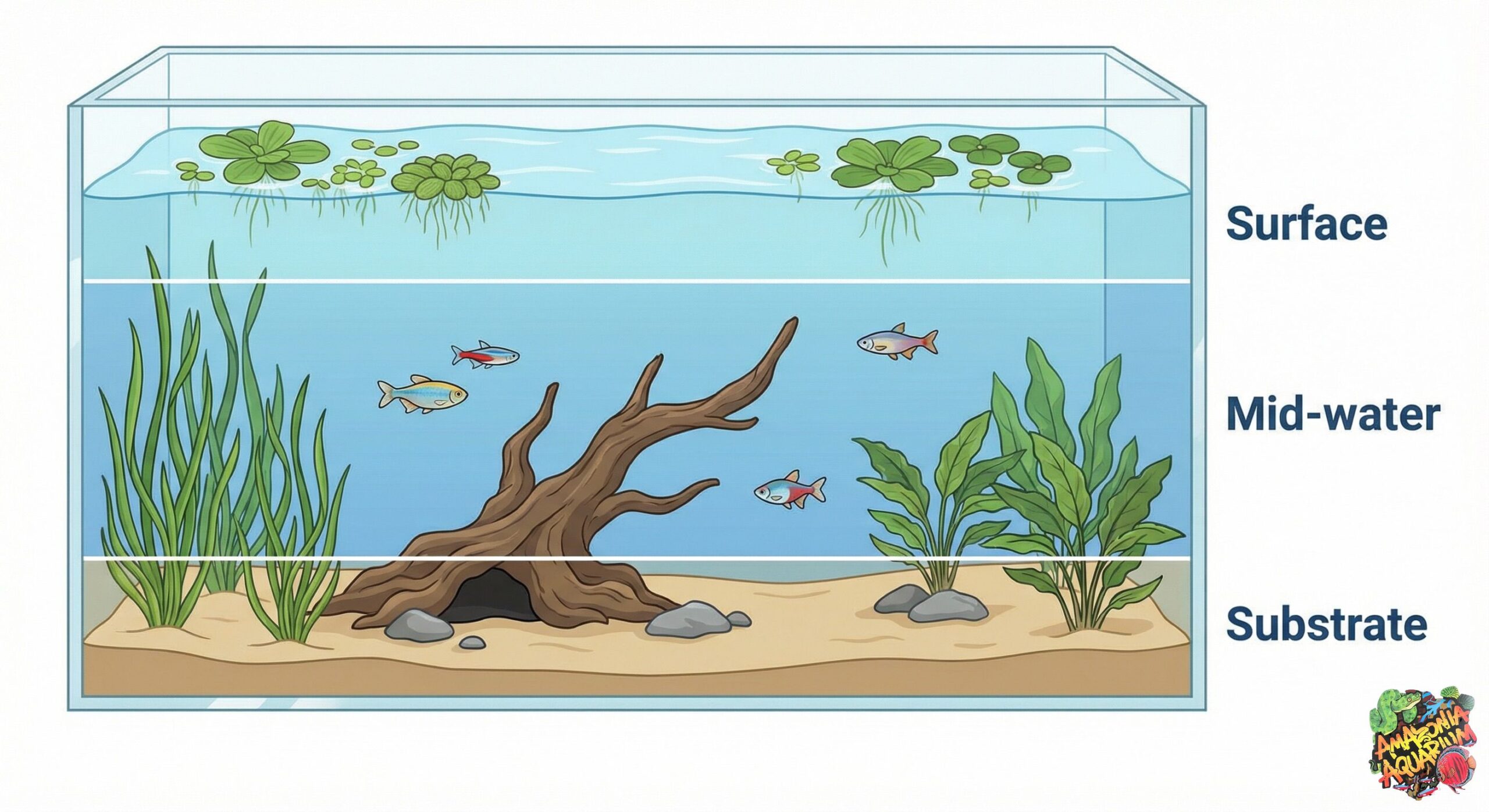
The Flame Tetra is a nano-tank superstar. A well-planted tank of 30-40 litres is sufficient for a school of 8-10 fish, though a larger tank naturally allows for a bigger school and more dramatic visual impact. The key design principles are simple: dark substrate, dense planting around the perimeter, and open space in the centre for the school to swim.
Fine dark sand or a dark aquasoil substrate brings out the orange-red coloration beautifully — the contrast effect is dramatic compared to light-coloured gravel. Plant the background with taller species like Vallisneria, Hygrophila, or Rotala, and the midground with bushier plants like Cryptocoryne or Java Fern attached to driftwood. Leave the front and centre open. Floating plants such as Salvinia, Amazon Frogbit, or Red Root Floaters provide shade that the fish appreciate and help create the dappled-light effect of their native forest streams.
Driftwood is a natural fit, both aesthetically and functionally. It provides visual barriers that reduce minor territorial tension between males, releases mild tannins that gently lower pH, and supports biofilm growth that the fish will graze on. A few dried Indian almond or Guava leaves on the substrate complete a naturalistic setup. The Flame Tetra is not demanding about decoration — it simply needs plants, some shade, and room to school.
Filter
Sponge filter for nano tanks (under 40 L); small HOB or canister for larger setups. Keep flow gentle — these are not river fish.
Heater
Optional in temperate climates (22 °C minimum). Adjustable 25-50W heater recommended if room temperature drops below 22 °C.
Lighting
Low to moderate intensity. Sufficient for plant growth but not so intense it washes out fish colour. Floating plants help diffuse light.
Substrate
Dark fine sand or aquasoil. Dark colours dramatically enhance the fish’s orange-red display.
Plants
Mix of rooted (Cryptocoryne, Vallisneria) and floating (Salvinia, Frogbit) species. Dense perimeter planting with open centre.
Driftwood/Botanicals
Small driftwood pieces plus Indian almond leaves for tannins, biofilm, and naturalistic aesthetics.
Diet & Feeding
Flame Tetras eat practically anything that fits in their small mouths, which makes feeding one of the simplest aspects of their care. A high-quality micro pellet or flake food designed for tropical community fish serves as an excellent daily staple. Look for foods with colour-enhancing ingredients like astaxanthin, spirulina, or krill — these carotenoid-rich ingredients directly contribute to the intensity of the fish’s red-orange pigmentation.
Frozen foods should feature in the rotation two to three times per week. Baby brine shrimp, daphnia, cyclops, and bloodworms (chopped or small-grade) are all greedily accepted. These protein-rich supplements promote growth, support breeding condition, and noticeably enhance colour within days of regular feeding.
Live foods are the ultimate treat and conditioning tool. Freshly hatched brine shrimp nauplii, micro worms, daphnia from a home culture, and fruit flies (for surface-feeding fun) will bring out the most animated feeding behaviour. If you are planning to breed, two weeks of daily live food is the most effective conditioning technique.
Feed small amounts once or twice daily — enough that the school finishes everything within 90 seconds. In a nano tank, restraint is particularly important because uneaten food decomposes quickly in small water volumes.
Breeding
Weeks 1-2
Conditioning
Separate and feed high-protein diet
Day 0
Spawning
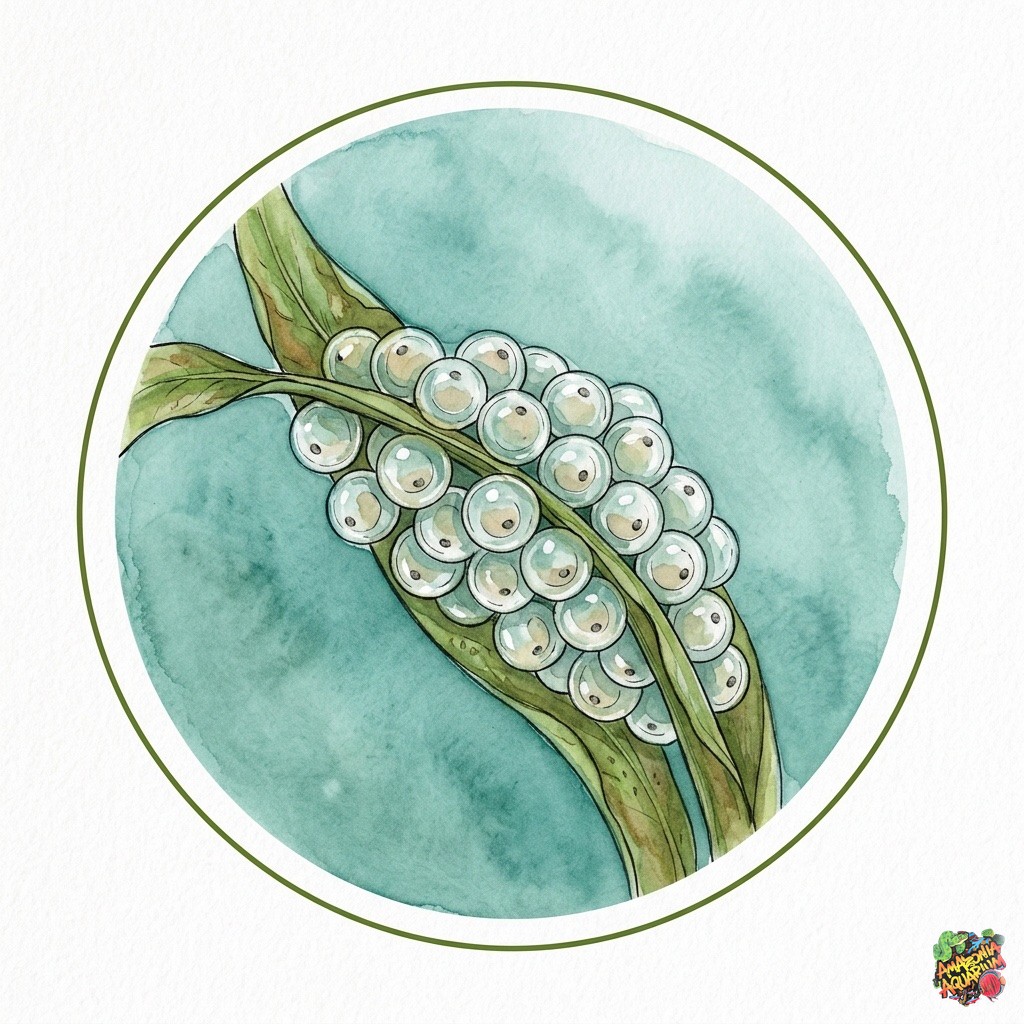
Eggs scattered at dawn
Day 1-2
Incubation
Eggs develop; keep tank dim
Day 2-3
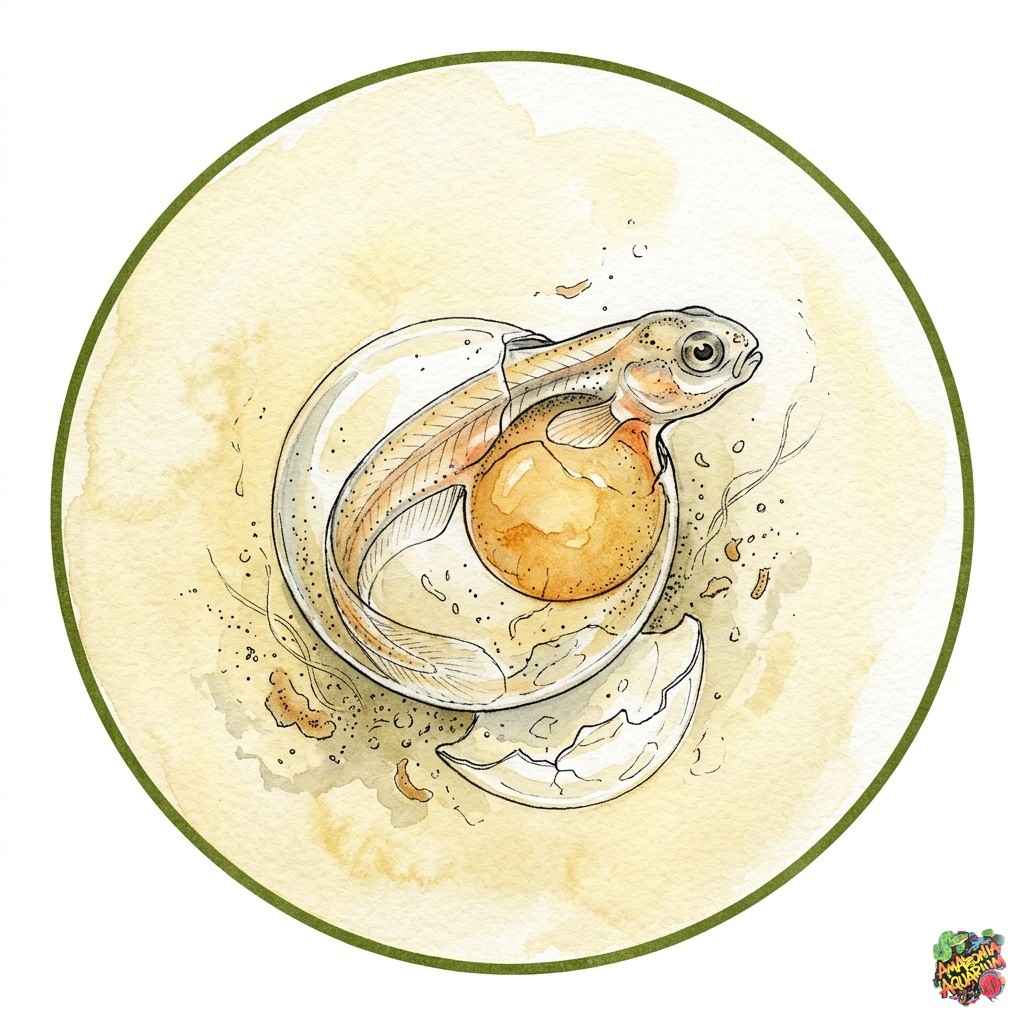
Hatching
Tiny larvae emerge
Day 4-5
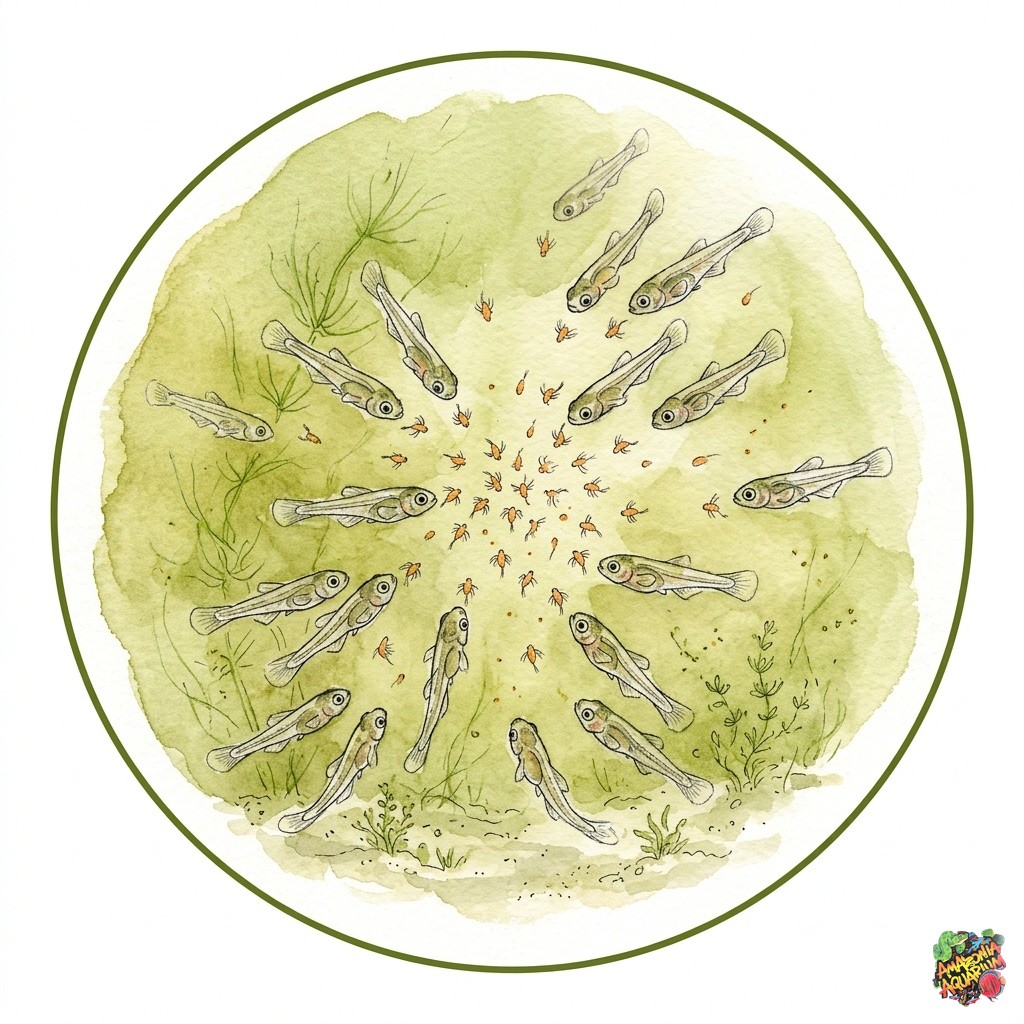
Free Swimming
Fry begin feeding
Weeks 3-8
Growth
Colour develops gradually
Conditioning
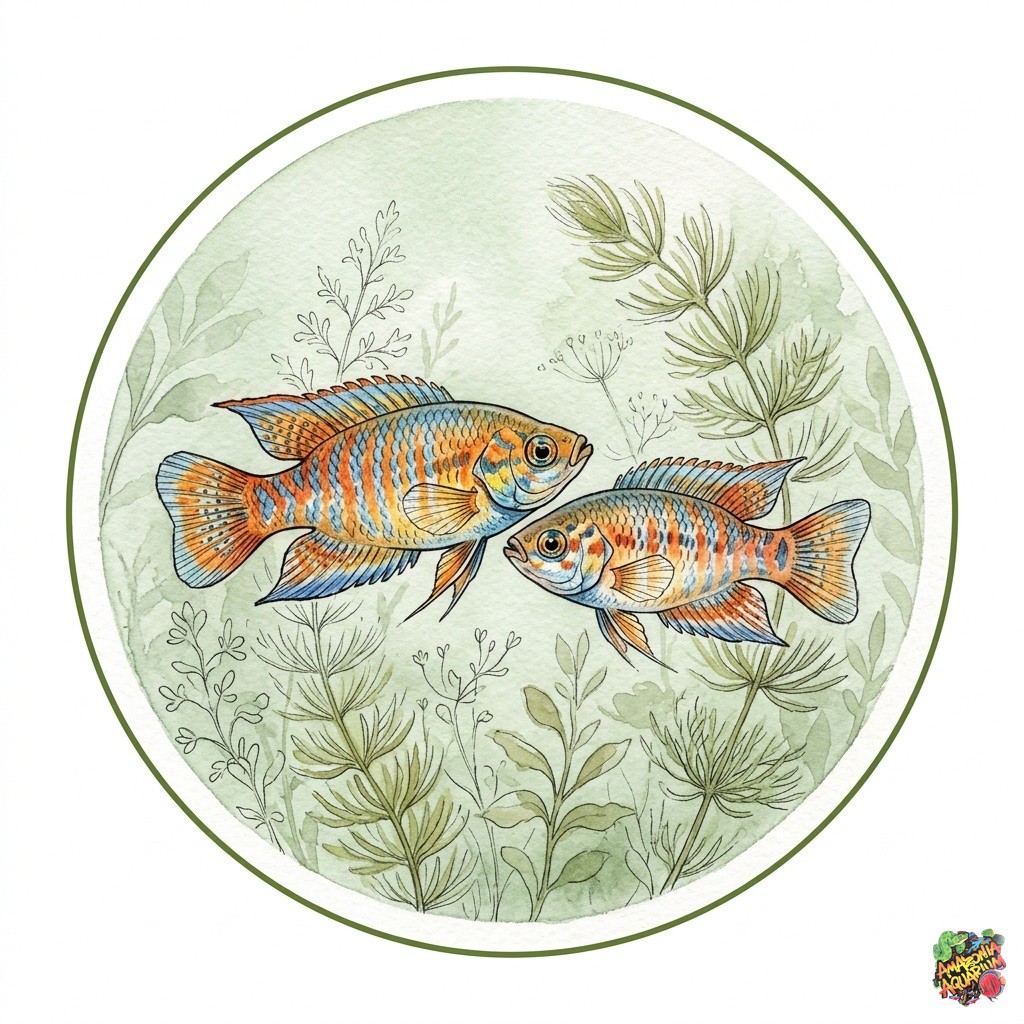
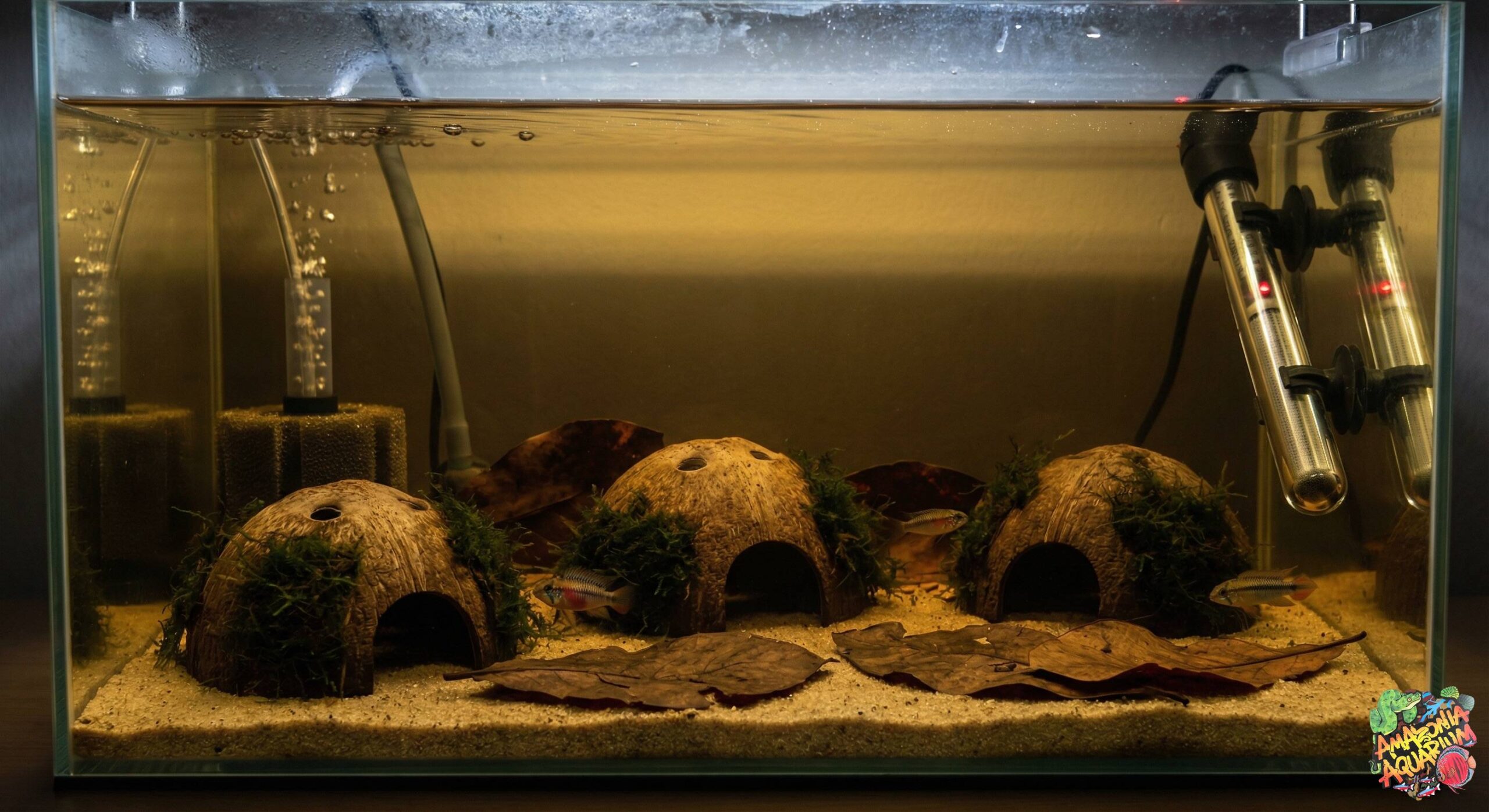
Select your brightest male and plumpest female (or use a trio of one male to two females). Move them to a dedicated breeding tank of 15-20 litres with soft, slightly acidic water (pH 6.0-6.5, temperature 26-27 °C). Dense clumps of Java Moss or fine-leaved plants provide essential egg-catching surfaces. A thin layer of marbles on the bare bottom also works, allowing eggs to fall between them out of reach of hungry parents. Condition with frozen and live foods — brine shrimp and daphnia daily — for 10-14 days.
Spawning
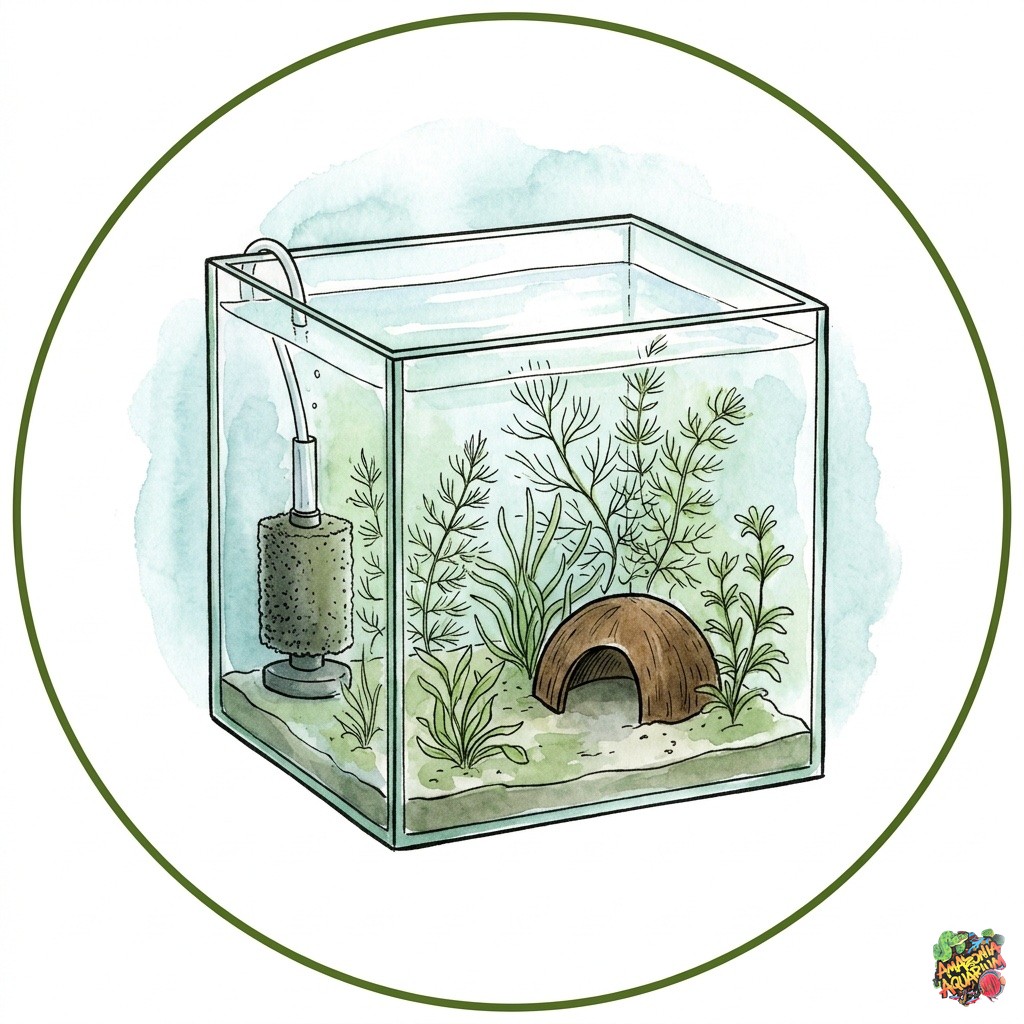
Spawning almost always occurs in the early morning, often triggered by a slight temperature increase from a partial water change the evening before. The male courts the female with flared fins and intensified colour, and the pair repeatedly dives into the plant mass, scattering small, slightly adhesive eggs among the leaves. A healthy female can produce 100-200 eggs in a single session. The eggs are tiny, clear to amber-coloured, and semi-adhesive. Remove the parents immediately after spawning — Flame Tetras will eat their own eggs without hesitation.
Incubation
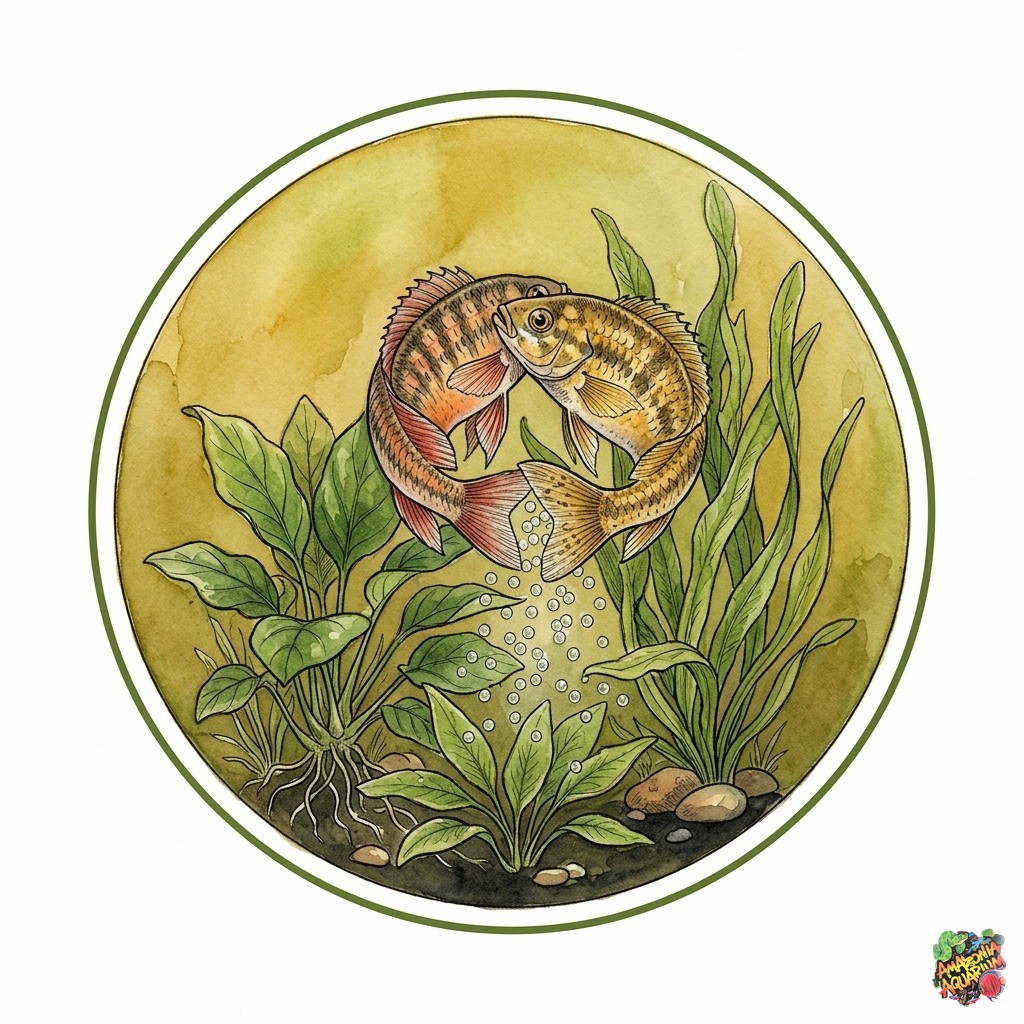
The eggs incubate for 24-36 hours at 26 °C. Keep the breeding tank dim during this period, as the eggs are somewhat light-sensitive. A towel draped over the tank or placing it in a low-light area of the room works well. Maintain gentle aeration from a sponge filter. Unfertilised eggs will turn white and should be removed with a pipette to prevent fungal spread to viable eggs.
Hatching
Larvae hatch and cling to plants and glass surfaces via their yolk sacs. They are incredibly small — barely visible to the naked eye — and completely immobile. Do not feed at this stage; the yolk sac provides complete nutrition. Avoid any disturbance to the tank; even a large water change could dislodge and kill the fragile larvae.
Free Swimming
The fry absorb their yolk sacs and become free-swimming, hovering near the water surface or among plant masses. Begin feeding immediately with infusoria, paramecium culture, or commercial liquid fry food. After 5-7 days, the fry are large enough to accept freshly hatched brine shrimp nauplii — the single most important food for rapid, healthy growth. Perform small daily water changes (10%) with temperature-matched water.
Growth
The fry grow steadily on a diet of baby brine shrimp supplemented with crushed micro pellets. By week 3-4, they begin to show the first hints of the orange body colour. By week 6-8, the characteristic two vertical bars appear and the fish begin to resemble miniature adults. At this point they can be moved to a grow-out tank or introduced to the main community tank. Sexual dimorphism (the male’s red anal fin edge) becomes visible at around 3 months of age.
Community Tank Mates
The Flame Tetra may be the single most community-compatible fish in the freshwater hobby. It is too small to threaten anything, too peaceful to nip fins, and too hardy to be the first casualty when conditions fluctuate. In a well-stocked community, Flame Tetras form a warm-toned school in the mid-water that serves as a visual anchor for the entire tank.
For a stunning warm-palette nano community, try 8-10 Flame Tetras with 6 Cherry Barbs, a pair of Honey Gouramis, and 6 Corydoras on the bottom — all in a densely planted 60 L tank with dark substrate and driftwood. The combined orange, red, and gold tones against green plants and dark wood create a display that rivals marine setups for visual warmth.
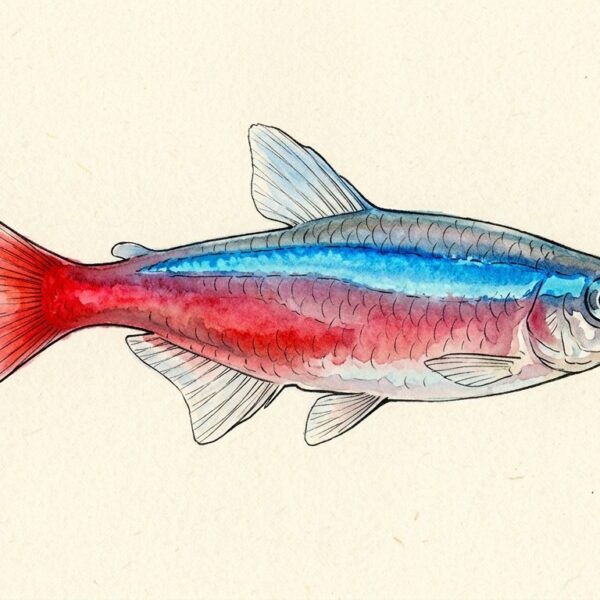
For a larger community (100 L+), adding a school of Neon or Cardinal Tetras introduces a cool blue-red counterpoint that makes the Flames’ warm colours pop even more. Layer in Otocinclus for algae duty, a few Kuhli Loaches for bottom interest, and you have a community that is both visually cohesive and ecologically balanced. The Flame Tetra fits into almost any peaceful community setup — it is very hard to go wrong with this fish.
| Species | Why | |
|---|---|---|
| ✅ | Neon Tetra | The blue-red neon stripe contrasts beautifully with the Flame Tetra’s warm orange. Both species school at the same level and share identical care needs. |
| ✅ | Cardinal Tetra | A slightly more demanding but equally peaceful school mate. The deeper red of Cardinals pairs gorgeously with the Flame Tetra’s orange gradient. |
| ✅ | Corydoras (e.g. Sterbai Cory) | Essential bottom-level companions. Corydoras clean up fallen food and add charming bottom-of-tank activity without any territorial conflict. |
| ✅ | Otocinclus | Tiny algae-eating catfish that keep plants and glass spotless. Completely ignore tetras and share the same soft-water preferences. |
| ✅ | Cherry Barb | Another warm-toned, peaceful species. Male Cherry Barbs display deep red alongside the Flame Tetra’s orange for a warm-palette community. |
| ✅ | Honey Gourami | A gentle centrepiece fish. The Honey Gourami’s golden-amber colour harmonises with the Flame Tetra’s fire tones without any aggression. |
| ✅ | Dwarf Chain Loach | Active, small loach that occupies the bottom zone. Keeps pest snail populations in check and adds movement to the lower tank levels. |
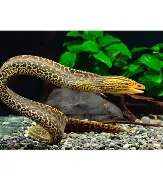
| ✅ | Kuhli Loach | Eel-like nocturnal bottom-dweller. Completely non-competitive with mid-level tetras and fascinating to observe during evening feeding. |
| ✅ | Boesemani Rainbowfish | In larger tanks (100 L+), Boesemani Rainbows add spectacular colour to the upper-middle zone. Peaceful despite their larger size. |
| ❌ | Large cichlids (Oscars, Convicts) | Any fish that can fit a Flame Tetra in its mouth will eventually try. Large cichlids are completely incompatible. |
| ❌ | Tiger Barbs | Aggressive fin-nippers that will chase and stress the smaller, more peaceful Flame Tetras. |
| ❌ | Bettas (males) | Male bettas may mistake the Flame Tetra’s red coloration for a rival, leading to persistent aggression. Best avoided. |
Quick Reference
| Scientific Name | Hyphessobrycon flammeus |
| Adult Size | 3.5-4 cm |
| pH | 6.0-7.5 (ideal 6.8) |
| Temperature | 22-28 °C (ideal 25 °C) |
| Hardness | 3-15 dGH (soft preferred for breeding) |
| Min. Tank | Nano/Small — under 40 L |
| Diet | Flakes, micro pellets, frozen & live foods |
| Tank Position | Middle |
| Schooling | Group of 8+ recommended |
| Community | Neons, Cardinals, Corydoras, Cherry Barbs, Honey Gourami |
| Breeding | Egg scatterer — very easy, beginner-friendly |
| Lifespan | 3-5 years |
| Special Feature | Tolerates cooler temps (22 °C); ideal unheated tank candidate |
Sydney Keeper Tips
Keeping Flame Tetras in Sydney comes with specific advantages and challenges. Here’s what local keepers should know.
Sydney Tap Water
Flame Tetras are one of the most adaptable tetras — Sydney’s tap water parameters (pH 7.0–7.6, moderate hardness) suit them perfectly. No water modification needed for general keeping.
Seasonal Considerations
These subtropical fish handle Sydney’s temperature range well. They can tolerate 20–28°C, making them forgiving during seasonal transitions. A heater set to 24°C provides optimal conditions year-round.
Local Tips
- Flame Tetras are an excellent beginner species for Sydney keepers — hardy and forgiving of tap water.
- Their orange-red colour intensifies with a dark substrate and planted tank — Sydney’s aquarium shops stock quality substrates.
- Males colour up more intensely when competing — keep a ratio of 2 females per male.
Frequently Asked Questions
Are Flame Tetras good for beginners?
How do I tell male from female Flame Tetras?
Will Flame Tetras eat plants?
Can Flame Tetras live in unheated tanks?
How do I breed Flame Tetras?
Related Products
Reviews
Clear filtersThere are no reviews yet.